" width="14px"><path d="M 13.864 5.629 L 13.3 5.629 L 13.3 5.6 L 7 5.6 L 7 8.4 L 10.956 8.4 C 10.379 10.03 8.828 11.2 7 11.2 C 4.681 11.2 2.8 9.319 2.8 7 C 2.8 4.681 4.681 2.8 7 2.8 C 8.071 2.8 9.045 3.204 9.786 3.864 L 11.766 1.884 C 10.516 0.719 8.844 0 7 0 C 3.134 0 0 3.134 0 7 C 0 10.866 3.134 14 7 14 C 10.866 14 14 10.866 14 7 C 14 6.531 13.952 6.073 13.864 5.629 Z" fill="rgb(255, 193, 7)" height="14px" id="H_YjfTNpn" width="14px"/><path d="M 0 3.742 L 2.3 5.429 C 2.922 3.888 4.429 2.8 6.193 2.8 C 7.264 2.8 8.238 3.204 8.979 3.864 L 10.959 1.884 C 9.709 0.719 8.037 0 6.193 0 C 3.504 0 1.172 1.518 0 3.742 Z" fill="rgb(255, 61, 0)" height="5.428500000000002px" id="PlkthQDhg" transform="translate(0.875 0)" width="10.959199999999996px"/><path d="M 6.232 5.581 C 8.04 5.581 9.683 4.889 10.925 3.764 L 8.758 1.931 C 8.032 2.483 7.144 2.782 6.232 2.781 C 4.411 2.781 2.865 1.62 2.283 0 L 0 1.759 C 1.159 4.026 3.511 5.581 6.232 5.581 Z" fill="rgb(76, 175, 80)" height="5.581099999999999px" id="WlnJ5gngE" transform="translate(0.7 8.4)" width="10.924899999999994px"/><path d="M 6.864 0.029 L 6.3 0.029 L 6.3 0 L 0 0 L 0 2.8 L 3.956 2.8 C 3.68 3.576 3.183 4.254 2.526 4.75 L 2.527 4.749 L 4.693 6.582 C 4.54 6.722 7 4.9 7 1.4 C 7 0.931 6.952 0.473 6.864 0.029 Z" fill="rgb(25, 118, 210)" height="6.589883930775992px" id="x_rSW275p" transform="translate(7 5.6)" width="7px"/></g></svg>)


Reviewed by:
Rokas Stankevicius

Founder @ aiclicks.io
Last updated:
Expert Verified

Key Takeaways
The GEO tool market split in 2026. Enterprise platforms like Profound retreated to custom-only pricing, while self-serve tools now start under $30/month. There's almost no middle ground left, so pick your lane before you pick your tool.
Engine count is the most overrated number on every pricing page. The real differentiator in 2026 is whether a tool helps you act on the data: content fixes, source outreach, publishing. Most teams over-buy monitoring and under-buy execution.
AIclicks covers tracking and execution in one self-serve platform, Otterly AI and Prompt Monitor are the cheapest credible entries, and Semrush or Ahrefs only make sense if you already pay for their SEO suites.
GEO tools had its gold rush.
In under two years, the category went from a handful of early prompt trackers to a crowded market of its own.
Venture-backed platforms now court enterprise buyers. Established SEO suites are bolting on AI visibility modules. And new $29-a-month tools launch almost weekly.
The question now is harder: which of these GEO tools actually earns its line on your budget?
Because somewhere along the way, the dashboards converged. Nearly every product in this space can show you a visibility score, a competitor chart, and a list of citations. Take a screenshot of any two GEO tools dashboard and you'd struggle to tell them apart.
The real differences moved underneath: how each tool collects its data, what it lets you do once you've seen the chart, and how the price behaves when you add markets, engines, or clients.
So here are the top 17 Generative Engine Optimization tools that you can try in 2026. Let’s get started.
If you’re new to GEO, read our comprehensive guide on what is Generative Engine Optimization (GEO).
What Are GEO Tools?
GEO tools are platforms that track and improve how your brand appears in AI-generated answers across engines like ChatGPT, Perplexity, Gemini, and Google's AI Overviews.
Where traditional SEO software measures rankings on a results page, GEO tools measure something different: whether AI assistants mention you, cite you, or recommend you when buyers ask questions in your category.
There's no position one to track. You're either part of the answer or you're absent from it.
Most tools in this space do some combination of three jobs:
Monitoring: Running your target prompts through AI engines on a schedule and recording who gets mentioned, who gets cited, and how you stack up against competitors.
Source intelligence: Identifying which websites, threads, and reviews the AI engines actually pull from when they answer questions in your niche. This is where the actionable work hides, because those sources are where you need to show up.
Optimization: Helping you act on the data: content recommendations, technical fixes, or tracking whether your changes moved the needle in subsequent answers.
Almost every tool on this list handles the first job well. The second and third are where they split, and that split is what the rest of this post is really about.
Learn more about how to get cited by AI.
How I Evaluated These Tools
Every tool here was assessed against the same six criteria, with pricing and feature claims checked against live vendor pages in June 2026:
Engine coverage: which AI platforms it tracks, and whether full coverage costs extra (it often does, and the add-on math gets ugly fast).
Tracking depth: prompt-level tracking, visibility scoring, position, sentiment, citations, competitor benchmarking.
Source intelligence: whether it shows you which third-party sites AI engines cite, because that's where optimization actually happens.
Action features: recommendations, content generation, outreach workflows, agents. A dashboard that ends at a chart scored lower than one that ends in a task.
Pricing honesty: headline price versus real all-in cost once add-ons, credits, and per-engine fees pile up.
Accessibility: free trial, self-serve signup, and how fast you get to first data.
One bias worth stating upfront: I weighted action features heavily. Plenty of tools can tell you ChatGPT ignores your brand. Far fewer help you change that, and the gap between knowing and doing is where most GEO budgets go to die.
Now let’s move to the tools.
The 17 Best GEO Tools in 2026: Quick Comparison
Tool Name | Best For | AI Engines | Starting Price | Free Trial |
AIclicks | Tracking + execution in one platform | 10+ | $59/mo | 3 days |
Scrunch AI | Optimizing your site for AI agents | 7 | $250/mo (annual) | 7 days |
Otterly AI | Budget-friendly monitoring | 4 (+2 add-ons) | $29/mo | Yes |
Cognizo | End-to-end AEO: tracking, content, and publishing | 10 (AI Overviews + AI Mode tracked separately) | $499/mo | No (free AEO audit instead) |
Promptwatch | UI-based tracking + AI crawler log analysis | 7+ | $95/mo | No |
Peec AI | Clean visibility analytics | Choose 3 of 7 | ~$95/mo | 7 days |
Profound AI | Enterprise procurement | 9+ | Custom only (enterprise) Brands (starts at $99/month) | No |
Writesonic | Content teams adding GEO tracking | 7+ | $79/mo (annual) | Yes |
Rankscale AI | Broadest engine coverage, no upsells | 17+ | $99/mo | Yes |
Prompt Monitor | Small businesses and lean teams | 8 | $29/mo | 7 days |
Semrush AI Visibility Toolkit | Existing Semrush users | 5+ | $99/mo per domain | 7 days |
Ahrefs Brand Radar | Prompt-volume research at scale | 7 | $199/mo per index (+ base plan) | No |
AthenaHQ | Structured optimization workflows | 8+ | $295/mo | No ($95 first month) |
LLMrefs | Keyword-first tracking on a budget | 11+ | Free; Pro $79/mo | Free plan |
Goodie AI | AI shopping and commerce brands | 12 | Custom | No |
Cloro | Embedding GEO tracking into your own product | 8+ (incl. Google Search & News) | Free tier, then $30/mo | Yes (500 credits/mo free) |
Gauge | Content-led AEO programs | 6 (+Claude on Enterprise) | $599/mo | Free Start |
1. AIclicks - #1 GEO Tracking Tool
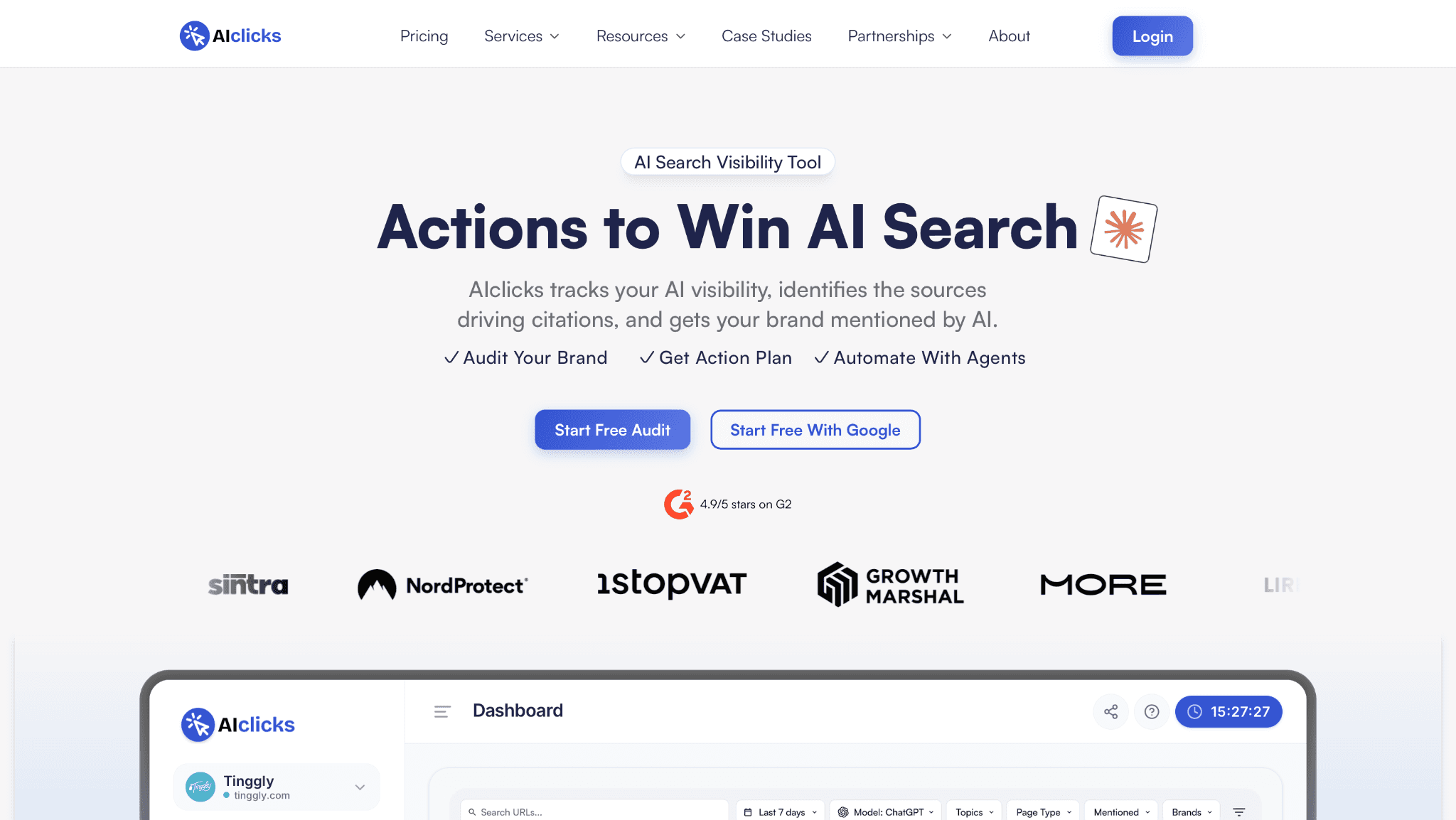
About AIclicks:
AIclicks is an AI search visibility and optimization platform built around a three-step loop: track, analyze, act.
The tracking layer monitors your brand across 10+ AI platforms, ChatGPT, Gemini, Perplexity, Claude, Copilot, Google AI Overviews, AI Mode, Grok, DeepSeek, and Meta AI, running your prompts daily and scoring visibility, position, and sentiment against competitors, with unlimited country coverage so you see what buyers in every market actually get told.
The analysis layer is where it pulls ahead of standard monitoring tools. AIclicks traces every AI answer back to the sources behind it, then maps your coverage against your competitors' domain by domain. You see not just that ChatGPT skipped you, but that it skipped you because three Reddit threads, a TechRadar listicle, and a comparison post all mention your competitor and not you.
The acting layer helps generate recommendations prioritized by expected visibility lift, then puts AI agents to work executing them: publishing optimized articles in-platform (20 a month on Pro), running Reddit mention workflows, updating directory listings, generating comparison pages, drafting YouTube briefs, and surfacing outreach targets among frequently cited sources.
Google Analytics integration closes the loop by tying visibility gains to real AI-referred traffic, so you can show the channel working rather than just the chart moving.
Key features:
Daily prompt tracking across 10+ AI platforms with visibility scoring, sentiment, position, and competitor benchmarking, in unlimited countries.
Source and citation analysis that identifies which domains drive AI answers in your category and exactly where your coverage gaps are.
AI agents that execute recommendations: in-platform article publishing, Reddit workflows, directory updates, comparison pages, and outreach to cited sources.
Recommendations prioritized by visibility lift, so your team works on the fixes that move the score most.
Google Analytics integration to connect AI visibility to actual AI-referred traffic.
Pros:
The only tool at this price that takes you from tracking all the way to executed fixes
Source-level citation intelligence with competitor gap mapping
Daily refresh and unlimited countries on every plan
Transparent self-serve pricing, no sales call required
Cons:
The 3-day trial is short (but you can contact the team to extend the trial)
Pricing: Starter $59/mo, Pro $189/mo, Business $499/mo. 3-day free trial.
Verdict: Most GEO tools hand you a diagnosis and wish you luck. AIclicks is built for the part that comes after: it shows you which sources to win and then helps you win them. If you want one tool covering the full loop from tracking to published fixes without an enterprise contract, this is the gap it was built to fill.
G2 Rating: 4.9/5
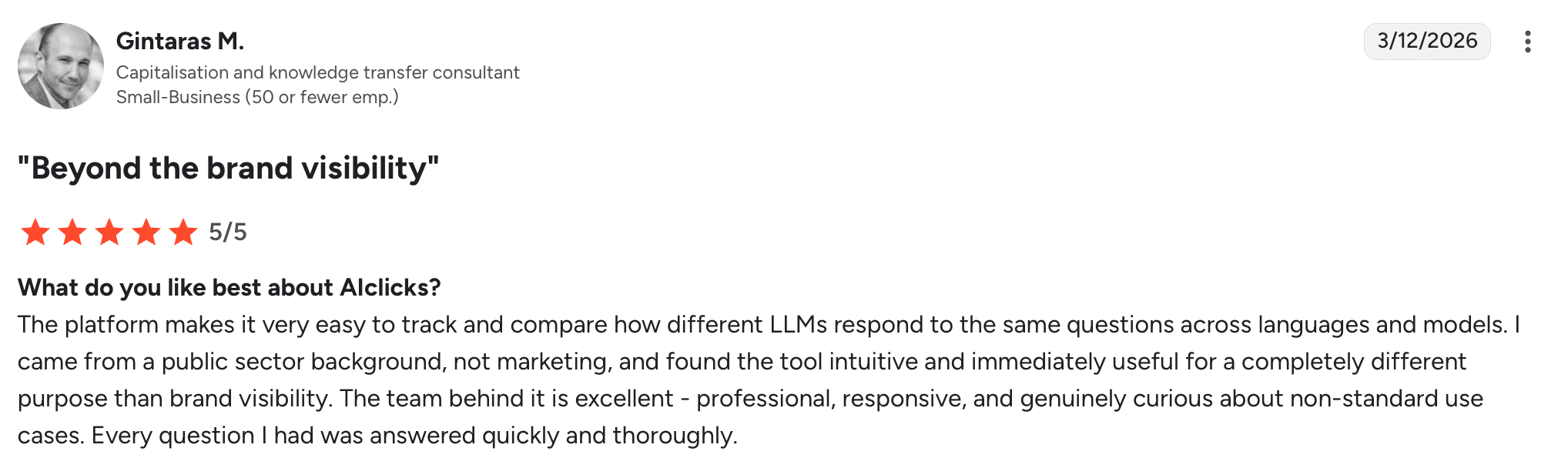
Here’s what users say:
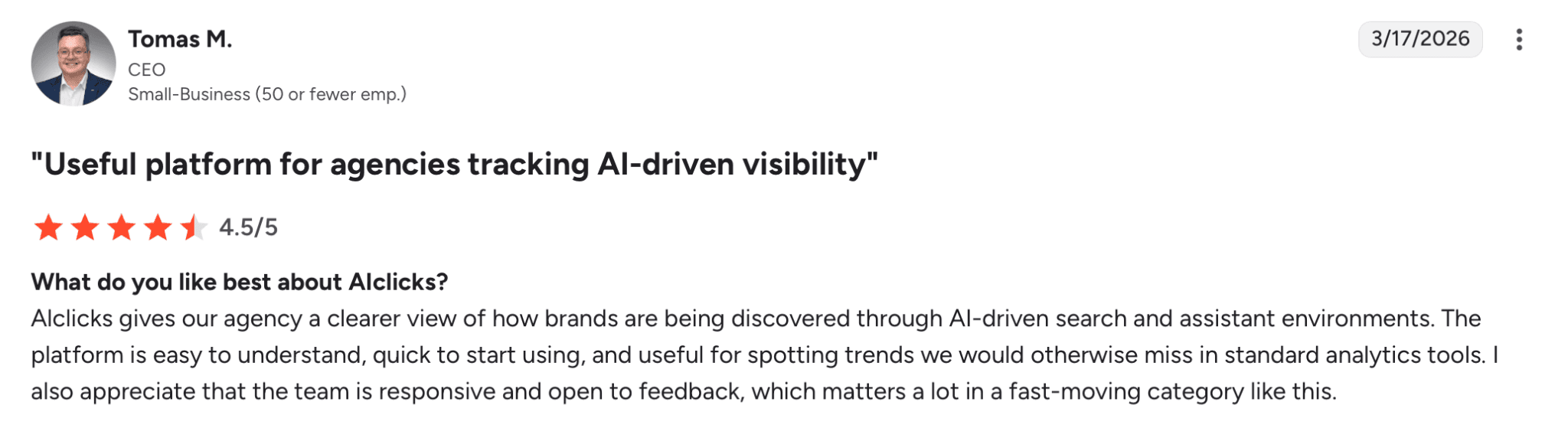
Another one:
Why not give it a try and see the difference?
2. Scrunch AI
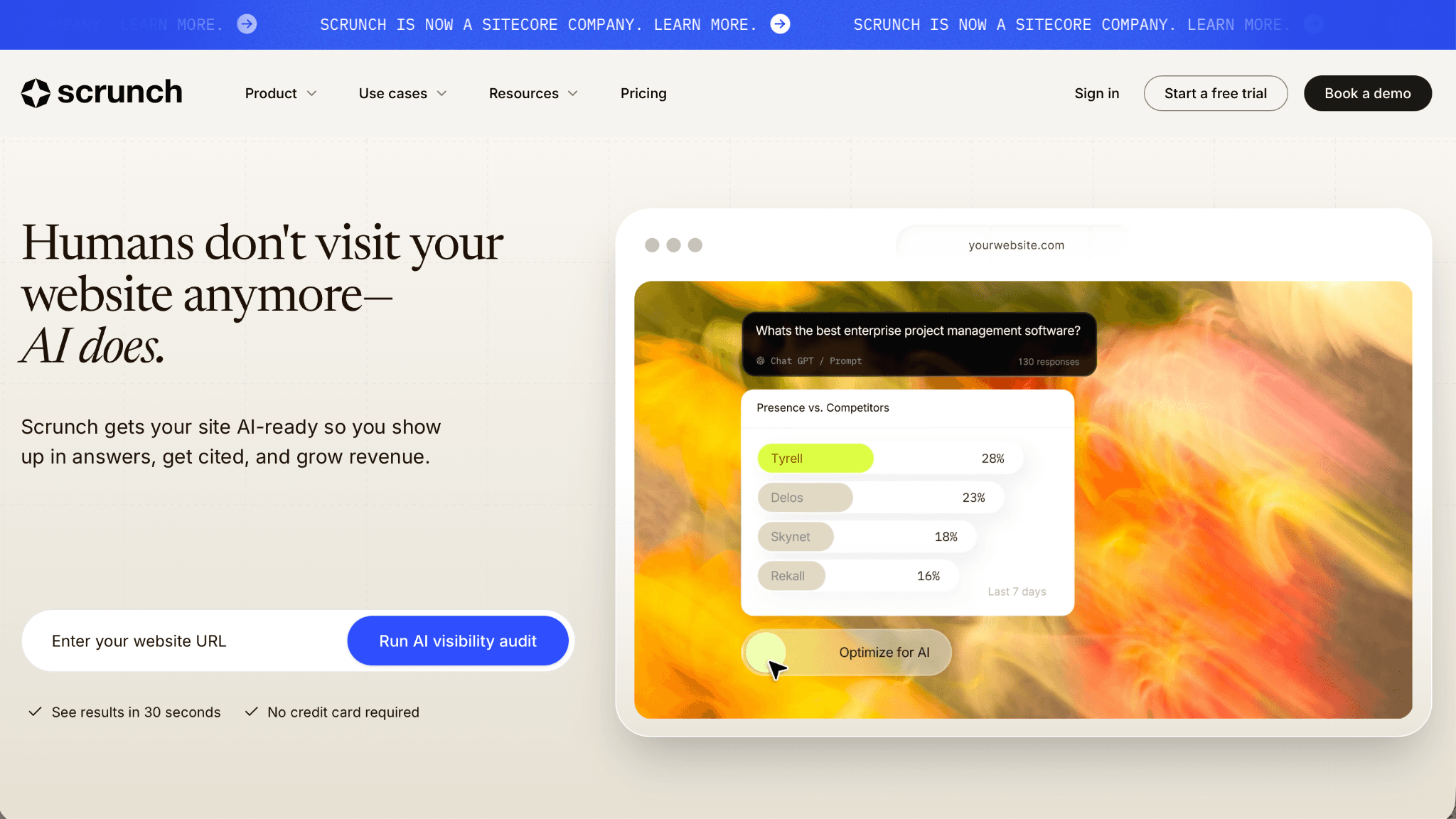
About Scrunch AI:
Scrunch AI approaches GEO from a different angle than most: instead of only measuring how AI talks about you, it changes how AI reads you.
Its Agent Experience Platform (AXP) generates a lightweight, machine-readable parallel version of your site and serves it directly to AI crawlers, so models parse your content cleanly without you touching the human-facing design.
On top of that sits a solid monitoring layer covering seven AI surfaces, persona-based prompt tracking, and a real-time feed of AI bots hitting your site.
Key features:
Monitoring across 7 surfaces: ChatGPT, Claude, Gemini, Perplexity, Google AI Mode, AI Overviews, and Meta, with prompt, topic, and persona-level tracking.
AXP serves AI-optimized parallel pages so crawlers parse your content reliably, with no changes to your live site.
Real-time AI bot feed and error detection showing how crawlers move through your site and where they fail.
Page audits (5 on Starter, 10 on Growth) grading individual URLs for AI readability.
Pros:
AXP is genuinely unlike anything else in the category
Strong crawl observability, you see what the bots see
Persona-based tracking is useful for multi-audience brands
Cons:
Pricing starts at $250/mo, which is steep if you only need monitoring
Page audit caps are low for the price
AXP's payoff is harder to prove for small, simple sites
Pricing: Starter $250/mo (annual) or $300 monthly; Growth $417/mo (annual); Enterprise custom. Also, offers a 7-day free trial.
Verdict: Shortlist Scrunch if your site is large, complex, or JavaScript-heavy enough that AI crawlers genuinely struggle with it; that's the problem AXP exists to solve, and nothing else here solves it. Smaller brands with clean sites should think twice: you'd be paying enterprise-adjacent money for monitoring that cheaper Scrunch AI alternatives offer for a third of the price.
G2 Rating: 4.6/5
3. Otterly AI
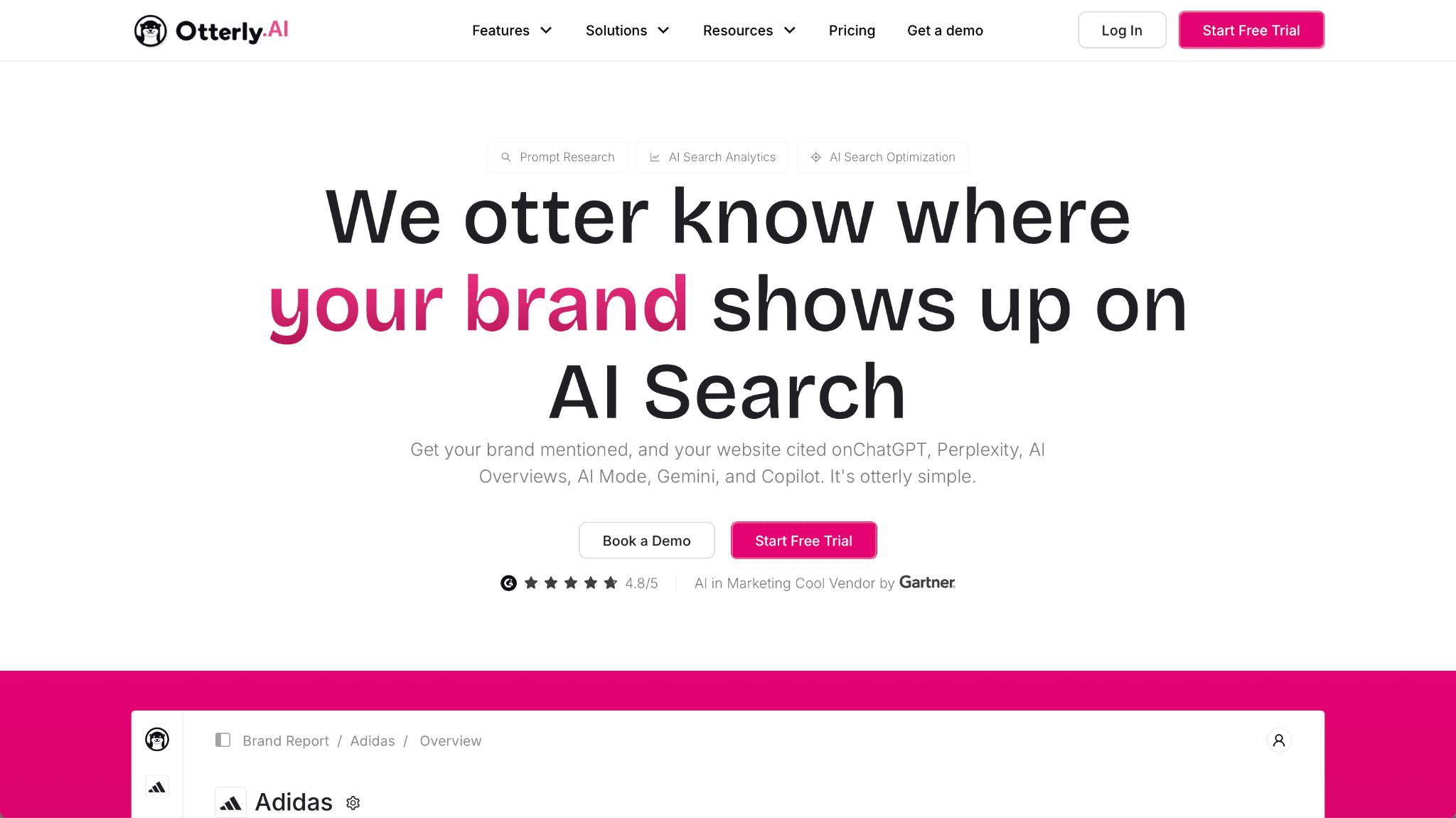
About Otterly AI:
Otterly AI is the most approachable entry point in the category and one of the more mature products in it, and few Otterly alternatives match it for ease of setup at this price.
It tracks brand mentions, link citations, and visibility across four AI engines on every plan, refreshes daily, and supports tracking in 50+ countries.
The standout structural choice is unlimited team members on all plans, including the $29 one, which removes the usual seat-counting friction when you want a whole marketing team looking at the same data.
Key features:
Four engines on every plan (ChatGPT, Google AI Overviews, Perplexity, Copilot), with Google AI Mode and Gemini available as paid add-ons.
Daily tracking with unlimited team members, rare at this price.
GEO URL audits (1,000-10,000 per month depending on plan) that grade individual pages for AI citation readiness.
API and MCP access from the Standard plan up, plus a Looker Studio connector for client reporting.
Pros:
Lowest credible entry price for proper daily monitoring
Unlimited seats everywhere, which agencies will appreciate
Mature, stable, easy to set up
Cons:
Gemini and AI Mode cost extra on every plan, and those add-ons accumulate
15 prompts on Lite runs out fast for anything beyond a test
Monitoring-first; you'll act on the findings elsewhere
Pricing: Lite $29/mo (15 prompts), Standard $189/mo, Premium $489/mo. Add-on engines billed separately.
Verdict: For solo marketers and small teams, Otterly AI is the obvious starting point: card in, data out, no sales call. The catch shows up at scale, where Google surface add-ons inflate the real price and the tool still stops at diagnosis. Treat it as the entry drug to GEO monitoring, not the endgame.
G2 Rating: 4.8/5
4. Cognizo
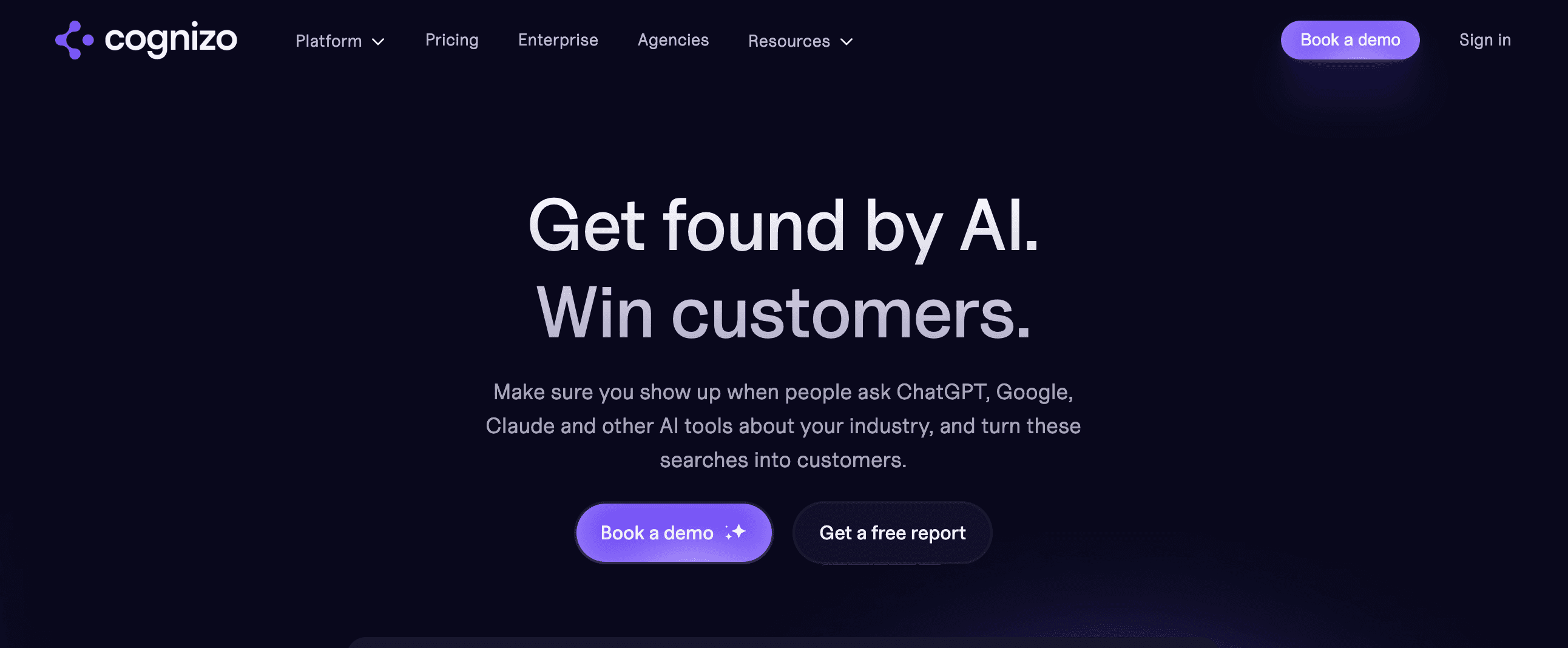
About Cognizo:
Cognizo runs AEO as a continuous agent workflow, market research, prompt planning, content production, and publishing, rather than a dashboard you act on manually. Coverage spans ten platforms tracked as separate surfaces, including Google AI Overviews and AI Mode. Its data comes from UI scraping, capturing the rendered answer rather than an API sample, feeding six metrics: visibility score, share of voice, citation share, source mention rate, sentiment, and positioning accuracy.
Key features:
Autopilot workflow: research, prompt planning, content, and publishing running continuously
Ten platforms tracked separately, including AI Overviews and AI Mode
UI-scraped answer capture behind the six-metric Answer Engine Insights
Prompt Volumes showing what buyers ask before they search your brand
ChatGPT Ads integration pairing organic visibility with paid placement
Pros:
UI-scraped data is a distinct method from prompt-sampling tools
Unlimited seats and regions on every tier
Prompt Volumes adds demand data most tools here don't have
Cons:
No self-serve trial; onboarding starts with a free audit
Full autopilot execution requires the $899/mo tier, not the $499 entry point
Pricing: Platform $499/mo; Autopilot $899/mo; Enterprise custom. Unlimited seats and regions on all tiers.
Verdict: Cognizo suits teams that want the AEO loop automated rather than assembled from separate tools. The catch is cost: full automation sits behind the $899 tier, and there's no trial to test it first.
Best for: teams ready to hand the full AEO loop to AI agents without a self-serve trial.
G2 Rating: 4.9/5
5. Promptwatch
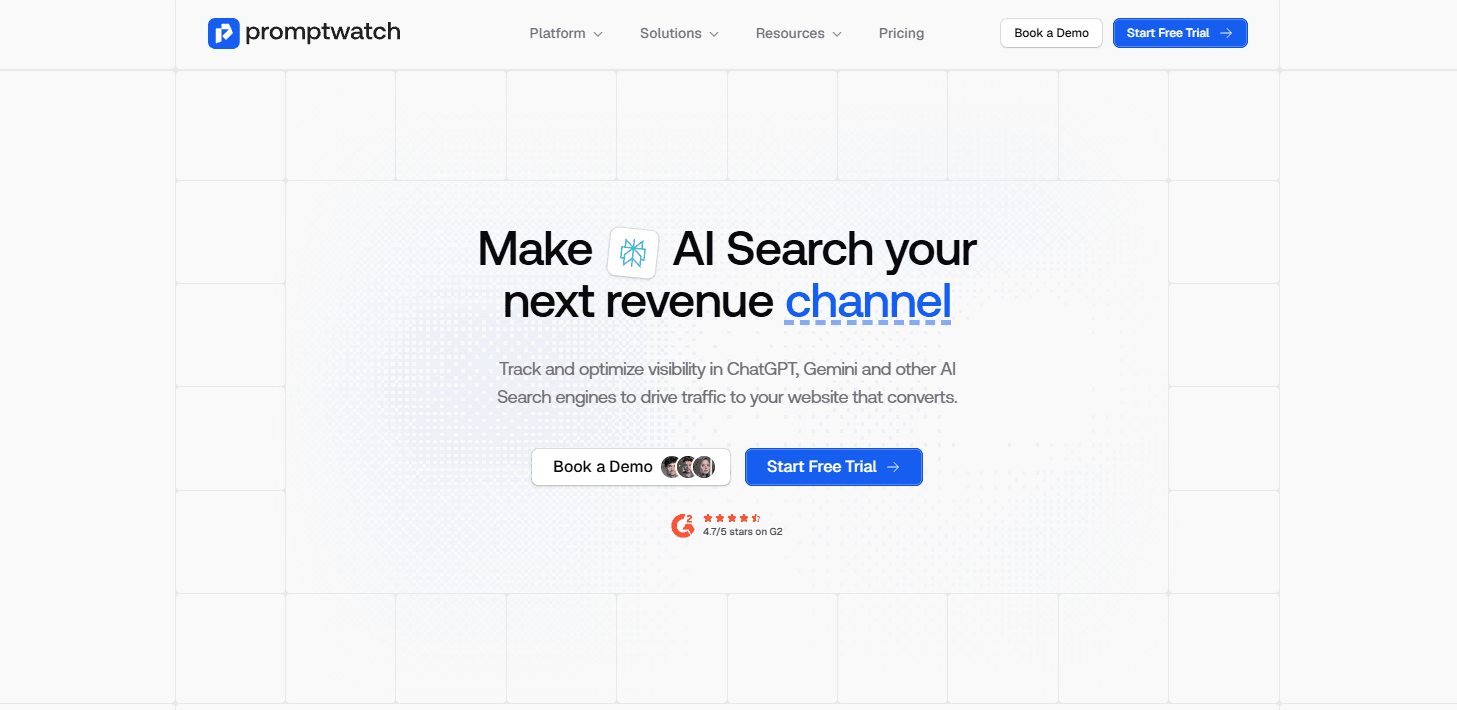
Promptwatch makes a different bet than most trackers on this list: instead of sampling AI answers through APIs, it scrapes the actual ChatGPT, Gemini, Perplexity, and Claude interfaces, the same rendered output a real user sees. That data feeds a real-time AI crawler log analysis layer, so brands can connect visibility directly to the traffic actually showing up on their site.
Coverage runs to 10 platforms, including Copilot, DeepSeek, Grok, Mistral, and Meta AI alongside the usual four, making it one of the broader trackers here.
Key features:
Prompt tracking with volume and difficulty scoring, plus query fan-out analysis to map how a single prompt splits into related AI queries.
Citation analysis that separates direct citations to a brand's own site from off-site mentions on Reddit, YouTube, and LinkedIn.
Content Gap Analysis flagging exactly which AI-asked questions a site can't yet answer, paired with a Content Agent that drafts AI-optimized content from that same gap data and publishes straight to Webflow and Framer.
Agent Analytics joining crawler logs to the pages they cite, showing the full crawl-to-citation path instead of raw log data.
Action Items turn recommendations into tasks assignable to a specific team owner, with Agent Chat for querying performance without leaving the dashboard.
Competitor benchmarking down to the country, state, and city level, plus ChatGPT Shopping tracking.
REST API and MCP access on every paid plan.
Pros:
UI-scraped data captures what users actually see, not an API approximation
Crawl-to-citation mapping is a level of detail most trackers don't offer
Content Agent closes the loop from gap analysis to published fix
Cons:
No published free trial, pricing starts straight at a paid plan
Hyperlocal benchmarking (city-level) is more granularity than most teams need to act on
Pricing: Starts at $95/month.
Verdict: Promptwatch suits teams that don't trust API-sampled data and want to see what AI interfaces actually render, then trace that straight to their own traffic. The crawl-to-citation and content-gap tooling push it past a pure monitoring tool, but the lack of a trial means you're committing before you've seen your own data.
G2 Rating: 4.5/5
6. Peec AI
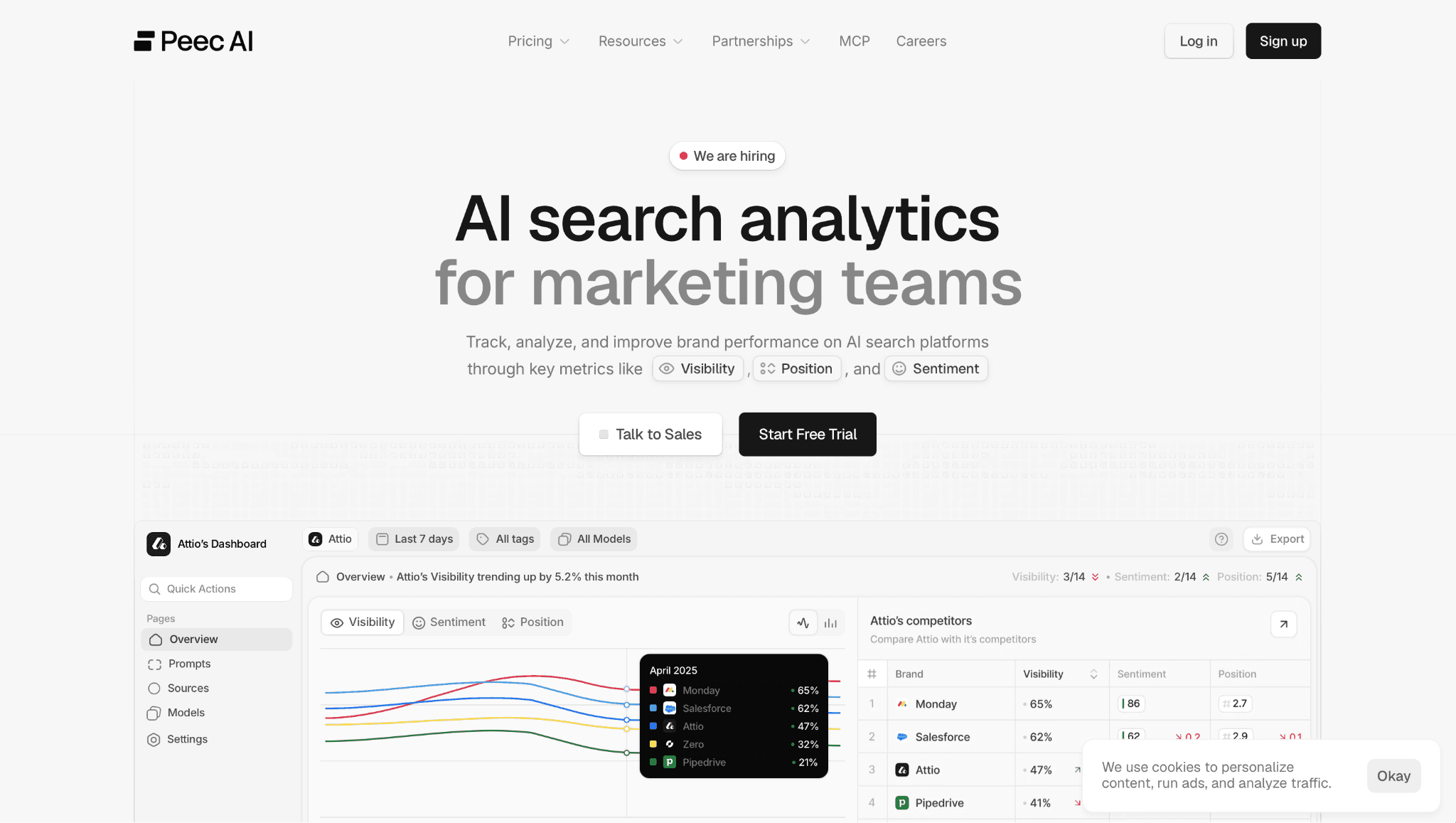
About Peec AI:
Peec AI is the analytics purist of this list. It tracks three core metrics; visibility, position, and sentiment, and presents them in what is probably the cleanest dashboard in the category.
There's no content engine, no agents, no audits; the bet is that most teams' first real need is a trustworthy, readable picture of where they stand, and Peec AI delivers that better than tools twice its size.
Every plan includes unlimited users and daily tracking.
Key features:
Visibility, position, and sentiment tracking across your choice of 3 models from a menu of 7 (ChatGPT, AI Mode, AI Overviews, Copilot, Perplexity, Gemini, Grok).
Source analysis showing which domains power AI answers in your market.
Unlimited users on every tier, so the whole team and the client can be in the account.
Multi-country tracking and Looker Studio integration on higher tiers, plus MCP support.
Pros:
Best-in-category dashboard clarity, reports practically build themselves
Unlimited seats on every plan
Dedicated agency plans with multi-client structure
Cons:
Only 3 models included per plan; extra engines are paid add-ons that can nearly double the bill
Pure analytics; once you have the numbers, the fixing happens outside the tool
No page audits or crawler data
Pricing: Starter ~$95/mo, Pro ~$245/mo, Advanced ~$495/mo; extra models cost more. It offers a 7-day trial.
Verdict: If your bottleneck is reporting, convincing leadership that AI visibility is measurable and moving, Peec AI is excellent. The three-model cap is the real catch: full engine coverage means stacking add-ons, and at that point the price advantage over fuller platforms disappears.
G2 rating: 4.9/5
7. Profound AI
About Profound AI:
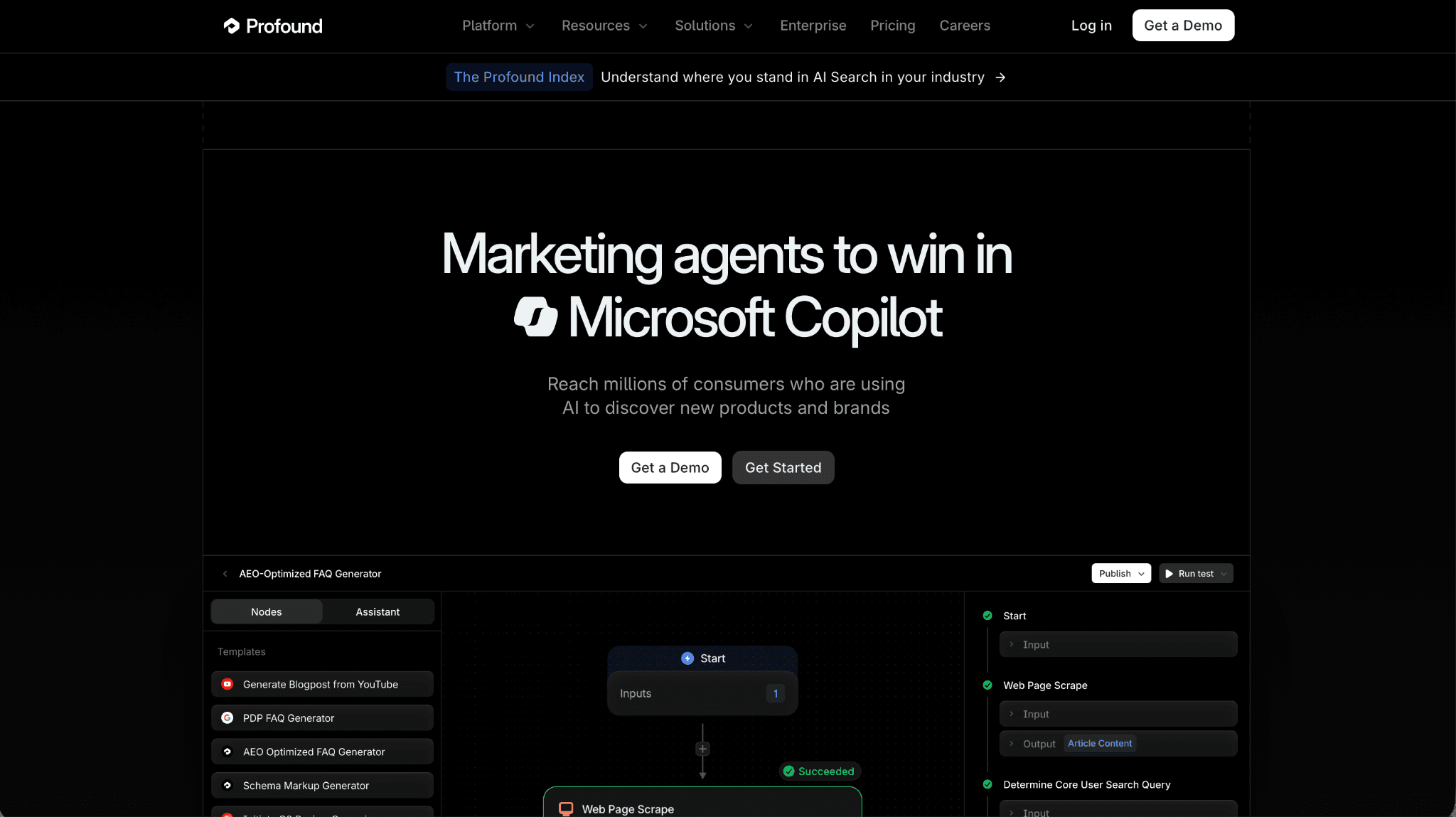
Profound AI is the deepest enterprise platform in the category, and as of 2026 it's also the least accessible: the pricing page now offers customized enterprise pricing only, with no self-serve tier and no trial, which is enough on its own to push most smaller teams toward Profound alternatives.
What sits behind the sales call is substantial. Prompt Volumes gives you panel data on what people actually ask AI, the closest thing GEO has to search volume, and the platform pairs it with answer tracking across 9+ surfaces, crawler analytics, and agents that automate content workflows end to end.
Key features:
Prompt Volumes: panel-based data on real AI queries, so you can prioritize prompts by actual demand instead of guessing.
Answer Engine Insights across 9+ surfaces, including ChatGPT, Claude, Gemini, Perplexity, Grok, Copilot, Meta AI, DeepSeek, and AI Overviews.
Agent Analytics tracking how AI crawlers interpret and crawl your site.
Agents that automate content workflows from research through CMS publishing.
Pros:
Prompt Volumes is a genuinely unique dataset, nothing else tells you what people actually ask
Broadest enterprise feature set in the category
Security and compliance posture built for procurement
Cons:
No public pricing, no trial, no way to validate fit before a sales cycle
Severe overkill below enterprise scale
Reporting-heavy; the buying process alone takes weeks
Pricing: Custom enterprise pricing only; no self-serve tier or free trial. For brands, the pricing starts at $99/month.
Verdict: Profound dropping self-serve pricing tells you exactly who it's for: brands with global footprints, procurement teams, and budgets to match. If you have the budget, the team, and a procurement process anyway, it's arguably the most complete enterprise platform here. Everyone else should be honest with themselves: if you flinched at "custom pricing," this tool wasn't built for you.
G2 rating: 4.5/5
8. Writesonic
About Writesonic:
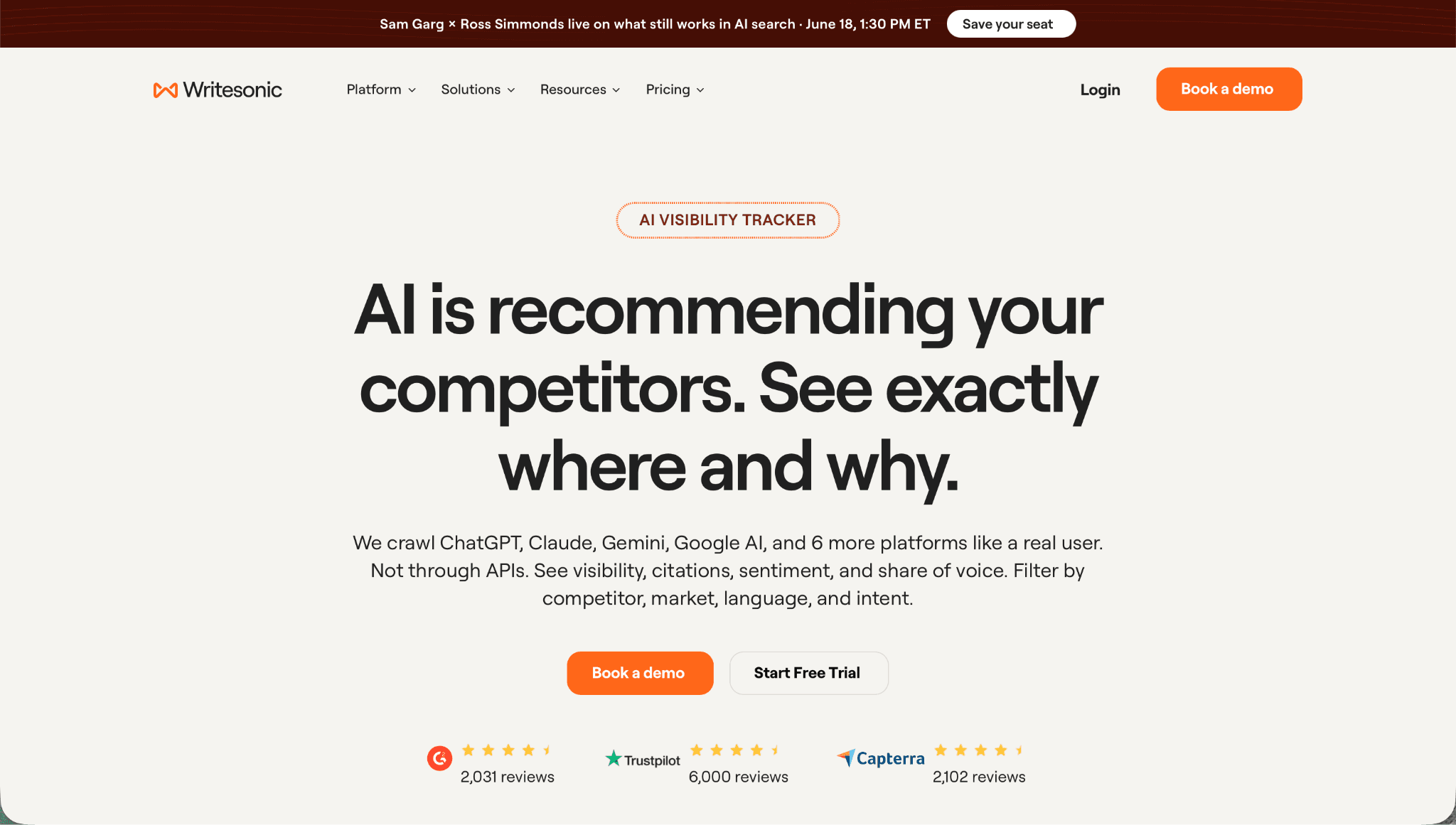
Writesonic comes at GEO from the content side.
The platform began as an AI writing tool and rebuilt itself around AI search visibility, which means its GEO suite sits directly on top of a content production engine, track a visibility gap in the morning, draft and publish the fix in the afternoon, in the same product.
The tracking layer covers 7+ platforms, and its AI Traffic Analytics surfaces the crawler visits that never show up in Google Analytics.
Key features:
Brand Presence Explorer tracking visibility, share of voice, and sentiment across AI queries, with competitor benchmarking.
AI Traffic Analytics showing AI crawler visits by platform and which of your pages AI systems access most.
ChatGPT Shopping visibility tracking for how products surface in AI-generated shopping results.
Built-in content creation, so optimization recommendations flow straight into AI-assisted drafting and publishing.
Pros:
Tracking and content production genuinely live in one stack
AI crawler analytics included rather than sold separately
Free GEO tools let you test the data quality before paying
Cons:
Steep jumps between tiers ($79 → $199 → $399)
Starter only tracks a single AI platform, which most teams outgrow within a quarter
A suite, not a specialist, dedicated tools beat it on tracking depth
Pricing: Starter from $79/mo (annual); Growth $399/mo; Enterprise custom.
Verdict: Writesonic suits content-heavy teams that want GEO measurement living next to production instead of in a separate tab. Go in knowing the entry tier is more of a taste than a plan, and that specialists will out-track it. As a one-subscription answer for a lean content team, it covers a lot of ground.
G2 Rating: 4.7/5
9. Rankscale AI
About Rankscale AI:
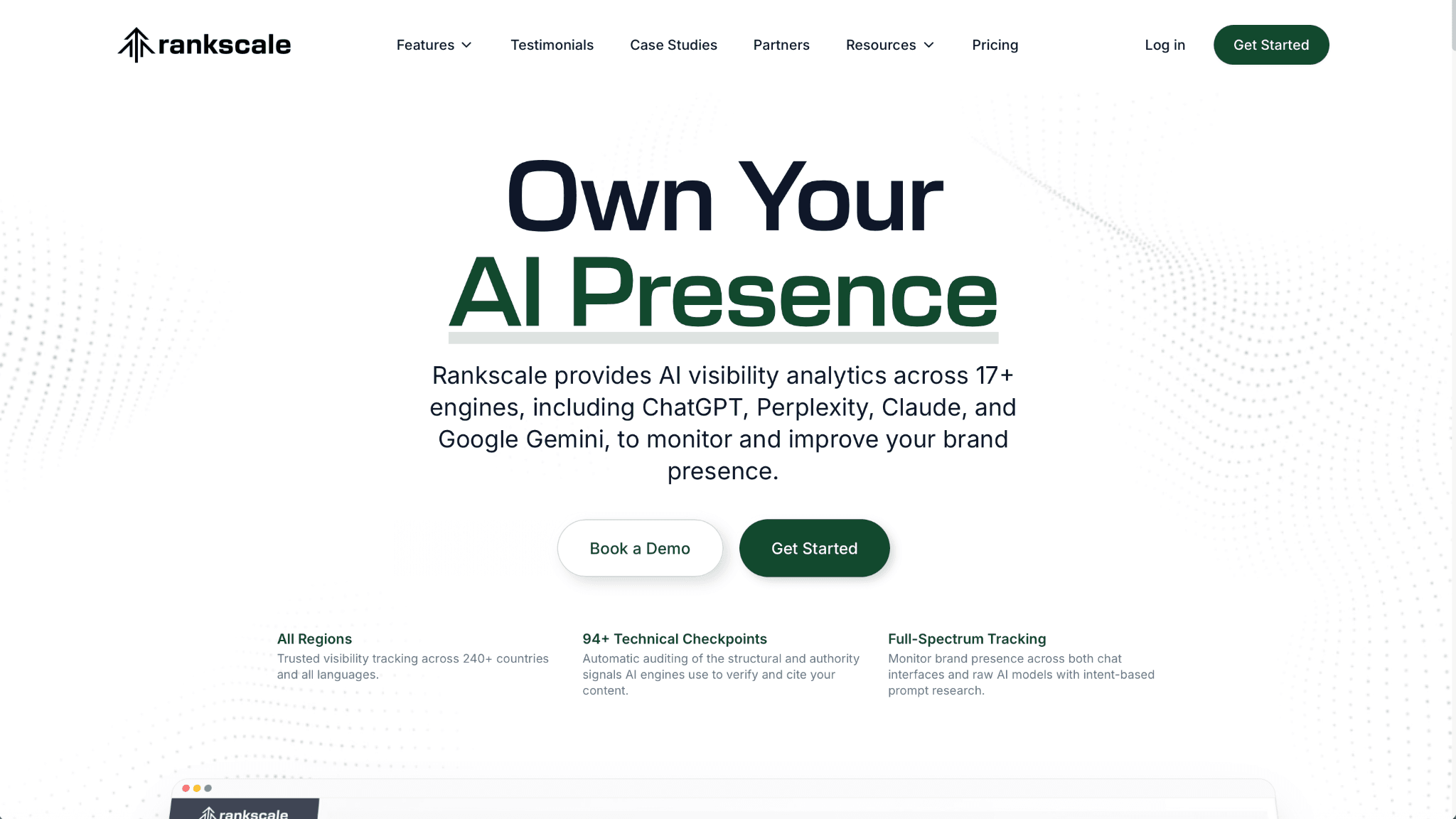
On engine coverage, few Rankscale alternatives come close: Rankscale tracks 17+ AI engines on every plan with no per-engine upsells, across 240+ countries and all languages.
That breadth is paired with the strongest technical audit layer on this list, 94+ checkpoints scoring the structural and authority signals AI engines use when deciding whether to cite a page. Billing is credit-based, with credits powering every monitoring run, and scheduling runs from hourly to monthly.
Key features:
17+ AI engines on all plans: ChatGPT, Perplexity, Claude, Gemini, AI Overviews, AI Mode, DeepSeek, Grok, Copilot, Mistral, and more, no add-on fees.
Page audits with 94+ technical checkpoints scoring any URL's AI citation readiness.
LLM-native prompt research estimating prompt volume through semantic reconstruction.
Flexible credit system with rollover, hourly-to-monthly scheduling, and white-label options for agencies.
Pros:
Widest engine coverage in the category, with refreshingly zero upsell games
Serious technical audit depth
True multi-language, multi-region tracking
Cons:
Credit math takes real getting used to, budgeting is harder than with flat plans
The interface is denser than Peec AI or Otterly AI
Recommendations are lighter than the action-focused platforms
Pricing: Pro $99/mo (1,200 credits), Growth $385/mo, Enterprise $780/mo. Credit-based.
Verdict: Rankscale AI is the answer for international brands and agencies that genuinely need to see everything, everywhere. My honest take: most teams don't; three engines cover the bulk of real buyer behavior, but if your markets span DeepSeek in one country and Mistral in another, nothing else matches this coverage at this price.
10. Prompt Monitor
About Prompt Monitor:
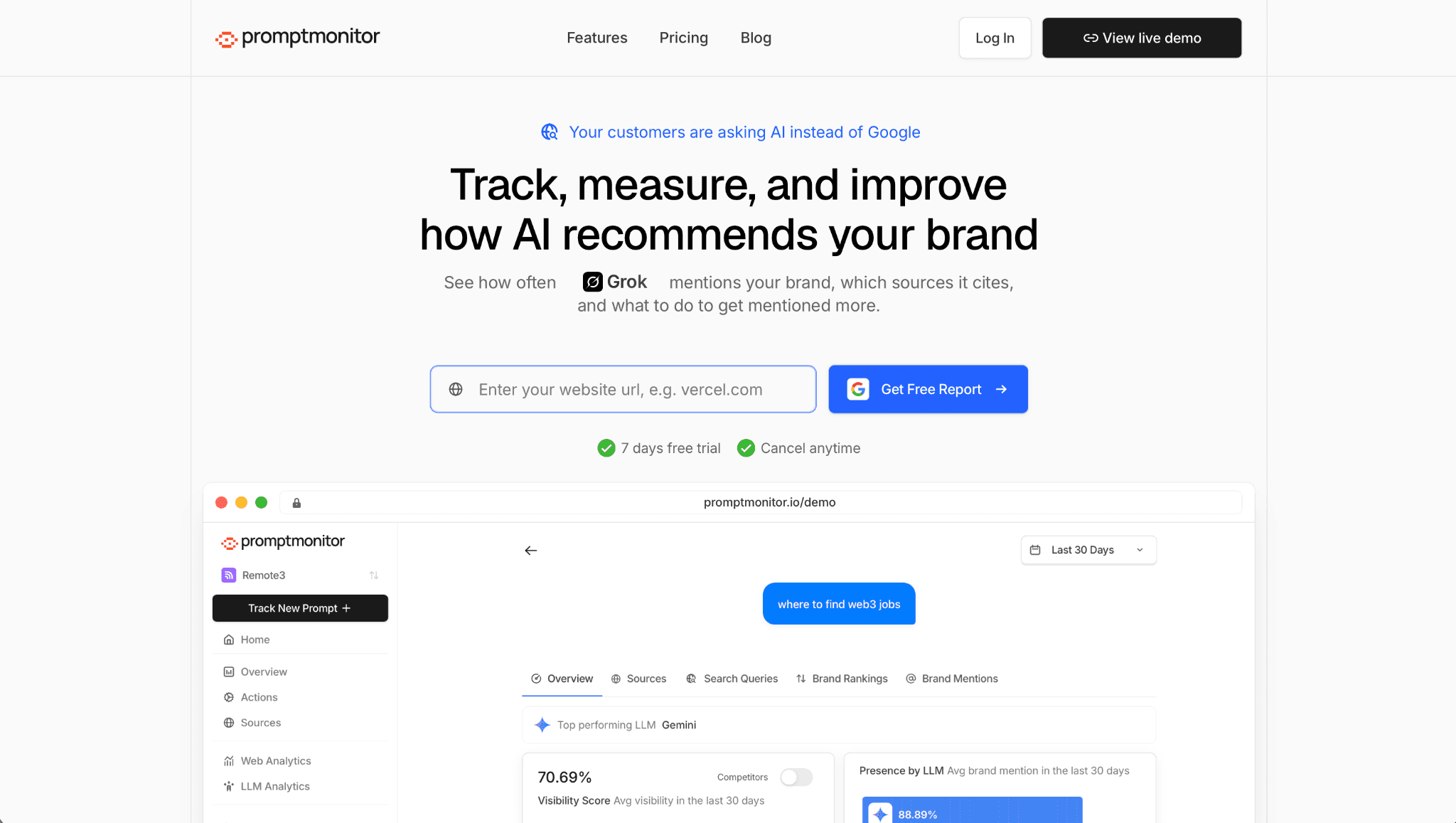
"Ahrefs, but for AI answers" is how Prompt Monitor describes itself, and the value-for-money comparison holds.
It tracks 8 AI models, shows which sources drive answers, and adds a feature nobody else has at this price: it extracts author emails and social profiles from every cited source, so the gap between "this article gets cited and doesn't mention us" and "I've pitched the author" is one click.
Setup is no-code, and your first visibility report lands within about two minutes of entering a URL.
Key features:
8 AI models tracked: ChatGPT, Claude, Gemini, DeepSeek, Grok, and Perplexity, plus AI Mode and AI Overviews on Pro.
Source contact extraction pulling author emails and socials for direct outreach.
"Outreach or outrank" guidance: every source ships with domain rating and backlink data, so you know whether to pitch the author or out-create the page.
Built-in cookie-free website analytics and AI bot crawler tracking, GDPR-compliant by default.
Pros:
Exceptional value at every tier; probably the most usable output per dollar on this list
Outreach contact extraction saves real hours of manual digging
There's a free agency plan, which almost sounds like a typo but isn't
Cons:
Modest prompt limits (25-150)
No prompt-volume data
Starter refreshes twice a week, not daily
Pricing: Starter $29/mo, Growth $39/mo, Pro $129/mo; free agency plan.
Verdict: For small businesses and lean teams, Prompt Monitor delivers more actionable output per dollar than anything else here. It's a monitoring-and-outreach tool rather than a full GEO platform, and you'll feel the prompt caps as you grow, but as a starting point it punches far above its price.
11. Semrush AI Visibility Toolkit
About Semrush AI Visibility Toolkit:
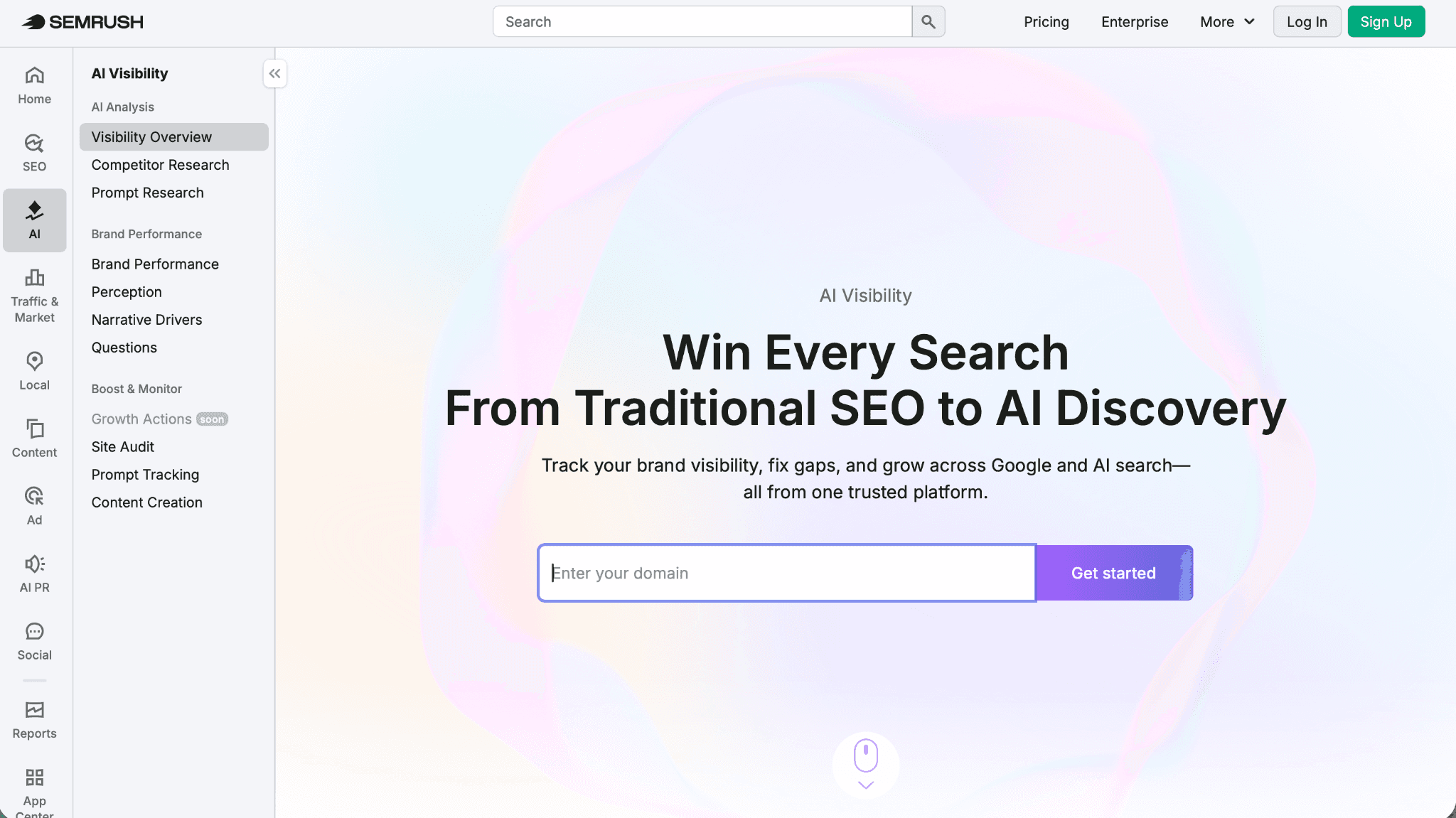
Semrush's AI Visibility Toolkit brings AI search tracking into the platform your SEO team probably already uses.
For $99/month per domain, you get mention tracking, sentiment, and share-of-voice benchmarking across ChatGPT, Gemini, Google AI Mode, AI Overviews, and Perplexity, sitting alongside your existing keyword, backlink, and audit data.
That adjacency is the whole pitch: AI visibility findings land in the same workspace where your SEO fixes already happen.
Key features:
AI visibility reports shows: mention frequency, sentiment, and prompt-level performance for your domain.
Competitor benchmarking with up to 9 tracked competitors for share of voice inside AI answers.
One workspace for SEO and GEO, connecting AI visibility to the keyword and technical data you already work with.
Broad international coverage, leaning on Semrush's existing multi-country infrastructure.
Pros:
No new vendor, no new login, no new learning curve for Semrush teams
AI data next to SEO data is genuinely useful for diagnosing why citations happen
Easy to trial inside an existing account
Cons:
$99 per domain, and additional users pay again, agencies feel this immediately
Tracking depth trails the dedicated platforms
Measurement only; no execution layer
Pricing: AI Visibility Toolkit $99/mo per domain; also available inside Semrush One bundles.
Verdict: The honest case for Semrush here is inertia, and inertia is underrated. If your team already lives in Semrush, adding AI visibility for $99 beats onboarding a new vendor for directional data. Just know the per-domain, per-user pricing punishes multi-brand setups, and a dedicated platform will out-track it.
12. Ahrefs Brand Radar
About Ahrefs Brand Radar:
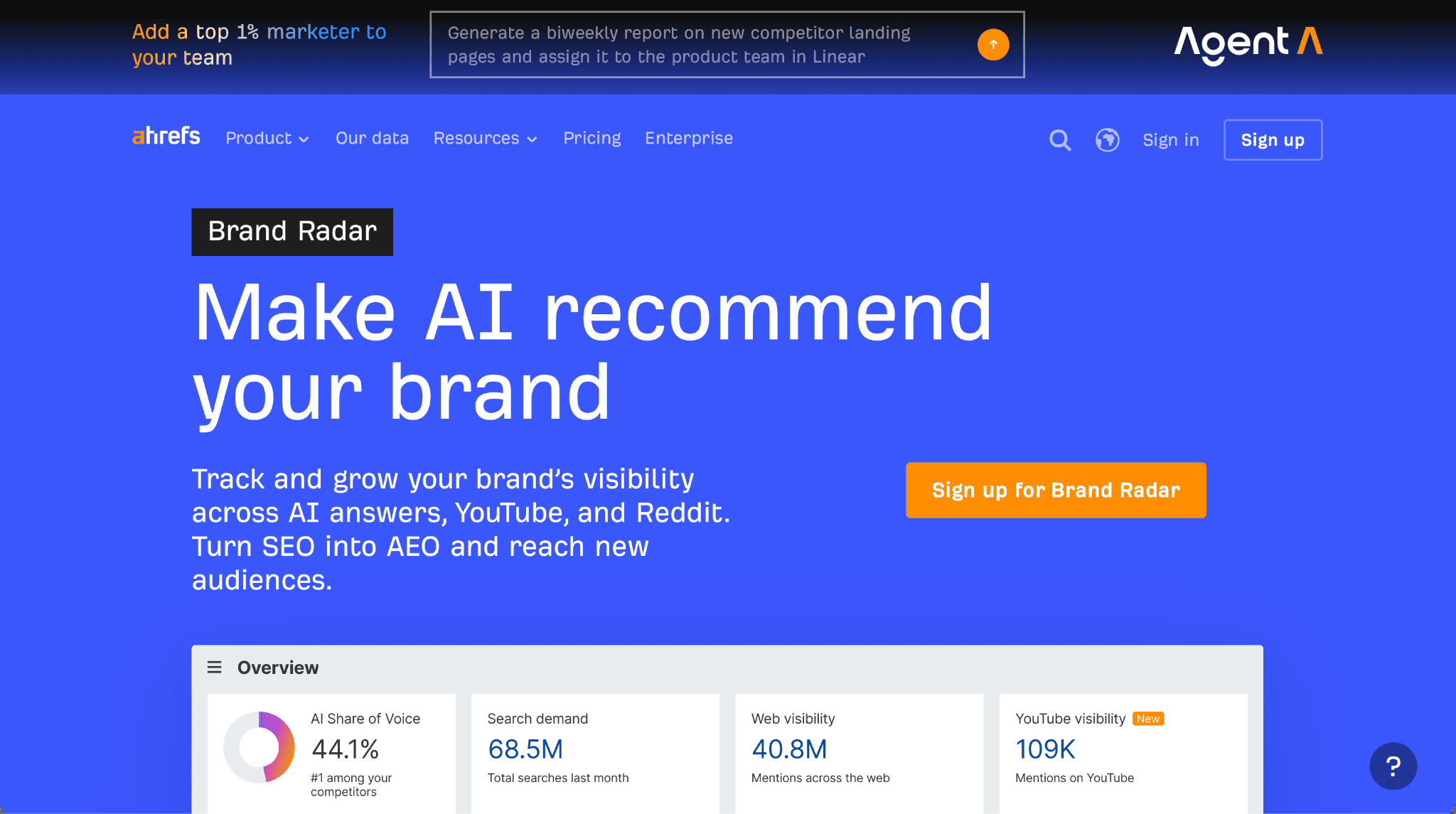
Brand Radar is Ahrefs' GEO tool, and it's built like a research database rather than a tracker.
Its index holds 384M+ monthly search-backed prompts across seven surfaces, and you can query any brand or domain instantly, yours, a competitor's, a prospect's, with zero setup and unlimited projects.
It also tracks the sources feeding AI answers beyond the web: YouTube transcripts, TikTok, and Reddit.
Key features:
The largest AI visibility index in the category, built from search-backed prompts rather than synthetic ones.
Unlimited projects: research any domain's AI visibility on demand, including ones you don't own.
Source tracking across YouTube, TikTok, and Reddit, the platforms increasingly feeding AI answers.
Custom prompt tracking (2,500 checks/month included) layered on top of the index.
Pros:
Massive dataset with instant, zero-setup research on any brand
Historical data that prompt-sampling tools simply don't have
Slots naturally into existing Ahrefs workflows
Cons:
The real cost is brutal: $199/mo per AI engine, $699/mo for all of them, stacked on top of a base Ahrefs plan, full coverage starts around $828/mo
No Claude or Meta AI tracking
Research tool first; no recommendations, no execution
Pricing: $199/mo per AI index or $699/mo for the all-index bundle, plus an Ahrefs base plan from $129/mo.
Verdict: Brand Radar is simultaneously the best research tool on this list and one of its weakest value propositions. As a market intelligence layer, which categories AI favors, which sources dominate, how competitors trend, it's genuinely impressive. As your primary GEO tool, you're paying enterprise money for measurement with nothing attached to act on.
13. AthenaHQ
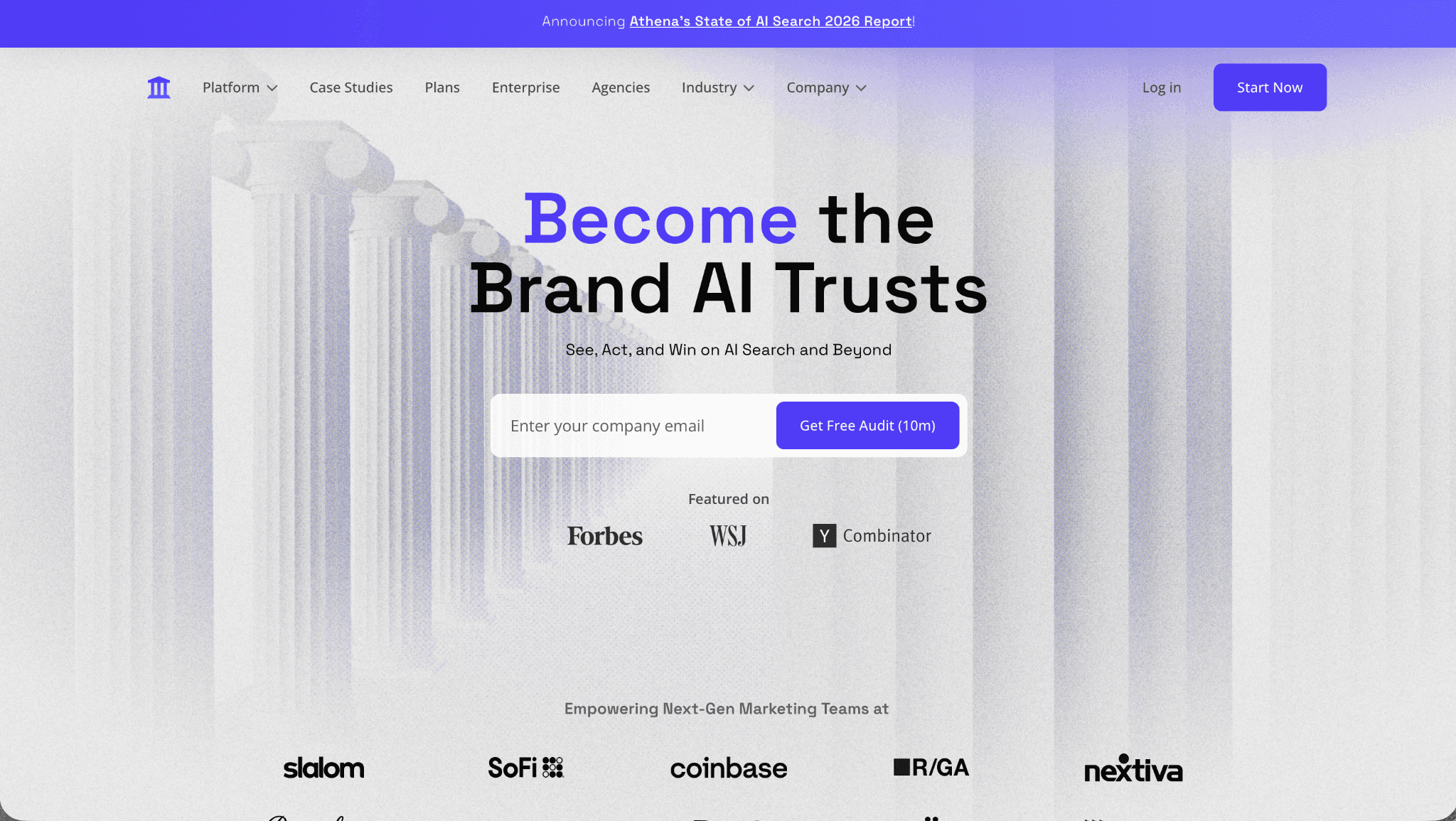
About AthenaHQ:
AthenaHQ is the most workflow-obsessed tool in the category.
Where most platforms stop at a list of recommendations, its Action Center converts every visibility gap into structured, assignable, trackable tasks, closer to a project management layer for GEO than a dashboard.
Coverage spans 8+ engines on all plans, and integrations with GA4 and Shopify connect AI visibility to traffic and revenue, which surprisingly few tools in this category can do.
Key features:
Action Center turning visibility gaps into prioritized tasks your team can own and check off.
8+ engine coverage on all plans: ChatGPT, Gemini, Claude, Perplexity, Copilot, AI Overviews, and more.
Revenue attribution via GA4 and Shopify integrations, plus Ask Athena, an AI copilot over your visibility data.
ACE Citation Engine (Enterprise only) for systematically earning placements in frequently cited sources.
Pros:
The best structured workflow layer in the category, data actually becomes work
Unlimited topics on the entry plan, where competitors cap you
Real revenue attribution, not just visibility charts
Cons:
Credit-based billing ties your bill to your curiosity, costs are hard to predict
Self-Serve plan is limited to a single country
The features that headline the product (ACE, personas, API) sit behind the Enterprise wall
Pricing: Self-Serve $295/mo (3,600 credits); Enterprise custom; $95 intro first month.
Verdict: AthenaHQ takes the action-over-dashboards argument seriously, and teams that run on structured workflows will feel at home immediately. Two caveats before you commit: model your credit burn honestly, and check whether the features that sold you on the demo are actually in the tier you're buying.
G2 Rating: 4.9/5
14. LLMrefs
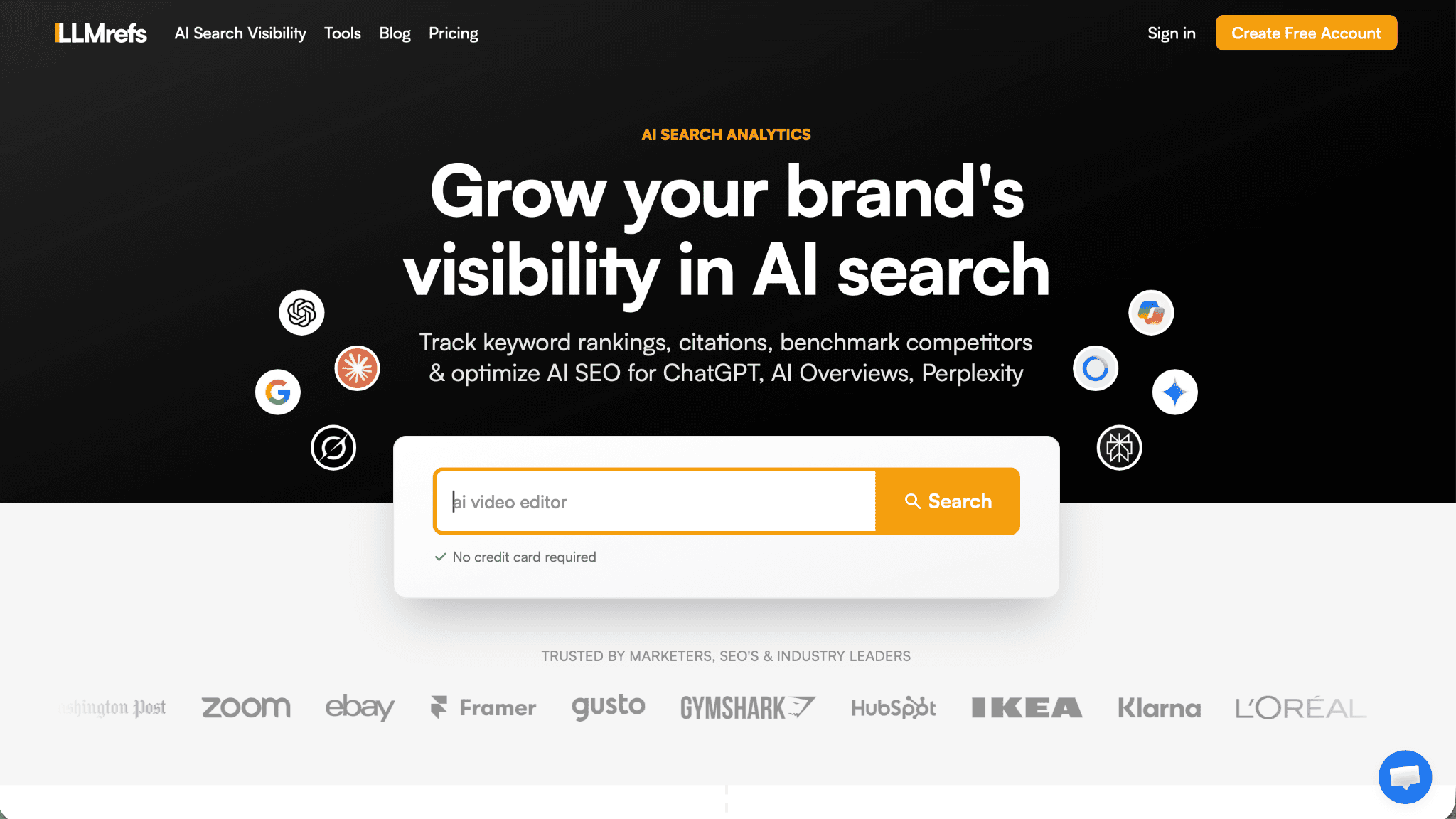
About LLMrefs:
LLMrefs makes a contrarian bet the SEO crowd will appreciate: you track keywords, not prompts.
Enter a keyword and the tool fans it out into the conversational prompts AI users actually type, then tracks rankings, citations, and sources across 11+ engines.
That mental model maps neatly onto how SEO teams already plan topics and report results, which makes the transition into GEO feel like an extension of existing work rather than a new discipline.
The free plan tracks one keyword, enough to learn whether AI search matters for your brand yet.
Key features:
Keyword-first tracking that auto-generates prompt variations from each keyword.
11+ engine coverage including ChatGPT, AI Overviews, Perplexity, Claude, Gemini, and Grok.
Citation and source reporting showing which URLs power the answers for each keyword.
Free utilities: an AI crawlability checker, an llms.txt generator, and a Reddit thread finder.
Pros:
A genuinely useful free tier, not a lead-capture gimmick
One $79 plan covers 50 keywords with unlimited projects and seats, the easiest pricing decision on this list
The keyword model means zero re-training for SEO teams
Cons:
No sentiment analysis, which matters for brand and PR use cases
Auto-generated prompts trade control for convenience, you don't choose exactly what gets tracked
50-keyword cap, then a jump straight to custom Enterprise pricing
Pricing: Free plan (1 keyword); Pro $79/mo (50 keywords); Enterprise custom.
Verdict: LLMrefs is the lowest-friction on-ramp to GEO for an SEO-led team: same keyword thinking, new surface. The abstraction cuts both ways, since you give up control over the exact prompts tracked, and brand teams will miss sentiment data. As a starting point or an agency add-on, the price is very hard to argue with.
G2 Rating: NA
15. Goodie AI
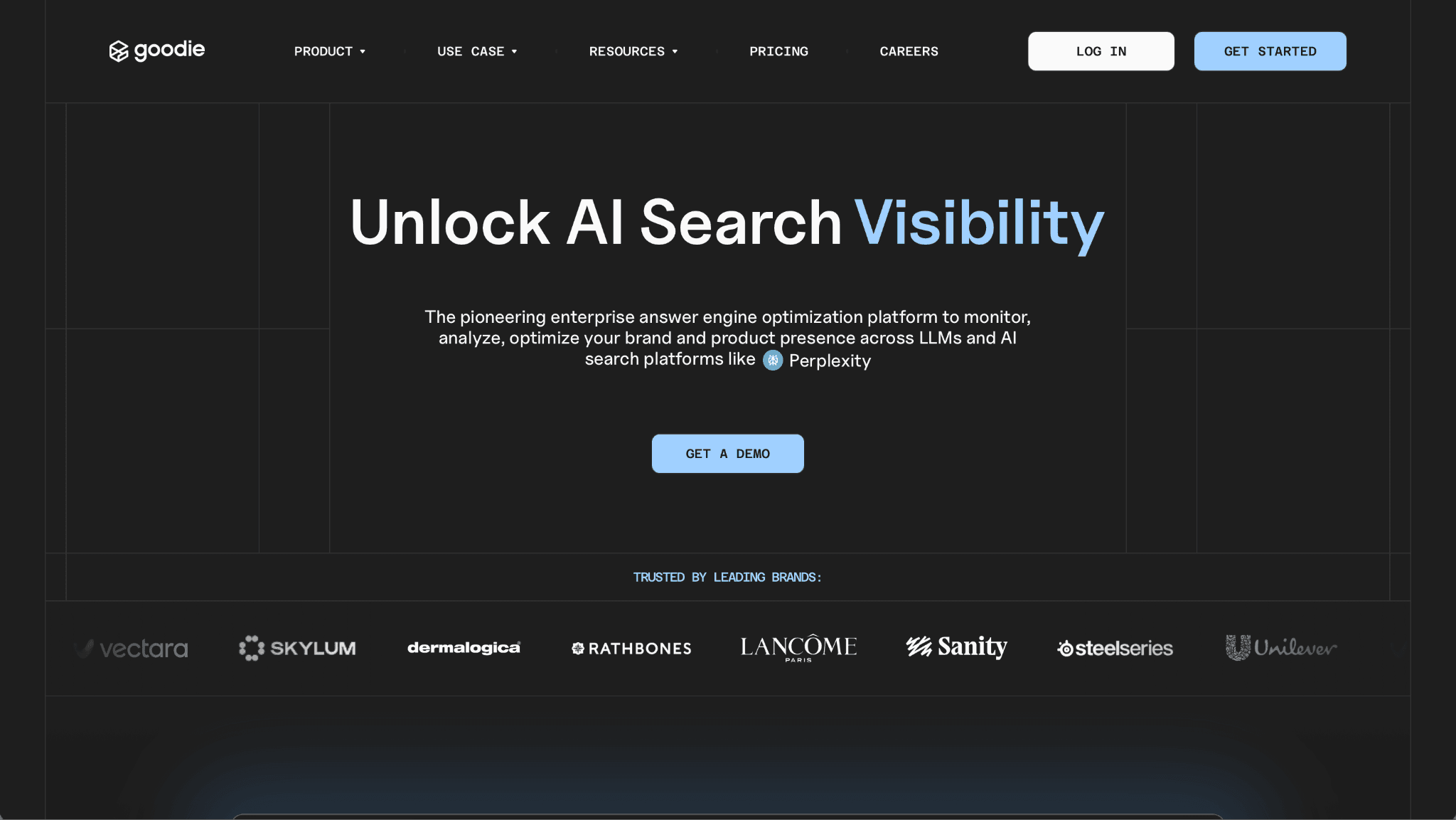
About Goodie AI:
Goodie AI tracks more answer engines than almost anyone, 12 models, including commerce-specific ones like Amazon Rufus and Walmart's Sparky that no other tool on this list touches, and that roster tells you its focus: AI-driven shopping.
Its Agentic Commerce Suite tracks visibility at the individual product level across ChatGPT's commerce features, Google AI Mode Shopping, Rufus, and Perplexity Shopping, then ships the fixes itself: feed enhancements, schema injection, and optimized content published from inside the platform.
Key features:
12-model coverage spanning the standard engines plus Amazon Rufus, Meta AI, DeepSeek, and Sparky.
Agentic Commerce Suite tracking individual products in AI shopping experiences, with feed and schema optimization deployed without developer time.
AEO Writer and Optimization Hub generating AI-optimized content that holds your brand voice.
Analytics and attribution connecting AI visibility to traffic and revenue, with Shopify and BigCommerce integrations.
Pros:
The only serious option for tracking AI shopping surfaces
Product-level granularity; performance by item, variant, and category
Closed loop from insight to published fix
Cons:
No public pricing and no trial; everything goes through sales
Overbuilt for B2B and content brands with nothing to sell on an AI shelf
Harder to budget for without a published price card
Pricing: Custom
Verdict: For ecommerce and retail brands, Goodie AI is arguably the most forward-looking tool on this list, because AI shopping surfaces are where product discovery is clearly heading. If you're not selling products, you'd be paying for a commerce engine you'll never start, look at the action platforms higher up this list instead.
16. Cloro
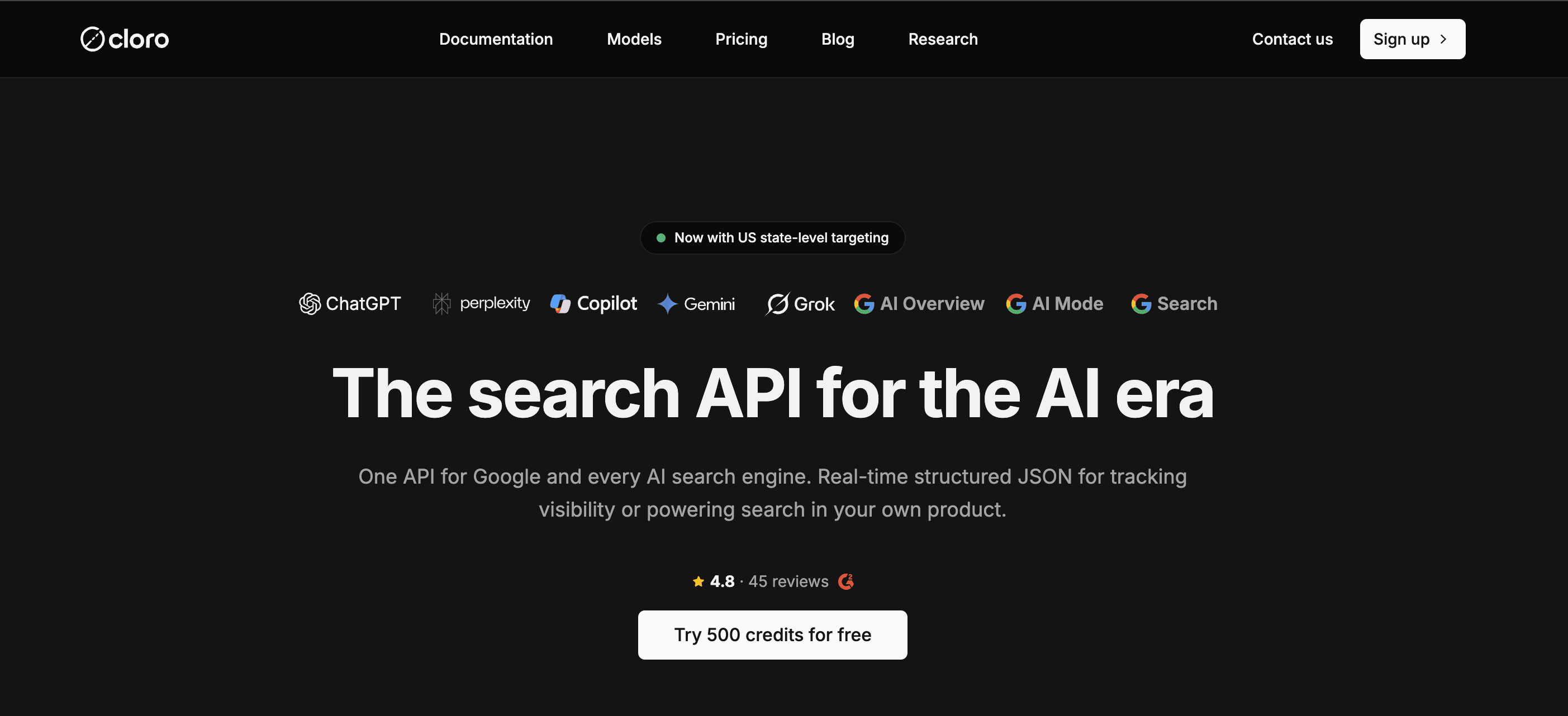
About Cloro:
Cloro is the layer underneath a GEO dashboard, not another dashboard. It's a REST API returning AI answers and cited sources as structured JSON from seven AI surfaces (ChatGPT, Perplexity, Gemini, Copilot, Grok, Google AI Overview, AI Mode), plus Google Search and News for the same query. Agencies use it for white-label reporting; product teams embed it into tools they already sell. Requests support geo/device targeting, run sync or async with webhooks, and bill per successful call only.
Key features:
One endpoint family covering seven AI surfaces plus Google Search and News
Structured JSON citations and source lists, not raw HTML
AI Overview and AI Mode as first-class endpoints
Geo and device targeting per request, async with webhook delivery
Success-only billing, with per-call credit cost published
Hosted MCP server for direct agent queries
Pros:
Full API access on every paid tier, from the $30 entry plan
Free tier at 500 credits/month to test before paying
Raw data you own and model, not a fixed report
Cons:
No dashboard, visibility score, or alerting, you build the interface
Needs a developer; the wrong pick for a marketer who wants a chart
No content recommendations or drafting
Pricing: Free (500 credits/mo) through Enterprise ($2,000+ self-serve); per-1,000-credit rate drops from $0.80 to $0.31 across the range.
Verdict: Pick Cloro when the data needs to live in something you own, an agency's white-label report or a product's own AI-visibility feature. If you just want a login showing a visibility score this week, a dashboard tool fits faster.
17. Gauge
About Gauge:
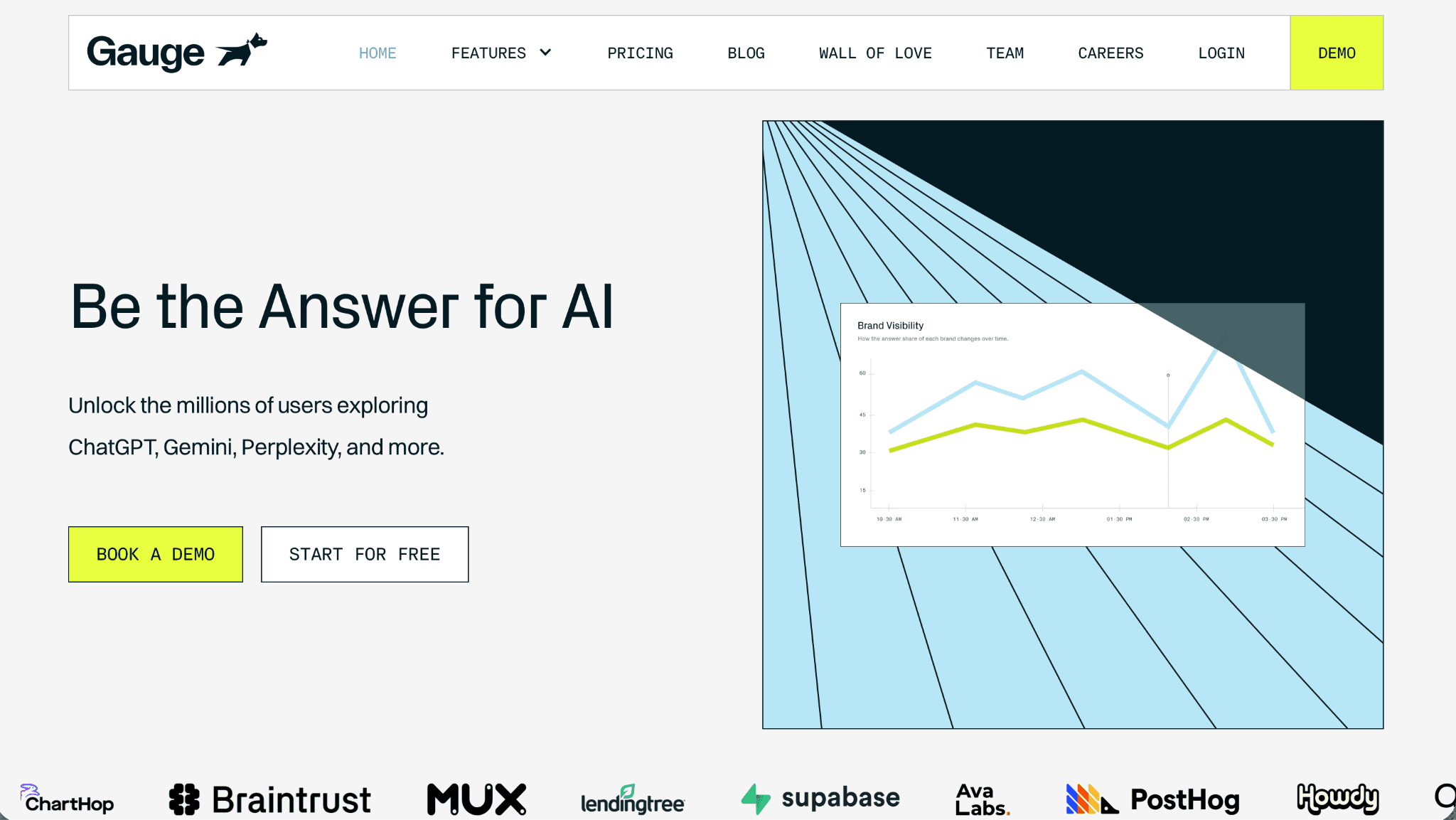
Gauge treats AEO as a content operation rather than a reporting exercise.
The platform pairs high-volume prompt tracking, 600 prompts run daily across six engines on the entry plan, with a content engine that produces AI-optimized articles each month, plus onsite and offsite recommendations for closing the gaps the tracking finds.
It also covers two newer surfaces most tools haven't touched yet: ChatGPT Ads support and Ask Gauge, an AI analyst you can question about your own visibility data.
Key features:
600 prompts run daily across ChatGPT, AI Overviews, AI Mode, Gemini, Perplexity, and Copilot (Claude joins on Enterprise).
Content engine producing 18 AEO-optimized articles a month on the Growth plan.
Ask Gauge, a conversational analyst over your visibility data, plus ChatGPT Ads support.
Agency mode for managing multiple client brands.
Pros:
High daily prompt volume, 600 daily runs is generous at this tier
Content production is part of the plan, not an upsell
Clear onsite and offsite recommendations, not just charts
Cons:
$599/mo entry with nothing below it, there's no cheap way to test the waters
Claude tracking is locked behind Enterprise
Newer product with a thinner public review base than the established names
Pricing: Growth $599/mo (600 prompts, 18 articles, 10 seats); Enterprise custom.
Verdict: Gauge is built for one buyer: a growth-stage company ready to fund AEO as an ongoing content program, not a dashboard subscription. If $599/month is comfortable and your buyers live inside AI tools, it's a serious contender. If you just want monitoring, it's the wrong shape entirely.
How To Choose the Right GEO Tool
Start with the question most buying guides skip: what will you actually do with the data? Teams tend to fall into three honest answers, and each points to a different shortlist.
"I need to prove this channel matters."
You're building a business case, not running a program yet. Buy cheap and fast: Otterly ($29), Prompt Monitor ($29), or LLMrefs (free) will show you within a week whether AI engines mention your brand, who they mention instead, and which sources drive it. Don't sign an annual enterprise contract to answer a yes/no question.
"I need to fix my visibility."
This is most teams in 2026, and it's where engine-count shopping leads people astray. ChatGPT plus Google's AI surfaces plus Perplexity covers the overwhelming majority of real buyer behavior; tracking those well beats tracking seventeen engines shallowly. What matters far more is whether the tool closes the loop.
AIclicks and AthenaHQ turn findings into executed work, Gauge bundles a content operation, Goodie does the same for commerce. A wide dashboard that ends at a chart feels impressive in month one and sits idle by month four, I've watched it happen more times than I'd like.
And if the gap you're closing sits mostly on Gemini and Google's AI surfaces, a dedicated Gemini SEO agency can take the execution side off your plate entirely.
"I need this inside my existing stack."
If your team lives in Semrush or Ahrefs, the add-ons are defensible, with eyes open about cost. Semrush's per-domain fees stack quickly across brands, Brand Radar's all-in price exceeds most dedicated platforms, and both stop at measurement.
One more filter: be wary of any tool you can't trial. Half this market is sales-gated now, and that's a positioning choice, not a quality signal. The tools confident enough to let you see your own data before paying tend to be the ones whose data survives the look.
Choose the #1 GEO Tool - AIclicks
The GEO tool market grew up fast. Two years ago, every product on this list was a dashboard with a different logo. In 2026, everyone has a credible dashboard, and the real competition is over what happens after the chart: who helps you win citations, ship content, and show revenue.
That's the lens worth applying to any shortlist. Measurement tells you the score. Execution changes it.
AIclicks was built around that second half: track your visibility across 10+ AI platforms, see exactly which sources drive the answers, and put AI agents to work closing the gaps. Run a free audit and see where your brand stands in AI search today.
Frequently Asked Questions (FAQs)
1. What is a Generative Engine Optimization (GEO) tool?
A GEO tool monitors how AI platforms like ChatGPT, Gemini, and Perplexity mention your brand in their answers. It runs the prompts your buyers ask, records which brands get named, identifies which sources the AI cites, and recommends (or in some tools, executes) changes to improve your visibility.
2. Which is the best GEO tool in 2026?
It depends on your lane. AIclicks covers tracking and execution in one self-serve platform, Profound leads for enterprise procurement, Otterly AI and Prompt Monitor are the best sub-$30 entries, and Semrush or Ahrefs make sense as add-ons if you already pay for those suites.
3. Are there free GEO tools?
Yes, AIclicks offers a free brand audit, Otterly publishes free GEO utilities, and Ahrefs has a free AI visibility checker. Free tiers are good for validating that AI search matters for your brand; running an actual program requires a paid plan.
4. How is GEO different from SEO?
SEO optimizes pages to rank in a list of links; GEO optimizes your brand to be named and cited inside a single AI-generated answer. The disciplines overlap, crawlability, structured content, and authority help both, but GEO adds work SEO never required: prompt tracking, citation source analysis, and earning mentions on the third-party sites AI engines trust. Learn more about GEO vs SEO.
5. How much do GEO tools cost in 2026?
Entry-level monitoring starts at $29/month (Otterly, Prompt Monitor). Mid-market platforms with execution features run $59-$500/month (AIclicks, Peec, AthenaHQ, Rankscale). Enterprise platforms like Profound and Goodie are custom-priced and sales-led. Suite add-ons from Semrush ($99/domain) and Ahrefs ($199-$699 plus a base plan) sit on top of existing subscriptions.



Any questions left?
Book a call here: