" width="14px"><path d="M 13.864 5.629 L 13.3 5.629 L 13.3 5.6 L 7 5.6 L 7 8.4 L 10.956 8.4 C 10.379 10.03 8.828 11.2 7 11.2 C 4.681 11.2 2.8 9.319 2.8 7 C 2.8 4.681 4.681 2.8 7 2.8 C 8.071 2.8 9.045 3.204 9.786 3.864 L 11.766 1.884 C 10.516 0.719 8.844 0 7 0 C 3.134 0 0 3.134 0 7 C 0 10.866 3.134 14 7 14 C 10.866 14 14 10.866 14 7 C 14 6.531 13.952 6.073 13.864 5.629 Z" fill="rgb(255, 193, 7)" height="14px" id="H_YjfTNpn" width="14px"/><path d="M 0 3.742 L 2.3 5.429 C 2.922 3.888 4.429 2.8 6.193 2.8 C 7.264 2.8 8.238 3.204 8.979 3.864 L 10.959 1.884 C 9.709 0.719 8.037 0 6.193 0 C 3.504 0 1.172 1.518 0 3.742 Z" fill="rgb(255, 61, 0)" height="5.428500000000002px" id="PlkthQDhg" transform="translate(0.875 0)" width="10.959199999999996px"/><path d="M 6.232 5.581 C 8.04 5.581 9.683 4.889 10.925 3.764 L 8.758 1.931 C 8.032 2.483 7.144 2.782 6.232 2.781 C 4.411 2.781 2.865 1.62 2.283 0 L 0 1.759 C 1.159 4.026 3.511 5.581 6.232 5.581 Z" fill="rgb(76, 175, 80)" height="5.581099999999999px" id="WlnJ5gngE" transform="translate(0.7 8.4)" width="10.924899999999994px"/><path d="M 6.864 0.029 L 6.3 0.029 L 6.3 0 L 0 0 L 0 2.8 L 3.956 2.8 C 3.68 3.576 3.183 4.254 2.526 4.75 L 2.527 4.749 L 4.693 6.582 C 4.54 6.722 7 4.9 7 1.4 C 7 0.931 6.952 0.473 6.864 0.029 Z" fill="rgb(25, 118, 210)" height="6.589883930775992px" id="x_rSW275p" transform="translate(7 5.6)" width="7px"/></g></svg>)


Reviewed by:
Rokas Stankevicius

Founder @ aiclicks.io
Last updated:
Expert Verified

Key Takeaways
Otterly's $29/mo entry plan gives you 15 prompts across 4 core engines, enough to get a first look, not enough to monitor a real brand across a real category.
Two of its six marketed engines (Gemini and Google AI Mode) are paid add-ons on all self-serve plans. Claude is not tracked at all.
The jump from Lite ($29/mo) to Standard ($189/mo) is steep, and most teams discover they need Standard within the first two weeks of real use.
The alternatives on this list split into three camps: full-stack platforms connecting tracking to action (AIclicks, Writesonic, AthenaHQ), focused analytics tools for clean reporting (Peec AI), and AI visibility modules built into established SEO suites (Semrush, SE Ranking, Rankability).
Visibility data is only worth paying for if it tells you what to do next. That action layer is what separates the tools on this list.
When someone searches for Otterly AI alternatives, they are rarely running away from a broken product. Otterly AI built a genuine reputation as the most accessible entry point in the AI visibility category. It tracks brand mentions across AI search engines, the interface is clean, and the $29/mo entry price is the lowest in the market. For teams getting started with GEO monitoring, that combination has real appeal.
But accessible and right fit are two different things.
Most teams hit one of three walls with Otterly AI, and which wall they hit tells you which alternative to look at first.
If it is the pricing structure, because that $29 plan turns out to be a tester and the real product starts at $189, you are in one camp.
If it is the monitoring-without-action problem, because Otterly AI shows you where you stand but leaves the "now what" entirely up to you, you are in another.
And if it is the coverage gap, because two of the six engines cost extra and there is no Claude tracking on any self-serve plan, that is a third reason entirely.
This blog covers 9 Otterly AI alternatives that you can try in 2026: what each does well, what the real price is before the add-ons, and who should walk straight past it. (Find your fit. Skip the rest. 😉)
Why Teams Outgrow Otterly
Otterly earned its place in the GEO conversation. It is genuinely easy to set up, the interface is intuitive, and customer support scores near-perfect on G2. But it is worth being precise about where the fit breaks down, because Otterly is not a bad tool. It is a specific one, and the mismatch is almost always about fit, not quality.
1. The pricing cliff arrives fast. The $29/mo Lite plan covers 15 prompts across 4 core engines, enough for a proof of concept, not enough to monitor a real brand. The next step is Standard at $189/mo: a 6.5x jump. Add Gemini and Google AI Mode (both paid add-ons), and the real entry price for comprehensive coverage is significantly higher than the headline.

2. Monitoring without action. Otterly shows you where you stand. What it does not do is tell you what to change. Reviewers across G2 and independent testers consistently flag the same gap: clear data, no practical path to acting on it.

3. Coverage gaps on every self-serve plan. Gemini and Google AI Mode are add-ons, not included on any base plan. Claude is not tracked at all, so teams whose buyers use Claude need a separate Claude rank tracking tool to cover it.
None of this means you should avoid Otterly. For small brands that need affordable monitoring and have the capacity to act on the data independently, it does the job. But if any of the three walls above sounds familiar, the tools below offer a more direct path.
How I Evaluated These Alternatives
Coming from Otterly, you already know the basics work. The question is not whether a tool can track brand mentions, most of them can. The question is what breaks down when your needs get more specific: more engines, more clients, a clearer answer on what to do next.
So instead of running a standard feature checklist, I evaluated each tool against the three specific things Otterly users tend to outgrow:
Does the pricing hold at scale? I worked out the real monthly cost including every add-on you would actually need, not the number on the homepage. Engine add-ons, seat fees, white-label costs, and client limits all went into the calculation.
Does it tell you what to do, or just what happened? Monitoring data is only useful if it routes to action. I looked at whether each tool has a built-in layer that converts findings into tasks, or whether that step is left entirely to you.
Does the engine coverage match where your buyers actually search? I verified which engines are included on base plans versus gated behind upgrades, and flagged where marketed coverage and real self-serve coverage diverge.
Feature and pricing data came directly from each company's site, verified against G2 reviews and independent testers. Where claims and user experience conflicted, I flagged it. Pricing in this category moves fast, so confirm on the company's page before you commit.
The 9 Best Otterly AI Alternatives in 2026
Tool | Best For | Starting Price | Engine Coverage | Standout Feature |
AIclicks | Agencies and teams that want action, not just dashboards | $59/mo | ChatGPT, Perplexity, Gemini, AI Overviews, AI Mode, Claude, Grok, DeepSeek, Meta AI, Copilot | Real-UI tracking plus ranked action plan |
Semrush | Teams already inside the Semrush ecosystem | $117.33/mo, AI toolkit add-on for $99/mo | ChatGPT, AI Overviews, AI Mode, Perplexity, Gemini, Copilot | Unified SEO plus AI visibility in one platform |
Geoptie | Teams that need Claude and Gemini tracked without add-on fees | $49/mo | ChatGPT, Claude, Perplexity, Gemini, AI Overviews, AI Mode, Copilot | Unlimited content generation on every plan |
AI Peekaboo | Outgrowing Otterly without add-on fees | $30/mo | ChatGPT, Gemini, Perplexity, AI Overviews, AI Mode, Claude (add-on), Copilot (add-on) | Configurable pricing with no tier jumps |
Writesonic | Content teams wanting tracking and creation in one stack | $79/mo (billed annually) | ChatGPT, AI Overviews, AI Mode, Perplexity, Claude, Gemini, Copilot, Meta AI, Grok, DeepSeek | GEO tracking plus built-in AI content generation |
SE ranking | Budget-conscious agencies needing SEO plus AI monitoring | $103.20/mo (billed annually) | AI Overviews, AI Mode, ChatGPT, Perplexity, Gemini | White-label reporting plus AI visibility add-on |
Peec AI | Mid-market teams wanting clean, focused AI analytics | $95/mo | ChatGPT, Perplexity, AI Overviews, Gemini, Claude | Unlimited seats on every plan |
Rankability | Agencies managing the full content lifecycle alongside AI tracking | $99/mo | ChatGPT, Gemini, AI Overviews, AI Mode, Perplexity, Claude, Grok | Content optimization and AI search tracking combined |
AthenaHQ | Enterprise and ecommerce teams that need revenue attribution | $295/mo | ChatGPT, AI Overviews, AI Mode, Gemini, Perplexity, Copilot, Grok | Action Center plus Shopify/GA4 revenue attribution |
Find out what AI says about your brand
AIclicks tracks the prompts your buyers ask, shows which brands get named, and tells you which pages the answers were pulled from.
1. AIclicks: The #1 Otterly AI Alternative
Most teams that switch from Otterly do not switch because the monitoring broke. They switch because monitoring was never the problem. They know which prompts their brand appears in, they know which competitors show up instead, and they still do not know what to do on Monday morning. AIclicks is the AI search visibility tool designed to close that gap.

Where Otterly stops at the data, AIclicks runs the next step. It tracks 10+ AI engines through their real user interfaces rather than APIs, so what you see in the platform matches what a real buyer would see in ChatGPT or Perplexity. Then it takes every finding, which prompts you are missing, which sources power the brands getting cited instead of you, which topics your brand is absent from, and converts it into something you can actually act on. That is why 400+ agencies and 1,000+ brands use it: every session ends with a concrete work queue and a clear next action for each gap.
Key features:
10+ AI platforms in one dashboard including ChatGPT, Perplexity, Gemini, Google AI Overviews, AI Mode, Claude, Grok, DeepSeek, Meta AI, and Microsoft Copilot. Most tools at this price cover only three to five engines.
Real-UI querying, not API calls. AIclicks sends each prompt the way a real user would ask it, through each platform's actual interface, because API responses and real user-facing answers often differ, and tracking the wrong one quietly distorts your data.
Competitors tab showing which brands get recommended instead of you across every tracked engine, which sources are powering their visibility, and where the gap between you and them is widest.

A Recommendations engine that converts visibility data into a ranked action list across three types: create AI-optimized content, earn mentions on the sources AI already trusts, and engage in community spaces where AI picks up brand signals, each action scored by expected impact.

Sources analysis that flags coverage gaps, shows which domains feed AI answers in your category, and reveals exactly where competitors are cited and you are not, with competitor benchmarking across every tracked model.

Google Analytics integration tying AI visibility back to actual site traffic, with daily refreshes and segmentation by model and country.
Pros and cons:
Pros:
Tracks 10+ AI platforms in one dashboard, broader coverage than most tools at this price
Real-UI querying captures what real users see, not API approximations
Recommendations engine turns data into ranked actions rather than charts to interpret
Accessible entry price with a 3-day free trial on all plans
Cons:
Schema fixes, content writing, and technical SEO execution sit outside the platform; it tells you where and what to act on, the work stays with your team
3-day trial is short for fully evaluating a visibility tool, though the team extends it if you ask
G2 rating: 4.9/5
Pricing: Starter $59/mo (30 prompts, 3 platforms) | Pro $189/mo (150 prompts, 4 platforms) | Business $499/mo (300+ prompts, 6 platforms) | Custom plans available | 3-day free trial on all plans
Verdict:
If your frustration with Otterly is some version of "the $29 plan is not enough and the jump to $189 is steep, and even then it still just tells me the problem," AIclicks answers both at once: broad, accurate tracking plus a ranked action plan starting at a lower price than Otterly Standard with more engines included.
For teams or agencies that need to show clients not just where they stand in AI search but what they are doing about it this week, AIclicks is the natural next tool once Otterly's monitoring loop runs out of road.
2. Semrush: Best for teams already inside the Semrush ecosystem
Semrush is the largest all-in-one SEO and marketing platform on the market, now a wholly-owned Adobe subsidiary following a $1.9 billion acquisition that closed in April 2026. It added AI visibility tracking through its AI Visibility Toolkit, making it the first legacy SEO vendor to ship a credible GEO suite.

The pitch for Semrush is consolidation. If you already pay for it to handle keyword research, site audits, competitive analysis, and content, the AI layer sits in the same dashboard, the same reporting workflow, and the same login.
Prompt research works the way keyword research does: you find the AI queries your audience uses, see volume and competition data, and identify which brands own the conversation. The integration makes the upsell logical for existing customers. For teams not already in the Semrush ecosystem, the math is less clean.
Key features:
AI Visibility Toolkit tracking brand mentions, sentiment, and share of voice across ChatGPT, Google AI Overviews, and Google AI Mode, with competitor benchmarking and prompt-level performance data.
Prompt research tool showing AI query volume, topic difficulty, and competing brand mentions for any topic, borrowing the keyword research methodology that Semrush built its reputation on.
Sentiment analysis tracking how AI platforms describe your brand over time, with a "mention-source divide" metric showing how many brands that get mentioned also get cited as authoritative sources.
Unified dashboard connecting traditional SEO rankings, AI visibility scores, backlink data, and content performance in one view, useful for reporting to leadership without pulling from multiple tools.
55+ tools across SEO, PPC, content marketing, and social media if you need the full platform rather than AI tracking alone.
Pros and cons:
Pros:
One platform for SEO and AI visibility removes a vendor from your stack
Prompt research methodology is strong and familiar for teams already doing keyword research
Largest keyword database in the category at 26.5 billion keywords
MCP server integration with ChatGPT and Claude for teams building AI-driven marketing workflows
Cons:
The AI Visibility Toolkit adds $99/mo on top of a plan starting at $117.33/mo, making the combined cost steep for teams whose primary need is AI tracking rather than the full SEO suite.
Claude and Perplexity were not tracked as of mid-2026, creating meaningful blind spots for teams whose buyers use those surfaces.
The AI Visibility Toolkit adds $99/mo on top of a plan already starting at $139.95/mo. G2 tags "Expensive" in 540+ reviews.

G2 rating: 4.4/5
Pricing: Semrush Pro $117.33/mo (annual) | Guru $208.33/mo (annual) | Business $416.66/mo (annual) | AI Visibility Toolkit: additional $99/mo add-on on any plan
Verdict:
Semrush makes sense if you are already paying for the platform and want to add AI visibility tracking without introducing a second vendor. The consolidated reporting and familiar interface mean the learning curve is minimal for existing customers.
If you are not already a Semrush customer, the combined cost for six tracked AI engines is a harder case to make when dedicated tools cover 8 to 10 engines for less. The Adobe acquisition is also worth factoring into any long-term commitment: the Marketo precedent from 2018 showed a pattern of enterprise-tier price increases and reduced accessibility for smaller buyers over the following years.
3. Geoptie: Best for teams that want Claude and Gemini included and help acting on the data

Geoptie is an AI visibility platform built around the three gaps Otterly users run into: Claude and Gemini are included on the $49 entry plan, the next tier is $99 rather than $189, and every tracked prompt turns into prioritized recommendations and unlimited content generation.
Best For: Teams that have outgrown Otterly's Lite plan and want Claude and Gemini in the mix, plus a way to act on what the tracking finds.
Otterly's Lite plan is $29/month for 15 prompts across four engines, with Gemini, AI Mode and Claude all sold as add-ons, and the next step is Standard at $189/month. Geoptie's Starter is $49/month for 15 prompts on any four of seven engines, Claude and Gemini included at no extra cost. At 100 prompts on four engines, Geoptie Professional is $99/month against Otterly Standard's $189, with Claude in the price rather than a $109/month add-on.
Key Features:
Claude and Gemini Included: Any four of ChatGPT, Claude, Perplexity, Gemini, Google AI Overviews, Google AI Mode and Microsoft Copilot per brand, with no engine add-ons on any plan.
Prioritized Recommendations: Every tracked prompt turns into a ranked list of what to change.
Unlimited Content Generation: Drafts new content and optimizes existing pages from the same data, with no credit pool.
Citation and Mention Tracking: Source position, top cited pages and domains, brand mentions, sentiment and competitor share of voice.
API and MCP Access: Included from the $99 Professional plan, alongside white-label reports and unlimited seats.
Pros:
Claude and Gemini on the $49 plan, where Otterly charges add-ons for both.
100 prompts on four engines for $99/month, about half of Otterly Standard's $189.
Recommendations and unlimited content generation on every plan.
API and MCP from $99, where Otterly starts them at $189.
Cons:
Tracks four engines at a time per brand, not all seven at once.
No free trial on the platform itself; the free GEO audit and AI rank trackers run without an account.
Pricing: Starter at $49/month (15 prompts, 2 brands), Professional at $99/month (100 prompts, 10 brands, white-label reports, API and MCP access), and Enterprise at $399/month (400 prompts, unlimited brands). Two months free with annual billing.
Verdict:
Geoptie suits teams that have outgrown Otterly's 15-prompt Lite plan but don't want to jump to $189/month and then pay extra for Claude and Gemini. Both engines come with the $49 plan, the next tier is $99, and recommendations plus unlimited content generation cover the step Otterly leaves to you.
4. AI Peekaboo: Best for teams outgrowing Otterly's Lite plan without paying for add-ons
AI Peekaboo is an AI visibility platform that tracks how brands show up across ChatGPT, Gemini, Perplexity, Google AI Overviews and Google AI Mode, with Claude and Copilot available as add-ons. Its pricing is fully configurable rather than split into fixed tiers, and it brings Search Console and GA4 data into the same view, so teams can see AI visibility next to the queries and pages that drive their traffic.

Best For: Teams that outgrow Otterly AI's low-prompt starter plan and want Gemini and AI Mode included without add-on fees.
Otterly AI's $30month Lite plan looks similar in price, but caps out at 15 prompts and charges add-ons for Gemini and Google AI Mode, $59/month each on the Standard plan. AI Peekaboo starts at $30/month, and pricing is fully configurable: choose your brands, prompts and which AI models to track. Gemini and Google AI Mode are part of the base engine set alongside ChatGPT, Perplexity and Google AI Overviews, with Claude and Copilot available as add-ons.
Key Features:
Gemini and AI Mode Included: Part of the five base engines, unlike Otterly's paid add-ons.
Fully Configurable Pricing: Choose your brands, prompts and models tracked instead of a fixed tier.
Search Console and GA4 Integration: Connects AI visibility to real queries, clicks and conversions.
API and MCP Access: Included on every paid plan for pulling data into other tools.
Pros:
No add-on fees for Gemini or Google AI Mode, unlike Otterly's Standard plan.
Configurable pricing lets you match cost to actual usage instead of a fixed tier.
API and MCP access from the entry plan, where Otterly starts them at $189/mo.
Cons:
Otterly's GEO URL audits, included on every Otterly plan, have no equivalent in AI Peekaboo.
Claude and Copilot cost extra, so full 7-engine coverage costs more than the $30 headline.
G2 rating: 4.8/5
Pricing: From ~$29month, fully configurable based on brands, prompts, models tracked and check frequency. 15% off annually. 14-day trial on plans under $100/month, card required.
Verdict:
AI Peekaboo suits teams that have outgrown Otterly's 15-prompt Lite plan but don't want to jump to $189/mo and then pay extra for Gemini and AI Mode. Getting both engines in the base plan, plus API access from day one, fixes two of Otterly's biggest gaps. Claude is still an add-on, so teams whose buyers rely on Claude should price that in before switching.
5. Writesonic: Best for content teams that want tracking and creation in one platform
Writesonic launched in 2020 as an AI writing tool and has since repositioned as a Generative Engine Optimization platform, adding AI visibility tracking alongside its content generation suite. The core idea is that you can identify a gap in your AI search presence and fill it with a content draft without leaving the platform.

Every self-serve plan includes some level of AI tracking, which sets Writesonic apart from tools where monitoring is gated behind a premium tier. The Starter plan at $79/mo annual tracks ChatGPT, Gemini, and Google AI Overviews with 50 daily prompt runs. Basic ($199/mo annual) and Growth ($399/mo annual) increase prompt volume and article credits while staying on the same three engines. The full 10-platform coverage, the Action Center for executing on visibility gaps, and the agentic workflows all require Enterprise pricing.
For content-heavy teams, the integrated workflow is the real pitch: discover where you are missing in AI answers and draft the content to fill it without switching tools. The Cloudflare crawler analytics, which show which AI bots visit your site and which pages they read, add a layer of bot-side visibility most competitors do not offer. The limit is that the depth of the GEO tooling scales sharply with plan tier, and teams expecting full engine coverage or an action layer on self-serve plans will find themselves waiting for Enterprise.
Key features:
GEO tracking across 10+ platforms including ChatGPT, Gemini, Claude, Perplexity, Copilot, Grok, Meta AI, DeepSeek, Google AI Overviews, and Google AI Mode, all on the Professional tier.
Cloudflare-based crawler analytics showing which AI bots visit your site, which pages they access, and how that crawl behavior changes over time. Most competitors do not offer this level of bot-side visibility.
Action Center on Growth and above: converts each visibility gap into a specific task with context on why it matters, from new content to create to sources that cite competitors but not you.
AI Article Writer for drafting content within the platform using context pulled directly from your visibility findings, keeping the research-to-draft workflow in one place.
Competitor citation analysis showing which sources AI engines cite for competing brands, giving you a ranked list of editorial targets to prioritize.
Proprietary dataset of 2 billion+ real AI conversations across 10 platforms and 50+ markets, updated weekly, providing prompt volume data and trend visibility.
Pros and cons:
Pros:
One of the most complete content-plus-tracking combinations in the category
10+ engine coverage at the Professional tier matches dedicated monitoring tools for breadth
Cloudflare crawler data gives insight into AI bot behavior that visibility-only tools cannot provide
Proprietary 2B+ AI conversation dataset underpins prompt volume estimates across 50+ markets
Cons:
Unused credits expire at the end of each billing cycle and do not roll over. This is the most commonly flagged complaint in Writesonic's G2 reviews, confirmed in their own documentation. A slow week means paid capacity disappears.
GEO features are locked behind $249/mo monthly or $199/mo annual. The lower-priced plans are writing tools, not visibility platforms.
Content output quality is the most recurring criticism across reviews.


G2 rating: 4.7/5
Pricing: Starter $79/mo annual | Basic $199/mo annual / $249/mo monthly | Growth $399/mo annual | Enterprise custom
Verdict:
Writesonic makes the strongest case for teams that are already producing content at volume and want AI visibility data feeding directly into that production workflow. Identifying a gap and drafting the article to close it in one platform is a real efficiency gain.
If your primary need is brand monitoring rather than content production, you will pay for writing credits you will not use. And the content quality issue is worth taking seriously: G2 reviewers who use Writesonic primarily for writing rather than monitoring consistently flag that the output requires significant editing before it is publish-ready.
6. SE Ranking: Best for budget-conscious agencies needing SEO and AI monitoring together
SE Ranking is a well-established SEO platform for small and mid-sized agencies, with AI visibility tracking available as an add-on on top of its Core and Growth plans. The AI Search add-on ($71.20/mo annual) unlocks full tracking across ChatGPT, Perplexity, Google AI Overviews, Google AI Mode, and Gemini. Without it, the base plans include only a limited daily prompt allowance for basic GEO research.

The value case is clearest for agencies already inside SE Ranking. If you are paying for the platform's SEO fundamentals and want to layer AI tracking onto the same login and reporting workflow, the add-on makes practical sense. White-label reporting for client-facing deliverables requires a separate Agency Pack add-on, so the true monthly cost for an agency needing both is meaningfully higher than the base plan headline. The source analysis, which shows which pages AI engines cite for your tracked prompts and where competitors appear without you, is one of the more practically useful features for content gap work.
Key features:
AI Search Toolkit included in both Core and Growth plans: tracks ChatGPT, Perplexity, Google AI Overviews, Google AI Mode, and Gemini with share of voice, competitor benchmarking, brand mention tracking (linked and unlinked), and historical trend data. Core plans include 100 prompt runs per day; Growth plans include 250.
Source analysis identifying which domains AI engines cite most often for your tracked prompts, and where competitors appear in answers without you, structured as a direct content gap list.
MCP server integration allows SE Ranking data to be piped directly into AI assistants like Claude, n8n, and Cursor for automated reporting and custom visibility workflows.
GA4 integration connects AI visibility data to traffic and user behavior context without requiring a separate analytics export.
White-label reporting available via the Agency Pack add-on ($69/mo annual), with client-facing dashboards and automated delivery.
Pros and cons:
Pros:
4.7/5 on G2, rated 9.3/10 for ease of use, among the highest in the SEO category
For agencies already paying for SE Ranking, layering AI tracking onto the same platform via the add-on avoids a second vendor contract
Source and citation analysis is well regarded for content gap identification, showing which pages AI engines cite and where competitors appear without you
MCP server integration for teams building automated reporting or AI-assisted SEO workflows
Cons:
White-label reporting requires the Agency Pack add-on at $69/mo annual on top of the base plan cost, rather than being included out of the box.
Claude is not currently tracked in either SE Ranking's AI Search Toolkit or SE Visible, a gap for teams whose buyers use Claude as a primary research tool.
The action gap is the most commonly flagged AI-specific limitation.

G2 rating: 4.7/5
Pricing: SE Ranking Core $103.20/mo annual ($129/mo monthly) | Growth $223.20/mo annual ($279/mo monthly) | AI Search Toolkit is add-on for $71.20/mo
Verdict:
SE Ranking is the right call for agencies already using it for SEO who want to layer AI tracking onto the same platform without switching vendors. The AI Search add-on keeps everything in one login and one reporting workflow, even if it adds to the monthly bill. The total cost is worth calculating before you commit: Core plus AI Search plus Agency Pack lands closer to $240/mo annual, which is a fair price for what you get but a different number than the $103 headline.
7. Peec AI: Best for mid-market teams wanting clean, precise AI analytics
Peec AI is a Berlin-based AI visibility platform founded in early 2025 that has moved unusually fast: over $29 million raised across multiple funding rounds, 2,000+ customers including Wix, ElevenLabs, Chanel, n8n, and Axel Springer, and a $100M+ valuation within 12 months of launch.
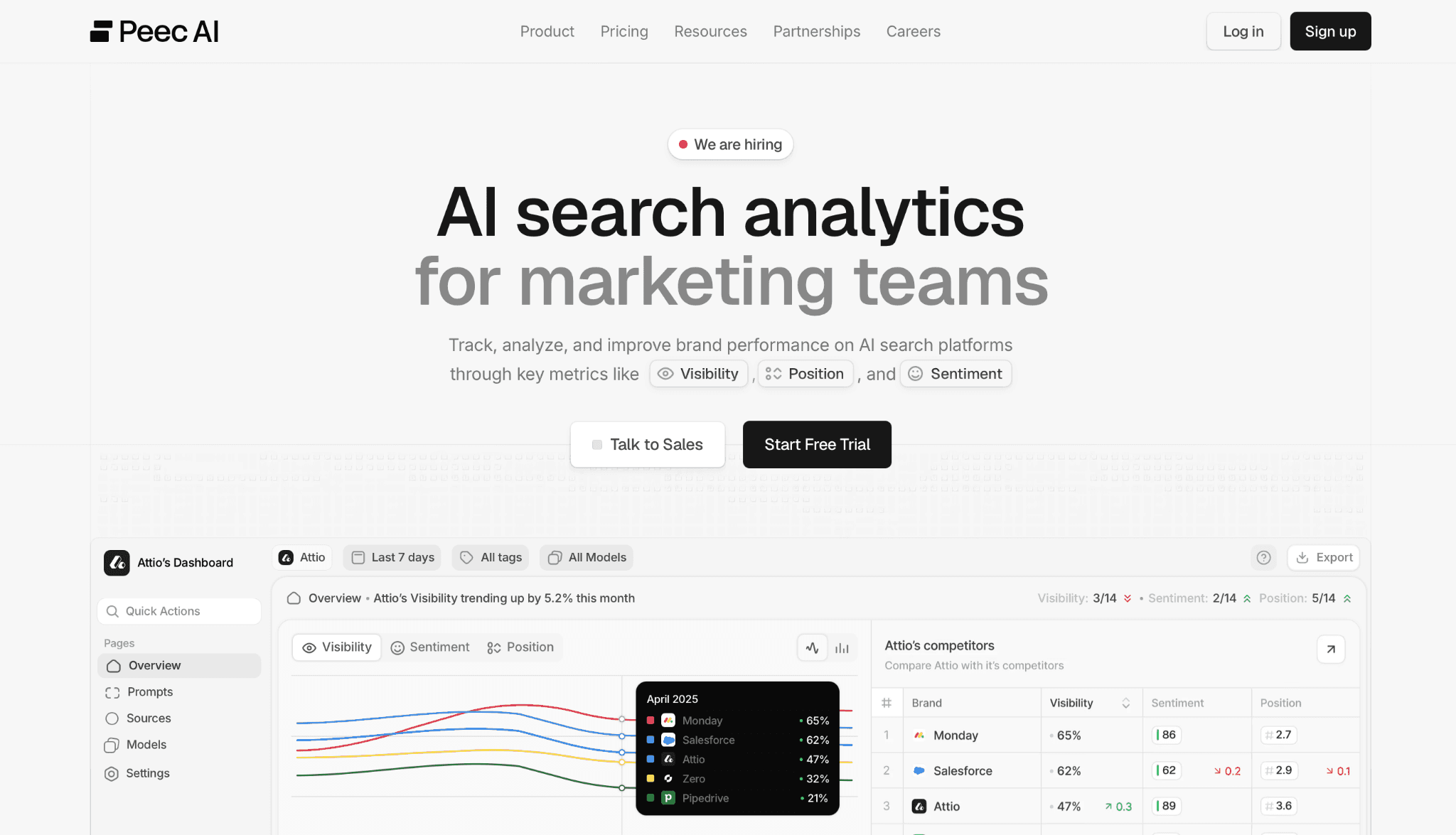
The platform is organized around clean analytics: you track how your brand appears across AI engines by prompt, see which sources are cited when competitors win answers you lose, benchmark share of voice over time, and export data to Looker Studio or CSV for client reporting. What G2 reviewers consistently highlight is the quality of the data and the support, with direct Slack access to the founding team on paid tiers cited as a consistent differentiator. Unlimited seats across all plans removes the per-user friction that hits agencies hardest. The gap, also consistent across reviews, is that Peec measures and flags, but the content creation and execution work sits entirely outside the platform.
Key features:
Prompt tracking with your choice of 3 engines from a pool of 6 on all self-serve plans: ChatGPT, AI Mode, Google AI Overviews, Microsoft Copilot, Perplexity, and Gemini. Claude, DeepSeek, and GPT-5 Search are available via API on Enterprise only.
Unlimited seats on every plan including Starter, a structural advantage for agencies billing by client rather than by head.
Source and citation tracking showing which domains AI engines cite when discussing your category, with a clear gap list of sources that mention competitors but not you, organized by type: competitor, brand, citation, UGC, and editorial.
Sentiment analysis tracking how AI models describe your brand over time, with alerts when mentions turn negative or when AI engines describe your category with inaccurate information.
115+ language support with multi-country tracking on Pro and above, and Looker Studio integration for automated client reporting on Advanced plans.
Pros and cons:
Pros:
4.9/5 on G2, with reviewers specifically praising setup speed, clean interface, and support quality
Unlimited seats on all plans makes per-seat economics genuinely attractive for agencies
GDPR-first architecture with EU data residency, a meaningful differentiator for European teams and regulated industries
UI scraping methodology rather than API calls means data reflects what users actually see in each AI platform
Cons:
No built-in content generation, no crawler log analysis, and no traffic attribution connecting AI visibility to actual revenue. One G2 reviewer noted that if your brand rarely appears in AI responses, the dashboard will mostly show zero mentions, making it less immediately useful for brands just starting to build AI presence.
Claude tracking and API access are Enterprise-only, limiting automation and integration on self-serve plans.
Teams without an analytics background may need more support while onboarding than the self-serve setup provides.

G2 rating: 4.9/5 (11 verified reviews, small sample size worth noting)
Pricing: Starter $95/mo (1 project, 1 country, choose 3 of 6 models) | Pro $245/mo (2 projects, 3 countries) | Advanced $495/mo (5 projects, 3 countries) | Enterprise custom (unlimited models, unlimited projects)
Verdict:
Peec AI is the strongest choice in the mid-market band for teams that want clean, daily AI visibility analytics with unlimited seats, solid geographic coverage, and a founding team that is genuinely responsive. The data quality and UI consistency are hard to argue with at its price tier.
The honest limitation is the same one that applies to most monitoring-focused tools: Peec shows you the problem clearly. Closing it requires content and PR work that happens outside the platform entirely. If that is a gap your team can handle independently, Peec is a strong fit. If you need the platform to route you to specific actions, something with a built-in recommendations layer will serve you better.
8. Rankability: Best for SEO agencies running the full content lifecycle alongside AI tracking
Rankability is a platform built specifically for SEO agencies, combining keyword research, content brief generation, content optimization, rank tracking, and AI visibility monitoring in one tool. Founded in May 2024 by Nathan Gotch and Simon L. Smith, it has grown to 7,000+ users across the agency community.

The differentiation is the combination. Most AI visibility tools track where your brand stands. Most content tools help you write. Rankability is one of the few that does both and connects them: the Researcher discovers keyword and prompt opportunities across Google, YouTube, Reddit, and AI platforms; the Copywriter drafts briefs grounded in both traditional SERPs and AI answer sources; the Optimizer scores content against competitors and provides an NLP-guided improvement checklist; and the Reporter tracks visibility across traditional search and five AI platforms in a unified index. All plans include unlimited clients and unlimited users, with plans differing only by monthly credit allotment, removing the per-seat and per-client costs that make agency tools expensive at scale.
Key features:
AI visibility tracking across ChatGPT, Gemini, Perplexity, Claude, and Copilot alongside traditional Google, Bing, and DuckDuckGo, all in a unified SPI visibility index, with all five AI engines included on every plan and no add-on fees.
Content Optimizer using NLP analysis from Google and IBM Watson, scoring existing and new content against top-ranking competitors and providing a prioritized checklist of specific topic and keyword changes.
Researcher tool discovering keyword and prompt opportunities across Google, YouTube, Reddit, and AI platforms, with built-in clustering and competitor gap analysis so prompts surface as a content plan, not a raw list.
Advisor tool connecting to Google Search Console, GA4, and Google Business Profile to surface weekly action plans grounded in actual performance data rather than modeled estimates.
API access and white-label reporting on every plan, with shareable client dashboards that agencies can deliver without exporting from a separate tool.
Pros and cons:
Pros:
5.0/5 on G2 and Capterra, with documented user results including 50+ position ranking jumps after running content through the optimizer
All 5 AI engines included on every plan, no per-engine add-ons at any tier
Unlimited clients and unlimited users on all plans, an unusual structure that keeps agency economics clean as headcount grows
API access on every plan, unusual for a platform at this price
Cons:
Even the Starter plan at $99/mo is designed around multi-client agency operations. Solo practitioners or small in-house teams without multiple paying clients may find it difficult to justify the cost relative to simpler alternatives.
No direct CMS integration on any plan. Content drafted in Rankability requires a manual copy-out step before publishing.
Credit cost transparency is the most commonly requested improvement.


G2 rating: 5.0/5
Pricing: Starter $99/mo | Growth $199/mo | Scale $399/mo | All plans include unlimited clients and unlimited users | Annual billing saves approximately 17%
Verdict:
Rankability makes the clearest case for agencies running active content programs for multiple clients who want AI tracking and content production consolidated in one workflow. The combination of prompt discovery, content briefing, optimization scoring, and AI visibility reporting in a single platform removes meaningful tool-switching overhead for teams doing all of those jobs simultaneously. Unlimited clients and users on every plan means the per-unit economics improve as the agency grows.
If your primary need is AI visibility monitoring and content production is secondary, the $99/mo Starter is more accessible than most agency-focused tools but the platform's architecture still favors teams running repeatable content operations rather than monitoring only.
9. AthenaHQ: Best for enterprise and ecommerce teams that need AI visibility tied to revenue
AthenaHQ is a premium GEO platform founded by Andrew Yan and Alan Yao, both alumni of Google Search and DeepMind, backed by Y Combinator with total seed funding of $2.7M. It sits at the top end of the market with the strongest action layer in the category and the only revenue attribution setup that connects AI citations directly to Shopify and GA4 sales data.
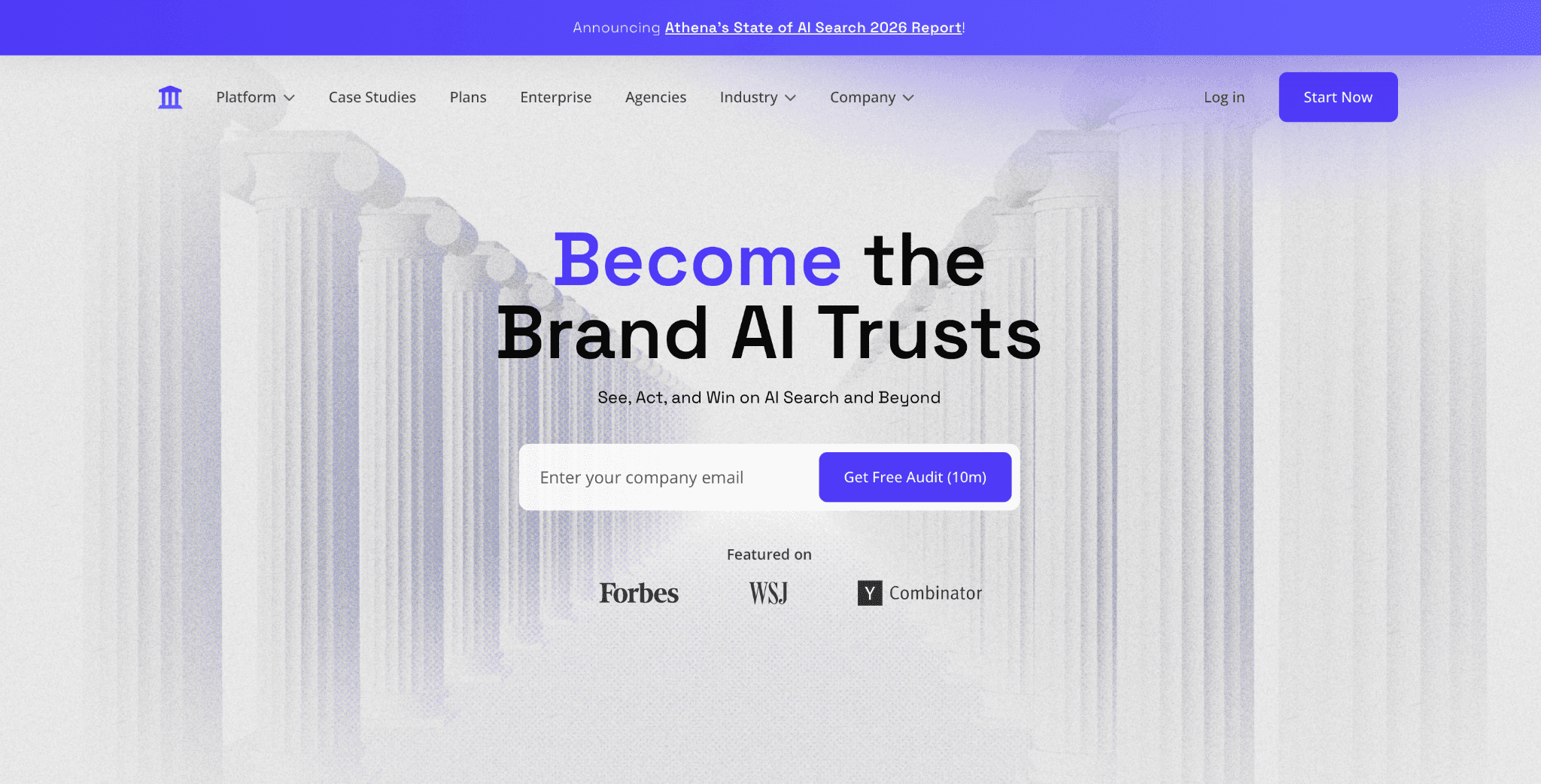
The platform runs on a monitor, analyze, act loop. The monitoring side tracks citations across eight AI platforms on every plan, no per-engine add-ons. The analysis side surfaces content gaps, prompt volume estimates, and competitor benchmarks. The action side deploys through the Action Center, which generates structured GEO optimization workflows with tasks that are assignable, trackable, and prioritized by estimated impact.
That third layer is what separates AthenaHQ from most tools in this category: rather than handing you a dashboard and stepping back, it hands you a weekly work queue with context on why each item matters. For ecommerce brands and large agencies that need to prove GEO ROI to a CFO, the Shopify and GA4 attribution takes it further, connecting AI citations directly to site visits, demo requests, and sales.
Key features:
Multi-engine tracking across 7 AI platforms on every plan: ChatGPT, Perplexity, Claude, Gemini, Copilot, Meta AI, Grok, and Google AI Overviews, with no per-engine add-ons or gated coverage tiers.
Action Center generating structured GEO optimization workflows with tasks that are assignable to team members, trackable to completion, and prioritized by estimated visibility impact. The most developed action layer currently available in the category.
Ask Athena AI copilot answering natural-language questions about your visibility data, such as "why did our ChatGPT mentions drop last week?" without requiring you to navigate to a specific report.
Revenue attribution via Shopify and GA4 integration, tracing AI citations through to actual sales and demo data. The only tool on this list connecting AI visibility to commercial outcomes directly.
Source Intelligence identifying the exact URLs AI engines reference when mentioning your brand, not just that a mention occurred, pointing your PR and content outreach to specific targets rather than broad categories.
Pros and cons:
Pros:
All 8 engines included from day one on every plan, the cleanest engine pricing structure on this list
Action Center is the most developed actionable workflow layer in the AI visibility category
Revenue attribution through Shopify and GA4 makes GEO ROI demonstrable, not just directional
Cons:
No free trial at $295/mo monthly entry. The ACE Citation Engine, multi-region tracking, and API access are all locked behind Enterprise custom pricing, which means the self-serve tier is meaningfully less capable than the full product.
The self-serve plan is limited to one country, which constrains any global brand evaluating the platform before committing to Enterprise.
The pace of product iteration is the friction point users flag most consistently, and it is worth factoring in if your team does not have a dedicated person managing the platform.

G2 rating: 4.9/5
Pricing: Free plan available | Self-Serve $295/mo monthly ($245/mo annual) | Enterprise custom
Verdict:
For enterprise brands and ecommerce companies with a real GEO budget, AthenaHQ is the most capable platform available. The Action Center, eight-engine coverage, and revenue attribution combination does things no other tool on this list does at the same level of maturity.
For everyone else, the pricing structure works against it. At $295/mo with no free trial, the ACE Citation Engine locked behind Enterprise, and a product that moves fast enough to require active management, the self-serve tier asks a lot before it gives you its best features. If you are evaluating your first AI visibility tool or working within a constrained budget, start further up this list and come back to AthenaHQ when you are ready to invest at this level.
How to Choose the Right Otterly Alternative
Seven tools is a lot to weigh. Skip the feature-list comparison and answer three questions about your own situation instead.
1. Are you replacing a monitoring tool or buying an action layer?
Otterly is a monitoring tool. If the reason you are leaving is that it does not tell you what to do next, buying another monitoring tool solves nothing. Peec AI, SE Ranking's AI add-on, and the base Writesonic tiers are all still primarily trackers. AIclicks, AthenaHQ, and Rankability are built around closing the loop from insight to task. Know which one you actually need before you sign up.
2. What does the real monthly cost look like?
Several tools on this list have a gap between the headline price and what you will actually pay. SE Ranking's AI tracking is a separate add-on. Peec AI's base plan gives you three engines and additional ones cost extra. Writesonic's Action Center requires Enterprise. AthenaHQ has no free trial at $295/mo. Work out the number you will actually pay for the engines, seats, and features you genuinely need, not the number on the pricing page.
3. Do you need a standalone tool or something that fits an existing stack?
If your team already runs inside SE Ranking for SEO, the AI Search add-on keeps data in one place and that has real workflow value even with the added cost. If AI visibility is becoming a primary channel rather than a reporting footnote, a platform built around it from day one will serve you better than a module bolted onto an SEO tool.
One last thing: most of these tools offer a free trial. Use it. A week of hands-on testing tells you more than any comparison table, including this one.
Go With the #1 Otterly Alternative: AIclicks
Here is the honest summary after seven tools: there is no universal best. There is only the best fit. Peec AI makes sense for mid-market teams that want clean analytics and unlimited seats. SE Ranking makes sense for agencies already paying for the platform. Rankability makes sense for content-heavy agencies that need research and tracking in one workflow. AthenaHQ makes sense for enterprise teams that need to tie AI visibility to revenue. Each one earns its place for some team.
But most people reading an "Otterly alternatives" article want the same two things: accurate visibility data without Otterly's pricing cliff, and a clear answer on what to actually do with it. That is the exact gap AIclicks is built to close. It tracks 10+ AI platforms through their real interfaces, not API approximations, and turns that data into a ranked action plan instead of another dashboard to decode.
The tools that win in 2026 are not the ones with the prettiest charts. They are the ones that answer the only question that matters: what do I do next? If that is what you are after, AIclicks is the most direct way to get it.
Start your free AIclicks trial and see where your brand stands across AI search, and get your action plan in minutes.
Frequently Asked Questions
1. What is Otterly AI, and why do people look for alternatives?
Otterly AI is an AI search monitoring platform that tracks how brands appear in AI-generated answers across ChatGPT, Perplexity, Google AI Overviews, and other engines. Teams look for alternatives mainly because of its pricing structure (the $29/mo Lite plan covers only 15 prompts across 4 core engines, with Gemini and AI Mode as paid add-ons), the monitoring-without-action gap, and the absence of Claude tracking on any self-serve plan.
2. What is the cheapest Otterly AI alternative?
AIclicks starts at $59/mo and adds a built-in recommendations engine and 10+ engine coverage, which makes it a strong value pick once you factor in what you would otherwise spend acting on the data manually. For teams that only need lightweight monitoring layered onto an existing SEO platform, SE Ranking adds AI tracking as an add-on to its $103.20/mo Core plan.
3. Is GEO (Generative Engine Optimization) still worth investing in?
GEO is no longer a new or speculative idea, it has been a defined discipline for well over a year with established tools, case studies, and measurable results. With AI search now part of how a large share of buyers research products, ignoring AI visibility means ignoring a real and growing slice of demand.
4. Do I need a separate GEO tool if I already use Semrush or SE Ranking?
Not necessarily. Both Semrush (AI Visibility Toolkit) and SE Ranking (AI Search add-on) offer AI visibility modules that integrate with their core platforms. If you already live in one of those tools, the add-on is the convenient choice. If AI visibility is becoming a core channel, a dedicated platform like AIclicks will usually give you more engine coverage and better action guidance.
5. What is the difference between monitoring and optimization tools?
Monitoring tools tell you what is happening: where your brand appears, who outranks you, which sources get cited. Optimization tools go further and tell you what to do: prioritized content, citation, and outreach actions. Many teams underestimate this distinction and end up buying a dashboard when they needed a roadmap. AIclicks, AthenaHQ, and Rankability lean toward optimization; Peec AI, SE Ranking, and base Writesonic tiers lean toward monitoring.
6. How many AI platforms should a good visibility tool track?
Coverage matters because every untracked engine is a blind spot. The minimum that gives a real picture in 2026 is five: ChatGPT, Perplexity, Google AI Overviews, Gemini, and Claude. Tools that gate two or three of those engines behind add-ons effectively have lower base coverage than their marketed engine count suggests. AIclicks tracks 10+, AthenaHQ covers 8 on every plan, and Rankability's Agency plan unlocks 9.



Any questions left?
Book a call here: