" width="14px"><path d="M 13.864 5.629 L 13.3 5.629 L 13.3 5.6 L 7 5.6 L 7 8.4 L 10.956 8.4 C 10.379 10.03 8.828 11.2 7 11.2 C 4.681 11.2 2.8 9.319 2.8 7 C 2.8 4.681 4.681 2.8 7 2.8 C 8.071 2.8 9.045 3.204 9.786 3.864 L 11.766 1.884 C 10.516 0.719 8.844 0 7 0 C 3.134 0 0 3.134 0 7 C 0 10.866 3.134 14 7 14 C 10.866 14 14 10.866 14 7 C 14 6.531 13.952 6.073 13.864 5.629 Z" fill="rgb(255, 193, 7)" height="14px" id="H_YjfTNpn" width="14px"/><path d="M 0 3.742 L 2.3 5.429 C 2.922 3.888 4.429 2.8 6.193 2.8 C 7.264 2.8 8.238 3.204 8.979 3.864 L 10.959 1.884 C 9.709 0.719 8.037 0 6.193 0 C 3.504 0 1.172 1.518 0 3.742 Z" fill="rgb(255, 61, 0)" height="5.428500000000002px" id="PlkthQDhg" transform="translate(0.875 0)" width="10.959199999999996px"/><path d="M 6.232 5.581 C 8.04 5.581 9.683 4.889 10.925 3.764 L 8.758 1.931 C 8.032 2.483 7.144 2.782 6.232 2.781 C 4.411 2.781 2.865 1.62 2.283 0 L 0 1.759 C 1.159 4.026 3.511 5.581 6.232 5.581 Z" fill="rgb(76, 175, 80)" height="5.581099999999999px" id="WlnJ5gngE" transform="translate(0.7 8.4)" width="10.924899999999994px"/><path d="M 6.864 0.029 L 6.3 0.029 L 6.3 0 L 0 0 L 0 2.8 L 3.956 2.8 C 3.68 3.576 3.183 4.254 2.526 4.75 L 2.527 4.749 L 4.693 6.582 C 4.54 6.722 7 4.9 7 1.4 C 7 0.931 6.952 0.473 6.864 0.029 Z" fill="rgb(25, 118, 210)" height="6.589883930775992px" id="x_rSW275p" transform="translate(7 5.6)" width="7px"/></g></svg>)


Reviewed by:
Matas Kibildis

Head of Growth @ aiclicks.io
Last updated:
Expert Verified

Disclosure: AIclicks appears on this list and it's our AI visibility tool. Every price and feature below was read off the vendor's own pricing page or product documentation in August 2026, with links so you can check us. Where a vendor gates its pricing behind a login, we say so.
Almost everyone who searches for a Rankscale alternative arrives with one of three complaints.
The first is the credit meter. You picked a plan, tracked a reasonable prompt set, added Claude because your buyers use it, and watched the allowance disappear two weeks into the month.
The second is scope. Rankscale tells you where you stand and who gets cited instead of you. It does not write the page, pitch the source, or connect any of it to traffic in GA4.
The third is engine count, and this one is usually a misunderstanding. Rankscale's "17+" figure counts model variants rather than seventeen assistants, but the ten platforms it does cover are more than most tools on this list give you at any self-serve price.
The ten Rankscale alternatives below are sorted by which of those three problems they actually solve, with every price read off the vendor's own page in August 2026.
How We Evaluated These Tools
Here are five things decided the rankings:
Cost per prompt-and-engine pair, not sticker price. Semrush's $99 buys 100 pairs a month. Gauge's $599 buys 108,000 answers.
Engines on the plan you would actually buy. Writesonic advertises ten platforms and ships three on every self-serve tier.
Pricing shape. Flat, per-prompt, per-domain or per-credit decides your month-six invoice.
Refresh rate at entry. Three tools here quietly refresh weekly at the bottom tier.
What happens after the dashboard. Recommendations, content, outreach targets, or nothing.
Rankscale AI Alternatives Compared
Tool | Best For | Entry Price | Engines at entry | Free Trial |
AIclicks | Tracking that ends in a task list | $59/mo | 3 (10+ available) | 3 days |
Peec AI | Marketing teams that want clean reporting | $95/mo | 3 (choose from 6) | 7 days |
Otterly AI | Solo marketers validating the channel | $29/mo | 4 | Yes, no card |
AI Peekaboo | Configurable pricing instead of credits | $30/mo | 5 (7 available) | 14 days, card required |
Gauge | High prompt volume with content included | $599/mo | 6 | 1 week |
xSeek | Teams that want a strategist attached | $249.99/mo | 7 | No, 30-min call |
Writesonic | Tracking plus article production | $79/mo (annual) | 3 | Yes |
Semrush AI Visibility Toolkit | Existing Semrush accounts | $99/mo per domain (annual) | 4 | No |
SE Visible (SE Ranking) | SEO and GEO on one invoice | $99/mo, or $89/mo add-on | 6 | 10 days |
Ahrefs Brand Radar | Category-level share of voice | $199/mo per index, $699 for all | 1 per index, 6 at $699 | Free checker |
Surfer AI Search Analytics | Content teams already in Surfer | $158/mo (annual) | 5 | No, 7-day refund |
Rankscale for reference: Essentials $20/mo, Pro $99/mo, Growth $385/mo, Enterprise $780/mo, credit-based. Prices verified on each vendor's pricing page, August 2026.
1. AIclicks
Best for: Teams whose problem is execution, not measurement
About AIclicks
AIclicks was built around the complaint this whole article is organised around: the dashboard is fine, nobody has time to act on what it says.
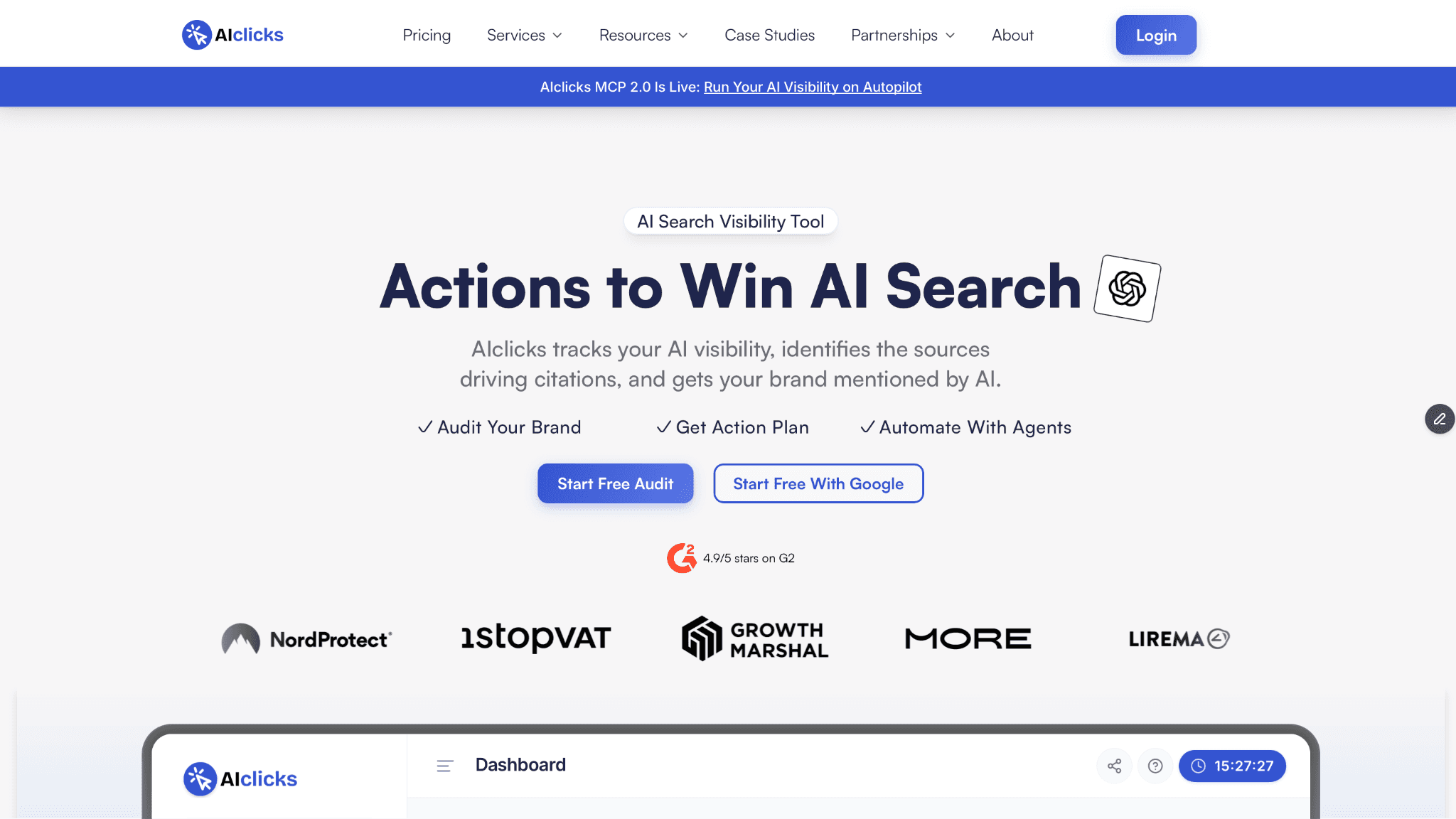
It tracks prompts across 10+ platforms including ChatGPT, Gemini, Perplexity, Claude, Google AI Overviews, AI Mode, Copilot, Grok, DeepSeek, and Meta AI, and it queries the real chat interfaces rather than the APIs. That distinction decides what you see. The chat interface is where live web retrieval, citations and ranked sources appear, so the answers AIclicks records are the ones your buyers get.
Pricing is flat. A prompt costs the same whether it runs against ChatGPT or Claude, which removes the engine-mix budgeting problem that Rankscale credits create. Every tracked prompt feeds a Recommendations tab that ranks next moves by expected impact: content to publish, high-authority domains to pitch, community threads worth joining. Pro and above connect Google Analytics so visibility ties back to real AI referral traffic, and ship an MCP server that pipes gaps into Claude or Cursor for fixing.
Key features
Prompt tracking across 10+ AI platforms via real chat interfaces, refreshed daily
Recommendations tab ranking content, outreach and community actions by expected impact
5 to 30 AI-optimised articles per month included in the plan, depending on tier
Citation source analysis showing which domains AI answers pull from in your category
GA4 connection, REST API, MCP server and CMS publishing from Pro upward
Unlimited websites and unlimited countries from Pro
Pros
Flat per-prompt pricing with no engine weighting or credit meter
Article production included rather than sold as an add-on
Country and model-level filtering on every plan
Cons
The 3-day trial is short but you can ask for extension
GA4, API and MCP access do not start until Pro at $189/mo
Pricing: Paid plans start at $59/mo, with a 3-day free trial (cancel before day 3 and you pay nothing). See plans.
Verdict: If the Rankscale complaint you recognise is the credit math, AIclicks solves it structurally: the bill does not move when you add Claude to a prompt set. If it is that tracking ends at a chart, the Recommendations tab and the included article allowance answer that. The honest trade is a three-day trial that assumes you arrive knowing which prompts matter.
2. Peec AI
Best for: In-house marketing teams that want reporting a CMO can read
About Peec AI
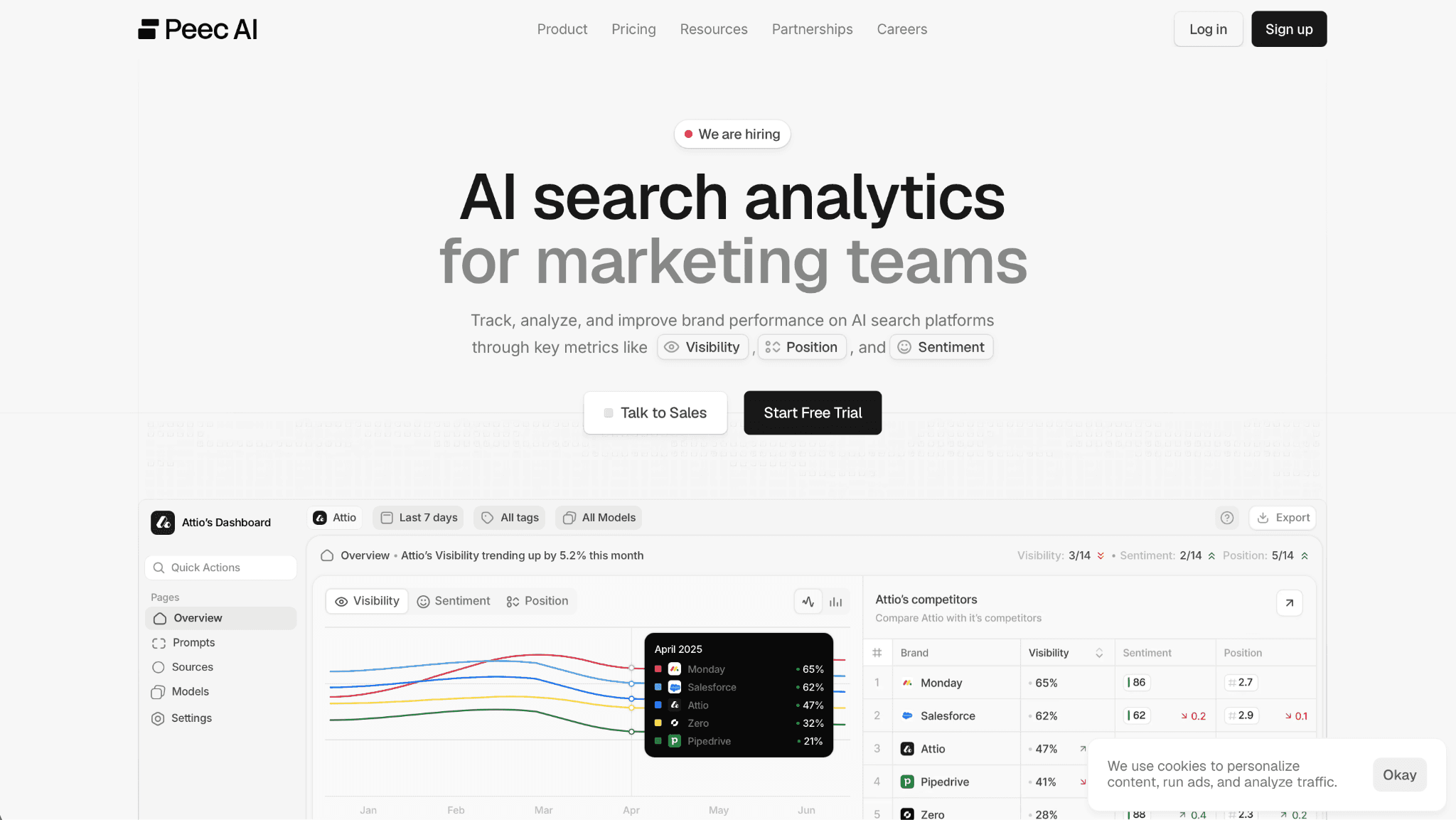
Peec AI is the Rankscale alternative for teams whose objection is interface density, not price. The Berlin team has made reporting clarity the product: visibility, position and sentiment across ChatGPT, Google AI Mode, AI Overviews, Gemini, Perplexity and Copilot, collected by scraping the real chat interfaces rather than calling APIs.
Clickstream data estimates how popular each query actually is, which stops teams tracking prompts nobody asks. The constraint sits in the model count, since every self-serve tier includes three engines and that number never rises.
Key features
Visibility, position and sentiment tracking across six AI platforms, refreshed daily
Clickstream-informed prompt popularity data
Citation source reporting showing which third-party sites feed answers in your space
MCP server and API for querying visibility data from Claude, Cursor or n8n
Shopping analytics for product-level AI visibility
Unlimited user seats on every tier
Pros
Cleanest reporting interface in the category
Unlimited seats, which suits agencies adding client viewers
7-day trial with no credit card
Cons
Three models on every self-serve plan; a fourth costs $35 to $165/mo depending on tier
Claude sits behind an Enterprise contract
Reviewers consistently describe it as a tracking dashboard rather than an optimisation engine
Pricing: Paid plans start at $95/mo, with a 7-day free trial and unlimited seats on every tier. Peec publishes pricing in-app rather than on an indexable page.
Verdict: Peec is right when the person who needs to understand the data is not the person collecting it. Nothing here makes a share-of-voice trend more legible to leadership. The wall arrives at renewal, since three models plus two add-ons on Pro lands near $415/mo for six engines, monitoring only, with no article production attached. Teams that hit it start comparing Peec AI alternatives.
3. Otterly AI
Best for: Solo marketers and small teams proving AI search matters before spending real money
About Otterly AI
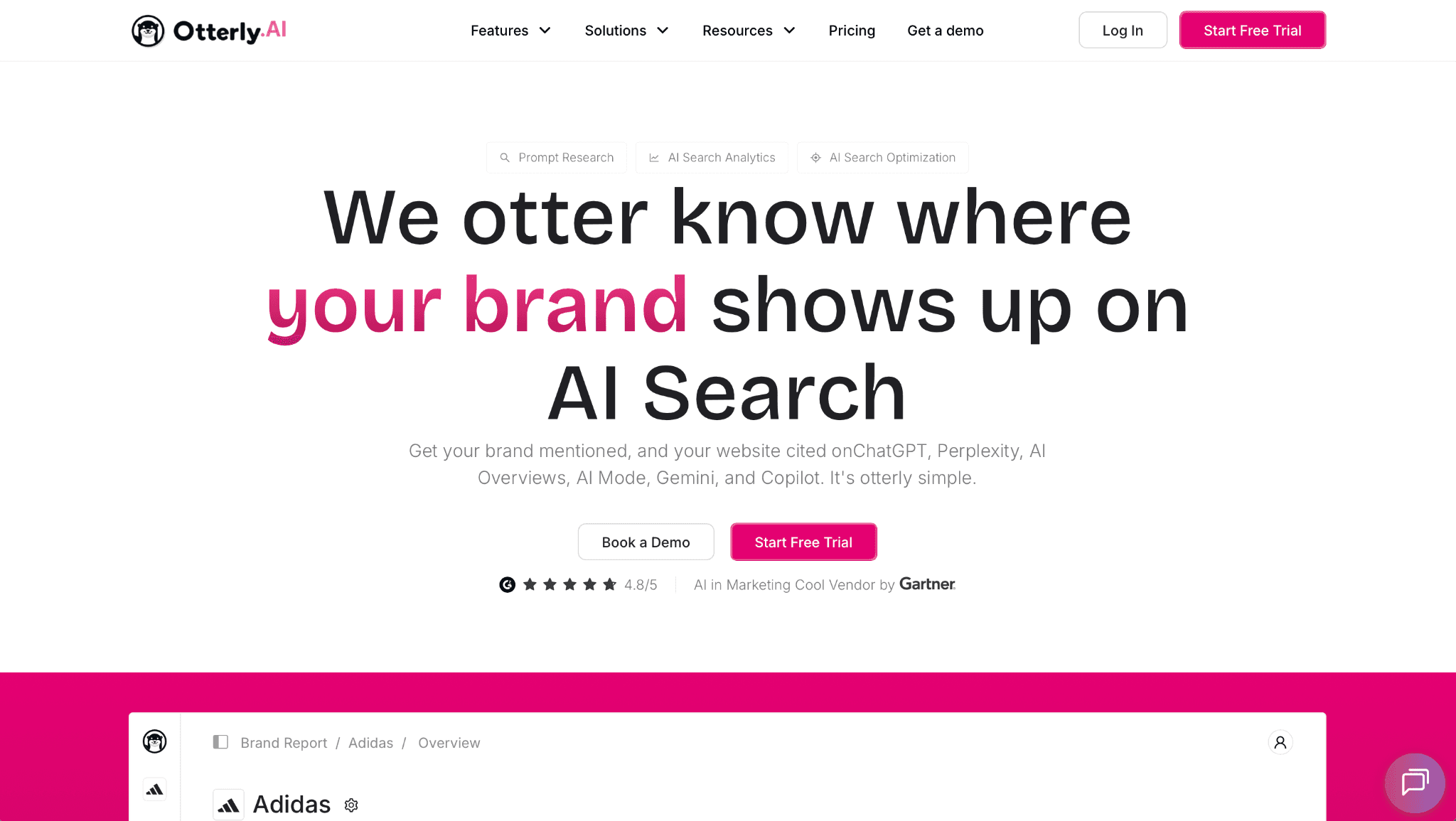
Otterly AI's bet is that most teams should not pay $200 a month to answer a question they have not asked yet. Fifteen prompts, four engines, daily refresh, $29, public signup, no sales call.
The base engines are ChatGPT, AI Overviews, Perplexity and Copilot; Gemini, AI Mode and Claude are paid add-ons at every tier. The underrated piece is the GEO audit, which checks whether AI crawlers can reach and extract your pages before you spend anything on tracking them.
Key features
Daily tracking across four base engines, with Gemini, AI Mode and Claude as paid add-ons
AI Prompt Research for finding the questions buyers actually ask
GEO audit checking AI crawler access and content extractability, 1,000 URLs on Lite
Multi-country monitoring across 50+ markets, even on the entry plan
Public REST API and an official MCP server from Standard upward
Unlimited team members on all plans
Pros
Lowest real entry price in the dedicated category
Four engines at the bottom tier instead of gating them behind an upgrade
Free trial with no credit card
Cons
Claude costs $29, $109 or $439/mo on top, depending on your tier
15 prompts do not roll over and go quickly on a real product line
API and MCP do not exist below the $189 Standard plan
Pricing: Paid plans start at $29/mo, with a free trial and no card required. See plans.
Verdict: Twenty-nine dollars to learn whether AI search is a channel for you is a fair trade, and Otterly does that job better than anything here. The trouble is month four. Adding Gemini, AI Mode and Claude to Standard pushes you past $400 for 100 prompts, which is more than flat-priced tools charge with those engines already included. That ceiling is why scaling teams compare Otterly AI alternatives.
4. AI Peekaboo
Best For: Agencies and brands who want configurable, usage-based pricing instead of Rankscale's credit system.
About AI Peekaboo
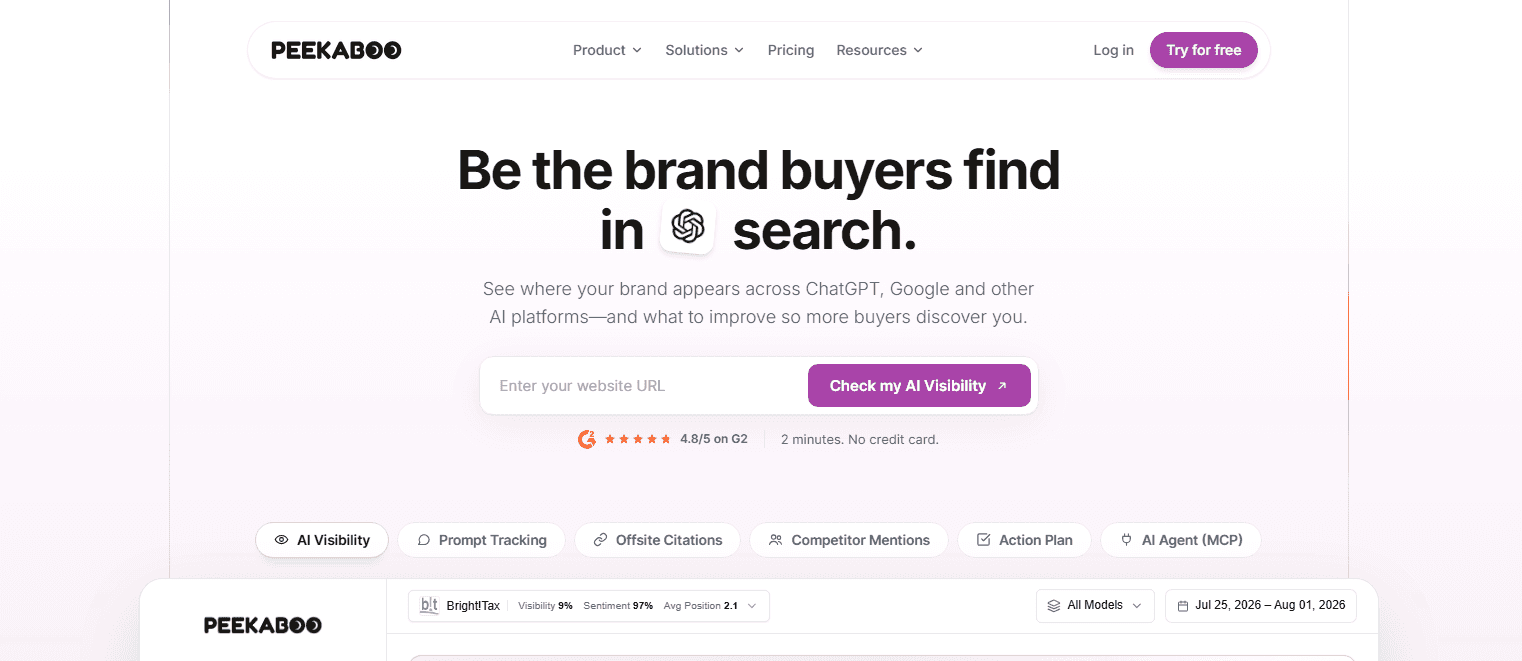
Where Rankscale bills by credits, one credit per AI response, AI Peekaboo uses fully configurable pricing: choose how many brands, prompts and AI models to track, and the price adjusts accordingly, starting at $30/month. It tracks ChatGPT, Gemini, Perplexity, Google AI Overviews and Google AI Mode, with Claude and Copilot as add-ons, and offers white-label reporting on plans from $100/month.
Key Features:
Fully Configurable Pricing: Predictable, usage-based cost instead of a credit system.
Up to 7 AI Engines Tracked: Five core engines, plus Claude and Copilot as add-ons.
Multi-Brand Tracking: Track from 1 to 150+ brands, with custom pricing for larger agencies.
API and MCP Access: Read/write access for pulling data into other tools.
Pros:
Configurable, predictable pricing versus Rankscale's credit-based model.
Unlimited team seats, so adding teammates doesn't raise the bill.
Search Console and GA4 integration ties AI visibility to real site traffic.
Cons:
Doesn't cover some niche models Rankscale tracks, like DeepSeek or Mistral.
Claude and Copilot cost extra, and white-label reports only unlock at $100/month.
Pricing: From $30/month, fully configurable based on brands, prompts, models tracked and check frequency. 14-day trial on plans under $100/month, card required.
Verdict: Rankscale's weak spot isn't its entry price. At $20/mo it still undercuts AI Peekaboo. The weak spot is not knowing whether your credits will last the month. AI Peekaboo fixes that by letting you size the plan upfront and pay the same amount every month. You give up a few of Rankscale's niche engines like DeepSeek and Mistral, but you get Search Console and GA4 context plus API and MCP access from the entry plan. Most tools in this article only include those on higher tiers.
5. Gauge
Best for: Teams that want tracking volume and content production in one tool
About Gauge
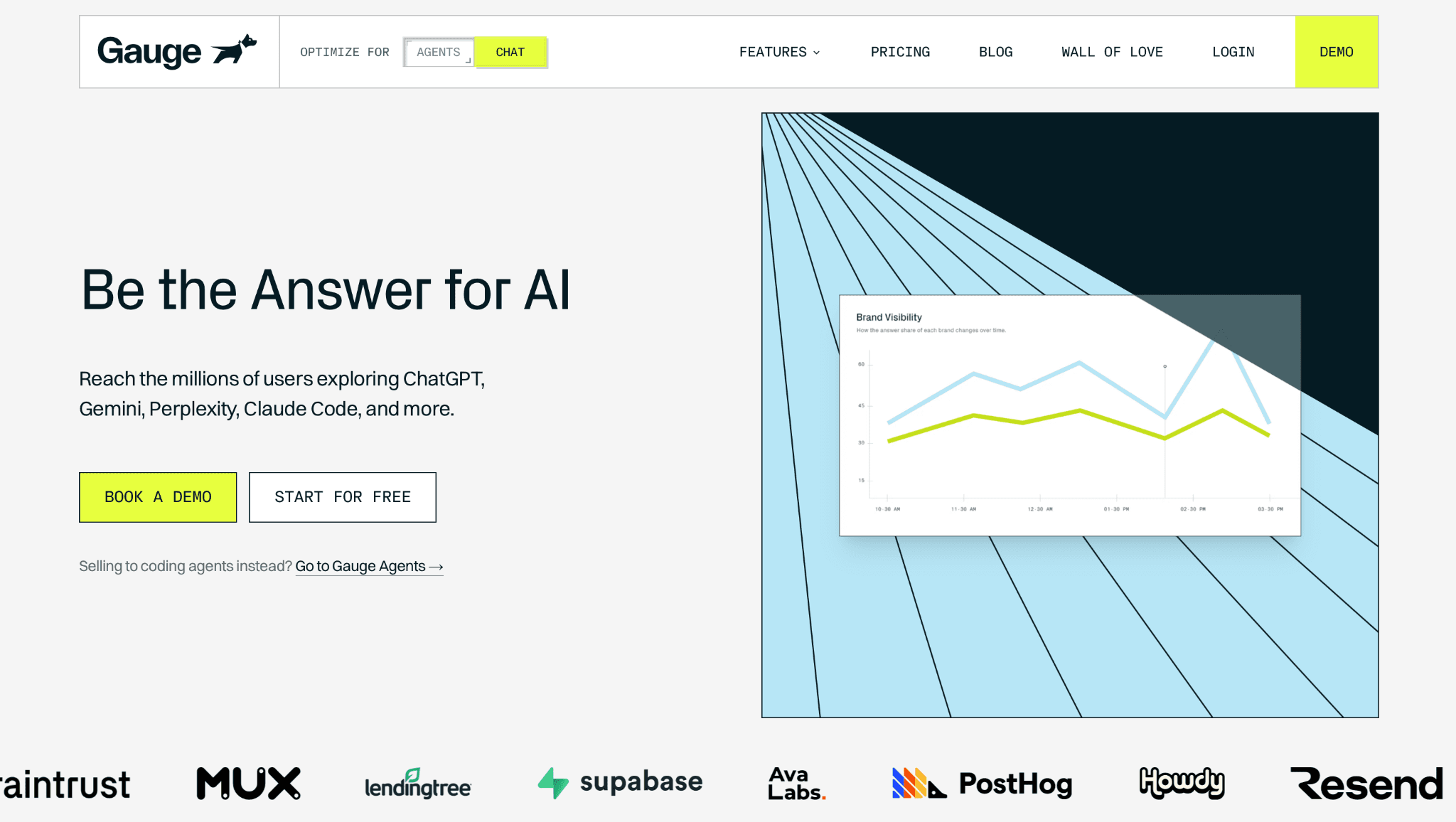
Gauge takes the opposite position to Rankscale on pricing philosophy. Where Rankscale meters consumption, Gauge sells one large plan and dares you to use it: 600 prompts, run daily, across six platforms, which works out to 108,000 answers a month at roughly half a cent each.
Growth bundles a content engine producing 18 publish-ready articles, an Ask Gauge agent, an Action Center and a ChatGPT ads tracker. Claude and Grok run on your own Anthropic or xAI API key, billed separately by those providers.
Key features
600 prompts refreshed daily across six platforms, 108,000 answers monthly
Content engine producing 18 publish-ready articles per month, with CMS publishing
Ask Gauge agent with unlimited chats against your visibility data
Claude and Grok tracking via your own API key on any plan
GA4, Search Console and DataForSEO integrations, plus MCP access
10 seats and unlimited domains and competitors on Growth
Pros
Best cost per tracked answer of anything here, by a wide margin
Content production and the agent are included, not add-ons
1-week free trial that starts running your prompts the same day
Cons
$599/mo is a hard floor with nothing below it
Growth covers a single location, so multi-market brands need Enterprise
Claude and Grok mean a second bill from Anthropic or xAI
Pricing: One paid plan at $599/mo, with a 1-week free trial. Enterprise is custom. See plans.
Verdict: Gauge is the pick if your prompt set is genuinely large and you currently pay for a tracker plus a content agency. At 600 daily prompts, nothing here matches its unit economics. It is wrong for anyone tracking 40 prompts, or anyone working more than one market, since Growth covers a single location at $599 and multi-country tracking means an Enterprise conversation.
6. xSeek
Best for: Teams with no in-house AI search expertise who want a person, not a login
About xSeek
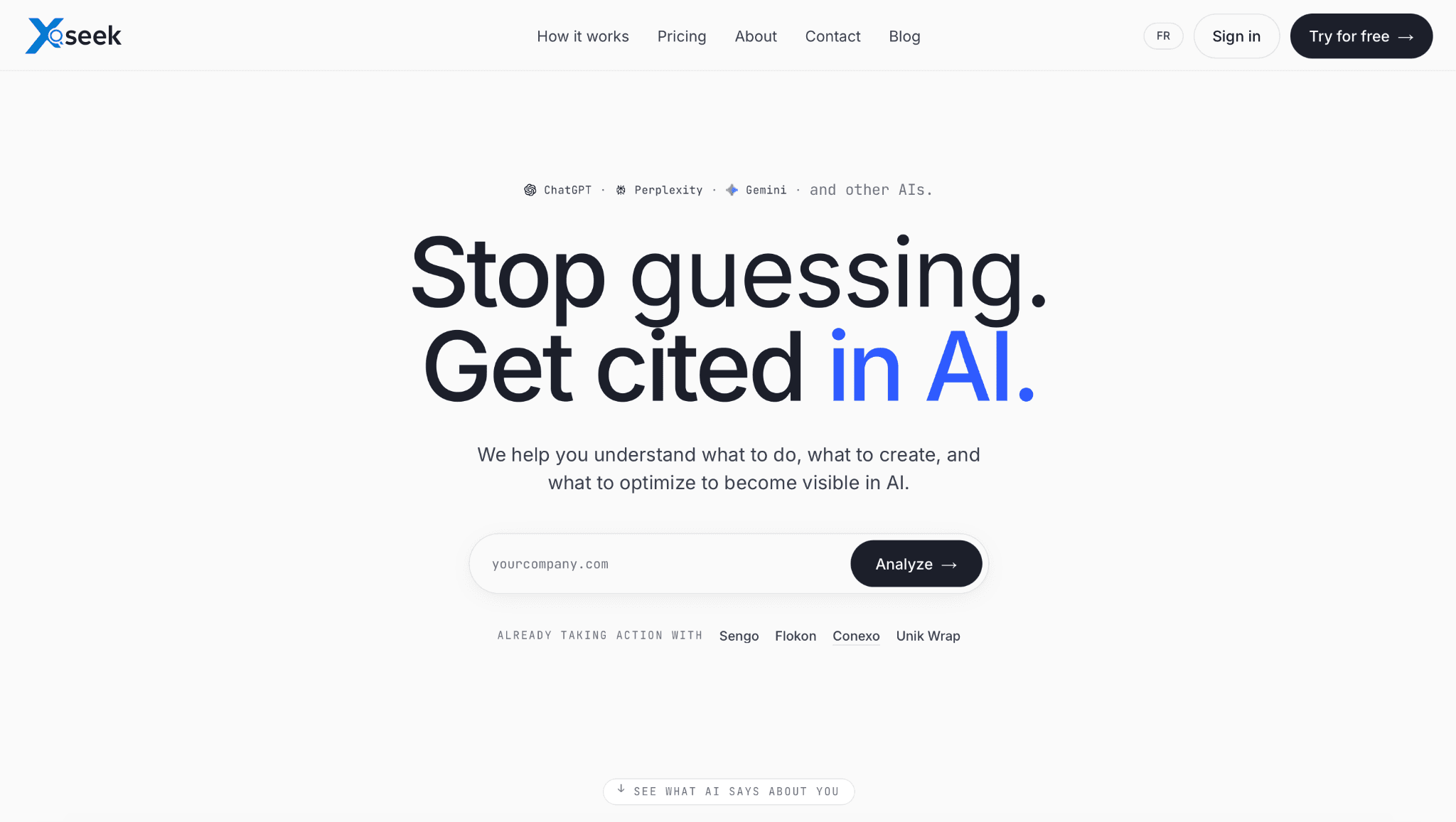
xSeek's bet is that the bottleneck is not data, it is that nobody on the team knows what to do with it. So every plan, including the $249.99 entry tier, comes with a dedicated account specialist and an onboarding session where someone sets up your prompts and competitors with you.
Coverage is broad for the money: ChatGPT, Perplexity, Gemini, AI Overviews, Claude, Grok and Copilot, all seven on every tier. The output is a fixed number of ranked opportunities each month rather than an open-ended dashboard.
Key features
Seven AI engines on every plan, Claude and Grok included at entry
Dedicated account specialist and strategic onboarding on all tiers
Ranked monthly opportunity list rather than an open-ended dashboard
Backlink Agent for AI-focused outreach and link exchange, Growth and up
Unlimited users on every plan
Pros
Broadest engine coverage at entry price of anything on this list
Human guidance included rather than sold as onboarding
Monthly billing with no annual lock-in
Cons
No free trial and no demo video; the company routes everyone to a 30-minute call
50 prompts on Starter for $249.99 is expensive per prompt
One website on Starter, three on Growth
Pricing: Paid plans start at $249.99/mo, billed monthly. No free trial, and buyers are routed to a 30-minute call. See plans.
Verdict: The per-prompt maths looks poor until you remember you are buying a strategist with a dashboard attached. For a marketing lead with no GEO experience, $249.99 beats hiring one. For anyone who already knows which prompts matter and what to do about them, you are paying a premium for guidance you will not use, and the missing trial is real friction.
7. Writesonic
Best for: Content teams that want AI visibility tracking and article production in the same tool
About Writesonic
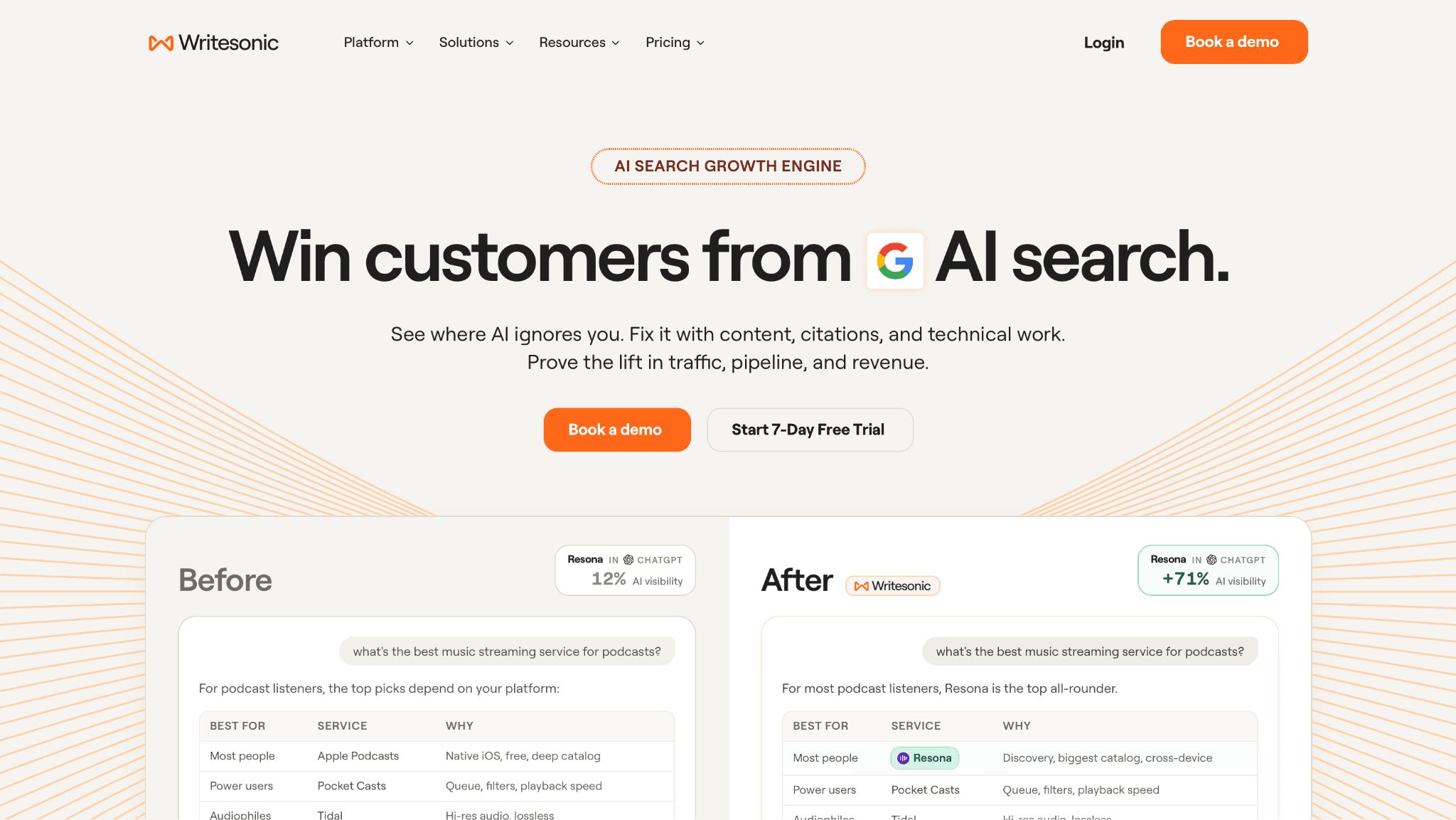
Writesonic started as an AI copywriting tool and has repositioned around AI search visibility, combining prompt tracking, an Action Center that executes fixes rather than listing them, an AI article writer, site audits and agentic workflows.
It runs one of the larger proprietary prompt datasets in the category. The problem is where the good parts sit. Every self-serve tier tracks exactly three platforms: ChatGPT, Gemini and AI Overviews. Perplexity, Claude, Copilot, Grok, DeepSeek, Meta AI and AI Mode are Enterprise-only, and so is the full Action Center.
Key features
Prompt tracking across ChatGPT, Gemini and AI Overviews on self-serve, all 10 platforms on Enterprise
Action Center classifying and executing off-page, on-page and technical fixes
AI article writer, 15 to 50 articles per month by tier
Site audits up to 2,500 pages per audit on Growth
ChatGPT and Google AI ads monitoring on every tier
Pros
Genuinely strong content production alongside tracking
Ads monitoring included at every tier, which most tools charge for
SOC 2, HIPAA and SSO available for regulated buyers
Cons
Three platforms on every self-serve plan; the other seven require Enterprise
One market (language plus country) on Starter, Basic and Growth
Extra seats cost $50/user/mo, capped at 3 on Basic and 2 on Growth
Pricing: Paid plans start at $79/mo billed annually, with a free trial and no card required. See plans.
Verdict: Buy Writesonic for the content engine and the ads data, both of which are strong. Understand that a Rankscale user accustomed to ten platforms on a $20 plan gets three here for $399, and broad coverage means a sales conversation. Compare it against a flat-priced GEO tool before signing an annual contract.
8. Semrush AI Visibility Toolkit
Best for: Teams already inside Semrush who want to track AI visibility
About the Semrush AI Visibility Toolkit
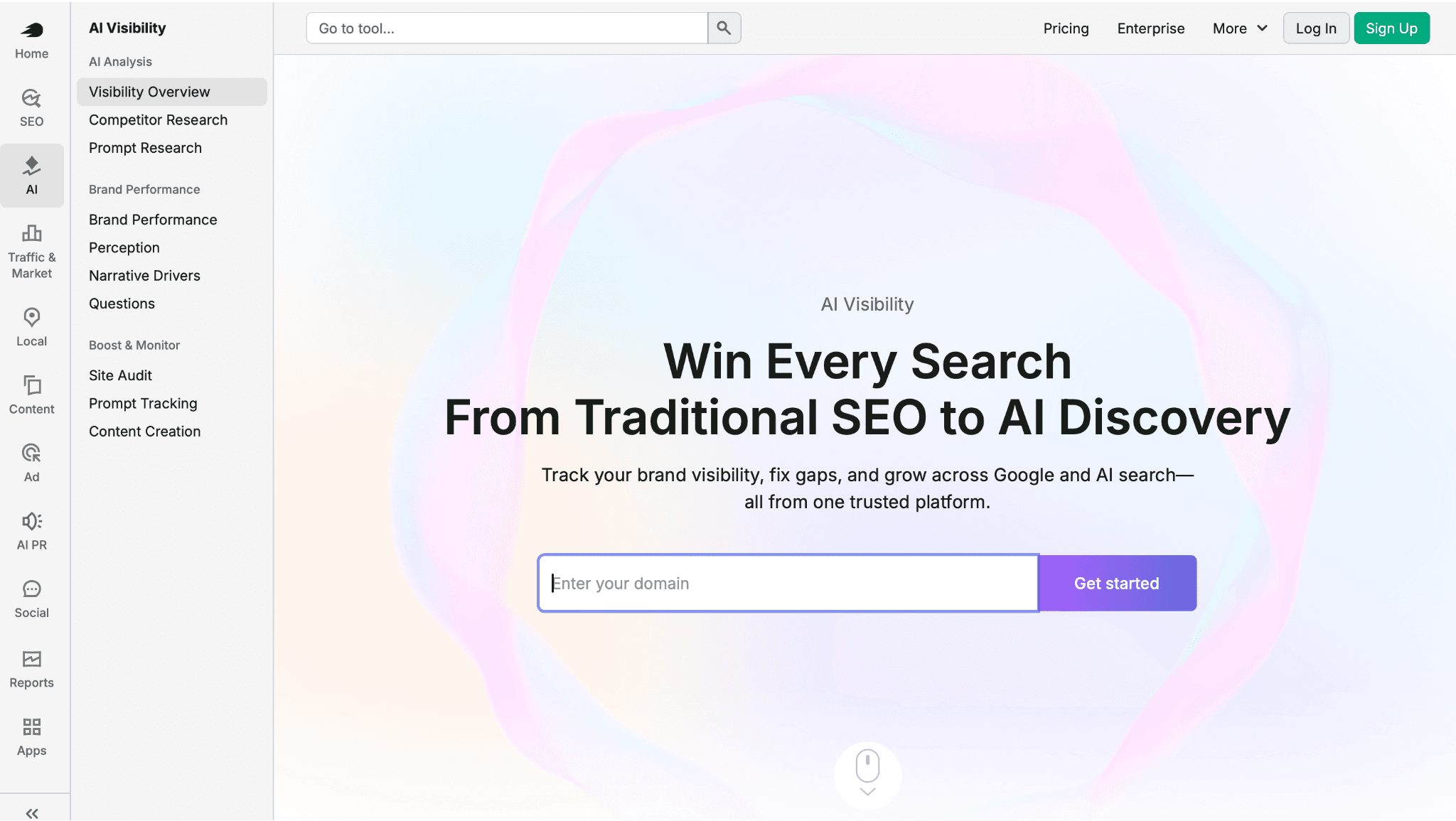
Semrush sells AI visibility as a per-domain add-on rather than a plan: $99/mo per domain, covering mentions from ChatGPT, Google AI, Gemini and Perplexity with 25 custom prompts on daily rankings, one domain of Brand Performance analysis and one licensed user.
The underlying prompt dataset is one of the largest in the category and drives prompt research with real volume and intent data, which is the module's genuine advantage over dedicated trackers. The per-domain unit is where it gets expensive, since every extra domain and every extra seat costs another $99/mo.
Key features
25 custom prompts with daily AI rankings on the base package
Coverage of ChatGPT, Google AI, Gemini and Perplexity
Prompt research with search volume and intent data from Semrush's prompt index
Brand Performance analysis and sentiment reporting
Content Analyzer scoring pages for AI extraction
Free AI Visibility Checker for a first look without paying
Pros
Four engines at $99 beats several funded specialists on coverage per dollar
Prompt volume data that dedicated trackers cannot match
The free checker gives you a read before any commitment
Cons
Per-domain and per-seat pricing stacks badly for agencies
25 prompts across four engines is 100 prompt-and-engine pairs, which is thin
No Claude, Copilot, Grok or DeepSeek; no free trial on the toolkit itself
Pricing: $99/mo per domain, billed annually. No free trial on the toolkit, though the AI Visibility Checker is free. See plans.
Verdict: For a single brand already running Semrush, this is the lowest-friction way to add AI tracking, and the prompt volume data justifies it on its own. For an agency, the per-domain unit makes it the most expensive option on this page. Multiply your client count by $99 before the headline number gets exciting.
9. SE Visible (SE Ranking)
Best for: Teams that refuse to split SEO and GEO across two tools
About SE Visible
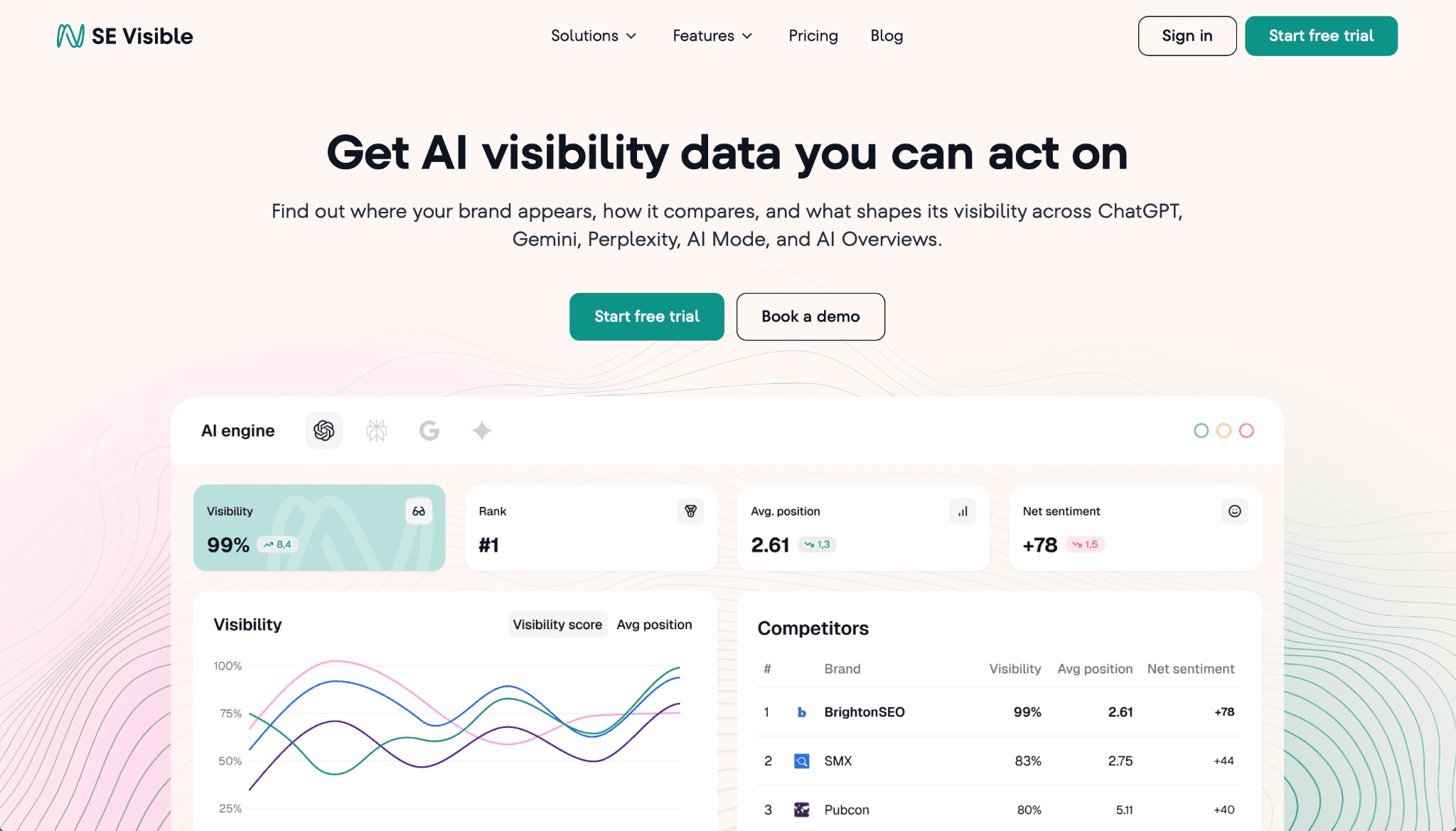
SE Ranking has split its AI visibility work into two products, which is either flexible or confusing depending on your patience. SE Visible is a standalone platform; the AI Search add-on sits inside the SE Ranking suite for existing customers and includes SE Visible access.
Coverage runs to ChatGPT, ChatGPT Search, Perplexity, Gemini, AI Overviews and Google AI Mode, and every plan carries unlimited seats, white labelling, API access and a Looker Studio connector. Exports are CSV only, and lower tiers refresh weekly rather than daily.
Key features
Six AI surfaces tracked, all Google and OpenAI-adjacent
White-label reporting, API access and Looker Studio connector
Unlimited user seats on every plan
Full SEO suite alongside on the add-on route: rank tracking, site audits, backlinks
MCP connector for querying live SEO and GEO data from ChatGPT or Claude
10-day free trial
Pros
Strongest agency reporting tooling per dollar in this list
One subscription covers organic rankings and AI visibility
Unlimited seats and multi-brand slots at every tier
Cons
No Claude and no Copilot, which is a real gap in 2026
Exports limited to CSV
Two overlapping products with different prices and refresh rates makes buying harder than it should be
Pricing: Paid plans start at $99/mo, or $89/mo as an add-on for existing SE Ranking customers, with a 10-day free trial.
Verdict: SE Visible gives agencies the most prompts per dollar here, and its white-label reporting is production-ready rather than an afterthought. If SEO is still your primary channel, the add-on route covers both cheaply. Teams living in AI search will find six Google-and-OpenAI surfaces narrow, and should confirm their refresh rate in writing before signing.
10. Ahrefs Brand Radar
Best for: Understanding category-level share of voice, not tracking your own prompt set
About Ahrefs Brand Radar
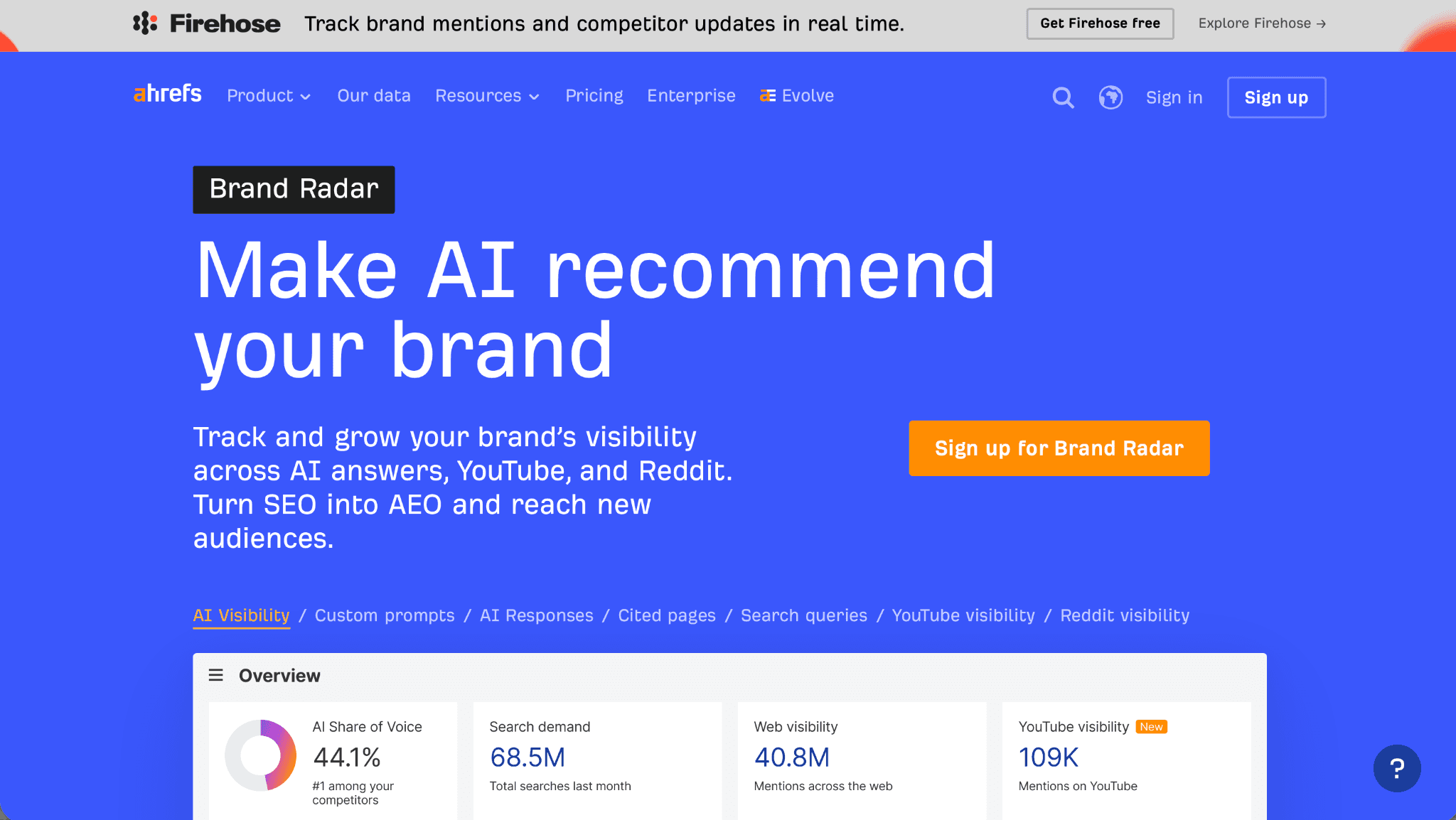
Brand Radar is a different instrument from everything else here, and comparing it on prompt counts misses the point. Instead of running your prompts, Ahrefs runs a modelled corpus of 475M+ monthly prompts across six indexes, drawn from Google's People Also Ask data and its own keyword database rather than invented.
You search that corpus the way you search Keywords Explorer: zero setup, unlimited projects, any brand or competitor. Question sets refresh monthly on a 90-day window, and Share of Voice models potential visibility rather than actual reach.
Key features
475M+ search-backed monthly prompts across six AI indexes, no setup required
AI Mentions, AI Citations, Impressions and AI Share of Voice as core metrics
YouTube, TikTok and Reddit-in-SERP indexes, free during beta
Search demand and web visibility alongside AI data
Custom prompts as an add-on, 2,500 checks/mo on the all-platforms tier
Free AI Visibility Checker for a preview
Pros
Best competitive and category research in the category, by some distance
Cross-references AI citations against Ahrefs' backlink and keyword data
Unlimited projects; research any brand, product, region or person
Cons
$199/mo per index or $699/mo for all six, on top of an Ahrefs base plan from $129/mo
Modelled prompts on a 90-day window; not a substitute for daily tracking of your own prompt set
Share of Voice measures potential visibility, which is a different number from what your buyers see
Pricing: From $199/mo per AI index or $699/mo for all six, on top of an Ahrefs plan starting at $129/mo. No trial, but the AI Visibility Checker is free.
Verdict: Brand Radar is the strongest research tool here and the weakest tracker, both consequences of one design decision. For planning a quarter of content around the domains AI engines trust, nothing beats it. For whether your visibility moved this week, the 90-day modelled window will not say, which is why most serious teams run it alongside a daily tracker.
11. Surfer AI Search Analytics
Best for: Content teams already writing in Surfer
About Surfer
Surfer quietly changed the calculation. What used to be a $95/mo AI Tracker add-on is now a standalone product, AI Search Analytics, covering 100 prompts refreshed daily across ChatGPT, Perplexity, Google AI Mode, AI Overviews and Gemini.
Inside the full content plans, tracking is gated carefully: Discovery tracks zero prompts, Standard tracks 25 against ChatGPT alone on a weekly refresh, and five models with daily refresh start at Pro. Where Surfer earns its place is Mention Gap, which routes a citation gap straight into the Content Editor.
Key features
100 prompts refreshed daily across five AI surfaces on the standalone plan
Mention Gap identifying prompts where competitors are cited and you are not
One-click route from a visibility gap into the Content Editor
Content Score, Topical Map, Content Audit and cannibalisation reporting
MCP access from Pro, API access on Peace of Mind
Five brand workspaces on the standalone AI plan
Pros
Tightest tracking-to-drafting loop of anything on this list
Standalone AI plan means you can buy tracking without the content suite
150,000+ customers and a mature product behind it
Cons
Five engines only; no Claude, Copilot, Grok or DeepSeek
Standard's 25 prompts run against ChatGPT alone, refreshed weekly
No free trial anywhere; Surfer offers a 7-day money-back guarantee instead
Pricing: The standalone AI plan starts at $158/mo billed annually. No free trial, though Surfer offers a 7-day money-back guarantee. See plans.
Verdict: Surfer suits teams whose constraint is writing throughput rather than measurement, and Mention Gap removes the step where a gap becomes a backlog ticket nobody picks up. Coming from Rankscale, five Google-and-OpenAI surfaces after ten platforms is a real reduction, and the weekly refresh on Standard is the trap. Budget for Pro or the standalone plan.
How to choose the right Rankscale AI alternative
Three questions, in order.
Which engines actually matter for your buyers?
Run ten of your money prompts manually across ChatGPT, Perplexity and Google AI Mode. If the answers and the cited sources diverge sharply by engine, pay for breadth. If one engine dominates your category, stop paying for coverage you never open. B2B SaaS skews heavily to ChatGPT and Perplexity; consumer and local categories lean on AI Overviews and AI Mode.
Who does the work after the dashboard?
If a content team is waiting on direction, a monitoring-first tool is enough and you should buy the cheapest reliable one. If nobody is waiting, weight the action layer heavily. Buying a second dashboard to solve an execution problem is the most common mistake in this category.
What does month six cost, not month one?
Model your real prompt count times engines times refresh frequency, and include every add-on. The cheapest headline price on this page is not the cheapest tool at 100 prompts across six engines.
Then run your two finalists on an identical prompt set for a fortnight. The numbers will disagree, and that disagreement tells you which collection method you actually trust.
The Bottom Line
Rankscale solved the hard part of this category early: broad platform coverage, transparent pricing, and citation data that holds up. If your prompt set is small, your engine mix is cheap, and you have people to act on what you find, staying put is a perfectly good decision and this article has not made a case against it.
The teams that move do so for one of two reasons. Either the credit meter made the monthly bill unpredictable, or the dashboard kept producing findings that nobody had time to act on. Those are different problems with different answers. Flat pricing fixes the first. An action layer fixes the second.
AIclicks was built to fix both at once, which is why it opens this list rather than sitting politely at number seven. Three days is enough to check whether that claim holds for your prompts.
Frequently Asked Questions
1. What is the cheapest Rankscale AI alternative?
Otterly AI's Lite plan at $29/mo is the lowest sticker price, covering 15 prompts across four engines. Cheapest per prompt is a different answer: AIclicks Starter at $59/mo covers 30 prompts and includes five AI-optimised articles a month, so you are paying roughly the same per prompt and getting the content layer at no extra cost.
2. Which Rankscale alternative covers the most AI engines?
AIclicks makes 10+ platforms available with 3 to 6 selectable per tier, and does not charge more for the expensive ones.
3. How many prompts do I actually need to track?
Most B2B teams get a usable picture from 25 to 50 prompts covering category questions, comparison questions and problem-led questions. Tracking 300 prompts before you know which ones convert is how teams end up on a $500 plan they cannot justify at renewal. Start at the bottom tier, watch which prompts move, then buy volume.
4. Do I still need a dedicated tool if I pay for an SEO suite?
The suite add-ons are a reasonable first step, but understand the ceiling. They cover Google-adjacent surfaces well and typically ship 25 prompts, none of them tracks Claude, Grok or Meta AI, and per-domain pricing makes them expensive across multiple clients. None of them tells you what to publish next, which is where dedicated tools with a recommendations layer pull ahead.
5. Does it matter whether a tool scrapes the chat interface or calls the API?
Yes, and it explains why two tools tracking identical prompts report different numbers. APIs return raw model output. The chat interface returns what users actually see, including live web retrieval, citations and ranked sources. AIclicks queries the real interfaces for this reason, which is slower to run but closer to what your buyers get.



Any questions left?
Book a call here: