Free Query Fan-Out Analysis Tool
See the synthetic sub-queries Google AI Mode and AI Overview generate from a single seed query — so you know exactly which related questions your content has to answer to get cited. Free, no signup.







What is a query fan-out analysis tool?
A query fan-out analysis tool reveals how Google AI Mode, AI Overview, and other answer engines decompose a single user query into multiple synthetic sub-queries before generating a response. When someone asks "best project management software for remote teams," the model fans out into 5–15 underlying searches like "asynchronous collaboration tools comparison," "free project management software 2026," and "project management with time tracking" — then assembles an answer from sources that match each sub-query. AIclicks' tool simulates that fan-out so you can see exactly which related questions your content needs to address to get cited. Free, no signup, unlimited.
How to use the query fan-out analysis tool
Type or paste a seed query (the search a customer would actually run) and click Generate. The tool returns the synthetic sub-queries an LLM is likely to expand it into — typically 8–15 underlying searches covering comparison, pricing, alternatives, troubleshooting, and intent variations. Map your existing content against the list: every sub-query you don't have a direct answer for is a citation gap. Build new sections, FAQ entries, or supporting articles to close them. Re-run with sibling queries to map the full topical cluster. Free, unlimited.
What is a query fan-out analysis tool?
A query fan-out analysis tool reveals how Google AI Mode, AI Overview, and other answer engines decompose a single user query into multiple synthetic sub-queries before generating a response. When someone asks "best project management software for remote teams," the model fans out into 5–15 underlying searches like "asynchronous collaboration tools comparison," "free project management software 2026," and "project management with time tracking" — then assembles an answer from sources that match each sub-query. AIclicks' tool simulates that fan-out so you can see exactly which related questions your content needs to address to get cited. Free, no signup, unlimited.
How to use the query fan-out analysis tool
Type or paste a seed query (the search a customer would actually run) and click Generate. The tool returns the synthetic sub-queries an LLM is likely to expand it into — typically 8–15 underlying searches covering comparison, pricing, alternatives, troubleshooting, and intent variations. Map your existing content against the list: every sub-query you don't have a direct answer for is a citation gap. Build new sections, FAQ entries, or supporting articles to close them. Re-run with sibling queries to map the full topical cluster. Free, unlimited.
What you can do with our free query fan-out tool
Six high-leverage workflows — content gap analysis, AI Overview optimization, brief construction, FAQ planning, and topical cluster mapping.
What you can do with our free query fan-out tool
Six high-leverage workflows — content gap analysis, AI Overview optimization, brief construction, FAQ planning, and topical cluster mapping.
Find content gaps for AI Overview
Run your primary keyword, get the synthetic sub-queries, and map your existing pages against them. Every sub-query without a direct-answer paragraph is a citation gap to close.
Find content gaps for AI Overview
Run your primary keyword, get the synthetic sub-queries, and map your existing pages against them. Every sub-query without a direct-answer paragraph is a citation gap to close.
Build a content brief that ranks in AI Mode
Use the fan-out list as the H2 outline of your next pillar page. Each sub-query becomes a heading; each direct answer becomes a citable passage. Built for AI extraction from the start.
Build a content brief that ranks in AI Mode
Use the fan-out list as the H2 outline of your next pillar page. Each sub-query becomes a heading; each direct answer becomes a citable passage. Built for AI extraction from the start.
Plan FAQ sections that get cited
The sub-queries are exactly the questions Google AI Mode is asking on your behalf. Drop them as FAQ items with 40–80 word answers and you've built citation bait, not filler content.
Plan FAQ sections that get cited
The sub-queries are exactly the questions Google AI Mode is asking on your behalf. Drop them as FAQ items with 40–80 word answers and you've built citation bait, not filler content.
Map a topical cluster
Run 3–5 sibling queries (your category's main searches) and merge the fan-outs. The deduped list is your full content cluster — every page you'd need to dominate the topic.
Map a topical cluster
Run 3–5 sibling queries (your category's main searches) and merge the fan-outs. The deduped list is your full content cluster — every page you'd need to dominate the topic.
Audit pages for sub-query coverage
For an existing top page, check whether it answers the full fan-out. Pages covering 80%+ of sub-queries dominate AI Overview citations; pages at 30% rarely show up at all.
Audit pages for sub-query coverage
For an existing top page, check whether it answers the full fan-out. Pages covering 80%+ of sub-queries dominate AI Overview citations; pages at 30% rarely show up at all.
Reverse-engineer competitor strategies
Run the same query a top competitor ranks for. Their content likely answers most of the fan-out — that's why they win citations. Spot the sub-queries they miss and out-cover them.
Reverse-engineer competitor strategies
Run the same query a top competitor ranks for. Their content likely answers most of the fan-out — that's why they win citations. Spot the sub-queries they miss and out-cover them.
SERP & Rankings
Technical SEO
AI Writing & Content
Keyword Research
AI Visibility
Social & YouTube
How AIclicks works
How AIclicks works

01

Brand Audit
We start by mapping your current AI visibility, analyzing how often you appear in LLMs answers. This gives us a precise roadmap of what needs to be fixed, improved, or created.
01
Brand Audit
We start by mapping your current AI visibility, analyzing how often you appear in LLMs answers. This gives us a precise roadmap of what needs to be fixed, improved, or created.
02
AI-Optimized Content
We produce content crafted specifically for AI models. We reinforce this with citation-worthy sources and high-authority mentions that help AI systems trust and reference your brand.
02
AI-Optimized Content
We produce content crafted specifically for AI models. We reinforce this with citation-worthy sources and high-authority mentions that help AI systems trust and reference your brand.
03
Optimization, Tracking & Insights
You get access to a custom AI visibility dashboard, weekly progress updates, and continuous optimization cycles. We monitor ranking shifts, citation changes, competitors, and new AI opportunities.
03
Optimization, Tracking & Insights
You get access to a custom AI visibility dashboard, weekly progress updates, and continuous optimization cycles. We monitor ranking shifts, citation changes, competitors, and new AI opportunities.
Explore our blog
Explore our blog



FAQ
What is query fan-out in AI search?
Query fan-out is the process AI search engines (Google AI Mode, AI Overview, Perplexity) use to break a single user query into multiple synthetic sub-queries. Instead of running one search, the model fires 5–15 related searches in parallel, gathers sources for each, and synthesizes a unified answer. Pages that match more sub-queries get cited more often.
How accurate is the fan-out simulation?
Directional. Real Google AI Mode fan-outs use proprietary signals (user history, location, intent classifiers) we can't perfectly replicate. Our simulation reproduces the structural pattern — comparison, pricing, alternatives, troubleshooting, intent variants — so the output is reliable for content planning, not for predicting exact phrasing of every sub-query.
Why does query fan-out matter for SEO?
Because AI Mode and AI Overview are increasingly the answer surface — for how-to, comparison, and 'best of' queries, they outrank classic blue links. Pages that answer just the literal query lose. Pages that answer the literal query plus the fan-out's sub-queries dominate, because the model can lift multiple passages from a single source.
How do I act on the fan-out output?
Three patterns: (1) add an FAQ section answering each sub-query in 40–80 words, (2) restructure the page so each sub-query gets its own H2 with a 120–180 word direct-answer passage, or (3) build sibling articles for sub-queries broad enough to support standalone pages, then internally link from your pillar.
Is the query fan-out tool really free?
Yes. Unlimited fan-outs, no signup, no credit card. We rate-limit gently to prevent abuse. For ongoing AI citation tracking, AI Overview rank monitoring, and per-query visibility scoring, pair with our paid AI Citation Tracker on app.aiclicks.io.
FAQ
What is query fan-out in AI search?
Query fan-out is the process AI search engines (Google AI Mode, AI Overview, Perplexity) use to break a single user query into multiple synthetic sub-queries. Instead of running one search, the model fires 5–15 related searches in parallel, gathers sources for each, and synthesizes a unified answer. Pages that match more sub-queries get cited more often.
How accurate is the fan-out simulation?
Directional. Real Google AI Mode fan-outs use proprietary signals (user history, location, intent classifiers) we can't perfectly replicate. Our simulation reproduces the structural pattern — comparison, pricing, alternatives, troubleshooting, intent variants — so the output is reliable for content planning, not for predicting exact phrasing of every sub-query.
Why does query fan-out matter for SEO?
Because AI Mode and AI Overview are increasingly the answer surface — for how-to, comparison, and 'best of' queries, they outrank classic blue links. Pages that answer just the literal query lose. Pages that answer the literal query plus the fan-out's sub-queries dominate, because the model can lift multiple passages from a single source.
How do I act on the fan-out output?
Three patterns: (1) add an FAQ section answering each sub-query in 40–80 words, (2) restructure the page so each sub-query gets its own H2 with a 120–180 word direct-answer passage, or (3) build sibling articles for sub-queries broad enough to support standalone pages, then internally link from your pillar.
Is the query fan-out tool really free?
Yes. Unlimited fan-outs, no signup, no credit card. We rate-limit gently to prevent abuse. For ongoing AI citation tracking, AI Overview rank monitoring, and per-query visibility scoring, pair with our paid AI Citation Tracker on app.aiclicks.io.
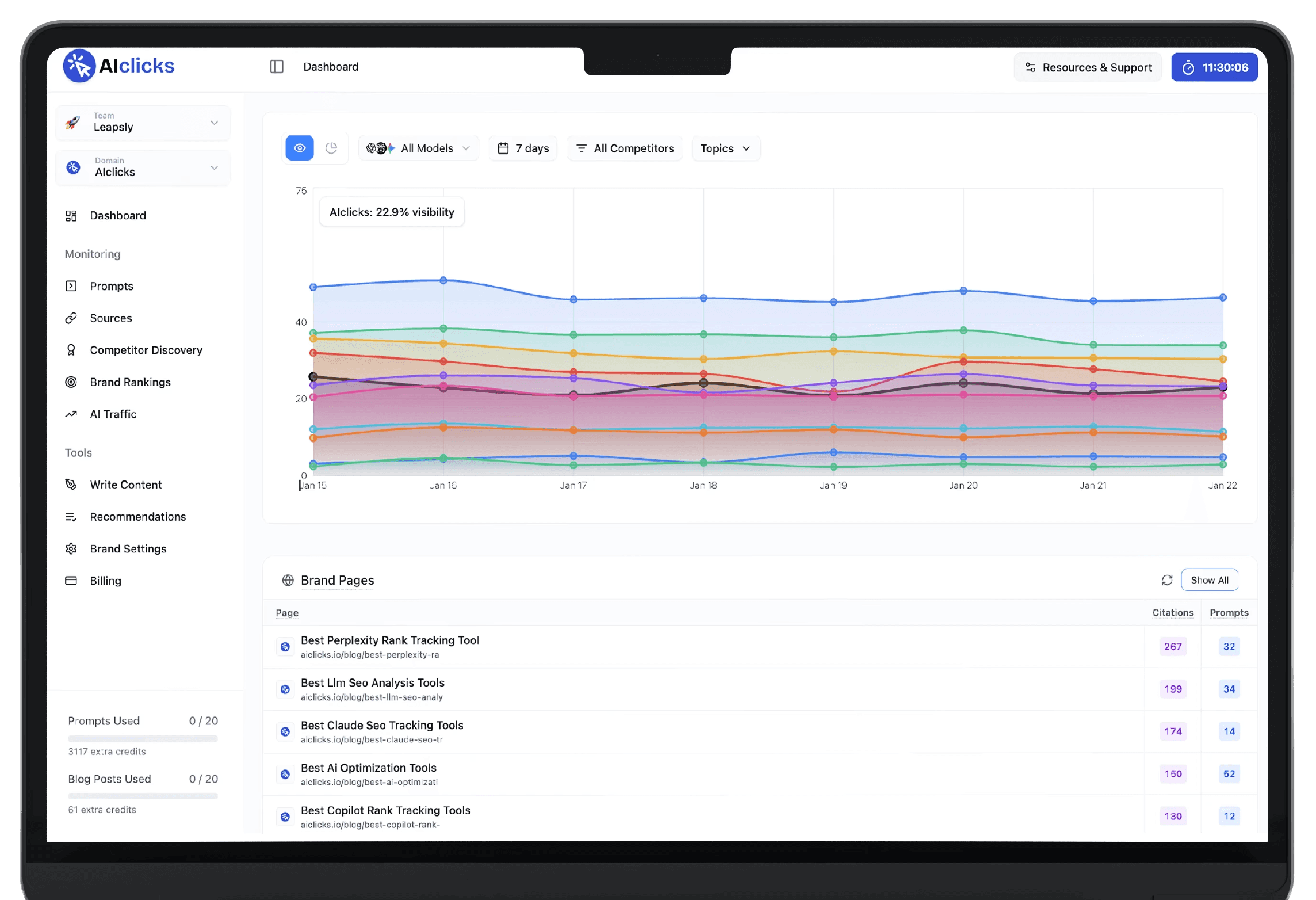
Be the #1 Response in AI
Reach millions of consumers who are using AI to discover new products and brands
Be the #1 Response in AI
Reach millions of consumers who are using AI to discover new products and brands
Be the #1 Response in AI
Reach millions of consumers who are using AI to discover new products and brands