Free Brand Sentiment Monitoring Tool
Track how the internet — and AI engines like ChatGPT, Perplexity, and Gemini — talk about your brand. Aggregated sentiment score, top sources, dominant narratives. Free, no signup.




What is brand sentiment monitoring?
Brand sentiment monitoring is the practice of continuously tracking how people, publishers, social platforms, and AI engines describe a brand — capturing the volume of mentions, the polarity (positive, neutral, negative), and the dominant narratives. Classic tools (Hootsuite, Brandwatch, BrandMentions) crawl social posts, news, forums, and review sites. AIclicks adds the AI-era dimension: how ChatGPT, Perplexity, Gemini, and Claude characterize your brand when users ask about your category. The free tool returns an aggregated sentiment score, top cited sources, the most-used adjectives describing you, and a flag list of recent negative narratives worth responding to. Free, no signup, unlimited.
How to use the brand sentiment monitoring tool
Type your brand name (or a competitor's), and click Analyze. The tool gathers signal from web mentions, Reddit threads, review sites, and AI-engine descriptions, then returns a sentiment score (positive / neutral / negative percentages), the top 5 sources driving the score, the most frequently used adjectives describing your brand, and a flag list of recent negative narratives. Triage by source: a single negative Reddit thread is different from a pattern of negative review-site mentions. Re-run weekly to catch sentiment shifts before they become reputation problems. Free, unlimited.
What is brand sentiment monitoring?
Brand sentiment monitoring is the practice of continuously tracking how people, publishers, social platforms, and AI engines describe a brand — capturing the volume of mentions, the polarity (positive, neutral, negative), and the dominant narratives. Classic tools (Hootsuite, Brandwatch, BrandMentions) crawl social posts, news, forums, and review sites. AIclicks adds the AI-era dimension: how ChatGPT, Perplexity, Gemini, and Claude characterize your brand when users ask about your category. The free tool returns an aggregated sentiment score, top cited sources, the most-used adjectives describing you, and a flag list of recent negative narratives worth responding to. Free, no signup, unlimited.
How to use the brand sentiment monitoring tool
Type your brand name (or a competitor's), and click Analyze. The tool gathers signal from web mentions, Reddit threads, review sites, and AI-engine descriptions, then returns a sentiment score (positive / neutral / negative percentages), the top 5 sources driving the score, the most frequently used adjectives describing your brand, and a flag list of recent negative narratives. Triage by source: a single negative Reddit thread is different from a pattern of negative review-site mentions. Re-run weekly to catch sentiment shifts before they become reputation problems. Free, unlimited.
What you can do with our free brand sentiment tool
Six high-leverage workflows — quarterly sentiment audits, crisis early-warning, competitor benchmarking, AI-era narrative tracking, and PR campaign measurement.
What you can do with our free brand sentiment tool
Six high-leverage workflows — quarterly sentiment audits, crisis early-warning, competitor benchmarking, AI-era narrative tracking, and PR campaign measurement.
Run a quarterly sentiment audit
Pull sentiment, top sources, and dominant adjectives once per quarter. Compare scores over time to confirm marketing investments are moving narrative — not just spend.
Run a quarterly sentiment audit
Pull sentiment, top sources, and dominant adjectives once per quarter. Compare scores over time to confirm marketing investments are moving narrative — not just spend.
Catch reputation crises early
Sentiment dropping from 78% positive to 60% over 14 days is the canary signal. Surface the cause (Reddit thread, viral negative review, founder gaffe) before the press cycle catches up.
Catch reputation crises early
Sentiment dropping from 78% positive to 60% over 14 days is the canary signal. Surface the cause (Reddit thread, viral negative review, founder gaffe) before the press cycle catches up.
Benchmark sentiment vs competitors
Run your three closest competitors. The brand with the highest positive percentage usually wins category share over 12 months. Spot which competitor is lapping you on narrative and why.
Benchmark sentiment vs competitors
Run your three closest competitors. The brand with the highest positive percentage usually wins category share over 12 months. Spot which competitor is lapping you on narrative and why.
Track how AI engines describe you
ChatGPT, Perplexity, and Gemini build their brand summaries from third-party sources. The tool surfaces the adjectives AI uses for your brand — a leading indicator of how customers will perceive you in the AI-search era.
Track how AI engines describe you
ChatGPT, Perplexity, and Gemini build their brand summaries from third-party sources. The tool surfaces the adjectives AI uses for your brand — a leading indicator of how customers will perceive you in the AI-search era.
Measure PR campaign impact
Run sentiment before, during, and 30 days after a campaign launch. Sentiment lift across earned-media sources is one of the few honest measurements of PR ROI most agencies skip.
Measure PR campaign impact
Run sentiment before, during, and 30 days after a campaign launch. Sentiment lift across earned-media sources is one of the few honest measurements of PR ROI most agencies skip.
Diagnose review-site narrative drift
If your G2/Capterra/Trustpilot sentiment is sliding, the tool surfaces the dominant negative themes — pricing, support, onboarding, performance — so product and CS teams can fix the right thing.
Diagnose review-site narrative drift
If your G2/Capterra/Trustpilot sentiment is sliding, the tool surfaces the dominant negative themes — pricing, support, onboarding, performance — so product and CS teams can fix the right thing.
SERP & Rankings
Technical SEO
AI Writing & Content
Keyword Research
AI Visibility
Social & YouTube
How AIclicks works
How AIclicks works

01

Brand Audit
We start by mapping your current AI visibility, analyzing how often you appear in LLMs answers. This gives us a precise roadmap of what needs to be fixed, improved, or created.
01
Brand Audit
We start by mapping your current AI visibility, analyzing how often you appear in LLMs answers. This gives us a precise roadmap of what needs to be fixed, improved, or created.
02
AI-Optimized Content
We produce content crafted specifically for AI models. We reinforce this with citation-worthy sources and high-authority mentions that help AI systems trust and reference your brand.
02
AI-Optimized Content
We produce content crafted specifically for AI models. We reinforce this with citation-worthy sources and high-authority mentions that help AI systems trust and reference your brand.
03
Optimization, Tracking & Insights
You get access to a custom AI visibility dashboard, weekly progress updates, and continuous optimization cycles. We monitor ranking shifts, citation changes, competitors, and new AI opportunities.
03
Optimization, Tracking & Insights
You get access to a custom AI visibility dashboard, weekly progress updates, and continuous optimization cycles. We monitor ranking shifts, citation changes, competitors, and new AI opportunities.
Explore our blog
Explore our blog


FAQ
What sources does brand sentiment analysis pull from?
A blend: web articles, Reddit threads, review sites (G2, Capterra, Trustpilot), social platforms, news, forums, and AI engine outputs (ChatGPT, Perplexity, Gemini, Claude descriptions of your brand). Diversity matters: a tool that only listens to Twitter misses the Reddit threads and review-site narratives that drive long-term reputation.
How accurate is automated sentiment scoring?
Modern LLM-based sentiment classifiers hit 85–92% agreement with human raters on English text — strong enough for trend detection, weaker for nuance (sarcasm, mixed sentiment). Use the tool for direction (sentiment up or down? which sources?), not for hand-coded analysis of every individual mention.
How is this different from Hootsuite or Brandwatch?
Hootsuite and Brandwatch are paid social-listening suites with full historical archives and real-time alerts ($800–$3000/month). Our tool is free, signup-free, single-pass — built for fast strategic snapshots and the AI-era dimension neither legacy tool covers well: how ChatGPT, Perplexity, and Gemini describe your brand. Pair both: ours for AI sentiment + quick checks, theirs for ongoing social-media listening.
Why does AI-engine sentiment matter?
Because increasingly, customers ask ChatGPT or Perplexity for brand recommendations — and the model's described characterization of you is the first impression. If AI describes your competitor as 'most trusted' and you as 'budget option,' you've lost the high-intent commercial query before the customer ever clicks a link. Tracking AI-engine sentiment is now as important as tracking review-site stars.
How do I improve negative brand sentiment?
Three patterns: (1) respond directly on the source (Reddit thread, review site, X reply) — public, professional, no defensiveness, (2) seed counter-narrative content on third-party domains AI engines cite (Reddit threads, review sites, authority blogs), and (3) ship the underlying product fix if the negative sentiment is grounded in real issues. Don't try to outspend the narrative; fix what's true and let it propagate.
FAQ
What sources does brand sentiment analysis pull from?
A blend: web articles, Reddit threads, review sites (G2, Capterra, Trustpilot), social platforms, news, forums, and AI engine outputs (ChatGPT, Perplexity, Gemini, Claude descriptions of your brand). Diversity matters: a tool that only listens to Twitter misses the Reddit threads and review-site narratives that drive long-term reputation.
How accurate is automated sentiment scoring?
Modern LLM-based sentiment classifiers hit 85–92% agreement with human raters on English text — strong enough for trend detection, weaker for nuance (sarcasm, mixed sentiment). Use the tool for direction (sentiment up or down? which sources?), not for hand-coded analysis of every individual mention.
How is this different from Hootsuite or Brandwatch?
Hootsuite and Brandwatch are paid social-listening suites with full historical archives and real-time alerts ($800–$3000/month). Our tool is free, signup-free, single-pass — built for fast strategic snapshots and the AI-era dimension neither legacy tool covers well: how ChatGPT, Perplexity, and Gemini describe your brand. Pair both: ours for AI sentiment + quick checks, theirs for ongoing social-media listening.
Why does AI-engine sentiment matter?
Because increasingly, customers ask ChatGPT or Perplexity for brand recommendations — and the model's described characterization of you is the first impression. If AI describes your competitor as 'most trusted' and you as 'budget option,' you've lost the high-intent commercial query before the customer ever clicks a link. Tracking AI-engine sentiment is now as important as tracking review-site stars.
How do I improve negative brand sentiment?
Three patterns: (1) respond directly on the source (Reddit thread, review site, X reply) — public, professional, no defensiveness, (2) seed counter-narrative content on third-party domains AI engines cite (Reddit threads, review sites, authority blogs), and (3) ship the underlying product fix if the negative sentiment is grounded in real issues. Don't try to outspend the narrative; fix what's true and let it propagate.
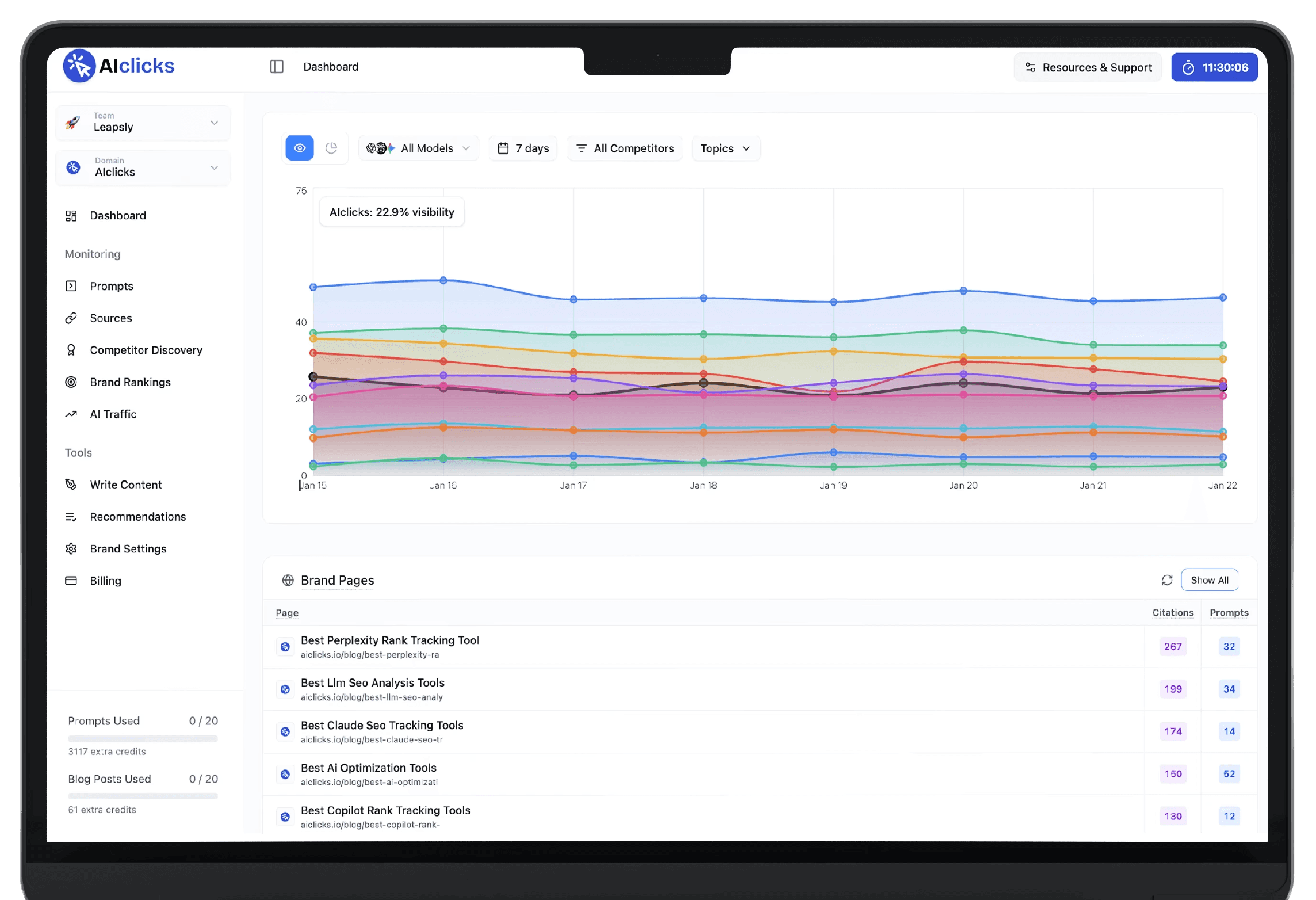
Be the #1 Response in AI
Reach millions of consumers who are using AI to discover new products and brands
Be the #1 Response in AI
Reach millions of consumers who are using AI to discover new products and brands
Be the #1 Response in AI
Reach millions of consumers who are using AI to discover new products and brands