" width="14px"><path d="M 13.864 5.629 L 13.3 5.629 L 13.3 5.6 L 7 5.6 L 7 8.4 L 10.956 8.4 C 10.379 10.03 8.828 11.2 7 11.2 C 4.681 11.2 2.8 9.319 2.8 7 C 2.8 4.681 4.681 2.8 7 2.8 C 8.071 2.8 9.045 3.204 9.786 3.864 L 11.766 1.884 C 10.516 0.719 8.844 0 7 0 C 3.134 0 0 3.134 0 7 C 0 10.866 3.134 14 7 14 C 10.866 14 14 10.866 14 7 C 14 6.531 13.952 6.073 13.864 5.629 Z" fill="rgb(255, 193, 7)" height="14px" id="H_YjfTNpn" width="14px"/><path d="M 0 3.742 L 2.3 5.429 C 2.922 3.888 4.429 2.8 6.193 2.8 C 7.264 2.8 8.238 3.204 8.979 3.864 L 10.959 1.884 C 9.709 0.719 8.037 0 6.193 0 C 3.504 0 1.172 1.518 0 3.742 Z" fill="rgb(255, 61, 0)" height="5.428500000000002px" id="PlkthQDhg" transform="translate(0.875 0)" width="10.959199999999996px"/><path d="M 6.232 5.581 C 8.04 5.581 9.683 4.889 10.925 3.764 L 8.758 1.931 C 8.032 2.483 7.144 2.782 6.232 2.781 C 4.411 2.781 2.865 1.62 2.283 0 L 0 1.759 C 1.159 4.026 3.511 5.581 6.232 5.581 Z" fill="rgb(76, 175, 80)" height="5.581099999999999px" id="WlnJ5gngE" transform="translate(0.7 8.4)" width="10.924899999999994px"/><path d="M 6.864 0.029 L 6.3 0.029 L 6.3 0 L 0 0 L 0 2.8 L 3.956 2.8 C 3.68 3.576 3.183 4.254 2.526 4.75 L 2.527 4.749 L 4.693 6.582 C 4.54 6.722 7 4.9 7 1.4 C 7 0.931 6.952 0.473 6.864 0.029 Z" fill="rgb(25, 118, 210)" height="6.589883930775992px" id="x_rSW275p" transform="translate(7 5.6)" width="7px"/></g></svg>)


Reviewed by:
Rokas Stankevicius

Founder @ aiclicks.io
Last updated:
Expert Verified

Key Takeaways
Peec AI's brand plans include 3 models by default, chosen from a pool of six: ChatGPT, Google AI Mode, AI Overviews, Microsoft Copilot, Perplexity, and Gemini.
Peec includes Actions, its prioritized recommendation layer, on every plan at no extra cost. Actions clusters your citation sources, scores each opportunity against competitors, and tells you what to create or where to get featured.
Peec's brand plans are flat monthly tiers priced by prompt count: Starter 50, Pro 150, Advanced 350, Enterprise custom. Credits apply to the agency plans, where they work as allocation slots you assign per client rather than a balance that gets drawn down each month.
The alternatives on this list split into three camps: action-oriented platforms that close the gap from data to execution (AIclicks, Gauge, AthenaHQ), monitoring and analytics tools with broader engine coverage (Profound, Scrunch AI, Rankscale AI), and content-plus-tracking platforms (Writesonic, Promptmonitor).
There is no single best alternative. The right pick depends on whether your primary need is measurement, execution, content production, or some combination of all three.
Peec AI's brand plans include 3 models by default, chosen from a pool of six: ChatGPT, Google AI Mode, AI Overviews, Microsoft Copilot, Perplexity, and Gemini.
Peec includes Actions, its prioritized recommendation layer, on every plan at no extra cost. Actions clusters your citation sources, scores each opportunity against competitors, and tells you what to create or where to get featured.
Peec's brand plans are flat monthly tiers priced by prompt count: Starter 50, Pro 150, Advanced 350, Enterprise custom. Credits apply to the agency plans, where they work as allocation slots you assign per client rather than a balance that gets drawn down each month.
The alternatives on this list split into three camps: action-oriented platforms that close the gap from data to execution (AIclicks, Gauge, AthenaHQ), monitoring and analytics tools with broader engine coverage (Profound, Scrunch AI, Rankscale AI), and content-plus-tracking platforms (Writesonic, Promptmonitor).
There is no single best alternative. The right pick depends on whether your primary need is measurement, execution, content production, or some combination of all three.
Peec AI is one of the genuinely liked tools in this category. Not "liked for the price" or "liked considering the limitations." Actually liked. The interface is clean, the setup takes under an hour, and unlimited seats at this price point is rare enough to matter.
So, why are you here?
It's usually one of three things. The model list stopped being a configuration setting and started being a business problem: your buyers are asking Claude or DeepSeek questions, and those models sit behind Enterprise on Peec, so there is no self-serve plan you can upgrade to that opens them up. Or your plan includes three models and you need five, and each extra one is priced against your prompt volume, so the Starter tier you budgeted for isn't the number on the invoice. Or the platform is working exactly as designed, Actions has handed you a ranked list of what to fix, and you still have nobody to write the content, pitch the publishers, or show up in the communities on that list.
If you're in camp one or two, this is a coverage and cost problem. The tools in the first half of this list solve it. If you're in camp three, this is a capacity problem, and what you need is a platform that carries more of the work rather than more of the analysis. Some teams are in all three at once, which is the most common version.
This article covers eleven alternatives: what each does differently from Peec, what it actually costs before you add the engines and seats you really need, and which type of team each one was genuinely built for.
Why Teams Outgrow Peec AI
Peec is built around a clear editorial stance: show teams accurate data, present it cleanly, point them at the highest-value opportunities, and let them run the work. That stance holds up well for a specific kind of team. It stops holding when the team outgrows one of three things. Here they are:
1. The models you need may not be buyable at your tier. Brand plans include three models, picked from a pool of six: ChatGPT, Google AI Mode, AI Overviews, Microsoft Copilot, Perplexity, and Gemini. If you need a fourth or fifth from that pool, Peec sells them as add-ons priced against the prompts in your plan, so coverage is available but it moves your monthly number. The harder ceiling is the second group. Claude Sonnet 4, GPT-5 Search, DeepSeek, Qwen, and Mistral run through API access on Enterprise for brands, and on Scale or above for agencies. If your buyers are on Claude and you're on Pro, no add-on fixes that. Enterprise is the only route, and that's a different commercial conversation.

2. Actions tells you what to do. Someone still has to do it. Peec's Actions feature is included on every plan at no extra cost, and it does real work: it groups hundreds of citation sources into content-type clusters, scores each one from 1 to 3 on how often models cite that source type versus how well your competitors are represented there, and splits the output into on-page and off-page. This is a genuine prioritization layer and it's better than what most of the category ships. The boundary is deliberate, and Peec says so in its own FAQ: you still create the content yourself. For a team with a content writer and someone who does outreach, that boundary is correct and probably preferable. For a team of one marketer who now has a ranked list of twelve publishers to pitch and no time to pitch them, the list becomes a second backlog rather than a solution.

3. Agency credit allocation is a planning exercise, not a line item. Brand plans are simple: a flat monthly price for 50, 150, or 350 prompts. Agency plans work differently. You buy a pool of credits (10,000 on Essential, 25,000 on Growth, 65,000 on Scale) and allocate them across clients, where one prompt on one model for one day equals one credit. Credits don't expire or reset, which makes them more predictable than a consumption model. What they do require is arithmetic. Peec's own guidance is roughly 90 credits per prompt per month at three models, with a 900-credit minimum per project, so a 25-client roster is a capacity plan you maintain rather than a subscription you forget about. Adding a model for one client silently re-prices that client against the shared pool.

Peec is still a strong product, and for a lot of teams it's the right one. Three models that match where your buyers actually ask, an in-house writer who can act on a ranked opportunity list, a clean roster that makes credit allocation trivial. That's a real profile and Peec serves it well. If that stopped describing you, here's what else exists.
How I Evaluated These Alternatives
People searching for Peec alternatives already know what AI visibility tracking does. They've been running prompts for months. They understand the category. What they're asking is narrower: does this tool solve the thing Peec doesn't?
I evaluated each tool on this list against the specific walls Peec AI runs into:
Engine coverage without an enterprise contract. Which engines come standard on paid self-serve plans, and how does that compare to Peec's pool of six? I verified each engine list directly from company pricing pages, and flagged where the marketed coverage and the real self-serve coverage don't match.
What the platform does with the data. Does it produce recommendations, tasks, or content briefs? Or does insight stop at the dashboard and execution start with your team? I looked for evidence of a genuine action layer rather than just a recommendations tab that surfaces generic suggestions.
What it actually costs for a realistic agency use case. I added up the base plan, the engine add-ons required to match Peec's six-engine pool, any seat or client fees, and the cost of white-label reporting where relevant. Headline prices in this category rarely survive that calculation.
Who built it and for whom. A tool built for a solo founder, an enterprise procurement team, and an eight-person agency are genuinely different products even when they track similar metrics.
All feature and pricing data came directly from official product pages and was cross-checked against G2 and independent testers. Verify pricing on each company's site before buying. This category moves fast.
The 12 Best Peec AI Alternatives in 2026
Tool | Best For | Starting Price | Engine Coverage | Standout Feature |
AIclicks | Agencies and teams that want action, not just dashboards | $59/mo | ChatGPT, Perplexity, Gemini, AI Overviews, AI Mode, Claude, Grok, DeepSeek, Meta AI, Copilot | Real-UI tracking plus ranked action plan |
AI Rank Checker | Flexible, occasional checks without a subscription | Pay-per-check (wallet) | ChatGPT, Gemini, Claude, Perplexity, AI Mode, AI Overview, Grok | No subscription required |
Profound | Enterprises needing the deepest AI search dataset | $99/mo | ChatGPT (Starter); + Perplexity, AI Overviews (Growth); + Gemini, Copilot, Meta AI, Grok, DeepSeek, Claude, AI Mode (Enterprise) | Prompt Volumes: real user AI query intelligence |
Scrunch AI | Brands needing hallucination detection and enterprise security | $250/mo | ChatGPT Perplexity Google AIO Copilot (Core); + Claude, Gemini, Meta AI, AI Mode, Copilot, Grok | AXP infrastructure layer for AI crawlers |
AthenaHQ | Ecommerce and enterprise teams needing revenue attribution | $295/mo | ChatGPT, Perplexity, AI Overviews, AI Mode, Gemini, Claude, Copilot, Grok | Action Center plus Shopify/GA4 attribution |
Writesonic | Content teams wanting tracking and creation together | $79/mo annual | ChatGPT, Gemini, AI Overviews (self-serve); 10+ Enterprise | GEO tracking from entry plan |
Otterly AI | Budget teams wanting fast, clean monitoring | $29/mo | ChatGPT, AI Overviews, Perplexity, Copilot. | Predictive GEO scoring before you publish |
PromptMonitor | Teams wanting tracking with built-in outreach targeting | $29/mo | ChatGPT, Claude, Gemini, DeepSeek, Grok, Perplexity (Plus AI Mode and AI Overviews in Pro plan) | Publisher contact extraction from cited sources |
Rankscale AI | Teams wanting the widest coverage at the lowest price | €99/mo | ChatGPT, Gemini, Perplexity, Claude, DeepSeek, Mistral, Grok, Copilot, and more | Most engines at any price point |
Gauge | Teams wanting tracking, content, and an AI assistant together | $599/mo | ChatGPT, Google AIO, AI Mode, Gemini, Perplexity, Microsoft CoPilot (Claude comes with Enterprise plan) | Content engine plus real-UI data plus AI assistant |
Geneo | Agencies needing white-label AI visibility dashboards | $39.90/mo individual / $129/mo agency | ChatGPT, Perplexity, Google AI Overviews | White-label client portals on custom domains |
Ahrefs Brand Radar | Teams researching a whole category rather than a custom prompt list | $199/mo per index ($699 all six) plus an Ahrefs base plan from $129/mo | ChatGPT, Perplexity, Gemini, Copilot, Google AI Overviews, AI Mode, plus YouTube, TikTok, Reddit | Prompt dataset built from real search behaviour |
1. AIclicks: The #1 Peec AI Alternative
About AIclicks
Peec AI does two things well: it tells you where your brand stands across AI models, and through Actions it tells you which sources and content types are worth going after. AIclicks, an AI search visibility tool, covers the same ground and then pushes further into the execution side.
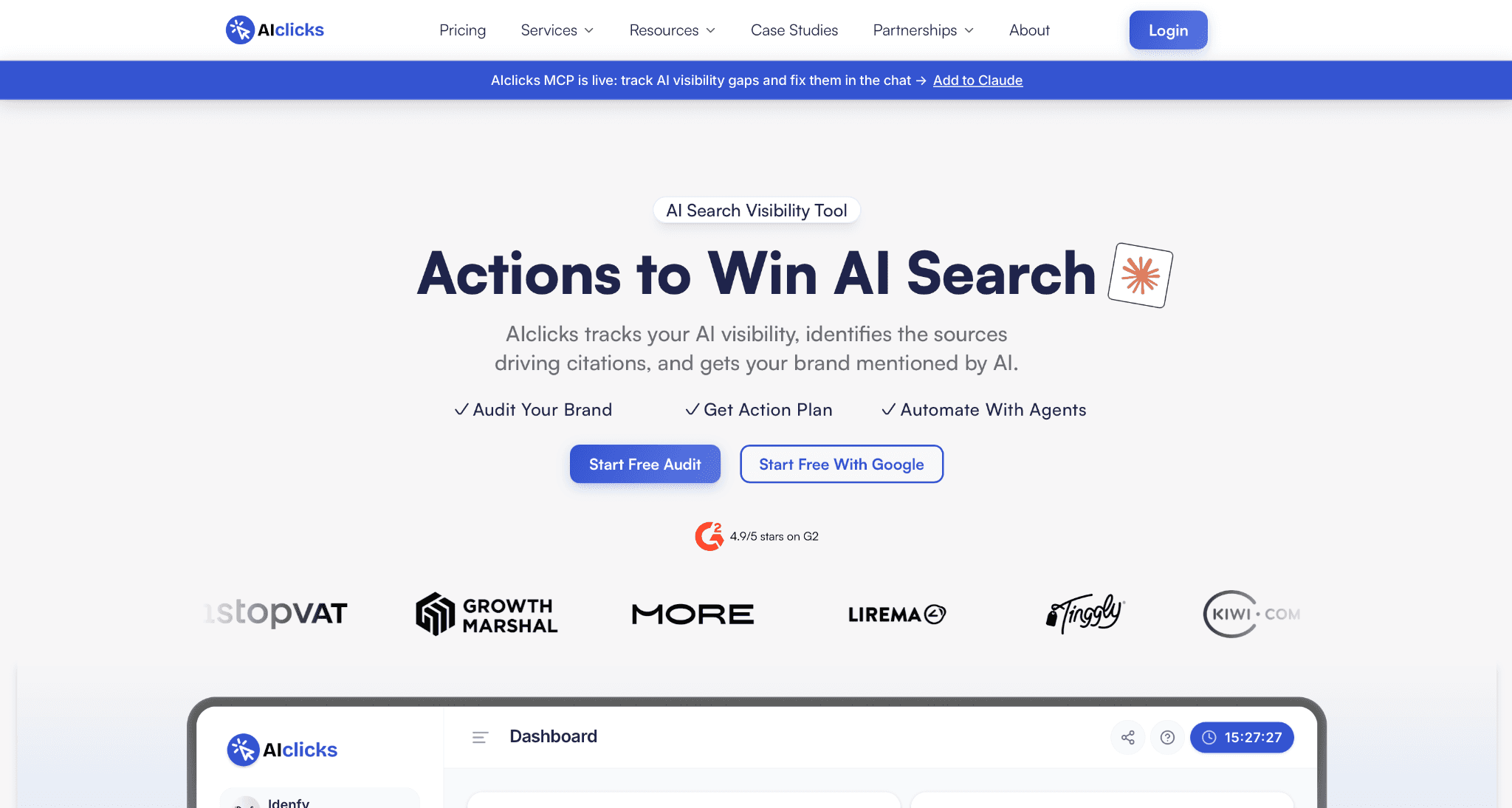
The practical difference is in scope. Peec's Actions scores opportunities by source cluster and hands you the priority order. AIclicks scores actions across three specific work types, content to create, sources to earn mentions on, and communities to engage in, and pairs that with 10+ models tracked on self-serve plans rather than three. The Competitors tab traces which specific sources power your competitors' visibility. The Sources tab maps the citation landscape in your category into a concrete work list.
Ten-plus AI engines are tracked through their real user interfaces rather than APIs, which matters because API responses and what a buyer actually sees when they ask ChatGPT a question are frequently different. That gap compounds over time when tracking is the basis for strategy. With 400+ agencies and 1,000+ brands on the platform, the underlying methodology has been tested against real category data across a wide range of industries.
Key features:
10+ AI platforms in one dashboard including ChatGPT, Perplexity, Gemini, Google AI Overviews, AI Mode, Claude, Grok, DeepSeek, Meta AI, and Microsoft Copilot. Most tools at this price cover three to five engines.
Real-UI querying, not API calls. AIclicks sends each prompt the way a real user would ask it, through each platform's actual interface, because API responses and real user-facing answers often differ, and tracking the wrong one quietly distorts your data.
Competitors tab showing which brands get recommended instead of you across every tracked engine, which sources are powering their visibility, and where the gap between you and them is widest.
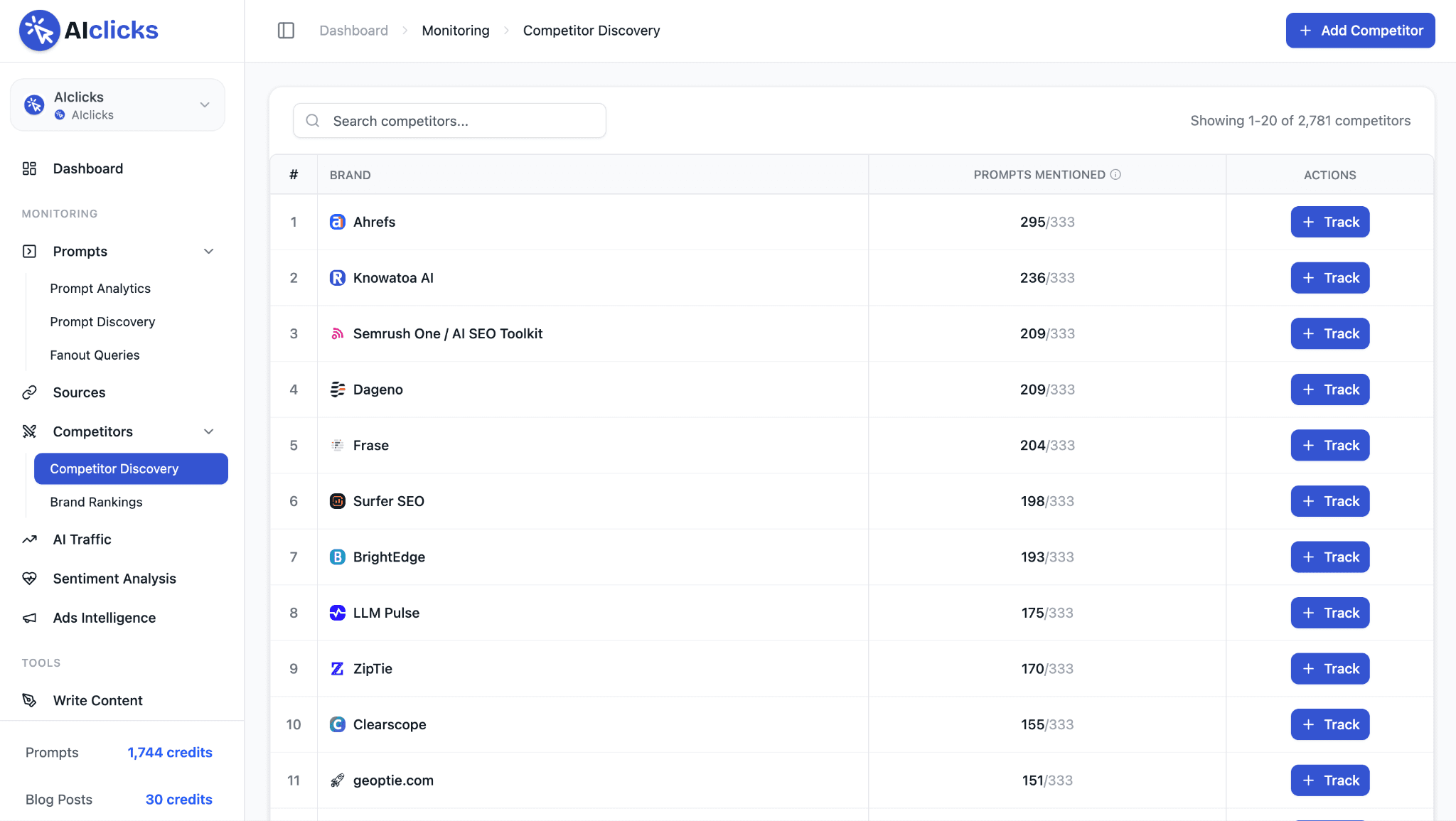
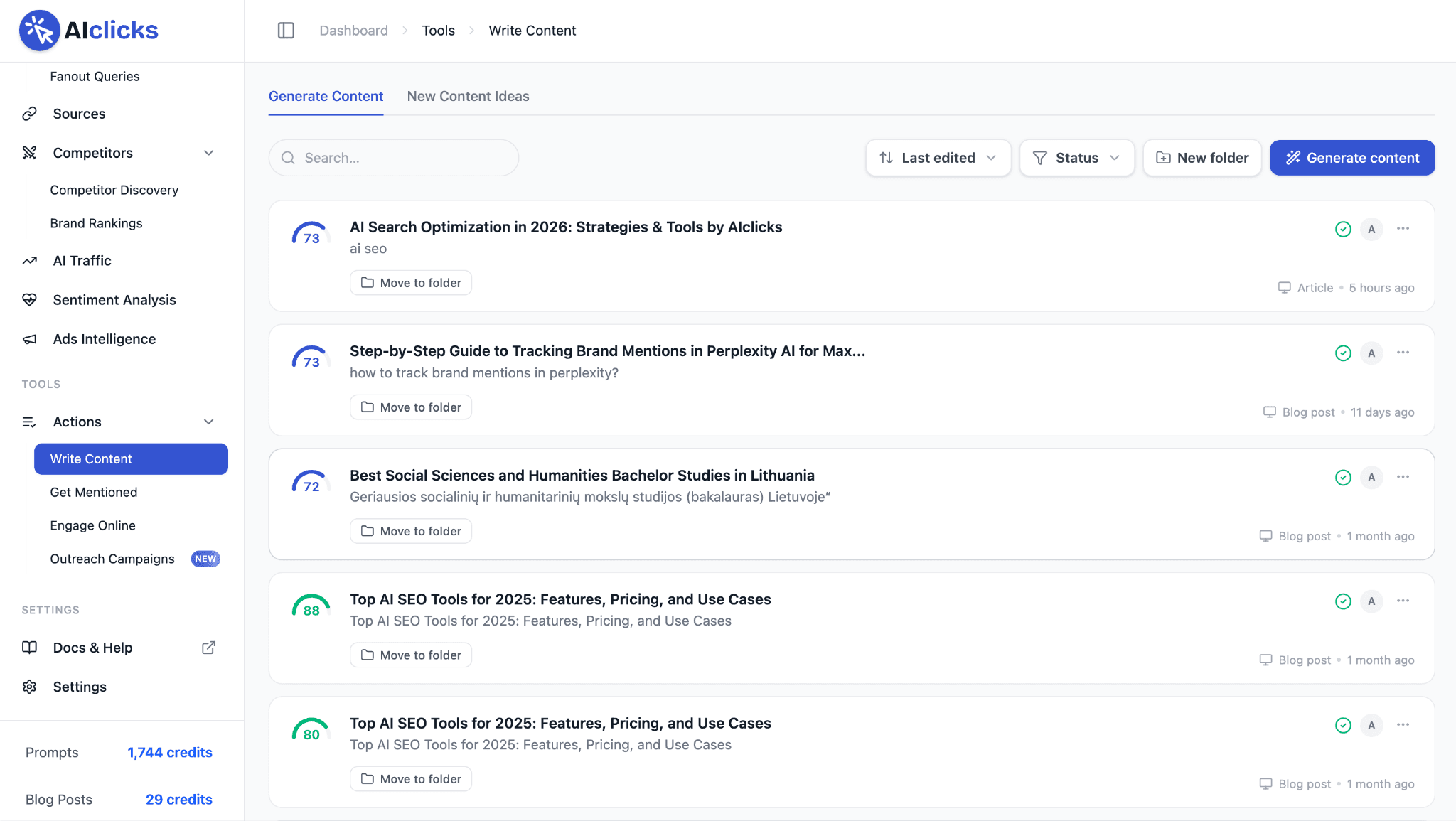
Actions engine converting visibility data into a ranked action list across three types: create AI-optimized content, earn mentions on the sources AI already trusts, and engage in community spaces where AI picks up brand signals, each action scored by expected impact.
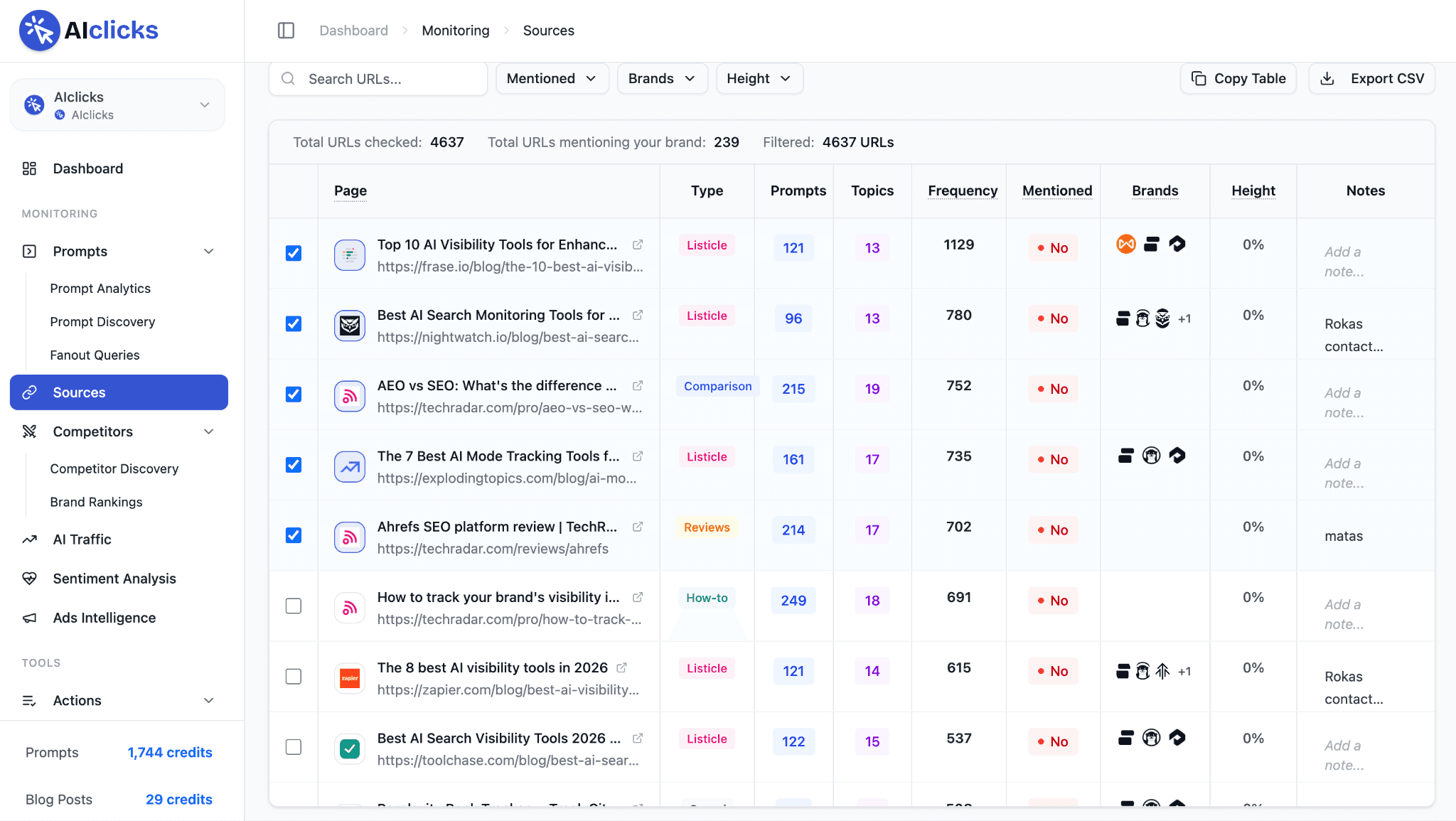
Sources analysis flagging coverage gaps, showing which domains feed AI answers in your category, and revealing exactly where competitors are cited and you are not.
Google Analytics integration tying AI visibility back to actual site traffic, with daily refreshes and segmentation by model and country.
Pros and cons:
Pros:
Tracks 10+ AI platforms in one dashboard, broader coverage than most tools at this price
Real-UI querying captures what real users see, not API approximations
Actions engine turns data into ranked actions rather than charts to interpret
Accessible entry price with a 3-day free trial on all plans
Cons:
Pricing is structured around predefined plan tiers rather than granular prompt-based billing, so teams with very specific usage volumes may find themselves between plans without a perfect fit. Custom plans are available on request.
The platform takes a few sessions to get comfortable with for teams new to prompt-level visibility data. The support team is responsive and helpful during onboarding.
The trial window is short for a platform whose value compounds over time. Most users report needing more than three days to feel confident in the data. The team extends it on request.
G2 rating: 4.9/5
Pricing: Starter $59/mo (30 prompts, 3 AI platforms) | Pro $189/mo (150 prompts, 4 platforms) | Business $499/mo (300+ prompts, 6 platforms) | Custom plans available | 3-day free trial on all plans
Verdict:
Peec gives you an accurate picture and a ranked list of opportunities, and stops there by design. AIclicks covers more models on self-serve and takes the work further, into what to build, which sources to pitch, and which conversations to enter. If your team already has the capacity to execute against a priority list, Peec's version may be all you need. If the list has been sitting untouched for a month, the gap isn't analysis.
If you want to go deeper on the strategy behind ranking in AI search before you trial anything, this walkthrough covers the full playbook:

2. AI Rank Checker: Best for occasional checks without a subscription
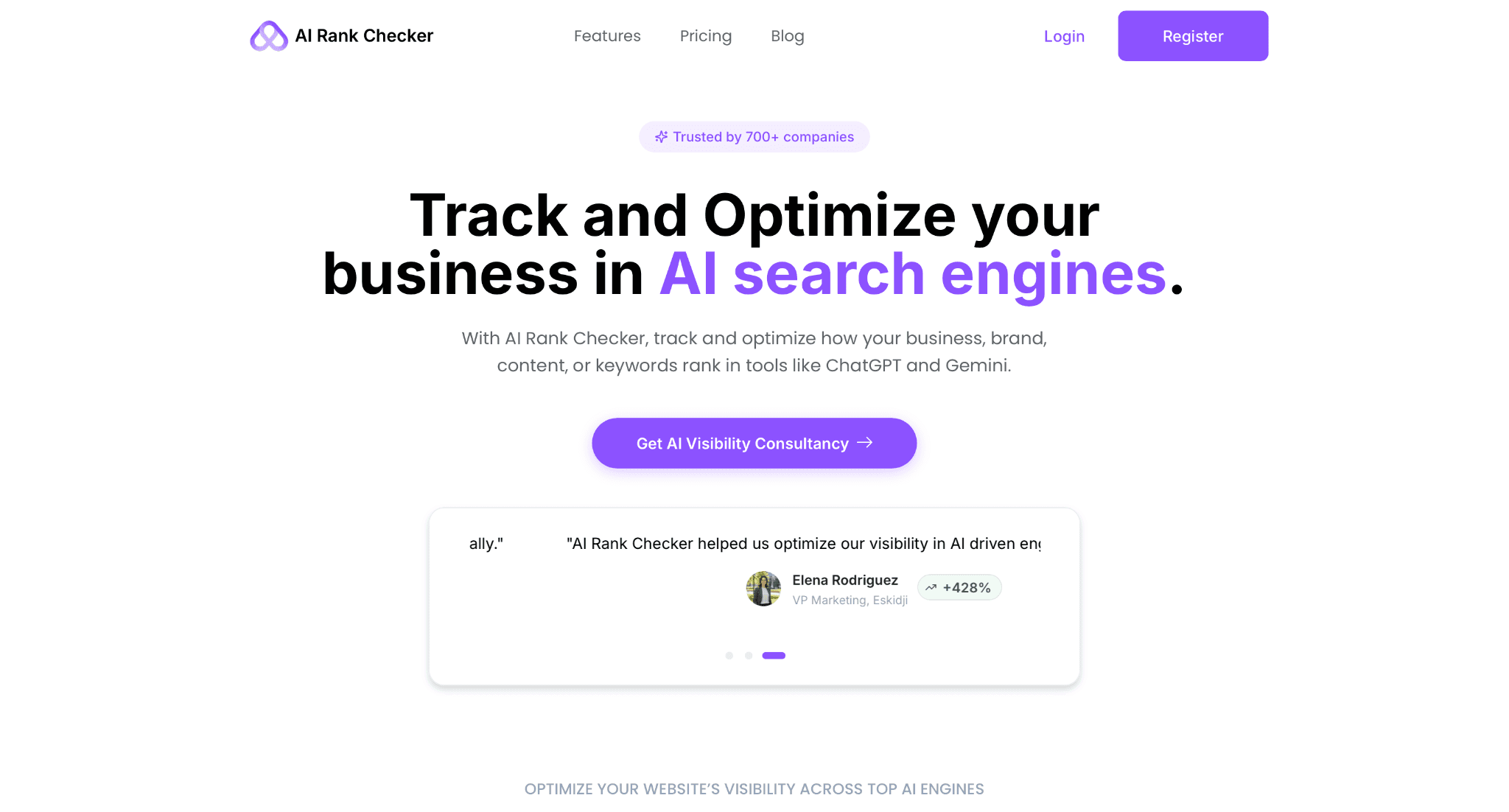
Most teams paying for a monthly AI visibility subscription use it three times a quarter. AI Rank Checker is built for those teams: a credit wallet that never expires, no subscription, and brand tracking across ChatGPT, Gemini, Claude, Perplexity, Copilot, and DeepSeek whenever you actually need it. The platform ends at the check. Citation analysis, source intelligence, trend data that compounds over time, those require a different tool.
Key features:
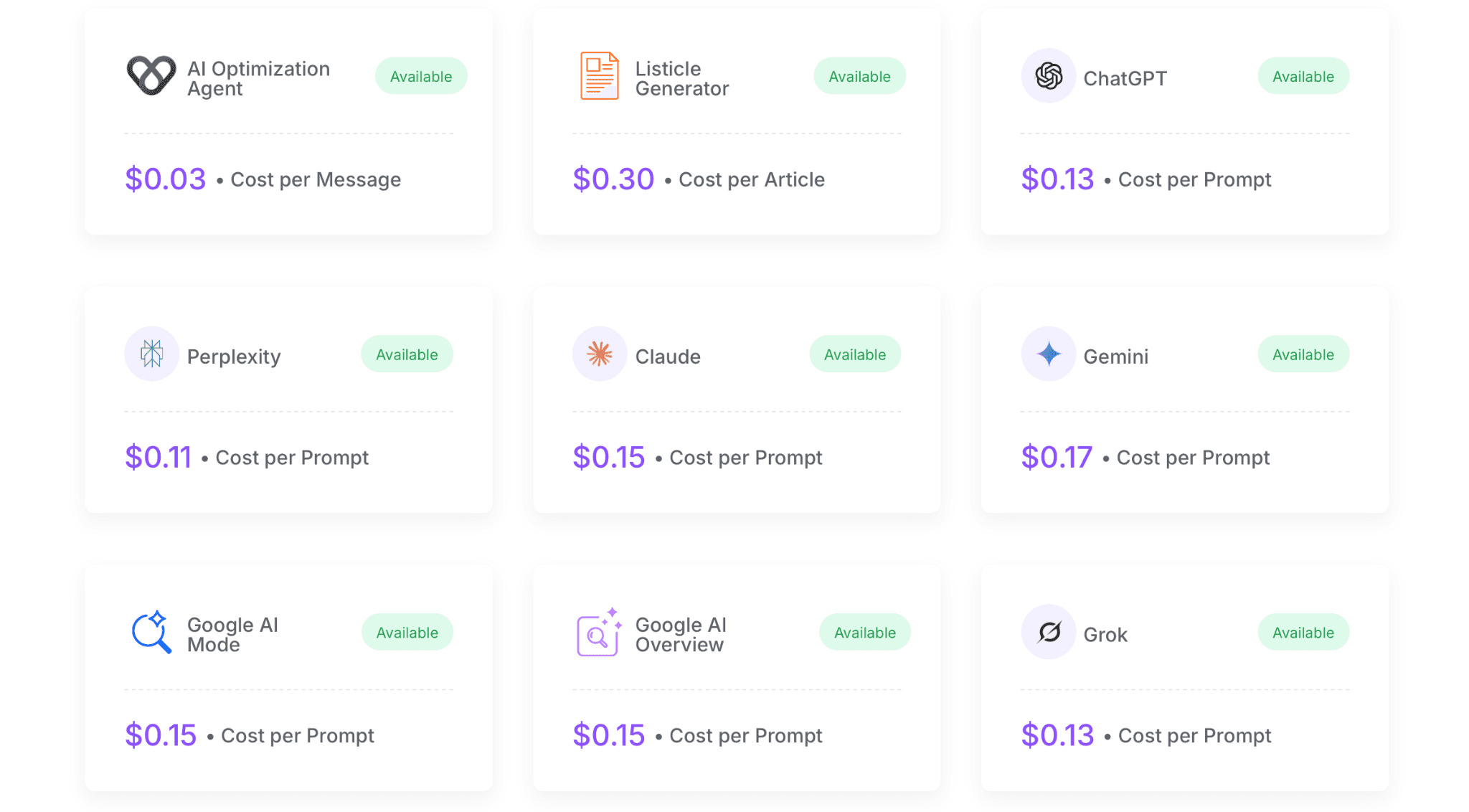
Pay-per-check wallet system across ChatGPT, Gemini, Claude, Perplexity, AI Mode, AI Overviews, and Grok. Funds never expire and no subscription is required.
Multi-domain tracking for agencies managing several clients, with competitor comparison across every tracked engine.
Clean PDF and CSV exports for sharing visibility snapshots with clients or leadership.
No account minimum or commitment; the lowest-friction entry point on this list for validating AI visibility before investing in a platform.
Pros and cons:
Pros:
No subscription means costs only accumulate when you actually run checks
Multi-domain support handles agency use without per-client fees
Exportable reports work for stakeholder communication without requiring a platform login
Cons:
Running large prompt sets across multiple engines without pre-calculating credit needs can produce unexpected monthly costs. Budget the run before you execute it.
No citation or source analysis, no action layer, no historical trend data. It tells you where you rank at a point in time and nothing more.
Limited G2 review presence and limited report customization options are the recurring feedback from users who need more than basic snapshots.

G2 rating: Limited verified reviews; check G2 directly before purchasing.
Pricing: Pay-per-check wallet; no monthly subscription. Verify current credit costs on the official site before running large volumes.
Verdict:
AI Rank Checker fits a real use case that most platforms ignore: the team that needs AI visibility data a few times a year rather than every week. Freelancers, small in-house teams, agencies validating the channel before pitching it to clients. The no-subscription model is genuinely useful in those situations.
Once AI visibility becomes a regular workflow rather than an occasional check, the credit cost overtakes a subscription and the absence of trend data and action guidance starts limiting what you can do with the output.
3. Profound: Best for enterprises with the budget and team depth to use the full platform

In February 2026, Profound closed a $96 million Series C at a $1 billion valuation. The customer list includes Ramp, DocuSign, Figma, Target, Walmart, and Charlotte Tilbury. The platform's distinctive asset is Prompt Volumes: a dataset from opted-in consumers showing what questions real people actually send to AI engines, broken down by topic, region, and demographic. No other platform in this category has built this. The Agents feature produces content and publishes it directly to WordPress, Sanity, Contentful, Webflow, and Framer, though Agents require Enterprise. The Starter plan at $99/mo gets you ChatGPT and 50 prompts. The capabilities Profound is known for begin at $399/mo Growth, which is the point where most teams start weighing Profound alternatives.
Key features:
Prompt Volumes dataset from opted-in consumers showing real AI query frequency by topic, region, and demographic. No equivalent exists in this category.
Answer Engine Insights tracking brand mentions, citations, sentiment, and competitive share of voice across multiple AI platforms depending on tier.
Agents: content workflow builder with pre-built templates (Content Refresh, AEO FAQ Generation, Competitive Research, Net-New Content) and CMS publishing to WordPress, Sanity, Contentful, Webflow, and Framer. Enterprise-only. Self-serve plans do not include Agents.
Agent Analytics connects to your CDN to show which AI crawlers visit which pages, at what frequency, and where they encounter errors.
Enterprise security: SOC 2 Type II, SSO/SAML, dedicated Slack support, and unlimited view-only seats on Enterprise.
Pros and cons:
Pros:
Prompt Volumes dataset is the category's only source of real AI query volume data and changes how teams prioritize content investment
Agents with CMS publishing closes the insight-to-content loop at a level most platforms leave to external tools
Enterprise customer roster and $155M in funding signal a platform that has earned adoption at serious organizational scale
Cons:
The Starter plan tracks ChatGPT only. Multi-engine tracking, Agents, Prompt Volumes, and data exports begin at $399/mo Growth or require Enterprise.
Dashboard complexity consistently surfaces in G2 reviews. "I find the overall user experience and dashboard of Profound to be confusing. It is not clear what is working and why." Verified G2 reviewer. The depth rewards a dedicated analyst.
Slow support response times are the most reported operational complaint. Multiple verified G2 reviewers cite wait times of up to a week on support requests, which is real friction at this price level.

G2 rating: 4.5/5
Pricing: Starter $99/mo (ChatGPT only, 50 prompts) | Growth $399/mo (3 engines, 100 prompts) | Enterprise custom (all 10 engines) | Annual billing approximately 17% off
Verdict:
Profound is the right call when your organization has committed AI visibility as a board-level metric, has the team depth to extract value from the Prompt Volumes dataset, and needs the Agents feature to close the content loop at scale. The $96M raise and the customer list are real signals that the platform delivers at that level.
The pricing structure makes it a difficult evaluation for most teams coming from Peec. The $99 Starter exists to give buyers a sense of the platform; the actual Profound program starts at $399/mo. If you need broader engine coverage and an action layer at a lower cost, that conversation points in a different direction.
4. Scrunch AI: Best for brands where AI misinformation creates real compliance or reputational risk
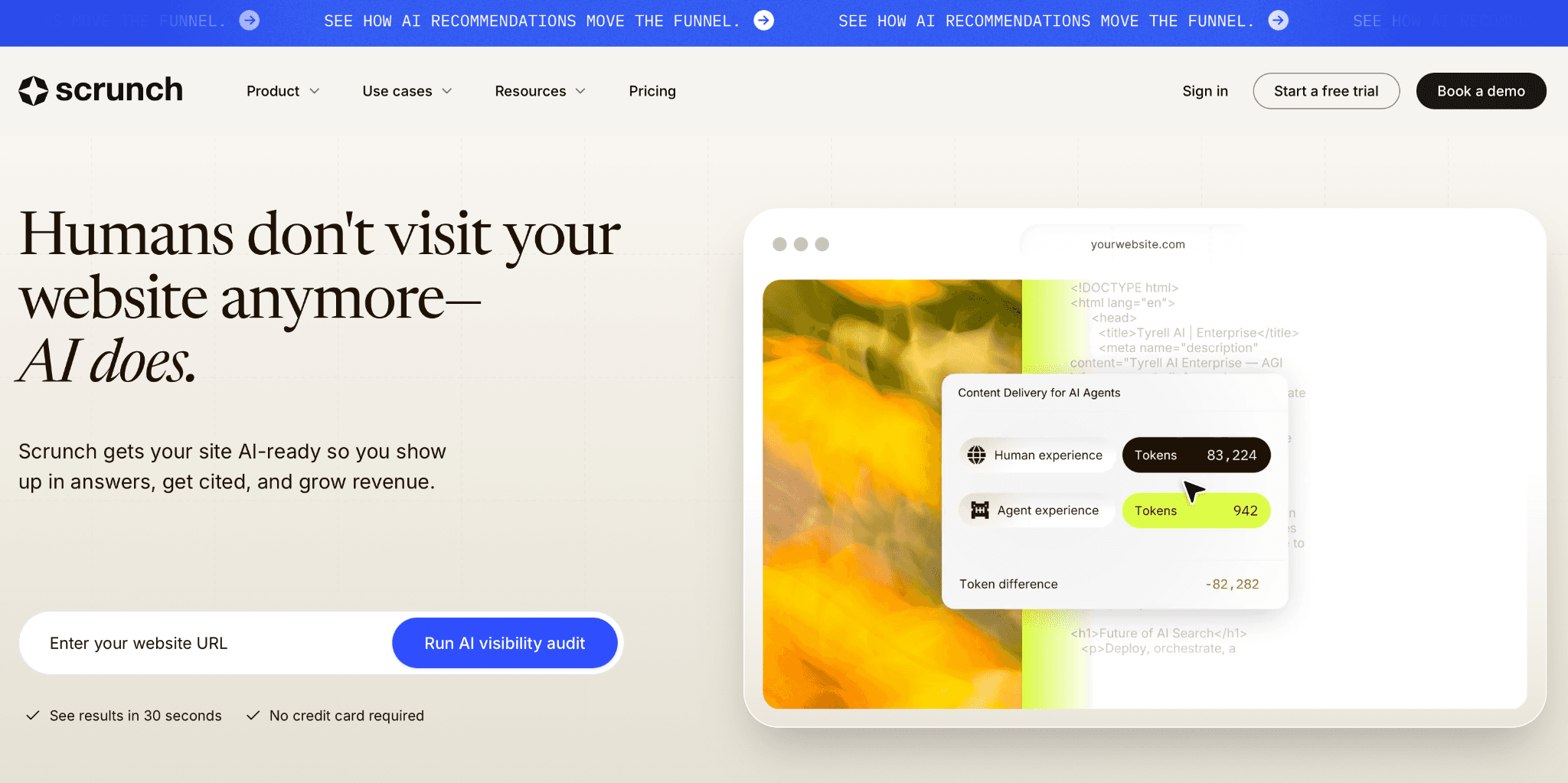
Scrunch AI operates across four products: monitoring, auditing, optimization, and content delivery via its Agent Experience Platform. The AXP layer is what makes it technically distinct from most Scrunch AI competitors: it detects AI crawler traffic at the edge through Akamai, Cloudflare, and Vercel, and automatically serves those crawlers a compressed, structured version of your site without changing anything a human visitor sees. Akamai's own case study documented a 5x increase in brand presence using AXP. The Core plan covers ChatGPT, Perplexity, Google AI Overviews, and Copilot. Scrunch does not currently offer content generation.
Key features:
Brand monitoring across AI platforms tracking brand presence, position, sentiment, citations, and full AI response text, giving visibility into how accurately AI engines describe your brand and where they diverge from reality.
Agent Experience Platform (AXP): detects AI crawler traffic at the edge and automatically serves those crawlers a compressed, structured, AI-readable version of your site without disrupting the human-facing experience. Compatible with Akamai, Cloudflare, and Vercel.
Audit layer analysing your site for AI readiness, including crawlability, structured data, and content accessibility to AI systems.
GA4 and Cloudflare integration for AI referral traffic monitoring and AI bot crawler analytics, included at no extra cost on the Core plan.
SOC 2 Type II compliance, SAML and OAuth-based SSO, role-based access controls, and an Agency Partner Program for multi-brand management.
Pros and cons:
Pros:
AXP is technically original and has no equivalent elsewhere in the category, with a documented customer case study showing 5x brand presence improvement
GA4 integration for AI referral traffic is consistently rated best-in-class by G2 reviewers
SOC 2 Type II and enterprise security posture makes procurement straightforward for regulated industries
Cons:
The Core plan covers four engines: ChatGPT, Perplexity, Google AI Overviews, and Copilot. Claude, Gemini, Meta AI, Grok, and AI Mode require Enterprise. For teams specifically leaving Peec because of engine coverage limits, the Core plan is narrower, not wider.
Scrunch does not currently offer content generation capabilities. If you need to act on visibility data by producing content within the platform, you will need a separate tool for that step.
"The sales process was frustrating. Terms shifted multiple times during negotiation, pricing confirmed in writing got retracted, and the contract didn't match verbal commitments on several points." Senior Product Manager, Computer Software, G2.

G2 rating: 4.6/5
Pricing: Core $250/mo (4 engines, 125 prompts, 5 seats) | Agency from $500/mo | Enterprise custom | 7-day free trial
Verdict:
Scrunch earns serious consideration for brands operating in regulated industries where AI-generated misinformation creates legal or reputational risk. Financial services, healthcare adjacent, any space where an AI engine generating incorrect claims about your product has real downstream consequences. For those buyers, the AXP infrastructure layer and misinformation detection justify the price even at Enterprise.
For teams primarily shopping for broader engine coverage or a clearer action layer, the Core plan delivers fewer self-serve engines than Peec at a significantly higher price, with the platform's most distinctive capabilities locked behind Enterprise.
5. AthenaHQ: Best for e-commerce and enterprise teams that need to show AI search in a P&L context
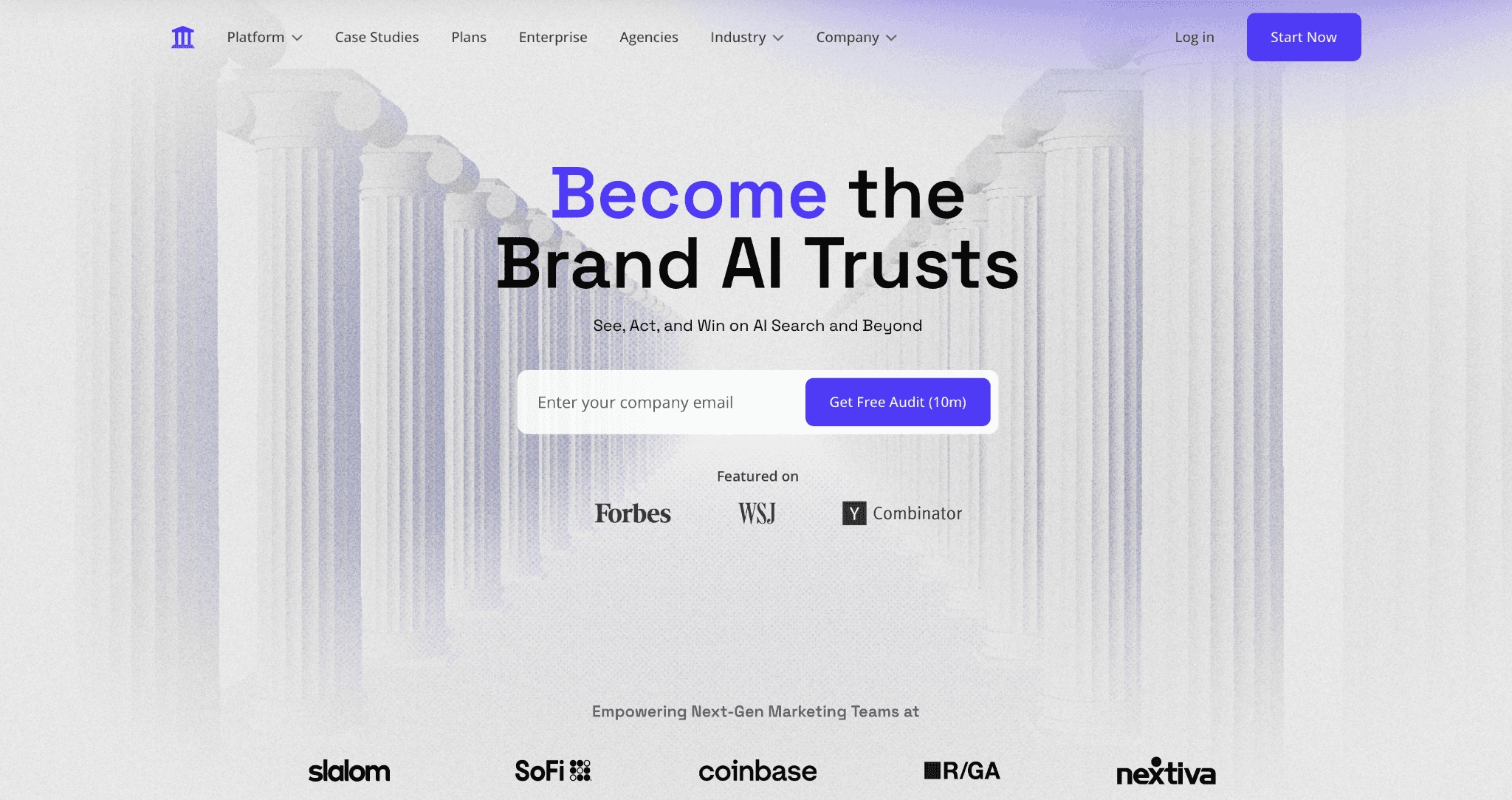
AthenaHQ tracks where your brand appears in AI answers and ties that directly to revenue through Shopify and GA4 integrations. Built by alumni of Google Search and DeepMind, backed by Y Combinator, it tracks 8+ AI platforms on every self-serve plan with no per-engine add-ons. The Action Center generates structured GEO optimization workflows, the Ask Athena copilot answers plain-language questions about your data, and hallucination detection flags when AI engines describe your brand inaccurately. At $295/mo with no free trial, it asks for a real commitment before the platform shows you what it can do.
Key features:
Multi-engine tracking across 8+ AI platforms on every plan including ChatGPT, Perplexity, Claude, Gemini, Copilot, and more, with no per-engine add-ons on any self-serve tier.
Action Center generating structured GEO optimization workflows with tasks assignable to team members, trackable through completion, and prioritized by estimated visibility impact.
Ask Athena AI copilot answering natural-language strategy questions about your visibility data, pulling from real-time prompt monitoring, citation tracking, and competitor benchmarks.
Revenue attribution via Shopify and GA4 integration, connecting AI citations to actual commercial outcomes. The only platform on this list doing this.
Source Intelligence identifies which websites AI systems draw from most frequently in your category, so you can target them strategically for content and PR.
Hallucination detection monitoring for when AI platforms describe your brand inaccurately.
Pros and cons:
Pros:
Eight-plus engines included on every self-serve plan with no add-on fees
Revenue attribution through Shopify and GA4 makes GEO investment defensible to finance and leadership
Action Center is the most developed task workflow layer in the category for self-serve buyers
Cons:
No free trial at $295/mo. The ACE autonomous agent layer, multi-region tracking, and API access are Enterprise-only, so the self-serve tier is meaningfully less capable than the full platform pitch.
Self-serve is limited to one country, which constrains global brands evaluating the platform before committing to Enterprise.
Product iteration happens fast enough that the UI changes between logins. "The product is developing very quickly so can be hard to keep up!" Two G2 reviewers note this independently, and teams without someone actively managing the platform experience more friction as a result.
Prompt-volume and revenue-attribution figures are modelled estimates rather than measured ground truth. Treat them as directional benchmarks for prioritizing work, not as numbers to hand to finance without a second source.

G2 rating: 4.9/5
Pricing: Self-Serve $295/mo monthly ($245/mo annual; discounted first month available) | Enterprise custom | No free trial
Verdict:
If your team needs to answer "what did AI search visibility generate in revenue this quarter," AthenaHQ is currently the only platform that can answer it directly. Eight-plus engines, an action layer, and revenue attribution in one self-serve product is a meaningful combination for e-commerce brands and enterprise growth teams.
The honest bar to clear before committing is $295/mo with no trial, and the self-serve tier is genuinely constrained compared to the full platform. For teams still establishing that AI visibility is a channel worth investing in, starting with a lower-cost tracking platform and coming back to AthenaHQ once the case is made is the more practical path.
6. Writesonic: Best for content teams that want tracking and creation in the same workflow
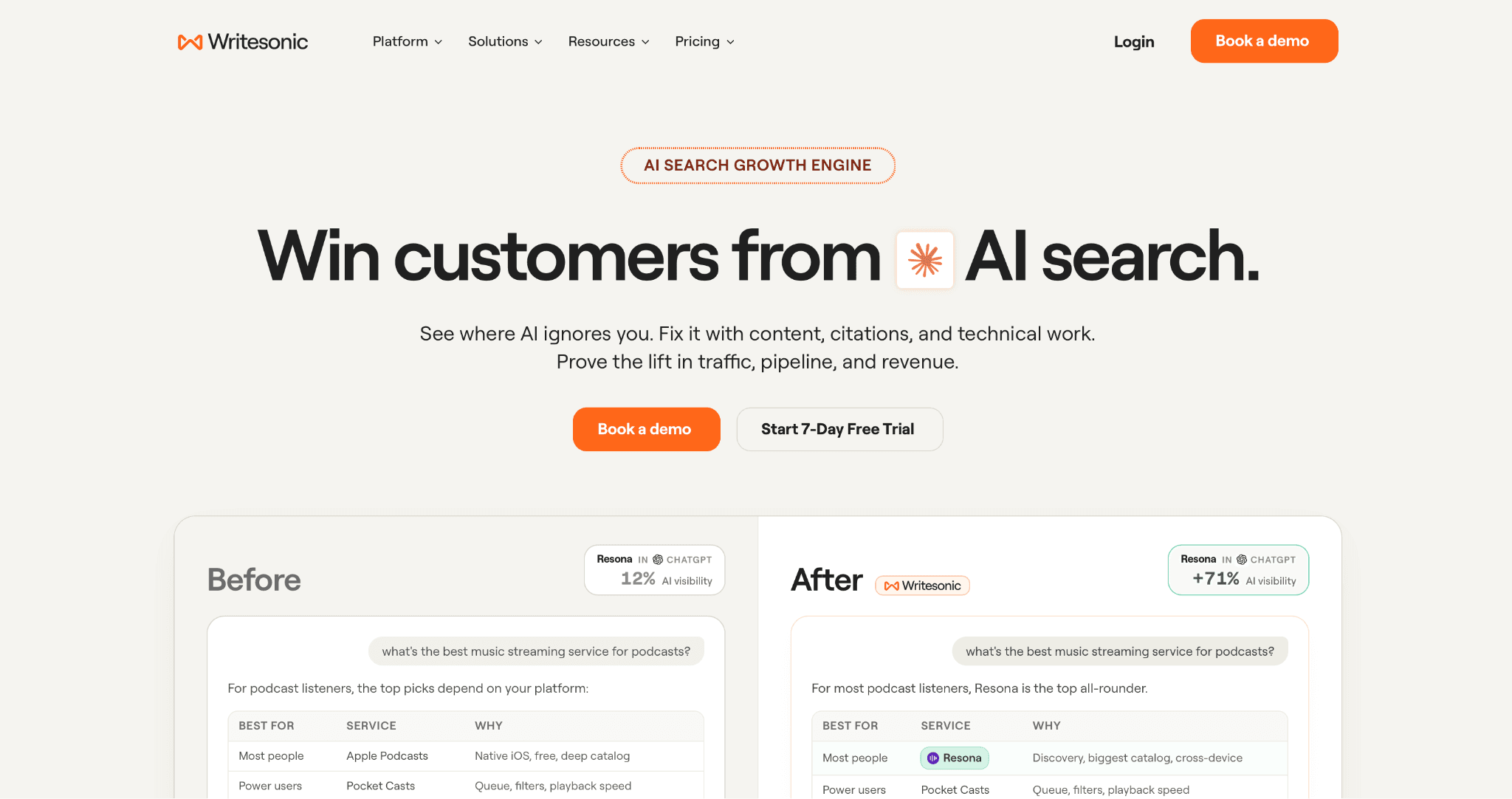
Writesonic came at AI visibility from the content creation side rather than the tracking side, and that origin shapes the product. The path from "we are missing from AI answers for this topic" to "here is a drafted article to fix that" does not require switching tools. Every self-serve plan includes tracking from Starter, covering ChatGPT, Gemini, and Google AI Overviews with 50 daily prompt runs and 15 AI articles per month. Cloudflare crawler analytics, which show which AI bots visit which pages, add a layer of bot-side visibility most monitoring tools do not offer at any price. The caveat: three engines on self-serve, and the full Action Center requires Enterprise.
Key features:
AI Search Visibility tracking from Starter, covering ChatGPT, Gemini, and Google AI Overviews. Full 10-platform coverage requires Enterprise.
Cloudflare-based crawler analytics showing which AI bots access which pages and how crawl behaviour changes over time.
Sentiment Analysis at Growth tier, showing how AI platforms describe your brand across tracked prompts.
Action Center on Enterprise (Growth tier gets 5 off-page and 5 on-page trial actions per month).
AI Article Writer on all plans: 15 articles per month on Starter, 50 on Growth.
2 billion+ real AI conversations across 10 platforms and 50+ markets, updated weekly, underpinning prompt volume data.
Pros and cons:
Pros:
Tracking included from the entry plan, the lowest-priced option on this list that includes any AI visibility monitoring
Cloudflare crawler analytics is a genuine differentiator for understanding bot behaviour alongside brand visibility
Integrated discovery-to-draft workflow saves tool-switching time for high-volume content teams
Cons:
Self-serve plans track ChatGPT, Gemini, and Google AI Overviews only. Teams coming from Peec's six-engine pool will find their coverage narrower with Writesonic on any self-serve plan.
Unused credits expire monthly without rollover, the most consistently flagged complaint across Writesonic's G2 reviews.
"Sometimes I just feel that these contents are just like ChatGPT only, but we pay extra every month for its premium plan without getting any additional features." Rohan T., Marketing Team, G2.

G2 rating: 4.7/5
Pricing: Starter $79/mo annual (ChatGPT, Gemini, AI Overviews, 50 daily prompts) | Basic $199/mo annual (same 3 engines, 100 prompts) | Growth $399/mo annual (Sentiment Analysis included) | Enterprise custom (all 10 platforms, full Action Center)
Verdict:
Writesonic makes its strongest case for content teams that publish regularly and want visibility data and content production in one place. The Cloudflare crawler analytics give a view of your site that most monitoring tools cannot provide.
The engine coverage is the honest comparison point for anyone coming from Peec: three engines on self-serve is a step backwards on coverage, not forwards. For teams specifically needing broader engine reach or a structured action layer without the content suite bundled in, this is not the right upgrade.
7. Otterly AI: Best for solo operators and lean teams that want clean monitoring with zero setup friction
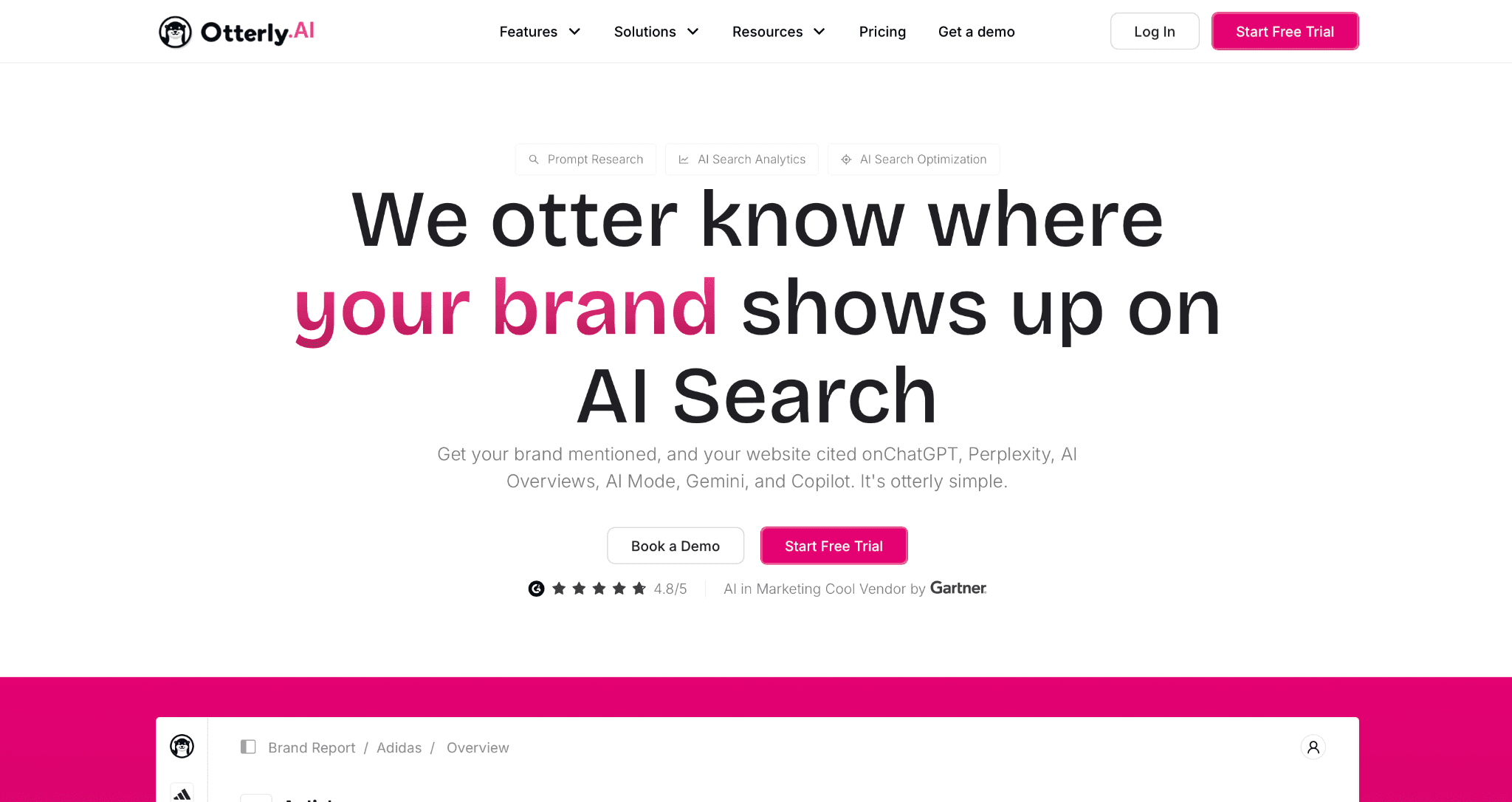
Otterly AI's bet is that AI visibility tracking should work without documentation, sales calls, or a technical background, a lower-friction promise than most Otterly alternatives make. You build a prompt library, Otterly runs it on a schedule, and the insight arrives in a report. Coverage on paid plans spans ChatGPT, Gemini, Perplexity, Copilot, AI Overviews, and AI Mode, though Gemini and AI Mode are add-ons on the $29/mo Lite base plan. The predictive GEO scoring estimates pre-publish citation likelihood and produces briefs for what needs fixing.
Key features:
Six-engine coverage on paid plans: ChatGPT, Perplexity, Google AI Overviews, AI Mode, Gemini, and Copilot. Gemini and AI Mode are add-ons on the base Lite plan.
Automated prompt library runs on a schedule, delivering reports rather than requiring active dashboard checks.
Neutral monitoring: Otterly queries platforms directly without personalized memory, so results are not skewed by location or search history.
Content Audit with predictive GEO scoring estimating pre-publish AI citation likelihood, with briefs to address weaknesses.
Recommendations feature (launched April 2026) producing prioritized action guidance from visibility data, turning monitoring findings into specific next steps.
Pros and cons:
Pros:
Fastest setup in the category with tracking running in under an hour from signup
Predictive scoring before publishing is a workflow advantage rarely available at this price
$29/mo entry with a 14-day free trial, no credit card required
Recommendations feature now closes part of the monitoring-to-action gap that was previously absent
Cons:
Gemini and Google AI Mode are add-ons on the Lite plan, so six-engine coverage costs more than the $29/mo headline suggests.
Claude is not tracked on any self-serve plan. Teams whose buyers use Claude have the same blind spot here as on Peec.
The Recommendations feature launched in April 2026 and is newer than the core tracking product. Depth of action guidance is still developing compared to platforms built around execution from the start.

G2 rating: 4.8/5
Pricing: Lite $29/mo (15 prompts, 4 core engines) | Standard $189/mo (100 prompts) | Premium $489/mo (400 prompts) | Pro $989+/mo (1,000 prompts) | 14-day free trial, no credit card
Verdict:
Otterly is genuinely the right pick for small teams and solo operators that want reliable monitoring delivered on autopilot. The predictive scoring and scheduled reporting save real time for teams publishing regularly, and the April 2026 Recommendations launch has started to close the gap between showing the problem and telling you what to do about it.
The direct comparison with Peec: Otterly is simpler and cheaper. If you are leaving Peec because the interface feels complex or the cost has become hard to justify, Otterly addresses both. If your primary frustration with Peec is the engine ceiling, Otterly's Lite plan has the same Claude gap and requires add-ons for Gemini and AI Mode.
8. PromptMonitor: Best for teams that want to go from "who cites this source" to "who do I email" in one step
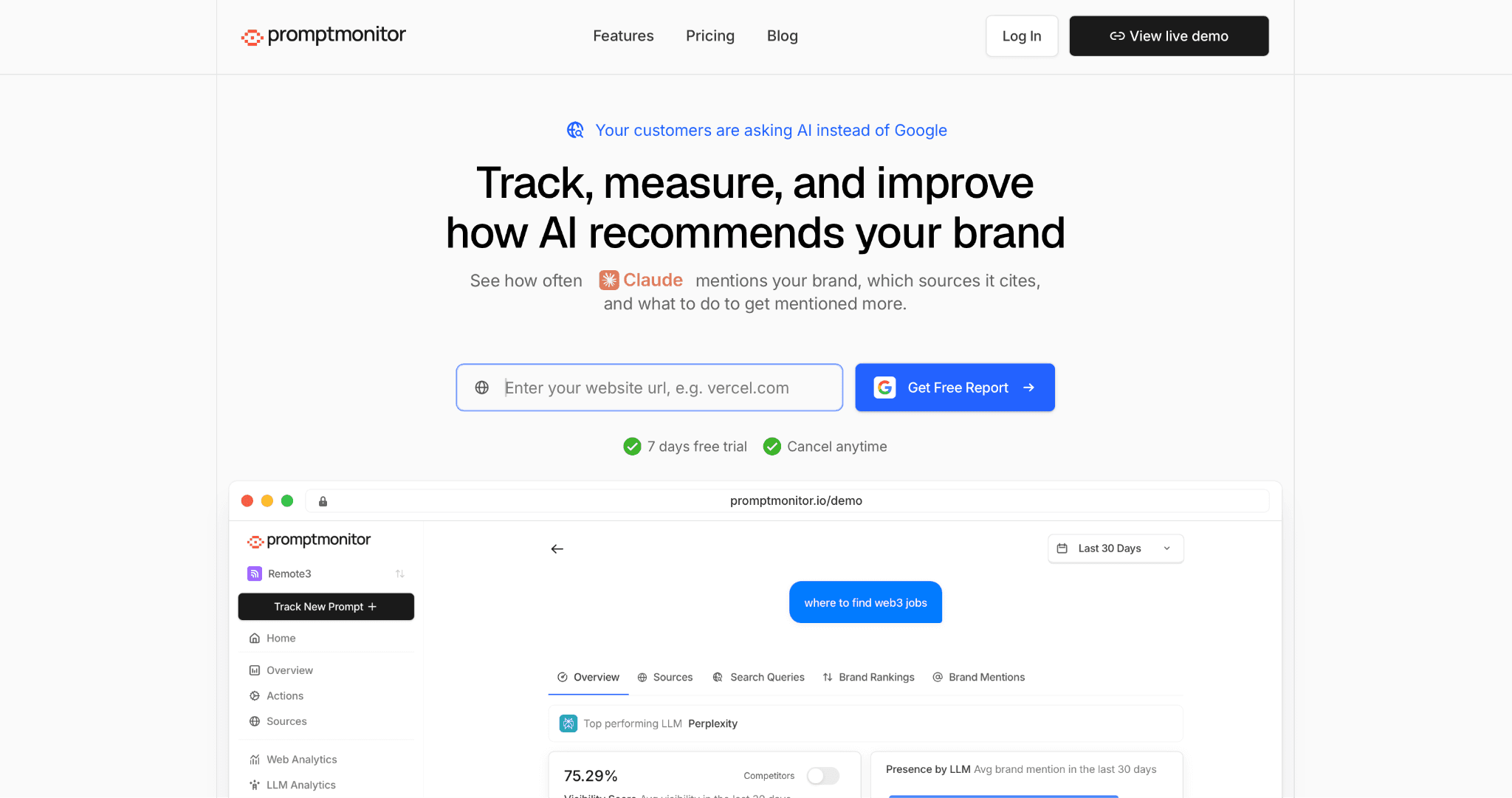
Most AI visibility tools show you which domains AI engines cite in your category. PromptMonitor shows you who wrote the content on those domains, how to reach them, and whether the domain is worth the effort. When an AI engine cites a source, PromptMonitor pulls the author's email, their social profiles, the domain rating, and the backlink count, so the decision about what to do next happens in the same view as the tracking data.
Key features:
Eight AI platforms tracked on all plans with no per-engine add-ons: ChatGPT, Claude, Gemini, DeepSeek, Grok, Perplexity, Google AI Overview, and AI Mode.
Publisher contact extraction pulling author emails and social profiles from every cited source alongside domain rating and backlink data.
Unlimited team seats on every plan including Starter at $29/mo.
AI crawler analytics showing which bots access your site and which pages they read.
Geographic targeting across 200+ countries with daily refresh on paid plans.
Pros and cons:
Pros:
Publisher contact extraction compresses outreach research that typically takes hours into a single view, with no equivalent available elsewhere on this list
Eight engines with no add-ons delivers more coverage per dollar than almost anything at this price
Unlimited seats from $29/mo removes per-head costs entirely
Cons:
Prompt limits are tight at every tier: 25 on Starter, 50 on Growth, 150 on Pro. Teams tracking multiple product lines or geographies will outgrow these quickly.
No content creation, no action recommendations beyond the source contact list, and no branded client reporting. The product scope is deliberately narrow and that boundary shows when teams need more than monitoring and outreach targeting.
Third-party review presence on G2 is limited, which makes it harder to assess support quality and long-term reliability compared to more established platforms.
G2 rating: No verified G2 reviews; check directly before purchasing.
Pricing: Starter $29/mo (25 prompts, 8 engines) | Growth $39/mo (50 prompts) | Pro $129/mo (150 prompts) | Enterprise custom | 7-day free trial
Verdict:
PromptMonitor earns its spot for teams that have already decided outreach is their primary lever for improving AI citation rates and want the research compressed into the tracking tool rather than a separate workflow. The contact extraction feature is not available anywhere else on this list at any price.
The prompt limits are the real planning constraint. Twenty-five prompts covers a narrow slice of any real category. At $129/mo Pro, 150 prompts becomes more meaningful but still modest compared to what dedicated platforms deliver at that price.
9. Rankscale AI: Best for teams that want to validate AI visibility across the widest possible engine set at the lowest cost
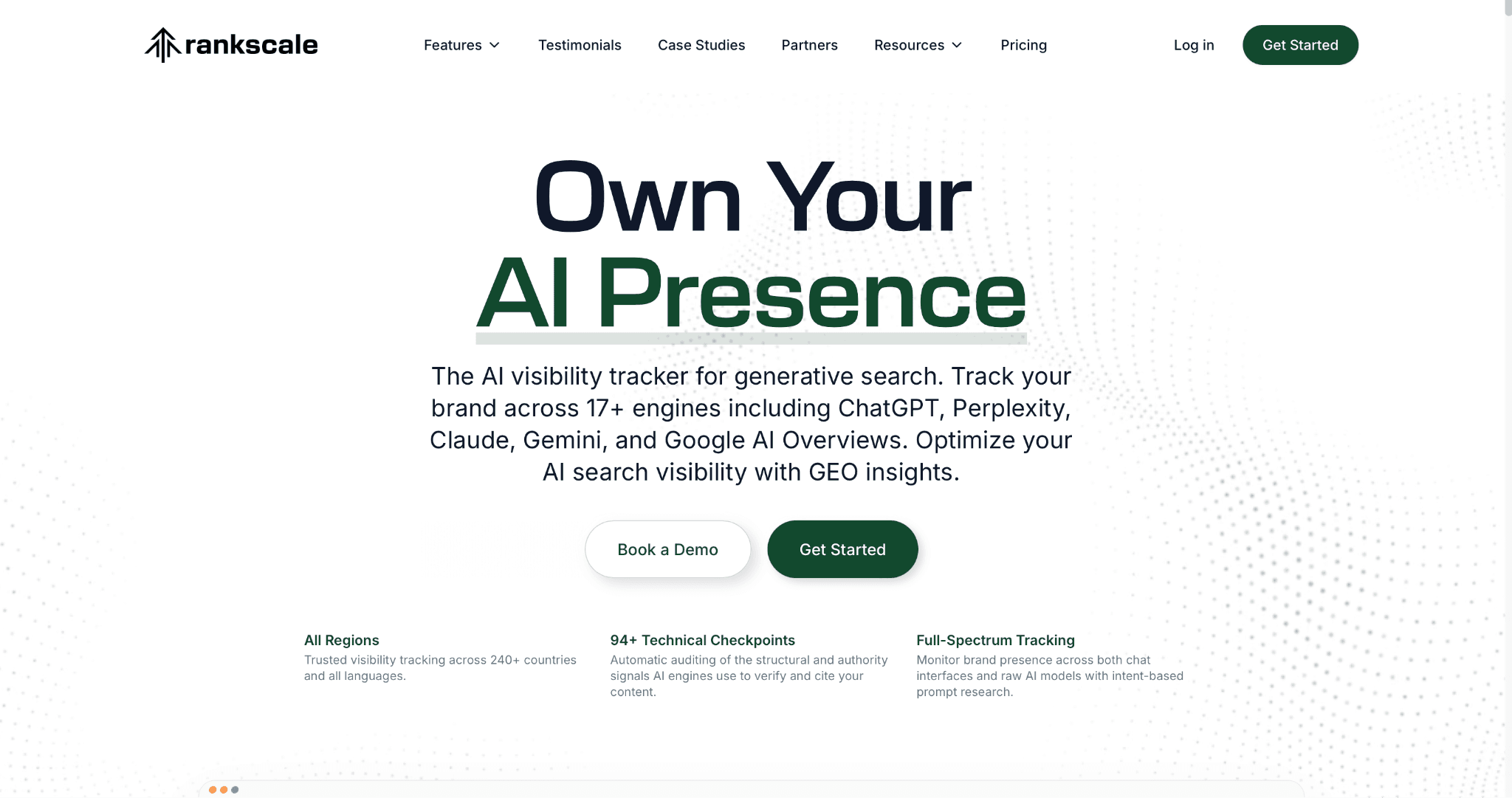
Rankscale is not trying to be polished. It is trying to be comprehensive, and on engine coverage it outruns most Rankscale alternatives. Seventeen-plus engines on every plan with no tier restrictions, citation-level sentiment, configurable monitoring from bi-hourly to bi-monthly, and a credit-based model that lets agencies allocate differently across clients. The engine list includes ChatGPT, Perplexity, Claude, Gemini, AI Overviews, AI Mode, DeepSeek, Grok, Copilot, and Mistral, with new models added to all accounts at launch. The interface rewards technically comfortable users and feels dense to everyone else.
Key features:
17+ AI engines on every plan with no tier-gating, including ChatGPT, Perplexity, Claude, Gemini, AI Overviews, AI Mode, DeepSeek, Grok, Copilot, and Mistral. New models are added to all accounts at launch.
Credit-based pricing with configurable monitoring schedules from bi-hourly to bi-monthly across 240+ regions.
Page Audits running 90+ checks across seven modules: Traditional SEO, RAG Optimisation, AI Readiness, Link Audit, Schema Engine, E-E-A-T, and Subjectivity Filter. Rule-based, no LLMs in the audit engine.
Prompt Research for exploring which prompts and intents are used most for a given segment, region, and language.
Citation analysis, sentiment analysis, competitor benchmarking, custom dashboards, and Looker Studio integration.
Pros and cons:
Pros:
17+ engines with no upsell is genuinely unmatched in the category at any price
Credit-based model suits agencies with variable client loads and avoids paying for unused capacity
Founder-led team ships updates quickly based on direct user feedback, with an active community Slack channel
Cons:
Credit budgeting across configurable monitoring frequencies, multiple brands, and varied prompt volumes has a real learning curve. Most teams spend the first month recalibrating before costs stabilize.
Dense interface built for data-comfortable users. Teams expecting clean dashboards with intuitive navigation will find the experience requires more effort than Peec's streamlined UI.
No built-in action output or client-facing reports on base plans. The platform ends at measurement and recommendation surfacing; execution stays with your team.

G2 rating: Limited verified G2 reviews; check directly before purchasing.
Pricing:Pro €99/mo (1200 credits) | Growth €385/mo (5500 credits) | Enterprise €780/mo (12,000 credits) | Free trial with in-app credit top-ups
Verdict:
Rankscale is the right starting point for teams that want to learn whether AI visibility tracking is worth investing in before committing to a real platform. Seventeen engines at €99/mo makes it the most affordable way to explore the category across a wide engine set.
The progression is predictable: most teams use Rankscale to validate the channel, then move to a platform with a structured action layer once weekly optimisation becomes a regular workflow. The credit system and dense interface have their own overhead that becomes a management cost as volume grows.
10. Gauge: Best for teams that want to close the full loop from visibility data to published content in one platform
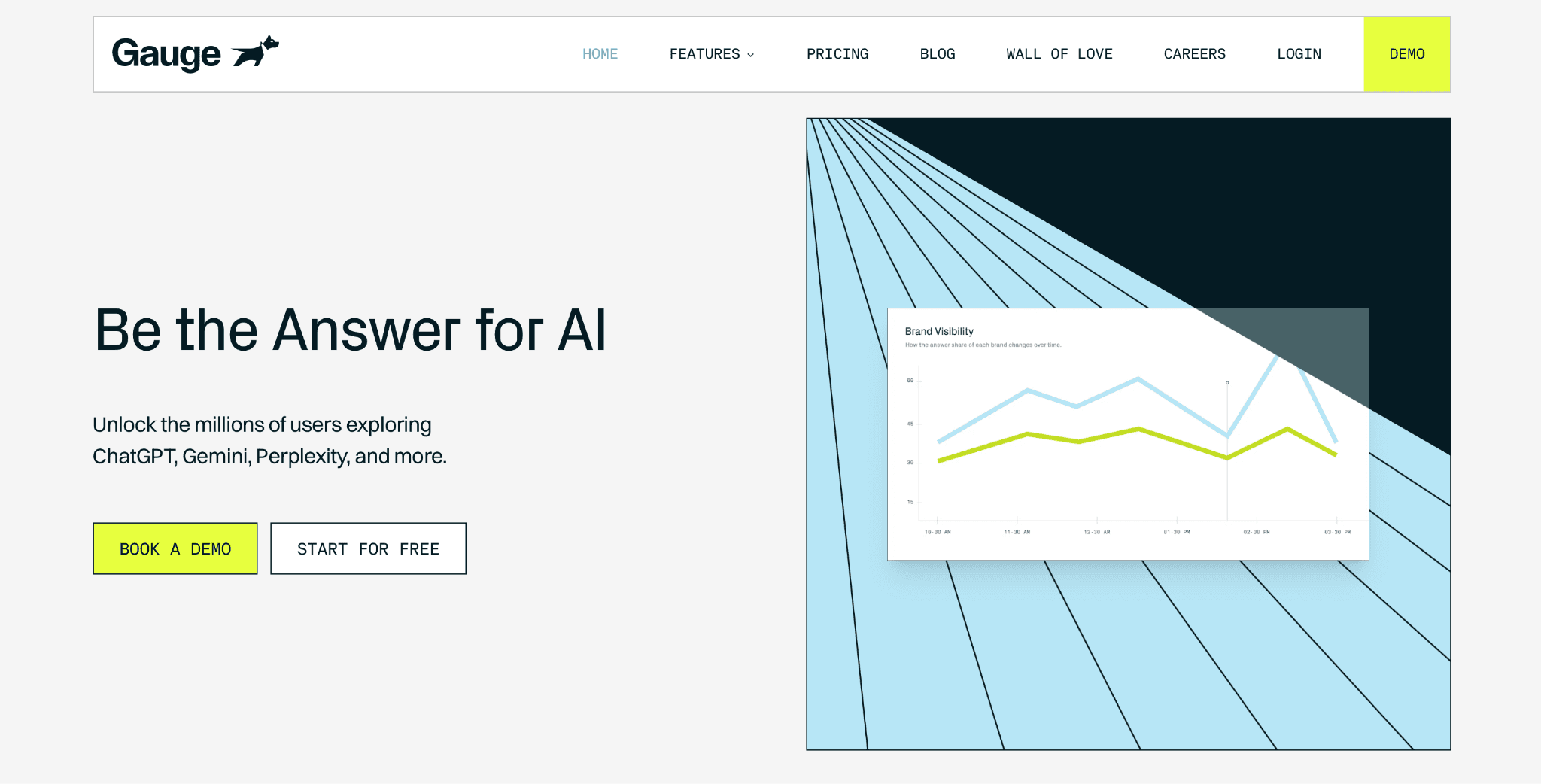
Gauge is a San Francisco-based platform that combines prompt tracking, a content engine, an AI assistant, and ChatGPT ad monitoring in one product. Seven AI engines tracked through real user interfaces, 600 daily prompt runs, and 18 articles per month from the content engine on the Growth plan at $599/mo. There is no lower-tier entry point, which means the platform is only practical for teams that have already decided AI visibility is a channel worth that level of investment.
Key features:
Prompt tracking across 7 engines through real UI interfaces: ChatGPT, Claude, Gemini, Perplexity, Copilot, AI Mode, and AI Overviews. 600 daily prompts on Growth.
Content engine produces 18 articles per month, built from combined visibility data and organic search data to target both AI citation and traditional search rankings.
Ask Gauge AI assistant for natural-language strategy questions and direct execution of recommendations.
ChatGPT Ads tracker monitoring paid placements inside ChatGPT, not available on any other platform on this list.
GA4, GSC, S3, and Slack integrations for teams that need AI visibility feeding into their existing data stack.
Pros and cons:
Pros:
Real-UI tracking across 7 engines means data reflects what actual buyers see rather than simulated API queries
Documented case studies with specific named customers showing measurable visibility improvements
GA4 and GSC integrations connect AI visibility data to organic and referral traffic in the same reporting view
Cons:
$599/mo Growth with no lower-tier entry is the highest self-serve price on this list and requires a team already convinced that AI visibility is a primary channel worth that investment.
Limited independent G2 review presence means the case studies are primarily first-party. The results are notable but external validation is thinner than for more established platforms.
The content engine producing 18 articles per month is a meaningful feature for content-heavy teams and irrelevant overhead for teams that are not. You pay for it regardless of whether you use it.
G2 rating: Limited verified G2 reviews (4.8/5, 4 reviews); check directly at withgauge.com before purchasing.
Pricing: Growth $599/mo (600 daily prompts, 18 articles/month) | Enterprise custom
Verdict:
Gauge is the right platform for growth teams that have decided AI visibility is a core acquisition channel and want a single product handling tracking, content production, and strategy guidance together. The case study results are strong and the all-in-one scope removes meaningful tool-switching overhead for teams running this as a full programme.
The price requires that conviction to already exist. At $599/mo with no lower entry point, teams still building the business case for AI visibility are better served starting with a tracking platform that lets them prove the channel first.
11. Geneo: Best for agencies that sell AI visibility as a service and need white-label delivery built in
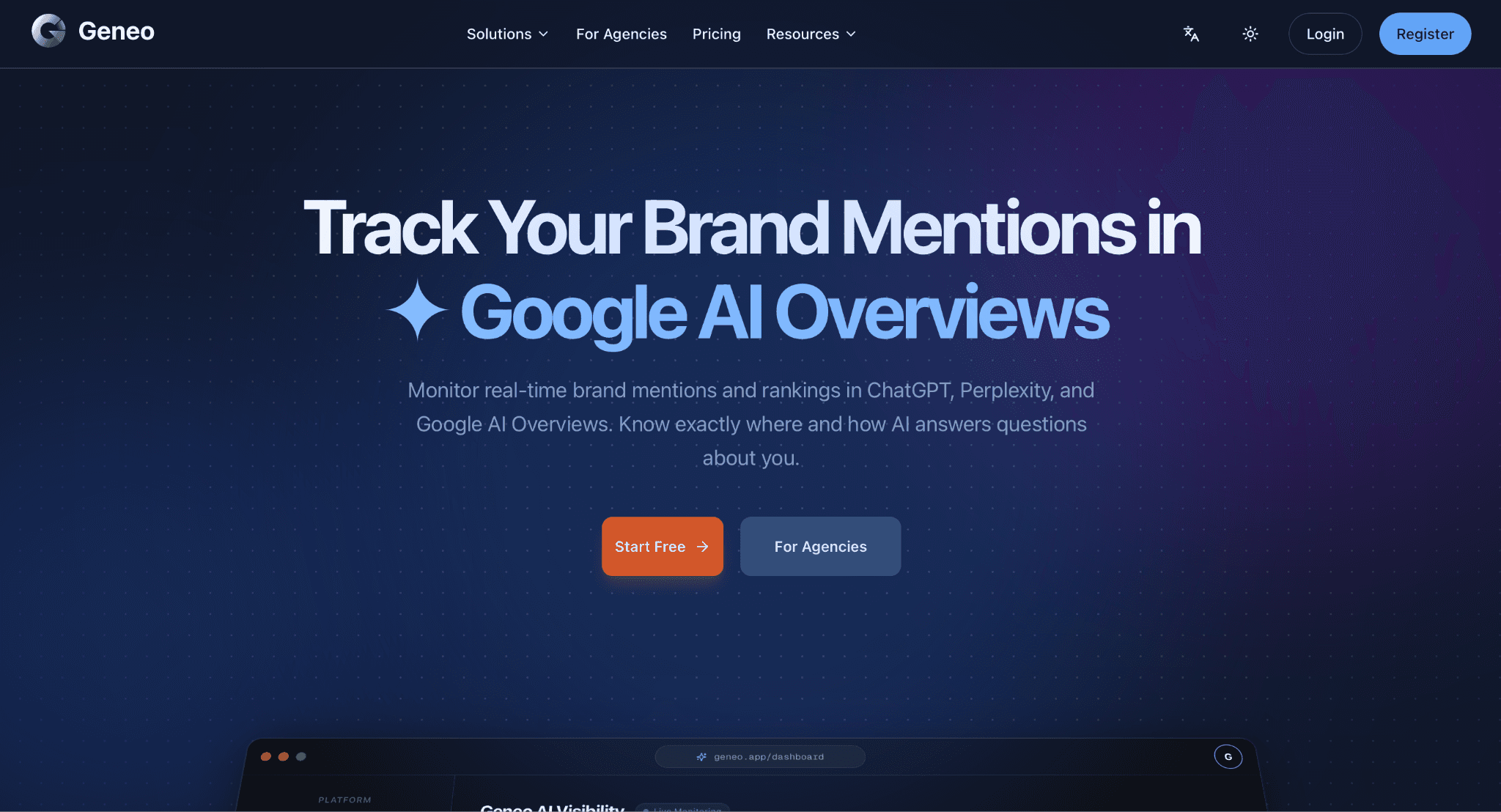
Geneo is not positioning itself as the deepest AI visibility analytics platform. It is the most useful one for agencies that charge clients for GEO services and need a clean, branded delivery layer built into the tool. The client portal is the product: dashboards hosted on your own domain, your logo, your brand colours, your clients logging in to what looks like your proprietary software. That white-label setup is accessible at $129/mo for the Agency Starter tier. The monitoring covers ChatGPT, Perplexity, and Google AI Overviews, with a free tier of 50 credits available before any payment is required.
Key features:
Real-time monitoring across ChatGPT, Perplexity, and Google AI Overviews with Brand Visibility Score, mentions, citation counts, sentiment, and competitor benchmarking.
White-label client portals on custom domains included on all agency plans from $129/mo, with branded login credentials for clients.
Content recommendations based on citation gaps and competitor patterns, with historical trend data for client QBRs.
Free tier with 50 credits available before any payment commitment.
Pros and cons:
Pros:
White-label portals on custom domains at $129/mo is more accessible than any comparable offering in the category
Free tier makes it risk-free to evaluate before committing budget
Credit-based agency tiers accommodate variable client loads without fixed seat constraints
Cons:
Three engine coverage (ChatGPT, Perplexity, Google AI Overviews) is the narrowest on this list. Agencies whose clients need Claude, Gemini, Copilot, or Grok coverage need a different platform for those engines.
No content creation tools, no outreach features, and no task layer beyond content recommendations. Execution of what Geneo surfaces happens entirely outside the platform.
Limited third-party review presence makes pre-purchase stability and support quality harder to assess.
G2 rating: Not listed on G2.
Pricing: Individual: Free (50 credits) | Pro $39.90/mo (1,000 credits/month) | Pay as you go available | Agency Starter $129/mo (5,000 credits, 5 seats) | Growth $249/mo | Scale $499/mo | Enterprise custom
Verdict:
Geneo solves a real agency problem: how to deliver AI visibility reporting to clients under your own brand without either building a custom dashboard or paying enterprise platform prices. The white-label portal at $129/mo is accessible in a way the rest of the category has not prioritised.
The engine coverage is the constraint to plan around honestly. Three platforms covers the most widely used AI search engines but is narrower than most alternatives on this list, including Peec's self-serve pool of six. Agencies whose clients need broader engine tracking will need to pair Geneo's delivery layer with a platform that provides wider coverage.
12. Ahrefs Brand Radar: Best for teams researching a whole category rather than a prompt list they maintain themselves
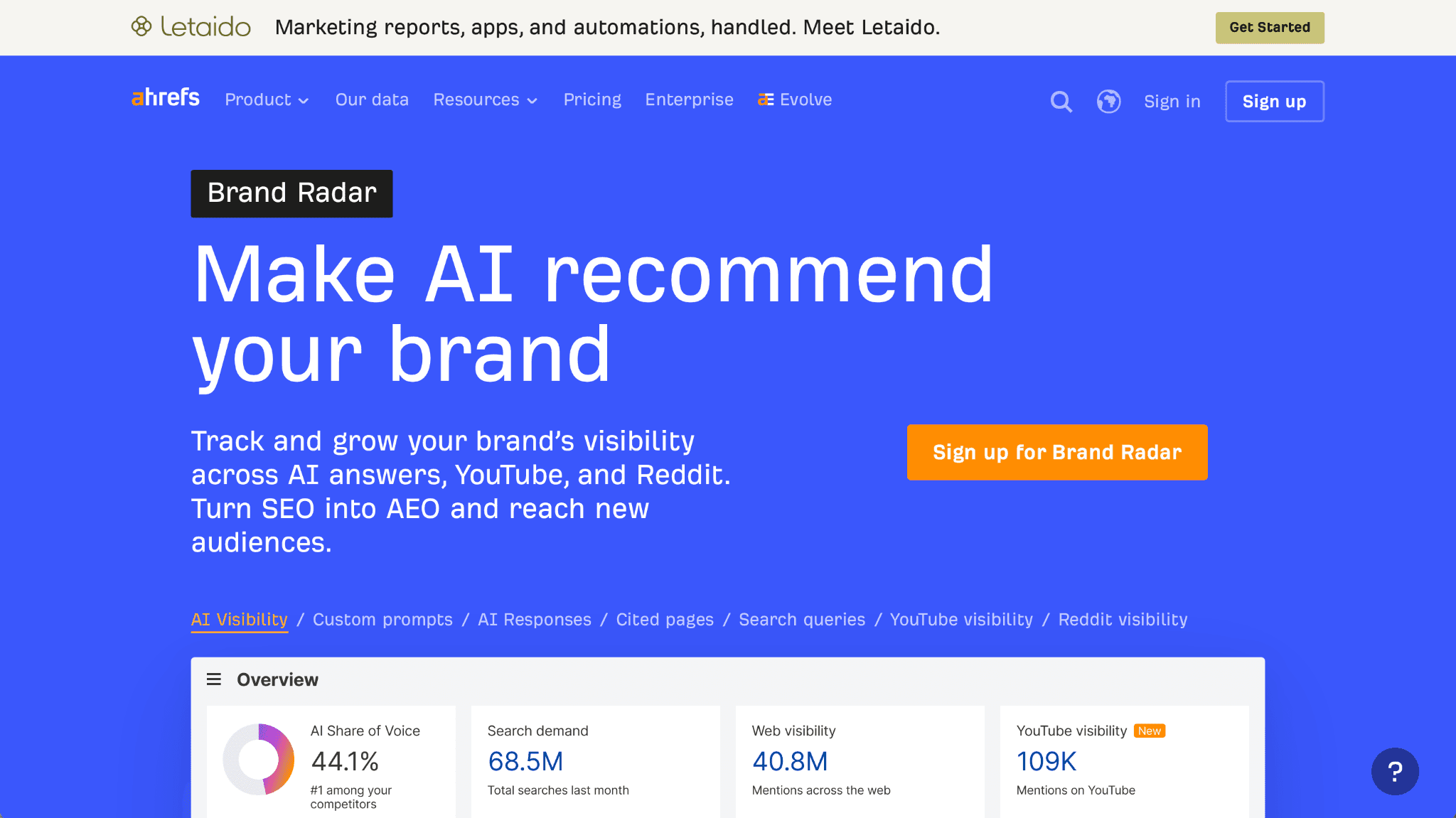
Every other tool on this list asks you to write your prompts. Ahrefs Brand Radar works the other way round. It reads hundreds of millions of real search-backed prompts already sitting in the Ahrefs index and shows where your brand lands inside the answers those prompts produce, across six AI engines plus YouTube, TikTok, and Reddit.
For a team that wants to study an entire category rather than fifty hand-written questions, that dataset is hard to replicate anywhere else. The cost structure is the wall. Brand Radar is an add-on rather than a product you can buy on its own, and the AI indexes are priced per platform on top of an Ahrefs base plan.
Key features:
Prompt database drawn from real search behaviour across hundreds of millions of prompts, rather than a prompt list your team writes and maintains.
Six AI indexes covering ChatGPT, Perplexity, Gemini, Microsoft Copilot, Google AI Overviews, and Google AI Mode, sold individually or as a bundle.
Brand visibility across YouTube, TikTok, and Reddit in the same view as the AI data, which nothing else on this list measures.
Long visibility history, so you can show how your share of AI mentions moved across months instead of reporting a current snapshot.
Cited domain and page reporting, cross-referenced against branded search demand and web mentions inside the Ahrefs suite your SEO team may already pay for.
Pros and cons:
Pros:
The prompt dataset is the largest in this comparison and surfaces category-level patterns a custom prompt list would never reach
Reddit, YouTube, and TikTok coverage sits beside the AI data, so you can see which surface won the answer you lost
AI visibility lives next to backlink, keyword, and rank data for teams already running SEO inside Ahrefs
Cons:
No content production, no recommendations, no task layer. Brand Radar reports what happened; deciding and doing stay with your team.
The pricing stacks. A base Ahrefs plan is required underneath, indexes are priced per platform, and everything bills per domain, which multiplies fast across an agency roster.
Independent testers have flagged undercounting in the AI modules against manual checks, so treat the output as directional category research rather than a number you report as a KPI.
G2 rating: Ahrefs is reviewed on G2 as a full SEO suite. Brand Radar has no separate listing, so the suite score is not an AI visibility signal. Check current reviews before buying.
Pricing: Requires an active Ahrefs base plan (Lite from $129/mo). AI indexes $199/mo each or $699/mo for all six, billed per domain. Roughly $828/mo all-in for full six-engine coverage on the entry base plan. Around 2,500 prompt checks included, with custom prompt tracking from about $50/mo. No free trial. Verify on the Ahrefs pricing page before buying.
Verdict:
Brand Radar fits one profile: a team already paying for Ahrefs that wants category-scale AI visibility research beside its SEO data, and treats the indexes as a research line item rather than a tracking subscription.
It is not a good fit for most readers coming off Peec. That move is usually about coverage, cost, or capacity, and Brand Radar answers none of the three. Full six-engine coverage lands near $828/mo against Peec's flat brand tiers, and where Peec at least hands you a scored opportunity list, Brand Radar stops at reporting.
How to Choose the Right Peec AI Alternative
Three questions cut through eleven options faster than any feature comparison.
1. Does your team generate its own execution plans from data, or do you need the platform to generate them?
This separates the market more cleanly than any feature list. Otterly, AI Rank Checker, Rankscale, Geneo, and Promptmonitor are analytics products: accurate data, execution handed back to you. Peec sits a step past them, with Actions prioritizing the work before you pick it up, but the work is still yours. AIclicks, Gauge, and AthenaHQ go further into execution. Profound and Scrunch sit between, with their content and infrastructure layers requiring enterprise access to unlock fully. Buying a monitoring tool when you needed execution capacity is the most common and expensive mistake in this category.
2. What does the total monthly cost look like once you have what you actually need?
Write down the engines your buyers use. Add the base plan cost, any engine add-ons needed to cover that set, seat costs for your team size, and white-label if you serve clients. Run that number for the top three platforms you are considering. Several tools on this list that look affordable at headline price become comparable to more capable options once you add realistic usage. The calculation takes ten minutes and tends to clarify the decision.
3. Which three or four engines actually show different results for your category?
Before buying based on engine count, run five of your core buying-intent prompts manually across ChatGPT, Perplexity, Claude, Gemini, and Google AI Overviews. The engines that return different brand recommendations are the ones you actually need to track. Paying for seventeen engines when four matter to your buyers is not better strategy, it is more overhead.
Run a trial with real prompts before you commit. A week of actual data from your category tells you more than any comparison table, including this one.
Go With the #1 Peec AI Alternative: AIclicks
After reviewing eleven tools, the honest picture is this: measuring AI visibility is a solved problem, and prioritizing what to fix is close behind it. Peec does both, and Otterly, Rankscale, Promptmonitor, and Geneo each cover the measurement half for a different profile. What most of the category still leaves on your desk is the work itself.
AIclicks is built around that step. It tracks 10+ AI engines through their actual user interfaces, so the data reflects what your buyers genuinely see. Every finding, from which prompts your brand is absent from to which specific sources power your competitors' citations, feeds an Actions engine that produces a ranked, prioritized work list rather than a dashboard to decode. The Competitors tab shows who is winning the prompts you are losing and what is driving them. The Sources tab turns the citation landscape in your category into concrete outreach and content targets.
The teams winning AI search in 2026 are the ones with a weekly system for turning visibility data into published content and earned mentions. That system requires both the data and a structured path from the data to work. AIclicks is where that path is built.
Start your free AIclicks trial and see where your brand stands across AI search, and get your action plan in minutes.
Frequently Asked Questions
1. What is Peec AI, and why do people look for alternatives?
Peec AI is a Berlin-based AI search analytics platform with unlimited seats on every plan, GDPR-first data handling, and clean analytics across AI models. Its Actions feature, included at no extra cost on all plans, turns citation data into a scored list of opportunities. Teams look for alternatives for three main reasons: brand plans include three models chosen from a pool of six, with extra models sold as add-ons; Claude Sonnet 4, GPT-5 Search, DeepSeek, Qwen, and Mistral are limited to Enterprise for brands and Scale or above for agencies; and Actions stops at prioritization by design, so teams without content and outreach capacity still need somewhere for the work to go.
2. What is the cheapest Peec AI alternative?
Rankscale AI starts at approximately €99/mo with 17+ engines. Promptmonitor and Otterly both start at $29/mo. AIclicks starts at $59/mo and adds a built-in recommendations engine and 10+ engine coverage, which makes it a strong value pick once you account for the execution guidance alongside the monitoring data.
3. Is GEO (Generative Engine Optimization) still worth investing in?
GEO has moved past the experimental phase. There are established platforms, documented case studies, and attributable traffic numbers from AI engines across enough industries that "whether to invest" is no longer the question. You can check your current AI search standing with the free GEO visibility checker before committing to a paid tool.
4. Do I need a separate GEO tool if I already use Semrush or SE Ranking?
Not necessarily, but price the whole stack before you decide. Semrush's AI Visibility Toolkit is $99/mo per domain as a monthly equivalent billed annually, covering one domain, one user, and 25 tracked prompts, with extra prompts, domains, and seats billed on top of that. SE Ranking's AI Search add-on is $89/mo, or $71.20/mo billed annually, and it does require a base plan underneath, with Core starting at $129/mo ($103.20/mo annual), so the realistic combined figure is closer to $218/mo billed monthly or $174.40/mo billed annually. For teams already living inside those platforms, the add-on is the lower-friction path. For teams where AI visibility has become a primary channel rather than a metric reported alongside SEO, a dedicated platform gives more depth per dollar and a clearer execution layer.
5. What is the difference between monitoring and optimization tools?
Monitoring tools measure what is happening: visibility scores, share of voice, which competitors appear in answers you do not. Optimization tools produce work from that data: specific content to create, sources to pitch, technical fixes to implement. Many teams conflate the two and buy a monitoring tool when the actual problem is the execution gap. AIclicks, Gauge, and AthenaHQ have genuine action layers; most other tools on this list are measurement-first products.
6. How many AI engines should a good visibility tool track?
Coverage should match where your buyers actually research, not the longest engine list on a pricing page. A practical baseline for 2026 is five engines: ChatGPT, Perplexity, Google AI Overviews, Gemini, and Claude. These cover the surfaces where most AI-influenced purchasing decisions happen. Tools that put Claude or Gemini behind Enterprise plans have narrower practical coverage than their marketed engine counts suggest. AIclicks covers 10+ on self-serve, Rankscale covers 17+, AthenaHQ covers 8 with no add-ons. AIclicks covers 10+ on self-serve, Rankscale covers 17+, AthenaHQ covers 8 with no add-ons, and Ahrefs Brand Radar covers 6 sold index by index.
Our Content:




Any questions left?
Book a call here: