" width="14px"><path d="M 13.864 5.629 L 13.3 5.629 L 13.3 5.6 L 7 5.6 L 7 8.4 L 10.956 8.4 C 10.379 10.03 8.828 11.2 7 11.2 C 4.681 11.2 2.8 9.319 2.8 7 C 2.8 4.681 4.681 2.8 7 2.8 C 8.071 2.8 9.045 3.204 9.786 3.864 L 11.766 1.884 C 10.516 0.719 8.844 0 7 0 C 3.134 0 0 3.134 0 7 C 0 10.866 3.134 14 7 14 C 10.866 14 14 10.866 14 7 C 14 6.531 13.952 6.073 13.864 5.629 Z" fill="rgb(255, 193, 7)" height="14px" id="H_YjfTNpn" width="14px"/><path d="M 0 3.742 L 2.3 5.429 C 2.922 3.888 4.429 2.8 6.193 2.8 C 7.264 2.8 8.238 3.204 8.979 3.864 L 10.959 1.884 C 9.709 0.719 8.037 0 6.193 0 C 3.504 0 1.172 1.518 0 3.742 Z" fill="rgb(255, 61, 0)" height="5.428500000000002px" id="PlkthQDhg" transform="translate(0.875 0)" width="10.959199999999996px"/><path d="M 6.232 5.581 C 8.04 5.581 9.683 4.889 10.925 3.764 L 8.758 1.931 C 8.032 2.483 7.144 2.782 6.232 2.781 C 4.411 2.781 2.865 1.62 2.283 0 L 0 1.759 C 1.159 4.026 3.511 5.581 6.232 5.581 Z" fill="rgb(76, 175, 80)" height="5.581099999999999px" id="WlnJ5gngE" transform="translate(0.7 8.4)" width="10.924899999999994px"/><path d="M 6.864 0.029 L 6.3 0.029 L 6.3 0 L 0 0 L 0 2.8 L 3.956 2.8 C 3.68 3.576 3.183 4.254 2.526 4.75 L 2.527 4.749 L 4.693 6.582 C 4.54 6.722 7 4.9 7 1.4 C 7 0.931 6.952 0.473 6.864 0.029 Z" fill="rgb(25, 118, 210)" height="6.589883930775992px" id="x_rSW275p" transform="translate(7 5.6)" width="7px"/></g></svg>)


Reviewed by:
Matas Kibildis

Head of Growth @ aiclicks.io
Last updated:
Expert Verified

Disclosure: AIclicks appears on this list and it’s our AI visibility tool. To keep it honest, every claim about every tool below comes from the vendor's live website or pricing page as of July 2026, with links so you can cross check.
Key Takeaways
Scrunch AI is a capable enterprise platform, but its $250/month Core plan (and $500/month for agencies) prices out most small teams, and reviewers keep flagging the gap between its monitoring data and what to actually do with it.
The eight alternatives below run from $29/month to fully custom enterprise contracts. The real differences sit in three places: how many AI engines you get at the entry price, whether the tool collects data from real chat interfaces or APIs, and whether it tells you what to fix.
Prompt math decides your bill more than the sticker price does. A "100 prompts" plan tracked across five engines can mean 500 tracked responses. Read the fine print on every tool here, including ours.
For most teams the pick comes down to budget and workflow: AIclicks and Otterly AI for affordable multi-engine tracking, Profound and AthenaHQ for enterprise stacks, Rankscale for credit-flexible agencies, SE Ranking if you want GEO inside a full SEO suite.
Why Teams Look Past Scrunch AI
$250 a month.
That's where Scrunch AI's Core plan starts for a single brand, and the agency version doubles it to $500.
For an enterprise brand with a JavaScript-heavy site that wants Scrunch's Agent Experience Platform serving lightweight pages to AI crawlers, that price can be defensible. Scrunch built something genuinely clever there.
The other problem are:
The models want you sit on higher tiers: The Core plan covers 125 prompts, 4 AI models, one brand workspace, and five user licenses. Four models are thin in 2026, when buyers are asking questions in ChatGPT, Perplexity, Gemini, AI Overviews, AI Mode, Claude, Grok, Copilot, and Meta AI.
The buying process frustrates people: One G2 reviewer describes pricing confirmed in writing and then retracted, a contract that didn't match verbal commitments, and a negotiation that dragged the past ten days. Their advice to other buyers: verify every line before signing.

You get data, not analysis: One reviewer says there's too much information per prompt and no way to ask the platform which content is working or where competitors are gaining ground. That question-driven layer, in their words, doesn't exist yet.
None of this makes Scrunch a bad product. It makes it a specific product, built for enterprise budgets and enterprise patience. If that's not you, here are eight alternatives worth a serious look.
How We Evaluated These Alternatives
Every roundup is an opinion wearing a methodology costume, so here's ours, stated plainly. We fetched each vendor's live website and pricing page in July 2026 and scored five things:
Engine coverage at the price you actually pay: Not "capability for" ten engines on a custom enterprise tier. What ships on the plan a normal team buys.
Data collection method: Tools that query the real chat interface capture what users see, including web retrieval and citations. API-based tools are cheaper to run but can drift from real answers.
Action layer: Does the tool stop at a dashboard, or does it produce recommendations, content briefs, or outreach targets?
Pricing honesty: How fast do prompts, engines, and frequency multiply the headline number?
Team economics: Per-seat pricing punishes growing teams. Unlimited seats and multi-brand workspaces matter for agencies.
8 Best Scrunch AI Alternatives: Quick Glimpse
Tool Name | Best For | Starting Price | Engines At Entry | Free Trial |
AIclicks | Actions to win AI search, brands and agencies | $59/mo | 3 (10+ available) | 3 days |
AI Peekaboo | SMBs and agencies wanting white-label reports | $50/mo | 4–5 | 14 days |
AthenaHQ | Enterprise teams tying AI visibility to revenue | $295/mo | 8+ | No (intro month discount) |
Profound AI | Enterprise AEO with agent workflows | $99/mo (annual) | 1 (ChatGPT only) | Yes (Growth) |
Relixir (Rex) | Teams outsourcing GEO to an autonomous agent | Custom | 4+ | Demo only |
Rankscale AI | Agencies wanting credit-based flexibility | $20/mo (Essentials) | 17+ on every plan | Yes (Pro) |
SE Ranking | Teams running SEO and GEO in one suite | $103.20/mo + AI add-on | 5 | 14 days |
Otterly AI | Solo marketers and lean teams on a budget | $29/mo | 4 | Yes |
Prices verified on each vendor's pricing page, July 2026. Annual billing where noted.
1. AIclicks
Best for: Actions to win AI search, for brands and agencies
About AIclicks:
AIclicks was built around the exact gap Scrunch reviewers keep describing: tracking that ends in a to-do list instead of a dashboard.
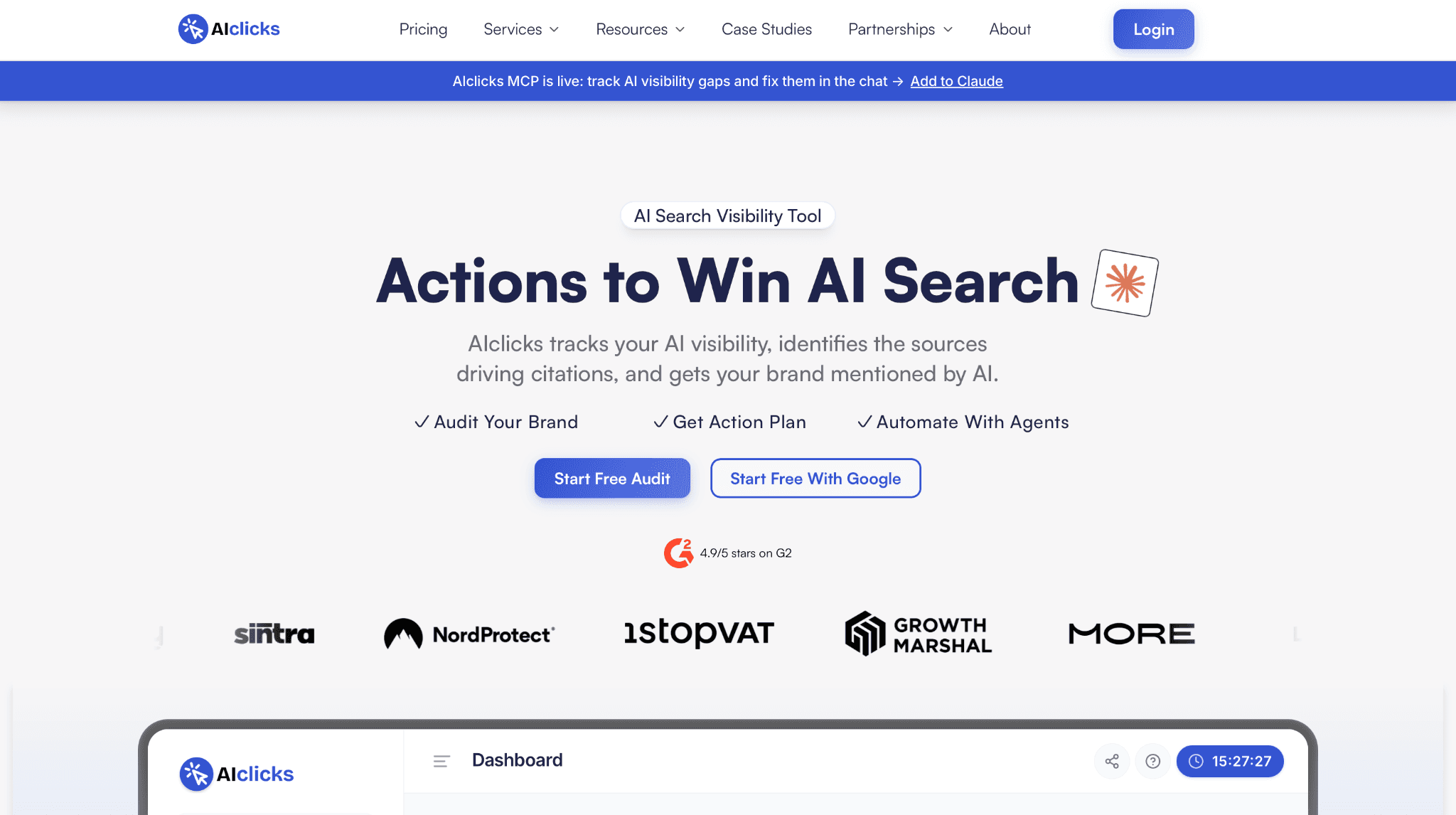
It monitors your brand across 10+ AI platforms, including ChatGPT, Perplexity, Gemini, AI Overviews, AI Mode, Claude, Grok, DeepSeek, Meta AI, and Copilot, by querying their real chat interfaces rather than APIs. That distinction matters more than it sounds: the chat interface is where live web retrieval, citations, and ranked sources appear, so the answers AIclicks records are the ones your buyers actually see.
Every tracked prompt feeds a Recommendations tab that ranks your next moves by expected impact: content to publish, high-authority sources to pitch for citations, Reddit and community threads worth joining.
A Google Analytics connection then ties those moves back to real AI referral traffic. Setup to first insight takes minutes, not a four-week baseline, and was built by a team running GEO campaigns for their own agency clients first.
Key features:
Prompt tracking across ChatGPT, Perplexity, Gemini, AI Overviews, AI Mode, Claude, Grok, DeepSeek, Meta AI, and Copilot
Recommendations tab that ranks content, outreach, and community actions by expected impact
Citation source analysis showing which domains drive AI answers in your category
Google Analytics connection tying visibility data to real AI referral traffic
MCP server that pipes visibility gaps straight into Claude for fixing
Pros:
Widest engine coverage in this price range
Actions, not just charts
Country and model-level filtering
Rated 4.9/5 on G2
Cons:
Entry plan limits you to 3 platforms
3-day trial is short
Pricing: The paid plan starts at Starter $59/mo. Explore more.
Verdict: What I'll say is that the Scrunch complaints above are the spec we build against: transparent pricing on the site, all 10+ engines visible per plan, an action layer instead of raw exports, and first insights the same day you connect. The 3-day trial is short, deliberately, because the first useful recommendation should land inside it.
2. AI Peekaboo
Best for: SMBs and agencies that need white-label client reports
About AI Peekaboo:
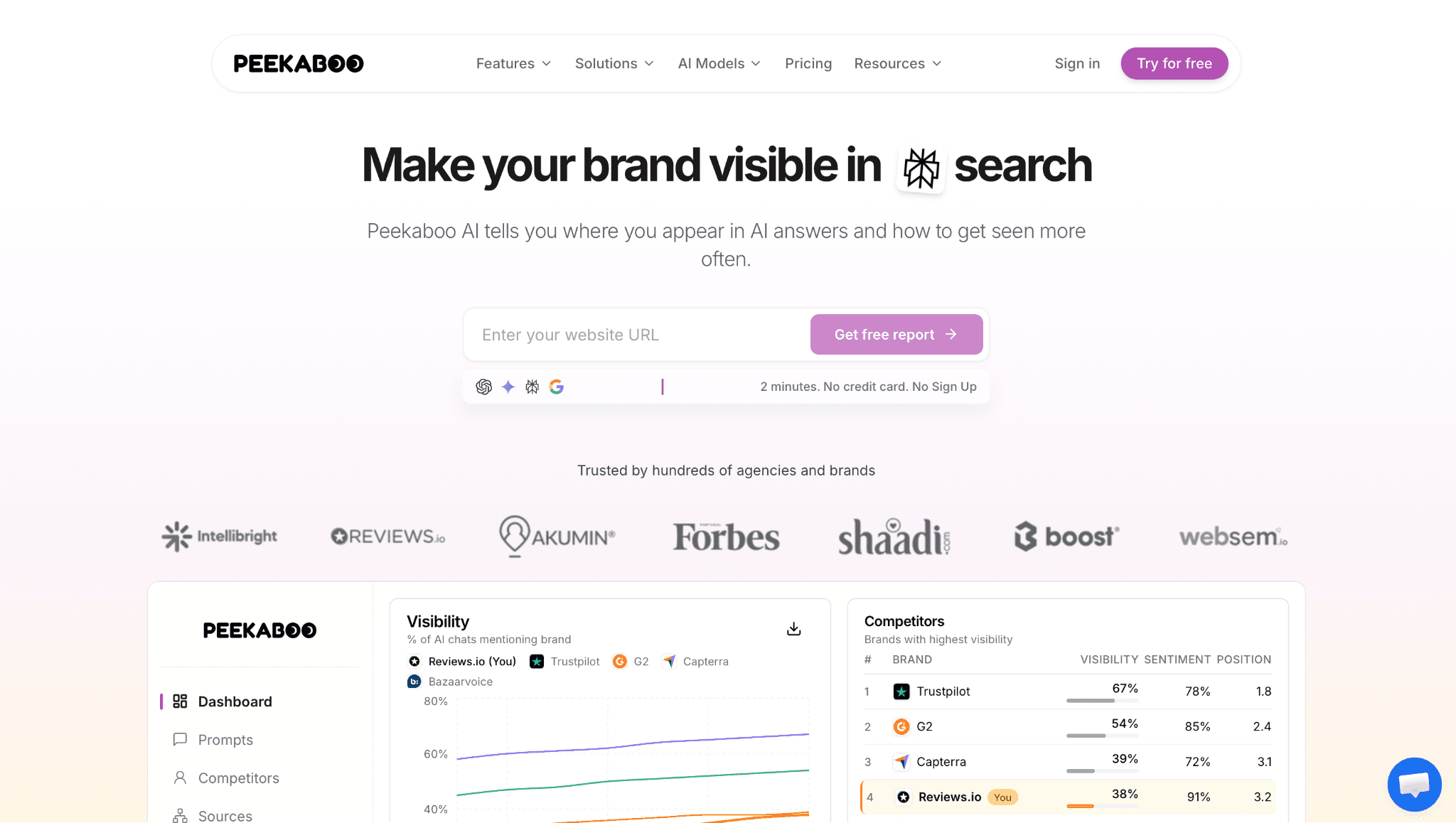
Peekaboo earned its place as a Scrunch AI alternative inside Scrunch's own G2 reviews, where an agency reviewer name-checked it as the tool that surfaces AI visibility insights faster, without a four-week baseline.

It tracks brand mentions across ChatGPT, Gemini, Perplexity, AI Overviews, and AI Mode through real user interfaces, and its agency bets are white-label AI search reports, a multi-client dashboard, and a Search Console AI chat.
Key features:
UI-based prompt tracking across 5 AI models, refreshed daily on most plans
Full white-labeling of reports, colors, and (soon) domains for agencies
Search Console AI chat for querying GSC performance conversationally
Free 2-minute AI visibility report with no signup required
Looker Studio connector plus content briefs and gap analysis
Pros:
Cheapest UI-based tracking here
Generous 14-day trial
White-label on agency plans
Cons:
Only 40 prompts on the two lower tiers
Fewer engines than category leaders
Pricing: Starter $50/mo, Peek $100/mo, Grow $200/mo.
Verdict: If you're a small agency that needs branded reports for clients, Peekaboo does that well at a fair price. The 14-day trial gives you enough time to actually test it. The catch is the 40-prompt limit on the lower plans, which serious programs will hit fast.
3. AthenaHQ
Best for: Enterprise and multi-brand teams connecting AI visibility to revenue
About AthenaHQ:
AthenaHQ is the Scrunch AI alternative for teams that liked Scrunch's enterprise pitch but wanted an analysis layer on top of the monitoring.
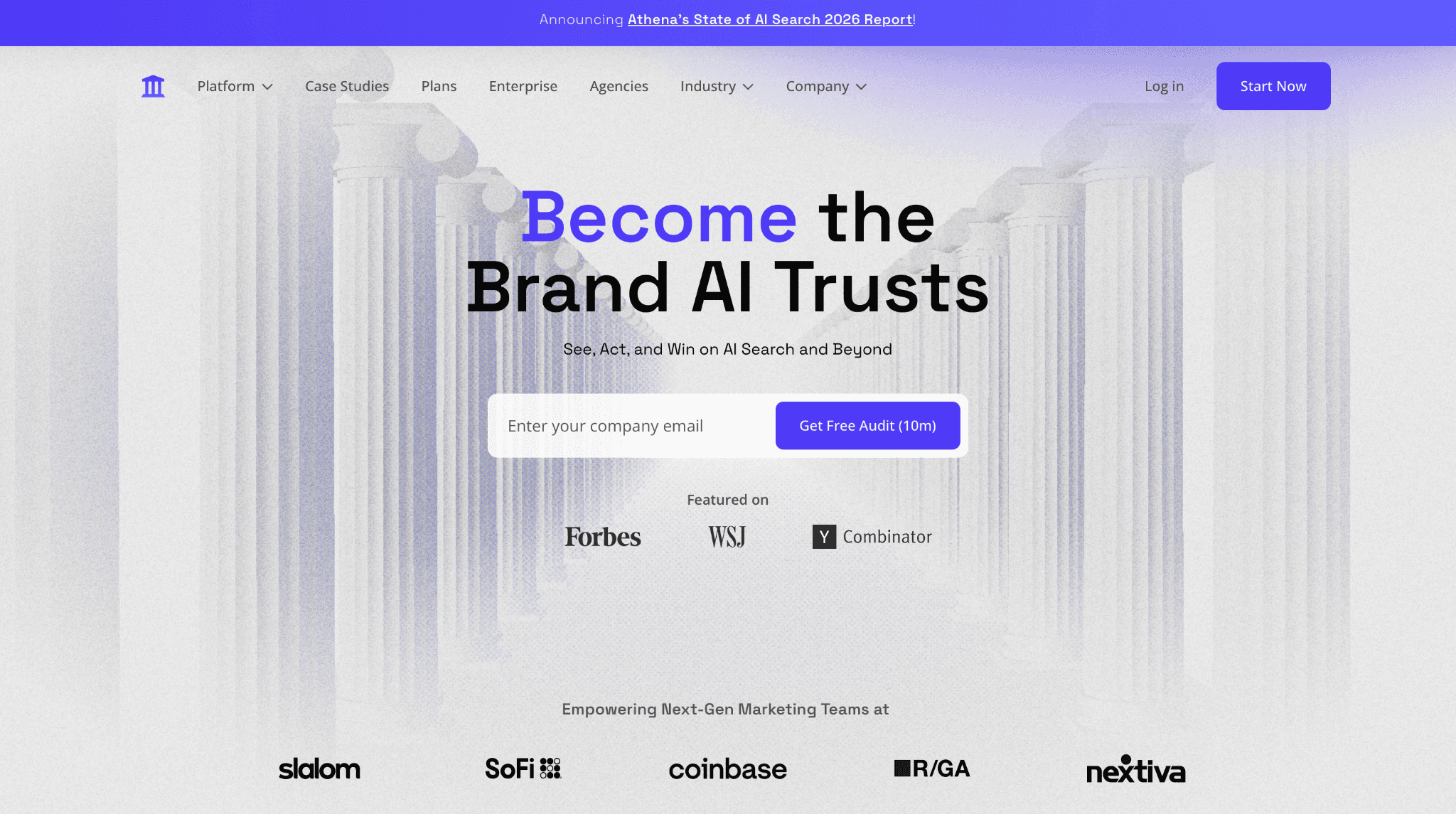
Its Ask Athena copilot answers strategy questions grounded in your live AEO data, the exact "just ask the AI" capability Scrunch reviewers say is missing, and native GA4, Search Console, and Shopify integrations tie AI search visibility to traffic and revenue.
The catch is a credit system: the Self-Serve plan includes 3,600 credits, and every model query draws from that pool.
Key features:
Cross-platform tracking across 8+ LLMs including Claude, Grok, and AI Mode
Ask Athena, an AI copilot trained on your account's visibility data
GA4, GSC, and Shopify integrations for revenue attribution
Content recommendations mapped to the passages AI engines extract
SOC II Type 2 certification, with API and BI integrations on Enterprise
Pros:
Strongest attribution story in the category
Unlimited users with role-based access
Copilot is genuinely differentiated
Cons:
Credits deplete fast with frequent multi-model tracking
ACE Citation Engine and API are Enterprise-only
No free trial
Pricing: Self-Serve $295/mo (3,600 credits), Enterprise custom.
Verdict: AthenaHQ makes sense if you need to show leadership what AI visibility is doing for revenue. That's what it's built for. The problem is the price: $295 a month with no free trial, credits that run out faster than you'd expect, and the best features locked behind Enterprise. If you just need tracking, look elsewhere.
4. Profound
Best for: Enterprise marketing teams that want agents doing the AEO work
About Profound:
Profound is the Scrunch AI alternative that shows up on nearly every enterprise shortlist, and the closest thing the category has to a direct rival at that tier.
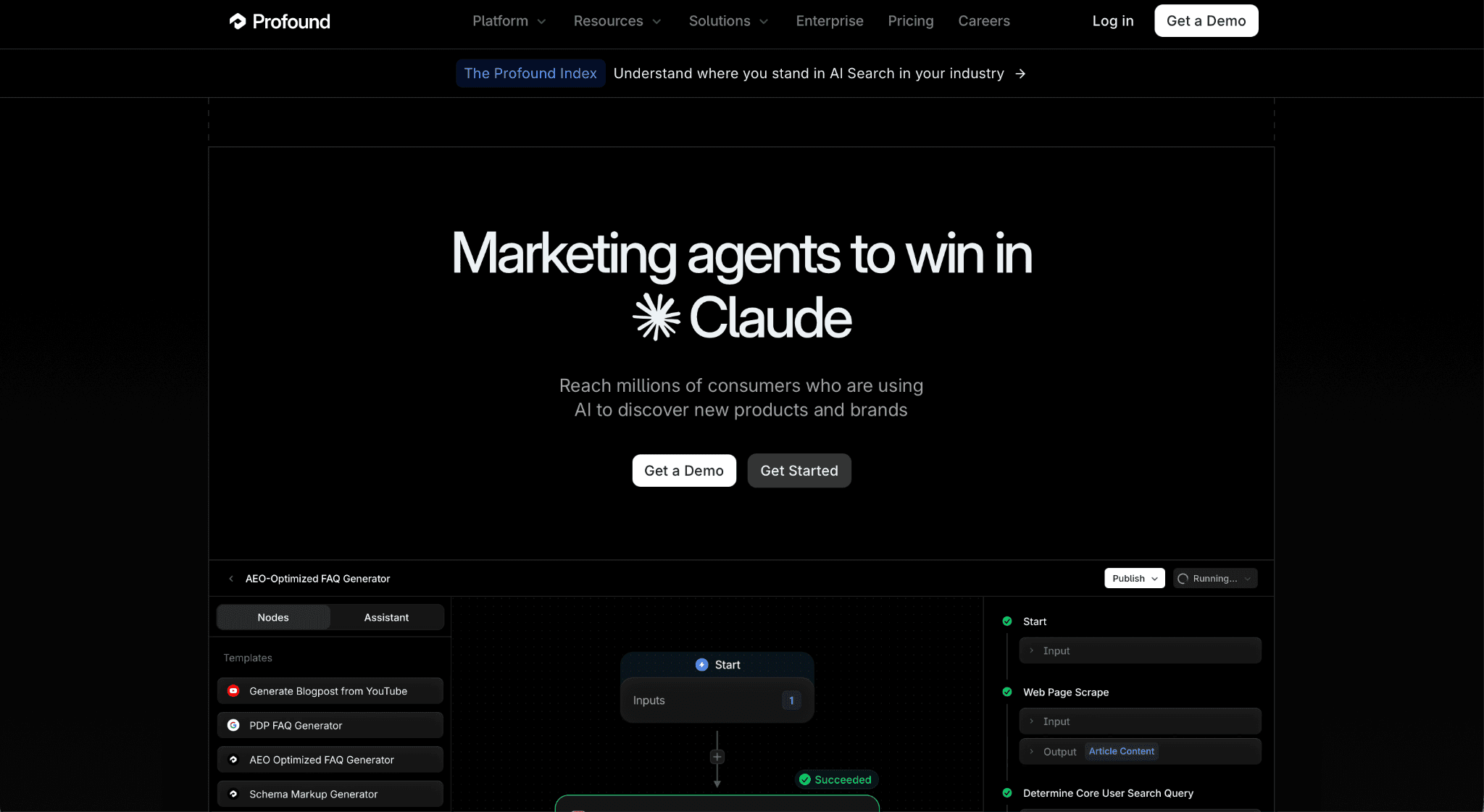
It goes past AI search monitoring with Marketing Agents (autonomous workflows for FAQ generation and content optimization), Prompt Volumes (a dataset estimating how often real users ask each prompt), and Agent Analytics for log-level AI crawler tracking. The self-serve tiers are deliberately narrow to push serious answer engine optimization buyers toward Enterprise.
Key features:
Answer Engine Insights covering sentiment, citations, and competitor share of voice
Prompt Volumes for prioritizing prompts by real user demand
Agents with credit-based pricing for content and optimization workflows
Agent Analytics tracking AI bot traffic with CDN integrations (Cloudflare, Fastly, Akamai)
Enterprise tier with up to 10 engines, SSO, and SOC 2
Pros:
Deepest enterprise feature set available
Prompt demand data nobody else matches at this depth
Unlimited domains on Agent Analytics
Cons:
Starter tracks ChatGPT only
Growth at $399/mo covers just 3 engines
Real value sits behind custom Enterprise pricing
Pricing: Starter $99/mo, Growth $399/mo, Enterprise custom, billed yearly.
Verdict: Profound AI is worth it for one kind of buyer: big companies that want to know which prompts people actually ask, plus automation on top. That data is genuinely hard to find elsewhere. But the cheaper plans are weak. $99 a month gets you one engine, and $399 gets you three. Unless you're going Enterprise, you're overpaying, and it's worth comparing Profound alternatives before you sign a yearly contract.
5. Relixir (Rex)
Best for: Teams that want to outsource GEO execution entirely
About Relixir:
Relixir is the Scrunch AI alternative for teams that don't want a visibility dashboard at all, Scrunch's or anyone else's.
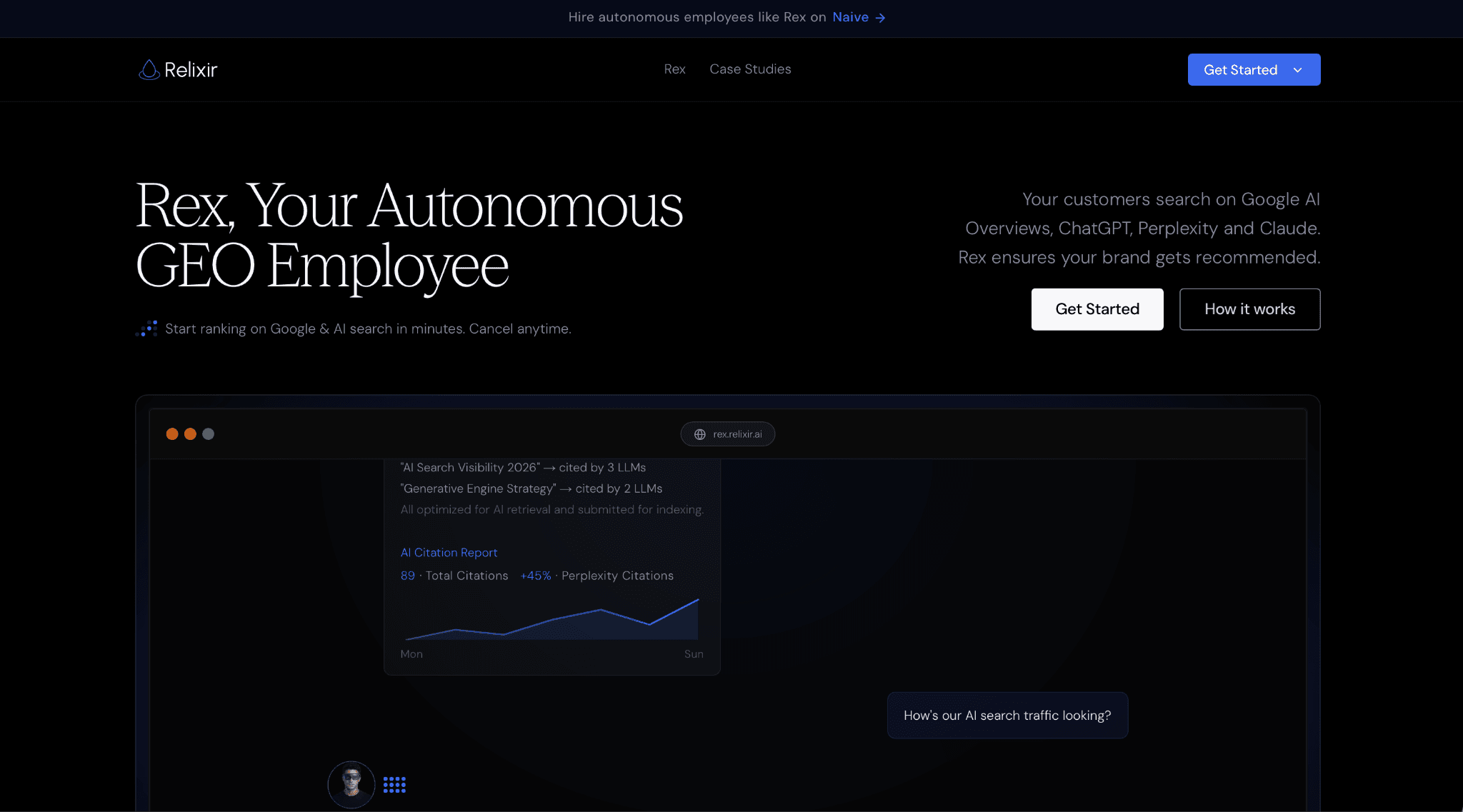
Relixir pitches it as an "autonomous GEO employee" that monitors AI search visibility across ChatGPT, Perplexity, Claude, and AI Overviews, then researches, writes, and publishes GEO-optimized content on its own, refreshing your CMS on 30 to 60 day cycles.
The company deploys and manages it for you, which puts Rex closer to a productized GEO agency than a SaaS tool.
Key features:
Autonomous content generation with JSON-LD schema and automated citations
AI visibility monitoring with mention rate, citation rate, and share of voice
Recurring CMS-wide content refreshes to keep citation rates up
Automated backlink outreach and Reddit citation identification
One-click connections to CMS, analytics, CRM, and Slack
Pros:
Genuinely hands-off execution model
Covers content, technical audits, and authority building
Forward-deployed team handles setup
Cons:
No transparent pricing, demo required
You cede editorial control to an agent
Hard to benchmark against self-serve tools
Pricing: Custom only, positioned against $5k+/mo agency retainers.
Verdict: Rex is for teams that want GEO done for them, not another dashboard to check. If you have no content team, that's tempting. But there's no public pricing, no trial, and it publishes to your site on its own. If you care about what goes out under your name, ask for a pilot with human review first.
6. Rankscale AI
Best for: Agencies that want maximum engines on flexible credits
About Rankscale:
Vienna-built Rankscale attacks Scrunch's thinnest spot, engine coverage, by including 17+ AI engines on every plan against Scrunch Core's four.
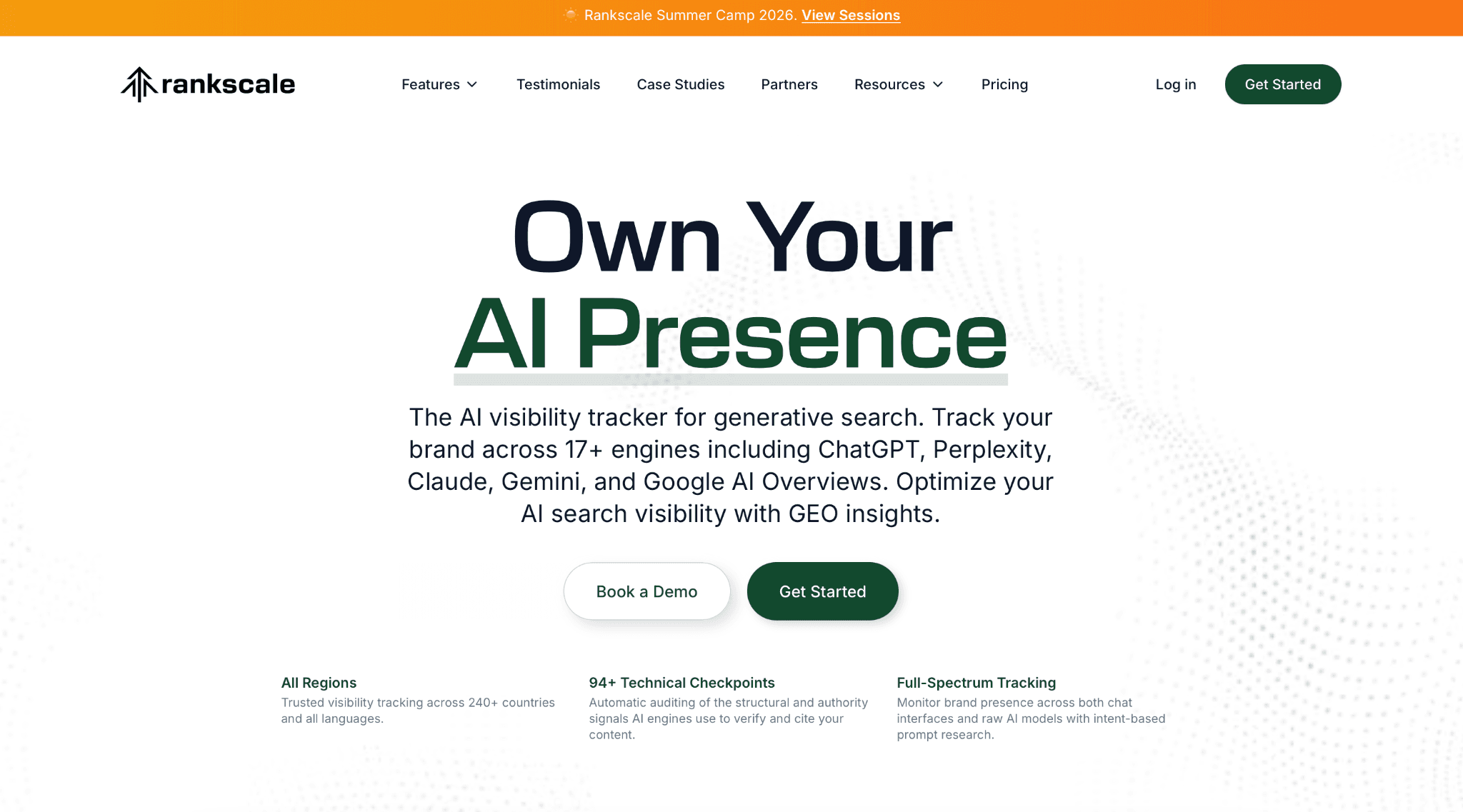
Everything is priced in credits (roughly 0.25 credits per engine per prompt), unused credits roll over up to 3x, AI visibility monitoring runs from hourly to monthly, and every plan includes unlimited team seats.
Key features:
17+ engines on all plans, including ChatGPT, Claude, Gemini, DeepSeek, Mistral, and Grok
Credit-based pricing with rollover and an in-app credit calculator
Page audits scoring 200+ AI-readiness factors per URL
Citation and sentiment analysis by brand, topic, and model
White-label dashboards and REST API on Growth and Enterprise
Pros:
Most engines per dollar in the category
Hourly monitoring option is rare
Unlimited seats everywhere
Cons:
Credit math takes a month to learn
Dense UI for first-timers
Pricing: Essentials $20/mo, Pro $99/mo, Growth $385/mo, Enterprise $780/mo.
Verdict: Rankscale AI is the pick if engine coverage is your main requirement. Nothing else gives you 17+ engines on every plan. The trade-off is the credit system, which takes about a month to figure out, and users say it's easy to burn through credits early on. The credit math alone pushes some teams toward Rankscale alternatives. It also stops at monitoring, so figuring out what to do next is still your job. If you'd rather have flat pricing and a to-do list built in, that's the trade AIclicks makes instead.
7. SE Ranking
Best for: Teams that refuse to split SEO and GEO into two tools
About SE Ranking:
SE Ranking is the Scrunch AI alternative for teams whose real objection is paying $250 a month for AI visibility tracking alone.
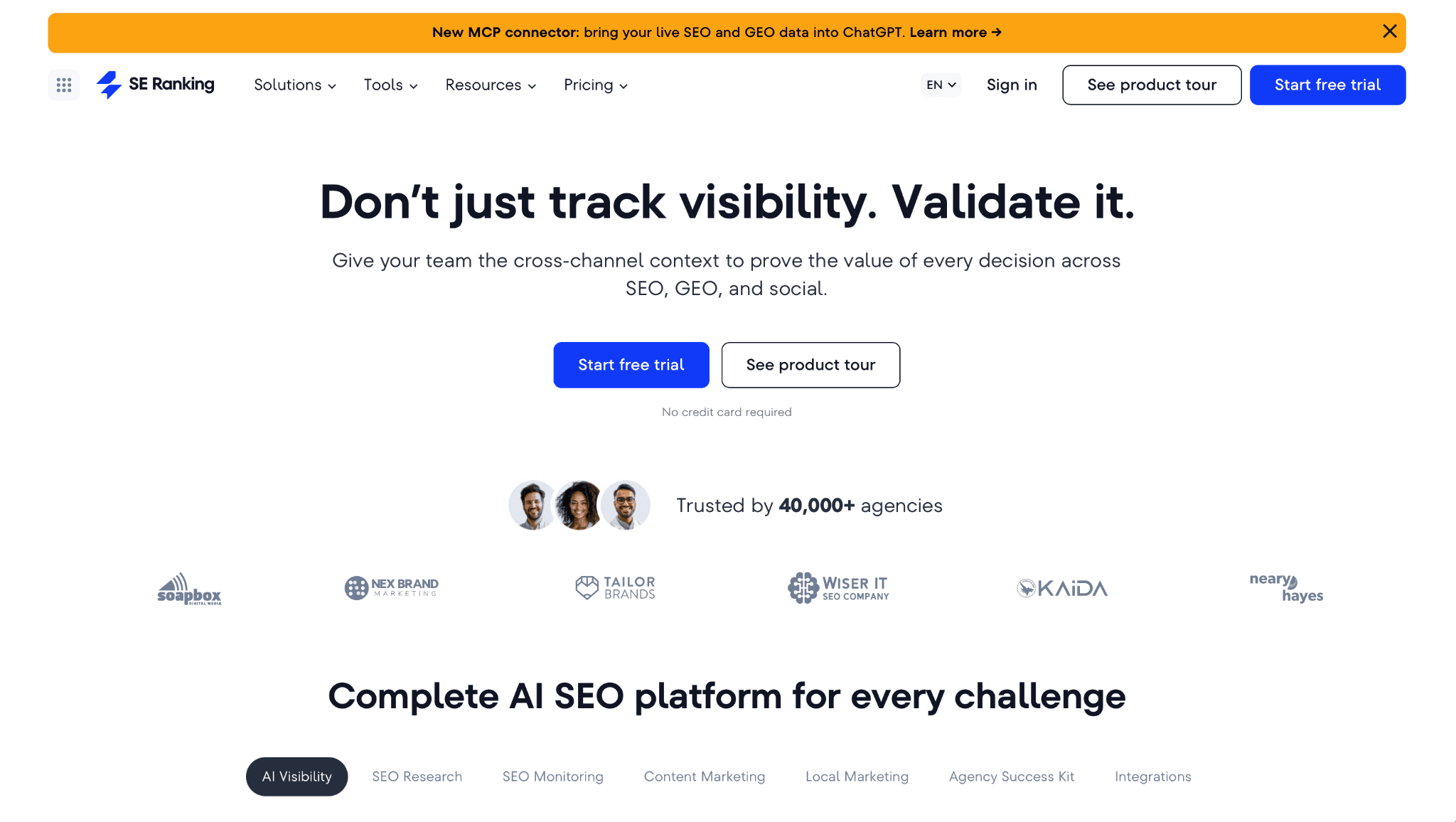
It's a mature SEO platform (rank tracking, site audits, a 5.5B keyword database) whose AI Visibility Tracker covers ChatGPT, Gemini, Perplexity, AI Overviews, and AI Mode as an add-on, so brand mentions in AI search sit in the same dashboard as your organic rankings and one subscription covers both channels.
Key features:
AI Visibility Tracker for brand mentions, links, and competitor benchmarks across 5 AI surfaces
Full SEO suite alongside: rank tracking, site audits, backlink monitoring
MCP connector to query live SEO and GEO data inside ChatGPT or Claude
Agency Pack with white-label reporting and client seats
API access and Looker Studio, Make.com, and n8n integrations
Pros:
One subscription for SEO and GEO
Deep historical and keyword data
Strong agency reporting tooling
Cons:
AI Search costs extra on top of the base plan
Fewer engines than dedicated GEO optimization tools
Pricing: Core from $103.20/mo; AI Search add-on from $71.20/mo.
Verdict: If SEO is still your main channel and AI search is a side project, SE Ranking covers both for less than two separate tools. That's the whole case. Teams that live and breathe AI search will find five engines and add-on pricing too thin.
8. Otterly AI
Best for: Solo marketers and lean teams validating AI search on a small budget
About Otterly AI:
Otterly AI is the Scrunch AI alternative that answers the entry-price objection most bluntly: its Lite plan tracks 15 prompts across ChatGPT, AI Overviews, Perplexity, and Copilot for $29 a month, roughly a ninth of Scrunch's Core.
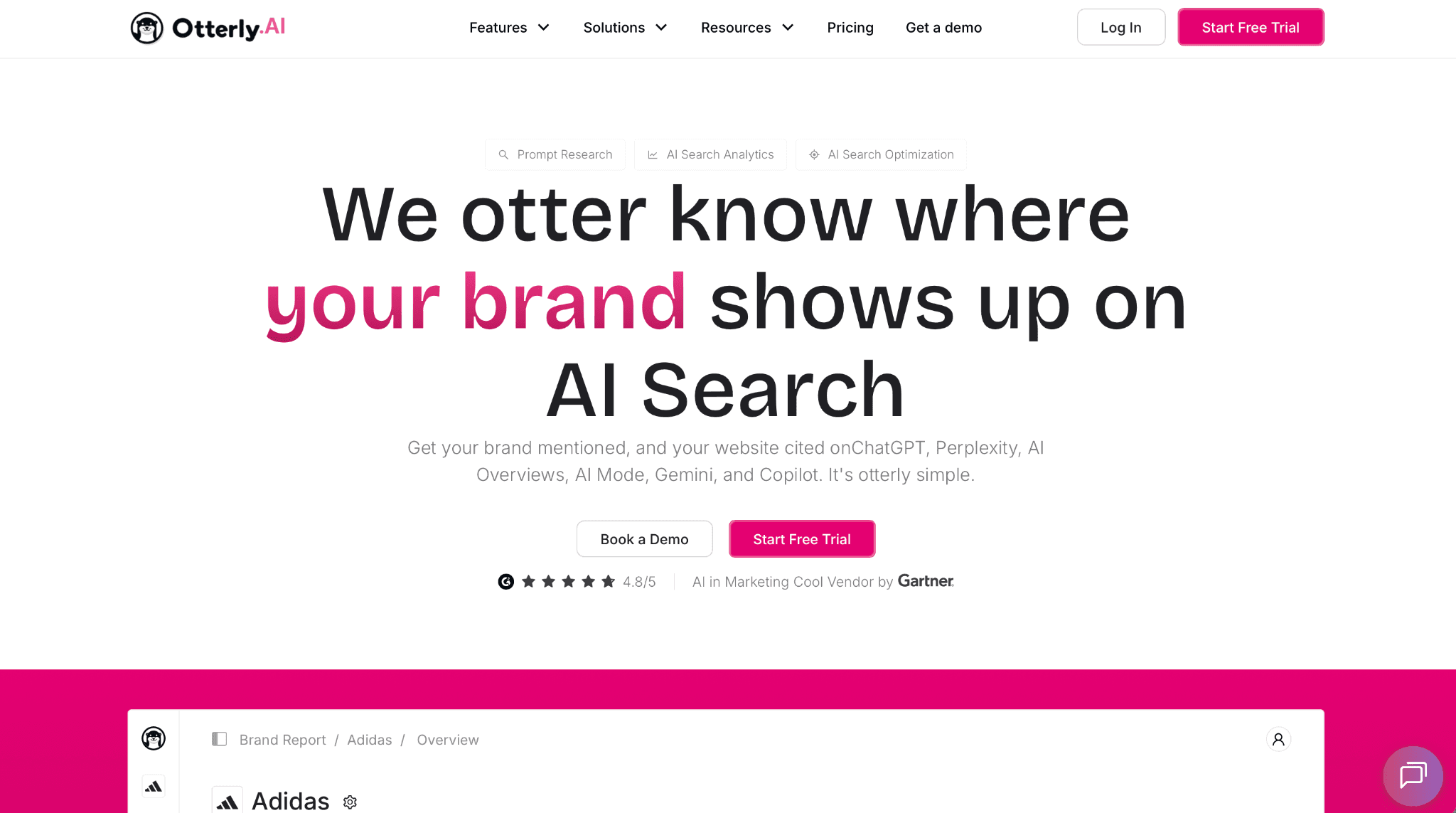
It pairs AI search monitoring with prompt research, GEO content audits, and recommendations. However, if you want to scale you will have to go from $29/mo to directly $189/mo, which is quite expensive.
Key features:
Tracking across 4 base engines, with Claude, Gemini, and AI Mode as paid add-ons
AI Prompt Research to find the questions buyers actually ask
GEO content audits with predictive AI-readiness scoring and briefs
Multi-country monitoring across 50+ markets
API and MCP access on Standard and above, unlimited team members on all plans
Pros:
Lowest entry price on this list
Gartner and G2 validation
Strong country-level granularity
Cons:
Add-on engines get pricey
15 prompts on Lite is a taste, not a program
Pricing: Lite $29/mo, Standard $189/mo, Premium $489/mo.
Verdict: Twenty nine dollars a month to find out whether AI search matters for your business. That's Otterly's job and it does it well. The problem starts when you grow. Fifteen prompts is a taste, and the add-on engines get expensive fast. That ceiling is why scaling teams start comparing Otterly AI alternatives. By the time you're on Standard with two add-ons, the same money buys 150 prompts with those engines included on AIclicks Pro. Start here, don't stay here.
How To Choose The Right Scrunch AI Alternative
Skip the feature matrices and answer three questions.
First, how many engines actually matter for your buyers?
Run ten of your money prompts manually across ChatGPT, Perplexity, and AI Mode. If the answers and cited sources differ wildly per engine, coverage breadth should drive your pick (Rankscale, AIclicks). If one engine dominates your category, a narrower tool is fine.
Second, who does the work after the dashboard?
If you have a content team waiting on direction, a monitoring-first tool plus your own execution works. If you don't, weight the action layer heavily: recommendations and outreach targets in AIclicks, agents in Profound, or full delegation with Rex.
Third, what does month six cost, not month one?
Model your real prompt count times engines times tracking frequency on each vendor's own calculator. The cheapest headline price on this list is not the cheapest tool at 100 prompts across six engines. Then trial two finalists on the identical prompt set for two weeks and let the data disagreement (there will be some) tell you which collection method you trust.
2026 AI Search Optimization Trends & Advanced Features
The world of AI search monitoring is moving fast. Here’s what you should expect from top visibility tools this year:
AI-Optimized Content Publishing: Going beyond tracking, leading platforms now generate and publish assets to win visibility in generative engines.
Prompt-Cluster-Based Gap Analysis: Not just alerts, but detailed maps of where content gaps exist across related queries or product clusters.
GA4 and AI Referrer Integration: Platforms that connect classic and AI search in a single dashboard unlock a more complete view of search visibility.
Journey Mapping: Track how AI appearances lead to real business impact, not just mentions.
Comprehensive Monitoring Dashboards: Simple, actionable, real-time reporting, with drill-downs by prompt, position, and engine.
This aligns with what we’ve built at AIclicks, as marketing is no longer just about organic traffic but about where your brand appears across the full landscape of AI-generated responses.
Check out this video if you need advanced GEO tactics to boost your rankings:
https://youtu.be/HZFguwvDA8k?si=6wMEdFhl2EInpuCP
The Bottom Line
Every tool on this list can tell you whether ChatGPT mentions your brand. That part is solved.
The question that should drive your pick is what happens after the dashboard: who turns the data into work, and how much you pay for the privilege.
If the answer is "we have a team for that," a pure monitor like Rankscale or Otterly is enough. If the answer is "that's exactly our problem," you want tracking with an action layer attached.
That's what AIclicks is, and the same G2 reviews that sent you looking for Scrunch alternatives say it's what buyers keep asking for. Three days is enough to check.
Frequently Asked Questions
1. Is Scrunch AI worth $250 a month?
For enterprise brands that need the Agent Experience Platform and white-glove onboarding, it can be. For teams that mainly need visibility tracking with clear next steps, alternatives on this list deliver comparable coverage from $29 to $99 per month.
2. What's the cheapest Scrunch AI alternative?
Otterly AI's Lite plan at $29/month is the lowest entry point, with 15 prompts across four engines. Rankscale's Essentials tier at $20/month exists but works as a top-up starting point rather than a full plan.
3. Which alternative covers the most AI engines?
Rankscale includes 17+ engines on every plan. AIclicks tracks 10+ platforms including Grok, DeepSeek, and Meta AI, which most tools skip.
4. Why does UI-based tracking matter versus API tracking?
APIs return raw model output. The chat interface returns what users actually see, including web retrieval, citations, and ranked sources. Tools that query real interfaces (AIclicks, Peekaboo) sit closer to your customer's reality; API tools scale more cheaply but can drift from live answers.
5. Do any of these tools guarantee AI rankings?
No, and be wary of anyone who promises them. AI answers vary by user, session, and model update. What these tools do is measure your presence reliably, reveal the sources shaping answers, and prioritize the work most likely to move your mention rate.
Our Content:




Any questions left?
Book a call here: