" width="14px"><path d="M 13.864 5.629 L 13.3 5.629 L 13.3 5.6 L 7 5.6 L 7 8.4 L 10.956 8.4 C 10.379 10.03 8.828 11.2 7 11.2 C 4.681 11.2 2.8 9.319 2.8 7 C 2.8 4.681 4.681 2.8 7 2.8 C 8.071 2.8 9.045 3.204 9.786 3.864 L 11.766 1.884 C 10.516 0.719 8.844 0 7 0 C 3.134 0 0 3.134 0 7 C 0 10.866 3.134 14 7 14 C 10.866 14 14 10.866 14 7 C 14 6.531 13.952 6.073 13.864 5.629 Z" fill="rgb(255, 193, 7)" height="14px" id="H_YjfTNpn" width="14px"/><path d="M 0 3.742 L 2.3 5.429 C 2.922 3.888 4.429 2.8 6.193 2.8 C 7.264 2.8 8.238 3.204 8.979 3.864 L 10.959 1.884 C 9.709 0.719 8.037 0 6.193 0 C 3.504 0 1.172 1.518 0 3.742 Z" fill="rgb(255, 61, 0)" height="5.428500000000002px" id="PlkthQDhg" transform="translate(0.875 0)" width="10.959199999999996px"/><path d="M 6.232 5.581 C 8.04 5.581 9.683 4.889 10.925 3.764 L 8.758 1.931 C 8.032 2.483 7.144 2.782 6.232 2.781 C 4.411 2.781 2.865 1.62 2.283 0 L 0 1.759 C 1.159 4.026 3.511 5.581 6.232 5.581 Z" fill="rgb(76, 175, 80)" height="5.581099999999999px" id="WlnJ5gngE" transform="translate(0.7 8.4)" width="10.924899999999994px"/><path d="M 6.864 0.029 L 6.3 0.029 L 6.3 0 L 0 0 L 0 2.8 L 3.956 2.8 C 3.68 3.576 3.183 4.254 2.526 4.75 L 2.527 4.749 L 4.693 6.582 C 4.54 6.722 7 4.9 7 1.4 C 7 0.931 6.952 0.473 6.864 0.029 Z" fill="rgb(25, 118, 210)" height="6.589883930775992px" id="x_rSW275p" transform="translate(7 5.6)" width="7px"/></g></svg>)


Reviewed by:
Matas Kibildis

Head of Growth @ aiclicks.io
Last updated:
Expert Verified

Key Takeaways
Profound's pricing climbs fast. The $99/month Starter plan tracks ChatGPT and nothing else; multi-engine tracking starts at the $399/month Growth tier, and full coverage is Enterprise-custom. For startups, lean teams, and agencies, the effective entry price is steeper than the headline suggests.
The alternatives split into three camps: full-stack platforms that connect tracking to action (AIclicks, Writesonic, Athena HQ), affordable monitoring tools (Rankscale, Otterly, Prompt Monitor), and AI modules bolted onto established SEO suites (Semrush, Ahrefs).
Monitoring alone isn't a strategy. The biggest complaint across nearly every tool in this space, Profound included, is "great data, now what?" The tools worth paying for tell you what to do next.
AIclicks is an AI search visibility tool that tracks 10+ AI platforms, queries real user-facing interfaces instead of APIs, and ships a built-in recommendations engine, all starting at $59/month.
There's no single "best" tool. The right pick depends on your budget, whether you need execution or just measurement, and how deep into AI search your team already is.
When someone searches "Profound alternatives," they're rarely asking what's better than Profound. They've usually seen it, been impressed, and walked away thinking some version of yeah… not for us.
If that's you, let's get this straight. You're here because Profound is either (a) too expensive, (b) too complicated, (c) great at monitoring but lousy at telling you what to do next, or (d) all of the above, and honestly, most people land on (d).
Each of those comes with its own quiet frustration. The plan that costs more than your entire content budget. The dashboard that's somehow both overwhelming and unhelpful. The audit that surfaces 40 problems and leaves you to figure out which one is actually worth it.
None of that means Profound is broken. It means it was built for a buyer who isn't you.
Profound earned its reputation, it's a genuinely capable platform that helped set the standard for AI visibility tracking. But "capable" and "right for your team" aren't the same thing.
Profound's entry plan is $99/month, and it tracks ChatGPT only, with everything else gated behind the $399/month Growth tier. For a serious program across multiple AI engines, $399 is the real starting line, and that's before you account for the platform's enterprise-grade complexity.
Here’s what users are saying:



Okay, now let’s move to a few Profound alternatives that you can try.
This blog covers 12 Profound alternatives that you can try in 2026: what each does well, what it costs before the add-ons, and who should walk straight past it. (Find your fit. Skip the rest. 😉)
Why Teams Outgrow Profound
Too expensive, too complicated, great-at-monitoring-but-quiet-on-action, those are the headline reasons that are already named at top. But it's worth being precise about who hits each wall, because Profound isn't a bad tool. It's a specific one, and the mismatch is almost always about fit, not quality.
1. The pricing wall is higher than it looks: Profound's $99/month Starter plan tracks ChatGPT only, useful for a first look, but not a real program when buyers are also asking Gemini, Perplexity, and Copilot.
Multi-engine tracking begins at the $399/month Growth tier. For agencies it's steeper still: the $99/month Agency Growth plan covers pitch workspaces, but each full client workspace is a $399/month add-on, so managing even a handful of clients runs into four figures monthly, fast.
2. Lean in-house teams hit the action wall: Profound is excellent at surfacing what's wrong, but acting on it is another matter. The Growth plan caps content generation at six optimized articles a month, and independent reviews note the platform identifies gaps without fixing them. Teams without a dedicated content function end up with a long list of problems and no realistic way to clear it.
3. Smaller teams hit the complexity wall: The dashboards reward an analyst's attention. Without one, the depth becomes friction, and reviewers cite recurring technical issues, from broken tracking to slow data exports, that make a tool steeper.
None of this means you should avoid Profound. If you're an enterprise with budget, analysts, and a tolerance for complexity, it may well be the right call. But if not, then there’s a strong chance one of the ten tools below will serve you better.
How I Evaluated These Alternatives
Well, AI visibility is a noisy category. New tools launch every month, and most of them describe themselves with the exact same three sentences. To cut through that, I held every tool on this list to the same five questions:
Platform coverage: How many AI engines does it actually track, ChatGPT, Gemini, Perplexity, Copilot, Claude, AI Overviews, AI Mode, Grok, and so on? Coverage gaps are blind spots.
Depth of insight: Does it just count mentions, or does it show you citations, sources, sentiment, and competitive position?
Action, not just analytics: Does the tool help you improve visibility, or does it hand you a dashboard and wish you luck?
Pricing honesty: Is the entry price real, or does it balloon the moment you add a model, a seat, or a client?
Who is it genuinely for: Solo marketer? Agency? Enterprise? A tool that's perfect for one is often wrong for another.
I pulled feature and pricing details directly from each company’s site, cross-checked against independent reviews and G2 feedback, and flagged where claims and reality diverge. Pricing in this space changes fast, so always confirm on the company’s page before you buy.
The 12 Best Profound Alternatives In 2026
Tool Name | Best For | Starting Price | Engine Coverage | Standout Feature |
AIclicks | Agencies & teams that want action, not just dashboards | $59/mo | 10+ engines | Real-UI tracking + ranked action plan |
AI Peekaboo | Agencies wanting white-label AI reports without enterprise pricing | $50/mo | 4 engines | Real-UI data + best-in-class white-label |
Otterly AI | SMBs & marketing teams wanting set-and-forget monitoring | $29/mo | 6 engines | Neutral, personalization-free data |
Prompt Monitor | Small businesses on a tight budget | $29/mo | 8 engines | Pulls author contacts from cited sources |
Scrunch AI | Enterprises & agencies needing broad coverage | ~$250/mo | 10+ engines | Agent Experience Platform (AXP) |
Peec AI | SEO teams wanting clean, focused analytics | ~$95/mo | 6 engines (3 included) | Unlimited seats on every plan |
BrightEdge | Enterprises wanting AI visibility inside a full SEO suite | Custom (enterprise) | 3 AI surfaces | AI Catalyst unified with full SEO stack |
Writesonic | Teams wanting tracking + content in one stack | Demo gated | 7+ engines | Bundles GEO with an AI writer |
AthenaHQ | Mid-market teams wanting structured workflows | $295/mo ($95 for first month - intro price) | 8+ engines | "Action Center" task workflows |
Rankscale AI | Solo operators & agencies on flexible credits | ~$20/mo | 17+ engines | Most engines, credit-based pricing |
Semrush AI Visibility Toolkit | Teams already living inside Semrush | $99/mo add-on | Major LLMs | AI data beside real SEO data |
Ahrefs Brand Radar | Competitive research with zero setup | Add-on (~$398/mo) | 6+ engines | 400M+ search-backed prompt database |
1. AIclicks - The #1 Profound Alternative
About AIclicks
If Profound's gap is the distance between knowing you have a visibility problem and actually fixing it, AIclicks was built to close exactly that gap.
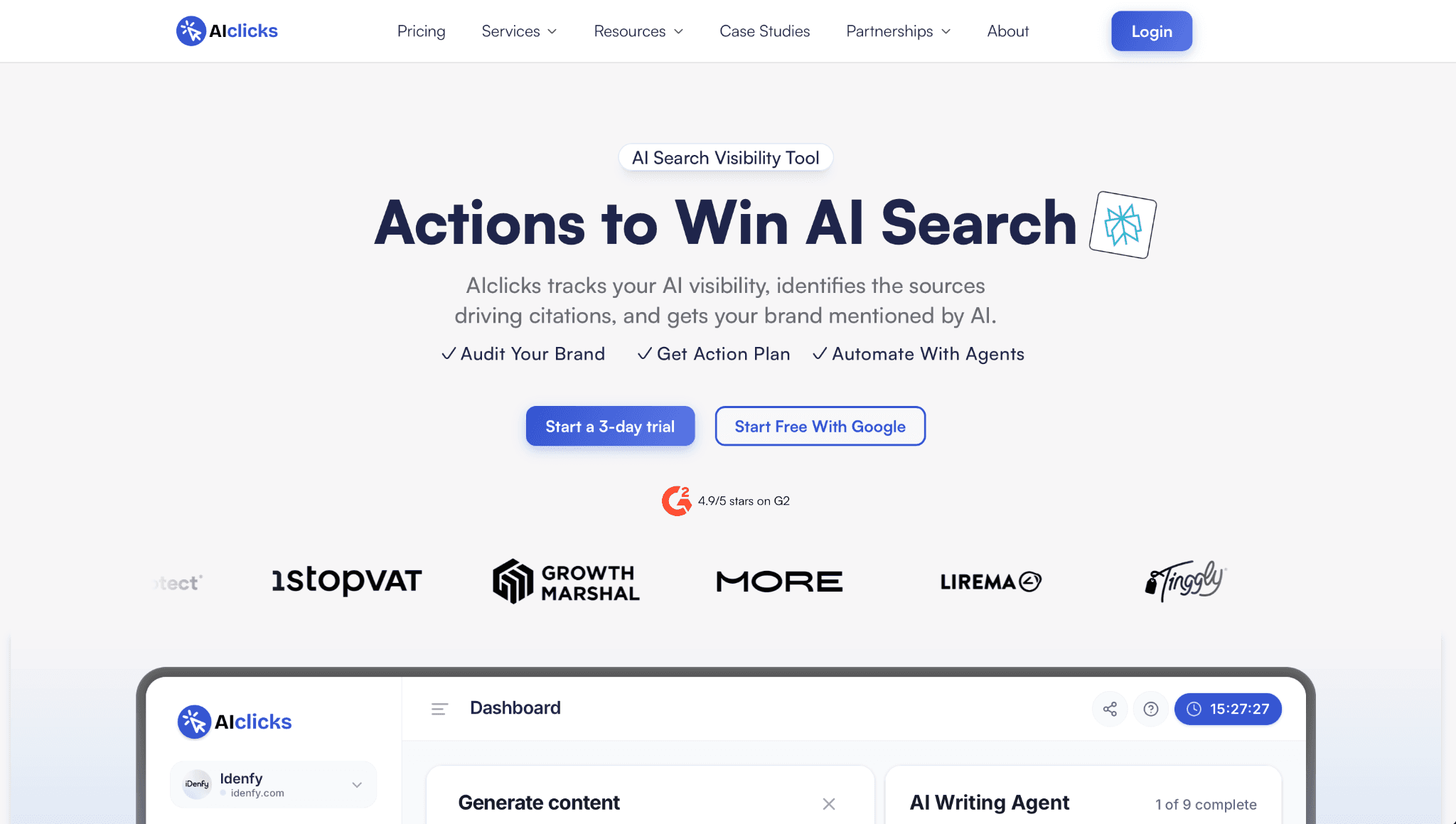
AIclicks is an AI search visibility platform that helps brands track how often they show up across AI engines.
The platform is organized around three jobs. First, monitoring: it watches 10+ AI engines; ChatGPT, Perplexity, Gemini, AI Overviews, AI Mode, Claude, Copilot, and others, and queries them through their real interfaces, not APIs, so the data reflects what users genuinely see.
Second, diagnosis: it shows which prompts trigger your brand, which sources AI is citing instead of you, how competitors perform across each model and region, and how all of it maps to real traffic via Google Analytics.
Third, action: a Recommendations engine clusters every finding into a prioritized to-do list; content to create, sources to earn mentions on, conversations to join, each scored by impact. That third pillar is the reason 400+ agencies and 1,000+ brands use it: it doesn't end the session with a chart, it ends it with a plan.
The platform was built by a team running an agency, who needed a tool that did more than report numbers back to clients. That origin shapes the whole product: where most platforms hand you a dashboard, AIclicks hands you a ranked list of actions.
Key features:
10+ AI platforms in one dashboard, ChatGPT, Perplexity, Gemini, Google AI Overviews, Google AI Mode, Claude, Grok, DeepSeek, Meta AI, and Microsoft Copilot, where most tools, Profound's mid-tier included, cover only three to five.
Real-UI querying, not API calls. AIclicks sends each prompt the way a real user would ask it, through each platform's actual interface, because API responses and real user-facing answers often differ, and tracking the wrong one quietly distorts your data.
A Recommendations engine that prioritizes the work. Visibility data is converted into a ranked action list across three types: create AI-optimized content, earn mentions on the sources AI already trusts, and join Reddit-style conversations where AI picks up brand signals, each action scored by expected impact.
Source and citation analysis that flags coverage gaps, shows which domains feed AI answers in your niche, and reveals exactly where competitors are cited and you aren't, plus competitor benchmarking across every model.
AI agents and real-traffic tracking. Agents can action content updates and outreach automatically, and a Google Analytics integration ties AI visibility back to actual site traffic, with daily refreshes and segmentation by model and country.
Pros & cons:
Pros:
Tracks 10+ AI platforms in one dashboard, broader coverage than most tools at this price
Real-UI querying captures what real users see, not API approximations
Recommendations engine and AI agents turn data into ranked actions, not just charts
Accessible pricing, $59/mo entry point, with custom plans
Cons:
3-day free trial is short for fully evaluating a visibility tool (but the team extend if you ask)
A bit of a learning curve is involved but the team is there to support
Pricing:
Starter $59/mo (30 prompts, 3 platforms), Pro $189/mo (150 prompts, 4 platforms), Business $499/mo (300+ prompts, 6 platforms). Custom plans available. 3-day free trial on all plans.
Verdict:
If your frustration with Profound is some blend of "this costs too much" and "great data, but now what?", AIclicks answers both at once; broad, accurate tracking plus a ranked action plan, starting at roughly an eighth of Profound Lite's entry price.
The team also did something most vendors won't: they ran their own process on themselves in public. In marketing SaaS, one of the most brutally competitive niches in AI search, they tracked 300+ prompts across major LLMs and landed top-5 visibility on 60% of them within 90 days.
In a category crowded with tools that are very good at measuring the problem, AIclicks is one of the few built to actually close it.
Why not give it a try and see the difference?
2. AI Peekaboo
About AI Peekaboo
If Profound's gap is the price tag and the procurement cycle, AI Peekaboo is the lean, agency-friendly answer that lets you start today.
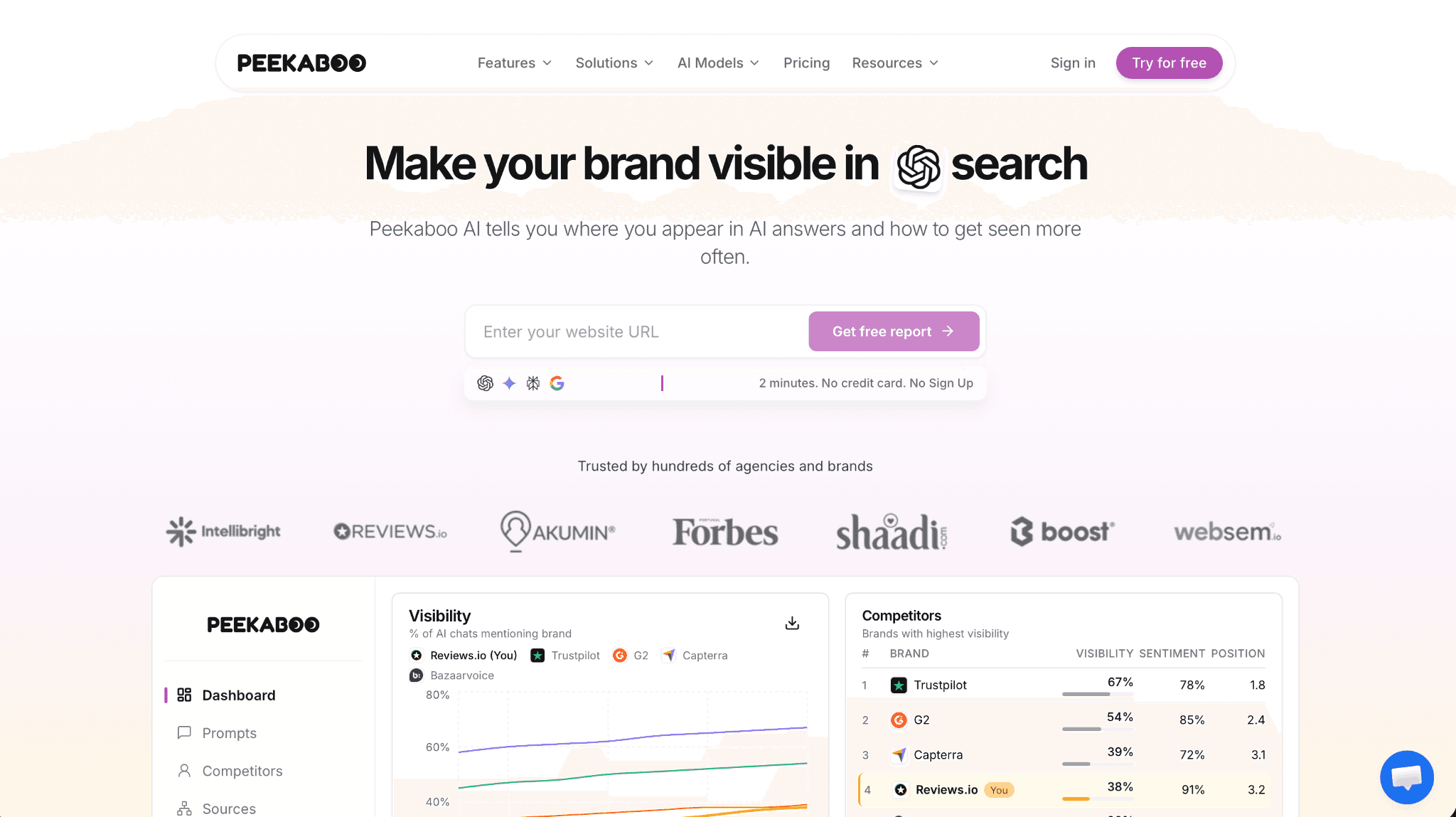
AI Peekaboo is built for brands and agencies that want prompt-level visibility into how AI search engines talk about them. The core differentiator: Peekaboo pulls its data from actual AI model interfaces, not APIs.
That means the responses you track reflect what real users see in ChatGPT, Gemini, Perplexity, and Google AI Overviews, rather than API approximations that quietly drift from reality.
Key features:
Tracks brand mentions across ChatGPT, Gemini, Perplexity, and Google AI Overviews.
Captures responses from real AI interfaces, not simulated API outputs.
AI Visibility Score with trend tracking, so you can measure progress over time.
Citation monitoring that shows which websites AI models reference when mentioning your brand.
Built-in competitor benchmarking to see how you stack up in AI search.
White-label reports and Looker Studio integration for agencies (Grow plan and above).
API access for workflow integration (Grow plan and above).
Pros & cons:
Pros:
Captures data from real AI interfaces, so it reflects what users actually see.
Best-in-class white-label reporting for agencies and multi-client setups.
14-day free trial, no credit card required.
Affordable entry point with no enterprise contract.
Cons:
No built-in content creation tools; Peekaboo is a tracking and intelligence platform.
API access is locked behind the Grow plan.
Pricing: Three plans. Starter at $50/month (1 brand, 40 prompts, tracking every 2 days, 3,000 data points/month), Peek at $100/month (1 brand, 40 prompts, daily tracking, 6,000 data points/month), and Grow at $200/month (1 brand, 100 prompts, daily tracking, 15,000 data points/month, plus API access, Looker Studio, and white-label reports). Agencies managing 10 or more brands can contact sales for custom pricing. All plans include a 14-day free trial, no credit card required.
Verdict: If your issue with Profound is the price and the sales-gated onboarding, Peekaboo is a strong fit for startups, in-house teams, and agencies that want accurate, real-world AI visibility data without enterprise pricing. You'll handle content creation elsewhere, but for tracking competitor performance and sending clean, branded reports to clients, it covers the depth and reporting flexibility most lightweight trackers miss.
3. Otterly AI
About Otterly AI
Where Profound asks you to grow into its dashboards, Otterly AI does the watching for you and surfaces only what matters. It's an AI search monitoring and optimization platform that tracks how AI engines mention, rank, and cite your brand, then ties that visibility back to your content.
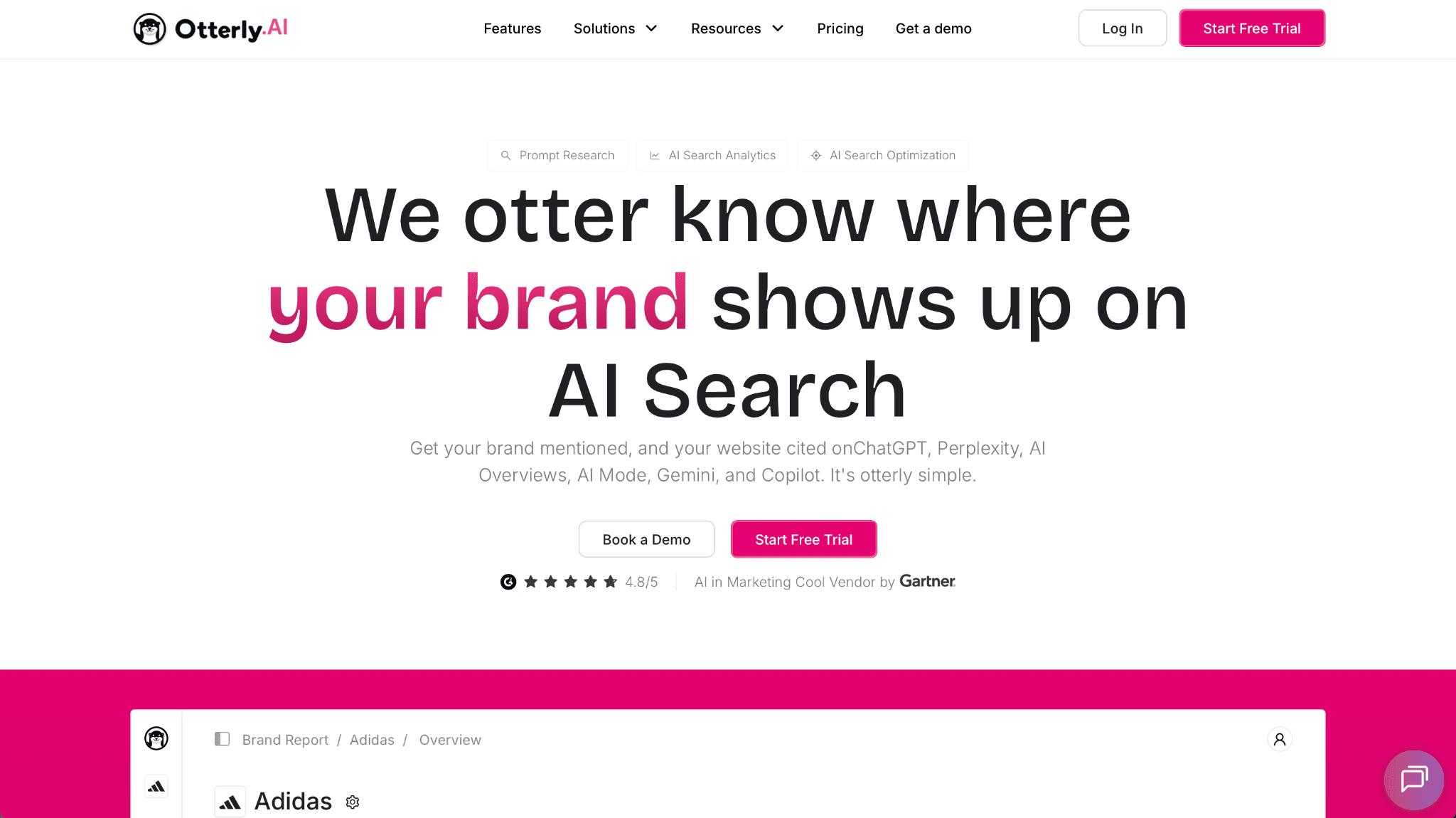
The model is automated simplicity: you build a prompt library of the questions your buyers actually ask, and Otterly runs them across every major engine on a schedule, so insight comes to you instead of you digging for it.
Reports break down share of voice, brand position, and sentiment, and the surrounding free GEO tools and weekly experiments make it as much a learning resource as a tracker.
Here are a few Otterly AI alternatives that you can try in 2026.
Key features:
Six-engine coverage, ChatGPT, Perplexity, Google AI Overviews, AI Mode, Gemini, and Copilot, with brand reports filterable by engine, country, and prompt tag.
AI Prompt Research that uncovers the prompts, topics, and intent patterns driving AI answers in your category.
Neutral, first-person monitoring, Otterly queries platforms directly rather than using personalized memory, so data isn't skewed by search history or location.
Content Audit with predictive scoring that estimates whether AI is likely to cite a page before you publish, with briefs to fix what's weak.
GEO optimization recommendations, sentiment tracking, and a public API for pulling data into your own stack.
Pros & cons:
Pros:
Fast setup, tracking within an hour
Neutral data, no personalization skew
Predictive scoring before you publish
Strong free tools and GEO experiments
Cons:
Only six engines, no Claude or Grok
Monitoring-led, light on automated execution
Prompt limits multiply across engines
Pricing:
Starts at $29/month; 14-day free trial, no credit card required. Higher tiers scale prompt volume and engine access.
Verdict:
Otterly is an affordable, design-forward choice for teams wanting clarity without Profound's complexity, fast setup, unbiased data, and useful predictive scoring. The limits: just six engines, and being monitoring-led, you're still the one turning insight into action. If you want that step handled too, a tool like AIclicks picks up where Otterly stops. But for low-effort, reliable monitoring, Otterly holds its own.
4. Prompt Monitor
About Prompt Monitor
Among Profound alternatives, Prompt Monitor is the one that trades breadth for focus, and undercuts Profound's price dramatically while doing it.
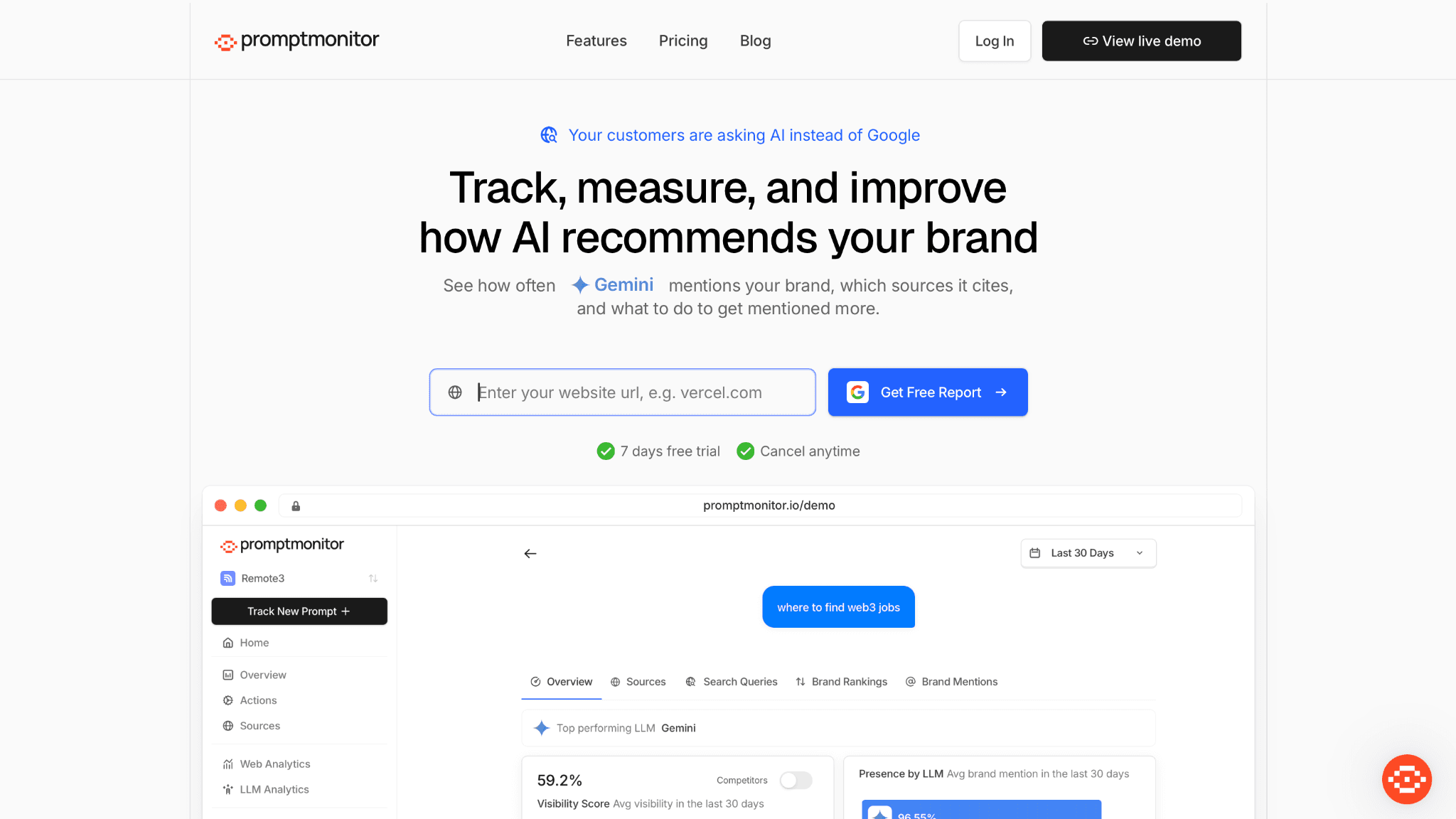
It's a lightweight AI visibility tool built around a single job: showing you whether an AI mentions your brand, which sources it pulls from when it answers, and how to get yourself into those sources.
Where it separates itself is the outreach angle; most trackers, Profound included, will tell you a competitor's blog gets cited and leave it there. Prompt Monitor goes a step further and extracts the author's email and social profiles so you can actually pitch them. It's deliberately simple to run: no code, no setup friction, and a first visibility report within two minutes of entering your URL.
Key features:
Tracks eight AI models, ChatGPT, Claude, Gemini, DeepSeek, Grok, Perplexity, Google AI Overview, and AI Mode.
Source contact extraction, pulls author emails and social profiles from every cited source for direct outreach.
"Outreach or outrank," each source comes with domain rating and backlink data to help you decide whether to pitch or out-create.
AI bot analytics plus built-in, cookie-free GDPR-compliant website analytics, and geo-targeting across 200+ countries.
Geographic targeting across 200+ countries and a transparent Visibility Score (Presence Rate × 80% + Cross-Model Consistency × 20%).
Pros & cons:
Pros:
Excellent value for the price
Source contact extraction saves outreach legwork
Daily refresh on most plans
Genuinely fast, no-code setup
Cons:
Modest prompt limits (25–150)
No prompt-volume data
Monitoring-and-outreach focused, not full strategy
Pricing:
Starter $29/mo, Growth $39/mo, Pro $129/mo; free agency plan available. 7-day free trial on all plans.
Verdict:
Prompt Monitor is one of the best value picks in the category, ideal for small businesses and lean teams that want to know where they stand and walk away with a concrete outreach plan, minus the enterprise invoice.
The trade-off is depth: tight prompt limits and no prompt-volume data mean it's a sharp monitoring-and-outreach tool rather than a full GEO platform. If you outgrow that, a broader tool like AIclicks adds the strategic layer, but for getting started, Prompt Monitor punches well above its price.
5. Scrunch AI
About Scrunch AI
Scrunch AI takes the AI visibility problem further than most, it doesn't just monitor your presence, it tries to fix the technical side of it.
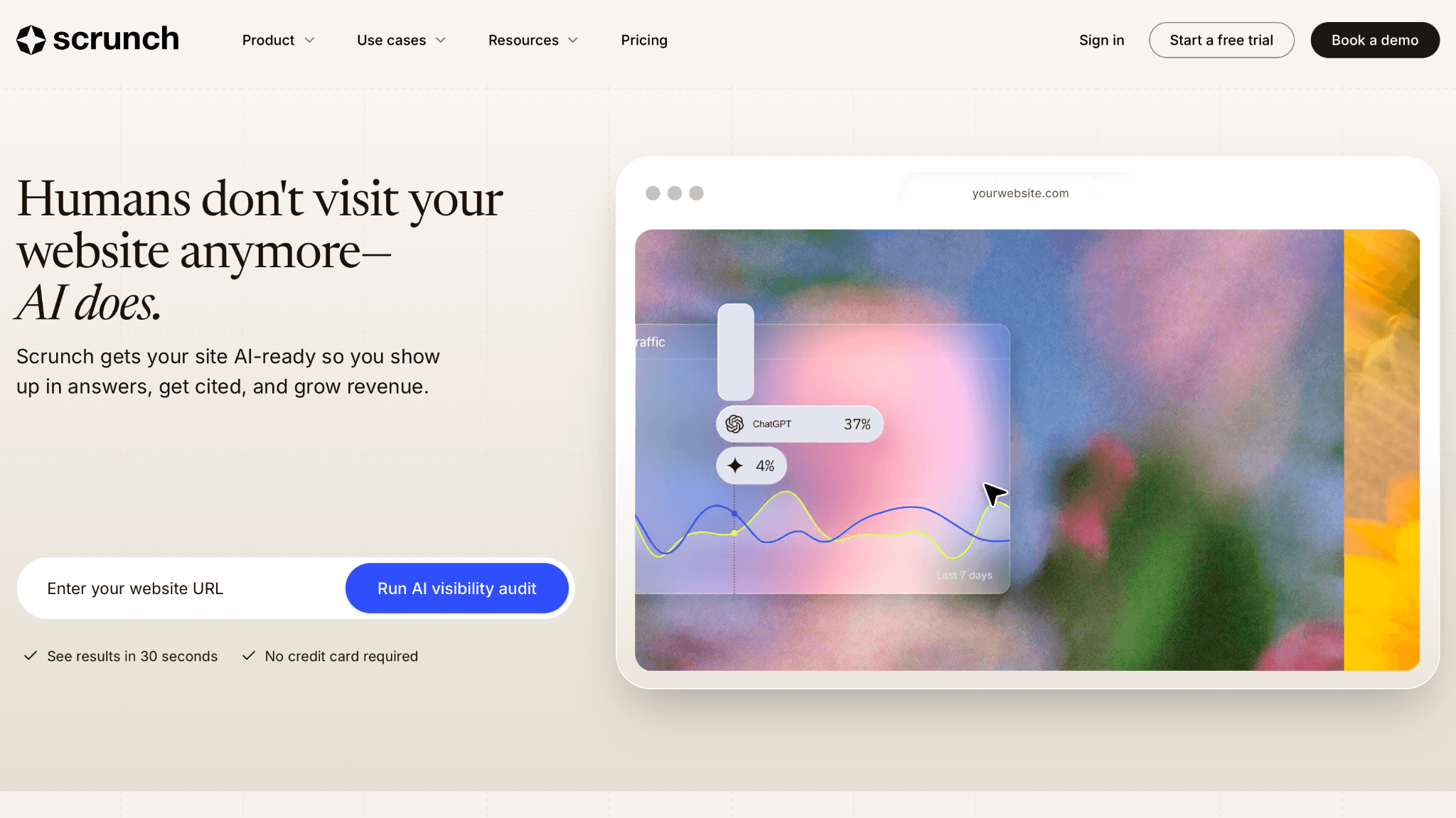
The platform monitors brand performance and citations across the major LLMs, explains the way behind your rankings, and then does something genuinely different with its Agent Experience Platform (AXP): it serves a parallel, lightweight, machine-readable version of your site built specifically for AI crawlers, so agents can parse your content without choking on JavaScript or page bloat.
That makes it a Profound alternative aimed less at marketers who want a dashboard and more at teams treating AI crawlability as an infrastructure problem. It's enterprise-grade software, with the pricing and feature depth to match.
Key features:
Monitoring across seven AI surfaces, ChatGPT, Claude, Gemini, Perplexity, Google AI Mode, AI Overviews, and Meta, with prompt-level tracking, trends, and rankings.
Insights layer that surfaces optimization guidance, citation analysis, and crawl-error detection.
Agent Experience Platform (AXP), serves compressed, structured pages purpose-built for LLM crawlers.
Competitive benchmarking by competitor, persona, topic, and geo, plus real-time AI bot traffic monitoring.
Pros & cons:
Pros:
AXP is a genuinely unique technical feature
Broad seven-engine coverage
Strong enterprise security (SOC 2 Type II)
Persona and geo benchmarking built in
Cons:
Expensive, $250/mo entry, billed annually
Page audits capped low (5 on Starter)
Heavier setup than lightweight trackers
Pricing:
Starter $250/mo (annual) or $300 month-to-month; Growth $417/mo (annual); Enterprise custom. 7-day free trial of Starter, no card needed.
Verdict:
Scrunch is a serious enterprise-grade Profound alternative, and the AXP layer is the most original idea in the category, solving a real problem nobody else touches. But that depth comes at a cost: a $250/month floor and a setup curve that lean teams won't want.
It's the right call if AI crawlability is a genuine technical bottleneck for you. If you mainly need broad tracking plus a clear action plan at a fraction of the price, a tool like AIclicks covers that ground far more affordably.
6. Peec AI
About Peec AI
Plenty of AI visibility tools lose users by burying the signal under features. Peec AI is built on the opposite instinct. It's an AI search analytics platform for marketing teams that deliberately strips the dashboard down to three numbers worth acting on, Visibility, Position, and Sentiment, and stops there.
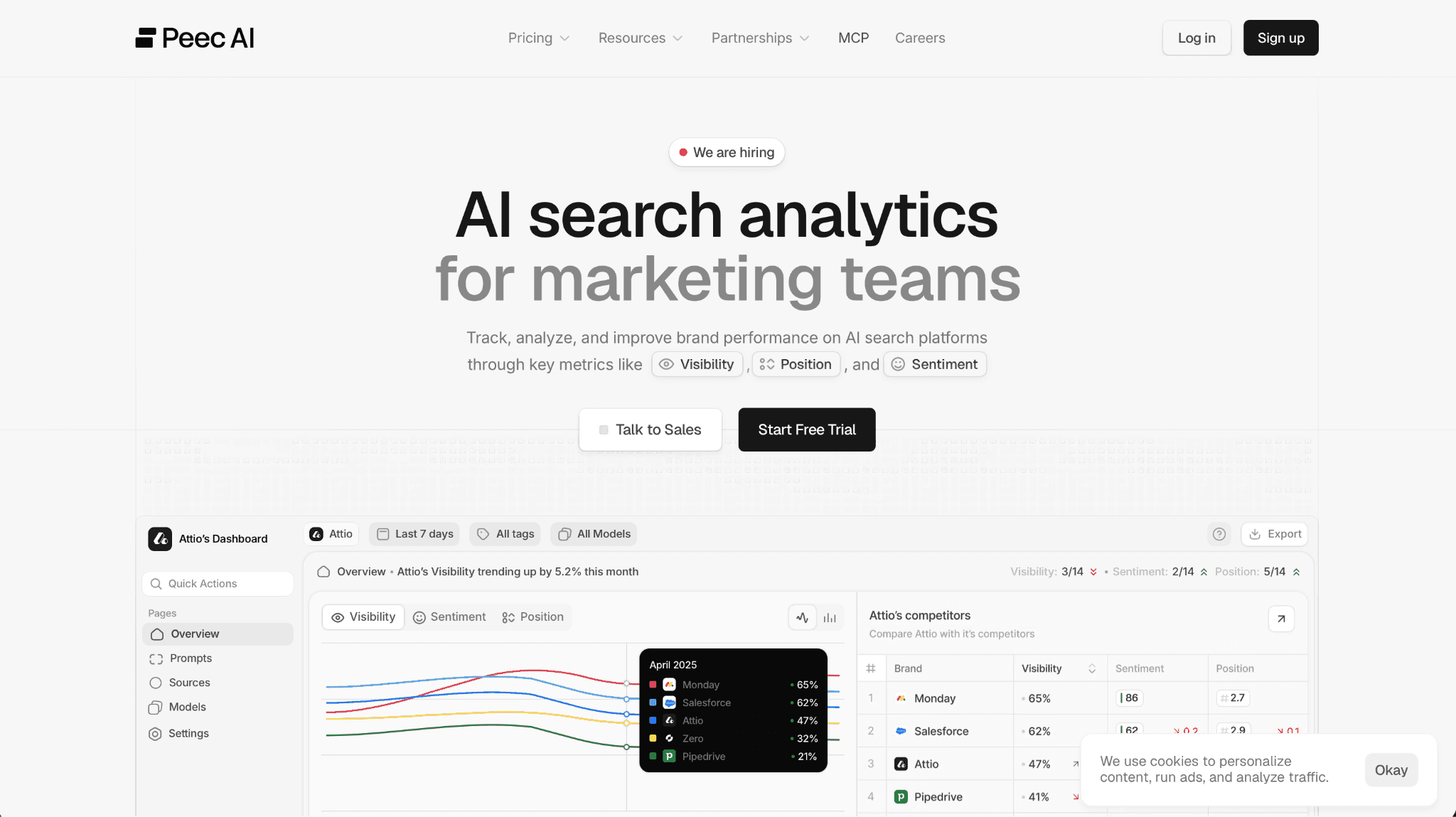
The pitch, echoed by SEO leaders who use it, is that it avoids the feature overload common to AEO platforms: set up your prompts, see where you stand, act on your top citations.
For teams that found Profound's dashboards exhausting, that restraint is the entire appeal, and it's backed by a recent Series A, so the simplicity isn't a sign of a thin product.
Key features:
Three core metrics, Visibility, Position, and Sentiment, tracked daily across ChatGPT, Perplexity, Gemini, AI Overviews, AI Mode, Copilot, and Grok.
Unlimited user seats on every plan, no per-seat upcharges as your team or agency grows.
Source citation tracking that distinguishes "used" (your content shaped the answer) from "cited" (your URL is named).
AI-suggested prompts with search volume data, so you focus on the highest-opportunity queries.
Looker Studio connector, CSV export, and a live MCP integration to pipe data into Claude, Cursor, or n8n.
Pros & cons:
Pros:
Clean, focused UI, no feature bloat
Unlimited seats on every plan
Distinguishes "used" vs "cited" sources
MCP integration fits modern AI stacks
Cons:
Only 3 models included per plan
Adding more models costs extra
Light on execution, no content tools
Pricing:
Starter ~$95/mo (50 prompts), Pro ~$245/mo (150 prompts), Advanced ~$495/mo (350 prompts); Enterprise custom. All include unlimited users; 7-day free trial.
Verdict:
Peec is the pick for SEO and content teams who want clarity over complexity, and unlimited seats genuinely change the cost math for bigger teams and agencies. The catch is in the model count: every plan includes just three engines, so broad coverage means paying up to Enterprise.
And like most analytics-led tools, Peec AI shows you the gap without closing it. If you want both the clean tracking and a ranked plan of what to do next, a tool like AIclicks covers more ground.
7. BrightEdge
About BrightEdge
Where Profound is a purpose-built AI tracker, BrightEdge is the enterprise SEO incumbent that folded AI visibility into a platform Fortune 500 teams already run.
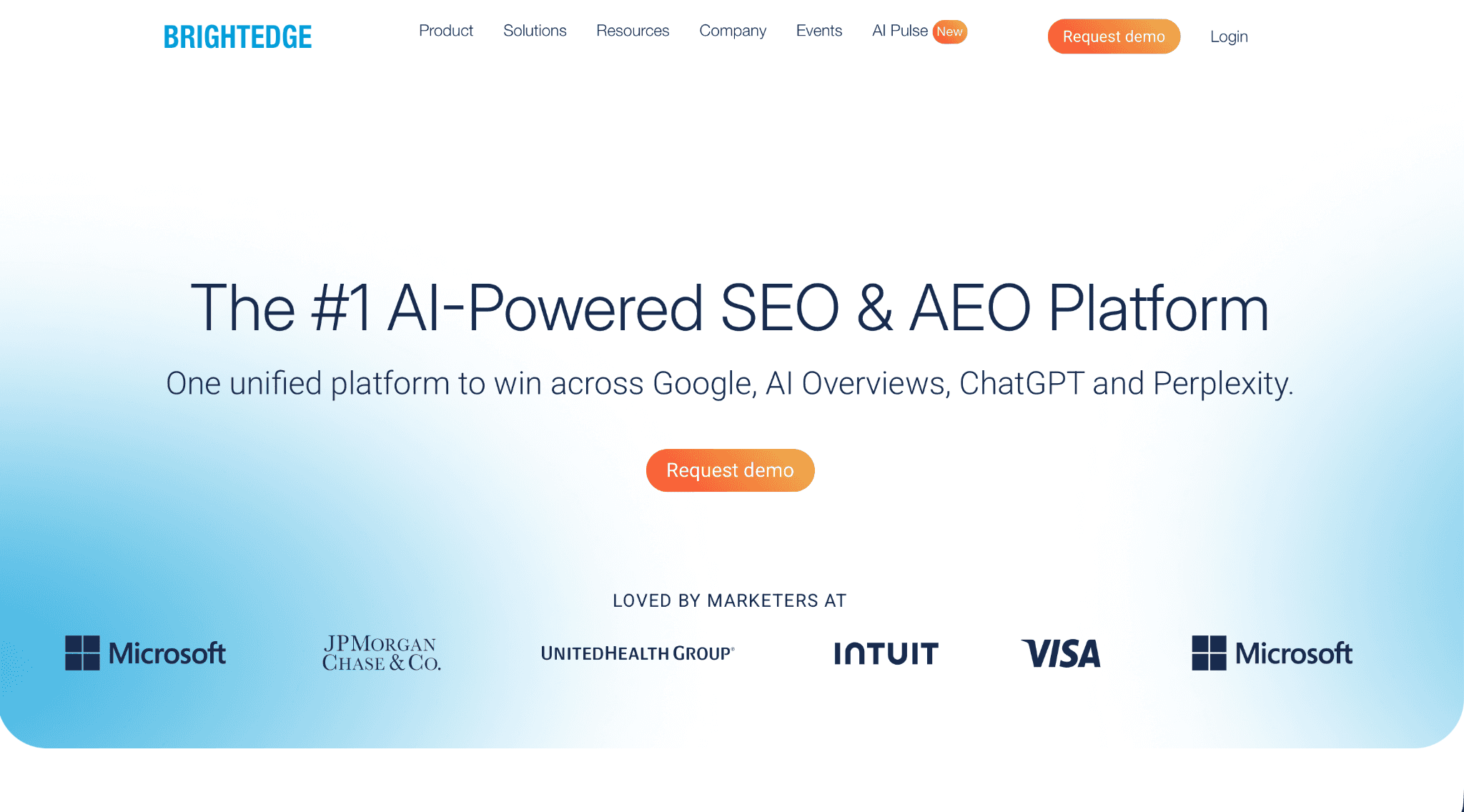
BrightEdge is an enterprise SEO platform that has added AI search visibility features through its AI Catalyst product, making it a strong Profound alternative if you already live in a large SEO stack.
Instead of bolting on a separate tool, it tracks how your brand appears across AI Overviews, ChatGPT, and Perplexity inside the same system you use for keyword research, technical audits, and content optimization.
Key features:
Combines classic SEO (keyword research, site audits, content recommendations) with insights into how your brand appears in AI-powered results.
AI Catalyst for AI visibility and sentiment across AI Overviews, ChatGPT, and Perplexity.
A single environment for traditional and AI-focused optimization.
Enterprise reporting, integrations (GA, Adobe Analytics, GSC), and dedicated customer success.
Pros & cons:
Pros:
Unifies traditional SEO and AI visibility in one mature platform.
Deep enterprise feature set with strong executive reporting.
Hands-on customer success and a long enterprise track record.
Cons:
Enterprise-level complexity and pricing; overkill for smaller teams.
AI visibility features are part of a broader suite, not the entire focus.
Pricing: Custom enterprise pricing, typically starting at several thousand dollars per month with annual contracts, tailored for large organizations based on domains, keywords, and AI-powered SEO features like generative visibility tracking. No public tiers or free trials available.
Verdict: BrightEdge is for large organizations that want AI-answer visibility but also need deep, long-standing SEO and content capabilities in one platform. If that's you, the unified view is genuinely valuable. As a Profound alternative for most teams, though, it's a step further into enterprise, not away from it, so smaller teams chasing a simpler, cheaper way to track AI visibility will be better served elsewhere on this list.
8. Writesonic GEO
About Writesonic
Most tools on this list answer "where do I stand?" Writesonic is built to answer "where do I stand, and what do I publish about it?" in the same place.
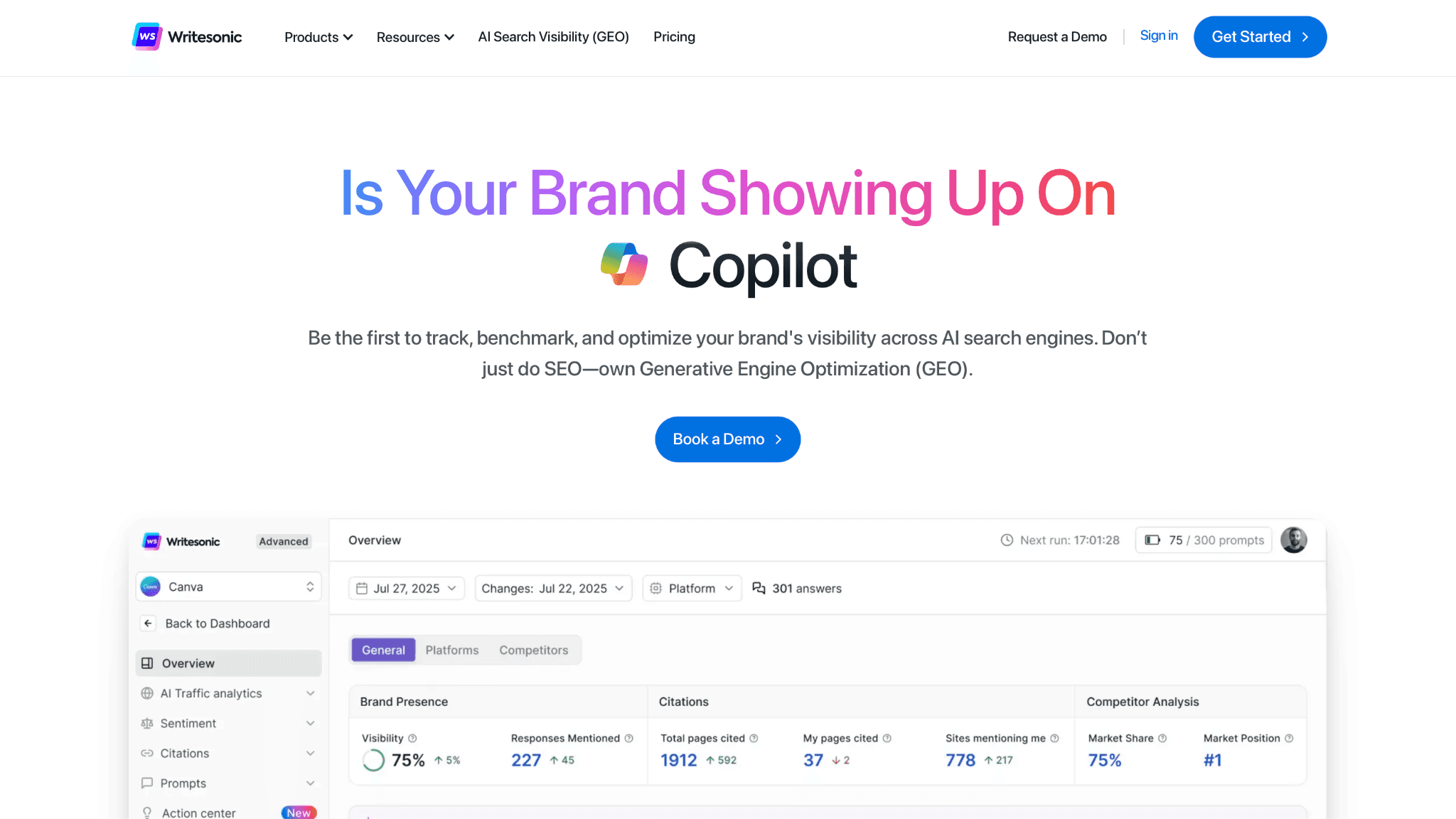
It's the AI search visibility arm of Writesonic's broader marketing suite, and its defining idea is a closed workflow: discover how AI sees your brand, compare against competitors, get optimization recommendations, then create the content to act on them, without leaving the platform.
For teams frustrated that Profound surfaces a content gap and stops, that end-to-end loop is the entire pitch. The trade-off is that you're buying a full suite, not a focused tracker.
Key features:
Brand Presence Explorer tracks visibility, share of voice, and sentiment across ChatGPT, Google AI Overviews, Claude, Perplexity, Gemini, Copilot, and Meta AI.
AI Traffic Analytics, a free tool, reveals AI crawler visits that Google Analytics misses entirely, broken down by platform.
Citation source analysis plus instant optimization suggestions to fill content gaps.
Built-in AI content and SEO tools so you can act on recommendations without switching platforms.
Pros & cons:
Pros:
True monitor-to-publish workflow in one tool
AI Traffic Analytics is genuinely free
Strong seven-platform coverage
Built-in content tools, no app-switching
Cons:
GEO platform is demo-gated, no public pricing
Overkill if you already have a content stack
AI writing quality is good, not best-in-class
Pricing:
No transparent pricing for the GEO platform, Brand Presence Explorer requires a demo call, with a free trial unlocked afterward. AI Traffic Analytics is free to use.
Verdict:
Writesonic is a strong fit for content-led marketing teams that want tracking and creation under one roof, the closed loop is real and genuinely saves tool-switching. The friction is transparency: you can't see GEO pricing without booking a sales call, and if your content workflow already lives elsewhere, you're paying for tools you won't touch.
For teams that just want sharp tracking and a focused action plan, a tool like AIclicks gets you there without the suite, but if "monitor and publish in one place" is the goal, Writesonic delivers it.
9. Athena HQ
About AthenaHQ
Founded by former Google Search and DeepMind leaders and backed by Y Combinator, Athena HQ is one of the most action-oriented platforms in the category.
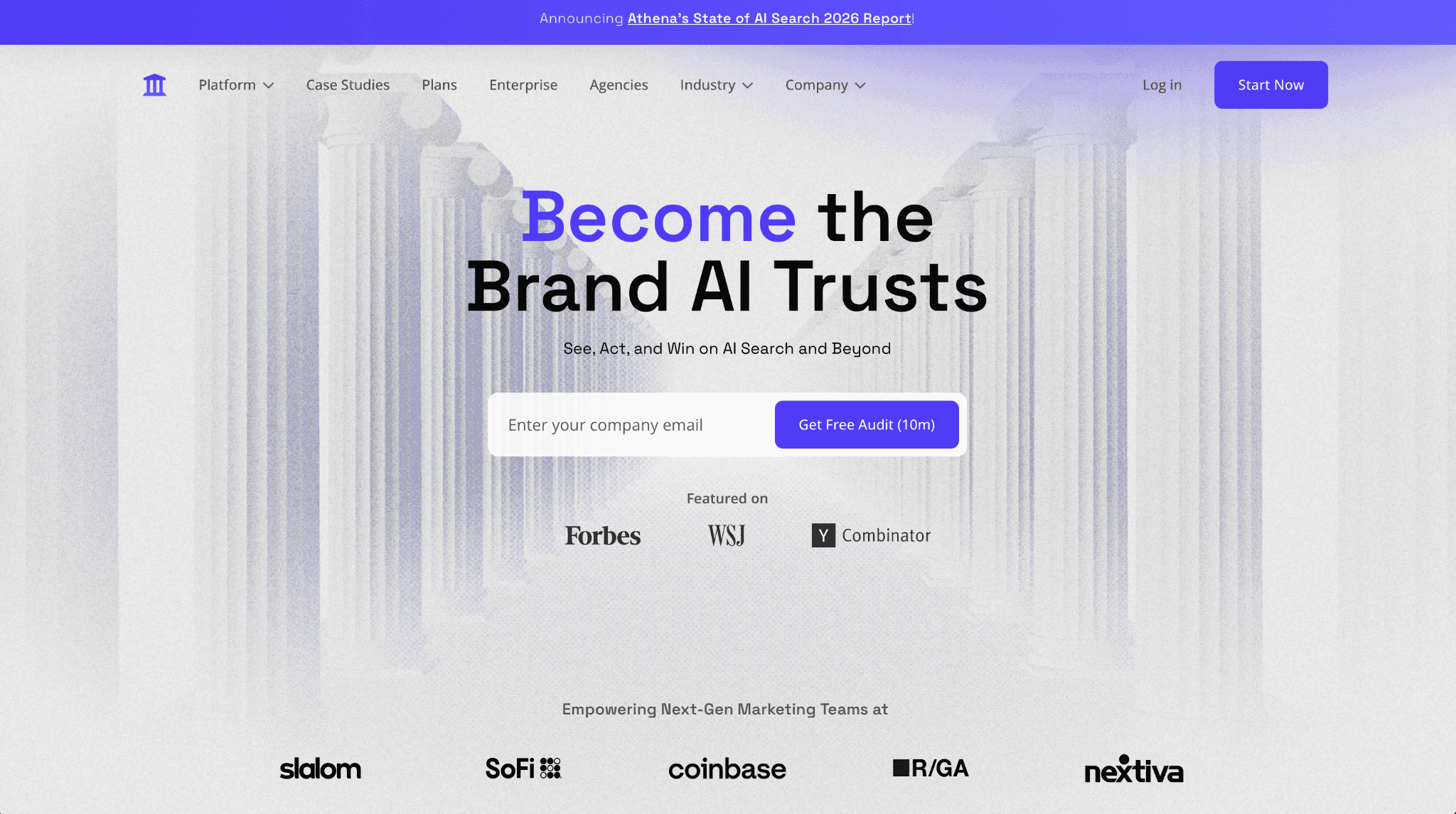
Where most tools, Profound included, leave you to interpret the data, Athena's Action Center converts monitoring insights into structured, assignable, trackable GEO tasks, closer to a project plan than a report.
It tracks brand visibility across eight AI engines, layers in an AI copilot you can question in plain English, and connects visibility to actual revenue. For mid-market teams that want their tool to hand them a to-do list, that's the appeal.
Key features:
Eight-engine coverage on all plans, ChatGPT, Perplexity, Google AI Overviews, AI Mode, Gemini, Claude, Copilot, and Grok.
Action Center that turns visibility gaps into structured, trackable optimization workflows and content drafts.
"Ask Athena" AI copilot, query your visibility data conversationally instead of digging through charts.
Revenue attribution via native GA4 and Shopify integrations, plus prompt-volume tracking.
Content gap analysis and hallucination detection, with geographic breakdowns for global brands.
Pros & cons:
Pros:
Action Center bridges insight-to-execution
8 engines on every plan
Revenue attribution via GA4/Shopify
Ask Athena copilot is genuinely useful
Cons:
Credit-based billing makes costs unpredictable
Self-Serve plan limited to one country
No free trial; ACE engine is Enterprise-only
Pricing:
Self-Serve from $295/month for 3,600 credits (1 credit per AI response); Growth and Enterprise tiers above. Discounted first month; no free trial.
Verdict:
Athena HQ is a strong pick for mid-market teams that want their tool to do more than report, the Action Center genuinely closes the gap between "here's the problem" and "here's the task list."
The catch is the billing model: credits are consumed by every AI response and analysis, so the more you track, the less the $295 sticker reflects reality. Do the credit math against your monitoring volume before committing. If you'd rather have a ranked action plan on flat, predictable pricing, a tool like AIclicks delivers that without the metered surprises.
10. Rankscale AI
About Rankscale AI
Next on our list of Profound alternatives is Rankscale AI, and it's the one that wins on raw coverage. It's an AI visibility analytics platform built for brands and agencies that want to track their presence across an unusually wide spread of engines, then dig into the why behind every result.
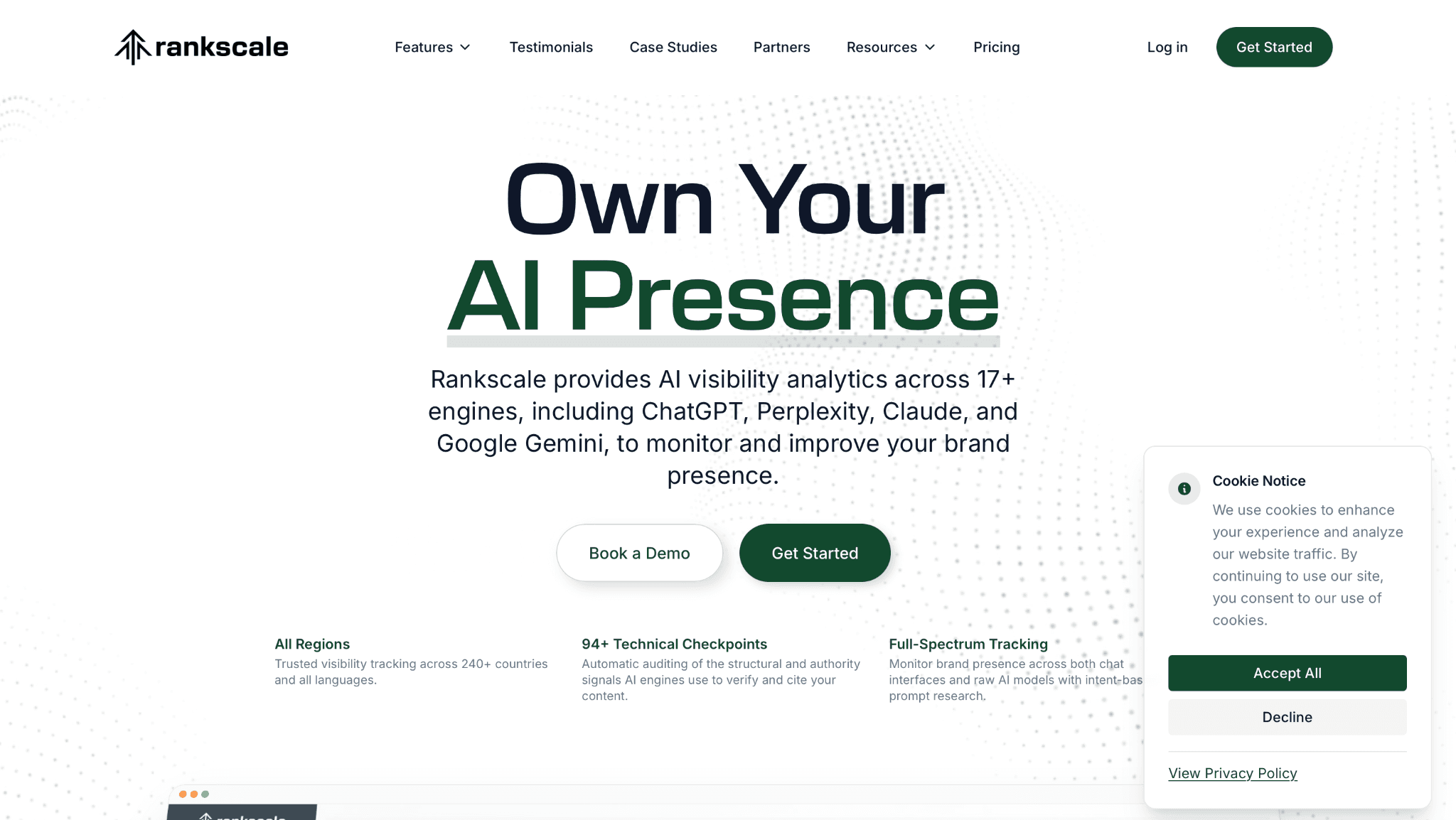
Where Profound gates broader model access behind higher tiers, Rankscale puts 17+ AI engines on every plan, no upsell. Its other defining trait is depth: instead of polished surface-level charts, it exposes the data underneath; single-query drilldowns, citation-level sentiment, and granular control over exactly what you track and how often.
Key features:
17+ AI engines on every plan, ChatGPT, Perplexity, Claude, Gemini, AI Overviews, AI Mode, DeepSeek, Grok, Copilot, Mistral, and more, the widest coverage in this guide.
AI Rank Tracker with visibility scoring, share of voice, citations, and historical trends plus recommendations.
Page Audits evaluating 200+ AI-readiness factors per URL, with actionable fixes.
Prompt Research that estimates prompt search volume via semantic reconstruction.
Credit-based pricing with flexible monitoring schedules (daily to hourly) and tracking across 240+ regions.
Pros & cons:
Pros:
Widest engine coverage; 17+, no upsell
Deep, granular query and citation data
Flexible credits suit variable agency volumes
Founder-led, ships updates constantly
Cons:
Credit math has a learning curve
Dense UI, less polished for beginners
Monitoring-first, light on execution
Pricing:
Credit-based; entry plans start low (around $20/month), scaling with usage. Free trial available; in-app credit top-ups.
Verdict:
The best way to dip a toe into Generative Engine Optimization (GEO) without financial risk. Perfect for solo marketers and small teams validating the channel, just expect to graduate to an action-oriented tool once visibility becomes a real priority. The flip side is operational: credit budgeting takes getting used to, and the interface rewards data-comfortable users over newcomers.
11. Semrush AI Visibility Toolkit
For the millions of marketers who already run their search work inside Semrush, the AI Visibility Toolkit is the path of least resistance. It's Semrush's answer to AI search, a module that tracks how often LLMs mention your brand, for which keywords, and how you stack up against competitors, all sitting inside the SEO platform you already know.
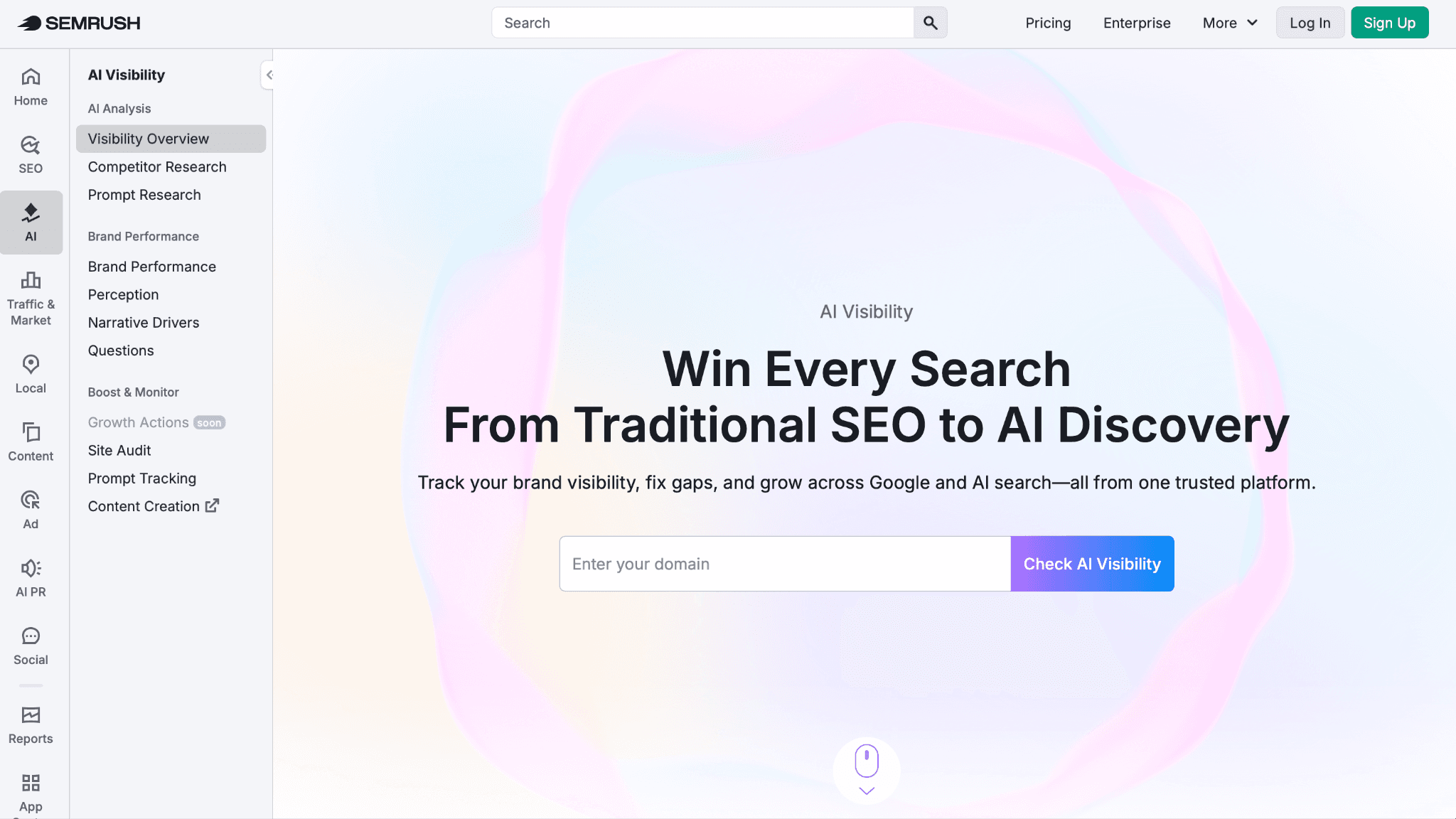
The pitch isn't "the best standalone AI tracker." It's "no new tool to learn," your AI visibility data next to your keyword rankings and site audits, in one login. For teams that find adopting a separate platform like Profound a hassle, that integration is the whole reason to choose it.
Key features:
Citations and mentions tracking across ChatGPT, Google AI Overviews, Gemini, Perplexity, and other LLMs, keyed to specific queries.
Competitor comparison, benchmark AI share of voice against up to nine competitors.
AI search site audit that flags what's blocking your content from being cited.
Prompt research and brand performance tracking, with 25 custom prompts on the base toolkit.
Deep integration with Semrush's full SEO dataset, the toolkit's real advantage.
Pros & cons:
Pros:
Zero learning curve for existing Semrush users
AI data sits beside real SEO data
Backed by Semrush's mature dataset
Familiar reporting and workflows
Cons:
Each extra domain costs another $99/mo
Each extra user also costs $99/mo
Limited standalone value without SEO tools
Pricing:
$99/month per domain as an add-on; or bundled in Semrush One from $199/month. Extra prompts $60/mo per 50; 14-day trial via Semrush One.
Verdict:
If Semrush is already your home base, the AI Visibility Toolkit is the obvious, low-friction choice; one login, unified reporting, and AI data beside your SEO data.
But the economics turn against you fast at scale: every extra domain and every extra seat is another $99/month, which gets punished for agencies. And reviewers broadly agree it isn't worth buying standalone unless you also use Semrush's SEO features. If AI visibility is your only need, a dedicated tool like AIclicks gives you more coverage and a clearer action plan for less.
12. Ahrefs Brand Radar
About Ahrefs Brand Radar
Ahrefs Brand Radar is another Profound alternative that approaches AI visibility from an angle no other tool here matches. Instead of you defining prompts and waiting days for data to accumulate, Brand Radar runs on Ahrefs' enormous index, 400M+ monthly prompts, the bulk of them search-backed rather than synthetic, so you can research any brand's AI visibility instantly, with zero setup.
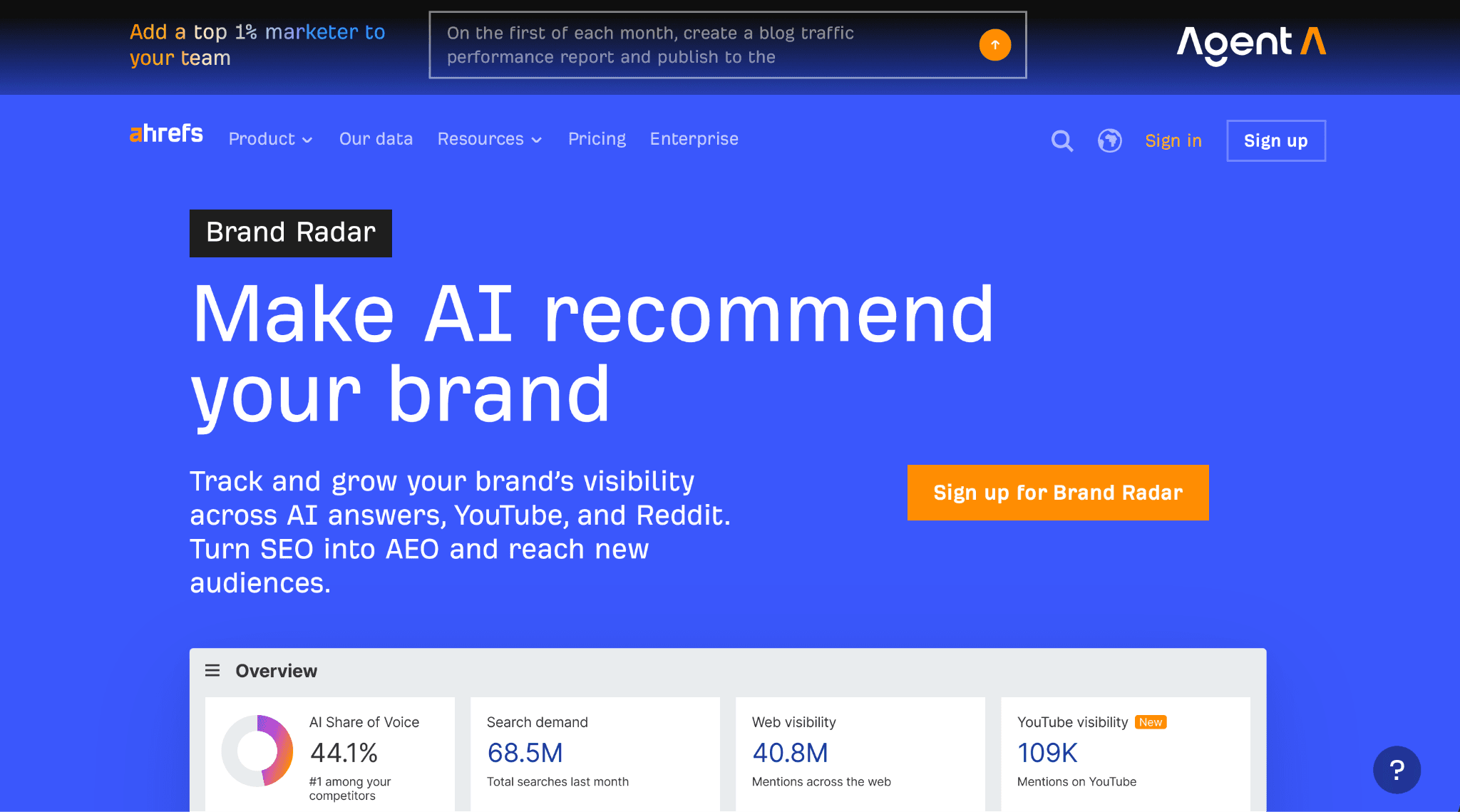
Type in a domain; yours, a competitor's, an acquisition target's, and see its AI footprint immediately. It's less a "set up tracking and monitor" tool and more an on-demand research engine for the entire AI search space, bolted onto the SEO suite many teams already pay for.
Key features:
A search-backed prompt database spanning AI Overviews, AI Mode, ChatGPT, Copilot, Gemini, Perplexity, and Grok.
Research any domain instantly, no tracking setup, no waiting period, unlimited projects.
AI Sources tracking that extends into YouTube, TikTok, and Reddit visibility.
Custom Prompts as an add-on for tracking the specific questions that matter to you.
The full Ahrefs SEO toolset alongside it like backlinks, keywords, site audits.
Pros & cons:
Pros:
Instant data, zero setup or waiting
Research any brand, not just your own
Massive search-backed prompt database
Extends into YouTube, TikTok, Reddit
Cons:
An Ahrefs add-on, not a standalone product
Research-led, light on prescriptive guidance
Custom prompts cost extra
Pricing:
Add-on to Ahrefs plans, selected platforms $398/month, all platforms $699/month; all-platform tier includes 2,500 custom-prompt checks.
Verdict:
Brand Radar is the standout for competitive intelligence and broad market research, the no-setup, query-any-brand model is genuinely unique, and invaluable if you're sizing up competitors or a whole category.
The trade-offs: it's an Ahrefs add-on rather than a standalone buy, and its strength is measuring the landscape more than handing you a task list. If you want a focused, action-led GEO workflow at a lower entry price, a dedicated tool like AIclicks fits better.
How To Choose the Right Profound Alternative
Ten tools is a lot to weigh. Skip the feature-list comparison and answer three questions about your own situation instead.
1. Do you need measurement or execution?
This is the real fork. If you have a team that just needs accurate data to act on, a monitoring tool, Otterly, Peec, Rankscale, Scrunch, does the job. If your actual problem is "I see the gaps but don't know what to do about them," you need an action-oriented platform like AIClicks, Athena HQ, or Writesonic. The most common regret in this category is buying a beautiful dashboard that changes nothing.
2. What's your real budget, including the add-ons?
Headline prices here are often fiction. A tool that charges extra per engine, per seat, or per client domain isn't priced at its sticker. Add it all up, base plan plus every model, seat, and domain you actually need and then compare. Flat-rate and unlimited-seat tools usually win at scale.
3. Where should it live?
If your team already runs on Semrush or Ahrefs, their add-ons keep everything in one login, real, if modest, value. If you're starting fresh, or AI visibility is becoming a core channel rather than a side experiment, a dedicated platform gives you more depth for the money.
One last thing: most of these tools offer a free trial. Use it. A week of hands-on testing tells you more than any comparison table, including this one.
Go With the #1 Profound Alternative - AIClicks
Here's the honest summary after ten tools: there's no universal "best." There's only the best fit. Scrunch makes sense for enterprise coverage, Peec for clean analytics, Rankscale for breadth on a budget, Semrush and Ahrefs if you already live in their suites. Each one earns its place for some team.
But most people reading a "Profound alternatives" article want the same two things, accurate visibility data without the enterprise price, and a clear answer on what to actually do with it. That's the exact gap AIClicks is built to close. It tracks 10+ AI platforms through their real interfaces, not API approximations, and turns that data into a ranked action plan instead of another dashboard to decode.
The tools that win in 2026 aren't the ones with the prettiest charts. They're the ones that answer the only question that matters: what do I do next? If that's what you're after, AIClicks is the most direct way to get it.
Start your free AIClicks trial and see where your brand stands across AI search, and get your action plan in minutes.
Frequently Asked Questions
1. What is Profound, and why do people look for alternatives?
Profound is an enterprise AI visibility platform that tracks how brands appear in AI-generated answers across ChatGPT, Perplexity, Gemini, and other engines. Teams look for alternatives mainly because of its pricing structure, the $99/month entry plan tracks ChatGPT only, with multi-engine coverage starting at $399/month, a steep learning curve, and the fact that, like most tools in the category, it surfaces gaps without fully closing them.
2. What's the cheapest Profound alternative?
Rankscale AI is the lowest entry point at around $20/month, followed by Otterly AI and Prompt Monitor at $29/month. AIClicks starts at $59/month and adds a built-in recommendations engine, which makes it a strong value pick once you factor in what you'd otherwise spend acting on the data manually.
3. Is GEO (Generative Engine Optimization) still worth investing in?
GEO is no longer a new or speculative idea, it's been a defined discipline for well over a year, with established tools, case studies, and measurable results. With AI search now part of how a large share of buyers research products, ignoring AI visibility means ignoring a real and growing slice of demand.
4. Do I need a separate GEO tool if I already use Semrush or Ahrefs?
Not necessarily. Both Semrush (AI Visibility Toolkit) and Ahrefs (Brand Radar) offer AI visibility modules that integrate with their core platforms. If you already live in one of those tools, the add-on is the convenient choice. If AI visibility is becoming a core channel, a dedicated platform like AIclicks will usually give you more depth and better action guidance.
5. What's the difference between monitoring and optimization tools?
Monitoring tools tell you what's happening, where your brand appears, who outranks you, which sources get cited. Optimization tools go further and tell you what to do, prioritized content, citation, and outreach actions. Many teams underestimate this distinction and end up buying a dashboard when they needed a roadmap. AIClicks, Athena HQ, and Writesonic lean toward optimization; most budget tools lean toward monitoring.
6. How many AI platforms should a good visibility tool track?
Coverage matters because every untracked engine is a blind spot. Budget tools often cover three to five platforms; stronger tools cover ten or more. AIClicks tracks 10+, Rankscale advertises 17+, and Athena HQ and Scrunch both cover eight-plus. Match coverage to where your audience actually researches, there's no need to pay for engines your buyers don't use.
Our Content:




Any questions left?
Book a call here: