
" width="14px"><path d="M 13.864 5.629 L 13.3 5.629 L 13.3 5.6 L 7 5.6 L 7 8.4 L 10.956 8.4 C 10.379 10.03 8.828 11.2 7 11.2 C 4.681 11.2 2.8 9.319 2.8 7 C 2.8 4.681 4.681 2.8 7 2.8 C 8.071 2.8 9.045 3.204 9.786 3.864 L 11.766 1.884 C 10.516 0.719 8.844 0 7 0 C 3.134 0 0 3.134 0 7 C 0 10.866 3.134 14 7 14 C 10.866 14 14 10.866 14 7 C 14 6.531 13.952 6.073 13.864 5.629 Z" fill="rgb(255, 193, 7)" height="14px" id="H_YjfTNpn" width="14px"/><path d="M 0 3.742 L 2.3 5.429 C 2.922 3.888 4.429 2.8 6.193 2.8 C 7.264 2.8 8.238 3.204 8.979 3.864 L 10.959 1.884 C 9.709 0.719 8.037 0 6.193 0 C 3.504 0 1.172 1.518 0 3.742 Z" fill="rgb(255, 61, 0)" height="5.428500000000002px" id="PlkthQDhg" transform="translate(0.875 0)" width="10.959199999999996px"/><path d="M 6.232 5.581 C 8.04 5.581 9.683 4.889 10.925 3.764 L 8.758 1.931 C 8.032 2.483 7.144 2.782 6.232 2.781 C 4.411 2.781 2.865 1.62 2.283 0 L 0 1.759 C 1.159 4.026 3.511 5.581 6.232 5.581 Z" fill="rgb(76, 175, 80)" height="5.581099999999999px" id="WlnJ5gngE" transform="translate(0.7 8.4)" width="10.924899999999994px"/><path d="M 6.864 0.029 L 6.3 0.029 L 6.3 0 L 0 0 L 0 2.8 L 3.956 2.8 C 3.68 3.576 3.183 4.254 2.526 4.75 L 2.527 4.749 L 4.693 6.582 C 4.54 6.722 7 4.9 7 1.4 C 7 0.931 6.952 0.473 6.864 0.029 Z" fill="rgb(25, 118, 210)" height="6.589883930775992px" id="x_rSW275p" transform="translate(7 5.6)" width="7px"/></g></svg>)



Reviewed by:
Rokas Stankevicius

founder @aiclicks.io
Last updated:
Expert Verified

Key Takeaways
AirOps is a content operating system, not just an AI visibility tracker. It connects monitoring, content creation, and CMS publishing in one workflow automation platform. Teams that need all three connected, and are willing to build the workflows to support them, get real value from it.
The most consistent G2 complaint is the learning curve. Thirty-three reviewers flag it as the primary friction. Workflows take real investment to build, and the platform rewards teams that can make that investment.
Task budgets deplete faster than expected, particularly during setup and experimentation. Additional tasks cost $0.025 each on the Solo plan after the monthly allocation runs out.
Solo tracking covers ChatGPT only. Multi-engine insights enter on Pro. Teams whose buyers are active on Claude, Grok, or DeepSeek are not covered on any self-serve plan.
The eight alternatives span dedicated AI visibility platforms (AIclicks, AthenaHQ, Peec AI), combined tracking-and-content platforms (Writesonic, Profound), an agency SEO and AI visibility system (Rankability), enterprise AEO (Conductor), and content intelligence for earning AI citations (MarketMuse).
AirOps is not a tool people regret signing up for. The 4.7/5 on G2, the customer list that includes Ramp, Webflow, Chime, and Monday.com, the reviewers talking about 80% time savings and content output tripling… this is a platform that delivers.
However, delivering and being the right tool are different questions.
AirOps is a content operating system. It tracks where you appear in AI search, surfaces the gaps, and then helps you close them with automated workflows that draft, refresh, and publish content across your CMS. For teams that need all three of those functions connected and are willing to invest the time to build workflows properly, AirOps is excellent. That investment is real, 33 G2 reviewers flag the learning curve as the primary friction. Workflows don't come ready-made. They come with a builder, a Copilot to assist, and a training program that AirOps sells alongside the product for a reason.
Then there are teams that ran into the learning curve and couldn't recover. Teams whose task budgets burned faster than expected during setup and experimentation. Teams that wanted AI visibility tracking without building a content automation infrastructure around it. Teams whose buyers are on Claude or Grok, which no AirOps self-serve plan covers.
We’ve collected eight AirOps alternatives, and each one does a different piece of what AirOps does.
Why Teams Look Beyond AirOps
The learning curve is real and the platform expects you to climb it. The platform is genuinely powerful once workflows are built and tested. Getting there requires time, iteration, and often engagement with AirOps' training cohorts. Teams that don't have that capacity available get less out of it than the feature set promises.

Task budgets deplete faster than expected, and overage costs are real. Every action in AirOps consumes tasks from your monthly allocation. Testing workflows before going live, experimenting with different configurations, running larger automations: all of it draws from the same pool. Additional tasks on the Solo plan cost $0.025 each after the allocation runs out. For teams managing tight budgets or variable workflow volumes, that uncertainty is hard to plan around.

Published output still requires human editorial review. The automation accelerates content production volume. It does not replace the editorial judgment needed before anything goes live. For lean teams that bought AirOps expecting to reduce manual work end-to-end, discovering that review time remains real is a meaningful recalibration.

How I Evaluated These Alternatives
Teams leaving AirOps usually want one of three things: a simpler AI visibility platform that doesn't require workflow engineering, a managed content-plus-tracking workflow without the operational overhead, or a cleaner entry point before committing to a content automation infrastructure.
For AI visibility platforms: how many engines are covered at the actual self-serve price, whether the platform produces prioritized recommendations or surface data and stops, and whether the entry point requires the same level of setup investment as AirOps.
For combined tracking-and-content platforms: how closely the workflow matches what AirOps does, and whether the entry price and complexity are lower while maintaining meaningful functionality.
For enterprise alternatives: what the platform delivers at scale that AirOps doesn't, and whether the evaluation process itself is accessible.
For content intelligence tools: whether they address the reason AI engines cite content in the first place, rather than the workflow automation around creating it.
All pricing and feature data came directly from official product pages, verified July 2026. Pricing changes fast, verify on each company's site before purchasing.
The 8 Best AirOps Alternatives in 2026
Tool | Best For | Starting Price | Standout Feature |
AIclicks | Teams wanting dedicated AI visibility with a clear action plan, without workflow engineering overhead | $59/mo | 10+ engines, real-UI querying, Recommendations engine |
AthenaHQ | Teams that want an action layer and revenue attribution without building content workflows | $295/mo | Action Center, Shopify + GA4 revenue attribution, 8+ engines |
Peec AI | Mid-market and agency teams wanting clean AI analytics with EU compliance | $95/mo | Choose 3 from 6 engines, unlimited users, EU data residency |
Writesonic | Teams wanting monitoring-to-content in one platform at a lower entry price | $99/mo | ChatGPT, Gemini, AI Overviews tracking + AI articles from Starter |
Profound | Enterprises with the depth to use the Prompt Volumes dataset and Agents at scale | $99/mo | Prompt Volumes dataset, Agents for CMS publishing |
Rankability | Agencies that want SEO and AI visibility connected without a separate tool stack | $99/mo | Serena AI agent, Track + Research + Create + Audit in one credit system |
Conductor | Global enterprises committed to AEO as a measured channel at scale | Quote | Forrester Wave Leader, official API data collection |
MarketMuse | Teams that want to build the topically authoritative content that AI engines cite | Quote | Topic modeling across entire content inventory |
1. AIclicks: The #1 AirOps Alternative
About AIclicks
AirOps does three jobs: it tracks where you appear in AI answers, builds workflows to create content that closes the gaps, and publishes that content to your CMS. AIclicks covers the first two (tracking and telling you exactly what to do about what you find) without asking you to build a single workflow before you see your data.

Setup takes minutes. The tracking covers 10+ AI engines through their real user interfaces (not API approximations) because what a buyer sees in ChatGPT and what an API returns are frequently different answers. Every session ends with a Recommendations engine that converts visibility findings into a ranked action list: content to create, sources to earn mentions on, communities to engage. Each action is scored by expected impact. The Competitors tab traces exactly which sources power the brands being cited instead of you. The Sources tab turns your category's citation landscape into a concrete work list. You leave each session knowing what's on your plate this week, not what workflow to build next.
Key features:
10+ AI platforms tracked through real user interfaces: ChatGPT, Perplexity, Gemini, Google AI Overviews, AI Mode, Claude, Grok, DeepSeek, Meta AI, and Microsoft Copilot.
Real-UI querying capturing what actual users see, not API approximations that return different answers from what buyers encounter.
Recommendations engine converting every visibility finding into a ranked, scored action list across three types: content to create, sources to earn mentions on, and communities to engage.

Competitors tab tracing which specific sources power competitors' AI visibility, so outreach and content targets are concrete rather than directional.

Sources analysis showing exactly which domains feed AI answers in your category and where you're absent.

Google Analytics integration tying AI visibility to actual site traffic, with daily refreshes segmented by model and country.
Pros and cons:
Pros:
No workflows to build, no setup investment, no learning curve comparable to AirOps. Tracking and recommendations are live within minutes
10+ engines from Starter, including Claude, Grok, and DeepSeek that AirOps self-serve plans don't cover
Transparent plan pricing with a 3-day free trial, no task-based billing uncertainty
Cons:
Content workflow automation at the depth AirOps provides (multi-step workflows, Grids for bulk processing, direct CMS publishing pipelines) is outside the platform's scope
Predefined plan tiers rather than task-based flexibility. Teams with very specific usage volumes may find themselves between plans. Custom plans available on request.
G2 rating: 4.9/5
Pricing: Starter $59/mo (30 prompts, 3 AI platforms) | Pro $189/mo (150 prompts, 4 platforms) | Business $499/mo (300+ prompts, 6 platforms) | 3-day free trial on all plans | Custom enterprise pricing is available
Verdict:
For teams where the workflow engineering, task budget management, and setup overhead were the friction, AIclicks removes all three. Real data in minutes, ranked action plan in the same session, transparent pricing before the month ends.
The honest gap: AIclicks doesn't replicate AirOps' automated content publishing pipelines or multi-step workflow builder. Teams that genuinely needed those capabilities are looking for a different kind of replacement.
If you want to go deeper on the strategy behind ranking in AI search before you trial anything, this walkthrough covers the full playbook:
2. AthenaHQ: Best for teams that want an action layer and revenue attribution without workflow engineering
About AthenaHQ
AthenaHQ tracks where your brand appears in AI answers and ties that directly to revenue through Shopify and GA4 integrations.
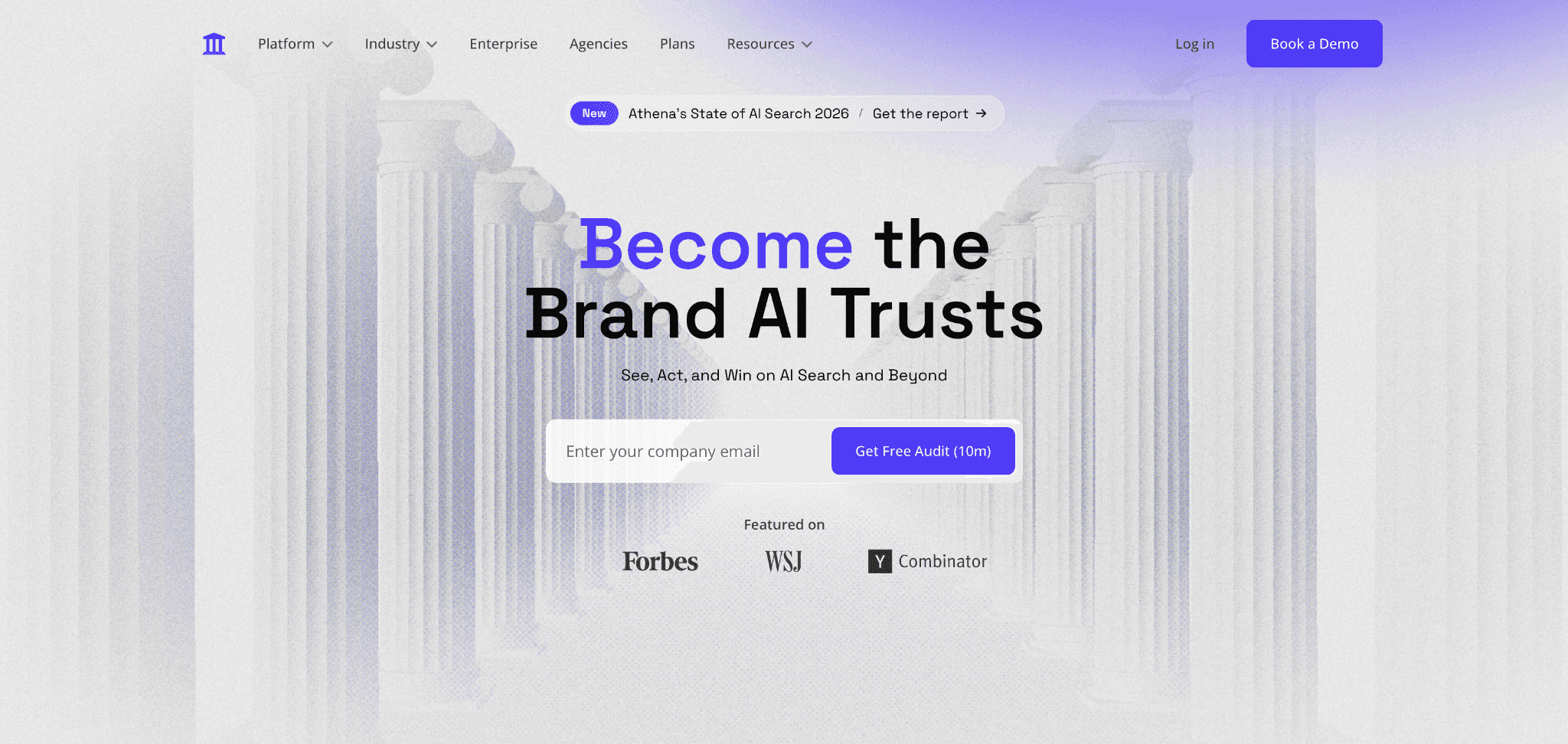
Built by alumni of Google Search and DeepMind, backed by Y Combinator, the platform tracks 8+ AI platforms on every self-serve plan with no per-engine add-ons. The Action Center generates structured GEO optimization workflows with tasks assignable to team members and prioritized by estimated visibility impact. Ask Athena answers plain-language strategy questions about your data without requiring you to build a report first. Unlike AirOps, there are no workflows to build and no Copilot to guide you through the setup. The platform surfaces recommendations directly from the tracking data. A free plan with $25 in starter credits removes the trial barrier.
Key features:
8+ AI platforms on every plan with no per-engine add-ons, including ChatGPT, Perplexity, Claude, Gemini, Copilot, and more.
Action Center generating structured GEO optimization workflows with tasks assignable to team members.
Ask Athena AI copilot answering natural-language strategy questions from your visibility data.
Revenue attribution via Shopify and GA4, connecting AI citations to commercial outcomes.
Source Intelligence identifying which websites AI systems draw from most frequently in your category.
Hallucination detection monitoring for when AI platforms describe your brand inaccurately.
Pros and cons:
Pros:
Revenue attribution through Shopify and GA4 is a genuine differentiator, the only platform on this list connecting AI visibility directly to commercial outcomes
8+ engines from the entry plan with no add-on fees and a lower learning curve than AirOps
Free plan with $25 starter credits for initial evaluation without a payment commitment
Cons:
Self-serve at $295/mo with no free trial beyond the credit allowance. The Athena Citation Engine (ACE), multi-region tracking, and API access are Enterprise-only.
Self-serve covers one country, which constrains global brands before Enterprise.
Too many product updates lead to confusion between users.

G2 rating: 4.9/5
Pricing: Free plan ($25 starter credits) | Starter $295/mo | Enterprise custom
Verdict:
AthenaHQ makes its strongest case for ecommerce brands and enterprise growth teams that need to show AI visibility in a P&L context. Eight-plus engines, a structured action layer, and revenue attribution in one self-serve product is the combination that justifies the price relative to AirOps at comparable investment levels.
For teams coming from AirOps that primarily need the content workflow automation, AthenaHQ addresses the visibility and action side but not the content production side.
3. Peec AI: Best for mid-market and agency teams wanting clean AI analytics with EU compliance
About Peec AI
Peec AI raised over $29 million, crossed 2,500 marketing teams including Wix, ElevenLabs, Chanel, and Axel Springer, and hit a $100M+ valuation in under twelve months. It's Berlin-based, GDPR-first, and EU data residency comes standard. The contrast with AirOps is deliberate: Peec shows you the data cleanly, quickly, and without asking you to build anything.
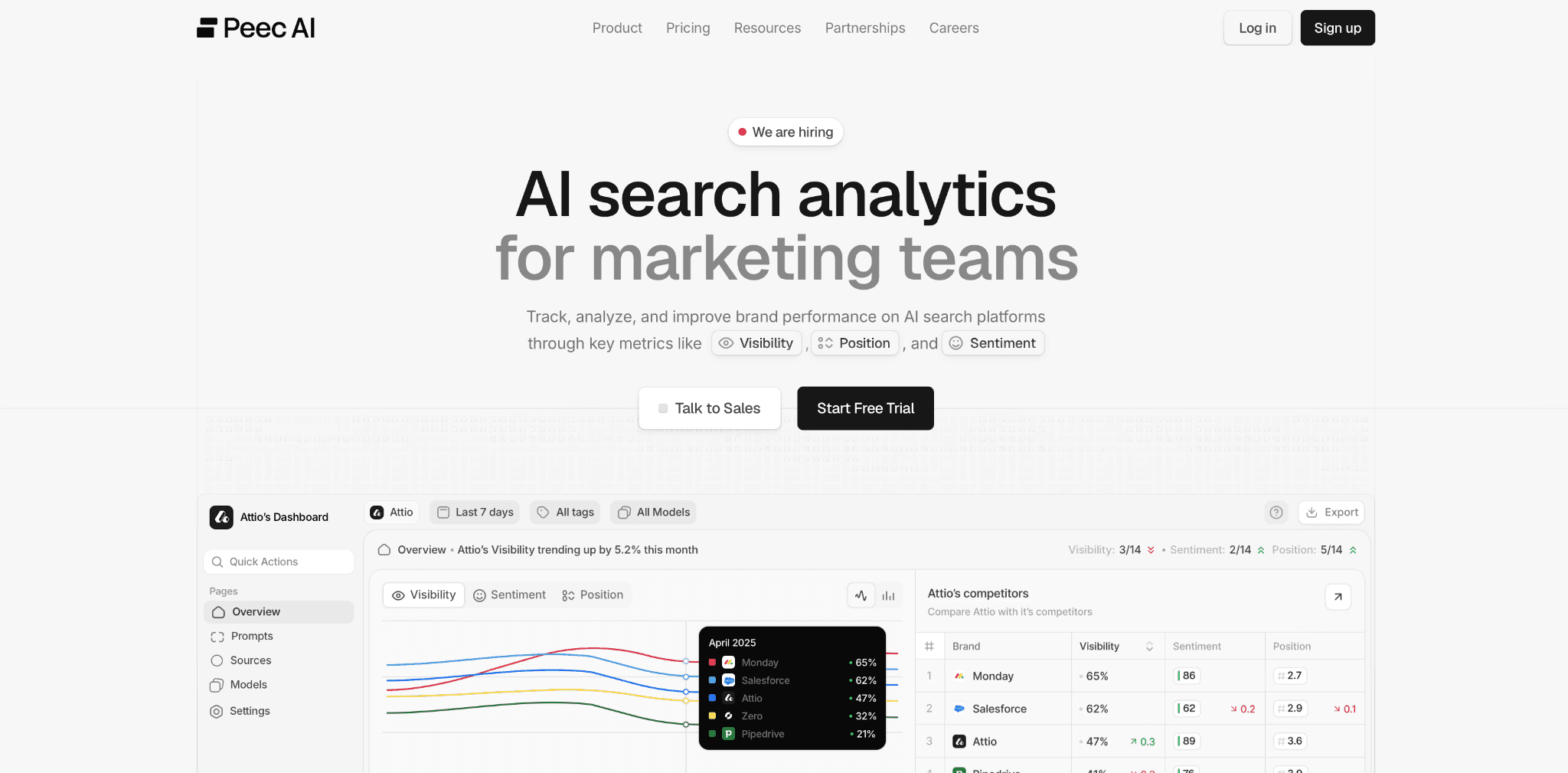
Setup takes under an hour. The platform tracks brand presence, citations, sentiment, and source data across your chosen engines with unlimited users on every plan. Reviewers consistently single out the clean interface and the direct Slack access to the founding team on paid tiers. Plans are Starter, Pro, and Advanced all with the same model selection: choose 3 from ChatGPT, AI Mode, AI Overviews, Microsoft Copilot, Perplexity, and Gemini. The gap relative to AirOps is execution: Peec shows you the gaps. What to do about them stays with your team.
Key features:
Prompt tracking with choice of 3 engines from a pool of 6 on all self-serve plans.
Unlimited users on every plan.
Source and citation tracking organized by type: competitor, brand, citation, UGC, and editorial.
Sentiment analysis with alerts for negative shifts or inaccurate AI descriptions.
MCP integration on all paid plans at no extra cost.
Looker Studio integration on Advanced.
Pros and cons:
Pros:
Fast setup with a clean interface, the opposite experience to AirOps' workflow builder learning curve
Unlimited users makes per-seat economics transparent for agencies
GDPR-first with EU data residency, a genuine differentiator for European teams and regulated industries
Cons:
No content generation, no action recommendations, no content workflow automation. The gap between "here's what the data shows" and "here's what to do about it" stays with your team.
Onboarding can feel difficult for small-business users who need more hands-on guidance.
3 engines from a pool of 6 on self-serve. Claude, DeepSeek, Qwen, and GPT-5 Search are Enterprise-only.

G2 rating: 4.9/5
Pricing: Starter $95/mo | Pro $245/mo | Advanced $495/mo | Enterprise custom
Verdict:
Peec is the right landing spot for teams coming from AirOps that wanted the AI visibility tracking layer without the content workflow infrastructure around it. Clean data, unlimited users, GDPR compliance, and a founding team accessible on Slack. For teams that also need an action layer connecting the data to weekly work, AIclicks covers both jobs at a lower price.
4. Writesonic: Best for teams wanting monitoring-to-content in one platform at a lower entry price
About Writesonic
Writesonic built its AI visibility product from the content creation side rather than the tracking side, which makes it structurally the closest comparison to AirOps on this list. Both platforms do monitoring and content creation. The difference is depth of workflow automation and the price at which the combination becomes available.

The Starter plan at $99/mo tracks ChatGPT, Gemini, and Google AI Overviews with 50 daily prompts and generates 15 AI articles per month. That monitoring-to-content loop is available without building a single workflow, which is the core AirOps friction most teams are trying to escape. Site audit features flag where AI bots encounter issues on your site. Sentiment analysis and a limited Action Center enter on Growth. The limitation is that all self-serve plans cover exactly three engines. Perplexity, Claude, and everything beyond Gemini require Enterprise with custom pricing.
Key features:
ChatGPT, Gemini, and Google AI Overviews tracking on all self-serve plans with daily refresh.
15-50 AI articles per month depending on plan, connected to visibility data.
Site audit on all plans flagging AI bot issues and technical gaps.
Sentiment Analysis on Growth and above.
Limited Action Center on Growth (5 off-page + 5 on-page actions/mo).
All 10 platforms and full Action Center on Enterprise.
Pros and cons:
Pros:
Monitoring-to-content workflow from $99/mo with a free trial, no workflow builder required
AI article generation from Starter removes tool-switching for content teams
Lower setup overhead than AirOps while maintaining the same core monitoring-to-content logic
Cons:
Self-serve covers ChatGPT, Gemini, and Google AI Overviews only. Perplexity, Claude, and all other engines require Enterprise.
Action Center not available on Starter or Basic. Growth gets limited trial access. Full Action Center is Enterprise.
The tone of the content can be too generic and AI-tell, needs human review.

G2 rating: 4.7/5
Pricing: Starter $99/mo | Basic $249/mo | Growth $499/mo | Enterprise custom | Free trial, no credit card needed
Verdict:
Writesonic is the most direct lower-friction replacement for teams that used AirOps primarily for the monitoring-to-content loop and want to continue doing that without the workflow engineering overhead. The entry price is lower and the setup is faster.
The honest comparison: Writesonic's self-serve engine coverage (3 platforms) is narrower than AirOps Pro (4 platforms), and the content automation depth is significantly less sophisticated. For teams that needed AirOps' workflow flexibility, Writesonic is simpler but also less capable. For teams that primarily needed a monitoring-to-draft workflow without building anything custom, it's a cleaner fit.
5. Profound: Best for enterprises with the analyst capacity to use the full platform
About Profound
Profound raised a $96 million Series C in February 2026 at a $1 billion valuation, bringing total funding to approximately $155 million. The customer roster includes Ramp, DocuSign, Figma, Target, Walmart, MongoDB, and Charlotte Tilbury. Like AirOps, Profound is built for organizations running content and AI visibility as connected programs at scale. The difference is where the depth sits.
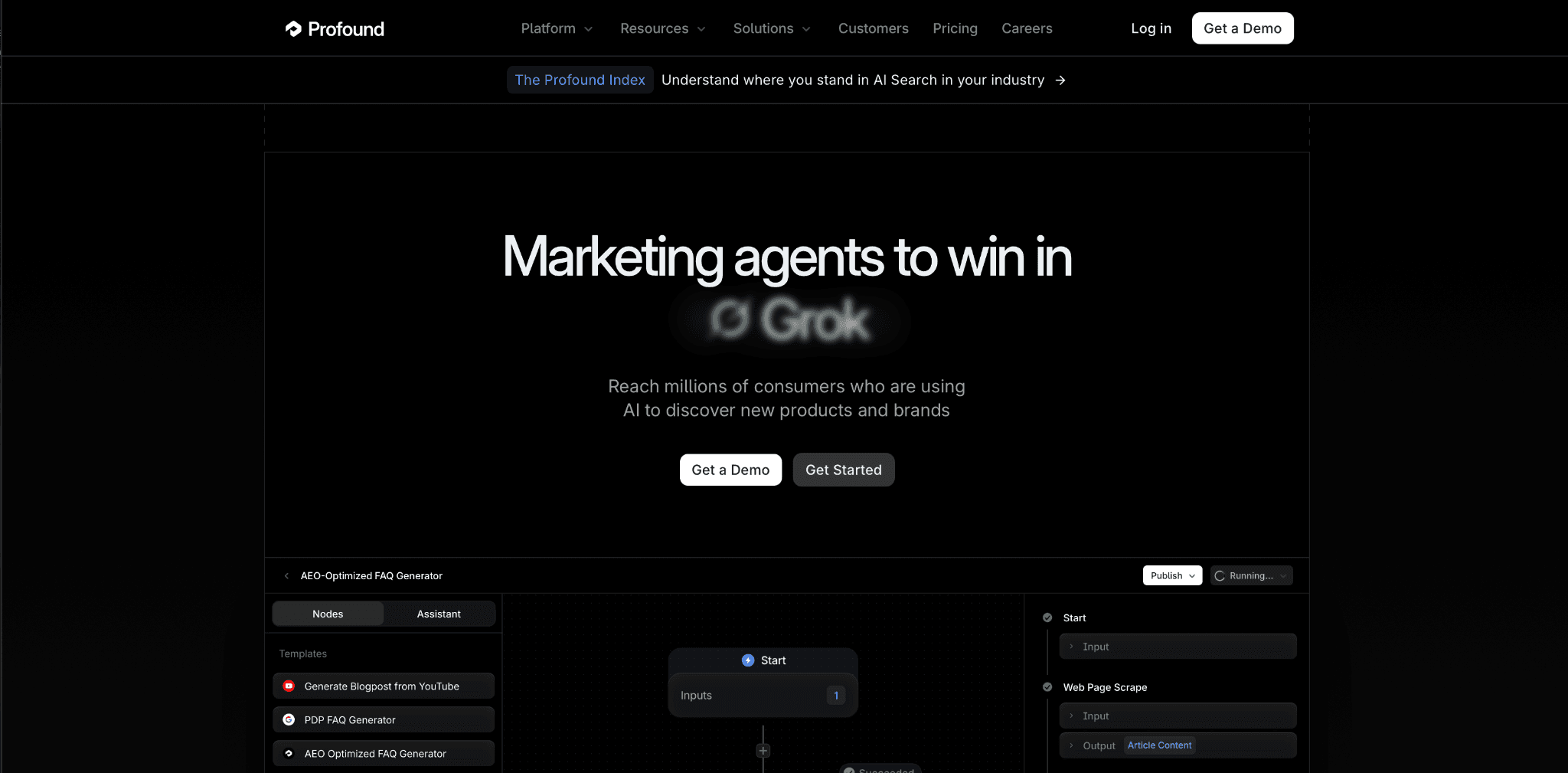
Profound's distinctive asset is Prompt Volumes: a dataset from opted-in consumers showing what questions real people actually send to AI engines, broken down by topic, region, and demographic. Agents, the platform's content workflow feature, produce content and publish directly to WordPress, Sanity, Contentful, Webflow, and Framer. That's closer to AirOps' CMS publishing capability than anything else on this list. The caveat: Agents are Enterprise-only. The $99/mo Starter tracks ChatGPT and 50 prompts. The capabilities Profound is known for start at $399/mo Growth, and Agents require Enterprise.
Key features:
Prompt Volumes dataset from opted-in consumers showing real AI query frequency by topic, region, and demographic.
Answer Engine Insights tracking brand mentions, citations, sentiment, and competitive share of voice.
Agents (Enterprise-only): content workflow builder with pre-built templates and direct CMS publishing to WordPress, Sanity, Contentful, Webflow, and Framer.
WordPress CDN connection to track how AI agents interact with specific site pages.
Enterprise security: SOC 2 Type II, SSO/SAML, dedicated Slack support, unlimited view-only seats.
Pros and cons:
Pros:
Prompt Volumes is the only real AI query volume dataset in the category and changes how teams prioritize content investment
Agents with CMS publishing is the closest feature equivalent to AirOps' content-to-publish workflow on this list
$155M in funding and the customer roster signal a platform delivering at enterprise scale
Cons:
Starter tracks ChatGPT only. Multi-engine tracking starts at $399/mo Growth. Agents require Enterprise. Most of what Profound markets is locked behind tiers most buyers never reach on self-serve.
Support wait times are the most common operational complaint, with multiple G2 reviewers reporting up to a week for responses.
Dashboard complexity surfaces consistently in G2 reviews.

G2 rating: 4.5/5
Pricing: Starter $99/mo | Growth $399/mo | Enterprise custom (Agents, CMS publishing)
Verdict:
Profound is the right call for organizations that have committed AI visibility as a board-level metric, have the analyst capacity to work with the Prompt Volumes dataset, and need Agents for CMS-integrated content production at scale. The overlap with what AirOps does is real but through different mechanisms and at different price points.
For teams coming from AirOps primarily because of the workflow overhead, Profound at the Growth tier is comparably complex. The Starter exists as a taste of the platform; the real program starts at $399/mo.
6. Rankability: Best for agencies that want SEO and AI visibility connected without a separate tool stack
About Rankability
Rankability is built for agencies that sell SEO and want to fold AI visibility into the same operating model rather than spinning up a separate service line with a separate tool stack. Six tools (Track, Research, Create, Audit, Promote, and Serena) all feed into one credit-based workspace with white-label client reporting.

Track monitors visibility across Google, AI platforms, and local search, up to 10 AI engines including ChatGPT, Perplexity, Google AI Overviews, Google AI Mode, Gemini, Claude, Grok, Microsoft Copilot, Brave AI, and DeepSeek. Serena, the platform's AI search agent included on every plan, reads your data and tells you exactly what to do. That action layer addresses the most common reason teams leave AirOps: knowing what the data shows but not knowing what to do about it this week. The credit opacity issue that appears in AirOps reviews applies here too (you can't see what an automation costs before running it) but the underlying workflow is SEO-agency-oriented rather than content-engineering-oriented.
Key features:
Track monitoring visibility across 10 AI platforms: ChatGPT, Perplexity, Google AI Overviews, Google AI Mode, Gemini, Claude, Grok, Microsoft Copilot, Brave AI, and DeepSeek.
Serena AI search agent included on every plan, reading your data and surfacing specific actions.
Research, Create, Audit, and Promote tools connecting keyword research, content briefing, optimization, and backlink analysis.
White-label client reporting across all plans.
Pros and cons:
Pros:
10 AI engines tracked via Track, broader coverage than AirOps Pro's four-engine self-serve layer
Serena addresses the action gap without requiring teams to build workflows, it reads the data and surfaces specific next steps
White-label reporting and unlimited clients on all plans makes the agency economics clear
Cons:
AI visibility is one component of a six-tool suite. Teams that primarily need prompt tracking and citation analysis pay for keyword research, content optimization, and backlink tools they may not use.
The platform's architecture is agency-first. Solo practitioners and single-brand in-house teams pay for multi-client infrastructure that has no use in their workflow.
Credit costs vary in different features, and are not quite transparent.

G2 rating: 5/5
Pricing: Starter $99/mo | Growth $199/mo | Scale $399/mo
Verdict:
Rankability makes the most sense for an agency already selling SEO that wants to add AI visibility without building a separate operating model. The white-label structure, multi-client architecture, and Serena's action guidance are more important here than the comparison to AirOps' content workflow depth.
For teams coming from AirOps that primarily needed AI visibility tracking and the action layer around it (without SEO audit tools, backlink analysis, and keyword research bundled in) a dedicated AI visibility platform addresses the job more directly.
7. Conductor: Best for global enterprises committed to AEO as a measured channel at scale
About Conductor
Named a Leader in the 2025 Forrester Wave for AI-integrated SEO with the highest scores possible, Conductor operates at the same enterprise scale as AirOps but from a different technical foundation.

Where AirOps is a workflow automation platform that includes tracking, Conductor is an AEO platform built on official API data collection. Most AI visibility tools scrape responses. Conductor uses official APIs where available, which produces more stable data and sidesteps the legal uncertainty around scraping at scale. The platform covers visibility tracking across ChatGPT, Gemini, Copilot, Claude, and traditional search, AI content generation, 24/7 real-time site monitoring, and LLM app integrations for teams building agentic workflows. Pricing is custom and usage-based. Meaningful evaluation requires a demo.
Key features:
AI visibility tracking across ChatGPT, Gemini, Copilot, Claude, and traditional search via official APIs.
AI content generation connected to visibility data with brand voice configuration.
24/7 real-time site monitoring tracking AI bot crawl activity.
Persona-based prompt customization for specific audiences and search intents.
LLM app integrations and API access for teams building custom AEO workflows.
Usage-based pricing.
Pros and cons:
Pros:
Official API-first data collection produces more stable data than scraping-based approaches
Forrester Wave Leader in AI-integrated SEO with the category's strongest independent validation
Full AEO lifecycle from tracking through content creation through site monitoring
Cons:
No public pricing, no free trial, demo required before you see a number.
Enterprise complexity and pricing put it out of reach for teams not running global AEO programs at organizational scale.

G2 rating: 4.3/5
Pricing: Custom, usage-based. Contact conductor.com for pricing.
Verdict:
For global enterprise organizations that have committed AEO as a board-level program and need API-based data reliability, Conductor is the most credentialed platform in the category. The comparison with AirOps is meaningful for enterprise content teams evaluating both. Both close the insight-to-content loop at scale, through different architectures and with different strengths.
For teams earlier in the AI visibility journey, the evaluation process requires more resourcing than the platform justifies before the business case is established.
8. MarketMuse: Best for teams wanting to build the topically authoritative content that AI engines cite
About MarketMuse
MarketMuse doesn't track where you appear in AI answers. It tells you whether the content you're publishing has the topical depth to be cited by AI engines in the first place, which is the upstream problem that AirOps' workflow automation is designed to address downstream.

The platform analyzes your entire content inventory against what's performing in your category, surfaces topical gaps where you have no coverage, identifies existing content too thin to compete, and produces detailed briefs mapping what comprehensive coverage looks like. AI engines cite authoritative, topically comprehensive content. MarketMuse helps teams understand whether their content meets that bar. Trusted by IBM, Deloitte, and MongoDB.
Key features:
Topic modeling analyzing your entire content inventory against competitive benchmarks and category-level coverage.
Personalized difficulty scores showing where you have competitive advantages and where you're outgunned.
Content briefs mapping comprehensive topic coverage with keyword, question, and structural guidance for writers.
Content inventory and cluster analysis identifying orphan pages, thin content, and consolidation opportunities.
SERP X-Ray breaking down top-ranking competitor pages by headings, links, word count, and entities.
Free plan with 10 queries/month for initial evaluation.
Pros and cons:
Pros:
Topic modeling across your entire content inventory surfaces systemic coverage gaps that page-level tools, including AirOps' opportunity detection, miss
Trusted by IBM, Deloitte, and MongoDB at serious enterprise content scale
Free plan allows genuine evaluation without any payment commitment
Cons:
Not an AI visibility tracker. It does not show brand mentions, citation rates, or share of voice across AI engines. It doesn't replace any of AirOps' monitoring functionality.
All paid plans require a demo, no public pricing. You can't evaluate cost versus alternatives without a sales conversation.
Subscription is expensive.

G2 rating: 4.6/5
Pricing: Free (10 queries/month) | Optimize, Research, Strategy: demo required for pricing
Verdict:
MarketMuse earns its place for teams who understand that AI engine citations follow topical authority and want a systematic way to identify and close content gaps at the inventory level. It doesn't replace AirOps' monitoring or workflow automation, it addresses the content quality question that determines whether any of that automation produces output AI engines actually cite.
Pairing MarketMuse with AIclicks covers both the visibility tracking and the content intelligence jobs that AirOps was trying to serve from one platform.
How to Choose the Right AirOps Alternative
What was AirOps actually doing for your team?
AirOps connects three distinct jobs: AI visibility tracking, content workflow automation, and CMS publishing. Most teams relied heavily on one or two of those. If tracking and recommendations were the primary need, AIclicks, AthenaHQ, or Peec AI do those jobs without the workflow engineering overhead. If the monitoring-to-content loop was the draw but the complexity was too high, Writesonic or Profound deliver the same logic at lower setup cost. If you genuinely needed the full workflow automation depth, be honest: no alternative on this list replicates AirOps' workflow builder flexibility at the same level.
Does the platform ask you to build something before you see value?
This is the sharpest dividing line between AirOps and most alternatives on this list. AirOps delivers value proportional to the workflows you build, which means the first weeks are setup and experimentation rather than outputs. AIclicks, AthenaHQ, Peec AI, and Writesonic all show you real data within minutes of signup. If time-to-value matters more than workflow depth, that distinction drives the decision.
What does the task or credit system actually cost at your usage level?
AirOps' task-based pricing makes monthly costs variable by design, $0.025 per task after the Solo plan allocation runs out. Rankability's credit system has a similar opacity: you can reference what automations cost in documentation but can't preview it at the moment of decision. AIclicks and Writesonic run on predefined plan tiers, which makes monthly costs predictable. Write down your expected usage volume and price it against your shortlist before you commit.
Go With the #1 AirOps Alternative: AIclicks
AirOps is a genuinely powerful platform. The workflow automation depth, the CMS publishing integrations, the Brand Kit system, the Grids for bulk processing, these are real capabilities that real enterprise content teams use and value. Nothing on this list fully replicates that combination.
What AIclicks does is handle the AI visibility and action layer as the whole product, without asking your team to become workflow engineers before they see their first prompt result.
For teams that left AirOps because the learning curve was too steep, the task budgets burned too fast, or the platform was more infrastructure than the job required, AIclicks gives you the visibility data and the action plan in the same session, starting at $59/mo, with a three-day trial on real data before you commit a dollar.
Frequently Asked Questions
1. What is AirOps and why do people look for alternatives?
AirOps is a content operating system that connects AI visibility tracking, content workflow automation, and CMS publishing in one platform. Teams look for alternatives primarily because of the learning curve required to build and maintain effective workflows, task budgets that deplete faster than expected during setup and experimentation, and a platform scope that's more than teams need when they primarily want AI visibility tracking rather than full content workflow automation.
2. What is the cheapest AirOps alternative?
AIclicks starts at $59/mo with 10+ engine AI visibility tracking and a built-in recommendations engine. Peec AI starts at $95/mo. Writesonic starts at $99/mo with combined tracking and content generation. AirOps has a free Insights plan (1,000 tasks, 1 user) and Solo and Pro free trials, though paid plan pricing is not publicly listed.
3. Which alternative is best for AI search visibility tracking specifically?
AIclicks covers 10+ engines through real user interfaces with a Recommendations engine converting visibility data into prioritized tasks, starting at $59/mo. You can check where your brand currently stands with the free GEO visibility checker. AthenaHQ is the strongest option for teams that also need revenue attribution, and Peec AI for EU-focused teams prioritizing data residency.
4. Which alternative best replicates AirOps' content workflow automation?
Profound's Agents feature (Enterprise-only) is the closest structural equivalent, publishing content directly to WordPress, Sanity, Contentful, Webflow, and Framer from an AEO workflow. Writesonic does monitoring-to-content in one platform without the workflow engineering overhead, though at lower automation depth. No self-serve alternative on this list replicates AirOps' Grids and multi-step workflow builder flexibility at the same level.
5. Which alternative is best for enterprise teams?
Conductor is the most credentialed enterprise alternative, named a Forrester Wave Leader in AI-integrated SEO with official API-based data collection. Profound handles enterprise AI visibility with the Prompt Volumes dataset and Agents. Both require sales conversations before pricing is available.
6. Is GEO worth investing in for content teams in 2026?
GEO has moved past the experimental phase. AI search now influences a meaningful share of how buyers discover and evaluate vendors across enough categories that the question is no longer "whether to invest" but "which platform matches the team's actual workflow." Check your current AI search standing with the free GEO visibility checker before committing to any paid platform.



Any questions left?
Book a call here: