
" width="14px"><path d="M 13.864 5.629 L 13.3 5.629 L 13.3 5.6 L 7 5.6 L 7 8.4 L 10.956 8.4 C 10.379 10.03 8.828 11.2 7 11.2 C 4.681 11.2 2.8 9.319 2.8 7 C 2.8 4.681 4.681 2.8 7 2.8 C 8.071 2.8 9.045 3.204 9.786 3.864 L 11.766 1.884 C 10.516 0.719 8.844 0 7 0 C 3.134 0 0 3.134 0 7 C 0 10.866 3.134 14 7 14 C 10.866 14 14 10.866 14 7 C 14 6.531 13.952 6.073 13.864 5.629 Z" fill="rgb(255, 193, 7)" height="14px" id="H_YjfTNpn" width="14px"/><path d="M 0 3.742 L 2.3 5.429 C 2.922 3.888 4.429 2.8 6.193 2.8 C 7.264 2.8 8.238 3.204 8.979 3.864 L 10.959 1.884 C 9.709 0.719 8.037 0 6.193 0 C 3.504 0 1.172 1.518 0 3.742 Z" fill="rgb(255, 61, 0)" height="5.428500000000002px" id="PlkthQDhg" transform="translate(0.875 0)" width="10.959199999999996px"/><path d="M 6.232 5.581 C 8.04 5.581 9.683 4.889 10.925 3.764 L 8.758 1.931 C 8.032 2.483 7.144 2.782 6.232 2.781 C 4.411 2.781 2.865 1.62 2.283 0 L 0 1.759 C 1.159 4.026 3.511 5.581 6.232 5.581 Z" fill="rgb(76, 175, 80)" height="5.581099999999999px" id="WlnJ5gngE" transform="translate(0.7 8.4)" width="10.924899999999994px"/><path d="M 6.864 0.029 L 6.3 0.029 L 6.3 0 L 0 0 L 0 2.8 L 3.956 2.8 C 3.68 3.576 3.183 4.254 2.526 4.75 L 2.527 4.749 L 4.693 6.582 C 4.54 6.722 7 4.9 7 1.4 C 7 0.931 6.952 0.473 6.864 0.029 Z" fill="rgb(25, 118, 210)" height="6.589883930775992px" id="x_rSW275p" transform="translate(7 5.6)" width="7px"/></g></svg>)



Reviewed by:
Matas Kibildis

Head of Growth @aiclicks.io
Last updated:
Expert Verified

Key Takeaways
News content has an extremely short shelf life for ranking purposes, but AI engines are increasingly citing, or failing to cite, breaking coverage in real time, adding a second, faster-moving visibility surface alongside Google News and Discover.
Five of the nine tools here are AI-visibility specialists (AIclicks, Rank Prompt, Rankscale.ai, SE Visible, Waikay.io) tracking whether AI engines cite a newsroom's coverage at all.
Two tools (NewzDash, Parse.ly) blend Google News/Discover-specific tracking or publisher analytics with some AI-referral awareness.
Sitebulb handles the technical crawling a high-volume publishing operation needs. Chartbeat is a newsroom analytics platform with light Google-traffic visibility, not a true SEO tool, worth knowing before it gets budgeted as one.
Pricing on the AI-visibility side varies enormously, from Sitebulb's $18/mo entry tier to Rankscale.ai's €780/mo Enterprise tier for full multi-engine depth.
What Makes an SEO Tool Worth Using for News Sites
It should work at newsroom publishing speed. A report that takes hours to refresh is of limited use against content whose relevance window can be measured in hours.
It should track Google's news-specific surfaces directly, not just organic rankings. Top Stories, Discover, and AI Overviews for breaking topics behave differently from a standard blue-link SERP.
It should show whether AI engines are citing, or ignoring, breaking coverage. A growing share of readers now ask an AI assistant what happened with a story instead of searching Google News directly.
Quick Comparison: Best SEO Tools for News Sites at a Glance
Tool | Category | Starting Price | Standout Feature |
AIclicks | AI-only | $59/mo | Real-UI querying across 10+ LLMs, with Sources and Competitor Discovery showing exactly where coverage is cited or missing |
Rank Prompt | AI-only | $49/mo | Geo Grid heatmaps and citation outreach across 50+ countries and 500+ cities |
Rankscale.ai | AI-only | €99/mo | 17+ AI platforms tracked under one subscription, no per-engine upsell |
SE Visible | AI-only | $99/mo | Prompt filtering by sentiment, showing how AI engines characterize coverage, not just whether it's cited |
Waikay.io | AI-only | $69.95/mo | Genuinely free tier tracking 6 AI engines |
NewzDash | AI & traditional mix | Custom (demo required) | DiscoverPulse tracking Google Discover visibility across 40 countries, updated every minute |
Parse.ly | AI & traditional mix | Custom (demo required) | Dedicated "AI" referrer category splitting ChatGPT/Perplexity/Gemini traffic from search and aggregator traffic |
Sitebulb | SEO-only | $18/mo | Evergreen Chromium rendering engine matching Googlebot, no crawl credit limits |
Chartbeat | Newsroom analytics, not SEO-specific | Custom (demo required) | Modeled Google Discover traffic estimation layered on real-time newsroom analytics |
1. AIclicks: Best for End-to-End AI Visibility Tracking and Action

AIclicks tracks brand visibility across 10+ AI engines, including ChatGPT, Perplexity, Gemini, Google AI Overviews, and Copilot, using real-UI querying rather than API calls. For a newsroom, that means seeing exactly which breaking-news prompts or comparison queries a masthead is missing from, which competing outlets are cited instead, and which LLMs are actually sending readers, then acting on those findings directly through its Actions suite.
Key features:
Prompt Analytics showing exactly which prompts a masthead appears in, and which it doesn't

Sources showing the specific pages and domains AI engines cite, and where coverage is missing from those sources
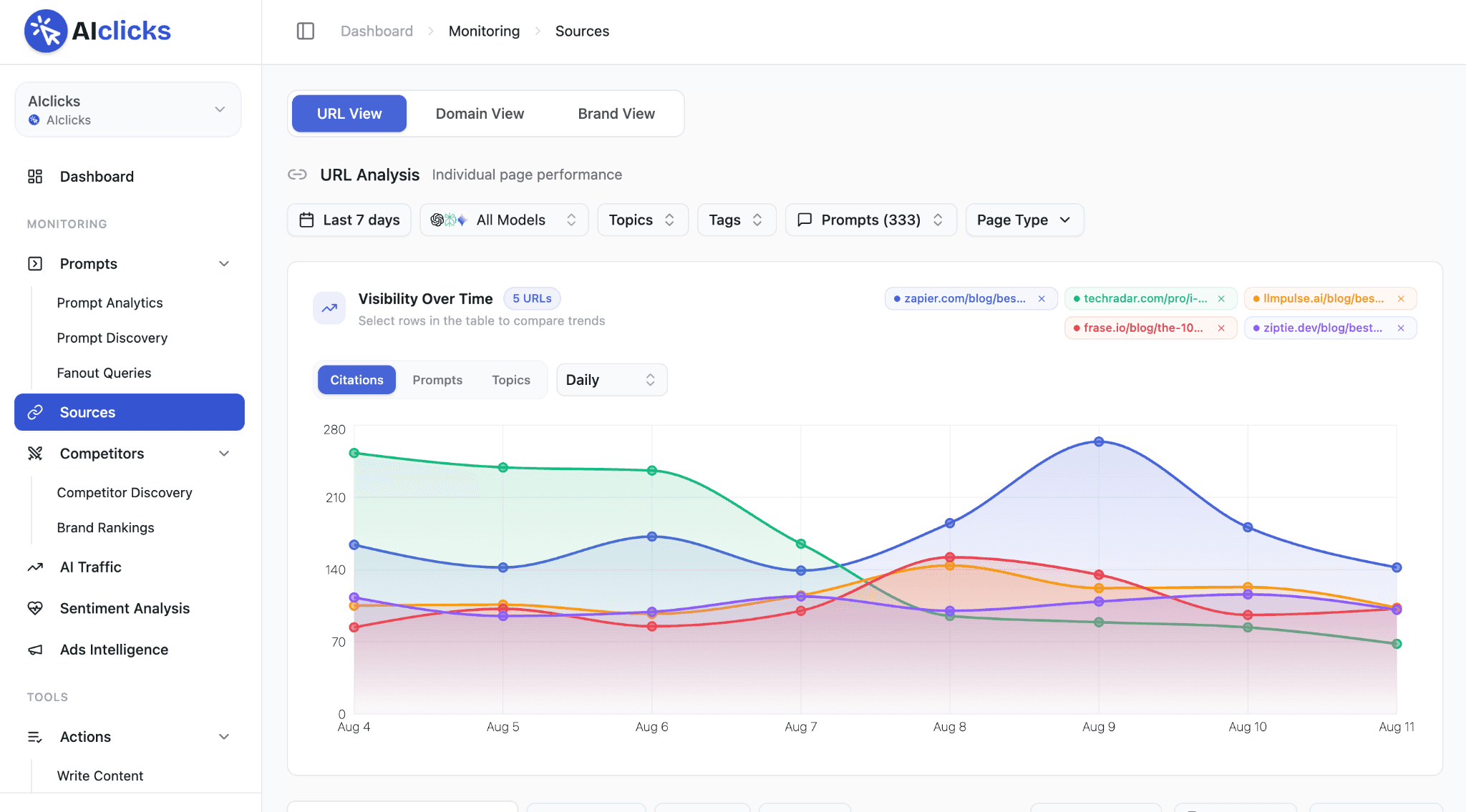
Competitor Discovery tracking how named rival outlets perform across the same LLMs

AI Traffic showing which LLMs are actually referring readers to the site, with GA4-connected analytics

Actions suite: Writer 2.0 writes AI-optimized content with one-click publishing, Get Mentioned surfaces where to pursue mentions, and Engage Online surfaces relevant social posts to engage with

Pros:
Tracking, competitor benchmarking, and traffic attribution live in one account, with a built-in path to act on what's found rather than a raw data dump
Get Mentioned and Engage Online extend the action layer beyond content into outreach and social engagement
3-day free trial runs on real prompt data from a newsroom's own coverage area
Cons:
Starter plan tracks 3 of the 10+ LLMs AIclicks monitors overall; full engine coverage requires Pro or Business
Built around AI visibility tracking and action rather than deep technical crawling, so a publisher-scale site audit still needs a dedicated crawler like Sitebulb alongside it
G2 rating: 4.9/5
Pricing: Starter $59/mo (30 prompts, 1 website, 3 LLMs, 5 AI-generated articles/mo) | Pro $189/mo | Business $499/mo | 3-day free trial on all plans
Verdict: For a newsroom that needs to know not just whether readers find it through Google but whether AI assistants cite it for breaking coverage, AIclicks combines prompt-level tracking, competitor and traffic data, and a built-in action layer in one platform.
If you need an example of how to rank in an AI platform, here’s an example:
2. Rank Prompt: Best for Multi-Market Geo Tracking and Citation Outreach

Rank Prompt tracks six AI engines, ChatGPT, Perplexity, Google AI Overviews (AI Mode), Claude, Gemini, and Grok, with Geo Grid heatmaps showing visibility by country, city, or neighborhood across 50+ countries and 500+ cities. For a wire-style or regional news operation covering many markets at once, that geographic depth is the main draw. Citation tracking is paired with built-in outreach for landing new citations and backlinks.
Key features:
Geo Grid heatmaps tracking visibility by country, city, or neighborhood across 50+ countries and 500+ cities
Citation tracking showing which domains AI engines cite, with built-in outreach tools for citation and backlink building
AI Content Studio generating articles directly from visibility data
Agent Mode for natural-language visibility queries, plus GA4-integrated AI traffic analytics
Pros:
Geo-level tracking depth is the most granular on this list, useful for a regional or multi-market news outlet
Citation outreach is built into the platform rather than requiring a separate PR or link-building tool
7-day free trial on all plans
Cons:
Credits don't roll over month to month, so unused capacity is lost
Six-engine coverage is solid but narrower than Rankscale.ai's 17+ platform reach
G2 rating: 5/5
Pricing: Starter $49/mo | Pro $89/mo | Agency $149/mo | Agency Plus $299/mo
Verdict: For a news operation covering many regions or cities and wanting citation outreach handled inside the same tool, Rank Prompt's geographic depth is hard to match here.
3. Rankscale.ai: Best for Broad AI Engine Coverage Without Per-Engine Upsells

Rankscale.ai tracks 17+ AI platforms and models, including GPT-4o, GPT-5, several Gemini versions, Claude, DeepSeek, Perplexity's Sonar models, and Mistral, all under one subscription with no extra charge to unlock additional engines. Query Fan Out automatically discovers new prompt variations, and Citation Rate plus Sources Box Analysis connect specific source URLs to visibility gaps.
Key features:
17+ AI platforms and models tracked under one subscription, with no per-engine add-on
Query Fan Out automatically discovering new prompt variations across tracked engines
Citation Rate and Sources Box Analysis connecting source URLs to visibility gaps
Refresh schedules ranging from hourly to monthly depending on plan tier
Pros:
Broadest engine coverage on this list, with no extra charge to unlock additional platforms
Query Fan Out surfaces prompt variations a newsroom might not think to track manually
Cons:
The Essentials tier's 120 credits and 2 dashboards are tight for a newsroom tracking several beats or verticals at once
Hourly refresh, the cadence that matters most for breaking news, is not confirmed at every tier; check the exact refresh allocation for your plan before committing
G2 rating: Limited G2 ratings.
Pricing: Pro €99/mo (1,200 credits, 10 dashboards) | Growth €385/mo (5,500 credits, 50 dashboards, white-label + API) | Enterprise €780/mo (12,000 credits, 100 dashboards)
Verdict: For the broadest AI engine coverage among the dedicated trackers here, Rankscale.ai is hard to beat, provided the refresh cadence at your tier is fast enough for breaking news.
4. SE Visible: Best for Sentiment-Level Tracking of How AI Engines Characterize Coverage

SE Visible, a standalone product built on SE Ranking's infrastructure, tracks five AI engines: ChatGPT, Gemini, Google AI Mode, Perplexity, and Google AI Overviews. It lets a newsroom filter tracked prompts by sentiment, useful for seeing not just whether AI engines mention a story but how they describe it. Its country coverage is currently capped at seven markets (US, UK, Canada, France, Germany, Netherlands, Spain), narrower than some marketing material about SE Ranking's broader platform might suggest.
Key features:
Tracking across 5 AI engines: ChatGPT, Gemini, Google AI Mode, Perplexity, and Google AI Overviews
Sources → Domains view for citation tracking, kept as a separate metric from the core Visibility score
Prompt filtering by date, topic, engine, competitor, and sentiment
Runs as a standalone product, not bundled into a full SE Ranking subscription
Pros:
Sentiment filtering is a genuinely useful lens for a newsroom tracking how AI engines characterize its coverage, not just whether it's cited
Standalone product, so a newsroom doesn't need a full SE Ranking subscription to use it
Mid-tier pricing sits between Waikay.io and Rankscale.ai's low end and Rank Prompt's higher end
Cons:
Country coverage is capped at 7 markets on SE Visible's own product page, not the unlimited coverage sometimes implied about the broader SE Ranking platform
No white-label reporting or client/campaign tagging currently appears on the official site; confirm directly if an agency workflow depends on either
G2 rating: Not listed on G2 as SE Visible.
Pricing: Basic $99/mo (200 prompts, 3 projects) | Core $189/mo (450 prompts, 5 projects) | Plus $355/mo (1,000 prompts, 10 projects)
Verdict: SE Visible is a reasonable mid-tier option for tracking AI citation and sentiment across a handful of markets, though its actual country coverage and lack of client-tagging features are worth checking against what any brief assumes about it.
5. Waikay.io: Best Genuinely Free Entry Point for AI Visibility Tracking
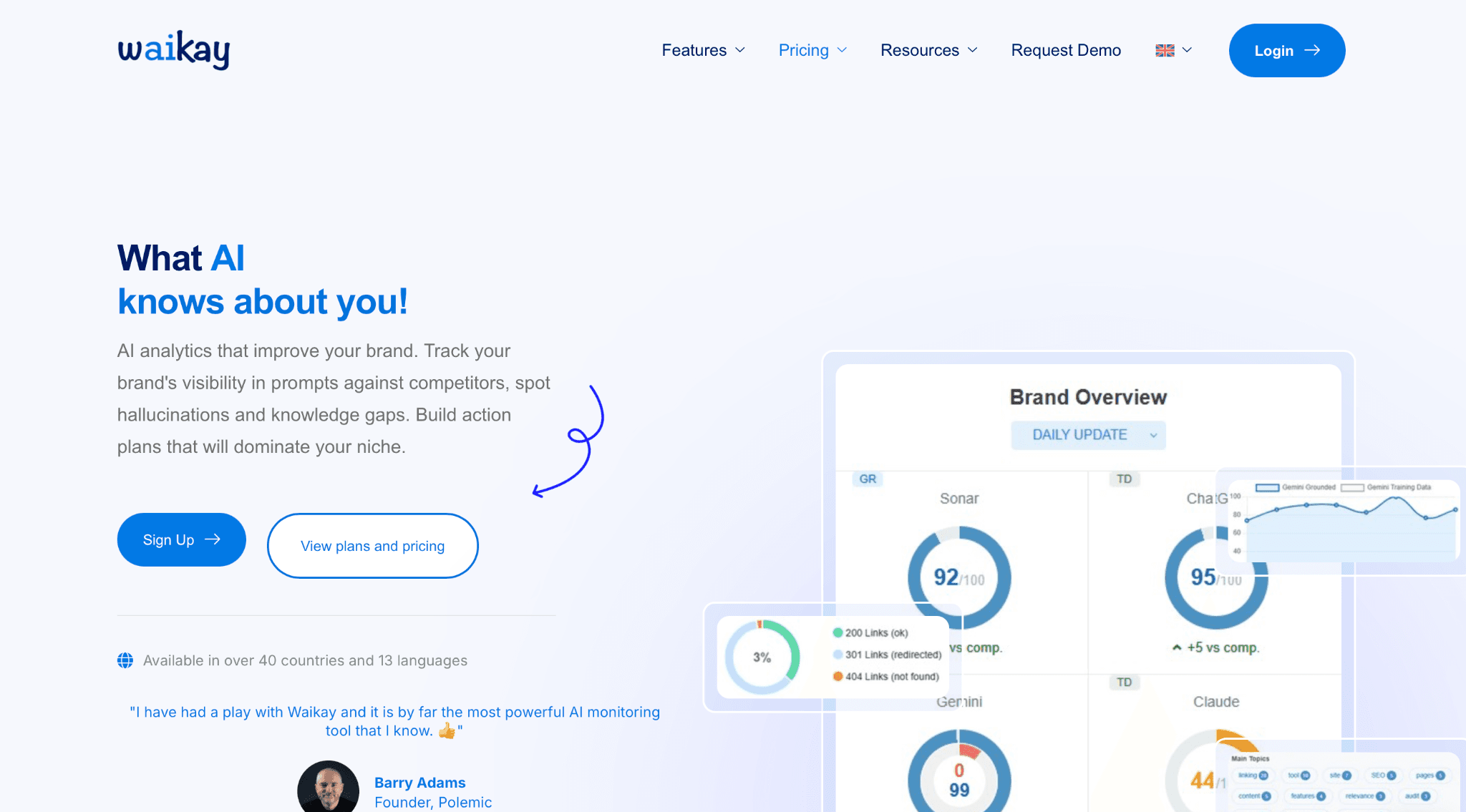
Waikay.io is tracking six AI engines: ChatGPT, Gemini, Claude, Perplexity (Sonar), Google AI Mode, and Microsoft Copilot. Paid tiers scale from a low entry price up to a custom Enterprise plan, giving a smaller newsroom room to grow before a sales conversation becomes necessary.
Key features:
Free tier with 1 Brand Overview report, 1 Topic Report and Action Plan, and up to 20 prompt tracking calls, no credit card required
Tracking across 6 AI engines: ChatGPT, Gemini, Claude, Perplexity (Sonar), Google AI Mode, and Microsoft Copilot
Credit-based paid tiers scaling from 8 to 220 credits monthly
Multi-seat access starting at the Expert tier
Pros:
The only genuinely free, no-card tier among the AI-visibility tools on this list
Six-engine coverage at the free tier is broader than most competitors offer even on a paid entry plan
Scales up to a $449.95/mo tier before requiring a custom Enterprise quote, giving room to grow before a sales call
Cons:
The free tier's 3 credits and 20 prompt calls are enough to evaluate the tool, not to run ongoing tracking
Plan names and figures differ slightly between the homepage and FAQ page; worth a final spot-check before quoting a client
G2 rating: 4.8/5
Pricing: Small teams $69.95/mo | Large teams $199.95/mo | Bigger projects $449.95/mo
Verdict: For a smaller or local newsroom that wants to test AI visibility tracking without committing budget upfront, Waikay.io's free tier is the most genuinely free entry point among the AI-only tools here.
6. NewzDash: Best for Google News, Discover, and Top Stories Tracking

NewzDash is a real-time dashboard built specifically for news publishers, tracking visibility in Google News, Google Discover, and Google Top Stories, used by outlets including the BBC, Forbes, NBC News, CNN, and USA Today. Its DiscoverPulse add-on tracks Discover visibility score and average position across 40 countries, analyzing more than 100,000 articles a day with updates every minute. Content Autopilot automatically detects new articles and checks their indexing status.
Key features:
Rank checks every 15 to 30 minutes across Top Stories, organic results, and video carousels
DiscoverPulse tracking Google Discover visibility score and average position across 40 countries
Content Autopilot auto-detecting new articles and checking indexing status
Competitor tracking with headline-change monitoring and Share of Voice by vertical
Visibility tracking within Google AI Overviews specifically for Top Stories placements
Pros:
Purpose-built for the exact surfaces, Top Stories and Discover, that matter most to a news publisher's traffic, more specific than a general rank tracker
DiscoverPulse's minute-level update cadence matches how fast Discover traffic can shift
Used by major outlets (BBC, Forbes, NBC News, CNN, USA Today), suggesting it holds up at newsroom scale
Cons:
No public pricing; every tier is gated behind a demo or sales conversation
AI tracking is limited to Google's own AI Overviews layer for Top Stories; it doesn't track ChatGPT, Perplexity, or other third-party AI engines the way the AI-only tools on this list do
G2 rating: Not listed on G2.
Pricing: Lite, Niche, and Enterprise tiers, custom pricing, demo required
Verdict: For a newsroom whose core traffic depends on Google News, Discover, and Top Stories specifically, NewzDash is the most purpose-built tool here, though it won't tell you anything about ChatGPT or Perplexity citations.
7. Parse.ly: Best for Separating AI Referral Traffic From Search and Aggregator Traffic

Parse.ly is a real-time and historical content analytics platform used by newsrooms including USA Today, The Wall Street Journal, NBC, Bloomberg, and Condé Nast. Its referrer breakdown splits traffic into seven categories, Social, Search, Aggregator (which includes Google News and Discover), AI, Other, Internal, and Direct, giving a newsroom a direct view of how much traffic AI engines like ChatGPT, Perplexity, and Gemini are actually sending.
Key features:
Dedicated "AI" referrer category splitting ChatGPT, Perplexity, and Gemini traffic from Search and Aggregator (Google News/Discover) categories
Real-time Pulse View dashboard with sub-second updates by content, author, section, and channel
Headline testing with AI-generated suggestions and automatic winner rollout
Parse.ly Sage, a plain-language AI analytics assistant
Pros:
Splitting AI referral traffic into its own category is a genuinely distinct way to see AI-driven readership separately from search and aggregator traffic
Real-time granularity down to sub-second updates suits a fast-moving newsroom better than a daily or weekly refresh
Used at major-masthead scale (USA Today, WSJ, NBC, Bloomberg), so it's proven at high traffic volumes
Cons:
No public pricing; three tiers exist (Content Performance, Content Value, Content Advocacy) but all require a demo
It measures AI referral traffic after the fact rather than tracking whether AI engines are citing specific stories, the way a dedicated AI-visibility tool does
G2 rating: 4.4/5
Pricing: Content Performance, Content Value, and Content Advocacy tiers, custom pricing, demo required
Verdict: For a newsroom that wants AI-driven traffic broken out clearly from search and aggregator traffic inside its existing analytics stack, Parse.ly's dedicated AI referrer category does that, though it's a traffic measurement tool, not a citation-tracking one.
8. Sitebulb: Best Technical Crawler for Publishing at Scale
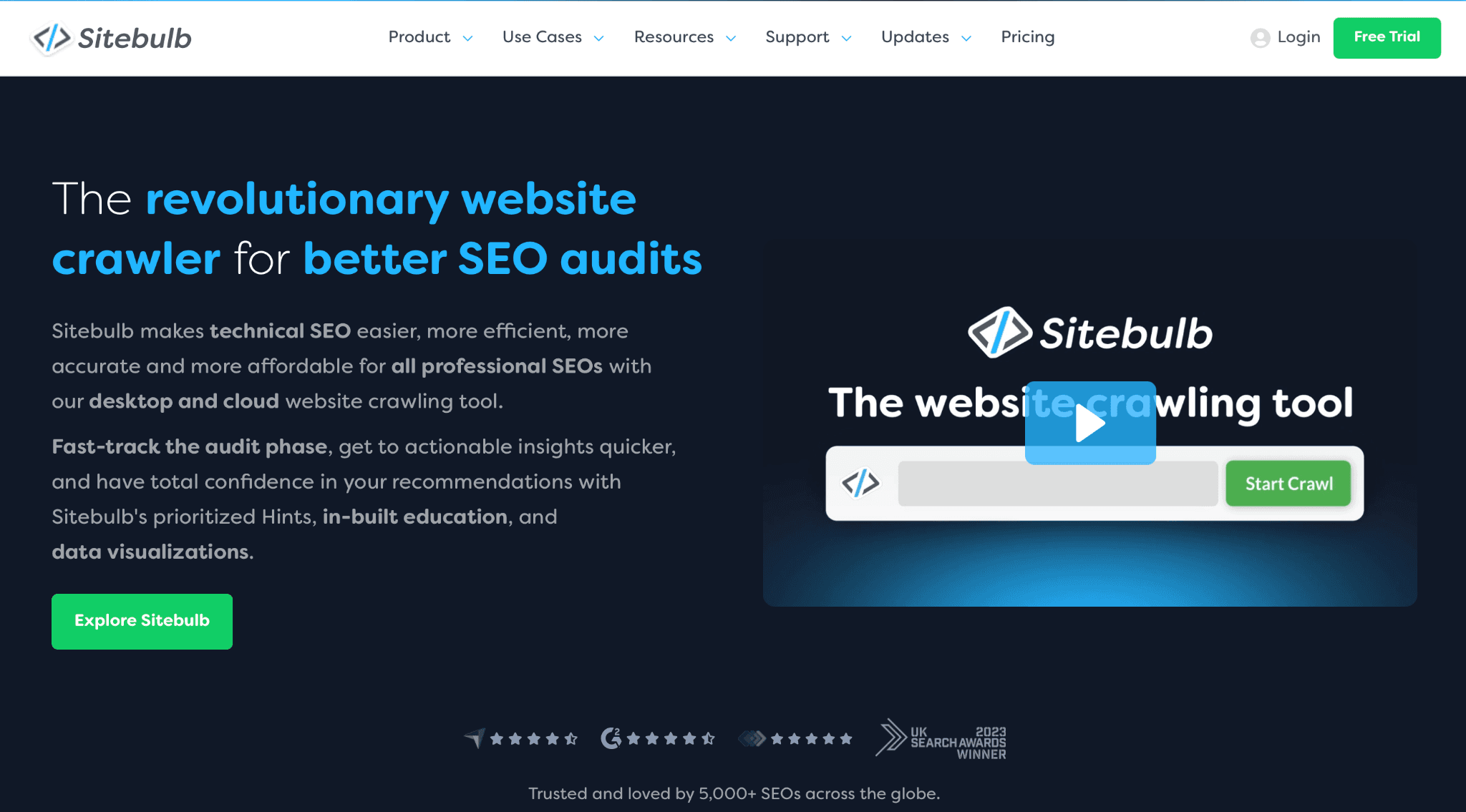
Sitebulb is a technical SEO crawler available as desktop software or a cloud platform, positioned as a mid-point between lighter desktop tools and expensive enterprise crawlers. Its Evergreen Chromium rendering engine is built to match Googlebot's own rendering, included at no extra cost, and there are no crawl credit or project limits on any tier, relevant for a publisher crawling a large, constantly growing archive.
Key features:
JavaScript rendering via an Evergreen Chromium engine built to match Googlebot's rendering, included at no extra cost
Scheduled, automated recurring audits on Pro and Cloud tiers
Dedicated structured data and schema validator, useful for verifying NewsArticle markup at scale
Hints system flagging 100+ (Lite) to 300+ (Pro/Cloud) prioritized issues with plain-language explanations
Pros:
No crawl credit or project limits on any tier, relevant for a publisher crawling a large, constantly growing archive
Positioned specifically as a mid-point between desktop tools and expensive enterprise crawlers, without the enterprise price tag
14-day free trial with no credit card required
Cons:
Exact base pricing for the Lite and Pro desktop tiers isn't published as a static figure, it runs through an on-page calculator, so getting a firm number means visiting the pricing page directly
No AI-answer-engine visibility tracking of any kind; it's a pure technical crawler
G2 rating: 4.5/5
Pricing: Lite $18/mo | Pro $42/mo | Sitebulb Cloud from $125/mo
Verdict: For the technical crawling and schema validation a high-volume publishing operation needs, Sitebulb fills a real gap none of the AI-visibility tools on this list cover.
9. Chartbeat: Newsroom Analytics Worth Knowing, Not an SEO Tool

Chartbeat is a real-time and historical content analytics platform used by more than 60,000 media brands, including Forbes, The New York Times, Rolling Stone, and Al Jazeera. It's worth being direct about this: Chartbeat is not an SEO tool. It has no keyword research, no ranking recommendations, and no technical site auditing. It earns a place on this list because it pulls Google Search Console data (impressions, clicks, CTR, average position, top queries) directly into the same real-time dashboard newsrooms already use, and because it estimates Google Discover traffic through proprietary modeling, since Google doesn't expose real Discover data directly.
Key features:
Real-time "Heads Up Display" tracking concurrent pageviews, unique visitors, and recirculation
Google Search Console integration importing impressions, clicks, CTR, average position, and top queries directly into Chartbeat's dashboards
Google Discover traffic estimation using proprietary modeling
Headline and image testing, plus engaged-time and scroll-depth measurement at the author, section, and topic level
Pros:
Bringing GSC data directly into the same dashboard newsrooms already use for real-time traffic removes a tool-switching step
Discover traffic estimation, even if modeled rather than exact, gives an early read on a surface Google doesn't report on directly
Used at serious scale (Forbes, The New York Times, Rolling Stone, Al Jazeera), so it holds up under newsroom-level traffic
Cons:
This is genuinely not an SEO tool, no keyword research, ranking recommendations, or technical crawling of any kind. It earns a spot here because newsrooms commonly run it alongside SEO tooling, not because it does SEO work itself
No public pricing; every plan requires a demo or sales conversation
G2 rating: 4.4/5
Pricing: Custom, demo required
Verdict: Chartbeat is worth knowing about because most newsrooms already run it for real-time traffic and headline testing, and its GSC and Discover integrations mean SEO data ends up in the same dashboard, but it doesn't replace an actual SEO tool and shouldn't be budgeted as one.
How to Choose the Right SEO Tool for News Sites
Start with what's actually driving traffic loss or gain. If the concern is whether AI engines cite breaking coverage at all, AIclicks, Rank Prompt, Rankscale.ai, SE Visible, or Waikay.io address that directly. If it's Google News, Discover, or Top Stories placement specifically, NewzDash is the most purpose-built.
Don't mistake newsroom analytics for SEO tooling. Chartbeat and, to a lesser extent, Parse.ly measure traffic and engagement well, but neither does keyword research, ranking optimization, or technical auditing, that's what Sitebulb and the AI-visibility tools are for.
Check engine coverage and refresh speed together, not separately. A tool tracking 17 AI engines at a monthly refresh won't catch a breaking-news citation shift the way a narrower tool refreshing hourly will.
Frequently Asked Questions
1. What is the best SEO tool for news sites in 2026?
It depends on the surface. For AI engine citation tracking broadly, AIclicks, Rank Prompt, or Rankscale.ai. For Google News, Discover, and Top Stories specifically, NewzDash. For technical crawling at publishing scale, Sitebulb.
2. Is Chartbeat an SEO tool?
Not really. Chartbeat is a real-time and historical newsroom analytics platform. It layers in Google Search Console data and modeled Google Discover estimates, but it doesn't do keyword research, ranking recommendations, or technical auditing, the things that actually define an SEO tool.
3. Can any of these tools track whether ChatGPT or Perplexity cite my news coverage?
AIclicks, Rank Prompt, Rankscale.ai, SE Visible, and Waikay.io all track citation and mention activity across multiple AI engines, including ChatGPT and Perplexity. NewzDash and Chartbeat's AI-related tracking is limited to Google's own AI Overviews, not third-party engines.
4. What's the cheapest way to start tracking AI visibility for a small newsroom?
Waikay.io's free tier requires no credit card and tracks 6 AI engines, though its 3 credits and 20 prompt calls only cover an initial evaluation.
5. Do I still need a traditional technical SEO crawler if I use an AI-visibility tool?
Yes. None of the AI-visibility tools on this list crawl a site for broken links, duplicate content, or schema errors the way Sitebulb does. A high-volume publisher generally needs both a technical crawler and an AI-visibility tool, they solve different problems.



Any questions left?
Book a call here: