
" width="14px"><path d="M 13.864 5.629 L 13.3 5.629 L 13.3 5.6 L 7 5.6 L 7 8.4 L 10.956 8.4 C 10.379 10.03 8.828 11.2 7 11.2 C 4.681 11.2 2.8 9.319 2.8 7 C 2.8 4.681 4.681 2.8 7 2.8 C 8.071 2.8 9.045 3.204 9.786 3.864 L 11.766 1.884 C 10.516 0.719 8.844 0 7 0 C 3.134 0 0 3.134 0 7 C 0 10.866 3.134 14 7 14 C 10.866 14 14 10.866 14 7 C 14 6.531 13.952 6.073 13.864 5.629 Z" fill="rgb(255, 193, 7)" height="14px" id="H_YjfTNpn" width="14px"/><path d="M 0 3.742 L 2.3 5.429 C 2.922 3.888 4.429 2.8 6.193 2.8 C 7.264 2.8 8.238 3.204 8.979 3.864 L 10.959 1.884 C 9.709 0.719 8.037 0 6.193 0 C 3.504 0 1.172 1.518 0 3.742 Z" fill="rgb(255, 61, 0)" height="5.428500000000002px" id="PlkthQDhg" transform="translate(0.875 0)" width="10.959199999999996px"/><path d="M 6.232 5.581 C 8.04 5.581 9.683 4.889 10.925 3.764 L 8.758 1.931 C 8.032 2.483 7.144 2.782 6.232 2.781 C 4.411 2.781 2.865 1.62 2.283 0 L 0 1.759 C 1.159 4.026 3.511 5.581 6.232 5.581 Z" fill="rgb(76, 175, 80)" height="5.581099999999999px" id="WlnJ5gngE" transform="translate(0.7 8.4)" width="10.924899999999994px"/><path d="M 6.864 0.029 L 6.3 0.029 L 6.3 0 L 0 0 L 0 2.8 L 3.956 2.8 C 3.68 3.576 3.183 4.254 2.526 4.75 L 2.527 4.749 L 4.693 6.582 C 4.54 6.722 7 4.9 7 1.4 C 7 0.931 6.952 0.473 6.864 0.029 Z" fill="rgb(25, 118, 210)" height="6.589883930775992px" id="x_rSW275p" transform="translate(7 5.6)" width="7px"/></g></svg>)


Reviewed by:
Matas Kibildis

Head of Growth @aiclicks.io
Last updated:
Expert Verified

TL;DR
If you're a solo marketer or small team writing your own content: start with Frase ($49/month) or Surfer SEO's Discovery plan ($59/month) to keep research, briefs, and AI-visibility checks in one tool without a big commitment.
If you're an in-house SEO or content team measuring whether your published articles actually get cited by ChatGPT, Gemini, AI Overviews, and others: AIclicks ($59 to $499/month) is the only tool on this list that writes the article and tracks whether it gets cited afterward, in the same platform.
If you're an agency or GTM team producing content at volume across many brand voices: Jasper (from $69/month) and Copy.ai (from $29/month, credit-based above that) are built for team-scale output, with Jasper leaning toward brand-consistent long-form and Copy.ai leaning toward workflow automation.
If you're an enterprise content team that needs topic-level authority mapping across hundreds of pages: MarketMuse is the specialist, though you will need to book a call to get a price.
Why This List Looks Different From the Usual Roundup
Most "AI content marketing tools" lists mix together writing assistants, social schedulers, ad platforms, and email tools under one banner, which makes for a long page and a short useful answer. Here, we don’t do that. Every tool here does two specific jobs: it helps produce content, and it gives you some way to tell whether that content is showing up where people now actually look for answers, inside ChatGPT, Perplexity, Google's AI Overviews, and Google AI Mode, not just in classic blue-link rankings.
That distinction matters more in September 2026 than it did two years ago. AI Overviews now appear on a large share of Google searches, and a growing number of buyers ask a chatbot before they ever open a search engine. A content tool that only checks a Flesch reading score or a keyword density number is optimizing for a search era that's already halfway gone. The six tools below were chosen because each one gives you a real answer to "will an AI engine actually cite this," not just "will Google rank this."
None of them do everything. A few of them barely overlap with each other. That's on purpose: pick based on what your team is actually short on, writing capacity, research speed, citation visibility, or topic-level strategy, rather than picking whichever one shows up first in search results.
How I Evaluated These Tools
AI-citation visibility. Does the tool tell you anything about how content performs inside ChatGPT, Gemini, Perplexity, or AI Overviews specifically, beyond a traditional keyword or readability score?
Published, verifiable pricing. Every price quoted here came from the vendor's own pricing page checked this month. Where a vendor doesn't publish a number, that's stated plainly instead of estimated.
Actual content output versus planning. Some tools draft full articles. Others only tell you what to write. Both are useful, but they solve different problems, and the write-up says which is which.
Independent user ratings. G2 review counts and scores are cited for every tool, pulled directly from each product's G2 page this month.
Named customers or verifiable scale claims. Preference went to tools that back up their positioning with real, checkable numbers (customer counts, named brands, review volume) rather than adjectives.
Real constraints, not marketing gloss. Every tool gets at least one specific, checkable con: a seat cap, a demo-gated price, a workflow-credit ceiling, something a buyer would actually run into.
AI Content Marketing Tools at a Glance
Tool | Best For | Key Features | Starting Price |
AIclicks | Teams that want one platform to write content and track its AI citations | AI-drafted articles from visibility data, 10+ LLM tracking, direct CMS publishing | $59/month |
Jasper | Enterprise teams standardizing brand voice at scale | Brand voice controls, SOC 2 Type II compliance, dedicated GEO/AEO workflows | $69/month |
Copy.ai | GTM teams automating repeatable content workflows | Workflow builder, multi-model access (OpenAI, Anthropic, Gemini), credit-based scaling | $29/month |
Surfer SEO | Teams that want content optimization tied directly to AI search tracking | Content Score, AI visibility tracking across 4+ AI surfaces, Topical Map | $59/month |
Frase | Solo marketers and small teams wanting research-to-draft speed | SERP-based briefs, AI Visibility engine tier, MCP/CLI access for custom agents | $49/month |
MarketMuse | Enterprise teams managing topic authority across large sites | Patented topic modeling, content inventory, personalized difficulty scoring | Demo-gated (no published price) |
1. AIclicks - Writes the Article and Tracks Whether It Gets Cited
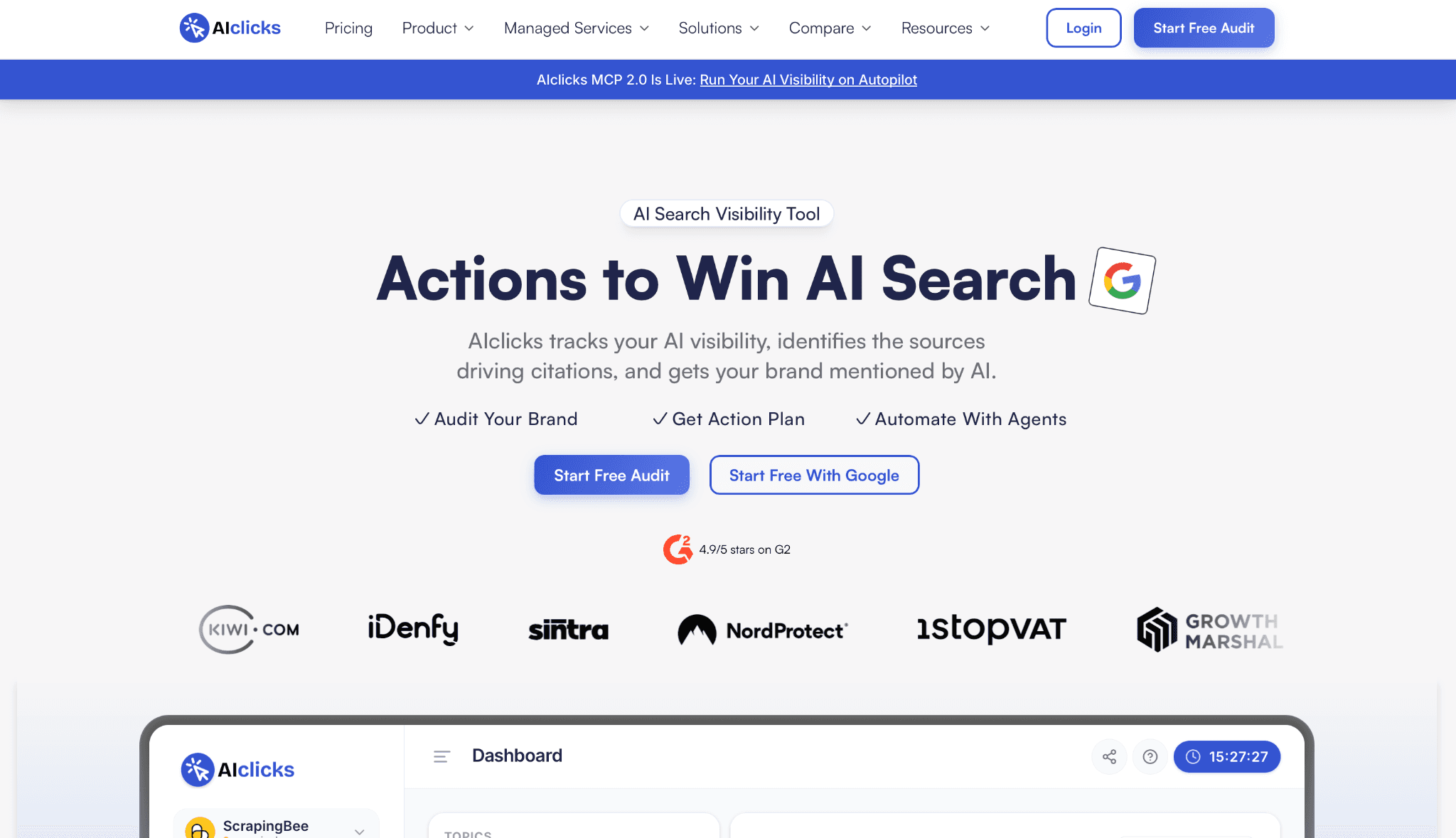
Most tools on this list solve one half of the content problem. AIclicks tries to close the loop on both halves inside one product. Its Content Agent turns visibility data and tracked prompts into a structured article draft, and the same platform then tracks whether that published article shows up in AI-generated answers across ChatGPT, Gemini, Perplexity, Google AI Overviews, Google AI Mode, Copilot, Grok, DeepSeek, Meta AI, and Claude. That loop, write the piece, then watch whether it earns a citation, is what separates AIclicks from a pure writing tool or a pure tracking tool.
Key features:
Content Agent drafting: generates AI-structured blog drafts from tracked prompts and visibility gaps, meant to be refined by a human editor for brand voice and proprietary detail rather than published untouched.

One-click CMS publishing: pushes finished drafts straight to WordPress, Webflow, Shopify, or Framer.
Multi-LLM visibility tracking: monitors prompt-level citations, mentions, and share of voice across 10+ AI engines.

Citation and source intelligence: shows which domains and page types are actually getting cited for a given topic, so you can see what a winning page looks like before you write one.

GA4-connected AI traffic reporting: ties AI-referred traffic back to the specific articles driving it, on the Pro plan and up.
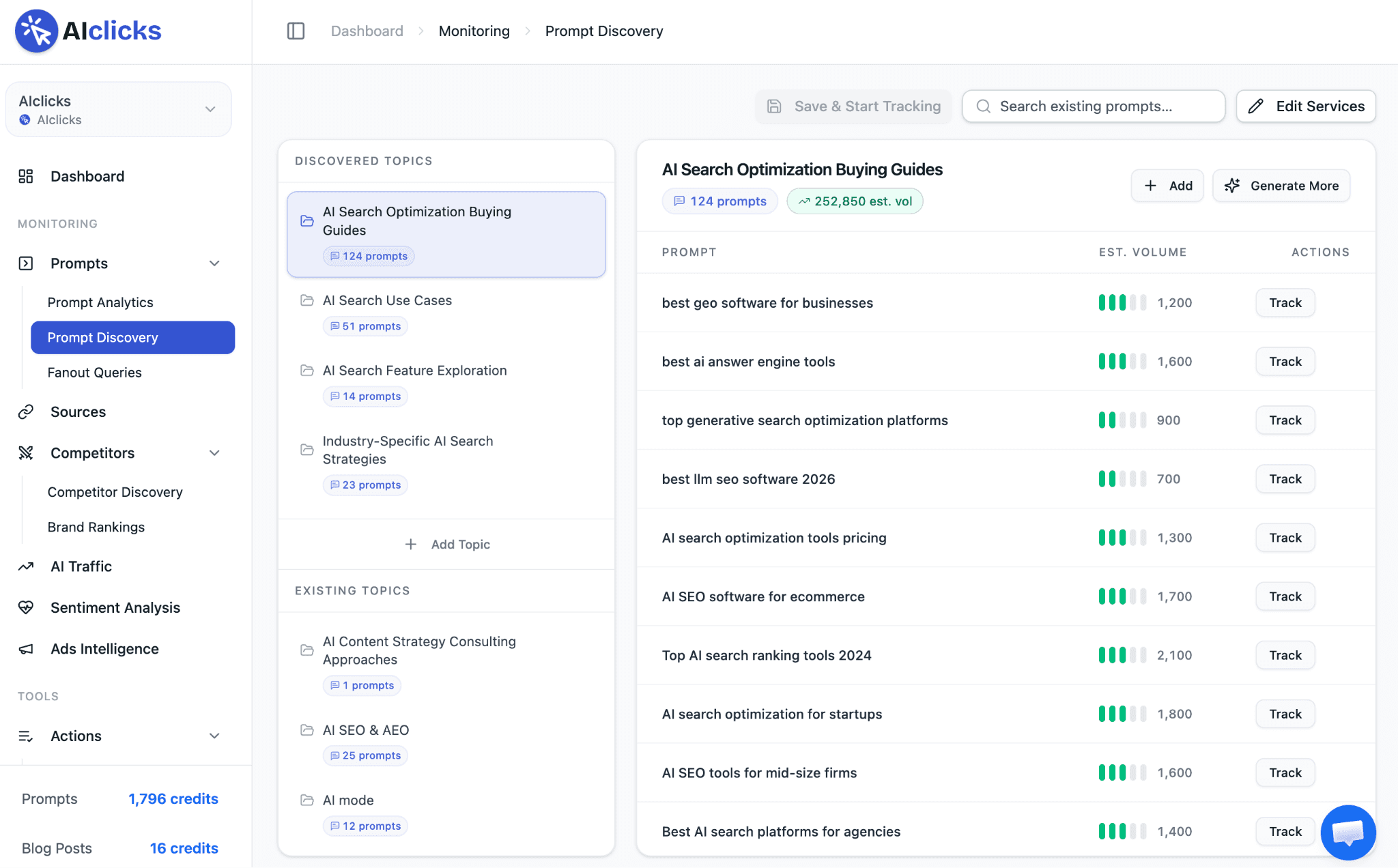
Prompt Discovery: surfaces the actual questions people ask AI engines in your category, which becomes the input for what to write next.
Pros:
The only tool here that closes the full loop, drafting content and then measuring whether that same content gets cited, without exporting data between two separate subscriptions.
Unlimited seats on every paid tier, which matters for agencies managing several client accounts on one plan.
Cons:
The Starter plan caps out at 5 tracked articles a month and one website, so a team publishing at real volume will need Pro or Business fairly quickly.
Content Agent drafts still need a human editing pass for brand voice and factual specifics; this isn't a fully autonomous writer.
Pricing. Starter runs $59/month (30 tracked prompts, 1 website, 3 LLMs, 5 articles/month). Pro runs $189/month (150 prompts, unlimited websites, 4 LLMs, 15 articles/month, GA4/API/MCP integrations). Business runs $499/month (300 prompts, 6 LLMs, 30 articles/month, a dedicated account specialist). Enterprise is custom. Starter and Pro both include a 3-day free trial with no credit card required.
Verdict. If your team already writes fine but has no idea whether that writing ever surfaces inside an AI answer, AIclicks is built for exactly that gap. Teams that need heavier long-form writing at very high volume, or a dedicated topic-authority model across hundreds of legacy pages, will still want to pair it with something like MarketMuse or Jasper rather than expecting Content Agent to replace a full editorial team.
See how the Content Agent actually works:
2. Surfer SEO - Content Optimization That Doubled Down on AI Visibility

Surfer built its name on Content Score, a real-time optimization grade that compares a draft against top-ranking pages. In 2026, the product has visibly repositioned around AI search rather than classic rankings alone: its plan names now read "Track AI Visibility," "AI Search Analytics," and "Plan, Write, and Track AI Visibility," and the platform covers Google AI Mode, Google AI Overviews, and Google Gemini citation tracking alongside its original content-scoring engine.
Key features:
Content Score: a live 0 to 100 grade comparing a draft's terms, structure, and length against top-ranking competitor content.
AI visibility tracking: monitors brand mentions and citation sources across Google AI Mode, AI Overviews, and Gemini, refreshed daily on higher tiers.
Surfy AI writing assistant: an in-editor AI writer that drafts and revises inside the same interface where Content Score is calculated.
Topical Map: clusters keyword and topic opportunities into a content plan rather than a flat keyword list.
Cannibalization Report: flags when multiple pages on the same site compete for the same topic.
AI Detector & Humanizer: checks whether a draft reads as AI-generated and can rewrite it to sound more natural.
Pros:
150,000+ customers and named enterprise users including FedEx, ClickUp, Lenovo, and Shopify, which is a meaningfully larger install base than any other tool on this list besides Jasper.
Cons:
Every price Surfer publishes is the yearly-billed rate, and paying monthly costs noticeably more, so a buyer comparing this list on sticker price alone should confirm which billing cycle a competitor's quoted number assumes.
The most AI-visibility-heavy features (multi-surface tracking, daily refresh, mention-gap analysis) are concentrated on the two higher tiers, not the entry Discovery plan.
Pricing. Discovery starts at $59/month for baseline content creation. AI Search Analytics runs $95/month for AI visibility tracking alone. Standard runs $119/month. Pro runs $219/month, adding daily-refreshed multi-surface AI tracking. Peace of Mind runs $359/month. Enterprise starts around $999/month with custom terms. All figures are the yearly-billed monthly equivalent; Surfer's own pricing page lists the exact dollar savings for choosing yearly over monthly on every tier.
Verdict. Surfer fits a team that already leans on Content Score for on-page optimization and wants AI-answer visibility folded into the same workflow instead of bolting on a separate tracker. It is the strongest pick here for someone who wants one tool covering both the writing-optimization side and the AI-citation side without going all the way to AIclicks' fully separate drafting-plus-tracking model.
3. Frase - Research-to-Brief Speed for Lean Teams

Frase's whole pitch is compressing the research phase. Point it at a topic and it pulls the top-ranking and top-cited pages, builds a content brief from what they cover in common, and hands a writer a structured starting point instead of a blank page. Frase leans into a "bring your own agent" position for 2026, offering MCP and CLI access so a team can wire Frase's data into its own custom AI workflows rather than being locked into Frase's own editor.
Key features:
SERP-based content briefs: auto-generates an outline and target terms from the pages currently ranking and getting cited for a topic.
AI Visibility engine tier: a dedicated feature set (available from the Professional plan up) for tracking how content performs in AI-generated answers alongside organic rankings.
MCP and CLI access: lets a team's own agents or scripts pull Frase's research and brief data directly, aimed at teams already running custom AI tooling.
FraseCMS: a separate, lightweight hosting product for publishing content directly, with its own free and paid tiers.
Content scoring and optimization: grades drafts against the same competitive data used to build the brief.
Seat and article limits scale by tier: each plan defines specific seat counts and article caps rather than unlimited use at every level.
Pros:
The fastest path from a blank topic to a usable brief of any tool on this list, which matters most for a lean team without a dedicated research function.
MCP/CLI access is a genuinely distinctive move for a content tool in this category, useful for teams already building custom AI workflows elsewhere.
Cons:
The AI Visibility tracking depth is not as broad as Surfer's or AIclicks' multi-surface coverage; it's an add-on capability on top of a brief tool, not the core product.
Article and seat caps on the lower tiers can get tight fast for an agency managing several accounts.
Pricing. Starter runs $49/month. Professional runs $129/month. Scale runs $299/month. Enterprise is custom. FraseCMS is a separate product, free at the base tier, $19/month for Basic hosting, $99/month for Pro hosting.
Verdict. Frase suits a small team or solo marketer who needs research and a brief fast and doesn't want to pay for a full visibility-tracking suite on day one. Teams whose main bottleneck is understanding whether already-published content gets cited by AI engines, rather than writing new content faster, are better served starting with Surfer or AIclicks instead.
4. Jasper - Brand-Consistent Content at Enterprise Scale

Jasper's differentiator has always been brand voice control at scale, the ability to teach the tool a company's specific tone, terminology, and style guide and have every output, across dozens of writers, stay consistent with it. That positioning hasn't changed in 2026, but the compliance and enterprise story around it has grown more explicit: Jasper now publishes SOC 2 Type II, GDPR, CCPA, PCI, and DPA compliance directly on its pricing page, aimed squarely at procurement teams evaluating it for large organizations.
Key features:
Brand voice profiles: trains the model on a company's existing content so output matches an established tone rather than a generic default.
Compliance certifications published upfront: SOC 2 Type II, GDPR, CCPA, PCI, and DPA are all listed on the pricing page itself, not buried in a separate trust center.
Dedicated GEO/AEO workflows: Jasper maintains specific pages and features aimed at generative-engine and answer-engine optimization, separate from its core writing product.
Multi-format generation: covers long-form articles, ad copy, and campaign assets from the same brand-voice foundation.
Named enterprise deployments: case studies reference customers including Wayfair, SentinelOne, and iHeartMedia.
Team collaboration controls: built for many writers working under one brand standard rather than a single-user workflow.
Pros:
4.7/5 on G2 across 1,309 reviews, one of the largest review bases of any tool on this list, which gives real signal on consistency at scale.
The compliance certification list is unusually complete for a content tool, which shortens procurement cycles for regulated or enterprise buyers.
Cons:
The Business tier has no published price; a team past the Pro tier's limits has to go through a sales conversation to get a number.
Jasper's AI-citation and visibility tracking is not as deep or as central to the product as AIclicks' or Surfer's; it's positioned more as a writing tool with GEO features attached than a tracking-first platform.
Pricing. Pro runs $59/month billed yearly, or $69/month billed monthly. Business is custom-priced through Jasper's sales team.
Verdict. Jasper fits an organization where dozens of people write under one brand and consistency matters more than per-article AI-citation tracking. A team of one or two writers, or one whose main question is "does our content get cited by ChatGPT," gets more direct value from Frase, Surfer, or AIclicks at a lower entry cost.
5. Copy.ai - Workflow Automation for Repeatable Content Ops

Copy.ai has moved further from "AI writing assistant" and further toward "workflow automation platform" than any other tool on this list. Its core unit isn't a document, it's a Workflow: a chained set of AI actions (research a lead, draft an article, check a competitor page) that a team builds once and reuses across every similar task. Pricing follows that shift, sold in seats plus workflow credits rather than a flat per-user rate above the entry tier.
Key features:
Workflow builder: chains research, generation, and tool integrations into a repeatable, reusable process rather than a single prompt-and-response interaction.
Multi-model access: a single workflow can call OpenAI, Anthropic, and Gemini models depending on the step.
Workflow credits: usage is metered by computational complexity per run rather than a flat seat cap, so heavier workflows cost more per execution.
Guided enterprise onboarding: a dedicated implementation process for large accounts, including security review support.
GTM-specific templates: built-in workflows for sales collateral, account plans, and SEO content specifically, not just generic blog drafting.
Flexible plan changes: upgrades apply immediately with prorated billing; downgrades credit the difference to the next invoice.
Pros:
The entry Chat plan costs $29/month for 5 seats with unlimited chat-based generation, a genuinely low per-seat cost for a small team.
17 million users gives it one of the largest user bases of any tool in this category, and its case studies cite specific, checkable outcomes (a Fortune 500 cybersecurity company's onboarding process, a retailer's 100,000-plus product catalog).
Cons:
At 180 reviews on G2, Copy.ai has a thinner independent review base than Jasper's 1,309 or Surfer's 546, less third-party signal to weigh against its own 17-million-user claim.
Copy.ai has no dedicated AI-citation or answer-engine visibility tracking; it's a content production tool, not a tracking tool, so a team needs a separate product (or this list's other five) to know if any of that output gets cited.
Pricing. The Chat plan (5 seats) runs $29/month billed monthly, Enterprise custom.
Verdict. Copy.ai fits a GTM or content-ops team that wants to codify a repeatable process (a sales-enablement workflow, a product-description pipeline) rather than a team looking for a single writer-plus-tracker tool. Anyone whose priority is AI-citation visibility specifically should treat Copy.ai as a production layer to pair with, not a replacement for, one of the tracking-capable tools higher on this list.
6. MarketMuse - Topic Authority Mapping for Large Content Operations
MarketMuse's bet is that content decisions should come from a full inventory of a site's topics and pages, not a keyword-by-keyword search. Its patented topic-modeling technology scores every page for Personalized Difficulty and Topic Authority, then uses that inventory to flag exactly where a site is thin, where it's strong, and which new topics represent the easiest wins given its existing authority. That's a fundamentally different starting point than the SERP-brief tools elsewhere on this list.
Key features:
Content inventory: automatically tracks every published page and topic on a site and keeps the map current without manual uploads.
Personalized Difficulty scoring: a 1-100 metric unique to each site, based on its existing coverage and authority rather than a generic keyword-difficulty number.
Patented topic modeling: MarketMuse holds a specific patent (US 10,409,875) on the algorithm behind its topic and relevance scoring.
Content Briefs and Strategy Documents: the Research and Strategy tiers add a set number of monthly briefs and strategy docs (10 briefs and 3 strategy docs a month on the Research-adjacent tier, 20 briefs and 5 strategy docs on the top tier).
Competitive Advantage metric: shows the gap between a topic's general difficulty and a specific site's personalized difficulty, meant to surface genuine competitive openings.
Team workflow tools: assigns content to specific team members, tracks due dates, and stores drafts in one shared workspace.
Pros:
The topic-authority and content-inventory approach is the most structurally different offering on this list; no other tool here builds a full site-wide topic map as its core feature.
The patent is real and publicly viewable, which is more substantiation than most "proprietary algorithm" claims in this category get.
Cons:
None of the paid tiers (Optimize, Research, Strategy) list a dollar price anywhere on the current site; every path to a number runs through booking a demo, which is a real friction point for a team trying to budget before committing time to a sales call.
MarketMuse doesn't track citations in ChatGPT, Gemini, or Perplexity at all; its Personalized Difficulty and Topic Authority metrics are built entirely around traditional search rankings, not AI-answer visibility, so a team still needs a separate tool for that half of this list's angle.
Pricing. Free is available for low content volume. Optimize, Research, and Strategy tiers exist with clearly documented feature differences (tracked topics, content briefs, and strategy docs scale up at each level), but none of the three list a public dollar price; getting a quote requires booking a demo.
Verdict. MarketMuse fits a large team or agency managing content across dozens or hundreds of pages that needs a site-wide topic strategy, not just a per-article brief. A smaller team that wants to see a price before talking to sales will likely start with Frase or Surfer instead and revisit MarketMuse once content volume justifies the sales conversation.
For a broader view of tools outside this content-and-citation scope, ads, social scheduling, and general marketing automation among them, our wider AI marketing tools roundup covers that ground.
How to Choose
Start with what your team is actually short on, then work through these in order:
Nobody on the team has time to write. The answer is AIclicks or Jasper, tools built to produce finished drafts rather than just plans for one.
Writing capacity already exists, but nobody knows whether any of it gets cited by ChatGPT or shows up in an AI Overview. AIclicks or Surfer answer that question directly; Jasper, Copy.ai, Frase, and MarketMuse don't track citations as a first-class feature.
Budget predictability matters more than feature depth. Rule out MarketMuse until you're ready for a sales call, since it's the only tool here with no published number to compare against a monthly budget.
Before you commit to any one of these, ask two questions. Does this tool tell you anything about AI-answer visibility specifically, or only about traditional search rankings? And if you stopped paying for it tomorrow, would you still know what to write next, or does all of that knowledge live inside the subscription?
Where AIclicks Fits in This List, and Where It Doesn't
AIclicks fits a team that wants content production and AI-citation tracking handled by one vendor instead of running a separate writing tool and a separate visibility tracker side by side. Its ChatGPT tracker shows exactly this kind of prompt-level visibility data feeding directly into what Content Agent decides to write about next, which is the loop most of the other five tools don't close on their own.
It's not the strongest fit for everyone here. A brand-heavy enterprise running dozens of writers under one strict style guide is better served starting with Jasper's brand-voice controls. A large publisher or enterprise site needing a full topic-inventory strategy across hundreds of existing pages should look at MarketMuse first. And a lean team whose only real need is a fast SERP-based brief, with AI-visibility tracking as a nice-to-have rather than the main job, will get more immediate value from Frase or Surfer's Discovery tier at a lower entry price.
If closing that write-and-track loop is the gap on your team, AIclicks' 3-day trial needs no credit card and is the fastest way on this list to see it working on your own content. Try AIclicks today.
FAQs
What's the difference between an AI content tool and an AI SEO tool?
An AI content tool focuses on producing the writing itself, an article, a brief, an outline. An AI SEO tool focuses on whether that content performs once it's published, in rankings and increasingly in AI-generated answers. Several tools on this list, AIclicks and Surfer especially, deliberately blend both functions into one product.
Do any of these tools track citations in ChatGPT and Google AI Overviews specifically, not just search rankings?
Yes. AIclicks and Surfer SEO both track AI-answer citations directly, across ChatGPT, Gemini, Perplexity, and Google's AI Overviews and AI Mode. Frase offers a narrower AI Visibility feature on its Professional tier and above. Jasper, Copy.ai, and MarketMuse are built primarily as production and strategy tools rather than citation trackers.
Which of these tools has the lowest starting price?
Copy.ai's entry Chat plan starts at $29/month for 5 seats. AIclicks and Surfer SEO's entry tiers both start at $49 to $59/month depending on billing cycle.
Why doesn't MarketMuse list its pricing?
As of September 2026, MarketMuse's Optimize, Research, and Strategy tiers are all demo-gated on its site, meaning the company doesn't publish a dollar figure for any of them; a buyer has to book a call to get a quote.
Can one of these tools replace a full content team?
No. Every tool on this list, including AIclicks' Content Agent, is built to produce a draft that a human editor still needs to refine for brand voice, factual accuracy, and proprietary detail before it publishes. None of them are positioned as a fully autonomous replacement for editorial judgment.



Any questions left?
Book a call here: