" width="14px"><path d="M 13.864 5.629 L 13.3 5.629 L 13.3 5.6 L 7 5.6 L 7 8.4 L 10.956 8.4 C 10.379 10.03 8.828 11.2 7 11.2 C 4.681 11.2 2.8 9.319 2.8 7 C 2.8 4.681 4.681 2.8 7 2.8 C 8.071 2.8 9.045 3.204 9.786 3.864 L 11.766 1.884 C 10.516 0.719 8.844 0 7 0 C 3.134 0 0 3.134 0 7 C 0 10.866 3.134 14 7 14 C 10.866 14 14 10.866 14 7 C 14 6.531 13.952 6.073 13.864 5.629 Z" fill="rgb(255, 193, 7)" height="14px" id="H_YjfTNpn" width="14px"/><path d="M 0 3.742 L 2.3 5.429 C 2.922 3.888 4.429 2.8 6.193 2.8 C 7.264 2.8 8.238 3.204 8.979 3.864 L 10.959 1.884 C 9.709 0.719 8.037 0 6.193 0 C 3.504 0 1.172 1.518 0 3.742 Z" fill="rgb(255, 61, 0)" height="5.428500000000002px" id="PlkthQDhg" transform="translate(0.875 0)" width="10.959199999999996px"/><path d="M 6.232 5.581 C 8.04 5.581 9.683 4.889 10.925 3.764 L 8.758 1.931 C 8.032 2.483 7.144 2.782 6.232 2.781 C 4.411 2.781 2.865 1.62 2.283 0 L 0 1.759 C 1.159 4.026 3.511 5.581 6.232 5.581 Z" fill="rgb(76, 175, 80)" height="5.581099999999999px" id="WlnJ5gngE" transform="translate(0.7 8.4)" width="10.924899999999994px"/><path d="M 6.864 0.029 L 6.3 0.029 L 6.3 0 L 0 0 L 0 2.8 L 3.956 2.8 C 3.68 3.576 3.183 4.254 2.526 4.75 L 2.527 4.749 L 4.693 6.582 C 4.54 6.722 7 4.9 7 1.4 C 7 0.931 6.952 0.473 6.864 0.029 Z" fill="rgb(25, 118, 210)" height="6.589883930775992px" id="x_rSW275p" transform="translate(7 5.6)" width="7px"/></g></svg>)


Reviewed by:
Rokas Stankevicius

Founder @ aiclicks.io
Last updated:
Expert Verified

Key Takeaways
Rankability sits at an unusual intersection: it handles content research, brief creation, AI-assisted writing, and AI search tracking in one platform. Most alternatives do one of those things better than Rankability but not all four.
The credit cost problem is real and surfaces consistently in G2 reviews. You cannot see what an automation will cost before running it, and that uncertainty compounds quickly for agencies running high prompt volumes.
At $99/mo minimum, Rankability is priced and architected for multi-client agency operations. Solo practitioners and small in-house teams consistently report paying for features and seat structures they don't use.
The 12 tools on this list split into three distinct camps: content optimization tools (Outranking, Surfer SEO, Jasper AI, SEO.ai, Page Optimizer Pro), AI visibility and tracking platforms (AIclicks, Peec AI, LLMrefs, Knowatoa), and full-suite SEO platforms where AI tracking is an available layer (Semrush, SE Ranking, Ahrefs).
Which camp you belong in depends entirely on why you're leaving Rankability. The answer to that question should come before you evaluate any specific tool.
The teams looking for Rankability alternatives are not usually unhappy with the platform. They have a more specific problem.
Some of them are running a single brand, not a client portfolio. The Starter plan's 2-client limit and credit structure don't map cleanly to an in-house team tracking one company's AI visibility and content performance. The architecture is built for agencies billing multiple clients. If that's not you, you're paying for infrastructure that has no use in your workflow.
Some of them needed AI visibility tracking specifically, and the research tools, brief creation, optimization scoring, and audit features are overhead they're paying $99/mo for but not using. Dedicated AI visibility tools do the same tracking job for less.
And some of them hit the credit wall. Every automation in Rankability consumes credits at a rate you can reference in documentation but can't preview at the moment of running it. "The only real downside to Rankability is that you can't see how much each automation will cost, in credits, prior to performing the action. There is a reference document somewhere, but it would be much easier to see it in all the locations where one of these automations could be triggered." Verified G2 reviewer. For agencies reconciling client costs month-to-month, that uncertainty is persistent friction.
This article covers twelve alternatives across three different use cases. Which one is right depends entirely on which part of Rankability was actually doing the job you cared about.
Why Teams Outgrow Rankability
Rankability earns its ratings. The 5.0 is not inflated, and the frustrations are not about quality. They're about fit, which is a different kind of problem.
Credit costs are invisible until after you've run something. "The only real downside to Rankability is that you can't see how much each automation will cost, in credits, prior to performing the action. There is a reference document somewhere, but it would be much easier to see it in all the locations where one of these automations could be triggered." Verified G2 reviewer.

The $99/mo Starter is built for agencies with multiple clients. For an in-house team at a single brand, you're paying for architecture that has no use in your workflow.

The platform moves fast and the feature surface is genuinely complex. "Sometimes all the new features can be a bit hard to keep up with. It's not always 100% clear what it can do and where to find all those features." Verified G2 reviewer.

How I Evaluated These Alternatives
Rankability alternatives fall into three different jobs, and the evaluation criteria shift depending on which job you're hiring for.
Content optimization tools: How does the brief output and optimization scoring compare to Rankability's Research and Create? Is the NLP methodology rigorous? Does it integrate with CMS tools the team already uses? And critically: does the pricing make sense for teams that don't need agency-oriented client management architecture?
AI visibility platforms: How many engines are covered on self-serve plans, and are they tracked through real user interfaces or APIs? Does the platform produce tasks and recommendations from visibility data, or does it hand the data back to your team? What's the real total cost once you add the engines, seats, and reporting features a real team would actually use?
Full-suite SEO platforms: Which AI tracking capabilities come standard and which require add-ons? What does the combined cost look like for a team that needs both the SEO foundation and the AI layer?
All pricing and feature data came directly from official product pages, verified in July 2026.
The 12 Best Rankability Alternatives in 2026
Tool | Best For | Starting Price | Standout Feature |
AIclicks | Teams that need dedicated AI visibility with a clear action plan | $59/mo | 10+ engines, real-UI querying, Recommendations engine |
Outranking | Content teams wanting SERP-driven brief creation without agency overhead | $39/mo | Step-by-step SERP-grounded content workflow |
Jasper AI | Marketing teams needing on-brand content at scale with GEO capabilities | $69/mo | 100+ marketing agents + GEO monitoring |
Surfer SEO | Content teams wanting optimization scoring plus AI tracking in one tool | $99/mo | Content scoring + 5-engine AI Tracker on Scale |
Semrush | Teams already inside the Semrush ecosystem | $139.95/mo | 26.5B keyword database + AI Visibility Toolkit |
SE Ranking | Agencies already on SE Ranking wanting to add AI tracking | $129mo annual + $89/mo AI add-on | Full SEO suite with AI tracking layer |
SEO.ai | Solo operators wanting content published automatically without managing the process | $149/mo | Autonomous AI SEO agent |
Page Optimizer Pro | SEOs wanting rigorous, experiment-backed on-page optimization | $40/mo | POP Rank Engine built on 400+ real SEO experiments |
Ahrefs | Teams needing the deepest backlink data with AI tracking as an add-on | $199/mo Brand Radar AI | 414M+ search-backed prompts in Brand Radar |
Peec AI | Mid-market teams wanting clean, focused AI visibility analytics | $95/mo | Unlimited seats, EU data residency, citation analysis |
LLMrefs | Agencies tracking AI visibility from their existing keyword lists | $79/mo | Keyword-based methodology, 10+ engines |
Knowatoa | Teams wanting AI visibility monitoring with optimization guidance | $59/mo | 7 platforms, AI agents, daily updates |
1. AIclicks: The #1 Rankability Alternative
About AIclicks
Rankability covers AI visibility through its Track tool as one component of a six-tool platform priced for agencies. AIclicks, an AI visibility tracker, is what that component looks like when it's the whole product.
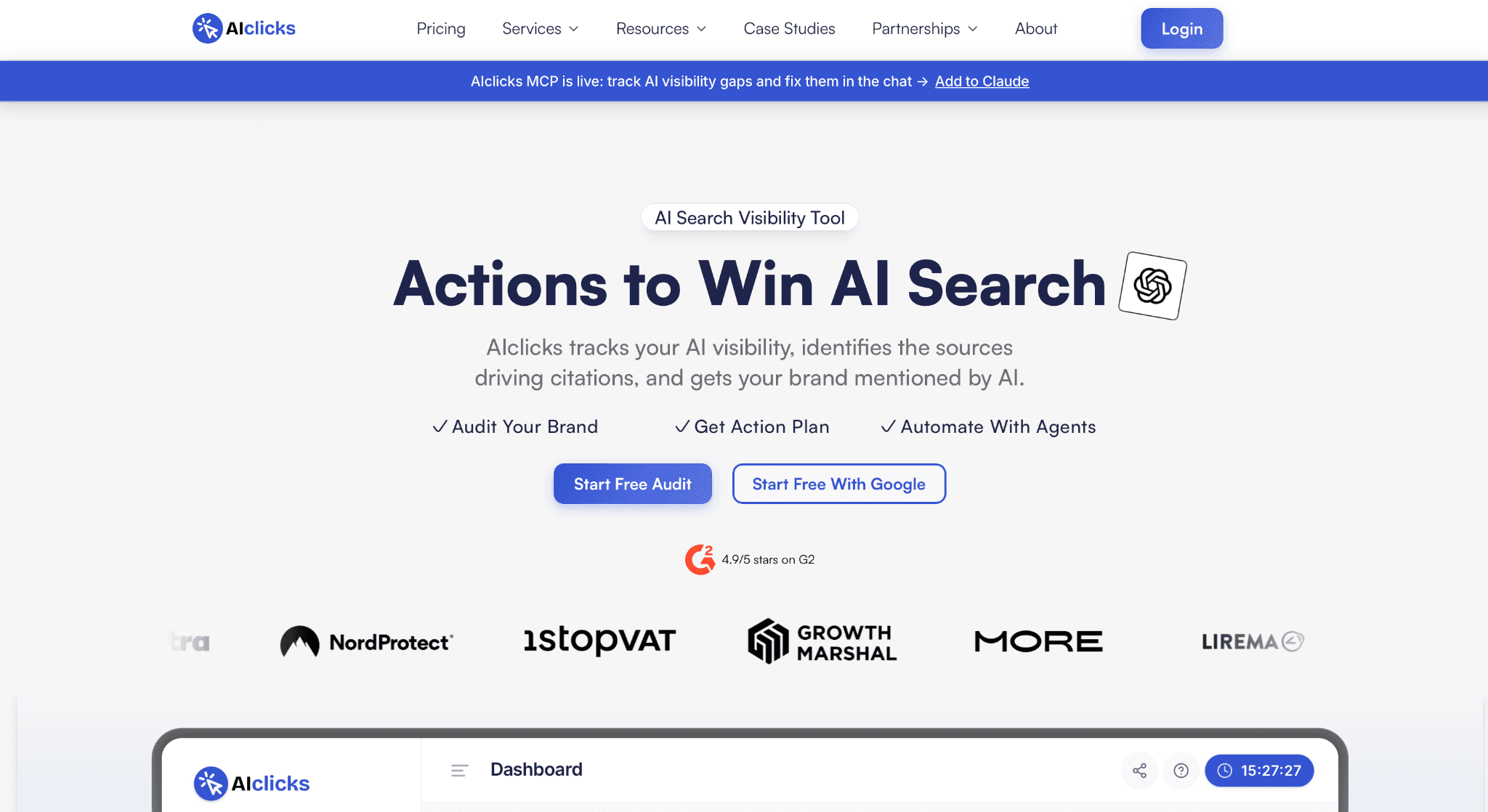
Both platforms cover 10 AI engines. Rankability's Track monitors ChatGPT, Perplexity, Google AI Overviews, Google AI Mode, Gemini, Claude, Grok, Microsoft Copilot, Brave AI, and DeepSeek as part of a broader content and SEO workflow. AIclicks covers ChatGPT, Perplexity, Gemini, Google AI Overviews, AI Mode, Claude, Grok, DeepSeek, Meta AI, and Microsoft Copilot as the primary product, with every feature in the platform built around what you do with that data.
That distinction matters more than it sounds. Every AIclicks session ends with a ranked list of work to do. The Actions engine scores each finding by expected impact and routes it into one of three action types: content to create, sources to earn mentions on, and communities to engage where AI picks up brand signals. The Competitors tab traces exactly which sources power the brands being cited instead of you. The Sources tab maps the citation landscape in your category into a concrete work list. Ten-plus engines tracked through real user interfaces rather than APIs, because what a buyer sees in ChatGPT and what an API returns are frequently two different answers.
The pricing difference is also structural. AIclicks runs on defined plan tiers at $59/mo to start. You know what you're paying before the month ends. There's no credit system, no documentation to consult before running an automation, no uncertainty to absorb into your client billing.
Key features:
10+ AI platforms tracked through real user interfaces: ChatGPT, Perplexity, Gemini, Google AI Overviews, AI Mode, Claude, Grok, DeepSeek, Meta AI, and Microsoft Copilot.
Real-UI querying captures what actual users see rather than API approximations.
Competitors tab tracing which specific sources power competitors' AI visibility.
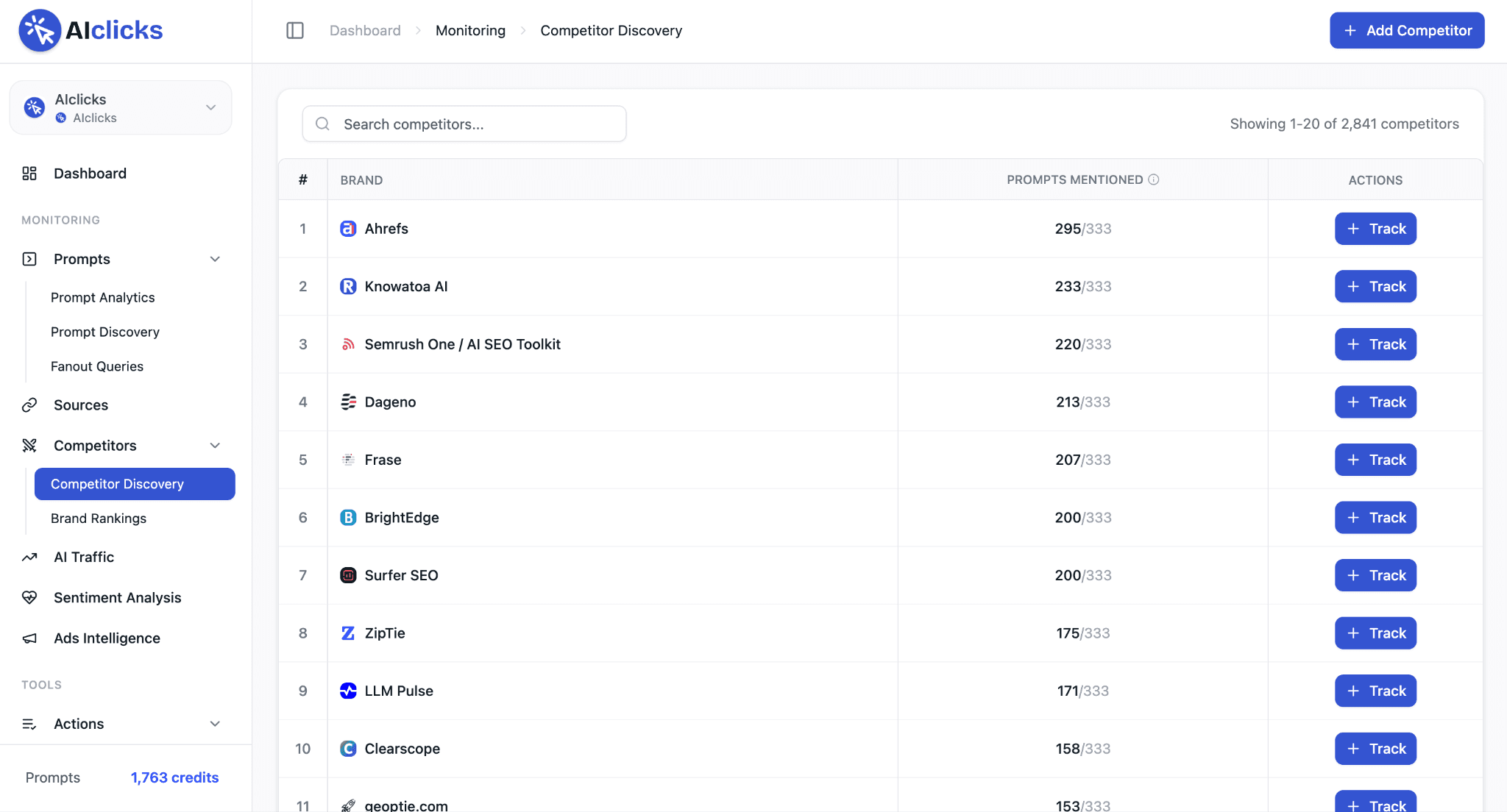
Actions engine converting every visibility finding into a ranked, scored action list.
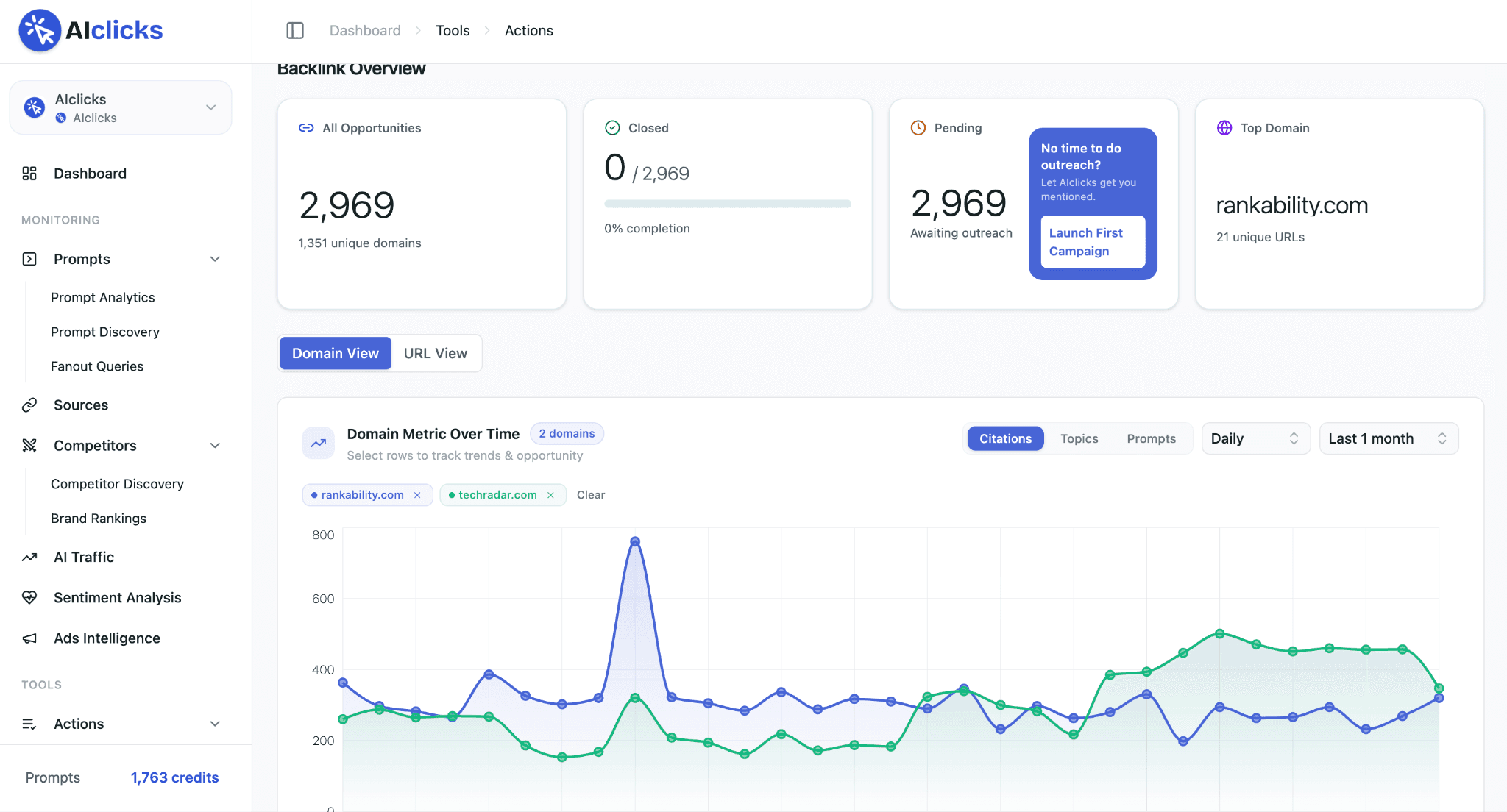
Sources analysis showing exactly which domains feed AI answers in your category and where you're absent.

Google Analytics integration with daily refreshes, segmented by model and country.
Pros and cons:
Pros:
Dedicated AI visibility platform; every feature serves the tracking-to-action workflow, without content brief creation and SEO audit overhead bundled around it
Real-UI querying catches gaps that API-based tracking misses
Transparent plan pricing removes the credit forecasting problem entirely
3-day free trial on all plans
Cons:
Three days is a short trial for a platform whose value compounds over time. Our team extends it on request.
Predefined plan tiers rather than credit-based flexibility. Teams with specific usage volumes may find themselves between plans. Custom plans are available.
G2 rating: 4.9/5
Pricing: Starter $59/mo (30 prompts, 3 AI platforms) | Pro $189/mo (150 prompts, 4 platforms) | Business $499/mo (300+ prompts, 6 platforms) | Custom plans available | 3-day free trial on all plans
Verdict:
If AI visibility tracking and a structured action layer were the jobs that mattered inside Rankability, AIclicks does those jobs as the whole product. Same engine count, purpose-built workflow, transparent pricing, no credit system to manage.
If you want to go deeper on the strategy behind ranking in AI search before you trial anything, this walkthrough covers the full playbook:
2. Outranking: Best for content teams wanting SERP-driven brief creation without agency overhead
About Outranking
The brief creation problem Rankability's Research and Create tools solve is also what Outranking is entirely built around. The difference is $39/mo versus $99/mo, and the absence of five other tools bundled around it.
Before a writer types a word, Outranking has already analyzed the top 20 ranking pages for the target keyword, surfaced the concepts, entities, headings, and questions that appear across those results, and built that structure into the outline. The step-by-step workflow runs from keyword through title through draft through optimization, each stage informed by live SERP data. Google Docs and WordPress integrations keep the process inside tools writers already know. Briefs are shareable without requiring the recipient to understand the scoring methodology underneath.
There's no AI search tracking in Outranking. No mention monitoring, no citation analysis, no engine coverage. If the visibility layer was meaningful to your Rankability workflow, it's absent here.
Key features:
SERP analysis pulls data from the top 20 ranking pages per keyword, covering headings, topics, entities, questions, and structure.
Step-by-step workflow from keyword research through title, outline, draft, and optimization.
Google NLP integration surfacing the entities Google identifies as relevant to the content.
Google PAA integration identifying question-based content opportunities.
Google Docs and WordPress native integration.
Multi-keyword document support for pillar content.
Team collaboration and shared documents for managing writers and freelancers.
Pros and cons:
Pros:
SERP-grounded research removes the manual competitor analysis step from the brief process
$39/mo entry saves $60/mo versus Rankability's Starter for teams that only needed the content workflow
Google Docs and WordPress integration keeps writers inside familiar tools
Cons:
No AI search tracking whatsoever.
Unused monthly credits don't roll over. Variable content output means wasted capacity some months.
AI character usage for drafts requires an add-on on top of base plan pricing.
G2 rating: No rating on G2.
Pricing: Starter $39/mo (10 documents) | SEO Writer $79/mo (10 documents) | SEO Wizard $159/mo (10 documents)
Verdict:
Pairing Outranking with AIclicks covers both the content workflow and the AI tracking at a combined $98/mo, less than Rankability's Starter and with better depth on both sides for teams that weren't using the audit, backlink, or agency reporting features anyway.
3. Jasper AI: Best for marketing teams needing on-brand content at scale with GEO capabilities
About Jasper AI
Jasper is a per-seat content platform built for marketing departments that need every writer on the team to produce content that sounds like the same company. The way it handles that is through Jasper IQ: you feed it your tone of voice, product details, messaging rules, and compliance requirements once, and every generation from that point forward reflects them automatically. No one has to remind the tool what the brand sounds like.
The GEO Hub monitors how your brand appears across AI answer engines, identifies where competitors are being cited and you're not, and produces content designed to close those gaps. The Research and Optimization Agent drafts from what AI engines are currently citing in your category. At $69/mo annual per seat, a five-person team is $345/mo before Business plan features unlock, which is worth knowing before you compare it to Rankability's per-workspace pricing.
Key features:
100+ specialized AI marketing agents grounded in brand context via Jasper IQ.
GEO Hub monitoring brand performance across AI answer engines, identifying gaps, generating brand-governed content for AI citation.
Jasper IQ brand context layer embedding tone, product knowledge, and compliance rules into every generation.
Research and Optimization Agent drafting content grounded in current AI engine citations.
Content pipelines from brief through draft through review through publishing.
Pros and cons:
Pros:
Brand governance at scale is genuinely hard to solve, and Jasper IQ addresses it more comprehensively than any other tool on this list
GEO Hub means teams get AI visibility alongside content, not as a separate vendor
7-day free trial on Pro
Cons:
$69/mo is per seat. A five-person content team is $345/mo before Business plan capabilities unlock.
GEO Hub and Research and Optimization Agent are newer than the core writing tools and carry less external validation.
Outputs at volume trend generic and require editorial oversight. The most consistent G2 pattern is that the tool is fast but quality requires human editing to reach.

G2 rating: 4.7/5
Pricing: Pro $59/mo annual ($69/mo monthly) | Business custom | 7-day free trial on Pro
Verdict:
For a mid-market or enterprise marketing department that needs brand-consistent content at volume across multiple channels, Jasper is a strong Rankability replacement on the content side with a genuine GEO layer built in. For SEO agencies and smaller teams, the per-seat economics and marketing department orientation make Rankability's architecture a better fit, limitations and all.
4. Surfer SEO: Best for content teams wanting optimization scoring plus AI tracking in one tool
About Surfer SEO
Of the twelve tools on this list, Surfer is the most direct structural comparison to Rankability. Both do content optimization and AI search tracking. The question is which one does each job better for what you specifically need.
The content side works the way most SEOs know it. Enter a keyword, the Content Editor analyzes the top-ranking pages and produces a real-time score as you write, covering word count, NLP terms, headings, and keyword usage against competitor benchmarks. The SERP Analyzer breaks down exactly what those competing pages include. Topical Maps identify content gaps across a cluster.
The AI tracking is built into the Standard plan at $119/mo: ChatGPT, 25 prompts, weekly refresh. That's a real entry point for teams that want both content optimization and AI visibility without a second tool. Multi-engine tracking with daily refresh enters on Pro at $219/mo, which covers ChatGPT, Perplexity, and Google AI surfaces alongside deeper content features including internal linking, cannibalization reporting, and content gap analysis.
Key features:
Content Editor with real-time optimization scoring based on competitor SERP analysis.
SERP Analyzer breaks down every top-ranking competitor page by structure, word count, NLP terms, and headings.
Topical Map for identifying content gaps across a topic cluster.
AI tracking from Standard: ChatGPT, 25 prompts, weekly refresh. Multi-engine daily tracking from Pro.
Google Docs and WordPress integration.
Pros and cons:
Pros:
AI tracking included from the entry plan at $119/mo, not gated behind a higher tier
Content scoring methodology is mature and trusted by a large verified user base
Clean interface usable by writers without technical SEO training
Cons:
Standard covers ChatGPT only on a weekly refresh. Daily multi-engine tracking requires Pro at $219/mo.
Keyword volume and backlink data are limited relative to full-suite SEO platforms.
At $219/mo for the multi-engine tracking that makes the platform most useful, the price is a recurring friction point for smaller teams.

G2 rating: 4.8/5
Pricing: Standard $119/mo (ChatGPT tracking, 25 prompts, weekly refresh, 30 documents) | Pro $219/mo (multi-engine daily tracking, 50 prompts, 30 documents) | Peace of Mind $359/mo (100 prompts, unlimited documents, API access)
Verdict:
Surfer is the natural landing spot for teams that used Rankability's Create and Track tools in combination and want one platform handling both jobs. The content scoring is well-established and AI tracking starts at the entry plan, not locked behind an upgrade.
At $119/mo for Standard or $219/mo for meaningful multi-engine daily tracking, the comparison with Rankability's $99/mo Starter is close enough that it comes down to which platform's content workflow fits your team better.
5. Semrush: Best for teams already inside the Semrush ecosystem
About Semrush
Semrush's AI Visibility is a separate product from its SEO Classic suite, priced at $99/mo per domain. The Base plan covers brand mention tracking across ChatGPT, Google AI, Gemini, and Perplexity, with 25 custom prompt slots refreshed daily, competitor analysis, prompt research, and a site audit for AI readiness.
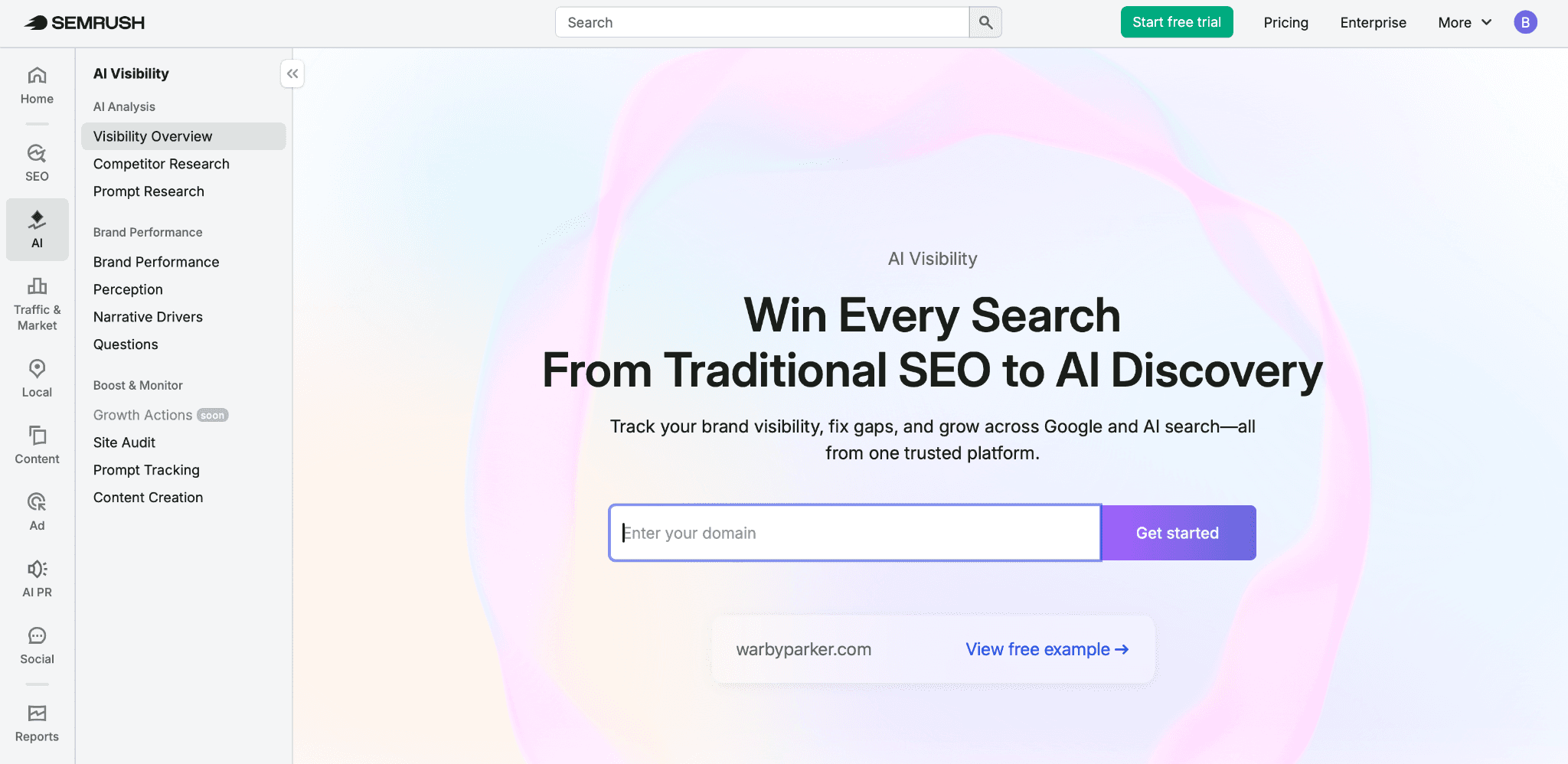
For teams already using Semrush for keyword research and competitive analysis, the AI Visibility toolkit extends into the same interface they already know. The prompt research methodology borrows from Semrush's keyword research approach, which makes it intuitive for existing users. Following the $1.9 billion Adobe acquisition completed in April 2026, Semrush's long-term product direction is worth watching for teams making multi-year platform commitments.
Key features:
AI Visibility Base plan tracking brand mentions across ChatGPT, Google AI, Gemini, and Perplexity.
25 custom prompt tracking slots with daily AI rankings.
Brand Performance analysis for one domain on Base.
AI competitor analysis and prompt research.
Site audit for AI readiness.
Daily, weekly, and monthly data updates.
Pros and cons:
Pros:
Daily AI rankings included on the Base plan across ChatGPT, Google AI, Gemini, and Perplexity
Site audit for AI readiness bundled in at no extra cost
Familiar interface and methodology for teams already running keyword research inside Semrush
Cons:
Four engines covered: ChatGPT, Google AI, Gemini, and Perplexity. Claude is excluded as of mid-2026, which matters for teams whose buyers use Anthropic models.
25 prompt slots on Base is a narrow set for agencies tracking multiple clients or brands.
"My least favorite thing about Semrush is how confusing the pricing is. I never feel sure which capabilities I actually have access to, because there always seems to be another tool I need to pay extra to use." Verified G2 reviewer. The standalone toolkit structure helps but the broader Semrush ecosystem still carries that complexity.

G2 rating: 4.4/5
Pricing: AI Visibility Base $99/mo per domain | Higher tiers and multi-domain pricing: verify directly at semrush.com/ai-visibility before purchasing | SEO Classic plans from $139.95/mo separately
Verdict:
At $99/mo as a standalone product, Semrush AI Visibility is more accessible than I described earlier and genuinely worth evaluating on its own merits. Four engines with daily tracking and prompt research at that price are competitive. The Claude gap and the 25-prompt ceiling on Base are the real constraints to plan around before committing.
6. SE Ranking: Best for agencies already on SE Ranking wanting to add AI tracking
About SE Ranking
SE Ranking is a full SEO platform for small and mid-sized agencies with AI visibility tracking available as a separate add-on. For agencies already running their SEO workflow inside SE Ranking, layering in AI tracking without switching to a second vendor is the main reason to consider it here.
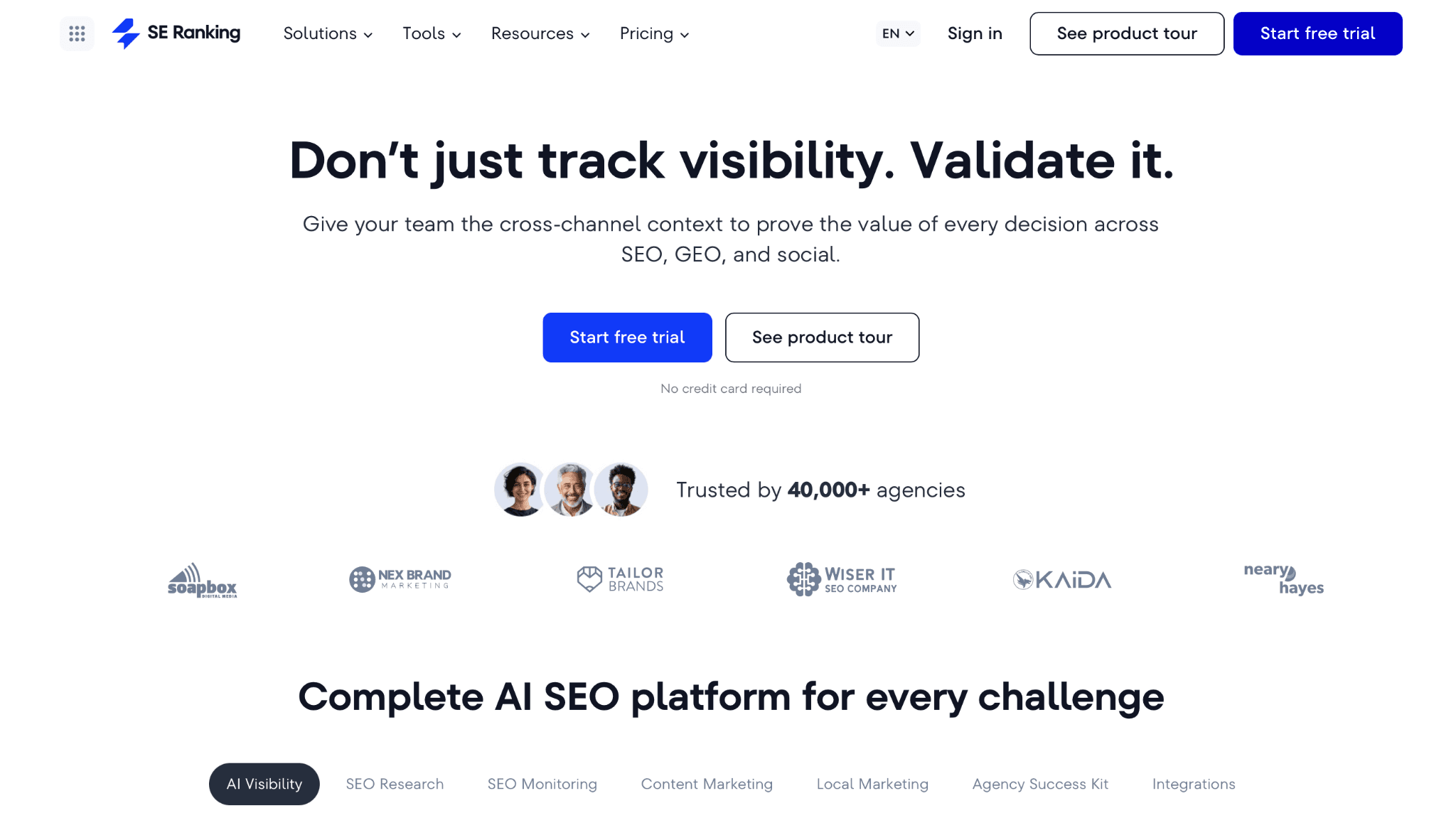
The AI Search add-on covers ChatGPT, Perplexity, Google AI Overviews, and Google AI Mode. What reviewers consistently single out is the source analysis: it surfaces which specific pages AI engines cite for your tracked prompts, organized as a direct content gap list rather than a graph to interpret. SE Visible, a companion standalone product at $99/mo, currently covers ChatGPT, Gemini, AI Mode, Perplexity, and AI Overview. White-label reporting for client deliverables requires the Agency Pack at $69/mo annual on top of everything else.
Key features:
AI Search add-on (~$71.20/mo annual) covering ChatGPT, Perplexity, Google AI Overviews, and Google AI Mode.
Source and citation analysis as a direct content gap list.
MCP server integration for piping data into AI assistants and automation platforms.
GA4 integration.
White-label reporting via Agency Pack at $69/mo annual.
Pros and cons:
Pros:
For agencies already on SE Ranking, the add-on avoids a second vendor contract
Source and citation analysis consistently praised in G2 reviews as practically useful
4.7/5 on G2 with 2629 reviews
Cons:
Core plus AI Search plus Agency Pack totals approximately $243/mo annual. The headline and the real price diverge.
Advanced features have a real learning curve for new users, and teams managing multiple brands across international markets report that the cross-brand reporting falls short of what enterprise-level operations need.

G2 rating: 4.7/5
Pricing: Core $103.20/mo annual ($129/mo monthly) | Growth $223.20/mo annual | AI Search add-on ~$71.20/mo annual | Agency Pack $69/mo annual | SE Visible from $99/mo | 14-day free trial
Verdict:
For SE Ranking agencies wanting to add AI tracking without a new vendor, the add-on makes sense. Calculate the real total first. For everyone else, the combined cost and SE Visible's current two-engine limitation make it a harder case.
7. SEO.ai: Best for solo operators wanting content published automatically without managing the process
About SEO.ai
Every other tool on this list gives you data, recommendations, or scoring and leaves the execution to you. SEO.ai does the execution.
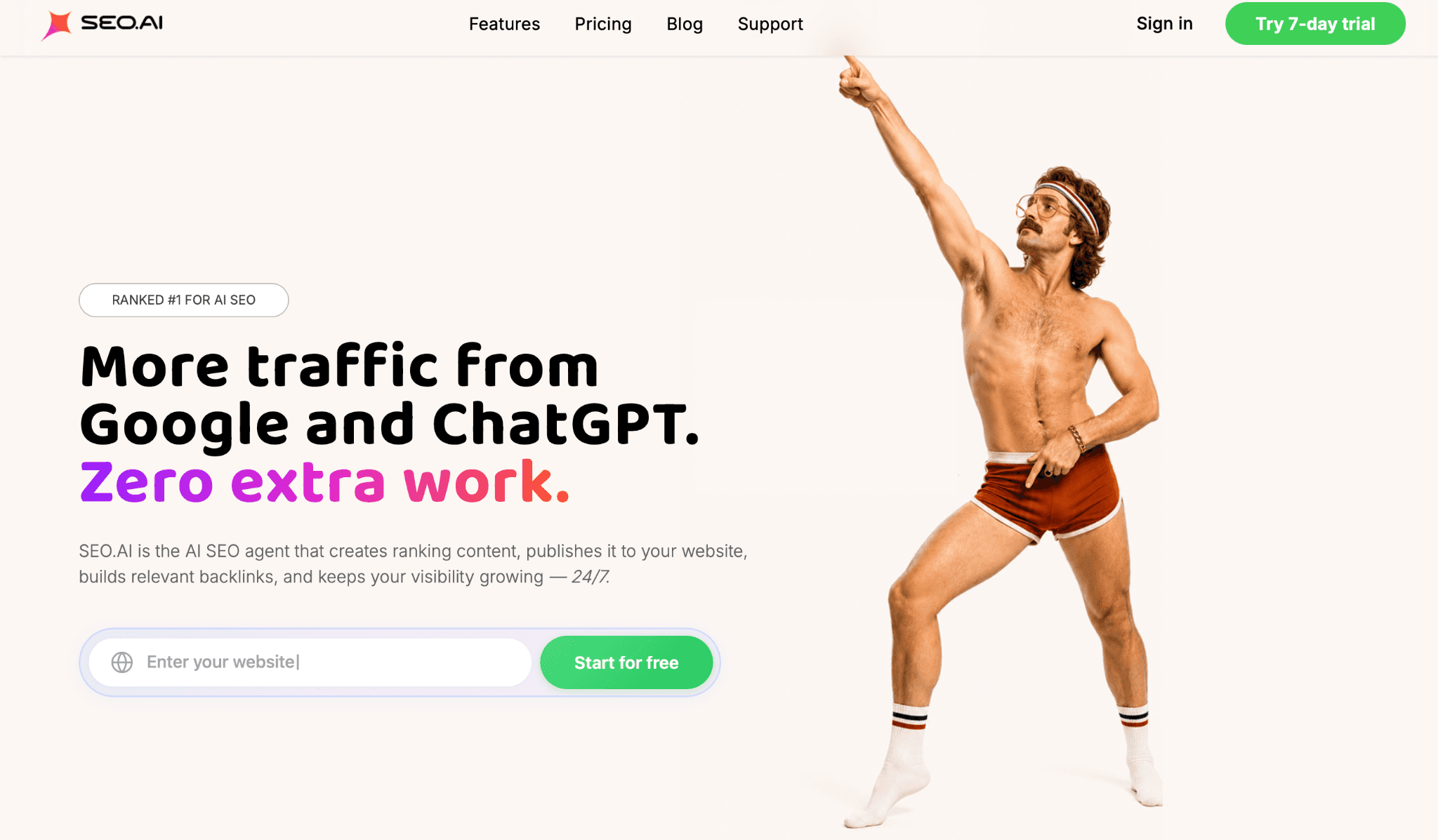
The platform runs an autonomous AI SEO agent that researches keywords for your specific business, writes content structured for your niche, publishes directly to your CMS, and builds backlinks through a member exchange network continuously, without requiring you to manage the process. The buyer this was built for is the business owner, freelancer, or lean team that knows content needs to happen but doesn't have the bandwidth or SEO background to run it. CMS compatibility is broad: WordPress, Webflow, Wix, Squarespace, Shopify, Magento. Optimization targets both Google rankings and AI citations.
There's no AI search tracking layer. SEO.ai optimizes for AI citation but doesn't show you brand visibility across AI surfaces or how you stack up against competitors in those answers. And you trade editorial control for the automation, the platform adapts to your style over time, but human review of output quality remains important.
Key features:
Autonomous AI SEO agent researching, writing, and publishing continuously without active management.
Keyword and topic discovery specific to your business.
Direct CMS integration with WordPress, Webflow, Wix, Squarespace, Shopify, Magento, and more.
Backlink building via member exchange network.
Optimization for both Google rankings and AI citations.
Pros and cons:
Pros:
Removes execution overhead entirely for teams that can't staff or manage a content program manually
Direct CMS publishing eliminates the gap between writing and going live
Annual billing saves 25%
Cons:
No AI search tracking or brand visibility monitoring.
Less editorial control than any other content tool on this list. Output quality requires human review.
Support quality at scale is the most frequently flagged concern in user reviews.
G2 rating: Not listed on G2.
Pricing: Single site $149/mo, price increases with the number of sites.
Verdict:
SEO.ai solves a problem Rankability was never designed to solve: running a content program on autopilot for a team that can't manage one manually. For that buyer, it's the right tool. For teams leaving Rankability because they want more control, more analytical depth, or actual AI visibility data, SEO.ai moves in the wrong direction on all three.
8. Page Optimizer Pro: Best for SEOs wanting rigorous, experiment-backed on-page optimization
About Page Optimizer Pro
Most SEO tools tell you what to do based on correlation data: here's what the top-ranking pages do, so you should probably do that too. Page Optimizer Pro is built on something different, over 400 controlled experiments run directly on Google by Kyle Roof to determine what actually moves rankings versus what the SEO industry assumes does.
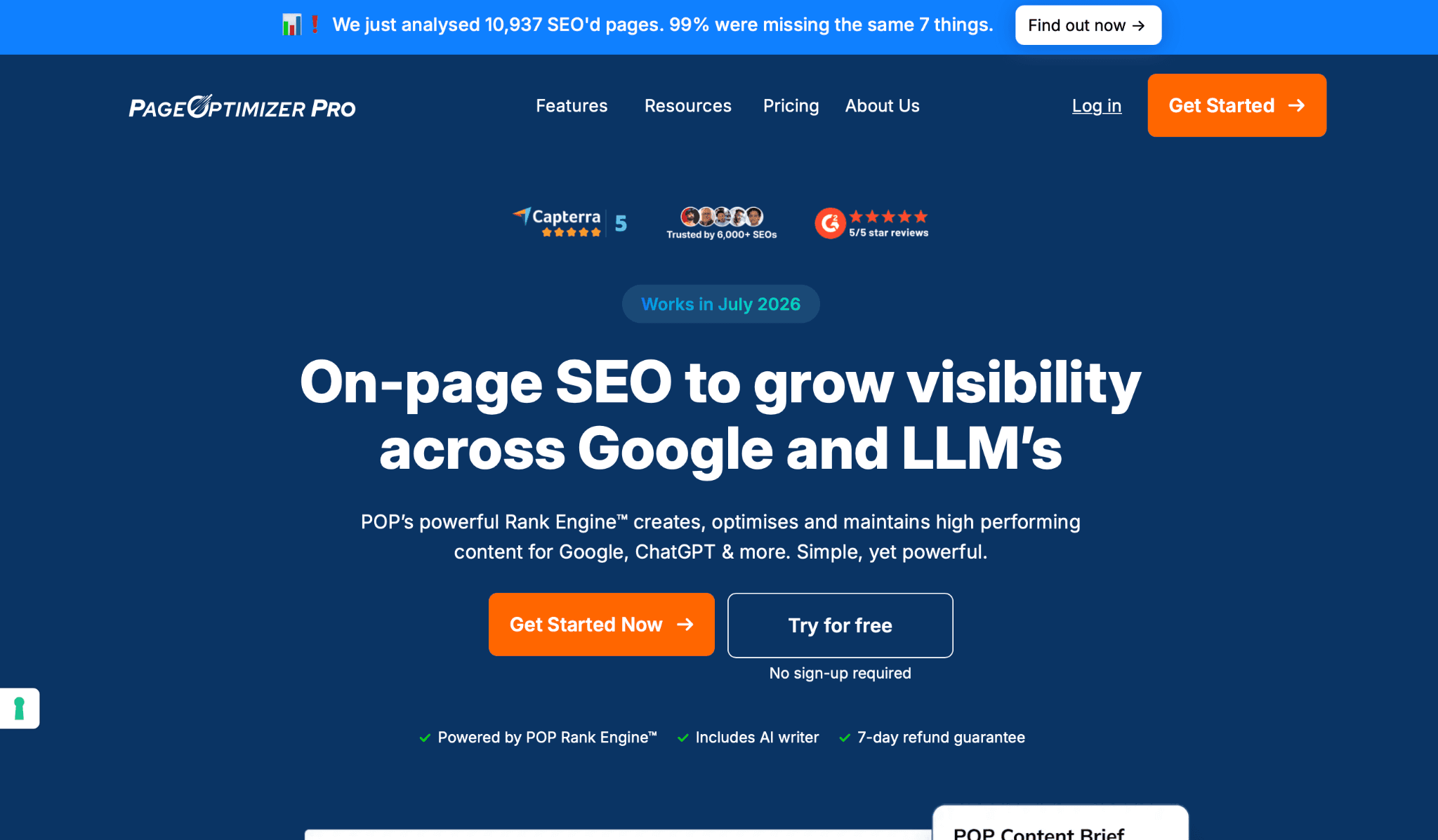
That experimental foundation is what makes POP distinct. The recommendations aren't pattern matching against competitor pages. They're derived from empirical evidence about what Google has actually rewarded in practice. You run a keyword through the tool and receive a report telling you, based on what's working in your specific SERP right now, exactly what your page needs and where. Google NLP analysis surfaces the entities Google has identified for your content and competitors, showing what you're missing. EEAT analysis audits Experience, Expertise, Authority, and Trust signals against competitor benchmarks. Watchdog monitors tracked pages for competitor changes and algorithm updates, flagging what specifically shifted and what to fix.
POP does none of this for AI search visibility. Every capability addresses traditional Google ranking.
Key features:
POP Rank Engine delivering recommendations grounded in 400+ real Google SEO experiments.
Google NLP integration surfacing entities and categories Google identifies for your content versus competitors.
EEAT analysis auditing E-E-A-T signals against competitor benchmarks.
POP Watchdog monitoring for competitor changes and Google updates with specific fix guidance.
AI Writer producing pre-optimized content using your own GPT-4 API key.
Keyword Strategy suite for clustering, intent classification, and research.
Pros and cons:
Pros:
Experiment-backed methodology gives verifiable justification for recommendations rather than black-box scoring
Watchdog tells you what changed and how to fix it specifically, not just that something dropped
Strong reputation among experienced SEO practitioners
Cons:
No AI search tracking at all. If AI visibility was part of your Rankability workflow, POP doesn't touch it.
The depth of recommendations is also an onboarding challenge. Teams without experienced SEO practitioners find the specificity difficult to action.
Credit system complexity across AI Writer, NLP, EEAT, and Watchdog requires active management.

G2 rating: 4.9/5 (5 reviews)
Pricing: Basic $40/mo (20 credits) | Unlimited $62/mo annual ($72/mo monthly, unlimited POP reports, 50 credits) | Teams $119/mo annual ($143/mo monthly, 120 credits, 5 sub-accounts)
Verdict:
POP is for the SEO practitioner who wants the most rigorous on-page data available and has the experience to use it. The methodology is genuinely distinctive. For teams that also need AI visibility tracking, pairing POP with AIclicks handles both jobs more specifically than Rankability does at any single tier.
9. Ahrefs: Best for teams needing the deepest backlink data with AI tracking as an available layer
About Ahrefs
Ahrefs has built the most comprehensive backlink index in the SEO industry. In 2025, it added Brand Radar: an AI visibility product drawing from 414 million organic prompts derived from actual search behavior covering ChatGPT, Perplexity, Gemini, Copilot, Google AI Overviews, AI Mode, and Grok.
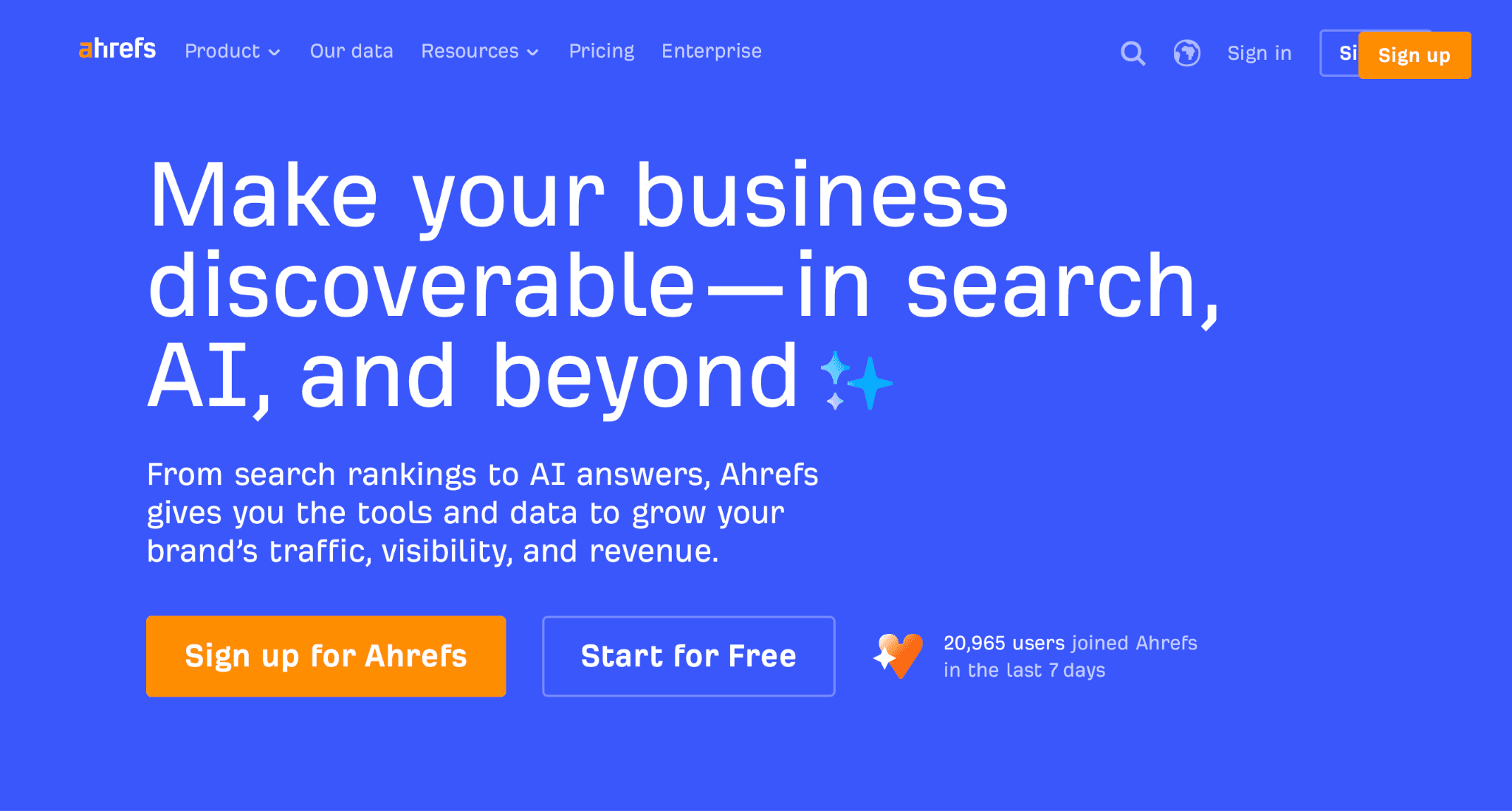
The methodology distinction matters. Most AI visibility tools track prompts researchers or users manually create. Ahrefs derives its prompt database from real search behavior, which means visibility data reflects what audiences are actually asking rather than what a team hypothesized they might ask. Brand Radar is purchasable as a standalone product without a base Ahrefs subscription. The AI Content Helper ($99/mo for 50 documents) adds content optimization targeting both traditional search and AI citations. Custom Prompts packages ($50-250/mo) let you track specific buyer-intent queries beyond the main Brand Radar database.
If you're already using Ahrefs for backlink analysis and competitive research, extending into AI visibility through Brand Radar keeps everything in one login. If you're coming to Ahrefs fresh primarily for AI visibility, the combined cost is worth working out before you commit: Lite at $129/mo plus Brand Radar one index at $199/mo totals $328/mo monthly with no annual discount on Brand Radar.
Key features:
Brand Radar tracking AI visibility across ChatGPT, Perplexity, Gemini, Copilot, Google AI Overviews, AI Mode, and Grok from 414M+ search-backed organic prompts.
Search behavior methodology: prompts from real keyword data and People Also Ask, not fabricated queries.
AI Content Helper ($99/mo, 50 documents) for content targeting both traditional search and AI citations.
Custom Prompts packages ($50-250/mo) for specific buyer-intent queries.
Ahrefs base suite from $129/mo: Site Explorer, Keywords Explorer, Site Audit, Rank Tracker.
Pros and cons:
Pros:
Brand Radar's real search behavior methodology produces more grounded AI visibility data than fabricated prompt sets
Brand Radar purchasable standalone without a base Ahrefs subscription
Backlink database and competitive research suite are best-in-class
Cons:
No annual billing discount on Brand Radar for self-serve customers.
Brand Radar shows visibility data. Deciding what to do with it stays entirely with your team.
Lite plus Brand Radar one index totals $328/mo. All-platform Brand Radar adds $699/mo.

G2 rating: 4.5/5
Pricing: Ahrefs Lite $129/mo | Brand Radar $199/mo (one AI index) or $699/mo (all 7 platforms) | Custom Prompts $50-250/mo | AI Content Helper from $99/mo (50 documents)
Verdict:
For teams already using Ahrefs who want AI visibility without another vendor, Brand Radar is a natural extension. For teams coming from Rankability primarily for AI visibility and an action plan, the total cost at $328/mo and the absence of an action layer make dedicated platforms a more direct path.
10. Peec AI: Best for mid-market teams wanting clean, focused AI visibility analytics
About Peec AI
In the twelve months after launch, Peec AI raised over $29 million, crossed 2,000 customers including Wix, ElevenLabs, Chanel, n8n, and Axel Springer, and hit a $100M+ valuation. The platform is Berlin-based with GDPR-first architecture and EU data residency, credentials that matter for European teams and regulated industries where data sovereignty isn't negotiable.
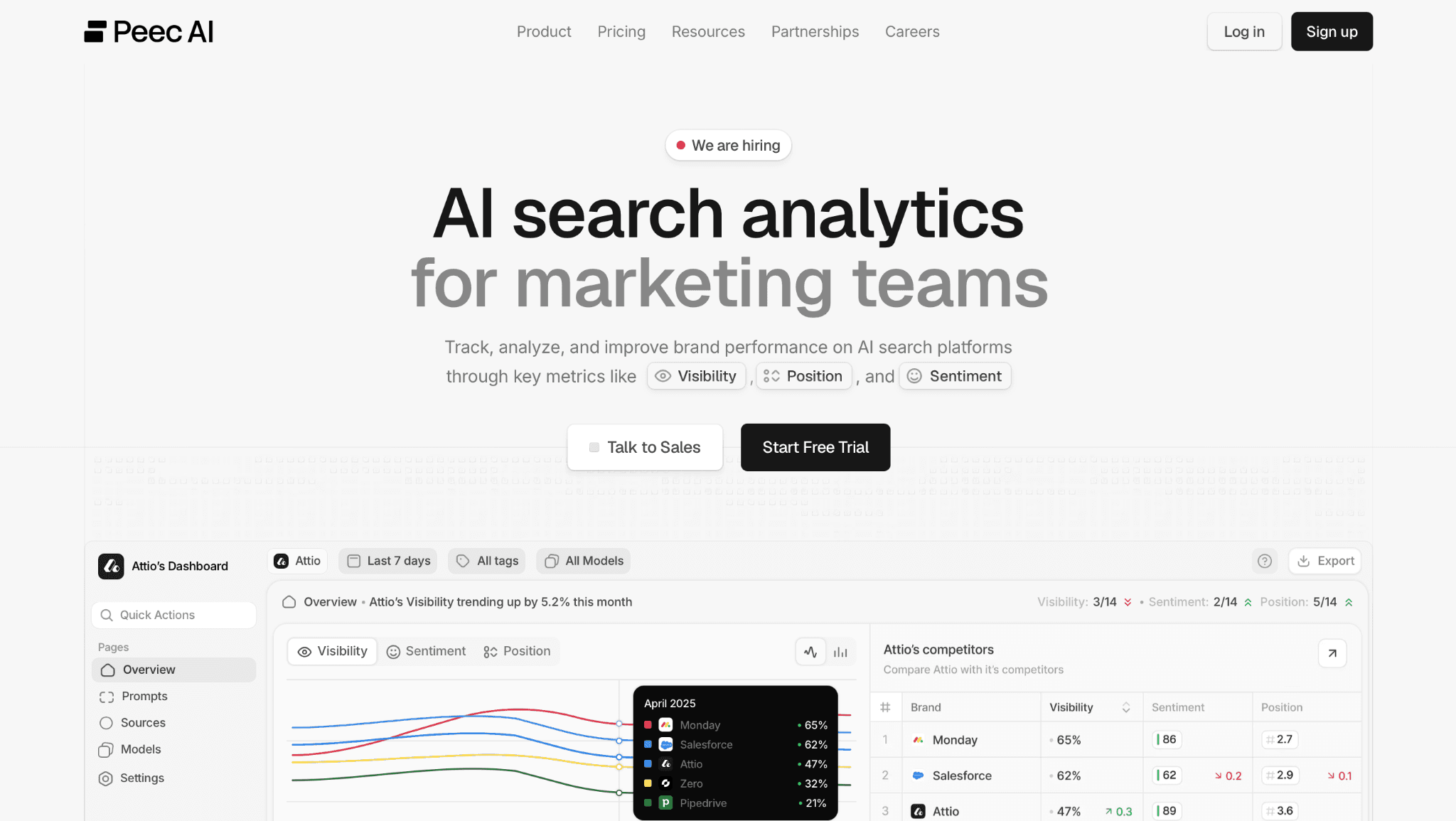
What reviewers keep coming back to is the cleanliness of the product and the directness of the support. Direct Slack access to the founding team on paid tiers is unusual at this stage of a company, and the 4.9/5 on G2 reflects it. The tracking covers your choice of 3 engines from a pool of 6 on self-serve plans (ChatGPT, AI Mode, Google AI Overviews, Microsoft Copilot, Perplexity, and Gemini) with Claude, DeepSeek, Qwen, and GPT-5 Search on Enterprise. Unlimited seats on every plan removes per-head friction for agencies. Looker Studio integration on Advanced plans makes client reporting straightforward.
The gap is execution. Peec shows you exactly where you stand. What to do about it stays with your team.
Key features:
Prompt tracking with choice of 3 engines from a pool of 6 on self-serve plans.
Unlimited seats on every plan including Starter.
Source and citation tracking organized by type: competitor, brand, citation, UGC, and editorial.
Sentiment analysis with alerts for negative shifts or inaccurate brand descriptions.
115+ language support, Looker Studio integration on Advanced plans.
Pros and cons:
Pros:
4.9/5 on G2 with direct Slack access to the founding team on paid plans
Unlimited seats makes per-seat economics attractive for agencies
GDPR-first with EU data residency
Cons:
3 engines from a pool of 6 on self-serve. Claude, DeepSeek, Qwen, and GPT-5 Search require Enterprise.
No content generation, no briefs, no action recommendations. Peec shows the gaps; closing them is external work.
Some users find the onboarding process difficult.

G2 rating: 4.9/5 (11 verified reviews, small sample size worth noting)
Pricing: Credit-based, approximately $89-95/mo for Starter per sources verified through May 2026. Verify directly at peec.ai before purchasing.
Verdict:
For teams that used Rankability's Track and want that analytics capability as a standalone product, without the content workflow, the credit complexity, or the agency seat structure around it, Peec delivers that cleanly. The EU data residency and unlimited seats are genuine differentiators for specific buyers.
If you want both the visibility data and an action plan from one platform, AIclicks covers both at a comparable price.
11. LLMrefs: Best for agencies tracking AI visibility from their existing keyword lists
About LLMrefs
The friction most AI visibility tools create for agencies is the prompt library. You have hundreds of keywords you're already tracking for clients. Now you need to rebuild a parallel set of prompts for AI visibility tracking. LLMrefs skips that step.
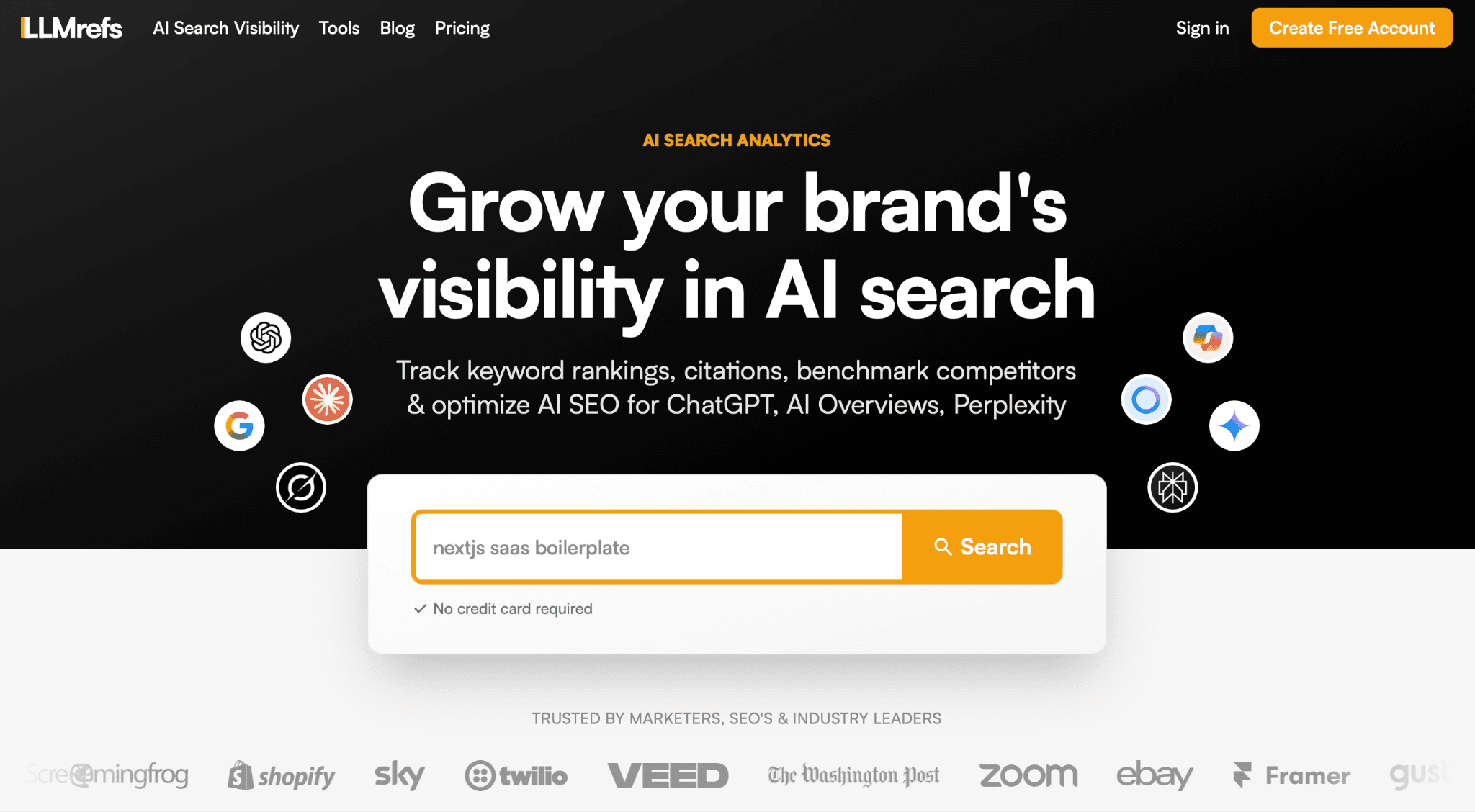
The platform takes your existing SEO keyword list and generates fan-out prompts automatically based on real AI user conversations, connecting AI visibility directly to the tracking infrastructure you've already built. Ten-plus engines covered with new models added automatically. Share of voice and position metrics are aggregated and weighted for statistical significance rather than directional estimates. One subscription, unlimited domains, unlimited team members.
Key features:
Keyword-based methodology automatically generating AI tracking from your existing SEO keyword list.
10+ AI engines tracked including ChatGPT, Google AI Overviews, AI Mode, Gemini, Perplexity, Claude, Grok, Copilot, Meta AI, and DeepSeek.
Statistically significant share of voice and position metrics.
One subscription covering unlimited domains and unlimited team members.
Citation source analysis with CSV export and API access.
Pros and cons:
Pros:
Keyword-based methodology extends existing SEO tracking into AI visibility without rebuilding from scratch
Unlimited domains and team members on one subscription makes agency economics clear
Cons:
No content optimization, no briefs, no action layer. LLMrefs surfaces visibility data and stops there.
Limited G2 presence makes independent support quality assessment harder than for established platforms.
Volume pricing requires a sales conversation, which introduces opacity at scale.
G2 rating: No rating on G2.
Pricing:Paid plans from €79/mo
Verdict:
For agencies with established SEO programs that want AI visibility without rebuilding tracking infrastructure in prompt format, LLMrefs is the most frictionless path. Unlimited domains and team members on one subscription keeps the per-client economics simple.
For teams that need an action layer alongside the data, pairing LLMrefs with a content tool covers both sides. For tracking and recommendations in one product, AIclicks addresses both.
12. Knowatoa: Best for teams wanting AI visibility monitoring with optimization guidance
About Knowatoa
Seven AI platforms tracked (ChatGPT, AI Overviews, AI Mode, Claude, Gemini, Meta AI, and Perplexity) with Starter covering the first three and Growth unlocking all seven with daily updates and a full reporting stack. The monitoring shows which AI answers you're absent from, which sites AI models trust in your category, where competitors appear and you don't, and how brand sentiment is shifting.
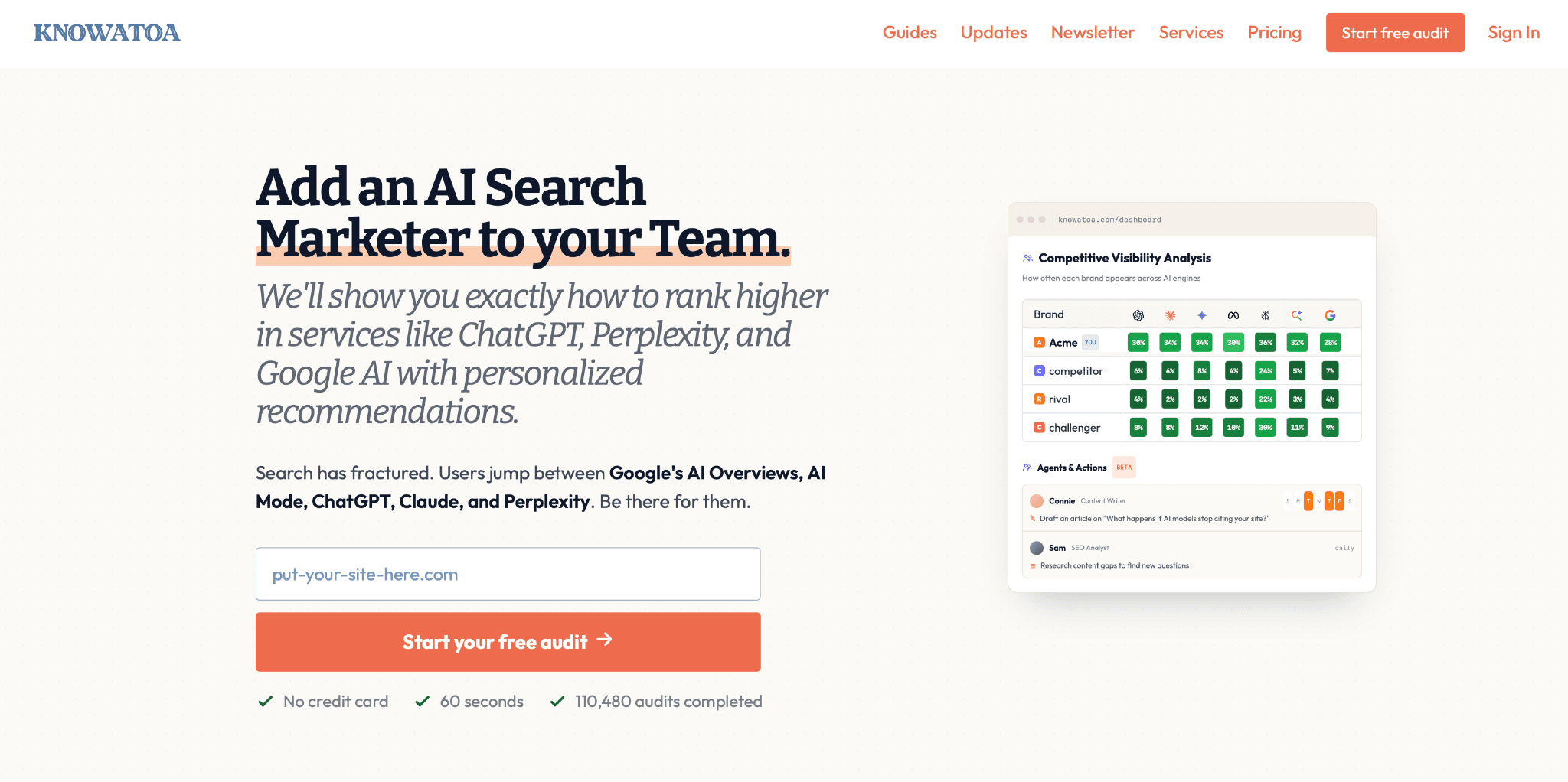
What separates Knowatoa from pure monitoring tools is the AI agents layer that generates specific recommendations for what to publish to close identified visibility gaps. The Growth reporting stack makes it deployable for agencies delivering AI visibility services to clients. A free audit is available before creating an account, which is genuinely useful for teams that want to see the data on their own brand before committing to anything.
The step between Starter and Growth is steep: $59/mo covering three platforms jumps directly to $199/mo for all seven, with no middle tier. Teams that need Claude, Gemini, Meta AI, or Perplexity tracking pay $199/mo from day one.
Key features:
Seven AI platforms tracked: ChatGPT, AI Overviews, AI Mode, Claude, Gemini, Meta AI, and Perplexity.
Competitor visibility gap analysis organized by gap type and priority.
Source intelligence identifying which sites AI models trust most in your category.
Brand sentiment alerts for inaccurate or negative AI descriptions.
AI agents generate specific publish recommendations to close visibility gaps.
Growth reporting stack: API access, MCP integration, Looker Studio connector.
Pros and cons:
Pros:
Seven-platform daily coverage with structured optimization guidance at $199/mo on Growth
Reporting stack on Growth is agency-deployable for client reporting
Free audit before account creation
Cons:
Starter to Growth is a $140/mo jump with no intermediate option. Teams needing Claude or Gemini pay $199/mo from day one.
Limited G2 presence makes independent reliability and support assessment harder.
No content creation tools. AI agents recommend what to publish; writing is external.
G2 rating: No G2 listing.
Pricing: Starter $59/mo (ChatGPT, AI Overviews, AI Mode) | Growth $199/mo (all 7 platforms, full reporting stack) | Enterprise custom
Verdict:
Knowatoa earns its place for teams that want a clean monitoring-plus-guidance product with agency-ready reporting. The seven-platform daily coverage and Looker Studio connector make it practical for smaller agencies delivering AI visibility to clients.
Before committing to $199/mo for all seven platforms, compare AIclicks at $189/mo, the engine coverage is comparable and the action layer goes deeper.
How to Choose the Right Rankability Alternative
Figure out which part of Rankability you were actually using.
Six tools, one credit pool. If Track and Serena were what you opened every week and the content tools were background overhead, you're shopping for a dedicated AI visibility platform. If Research and Create were the core workflow and Track was secondary, you're shopping for a content optimization tool. If you used all six genuinely, be honest: no single alternative matches that breadth in one product. Know which job is primary before you spend time evaluating feature lists.
Does your team need the platform to tell you what to do, or can it figure that out from data alone?
Peec AI, LLMrefs, and Knowatoa show you where you stand in AI search clearly and stop there. AIclicks, and to some extent Surfer and Jasper, produce specific work from the visibility data, content to create, sources to pitch, communities to enter. If you left Rankability partly because the action guidance wasn't specific enough for your needs, check whether the alternative actually closes that gap or just offers a different dashboard.
Work out the real monthly number before you decide.
Surfer's entry plan is $119/mo but covers ChatGPT only on a weekly refresh. Multi-engine daily tracking requires Pro at $219/mo. Semrush AI Visibility is $99/mo per domain as a standalone product. Ahrefs' Brand Radar adds $199/mo for one AI index on top of the Ahrefs base plan. SE Ranking's combined monthly cost for Core, AI Search add-on, and white-label reporting lands significantly higher than the $129/mo headline. Write down the engines you need, your seat count, and white-label if relevant. Price that exact combination across your shortlist. The answer is almost always different from the number you had in your head.
Go With the #1 Rankability Alternative: AIclicks
No tool on this list does what Rankability does across all six tools in one connected workspace. That's worth saying plainly, because a lot of alternative articles pretend there's a perfect drop-in replacement when there isn't.
What AIclicks does is handle the AI visibility piece as the whole product, not one tool among six in a platform priced for agencies. Both platforms cover 10 AI engines. The difference is that AIclicks is built entirely around what you do with that tracking data: an Actions engine that converts every finding into a prioritized work list, a Competitors tab that traces which sources power the brands beating you in AI answers, a Sources tab that turns your category's citation landscape into concrete outreach and content targets.
For teams where AI visibility tracking was the job, AIclicks does that job without the credit opacity, without the client-count architecture, and at a price you can predict before the month ends.
Start your free AIclicks trial and see where your brand stands across AI search, and get your action plan in minutes.
Frequently Asked Questions
1. What is Rankability, and why do people look for alternatives?
Rankability is an agency-focused SEO and AI search platform combining six tools: Track (Google, AI, local, and video visibility across 10 AI engines), Research, Create, Audit, Promote, and Serena, in one credit-based workspace. Teams look for alternatives primarily because credit costs are invisible before running automations, because the client-count plan structure doesn't fit every buyer, and because the platform's feature scope and pace of change can be difficult to navigate.
2. What is the cheapest Rankability alternative?
Outranking starts at $39/mo for content optimization. SEO.ai starts at approximately $49/mo. AIclicks starts at $59/mo with 10+ engine AI visibility tracking and a built-in recommendations engine. The right answer depends on which part of Rankability you're replacing.
3. Which alternative is best for AI search visibility?
AIclicks covers 10+ engines through real user interfaces with a Recommendations engine that converts visibility data into prioritized tasks. You can check where your brand currently stands with the free GEO visibility checker. For pure analytics without an action layer, Peec AI and LLMrefs are strong options at comparable prices.
4. Which alternative is best for content optimization?
Surfer SEO is the most direct replacement for Rankability's Create and Track tools combined. Page Optimizer Pro is the most rigorous for on-page optimization. Outranking is the most streamlined for brief creation. Jasper AI is best for marketing departments needing on-brand content at scale with GEO capabilities built in.
5. Does Rankability have an action layer?
Yes. Serena, included on every plan, is described as an AI search agent that reads your data and tells you exactly what to do. The platform also has Research, Create, Audit, and Promote feeding into a connected workflow. The credit opacity issue is about the cost of running those tools, not their absence.
6. Is GEO worth investing in for SEO-focused agencies?
GEO has moved past the experimental phase. AI search now influences a meaningful share of how buyers discover and evaluate vendors across enough categories that "whether to invest" is no longer the right question.
Our Content:




Any questions left?
Book a call here: