
" width="14px"><path d="M 13.864 5.629 L 13.3 5.629 L 13.3 5.6 L 7 5.6 L 7 8.4 L 10.956 8.4 C 10.379 10.03 8.828 11.2 7 11.2 C 4.681 11.2 2.8 9.319 2.8 7 C 2.8 4.681 4.681 2.8 7 2.8 C 8.071 2.8 9.045 3.204 9.786 3.864 L 11.766 1.884 C 10.516 0.719 8.844 0 7 0 C 3.134 0 0 3.134 0 7 C 0 10.866 3.134 14 7 14 C 10.866 14 14 10.866 14 7 C 14 6.531 13.952 6.073 13.864 5.629 Z" fill="rgb(255, 193, 7)" height="14px" id="H_YjfTNpn" width="14px"/><path d="M 0 3.742 L 2.3 5.429 C 2.922 3.888 4.429 2.8 6.193 2.8 C 7.264 2.8 8.238 3.204 8.979 3.864 L 10.959 1.884 C 9.709 0.719 8.037 0 6.193 0 C 3.504 0 1.172 1.518 0 3.742 Z" fill="rgb(255, 61, 0)" height="5.428500000000002px" id="PlkthQDhg" transform="translate(0.875 0)" width="10.959199999999996px"/><path d="M 6.232 5.581 C 8.04 5.581 9.683 4.889 10.925 3.764 L 8.758 1.931 C 8.032 2.483 7.144 2.782 6.232 2.781 C 4.411 2.781 2.865 1.62 2.283 0 L 0 1.759 C 1.159 4.026 3.511 5.581 6.232 5.581 Z" fill="rgb(76, 175, 80)" height="5.581099999999999px" id="WlnJ5gngE" transform="translate(0.7 8.4)" width="10.924899999999994px"/><path d="M 6.864 0.029 L 6.3 0.029 L 6.3 0 L 0 0 L 0 2.8 L 3.956 2.8 C 3.68 3.576 3.183 4.254 2.526 4.75 L 2.527 4.749 L 4.693 6.582 C 4.54 6.722 7 4.9 7 1.4 C 7 0.931 6.952 0.473 6.864 0.029 Z" fill="rgb(25, 118, 210)" height="6.589883930775992px" id="x_rSW275p" transform="translate(7 5.6)" width="7px"/></g></svg>)


Reviewed by:
Rokas Stankevicius

Founder @ aiclicks.io
Last updated:
Expert Verified

Key Takeaways
Ranking gets you considered, not cited. Only about 38% of AI Overview citations now come from Google's top 10, down from 76% a year earlier. Keep doing SEO, because it qualifies you, but a top ranking no longer guarantees the citation.
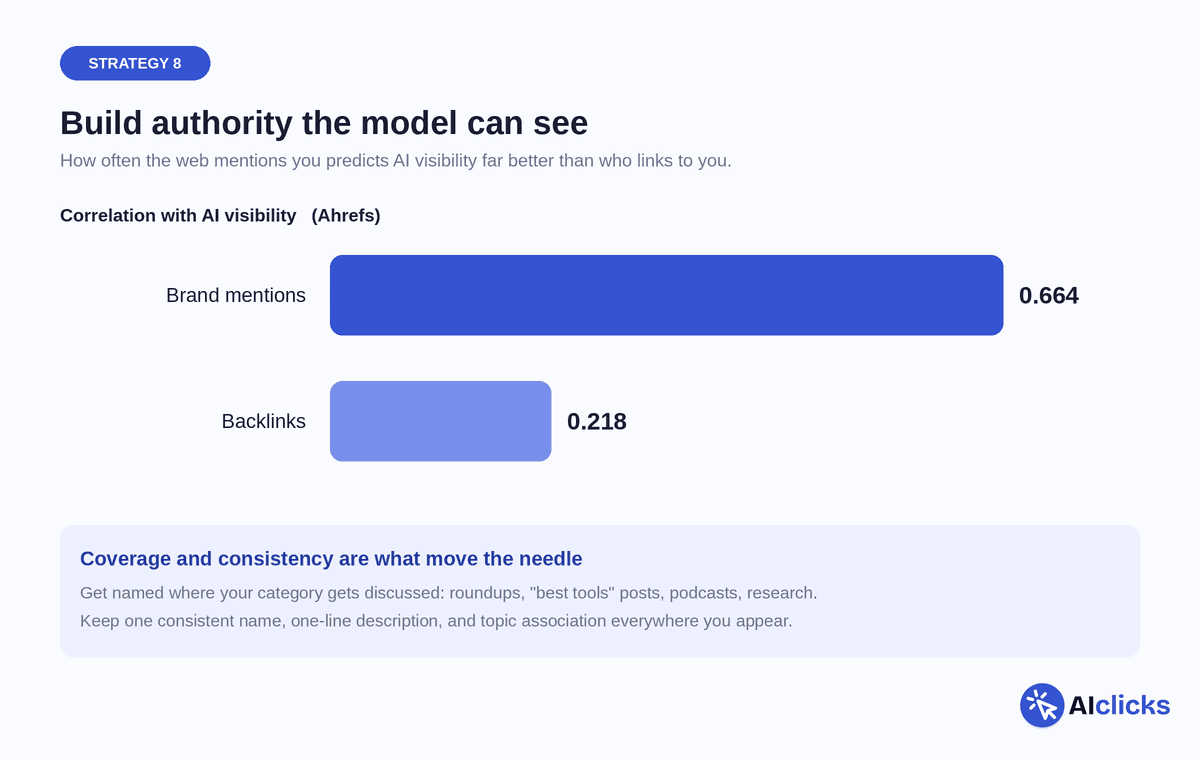
Brand mentions matter more than backlinks. Ahrefs found mentions correlate with AI visibility at 0.664, against 0.218 for backlinks. What most affects whether you get cited usually happens off your page.
The flashy tactics barely move the needle. Google stated plainly in May 2026 that there's no special schema, no llms.txt, and no "chunking" requirement for AI search.
Clicks are falling and won't recover. An AI Overview takes 58% of the clicks away from the number-one result. The job now is to get cited in the answer, because ranking beneath it pays less every quarter.
Original, answer-first content wins citations. Google says original content affects your AI visibility more than anything else it recommends. Write the clear answer first, then add the detail underneath.
Most of what you've been told about ranking in AI Overviews is wrong, and for once I can prove it instead of just asserting it.
In May 2026, Google published its first official guide to showing up in AI search. It dismisses most of the popular advice outright: you don't need special schema, you don't need an llms.txt file, you don't need to break your pages into smaller pieces, and you don't need to rewrite your sentences for the machines.
The single thing Google said matters most is original content.
This is worth paying attention to because the cost of getting it wrong keeps climbing. An AI Overview now takes 58% of the clicks away from the number-one result, and the feature already appears across 48% of industries. A page can rank first and still vanish from the answer the moment a summary appears on top of it.
At AIclicks, we track which brands get cited across AI Overviews, AI Mode, ChatGPT, Perplexity, and Gemini. So this isn't a theory but what I see in the citation data every week.
This blog post covers a list: 10 things that actually correlate with showing up in an AI Overview, each with the evidence behind it.
What are AI Overviews?
AI Overviews are the AI-generated answers Google places at the very top of its search results, above the regular links.
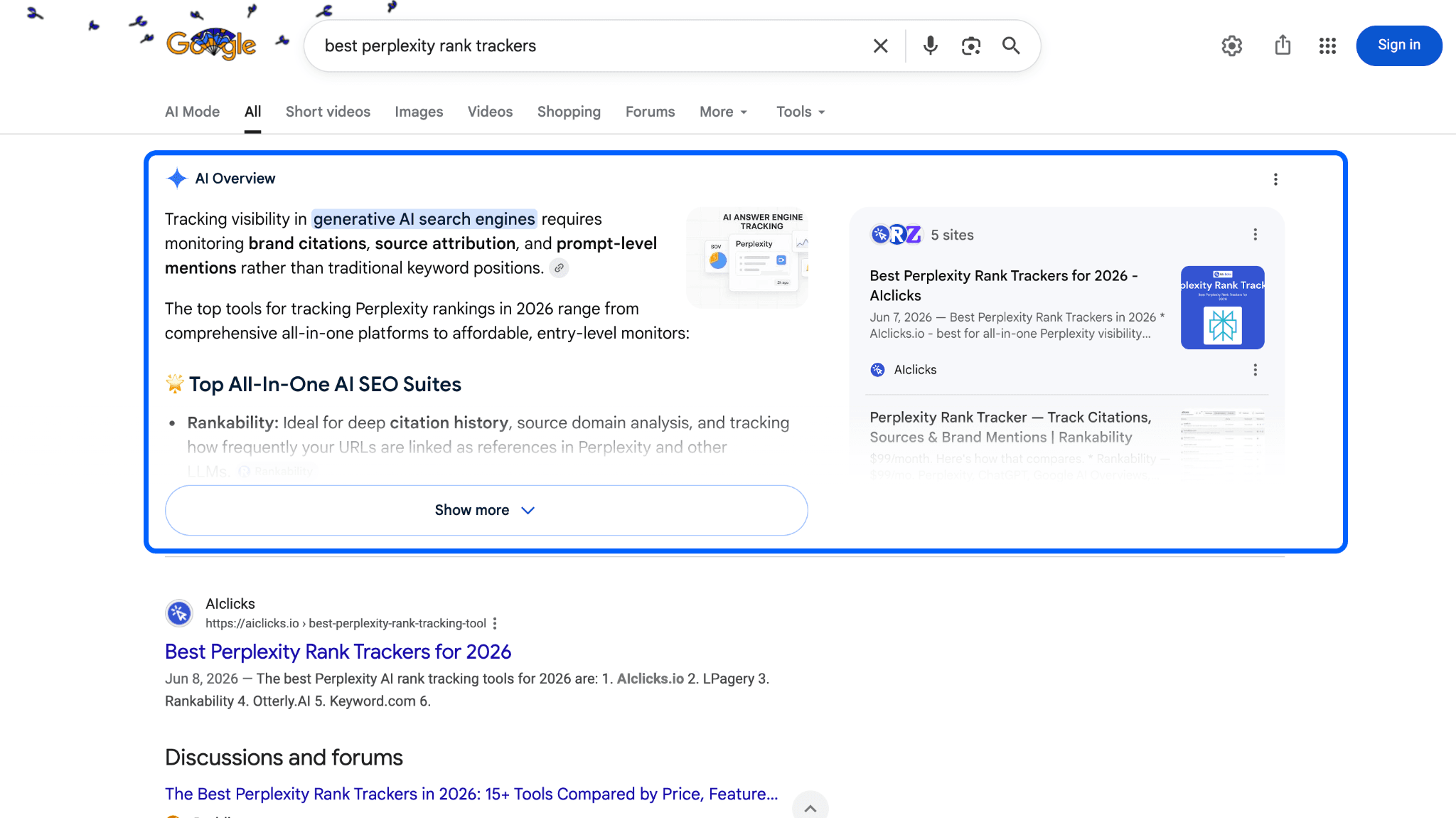
Google reads your query, pulls relevant passages from several web pages, and writes a short summary with a few of those pages cited inline. They run on a custom version of Gemini and pull from the same search index that powers normal results.
They began as the Search Generative Experience in 2023, became "AI Overviews" in 2024, and by 2025 had rolled out to more than 200 countries. Today they show up on a large share of searches.
BrightEdge tracked them across 48% of industries, and in health, education, and research they appear closer to 80% of the time.
One thing to clear up early, since it changes how you read the rest of this post: there's no position one inside an AI Overview. Ranking in one really means getting your page picked as a source the answer cites. So when I say "rank in AI Overviews," I mean earn the citation.
The other thing that trips people up is how an AI Overview differs from a featured snippet. A snippet lifts one passage from one page and links straight to it. An AI Overview builds a fresh answer from several sources at once, using a process called query fan-out, which is why the page that gets cited often isn't the one ranking first.
For most informational questions, the AI Overview is now the answer the reader actually reads, and your link is one of a few citations sitting underneath it, assuming you made it in at all.
If you're optimizing for AI answers beyond Google, here's the broader playbook on how to rank in AI search results.
How Google Chooses Which Sources To Cite
Two details about the selection process explain most of what follows, so it's worth a minute before the tactics.
When you search, Google expands your one question into a set of related sub-questions, runs them all at once, takes the most useful passage from each result, and assembles those passages into a single answer with a handful of citations.
That expansion is query fan-out, and Google has confirmed it uses the technique. AI Mode queries run about twice as long as classic searches, which hints at how much extra ground each prompt covers behind the scenes.
Studies that reverse-engineer the pipeline suggest Google narrows a few hundred candidate pages down to roughly 5 to 15 cited sources, filtering for relevance, quality signals like E-E-A-T, and how cleanly a passage answers a sub-question. Two things follow:
Google pulls at the passage level, so one clear, self-contained answer can get cited even when the rest of the page is average.
Google judges you on questions you never see. You can own the headline query and still miss out because someone answered a hidden sub-question better.
Almost every tactic below is a response to one of those two facts.
If you are targeting all AI tools, here’s our quick guide on how to get cited by AI.
How to Rank in AI Overviews: 10 Strategies That Actually Work
I've put these in roughly the order you'd run them, from finding the right queries to maintaining the pages that win. The first four are research, the middle four are the writing, and the last two are the parts most teams skip.
Let’s get started! ✨
1. Go after the queries that actually trigger AI Overviews
The easiest way to waste time is to optimize every page for AI Overviews when most of your queries never trigger one. Stop doing that.
AI Overviews show on a slice of searches, so the first job is finding those queries and aiming your effort there.
Where they trigger is settled data. Ahrefs studied 146 million SERPs and found AI Overviews on 21% of all keywords, 57.9% of question queries, and 46.4% of queries with seven or more words, with "why" questions topping the list at 59.8%.
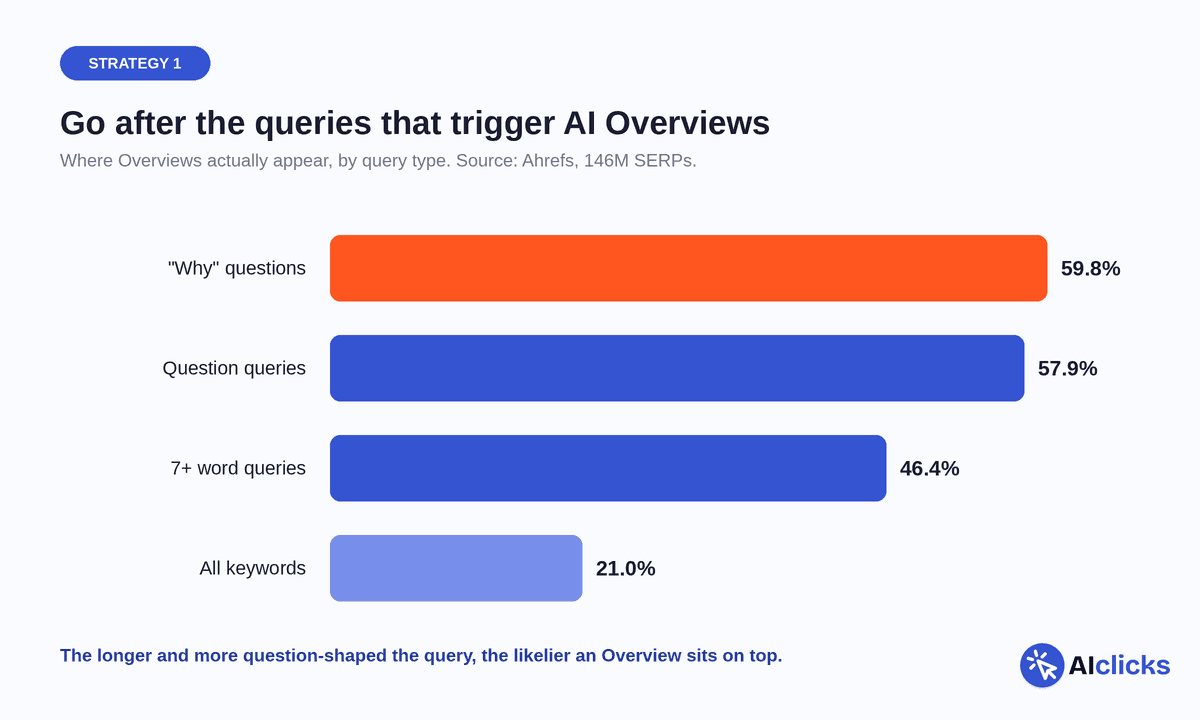
The pattern is blunt: the longer and more question-shaped the query, the more likely an Overview sits on top of it. Short head terms mostly still return a plain page of links.
That tells you where AI Overviews appear. It says nothing about which ones are worth winning, and that is where most prioritization breaks.
Plenty of Overviews sit on informational queries, where the reader gets the answer in the box and never clicks through. You can win that citation and get nothing back. I start with comparison, "best," and how-to-buy queries, where people still open a source before they commit. Win those first. Volume is a tiebreaker, not the target.
Do this: Export your tracked keywords with the SERP-feature column, filter to the ones that trigger an AI Overview, then sort that subset by commercial intent ("best," "vs," "alternatives," how-to-buy) and start at the top.
2. Start with pages you already rank for but aren't cited in
This is the fastest win on the board, and most teams walk straight past it.
Build one list: queries where an Overview appears, you already rank in the top 10, and you're not in the citations.
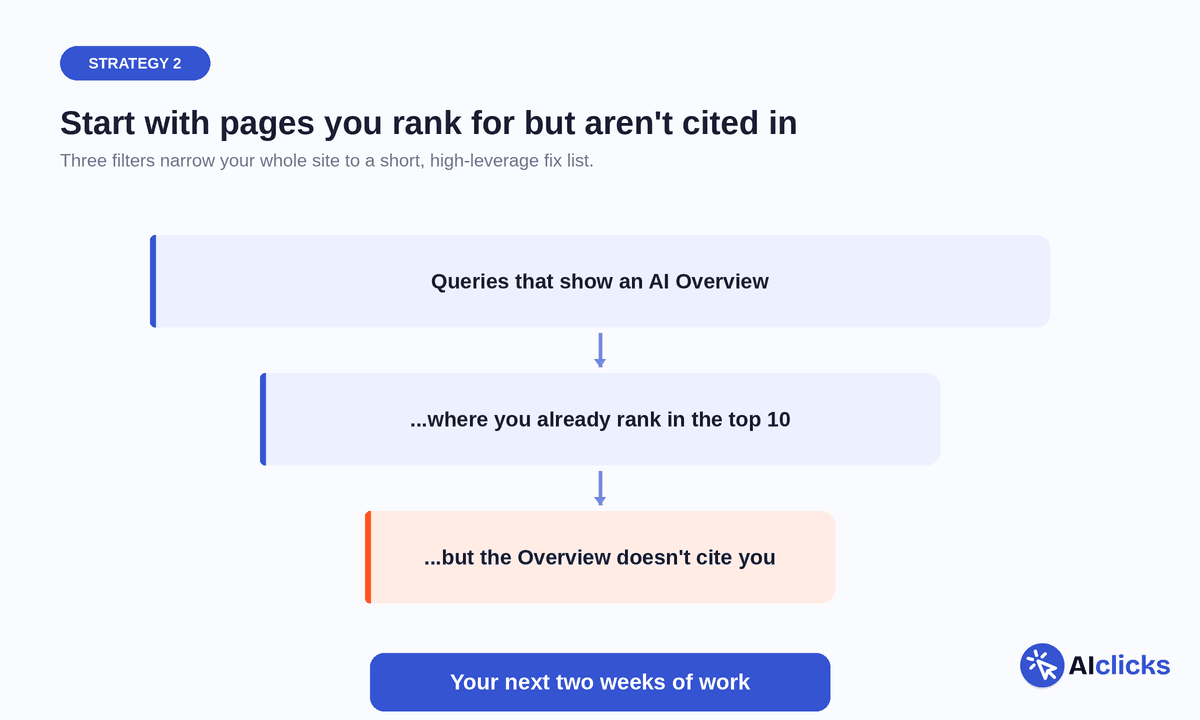
Those pages have cleared the hard part. Google already trusts them enough to rank them. They are just not structured or complete enough to get pulled into the answer yet, and that is a far smaller fix than starting a page from zero.
This is also the highest-leverage place to begin, because you are editing proven pages instead of betting on new ones. You skip the slow part, earning enough authority to rank, and go straight to the part that wins the citation.
Do this: Pull your top-10 ranking queries from Search Console (or Ahrefs) and keep the ones that show an AI Overview. Then check which of those Overviews leave you out. In AIclicks, any of those queries you track as prompts show citation status directly, cited, mentioned, or absent, next to the competitors getting cited in your place. Fix that set before you write a single new page.
3. Reclaim the answers that name you but cite someone else
There's a gap even narrower than ranking-but-not-cited, and it's the highest-intent fix you'll find: AI Overviews that already mention your brand in the answer, then link a competitor as the source.
Read what that actually means. The AI didn't learn about you from your own site. It learned about you from someone else's page, a roundup, a review, a Reddit thread, a rival's comparison, and that page is the one collecting the citation. You're already in the answer, just not the source it trusts.
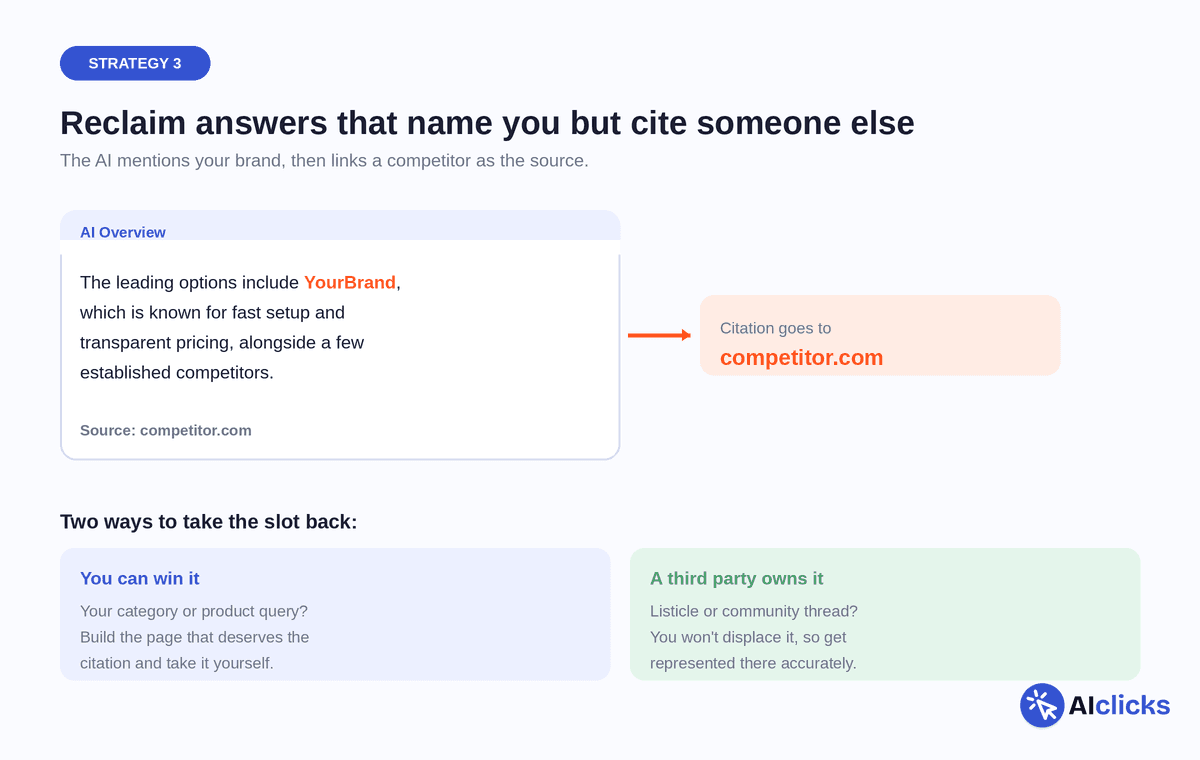
That splits into two jobs, and picking the wrong one wastes the signal:
If it's a query you should own with your own asset (your category, your product, a comparison you can write better than anyone), build the page that deserves the citation and take the slot yourself.
If the cited source is a listicle or community thread that structurally wins these answers, you won't displace it with your own page. The move is to make sure that page represents you accurately. That's brand-mention work, not on-page work.
Either way, a mention you don't control is brand equity sitting in someone else's account.
Do this: In AIclicks, pull the mentioned but not cited prompts and open the source the AI actually credited for each. If it's a page you can beat with your own, write it. If it's a third-party page that owns the slot, log it as a mention target and get yourself represented there, accurately.
4. Reverse-engineer the AI Overview you're trying to crack
Before you write a word, study the AI Overview that's already winning.
Run your target query and read the answer Google assembled. Then click into every source it cited and log two things: each claim the answer makes, and which page fed it. Ten minutes of this tells you which points Google treats as essential, which sources it leaned on hardest, and where the answer is thin or repeating itself.
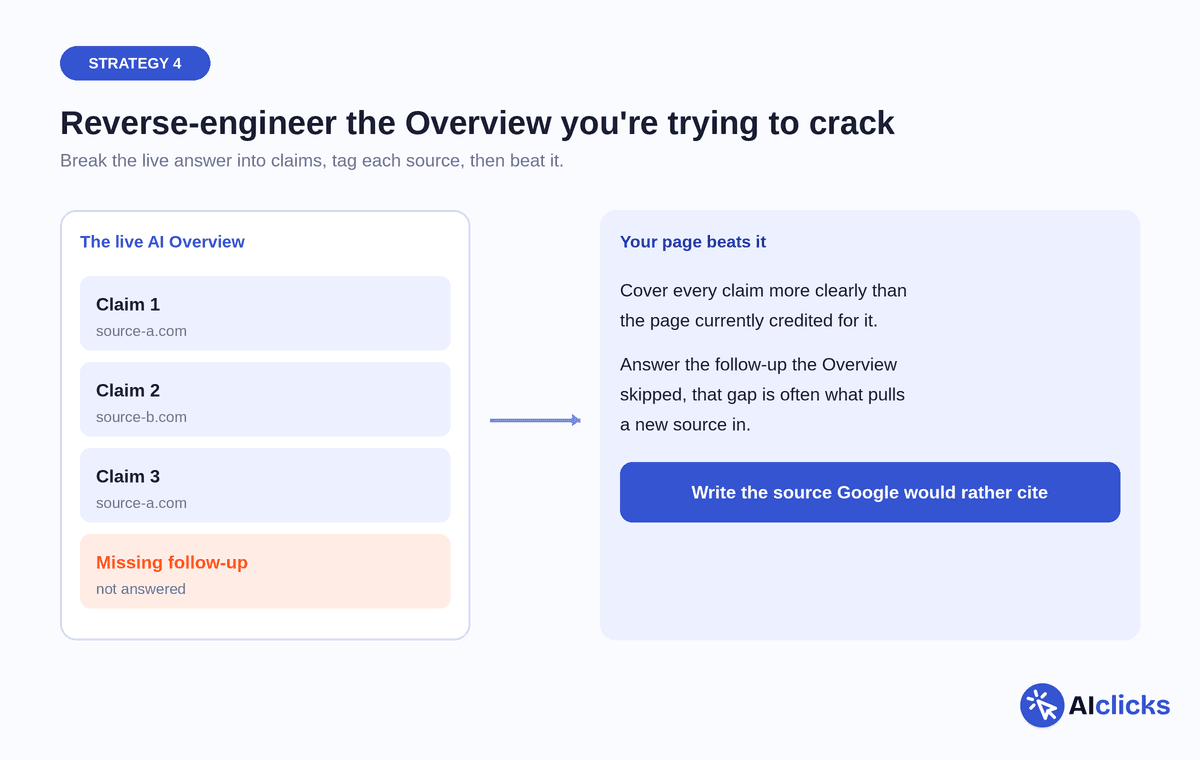
That list is your brief. Take every claim in it and cover the same ground more clearly than the page currently credited for it. Then answer the obvious next question the AI Overview skipped, because that gap is often what gets a new source pulled in.
This way you already have the answer Google assembled, so write the one it would rather cite.
Do this: Map the live Overview claim by claim, note the source behind each, then build your outline to beat every claim and add the one question it left unanswered.
5. Write answer-first passages a model can lift
Google pulls at the passage level, so every section has to survive on its own.
Open each one with a direct answer, two to three sentences, roughly 40 to 60 words, with the key fact in sentence one. Keep the full unit self-contained at around 130 to 170 words, then layer the depth underneath. Phrase the H2 as the question a real person would type.
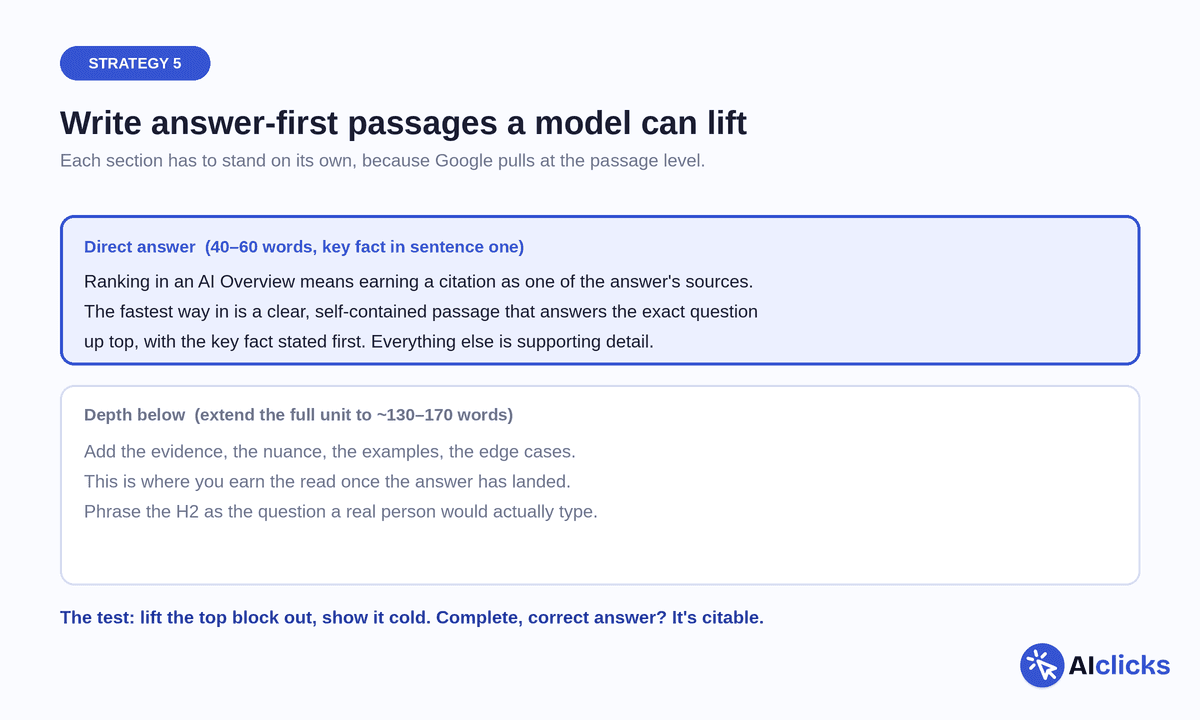
Here's the test before you publish a section. Lift that opening paragraph out, hand it to someone cold, and see if they get a complete, correct answer with no other context. If they don't, it's buried too deep to be cited.
One clarification, because the hack-sellers love to muddy this: Google said you do not need to shred your page into fragments or write in robotic, stripped-down sentences. Clear and self-contained is the whole ask. Nothing more exotic than that.
Do this: For each section, write the answer first in one liftable paragraph, then ask whether it stands alone with zero surrounding context. If not, rewrite until it does.
6. Optimize for intent and entities, not just keywords
Exact-match optimization is mostly wasted on AI Overviews, because the answer rarely repeats the query word for word.
Google's model reads for meaning: the concept behind the question, the entities involved, and what the searcher actually wants. A page stuffed with the literal keyword but thin on substance loses to one that genuinely covers the topic. The match it's grading isn't string against string. It's your page against the real intent.
So before you write, list the entities and sub-intents a complete answer has to include: the people, tools, terms, and adjacent questions a knowledgeable source would mention without being prompted.
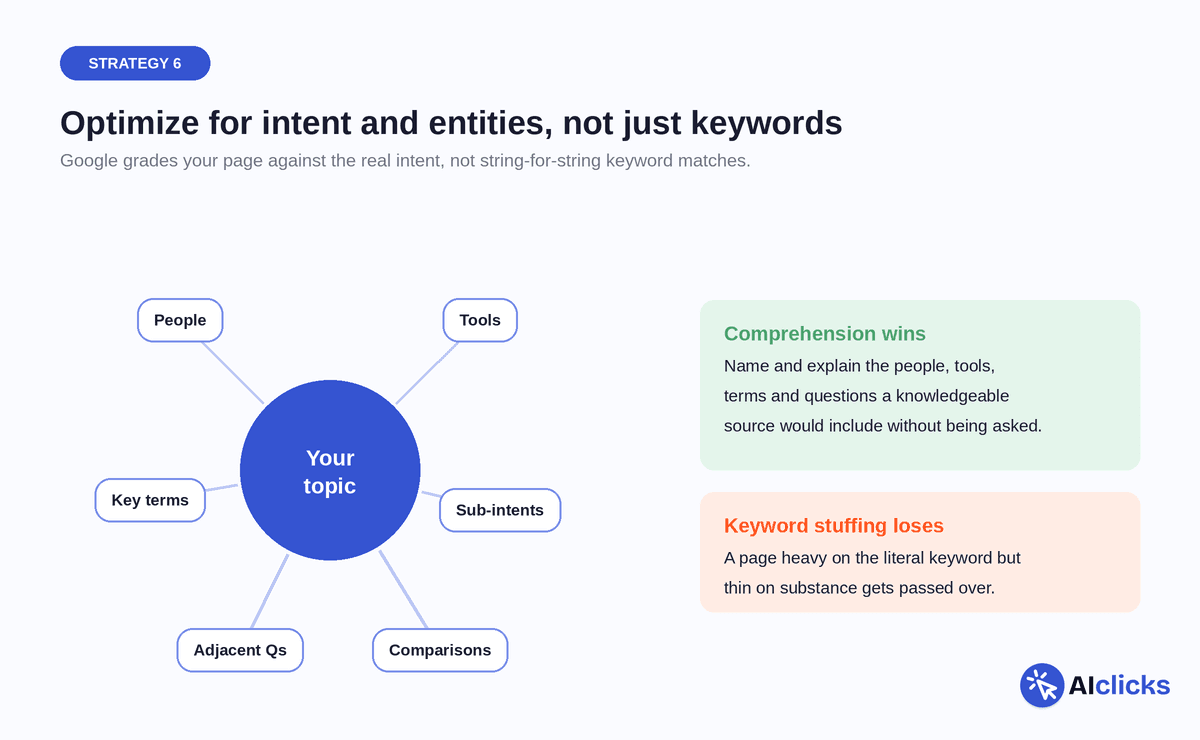
Then make sure your page names them and explains them. You're optimizing for comprehension, and the model cites the page that demonstrates it.
Do this: List every entity and sub-intent a credible answer would cover, then check your draft names and explain each one. Fill the gaps before you publish.
7. Answer the whole question, including the fan-out
This is where pages that rank well still lose the citation.
Google fans your query into related sub-questions and rewards the source that answers several of them in one place. For "how to rank in AI Overviews," the fan-out likely includes "what triggers an AI Overview," "do they use schema," and "how does Google pick its sources." A page that covers the full set gives Google reason after reason to keep quoting it.

Map those sub-questions before you write, using AlsoAsked, Google's People Also Ask, or an LLM to expand your seed query. Build one page that answers all of them, with subheads that match. Resist the urge to split each into its own thin page, because the fan-out rewards the single page that holds the topic together.
This is also how a result at position three slips into the Overview ahead of position one. It answered a sub-question the top page didn't.
Do this: Expand your seed query into its fan-out, then build subheads that answer each sub-question on one page instead of scattering them across several.
8. Build authority the model can see
The biggest factor in whether you get cited often is whether the rest of the web already talks about you in connection with your topic.
Ahrefs found brand mentions correlate with AI visibility at 0.664, against 0.218 for backlinks, so how often the web talks about you predicts citations far better than who links to you.
The reason is straightforward. These systems recognize brands as entities, and an entity the web describes consistently, same name, same topic, is one they can surface with confidence. So coverage and consistency are what move the needle, not a single big link.
Two things to work on. First, get named where your category actually gets discussed, the roundups, the "best tools for X" posts, the podcasts, the expert quotes, the research other people publish. Second, stay consistent about who you are, with the same name and the same one-line description and the same topic association everywhere you show up.
One caution Google put in writing: don't manufacture this with paid or synthetic mentions, because the spam systems that catch it in normal search feed the AI features too.
Do this: List the five pages or shows where your category gets discussed most, get your brand named in each with one consistent description, and keep it honest, no paid or synthetic mentions.
9. Make sure AI can actually crawl and read your page
This is the most overlooked point on the list, because it stays invisible until you check. None of the work above matters if Google can't fetch and parse your content in the first place. A genuinely strong page can sit there for months, uncited, for a reason no one ever looks at.
Run the basics:
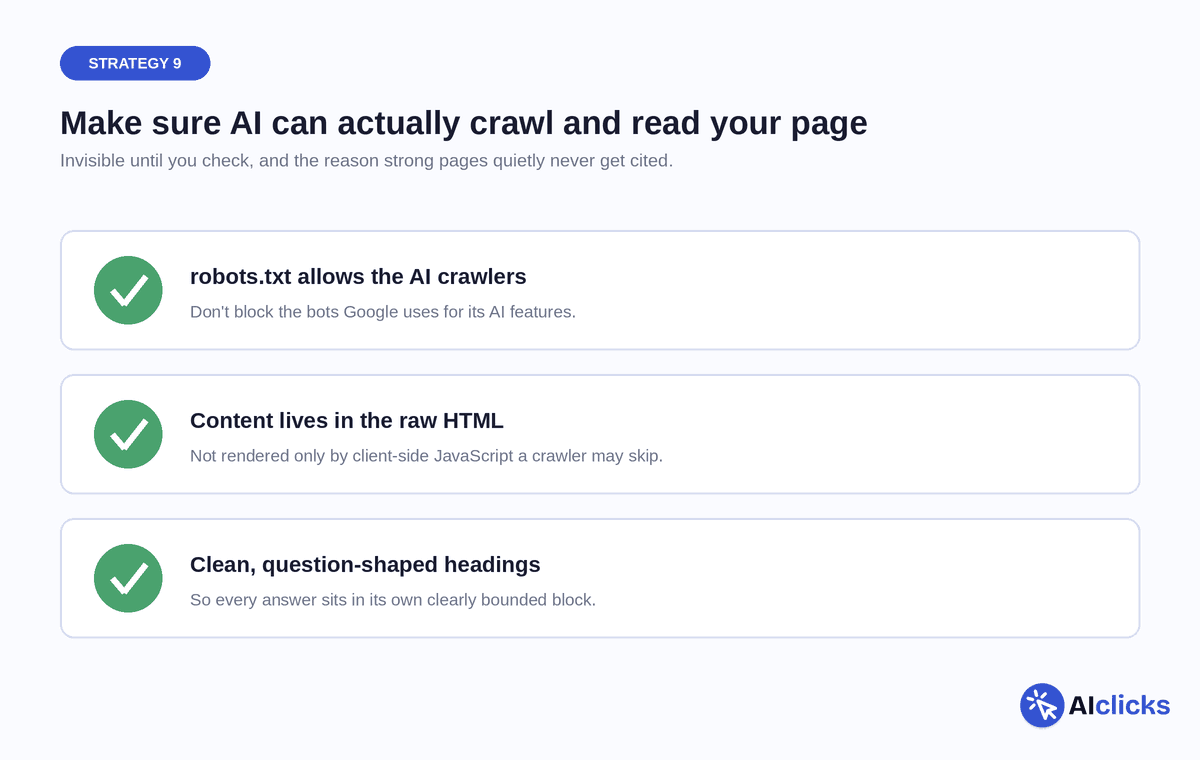
Check robots.txt and confirm you're not blocking the crawlers Google uses for its AI features.
Make sure your key content lives in the raw HTML, not rendered only by client-side JavaScript a crawler might skip.
Keep load times sensible and your heading structure clean, so each answer sits in its own clear block.
It isn't glamorous and it isn't where the hot takes are. It's also the first thing I'd check when a page that should win keeps losing, because it takes an afternoon to rule out and quietly sinks pages that did everything else right.
Do this: Confirm AI crawler access in robots.txt, load your page with JavaScript disabled to see what actually renders, and clean up the headings so every answer sits under a clear, question-shaped subhead. Try AIclicks AI Crawlability Checker.
10. Measure citations and share of voice, then maintain
The metric most teams still report, organic clicks from AI Overview queries, measures the wrong thing and gets worse at it every quarter. Once an answer box sits on top of a query, the citation is what holds your share of the clicks, so that's what you have to track.
Search Console can't show you any of this. The questions that matter now: are we cited in the AI Overviews we care about, how do we compare to competitors inside those answers, and are our citations going up, holding, or slipping over time.
You have to keep checking, because citations don't hold. Models update and so do competitors, so a page cited in March can be dropped by July with no warning and no change in your ranking to flag it.
This is where AIclicks comes in. It runs your main queries across the AI engines every day, records whether each answer cites you, mentions you, or leaves you out, and shows how you stack up against the brands getting picked instead.
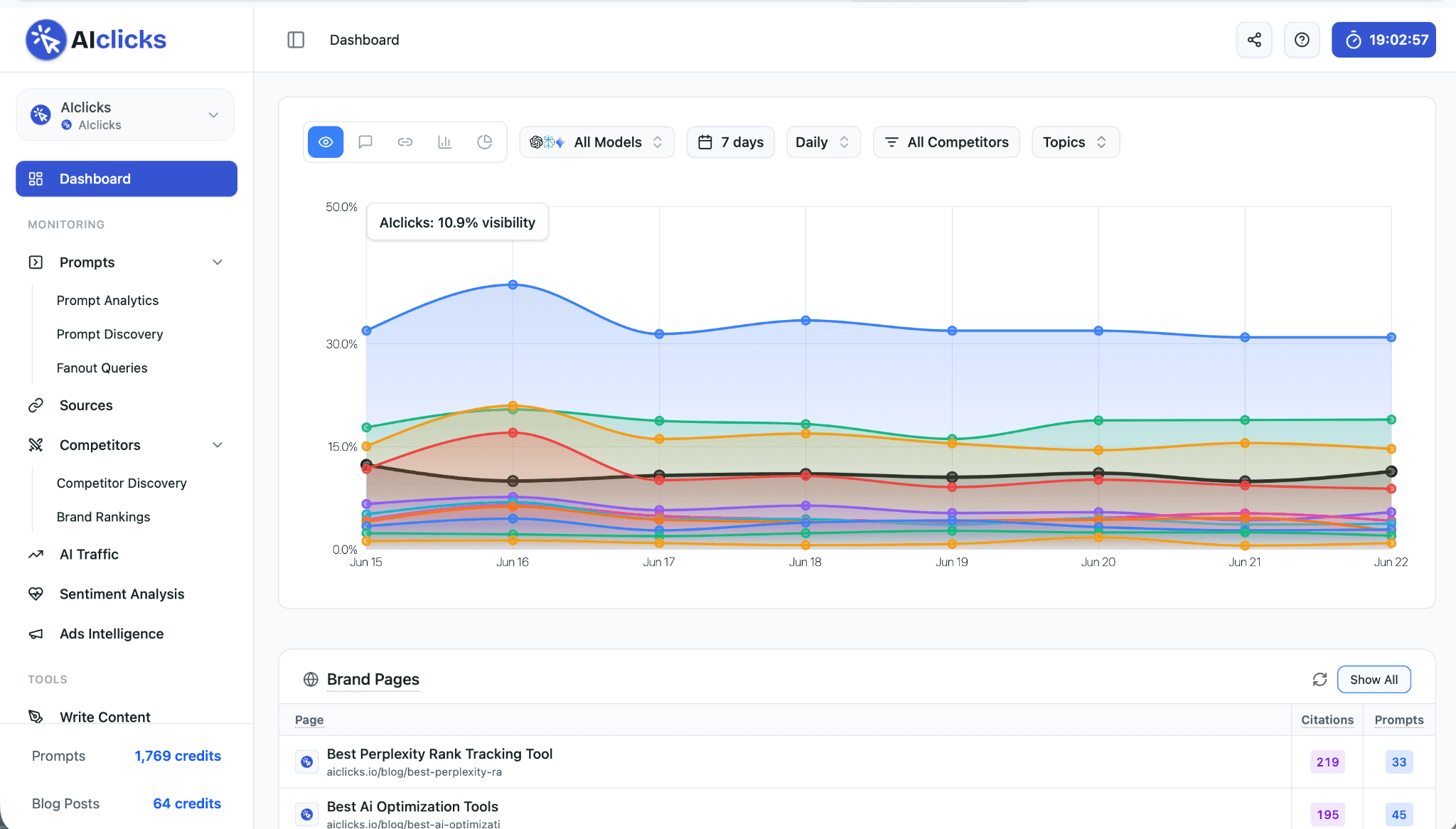
You can see what's working, what's slipping, and where you've lost a spot, so you fix the right pages instead of guessing.
AI Mode answers drift the same way, so AIclicks includes a Google AI Mode visibility tracker that runs the same daily checks there.
Do this: Add your main queries to AIclicks and check it monthly. It shows which answers cite you, mention you, or drop you, so you refresh the slipping pages first.
What To Skip
Before you spend money or hours on the "AI Overview hacks" doing the rounds, know that Google publicly deflated most of them in its May 2026 guide. Here's what I'd drop, and why.
Tactic being sold | What the evidence says |
Schema markup to win citations | Ahrefs added schema to 1,885 pages and measured no meaningful citation lift. Keep schema for the rich results it earns in normal search. It won't get you into an AI Overview. |
Publishing an llms.txt file | Google Search ignores it. It won't hurt you and it won't help you. |
Chunking content into fragments | Google says there's no requirement to break content up. Its systems read full pages fine. |
Rewriting prose into "AI-friendly" syntax | Google's quality systems read rewritten-for-AI copy as low effort. Write clearly for people. |
The thread running through all four: each one promises to replace the harder work above, and none of them does. They sell motion in place of progress.
One honest caveat. Google's guidance covers Google's own surfaces. ChatGPT, Claude, and Perplexity work differently, and one or two of these carry slightly more weight there. But for AI Overviews, the question is settled. Skip them and put the hours into points 1 through 10.
What I'd Bet On Next
One prediction I'm comfortable putting my name on: within a year, "ranking in AI Overviews" stops being its own discipline and folds back into doing SEO and content unusually well.
Google has effectively said so. Its AI features run on the same index, the same ranking systems, and the same E-E-A-T signals as classic search. The two were never going to stay separate for long.
What won't reverse is the split between visibility and traffic. Being seen no longer means being clicked. AI Overviews already cover 48% of industries, and run past 80% in health, education, and research. That number climbs from here.
So here's what I'd plan around. The teams that come out ahead will be the ones rebuilding their measurement around citations and share of voice, then feeding what they learn back into content nobody else could write.
Do that, and the 58% click drop stops being a threat to your traffic. It becomes the reason your name is in the answer.
Track Your AI Overview Citations with AIclicks
The job changed quietly. For years the goal was to be top ranking, and the click came with it.
Now the ranking gets you considered and the citation gets you the click, and the brands that adjust to that gap first are the ones that will own the answers everyone else is still trying to rank beneath.
Everything above is how you close it. But you can't improve what you can't see, and this is the one part rankings and Search Console leave you blind to: whether the answer actually cited you, or quietly handed your spot to someone else.
That's the gap AIclicks fills. It runs your priority queries across the AI engines every day, shows whether each answer cites you, mentions you, or leaves you out, and tracks your share of voice against the brands getting picked instead. Do the work in this guide, then let the data tell you it worked.
See where you stand in AI Overviews.
Frequently Asked Questions (FAQs)
1. What are AI Overviews?
AI Overviews are the AI-generated summaries Google shows at the top of its search results. Google pulls passages from several web pages, writes one direct answer, and cites a few of those pages inline. The feature runs on a custom version of Gemini and draws from Google's regular search index.
2. How do I rank in AI Overviews?
You don't rank in the usual sense; you earn a citation as one of the answer's sources. The levers that matter most, in order: rank in Google's top 10 to qualify, answer each question in a self-contained passage, cover the sub-questions behind the main query, build consistent brand mentions across the web, and publish original content. Google has confirmed you don't need special schema, an llms.txt file, or content chunking to get there.
3. Do AI Overviews use the same ranking factors as normal Google search?
Mostly, yes. Google says its AI features sit on top of its core Search ranking and quality systems, so the same index, crawling, and E-E-A-T signals apply. What's different is retrieval: AI Overviews use query fan-out to pull passages across many sub-questions, so broad coverage and self-contained passages matter more than they did for a single blue link.
4. Does schema markup help me rank in AI Overviews?
Not directly. Google confirmed in May 2026 that no special schema is required. Keep schema for the rich results it earns in regular search, but don't treat it as an AI citation lever.
5. Do I need an llms.txt file to show up in AI Overviews?
No. Google Search, including AI Overviews and AI Mode, ignores llms.txt entirely. It won't help or hurt your Google visibility. It may matter for some other AI systems, but not for Google's.
6. Why does my page rank #1 but never appear in the AI Overview?
Ranking qualifies you for the citation pool but doesn't guarantee selection; position one carries only about a 33% chance of appearing. The usual reasons for being skipped: your answer isn't structured as a self-contained passage, you don't cover the fan-out sub-questions, or your brand lacks the entity recognition the model leans on. Brand mentions correlate far more strongly with AI visibility than backlinks do.
7. Is it worth optimizing for AI Overviews if they reduce clicks?
Yes, because the alternative is worse. Being cited correlates with 120% more organic clicks per impression than not being cited. The citation protects a slice of your traffic when the AI answer would otherwise replace your page. The move is to shift your measurement from clicks to citations and share of voice.
8. How do I track whether I'm cited in AI Overviews?
Google Search Console doesn't break out AI Overview citations, so you need a dedicated AI visibility too like AIclicksl that monitors citations across AI Overviews, AI Mode, ChatGPT, Perplexity, Gemini, and Copilot. Track your citation frequency and your share of voice against named competitors, month over month.
Our Content:




Any questions left?
Book a call here: