" width="14px"><path d="M 13.864 5.629 L 13.3 5.629 L 13.3 5.6 L 7 5.6 L 7 8.4 L 10.956 8.4 C 10.379 10.03 8.828 11.2 7 11.2 C 4.681 11.2 2.8 9.319 2.8 7 C 2.8 4.681 4.681 2.8 7 2.8 C 8.071 2.8 9.045 3.204 9.786 3.864 L 11.766 1.884 C 10.516 0.719 8.844 0 7 0 C 3.134 0 0 3.134 0 7 C 0 10.866 3.134 14 7 14 C 10.866 14 14 10.866 14 7 C 14 6.531 13.952 6.073 13.864 5.629 Z" fill="rgb(255, 193, 7)" height="14px" id="H_YjfTNpn" width="14px"/><path d="M 0 3.742 L 2.3 5.429 C 2.922 3.888 4.429 2.8 6.193 2.8 C 7.264 2.8 8.238 3.204 8.979 3.864 L 10.959 1.884 C 9.709 0.719 8.037 0 6.193 0 C 3.504 0 1.172 1.518 0 3.742 Z" fill="rgb(255, 61, 0)" height="5.428500000000002px" id="PlkthQDhg" transform="translate(0.875 0)" width="10.959199999999996px"/><path d="M 6.232 5.581 C 8.04 5.581 9.683 4.889 10.925 3.764 L 8.758 1.931 C 8.032 2.483 7.144 2.782 6.232 2.781 C 4.411 2.781 2.865 1.62 2.283 0 L 0 1.759 C 1.159 4.026 3.511 5.581 6.232 5.581 Z" fill="rgb(76, 175, 80)" height="5.581099999999999px" id="WlnJ5gngE" transform="translate(0.7 8.4)" width="10.924899999999994px"/><path d="M 6.864 0.029 L 6.3 0.029 L 6.3 0 L 0 0 L 0 2.8 L 3.956 2.8 C 3.68 3.576 3.183 4.254 2.526 4.75 L 2.527 4.749 L 4.693 6.582 C 4.54 6.722 7 4.9 7 1.4 C 7 0.931 6.952 0.473 6.864 0.029 Z" fill="rgb(25, 118, 210)" height="6.589883930775992px" id="x_rSW275p" transform="translate(7 5.6)" width="7px"/></g></svg>)


Reviewed by:
Rokas Stankevicius

Founder @aiclicks.io
Last updated:
Expert Verified

Quick summary:
AI engines can only recommend products they can read, so machine-readable product data (schema, clean feeds, crawler access) is the price of entry.
Recommendations are won off your site, in the review platforms, buying guides, and community threads each engine cites back to.
Product pages written around the questions shoppers actually ask beat pages stuffed with category keywords.
Mismatched titles, prices, or availability across your site, feeds, and marketplaces lower an engine's confidence and quietly drop you from answers.
You cannot improve what you do not track, so a fixed prompt set run across engines and logged over time is the part most teams skip and the part that tells you if you're winning.
Most ecommerce brands still think AI recommendation is a future problem.
It is not. Traffic from AI sources to US retail sites grew 393% year over year in the first quarter of 2026, according to Adobe Analytics. Those visitors convert better than shoppers from any other channel, and they arrive having already made most of their decision inside the chat.
The catch: AI assistants only recommend products they can find, read, and verify. They retrieve structured product data in real time, then cross-check your brand against independent sources like review platforms, buying guides, and community threads. Get both halves right and you show up. Miss either one and you stay invisible, no matter how good the product actually is.
We spend our days inside this data, watching which prompts shoppers ask, which sources each engine pulls into its AI shopping recommendations, and which brands make the answer. This post covers both jobs: the on-page work that makes you eligible, the off-site work that gets you chosen, and how to measure whether any of it is landing.
What Are AI Product Recommendations?
AI product recommendations are specific products an AI assistant names inside a conversational answer, instead of handing back a page of links for you to sort through. A shopper asks "best waterproof hiking boots under $200" and gets three to five named options with prices, images, and a short rationale, often with a buy button attached.
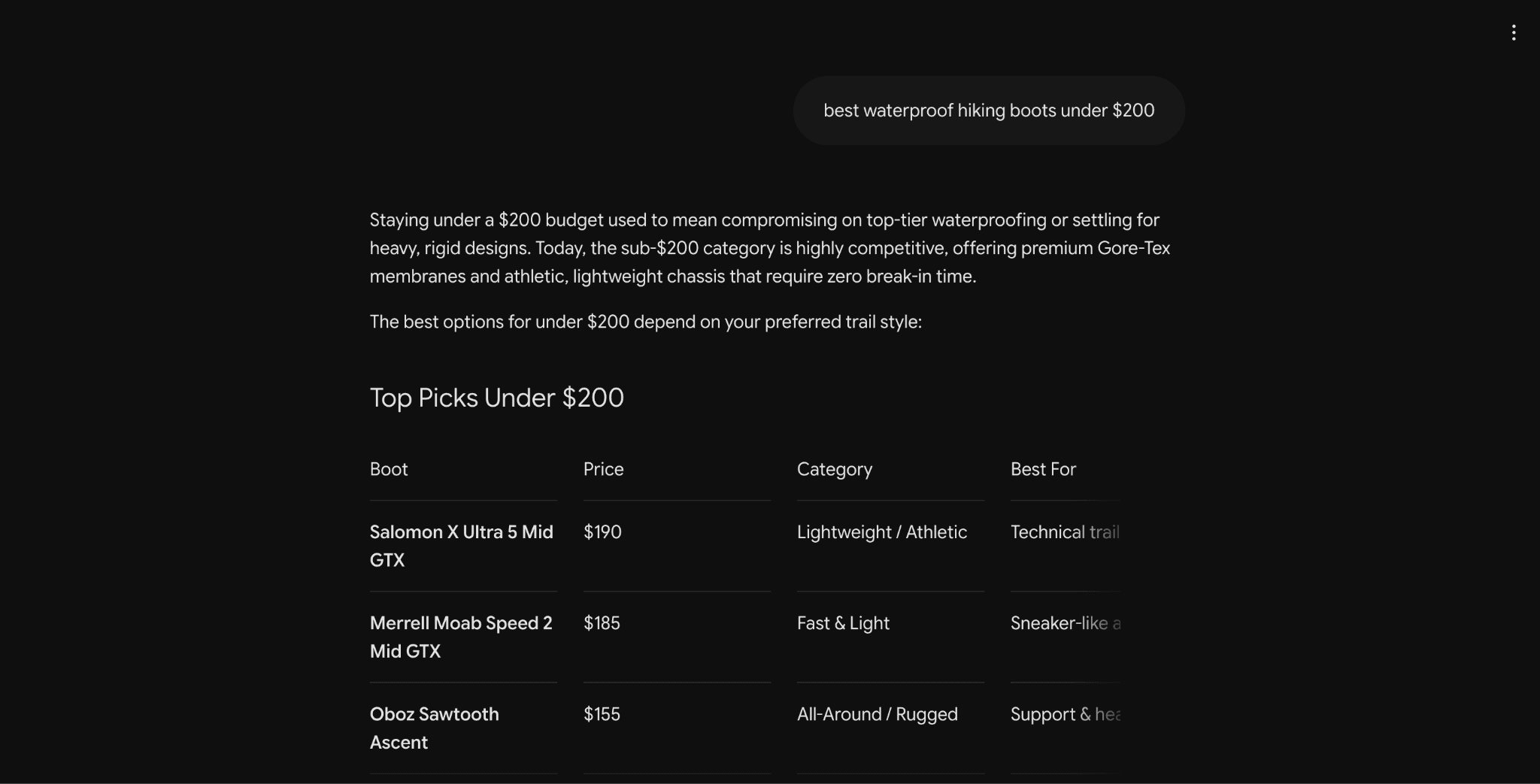
These answers show up across a handful of surfaces, and each one behaves a little differently. ChatGPT Shopping returns product cards inside the chat. Perplexity displays cards with visible source citations and AI-written pros and cons. Google AI Overviews and Gemini surface product units inside search and AI Mode. Amazon Rufus, now rolling out in the US as Alexa for Shopping, answers shopping questions directly inside the Amazon app. Same broad behavior, four different sets of plumbing underneath.
Why Do AI Recommendations Matter for Ecommerce?
Because AI shoppers buy, and they buy at a higher rate than almost any other traffic source:
AI traffic to retail sites converted 42% better than non-AI traffic in March 2026, a record high and a complete reversal from the year before, when AI visitors converted worse than everyone else.
Salesforce estimated that AI tools influenced more than 20% of all online retail sales globally over the 2025 holiday season.
The people arriving from these answers have already done their comparison shopping inside the chat. They land closer to a decision.
The structural reason it matters even more than the numbers suggest: AI answers name a few products and stop.
A Google results page gives ten brands a fighting chance at the click. An AI answer names three or four.
The brands inside that shortlist absorb almost all of the demand. Everyone else gets nothing, because the shopper never sees a second page.
That is why GEO for ecommerce has grown into its own discipline rather than a footnote under regular SEO. The shortlist rewards the brands that did the off-site work long before the question was ever asked.
How Do AI Assistants Decide Which Products to Recommend?
AI assistants decide through retrieval plus credibility triangulation, not keyword ranking. When a shopper asks a question, the engine retrieves candidate products and supporting documents from a live index, then checks your brand against what independent sources say about it before naming you.
In plain terms, most shopping answers run on retrieval-augmented generation. The engine turns the question into a search, pulls back the most relevant product data and content, and writes its answer from that material rather than from memory alone. Then it triangulates: if your product page, three review platforms, a buying guide, and a Reddit thread all describe the same product the same way, the engine treats that agreement as confidence and surfaces you. If your own site is the only place making the claim, that confidence is thin.
Two things follow from this. First, the same prompt can return different products across sessions, because retrieval timing, the shopper's location, and conversation history all feed the result. Recommendations are probabilistic, not fixed. Second, the work that moves recommendations sits mostly off your website, in the sources the engine cross-checks. That is the part the typical optimization checklist never reaches.
Which AI Engines Recommend Products?
Four engines drive most AI product discovery, and they source their answers differently, which is why a single-platform playbook leaves visibility on the table. The table below is the one-screen version. Engine-specific tactics go deep in their own guides; here we stay at the level of where each one actually gets its product data.
Engine | Where it pulls product data | How it links out | Worth knowing |
ChatGPT Shopping | Bing's web index for the conversational answer, plus Google Shopping listings for the product carousel and feeds from OpenAI's own Merchant Program | Organic results with links to retailers; no paid placement or ad bidding | A March 2026 Search Engine Land analysis found 83% of carousel products matched Google Shopping's top listings. |
Perplexity | Live web sources it cites in real time (review sites, comparison content, manufacturer and retailer pages), plus its free Merchant Program feed | Every recommendation carries visible source citations; product cards include AI-written pros and cons | Buy with Pro enables in-chat checkout; Shopify catalogs can syndicate automatically. |
Google AI Overviews / Gemini | Google's Shopping Graph, fed by Merchant Center, holding tens of billions of listings with billions refreshed hourly | Surfaces product units with links; weighs merchant trust and store ratings heavily | Owns the demand already searching on Google. Rewards complete Merchant Center feeds and Product schema. |
Amazon Rufus / Alexa for Shopping | Amazon's own catalog, customer reviews, and community Q&As, plus some external editorial sources | Recommends listings inside Amazon, with "Buy for Me" and "Shop Direct" options | A closed ecosystem. Listing completeness and review depth drive inclusion; recommended products tend to carry heavy review counts. |
The takeaway from the table is that there is no single feed or single tactic that covers all four. What it takes to get recommended by ChatGPT, which leans on Google Shopping data and Bing, is different from what wins in Rufus, which reads your Amazon listing and reviews. A product that wins in one engine can be absent from another because its data there is thin, or because no third-party source describes it.
How to Get Your Products Recommended by AI: 5 Steps
Step 1: Make your product data machine-readable
Start with eligibility, because no amount of off-site work helps if an engine cannot read your products. The fastest wins here are technical and you control all of them.
Add Product schema to every product page with the fields engines actually parse: price, availability, GTIN, brand, aggregateRating, reviewCount, and offers. Keep your feeds clean and submit them where each engine looks, including Google Merchant Center and the direct merchant programs ChatGPT and Perplexity now run. Allow the AI crawlers through in your robots file (OAI-SearchBot and GPTBot for ChatGPT, PerplexityBot for Perplexity) so they can actually fetch your catalog. And keep stock status accurate in real time, because retrieval is live and an out-of-stock product is an unrecommended product.
The one thing teams miss most often is crawler access, since it fails silently. You can confirm whether AI crawlers can reach your catalog with the free GEO visibility checker before you spend a month wondering why nothing surfaced.
Step 2: Get into the sources AI cites
Eligibility gets you considered. Getting named happens in the sources each engine cross-checks, so this is where most of the real work lives. The goal is genuine brand mentions across the places AI pulls from, which is a broader job than chasing backlinks.
There are four kinds of off-site presence worth building, and we group them as a system: create content on your own site, get mentioned on pages that already rank and get cited, engage in the communities engines read, and build trust on review platforms. In practice that means earning a spot in third-party buying guides and category listicles, keeping a real and well-reviewed presence on the review platforms in your category, and participating honestly in Reddit and forum threads where shoppers compare options.
On communities, genuine participation is the only thing that works; astroturfing gets detected, downranked, and occasionally banned, and it poisons the exact sentiment signal you were trying to improve. Editorial mentions in trade and review media round it out.
This is the slowest layer and the one that compounds. A product mentioned consistently across fifteen independent sources is one an engine can recommend with confidence. A product that only its own site vouches for is one an engine hedges on.
Step 3: Write product pages for questions, not keywords
Write your product pages the way a shopper asks an AI assistant, because that is the language the engine is matching against. AI prompts are long and conversational, closer to twenty words than the three or four people type into Google, and they are framed around problems and use cases.
So lead with attributes in plain language. "Stays dry in light rain and a quick downpour" does more work than "water-resistant nylon blend," because it answers the question a shopper actually asked. Frame the page around use cases ("for daily commuting," "for a first marathon") rather than feature lists.
Add an FAQ block built from the real questions your support team and reviews surface, since engines extract those cleanly. And write honest comparison content that says who a product is and is not for, which engines treat as more trustworthy than uniform praise.
Step 4: Keep product info consistent everywhere
Keep your titles, pricing, specs, and availability identical across your own site, your marketplaces, your feeds, and your review profiles. When an engine cross-checks a product and finds your price is $49 on your site, $54 in a feed, and "unavailable" on a marketplace, it cannot tell which version is true, and uncertainty reads as risk. The safe move for the engine is to recommend a competitor whose data lines up everywhere.
Consistency sounds like housekeeping, and it is, but it is the kind that silently decides recommendations. The validation step in Step 3's retrieval logic is looking for agreement. Mismatched data is the easiest way to fail it.
Step 5: Track whether AI actually recommends you
Measure it, because everything above is invisible until you do. None of the ranking pages on this topic cover tracking, which is exactly why it is the step that separates teams who improve from teams who guess.
Do it by hand first. Write 20 to 30 buying-intent prompts per category, the real ones shoppers ask ("best [category] for [use case]," "[category] under [price]," "what's a good [category] for beginners"). Run each prompt in every engine you care about. For every answer, log whether your brand appeared, where you landed, and which sources the engine cited. Repeat the same set weekly so you are comparing like with like, and watch both your own movement and which competitors keep showing up instead of you. Tracked over a few weeks, that log becomes a real picture of your AI search visibility for ecommerce, and the competitors' cited sources become your next targets.
Running this manually across four engines every week is real work, and once the prompt set grows it stops being practical, which is why a handful of AEO tracking tools automate the prompt runs and source logging. The method matters more than the tool, though. Even a spreadsheet beats flying blind.
How AIclicks Helps You Get Recommended by AI
Every step above can be done by hand, and we genuinely recommend starting that way so you understand your own data. AIclicks exists to run that same loop continuously, once doing it manually stops scaling. Here is how each step maps to a feature:
Steps 2 and 5 (running prompts, logging sources) become prompt tracking. It runs your buying-intent prompts across ChatGPT, Perplexity, Gemini, and more, every day, so you are not re-running spreadsheets by hand.
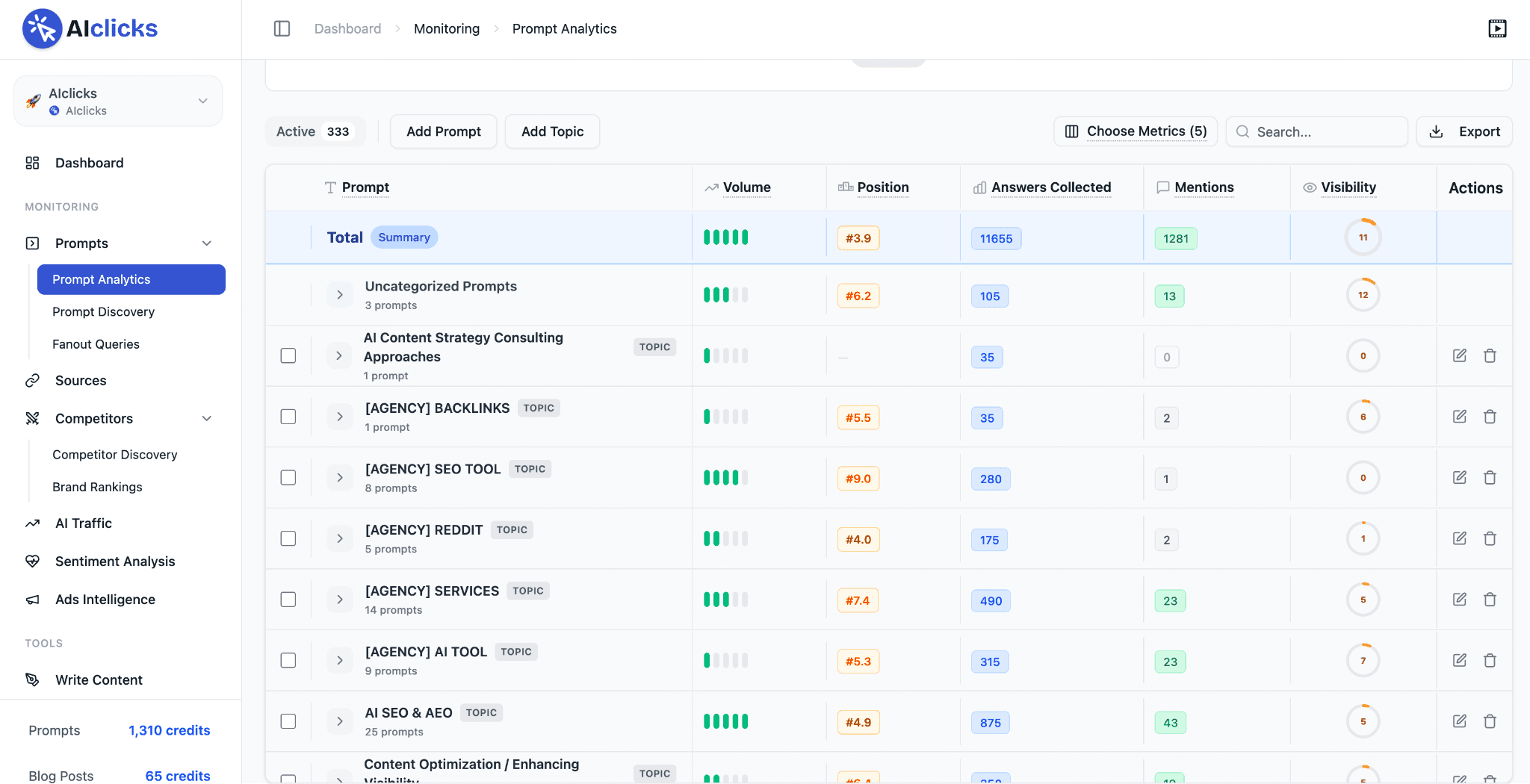
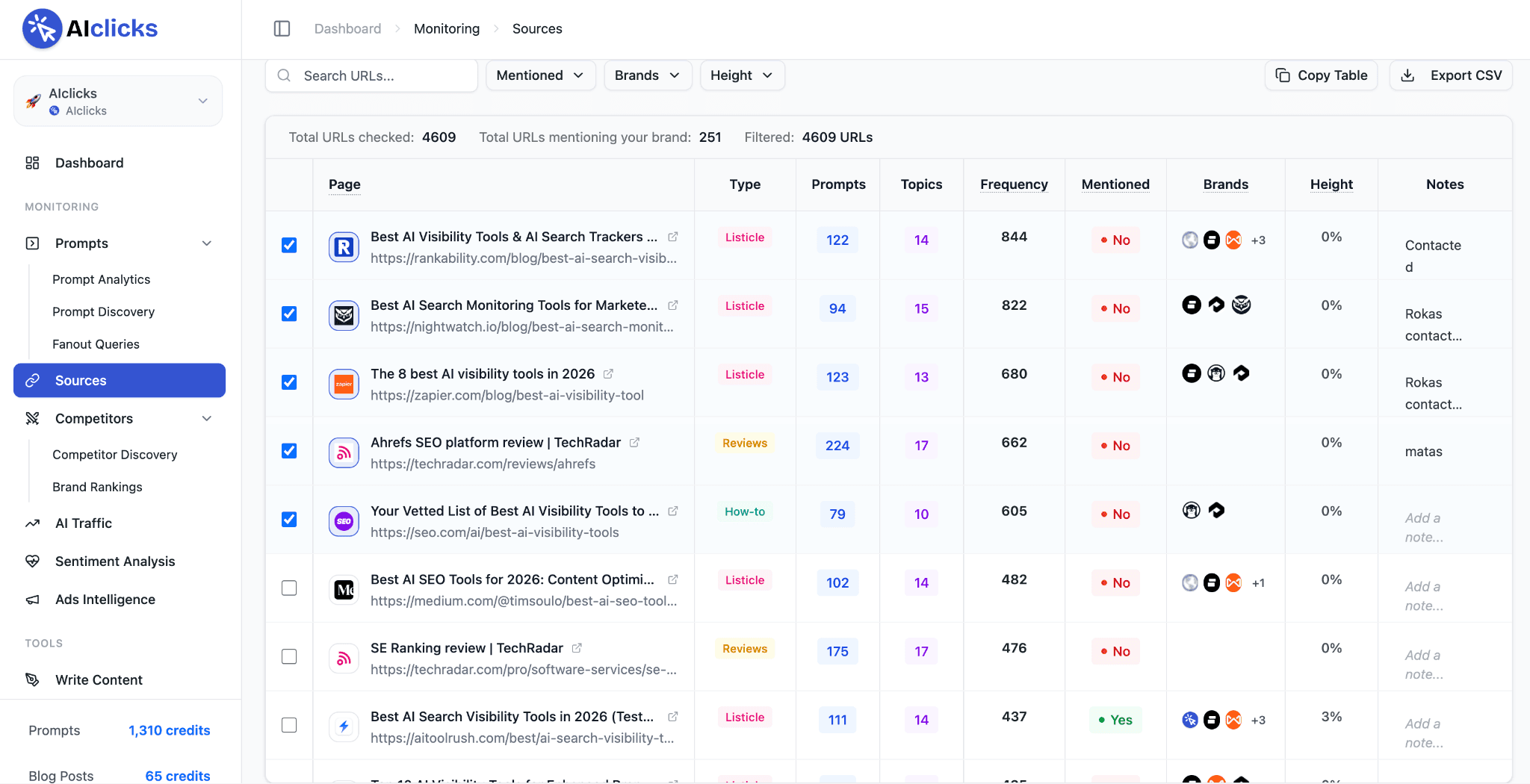
Step 2 source discovery becomes the Sources tab. It shows exactly which sites each engine cites in your category, and turns each one into an action: Create Content, Get Mentioned, Engage in Communities, or Build Trust.
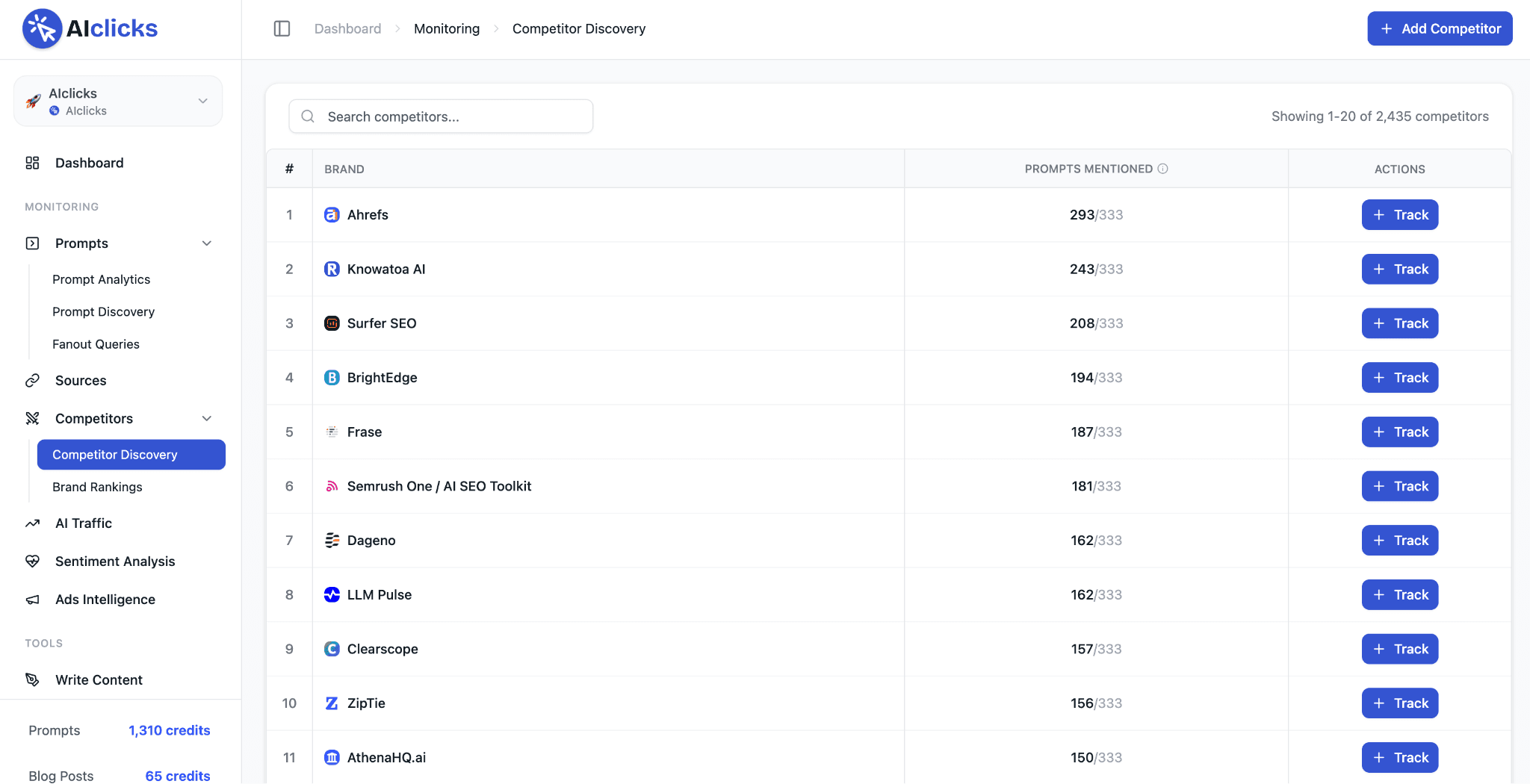
The competitive blind spot becomes the Competitors tab. It shows which brands get recommended instead of you and which sources are powering them.
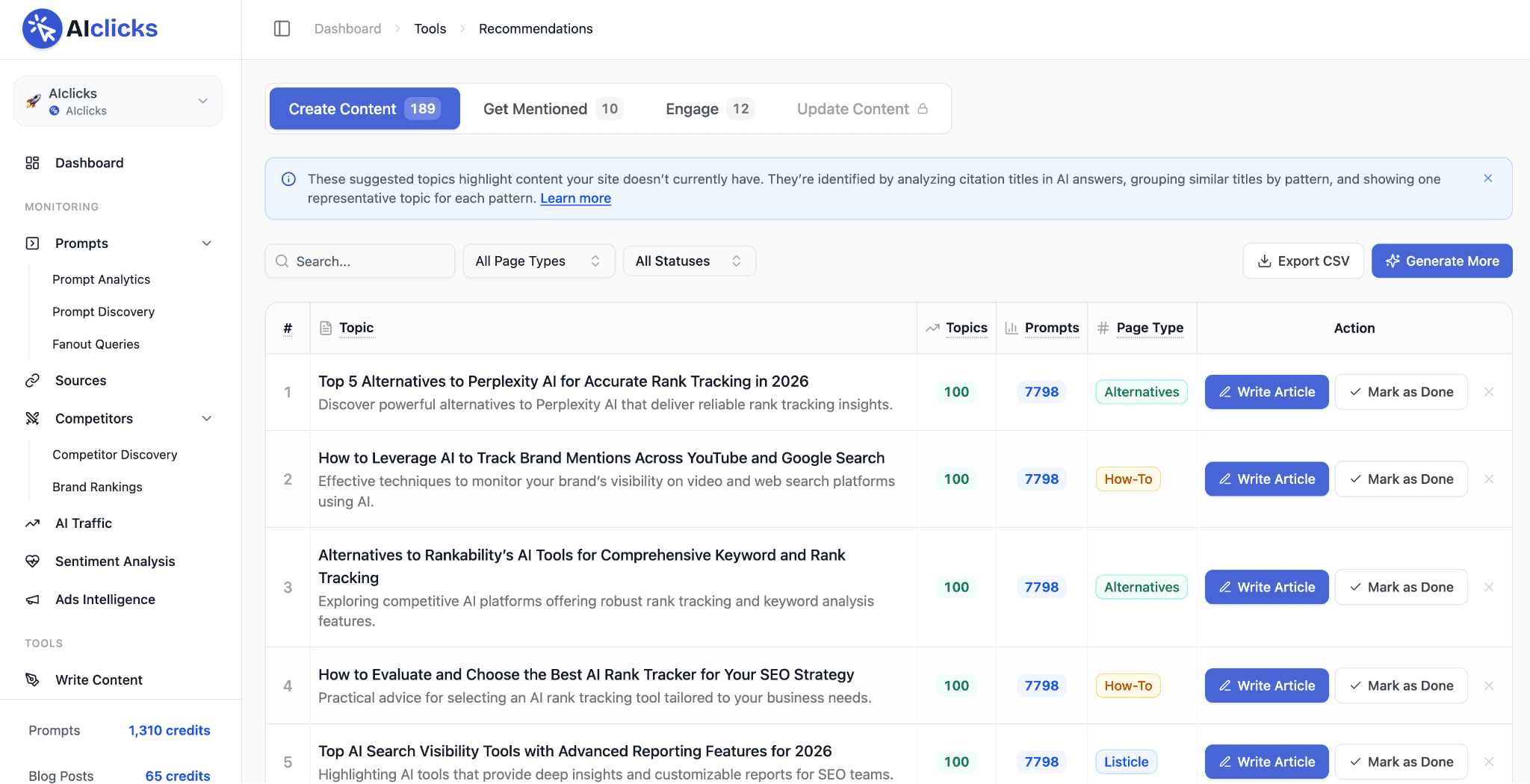
The "what do I do next" gap becomes the Actions tab. It converts every gap into a specific task you can ship that week.
One honest caveat: AIclicks will not fix your schema, write your product pages, or clean your feeds for you. That work stays on your side. What it does is tell you where to act and whether the action moved anything, which is the part that is hardest to see on your own. A good place to start is running your category through the free GEO visibility checker to see what AI says about you today.
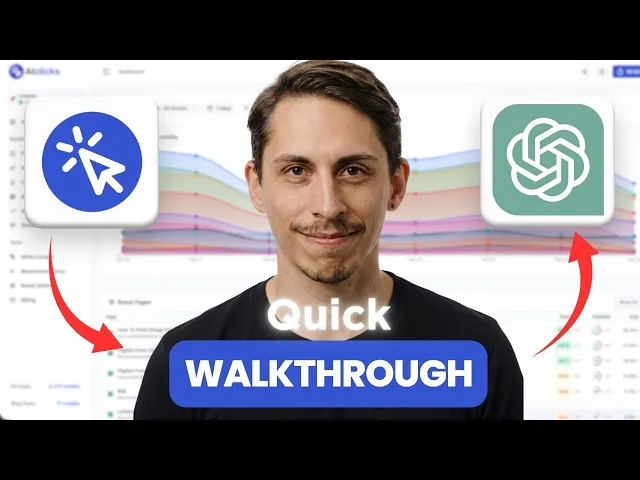
For a better understanding, watch the simple tutorial on how to setup your brand on AIclicks:
How Long Does It Take to Get Recommended by AI?
Some of it is fast and some of it is slow, and knowing which is which keeps expectations honest. Product data fixes can surface within weeks, because retrieval is real-time. Submit a clean feed, fix your schema, open crawler access, and the next time an engine retrieves for a relevant query, your corrected data is in play. We have seen technical fixes show up in answers inside a couple of weeks.
Authority and citation building runs on a longer clock, usually months. Earning mentions across review platforms, buying guides, and community threads takes time, and there is a lag between when those sources publish and when engines crawl, index, and start reflecting them in answers, typically a few weeks behind the event itself. The teams that win treat the two timelines as one program: ship the fast technical fixes now to stop bleeding eligibility, and start the slow off-site work in parallel so the compounding has begun by the time it matters.
Frequently Asked Questions
Can you pay AI assistants to recommend your products?
Not in the organic recommendations, no. The major shopping surfaces currently select products through data quality and third-party signals, with no ad bidding inside the recommendation itself. Paid ad formats are starting to appear around these experiences, but the recommendation you are trying to win is earned, not bought.
Which AI assistant matters most for ecommerce?
It depends on your category and where your buyers are. ChatGPT leads on raw volume, Amazon Rufus owns shoppers already on Amazon, and Google AI Overviews captures the demand still searching on Google. Track all of the ones your customers actually use rather than betting on one.
Do Reddit mentions really influence AI recommendations?
Yes, often more than brands expect. Community threads are among the most heavily weighted sources several engines pull from, because they read as independent and unscripted. Genuine participation works; manufactured praise gets detected and hurts you.
Does blocking AI crawlers protect my product data?
It removes you from the answers entirely. Blocking OAI-SearchBot, GPTBot, or PerplexityBot means those engines cannot read your catalog, so they recommend products they can. The tradeoff almost never favors blocking for a brand that wants to be discovered.
See where you stand
AI now decides a real share of which products shoppers ever see, and that decision runs on data you can read and influence. Getting your products recommended by AI takes three things run together: the eligibility work, the off-site work, and the measurement that tells you whether either moved. Knowing how to get AI to recommend your product is mostly a matter of doing that consistently, then tracking what changes.
See which products AI recommends in your category and which sources drive it with the free GEO visibility checker.
When you're ready to run the full tracking loop continuously, you can try AIclicks for free for 3 days, no credit card required.
Our Content:




Any questions left?
Book a call here: