" width="14px"><path d="M 13.864 5.629 L 13.3 5.629 L 13.3 5.6 L 7 5.6 L 7 8.4 L 10.956 8.4 C 10.379 10.03 8.828 11.2 7 11.2 C 4.681 11.2 2.8 9.319 2.8 7 C 2.8 4.681 4.681 2.8 7 2.8 C 8.071 2.8 9.045 3.204 9.786 3.864 L 11.766 1.884 C 10.516 0.719 8.844 0 7 0 C 3.134 0 0 3.134 0 7 C 0 10.866 3.134 14 7 14 C 10.866 14 14 10.866 14 7 C 14 6.531 13.952 6.073 13.864 5.629 Z" fill="rgb(255, 193, 7)" height="14px" id="H_YjfTNpn" width="14px"/><path d="M 0 3.742 L 2.3 5.429 C 2.922 3.888 4.429 2.8 6.193 2.8 C 7.264 2.8 8.238 3.204 8.979 3.864 L 10.959 1.884 C 9.709 0.719 8.037 0 6.193 0 C 3.504 0 1.172 1.518 0 3.742 Z" fill="rgb(255, 61, 0)" height="5.428500000000002px" id="PlkthQDhg" transform="translate(0.875 0)" width="10.959199999999996px"/><path d="M 6.232 5.581 C 8.04 5.581 9.683 4.889 10.925 3.764 L 8.758 1.931 C 8.032 2.483 7.144 2.782 6.232 2.781 C 4.411 2.781 2.865 1.62 2.283 0 L 0 1.759 C 1.159 4.026 3.511 5.581 6.232 5.581 Z" fill="rgb(76, 175, 80)" height="5.581099999999999px" id="WlnJ5gngE" transform="translate(0.7 8.4)" width="10.924899999999994px"/><path d="M 6.864 0.029 L 6.3 0.029 L 6.3 0 L 0 0 L 0 2.8 L 3.956 2.8 C 3.68 3.576 3.183 4.254 2.526 4.75 L 2.527 4.749 L 4.693 6.582 C 4.54 6.722 7 4.9 7 1.4 C 7 0.931 6.952 0.473 6.864 0.029 Z" fill="rgb(25, 118, 210)" height="6.589883930775992px" id="x_rSW275p" transform="translate(7 5.6)" width="7px"/></g></svg>)



Reviewed by:
Matas Kibildis

Head of Growth @ aiclicks.io
Last updated:
Expert Verified

Right now, an AI tool is recommending products in your category to a buyer with a credit card out, and the odds are it didn't mention you.
When someone asks ChatGPT for "the best espresso machine under $500," the engine doesn't open your product page and weigh it instead It assembles an answer out of review sites, Reddit threads, retailer listings, and YouTube teardowns, then names three or four products.
If your ecommerce brand is one of the four, you may have just won a customer who never touched Google, never saw an ad, and never landed on a category page. If it isn't, you don't get a second chance and you never even know the conversation happened.
That shift is already showing up in the numbers.
Adobe Analytics clocked an 805% year-over-year jump in AI-driven traffic to U.S. retail sites during the Black Friday window (November 1 to 28, 2025).
Salesforce found that AI and agents influenced 20% of all global orders during Cyber Week, around $67 billion in sales.
And McKinsey estimates agentic commerce could reach $3 trillion to $5 trillion globally by 2030.
Most GEO tools track whether your brand gets mentioned. For a store, that's the wrong question, because AI recommends products, not brands. This guide ranks six on the one that pays your bills: do they help your products win the AI shelf, or do they just tell you that you lost?
What GEO Tools for Ecommerce Are, and Why They Matter?
GEO stands for Generative Engine Optimization: the practice of getting your brand and products surfaced inside AI-generated answers rather than blue links.
A GEO tool is what makes that practice measurable. It sends real shopping prompts to AI engines, records which brands and products appear, tracks which sources those answers cite, and shows you where you stand against competitors.
For ecommerce specifically, that matters more than it does for most industries, for one simple reason: AI doesn't just mention you, it recommends what to buy.
When someone asks an AI assistant for "a durable carry-on under $200," the model returns specific products, often with prices, ratings, and a one-line reason to choose each. That is a purchase decision being shaped before the shopper ever reaches a store. And GSC won’t show this data.
There's a second reason ecommerce needs its own category of tool. AI engines form opinions about your products from structured data, reviews, marketplace listings, and third-party content, then repeat those opinions as fact.
If ChatGPT believes your bestseller ships in two weeks when it ships in two days, that error costs you sales every time the question comes up. A good ecommerce GEO tool catches that, shows you the source, and tells you how to correct it. That's the difference between a vanity dashboard and a tool that protects revenue.
What Makes Ecommerce GEO Different?
Worth being precise here, because the difference is the whole reason this list exists.
You need product-level visibility, not brand-level. A B2B company cares whether ChatGPT says nice things about its platform. A store needs to know whether this SKU shows up when someone asks for "a quiet blender for a small apartment."
The AI shelf is the new digital shelf. ChatGPT shows product cards with prices and purchase links, Google AI Mode has agentic checkout built in, and Amazon Rufus answers product questions inside the marketplace. You optimize for this layer the way you once optimized for Google Shopping.
Reviews and feeds decide who wins. AI shopping agents lean hard on reviews and structured product data. A product with 4.2 stars and 2,000 reviews will usually beat a product with 4.8 stars and 50 reviews in AI recommendations. And incomplete feeds with missing attributes, outdated pricing, or broken imagery cause AI agents to skip your products entirely. Feed hygiene is now an SEO input.
If you want the foundational explainer before going further, our breakdown of generative engine optimization covers how AI engines decide what to cite in the first place.
How These Tools Were Evaluated
Every tool here was judged on five questions that matter specifically to product brands, not just to marketers:
Shopping and product-level coverage: Does it track ChatGPT Shopping and product placement, or only brand mentions?
Engine coverage: Which AI platforms does it monitor, and does that include where your shoppers actually research?
Action, not just analytics: Does it tell you what to fix, or hand you a chart and wish you luck?
Ecommerce fit: Marketplace and store integrations, competitor benchmarking, sentiment on product descriptions.
Honest pricing: Is the entry price real for a catalog-sized workload, or does it balloon with add-ons?
Details came from each vendor's own site and pricing pages, cross-checked against independent reviews. Pricing in this space changes fast, so confirm current numbers before you buy.
The 8 Best Ecommerce GEO Tools at a Glance
Tool Name | Best For | Starting Price | Engine Coverage | Ecommerce Edge |
AIclicks | Stores & agencies wanting action, not just data | $59/mo | 10+ engines | Real-UI tracking + ranked action plan tied to GA traffic |
Goodie AI | Enterprise brands managing thousands of SKUs | Custom | 12+ (incl. Amazon Rufus) | Agentic Commerce Optimizer + SKU-level attribution |
Azoma | Marketplace-heavy retail brands | Custom | Major LLMs | Seller Central + Shopify integrations |
Athena HQ | Stores tying GEO to revenue | $295/mo | 8+ engines | GA4 + Shopify revenue attribution, Action Center |
Scrunch AI | Catalog-heavy stores fixing AI crawlability | $250/mo (7-day trial) | 6+ engines | Agent Experience Platform for machine-readable PDPs |
Profound | Enterprises tracking ChatGPT Shopping | ~$99/mo (multi-engine ~$399) | 10+ engines | Conversation Explorer (real shopper prompts) |
Evertune | Data-driven brands needing statistical confidence | Custom | 11 engines | Shopping Intelligence + retail-partner analytics |
Peec AI | Growth-stage DTC brands on a budget | From €89/mo | 3 base engines | Clean analytics, unlimited seats |
1. AIclicks - The Action Engine for AI Search Visibility
About AIclicks:
AIclicks is an AI search visibility platform built around a simple idea: tracking where you stand is only useful if it tells you what to do next.
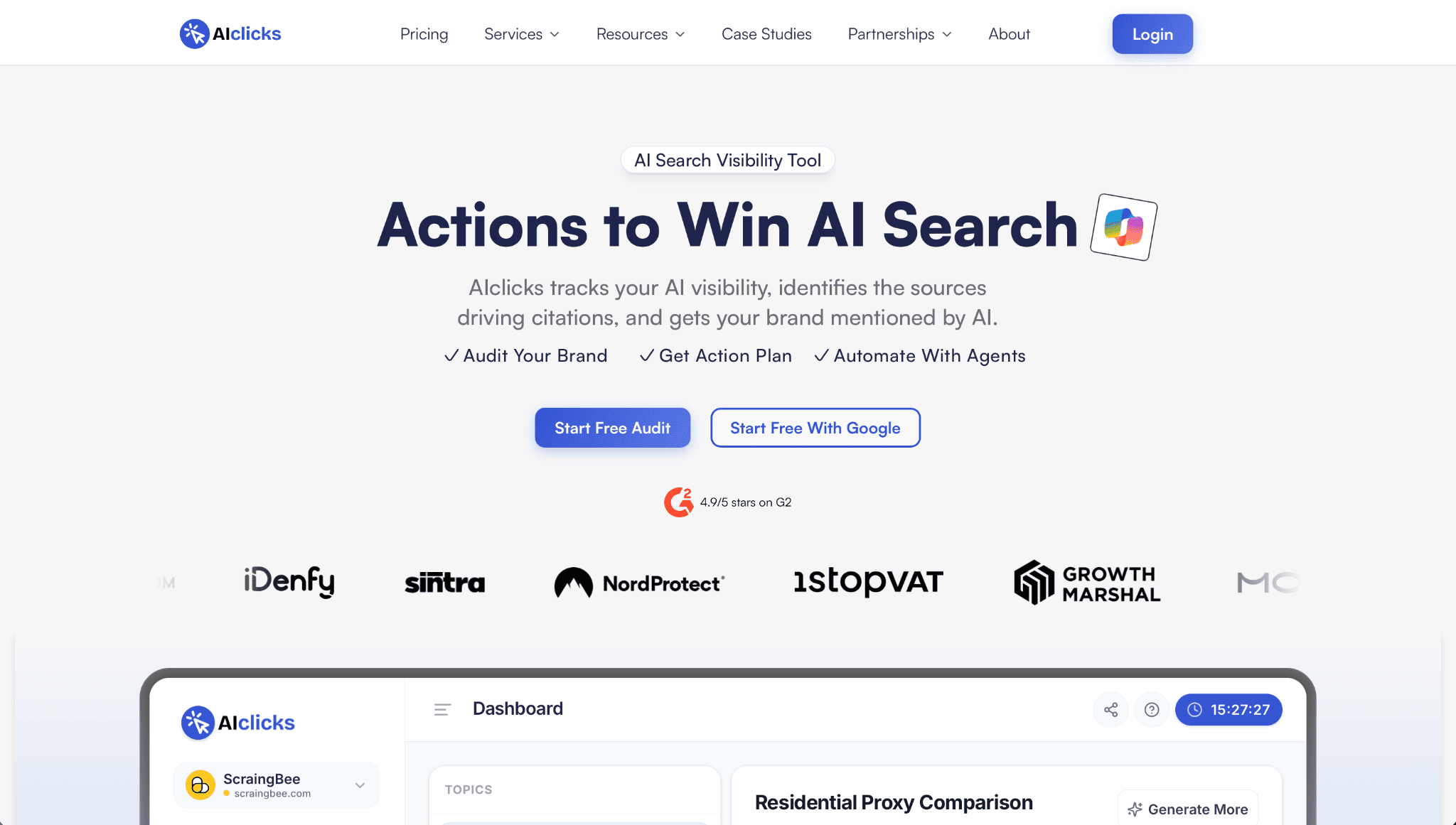
AIclicks is an AI search visibility platform organized around three jobs.
First, monitoring: it watches 10+ AI engines (ChatGPT, Perplexity, Gemini, Google AI Overviews, Google AI Mode, Claude, Copilot, Grok, DeepSeek, Meta AI) and queries them through their real user-facing interfaces rather than APIs, because what an API returns and what a real shopper sees are often not the same answer.
Second, diagnosis: it shows which prompts trigger your brand, which sources AI cites instead of you (review sites, Reddit threads, retailer pages), and how competitors place across each model and region.
Third, action: a Recommendations engine clusters every finding into a ranked to-do list, content to create, sources to earn mentions on, conversations to join, each scored by expected impact.
For an ecommerce store, that third pillar is the difference between knowing your competitor's product gets cited and actually doing something about it. The Google Analytics integration also ties AI search visibility back to real site traffic, so you can argue the channel in revenue terms, not vanity mentions.
Key features:
10+ AI platforms in one dashboard, where many tools cover only three to five. For ecommerce that breadth matters, since shoppers research across ChatGPT, Gemini, Perplexity, and AI Overviews interchangeably.
Real-UI querying, not API calls. Prompts run the way a real shopper would ask them, so the data reflects the actual answer a buyer sees.
A Recommendations engine that ranks the work across three action types: create AI-optimized content, earn mentions on the sources AI already trusts, and join the community threads where AI picks up brand signals.
Source and citation analysis that flags which domains feed AI answers in your category and exactly where competitors are cited and you aren't.
Google Analytics integration with daily refreshes and segmentation by model and country, connecting AI visibility to real traffic.
Pros:
Tracks 10+ AI platforms, broader coverage than most tools at this price
Real-UI querying captures what real shoppers actually see
Recommendations engine turns data into a ranked plan, not another chart
Accessible entry at $59/month with a clear upgrade path
Cons:
The 3-day free trial is short for fully evaluating a visibility tool (the team will extend it if you ask)
Pricing: Starter $59/mo (30 prompts, 3 platforms), Pro $189/mo (150 prompts, 4 platforms, GA integration), Business $499/mo (300 prompts, 6 platforms, GA + API). Enterprise custom. Yearly billing saves up to 29%, and there's a 3-day free trial on every plan.
Verdict: If your frustration is some mix of "this costs too much" and "great data, but now what," AIclicks answers both. It's the right call for DTC brands and agencies that want broad, accurate tracking plus a prioritized action plan without an enterprise invoice.
The team also ran their own method on themselves in public: in marketing SaaS, one of the most competitive niches in AI search, they tracked 300+ prompts and reached top-5 visibility on 60% of them within 90 days.
In a category full of tools that measure the problem beautifully, AIclicks is one of the few built to close it. Start a trial and see where your products stand.
Need help? Our team can help you set it up.
2. Goodie AI - The Full-Stack Ecommerce GEO Platform
About Goodie AI
If AI agents skip your products and you don't know why, Goodie AI is the most complete answer here. It runs as a closed loop: research the prompts customers ask, monitor where you show up, action the gaps, measure the revenue.
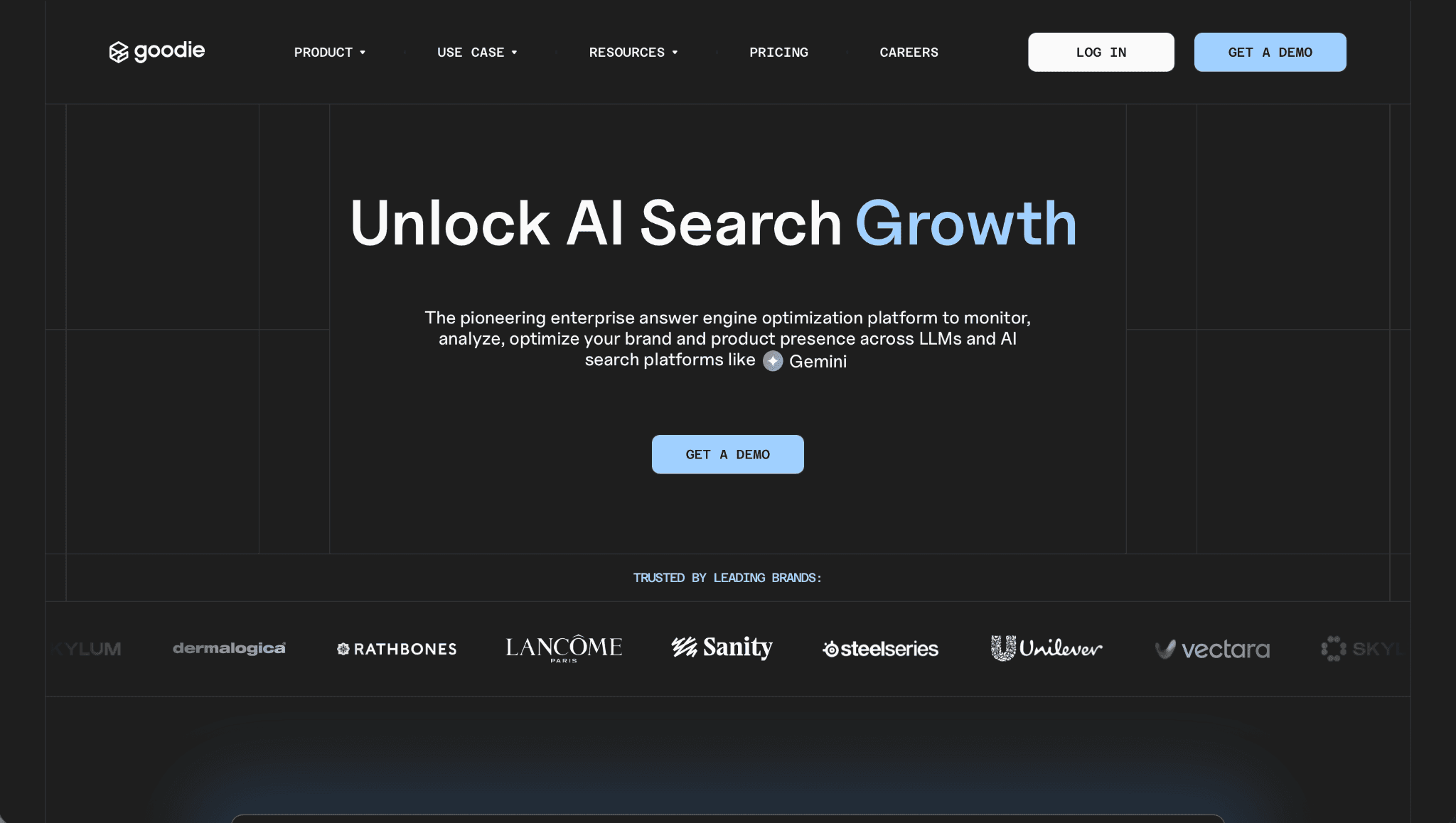
The piece that matters for a store is the Agentic Commerce Suite, which tracks how individual products appear across ChatGPT, Amazon Rufus, Perplexity, Google AI Mode, and Walmart Sparky.
That marketplace coverage is rare, and Goodie tracks 12 models in all, the broadest set on this list. It also fixes, not just flags: agents rewrite product content, repair llm.txt and sitemaps, and publish changes.
Key features:
Agentic Commerce Suite tracking product-level visibility across ChatGPT, Perplexity, Google AI Mode, Amazon Rufus, and Walmart Sparky
12 models tracked, the broadest coverage here, including marketplace agents most tools ignore
Optimization Actions with agents for content writing and optimization, technical fixes (llm.txt + sitemap repair), outreach, and social
Agent Experience Suite to check and fix how AI crawlers read your pages
Analytics & Attribution connecting AI visibility to traffic and revenue via Google Analytics, Search Console, and more, with SOC 2-grade infrastructure
Pros:
The most ecommerce-native feature set here, built around products, not just domains
Closes the full loop: research, monitor, fix, and measure in one platform
Marketplace-agent coverage (Amazon Rufus + Walmart Sparky) is genuinely rare
Cons:
No public pricing: every tier is quote-and-demo only, so you can't size it up before a sales call
AI commerce visibility starts on the mid (Pro) tier, not the entry plan
Built for enterprise depth, so it's heavier than a small store needs
Pricing: Three tiers, all quote-based via demo, with no dollar figures published on Goodie's site
Verdict: For enterprise consumer brands and DTC companies juggling thousands of SKUs across marketplaces, Goodie is the most powerful pick here, the rare tool that researches, tracks, fixes, and attributes product visibility in one loop. The trade-offs are that it's demo-only and built for enterprise budgets. If you're a smaller store that mainly needs accurate cross-engine tracking and a clear action plan without a sales call, AIclicks covers that ground far more affordably.
3. Azoma - The Marketplace-Agent ACO Platform
About Azoma
Next on the list is Azoma, one of the few GEO platforms built specifically for ecommerce rather than adapted to it.
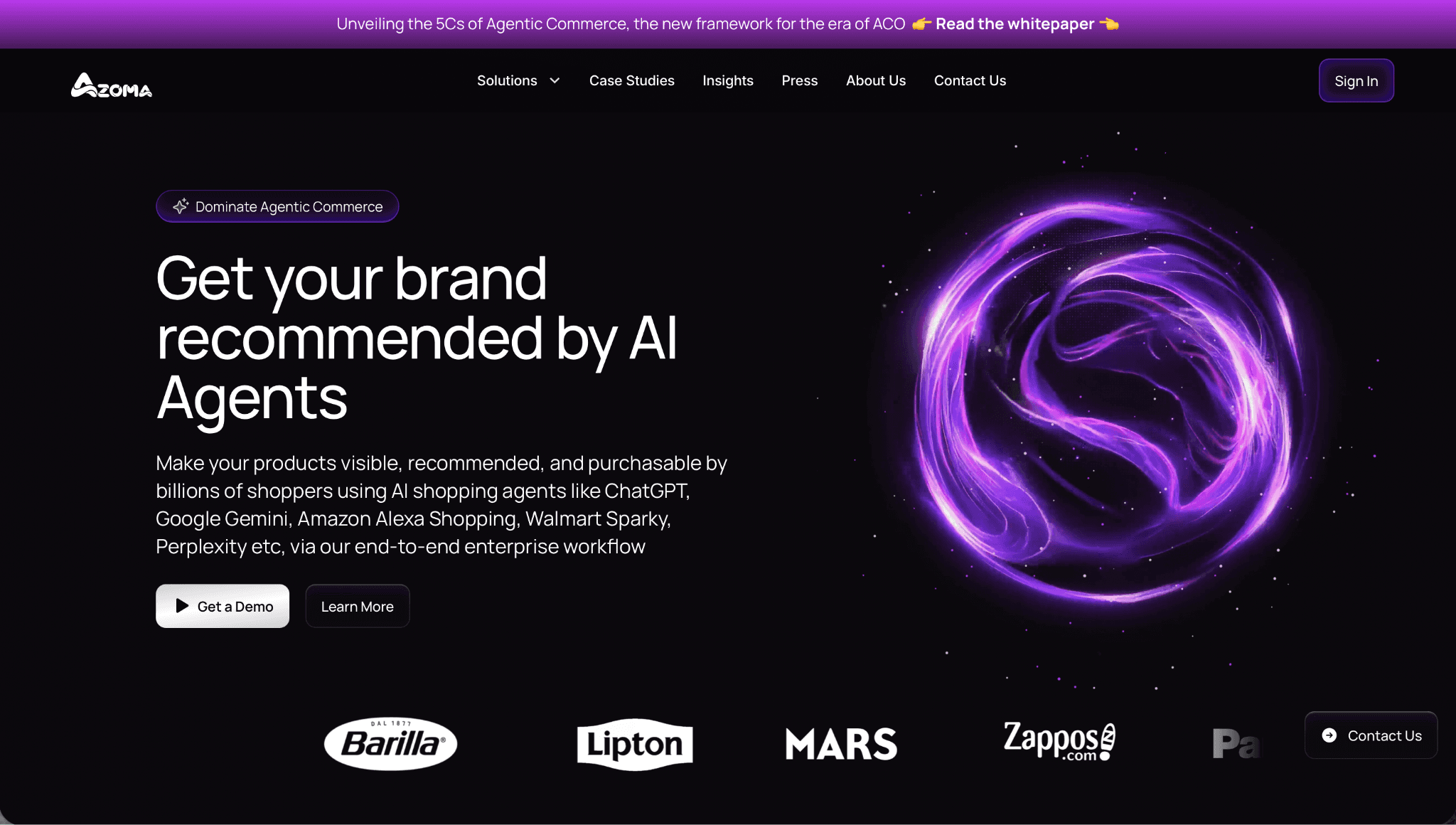
Positioned as end-to-end Agentic Commerce Optimization (ACO) software for enterprises, it helps products get discovered by AI shopping agents across ChatGPT, Gemini, Google AI Mode, Perplexity, and Amazon Rufus, then goes a step further than most by also covering Walmart Sparky and Alexa for Shopping.
Beyond tracking, Azoma generates optimized product listing content, fixes technical crawlability, and can build ChatGPT shopping apps.
Moreover, Azoma bundles Answer Engine Optimisation, Technical GEO (crawler optimization so agents can actually read your pages), and tooling to build ChatGPT shopping apps.
Key features:
The widest marketplace-agent coverage here: Amazon Rufus, Walmart Sparky, and Alexa for Shopping alongside ChatGPT, Perplexity, Gemini, Google AI Overviews, Meta AI, and Claude
Technical GEO/crawler optimization so AI agents can read and extract your product data cleanly
ChatGPT shopping app building for branded commerce experiences inside the assistant
AI visibility analytics and share-of-voice tracking across agents and geographies
Pros:
Broadest shopping-agent coverage of any tool here, including marketplace agents (Rufus, Walmart Sparky, Alexa) that others ignore
End-to-end: measurement, optimization, and technical execution in one platform
Optimizes and generates content, doesn't just measure
Established player: roughly three years optimizing for LLM search, with two patents
Cons:
Enterprise and demo-only, with no public pricing
Marketplace depth is overkill if you only sell on your own DTC site
Closer to a managed, done-with-you engagement (content generation, PR support) than a self-serve dashboard
Pricing: Custom/enterprise pricing; demo required.
Verdict: Azoma is the pick for brands selling across Amazon, Walmart, and their own site that want one partner to win the marketplace AI agents specifically, and its results are the most concrete and revenue-tied here. The trade-offs are real: it's enterprise, demo-only, and overkill for a pure-DTC store. For a focused store that wants accurate cross-engine tracking plus a clear action plan without a sales cycle, AIclicks is the more accessible call.
4. Athena HQ - Best for Shopify Revenue Attribution
About Athena HQ
Founded by former Google Search and DeepMind leaders, Athena HQ is one of the more action-oriented tools in the category, and the one that speaks most directly to Shopify stores.
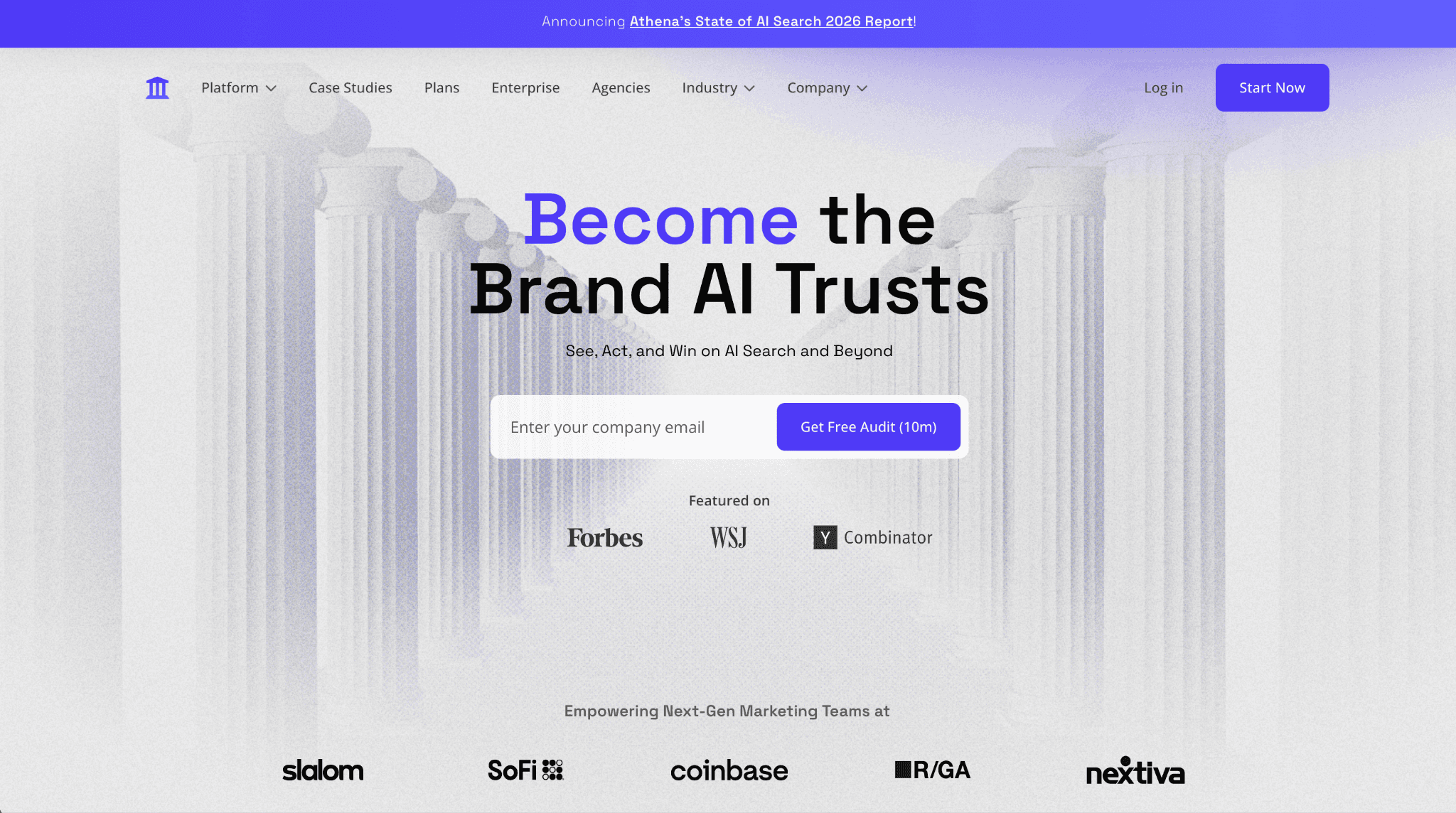
Where most platforms leave you to interpret the data, Athena's Action Center converts monitoring insights into structured, assignable, trackable tasks, closer to a project plan than a report.
For ecommerce specifically, the draw is attribution: native GA4 and Shopify integrations connect AI visibility to actual revenue, plus prompt-volume tracking so you focus on the queries that matter. There's also an "Ask Athena" copilot you can question in plain English instead of digging through charts.
Here are a few AthenaHQ alternatives that you can explore more.
Key features:
Action Center turning visibility gaps into trackable optimization tasks
Native GA4 and Shopify integrations for revenue attribution
8-engine coverage on all plans
"Ask Athena" copilot for conversational queries
Content gap analysis with geographic breakdowns
Pros:
Shopify and GA4 attribution is a direct fit for DTC stores
Action Center bridges insight to execution
8 engines on every plan
The copilot is genuinely useful for non-analysts
Cons:
Credit-based billing makes costs unpredictable as monitoring volume grows
No free trial, so you commit before you test
Self-serve plan is limited to one country
Pricing: Self-serve from $295/month (3,600 credits, 1 credit per AI response), with Growth and Enterprise tiers above. First month is discounted; there's no free trial.
Verdict: Athena HQ is a strong pick for mid-market Shopify brands that want their tool to hand them a task list and prove revenue impact. Do the credit math against your monitoring volume first, because the more you track, the less the $295 sticker reflects reality. If you'd rather have a ranked action plan on flat, predictable pricing, AIclicks gives you that without the metered surprises.
5. Scrunch AI - Best for Making Product Pages AI-Readable
About Scrunch AI
Scrunch AI takes the ecommerce problem somewhere no other tool on this list goes: it tries to fix the technical side of how AI reads your store.
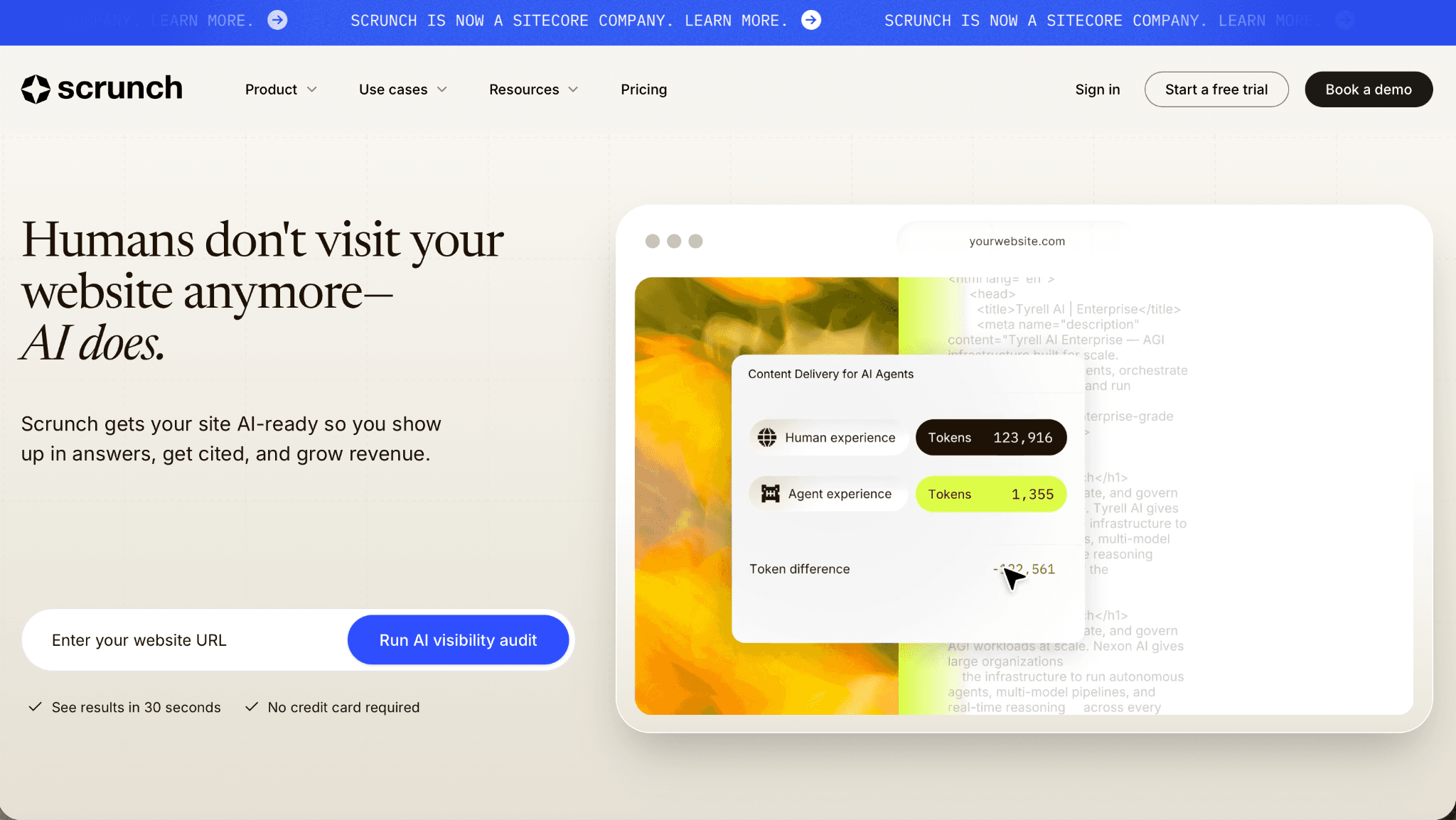
Its standout is the Agent Experience Platform (AXP), which creates machine-readable versions of your web pages optimized for AI agents without changing what human shoppers see.
For a catalog-heavy store, this is the difference between AI parsing your specs accurately and quietly pulling them from a competitor's review site instead. Bot and agent traffic insights show which AI crawlers hit your product pages, how often, and what they pull, which matters when you're managing hundreds or thousands of PDPs.
Scrunch also leans into proactive misinformation detection, flagging when AI describes your products inaccurately.
Key features:
Agent Experience Platform (AXP) serving compressed, machine-readable versions of your pages to AI agents
Real-time AI bot feed with crawl-health monitoring and error detection
Prompt-level monitoring (citations, rankings, trends, share of voice) across major LLMs including ChatGPT, Perplexity, Claude, Gemini, and Copilot
Citation and source analysis plus competitor, persona, and geo benchmarking
Enterprise-grade: SOC 2 Type II, RBAC, multi-region, and a Data API
Pros:
AXP is a genuinely original fix for AI crawlability
Real-time bot observability suits large catalogs
Strong, named client roster including a major DTC brand (Skims)
7-day free trial, so you can test before committing
Cons:
Premium pricing for what is largely a monitoring-plus-infrastructure tool
Heavier setup than a lightweight tracker (AXP can involve CDN configuration)
More infrastructure-focused than action-planning
Pricing: From $250/month for brands and $500/month for agencies, with higher tiers for expanded model coverage, API access, and support. A 7-day free trial is available.
Verdict: Scrunch is the right call if AI crawlability is a genuine bottleneck, your PDPs are complex, and you suspect AI is misreading your catalog. It solves a problem most tools don't even measure, and the real-time bot feed is a real plus for large catalogs. If your main need is broad tracking plus a clear action plan rather than an engineering-grade crawl layer, Scrunch AI alternative like AIclicks fits more cheaply. The two can also work side by side: Scrunch makes pages readable, AIclicks tells you which ones to prioritize.
6. Profound AI - The Enterprise Market Leader
About Profound AI
Profound AI helped define this category and now wants to own its next phase. Its site no longer reads like a monitoring tool; it pitches a full-stack marketing platform built around agents that understand, analyze, build, and measure.
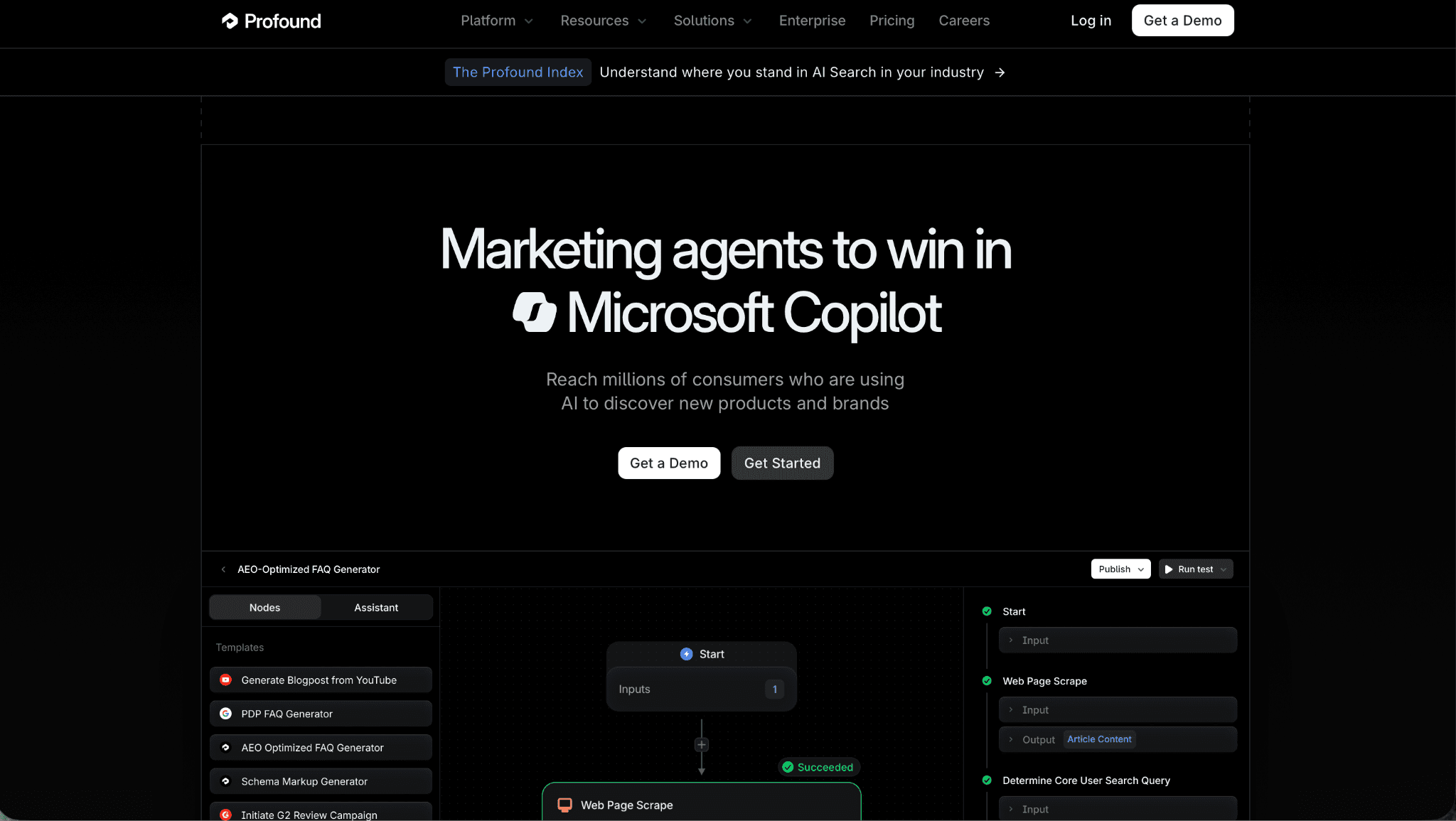
For an ecommerce store, the useful parts are concrete. Prompt Volumes shows the real questions millions of shoppers ask AI, so you can align content with actual demand. Answer Engine Insights shows how AI describes your brand across nine engines (ChatGPT, Perplexity, Gemini, Claude, Copilot, Grok, Meta AI, DeepSeek, and Google AI Overviews).
A dedicated Shopping view tracks product visibility, and Agent Analytics reveals how AI bots crawl your site. Then its Agents can produce and publish optimized content.
Explore more Profound AI alternatives.
Key features:
Prompt Volumes showing what millions of people actually ask AI, so content maps to real demand
Answer Engine Insights covering how AI represents your brand across 9 engines, with citations, sentiment, and share of voice
Shopping view dedicated to tracking product visibility in AI shopping answers
Agent Analytics showing how AI bots crawl and interpret your site
Agents that autonomously build and publish AEO-optimized content (the "Create" layer)
Pros:
Deepest data layer in the category, with real prompt-demand data
Now closes the loop with agents that build and publish, not just monitor
Broad engine coverage (9) plus a dedicated Shopping view
Cons:
Enterprise-only: pricing is custom, with no public self-serve tier
The "marketing engineer" framing and platform depth reward a dedicated team
Likely overkill for a small or single-market store
Pricing: Entry around $99/month (ChatGPT only), with multi-engine tracking from roughly $399/month and enterprise pricing above. Confirm current tiers on Profound's site, as they shift.
Verdict: If you're an enterprise with budget, a dedicated team, and appetite for depth, Profound is a defensible market-leading choice, and Prompt Volumes is genuinely useful for understanding what shoppers ask AI. For lean ecommerce teams, the enterprise-only pricing and the "marketing engineer" learning curve are real barriers. A tool like AIclicks delivers broad tracking plus a ranked action plan at a fraction of the cost.
7. Evertune - Best for Shopping Intelligence and Retail-Partner Data
About Evertune
Every GEO tool hands you a visibility score.
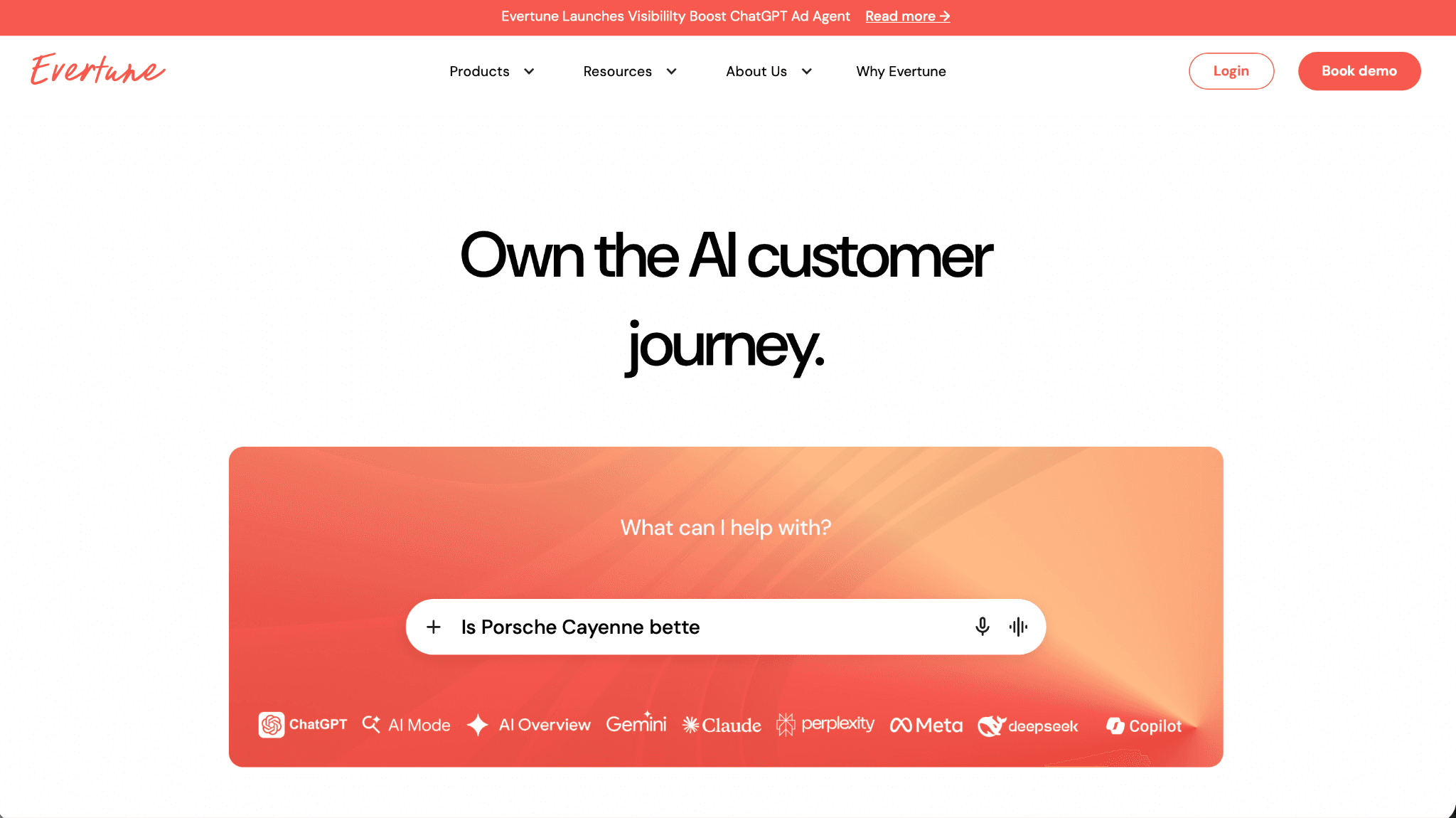
Evertune's pitch is that most of those scores are noisy, and it leans on what it calls the most statistically significant brand monitoring available, drawing on EverPanel, a consumer panel of more than 150 million real AI-search prompts. The aim is a number you can actually reallocate budget against, not one that wobbles week to week.
What makes it relevant for ecommerce is that Evertune doesn't stop at measurement. It spans the full journey: prompt-level user insights, organic GEO optimization, data-driven content activation with affiliate partnerships, and, more unusually, AI advertising, including a new agent that places paid brand mentions inside the conversations where you aren't being recommended.
Key features:
EverPanel user insights built on 150M+ real AI-search prompts, for prompt-volume and behavior data rather than guesses
Statistically significant brand monitoring across ChatGPT, Google AI Mode, AI Overviews, Gemini, Claude, Perplexity, Meta, DeepSeek, and Copilot
Content Activation that turns the product attributes and sources driving recommendations into data-led content and affiliate partnerships
AI Website Optimization to improve how AI engines read and represent your pages
AI Advertising (Visibility Boost), an ads agent that buys brand presence inside AI conversations where you're absent, the part almost no competitor offers
Pros:
Covers the full funnel: insights, organic GEO, content, and paid AI placements in one platform
The statistical-significance angle is built for budget-level decisions, not vanity dashboards
AI advertising is a genuinely rare capability here
Credible enterprise and agency roster (WPP, Roku, Virgin Voyages, HexClad)
Cons:
No public pricing and a demo-first sales motion, so it's not a quick self-serve start
Built for enterprises and agencies; overkill for a small store
Tracks at the brand level, not true SKU-by-SKU product tracking
Pricing: Custom. No public tiers; you book a demo to get pricing.
Verdict: Evertune is for enterprise brands and agencies that want to measure AI visibility rigorously and then act on it across content and paid, all in one place. The AI advertising piece makes it stand out, and the statistical rigor is real. But there's no self-serve on-ramp and no published price, so it's a commitment, and like most platforms here it reads your brand rather than your individual SKUs. A focused DTC store that wants accurate tracking plus a clear action plan without the enterprise sales cycle is better served by AIclicks.
8. Peec AI - The Affordable Entry Point for Growing DTC Brands
About Peec AI
Not every ecommerce store needs an enterprise platform on day one.
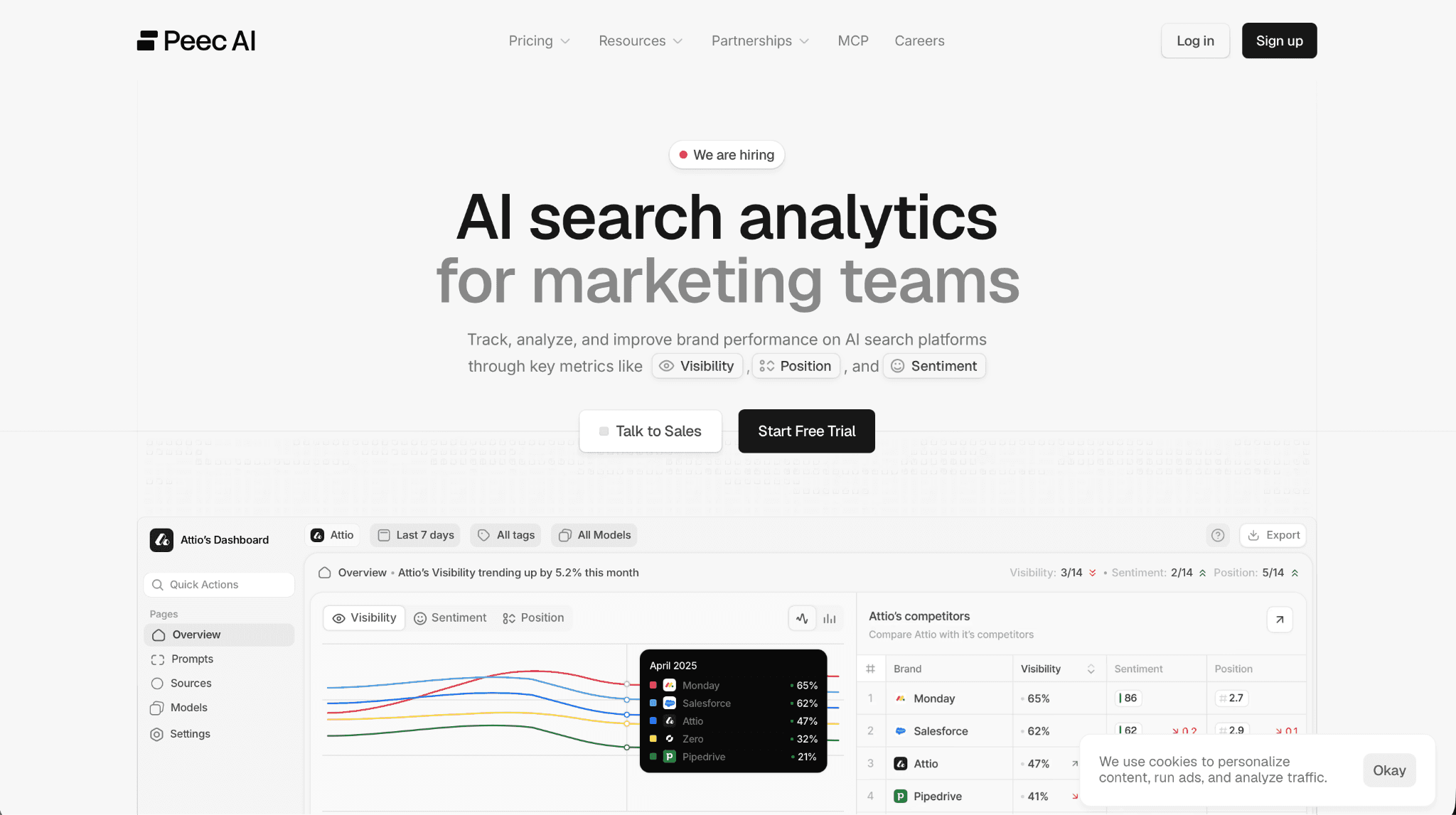
Peec AI is the affordable, no-bloat entry into AI visibility. It keeps the dashboard to the numbers worth acting on: Visibility (how often AI mentions you), Position (where you rank in answers), and Sentiment (how AI frames you), tracked daily across your chosen models with competitor benchmarking.
Where it has grown past pure monitoring is Find Key Sources and Act on Insights, which surface the citations shaping your visibility and turn them into concrete moves: get listed on the review sites AI cites, join the relevant communities, invest in digital PR.
Key features:
Three core metrics tracked daily: Visibility, Position, and Sentiment, with competitor benchmarking
Three AI models of your choice on every plan (from ChatGPT, Perplexity, Gemini, AI Overviews, AI Mode, Copilot), unlimited users included
Find Key Sources: tracks "used" vs "cited" sources at domain and URL level to guide GEO
Act on Insights: concrete recommendations (reviews, communities, digital PR) rather than just a mention count
API, live MCP connector (Claude, Cursor, n8n), Looker Studio connector, and CSV export for reporting
Pros:
Genuinely affordable, with unlimited seats on every plan
Clean, focused UI that's fast to act on
Source/citation tracking plus recommendations, not just a counter
API and MCP make it easy to pipe into your own reporting or n8n workflows
Cons:
Only three models included per plan; broader (or all-model) coverage needs add-ons or Enterprise
Analytics and recommendations only, no content generation, feed optimization, or agentic commerce
Not ecommerce or marketplace-specific (no Amazon Rufus or Walmart Sparky, no product-level tracking)
Pricing: The paid plan starts at Starter around €89/month, Pro near €240, and Advanced near €500, so confirm exact prices on peec.ai/pricing. Separate agency pricing exists.
Verdict: Peec is a solid starting point for DTC brands that want a clean, affordable read on whether AI mentions them and where, plus concrete next steps, without enterprise pricing. The limit is scope: three included models, and no content or commerce execution, so you will outgrow it as AI search becomes a core channel. When that happens, a Peec AI alternative like AIclicks adds broader coverage and a ranked action plan.
How to Choose the Right Ecommerce GEO Tool
Eight tools is a lot to weigh. Skip the feature grid and answer three questions about your own store instead.
1. Do you need measurement or execution?
This is the real fork. If you have a team that just needs accurate cross-engine data to act on, a monitoring-led tool (Peec, Ahrefs Brand Radar) does the job. If your actual problem is "I can see the gaps but don't know what to do," you need an action-led platform like AIclicks, Athena HQ, or Goodie. Buying a beautiful dashboard that changes nothing is the most expensive mistake in this category.
2. How deep does your product catalog go, and where does it sell?
A single Shopify store with 200 SKUs has very different needs from a consumer brand with 5,000 SKUs across Amazon, Target, and DTC. Thousands of SKUs and multiple retail partners push you toward commerce-native enterprise tools (Goodie, Evertune). A focused DTC catalog is well served by an action-led platform at a far lower price.
3. What's your real budget, including the add-ons?
Headline prices here are often fiction. A tool that charges per engine, per seat, or per credit isn't priced at its sticker. Add up the base plan plus every model, seat, and market you actually need, then compare. Flat-rate plans usually win at scale.
One last thing: several of these offer a free trial. Use it. A week of hands-on testing tells you more than any comparison table, including this one.
The Bottom Line
There's no universal "best" ecommerce GEO tool. There's only the best fit.
Goodie AI and Evertune make sense for enterprise brands with deep catalogs and real budget. Scrunch earns its place if AI crawlability is your bottleneck. Athena fits Shopify teams chasing attribution. Peec AI is smart, affordable entry points depending on your stack.
But most teams reading a guide like this want the same two things: accurate visibility across the AI surfaces shoppers actually use, and a clear answer on what to do next. That's the exact gap AIclicks is built to close.
It tracks 10+ AI platforms through their real interfaces, ties that data to real traffic through Google Analytics, and turns it into a ranked action plan instead of another dashboard to decode.
The tools that win in 2026 aren't the ones with the prettiest charts. They're the ones that answer the only question that matters for a store: what do I do next to get my products in front of buyers?
If that's what you're after, start a 3-day AIclicks trial and see where your products stand across AI search.
Frequently Asked Questions
1. What is a GEO tool for ecommerce?
A GEO (Generative Engine Optimization) tool for ecommerce is a platform that tracks how often AI engines like ChatGPT, Google AI Mode, Perplexity, and Amazon Rufus recommend your products in shopping answers, and ideally helps you improve that visibility. Unlike general GEO tools that track domain-level brand mentions, ecommerce GEO tools track product-level and SKU-level visibility inside AI shopping experiences.
2. How is ecommerce GEO different from regular SEO?
Traditional ecommerce SEO focuses on ranking product pages in Google's organic results. GEO focuses on getting your products recommended inside AI-generated answers. The pipeline shifts from "crawl, index, rank" to "retrieved, cited, recommended." AI systems evaluate your product feed, structured data, review quality, and third-party validation rather than classic ranking signals. Our GEO vs SEO breakdown covers the differences in full.
3. Do product feeds really affect AI visibility?
Yes, significantly. Incomplete feeds with missing attributes, outdated pricing, or broken imagery cause AI shopping agents to skip your products entirely. Feed hygiene is now table stakes: a store that thinks it sells 2,000 products may find AI cleanly recognizes far fewer once it scans the catalog.
4. Which AI platforms matter most for ecommerce?
Google AI (Overviews, AI Mode, and Gemini) reaches the largest audience and now includes agentic checkout. ChatGPT drives the most measurable referral traffic and shows product cards with purchase links. Amazon Rufus influences decisions inside the marketplace, and Perplexity Shopping is growing with research-heavy shoppers. A strong ecommerce GEO strategy covers all four.
5. How long does it take to see results from ecommerce GEO?
Brands typically see citation improvements on long-tail product queries within 4 to 6 weeks, while headline category terms like "best wireless earbuds" take longer, usually 3 to 4 months. Feed fixes and structured-data improvements often produce faster results because they remove issues actively preventing AI from recommending your products.
6. What's the cheapest ecommerce GEO tool worth using?
Peec AI (from €89/month) and AIclicks (from $59/month) are the most accessible serious options. AIclicks adds a built-in recommendations engine and 10+ engine coverage, which makes it a strong value pick once you factor in what you'd otherwise spend acting on the data manually.



Any questions left?
Book a call here: