
" width="14px"><path d="M 13.864 5.629 L 13.3 5.629 L 13.3 5.6 L 7 5.6 L 7 8.4 L 10.956 8.4 C 10.379 10.03 8.828 11.2 7 11.2 C 4.681 11.2 2.8 9.319 2.8 7 C 2.8 4.681 4.681 2.8 7 2.8 C 8.071 2.8 9.045 3.204 9.786 3.864 L 11.766 1.884 C 10.516 0.719 8.844 0 7 0 C 3.134 0 0 3.134 0 7 C 0 10.866 3.134 14 7 14 C 10.866 14 14 10.866 14 7 C 14 6.531 13.952 6.073 13.864 5.629 Z" fill="rgb(255, 193, 7)" height="14px" id="H_YjfTNpn" width="14px"/><path d="M 0 3.742 L 2.3 5.429 C 2.922 3.888 4.429 2.8 6.193 2.8 C 7.264 2.8 8.238 3.204 8.979 3.864 L 10.959 1.884 C 9.709 0.719 8.037 0 6.193 0 C 3.504 0 1.172 1.518 0 3.742 Z" fill="rgb(255, 61, 0)" height="5.428500000000002px" id="PlkthQDhg" transform="translate(0.875 0)" width="10.959199999999996px"/><path d="M 6.232 5.581 C 8.04 5.581 9.683 4.889 10.925 3.764 L 8.758 1.931 C 8.032 2.483 7.144 2.782 6.232 2.781 C 4.411 2.781 2.865 1.62 2.283 0 L 0 1.759 C 1.159 4.026 3.511 5.581 6.232 5.581 Z" fill="rgb(76, 175, 80)" height="5.581099999999999px" id="WlnJ5gngE" transform="translate(0.7 8.4)" width="10.924899999999994px"/><path d="M 6.864 0.029 L 6.3 0.029 L 6.3 0 L 0 0 L 0 2.8 L 3.956 2.8 C 3.68 3.576 3.183 4.254 2.526 4.75 L 2.527 4.749 L 4.693 6.582 C 4.54 6.722 7 4.9 7 1.4 C 7 0.931 6.952 0.473 6.864 0.029 Z" fill="rgb(25, 118, 210)" height="6.589883930775992px" id="x_rSW275p" transform="translate(7 5.6)" width="7px"/></g></svg>)


Reviewed by:
Matas Kibildis

Head of Growth @aiclicks.io
Last updated:
Expert Verified

Key Takeaways
AI has changed SEO in two directions at once. It has changed how the tools work: platforms now use machine learning to surface insights, score content, and automate workflows that used to take days. And it has changed where buyers search: ChatGPT, Perplexity, Gemini, and Google AI Overviews are now part of how purchase decisions get made. The best AI SEO tools in 2026 address both.
These eight tools cover every major AI-powered SEO job: AI search visibility tracking (AIclicks, AthenaHQ), content optimization and creation (Surfer SEO, Writesonic), keyword and competitive intelligence (Semrush, Ahrefs), affordable full-suite SEO (SE Ranking), and connected SEO-plus-AI-visibility workflow (Rankability).
No single tool covers everything. Most teams run two or three in combination: one for AI search visibility, one for content optimization, one for keyword research and competitive analysis.
Two things happened to SEO at roughly the same time, and they pulled in different directions.
The tools got smarter. Machine learning started doing the work that used to take an analyst a full day such as clustering keyword ideas by topic, scoring content against what actually ranks, flagging technical issues by estimated traffic impact rather than just severity. The research-to-publish workflow accelerated across the board, and teams started getting more done with smaller headcounts.
At the same time, the question of where buyers actually search became more complicated. ChatGPT does not return a list of links. Perplexity synthesizes an answer and cites sources. Google now answers questions at the top of the page before any organic result appears. The signals that determine whether a brand gets mentioned in those answers are fundamentally different from the signals that determine whether it ranks in a traditional SERP, which means the tools that measure and improve one do not automatically handle the other.
The eight tools on this list sit at the intersection of both shifts. Some use AI to make traditional SEO faster and more precise. Some track the new surfaces where buyer decisions increasingly start. Most do both, though with very different depth on each side.
How AI Has Changed These Eight Tools
Traditional SEO tools have gotten meaningfully smarter. Semrush and Ahrefs now surface AI-powered keyword clustering, content gap analysis, and competitive opportunity scoring that used to require a dedicated analyst to produce manually. SE Ranking's AI Search add-on layers AI visibility tracking onto an existing SEO platform. Surfer SEO now tracks brand visibility across five AI engines on its Pro plan and positions itself as an "AI Visibility Platform", a significant repositioning from the content optimization tool it was three years ago.
AI-native tools have moved into execution. AIclicks and AthenaHQ were built specifically for the AI search visibility layer, and both have expanded from monitoring into action: recommendations, content agents, source intelligence, and attribution. Writesonic and Rankability close the loop from tracking to content creation and publishing.
The line between "SEO tool" and "AI visibility tool" has blurred. Most platforms on this list now do both. The meaningful distinction is which job each one does best, and at what price.
The 8 Best AI Tools for SEO in 2026
Tool | Best For | Starting Price | Standout Feature |
AIclicks | Teams needing dedicated AI search visibility with a clear action plan | $59/mo | 10+ engines, real-UI querying, Recommendations engine |
Surfer SEO | Content teams wanting AI-powered optimization and AI visibility tracking in one platform | $59/mo | Content Score, AI Tracker across 5 engines on Pro, Surfy AI agent |
Semrush | Teams wanting the broadest AI-powered SEO suite with standalone AI visibility tracking | $139.95/mo 8 (SEO) $99/mo per domain (AI Visibility) | 26.5B keyword database, 55+ tools, AI Visibility standalone add-on |
Ahrefs | Teams prioritizing AI-powered backlink intelligence and keyword research | $129/mo (Lite) $199/mo (Brand Radar AI) | World's second-most active crawler, AI-powered keyword clustering, Brand Radar add-on |
Writesonic | Teams wanting AI visibility monitoring and AI content creation in one subscription | $99/mo | Gap-to-draft workflow, ChatGPT + Gemini + AI Overviews tracking from Starter |
Rankability | SEO agencies wanting AI search tracking and content workflow in one credit system | $99/mo | Serena AI agent, Track covering 10 AI engines, Create + Audit + Research unified |
SE Ranking | Teams wanting an affordable AI-powered SEO suite with AI visibility added on | $129/mo | White-label reporting, AI Search add-on, full traditional SEO at lower price than Semrush |
AthenaHQ | Teams needing revenue attribution alongside AI search visibility | $295/mo | GA4 + Shopify attribution, 9 AI models on Starter, Action Center |
1. AIclicks: Best for Dedicated AI Search Visibility With an Action Plan
About AIclicks
Every tool on this list tracks something about AI search. AIclicks was built to track AI search specifically (not as a feature inside a broader SEO platform, but as the entire product) and then to tell you what to do about what it finds.

Ten-plus AI engines tracked through their real user interfaces rather than APIs, because what a buyer sees in ChatGPT and what an API returns are frequently different answers, and tracking the wrong one quietly distorts strategy over time. Every session ends with an Actions engine output: a ranked, prioritized list of content to create, sources to earn mentions on, and communities to engage, each action scored by expected impact. The Competitors tab traces which specific sources power the brands being cited instead of you. The Sources tab maps your category's citation landscape into a concrete target list. The Google Analytics integration connects AI visibility to actual traffic data with daily refreshes by model and country.
Key features:
10+ AI platforms through real user interfaces: ChatGPT, Perplexity, Gemini, Google AI Overviews, AI Mode, Claude, Grok, DeepSeek, Meta AI, and Microsoft Copilot.
Real-UI querying captures what actual users see, not API approximations.
Actions engine converting every visibility finding into a ranked, scored action list.
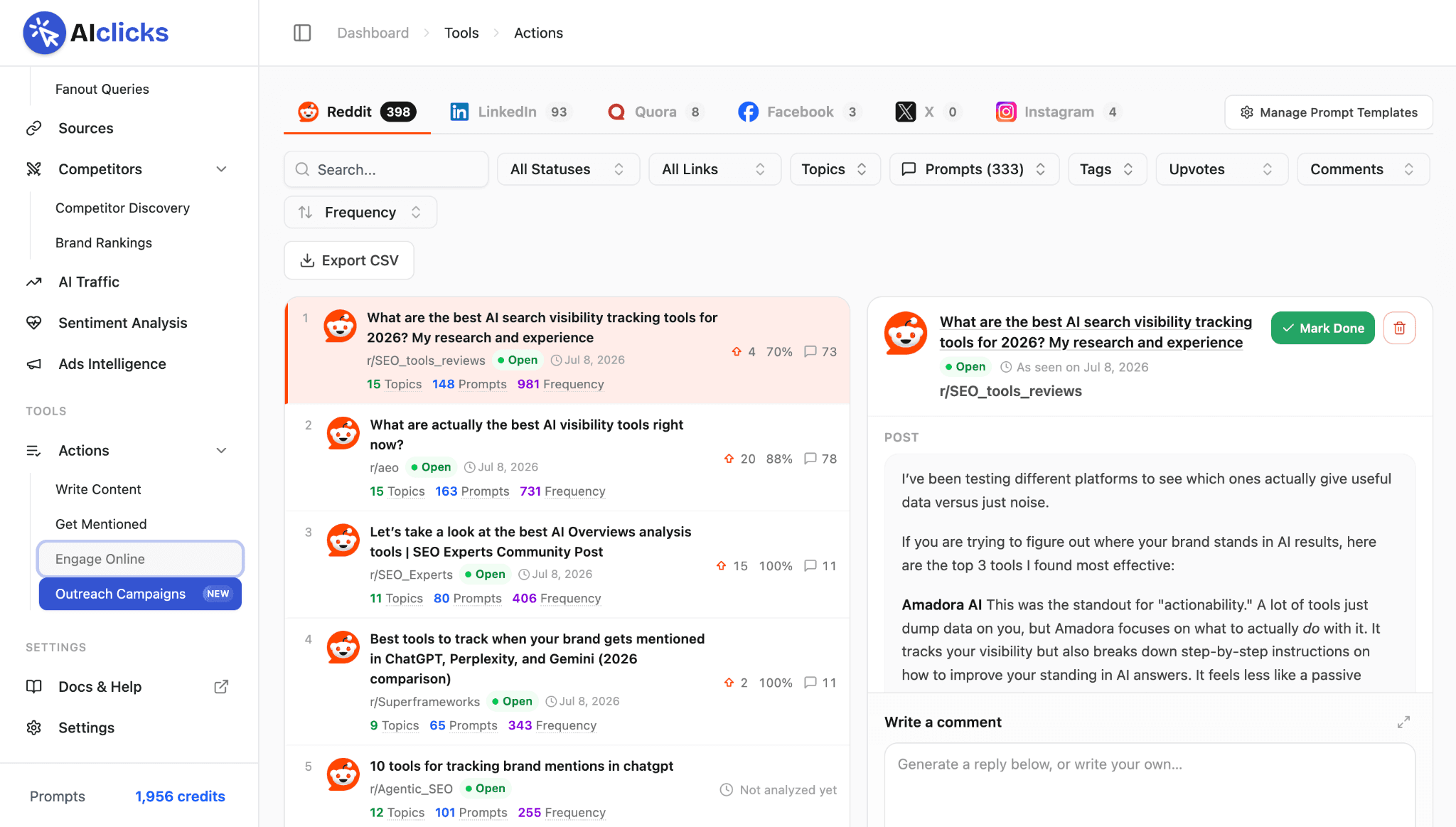
Competitors tab tracing which specific sources power competitors' AI visibility.
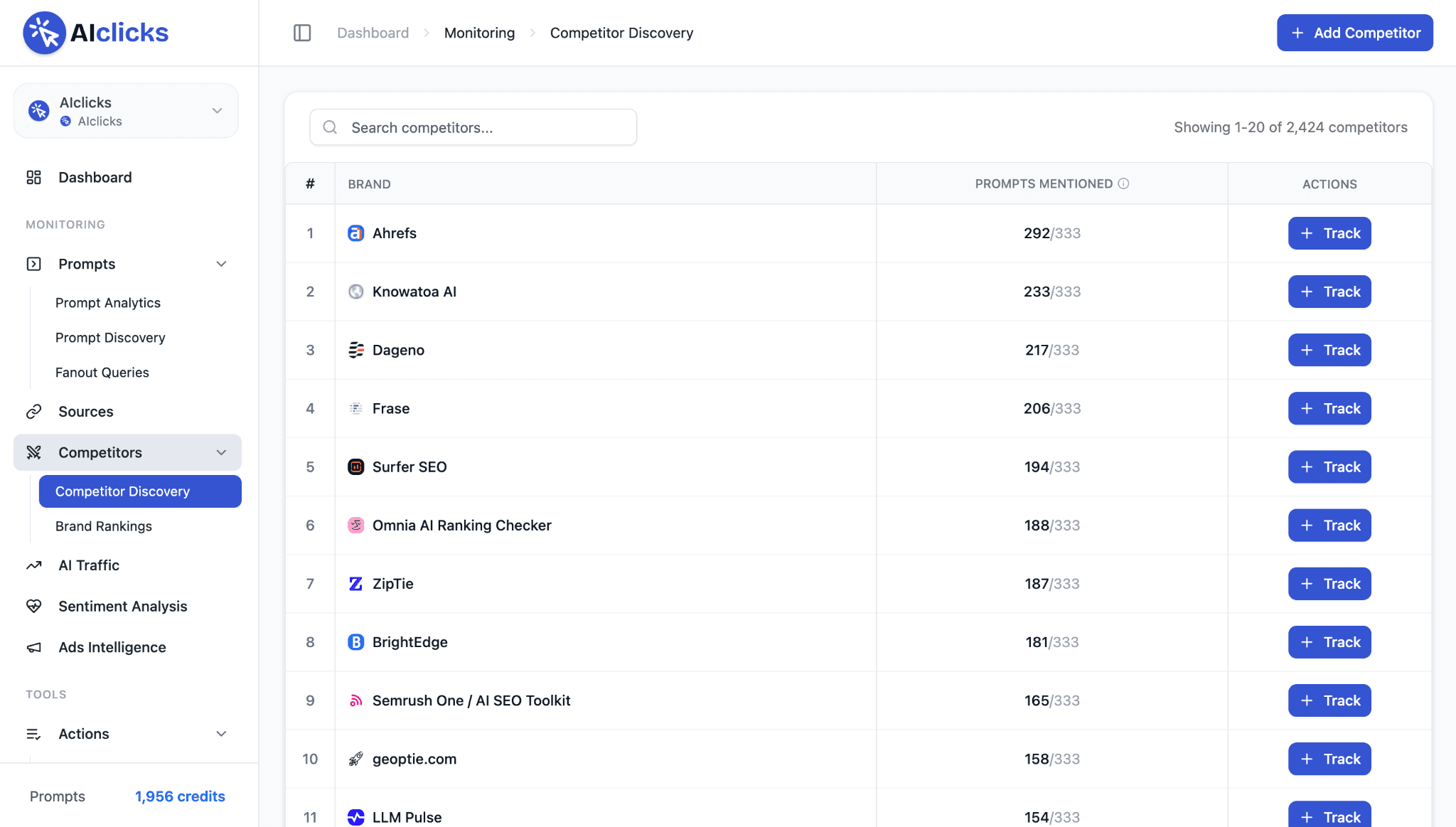
Sources analysis showing exactly which domains feed AI answers in your category.
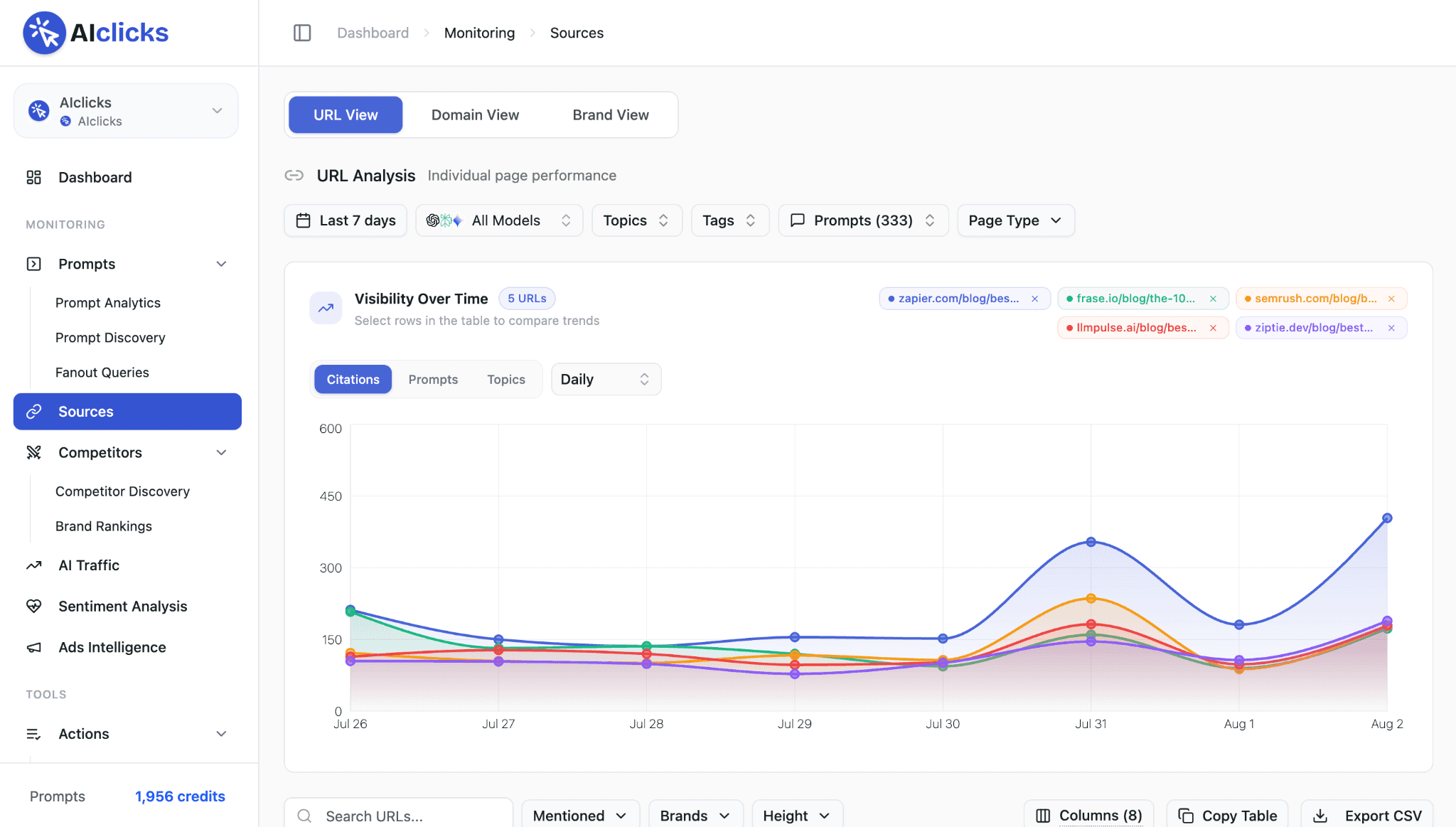
Google Analytics integration with daily refreshes segmented by model and country.
Pros and cons:
Pros:
10+ engines from $59/mo with a 3-day free trial on real data, broader coverage at lower price than any comparable dedicated platform
Actions engine closes the gap between visibility data and weekly execution without needing a dedicated strategist
Real-UI querying tracks what buyers actually encounter, not API approximations
Cons:
Predefined plan tiers rather than credit-based flexibility. Teams with specific prompt volumes may need custom plans.
Three-day trial is short for a platform whose value compounds over time. The team extends it on request.
G2 rating: 4.9/5
Pricing: Starter $59/mo (30 prompts, 1 website, 3 AI platforms) | Pro $189/mo (150 prompts, unlimited websites, 4 platforms) | Business $499/mo | 3-day free trial on all plans
Verdict:
For teams where AI search visibility is the primary job and the platform needs to produce a ranked work list at the end of every session, AIclicks is the most focused tool on this list. For teams that want AI visibility embedded inside a broader content or SEO workflow, Surfer SEO, Rankability, or Writesonic may be a better architectural fit.
If you want to go deeper on the strategy behind ranking in AI search before you trial anything, check this out:
2. Surfer SEO: Best for AI-Powered Content Optimization With Built-In AI Tracking
About Surfer SEO
Surfer SEO started as a content optimization tool and has repositioned itself in 2026 as an "AI Visibility Platform", which is either an accurate description of where the product has gone or a marketing move, depending on which plan you're on.

The core product has not changed: enter a keyword, get a real-time content score based on competitor SERP analysis, write to the recommendations in the Content Editor, and publish content that reflects what's actually ranking right now. That workflow is still the most polished content optimization experience on this list. What's new is the AI Tracker. Standard plan ($99/mo annual) tracks ChatGPT only, 25 prompts weekly. Pro plan ($182/mo annual) tracks ChatGPT, Perplexity, Google AI Mode, Google AI Overviews, and Gemini across 50 prompts refreshed daily. It is not the deepest AI visibility tool on this list but for content teams that want both jobs in one platform without running separate subscriptions, Pro's combination of Content Editor, AI Tracker, Topical Map, and Content Audit is genuinely strong. Now part of Positive Group.
Key features:
Content Editor with real-time content scoring based on 500+ web and AI signals, NLP terms, and competitor SERP analysis.
AI Tracker monitors brand visibility across 5 engines on Pro: ChatGPT, Perplexity, Google AI Mode, Google AI Overviews, Gemini, 50 prompts daily.
Topical Map identifying content gaps and cluster opportunities for building topical authority.
Content Audit flagging underperforming pages and prioritizing quick-win refresh opportunities.
Surfy AI agent for strategy questions, content outlines, and AI SEO guidance.
Standalone AI Search Analytics plan available at $158/mo (100 daily prompts, 5 engines) for teams that only need the tracking layer.
Pros and cons:
Pros:
Content Editor remains the most polished AI-powered content optimization experience in the category
Pro plan at $182/mo annual combines content optimization and 5-engine AI tracking without a second subscription
150,000+ customers across 159 countries; proven at scale from solo bloggers to enterprises including ClickUp, FedEx, and Bolt
Cons:
AI tracking on Standard is ChatGPT only, weekly refresh. The meaningful AI visibility tier is Pro at $182/mo, a significant jump from Discovery at $49/mo.
Five engines on Pro. Claude, Grok, DeepSeek, and Meta AI are not tracked on any self-serve plan.
"The cost. It's very expensive to use, so I would love something a bit more affordable." Verified G2 reviewer. The Pro plan is the practical entry for teams that want both content optimization and meaningful AI tracking.

G2 rating: 4.8/5
Pricing: Discovery $49/mo annual (content only, no AI tracking) | Standard $99/mo annual (ChatGPT only, weekly) | Pro $182/mo annual (5 engines, daily) | Peace of Mind $299/mo annual (100 prompts, unlimited documents) | Enterprise $999/mo | Standalone AI Search Analytics $158/mo annual (100 daily prompts)
Verdict:
Surfer earns its place on this list for content teams that want AI-powered content optimization and AI search tracking in one platform. The Content Editor is the strongest on this list for that job. The AI Tracker on Pro covers the five most commonly cited engines, which handles most B2B and B2C category landscapes. For teams that need Claude, Grok, or broader engine coverage, a dedicated AI visibility tool alongside Surfer makes more sense than paying for the higher tiers.
3. Semrush: Best for the Broadest AI-Powered SEO Suite
About Semrush
Semrush has been the most recognized name in SEO for a decade, and it has spent the last two years adding AI to most of what it already did well. The Keyword Magic Tool now clusters keywords by topic and intent rather than just generating a list. The AI Copilot pulls recommendations from your GSC data and site audit findings and surfaces them in a single prioritized view. The AI Visibility product tracks brand mentions across ChatGPT, Google AI, Gemini, and Perplexity at $99/mo per domain, with no base subscription required.
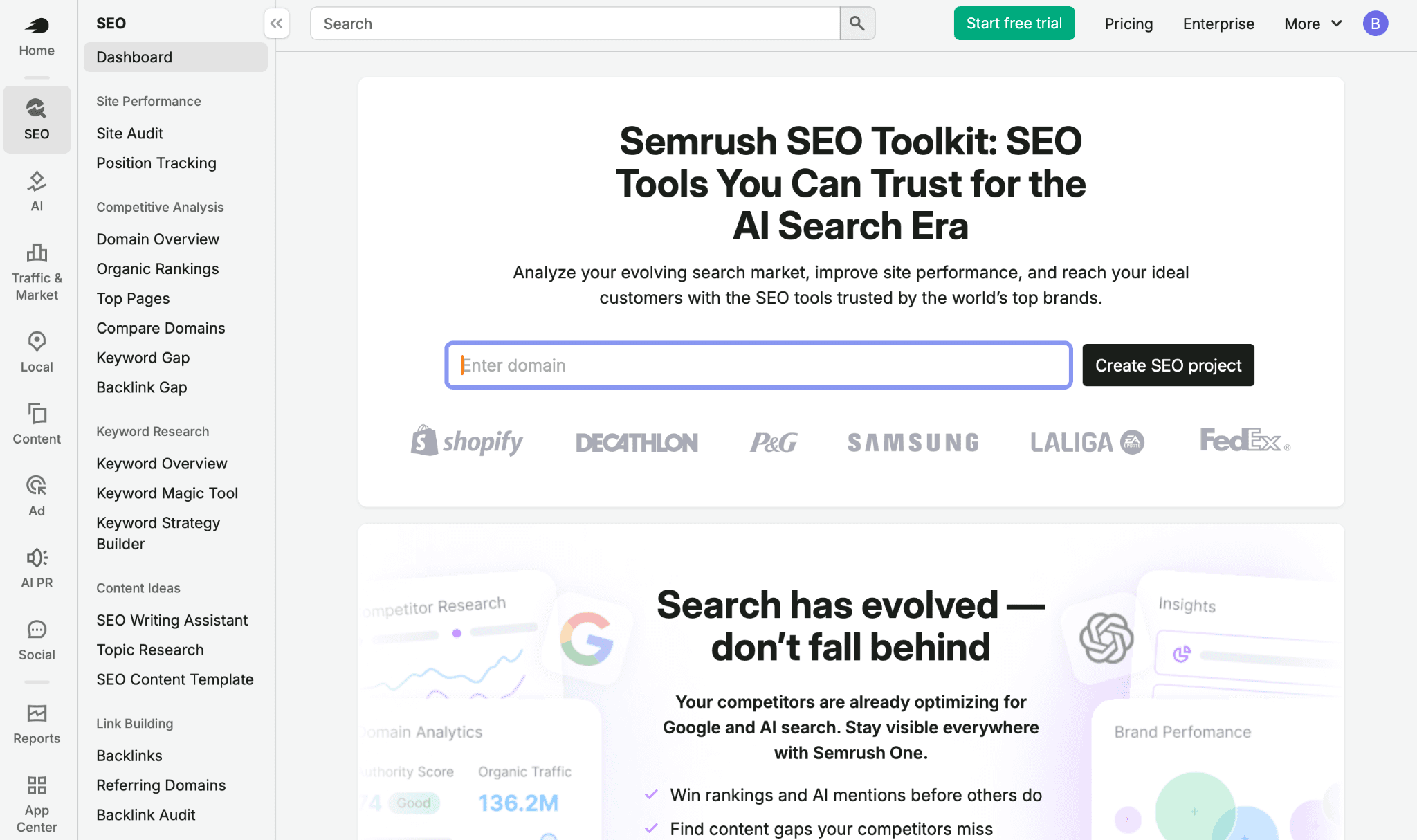
The case for Semrush as an AI SEO tool is the same case as Semrush generally: the breadth. AI-powered keyword clustering, content gap analysis, position tracking, site auditing, backlink intelligence, competitor traffic analytics, all with AI surfacing priorities and recommendations across each module. The AI Visibility product handles the new layer. The Adobe acquisition adds long-term strategic uncertainty for teams making platform commitments.
Key features:
Keyword Magic Tool with AI-powered topic clustering grouping keywords by intent, topic, and competitive difficulty.
AI Copilot surfacing personalized recommendations from GSC data, site audit findings, and rank tracking inside the platform.
Content Marketing Toolkit with AI-powered content briefs and SEO writing assistance on Guru and Business plans.
AI Visibility Toolkit tracking brand mentions across ChatGPT, Google AI, Gemini, and Perplexity with 25 prompt slots daily standalone, no base subscription required.
Traffic Analytics estimating competitor organic and paid traffic from any domain.
Site Audit identifying and prioritizing technical SEO issues with AI-powered fix guidance.
Pros and cons:
Pros:
Broadest AI-enhanced traditional SEO toolkit available with keyword research, site audit, backlinks, content, and competitor analysis all in one platform
AI Visibility Toolkit is a standalone product, so agencies can add it per client without upgrading the base plan
AI Copilot consolidates insights from multiple data sources into a prioritized action list inside the platform
Cons:
"My least favorite thing about Semrush is how confusing the pricing is. I never feel sure which capabilities I actually have access to." Verified G2 reviewer. AI Visibility adds $99/mo per domain on top of the base plan, the real agency cost climbs fast.
AI Visibility covers 4 engines. Claude excluded on the Base plan. Engine coverage expands on higher tiers.
The Adobe acquisition introduces product direction uncertainty worth factoring into long-term commitments.

G2 rating: 4.4/5
Pricing: Pro $139.95/mo | Guru $249.95/mo | Business $499.95/mo | AI Visibility Toolkit $99/mo per domain (standalone)
Verdict:
For teams already inside the Semrush ecosystem, the AI Copilot and AI Visibility Toolkit make the platform more useful without requiring a significant additional investment per existing user. For teams evaluating Semrush specifically for AI SEO in 2026, it is more comprehensive than any alternative but also more expensive, and the AI Visibility coverage (4 engines on Base) is narrower than dedicated platforms.
4. Ahrefs: Best for AI-Powered Backlink Intelligence and Keyword Research
About Ahrefs
Ahrefs runs one of the most active web crawlers on the planet. Everything else the platform does such as AI-powered keyword clustering, content gap analysis, and link opportunity identification, sits on top of that data foundation. The data quality is the differentiation.
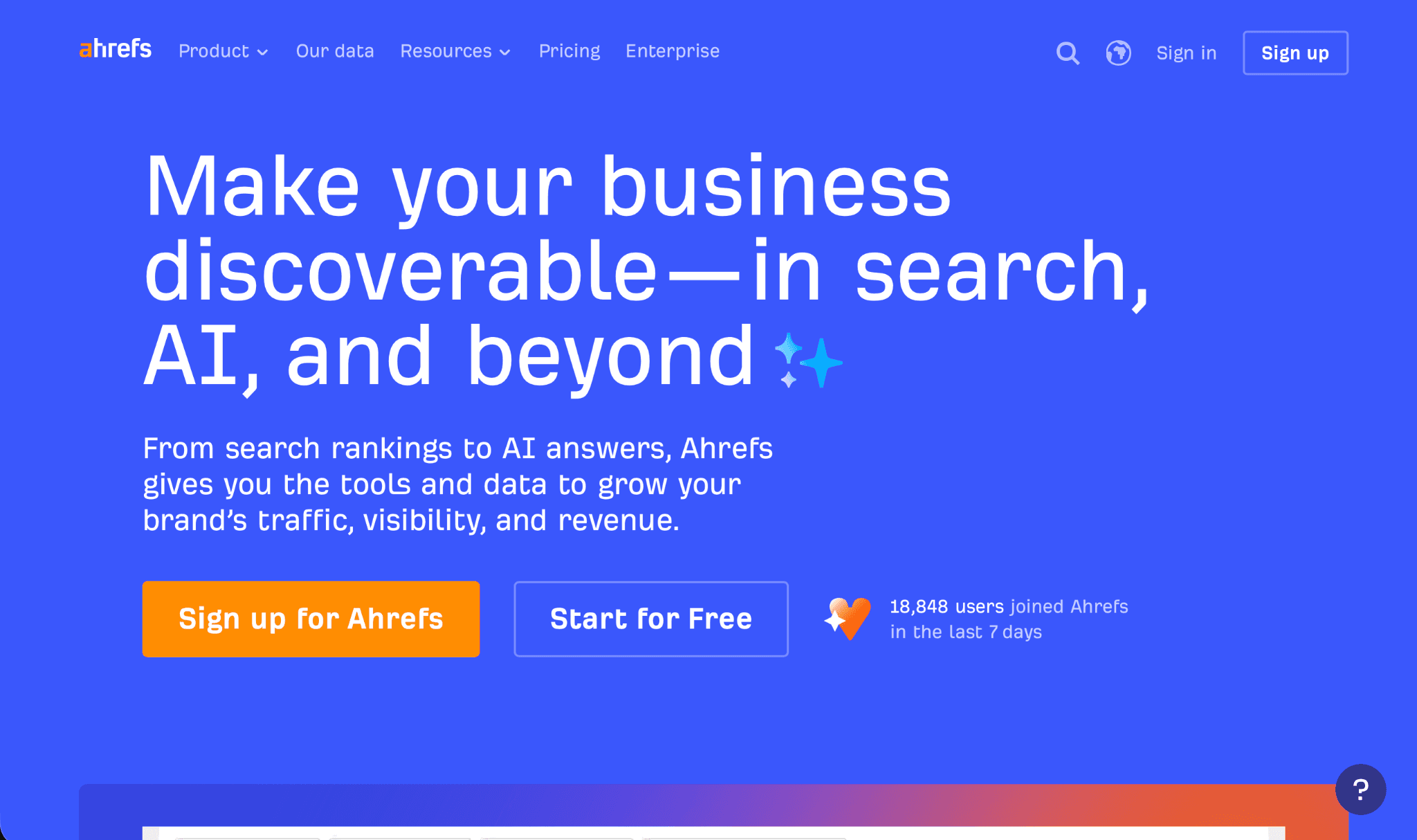
The Keywords Explorer uses machine learning to cluster keyword ideas by topic and flag intent signals, which turns a seed keyword into a structured content cluster in minutes rather than hours. The Content Gap tool identifies keywords competitors rank for that you do not, and AI-powered prioritization surfaces the highest-opportunity gaps rather than just listing everything. Site Audit uses AI to prioritize technical issues by estimated traffic impact. Brand Radar, available at $199/mo, tracks AI visibility across ChatGPT, Perplexity, Gemini, Copilot, Google AI Overviews, AI Mode, and Grok using prompts derived from 271 million real organic searches rather than researcher-guessed prompts.
Key features:
Keywords Explorer with AI-powered topic clustering, intent classification, and keyword difficulty scoring.
Content Gap identifying keyword opportunities where competitors rank and you do not, with AI-prioritized surfacing of highest-value gaps.
Site Explorer showing the full backlink profile of any domain, updated constantly by Ahrefs' crawler.
Content Explorer finding top-performing content by topic with traffic, backlink, and engagement signals.
Site Audit with AI-powered issue prioritization by estimated traffic impact.
Brand Radar: AI visibility across 7 platforms from search-behavior-grounded prompts, $199/mo per index or $699/mo all platforms.
Pros and cons:
Pros:
Best backlink database and crawler frequency available, the data foundation that makes every other AI-powered feature more reliable
AI-powered keyword clustering turns seed keywords into content clusters faster than manual research
Brand Radar's search-grounded prompt methodology produces AI visibility data closer to real buyer behavior than fabricated prompt sets
Cons:
Starter plan ($29/mo, monthly only) is credit-limited. The practical agency entry point is Lite at $129/mo.
Brand Radar is a separate charge on top of the base subscription. Ahrefs Lite plus Brand Radar one index totals $328/mo monthly.
The pricing is costly for small businesses.

G2 rating: 4.5/5
Pricing: Starter $29/mo | Lite $129/mo | Standard $249/mo | Advanced $449/mo | Enterprise $1,499/mo | Brand Radar $199/mo per index or $699/mo all platforms
Verdict:
For teams where backlink strategy, keyword research, and content gap analysis are core SEO jobs, Ahrefs is the strongest platform on this list for that work. The AI-powered clustering and prioritization make the research layer faster. Brand Radar adds AI visibility with a methodology that is genuinely distinct from every other platform on this list, though the add-on cost makes it worth calculating whether a dedicated AI visibility tool covers the same need at a lower price.
5. Writesonic: Best for Teams Wanting AI Visibility Monitoring and Content Creation Together
About Writesonic
Most AI SEO workflows have two separate steps: finding where your brand is missing from AI answers, then creating content to fix it. Writesonic connects those two steps in one dashboard from $99/mo, without a demo call or a second subscription.
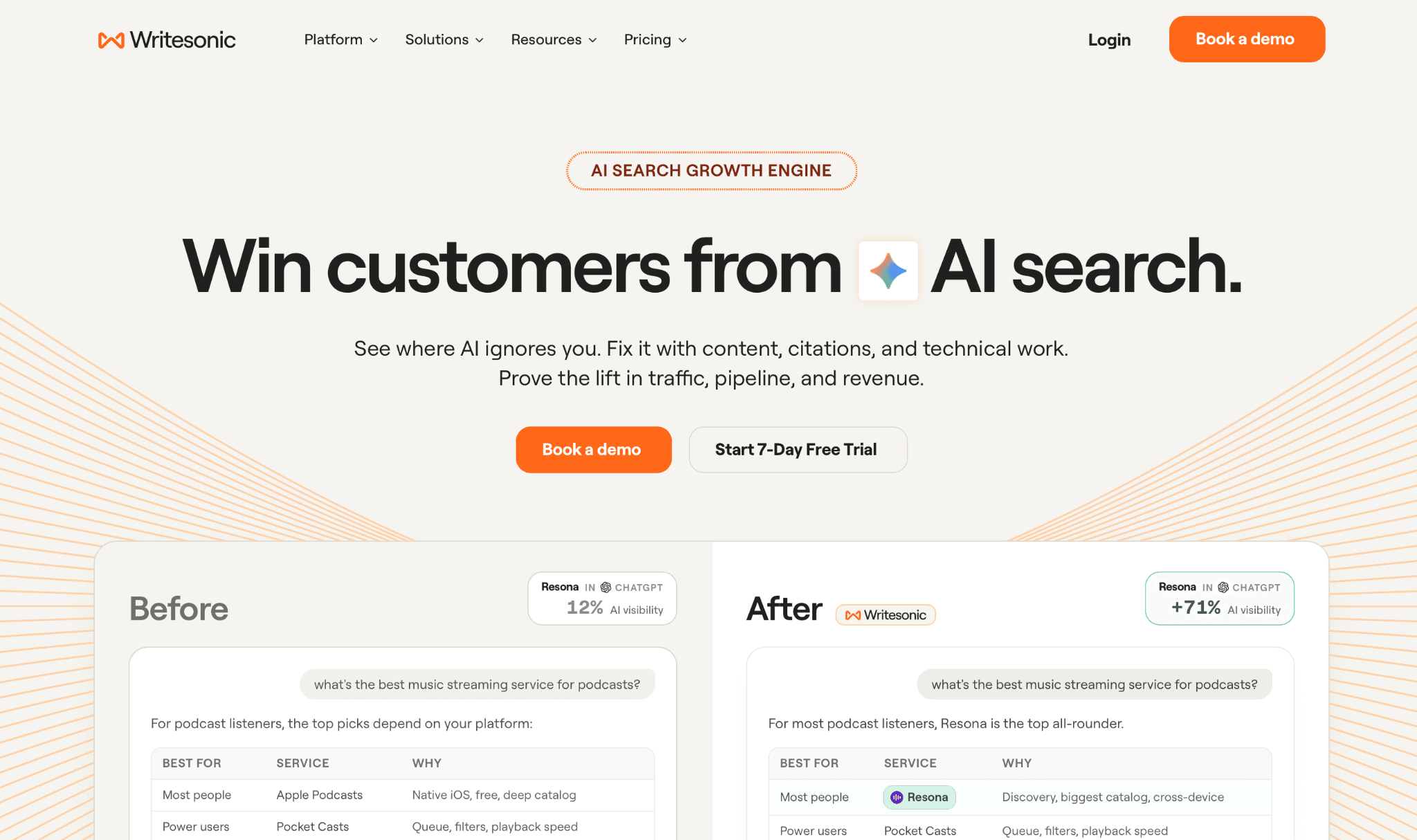
The Starter plan tracks ChatGPT, Gemini, and Google AI Overviews with 50 daily prompts and generates 15 AI articles per month, both connected to the same visibility data. Site audit features flag where AI bots encounter technical issues on your site. Sentiment analysis enters on Growth. The limitation to plan around: all self-serve plans cover exactly three engines. Perplexity, Claude, and everything beyond Gemini require Enterprise with custom pricing. The monitoring-to-content loop is the real value. For teams that primarily need that workflow without the complexity of an enterprise platform, Writesonic delivers it at an accessible price.
Key features:
ChatGPT, Gemini, and Google AI Overviews tracking on all self-serve plans with daily refresh.
15-50 AI articles per month depending on plan, generated from the same visibility data in one workflow.
Site audit flagging AI bot issues and technical gaps across all plans.
Sentiment Analysis on Growth and above.
Limited Action Center on Growth (5 off-page + 5 on-page actions/mo). Full Action Center on Enterprise.
All 10 platforms on Enterprise only.
Pros and cons:
Pros:
Monitoring-to-content workflow from $99/mo closes the gap between visibility data and content production without tool-switching
AI article generation from Starter means teams act on what they find rather than handing data to a separate content team
Site audit for AI bot issues included from the entry plan
Cons:
Three engines on all self-serve plans. Perplexity and Claude require Enterprise.
Action Center not available on Starter or Basic. Growth gets limited trial access only.
"Sometimes I just feel that these contents are just like ChatGPT only, but we pay extra every month for its premium plan without getting any additional features." Verified G2 reviewer.

G2 rating: 4.7/5
Pricing: Starter $99/mo (ChatGPT, Gemini, AI Overviews, 50 prompts, 15 articles) | Basic $199/mo | Growth $399/mo (limited Action Center) | Enterprise custom | Free trial, no credit card needed
Verdict:
Writesonic makes its strongest case for content teams publishing regularly who want the visibility tracking and the content production in one platform. For teams that need Perplexity, Claude, or broader engine coverage on self-serve plans, AIclicks or AthenaHQ cover the tracking side more comprehensively, and Writesonic handles the content production side at a lower price than enterprise alternatives.
6. Rankability: Best for SEO Agencies Wanting AI Search and SEO Workflow in One System
About Rankability
Rankability built its platform around a specific problem agencies have: AI visibility has become a deliverable, but most agencies do not want to run a separate tool stack for it. Track, Research, Create, Audit, Promote, and Serena: six tools in one credit system, covering keyword research, content briefing and drafting, technical auditing, backlink analysis, and AI visibility across 10 engines.

Track covers Google, AI platforms, local search, and video. On the AI side that means ten engines: ChatGPT, Perplexity, Google AI Overviews, Google AI Mode, Gemini, Claude, Grok, Microsoft Copilot, Brave AI, and DeepSeek. Serena, the AI search agent on every plan, reads your data across all six tools and surfaces specific next steps. White-label client reporting, unlimited clients, and unlimited users are included on every plan, the pricing variable is credit volume, not seats. The credit opacity that G2 reviewers flag consistently applies here: credit costs per action are in the documentation but not visible at the point of running something.
Key features:
Track covering 10 AI engines: ChatGPT, Perplexity, Google AI Overviews, Google AI Mode, Gemini, Claude, Grok, Microsoft Copilot, Brave AI, and DeepSeek.
Serena AI agent reading data across all six tools and surfacing specific prioritized actions.
Research, Create, Audit, and Promote connecting keyword research, content production, technical SEO, and backlink analysis in one credit system.
White-label client reporting on all plans.
Unlimited clients and unlimited users on every plan.
Pros and cons:
Pros:
10 AI engines via Track is broader self-serve coverage than most platforms on this list
Serena turns data into a specific next-step list without requiring a separate analyst to interpret the output
Unlimited clients and users from $99/mo makes the agency economics transparent
Cons:
Credit costs per action are not visible before running automations.
The feature surface is complex and growing.

G2 rating: 5/5 (small sample size with 17 reviews)
Pricing: Starter $99/mo | Growth $199/mo | Scale $399/mo
Verdict:
Rankability makes the most sense for SEO agencies that sell SEO as a service and want AI search visibility in the same operating model rather than a separate tool stack. The 10-engine coverage via Track, the Serena action layer, and the white-label reporting together make it the most agency-complete platform on this list. For solo practitioners or single-brand in-house teams, the agency architecture adds cost for infrastructure they will never use.
7. SE Ranking: Best for Teams Wanting an Affordable AI-Powered SEO Suite
About SE Ranking
SE Ranking has been the most underrated platform in this category for years. The white-label reporting, the affordable per-seat pricing, and the full traditional SEO toolkit make it the natural choice for agencies and in-house teams that find Semrush's per-seat model expensive at scale and want AI visibility without a second subscription.

The AI Search add-on ($89/mo) adds brand monitoring across ChatGPT, Perplexity, Google AI Overviews, Google AI Mode, and Gemini with daily refresh and source citation analysis. The base platform covers keyword tracking, site auditing, backlink monitoring, competitor analysis, and on-page SEO checking, all with AI-powered prioritization inside each module. SE Visible, the standalone AI visibility product, covers ChatGPT and Google AI Mode at $189/mo, a narrower but simpler option. For agencies wanting the full traditional-plus-AI SEO stack at a lower price than Semrush, SE Ranking plus the AI Search add-on is the most complete affordable combination on this list.
Key features:
AI Search add-on tracking ChatGPT, Perplexity, Google AI Overviews, Google AI Mode, and Gemini with daily refresh and citation source analysis.
Keyword rank tracking across Google and Bing with daily updates, AI-powered priority surfacing.
Site Audit with AI-powered issue prioritization and historical comparison.
Backlink monitoring tracking new, lost, and referring domain changes.
White-label reports via Agency Pack add-on ($69/mo annual), with client branding and automated delivery.
On-page SEO checker with AI content recommendations.
Pros and cons:
Pros:
Lower per-seat cost than Semrush or Ahrefs makes multi-team agency economics more manageable
AI Search add-on covers 5 engines with daily refresh, more coverage than Semrush AI Visibility Base at $99/mo
White-label reporting via Agency Pack is the most polished client-facing reporting on this list
Cons:
Full agency setup (Core plus AI Search add-on plus Agency Pack) lands meaningfully higher than the $129 headline. Calculate the real total before committing.
Advanced features have a learning curve. Teams managing multiple brands across international markets report cross-brand reporting falls short.
SE Visible standalone ($189/mo) covers only ChatGPT and Google AI Mode, too narrow for serious AI search visibility work at that price.

G2 rating: 4.7/5
Pricing: Core $129/mo monthly | Growth $239/mo | AI Search add-on $89/mo annual
Verdict:
SE Ranking is the right call for teams that want AI-enhanced traditional SEO plus AI visibility tracking at a lower price than Semrush, particularly for agencies where white-label reporting is a core deliverable. The full agency configuration costs more than the headline, but even at total cost it delivers more per dollar than Semrush at agency scale.
8. AthenaHQ: Best for Teams Needing Revenue Attribution Alongside AI Visibility
About AthenaHQ
AthenaHQ tracks where your brand appears in AI answers and ties that directly to revenue through GA4 and Shopify integrations. For teams that need to show a CFO what AI search visibility is actually generating, it is the only platform on this list that answers that question directly.
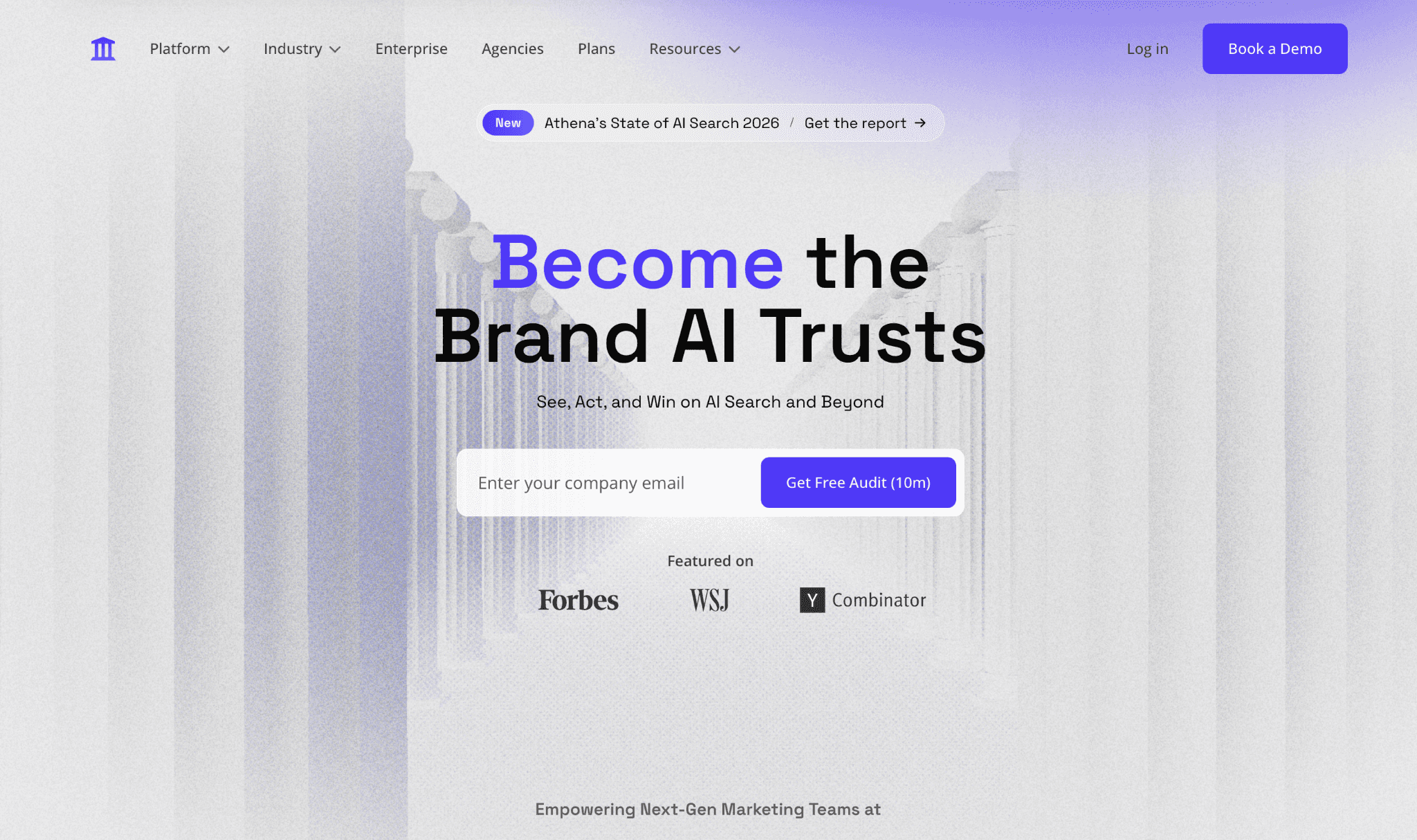
Built by alumni of Google Search and DeepMind, backed by Y Combinator, the Starter plan at $295/mo covers 9 AI models including ChatGPT, Perplexity, AI Overviews, AI Mode, Gemini, Claude, Copilot, and Grok, plus additional models on request. The Action Center generates structured GEO optimization workflows with tasks assignable to team members. The Ask Athena AI agent answers plain-language questions about your visibility data without needing to build a report. The Essential plan (free, $25 credit, 300 credits) gives access to 5 engines, unlimited members, content recommendations, and the Athena AI agent, a genuinely substantive free entry point. The Athena Recommendation Engine and Citation Engine (ACE) are Enterprise-only.
Key features:
9 AI models on Starter with no per-model add-ons: ChatGPT, Perplexity, AI Overviews, AI Mode, Gemini, Claude, Copilot, Grok.
Revenue attribution via GA4 and Shopify connecting AI citations to conversions, demos, and sales.
Action Center generates structured GEO optimization workflows with tasks assignable by team member.
Ask Athena AI agent answering plain-language strategy questions from live visibility data.
Source Intelligence identifying which websites AI systems draw from most in your category.
Hallucination detection monitoring for AI engines describing your brand inaccurately.
Essential plan: free, $25 credit, 5 engines, unlimited members, content recommendations, Athena AI agent.
Pros and cons:
Pros:
Revenue attribution through GA4 and Shopify makes AI search investment defensible to finance, the only platform on this list doing this
9 engines on Starter with no add-on fees, and a free Essential plan that includes meaningful features
Action Center is the most developed task workflow layer for self-serve AI visibility buyers
Cons:
$295/mo with no trial on Starter. The Essential free plan helps evaluate but the Recommendation Engine and ACE are Enterprise-only.
Single country/language on Starter. Multi-region tracking requires Enterprise.
Product updates ship fast enough that the interface changes between sessions.

G2 rating: 4.9/5
Pricing: Essential free ($25 credit, 5 engines, unlimited members) | Starter $295/mo (3,600 credits, 9 models) | Enterprise custom
Verdict:
For ecommerce brands and enterprise growth teams that need to connect AI search visibility to commercial outcomes, AthenaHQ is the most complete platform on this list for that specific job. The 9-model coverage, the revenue attribution, and the Action Center in one self-serve product is a meaningful combination. For teams still building the business case for AI visibility investment, the Essential free plan allows a genuine evaluation before committing $295/mo.
How to Choose the Right AI SEO Tool
Identify which half of the AI SEO problem you need to solve first. The tools on this list address two distinct challenges: making traditional SEO work smarter (AI-powered keyword clustering, content scoring, issue prioritization) and tracking the new AI search surfaces where buyers are increasingly active. Most teams need both, but one is usually more urgent. If buyers in your category are actively using ChatGPT and Perplexity and you have no data on your brand's position there, AI visibility tracking is the more urgent starting point. If your Google organic rankings have stagnated and you need faster content production and better optimization, the content-and-SEO tools take priority.
Decide whether you need one platform or two working together. Surfer SEO, Writesonic, and Rankability all attempt to combine both jobs in one subscription. They are meaningful combinations, but with honest trade-offs on the AI visibility side: Surfer Pro tracks 5 engines, Writesonic self-serve tracks 3, Rankability tracks 10 via its credit system. AIclicks and AthenaHQ do the AI visibility job more deeply but do not replace content optimization tools. For most teams, a dedicated AI visibility platform paired with a dedicated content optimization tool produces better results than one platform trying to do both.
Price the real cost at the feature level you actually need. Surfer's Discovery plan ($49/mo) has no AI tracking. Surfer's Pro plan ($182/mo) has meaningful AI tracking. Semrush's base plan has no AI visibility, that requires a $99/mo additional plan per domain. Ahrefs' Webmaster Tools is free but excludes Keywords Explorer. SE Ranking's AI Search add-on is $89/mo on top of the base plan. Write down the specific features your workflow requires, price those features specifically at each platform, and compare from that number rather than the headline.
Why AIclicks Belongs in Every AI SEO Stack
Several tools on this list include some form of AI visibility tracking. What separates AIclicks is what happens after the data comes in.
Every session ends with a ranked work list: which prompts your brand is missing from, which sources are powering the competitors beating you, what to create, what to pitch, where to show up. That output is what makes AI visibility a weekly workflow rather than a metric you check quarterly.
Frequently Asked Questions
1. What is the best AI tool for SEO in 2026?
The answer depends on which job matters most. For AI search visibility with a clear action plan, AIclicks covers 10+ engines with an Actions engine at $59/mo. For AI-powered content optimization with built-in AI tracking, Surfer SEO Pro at $182/mo annual is the strongest combination. For the broadest AI-enhanced traditional SEO suite, Semrush covers the most ground. For revenue attribution alongside AI visibility, AthenaHQ is the only platform that connects AI search to commercial outcomes.
2. Do you need a separate AI visibility tool if you already use Semrush or Ahrefs?
Not necessarily, but the AI visibility coverage on those platforms has meaningful limitations. Semrush AI Visibility Base covers 4 engines. Ahrefs Brand Radar covers 7 engines but costs $199/mo extra per index. For teams where AI search is becoming a primary channel, a dedicated platform like AIclicks or AthenaHQ provides meaningfully deeper tracking, recommendations, and action guidance than either add-on delivers.
3. Which AI SEO tool is best for content teams?
Surfer SEO has the strongest AI-powered content optimization experience. The Content Editor, Topical Map, Content Audit, and AI Tracker in one platform cover the full content cycle. Writesonic is the right choice for teams that want monitoring-to-draft in one workflow at a lower price. MarketMuse addresses the content intelligence layer (topical gaps, inventory analysis) for teams focused on building the type of authoritative content AI engines cite.
4. Which tool is best for SEO agencies?
Rankability was designed specifically for agencies with 10 AI engines, white-label reporting, unlimited clients and users, and Serena AI agent from $99/mo. SE Ranking is the best choice for agencies that want traditional SEO plus AI visibility at a lower price than Semrush, with the most polished white-label reporting on this list via Agency Pack. AIclicks has an agency program with custom pricing and revenue share for agencies making AI visibility a billable service.
5. How do I track whether AI search is generating real traffic?
Set up GA4 AI referral traffic tracking to segment sessions from ChatGPT, Perplexity, and other AI surfaces. AIclicks connects directly to GA4 on Pro plans and above. AthenaHQ ties AI visibility directly to GA4 and Shopify revenue attribution on the Starter plan.
6. Is Surfer SEO's old pricing still accurate?
No. Surfer SEO updated its pricing significantly in 2026. The plans and prices published in many articles are no longer correct. Current pricing (annual billing): Discovery $49, Standard $99, Pro $182, Peace of Mind $299. Verify at surferseo.com/pricing before purchasing.



Any questions left?
Book a call here: