
" width="14px"><path d="M 13.864 5.629 L 13.3 5.629 L 13.3 5.6 L 7 5.6 L 7 8.4 L 10.956 8.4 C 10.379 10.03 8.828 11.2 7 11.2 C 4.681 11.2 2.8 9.319 2.8 7 C 2.8 4.681 4.681 2.8 7 2.8 C 8.071 2.8 9.045 3.204 9.786 3.864 L 11.766 1.884 C 10.516 0.719 8.844 0 7 0 C 3.134 0 0 3.134 0 7 C 0 10.866 3.134 14 7 14 C 10.866 14 14 10.866 14 7 C 14 6.531 13.952 6.073 13.864 5.629 Z" fill="rgb(255, 193, 7)" height="14px" id="H_YjfTNpn" width="14px"/><path d="M 0 3.742 L 2.3 5.429 C 2.922 3.888 4.429 2.8 6.193 2.8 C 7.264 2.8 8.238 3.204 8.979 3.864 L 10.959 1.884 C 9.709 0.719 8.037 0 6.193 0 C 3.504 0 1.172 1.518 0 3.742 Z" fill="rgb(255, 61, 0)" height="5.428500000000002px" id="PlkthQDhg" transform="translate(0.875 0)" width="10.959199999999996px"/><path d="M 6.232 5.581 C 8.04 5.581 9.683 4.889 10.925 3.764 L 8.758 1.931 C 8.032 2.483 7.144 2.782 6.232 2.781 C 4.411 2.781 2.865 1.62 2.283 0 L 0 1.759 C 1.159 4.026 3.511 5.581 6.232 5.581 Z" fill="rgb(76, 175, 80)" height="5.581099999999999px" id="WlnJ5gngE" transform="translate(0.7 8.4)" width="10.924899999999994px"/><path d="M 6.864 0.029 L 6.3 0.029 L 6.3 0 L 0 0 L 0 2.8 L 3.956 2.8 C 3.68 3.576 3.183 4.254 2.526 4.75 L 2.527 4.749 L 4.693 6.582 C 4.54 6.722 7 4.9 7 1.4 C 7 0.931 6.952 0.473 6.864 0.029 Z" fill="rgb(25, 118, 210)" height="6.589883930775992px" id="x_rSW275p" transform="translate(7 5.6)" width="7px"/></g></svg>)


Reviewed by:
Rokas Stankevicius

Founder @ aiclicks.io
Last updated:
Expert Verified

AI engines cite third-party sources instead of your website because they treat your pages as claims and independent coverage as evidence.
Just go to ChatGPT and ask for the best project management tool and watch what it cites. There might be a Zapier’s blog comparing tools, or a Reddit thread, or a G2 comparison page. What you will almost see: asana.com or monday.com vouching for themselves.
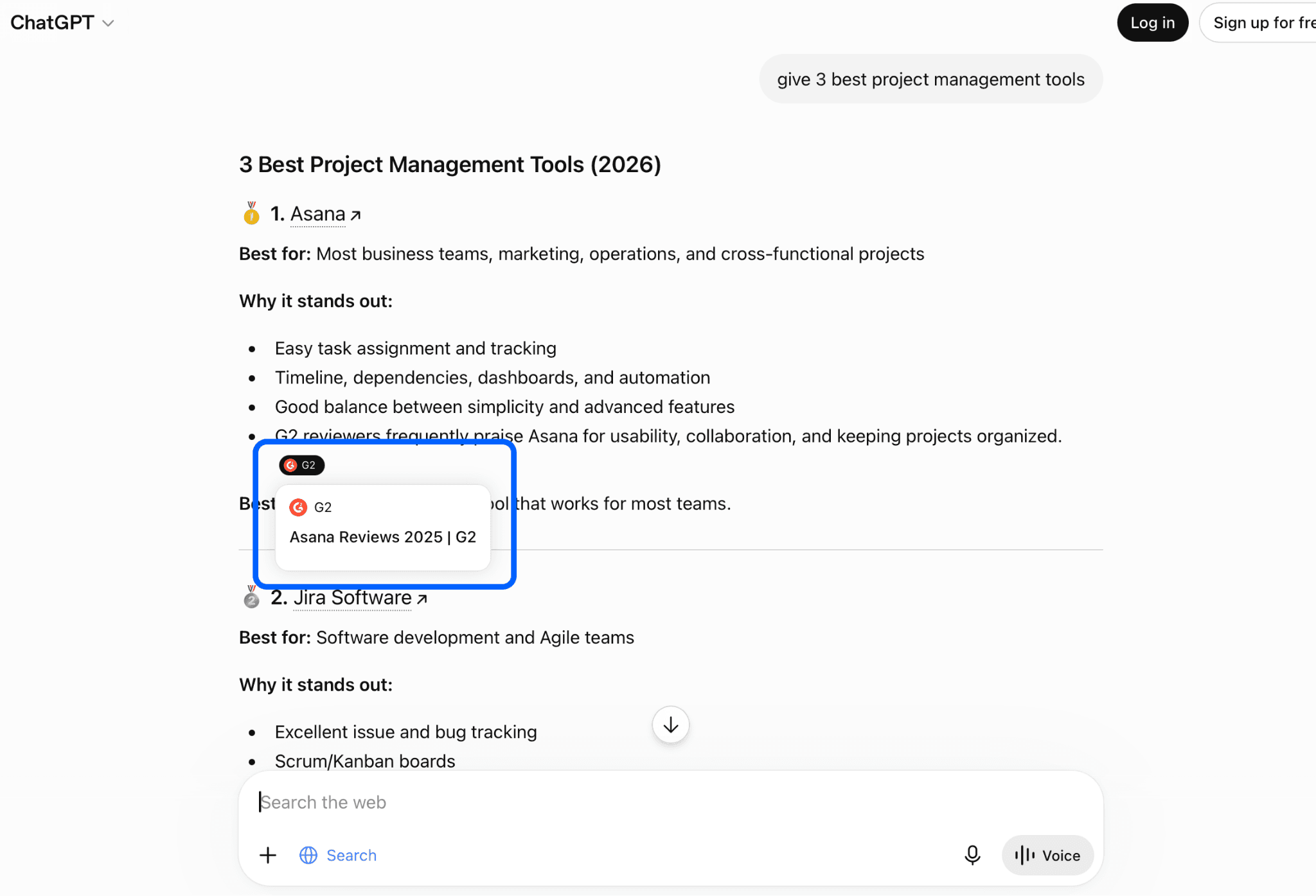
After watching citation data across hundreds of tracked brands at AIclicks, I've come to a conclusion: your website is now one of the least influential documents about your product.
Moreover, every large study finds the same pattern. A 2026 analysis of 149,912 citations across ChatGPT, Gemini, Perplexity, Claude, and Grok found that only 2.9% pointed to the brand's own website.
Simply, your website loses the vote on what AI says about your brand.
Most marketing teams respond to this by doing more of what they can control: restructuring H2s, adding FAQ schema, publishing an llms.txt file. That work has some value. It also fixes the smallest part of the problem, which is why a brand can execute a flawless on-page checklist and still watch a competitor get recommended in every "best tools for X" prompt.
This post covers what the citation data actually shows, the mechanics behind why AI engines behave this way, and where the effort should go instead.
What Is a Third-Party Citation in AI Search?
A third-party citation is any moment an AI answer talks about your brand while sourcing that information from a domain you don't control.
A Perplexity answer that names your product but links a G2 comparison page. A ChatGPT recommendation sourced from a Reddit thread. An AI Overview describing your features via someone else's listicle.
The answer might be accurate, flattering, even better than your own copy. The point is that someone else's page earned the trust, and someone else's page gets the click if there is one. Here’s an example:
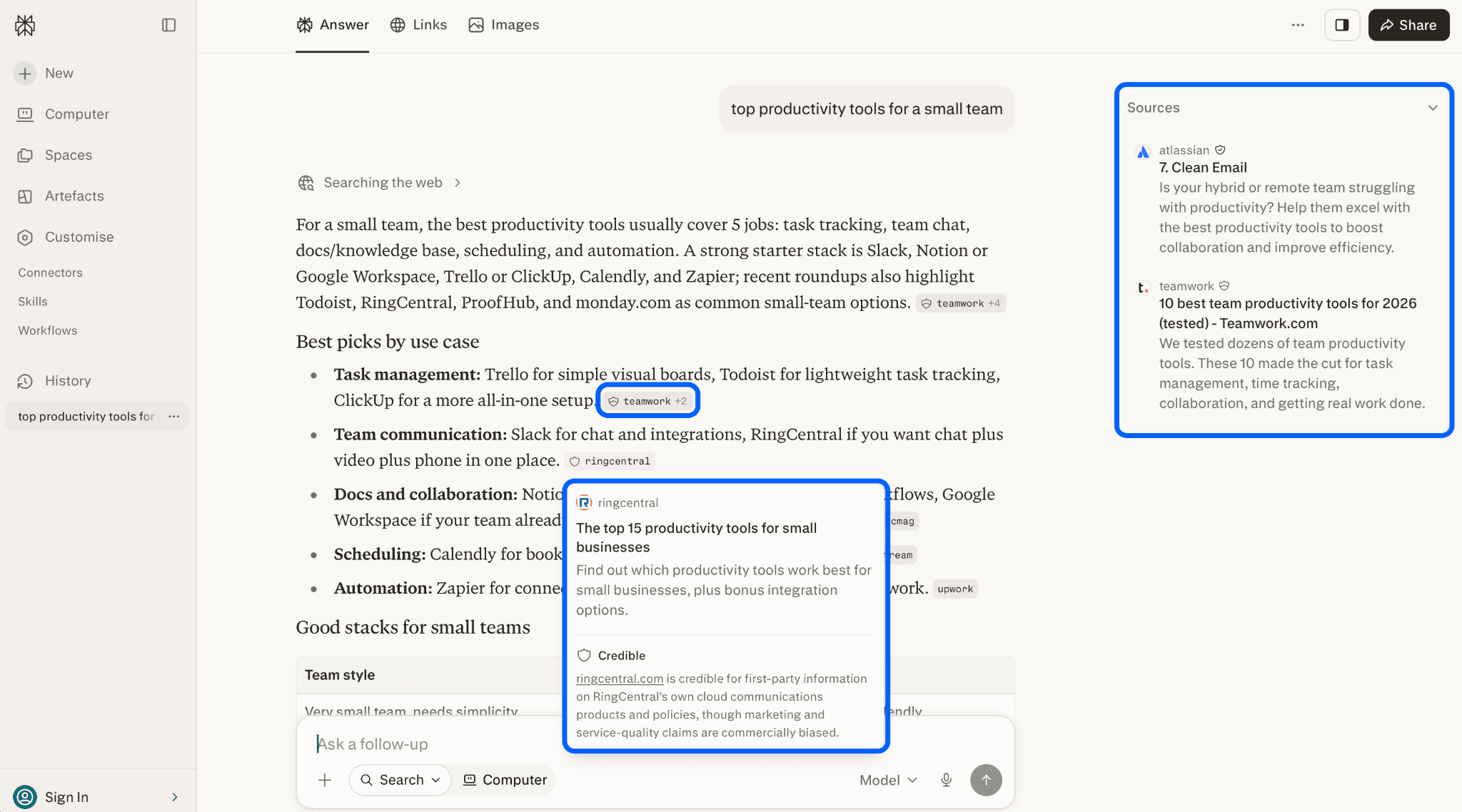
The opposite is a first-party citation: the AI links your own domain as its evidence. Both put you in the answer. Only one is a page you can edit tomorrow morning.
The Four Ways AI Answers Handle Your Brand
Every AI answer involving your brand lands in one of four buckets, and each bucket calls for a different response:
What happened | What it means | Your move |
Cited, your domain | AI linked your page as the evidence | Protect it: keep the page fresh, it can fall out of rotation |
Cited, third-party domain | AI trusted someone else's page about you | Audit that page. Is it accurate? Current? Positive? |
Mentioned, no link | AI knows you from training data or unlinked mentions | Build citable surfaces so mentions convert to citations |
Absent | The answer went to competitors | Find which sources the answer pulled from, get mentioned there |
Now let’s see how to find if AI is actually citing your website.
Is AI Citing Your Website, or Someone Else's?
The table is only useful once you know which rows describe you, and that takes 20 minutes to find out.
Here's a 20-minute test. Pick five buying-intent prompts in your category ("best [category] tool", "[competitor] alternatives", "is [your product] worth it"), run each in ChatGPT and Perplexity, and drop every answer into a row of the table above.
I'll save you some suspense: nearly every team I've watched do this lands the same way: rows two and four dominate. Their brand is in the answers, but the evidence belongs to pages they've never read, or the answer skips them entirely and cites competitors instead.
The catch is that AI answers shift weekly, so the manual snapshot goes stale fast. In AIclicks, prompt tracking runs your prompt set across engines on a schedule, and the Sources tab classifies every answer by cited domain, including the prompts where competitors are cited and you aren't.
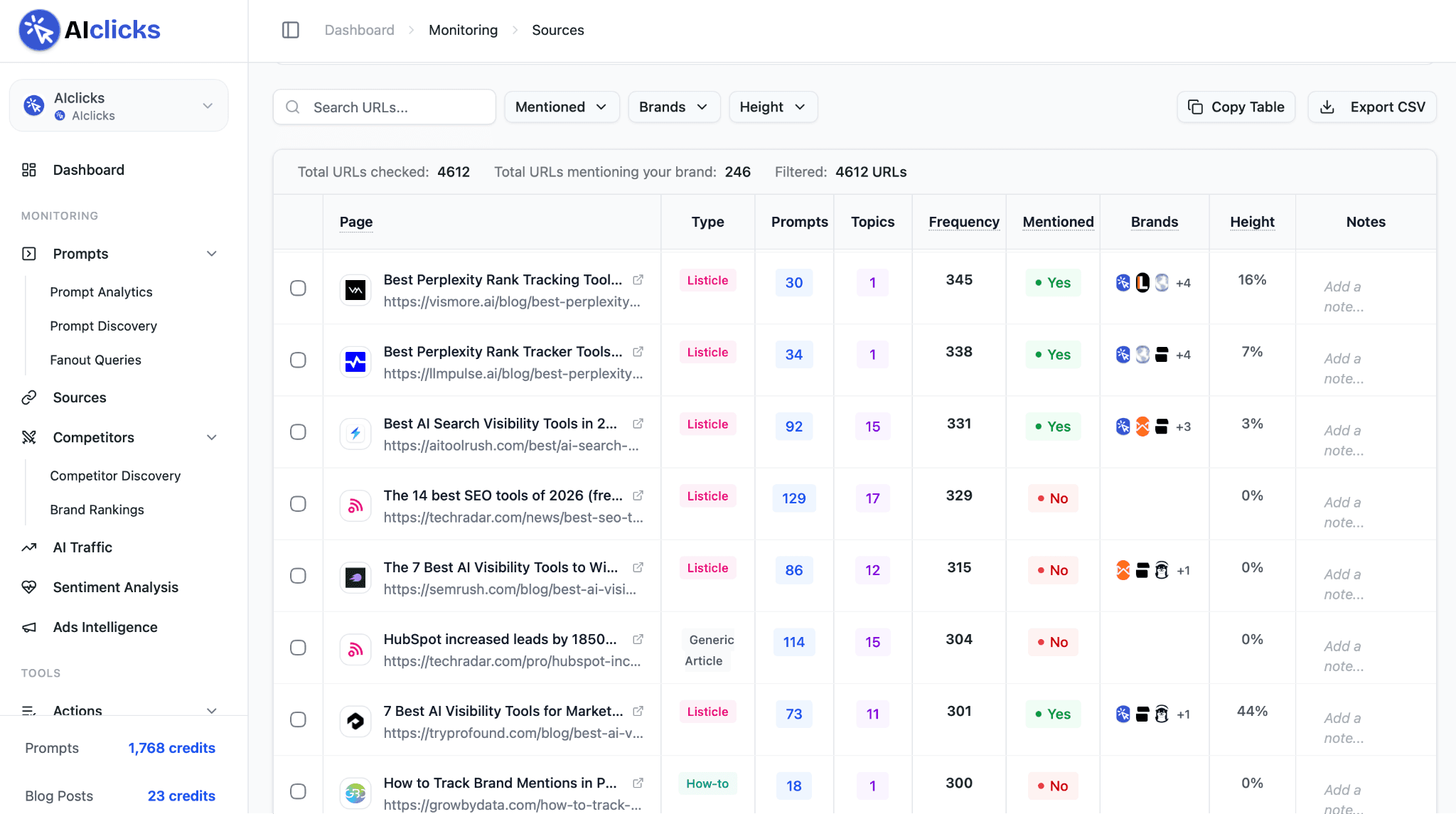
Try it out for yourself.
If you're setting this up from scratch, start with our guide on how to choose prompts to track; the prompt set determines whether the source data means anything.
How Much of AI's Citation Diet Is Third-Party?
Most of it, and the share grows exactly where it hurts: on buying queries.
Muck Rack's What Is AI Reading? study has now run three editions since July 2025. Earned media has held between 82% and 89% of all citations every time. Journalism alone accounts for roughly 27%. Press releases get 1.1%. Advertising gets effectively nothing.
Search Engine Land's study of 30 million cited sources shows what fills the rest: Reddit is the most-cited domain across every major engine, with YouTube, LinkedIn, Wikipedia, and Forbes behind it. Five domains, none of which you control.
We see the same pattern in AIclicks tracking data. On buying prompts like "best X" or "[competitor] alternatives", brand websites make up only a small share of the cited sources. On how-to and definition prompts, the same brands get cited directly all the time. In short: third-party sources take over exactly on the questions where buyers decide.
What Actually Happens When an AI Builds an Answer?
When a user asks a question, engines like ChatGPT, Perplexity, and Google AI Overviews retrieve live pages, break them into chunks, and synthesize a response from the chunks that corroborate each other. The model is not selecting one authoritative page the way Google selects a #1 result. It is assembling agreement across several sources, typically 3 to 6 per answer.
That mechanic explains the whole citation pattern. A page only gets cited if it (a) gets retrieved, (b) contains an extractable answer, and (c) agrees with what other retrieved sources say. Your product page can pass the first two tests and still fail the third, because nothing independent backs it up.
It also explains why Google rankings don't carry over. Ahrefs analyzed AI Overview citations and found only 38% come from pages ranking in Google's top 10 for the query. The retrieval step runs its own logic, including query fan-out, where the engine generates related sub-queries and pulls sources for each.
A page that never ranked for the head term can get cited because it answered one of the sub-queries. We cover this retrieval behavior in more depth in our guide on how to rank in AI search results.
What Does The Citation Data Show?
Search Engine Land's analysis of 30 million cited sources found Reddit is the most-cited domain across ChatGPT, Google AI Mode, Gemini, Perplexity, and AI Overviews, with YouTube, LinkedIn, Wikipedia, and Forbes rounding out the top five.
Review platforms like G2 and Yelp appear heavily in recommendation queries, exactly the queries where buying decisions get made. Each platform has its own bias:
Platform | Leans toward | What that means for you |
ChatGPT | Wikipedia, Reddit, editorial press (Forbes, Business Insider) | Entity accuracy and press coverage matter most |
Google AI Overviews / AI Mode | Google-adjacent surfaces: YouTube, Facebook, Yelp, plus the underlying SERP | Video presence and local profiles carry weight |
Perplexity | Reddit, LinkedIn, G2 for B2B queries | Community threads and review profiles decide B2B answers |
Two things follow from this table.
First, "AI visibility" is not one channel. A brand can be well cited in Perplexity and invisible in ChatGPT for the same prompt. Second, the domains deciding your visibility are mostly domains you don't own.
PartnerStack's research on B2B vendors found 43% of citations in AI answers about top vendors came from partner ecosystem content: comparison articles, integration listings, reviews. Not the vendors' own sites.
Why Does Your Page Lose to a G2 Page or a Reddit Thread?
The mechanical reason is corroboration.
An AI system constructing an answer weighs claims that repeat across independent sources. Your homepage saying "the most accurate AI visibility tracker" is one data point from an interested party. Three review platforms, a trade publication, and two Reddit threads saying roughly the same thing is a pattern the model can lean on.
This is worth sitting with, because most teams respond to weak AI visibility by rewriting their own pages. For evaluative queries, that work barely moves the number.
There's also a structural reason your rankings don't rescue you. Ahrefs' overlap study found just 12% of citations in AI assistants also rank in Google's top 10, and around 80% of AI-cited URLs don't rank anywhere in Google for the original query. Even inside Google's own AI Overviews, the connection is dissolving: Ahrefs' updated analysis of 863,000 keywords found top-10 pages supplied only 38% of AI Overview citations, down from 76% seven months earlier.
Ranking and citation are different games scored by different signals. In Ahrefs' study of 75,000 brands, branded web mentions correlated roughly three times more strongly with AI Overview visibility than backlinks did. The link graph built your SEO. The mention graph builds your AI visibility.
How Do You Find Out Which Sources AI Trusts in Your Category?
You already collected the raw material during the bucket test. Go back through those same answers, ignore your own brand this time, and list every domain that got cited, with a tally for each repeat.
After five prompts across two engines, a shape appears: the same 10 to 20 domains keep coming back. That list is your category's citation layer, and it's shorter than most people expect.
Then rank it by what you can act on.
A listicle cited on three of your prompts that doesn't include you is one outreach email with measurable upside.
A subreddit that keeps appearing is a place your team should already be answering questions.
A review platform on the list means your profile there is a sales asset now, whether you maintain it or not.
The tally-mark method breaks past a couple dozen prompts, and the list moves as engines reshuffle sources. The Sources tab in AIclicks maintains it continuously: every cited domain across your tracked prompts, whether your brand appears on that page, how prominently, and which page types dominate (Reddit, directories, listicles, reviews). What comes out is a ranked outreach list rather than a tally.
10 Ways To Earn Citations Across the Sources AI Already Trusts
1. Find out which domains actually feed your category's answers
Before writing anything, pull the citation data. Run your priority prompts across engines and list every domain that appears as a source. This is the ground truth for everything else on this list, and it's different for every category. In AIclicks, the source view does this across ChatGPT, Perplexity, Gemini, AI Overviews, and the rest, so you can see which third-party pages carry your prompts and which carry your competitors'.
2. Fix your review platform presence first
It's the cheapest, highest-return surface on the list. Trustpilot and Seer Interactive's joint study found brands with active review profiles appeared in 75% of relevant AI answers versus 1% for brands without them. For B2B software, G2 plays the same role: Perplexity cites it constantly for evaluative queries.
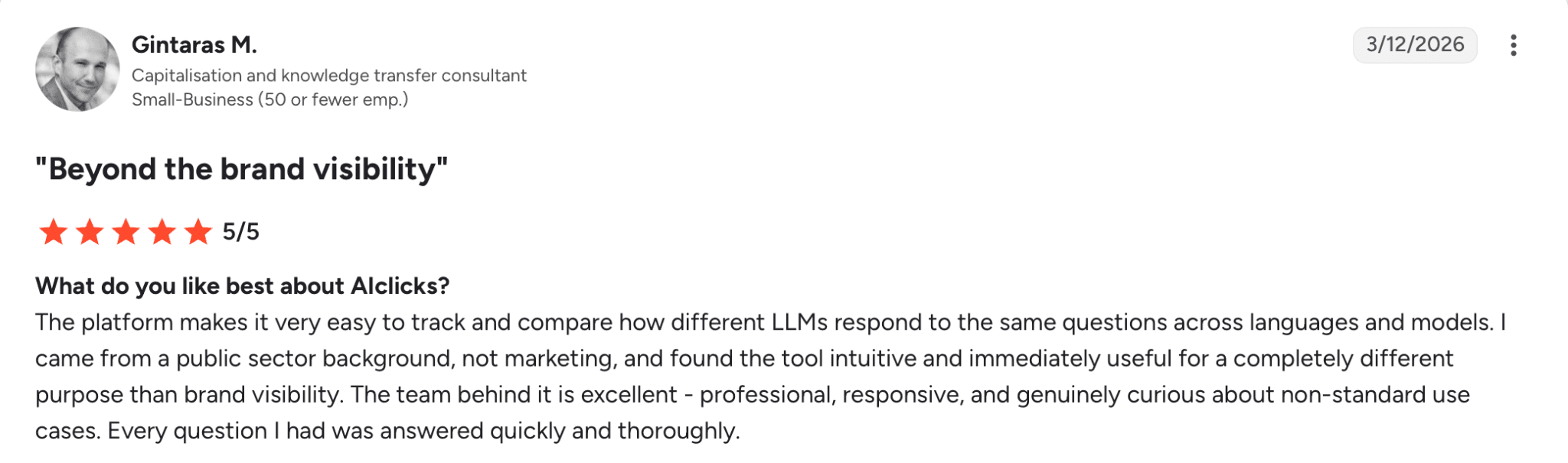
Two things matter here: volume of recent, detailed reviews, and the specifics inside them. AI extracts phrases from reviews. A review that says "makes it very easy to track and compare how different LLMs respond to the same questions across languages and models" is quotable evidence. Fifty five-star ratings with no text are not.
3. Get into the roundups that already rank for your prompts
For "best X" queries, models repeatedly cite the same handful of listicles and comparison posts. Identify them (step 1 gives you the list), then do the unglamorous outreach: brief the author, offer data, correct outdated pricing, ask to be evaluated. One placement in a roundup that three engines cite beats ten posts on your own blog for that query.
This is also the piece brands most often hand to an AI search optimization agency, because the pitching scales badly in-house.
4. Treat Reddit threads as citation surfaces, not PR incidents
Reddit is a top-cited domain across ChatGPT, Gemini, and Perplexity. A single thread answering "anyone used [category] tools?" can become standing evidence in AI answers for months.
Participate honestly, with a flaired account and disclosed affiliation, and answer the actual question with specifics. Astroturfing gets detected by the community faster than by any model, and downvoted threads don't get cited.
See how we helped Tinggly get mentioned in Reddit threads and draw 71,000 visits in total.
5. Publish original research on your own domain
This is the exception to "owned content doesn't earn evaluative citations."
Proprietary data gets cited directly and generates the earned coverage that gets cited again. First-party research is cited at several times the rate of standard blog content, and the Princeton GEO paper found that adding statistics and quotable claims improved AI visibility by 30-40% in controlled tests.
If you run a platform that generates data, every month you don't publish from it is a month competitors' numbers define your category.
6. Pitch trade publications, not just tier-1 press
Forbes coverage flatters the board. A trade publication gets you cited. When a prompt is industry-specific, models pull from industry-specific sources: a logistics question surfaces supply chain media, not general business press.
A detailed piece in the vertical publication your buyers already read will show up for category queries where a tier-1 mention never appears. The practical upside nobody mentions: trade editors answer pitches, run contributed essays, and publish in days rather than quarters.
One caveat: wire distribution barely registers as a citation source, so pitch stories and bylines, not press releases.
7. Refresh the coverage you already have
Earned media behaves like a subscription. In the prompt sets we track, cited sources rotate constantly, and older coverage falls out of answers as fresher pages replace it. The launch story that carried your visibility in Q1 is often dead weight by Q3.
Budget for a steady cadence of smaller stories rather than one annual launch splash. A quarterly data cut from your own research (see #5) gives journalists a recurring reason to cover you. The cheapest citation is often an old page with a new date and a real update behind it.
8. Keep your facts identical everywhere AI reads
Models cross-check.
If your pricing page says one thing, your G2 profile another, and a six-month-old directory listing a third, you've manufactured the inconsistency that makes a model hedge or skip you.
Audit the top 10-15 third-party pages that describe your product quarterly. Update pricing, feature lists, and positioning language so every source corroborates the same story.
9. Own the factual branded queries completely
Owned content isn't dead; it's miscast. Across the brands we track, first-party pages earn citations consistently on factual, objective questions, so stop pointing your site at "best X" queries it structurally cannot win and aim it where it dominates: pricing, integrations, limits, security, comparisons on named features.
The test for each page: does the first sentence under the heading answer the question outright, phrased the way a buyer would ask it? If someone asks ChatGPT "does [your product] integrate with HubSpot" and the model cites a forum guess instead of your integrations page, that's not a third-party problem. That's a page you failed to write.
10. Track mentions and citations as separate metrics
A citation without a mention is a page about your category that ignores you. A mention without a citation is reputation with no link.
The two move independently, and we regularly see it in tracked accounts: citation counts climbing while actual recommendations flatten, because the pages getting cited stopped naming the brand prominently.
Watching one metric while assuming the other follows is how teams report progress while losing ground.
The reporting you need is per prompt: named or not, linked or not, and whether the attached sentiment is one you'd sign off on. That's the reporting layer we built AIclicks around, because a monthly manual spot check across nine engines isn't a methodology, it's a coin flip.
Where AIclicks Fits In
Everything above is doable and we know because we did it ourselves first: spreadsheets of prompts, tabs of pasted answers, tally marks next to domains. The method works. It just collapses somewhere around prompt twenty, engine three, week four, and the moment it collapses, you're back to guessing.
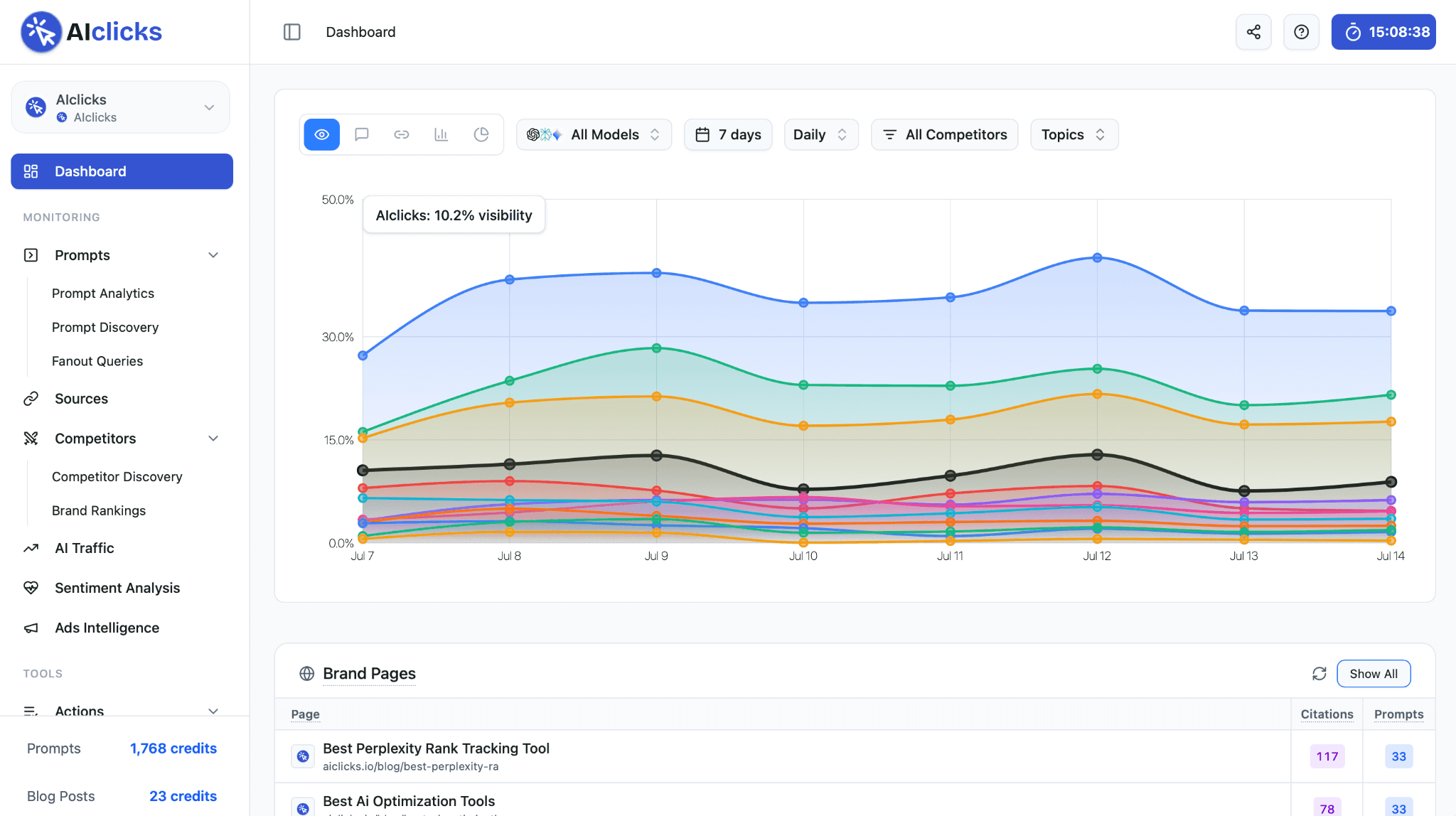
AIclicks runs that exact workflow as a system:
See where you stand: Prompt tracking runs your prompt set across ChatGPT, Perplexity, Gemini, Google AI Overviews, and the rest, on a schedule, so the bucket test from earlier in this piece happens continuously instead of once. Per prompt, per engine, you see whether you're cited, mentioned without a link, or absent.
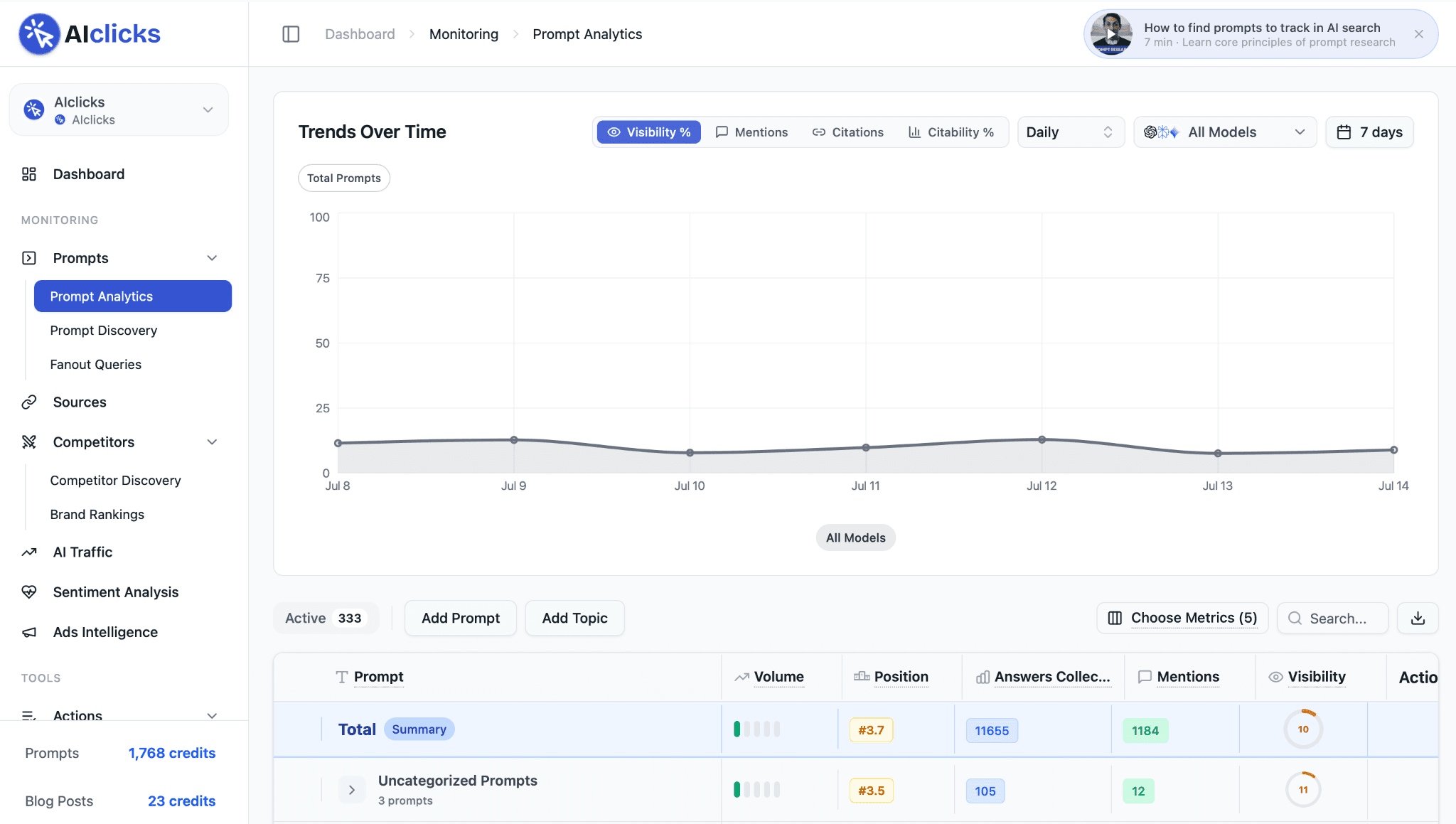
Know which sources matter: The Sources tab is the tally list from point 1, maintained for you: every domain cited across your prompts, whether your brand appears on that page, how prominently, and what type of page it is (Reddit thread, directory, listicle, review profile). It's the ground truth for the outreach in points 3, 6, and 8.

See who's winning instead: The Competitors tab shows which brands take the answers you're absent from, and which sources carry them there. When a rival owns a prompt cluster, you can see the exact pages doing the work, which turns "we're losing in AI" into a target list.
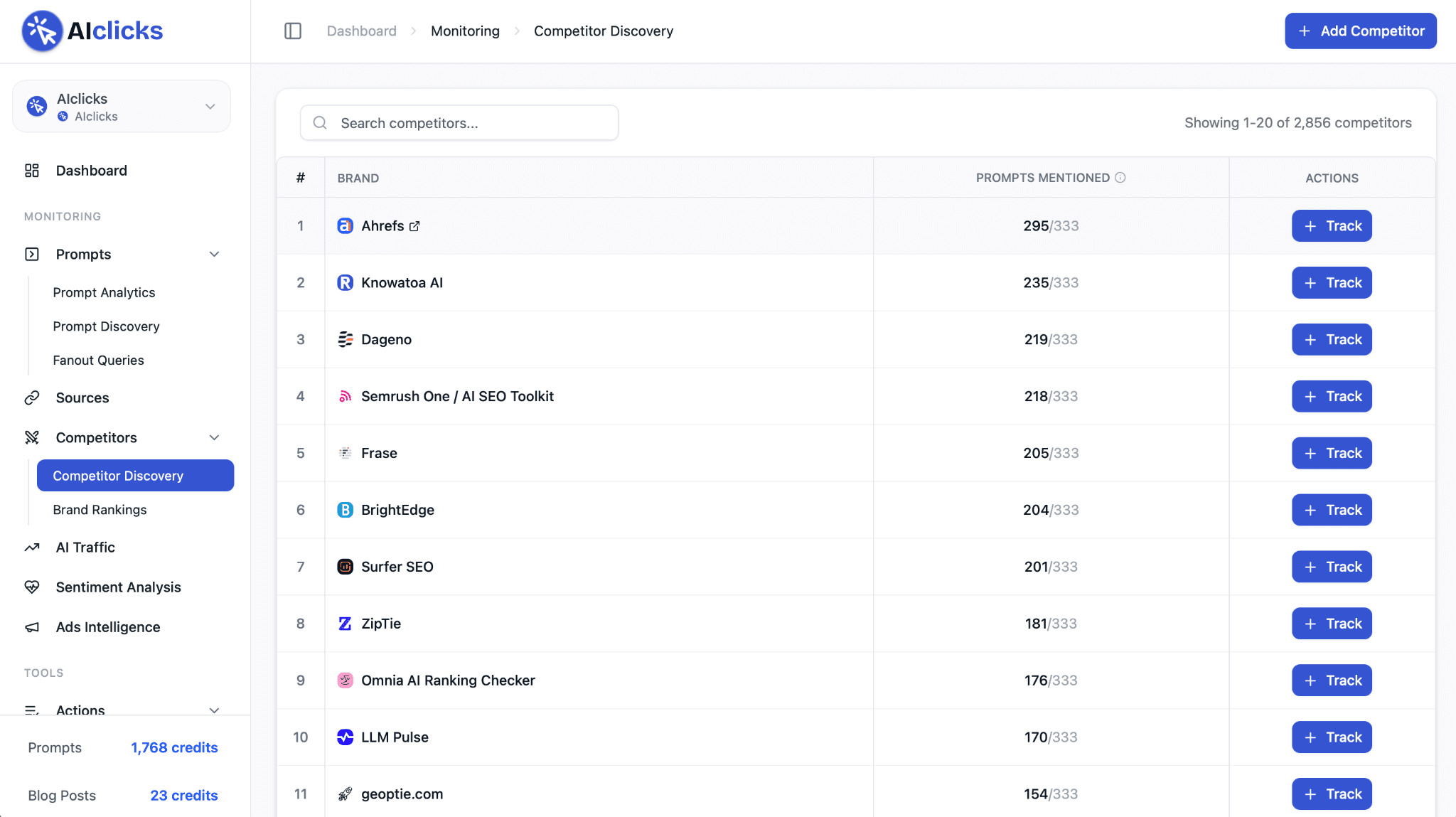
Act on it, inside the same tool: This is where most trackers stop and AIclicks doesn't. The Actions section turns the gaps into work you can execute:
Get Mentioned queues every page AI cites in your category where your brand is absent, deduplicated by domain, so points 3 and 8 start from a ready list instead of a research project.
Engage Online surfaces the live Reddit, LinkedIn, and Quora threads feeding your prompts, ranked by how many tracked prompts each thread influences and how often it appears in answers. You see which conversations are worth joining before you spend an hour writing a reply.
Learn more about how to use Reddit for AI citations in 2026.
Write Content covers point 9: generating the answer-first pages for the factual queries your own site should win.
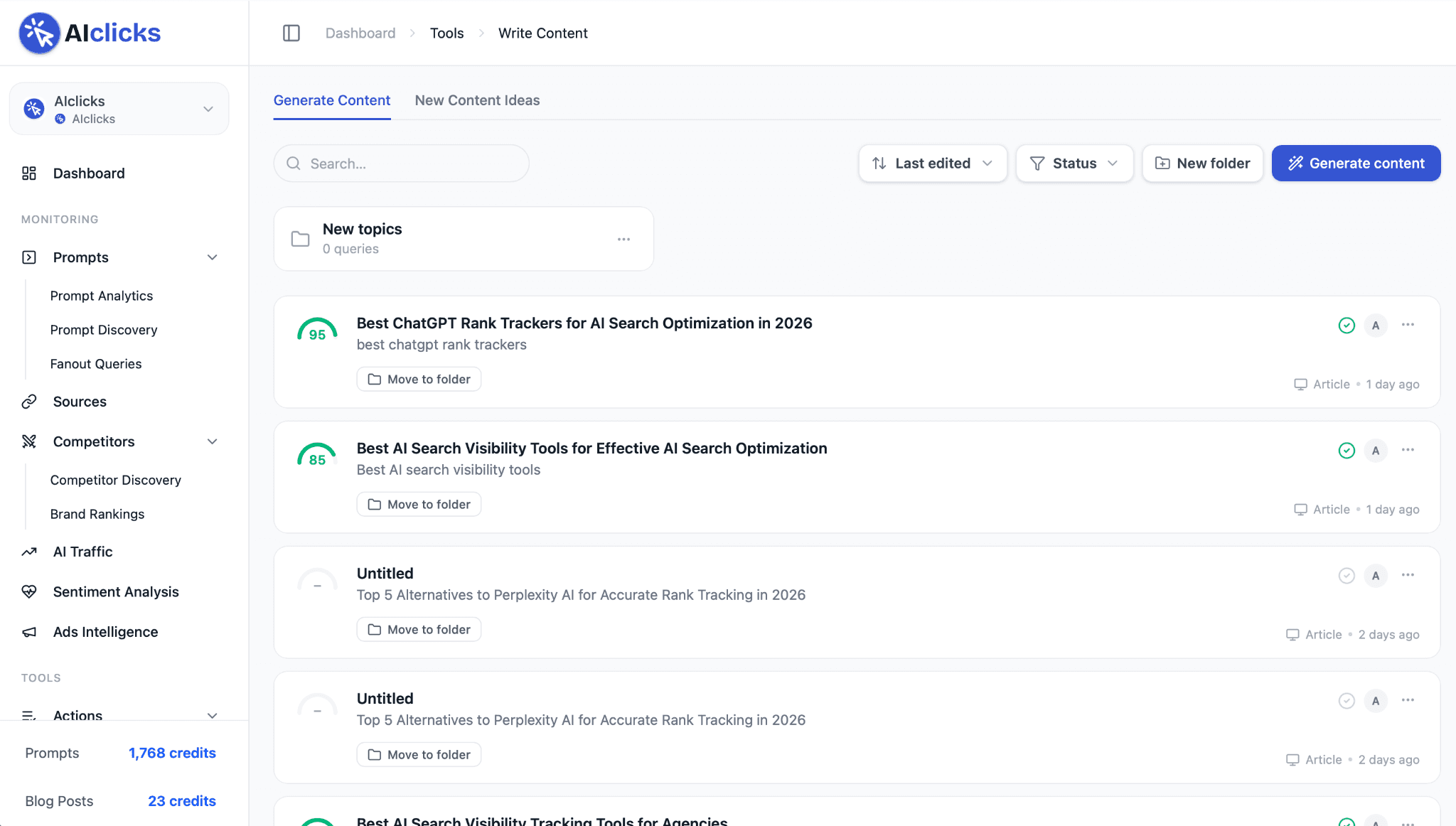
Outreach Campaigns is for teams that don't have outreach hours at all. Fund a campaign, and we work the queued targets for you on a pay-per-result basis: you're charged when a mention lands, not when an email gets sent.
The parts no platform can do for you, the original research, the honest community participation under your own name, stay yours. Everything else in this article is a workflow inside the product.
FAQs
1. Is it bad that AI cites third-party sources instead of my site?
Not inherently. A citation of an accurate, positive G2 profile or Reddit thread still puts your brand in the answer, which is where the buying decision happens. It becomes a problem when the cited source is outdated, wrong, or negative, because you're then being represented by content you've never audited.
2. Can I get AI to cite my site more often?
For informational queries, yes: publish original data, definitional content, and structured how-tos, and format them for extraction. For evaluative queries, mostly no, and effort spent trying is better redirected to the third-party sources those queries actually pull from.
3. Do backlinks still matter for AI visibility?
Less than mentions. Ahrefs measured backlinks at a 0.218 correlation with AI visibility versus 0.664 for branded web mentions. A mention without a link now carries signal that old-school SEO assigned a value of zero. Links still matter for classic rankings, which still feed some retrieval systems, so they're not dead weight, just no longer the primary lever.
4. How is this different across ChatGPT, Perplexity, and Google AI Overviews?
Each engine has distinct source preferences: ChatGPT leans on Wikipedia, Reddit, and editorial press; Perplexity leans on Reddit, LinkedIn, and G2 for B2B; Google's AI surfaces stay closer to the underlying SERP plus YouTube. Treat them as separate channels and measure each one, because visibility in one predicts little about the others.
5. How long does it take to see citation changes after fixing third-party presence?
There's no fixed timeline, but live-retrieval engines (Perplexity, ChatGPT with browsing, AI Overviews) can pick up new or updated sources within days to weeks. We've seen listicle inclusions show up in tracked prompts inside a month. Training-data-driven answers move much slower and reward consistency over quarters.
Want to see which sources AI is citing in your category right now, and where your brand is missing? Run a free AI visibility audit with AIclicks and get the source list plus a prioritized action plan.



Any questions left?
Book a call here: