

Reviewed by:
Rokas Stankevicius

Founder @aiclicks.io
Last updated:
Expert Verified


Free AI visibility audit
Quick summary:
LLMO meaning in one line: the work of getting your brand mentioned, recommended, and cited inside AI assistant answers.
It overlaps heavily with SEO but adds things SEO never measured, including unlinked brand mentions, sentiment, and your share of an AI answer.
There are two ways in: the model's training data, which is slow and compounding, and real-time retrieval, which is fast and fixable.
You start by getting technical access right, earning mentions in the sources AI pulls from, and tracking a fixed prompt set so you know whether any of it is working.
You probably saw LLMO on LinkedIn, heard it on a podcast, or had a client drop it into a call. Now you are looking it up trying to work out whether this is a real discipline, a rebranding of something you already do, or just another acronym the industry invented to feel important.
The honest answer is a bit of all three, and this blog gives you the straight version: what it means, how it sits next to GEO and SEO, and what the work actually looks like.
What Does LLMO Mean?
LLMO stands for large language model optimization: the discipline of getting your brand mentioned, recommended, and cited inside AI-generated answers.
The goal is specific. When someone asks ChatGPT, Gemini, Claude, or Perplexity a question your product or service could answer, you want to be the brand they name, not a competitor.
Here is what getting there actually covers: the content that makes you readable by AI systems, the technical setup that lets crawlers reach your pages, and the off-site presence that makes you trusted enough to surface in responses. Together those three determine whether you make the answer or miss it entirely.
LLMO vs GEO vs AEO: Are They Different?
Short answer? No. Here's the thing: LLMO, GEO, and AEO are three names for basically the same discipline. Different crowds coined them, each looking at the work from a slightly different angle, but they all point at the same goal: getting your brand picked up by AI answers.
So why three terms? It mostly comes down to who's talking. The table below breaks down who uses which label and what each one tends to emphasize.
Term | What it stands for | What it emphasizes | Who tends to use it |
LLMO | Large language model optimization | Showing up in answers from the models themselves (ChatGPT, Claude, Gemini, Perplexity) | People who think in terms of the underlying models |
GEO | Generative engine optimization | The same goal, framed around generative engines broadly | The most widely adopted term in marketing circles |
AEO | Answer engine optimization | Being the answer, including snippets and voice; predates the LLM wave | Teams who came to this from the answer-box era |
AI SEO | AI search optimization | Ties the work back to SEO as an extension of it | Teams who see it as the next layer of SEO |
Our position on LLMO vs GEO is practical: we use the two interchangeably, lean on GEO as our default term, and spend our energy on the work rather than the label. Ahrefs has argued the whole category is really just SEO under a new name. We mostly agree, with one exception that matters in practice. An unlinked brand mention, the sentiment attached to it, and your share of a given AI answer have no clean equivalent in traditional SEO, and each one moves your LLM visibility on its own. So pick a term, then execute.
How Do LLMs Decide What to Mention?
LLMs decide what to mention through two pathways: their training data and real-time retrieval. Training data is everything the model absorbed during pre-training, so a brand that appeared often and consistently across the web before the cutoff is already part of the model's internal picture of a category. Retrieval, or RAG, is what happens when the model searches the live web mid-answer, pulls back current sources, and writes its response from them. Most modern AI search experiences blend both, a mechanism Ahrefs lays out cleanly.
Training-data visibility is slow to build and slow to change, so it compounds over months. Retrieval visibility responds in real time, which means a lot of it is fixable this week. Knowing which pathway a tactic affects tells you how fast to expect results.
LLMO vs Traditional SEO: What Actually Changes?
The core shift in LLMO vs SEO is the goal itself: you move from ranking pages to being named inside an answer. The mechanics you already know still apply underneath, but the target, the currency, and the success metric all change.
Traditional SEO | LLMO |
Targets keywords | Targets conversational prompts |
Runs on backlinks | Runs on brand mentions, linked or not |
Measured by ranking position | Measured by share of voice in answers |
Wins on the click | Wins on being cited or named in the answer |
The change is worth the effort because the traffic behaves differently. Semrush found that AI search visitors convert 4.4 times better than traditional organic visitors, since they arrive having already compared options inside the chat. Measuring rankings is a solved problem with mature tools. Measuring your share of AI answers is not, which is why a quick read with the free GEO visibility checker is a sensible first look before you commit to a strategy.
How Do You Do LLMO? The 4 Actions
LLMO marketing asks for one shift in goal, from ranking pages to being named in answers, and then a fairly concrete set of work to get there. Here you will find four actions, with twelve named tactics nested inside, so you can see which action each tactic serves and which pathway it moves. These twelve tactics are how the 4-Action System we built AIclicks around plays out in practice.
Action | Tactic | Pathway |
Create Content | 1. Answer-first formatting | Retrieval |
2. Citable original data | Retrieval | |
3. Schema and clean structure | Retrieval | |
4. Technical crawler access | Retrieval | |
Get Mentioned | 5. Digital PR and editorial mentions | Both |
6. Third-party listicles and roundups | Both | |
7. Review platforms | Both | |
Engage in Communities | 8. Reddit and Quora | Both |
9. Niche forums and industry communities | Both | |
Build Trust | 10. Entity consistency | Training data |
11. Author credibility | Training data | |
12. Freshness | Training data |
Action 1: Create Content LLMs can lift (Pathway: mostly retrieval)
Content is the one layer you control completely, and four things make it liftable:
Answer-first formatting: phrase your headings as questions, answer in the opening sentence, and keep each answer self-contained so a model can quote it without needing the paragraph above it.
Citable original data: stats, benchmarks, and research only you have. Models reach for numbers that come with a source, so proprietary data is the highest-value asset on your site.
Schema and structure: Article and FAQ schema, comparison tables, and clean HTML, with your key content kept out of JavaScript that has to render, since AI crawlers generally do not execute it.
Technical access: allow GPTBot, OAI-SearchBot, PerplexityBot, and ClaudeBot in your robots file so the engines can fetch your pages at all. Add an llms.txt file too, with one honest caveat: it is emerging, its weight is unproven, and it costs almost nothing to include.
A practical check on answer-first formatting: take any H2 on your site that opens with a noun phrase like "Our Approach" and rewrite it as a question, then answer it in the first sentence. That single change is often enough to make a block liftable. For technical access, search your robots.txt for each of the four bot names above right now. A surprising number of teams discover they are blocked under a catch-all disallow rule added years ago and never revisited.
The same logic applies whether you sell software or run a store, where getting your products named in AI answers follows this exact pattern.
Action 2: Get Mentioned where LLMs look (Pathway: both)
Getting named in answers happens largely in the sources the models cross-check, so the work here is earning genuine brand mentions in the right places:
Digital PR and editorial mentions: these count even when the mention carries no link, which is the sharpest break from classic SEO, where a linkless mention does little.
Third-party listicles and category roundups: target the exact pages that models already cited for your category rather than running generic outreach.
Review platforms: keep a current, well-populated profile on the G2 or Capterra equivalent for your niche, since it feeds both the model's picture of you and the sentiment around your name.
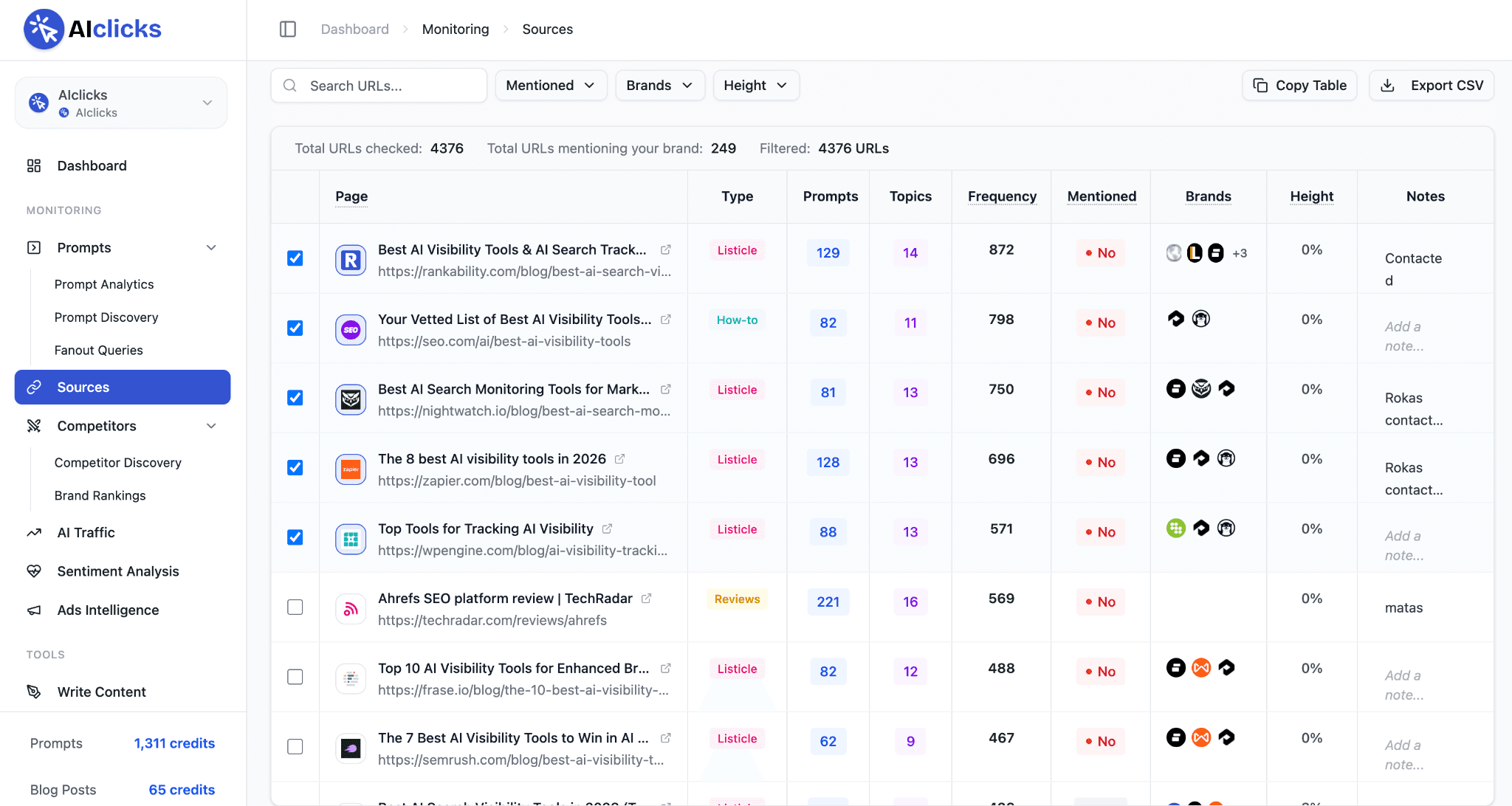
The fastest way to find which listicles and roundups are worth targeting: run five of your core category prompts in ChatGPT or Perplexity and look at which sources appear in the answers. Those are the pages the engine already trusts for your category. Earning a mention on one of them is more direct than generic outreach to every blog in your space.
Action 3: Engage in Communities (Pathway: both)
Community participation feeds AI answers more than most teams expect:
Reddit and Quora participation: these threads are heavily weighted source material, so credible, account-aged answers that genuinely help carry real weight in what models surface.
Niche forums and industry communities: smaller surfaces with less competition, and they pull the same citation weight inside vertical queries where the big platforms go quiet.
One honest warning: astroturfing backfires. Manufactured praise gets detected and downranked, and it pollutes the exact sentiment signal you were trying to improve, so the only version of this that works is real participation.
A practical starting point: search Reddit for "[your category] best" and "[your category] vs" and filter by top posts. The threads that rank well on Google are the same ones already being indexed and cited by AI engines. A genuine, useful answer in one of those threads is worth more than a new post with no audience yet.
Action 4: Build Trust signals (Pathway: mostly training data, slow and compounding)
Trust signals shape how the model understands your brand over the long run, and they move the slow training-data pathway:
Entity consistency: the same name, description, and positioning across your site, LinkedIn, directories, and profiles, plus a Wikipedia or Wikidata presence where you can legitimately earn one, so the model can resolve who you are.
Author credibility: named authors, visible credentials, expert review, and real About and editorial pages.
Freshness: dated updates and current stats, since both models and retrieval systems favor sources that look actively maintained.
A quick entity consistency check: ask ChatGPT or Perplexity "What is [your brand]?" and read how it describes you. If the description is vague, outdated, or just wrong, the gap is usually traceable to conflicting information across your public profiles. Wikidata is worth adding if you qualify, since several models draw on it to resolve brand entities when building answers.
How Do You Measure LLMO?
You measure LLMO by tracking whether AI mentions your brand across a repeatable set of prompts over time, because a single check tells you almost nothing. AI answers are non-deterministic, so the same prompt can return different brands across sessions, and only a fixed set run repeatedly separates a real trend from noise.
Build your prompt set: Your prompt set is the fixed list of questions you run through each engine every week, and building it well is what makes everything else comparable over time. Write 20 to 30 buying-intent prompts per category, phrased the way real buyers ask rather than as keyword strings: "best [category] for [use case]," "[brand] vs [brand]," "is [product] worth it." Source them from the questions that already show up in sales calls, support tickets, People Also Ask boxes, and search autocomplete, since those are the prompts your buyers genuinely type.
What to log: Logging is how you turn a prompt run from a one-off check into a dataset you can act on. For each answer, record whether your brand appeared, where it landed (named first or mentioned as an afterthought), the sentiment attached to it, which competitors showed up, and which sources the answer cited. Those cited sources are not just data, they are the action list for the Get Mentioned work from the previous section, which is what closes the loop between measurement and action.
Cadence and the metrics that matter: Cadence is what separates a trend from a fluke, and the right metrics keep you from chasing the wrong number. Run the set weekly at a minimum. Track share of voice, meaning your mentions versus competitors across the whole set, and source coverage, meaning how many of the citing pages include you, rather than fixating on a single vanity visibility number. Segment your AI referral traffic in analytics as well, so you have a downstream check on whether the visibility is translating into visits.
Automating it: The manual loop works and we recommend starting there, but it stops scaling past one category, which is where a tool earns its place. AIclicks runs prompt tracking across ChatGPT, Gemini, Perplexity, and more continuously. A handful of AEO tracking tools handle the prompt runs and source logging if you would rather not maintain a spreadsheet.
Running it by hand is the right way to learn what to look for, so once you have the loop down, find below how AIclicks runs the whole thing for you.
How AIclicks Helps With LLMO
LLMO tends to fail when it stays a monitoring exercise. A visibility score on a dashboard is a side effect; the point is acting on what the score is telling you. AIclicks is built around that, and it maps directly onto the four actions and the measurement loop above.
Prompt tracking covers the measurement, running your buying-intent set across the major engines every day.
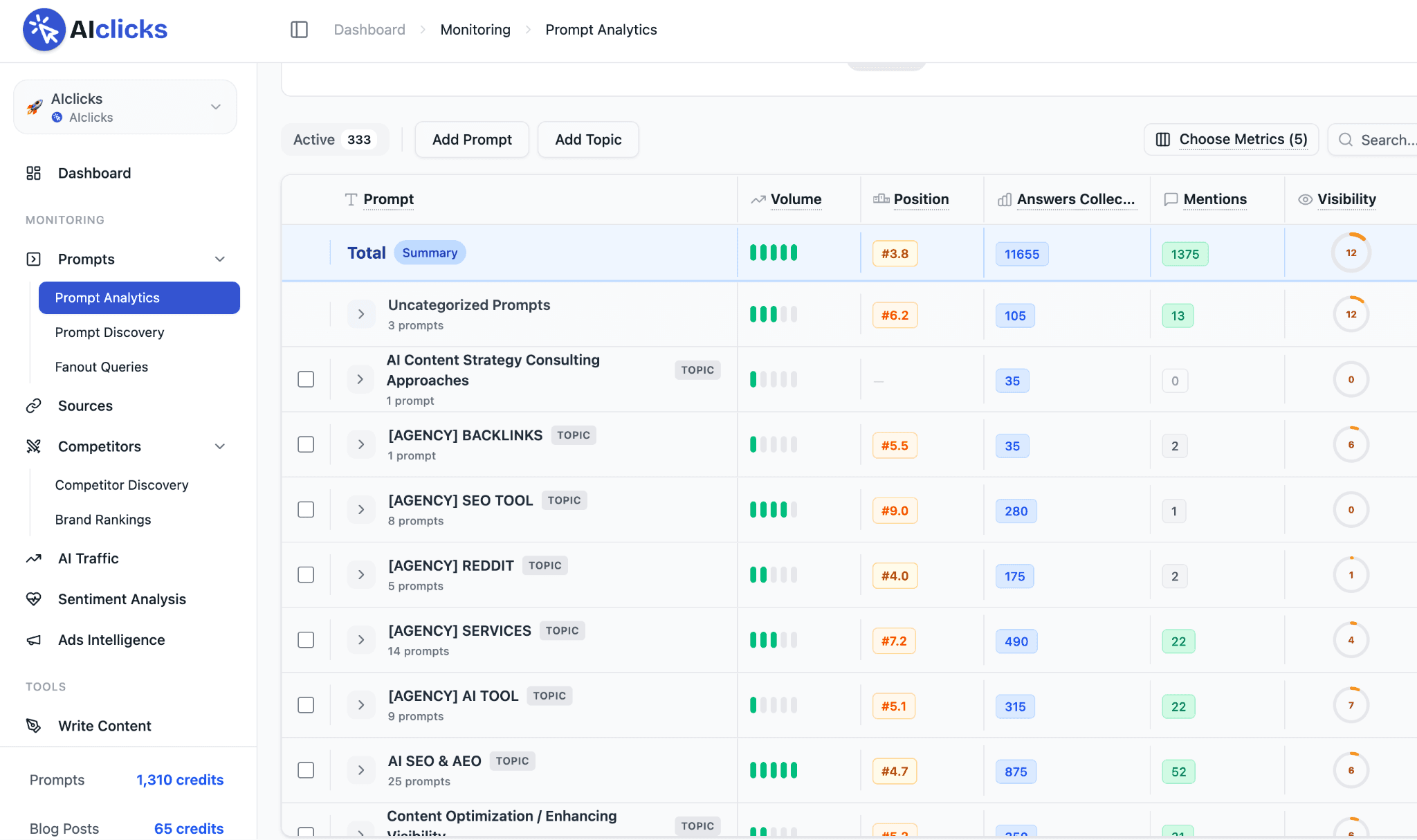
The Sources tab shows where to act, naming the exact pages each engine cites in your category.
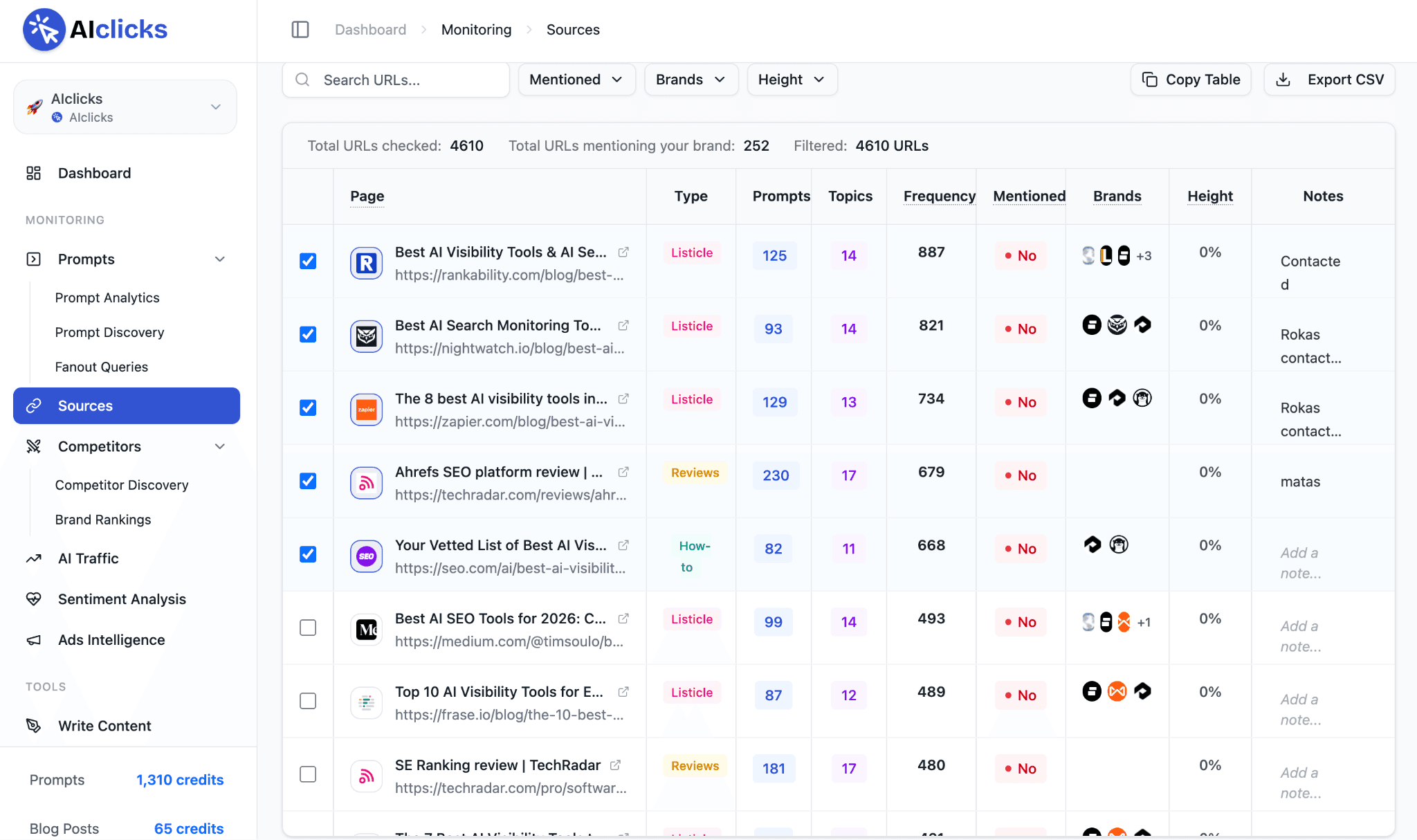
Recommendations tell you what to do, turning each gap into a task. And the four actions are the connective tissue that explains why each task matters and which pathway it moves.
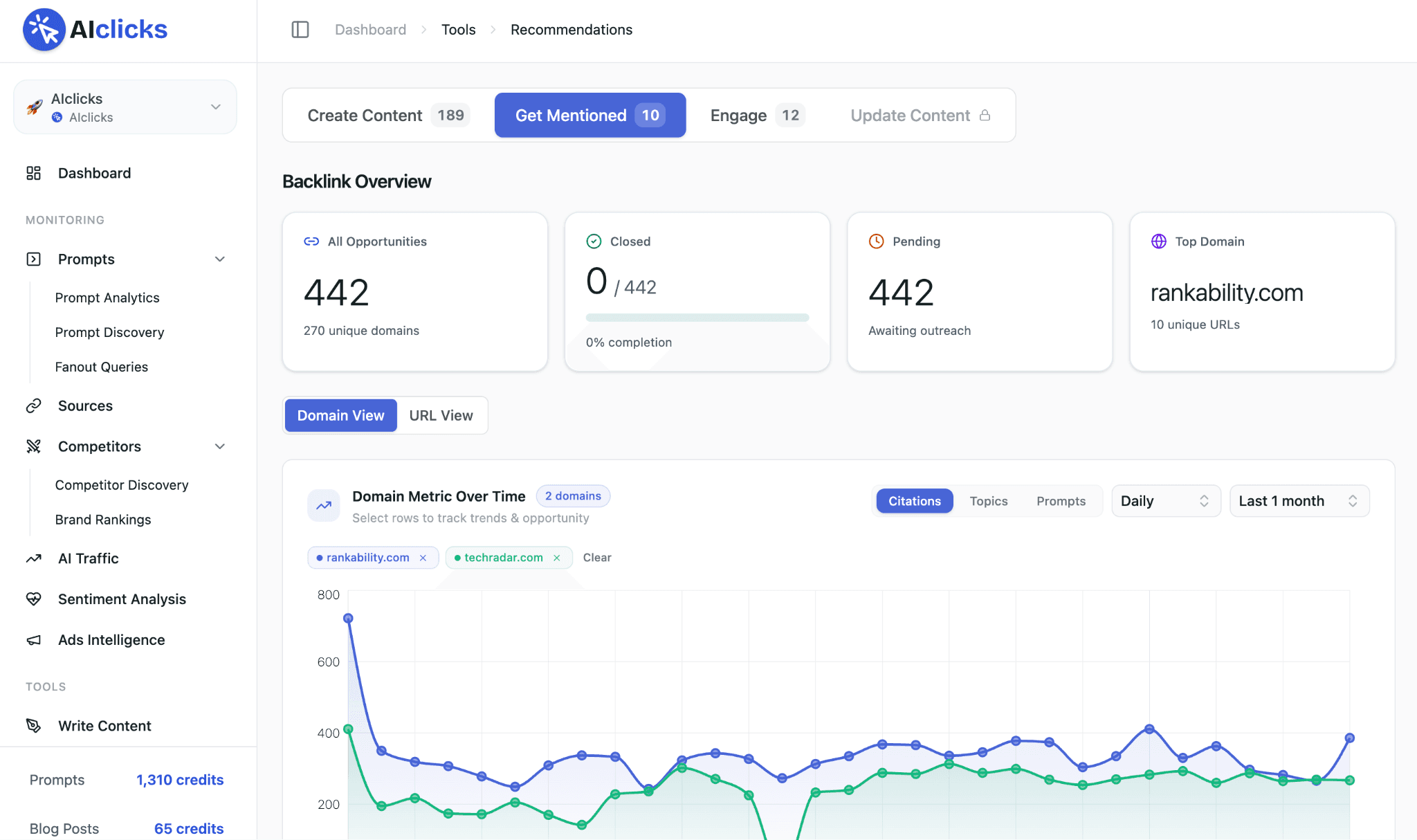
We are clear about the limit. AIclicks tells you where to act and what to do, then shows you whether it moved anything. The content, the PR, and the community work behind those tasks are still work, and they still sit with you. A good starting point is running your category through the free GEO visibility checker to see what AI says about you today, you can start a free audit with AIclicks here.
The Short Path
LLMO is the work of being mentioned, recommended, and cited in AI answers, and it runs on the same fundamentals as SEO with a different goal and a few new signals. The teams that win treat it as a loop: do the four actions, measure a fixed prompt set, and feed what you learn back into the next round. See where your brand stands today with the free GEO visibility checker, and start an AIclicks trial when you are ready to run the full loop continuously.
Frequently Asked Questions
Is LLMO the same as GEO?
Effectively, yes. LLMO and GEO are different names for the same discipline of getting a brand mentioned and cited in AI answers. The terms emphasize slightly different angles, but the work is the same, so pick one and run with it.
Is LLMO replacing SEO?
No. LLMO and SEO overlap heavily and are best run together, since good SEO already shapes much of what AI models pull from. LLMO adds a layer for the answer surfaces rather than replacing the work that earns rankings.
How long does LLMO take to work?
It depends on the pathway. Retrieval-based fixes like crawler access, schema, and fresh content can surface within weeks, while training-data presence built through consistent mentions and entity signals takes months to compound.
Can you do LLMO without new content?
Partly. Mentions, community participation, review profiles, and technical access all move LLM visibility without publishing a single new post. New content helps, especially original data, but a meaningful share of LLMO is off-site work.
Any questions left?
Book a call here: