

Reviewed by:
Matas Kibildis

Head of Growth @aiclicks.io
Last updated:
Expert Verified


Free AI visibility audit
TL;DR: which SEO MCP server should you install?
If you're an agency running multiple clients → SE Ranking MCP turns tools you're likely already paying for into one MCP connection covering every client, at no extra fee.
If you're in-house at a SaaS company → AIclicks MCP shows whether ChatGPT, Gemini, and AI Overviews already recommend your product, a number a rankings-only stack can't produce.
If you're a solo SEO or consultant → Google Search Console MCP puts your own ranking data in the chat for free.
If you only install one → the free Google Search Console MCP covers data you already own; add an AI-visibility server once the question moves from rankings to what AI assistants say about you.
Every name above is a specific, tested pick, not a category. Here's what each server actually returns, what it costs, and why.
A "best SEO MCP" roundup can read like the last five you've seen: same servers, same missing detail about which ones need a paid API tier, no mention of what ChatGPT or Google's AI Overviews say about a brand, because that's a different category of tool entirely.
The split is real and it decides more than any single feature list. One half of the SEO MCP category connects an AI assistant to Google-facing data: a Search Console account, a keyword and backlink database already being paid for, or a desktop crawl. The other half connects that same assistant to what AI engines say when someone asks a buying question, the GEO-versus-SEO split a stack built only from the first half never sees.
That gap shows up in practice constantly. A team installs a Search Console MCP, a keyword MCP, and a crawler MCP, then learns months later that a competitor is the brand ChatGPT actually recommends, and nothing in that stack would have caught it.
This roundup tested 11 SEO MCP servers across both halves: three Search Console connectors, five platforms wrapping keyword, SERP, and backlink data, one crawler, and two AI-visibility trackers.
What is an SEO MCP server?
An SEO MCP server is a connector that lets an AI assistant such as Claude, Cursor, or ChatGPT query live SEO data, keyword metrics, SERP results, backlinks, Search Console performance, or AI-search visibility, directly inside a conversation, instead of working from an exported spreadsheet or the model's own training data.
MCP, short for Model Context Protocol, is the open standard behind this. Anthropic built it so AI applications could connect to external data sources and tools in a consistent format, and adoption has since spread well past Claude.
In practice, that means an AI assistant pulls today's numbers itself instead of working from last month's CSV export. The trade-off is that every server here draws its own line on how much data it exposes, how fresh it is, and what it costs to unlock.
SEO MCPs vs AI-visibility MCPs
Nine of the eleven servers here connect an assistant to Google data, a Search Console account, or a paid platform's keyword and backlink database. The other two connect it to a different question: what ChatGPT, Perplexity, and AI Overviews say when they fan out a single query into the sub-questions that decide who gets mentioned. Both halves matter. Only one says anything about AI search.
How we evaluated these SEO MCP servers
Every ranking below came from a server's own docs, GitHub repo, or pricing page, checked directly rather than repeated from another listicle, against the same eight questions:
Live data or cached and estimated data.
Which MCP clients it actually connects to - Claude web, Desktop, Code, Cursor, and ChatGPT are not interchangeable, and vendors document different subsets of each.
Auth friction - OAuth, a plain API key, or a Google Cloud project built from scratch first.
Whether it needs a paid tier of the parent tool.
Read-only, or read and write.
Tool count, and whether the tools are usefully scoped - a four-tool server exposing a whole API can beat a fifty-tool server with narrow, redundant endpoints.
Rate limits - requests per minute, rows per call, or days of history per query.
Whether it covers AI search or only Google.
That last question is a neutral split, not a quality judgment: a server built for Google data will never surface an AI Overview citation, and one built for AI visibility will never return a keyword's search volume.
SEO MCP servers at a glance
The eleven servers below split across four jobs: a Search Console account, a paid platform's keyword and backlink database, a desktop crawl, or what AI assistants say about a brand. Every row uses the same six columns, since those are what an AI engine tends to parse and lift whole.
Server | Best for | Data it returns | Works with | Free tier? | Starting price |
Google Search Console MCP (AminForou) | Your own Search Console data, free | Google Search data: queries, clicks, impressions, position, indexing, sitemaps | Claude Desktop, Cursor, Codex CLI, Gemini CLI | Yes | Free |
OpenSEO | GSC access without a Google Cloud project | Google Search data: search performance, URL inspection | Claude Code, Claude Desktop, Cursor | No | $10/mo |
GSC Wizard | Search Console past Google's row and history limits | Google Search data: search analytics, ranking/cannibalization/decay analysis, up to 10 years' history | Claude, ChatGPT | No | $19/mo |
DataForSEO MCP | Cheapest raw keyword, SERP, and backlink data | Keyword, SERP, backlink, and on-page data (12+ product lines) | Claude Desktop, Claude Code, Cursor, ChatGPT | No | Pay-as-you-go, $50 minimum |
SE Ranking MCP | Widest tool count, if you already pay for the platform | Keyword, SERP, backlink, and AI-visibility data (180+ tools) | Claude Web/Desktop/Code, Cursor, VS Code | No | $129/mo |
Ahrefs MCP | Best backlink data, if you're already on Lite or above | Backlink, keyword, and rank-tracking data | Claude Web/Desktop/Code, ChatGPT Web | No | $129/mo |
Semrush MCP | Convenience for teams already on Semrush | Keyword, domain, backlink, position-tracking, and site-audit data | Claude, ChatGPT, Cursor, VS Code | No | $139.95/mo |
SEO Review Tools MCP | Lowest-commitment entry point | Backlink, keyword, traffic, and content-scoring data | Claude Desktop, VS Code | No | $135 / 6 months |
Screaming Frog MCP | Crawl and technical data, desktop-bound | Site crawl and technical-audit data | Claude Desktop | Yes (500 URLs/crawl) | $279/yr |
AIclicks MCP | What ChatGPT, Gemini, and AI Overviews say about your brand | AI-answer visibility, citations, sentiment, and GA4 data (the only non-Google row here) | Claude Web/Desktop/Code, Cursor | No | $189/mo (Pro) |
Peec AI MCP | The other AI-visibility option, source-level citation intelligence | AI-answer visibility, share of voice, and cited-source data | Claude Desktop/Web/Code, Cursor, VS Code | No | $80/mo |
Start here: pick by what you're trying to do
"You want your own performance data in the chat" → a GSC MCP, and the free, open-source Google Search Console MCP is the obvious first install: no subscription, no lock-in, just an existing Search Console account queried live. OpenSEO and GSC Wizard exist for the two cases that server doesn't cover: skipping the Google Cloud setup step, or querying years of history past Google's own export limits.
"You want keyword, SERP, and backlink data" → whichever platform is already being paid for. Semrush and Ahrefs seats both include their native MCP once the account clears a high enough tier, so check that first. Paying for nothing yet, DataForSEO MCP is the cheapest way in, pure pay-as-you-go with no subscription to justify.
"You want crawl and technical data" → Screaming Frog MCP, with one caveat up front: it's built into the desktop app, so whatever machine runs it has to stay on.
"You want to know what AI assistants say about your brand" → the AI-visibility half of this category, and none of the first three routes touch it. AIclicks MCP and Peec AI MCP are the two tested here; neither returns a keyword, a backlink, or a Search Console number, because that isn't the question either one answers.
SEO MCP servers for your own performance data
These three connect an AI assistant to Google Search Console, nothing else. The data is already owned by whoever's asking; the only cost is setup time, or a subscription that buys that time back.
1. Google Search Console MCP (AminForou / ahonn)
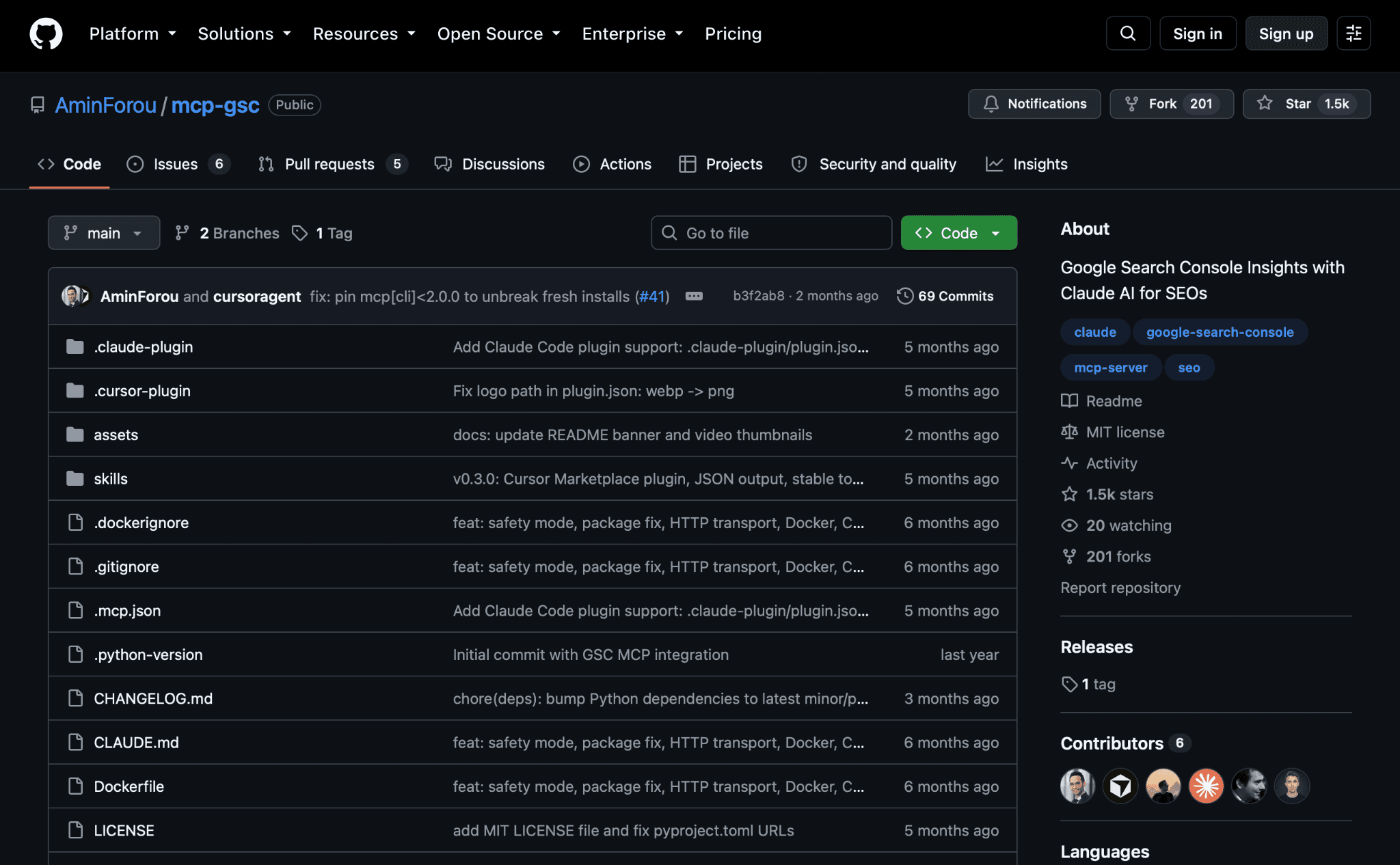
Google Search Console MCP, built by developer AminForou (github.com/AminForou/mcp-gsc), is the open-source project most "seo mcp github" searches land on. Free, MIT-licensed, it exposes queries, clicks, impressions, position, indexing status, and sitemaps to an AI assistant through 20 tools across four categories. The bet: ranking data is already free inside Google's dashboard, so the only value this server adds is putting it in a chat instead of a browser tab.
A smaller alternative from developer ahonn (mcp-server-gsc) covers only search-analytics queries through a single tool; AminForou's build is more complete and more actively maintained. Getting connected means creating a Google Cloud project with OAuth or a service account, Google's requirement rather than the server's, but it's still what turns a five-minute install into an afternoon one.
Key features
Search analytics: queries, clicks, impressions, CTR, position, filterable by country, device, query, or page, with period comparison
URL inspection: single or batch (up to 10 URLs) indexing and crawl-status checks
Sitemap management: list, submit, or delete (delete disabled by default)
Property management: list, add, or remove verified properties (add/remove disabled by default)
Installs via
uvx, or one-click through the Cursor MarketplaceWorks with Claude Desktop, Cursor, Codex CLI, Gemini CLI, Antigravity
Pros and cons
Pro: Free and open source under an MIT license, no subscription ever
Pro: Covers the full Search Console API surface in one server
Con: Its own GitHub issues document batch URL inspection timing out against domain-property (
sc-domain:) accounts on a full 10-URL batch, and some Windows users can't get its tools to appear in Claude Desktop because newer Desktop builds prioritize remote connectors over the local config file
Pricing
Free and open source. No paid tier exists.
Verdict
For anyone with Search Console access and fifteen minutes for a Google Cloud project, there's no reason to pay for this data anywhere else. Teams that can't spare that setup time, or that manage multiple clients, are better served by OpenSEO or GSC Wizard.
2. OpenSEO
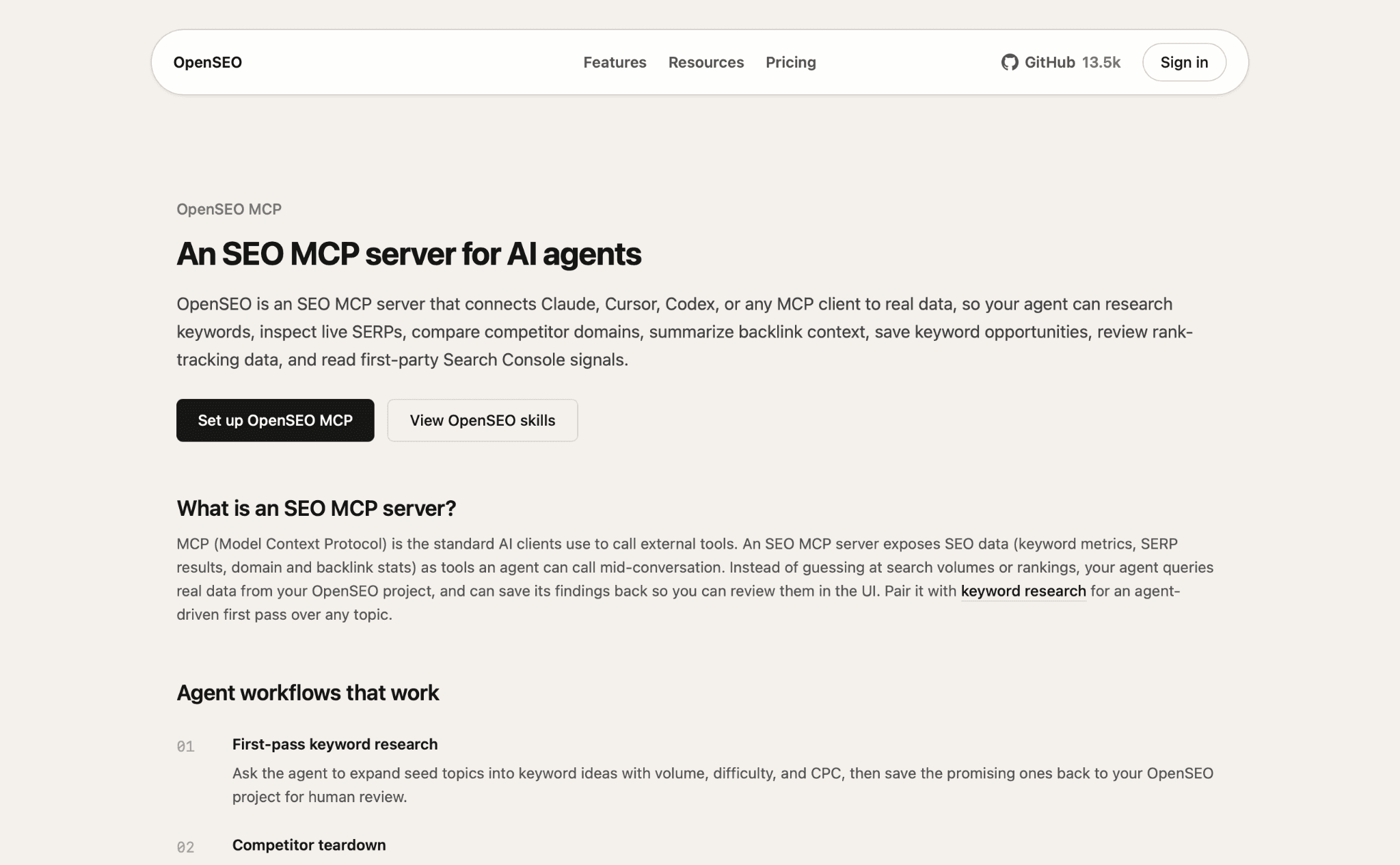
OpenSEO is a hosted SEO platform built on DataForSEO's APIs, with an MCP endpoint attached; its Search Console module is what's relevant here. The bet: most people who want GSC data in an AI assistant don't want to learn the Google Cloud console, so OpenSEO's backend handles the OAuth flow and hands over a ready MCP URL instead.
That convenience isn't free everywhere. GSC queries cost nothing once connected, but the platform runs on a credit system, and its other modules, keyword research, backlinks, rank tracking, sit behind DataForSEO's own paid API. A self-hostable open-source version exists too, but it still needs a personal DataForSEO key for anything past Search Console.
Key features
Search Performance: clicks, impressions, CTR, position, filterable by query, page, country, or device, up to 16 months of history
URL Inspection: indexing, coverage, canonical, mobile-usability, and rich-results status, up to 10 URLs per query
Hosted OAuth: connects a GSC property with no Cloud Console project required
Works with Claude Code, Claude Desktop, Cursor
Non-GSC modules run on DataForSEO's API
Pros and cons
Pro: Removes the biggest setup barrier of the free GSC MCP
Pro: GSC calls cost zero credits even on the $10/mo base plan
Con: An independent developer who rebuilt the same functionality for free called the "open source and free" positioning misleading in practice, since anything past Search Console depends on DataForSEO's paid API, with a $50 minimum top-up and per-request keyword costs of $3.50 to $7
Pricing
$10/mo base plan, including $10 of monthly usage credits. A one-time $0.50 trial credit is given at signup, not a recurring free tier. No card required to start.
Verdict
OpenSEO earns its $10/mo the moment a Google Cloud project is the thing stopping someone from using the free option. Anyone already comfortable with OAuth setup has little reason to pay for what AminForou's server already does for free.
3. GSC Wizard
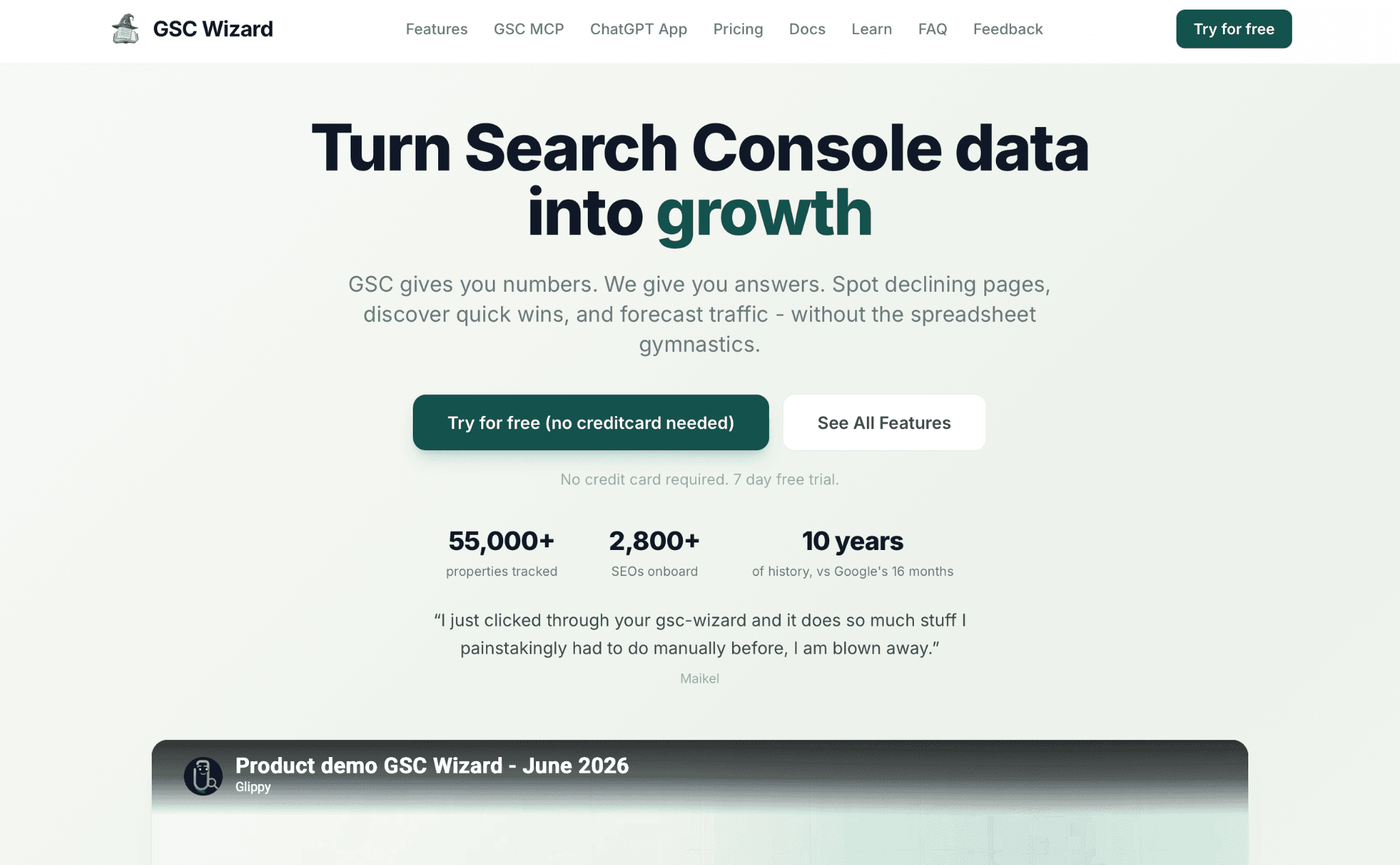
GSC Wizard rebuilds Search Console's pipeline on a ClickHouse backend instead of Google's own API: querying billions of rows directly instead of paging through a slower, rate-limited export. The bet pays off for one kind of account, one big enough that Google's native 16-month history window and row-sampling limits are already a problem.
Every tier ships the same feature set, over 40 tools spanning search analytics, ranking-change detection, keyword cannibalization, content-decay analysis, bulk URL inspection, and GA4 and Core Web Vitals data alongside Search Console. Tiers differ only by property count and full-storage history, up to ten years on the higher tiers against Google's own 16-month cap.
Key features
Search analytics queried against ClickHouse instead of Google's rate-limited API
Ranking-change detection, keyword cannibalization, content-decay analysis
Bulk URL inspection and indexing-status tracking
GA4 and Core Web Vitals (CrUX) data alongside Search Console
Full-storage properties retain up to 10 years of history
Documented for Claude, ChatGPT, and Grok
Pros and cons
Pro: The only server here solving Google's own data-retention and sampling limits directly
Pro: GA4 and Core Web Vitals sit alongside Search Console in one server
Con: By GSC Wizard's own docs, accounts without a paid subscription fall back to the standard, slower Google API instead of ClickHouse, meaning the core pitch, billions of rows in seconds, is paid-plan-only. No independent G2 or Reddit complaint exists yet for a product this new; this limitation comes from the vendor's own docs, not a user report.
Pricing
Starter $19/mo (10 API properties, 5 full-storage), Pro $49/mo (50/25), Business $299/mo (500/150), Custom $426+/mo. No free tier; a 7-day trial needs no card.
Verdict
GSC Wizard earns its price the moment an account is already hitting Google's own limits. Anyone not bumping into those caps yet has no reason to pay for a workaround they don't need.
SEO MCP servers for keyword, SERP and backlink data
The paid-platform half of the category, five servers, each an extension of a subscription that might already exist. If a platform below is already being paid for, its MCP is usually already in the seat.
4. DataForSEO MCP
DataForSEO MCP doesn't organize into dozens of named tools. It ships exactly four: three for browsing DataForSEO's own docs, and one, api_request, that calls any of the 11 API product categories DataForSEO's own Status API endpoint documents directly: SERP, AI Optimization, Keywords Data, Domain Analytics, DataForSEO Labs, Backlinks, OnPage, Content Analysis, Merchant, App Data, and Business Data.
The bet: most people querying SEO data through an AI assistant want raw access at the lowest per-call price and are willing to read docs to get it. There's no subscription. Payment is only for what gets called.
Key features
A four-tool meta-server: three docs tools plus one dynamic
api_requesttool covering the full API surface12+ product lines: SERP, AI Optimization, Keywords Data, On-Page, Backlinks, Business Data, Domain Analytics, Content Analysis, Merchant, more
Pure pay-as-you-go, no subscription tier required
$50 minimum top-up, billed per call
Works with Claude Desktop, Claude Code, Cursor, ChatGPT, Gemini CLI, Docker
Pros and cons
Pro: The cheapest way into real keyword, SERP, and backlink data, no subscription
Pro: One server exposes the entire API surface instead of gating features behind named tools
Con: Reviewers on G2 flag search-volume data specifically as inconsistent with Google Keyword Planner, Semrush, and Ahrefs numbers, and one reviewer described the SERP screenshot add-on as leaving them "misled and unsupported" after paying for it
Pricing
Pay-as-you-go, $50 minimum. A one-time $1 signup credit covers roughly 833 SERP calls or 20,000 backlink rows, not a recurring allotment.
Verdict
Right for anyone comfortable reading API docs who wants keyword, SERP, or backlink data without a subscription seat they'll barely use. Teams wanting a built-in workflow instead of raw endpoints are better served by Semrush or SE Ranking.
5. SE Ranking MCP
SE Ranking's MCP runs on a hosted remote server exposing the platform's entire toolset, keyword research, domain analysis, backlinks, site audits, AI-visibility tracking, without a local install. The company's own blog states its docs list more than 180 tools, the widest count in this roundup.
The bet only makes sense with an existing SE Ranking subscription. MCP access comes included on both current tiers, Core and Growth, no separate add-on fee.
Key features
180+ tools spanning keyword research, domain analysis, backlinks, site audits, AI/GEO visibility tracking
MCP included on both current plans, Core and Growth, no separate fee
Growth: 250 AI-visibility prompts/day, 100,000 API credits/mo; Core: 100 prompts/day, 25,000 credits
Hosted remote server, no local install
Works with Claude Web/Desktop/Code, Cursor, VS Code, Windsurf, Codex, Zed
Pros and cons
Pro: The broadest tool count of any server tested, included in an existing subscription
Pro: No local setup, credits scale with the plan already purchased
Con: G2 reviewers note newer features regularly ship as paid add-ons on top of the monthly plan, and flag the platform as not mobile-friendly, with the audit tool called out as harder to use than Screaming Frog's
Pricing
Core $129/mo ($103.20/mo annual), Growth $279/mo ($223.20/mo annual). No permanent free tier; a trial offers 100,000 free credits, no card required.
Verdict
If SE Ranking already runs the SEO work, its MCP is close to a free upgrade. Starting a new subscription solely for MCP access is a harder case when DataForSEO covers the same raw data for less.
6. Ahrefs MCP
Ahrefs MCP is the most locked-down server here, and Ahrefs is explicit why: the remote MCP server is available only on paid plans starting from Lite, so Ahrefs Free and the entry-level Starter plan ($29/mo) get no MCP access at all. The bet: Ahrefs' backlink index is valuable enough that a $129/mo gate won't cost many customers already paying for that data.
Ahrefs also restricts how the MCP can be used: custom scripts, bridges, or standalone HTTP/JSON-RPC clients outside its supported list are explicitly against its terms, a tighter leash than any other server here.
Key features
Backlink index data: referring domains, anchor text, link-quality signals
Keyword and rank-tracking data alongside backlinks
MCP gated to Lite ($129/mo) and above; not on Ahrefs Free or Starter ($29/mo)
Supported clients: Claude (Web, Desktop, Mobile, Code), Copilot Studio, ChatGPT Web, Lovable, n8n, Manus, Mistral Le Chat, OpenClaw
Custom scripts, bridges, or standalone HTTP/JSON-RPC access are unsupported
Pros and cons
Pro: One of the larger backlink indexes available through any MCP in this category
Pro: Broad official client support once past the Lite tier
Con: G2 reviewers describe paying over $2,000 a year to be "heavily restricted" in usage, and cite forced plan migrations pushing costs as high as $8,000 a year after a legacy account was discontinued
Pricing
Starter $29/mo (no MCP), Lite $129/mo (minimum with MCP), Standard $249/mo, Advanced $449/mo, Enterprise $1,499/mo (annual commitment).
Verdict
Worth the Lite-tier minimum for anyone who specifically needs Ahrefs' backlink index inside an AI assistant. Anyone shopping on price alone will find the same category of data cheaper through DataForSEO or SE Ranking.
7. Semrush MCP

Semrush MCP wraps the platform's research toolkit, domain overview, organic and keyword research, competitor research, backlinks, traffic, paid search, position tracking, into one connector. Position tracking isn't a separate product here; it's one tool among fourteen, bundled the same way it's bundled into the Semrush One subscription.
The bet is convenience, not new data: nothing this MCP returns is unavailable in the Semrush dashboard already, but querying through an assistant saves the clicking. That only applies to accounts already on a qualifying plan.
Key features
Fourteen tools: domain overview, organic/keyword/competitor research, backlinks, audience research, traffic overview, paid/shopping search research, position tracking, site audit, projects
Position tracking ships bundled, not standalone
Requires Semrush One Starter or above, or a comparable SEO Classic/Advanced plan
Works with ChatGPT, Claude, Cursor, VS Code, Perplexity, Lovable, Antigravity, Gemini
Pros and cons
Pro: The widest official MCP-client list of any platform-native server tested, including both Claude and ChatGPT
Pro: The full research toolkit in one connector, no separate MCP fee once qualifying
Con: G2 reviewers call it expensive for small businesses and freelancers specifically, with add-on features stacking into thousands of dollars a month if left unchecked
Pricing
Semrush Pro $139.95/mo, Guru $249.95/mo, Business $499.95/mo. A $0/mo Free plan exists but excludes MCP; paid plans include a 7-day trial.
Verdict
Makes sense as a convenience layer for teams already paying for Semrush One, not as a reason to start. Anyone evaluating from scratch will find comparable data for less through DataForSEO or SE Ranking.
8. SEO Review Tools MCP

SEO Review Tools MCP wraps one company's own catalog of narrow tools, a backlink checker, a domain authority checker, a plagiarism checker, keyword tools, spread across dozens of pages on its site, into a single paid API accessible through MCP. It isn't aggregating other vendors' tools; every tool behind it belongs to SEO Review Tools itself.
The shallowness shows in what each tool returns: broad coverage across backlinks, keyword metrics, traffic estimates, SERP analysis, content scoring, but none as deep as a platform built around one specialty, the way Ahrefs goes deep on backlinks or Screaming Frog on crawling.
Key features
Backlink data: referring domains, anchors, IPs
Keyword metrics: search volume, difficulty, CPC
Traffic estimates and SERP analysis
Content optimization scoring and domain authority checks
Plagiarism and duplicate-content detection
Works with Claude Desktop, VS Code, Postman Desktop, Copilot Studio
Pros and cons
Pro: The broadest single-vendor category coverage here, one API touching backlinks, keywords, traffic, and content scoring
Pro: Individual browser-based tools stay free with no signup, even without the paid API
Con: None of the data types go deep enough to replace a specialist tool, and the product carries no G2 listing at all, an absence worth stating plainly rather than papering over with an invented complaint
Pricing
API plans on a 6-month commitment: Lite $135, Standard $315, Advanced $810 (6-month totals). Browser tools stay free indefinitely; the API carries only a short free trial.
Verdict
Fits someone who wants one cheap connector touching several data types lightly, not someone who needs any one of them in depth. Anyone who already knows which specific data they need is better served further up this list.
SEO MCP servers for crawl and technical data
One server covers this job, and it carries the "technical seo mcp tool" search on its own: crawl and technical-audit data, from a crawler that has to be running somewhere.
9. Screaming Frog MCP
Screaming Frog shipped an official MCP server with version 24.0 of its SEO Spider crawler, letting an assistant run crawls, pull exports, and analyze technical audit data through natural language instead of the desktop UI. The company is upfront that coverage is partial: not every SEO Spider feature is exposed to the MCP yet.
The real constraint is architectural: the MCP is built into the desktop app, not cloud-hosted, so whatever machine runs SEO Spider has to stay running for the MCP to answer anything. Screaming Frog publishes its own guide for provisioning a cloud VM just to keep a headless instance alive, a fair signal of how real that constraint is for a team rather than one laptop.
Key features
Runs crawls and pulls technical audit exports through natural-language requests
Site crawl data: broken links, redirects, duplicate content, metadata, where exposed to the MCP
Officially documented clients: Claude (desktop app) and LM Studio, plus "other MCP-compatible clients" generally
Free version caps crawls at 500 URLs; a paid license removes that limit
Pros and cons
Pro: The only server here returning genuine site-crawl and technical-audit data
Pro: The free tier covers real crawls up to 500 URLs
Con: Capterra reviewers report the desktop app running out of memory on large crawls and slowing the whole machine, the same local-resource constraint that ties the MCP to whatever machine runs it
Pricing
Free (500 URLs/crawl); $279/yr for unlimited crawls and full feature access.
Verdict
The only reasonable choice for crawl data in this category, there's no cloud-native competitor to weigh it against, but the desktop dependency fits a solo consultant's laptop far more comfortably than a team that needs the data always-on.
SEO MCP servers for what AI assistants say about you
Nothing in the first three segments touches this. These two servers return data about AI answers, not Google: whether ChatGPT, Perplexity, and AI Overviews mention a brand at all, and what they cite when they do.
10. AIclicks MCP
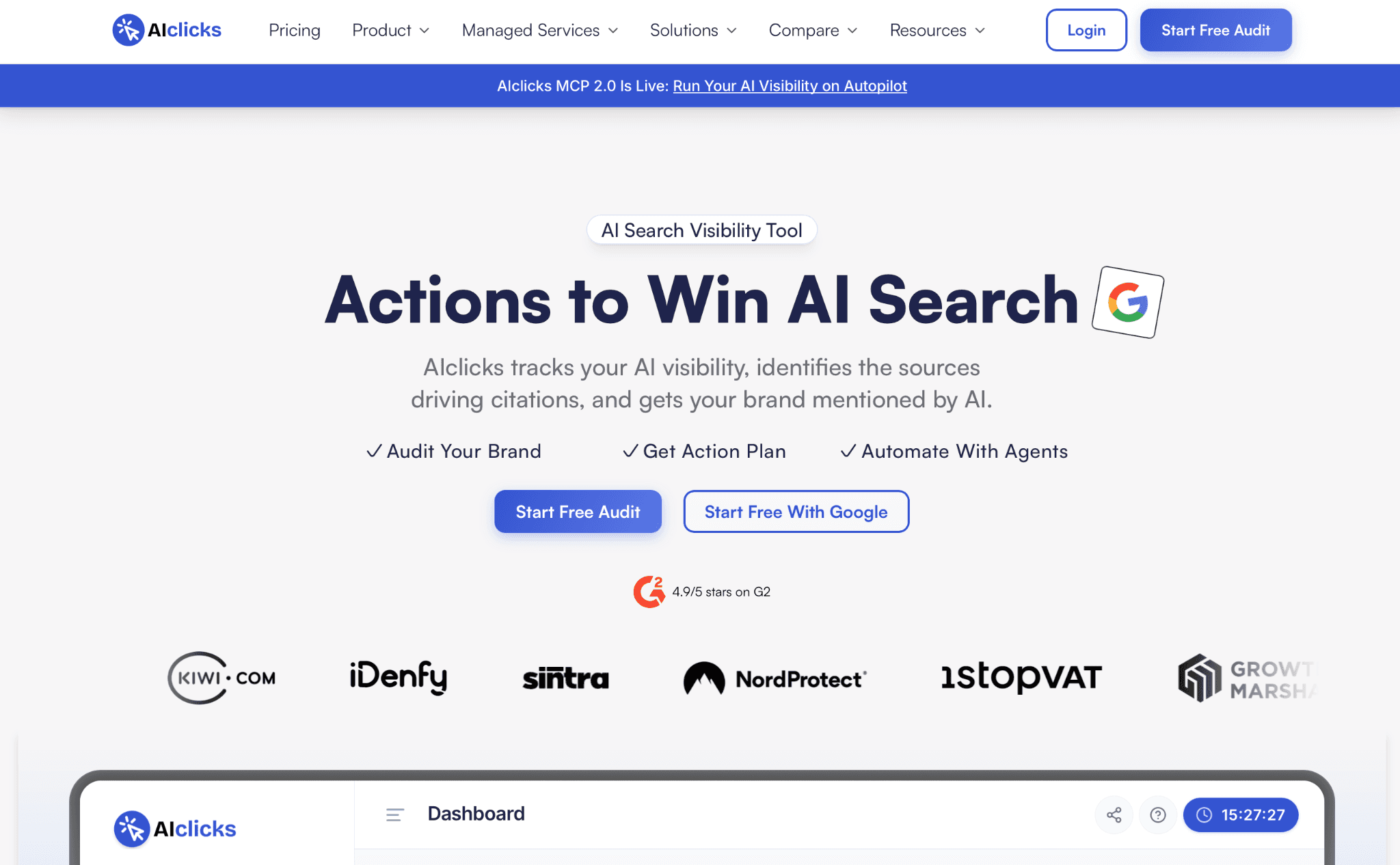
AIclicks MCP is one of two servers here that doesn't touch Google data at all. Instead of keywords, backlinks, or Search Console, it returns whether and how a brand shows up inside AI assistant answers, ChatGPT, Perplexity, Gemini, Google AI Overviews, and the rest of the 10+ platforms AIclicks tracks, along with citations, sentiment, competitor mentions, and GA4 traffic attribution. AIclicks documented the launch of its API and MCP server in mid-2026; the live server carries 37 tools across 8 categories, account access, prompt/topic catalogs, time-series visibility metrics, citations and rankings, ChatGPT ads intelligence, sentiment, GA4 traffic, and three write tools, adding prompts or competitors, creating a tracked domain, that require the assistant to confirm before running.
The bet is narrow by design: this server won't return a keyword's search volume or a backlink count, because that isn't the question it answers.
Key features
37 tools across 8 categories: account access, prompt/topic catalogs, visibility time-series, citations and rankings, ChatGPT ads data, sentiment, GA4 traffic, 3 confirm-before-write tools
Tracks brand visibility, citations, and mentions across 10+ AI platforms including ChatGPT, Perplexity, Gemini, Google AI Overviews, Microsoft Copilot
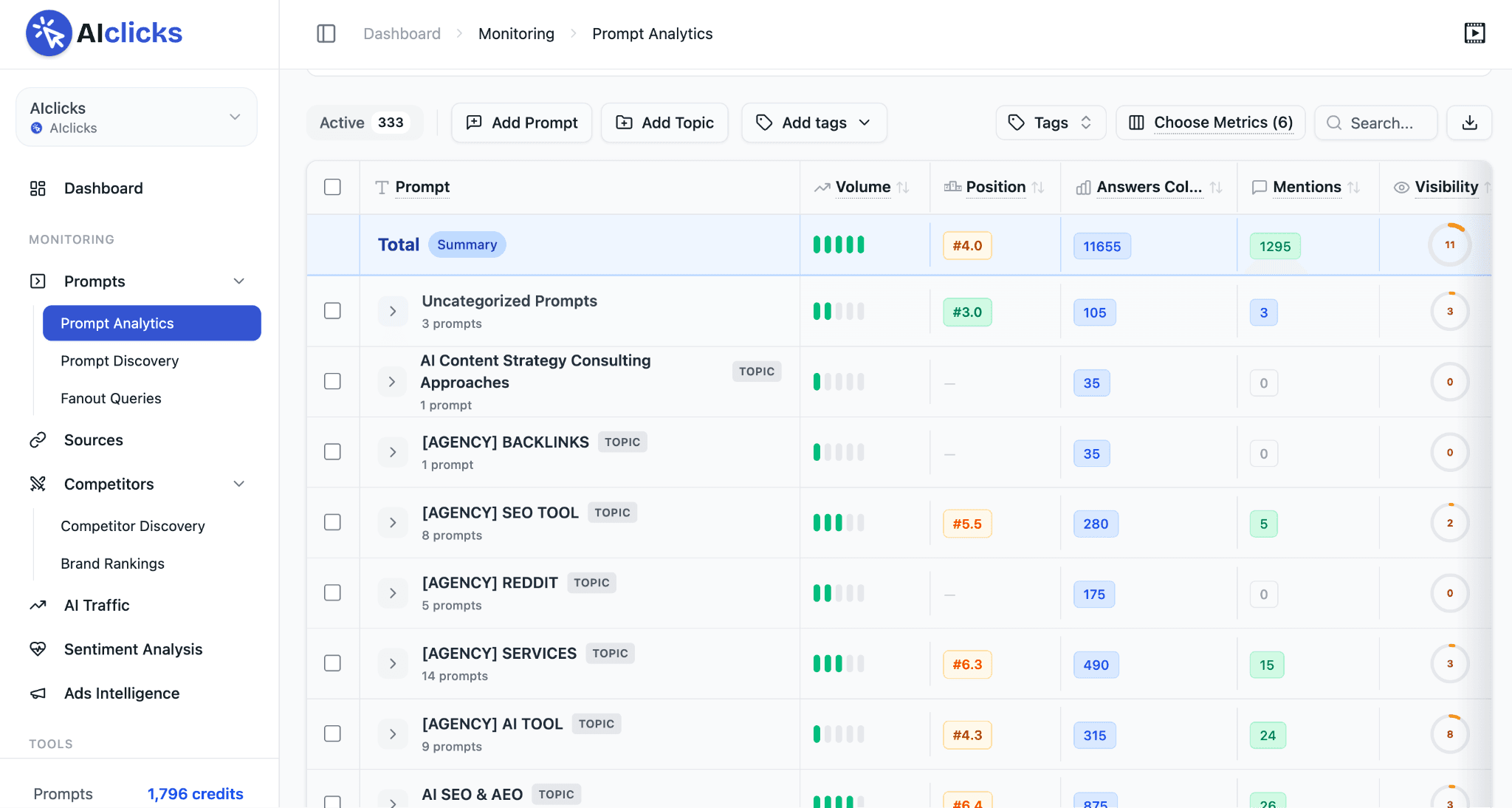
Sentiment analysis and competitor-mention tracking alongside raw visibility numbers
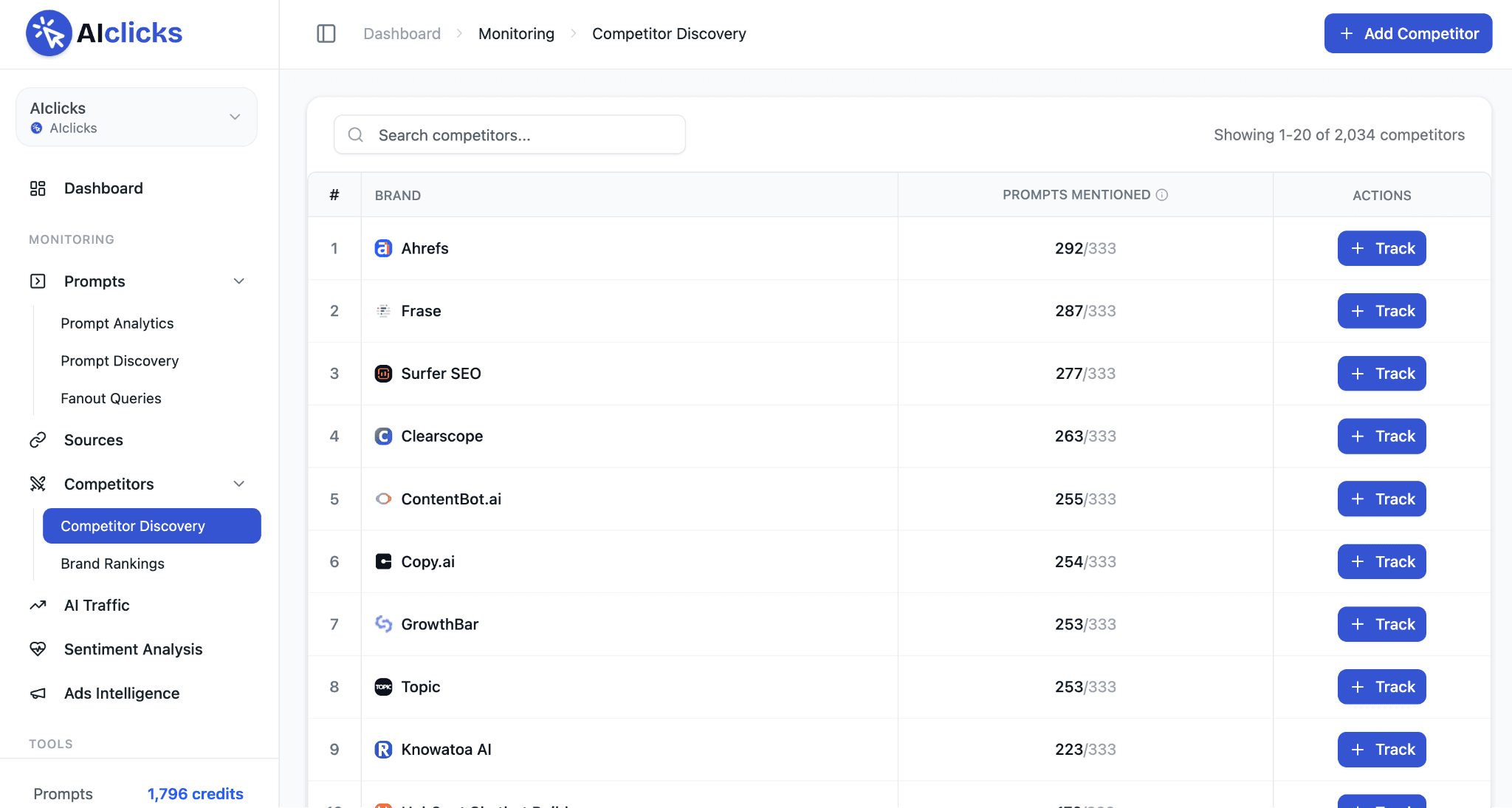
GA4 integration surfaces AI-referred traffic through the same connector
Authenticates via OAuth or an
ak_live_*API key as a Bearer tokenWorks with Claude Web, Claude Desktop, Claude Code, Cursor
Pros and cons
Pro: The only server tested returning AI-answer visibility data instead of Google data
Pro: Write tools, adding a prompt or competitor, run directly from the assistant, with confirmation required first
Con: MCP access starts at the $189/mo Pro plan; the $59/mo Starter plan has no MCP or API access at all, and even on Pro, data pulls are capped to relative windows up to 90 days with no custom date range, plus an hour-long read cache
Pricing
Starter $59/mo (no MCP), Pro $189/mo (MCP and API included), Business $499/mo, Enterprise custom. A 3-day free trial runs on Starter and Pro, no card required.
Verdict
Worth connecting the moment the question shifts from "how do we rank" to "does ChatGPT mention us," not before. Teams whose SEO work is still entirely about Google rankings won't get anything from this server; the first nine tools on this list don't already cover better.
If you’re not familiar with AIclicks, here’s a start for you:
11. Peec AI MCP
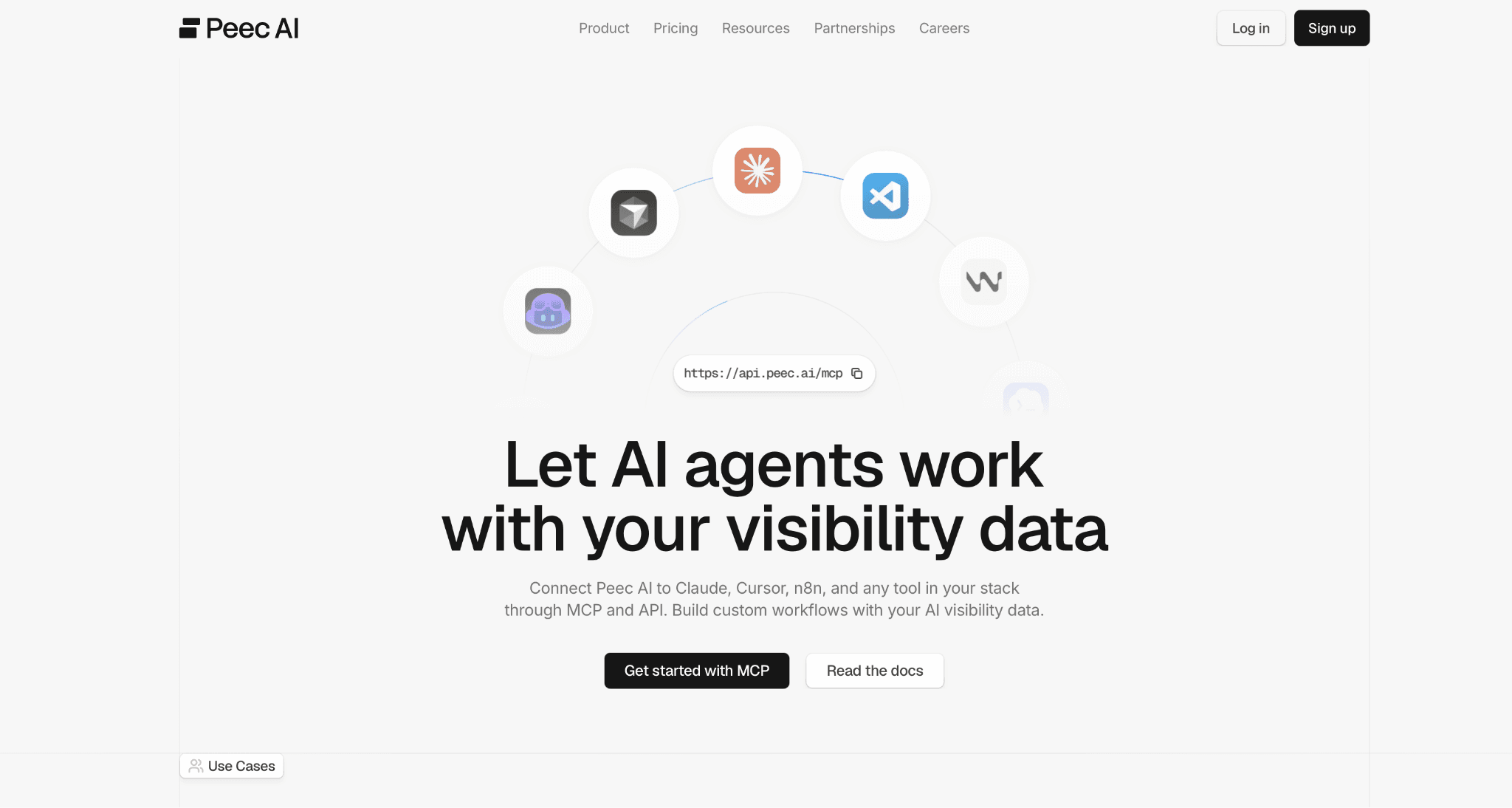
Peec AI MCP is the other AI-visibility server here, and it approaches the category from a source-level angle: alongside brand visibility and share of voice across tracked AI engines, its Find Key Sources feature surfaces which third-party sites AI models cite most often in a given space, then points toward building presence on the pages already earning those citations.
Peec tracks eleven AI platforms in total, including ChatGPT, Perplexity, Gemini, Google AI Mode, Google AI Overviews, and Microsoft Copilot, but self-serve plans only unlock three at a time; Claude and GPT-5 Search sit behind Enterprise access or a paid add-on.
Key features
Find Key Sources: surfaces which third-party domains AI models cite most often in a topic, with a path to building presence on them
Brand visibility and share-of-voice tracking across chosen AI engines
Competitor comparison and cited-source inspection, filterable by model, topic, country, date
AI bot traffic analytics and "Peec Actions" opportunity recommendations
Works with Claude (Desktop, Web, Code), Cursor, VS Code (GitHub Copilot), Windsurf
Pros and cons
Pro: Find Key Sources is a genuinely distinct angle on the same AI-visibility question AIclicks MCP answers
Pro: Strong marks from reviewers for reporting clarity and ease of interpreting citation data
Con: A G2 reviewer specifically asked for access to "more models, like Grok and Claude," reflecting that self-serve plans cap tracking at three of eleven platforms; reviewers also note there's no native Google Analytics integration yet, so AI visibility can't be tied directly to traffic or leads
Pricing
Starter $80/mo, Pro $205/mo, Advanced $420/mo. No permanent free tier; a free trial is available.
Verdict
The stronger pick for anyone whose first priority is finding which sites to target for AI citations, not just tracking visibility. Teams wanting GA4 traffic tied to that visibility data in the same connector will find AIclicks MCP covers more of that ground natively.
How to choose an SEO MCP server
Do you already pay for an SEO platform?
If yes, its native MCP is likely already included in that seat, worth activating before buying anything new. Semrush, SE Ranking, and Ahrefs (once past Lite) all include MCP access on qualifying plans, and paying for a second platform's data on top of one already in place is the single most common overspend in this category.
Do you want read-only or read and write access?
Write tools mutate an account: AIclicks MCP can add a prompt or competitor, Peec AI's write tools can create or edit prompts and topics, and even a GSC MCP can submit or delete a sitemap where that tool isn't disabled. Before handing an assistant write access, it's worth deciding whether it should actually be able to change the setup, not just read from it.
How many MCP servers should you run at once?
Most people install one. Most stacks need two, one search-data MCP for keyword, SERP, or backlink data, and one for a Search Console account's own performance. A third only pays off if it covers something the first two can't, which is exactly where AI-visibility MCPs come in, and only if your buyers are already asking AI assistants these questions.
Two questions settle it either way: which of these can the current stack already answer, and if an AI assistant recommended a competitor tomorrow, would anyone find out?
Where AI visibility fits in your SEO stack
Every server here answers one of two questions: what does Google's index say about a site, or what does an AI engine say when it answers a buying question. Nine tools cover the first well. Two cover the second, and the two aren't interchangeable with the first nine no matter how many keyword tools sit next to them in a stack.
That split isn't going away. AI assistants already expand a single question into the sub-queries that decide who gets cited, and a stack that only watches Google rankings has no visibility into that process. Running these servers side by side, inside an assistant like Claude Code with an AI SEO skill set already configured, is the practical version of covering both halves without switching tools mid-task.
A 3-day free trial covers the AI-visibility half for anyone who wants to see what it returns before deciding whether the current stack needs it.
SEO MCP Servers: Frequently Asked Questions
What is an SEO MCP server?
An SEO MCP server connects an AI assistant to live SEO or AI-visibility data, keyword metrics, Search Console performance, backlinks, or brand mentions in AI answers, so the assistant queries current numbers directly inside a conversation instead of relying on an exported file or its own training data. Which data it returns depends on which half of the category it's built for, Google-facing or AI-answer-facing.
Which SEO MCP server should you install first?
The free Google Search Console MCP is the right first install for almost everyone, since it costs nothing and returns data already sitting in an existing Search Console account. From there, add a paid-platform MCP only if a subscription to one already exists, and add an AI-visibility MCP like AIclicks MCP or Peec AI once the question shifts from rankings to what AI assistants say about a brand.
What's the best free SEO MCP?
The Google Search Console MCP built by AminForou is free and open source with no paid tier at all, the most complete free option here. Screaming Frog MCP is free too, capped at 500 URLs per crawl before its £199/yr license applies. Every other server tested, including AIclicks MCP and Peec AI MCP, runs on a paid subscription or a time-limited trial.
Do you need a paid SEO tool subscription to use an MCP?
No, not for every server. The Google Search Console MCP, Screaming Frog's free tier, and DataForSEO's pay-as-you-go model all work without an existing subscription. Semrush, Ahrefs, and SE Ranking are different: gated to specific paid tiers of the parent platform, so a subscription, existing or new, is required before the MCP becomes available at all.
Can you use SEO MCP servers with ChatGPT, or only Claude?
Claude, in its web, desktop, and Code forms, along with Cursor, has the broadest documented support across the servers tested here. ChatGPT can connect to MCP servers too, through OpenAI's Developer Mode, but that access is still in beta and currently limited to Business, Enterprise, and Edu accounts on the web, with Pro accounts getting read-only access and Free or Plus accounts getting none of it yet.
What's the difference between an SEO MCP and an AI-visibility MCP?
An SEO MCP connects an assistant to Google-facing data, a Search Console account, or a platform's keyword, SERP, and backlink database. An AI-visibility MCP connects it to a different question: whether AI assistants like ChatGPT and Google's AI Overviews mention or cite a brand at all. Nine of the eleven servers here cover the first job. Only two, AIclicks MCP and Peec AI MCP, cover the second.




Any questions left?
Book a call here: