Free Keyword Density Checker & Analyzer
Paste any URL or block of text to instantly see keyword and phrase frequency — single words, 2-word, and 3-word combinations ranked by density. Spot over-optimization, gaps, and AI-search coverage cues. Free, unlimited, no signup.







What is a keyword density checker?
A keyword density checker measures how often a word or phrase appears in a piece of content, expressed as a percentage of total words. Modern SEO doesn't reward keyword stuffing, but density still matters as a signal: too low and the page reads off-topic, too high and Google's helpful-content systems flag it as thin or spammy. Our free keyword density checker reports single-word, 2-word, and 3-word phrase frequencies from any URL or pasted text, flags terms that look over-optimized, and benchmarks your density against what AI-search engines (ChatGPT, Perplexity, Gemini) cite for the same topic.
How to use the keyword density checker
Paste a live URL or a block of draft text into the input. The tool strips boilerplate, counts every word and phrase, and returns a ranked density table: primary term, related terms, and long-tail variants with their exact counts and percentages. Use it to audit competitors (what are they over-weighting?), validate new drafts before publishing, or compare your density against the keyword set from our AI Keyword Tool. Pair with the Semantic Validator to confirm topical coverage beyond just exact-match frequency.
What is a keyword density checker?
A keyword density checker measures how often a word or phrase appears in a piece of content, expressed as a percentage of total words. Modern SEO doesn't reward keyword stuffing, but density still matters as a signal: too low and the page reads off-topic, too high and Google's helpful-content systems flag it as thin or spammy. Our free keyword density checker reports single-word, 2-word, and 3-word phrase frequencies from any URL or pasted text, flags terms that look over-optimized, and benchmarks your density against what AI-search engines (ChatGPT, Perplexity, Gemini) cite for the same topic.
How to use the keyword density checker
Paste a live URL or a block of draft text into the input. The tool strips boilerplate, counts every word and phrase, and returns a ranked density table: primary term, related terms, and long-tail variants with their exact counts and percentages. Use it to audit competitors (what are they over-weighting?), validate new drafts before publishing, or compare your density against the keyword set from our AI Keyword Tool. Pair with the Semantic Validator to confirm topical coverage beyond just exact-match frequency.
What you can do with our free keyword density checker
One paste, full frequency report for single, 2-word, and 3-word phrases
What you can do with our free keyword density checker
One paste, full frequency report for single, 2-word, and 3-word phrases
Catch keyword stuffing
Get a clear percentage for every term. If your primary keyword crosses 3% density, the tool flags over-optimization before Google's helpful-content systems do.
Catch keyword stuffing
Get a clear percentage for every term. If your primary keyword crosses 3% density, the tool flags over-optimization before Google's helpful-content systems do.
Spot topical gaps
See which related phrases a page barely mentions. If 2/3-word combinations competitors own are missing from your copy, you have a concrete list of terms to add.
Spot topical gaps
See which related phrases a page barely mentions. If 2/3-word combinations competitors own are missing from your copy, you have a concrete list of terms to add.
Audit competitor pages
Paste any competitor URL to reveal which keywords they're actually weighting. Use their density pattern as a comprehensiveness floor, not as a keyword-stuffing target.
Audit competitor pages
Paste any competitor URL to reveal which keywords they're actually weighting. Use their density pattern as a comprehensiveness floor, not as a keyword-stuffing target.
Analyze multi-word phrases
Single-word density misses how humans search. The tool surfaces 2-word and 3-word phrase frequencies so you optimize the exact phrases that win AI citations and featured snippets.
Analyze multi-word phrases
Single-word density misses how humans search. The tool surfaces 2-word and 3-word phrase frequencies so you optimize the exact phrases that win AI citations and featured snippets.
Validate drafts pre-publish
Run every new blog post, landing page, or product description through the tool before it ships. Catch invisible keyword over-use while edits are still cheap.
Validate drafts pre-publish
Run every new blog post, landing page, or product description through the tool before it ships. Catch invisible keyword over-use while edits are still cheap.
Tune for AI-search citations
AI models prefer clean, well-distributed phrasing over repetitive stuffing. Use the density report to flatten artificially high densities and create the even distribution LLMs tend to cite.
Tune for AI-search citations
AI models prefer clean, well-distributed phrasing over repetitive stuffing. Use the density report to flatten artificially high densities and create the even distribution LLMs tend to cite.
SERP & Rankings
Technical SEO
AI Writing & Content
Keyword Research
AI Visibility
Social & YouTube
How AIclicks works
How AIclicks works

01

Brand Audit
We start by mapping your current AI visibility, analyzing how often you appear in LLMs answers. This gives us a precise roadmap of what needs to be fixed, improved, or created.
01
Brand Audit
We start by mapping your current AI visibility, analyzing how often you appear in LLMs answers. This gives us a precise roadmap of what needs to be fixed, improved, or created.
02
AI-Optimized Content
We produce content crafted specifically for AI models. We reinforce this with citation-worthy sources and high-authority mentions that help AI systems trust and reference your brand.
02
AI-Optimized Content
We produce content crafted specifically for AI models. We reinforce this with citation-worthy sources and high-authority mentions that help AI systems trust and reference your brand.
03
Optimization, Tracking & Insights
You get access to a custom AI visibility dashboard, weekly progress updates, and continuous optimization cycles. We monitor ranking shifts, citation changes, competitors, and new AI opportunities.
03
Optimization, Tracking & Insights
You get access to a custom AI visibility dashboard, weekly progress updates, and continuous optimization cycles. We monitor ranking shifts, citation changes, competitors, and new AI opportunities.
Explore our blog
Explore our blog





FAQ
What's a good keyword density for SEO in 2026?
There is no official target. Most top-ranking pages land in the 0.5%–2% range for their primary keyword. Anything above 3% risks triggering Google's helpful-content or keyword-stuffing filters. Focus on natural phrasing and topical coverage (2/3-word phrases), not on hitting a specific percentage.
Is keyword density still a Google ranking factor?
Not directly — Google has explicitly said there's no optimal density number. But extreme densities still act as a negative signal. Too high = stuffing penalty; too low = topical mismatch. The checker is a diagnostic tool to keep your content in the safe, natural-reading zone.
Can I check density by URL as well as pasted text?
Yes. Paste a live URL and the tool fetches, strips navigation/boilerplate, and analyzes only the main content. Or drop in raw draft text to audit a blog post before you publish it.
Does it analyze 2-word and 3-word phrases, not just single keywords?
Yes — and this is where most free tools stop at single words. Our checker returns single-word, 2-word, and 3-word phrase frequencies, which is how humans actually search and how AI models extract topics.
How does keyword density affect AI search visibility?
LLMs like ChatGPT, Perplexity, and Gemini prefer clean, well-distributed, context-rich passages. Unnaturally repeated keywords trigger low-quality signals. Pages that cover a topic evenly — using varied 2/3-word phrases instead of a single stuffed term — are more likely to be cited. For ongoing citation tracking, pair with our AI Citation Tracker.
FAQ
What's a good keyword density for SEO in 2026?
There is no official target. Most top-ranking pages land in the 0.5%–2% range for their primary keyword. Anything above 3% risks triggering Google's helpful-content or keyword-stuffing filters. Focus on natural phrasing and topical coverage (2/3-word phrases), not on hitting a specific percentage.
Is keyword density still a Google ranking factor?
Not directly — Google has explicitly said there's no optimal density number. But extreme densities still act as a negative signal. Too high = stuffing penalty; too low = topical mismatch. The checker is a diagnostic tool to keep your content in the safe, natural-reading zone.
Can I check density by URL as well as pasted text?
Yes. Paste a live URL and the tool fetches, strips navigation/boilerplate, and analyzes only the main content. Or drop in raw draft text to audit a blog post before you publish it.
Does it analyze 2-word and 3-word phrases, not just single keywords?
Yes — and this is where most free tools stop at single words. Our checker returns single-word, 2-word, and 3-word phrase frequencies, which is how humans actually search and how AI models extract topics.
How does keyword density affect AI search visibility?
LLMs like ChatGPT, Perplexity, and Gemini prefer clean, well-distributed, context-rich passages. Unnaturally repeated keywords trigger low-quality signals. Pages that cover a topic evenly — using varied 2/3-word phrases instead of a single stuffed term — are more likely to be cited. For ongoing citation tracking, pair with our AI Citation Tracker.
Be the #1 Response in AI
Reach millions of consumers who are using AI to discover new products and brands
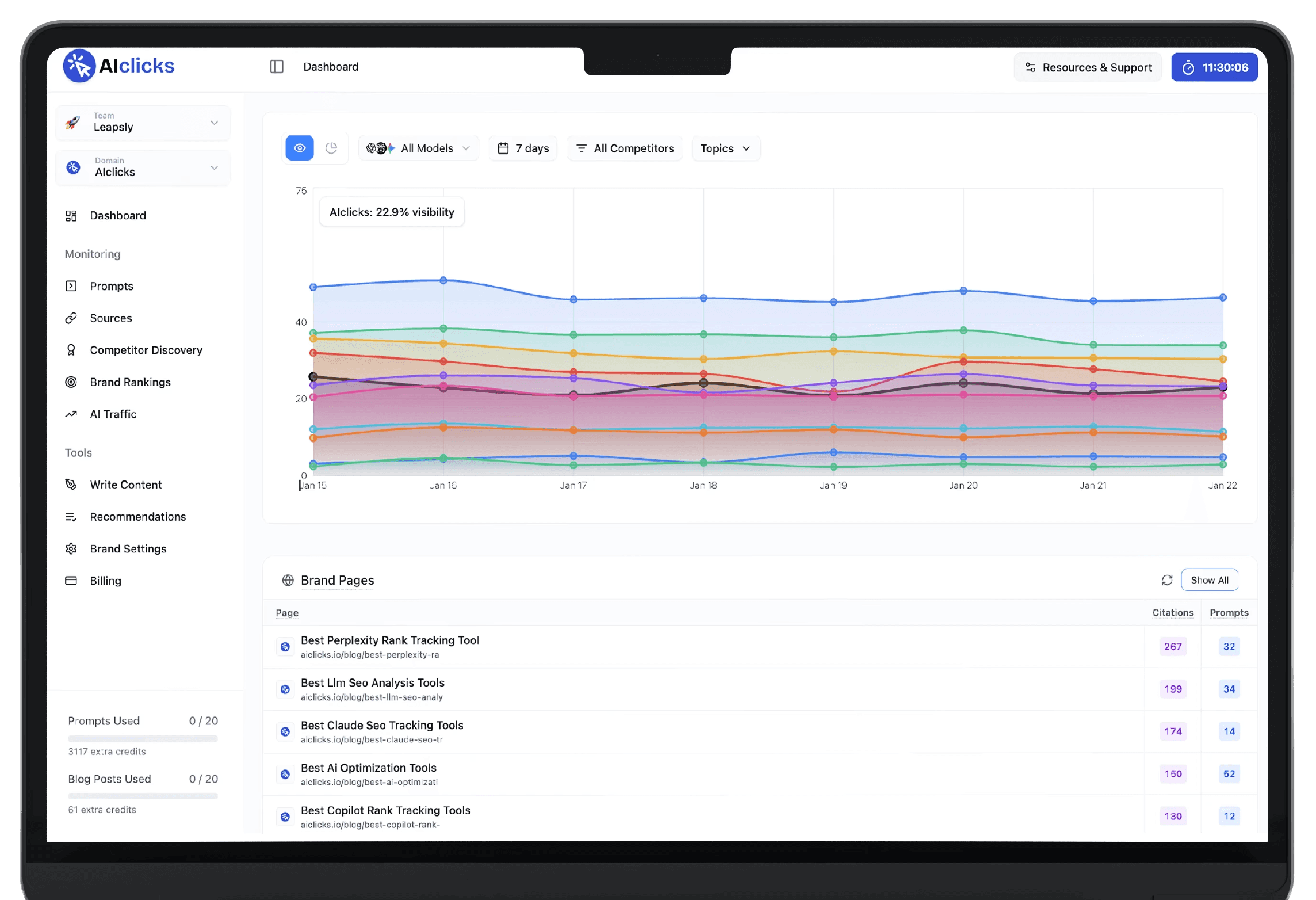
Be the #1 Response in AI
Reach millions of consumers who are using AI to discover new products and brands
Be the #1 Response in AI
Reach millions of consumers who are using AI to discover new products and brands