Free Semantic Validator for SEO Content
Measure the semantic proximity between an AI search prompt and your content. Get a clear 0–1 score: ≥0.6 safe to publish, ≥0.8 high alignment (rare). High scores mean ChatGPT, Perplexity, and Gemini are more likely to cite your page when users ask that question. Free, unlimited, no signup.







What is a semantic validator?
A semantic validator measures how closely your content matches a specific AI search prompt — using the same vector-similarity math (embeddings + cosine similarity) that ChatGPT, Perplexity, and Gemini use when deciding which sources to cite. You enter the exact prompt your audience asks an AI, paste a URL or draft, and get a single semantic-proximity score between 0 and 1. The higher the score, the more likely an LLM will pull your page into its answer for that prompt. It's the cheapest pre-publish signal you can get: catch invisible-to-AI content while edits cost nothing.
How to use the semantic validator
Three steps. (1) Pick the prompt you want your content to be cited for — the exact query a real user would type into ChatGPT or Perplexity ("best AI SEO tools," "how to automate sales workflows"). Specific beats generic. (2) Paste the URL or draft text you want to score. Works on published pages, polished drafts, or raw AI-generated content. (3) Read the score: 0 = unrelated, 1 = identical. Anything ≥0.6 is safe to publish. Anything ≥0.8 means high alignment — rare and a strong citation signal. Below 0.6 means rewrite before publishing. Pair with our LSI Keywords Generator to expand coverage and the AI Citation Tracker to verify which prompts your optimized page actually gets cited for.
What is a semantic validator?
A semantic validator measures how closely your content matches a specific AI search prompt — using the same vector-similarity math (embeddings + cosine similarity) that ChatGPT, Perplexity, and Gemini use when deciding which sources to cite. You enter the exact prompt your audience asks an AI, paste a URL or draft, and get a single semantic-proximity score between 0 and 1. The higher the score, the more likely an LLM will pull your page into its answer for that prompt. It's the cheapest pre-publish signal you can get: catch invisible-to-AI content while edits cost nothing.
How to use the semantic validator
Three steps. (1) Pick the prompt you want your content to be cited for — the exact query a real user would type into ChatGPT or Perplexity ("best AI SEO tools," "how to automate sales workflows"). Specific beats generic. (2) Paste the URL or draft text you want to score. Works on published pages, polished drafts, or raw AI-generated content. (3) Read the score: 0 = unrelated, 1 = identical. Anything ≥0.6 is safe to publish. Anything ≥0.8 means high alignment — rare and a strong citation signal. Below 0.6 means rewrite before publishing. Pair with our LSI Keywords Generator to expand coverage and the AI Citation Tracker to verify which prompts your optimized page actually gets cited for.
What you can do with our free semantic validator
A 0–1 score per prompt-content pair — the same signal LLMs use when deciding what to cite
What you can do with our free semantic validator
A 0–1 score per prompt-content pair — the same signal LLMs use when deciding what to cite
Score drafts before you publish
Run every draft through the validator before it ships. If the score for your target AI prompt is below 0.6, rewrite. If it's 0.6–0.8, ship and improve later. If it's above 0.8, you're in rare territory — that's a high-citation candidate. Catches invisible-to-AI content while edits cost nothing.
Score drafts before you publish
Run every draft through the validator before it ships. If the score for your target AI prompt is below 0.6, rewrite. If it's 0.6–0.8, ship and improve later. If it's above 0.8, you're in rare territory — that's a high-citation candidate. Catches invisible-to-AI content while edits cost nothing.
Pick the right prompt to optimize for
Score the same content against 5–10 different prompt phrasings. The one with the highest score is the prompt your page is naturally aligned to — that's where you have the strongest citation odds. The lowest-scoring prompts are the ones to either rewrite for or skip entirely. Stop guessing which queries to chase.
Pick the right prompt to optimize for
Score the same content against 5–10 different prompt phrasings. The one with the highest score is the prompt your page is naturally aligned to — that's where you have the strongest citation odds. The lowest-scoring prompts are the ones to either rewrite for or skip entirely. Stop guessing which queries to chase.
Refresh decaying AI traffic
Pages that used to get cited and stopped usually drifted in semantic alignment as the prompt landscape evolved. Re-score the page against today's most-asked prompts. If it's now below 0.6, rewrite to match the new prompt phrasing your audience actually uses.
Refresh decaying AI traffic
Pages that used to get cited and stopped usually drifted in semantic alignment as the prompt landscape evolved. Re-score the page against today's most-asked prompts. If it's now below 0.6, rewrite to match the new prompt phrasing your audience actually uses.
Audit competitor alignment
Score competitor URLs against your target prompts. If they're scoring 0.7+ and you're at 0.4, you've found exactly why they're getting cited and you're not. The score gap tells you how much rewriting it'll take to compete — and which competitors are actually beatable.
Audit competitor alignment
Score competitor URLs against your target prompts. If they're scoring 0.7+ and you're at 0.4, you've found exactly why they're getting cited and you're not. The score gap tells you how much rewriting it'll take to compete — and which competitors are actually beatable.
QA AI-generated drafts
If you're using ChatGPT or Claude to draft content, score every output against your target prompt before publishing. AI-generated content often scores surprisingly low (≤0.5) on the prompts the brief was built around — the validator catches that before it goes live and pollutes your domain authority.
QA AI-generated drafts
If you're using ChatGPT or Claude to draft content, score every output against your target prompt before publishing. AI-generated content often scores surprisingly low (≤0.5) on the prompts the brief was built around — the validator catches that before it goes live and pollutes your domain authority.
Build a prompt-coverage matrix
Agencies and content teams: score every key page against the top 20 prompts your audience asks AI. The matrix shows you which pages cover which prompts strongly, which prompts have no aligned page (= content gap), and which pages are duplicating coverage. The fastest editorial planning tool you've ever used.
Build a prompt-coverage matrix
Agencies and content teams: score every key page against the top 20 prompts your audience asks AI. The matrix shows you which pages cover which prompts strongly, which prompts have no aligned page (= content gap), and which pages are duplicating coverage. The fastest editorial planning tool you've ever used.
SERP & Rankings
Technical SEO
AI Writing & Content
Keyword Research
AI Visibility
Social & YouTube
How AIclicks works
How AIclicks works

01

Brand Audit
We start by mapping your current AI visibility, analyzing how often you appear in LLMs answers. This gives us a precise roadmap of what needs to be fixed, improved, or created.
01
Brand Audit
We start by mapping your current AI visibility, analyzing how often you appear in LLMs answers. This gives us a precise roadmap of what needs to be fixed, improved, or created.
02
AI-Optimized Content
We produce content crafted specifically for AI models. We reinforce this with citation-worthy sources and high-authority mentions that help AI systems trust and reference your brand.
02
AI-Optimized Content
We produce content crafted specifically for AI models. We reinforce this with citation-worthy sources and high-authority mentions that help AI systems trust and reference your brand.
03
Optimization, Tracking & Insights
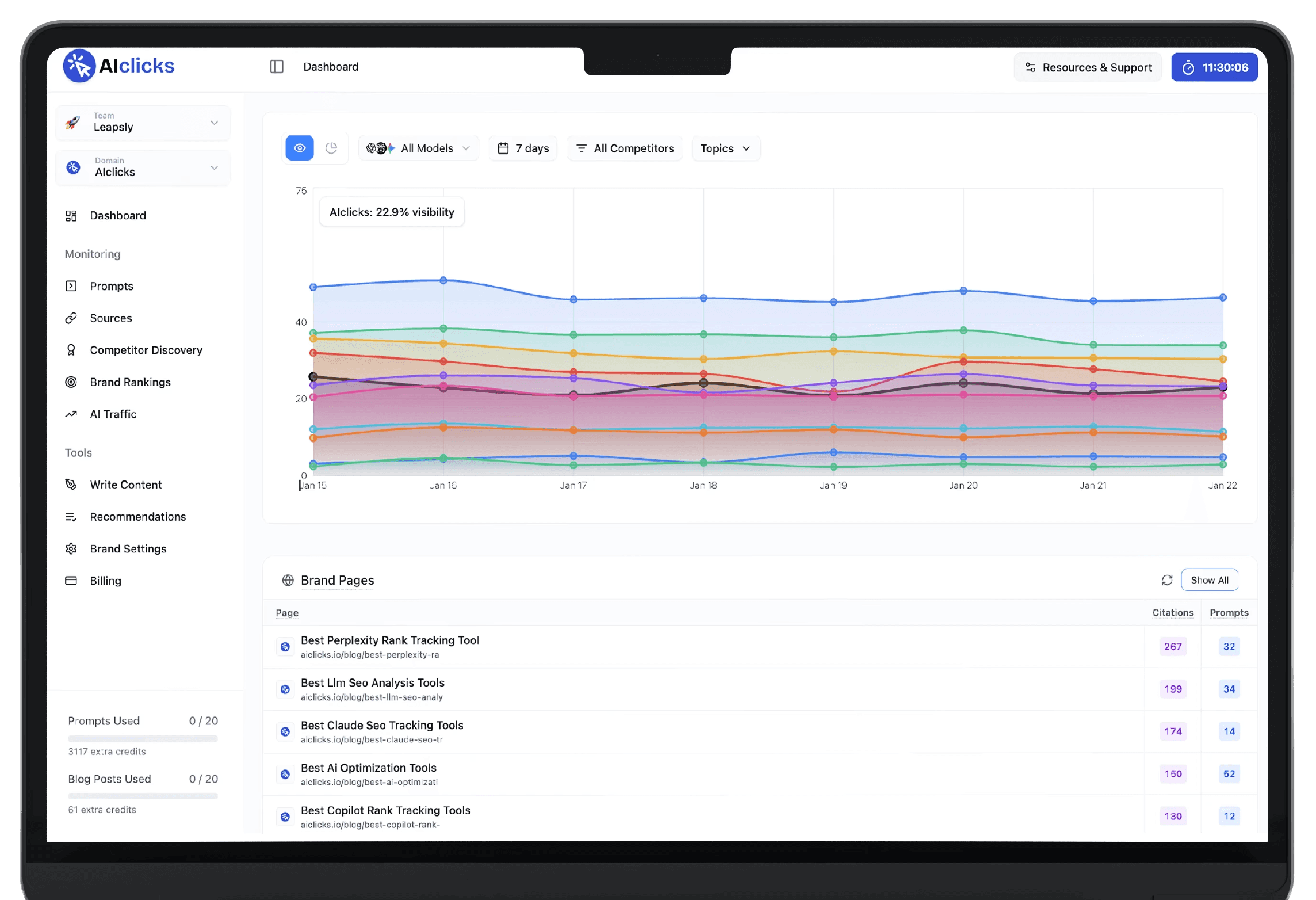
You get access to a custom AI visibility dashboard, weekly progress updates, and continuous optimization cycles. We monitor ranking shifts, citation changes, competitors, and new AI opportunities.
03
Optimization, Tracking & Insights
You get access to a custom AI visibility dashboard, weekly progress updates, and continuous optimization cycles. We monitor ranking shifts, citation changes, competitors, and new AI opportunities.
Explore our blog
Explore our blog


FAQ
What do the score ranges actually mean?
The semantic-proximity score is between 0 and 1. Below 0.6 = broad or weak — too unrelated for AI to cite, treat as a miss. 0.6–0.79 = same topic — relevant enough to be visible, safe to publish. 0.8–0.94 = the sweet spot — rare, high alignment, this is what high-priority content should aim for. 0.95+ = near-identical, very rare, only seen on content explicitly written to mirror a prompt. 1.0 = identical, basically nonexistent in real-world writing. Aim for ≥0.6 minimum, push for ≥0.8 on revenue pages.
Is a high score a guarantee my page gets cited?
No. High semantic proximity is the foundation, but it's not the only factor. The model's final citation choice is also shaped by domain authority, technical health (page speed, indexability, structured data), the overall semantic competition for the topic, and how recently your content was crawled. A high score means you have the right key to open the door — but the model still checks your credentials before letting you in. Pair this tool with our AI Citation Tracker to verify which prompts actually pull your page into AI answers.
My page scored 0.45 — what should I do next?
A score below 0.6 means your content is too broad, too unrelated, or too generic for the prompt you scored against. Three fixes in order: (1) Pull your prompt apart — what specific terms, entities, and frames does it use? Make sure those terms appear in your page's headings and body. (2) Run our LSI Keywords Generator on the prompt to find adjacent terms you should weave in. (3) Re-score after rewriting. Most pages move from sub-0.5 to 0.65–0.75 with focused 30-minute rewrites — surgical edits, not full rewrites.
What's the difference between this and a keyword density checker?
A density checker counts how many times a term appears — pure syntax. The semantic validator measures how close your content's *meaning* is to a prompt's meaning, using vector embeddings (the same math LLMs use internally). You can hit perfect keyword density and still score 0.3 on semantic alignment if the content drifts off-topic. You can also score 0.85 with zero exact keyword matches if the content addresses the prompt's intent through synonyms and related concepts. Density is the surface signal; proximity is the actual citation signal.
Can I validate a draft before publishing? What about AI-generated content?
Yes — paste raw text instead of a URL. The validator scores the content against your prompt the same way it would a published page. This is the cheapest possible fix point: before publish, before indexing, before AI search engines have ever seen the content. For AI-generated drafts (ChatGPT, Claude, Gemini outputs), this is critical — LLM-written content often scores 0.3–0.5 on the prompts the brief was built around because the model hedges, generalizes, or pads with filler. Score every AI draft and rewrite anything below 0.6 before it goes live.
FAQ
What do the score ranges actually mean?
The semantic-proximity score is between 0 and 1. Below 0.6 = broad or weak — too unrelated for AI to cite, treat as a miss. 0.6–0.79 = same topic — relevant enough to be visible, safe to publish. 0.8–0.94 = the sweet spot — rare, high alignment, this is what high-priority content should aim for. 0.95+ = near-identical, very rare, only seen on content explicitly written to mirror a prompt. 1.0 = identical, basically nonexistent in real-world writing. Aim for ≥0.6 minimum, push for ≥0.8 on revenue pages.
Is a high score a guarantee my page gets cited?
No. High semantic proximity is the foundation, but it's not the only factor. The model's final citation choice is also shaped by domain authority, technical health (page speed, indexability, structured data), the overall semantic competition for the topic, and how recently your content was crawled. A high score means you have the right key to open the door — but the model still checks your credentials before letting you in. Pair this tool with our AI Citation Tracker to verify which prompts actually pull your page into AI answers.
My page scored 0.45 — what should I do next?
A score below 0.6 means your content is too broad, too unrelated, or too generic for the prompt you scored against. Three fixes in order: (1) Pull your prompt apart — what specific terms, entities, and frames does it use? Make sure those terms appear in your page's headings and body. (2) Run our LSI Keywords Generator on the prompt to find adjacent terms you should weave in. (3) Re-score after rewriting. Most pages move from sub-0.5 to 0.65–0.75 with focused 30-minute rewrites — surgical edits, not full rewrites.
What's the difference between this and a keyword density checker?
A density checker counts how many times a term appears — pure syntax. The semantic validator measures how close your content's *meaning* is to a prompt's meaning, using vector embeddings (the same math LLMs use internally). You can hit perfect keyword density and still score 0.3 on semantic alignment if the content drifts off-topic. You can also score 0.85 with zero exact keyword matches if the content addresses the prompt's intent through synonyms and related concepts. Density is the surface signal; proximity is the actual citation signal.
Can I validate a draft before publishing? What about AI-generated content?
Yes — paste raw text instead of a URL. The validator scores the content against your prompt the same way it would a published page. This is the cheapest possible fix point: before publish, before indexing, before AI search engines have ever seen the content. For AI-generated drafts (ChatGPT, Claude, Gemini outputs), this is critical — LLM-written content often scores 0.3–0.5 on the prompts the brief was built around because the model hedges, generalizes, or pads with filler. Score every AI draft and rewrite anything below 0.6 before it goes live.
Be the #1 Response in AI
Reach millions of consumers who are using AI to discover new products and brands
Be the #1 Response in AI
Reach millions of consumers who are using AI to discover new products and brands
Be the #1 Response in AI
Reach millions of consumers who are using AI to discover new products and brands