LSI keyword generator
Generate semantically related keywords from any seed in seconds. Our free LSI keywords generator pulls concept-level variants that help Google and AI models recognize true topical depth — not just keyword stuffing. Unlimited, no signup.







What are LSI keywords?
LSI (Latent Semantic Indexing) keywords are semantically related terms and concepts that help search engines and AI models understand the true topic of a page, beyond just the exact primary keyword. A page targeting "email marketing" gains topical strength from terms like "drip campaign," "open rate," "sender reputation," and "segmentation." Google has moved past naive LSI since its BERT and MUM updates, but the underlying signal — semantic depth — still matters. Our free LSI keywords generator produces concept-rich variants for any seed so both classic SEO and LLMs like ChatGPT, Perplexity, and Gemini recognize your content as genuinely comprehensive.
How to use the LSI keywords generator
Type any seed keyword — a product, a service, a topic. The tool returns semantically related concepts, entities, and supporting phrases you can weave naturally into headings, subheadings, and body copy. Use the output as a topical coverage checklist for new drafts, or run existing pages through the list to spot gaps. Pair with the Semantic Validator to confirm whether your existing content already covers the concept cluster, or with the Keyword Density Checker to make sure you're not over-stuffing the primary term.
What are LSI keywords?
LSI (Latent Semantic Indexing) keywords are semantically related terms and concepts that help search engines and AI models understand the true topic of a page, beyond just the exact primary keyword. A page targeting "email marketing" gains topical strength from terms like "drip campaign," "open rate," "sender reputation," and "segmentation." Google has moved past naive LSI since its BERT and MUM updates, but the underlying signal — semantic depth — still matters. Our free LSI keywords generator produces concept-rich variants for any seed so both classic SEO and LLMs like ChatGPT, Perplexity, and Gemini recognize your content as genuinely comprehensive.
How to use the LSI keywords generator
Type any seed keyword — a product, a service, a topic. The tool returns semantically related concepts, entities, and supporting phrases you can weave naturally into headings, subheadings, and body copy. Use the output as a topical coverage checklist for new drafts, or run existing pages through the list to spot gaps. Pair with the Semantic Validator to confirm whether your existing content already covers the concept cluster, or with the Keyword Density Checker to make sure you're not over-stuffing the primary term.
What you can do with our free LSI keywords generator
One seed, a full semantic map for Google and AI-search topical coverage
What you can do with our free LSI keywords generator
One seed, a full semantic map for Google and AI-search topical coverage
Build topically rich briefs
Turn a single seed into a concept map. Hand it to writers as a coverage checklist so every new page reads comprehensive instead of thin.
Build topically rich briefs
Turn a single seed into a concept map. Hand it to writers as a coverage checklist so every new page reads comprehensive instead of thin.
Refresh underperforming pages
Compare an existing page's terms against the LSI set. Add the missing semantic variants to restore topical depth and stop the content-decay slide.
Refresh underperforming pages
Compare an existing page's terms against the LSI set. Add the missing semantic variants to restore topical depth and stop the content-decay slide.
Escape keyword stuffing
Repeating the primary keyword 30 times kills a page. Use LSI variants to say the same idea in 30 different ways — natural, citable, and penalty-safe.
Escape keyword stuffing
Repeating the primary keyword 30 times kills a page. Use LSI variants to say the same idea in 30 different ways — natural, citable, and penalty-safe.
Win AI-search citations
LLMs cite passages that cover a topic comprehensively. Semantic variants are the signal that tells ChatGPT, Perplexity, and Gemini "this page actually knows the domain."
Win AI-search citations
LLMs cite passages that cover a topic comprehensively. Semantic variants are the signal that tells ChatGPT, Perplexity, and Gemini "this page actually knows the domain."
Structure topic clusters
Group the LSI output by sub-theme to design hub-and-spoke clusters. Each related concept becomes a supporting article linking to the pillar, building topical authority.
Structure topic clusters
Group the LSI output by sub-theme to design hub-and-spoke clusters. Each related concept becomes a supporting article linking to the pillar, building topical authority.
Unlimited, no signup
Run any seed, any niche, as many times as you want. No credit card, no daily cap, no account. Just paste a seed and copy the semantic set.
Unlimited, no signup
Run any seed, any niche, as many times as you want. No credit card, no daily cap, no account. Just paste a seed and copy the semantic set.
SERP & Rankings
Technical SEO
AI Writing & Content
Keyword Research
AI Visibility
Social & YouTube
How AIclicks works
How AIclicks works

01

Brand Audit
We start by mapping your current AI visibility, analyzing how often you appear in LLMs answers. This gives us a precise roadmap of what needs to be fixed, improved, or created.
01
Brand Audit
We start by mapping your current AI visibility, analyzing how often you appear in LLMs answers. This gives us a precise roadmap of what needs to be fixed, improved, or created.
02
AI-Optimized Content
We produce content crafted specifically for AI models. We reinforce this with citation-worthy sources and high-authority mentions that help AI systems trust and reference your brand.
02
AI-Optimized Content
We produce content crafted specifically for AI models. We reinforce this with citation-worthy sources and high-authority mentions that help AI systems trust and reference your brand.
03
Optimization, Tracking & Insights
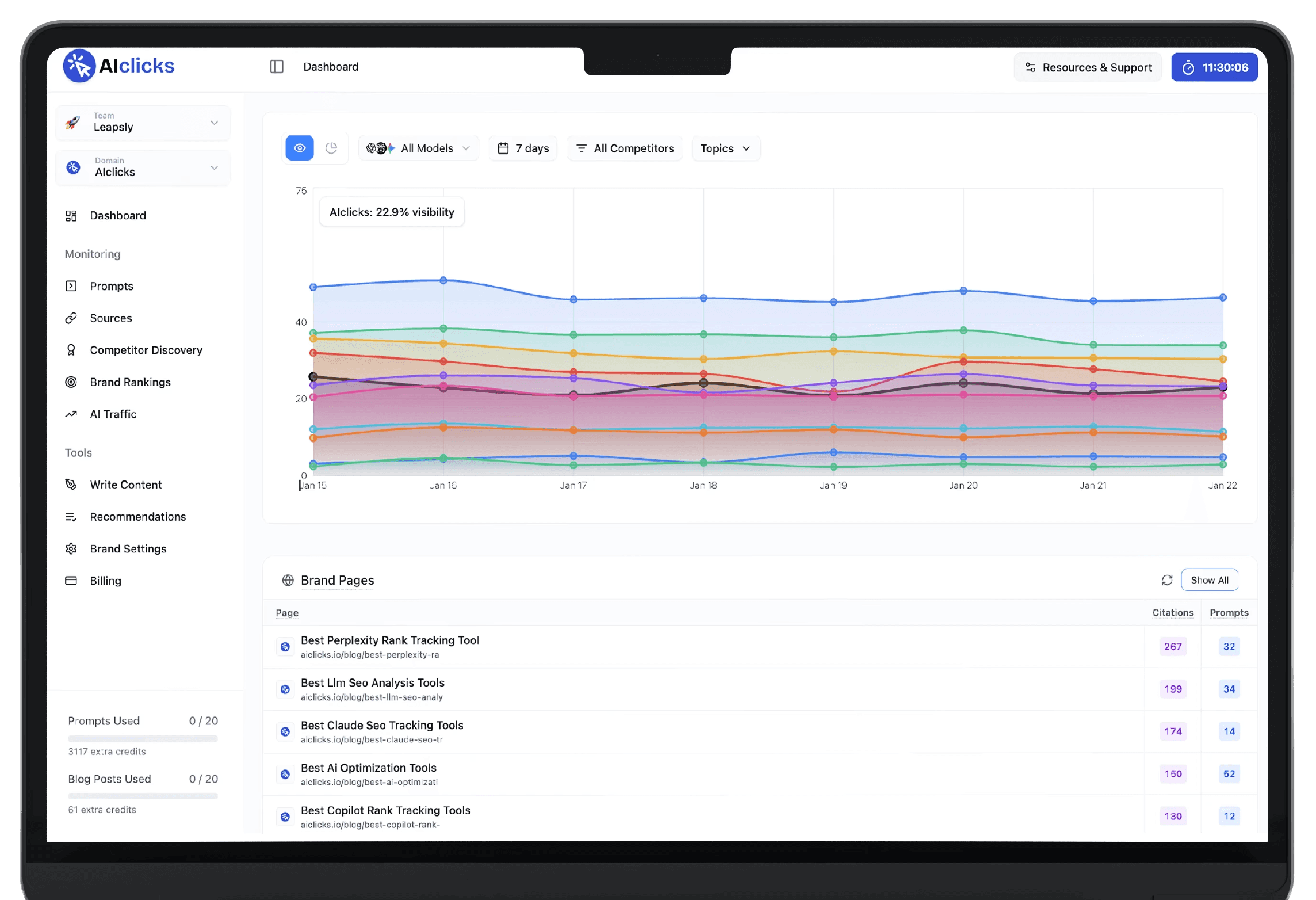
You get access to a custom AI visibility dashboard, weekly progress updates, and continuous optimization cycles. We monitor ranking shifts, citation changes, competitors, and new AI opportunities.
03
Optimization, Tracking & Insights
You get access to a custom AI visibility dashboard, weekly progress updates, and continuous optimization cycles. We monitor ranking shifts, citation changes, competitors, and new AI opportunities.
Explore our blog
Explore our blog


FAQ
Are LSI keywords still important in 2026?
Google has moved past the original "Latent Semantic Indexing" model (John Mueller has said the exact term is a bit of a myth), but the underlying signal — covering a topic with semantically related concepts — is more important than ever. BERT and MUM explicitly rely on it, and AI-search engines cite pages that demonstrate real topical depth.
How many LSI keywords should I add to a page?
There's no fixed number. For a 1,000-word article, covering 10–20 semantic variants naturally is plenty. Prioritize the concepts humans would expect to see, and don't force terms that don't fit the narrative — that's stuffing, not semantic optimization.
What's the difference between LSI keywords and long-tail keywords?
Long-tail keywords are longer, more specific search queries (e.g. "best email marketing tool for ecommerce"). LSI keywords are semantically related concepts that flesh out a topic (e.g. "open rate," "drip campaign," "sender reputation" for email marketing). You want both: long-tails bring the searches, LSI gives the page topical depth.
Where should I place LSI keywords?
Distribute them naturally across H2s and H3s, within body paragraphs, in FAQ answers, and in image alt text where relevant. Avoid clumping them in a list at the end — that reads like stuffing. The goal is a paragraph-by-paragraph narrative that genuinely covers the concept.
Do LSI keywords help with AI search visibility (ChatGPT, Perplexity, Gemini)?
Yes — and arguably more than for classic SEO. LLMs rank context and coverage heavily when deciding what passages to cite. A page that covers every semantic angle of a topic is the one AI models quote. Pair the LSI output with our AI Citation Tracker to measure the payoff.
FAQ
Are LSI keywords still important in 2026?
Google has moved past the original "Latent Semantic Indexing" model (John Mueller has said the exact term is a bit of a myth), but the underlying signal — covering a topic with semantically related concepts — is more important than ever. BERT and MUM explicitly rely on it, and AI-search engines cite pages that demonstrate real topical depth.
How many LSI keywords should I add to a page?
There's no fixed number. For a 1,000-word article, covering 10–20 semantic variants naturally is plenty. Prioritize the concepts humans would expect to see, and don't force terms that don't fit the narrative — that's stuffing, not semantic optimization.
What's the difference between LSI keywords and long-tail keywords?
Long-tail keywords are longer, more specific search queries (e.g. "best email marketing tool for ecommerce"). LSI keywords are semantically related concepts that flesh out a topic (e.g. "open rate," "drip campaign," "sender reputation" for email marketing). You want both: long-tails bring the searches, LSI gives the page topical depth.
Where should I place LSI keywords?
Distribute them naturally across H2s and H3s, within body paragraphs, in FAQ answers, and in image alt text where relevant. Avoid clumping them in a list at the end — that reads like stuffing. The goal is a paragraph-by-paragraph narrative that genuinely covers the concept.
Do LSI keywords help with AI search visibility (ChatGPT, Perplexity, Gemini)?
Yes — and arguably more than for classic SEO. LLMs rank context and coverage heavily when deciding what passages to cite. A page that covers every semantic angle of a topic is the one AI models quote. Pair the LSI output with our AI Citation Tracker to measure the payoff.
Be the #1 Response in AI
Reach millions of consumers who are using AI to discover new products and brands
Be the #1 Response in AI
Reach millions of consumers who are using AI to discover new products and brands
Be the #1 Response in AI
Reach millions of consumers who are using AI to discover new products and brands