
" width="14px"><path d="M 13.864 5.629 L 13.3 5.629 L 13.3 5.6 L 7 5.6 L 7 8.4 L 10.956 8.4 C 10.379 10.03 8.828 11.2 7 11.2 C 4.681 11.2 2.8 9.319 2.8 7 C 2.8 4.681 4.681 2.8 7 2.8 C 8.071 2.8 9.045 3.204 9.786 3.864 L 11.766 1.884 C 10.516 0.719 8.844 0 7 0 C 3.134 0 0 3.134 0 7 C 0 10.866 3.134 14 7 14 C 10.866 14 14 10.866 14 7 C 14 6.531 13.952 6.073 13.864 5.629 Z" fill="rgb(255, 193, 7)" height="14px" id="H_YjfTNpn" width="14px"/><path d="M 0 3.742 L 2.3 5.429 C 2.922 3.888 4.429 2.8 6.193 2.8 C 7.264 2.8 8.238 3.204 8.979 3.864 L 10.959 1.884 C 9.709 0.719 8.037 0 6.193 0 C 3.504 0 1.172 1.518 0 3.742 Z" fill="rgb(255, 61, 0)" height="5.428500000000002px" id="PlkthQDhg" transform="translate(0.875 0)" width="10.959199999999996px"/><path d="M 6.232 5.581 C 8.04 5.581 9.683 4.889 10.925 3.764 L 8.758 1.931 C 8.032 2.483 7.144 2.782 6.232 2.781 C 4.411 2.781 2.865 1.62 2.283 0 L 0 1.759 C 1.159 4.026 3.511 5.581 6.232 5.581 Z" fill="rgb(76, 175, 80)" height="5.581099999999999px" id="WlnJ5gngE" transform="translate(0.7 8.4)" width="10.924899999999994px"/><path d="M 6.864 0.029 L 6.3 0.029 L 6.3 0 L 0 0 L 0 2.8 L 3.956 2.8 C 3.68 3.576 3.183 4.254 2.526 4.75 L 2.527 4.749 L 4.693 6.582 C 4.54 6.722 7 4.9 7 1.4 C 7 0.931 6.952 0.473 6.864 0.029 Z" fill="rgb(25, 118, 210)" height="6.589883930775992px" id="x_rSW275p" transform="translate(7 5.6)" width="7px"/></g></svg>)


Reviewed by:
Rokas Stankevicius

Founder @aiclicks.io
Last updated:
Expert Verified

Key Takeaways
SEO in 2026 covers two channels: Google search and AI search. Small businesses that only track one are operating with half the picture, and the half they are missing is the one growing fastest.
The tools built for enterprise SEO teams (the ones with 55+ features, $250/mo minimum commitments, and mandatory demo calls) are not the right starting point for a small business still figuring out whether AI search is generating any real traffic.
The six tools on this list start at $29/mo and focus specifically on the AI visibility side of modern SEO: where your brand appears when buyers ask ChatGPT, Perplexity, Gemini, or Google AI Overviews a question about your category.
AIclicks, Otterly AI, LLMrefs, Peec AI, Writesonic, and Rankscale have different strengths. The right one depends on how you discovered the gap, what you need to do about it, and how much you want to spend before you have proof the channel works.
Every price in this article was verified from official product pages in July 2026.
Small business SEO used to mean one thing: rank on Google. Build backlinks, optimize your pages, track your keyword positions, repeat. That playbook still works. The problem is that buyers are increasingly starting their research somewhere else.
When someone asks ChatGPT which accountant to hire in their city, or asks Perplexity which project management tool is best for a small team, or asks Google AI Overviews to recommend a local plumber, the results they get are not determined by your keyword rankings. They are determined by which brands AI engines have learned to trust, cite, and recommend. A small business with strong Google rankings but no AI visibility is invisible to a growing share of its potential customers.
The tools most people think of as SEO tools do not track this. They were built for traditional search. The tools that do track AI visibility were mostly built for enterprise teams with dedicated budgets, which creates a real gap for small businesses that want to understand and improve their position in AI search without committing to a $300/mo platform before they know if it matters for their category.
The six tools on this list are built for that. Affordable, accessible, and focused specifically on AI search visibility as the part of modern SEO that most small business tools are missing.
What to Look for as a Small Business
Access to AI search data before a budget commitment. Traditional SEO tools have made it easy for small businesses to check their Google rankings for free, or at least cheaply. AI visibility platforms have been slower to follow. Too many still require a demo call before you see pricing, or a $200+ monthly commitment before you see your own data. Every tool on this list shows you where you stand before asking for a serious financial commitment.
A clear next step, not just a score. Knowing your brand has a 12% share of voice in your category across ChatGPT and Perplexity is a data point. Knowing which specific content to create, which publications to pitch, and which communities to engage to improve that number is an action plan. Some tools on this list stop at the data. Some produce the action plan. The difference shows up at the end of your first session.
Pricing that fits a single-brand, small-team operation. Most AI visibility platforms are priced and architected for agencies managing multiple clients. Unlimited client slots, white-label dashboards, multi-seat structures… These add costs that a small business operating one website for one brand has no use for. The tools that fit small businesses best are the ones where the entry tier matches that reality.
The 6 Best AI Visibility Tools for Small Businesses in 2026
Tool | Best For | Starting Price | Standout Feature |
AIclicks | Businesses that want visibility data and a ranked action plan in one session | $59/mo | 10+ engines, Recommendations engine, real-UI querying |
Otterly AI | The most affordable entry point in the category with predictive content scoring | $29/mo | $29 Lite plan, predictive GEO scoring before you publish, free trial |
LLMrefs | Small businesses with an existing keyword list who want to extend it into AI visibility | €79/mo | Keyword-based methodology, 10+ engines, unlimited domains |
Peec AI | EU-based small businesses that need GDPR compliance alongside clean analytics | $95/mo | EU data residency, unlimited users, clean citation tracking |
Writesonic | Small businesses that need AI visibility tracking and content generation in one tool | $99/mo | Tracking plus AI article generation from the same dashboard |
Rankscale | Small businesses that want the widest engine coverage at a predictable credit cost | €99/mo | 17+ engines, credit-based pricing, Looker Studio on Pro |
1. AIclicks: Best for Small Businesses That Want a Clear Action Plan
About AIclicks
For most small businesses, the AI visibility problem is not finding the data. It is figuring out what to do with it. AIclicks is built for that.
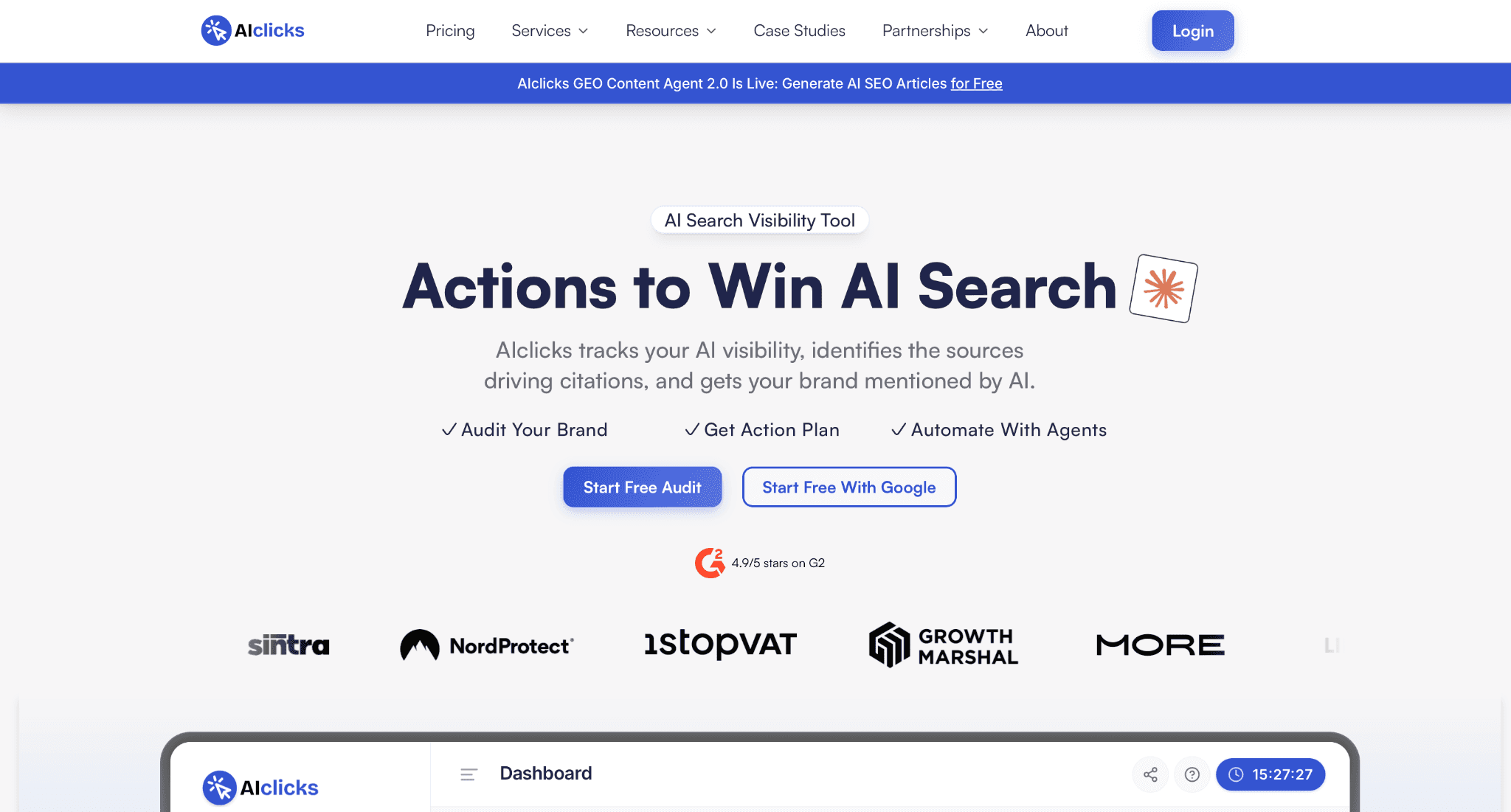
Every session ends with a ranked list of specific actions: which content to create, which sources to earn mentions on, which communities to show up in. Each action is scored by expected impact so the next step is always clear rather than directional. That output matters for small businesses because there is rarely a dedicated strategist translating data into a weekly work plan. The Recommendations engine does that work automatically. Ten-plus AI engines are tracked through their real user interfaces rather than APIs, because what a buyer actually sees in ChatGPT and what an API returns are frequently different answers. The Competitors tab shows exactly which sources are powering the brands showing up instead of you. The Sources tab converts your category's citation landscape into a concrete target list for content and outreach.
Key features:
10+ AI platforms tracked through real user interfaces: ChatGPT, Perplexity, Gemini, Google AI Overviews, AI Mode, Claude, Grok, DeepSeek, Meta AI, and Microsoft Copilot.
Real-UI querying captures what actual users see, not API approximations.
Actions engine converting every visibility finding into a ranked, scored action list.
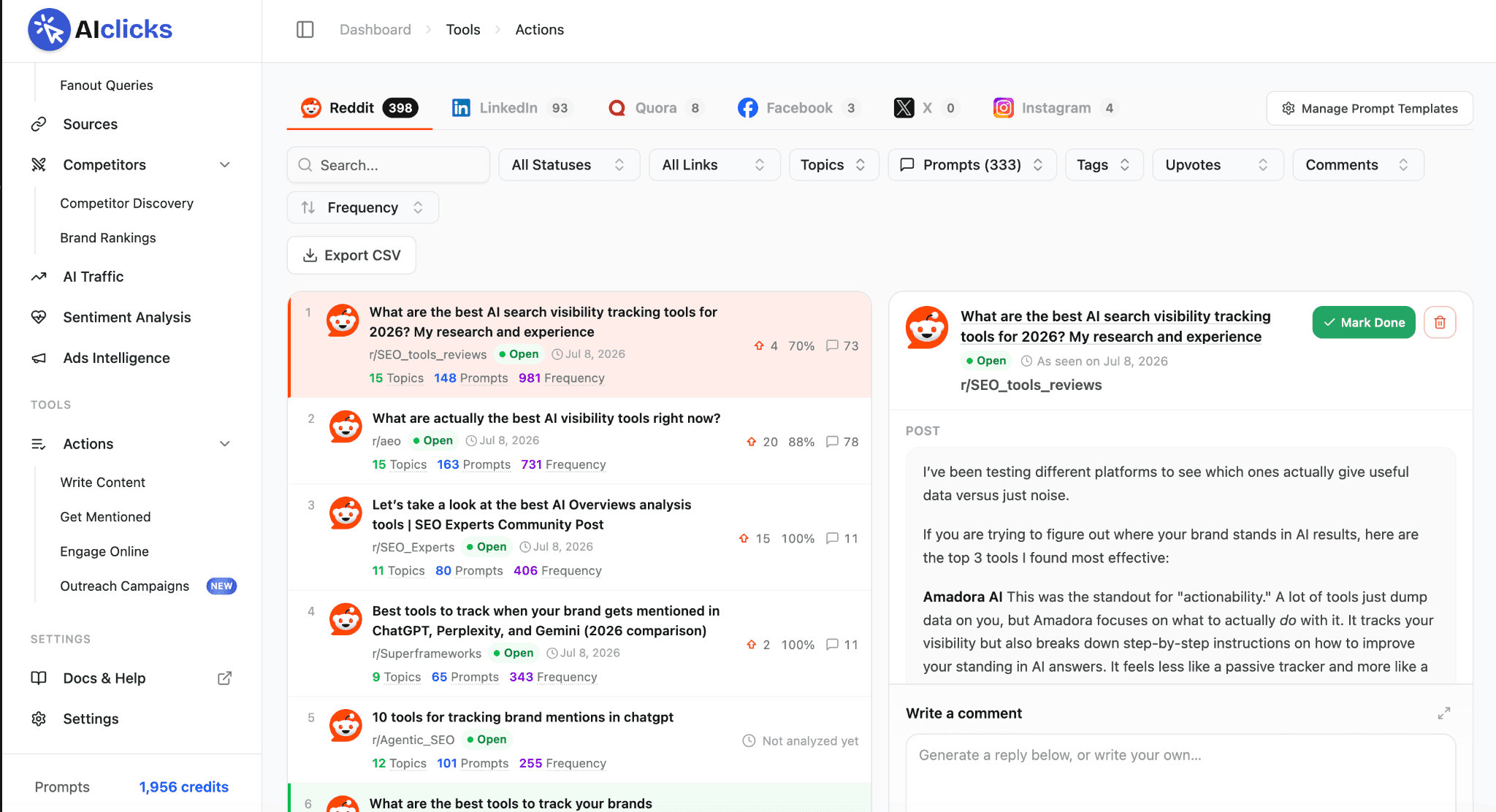
Competitors tab tracing which specific sources power competitors' AI visibility.
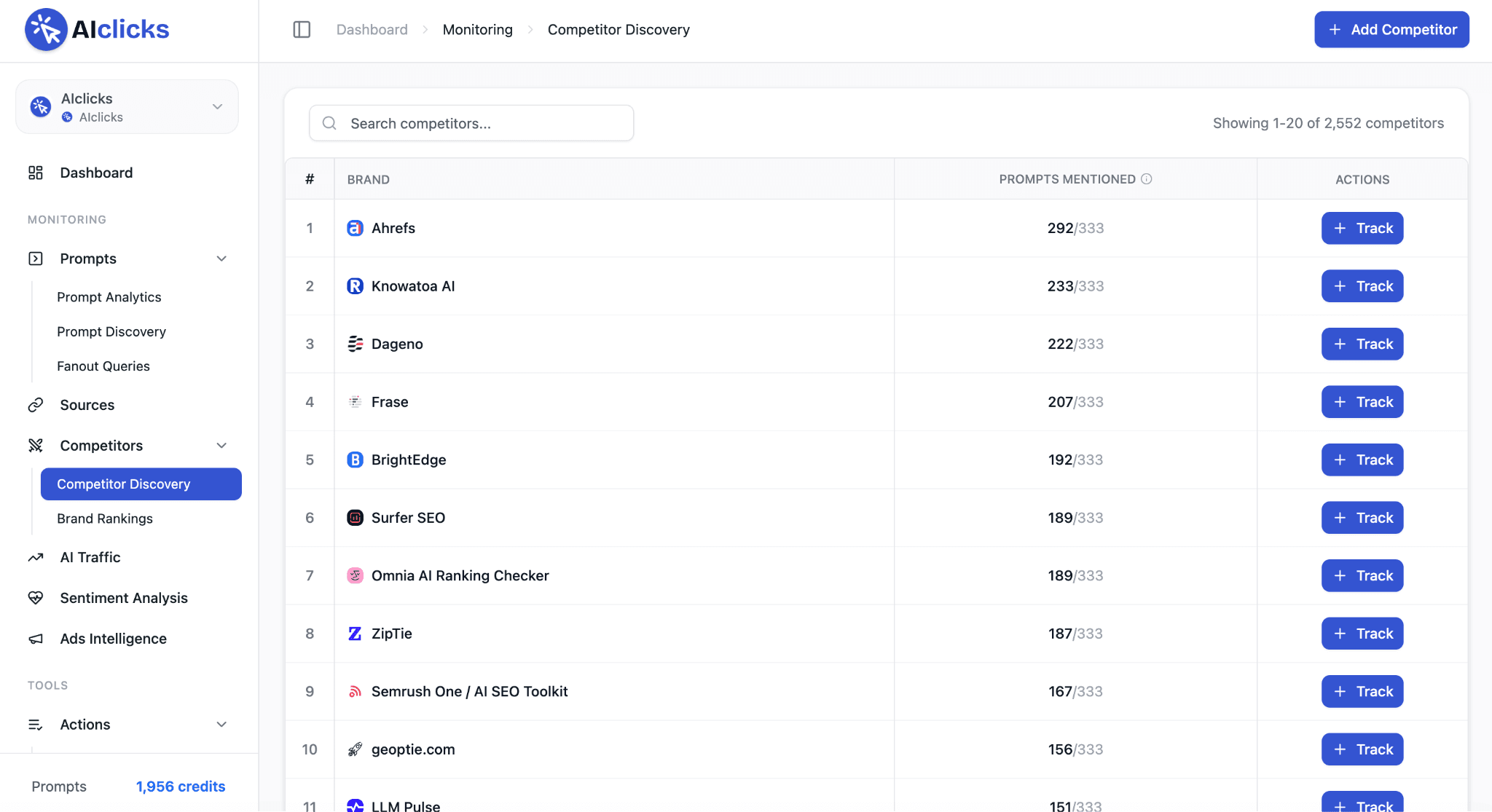
Sources analysis showing exactly which domains feed AI answers in your category.
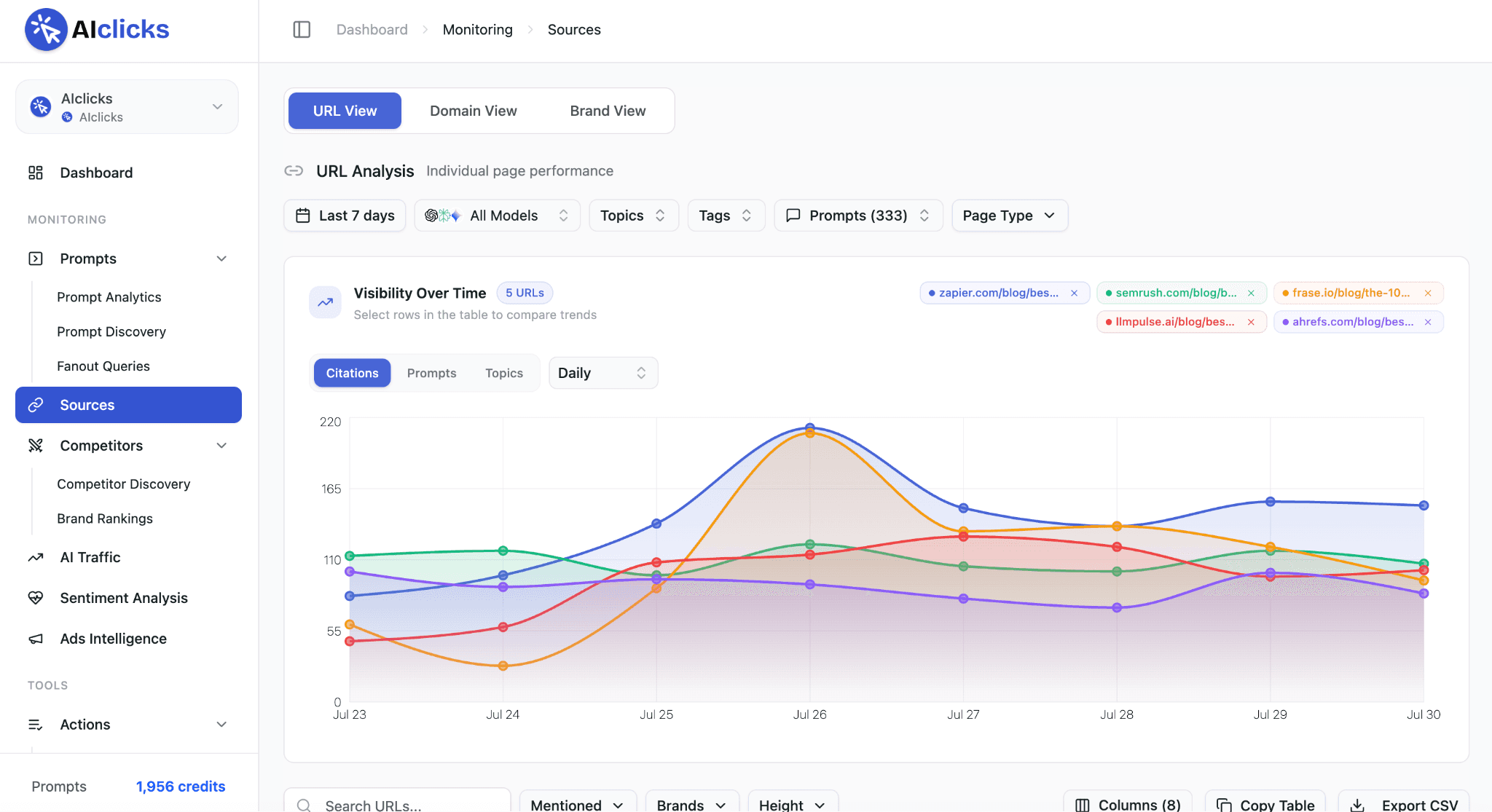
Google Analytics integration with daily refreshes segmented by model and country.
Writer agent for producing AI-optimized articles.
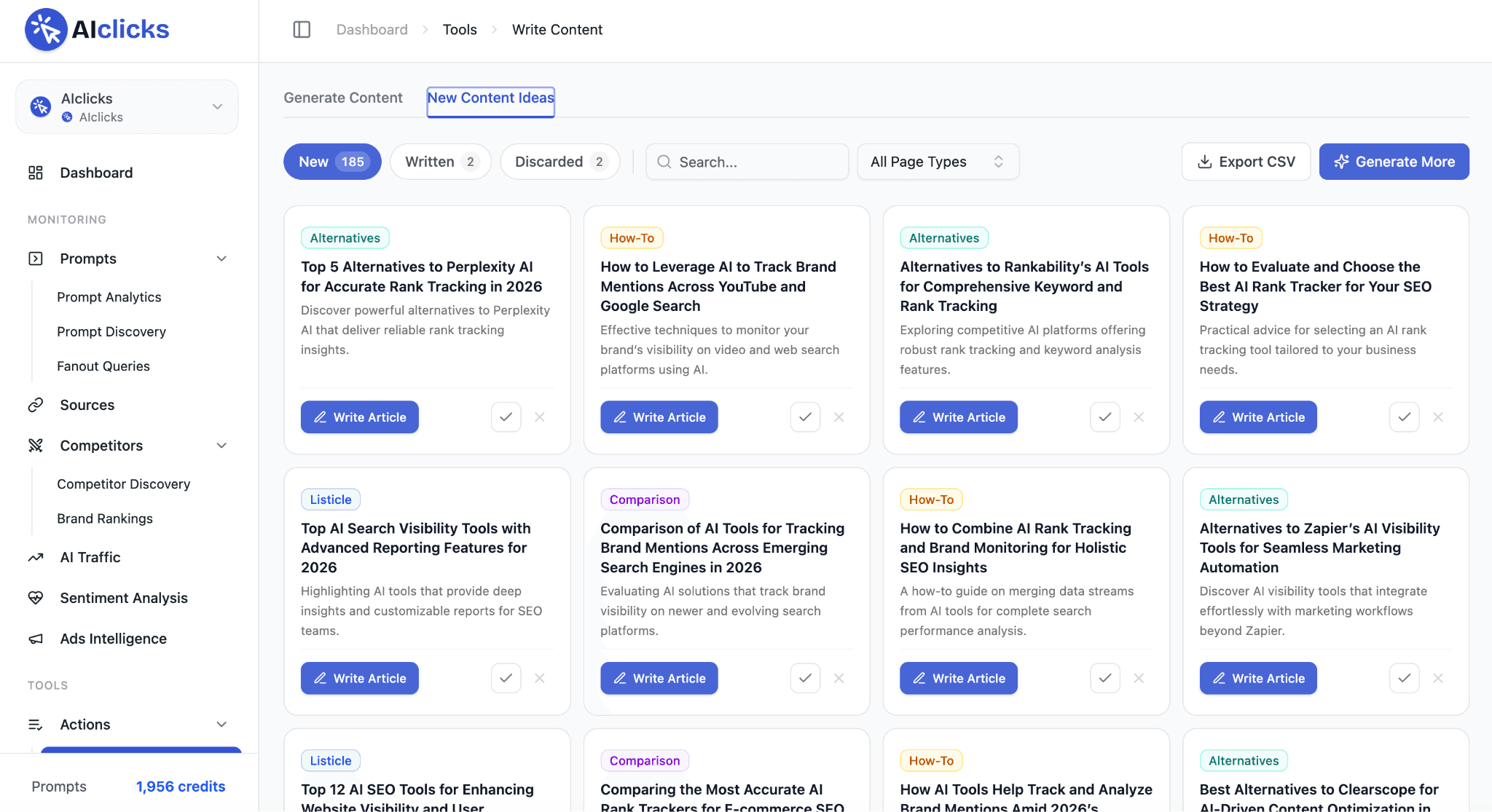
Pros and cons:
Pros:
Actions engine turns visibility data into a specific weekly work plan without needing a strategist to interpret it
3-day free trial on all plans with real data from your actual category before you spend anything
Covers 10+ engines including Claude, Grok, and DeepSeek that many entry-tier plans on this list exclude
Cons:
Predefined plan tiers rather than credit-based flexibility. Small businesses with very low or variable prompt volumes may find themselves between plans.
Three days is a short trial for a platform whose value compounds over time. The team extends it on request.
G2 rating: 4.9/5
Pricing: Starter $59/mo (30 prompts, 1 website, 3 AI platforms) | Pro $189/mo (150 prompts, unlimited websites, 4 platforms) | Business $499/mo | 3-day free trial on all plans
Verdict:
AIclicks earns the top spot for small businesses because it solves the problem that follows AI visibility tracking: what to actually do about what you find. The Actions engine, the Competitors tab, and the Sources tab together produce a work plan, not just a dashboard. At $59/mo with a three-day trial on real data, it is the most practical starting point on this list for a small business that wants to act on what it learns.
If you want to go deeper on the strategy behind ranking in AI search before you trial anything, this walkthrough covers the full playbook:
2. Otterly AI: Best for the Most Affordable Entry Point in the Category
About Otterly AI
At $29/mo, Otterly AI's Lite plan is the lowest-priced serious AI visibility tool on this list. It tracks 15 prompts daily across ChatGPT, Google AI Overviews, and Perplexity, with Google Gemini, Google AI Mode, and Claude available as paid add-ons on any plan.
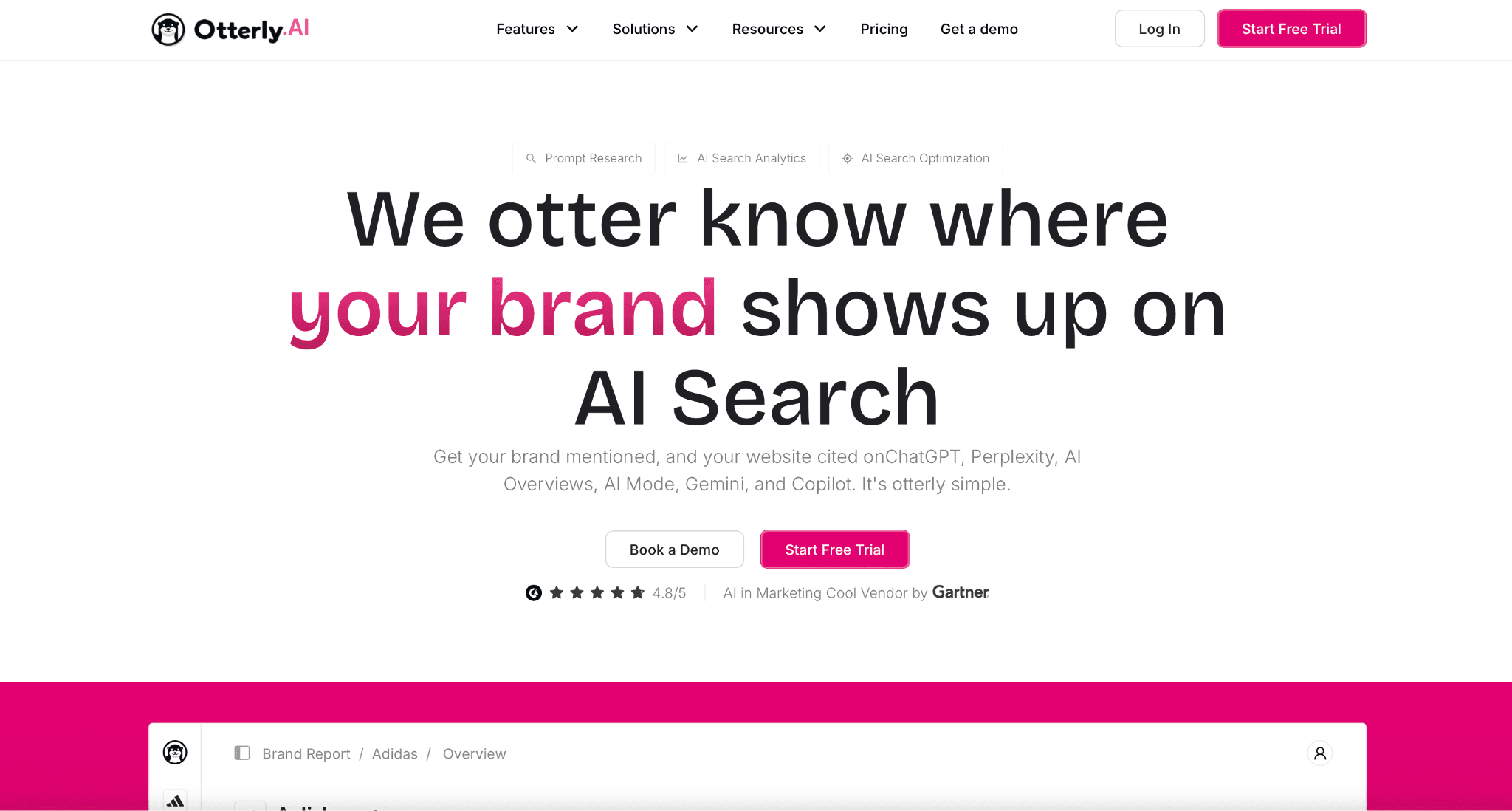
The platform is designed around one core premise: AI visibility tracking should not require a technical background or a long setup process. You add your brand, build a prompt list, and Otterly runs it on a schedule and delivers a report. The predictive GEO scoring feature is genuinely useful for small businesses publishing content regularly. It estimates the likelihood that a page will be cited by AI engines before you publish, and produces a brief for what needs fixing. That pre-publish audit saves the effort of troubleshooting after the fact.
Key features:
ChatGPT, Google AI Overviews, and Perplexity tracked on all plans. Gemini, Google AI Mode, and Claude available as paid add-ons.
Predictive GEO scoring estimating pre-publish AI citation likelihood with briefs for what to fix.
Recommendations feature producing prioritized action guidance from visibility data.
Automated prompt library running on a schedule and delivering reports rather than requiring dashboard checks.
14-day free trial, no credit card required.
Pros and cons:
Pros:
$29/mo Lite plan is the most accessible entry point on this list, with a 14-day free trial and no credit card required
Predictive GEO scoring before publishing is a workflow advantage most tools only offer on premium tiers
Automated reporting means small businesses get results without remembering to check a dashboard
Cons:
Gemini, AI Mode, and Claude require paid add-ons on top of the base plan, so six-engine coverage costs more than the $29/mo headline suggests.
Standard plan at $189/mo for 100 prompts is a significant jump from Lite. There is no mid-tier between $29 and $189.

G2 rating: 4.7/5
Pricing: Lite $29/mo (15 prompts, ChatGPT + AI Overviews + Perplexity) | Standard $189/mo (100 prompts) | Premium $489/mo (400 prompts) | Enterprise custom | 14-day free trial, no credit card
Verdict:
Otterly AI is the right starting point for small businesses that want to test AI visibility tracking before committing to a real budget. At $29/mo with a 14-day trial, the financial barrier is genuinely low. The predictive GEO scoring adds practical value that goes beyond monitoring. The honest caveat: meaningful multi-engine coverage requires add-ons, and the jump from Lite to Standard is steep if your needs outgrow 15 prompts.
3. LLMrefs: Best for Small Businesses With an Existing Keyword List
About LLMrefs
Most AI visibility tools ask you to build a prompt list from scratch. LLMrefs starts from the keyword list you already have. It generates AI tracking prompts automatically from your existing SEO keywords, connecting two workflows that most small businesses are running separately.
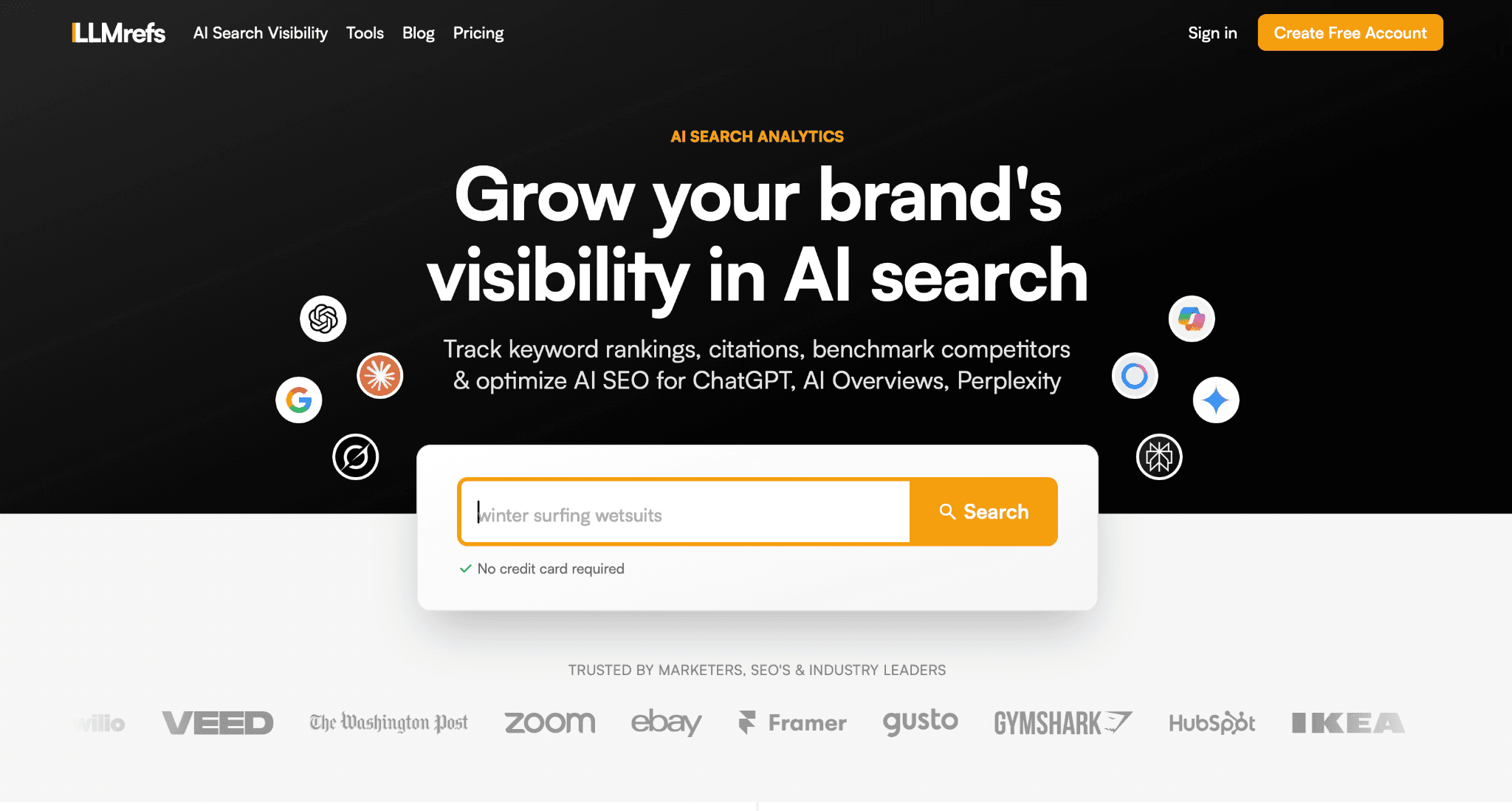
The platform tracks ChatGPT, Google AI Overviews, AI Mode, Gemini, Perplexity, Claude, Grok, Copilot, Meta AI, and DeepSeek, with new models added automatically. Share of voice and position metrics are weighted across every prompt variant for statistical significance. One subscription covers unlimited domains and unlimited team members, which means small businesses managing a main brand and a secondary site pay the same $79/mo.
Key features:
Keyword-based methodology automatically generates AI tracking prompts from your existing SEO keyword list.
10+ AI engines tracked including ChatGPT, Google AI Overviews, AI Mode, Gemini, Perplexity, Claude, Grok, Copilot, Meta AI, and DeepSeek.
Statistically weighted share of voice and position metrics across every prompt variant.
Unlimited domains and unlimited team members on one subscription.
Citation source analysis with CSV export and API access.
Pros and cons:
Pros:
Keyword-based methodology connects AI visibility directly to your existing SEO work without rebuilding tracking infrastructure from scratch
Unlimited domains and team members on one subscription simplifies pricing for small businesses with multiple sites
10+ engines covered with no add-ons or tier restrictions
Cons:
No content generation, no action recommendations, no content briefs. LLMrefs surfaces visibility data and stops there.
No public free plan. Paid plans from $79/mo. Verify current plan details directly at llmrefs.com before purchasing.
No independent G2 review presence makes it harder to assess support quality and long-term reliability versus more established platforms.
G2 rating:No G2 reviews.
Pricing: All-in-one plan is €79/mo
Verdict:
LLMrefs earns its place for small businesses that are already running SEO keyword tracking and want to extend that work into AI visibility without starting over. The methodology is the differentiator: prompts grounded in real keyword data rather than researcher assumptions. For small businesses that want an action layer alongside the tracking data, pairing LLMrefs with AIclicks covers both jobs.
4. Peec AI: Best for EU-Based Small Businesses Needing GDPR Compliance
About Peec AI
Peec AI raised over $29 million and crossed 2,500 marketing teams in under twelve months. It is Berlin-based, GDPR-first, and EU data residency comes standard on every paid plan.
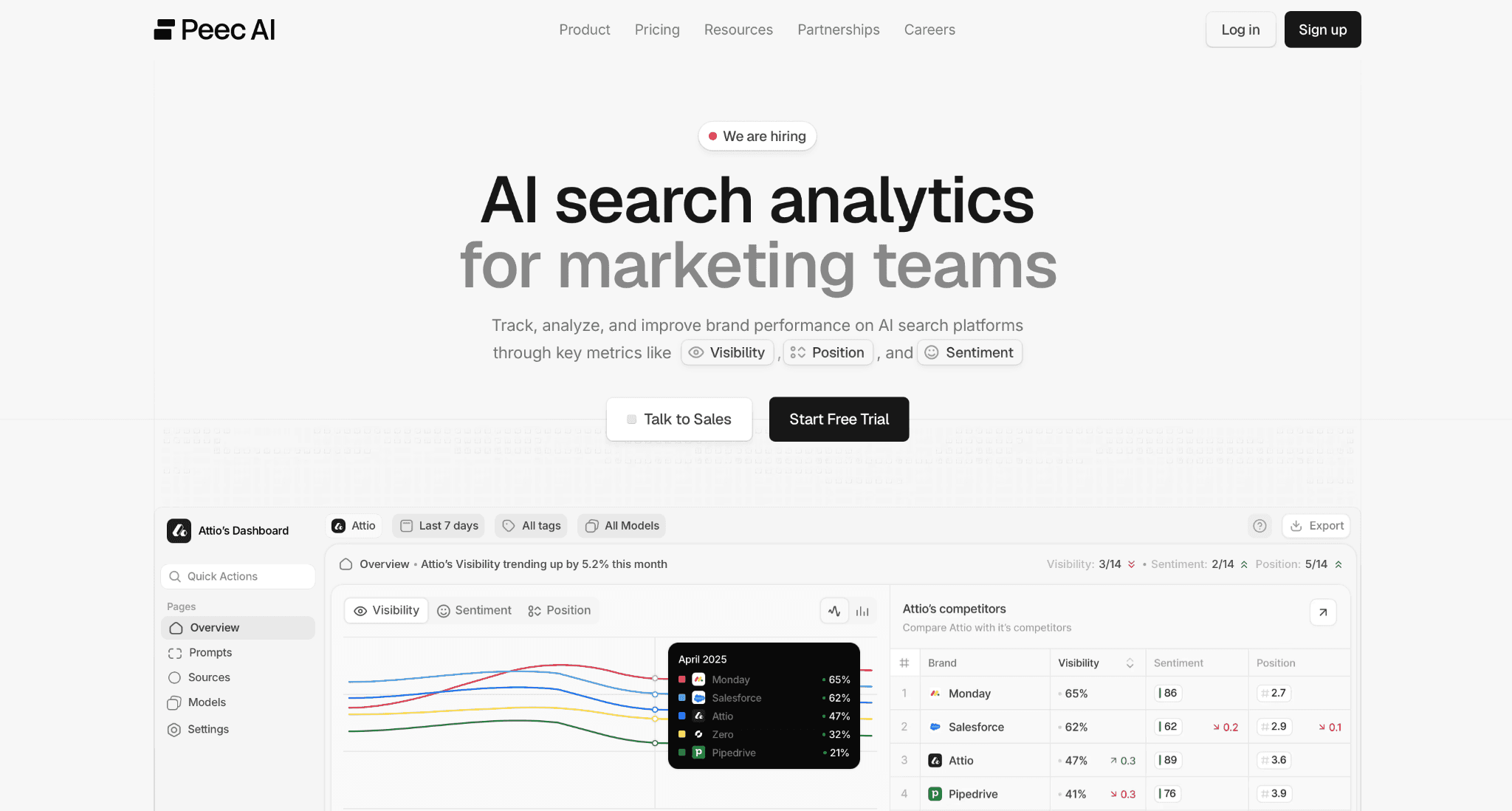
The platform tracks brand presence, citations, sentiment, and source data with unlimited users on every plan. Self-serve plans cover 3 engines from a pool of 6: ChatGPT, AI Mode, Google AI Overviews, Microsoft Copilot, Perplexity, and Gemini. For a small business tracking its category across the most commonly used AI surfaces, three engines from that pool covers most practical scenarios. The gap is execution: Peec shows you where you stand, and what to do about it stays with your team.
Key features:
Prompt tracking with choice of 3 engines from a pool of 6 on all self-serve plans.
Unlimited users on every plan.
Source and citation tracking organized by type: competitor, brand, citation, UGC, and editorial.
Sentiment analysis with alerts for negative shifts or inaccurate AI descriptions.
MCP integration on all paid plans at no extra cost.
Free trial available.
Pros and cons:
Pros:
GDPR-first with EU data residency is a genuine requirement for many European small businesses, not just a feature
4.9/5 on G2 with direct Slack access to the founding team on paid plans
Unlimited users means a small team of three or four people pays the same as a solo founder
Cons:
No content generation, no action recommendations. Peec surfaces the data; closing the gaps is your team's job.
Onboarding can feel difficult for small-business users who need more hands-on guidance.
3 engines from a pool of 6 on self-serve. Claude, DeepSeek, Qwen, and GPT-5 Search require Enterprise.

G2 rating: 4.9/5
Pricing: Starter $95/mo | Pro $245/mo | Advanced $495/mo | Enterprise custom pricing available
Verdict:
For EU-based small businesses where GDPR compliance is non-negotiable, Peec is one of the most practical options on this list. The EU data residency, clean interface, and responsive support address the specific concerns that make data sovereignty a real barrier elsewhere in the category. For small businesses outside Europe or those who primarily need an action layer alongside the tracking data, AIclicks covers both at a lower price.
5. Writesonic: Best for Small Businesses That Need Tracking and Content in One Tool
About Writesonic
Small businesses running lean often cannot justify separate tools for tracking AI visibility and creating content to address the gaps they find. Writesonic does both from the same dashboard, from $99/mo, without a demo call.
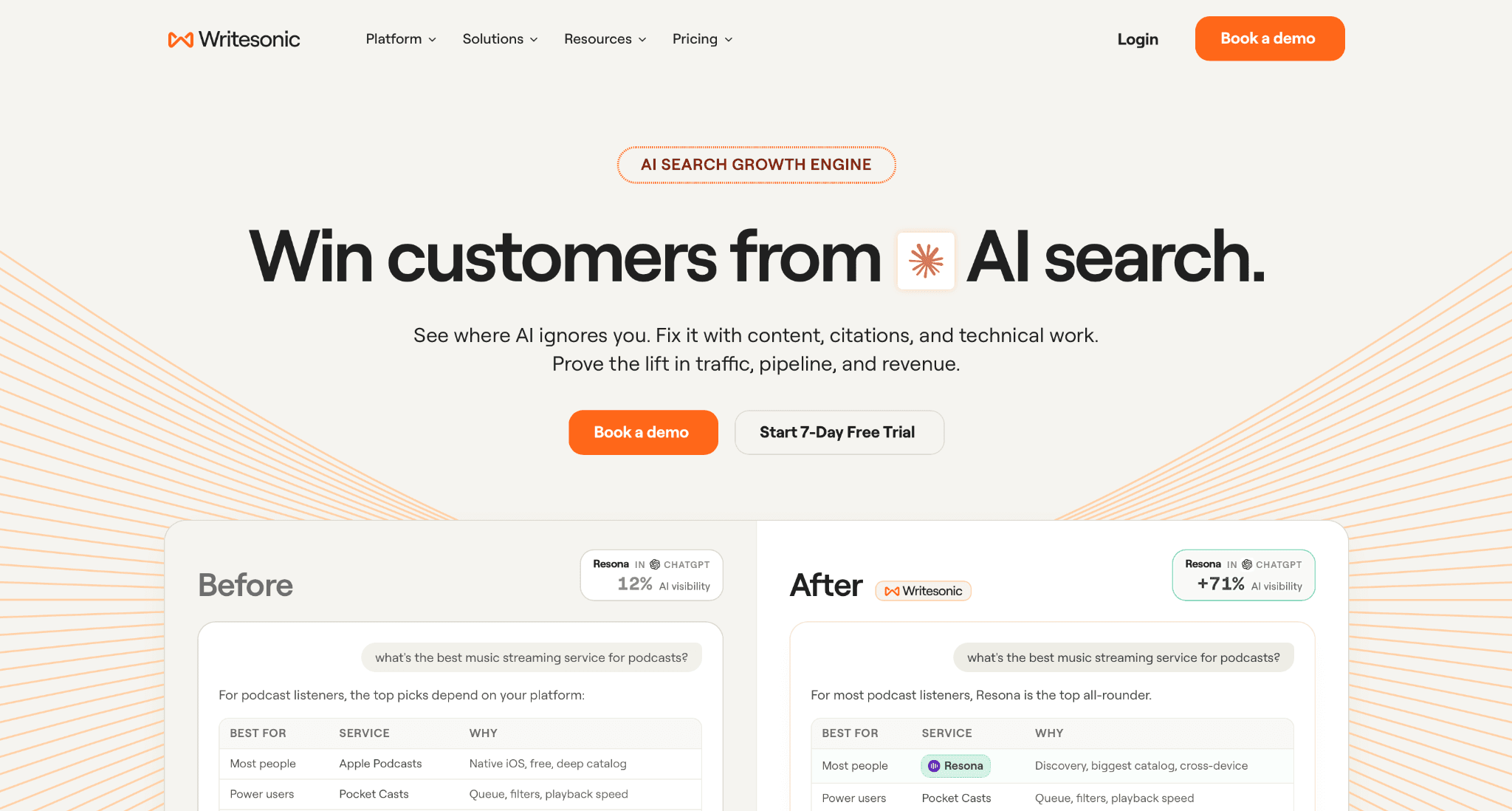
The Starter plan tracks ChatGPT, Gemini, and Google AI Overviews with 50 daily prompts and generates 15 AI articles per month. When a visibility gap surfaces, you can address it with content from the same platform rather than opening a separate writing tool. Site audit features flag where AI bots are encountering issues on your site. The connection between what you find and what you create to fix it is the core value for small businesses that cannot afford to run a research-to-production workflow across multiple subscriptions. The honest limitation: all self-serve plans cover exactly three engines. Perplexity, Claude, and everything beyond Gemini require Enterprise with custom pricing.
Key features:
ChatGPT, Gemini, and Google AI Overviews tracking on all self-serve plans with daily refresh.
15-50 AI articles per month depending on plan, connected to visibility data.
Site audit on all plans flagging AI bot issues and technical gaps.
Sentiment Analysis on Growth and above.
Limited Action Center on Growth (5 off-page + 5 on-page actions/mo).
All 10 platforms and full Action Center on Enterprise.
Pros and cons:
Pros:
Monitoring-to-content workflow from $99/mo with a free trial and no demo required
AI article generation from Starter removes the gap between finding a visibility problem and creating content to address it
Site audit for AI bot issues included from the entry plan
Cons:
Self-serve tracks ChatGPT, Gemini, and Google AI Overviews only. Perplexity, Claude, and all other engines require Enterprise.
Action Center not available on Starter or Basic. Growth gets limited trial access. Full Action Center is Enterprise.
Content quality is not very high, and needs careful review.

G2 rating: 4.7/5
Pricing: Starter $99/mo | Basic $249/mo | Growth $499/mo | Enterprise custom
Verdict:
Writesonic makes its strongest case for small businesses that publish content regularly and want the visibility tracking and the content production workflow in one place rather than two subscriptions. The three-engine self-serve limitation is real and worth knowing before you sign up expecting broader coverage.
6. Rankscale: Best for Small Businesses That Want the Widest Engine Coverage
About Rankscale
Seventeen-plus AI engines at €99/mo. No tier restrictions. Credit-based pricing that charges only for what you actually track. For small businesses whose buyers are spread across ChatGPT, Perplexity, Claude, Gemini, Grok, DeepSeek, and Mistral, Rankscale covers the full landscape without charging enterprise pricing to access it.

The credit system works straightforwardly: 0.25 credits per engine per prompt for most platforms. Claude costs 2+ credits per query, reflecting the API cost difference. Your monthly credit allocation renews each billing cycle, and top-up credits are available if you need more. Configurable monitoring from bi-hourly to bi-monthly means you control exactly how much your tracking costs rather than paying for refresh frequency you don't need. Citation analysis, sentiment tracking, competitor benchmarking, and Looker Studio integration are all on the Pro plan. The interface is built for technically comfortable users and rewards investment in learning how to use it.
Key features:
17+ AI engines with no tier restrictions: ChatGPT, Perplexity, Gemini, Claude, DeepSeek, Grok, Copilot, AI Mode, Mistral, and more.
Credit-based pricing at 0.25 credits per engine per prompt for most platforms.
Configurable monitoring schedules from bi-hourly to bi-monthly across 240+ countries.
Citation analysis, sentiment tracking, and competitor benchmarking included.
Looker Studio integration on Pro and above.
Unlimited seats on all plans.
Free trial with in-app credit top-ups.
Pros and cons:
Pros:
17+ engines at €99/mo is the widest coverage at the lowest price anywhere on this list
Credit-based model means you only pay for what you actually track, which suits small businesses with focused, consistent prompt sets
Active community Slack channel and responsive founder-led support, which matters when you are learning a new category without a dedicated team
Cons:
Interface is dense and built for technically comfortable users. Small businesses expecting a clean, simple setup will have a longer ramp than with Otterly or AIclicks.
Credit budgeting across different engines and frequencies has a learning curve. Most users recalibrate in the first month.
No built-in action layer or content recommendations. The platform ends at data and analysis.
G2 rating: Limited verified G2 reviews; check directly before purchasing.
Pricing: Pro €99/mo | Growth €385/mo | Enterprise €780/mo | Free trial with in-app credit top-ups
Verdict:
Rankscale is the right choice for small businesses that want to track the widest possible set of AI engines without paying enterprise pricing to do it. The credit system rewards lean, focused usage, exactly how small businesses operate. The trade-off is a steeper learning curve and no built-in action guidance. For small businesses that want the data and already have the expertise to act on it, the value per euro is hard to beat.
How to Choose the Right AI Visibility Tool
Start with how you discovered the problem.
If a customer mentioned a competitor showing up in ChatGPT, you probably need to know what the landscape looks like across a handful of engines before you decide what to do. AIclicks and Otterly AI both get you there fastest. If you have an existing SEO keyword list and want to understand your AI visibility relative to those keywords, LLMrefs connects those two workflows directly.
Decide whether you need the tool to tell you what to do.
Otterly AI, LLMrefs, Peec AI, and Rankscale all surface visibility data accurately and stop there. AIclicks and Writesonic produce specific next steps from what they find. If you have an experienced SEO or content strategist who can translate data into a weekly plan, any tool on this list works. If you need the platform to do that translation, AIclicks is the clearest option.
Price the real cost at the engine coverage you actually need.
Otterly AI's $29/mo Lite plan covers ChatGPT, AI Overviews, and Perplexity. Adding Gemini and Claude as add-ons changes the monthly cost. Writesonic's $99/mo Starter covers three engines with no path to Perplexity or Claude without Enterprise. AIclicks' $59/mo Starter covers three platforms with the option to add more on higher tiers. Write down which AI engines your customers actually use, price that specific coverage across your shortlist, and make the decision from that number rather than the headline.
Why AIclicks Is the Best AI Visibility Tool for Small Businesses
Several tools on this list will show a small business where it stands in AI search. AIclicks does that and then produces a ranked list of what to do about it.
That distinction matters most for small businesses because the gap between "here is what the data shows" and "here is what I am doing this week" is where most AI visibility programs stall. The Actions engine closes that gap automatically. The Competitors tab tells you which sources are powering the brands appearing instead of you. The Sources tab turns your category's citation landscape into a target list.
At $59/mo with a three-day trial on real data, it is the most complete starting point on this list for a small business that needs to both understand and act on its AI visibility.
Frequently Asked Questions
1. Do small businesses need to track AI visibility in 2026?
If your customers use ChatGPT, Perplexity, or Google AI Overviews to research products or services in your category, then yes. You can check where your brand currently stands with the free GEO visibility checker before committing to any paid tool.
2. What is the cheapest AI visibility tool for small businesses?
Otterly AI starts at $29/mo for 15 prompts with a 14-day free trial and no credit card required. AIclicks starts at $59/mo with a 3-day trial and adds a Recommendations engine that turns data into a specific action plan. LLMrefs starts at $79/mo with 10+ engines and unlimited domains.
3. Which AI visibility tool is easiest to set up?
Otterly AI and AIclicks both have the lowest setup friction on this list. Otterly gets you tracking within minutes of signup with no technical configuration. AIclicks shows you your first visibility report and action plan in the same session. Rankscale is the most powerful but has the steepest learning curve.
4. Do these tools replace traditional SEO tools?
No. Traditional SEO tools track Google rankings, site health, and backlink profiles. AI visibility tools track how your brand appears in ChatGPT, Perplexity, Gemini, and other AI answer engines. The two channels operate in parallel and the tools serve different jobs.
5. Which tool is best for a small business in Europe?
Peec AI is the strongest option for EU-based small businesses due to its GDPR-first architecture and EU data residency as a standard feature. AIclicks and Otterly AI are also accessible options for European teams that do not have specific data residency requirements.
6. How do I know if AI visibility is driving any real traffic?
Connect GA4 AI referral tracking to segment traffic from ChatGPT, Perplexity, and other AI surfaces. AIclicks connects directly to GA4 on Pro plans and above to show AI visibility alongside traffic data in the same dashboard.



Any questions left?
Book a call here: