" width="14px"><path d="M 13.864 5.629 L 13.3 5.629 L 13.3 5.6 L 7 5.6 L 7 8.4 L 10.956 8.4 C 10.379 10.03 8.828 11.2 7 11.2 C 4.681 11.2 2.8 9.319 2.8 7 C 2.8 4.681 4.681 2.8 7 2.8 C 8.071 2.8 9.045 3.204 9.786 3.864 L 11.766 1.884 C 10.516 0.719 8.844 0 7 0 C 3.134 0 0 3.134 0 7 C 0 10.866 3.134 14 7 14 C 10.866 14 14 10.866 14 7 C 14 6.531 13.952 6.073 13.864 5.629 Z" fill="rgb(255, 193, 7)" height="14px" id="H_YjfTNpn" width="14px"/><path d="M 0 3.742 L 2.3 5.429 C 2.922 3.888 4.429 2.8 6.193 2.8 C 7.264 2.8 8.238 3.204 8.979 3.864 L 10.959 1.884 C 9.709 0.719 8.037 0 6.193 0 C 3.504 0 1.172 1.518 0 3.742 Z" fill="rgb(255, 61, 0)" height="5.428500000000002px" id="PlkthQDhg" transform="translate(0.875 0)" width="10.959199999999996px"/><path d="M 6.232 5.581 C 8.04 5.581 9.683 4.889 10.925 3.764 L 8.758 1.931 C 8.032 2.483 7.144 2.782 6.232 2.781 C 4.411 2.781 2.865 1.62 2.283 0 L 0 1.759 C 1.159 4.026 3.511 5.581 6.232 5.581 Z" fill="rgb(76, 175, 80)" height="5.581099999999999px" id="WlnJ5gngE" transform="translate(0.7 8.4)" width="10.924899999999994px"/><path d="M 6.864 0.029 L 6.3 0.029 L 6.3 0 L 0 0 L 0 2.8 L 3.956 2.8 C 3.68 3.576 3.183 4.254 2.526 4.75 L 2.527 4.749 L 4.693 6.582 C 4.54 6.722 7 4.9 7 1.4 C 7 0.931 6.952 0.473 6.864 0.029 Z" fill="rgb(25, 118, 210)" height="6.589883930775992px" id="x_rSW275p" transform="translate(7 5.6)" width="7px"/></g></svg>)


Reviewed by:
Matas Kibildis

Head of Growth @aiclicks.io
Last updated:
Expert Verified

Key Takeaways
Content writing for SEO in 2026 means two jobs that used to be one. Writing content that earns Google rankings. And writing content that earns citations in AI-generated answers. The same article that ranks well on Google can be completely absent from ChatGPT answers in the same category, and the two require different approaches.
The six tools on this list cover the full range: content optimization against Google SERP data (Surfer SEO, Semrush), AI-assisted content generation at scale (Jasper, Writesonic), content intelligence for building topical authority (MarketMuse), and content creation starting from AI search visibility data (AIclicks).
Some of these tools do overlapping jobs. Most SEO content teams run two or three in combination rather than one platform trying to do everything.
Writing content for SEO used to mean one thing: figure out what keywords people search for on Google and write the best article on that topic. Get the structure right, cover the topic comprehensively, earn some links, and the rankings follow. That playbook is not wrong. It still works.
What changed is that Google is no longer the only place buying decisions start. A growing share of product research, vendor comparison, and category exploration now happens inside ChatGPT, Perplexity, Gemini, and Google AI Overviews. Those surfaces do not return a list of ten articles for the reader to sort through. They write an answer and name a few sources. The content that earns those citations is not always the same content that earns the Google ranking, and writing for both surfaces in parallel is a newer problem the older content tools were not designed to solve.
The six tools on this list sit across both sides of that equation. Some are built to help you write content that ranks. Some help you generate content that AI engines cite. Some are starting to do both. The right combination depends on which problem your team is actually trying to solve.
What Makes a Content Writing Tool Worth Using for SEO
It should tell you what to write, not just how to write better. The most useful tools in this category do not just polish a draft you already have. They start from search data, AI answer data, or competitor analysis and tell you which topics to cover, which questions to answer, and which structural elements the content needs to compete. A grammar checker is not a content writing tool for SEO. A tool that analyzes the top-ranking pages for your target keyword and produces a brief your writer can actually use is.
It should fit into your production workflow. The content writing tools that get used are the ones that work where writers already work. Google Docs integrations, WordPress plugins, direct CMS publishing… The tools that require writers to copy and paste content between platforms create friction that compounds across a content calendar. The best tools on this list reduce that friction rather than add to it.
It should cover where buyers actually search. Most content optimization tools are calibrated to Google. They analyze Google SERPs, score against Google ranking signals, and track Google positions. In 2026, that is still the majority of search traffic. But it misses the growing share of buying decisions that happen in AI-generated answers, and a content strategy that optimizes only for Google is increasingly leaving visibility on the table.
The 6 Best Content Writing Tools for SEO in 2026
Tool | Best For | Starting Price | Standout Feature |
AIclicks | Teams that want content creation starting from AI search visibility data | $59/mo | Writer 2.0 generating AI-optimized articles from visibility findings with one-click CMS publishing |
Surfer SEO | Content teams wanting the most complete real-time content optimization against SERP data | $59/mo | Content Editor with live scoring, Topical Map, Content Audit, Surfy AI agent |
Writesonic | Teams wanting AI article generation connected to AI visibility monitoring in one platform | $99/mo | Visibility tracking to article generation without switching tools |
MarketMuse | Teams wanting content intelligence and topic modeling before the writing starts | Free / Demo required | Topic modeling across entire content inventory, personalized difficulty scoring |
Semrush | Teams that want real-time content scoring inside Google Docs or WordPress | $139.95/mo | SEO Writing Assistant with real-time scoring, ContentShake AI for unlimited articles |
Jasper | Enterprise marketing teams wanting brand-governed AI content at scale | $69/mo | Brand Voice, Jasper Grid for scaling production, Research and Optimization Agent |
1. AIclicks: Best for Content That Targets AI Search Citations
About AIclicks
Most content writing tools start from keyword research. AIclicks starts from a different question: what content does your brand need to earn AI citations in your category?
The platform tracks where your brand appears across 10+ AI engines. When you find a prompt your brand is absent from, or a topic where competitors keep getting cited instead of you, Writer 2.0 generates an AI-optimized article targeting that specific visibility gap directly from the data. You are not guessing at what to write, the tracking data tells you exactly which content your AI search presence is missing, and Writer 2.0 produces a draft from that signal. One-click CMS publishing connects to WordPress, Webflow, Shopify, and Framer, so the article moves from draft to live without manual export and formatting steps. For teams building content programs around AI search citation rather than keyword rankings alone, this is the tool that closes the loop between what you track and what you produce.
Key features:
Writer 2.0 generates AI-optimized articles from visibility data with one-click CMS publishing to WordPress, Webflow, Shopify, and Framer.
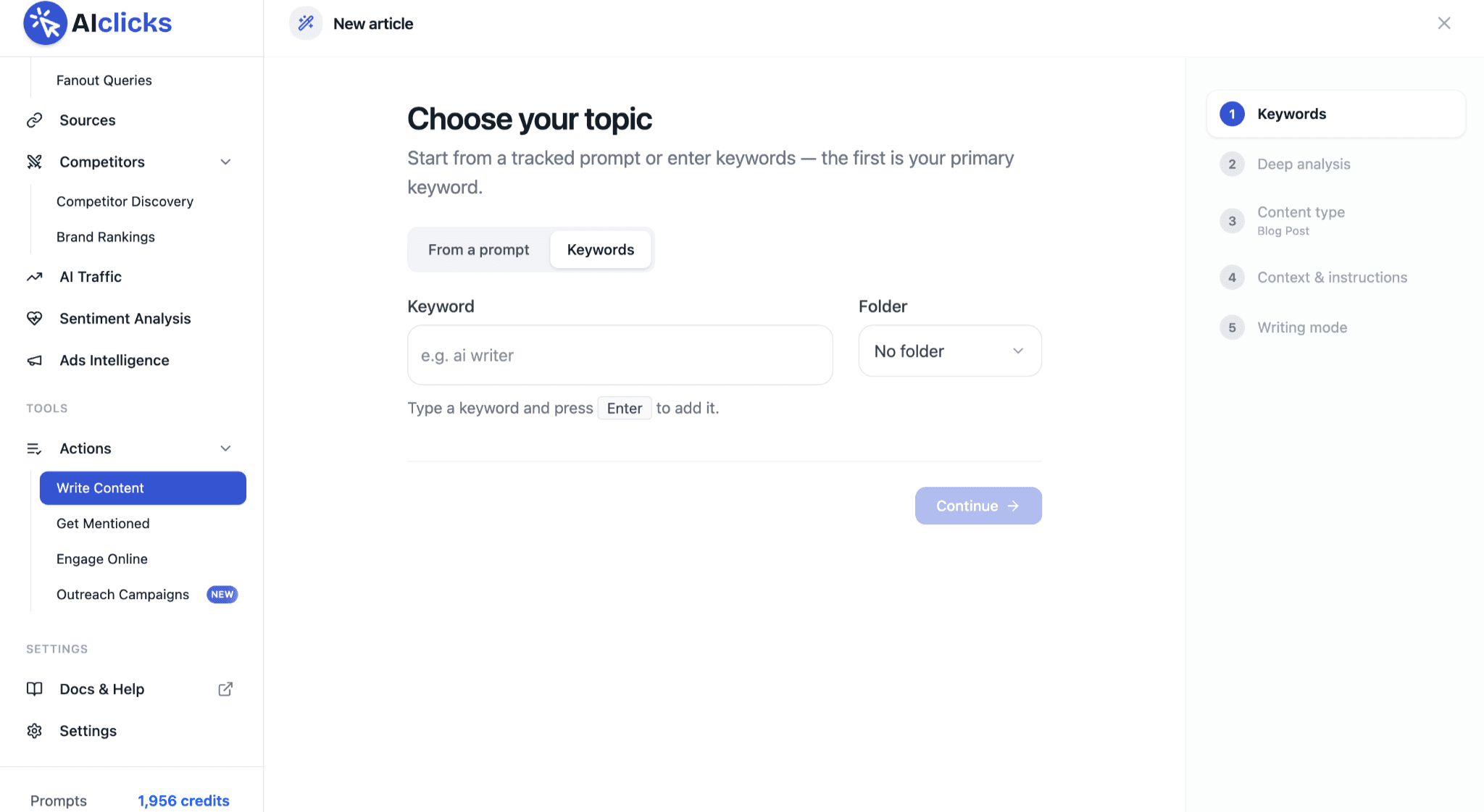
Content briefs connected to prompt-level tracking data showing which topics your brand needs coverage on.

10+ AI engines tracked to identify which prompts and topics to target.
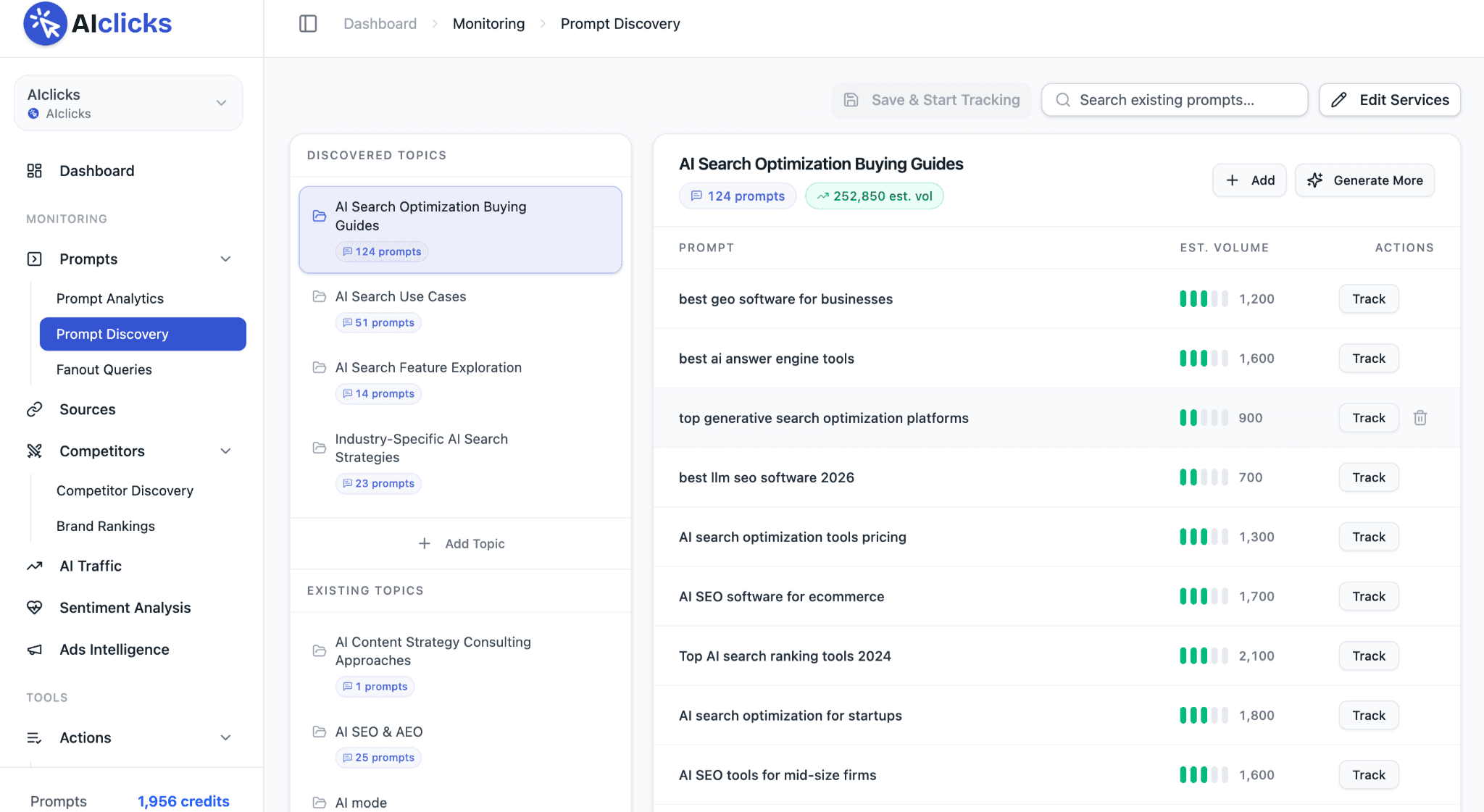
Acttions engine converting visibility findings into prioritized content tasks.
Google Analytics integration connecting published content to AI-referred traffic.
Pros and cons:
Pros:
Content creation starts from real AI search visibility data rather than keyword assumptions
One-click CMS publishing removes the manual handoff between draft and live content
Three-day free trial on all plans with real data from your category before spending anything
Cons:
AIclicks is built for AI-search-optimized content. Teams looking for SERP-scoring, readability analysis, and competitor content benchmarking in the writing interface need Surfer SEO or Semrush alongside it.
The three-day trial is short. The team extends it on request.
G2 rating: 4.9/5
Pricing: Starter $59/mo (30 prompts, 1 website, 3 AI platforms) | Pro $189/mo | Business $499/mo | 3-day free trial on all plans
Verdict:
If the gap in your content strategy is AI search citations and not just Google rankings, AIclicks is the only content tool on this list that starts from that specific problem. The content it generates is targeted at where your brand needs AI visibility, not just where the keyword volume is.
This breakdown covers the strategy behind building the kind of content AI engines actually cite:
2. Surfer SEO: Best Real-Time Content Optimization Against SERP Data
About Surfer SEO
Open a keyword, get a real-time score based on what is actually ranking in Google right now, and write to that score inside the Content Editor as you go. That is Surfer's core loop, and no other tool on this list does it better.
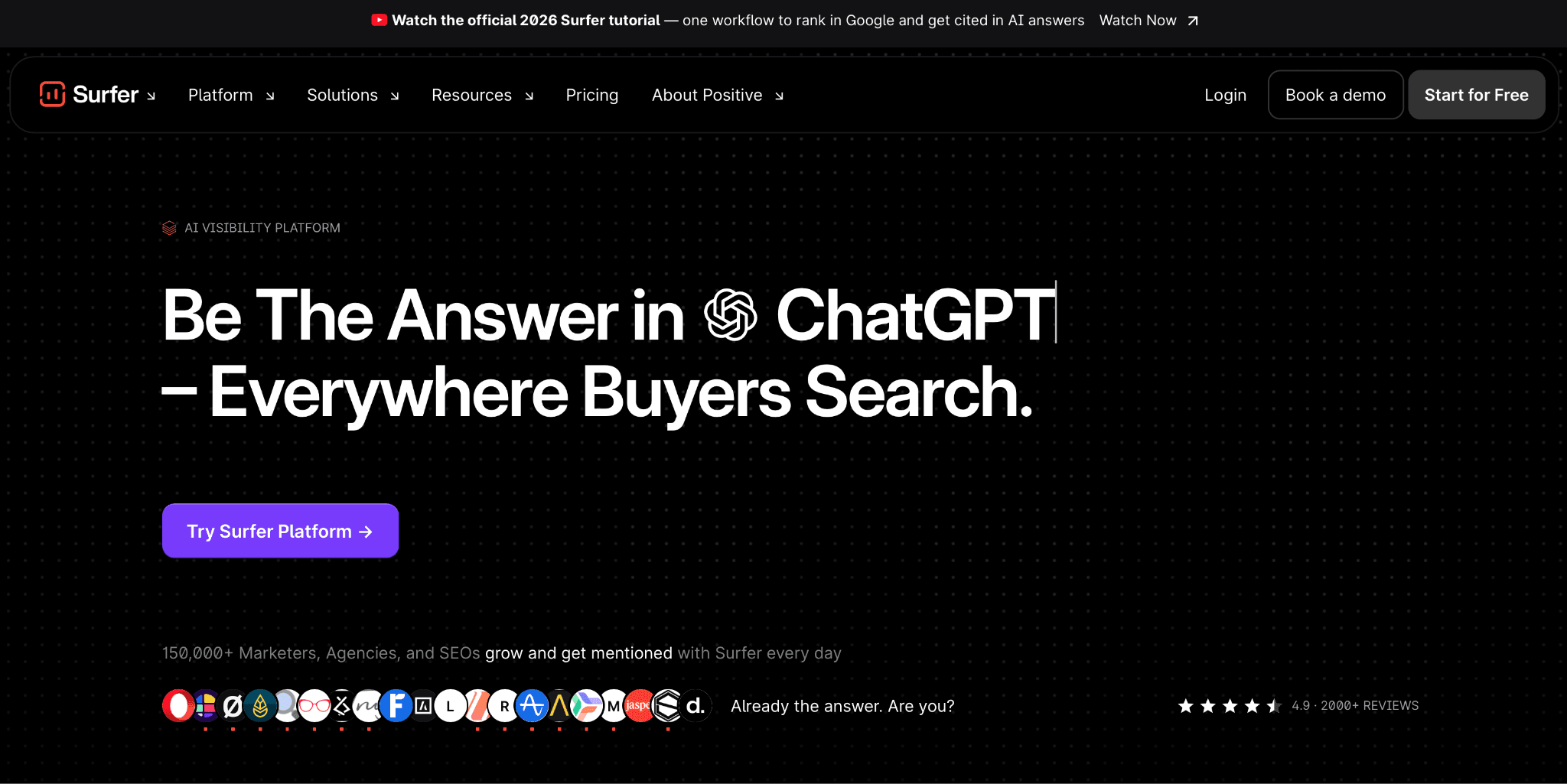
The Content Editor analyzes the top-ranking pages for your target keyword across 500+ web and AI signals (word count, NLP terms, entity coverage, heading structure) and updates your content score live as you write. Writers know what good looks like for that specific keyword at that specific moment in the SERP, not six months ago when the brief was written. The Topical Map generates a full content cluster from a seed topic, showing which articles you need to write and how they connect. Content Audit flags existing pages that have decayed and prioritizes which to refresh for the fastest traffic recovery. Surfy, the AI agent on all paid plans, answers strategy questions, generates outlines, and drafts sections directly inside the tool. Standard plan ($99/mo annual) adds ChatGPT tracking at a weekly refresh. Pro ($219/mo) adds five-engine AI tracking across ChatGPT, Perplexity, Google AI Mode, AI Overviews, and Gemini at daily refresh. 150,000+ customers across 159 countries.
Key features:
Content Editor with real-time content scoring against competitor SERP analysis, updating live as you write.
NLP term recommendations surfacing semantically relevant terms competitors cover that strengthen topical depth.
Topical Map generating a full content cluster from a seed topic for systematic authority building.
Content Audit analyzing your existing content inventory and prioritizing pages to refresh by traffic opportunity.
Surfy AI agent generating outlines, drafting content, and answering SEO strategy questions inside the platform.
AI Tracker: Standard tracks ChatGPT weekly; Pro tracks ChatGPT, Perplexity, Google AI Mode, AI Overviews, and Gemini daily.
Pros and cons:
Pros:
Content Editor is the most polished real-time SERP-based writing experience available, writers get a clear, live score to write toward rather than a static brief
Topical Map turns a seed keyword into a full content strategy with cluster architecture and interlinking guidance
Pro plan at $219/mo annual combines content optimization with five-engine AI tracking without a second subscription
Cons:
AI tracking on Standard (ChatGPT only, weekly) is limited for teams making AI search visibility a meaningful part of their content strategy. The practical tier for both jobs is Pro at $219/mo annual.
No CMS publishing integration. Content moves from Surfer to your CMS manually.
"The cost. It's very expensive to use, so I would love something a bit more affordable." Verified G2 reviewer. The Content Editor is strong enough to justify the price for high-volume content teams, but it is a meaningful investment for solo writers or small blogs.

G2 rating: 4.8/5
Pricing: Discovery $59/mo (content only, no AI tracking) | Standard $119/mo (ChatGPT weekly) | Pro $219/mo annual | Peace of Mind $359/mo | Enterprise $999/mo | All prices annual billing
Verdict:
For content teams whose primary job is ranking in Google, Surfer SEO is the most complete tool on this list for that work. The Content Editor closes the gap between "we wrote an article" and "we wrote an article calibrated to what's actually ranking." For teams that want both SERP optimization and AI search citation tracking in one platform, Pro at $219/mo is where that combination becomes meaningful.
3. Writesonic: Best for Monitoring-to-Article Workflow in One Platform
About Writesonic
Writesonic built its SEO product by connecting two things most teams run separately: knowing where you are absent from AI answers, and producing content to fix it. Both live in the same dashboard from $99/mo.

The Starter plan tracks ChatGPT, Gemini, and Google AI Overviews with 50 daily prompts and generates 15 AI articles per month. When a visibility finding surfaces, you move from data to draft inside the same tool rather than opening a separate writing platform. Site audit features flag where AI bots encounter technical issues on your site. The workflow connection is the actual differentiator here, not the quality of the tracking alone, or the quality of the writing alone, but the fact that those two steps happen inside one subscription without a handoff. All self-serve plans track exactly three engines. Perplexity, Claude, and anything beyond Gemini require Enterprise with custom pricing.
Key features:
ChatGPT, Gemini, and Google AI Overviews tracking with daily refresh, connected to article generation.
15 to 50 AI articles per month depending on plan, generated from visibility data in the same platform.
Site audit on all plans flagging AI bot crawl issues and technical gaps.
Sentiment Analysis on Growth and above.
Limited Action Center on Growth (5 off-page + 5 on-page actions per month).
All 10 platforms and full Action Center on Enterprise.
Pros and cons:
Pros:
Combined tracking and article generation from $99/mo removes the tool-switching step between finding a content opportunity and producing the draft
Site audit for AI bot issues is a genuinely useful technical layer that dedicated content tools don't include
Free trial with no credit card required
Cons:
Three engines on all self-serve plans. Perplexity and Claude are locked to Enterprise.
Action Center not available on Starter or Basic. Growth provides limited trial access only.
Article generation quality is the most commonly flagged limitation in G2 reviews. "Sometimes I just feel that these contents are just like ChatGPT only, but we pay extra every month for its premium plan without getting any additional features." Rohan T., Marketing Team, G2

G2 rating: 4.7/5
Pricing: Starter $99/mo (ChatGPT, Gemini, AI Overviews, 50 prompts, 15 articles) | Basic $249/mo | Growth $499/mo | Enterprise custom | Free trial, no credit card required
Verdict:
Writesonic earns its place for teams where the bottleneck is moving from AI visibility data to a published article without managing two separate tools. If the content generation depth or engine coverage becomes a constraint, AIclicks covers the visibility side more thoroughly and Jasper or Surfer cover content production at a higher quality ceiling.
4. MarketMuse: Best for Content Intelligence Before the Writing Starts
About MarketMuse
The difference between a piece of content that earns AI citations and one that doesn't is usually not the writing quality. It is whether the content covers a topic with enough depth and breadth that an AI engine treats the source as authoritative. MarketMuse was built to identify where that authority exists and where it doesn't.
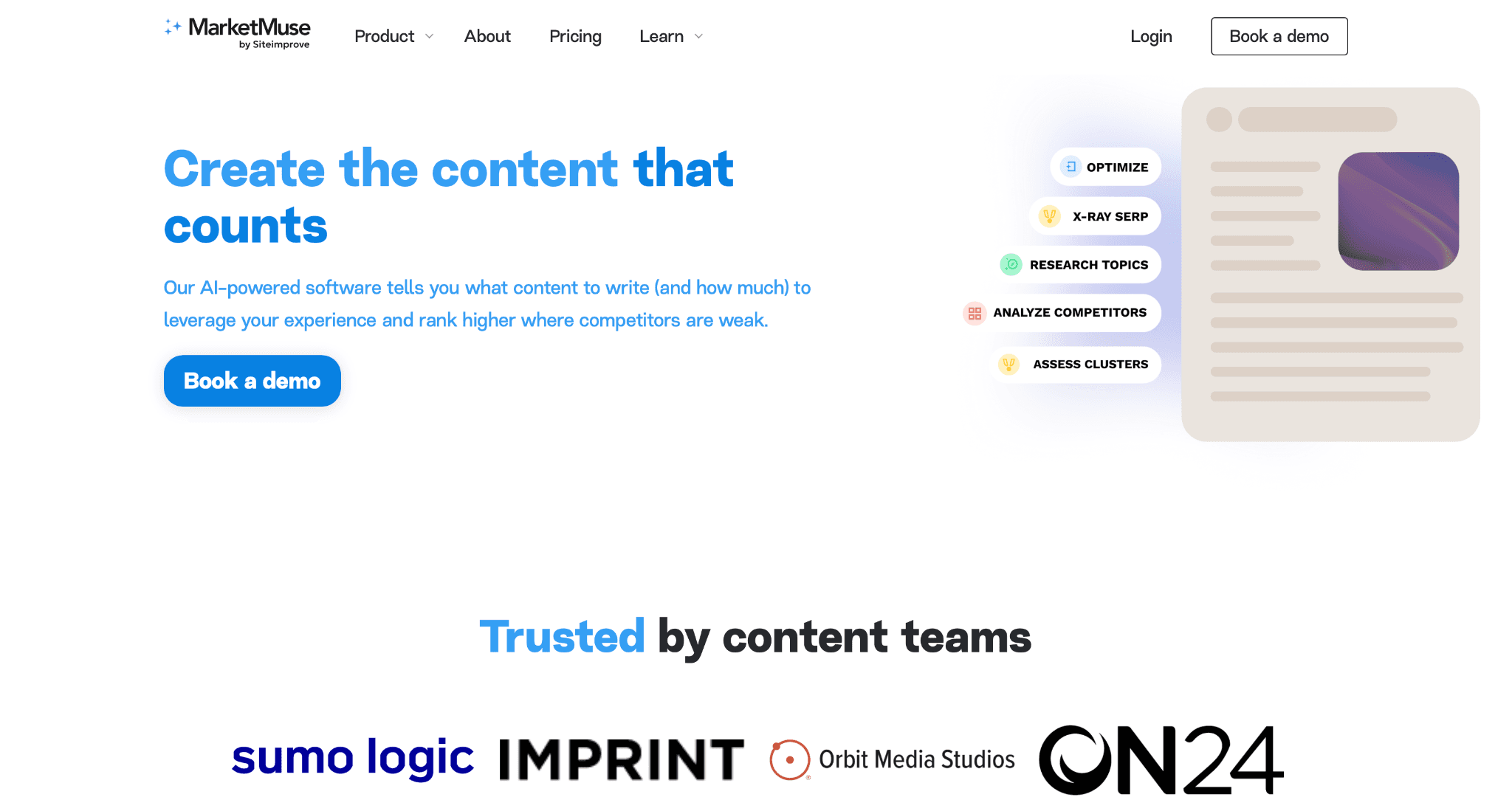
The platform analyzes your entire content inventory against the competitive landscape in your category. It shows which topics you cover well, which you cover thinly, and which you have no coverage of at all. Personalized difficulty scores account for the topical authority you have already built, a score of 40 for a well-established site and a score of 40 for a new site represent very different levels of actual difficulty. Content briefs produced from this analysis go deeper than most keyword research briefs: they map what comprehensive coverage of a topic looks like, including the questions, subtopics, and related concepts that distinguish a genuinely authoritative piece from one that covers the basics and stops. IBM, Deloitte, and MongoDB use it at enterprise content scale. Plans are Free (10 queries/month), Optimize, Research, and Strategy, with all paid tiers requiring a demo for pricing.
Key features:
Topic modeling analyzing your full content inventory against competitive benchmarks and category-level coverage standards.
Personalized difficulty scores reflecting your specific site's topical authority rather than a generic keyword difficulty number.
Content briefs mapping comprehensive topic coverage with questions, subtopics, entities, and structural guidance.
Inventory analysis identifying thin content, orphan pages, and consolidation opportunities across existing articles.
SERP X-Ray breaking down competitor pages by headings, internal links, word count, and entity coverage.
Content Optimizer scoring content against topical completeness in the editor.
Pros and cons:
Pros:
Topic modeling across the full content inventory surfaces systemic gaps that keyword research alone misses entirely
Personalized difficulty scoring makes prioritization decisions more reliable than industry-average metrics
Free plan with 10 queries per month allows genuine evaluation before any payment commitment
Cons:
All paid plans require a demo, no public pricing and no self-serve path to any paid tier.
Not a writing tool in the traditional sense. MarketMuse produces the intelligence that informs writing. The actual writing happens in Google Docs, WordPress, or another tool.
"If you're paying a monthly subscription for it, it is incredibly expensive. Worse, the amount of money you have to pay for the higher tiers is disproportionate to the value it provides." Verified G2 reviewer.

G2 rating: 4.6/5
Pricing: Free (10 queries/month) | Optimize, Research, Strategy: demo required for pricing
Verdict:
MarketMuse earns its place for teams who understand that topical authority is what earns AI citations and want a systematic way to identify exactly where their content inventory falls short of that standard. The investment is in the intelligence layer before the writing starts, not the writing tool itself.
5. Semrush: Best for Real-Time SEO Scoring Inside Google Docs or WordPress
About Semrush
Semrush's content tools live in Content Toolkit: AI Article Generator, Content Optimizer, Converter to SMM or Email, Topic Finder, and SEO Brief Generator, all built on Semrush's own SEO and AI search data. Semrush's own framing: "Create, optimize, and repurpose content that performs, across SEO, AI search, social, and even email."
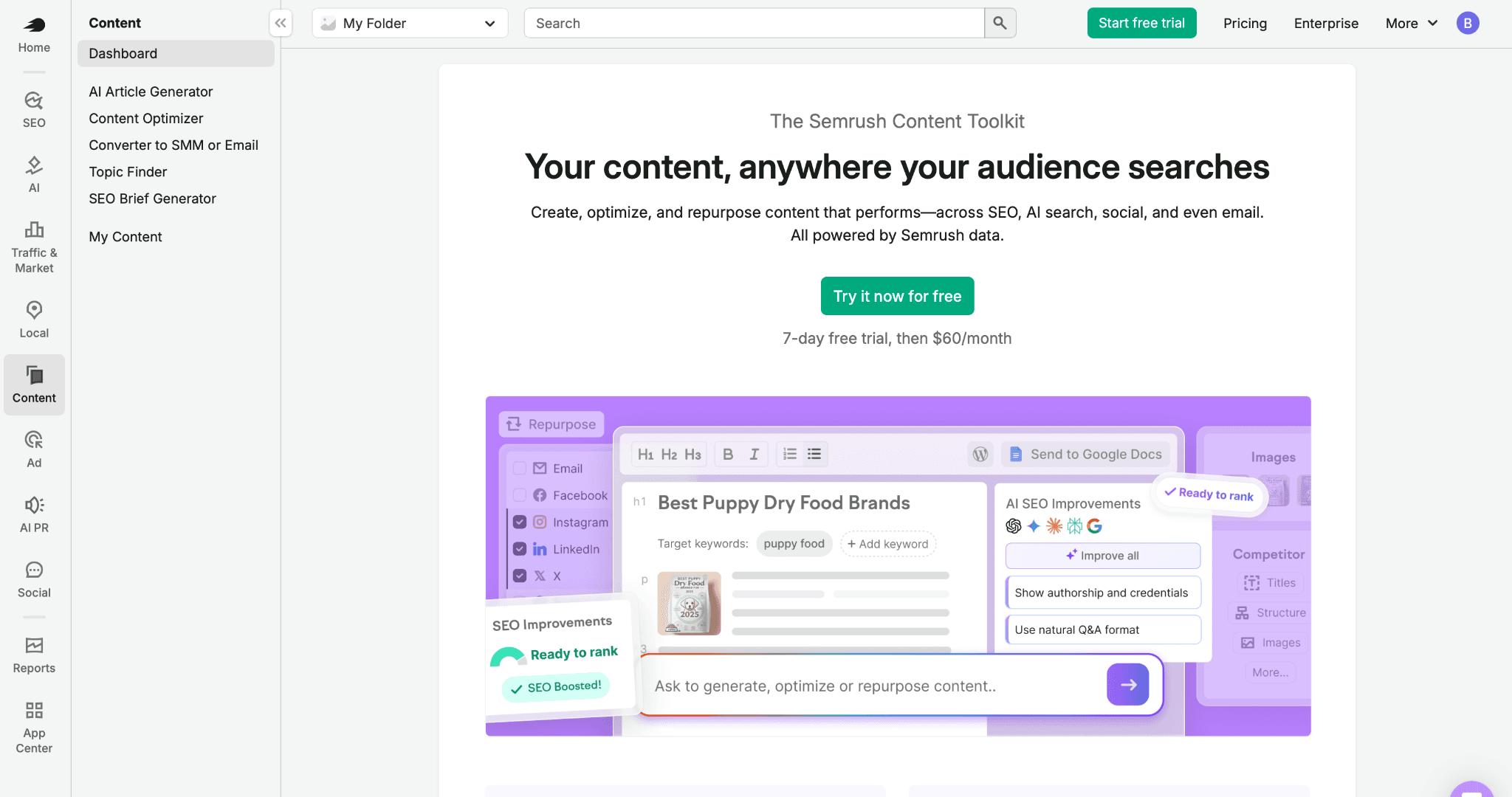
AI Article Generator writes the draft. Content Optimizer scores it against Google and AI search signals through an "AI SEO Improvements" panel that suggests specific fixes such as adding authorship and credentials or switching to a natural Q&A format. Converter to SMM or Email turns the finished piece into email, Facebook, Instagram, LinkedIn, and X versions. The editor publishes straight to WordPress and can send a draft to Google Docs. Content Toolkit runs as its own $60/month subscription with a 7-day free trial, separate from Semrush's core SEO Toolkit (Pro, Guru, Business) or Semrush One (Starter, Pro+, Advanced) plans.
Key features:
AI Article Generator producing full drafts from a keyword and audience brief.
Content Optimizer scoring drafts against Google and AI search signals, with specific fixes like authorship credentials and Q&A formatting.
Converter to SMM or Email repurposing a published article into email, Facebook, Instagram, LinkedIn, and X versions.
Topic Finder and SEO Brief Generator covering topic discovery and brief-building from competitor data.
Direct WordPress publishing and Send to Google Docs built into the article editor.
Pros and cons:
Pros:
Content Optimizer's suggestions are specific and actionable, authorship signals and Q&A formatting, rather than a generic score.
Converter to SMM or Email removes the manual step of reformatting one article into five other channels.
$60/month with a 7-day free trial is a clear, standalone price rather than a feature buried inside a bigger plan.
Cons:
CMS publishing in the editor is WordPress only, alongside a Send to Google Docs export. Teams on Webflow, Shopify, or Framer don't get the one-click publish across all four platforms that AIclicks offers.
The $60/month price shown in-app doesn't list an article cap, so confirm actual usage limits before committing a content calendar to it.
Content Toolkit builds articles from a keyword and audience brief, not from AI-citation-gap data, so it doesn't point you toward what to write next in your AI search coverage the way AIclicks' visibility tracking does.
G2 rating: 4.4/5
Pricing: Content Toolkit $60/month, 7-day free trial | Core Semrush plans: SEO Toolkit Pro $139.95/mo, Guru $249.95/mo, Business $499.95/mo, or Semrush One Starter $199/mo, Pro+ $299/mo, Advanced $549/mo
Verdict:
Semrush's content tools work well for a team that wants article generation, scoring, and repurposing tied to the same data as the rest of their SEO work, at a stated $60/month. Against AIclicks specifically, the gap is CMS reach: Semrush publishes to WordPress, AIclicks publishes to WordPress, Webflow, Shopify, and Framer.
6. Jasper: Best for Enterprise Content Teams Wanting Brand-Governed AI Writing at Scale
About Jasper
Jasper is not a single writing tool. It is an agent workspace for marketing teams that need AI-generated content to stay on-brand across a large volume of output, multiple writers, and multiple brand voices at once.
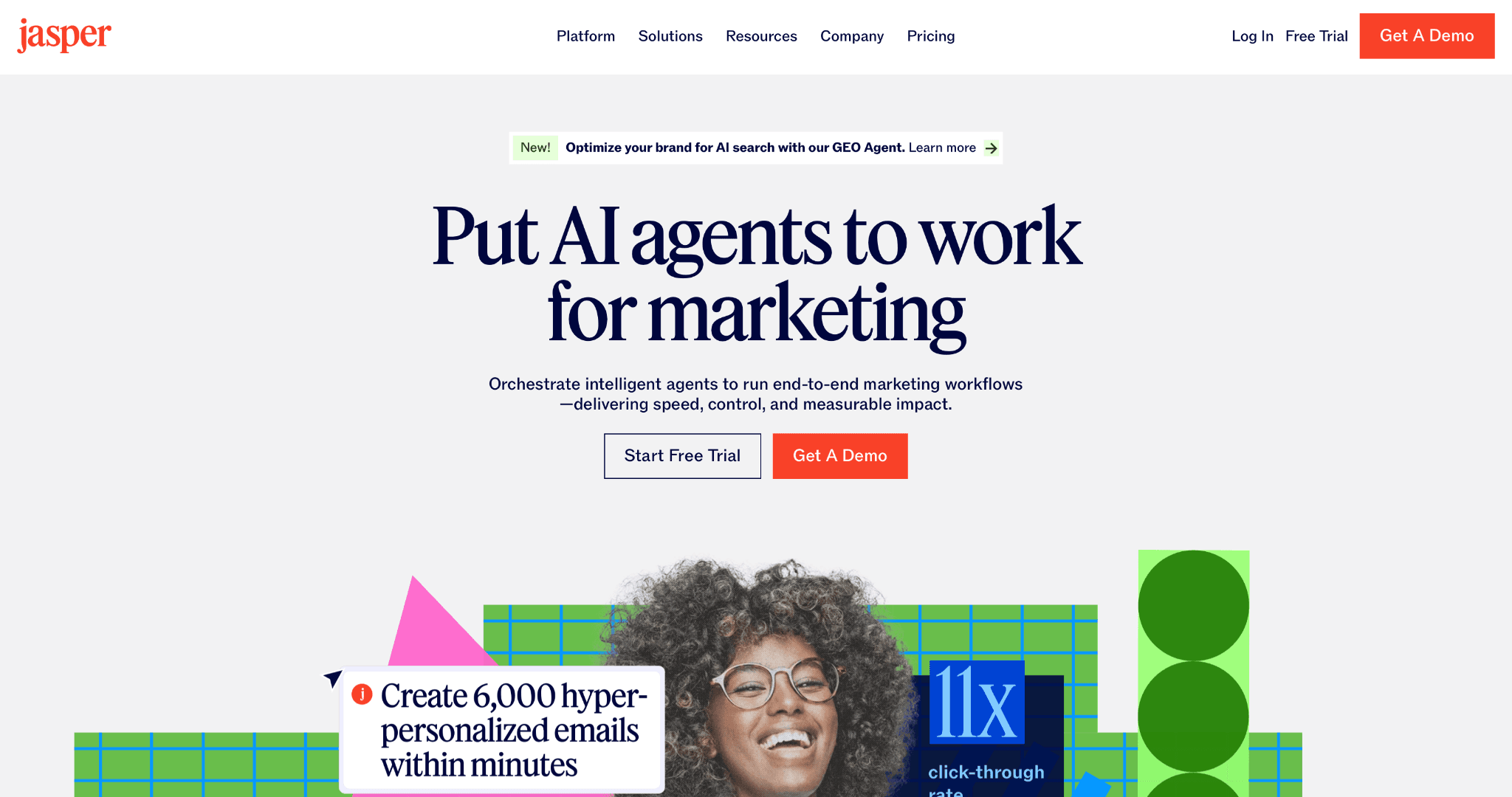
Brand Voice is the feature that justifies Jasper for enterprise teams. You train it on your existing content, specify your style guidelines, and every piece Jasper generates writes in that voice rather than the generic AI register that makes most AI-written content read like every other AI-written content. The Jasper Grid scales content production across multiple variations, useful for running campaign assets, product descriptions, or page variants in parallel. The Research and Optimization Agent researches topics and optimizes content for SEO, AEO, and GEO, which is the closest Jasper comes to the kind of SERP-based content optimization that Surfer SEO delivers. Jasper IQ embeds your brand's context, market position, and content rules into every output so the AI understands your business before it writes. Pro plan at $69/mo covers multi-brand support and campaign collaboration. Business is custom with a 12-month minimum and includes a dedicated Customer Success Manager.
Key features:
Brand Voice training Jasper on your existing content, style guidelines, and tone so every output reflects the brand rather than a generic AI register.
Jasper IQ embedding marketing context, brand rules, and knowledge base into outputs across every template and agent.
Research and Optimization Agent researching topics and optimizing content for SEO, AEO, and GEO performance.
Jasper Grid for parallel content production across multiple variations, useful for scaling product descriptions, ad copy, or landing page variants.
Jasper MCP for integrating Jasper's content capabilities into other marketing workflows.
7-day free trial on Pro (credit card required).
Pros and cons:
Pros:
Research and Optimization Agent covers SEO, AEO, and GEO in one workflow, which is a meaningful addition for teams trying to write for both Google and AI search surfaces
Jasper Grid scales content production in a way that individual editor-based tools don't, useful for teams producing hundreds of content variations
Cons:
Pro at $69/mo is the entry point but Business (custom, 12-month minimum) is where most enterprise features including full API access and custom AI templates are available. The true enterprise cost requires a sales conversation.
7-day free trial requires a credit card, which adds friction compared to trials that don't.
Jasper produces content faster than most human writers, but the Research and Optimization Agent for SEO is a newer addition. Teams with advanced SERP-based content optimization needs still benefit from combining Jasper with a dedicated tool like Surfer SEO.

G2 rating: 4.7/5
Pricing: Pro $69/mo | Business custom (12-month minimum) | 7-day free trial on Pro (credit card required)
Verdict:
Jasper makes the most sense for enterprise marketing teams running high-volume content programs where brand consistency across writers, markets, and formats is a real operational problem. For small teams or solo writers, the Pro plan delivers solid AI writing at $69/mo, but most of what makes Jasper worth the investment for an enterprise is in the Business tier. Teams primarily trying to improve Google or AI search rankings rather than scale branded content production will get more direct value from Surfer SEO, MarketMuse, or AIclicks.
How to Choose the Right Content Writing Tool
Figure out where your content program is actually stuck. The tools on this list solve different problems. If the bottleneck is knowing what content to write and how to structure it for a specific keyword, Surfer SEO or MarketMuse address that. If the bottleneck is writing AI-search-optimized content faster with brand governance, Jasper addresses that. If the bottleneck is knowing which AI search gaps to close and then closing them without switching tools, AIclicks or Writesonic address that. Semrush addresses it inside the platform most teams are already paying for.
Decide where in the workflow the tool needs to fit. SEO Writing Assistant and Surfer SEO both work inside Google Docs, which means writers don't need to change where they write. Jasper is its own editor. AIclicks publishes directly to your CMS. MarketMuse informs the brief before any writing starts. The tool that gets used is the one that creates the least friction in the workflow your team already runs.
Price for the features you actually need, not the headline. Semrush's content writing features require Guru at $249.95/mo, not Pro at $139.95/mo. MarketMuse's paid tiers require a demo with no public pricing. Jasper's most useful enterprise features are in Business with a 12-month minimum. Surfer's meaningful AI tracking enters at Pro ($182/mo annual), not Discovery ($59/mo). Write down the specific combination of features your content workflow requires and price that exact configuration at each platform before making a decision.
Why AIclicks Writer 2.0 Belongs in Every SEO Content Stack
The tools above handle content that ranks in Google. AIclicks handles the part of content strategy those tools do not cover: writing for the AI search surfaces where a growing share of buying decisions now happen.
AIclicks generates AI-optimized articles starting from visibility data, the tracking data that shows which prompts your brand is absent from, which competitors keep getting cited instead, and what content your AI search presence needs. That is a different brief from a keyword research brief, and it produces different content, targeting citation by AI engines rather than position in a SERP.
For teams building a content program in 2026, that distinction matters more every quarter.
Frequently Asked Questions
1. What is the best content writing tool for SEO in 2026?
The right tool depends on which SEO writing job matters most. For SERP-based content optimization with real-time scoring, Surfer SEO is the strongest tool on this list. For AI search citation targeting, AIclicks starts from visibility data and publishes directly to your CMS. For enterprise brand-governed content at scale, Jasper. For content intelligence and topical authority research before writing starts, MarketMuse.
2. Does Semrush have a content writing tool?
Yes. The SEO Writing Assistant scores content in real-time for SEO, readability, tone, and originality inside Google Docs and WordPress. ContentShake AI generates unlimited SEO articles and publishes to WordPress. Both features require the Guru plan at $249.95/mo for full access, they are not available on the Pro base plan.
3. What is the cheapest content writing tool for SEO on this list?
Surfer SEO's Discovery plan starts at $49/mo annual and includes the Content Editor, though AI tracking is not included at that tier. AIclicks starts at $59/mo. Jasper Pro starts at $59/mo annual. MarketMuse has a free plan with 10 queries per month.
4. How is writing for AI search different from writing for Google?
Google ranks pages based on links, authority, keyword relevance, and technical signals. AI engines cite sources based on topical comprehensiveness, factual accuracy, consistency across third-party sources, and whether the content directly answers the conversational question being asked. The same article can rank well on Google and be completely absent from AI answers, and vice versa. Check your current AI search standing with the free GEO visibility checker.
5. Do any of these tools publish directly to WordPress or other CMS platforms?
AIclicks Writer 2.0 publishes to WordPress, Webflow, Shopify, and Framer in one click. ContentShake AI (Semrush Guru+) publishes to WordPress. Surfer SEO does not include CMS publishing.



Any questions left?
Book a call here: