" width="14px"><path d="M 13.864 5.629 L 13.3 5.629 L 13.3 5.6 L 7 5.6 L 7 8.4 L 10.956 8.4 C 10.379 10.03 8.828 11.2 7 11.2 C 4.681 11.2 2.8 9.319 2.8 7 C 2.8 4.681 4.681 2.8 7 2.8 C 8.071 2.8 9.045 3.204 9.786 3.864 L 11.766 1.884 C 10.516 0.719 8.844 0 7 0 C 3.134 0 0 3.134 0 7 C 0 10.866 3.134 14 7 14 C 10.866 14 14 10.866 14 7 C 14 6.531 13.952 6.073 13.864 5.629 Z" fill="rgb(255, 193, 7)" height="14px" id="H_YjfTNpn" width="14px"/><path d="M 0 3.742 L 2.3 5.429 C 2.922 3.888 4.429 2.8 6.193 2.8 C 7.264 2.8 8.238 3.204 8.979 3.864 L 10.959 1.884 C 9.709 0.719 8.037 0 6.193 0 C 3.504 0 1.172 1.518 0 3.742 Z" fill="rgb(255, 61, 0)" height="5.428500000000002px" id="PlkthQDhg" transform="translate(0.875 0)" width="10.959199999999996px"/><path d="M 6.232 5.581 C 8.04 5.581 9.683 4.889 10.925 3.764 L 8.758 1.931 C 8.032 2.483 7.144 2.782 6.232 2.781 C 4.411 2.781 2.865 1.62 2.283 0 L 0 1.759 C 1.159 4.026 3.511 5.581 6.232 5.581 Z" fill="rgb(76, 175, 80)" height="5.581099999999999px" id="WlnJ5gngE" transform="translate(0.7 8.4)" width="10.924899999999994px"/><path d="M 6.864 0.029 L 6.3 0.029 L 6.3 0 L 0 0 L 0 2.8 L 3.956 2.8 C 3.68 3.576 3.183 4.254 2.526 4.75 L 2.527 4.749 L 4.693 6.582 C 4.54 6.722 7 4.9 7 1.4 C 7 0.931 6.952 0.473 6.864 0.029 Z" fill="rgb(25, 118, 210)" height="6.589883930775992px" id="x_rSW275p" transform="translate(7 5.6)" width="7px"/></g></svg>)


Reviewed by:
Matas Kibildis

Head of Growth @ AIclicks
Last updated:
Expert Verified

If your link-building strategy in 2026 still revolves around domain authority scores and "build more links to rank on Google," you're working on a problem that's getting smaller day-by-day.
Key Takeaways
Backlinks still drive Google rankings, but AI search runs on a different signal: citation sources, LLMs retrieve from when generating answers. Most backlink tools can't show you these citation sources.
The two layers overlap, but unevenly. A page can be a strong backlink target without being a citation source, and vice versa.
Traditional tactics (broken link building, unlinked mentions, guest posting on relevant sites) still work and help both layers. Avoid anything resembling a link scheme, as Google's spam policies still apply.
AI-specific tactics (G2/review platform placement, Reddit category presence, getting included in listicles AI tools cite) move AI citations directly without affecting backlink strategy.
AIClicks shows you which pages on the open web LLMs actually cite in your category, and which of those pages don't mention your brand. A prioritized outreach list backlink tools can't generate.
Track both: referring domain growth in Google Search Console for traditional SEO, plus Citations (Frequency), Visibility, and Share of Voice in AIClicks for AI search.
Backlinks still matter. They’re one of the strongest authority signals search engines use to rank pages. But backlinks are not the variable that decides whether you show up in the answer.
AI search runs on a different layer: citation sources. The pages LLMs actually retrieve from when answering a question, like the Reddit thread, G2 comparison page, listicles, or more.
Most backlink tools can't track this. They show you who links to your domain but not which third-party pages are shaping how AI describes your category, or whether your brand appears on those pages at all.
This piece covers both: the traditional tactics that still work, the AI-era citation work that's becoming more important, and how to use AIClicks, our AI visibility tracker, to find the citation sources sitting between your buyers and your brand.
Backlinks vs. AI Citations: What's Actually Different in 2026
A backlink is a hyperlink that passes (or doesn't pass) ranking signals to search engines. Domain authority, anchor text, and dofollow/nofollow attributes all influence how Google weights it.
An AI citation is different. It's a URL an LLM retrieves and uses when generating an answer. The model doesn't care about anchor text or nofollow attributes. It cares whether the page has the content to answer the question, whether it's recent enough, and whether your brand is mentioned on it.
The two layers overlap unevenly. A high-DR backlink from an unrelated site can do nothing for your AI citations. A Reddit thread that doesn't link to you at all can drive thousands of brand mentions across ChatGPT and Perplexity if it discusses your category.
The unit of analysis isn't the link anymore but the page, and whether your brand appears on it.
In practice, this means link-building in 2026 is a two-track effort. Traditional backlinks for traditional SEO. Citation-source mentions for AI search. The tactics overlap in places, but the targeting, prioritization, and measurement are different.
Now let’s jump to the most important part: how to get backlinks to your site.
How To Get Backlinks: An 8-Step Playbook for the AI Era
Here’s the workflow. Steps 1 and 2 are the audit. Steps 3 through 7 are the work itself, split between traditional backlink tactics that still earn links and the AI-era tactics that earn citations. Step 8 is how you measure both.
Step 1: Audit your existing backlink profile in Google Search Console
Before any new outreach, you need a baseline of what you already have. Google Search Console is free, and the Links report shows you everything you need:
Top sites linking to you (your strongest existing relationships)
Your top linked pages (your existing "link magnets")
Common anchor text patterns
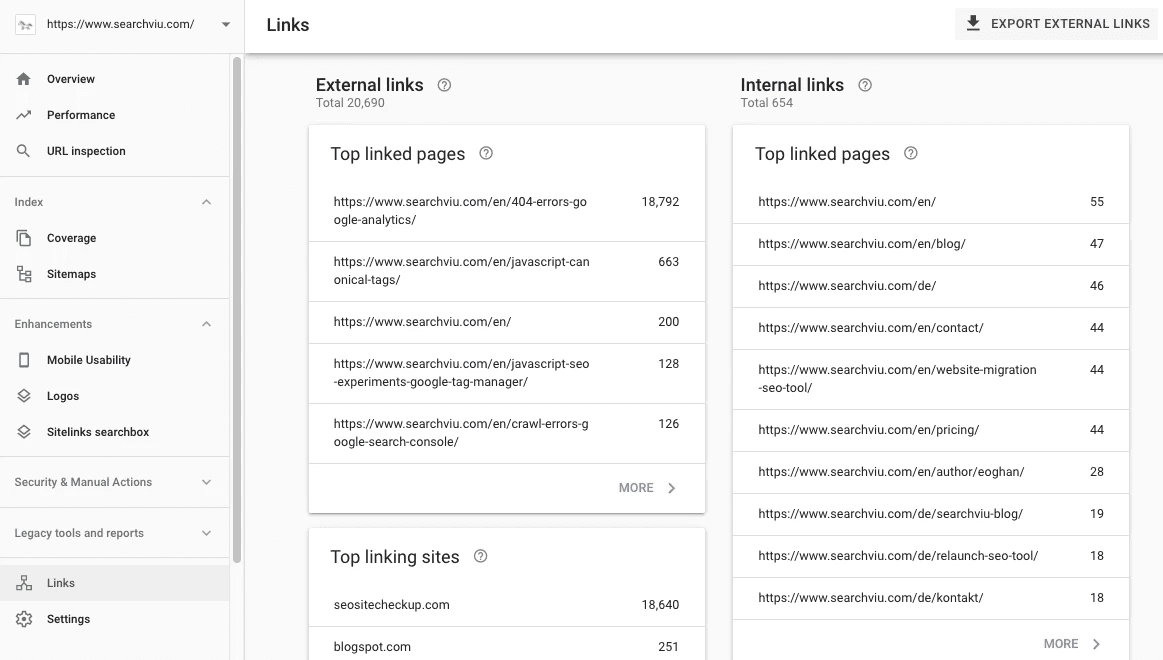
Three things to scan for first:
Pages with strong link profiles but outdated content. Refresh, don't replace.
Priority pages with few links. These are your outreach targets.
Spammy linking domains. Google ignores most automatically; reject only if there's a clear pattern of negative SEO.
This audit gives you the SEO half of the picture. The next step covers the AI search half, and most of the gaps your team is actually missing.
Step 2: Audit your AI citation footprint with AIClicks
The Google Search Console audit covers the backlink layer but nothing about the AI citation layer, and in 2026, that's the bigger blind spot.
The AIClicks Sources view is the equivalent audit for AI citations. It shows you every URL across the open web that AI models are actually retrieving from when answering questions in your category. Each row is a page that ChatGPT, Perplexity, Gemini, Google AI Overviews, or Claude has cited at least once in the prompts you track.
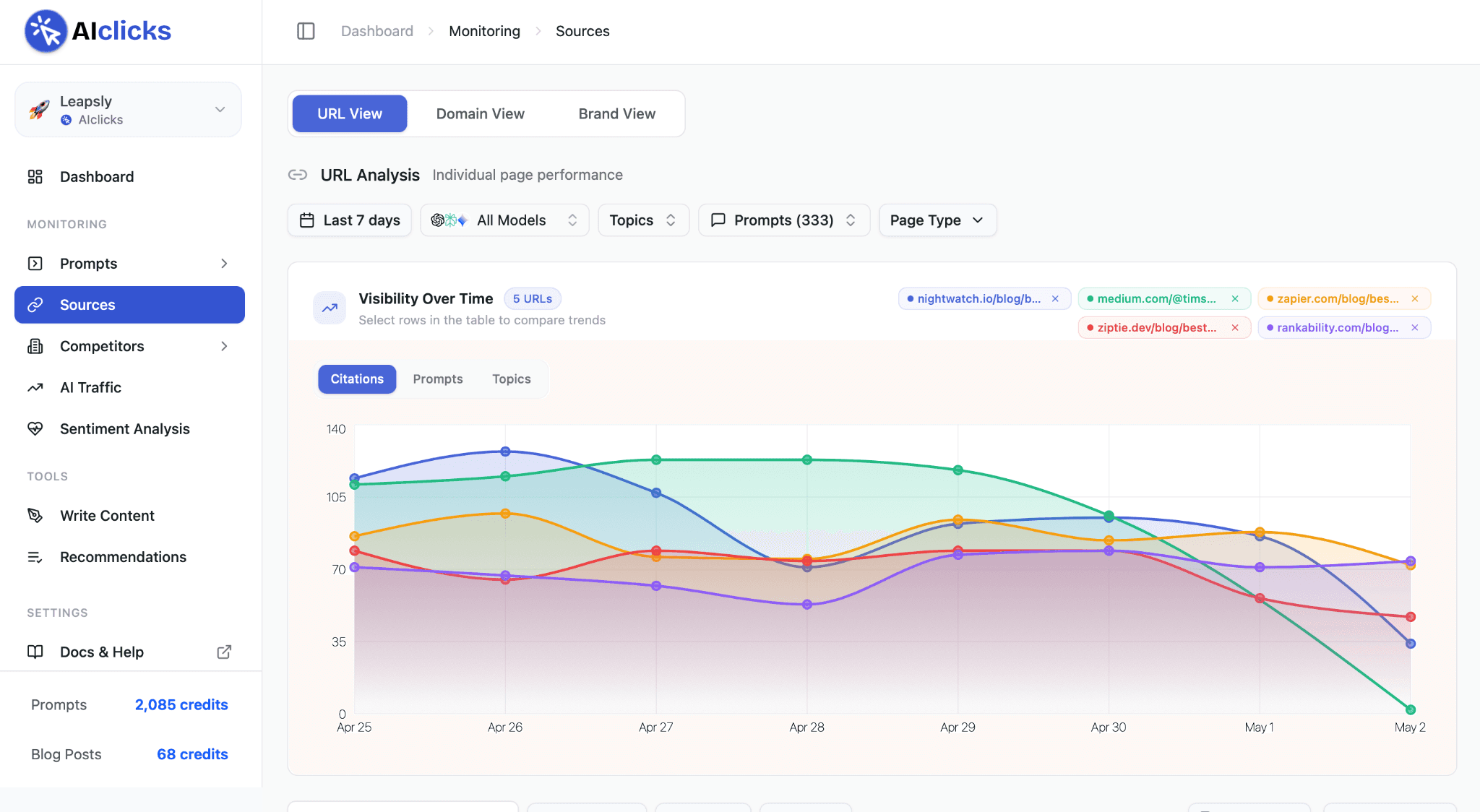
The first time most brands run this view, three things become obvious:
The pages driving AI citations in your category are mostly third-party. Reviews, comparisons, listicles, Reddit threads. Your own domain shows up too, but usually further down the list than you'd expect.
You're not mentioned on most of the high-frequency pages. Filter by Mentioned = No and sort by Frequency. The result is a sorted list of the highest-leverage outreach targets you have, ranked by how often AI tools actually cite them.
The page types matter. Sources can include comparison articles, listicles, reviews, forums, how-to guides, alternatives pages, and a few other formats. Different page types require different outreach approaches, and AIClicks lets you filter by type so you can group similar outreach work together.
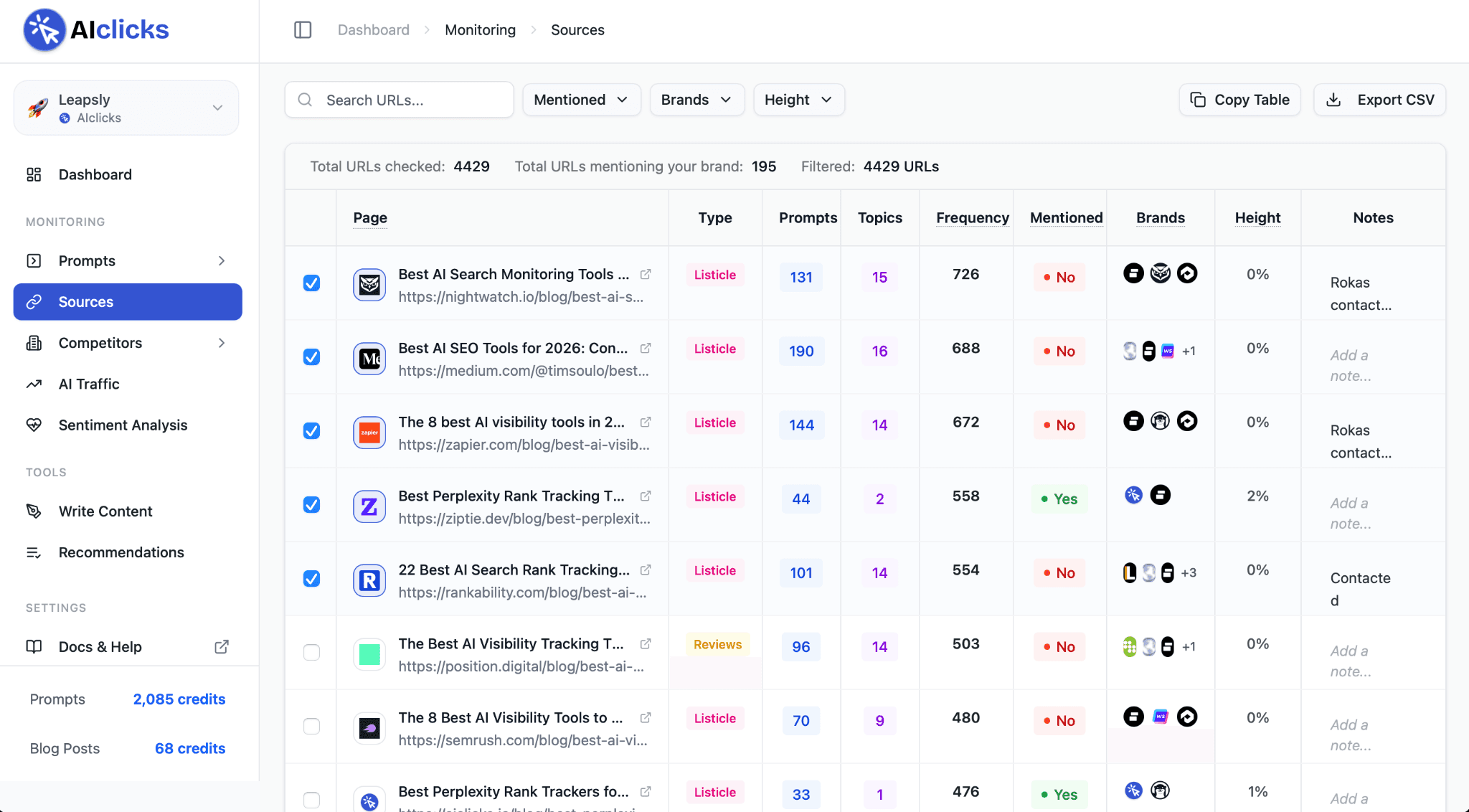
This is what makes the Sources view different from any backlink tool: it's not measuring who links to you but also which pages on the open web AI models trust enough to retrieve from when describing your category, and whether you're on those pages at all.
Step 3: The 4 traditional backlink tactics that still work
Four tactics still work in 2026, and three of them double as AI citation tactics.
Reverse-engineering competitor backlinks. Pull linking domains for 3-5 competitors. Filter for pages linking to multiple competitors, those are "category linkers." Look for the content types getting linked (top-tools roundups, statistics pages, comparisons), then create something better in the same format.
Broken link building. Find dead links on relevant resource pages. Identify what the dead page used to cover (use archive.org if needed). Create or point to a better replacement. Email the page owner with a heads-up plus your suggestion. The pitch works because you're improving their page, not asking for a favor.
Unlinked brand mentions. Some publications already mention you without linking. Tools like Ahrefs Content Explorer, Mention, or Brand24 surface these. Conversion rates are much higher than cold outreach because the writer already decided you were worth referencing.
Guest posting on relevant publications. Still works when it's actual editorial publishing on sites you'd publish on without a link. Avoid scale, avoid keyword-stuffed anchors, and avoid anything Google's link spam policies would flag.
All four still work. None of them, on their own, will move your AI citations. That's what Step 4 is for.
Step 4: The AI-era version - getting cited by sources LLMs retrieve from
This is where AIClicks does work that no traditional backlink tool can. The challenge in AI search isn't getting more backlinks. It's getting your brand mentioned on the specific pages AI tools already retrieve from.
The Get Mentioned tab inside AIClicks turns this into a structured workflow. It surfaces every URL where:
AI models are actively citing the page in answers to prompts you track
Your brand isn't currently mentioned
Each entry shows the page title, domain, the topics and prompts it appears in, the citation frequency, and a status field (pending, done, dismissed) for tracking outreach. The result is a prioritized outreach list, ranked by how much AI exposure each placement would actually generate.
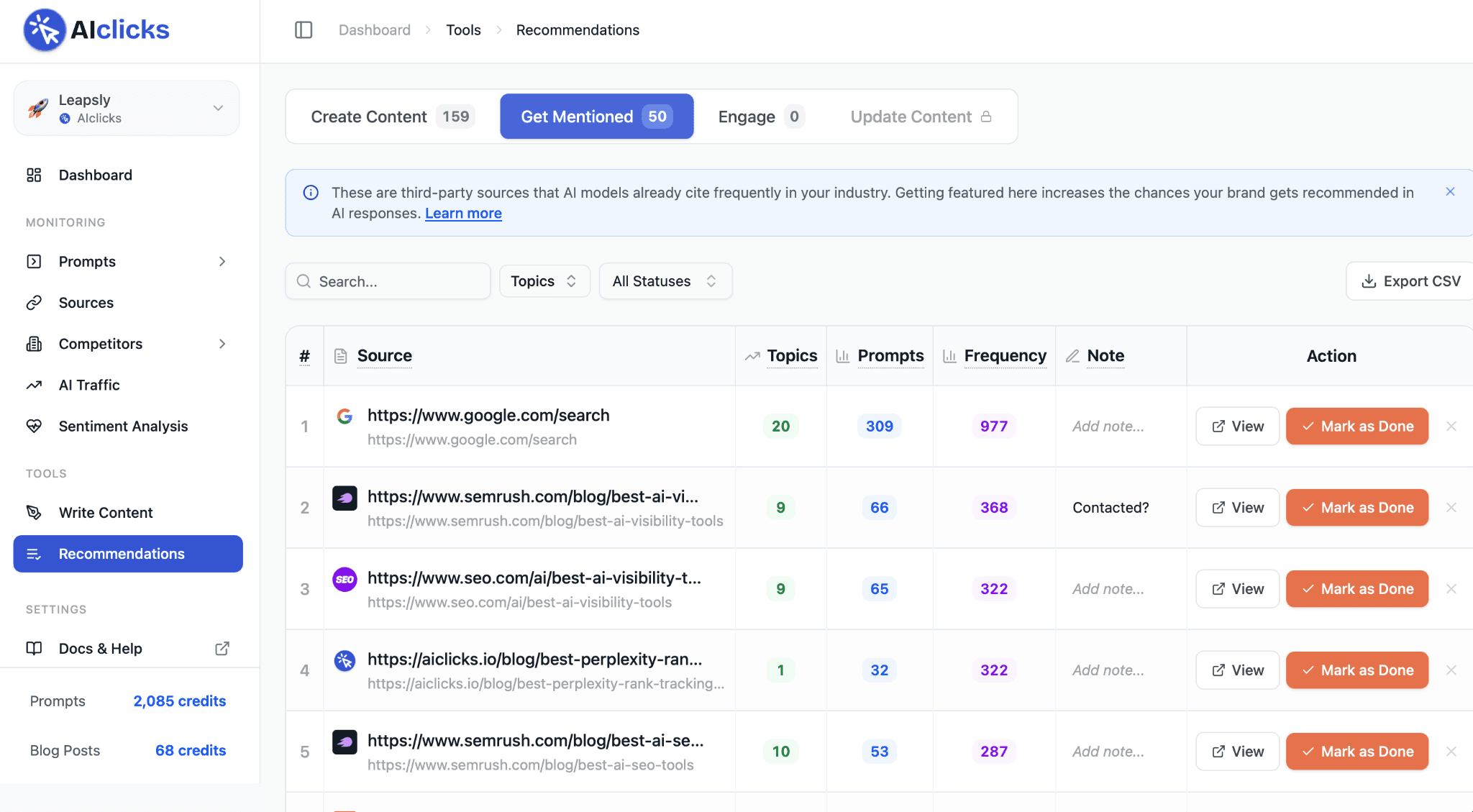
Different page types call for different playbooks:
Reviews and directories (G2, Capterra, Trustpilot). Claim profiles, run review-collection campaigns with current customers, update product information. AI tools cite review platforms heavily for "best software" prompts.
Listicles and comparison pages. Pitch the writer with a specific angle: original data, a unique product feature, customer outcomes the existing list doesn't cover.
Reddit threads. Direct posting backfires. The approach that works is having team members participate authentically under real names over months. Full playbook in our piece on why Reddit is frequently cited by LLMs.
Editorial publications. Long-cycle outreach with PR-quality pitches. Original research and proprietary data are the strongest hooks.
The Get Mentioned workflow turns AI citation work from "be everywhere" into a measurable program targeting the 20-50 high-frequency pages that actually drive citations in your category.
Step 5: Use the Domains view for publisher-level outreach
Individual URLs are useful for tactical outreach, but some publishers operate at the domain level. If a single publication is producing five high-frequency citation pages in your category, it's more efficient to pitch the publication once than to pitch each URL individually.
The AIClicks Domains view rolls up citations to the domain level. Sort by frequency, and you'll see the publishers, platforms, and ecosystems that matter most for your category.
Three patterns to watch for:
A single publisher dominating multiple high-frequency pages. Build a relationship with that publication. One editorial relationship can cover many URLs at once.
Review platforms and directories with multiple category pages. Profile updates and review-collection campaigns can lift your visibility across all of them simultaneously.
Niche communities with concentrated citation patterns. Often a single subreddit or forum is producing most of your category's community-source citations. Concentrate your community engagement there rather than spreading thin across ten different platforms.
Step 6: Create content people actually link to (and AI actually cites)
Most link-building fails because the underlying content isn't link-worthy. Most AI-citation work fails for the same reason: AI tools don't cite generic pages.
Here are four formats consistently earn both:
Original data: Industry benchmarks, original surveys, trend reports. Writers need sources, AI models need citable facts.
Practical templates and tools: Calculators, checklists, audit spreadsheets. Earn links because they're useful in workflows. Get cited because LLMs surface them when answering "is there a tool for this" questions.
Strong opinionated takes: Pieces that argue a specific position or push back on conventional wisdom. Memorable content gets linked and cited. Generic content rarely does.
Refreshed evergreen pages: A page republished with current data ranks better, gets linked more, and gets cited more than one untouched since 2023.
Skyscraper-style "make it longer" content is mostly dead. Substance, original perspective, and recency are the variables that matter.
You can also use AIClicks to generate top-notch content.
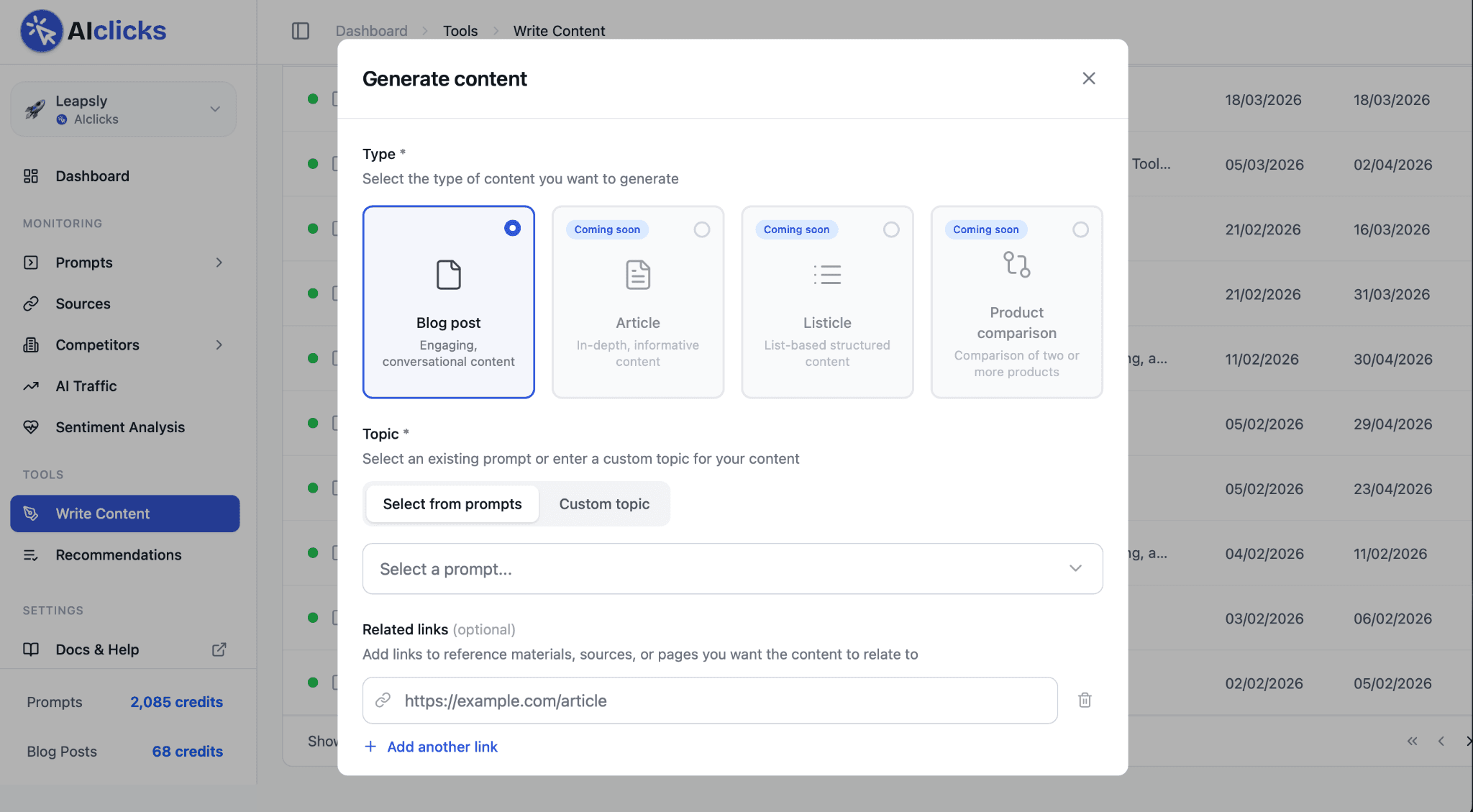
Give it a shot and see the difference.
Step 7: Outreach that earns responses
Outreach has one job: make it easy for a busy editor or site owner to say yes. Every word that adds friction reduces response rate.
A pitch template that works for broken links, unlinked mentions, and link-insert suggestions:
Reference the exact page and the exact spot you're suggesting
Show proof (screenshot, quote, or the broken URL)
Offer a specific replacement and a one-sentence reason it's better
Suggest the anchor text (optional, and only if natural)
Sign off without follow-up pressure
The shorter, the better. The single most common mistake in outreach emails is explaining your background or your company before getting to the suggestion.
Editors don't read past the third sentence. Lead with the suggestion.
Step 8: Track both layers
The "how many backlinks do I need" question doesn't have a clean answer. Ten high-quality backlinks from authoritative pages can outperform 200 low-quality directory placements. The metric to watch is referring domains growth on priority pages, not raw link counts.
For AI search, the metrics live in AIClicks:
Citations: how often AI tools cite pages in your category, by URL, domain, and prompt
Visibility: how often your brand appears in AI answers across tracked prompts
Share of Voice: your brand's share of mentions relative to competitors
Position: how often you're recommended versus ranked behind competitors
Competitor benchmark: how are your competitors performing for specific prompts
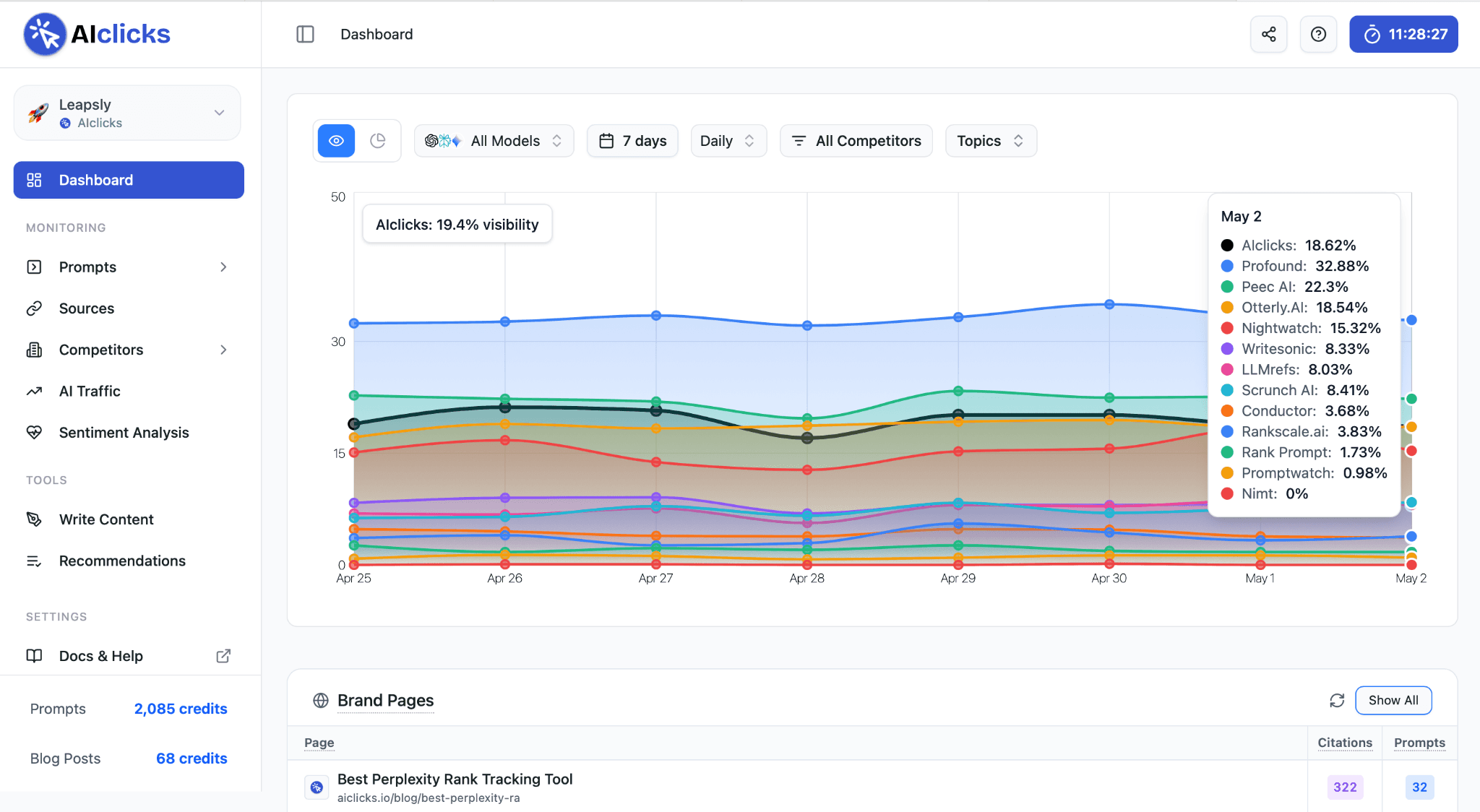
A healthy program sees movement on both layers. Referring domains grow steadily for pages you're actively building links to. Citation Frequency rises for prompts you're targeting through Get Mentioned outreach. Share of Voice expands relative to named competitors.
If one layer moves and the other doesn't, that's diagnostic. Backlinks growing but AI citations flat usually means your outreach is winning placements on pages AI tools don't retrieve from. AI citations growing but backlinks flat usually means you're winning mentions without links, fine for AI, worth following up on for traditional SEO.
A weekly routine that covers both layers
If you want a proper system that runs continuously rather than as a campaign, here’s one:
Monday - Audit
Open the GSC Links report and the AIClicks Sources view. Identify one priority page from each. Note them in your tracker.
Tuesday - Prospect
Pull 30 traditional backlink prospects from competitor backlinks. Pull 10 high-frequency AIClicks Get Mentioned URLs where you're not yet mentioned. Combine into a single outreach list.
Wednesday - Asset work
Update one priority page with new data, examples, or a sharper opinion. Republish.
Thursday - Outreach
Send 10 personalized emails: 5 traditional backlink targets (broken links, unlinked mentions), 5 AI Citation targets (review profile updates, listicle pitches, editorial pitches).
Friday - Measure
Track responses, update statuses in AIClicks Get Mentioned, log new referring domains in your tracker. Repeat.
That's roughly 5 hours per week, run consistently, that covers both backlink building and AI citation work without burning the team out.
How AIClicks helps you do both
To summarize what AIClicks specifically does for backlink and AI citation work:
Sources view: Surfaces every URL across the open web that AI models retrieve from in your category, with frequency counts and the ability to filter by Mentioned = No to find your highest-leverage outreach targets.
Get Mentioned recommendations: Turns the unmentioned high-frequency URLs into a structured outreach queue with notes, status tracking, and CSV export for CRM integration.
Domains view: Rolls citations up to the publisher level so you can plan relationship-based outreach instead of one-URL-at-a-time pitches.
Citations (Frequency), Visibility, Share of Voice metrics: Measures whether the outreach work is moving the AI search needle, broken down by prompt and competitor.
Sentiment analysis: Flags whether the citation sources driving your visibility are positive, neutral, or negative, the equivalent of monitoring whether your brand is being described well in the places AI is actually reading.
If you want to see what your AI citation footprint looks like across ChatGPT, Perplexity, Gemini, Google AI Overviews, and AI Mode, you can try AIClicks.
Learn more about how to get traffic from ChatGPT.
Most brands find at least one significant gap in the first hour they spend with the data, and the gap is almost always a high-frequency page they didn't know existed.
Frequently Asked Questions
1. Do backlinks still matter in 2026?
Yes, for traditional SEO. Backlinks remain one of the strongest ranking signals for Google and Bing. They matter much less for AI search, which weights citation sources, content recency, and brand mention patterns more heavily than the raw link graph.
2. What's the difference between a backlink and an AI citation?
A backlink is a hyperlink that passes ranking signals to search engines. An AI citation is a URL an LLM retrieves and uses when generating an answer. You can have backlinks that don't drive AI citations, and AI citations that don't include any link to your domain.
3. How do I find pages where AI tools cite my competitors but not me?
The AIClicks Sources view shows every URL AI models retrieve from in your category. Filter by Mentioned = No and sort by Frequency. The result is a list of high-impact pages where competitors are mentioned and you aren't. The Get Mentioned tab turns this into an outreach workflow.
4. Are nofollow backlinks useful for AI search?
More than they are for traditional SEO. AI models don't typically distinguish between dofollow and nofollow links the way Google's ranking algorithm does. A nofollow mention on a high-frequency citation page can drive AI visibility just as effectively as a dofollow link.
5. Which is more valuable in 2026: backlinks or AI citations?
Depends on where your traffic comes from. If most of your buyers find you through Google, backlinks still drive the bulk of your discoverability. If your category has high AI search adoption, AI citations are increasingly the dominant signal. For most brands, the right answer is both — they reinforce each other and the operational work overlaps.
6. How long does it take to see citation lift from new mentions?
Backlink-driven Google ranking changes typically show up over 2-8 weeks. AI citation lift moves on a different timeline because it depends on when LLM retrieval pipelines next index the page. Review platforms and major publications usually re-crawl within a week or two. Smaller publications can take a month or more.
Our Content:




Any questions left?
Book a call here: