SEO for Veterinary Practices:
A pet owner does not shop around. They notice something is wrong on a Sunday evening, ask an assistant whether it can wait, then search for whoever is open, close and well reviewed. That whole sequence finishes before your phone rings.









Why Veterinary Practices Need SEO
The Competition and Markets Authority found pet owners rarely compare vet prices before choosing, largely because practices do not publish them. Whoever answers the cost question first wins the registration.
A worried owner types lungworm symptoms, or my dog ate chocolate, and not veterinary practice. Your site lists consultations, vaccinations and dental work, so it never appears at the exact moment the worry starts. By the time they search for a vet at all, a charity page has already told them what they should do next.
Run vets near me from almost anywhere and Vets4Pets’ practice finder outranks the independents, with the RSPCA’s find-a-vet tool and Vets Now’s out-of-hours directory just behind. Groups such as CVS, Medivet and IVC Evidensia rank one domain across hundreds of branches. One practice, one website, competing with all that.
Practices bid on 24 hour vet and emergency vet terms against national out-of-hours providers with far deeper pockets, then add a £500 to £2,500 monthly retainer and leaflet drops to new housing estates. Pause any of it and enquiries fall the same week, because nothing was built that keeps working without a card attached.
How SEO Works for Veterinary Practices
Search Engine Optimization projects are long-term investments for veterinary surgeons, where each task supplements the others and creates compound results over time.
01
Keywords, page structure, and the signals Google reads directly
On-page work is awkward in veterinary practice because the site is organised the way the practice is organised, and pet owners search the way they worry. A menu reading Small Animal, Equine, Farm and Referrals is accurate and matches nothing anyone types. Google also files pet health under YMYL, so an unsigned page about seizures or bloat gets held back regardless of how well it is written. The pages that carry weight are your individual procedure pages, your fees page, your out-of-hours page and your registration page, each with a named RCVS-registered vet attached to the clinical claims.
Procedure and cost pages age extremely well. What a cruciate repair involves, what a dental scale and polish costs, what happens on the day of a spay: none of that changes much, and the anxiety behind the question never changes at all. The churn is everything with a date on it, the Christmas opening hours post, the new graduate announcement, the fireworks reminder published every November and never updated. Those quietly become most of a practice blog and earn nothing after 3 weeks. Write fewer pages, tie them to procedures rather than to the calendar, and revisit the fee figures on them every year.
1
Build a page for each presenting symptom owners actually type, such as dog limping or cat not eating, routing into the matching procedure page.
2
Unpublish last year’s fireworks and Christmas hours posts every January, and 301 them onto the evergreen advice page covering the same worry.
3
Mark the practice up with VeterinaryCare schema and each procedure with Service plus a priceRange, then check both in Schema Markup Validator.
4
Publish a plain HTML fee table for consults, vaccinations, neutering and dentals, the CMA disclosure work doubling as your highest-intent landing page.
02
Map Pack visibility, citations, and proximity signals
Almost nobody travels for routine veterinary care. Owners register with whoever is close, open when they need it and visibly trusted, which makes the 3-slot map pack the most valuable position in the industry. It sits above Vets4Pets, above the RSPCA, above every group practice finder, and a single-site practice can win it against a corporate holding hundreds of branches. Proximity you cannot change. Profile completeness and review volume you can.
Set the primary category to Veterinarian, not Animal Hospital, unless you genuinely run inpatient care, then add Emergency Veterinarian Service and Veterinary Pharmacy as secondaries if they apply. Load real photographs of the consult room, the ward and the team in scrubs. State opening hours honestly, including who covers out-of-hours and whether that means a different building. Answer up front what actually decides a registration: consult fee, whether you take new clients, parking, and which species you see.
Veterinary has a register layer general local SEO ignores. The RCVS Find a Vet directory carries weight because it verifies registration, and Practice Standards Scheme accreditation surfaces there too. Add VetHelpDirect, VetRatingz, the RSPCA and PDSA vet finders, the Vets Now out-of-hours locator, then Yell and Thomson Local underneath. Every entry needs the identical practice name, unit number and phone, or 30 listings quietly work against each other.
1
Choose Veterinarian as the primary category, list every species and specialism as separate services, and upload genuine consult room and ward photos.
2
Every branch needs a separate profile and a page naming the vets and RVNs who actually work there, never one shared practice-finder.
3
Run BrightLocal against RCVS Find a Vet, VetHelpDirect, VetRatingz and Yell, correcting every unit number and trading-name variant you find.
4
Add a profile update weekly: new kit, a free appointment slot, or a seasonal warning about lungworm, antifreeze and adder bites.
03
Topic authority, inbound links, and content that earns traffic
Before an owner picks a practice they are trying to answer 3 things: is this serious, will it wait until morning, and what is it going to cost. Content that answers those honestly outperforms anything written for a keyword. A page setting out what counts as a genuine emergency, or what a dental costs and why the quote moves once the vet is in there, earns trust exactly when the decision is being made.
An owner who already knows their dog needs a cruciate repair is now choosing a surgeon, and they want proof, not adjectives. Name the vet who will hold the scalpel, list their certificates and RCVS Advanced Practitioner status, show real case photographs with outcomes, and publish the price band including complications. Put it on the procedure page, not 3 clicks away in a bio. Practices lose these clients at the moment nobody will quote.
Veterinary links come from the animal world rather than the marketing world. Rescue centres, breed clubs, riding schools, kennels, catteries, groomers and dog walkers all publish recommended-vet pages nobody thinks to ask for. Vet schools list clinical supervisors and EMS placement providers. Trade titles like Veterinary Practice, Vet Times and VetSurgeon run practice news and comment pieces. Local media want a vet quoted whenever there is a heatwave, a firework season or a dog theft story.
1
Publish an annual guide comparing what neutering, vaccinations and dentals actually cost, with and without a health plan, and restate the figures every April.
2
Template a landing page per species and life stage you serve, puppy, kitten, rabbit, senior dog, equine, each with its own vaccination and worming schedule.
3
Answer every money question in a single hub: pet insurance, health plans, PDSA and Blue Cross eligibility, payment options, and what treatment costs uninsured.
4
Write a page for each capability you genuinely hold, CT, laparoscopic spays, RCVS Practice Standards accreditation, since owners search these before they search practices.
04
Site speed, crawlability, Core Web Vitals, and mobile health
The failure nobody notices is that the information owners search for most is not in the HTML. Fee lists go up as PDFs. Opening hours and out-of-hours cover sit inside a PetsApp or Vetstoria booking widget that renders after the page loads. Branch pages come off a group template where only the address changes. Google indexes an address and a spinner, then ranks the charity page that wrote the answer in plain text instead.
The highest-intent veterinary search happens one-handed at 11 at night by someone holding a towel and a bleeding dog. They are not browsing. They want a phone number, and one line telling them whether anyone is actually there. If the page takes 4 seconds, or the out-of-hours number is baked into an image, or a cookie banner covers the call button, they are back in the results ringing whoever answers first.
1
Crawl with Screaming Frog, list every PDF and JavaScript-rendered block, then rebuild fee lists, hours and out-of-hours cover as plain HTML.
2
Run Lighthouse on the online booking page, usually the heaviest on a vet site, and fix whatever it names as the blocking resource.
3
Compress surgical before-and-after and facility photos to WebP, lazy-load the gallery, and set width and height so nothing shifts.
4
Give procedure, branch and fee URLs their own XML sitemap, away from news, and resubmit whenever prices, rota cover or out-of-hours arrangements change.
05
Star ratings, review volume, and response strategy that builds trust
Reviews decide veterinary searches because the reader is about to hand over an animal they love to a stranger, and a star rating is the only evidence they have. They are also brutally hard to manage. The outcome is sometimes euthanasia, and nobody writes a review the week their dog dies. Bills arrive at the emotional low point, so the most motivated writer is usually the one disputing an invoice, and unmanaged practices drift below what they deserve.
The moment to ask is the post-op check when the owner has just been told their animal is doing well, not on the invoice email. Wire the request into your practice management system so it fires on discharge status, signed by the nurse who did the handover rather than by the practice. Keep it to one sentence and one link, with no account to create. Ask on routine vaccination visits too, because those are your highest-volume moment and nobody is upset.
1
Fire the review request from ezyVet, RoboVet or PetsApp when the patient is marked discharged, sent from the nurse who handled the aftercare call.
2
Reply within 24 hours without discussing the case, since RCVS confidentiality binds you even when the owner has posted the clinical detail themselves.
3
Pull reviews mentioning dentals onto the dental page and cruciate reviews onto the orthopaedic page, putting the evidence next to the quoted fee.
4
Ask referring first-opinion practices for reviews as well, since a vet endorsing your surgical work reads differently to owners than a client testimonial.
Google is No Longer the Only Place Your pet owners are Searching
Pet Owners are using AI to find answers, and they trust what it tells them. Invest in GEO to get recommended in those answers.
1 Billion
Questions ChatGPT receives every single day
38%
Your #1 top ranking page on Google would be cited by AI
14%
of veterinary surgeons optimise for GEO. The rest are invisible in AI answers


You can rank #1 for “veterinary surgeon near me” and still not exist in ChatGPT’s answer. Run a free GEO audit to see where your brand actually stands.
GEO vs SEO: Same Goal, Different Methods
GEO is wider than SEO. AI recommends the brands that show up across the sources it reads, so your presence in forums, social platforms and veterinary blogs decides your odds. AIclicks measures the three metrics below so you know which to work on first.
AI Assistant
Who can see my dog tonight near me?
Your Surgery
Citation Rate
Shows how many AI answers about veterinary practices name your brand, out of every 100. Models pull from the same trusted pages over and over, so citations compound: once you are in, staying in gets easier. Find the competitor pages AI cites most, then publish your own version of each.
Your Surgery
82% positive
Competitor A
54% positive
Competitor B
38% positive
Brand Sentiment
Shows how AI describes you when your brand comes up: positive, neutral or negative. Tone is what separates being mentioned from being recommended, and models repeat whatever framing they find. Track the negative mentions back to the reviews and threads behind them, then publish content that answers those directly.
Others 52%
You 24%
— 24%
Your Surgery
AI mention share of voice — veterinary category
Competitors
Not Cited
Share of Voice in AI
Shows how much of the veterinary conversation belongs to you rather than your competitors. This is the metric that matters most, the GEO version of a Google ranking. With only 1–5 brands named per answer, the market is winner-takes-more and every point is taken from someone.
The Dashboard Your Dedicated AI Search Team Works In
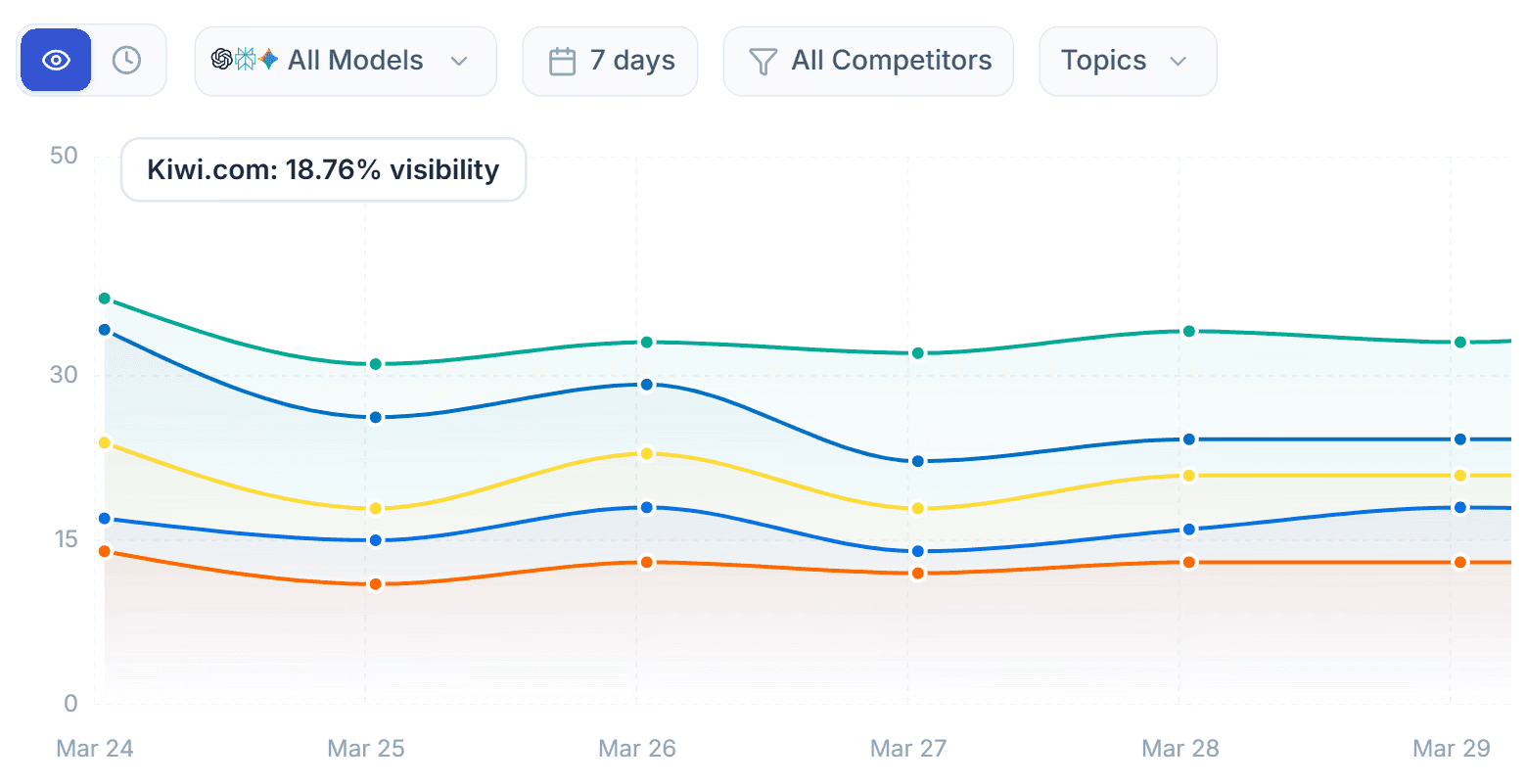
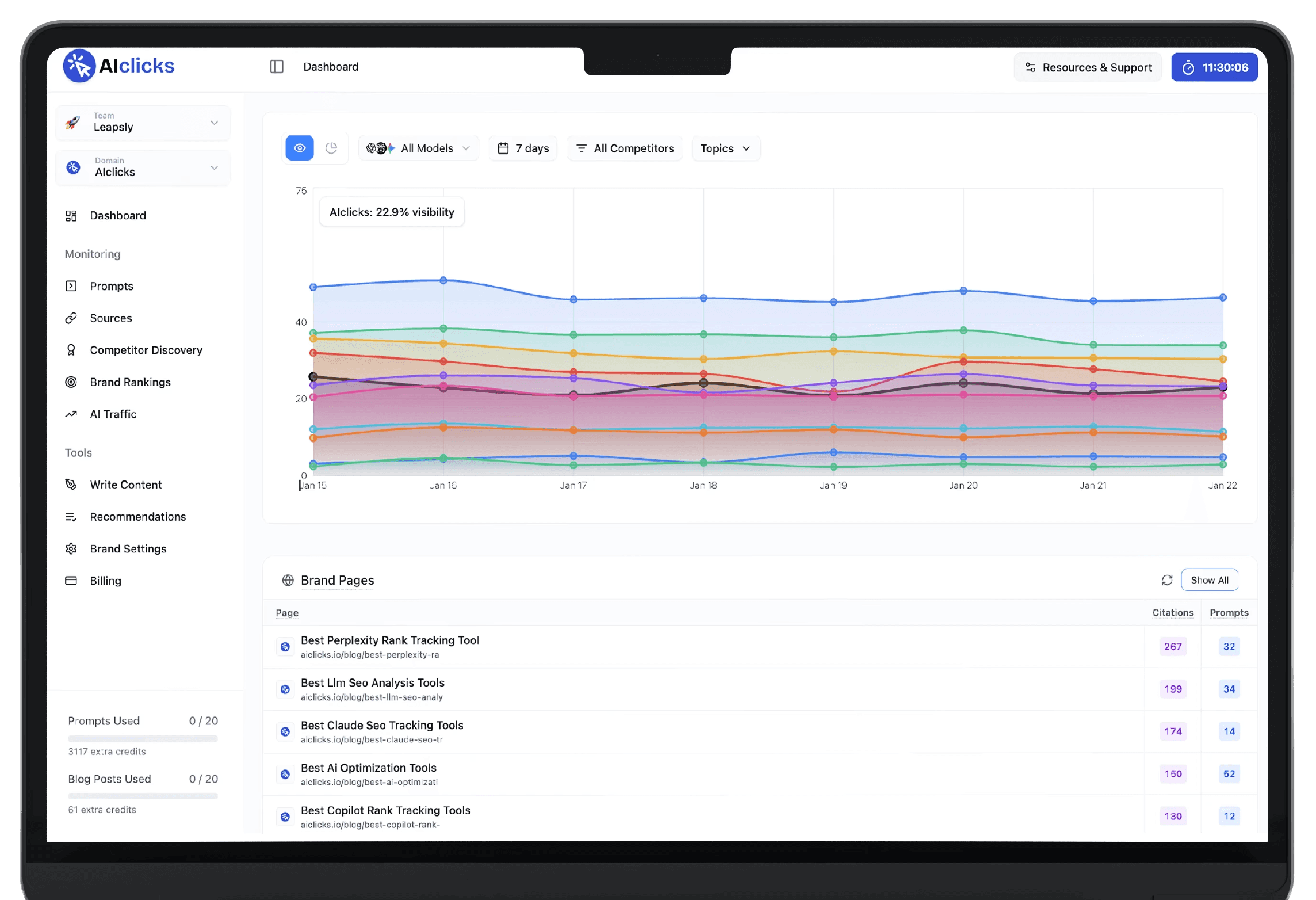
AIclicks gives you a live dashboard with daily ChatGPT mention rate, citation rate, sentiment, and share-of-voice across your tracked prompts, plus GA4 referral attribution for the traffic ChatGPT does send back.
Choose Your Plan
Flexible pricing that grows with your team. Upgrade or downgrade at any time.
Monthly
Yearly
-20%
Starter
Perfect for individuals & small teams
$49
/ month
Billed annually — you save $142
Choose 3 from:
Daily

" height="16px" id="fvSweaOBo" transform="translate(1 0)" width="14px"/></svg>)
" width="14px"><path d="M 13.864 5.629 L 13.3 5.629 L 13.3 5.6 L 7 5.6 L 7 8.4 L 10.956 8.4 C 10.379 10.03 8.828 11.2 7 11.2 C 4.681 11.2 2.8 9.319 2.8 7 C 2.8 4.681 4.681 2.8 7 2.8 C 8.071 2.8 9.045 3.204 9.786 3.864 L 11.766 1.884 C 10.516 0.719 8.844 0 7 0 C 3.134 0 0 3.134 0 7 C 0 10.866 3.134 14 7 14 C 10.866 14 14 10.866 14 7 C 14 6.531 13.952 6.073 13.864 5.629 Z" fill="rgb(255, 193, 7)" height="14px" id="H_YjfTNpn" width="14px"/><path d="M 0 3.742 L 2.3 5.429 C 2.922 3.888 4.429 2.8 6.193 2.8 C 7.264 2.8 8.238 3.204 8.979 3.864 L 10.959 1.884 C 9.709 0.719 8.037 0 6.193 0 C 3.504 0 1.172 1.518 0 3.742 Z" fill="rgb(255, 61, 0)" height="5.428500000000002px" id="PlkthQDhg" transform="translate(0.875 0)" width="10.959199999999996px"/><path d="M 6.232 5.581 C 8.04 5.581 9.683 4.889 10.925 3.764 L 8.758 1.931 C 8.032 2.483 7.144 2.782 6.232 2.781 C 4.411 2.781 2.865 1.62 2.283 0 L 0 1.759 C 1.159 4.026 3.511 5.581 6.232 5.581 Z" fill="rgb(76, 175, 80)" height="5.581099999999999px" id="WlnJ5gngE" transform="translate(0.7 8.4)" width="10.924899999999994px"/><path d="M 6.864 0.029 L 6.3 0.029 L 6.3 0 L 0 0 L 0 2.8 L 3.956 2.8 C 3.68 3.576 3.183 4.254 2.526 4.75 L 2.527 4.749 L 4.693 6.582 C 4.54 6.722 7 4.9 7 1.4 C 7 0.931 6.952 0.473 6.864 0.029 Z" fill="rgb(25, 118, 210)" height="6.589883930775992px" id="x_rSW275p" transform="translate(7 5.6)" width="7px"/></g></svg>)
" height="16px" id="hHS98fTxZ" width="16px"/></svg>)
 scale(1 1) translate(-1.861736945942159, -1.1170155383302638)" id="P20NzAvj0-699428820-radial-gradient" r="0.9935228066204626"><stop offset="0" stop-color="rgb(0, 174, 255)"/><stop offset="1" stop-color="rgb(7, 54, 196)"/></radialGradient><radialGradient cx="0.48250042504016705" cy="1.8366934653567062" gradient-transform="translate(0.48250042504016705, 1.8366934653567062) scale(1 1) translate(-0.48250042504016705, -1.8366934653567062)" id="UEWZqVjij-699428820-radial-gradient" r="0.9176890228114506"><stop offset="0" stop-color="rgb(255, 182, 87)"/><stop offset="1" stop-color="rgb(192, 43, 60)"/></radialGradient><linearGradient id="jyMN3TmKx-699428820-linear-gradient" x1="0.4594862532842614" x2="0.5405137467157386" y1="0" y2="1"><stop offset="0" stop-color="rgb(13, 145, 225)"/><stop offset="1" stop-color="rgb(255, 200, 0)"/></linearGradient><linearGradient id="xhMNwDFG0-699428820-linear-gradient" x1="0.4784828731548295" x2="0.5215171268451705" y1="5.551115123125783e-17" y2="1"><stop offset="0" stop-color="rgb(61, 203, 255)"/><stop offset="1" stop-color="rgba(5, 136, 247, 0)"/></linearGradient><radialGradient cx="1.4305090871482182" cy="0.34866158048251783" gradient-transform="translate(1.4305090871482182, 0.34866158048251783) scale(1 1) translate(-1.4305090871482182, -0.34866158048251783)" id="i79kAqaS4-699428820-radial-gradient" r="1.3362743412697924"><stop offset="0" stop-color="rgb(140, 72, 255)"/><stop offset="1" stop-color="rgb(255, 177, 82)"/></radialGradient><linearGradient id="mcxvno3tX-699428820-linear-gradient" x1="0.49844355920154226" x2="0.5015564407984577" y1="0" y2="1"><stop offset="0" stop-color="rgb(248, 173, 250)"/><stop offset="1" stop-color="rgba(168, 110, 221, 0)"/></linearGradient></defs><g d="M 11.605 1.219 C 11.397 0.499 10.739 0.002 9.989 0 L 9.498 0 C 8.682 0.002 7.985 0.588 7.842 1.391 L 7 6.016 L 7.209 5.296 C 7.416 4.574 8.075 4.076 8.825 4.074 L 11.681 4.074 L 12.879 4.545 L 14.033 4.074 L 13.697 4.074 C 12.947 4.072 12.289 3.575 12.081 2.855 Z M 4.413 13.387 C 4.618 14.111 5.278 14.611 6.031 14.613 L 7.075 14.613 C 7.988 14.613 8.735 13.88 8.758 12.96 L 8.871 8.5 L 8.633 9.319 C 8.426 10.039 7.768 10.537 7.018 10.539 L 4.138 10.539 L 3.111 9.977 L 2 10.539 L 2.331 10.539 C 3.084 10.542 3.743 11.042 3.949 11.766 L 4.413 13.387 Z M 9.999 0 L 4.167 0 C 2.501 0 1.501 2.221 0.834 4.441 C 0.045 7.073 -0.989 10.591 2.001 10.591 L 4.519 10.591 C 5.273 10.591 5.933 10.089 6.139 9.36 C 6.577 7.815 7.345 5.121 7.948 3.069 C 8.255 2.027 8.509 1.132 8.901 0.575 C 9.148 0.212 9.56 -0.004 9.999 0 M 9.999 0 L 4.167 0 C 2.501 0 1.501 2.221 0.834 4.441 C 0.045 7.073 -0.989 10.591 2.001 10.591 L 4.519 10.591 C 5.273 10.591 5.933 10.089 6.139 9.36 C 6.577 7.815 7.345 5.121 7.948 3.069 C 8.255 2.027 8.509 1.132 8.901 0.575 C 9.148 0.212 9.56 -0.004 9.999 0 M 6 14.593 L 11.833 14.593 C 13.499 14.593 14.499 12.372 15.166 10.151 C 15.955 7.519 16.989 4 13.999 4 L 11.48 4 C 10.725 4.002 10.063 4.505 9.86 5.232 C 9.266 7.332 8.663 9.429 8.051 11.523 C 7.745 12.566 7.49 13.461 7.098 14.019 C 6.851 14.382 6.439 14.597 6 14.593 M 6 14.593 L 11.833 14.593 C 13.499 14.593 14.499 12.372 15.166 10.151 C 15.955 7.519 16.989 4 13.999 4 L 11.48 4 C 10.725 4.002 10.063 4.505 9.86 5.232 C 9.266 7.332 8.663 9.429 8.051 11.523 C 7.745 12.566 7.49 13.461 7.098 14.019 C 6.851 14.382 6.439 14.597 6 14.593" fill="transparent" height="14.613333333333333px" id="QzkBy4Ibc" transform="translate(0 1)" width="16.00011071294081px"><path d="M 4.605 1.219 C 4.397 0.499 3.739 0.002 2.989 0 L 2.498 0 C 1.682 0.002 0.985 0.588 0.842 1.391 L 0 6.016 L 0.209 5.296 C 0.416 4.574 1.075 4.076 1.825 4.074 L 4.681 4.074 L 5.879 4.545 L 7.033 4.074 L 6.697 4.074 C 5.947 4.072 5.289 3.575 5.081 2.855 Z" fill="url(%23P20NzAvj0-699428820-radial-gradient)" height="6.016px" id="P20NzAvj0" transform="translate(7 0)" width="7.0333333333333385px"/><path d="M 2.413 4.887 C 2.618 5.611 3.278 6.111 4.031 6.113 L 5.075 6.113 C 5.988 6.113 6.735 5.38 6.758 4.46 L 6.871 0 L 6.633 0.819 C 6.426 1.539 5.768 2.037 5.018 2.039 L 2.138 2.039 L 1.111 1.477 L 0 2.039 L 0.331 2.039 C 1.084 2.042 1.743 2.542 1.949 3.266 L 2.413 4.887 Z" fill="url(%23UEWZqVjij-699428820-radial-gradient)" height="6.113333333333333px" id="UEWZqVjij" transform="translate(2 8.5)" width="6.871333333333332px"/><path d="M 9.999 0 L 4.167 0 C 2.501 0 1.501 2.221 0.834 4.441 C 0.045 7.073 -0.989 10.591 2.001 10.591 L 4.519 10.591 C 5.273 10.591 5.933 10.089 6.139 9.36 C 6.577 7.815 7.345 5.121 7.948 3.069 C 8.255 2.027 8.509 1.132 8.901 0.575 C 9.148 0.212 9.56 -0.004 9.999 0" fill="url(%23jyMN3TmKx-699428820-linear-gradient)" height="10.591388755215167px" id="jyMN3TmKx" width="9.999444046274142px"/><path d="M 9.999 0 L 4.167 0 C 2.501 0 1.501 2.221 0.834 4.441 C 0.045 7.073 -0.989 10.591 2.001 10.591 L 4.519 10.591 C 5.273 10.591 5.933 10.089 6.139 9.36 C 6.577 7.815 7.345 5.121 7.948 3.069 C 8.255 2.027 8.509 1.132 8.901 0.575 C 9.148 0.212 9.56 -0.004 9.999 0" fill="url(%23xhMNwDFG0-699428820-linear-gradient)" height="10.591388755215167px" id="xhMNwDFG0" width="9.999444046274142px"/><path d="M 0 10.593 L 5.833 10.593 C 7.499 10.593 8.499 8.372 9.166 6.151 C 9.955 3.519 10.989 0 7.999 0 L 5.48 0 C 4.725 0.002 4.063 0.505 3.86 1.232 C 3.266 3.332 2.663 5.429 2.051 7.523 C 1.745 8.566 1.49 9.461 1.098 10.019 C 0.851 10.382 0.439 10.597 0 10.593" fill="url(%23i79kAqaS4-699428820-radial-gradient)" height="10.593388755215164px" id="i79kAqaS4" transform="translate(6 4)" width="10.000110712940803px"/><path d="M 0 10.593 L 5.833 10.593 C 7.499 10.593 8.499 8.372 9.166 6.151 C 9.955 3.519 10.989 0 7.999 0 L 5.48 0 C 4.725 0.002 4.063 0.505 3.86 1.232 C 3.266 3.332 2.663 5.429 2.051 7.523 C 1.745 8.566 1.49 9.461 1.098 10.019 C 0.851 10.382 0.439 10.597 0 10.593" fill="url(%23mcxvno3tX-699428820-linear-gradient)" height="10.593388755215164px" id="mcxvno3tX" transform="translate(6 4)" width="10.000110712940803px"/></g></svg>)
" height="15.360666565427872px" id="HZPvvPBv7" transform="translate(0 0.5)" width="16px"/></svg>)
Tracked prompts
30
Websites you can add
3
LLMs you can track
3
Countries per project
1
LLM responses / mo
4,650
AI-optimized articles per month
10
Integrations
-
Support
Pro
For growing teams for more power
$140
/ month
Billed annually — you save $454
Choose 4 from:
Daily
Tracked prompts
150
Websites you can add
Unlimited
LLMs you can track
4
Countries per project
Unlimited
LLM responses / mo
18,600
AI-optimized articles per month
20
Integrations
Google Analytics
Support
BUSINESS
Best for medium-sized organizations
$357
/ month
Billed annually — you save $1198
Choose 6 from:
Daily
Tracked prompts
300
Websites you can add
Unlimited
LLMs you can track
6
Countries per project
Unlimited
LLM responses / mo
55,800
AI-optimized articles per month
30
Integrations
Google Analytics, API
Support
Dedicated account specialist
Become the #1 Answer in AI
Succeed in GEO yourself, or let us do all the work.
Do it yourself
Use AIclicks to see exactly where you appear across 10+ AI platforms, spot the gaps competitors are filling, and act on clear weekly recommendations.
From $59/month · Cancel anytime
Done for you
We Do All the Work for You
Our team manages your complete search presence: traditional SEO and GEO strategy, content, implementation, and reporting. You focus on pet owners.
Custom pricing · Minimum 3-month engagement
The AI SEO agency trusted by 1,000+ brands worldwide
From solo founders to multi-client agencies, AIclicks runs the full AI SEO agency program for organizations of every shape and size that want to be cited across every AI surface.
4.9/5 stars on G2






FAQ
How soon would a vet practice see results from SEO?
Expect the map pack to shift within 2 to 4 months and steady new registrations by month 6 to 9. Competitive terms like emergency vet in a large city take 12 months or more, because you are building trust signals for pet health content, not just publishing pages. A practice in a quieter catchment often moves faster. Watch Google Business Profile calls first, since they rise well before organic rankings do.
Should we work on AI answers or stick with Google?
Both, because they now behave differently. Ahrefs analysed 863,000 keywords and found only 38% of pages cited in AI Overviews also ranked in the top 10, down from 76% a year earlier. Ranking no longer carries you into the answer. Worse for vets, assistants answering is my dog ill questions tend to cite PDSA, Blue Cross and RSPCA rather than practices, so the triage happens before anyone searches for you.
How is vet SEO different from ordinary local SEO?
Three things are different. Pet health is YMYL, so Google wants a named RCVS-registered vet behind clinical claims before it ranks you. Your competition is not other practices but corporate groups ranking one domain across hundreds of branches, plus charity advice sites that own the symptom queries. And regulation now pushes you to publish prices, which happens to be the single strongest content asset you can build. Generic local SEO advice touches none of that.
What should a veterinary practice budget for SEO?
Typically £500 to £1,200 a month where one practice serves a quiet catchment, £1,200 to £2,500 to compete properly in a busy town, and more again for multi-branch groups needing work on the practice management feed. Set it beside what out-of-hours ad clicks and leaflet drops already cost you, rather than against zero. 2 or 3 extra dentals a month usually covers the retainer.
Where do Google Ads fit alongside organic search?
You will still want ads on out-of-hours and emergency terms, because those searches happen once and cannot wait for a ranking. Everything else is cheaper organically. Most practices bid on the urgent queries while building organic strength on fees, procedures and symptom content, then let the ad data pick which page gets written next. Measure both on registrations and treatment value, not clicks or positions.
Which pages should a vet practice build first?
The Google Business Profile comes first, free and already outranking your own homepage. Then the fees page, which answers the question owners search most and almost nobody publishes. Then your out-of-hours page, then a page for each of your 3 highest-value procedures with a named vet on it, then a registration page built to convert. The blog comes last, and most practices start there.
How do we tell if any of this is working?
Count new client registrations from organic search, not rankings. Veterinary enquiries arrive by phone, so without call tracking the channel looks dead in analytics. Google Business Profile insights move first: calls, direction requests, website clicks. Search Console impressions on fee and procedure queries climb before positions do. Then reconcile with your practice management system, because registrations and first consults are the only numbers that pay.
Should we do this in-house or hire an agency?
Split it. Profile updates, photos, review requests and answering owner questions in writing belong in-house, because nobody outside the practice knows your cases or your catchment. Technical work, schema and citation cleanup need a specialist. If you outsource, pick someone who can talk about RCVS advertising guidance and price transparency without being briefed. Practice owners on forums repeatedly describe agencies that spent 6 months auditing and delivered nothing measurable.
Further Reading
Go deeper on GEO, AI search, and visibility tracking.