SEO for Travel Agencies:
A traveller now drafts the itinerary before they look for anyone to book it. They ask an AI assistant where to go, search near me for someone local, then read reviews. Most of that happens before your consultation form is ever opened.









Why Travel Agencies Need SEO
Travel is one of the most common things people now ask AI assistants about, and the planning happens weeks before anyone books. Three problems keep agencies out of that window.
Your site is organised the way you sell: cruises, all-inclusive, groups, honeymoons. Travellers search by trip and traveller type, a multigenerational river cruise or a first-time safari, and land on whoever wrote it. You never see the enquiry, so you assume the demand was not there.
Search travel agent near me in a US city and Travel Leaders, Thumbtack, Yelp and the Better Business Bureau all sit above independent advisors. So does your host agency, which runs programmatic near-me pages for every market and lists you inside them, on its domain rather than yours.
Travel SEO retainers start around $1,500 to $3,000 a month, and most agencies instead pour that into boosted posts, bridal-show booths and supplier co-op ads. Every one of those stops the day you stop paying. Commission is thin enough without renting all the attention that earns it.
How SEO Works for Travel Agencies
Search Engine Optimization projects are long-term investments for travel advisors, where each task supplements the others and creates compound results over time.
01
Keywords, page structure, and the signals Google reads directly
On-page work fails in travel for a structural reason: agencies build sites around suppliers and internal service categories, and travellers search around trips. A menu reading Cruises, Tours, All-Inclusive and Groups makes sense to an advisor and matches nothing anyone types. The pages that earn enquiries are one page per trip type crossed with traveller type, plus your specialisation page, your planning-fee page and your sample itineraries. Worse, much of the copy already on those pages arrived from a supplier or a host agency and is sitting word for word on hundreds of other advisor sites.
Trip-type pages hold their value. A page explaining what a planning fee covers, or how far ahead to book a peak-season sailing, still pulls enquiries in 4 years because the question never changes. What rots is everything pinned to a date: the promotion that ended in March, the group departure that already sailed, the resort refurbishment notice. Travel agencies accumulate expired deal pages faster than any other local business and almost never remove them, so the site slowly fills with thin URLs advertising trips nobody can buy. Write fewer pages, tie them to trip types rather than promotions, and revisit prices annually.
1
Replace the supplier-led menu with one page per trip type and traveller type: multigenerational river cruise, first-time safari, all-inclusive honeymoon.
2
Pull every promotion and departed sailing page from Search Console quarterly, then 301 each into the evergreen trip-type page that replaced it.
3
Mark the business up with TravelAgency schema and each sample itinerary with TouristTrip, then validate both in Google’s Rich Results Test.
4
Publish what a planning fee buys, what happens when a supplier fails, and how booking through an advisor compares with booking direct.
02
Map Pack visibility, citations, and proximity signals
Travel agent near me returns a map pack of 3 advisors above every organic result, including the national networks and Yelp. The pack is the only place where a solo home-based advisor beats a company with thousands of agents. Most travel demand is not local, but the decision to trust a person with $8,000 and a honeymoon usually is, and the profile carrying reviews wins it.
Most advisors work from home, so the profile has to be built as a service-area business with the street address hidden, or Google suspends it. Set Travel Agency as the primary category, add Cruise Agency or Tour Operator only if you genuinely do that work, list each trip type as a service, and pre-answer what decides bookings: fees, deposits, and whether the first call costs anything.
Travel carries an accreditation layer that general local SEO advice never mentions. IATAN, CLIA and ASTA all run consumer-facing advisor finders, and consortium profiles on Virtuoso, Signature Travel Network or Ensemble carry real weight. Then the ordinary layer: Better Business Bureau, Yelp, Thumbtack and your chamber of commerce, which genuinely ranks for near-me travel queries. Every listing needs the identical business name, suite and phone.
1
Set Travel Agency as the primary category, hide the home address, define your service area, and list every trip type as a service.
2
Give each staffed office its own profile; home-based contractors need their own service-area listing, never a duplicate pinned to the agency address.
3
Run Whitespark across your IATAN, CLIA, ASTA and consortium profiles, then fix every business name, suite and phone variant you find.
4
Post to the profile weekly from a live client trip or a site inspection, using a photograph you took yourself.
03
Topic authority, inbound links, and content that earns traffic
Before anyone contacts an advisor they are working out whether they need one at all. The questions Google surfaces are blunt: is it cheaper to use a travel agent, how much does one cost, what are the drawbacks. Answer those plainly, with real fee numbers and the trips where booking direct is genuinely better, and you earn trust from the travellers most likely to book.
A traveller who has accepted they want an advisor is now choosing between 4 of them, and they want evidence. Sample itineraries with real budgets and day-by-day detail, the properties you have personally inspected, your certifications, and a straight answer on what you charge beat any amount of passionate about travel. Put the fee on the page. Advisors lose these enquiries at the point of not finding a price.
Travel links come from the supply chain rather than the industry. Tourism boards and destination marketing organisations publish partner and press-trip pages. Cruise lines and tour operators list preferred advisors. Trade titles such as Travel Weekly, Travel Market Report and TravelPulse quote working advisors on deadline, and none of them are hard to reach. Add your consortium member profile, the chamber of commerce, and the schools and charities whose group trips you already handle.
1
Publish an annual booking-direct-versus-advisor comparison using your real planning fees, including the trip types where booking direct genuinely wins.
2
Build one landing page per trip type crossed with traveller type, each with its own sample itinerary, budget band and supplier list.
3
Cluster every affordability question into one hub: planning fees, deposit schedules, payment plans, travel insurance, and what is refundable when plans change.
4
Build a page for every cruise line, tour operator and resort group you sell, naming your preferred-partner or Virtuoso status and the perks it unlocks.
04
Site speed, crawlability, Core Web Vitals, and mobile health
The failure specific to this industry is the host agency website. Independent advisors are handed a free templated site carrying supplier-syndicated destination copy, often on a subdomain or a folder of the host’s domain, so every link and ranking signal accrues to the host. The packages section is usually an iframed booking engine from a vendor such as VAX VacationAccess, which Google never indexes, so the most commercial inventory on the site is invisible.
Travel sites are among the heaviest on the web, because the thing that sells a trip is a photograph. One itinerary page can ship 30 full-resolution supplier images, an autoplaying hero video and 3 Instagram embeds. The traveller comparing advisors is doing it on a phone, often on hotel or airport wifi, with 2 other tabs open. If the consultation button renders after the gallery, they enquire with whoever loaded first.
1
Run URL Inspection on your packages page and read the rendered HTML; if the booking engine sits in an iframe, none of it is indexed.
2
Test your longest sample itinerary in PageSpeed Insights and fix whatever the image gallery is doing to Largest Contentful Paint on mobile.
3
Resize supplier hero photography to display size, convert to WebP or AVIF, strip EXIF data, and lazy-load everything below the first screen.
4
Keep trip-type pages in a separate sitemap from deals, set accurate lastmod dates, and push updates to Bing through IndexNow.
05
Star ratings, review volume, and response strategy that builds trust
Reviews decide this industry because a traveller is handing a stranger a deposit, a passport number and the only 2 weeks off they get all year. They are also awkward to collect. The reviewable moment lands after the trip, when the client is jet-lagged and back at work, and when something goes wrong, a cancelled flight, a hurricane, an airline strike, a supplier collapse, the advisor absorbs the blame for decisions they never made and could not have prevented.
Ask 3 or 4 days after they land, while the photos are still being posted and before the laundry is done. Wire it to trip status in Travefy, TravelJoy or Tern so it fires automatically on the return date, signed by the advisor who planned the trip, with one link and one sentence and nothing to log into. Ask after every trip, not only the expensive ones, because an agency that asks selectively ends up with a profile that reads as curated.
1
Fire the review request from Travefy, TravelJoy or Tern 3 days after the return date, signed by the advisor who planned it.
2
Reply within 24 hours, separating what you controlled from what an airline or supplier did, without contradicting the traveller’s account of the trip.
3
Surface honeymoon reviews on the honeymoon page and cruise reviews on the cruise page, rather than one site-wide testimonial slider.
4
Ask every traveller on a group departure, not only the organiser, since a single escorted trip can yield 20 willing reviewers.
Google is No Longer the Only Place Your travellers are Searching
Travellers are using AI to find answers, and they trust what it tells them. Invest in GEO to get recommended in those answers.
1 Billion
Questions ChatGPT receives every single day
38%
Your #1 top ranking page on Google would be cited by AI
14%
of travel advisors optimise for GEO. The rest are invisible in AI answers


You can rank #1 for “travel advisor near me” and still not exist in ChatGPT’s answer. Run a free GEO audit to see where your brand actually stands.
GEO vs SEO: Same Goal, Different Methods
GEO is wider than SEO. AI recommends the brands that show up across the sources it reads, so your presence in forums, social platforms and travel blogs decides your odds. AIclicks measures the three metrics below so you know which to work on first.
AI Assistant
Which travel advisor should I use to plan this?
Your Agency
Citation Rate
Shows how many AI answers about travel agencies name your brand, out of every 100. Models pull from the same trusted pages over and over, so citations compound: once you are in, staying in gets easier. Find the competitor pages AI cites most, then publish your own version of each.
Your Agency
82% positive
Competitor A
54% positive
Competitor B
38% positive
Brand Sentiment
Shows how AI describes you when your brand comes up: positive, neutral or negative. Tone is what separates being mentioned from being recommended, and models repeat whatever framing they find. Track the negative mentions back to the reviews and threads behind them, then publish content that answers those directly.
Others 52%
You 24%
— 24%
Your Agency
AI mention share of voice — travel category
Competitors
Not Cited
Share of Voice in AI
Shows how much of the travel conversation belongs to you rather than your competitors. This is the metric that matters most, the GEO version of a Google ranking. With only 1–5 brands named per answer, the market is winner-takes-more and every point is taken from someone.
The Dashboard Your Dedicated AI Search Team Works In
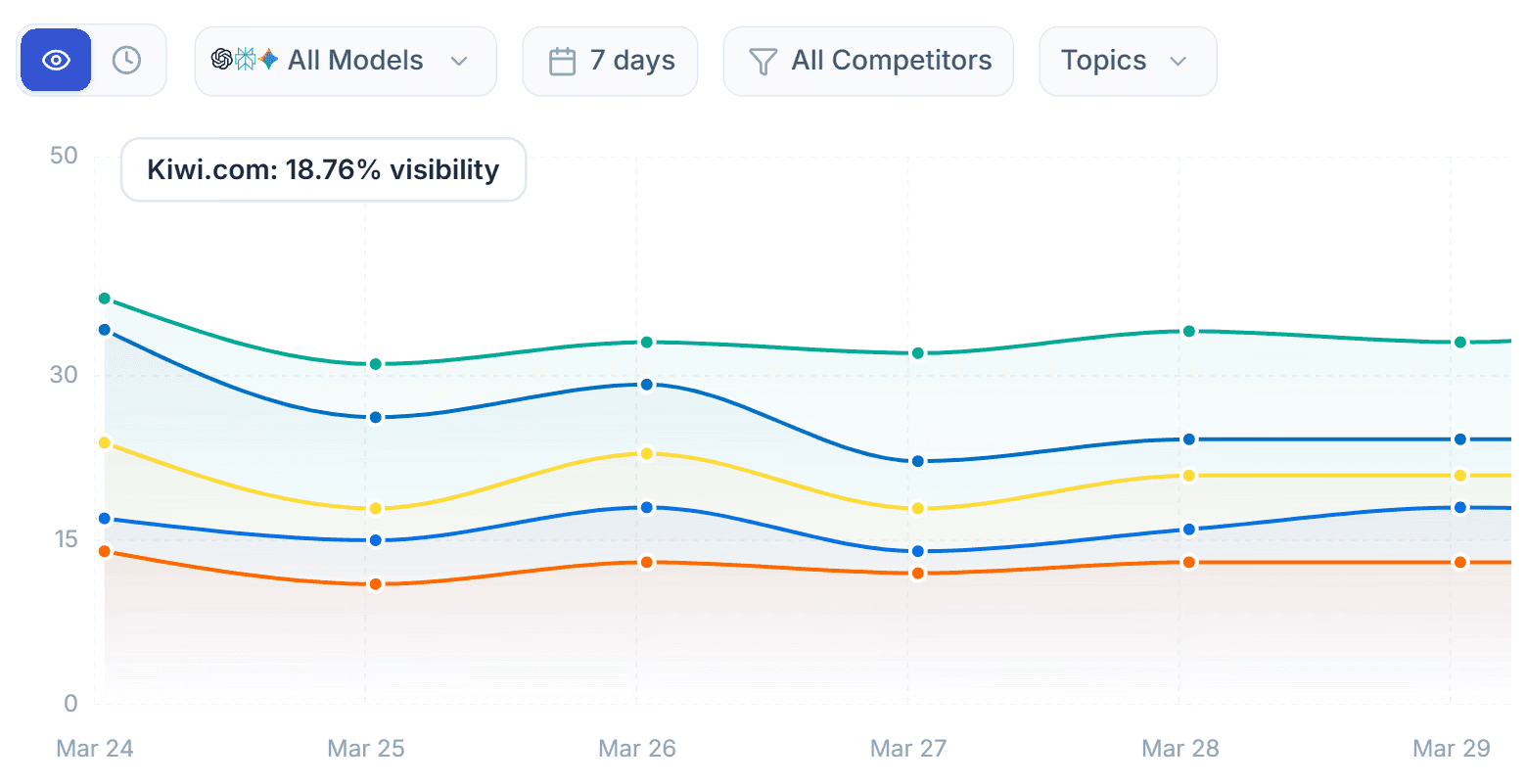
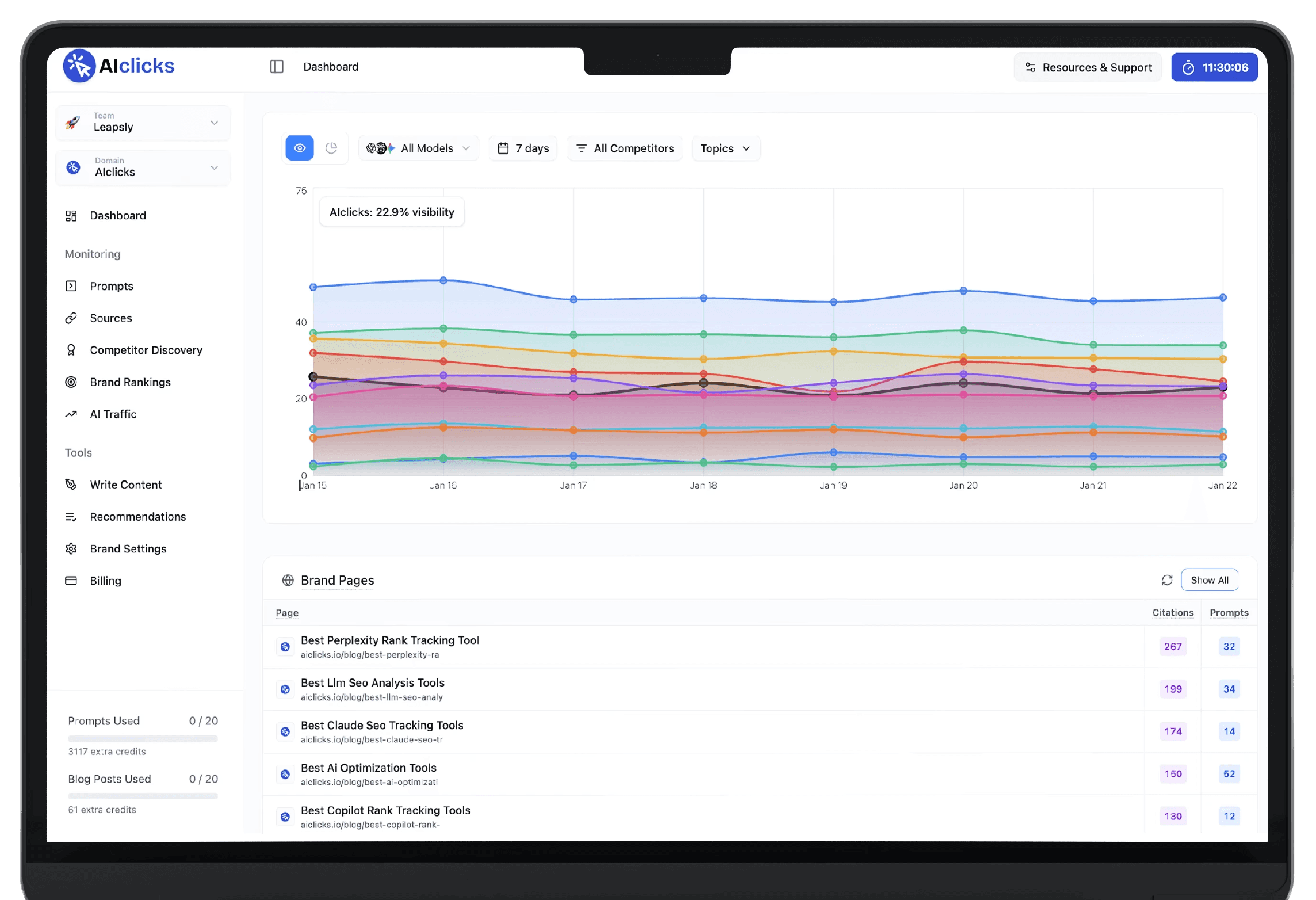
AIclicks gives you a live dashboard with daily ChatGPT mention rate, citation rate, sentiment, and share-of-voice across your tracked prompts, plus GA4 referral attribution for the traffic ChatGPT does send back.
Choose Your Plan
Flexible pricing that grows with your team. Upgrade or downgrade at any time.
Monthly
Yearly
-20%
Starter
Perfect for individuals & small teams
$49
/ month
Billed annually — you save $142
Choose 3 from:
Daily

" height="16px" id="fvSweaOBo" transform="translate(1 0)" width="14px"/></svg>)
" width="14px"><path d="M 13.864 5.629 L 13.3 5.629 L 13.3 5.6 L 7 5.6 L 7 8.4 L 10.956 8.4 C 10.379 10.03 8.828 11.2 7 11.2 C 4.681 11.2 2.8 9.319 2.8 7 C 2.8 4.681 4.681 2.8 7 2.8 C 8.071 2.8 9.045 3.204 9.786 3.864 L 11.766 1.884 C 10.516 0.719 8.844 0 7 0 C 3.134 0 0 3.134 0 7 C 0 10.866 3.134 14 7 14 C 10.866 14 14 10.866 14 7 C 14 6.531 13.952 6.073 13.864 5.629 Z" fill="rgb(255, 193, 7)" height="14px" id="H_YjfTNpn" width="14px"/><path d="M 0 3.742 L 2.3 5.429 C 2.922 3.888 4.429 2.8 6.193 2.8 C 7.264 2.8 8.238 3.204 8.979 3.864 L 10.959 1.884 C 9.709 0.719 8.037 0 6.193 0 C 3.504 0 1.172 1.518 0 3.742 Z" fill="rgb(255, 61, 0)" height="5.428500000000002px" id="PlkthQDhg" transform="translate(0.875 0)" width="10.959199999999996px"/><path d="M 6.232 5.581 C 8.04 5.581 9.683 4.889 10.925 3.764 L 8.758 1.931 C 8.032 2.483 7.144 2.782 6.232 2.781 C 4.411 2.781 2.865 1.62 2.283 0 L 0 1.759 C 1.159 4.026 3.511 5.581 6.232 5.581 Z" fill="rgb(76, 175, 80)" height="5.581099999999999px" id="WlnJ5gngE" transform="translate(0.7 8.4)" width="10.924899999999994px"/><path d="M 6.864 0.029 L 6.3 0.029 L 6.3 0 L 0 0 L 0 2.8 L 3.956 2.8 C 3.68 3.576 3.183 4.254 2.526 4.75 L 2.527 4.749 L 4.693 6.582 C 4.54 6.722 7 4.9 7 1.4 C 7 0.931 6.952 0.473 6.864 0.029 Z" fill="rgb(25, 118, 210)" height="6.589883930775992px" id="x_rSW275p" transform="translate(7 5.6)" width="7px"/></g></svg>)
" height="16px" id="hHS98fTxZ" width="16px"/></svg>)
 scale(1 1) translate(-1.861736945942159, -1.1170155383302638)" id="P20NzAvj0-699428820-radial-gradient" r="0.9935228066204626"><stop offset="0" stop-color="rgb(0, 174, 255)"/><stop offset="1" stop-color="rgb(7, 54, 196)"/></radialGradient><radialGradient cx="0.48250042504016705" cy="1.8366934653567062" gradient-transform="translate(0.48250042504016705, 1.8366934653567062) scale(1 1) translate(-0.48250042504016705, -1.8366934653567062)" id="UEWZqVjij-699428820-radial-gradient" r="0.9176890228114506"><stop offset="0" stop-color="rgb(255, 182, 87)"/><stop offset="1" stop-color="rgb(192, 43, 60)"/></radialGradient><linearGradient id="jyMN3TmKx-699428820-linear-gradient" x1="0.4594862532842614" x2="0.5405137467157386" y1="0" y2="1"><stop offset="0" stop-color="rgb(13, 145, 225)"/><stop offset="1" stop-color="rgb(255, 200, 0)"/></linearGradient><linearGradient id="xhMNwDFG0-699428820-linear-gradient" x1="0.4784828731548295" x2="0.5215171268451705" y1="5.551115123125783e-17" y2="1"><stop offset="0" stop-color="rgb(61, 203, 255)"/><stop offset="1" stop-color="rgba(5, 136, 247, 0)"/></linearGradient><radialGradient cx="1.4305090871482182" cy="0.34866158048251783" gradient-transform="translate(1.4305090871482182, 0.34866158048251783) scale(1 1) translate(-1.4305090871482182, -0.34866158048251783)" id="i79kAqaS4-699428820-radial-gradient" r="1.3362743412697924"><stop offset="0" stop-color="rgb(140, 72, 255)"/><stop offset="1" stop-color="rgb(255, 177, 82)"/></radialGradient><linearGradient id="mcxvno3tX-699428820-linear-gradient" x1="0.49844355920154226" x2="0.5015564407984577" y1="0" y2="1"><stop offset="0" stop-color="rgb(248, 173, 250)"/><stop offset="1" stop-color="rgba(168, 110, 221, 0)"/></linearGradient></defs><g d="M 11.605 1.219 C 11.397 0.499 10.739 0.002 9.989 0 L 9.498 0 C 8.682 0.002 7.985 0.588 7.842 1.391 L 7 6.016 L 7.209 5.296 C 7.416 4.574 8.075 4.076 8.825 4.074 L 11.681 4.074 L 12.879 4.545 L 14.033 4.074 L 13.697 4.074 C 12.947 4.072 12.289 3.575 12.081 2.855 Z M 4.413 13.387 C 4.618 14.111 5.278 14.611 6.031 14.613 L 7.075 14.613 C 7.988 14.613 8.735 13.88 8.758 12.96 L 8.871 8.5 L 8.633 9.319 C 8.426 10.039 7.768 10.537 7.018 10.539 L 4.138 10.539 L 3.111 9.977 L 2 10.539 L 2.331 10.539 C 3.084 10.542 3.743 11.042 3.949 11.766 L 4.413 13.387 Z M 9.999 0 L 4.167 0 C 2.501 0 1.501 2.221 0.834 4.441 C 0.045 7.073 -0.989 10.591 2.001 10.591 L 4.519 10.591 C 5.273 10.591 5.933 10.089 6.139 9.36 C 6.577 7.815 7.345 5.121 7.948 3.069 C 8.255 2.027 8.509 1.132 8.901 0.575 C 9.148 0.212 9.56 -0.004 9.999 0 M 9.999 0 L 4.167 0 C 2.501 0 1.501 2.221 0.834 4.441 C 0.045 7.073 -0.989 10.591 2.001 10.591 L 4.519 10.591 C 5.273 10.591 5.933 10.089 6.139 9.36 C 6.577 7.815 7.345 5.121 7.948 3.069 C 8.255 2.027 8.509 1.132 8.901 0.575 C 9.148 0.212 9.56 -0.004 9.999 0 M 6 14.593 L 11.833 14.593 C 13.499 14.593 14.499 12.372 15.166 10.151 C 15.955 7.519 16.989 4 13.999 4 L 11.48 4 C 10.725 4.002 10.063 4.505 9.86 5.232 C 9.266 7.332 8.663 9.429 8.051 11.523 C 7.745 12.566 7.49 13.461 7.098 14.019 C 6.851 14.382 6.439 14.597 6 14.593 M 6 14.593 L 11.833 14.593 C 13.499 14.593 14.499 12.372 15.166 10.151 C 15.955 7.519 16.989 4 13.999 4 L 11.48 4 C 10.725 4.002 10.063 4.505 9.86 5.232 C 9.266 7.332 8.663 9.429 8.051 11.523 C 7.745 12.566 7.49 13.461 7.098 14.019 C 6.851 14.382 6.439 14.597 6 14.593" fill="transparent" height="14.613333333333333px" id="QzkBy4Ibc" transform="translate(0 1)" width="16.00011071294081px"><path d="M 4.605 1.219 C 4.397 0.499 3.739 0.002 2.989 0 L 2.498 0 C 1.682 0.002 0.985 0.588 0.842 1.391 L 0 6.016 L 0.209 5.296 C 0.416 4.574 1.075 4.076 1.825 4.074 L 4.681 4.074 L 5.879 4.545 L 7.033 4.074 L 6.697 4.074 C 5.947 4.072 5.289 3.575 5.081 2.855 Z" fill="url(%23P20NzAvj0-699428820-radial-gradient)" height="6.016px" id="P20NzAvj0" transform="translate(7 0)" width="7.0333333333333385px"/><path d="M 2.413 4.887 C 2.618 5.611 3.278 6.111 4.031 6.113 L 5.075 6.113 C 5.988 6.113 6.735 5.38 6.758 4.46 L 6.871 0 L 6.633 0.819 C 6.426 1.539 5.768 2.037 5.018 2.039 L 2.138 2.039 L 1.111 1.477 L 0 2.039 L 0.331 2.039 C 1.084 2.042 1.743 2.542 1.949 3.266 L 2.413 4.887 Z" fill="url(%23UEWZqVjij-699428820-radial-gradient)" height="6.113333333333333px" id="UEWZqVjij" transform="translate(2 8.5)" width="6.871333333333332px"/><path d="M 9.999 0 L 4.167 0 C 2.501 0 1.501 2.221 0.834 4.441 C 0.045 7.073 -0.989 10.591 2.001 10.591 L 4.519 10.591 C 5.273 10.591 5.933 10.089 6.139 9.36 C 6.577 7.815 7.345 5.121 7.948 3.069 C 8.255 2.027 8.509 1.132 8.901 0.575 C 9.148 0.212 9.56 -0.004 9.999 0" fill="url(%23jyMN3TmKx-699428820-linear-gradient)" height="10.591388755215167px" id="jyMN3TmKx" width="9.999444046274142px"/><path d="M 9.999 0 L 4.167 0 C 2.501 0 1.501 2.221 0.834 4.441 C 0.045 7.073 -0.989 10.591 2.001 10.591 L 4.519 10.591 C 5.273 10.591 5.933 10.089 6.139 9.36 C 6.577 7.815 7.345 5.121 7.948 3.069 C 8.255 2.027 8.509 1.132 8.901 0.575 C 9.148 0.212 9.56 -0.004 9.999 0" fill="url(%23xhMNwDFG0-699428820-linear-gradient)" height="10.591388755215167px" id="xhMNwDFG0" width="9.999444046274142px"/><path d="M 0 10.593 L 5.833 10.593 C 7.499 10.593 8.499 8.372 9.166 6.151 C 9.955 3.519 10.989 0 7.999 0 L 5.48 0 C 4.725 0.002 4.063 0.505 3.86 1.232 C 3.266 3.332 2.663 5.429 2.051 7.523 C 1.745 8.566 1.49 9.461 1.098 10.019 C 0.851 10.382 0.439 10.597 0 10.593" fill="url(%23i79kAqaS4-699428820-radial-gradient)" height="10.593388755215164px" id="i79kAqaS4" transform="translate(6 4)" width="10.000110712940803px"/><path d="M 0 10.593 L 5.833 10.593 C 7.499 10.593 8.499 8.372 9.166 6.151 C 9.955 3.519 10.989 0 7.999 0 L 5.48 0 C 4.725 0.002 4.063 0.505 3.86 1.232 C 3.266 3.332 2.663 5.429 2.051 7.523 C 1.745 8.566 1.49 9.461 1.098 10.019 C 0.851 10.382 0.439 10.597 0 10.593" fill="url(%23mcxvno3tX-699428820-linear-gradient)" height="10.593388755215164px" id="mcxvno3tX" transform="translate(6 4)" width="10.000110712940803px"/></g></svg>)
" height="15.360666565427872px" id="HZPvvPBv7" transform="translate(0 0.5)" width="16px"/></svg>)
Tracked prompts
30
Websites you can add
3
LLMs you can track
3
Countries per project
1
LLM responses / mo
4,650
AI-optimized articles per month
10
Integrations
-
Support
Pro
For growing teams for more power
$140
/ month
Billed annually — you save $454
Choose 4 from:
Daily
Tracked prompts
150
Websites you can add
Unlimited
LLMs you can track
4
Countries per project
Unlimited
LLM responses / mo
18,600
AI-optimized articles per month
20
Integrations
Google Analytics
Support
BUSINESS
Best for medium-sized organizations
$357
/ month
Billed annually — you save $1198
Choose 6 from:
Daily
Tracked prompts
300
Websites you can add
Unlimited
LLMs you can track
6
Countries per project
Unlimited
LLM responses / mo
55,800
AI-optimized articles per month
30
Integrations
Google Analytics, API
Support
Dedicated account specialist
Become the #1 Answer in AI
Succeed in GEO yourself, or let us do all the work.
Do it yourself
Use AIclicks to see exactly where you appear across 10+ AI platforms, spot the gaps competitors are filling, and act on clear weekly recommendations.
From $59/month · Cancel anytime
Done for you
We Do All the Work for You
Our team manages your complete search presence: traditional SEO and GEO strategy, content, implementation, and reporting. You focus on travellers.
Custom pricing · Minimum 3-month engagement
The AI SEO agency trusted by 1,000+ brands worldwide
From solo founders to multi-client agencies, AIclicks runs the full AI SEO agency program for organizations of every shape and size that want to be cited across every AI surface.
4.9/5 stars on G2







FAQ
Does SEO even work for a travel agency this new?
Expect map pack movement in 3 to 4 months and steady enquiries around 8. Trip-type and destination terms need 6 to 12 months of steady work, and a domain under a year old is starting from nothing, so the honest early signal is impressions in Search Console rather than bookings. Seasonality distorts the picture too: a page published 2 months before its booking window opens looks dead until it suddenly is not.
Is GEO actually a thing for travel advisors yet?
Yes, and travel is one of the categories where it bites hardest, because trip planning is exactly what people use chatbots for. Ahrefs analysed 863,000 keywords and found only 38% of pages cited in AI Overviews also ranked in the top 10, down from 76% a year earlier. Ranking no longer carries you into the answer. Being quotable, accredited and structured is a separate job.
What makes travel agency SEO different from normal local SEO?
Three things separate it. Demand is seasonal, so a page has to be live and indexed months before the booking window opens rather than during it. Your competition is not the agency down the road but booking platforms, national networks and your own host agency. And most advisors work from home, which changes how the Google Business Profile has to be built. Generic local advice covers none of that.
What should a travel agency budget for SEO each month?
Entry-level travel SEO retainers typically run $1,500 to $3,000 a month for a single-market agency, with specialist travel shops quoting from around $1,499 and broad industry averages closer to $3,000. A solo advisor can start far cheaper by handling the profile, the reviews and 2 trip-type pages in-house. Judge it against commission per booking: one recovered honeymoon or group departure covers several months.
How does SEO fit with the ads we already run?
They solve different problems. Paid social and search fill the shoulder-season gap and let you test which trip types actually convert; organic compounds and keeps working through the quiet months when the ad budget gets cut. Most agencies run ads on high-value terms they cannot yet rank for, and build organic strength on fee, process and trip-type queries. Judge both on cost per booked trip.
What should we build first if budget is tight?
Google Business Profile first, since it costs nothing and outranks every organic listing on near-me searches. It is the fastest thing you own. Then your 2 strongest trip-type pages, written the way travellers describe the trip rather than the way suppliers name it. Then the planning-fee page, which filters out people who were never going to pay. Sample itineraries after that. The travel-news blog is last, and mostly optional.
How do we tell whether any of this is working?
Count consultation requests from organic search, not rankings. Tag every enquiry form by landing page, add call tracking because plenty of travel enquiries still arrive by phone, and watch Google Business Profile insights for calls and direction requests, which move first. Inside Search Console, watch impressions on trip-type terms rather than position, since seasonality swings position for reasons unconnected to your work.
Should I do this myself or hire someone?
Split it. The profile, the reviews, the trip-type pages and the destination detail have to come from you, because nobody outside your business has stood in those hotels. Hand out the technical layer: schema, site speed, the iframe problem, citation cleanup. If you hire an agency, ask what they would do about your host agency template first. A generalist will not know it exists.
Further Reading
Go deeper on GEO, AI search, and visibility tracking.