SEO for Trade Businesses:
Get More Customers From Google
A homeowner with water coming through a ceiling gives you about 20 seconds. They open the map, ring the first 3 numbers with reviews, and book whoever answers. Increasingly they ask an assistant first, and it names someone before they have opened a single website.









Why Trade Businesses Need SEO
Rated People alone has routed over 3 million UK homeowners to a trade, and assistants now read those profiles rather than your website. Three problems decide whether your own name appears.
Nobody types electrical services or property maintenance. They type fuse box keeps tripping, EICR before a tenancy, shower tray leaking through a ceiling. A single Services page listing 14 jobs as bullets says almost nothing about any of them, so it ranks for none. The enquiry goes to whoever wrote an honest page about that job.
Search tradesmen near me in any UK town and Checkatrade, MyBuilder, Rated People and MyJobQuote fill the page before a single trade does. They aggregate over 50,000 tradespeople and outrank them all on authority, then sell a competitor the lead that came off your name. You appear inside their listing, paying for the privilege.
A plumbing business posted the $3,500 a month local SEO quote it had been given and asked what it actually bought them; 280 replies later and nobody could say. UK trade retainers realistically sit somewhere between £500 and £2,500 a month. Pay at the top of that range for reporting rather than pages and you still own nothing.
How SEO Works for Trade Businesses
Search Engine Optimization projects are long-term investments for tradesmen, where each task supplements the others and creates compound results over time.
01
Keywords, page structure, and the signals Google reads directly
On-page work is awkward for tradesmen because the thing you sell and the thing people search are different words. You quote for electrical installation; they search fuse box keeps tripping. You fit bathrooms; they search shower tray leaking through ceiling. The gap between trade vocabulary and homeowner panic is where most trade sites lose the job. The pages that carry weight are one per job you actually want more of, a rewire, an EICR, a flat roof repair, a boiler swap, plus your accreditation page and your emergency page. The van, the team photo and the About page rank for nothing.
The pages that hold value are built around a job, not a season. A page explaining what a fuse board upgrade involves, what certificate you hand over and what happens when the wiring behind it turns out to be rubber-sheathed will still be earning enquiries in 4 years, because the job does not change and neither does the worry. What churns is everything dated: the Christmas boiler service offer, the new van announcement, the weekly post about 5 signs you need an electrician. Most trade sites have this backwards, with 14 services in bullet points and a blog nobody reads.
1
Split the services list into one page per job: fuse board upgrade, EICR, rewire cost, flat roof repair, boiler swap.
2
Unpublish last winter’s boiler offers and retired accreditation pages in WordPress, redirecting each into the job page that replaced it.
3
Mark the site up with Plumber, Electrician or HomeAndConstructionBusiness schema plus Service and areaServed, then check it in Google’s Rich Results Test.
4
Publish a cost page per job and one per certificate you issue, EICR, Gas Safe record, Part P notification, which rank year-round.
02
Map Pack visibility, citations, and proximity signals
Almost nobody hires a tradesman outside the area they can get to in half an hour, so effectively all of the demand is local. That is why the 3-result map box sits above every organic result, Checkatrade included, and why most homeowners never scroll past it. It is also the one place a one-van outfit genuinely outranks a national directory, and claiming it costs nothing but the verification postcard.
Set the primary category to the trade people actually search, Roofer rather than Building Contractor, then add every job as a service with its own description. Draw the service area from towns you genuinely work in, not a 50-mile circle. Load photos from real jobs, boards, boilers, roofs mid-repair, dated as you go. Put opening hours that are true, including out-of-hours cover, and pre-answer the Q&A: call-out fee, minimum charge, whether you take card.
Trades carry 2 citation layers. The general one is Yell, Apple Business Connect, Bing Places and Facebook. The layer that actually moves rankings is the register layer: Gas Safe Register, NICEIC, NAPIT, FENSA, TrustMark, Which? Trusted Traders, the FMB, plus Checkatrade and MyBuilder. Google trusts them because each verifies a real qualification. Every one needs the identical trading name, unit number and mobile, because one stray variant across 30 listings quietly cancels the signal.
1
Pick the narrowest true primary category, list every job as a service, and set the service area by town rather than radius.
2
Give each yard or depot its own verified profile and its own page naming the team based there, never one profile listing 3 areas.
3
Run BrightLocal across Checkatrade, MyBuilder, Yell and your Gas Safe or NICEIC entry, and fix every trading-name and mobile-number variant.
4
Post one finished job a week to the profile from your phone, captioned with the job and the town, straight off the van.
03
Topic authority, inbound links, and content that earns traffic
Homeowners rarely know what to ask for. They search the symptom: lights keep tripping downstairs, no hot water but the boiler is on, damp patch above the bay window. A page that names the likely cause, says roughly what the fix costs and admits when it might be worse than it looks earns the call, because it is the first straight answer they have had all morning.
Someone who already knows they need a rewire is now choosing between 3 quotes. They want the certificate they will end up with, the accreditation number they can check on the register, a price band rather than call for a quote, and photos of a job like theirs. Put that on the job page, not 3 clicks away on a gallery. Most trades lose these enquiries at the point of hiding the price.
Trade links come off the job, not off a keyboard. Merchants and manufacturers run installer finders; Vaillant, Baxi, Velux and Ideal all list accredited fitters. Your accreditation bodies publish member directories. Architects, letting agents, estate agents and the surveyor who keeps recommending you all have websites with a partners page. Sponsor a junior football kit and the club lists you. None of that costs a link fee, and none of it can be bought back later.
1
Refresh a price guide for each job every year, with real bands, what moves the number, and what a bad quote looks like.
2
Write 3 or 4 genuine area pages covering that area’s housing stock and your jobs there, never 40 doorway pages with the town swapped.
3
Build one money hub covering payment terms, Boiler Upgrade Scheme grants, ECO4 eligibility, finance options and what size deposit is normal.
4
Build a page per brand you are accredited to fit, Vaillant, Baxi, Velux or Hive, since homeowners search the brand before the trade.
04
Site speed, crawlability, Core Web Vitals, and mobile health
The quiet killer in trades is the one-page website. A cheap build gives you a single URL with anchor links, so Services, About and Contact are not pages at all, just places the page scrolls to. Google has exactly one thing to rank, and it ranks it for your trading name only. Worse, the phone number often lives inside the header graphic, which means no search engine and no assistant can read it.
The highest-intent trade search happens standing in the room with the problem, on a phone, on patchy signal, with a bucket underneath the leak. That person is not browsing. They want a phone number and one line confirming you cover their postcode. If the page carries 30 uncompressed job photos, or a quote form loads before the header, or a cookie banner covers the call button, they are back in the map ringing the next name.
1
Crawl the site with Screaming Frog; if it returns 1 URL, rebuild Services as real pages and put the number in text.
2
Run PageSpeed Insights on your job gallery, the heaviest page on most trade sites, then throttle to 4G and retest.
3
Resize phone photos of finished jobs to display width and serve WebP; a raw 4 megabyte board shot kills the page on mobile.
4
Split job and area pages into their own sitemap, away from blog posts, and resubmit in Search Console whenever a price band changes.
05
Star ratings, review volume, and response strategy that builds trust
Reviews decide trade searches because a homeowner is about to give a stranger a key and a deposit, and the star rating is the only evidence they have. The difficulty is that trades collect them passively and therefore collect almost none. You finish, you load the van, you drive to the next job, and the moment passes. The people who do write unprompted are the ones arguing about a final invoice, which is why an unmanaged trade ends up rated by its complaints.
Ask before you leave, while they are looking at the finished work and still relieved. A saved text with a direct Google link, sent from the van outside, beats any automated sequence sent 3 days later when the job has become normal. If you invoice through Tradify, Powered Now or Xero, wire the request to fire when the invoice is marked paid. Ask on every job, small ones included, and keep it to a trickle rather than 20 in one week.
1
Trigger the review link from Tradify or Powered Now the moment an invoice is marked paid, or send a saved text on site.
2
Reply within 24 hours with dates, the quote and what you offered to put right; future customers read the reply, not the complaint.
3
Pull reviews that mention a rewire onto the rewire page and boiler reviews onto the boiler page, not a homepage carousel.
4
Ask the letting agents and landlords on your maintenance contracts too, since a repeat commercial reviewer carries more weight than a one-off homeowner.
Google is No Longer the Only Place Your customers are Searching
Customers are using AI to find answers, and they trust what it tells them. Invest in GEO to get recommended in those answers.
1 Billion
Questions ChatGPT receives every single day
38%
Your #1 top ranking page on Google would be cited by AI
14%
of tradesmen optimise for GEO. The rest are invisible in AI answers


You can rank #1 for “tradesman near me” and still not exist in ChatGPT’s answer. Run a free GEO audit to see where your brand actually stands.
GEO vs SEO: Same Goal, Different Methods
GEO is wider than SEO. AI recommends the brands that show up across the sources it reads, so your presence in forums, social platforms and trade blogs decides your odds. AIclicks measures the three metrics below so you know which to work on first.
AI Assistant
Who is the best local tradesman for emergency work?
Your Trade
Citation Rate
Shows how many AI answers about trade businesses name your brand, out of every 100. Models pull from the same trusted pages over and over, so citations compound: once you are in, staying in gets easier. Find the competitor pages AI cites most, then publish your own version of each.
Your Trade
82% positive
Competitor A
54% positive
Competitor B
38% positive
Brand Sentiment
Shows how AI describes you when your brand comes up: positive, neutral or negative. Tone is what separates being mentioned from being recommended, and models repeat whatever framing they find. Track the negative mentions back to the reviews and threads behind them, then publish content that answers those directly.
Others 52%
You 24%
— 24%
Your Trade
AI mention share of voice — trade category
Not Cited
Share of Voice in AI
Shows how much of the trade conversation belongs to you rather than your competitors. This is the metric that matters most, the GEO version of a Google ranking. With only 1–5 brands named per answer, the market is winner-takes-more and every point is taken from someone.
The Dashboard Your Dedicated AI Search Team Works In
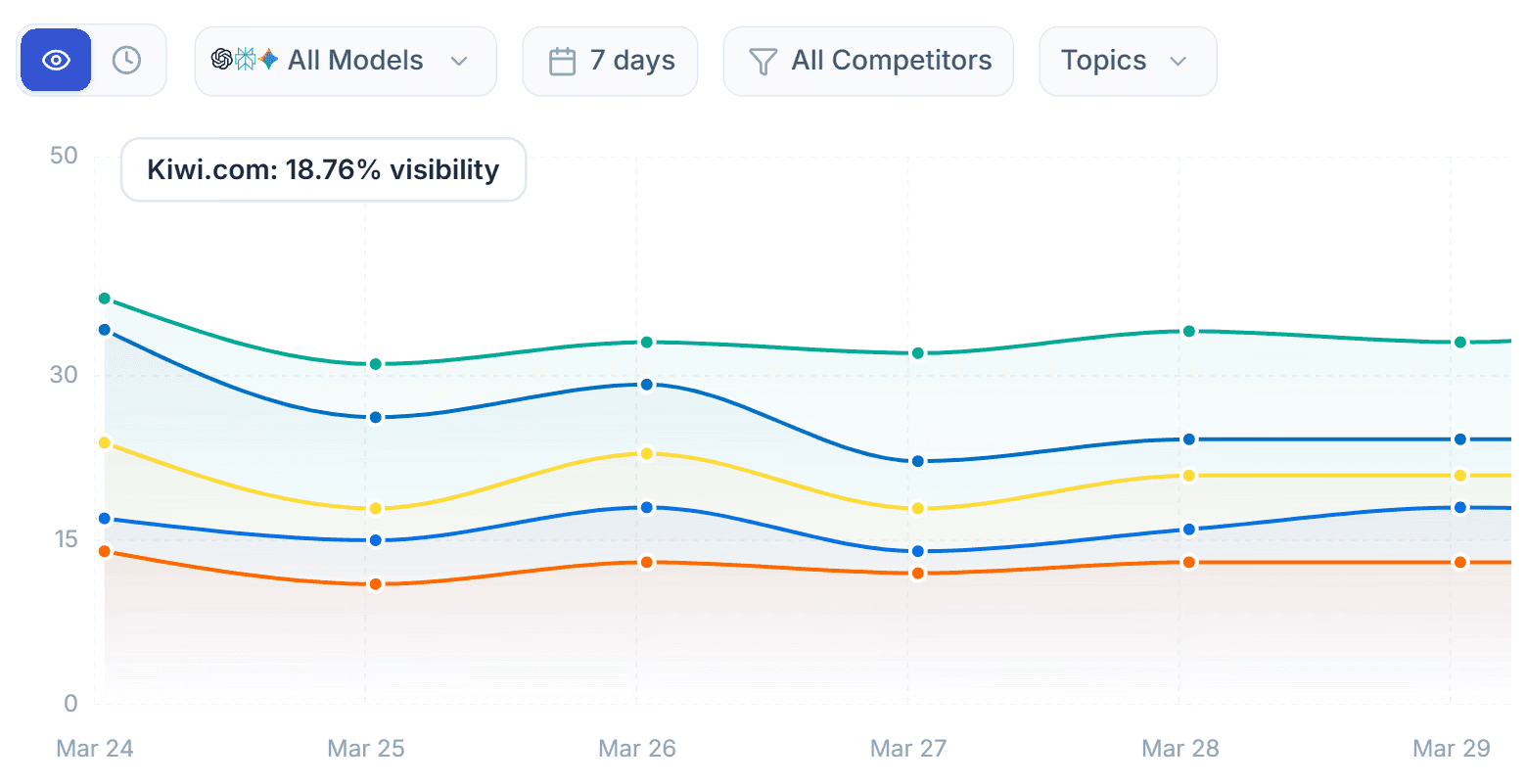
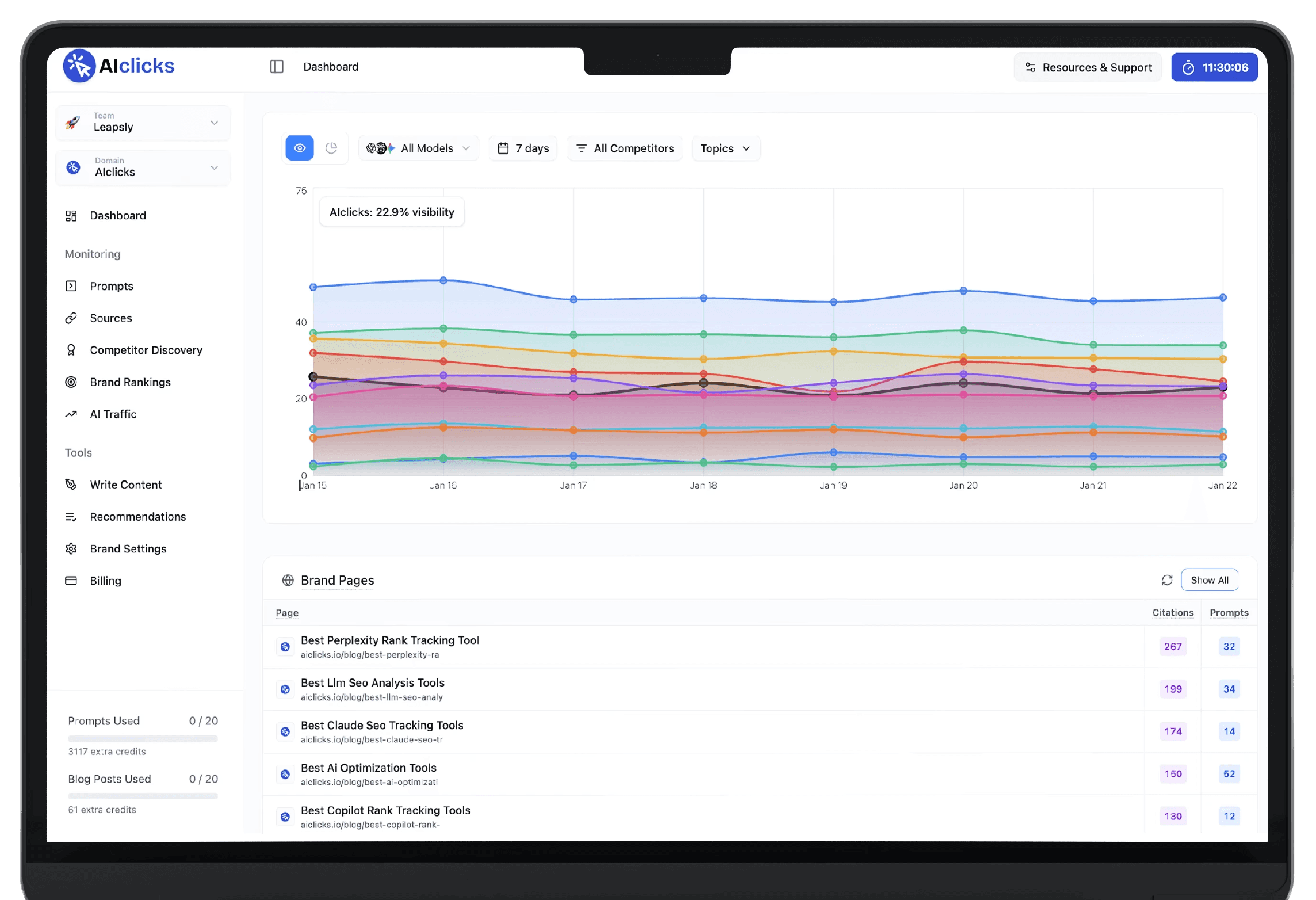
AIclicks gives you a live dashboard with daily ChatGPT mention rate, citation rate, sentiment, and share-of-voice across your tracked prompts, plus GA4 referral attribution for the traffic ChatGPT does send back.
Choose Your Plan
Flexible pricing that grows with your team. Upgrade or downgrade at any time.
Monthly
Yearly
-20%
Starter
Perfect for individuals & small teams
$49
/ month
Billed annually — you save $142
Choose 3 from:
Daily

" height="16px" id="fvSweaOBo" transform="translate(1 0)" width="14px"/></svg>)
" width="14px"><path d="M 13.864 5.629 L 13.3 5.629 L 13.3 5.6 L 7 5.6 L 7 8.4 L 10.956 8.4 C 10.379 10.03 8.828 11.2 7 11.2 C 4.681 11.2 2.8 9.319 2.8 7 C 2.8 4.681 4.681 2.8 7 2.8 C 8.071 2.8 9.045 3.204 9.786 3.864 L 11.766 1.884 C 10.516 0.719 8.844 0 7 0 C 3.134 0 0 3.134 0 7 C 0 10.866 3.134 14 7 14 C 10.866 14 14 10.866 14 7 C 14 6.531 13.952 6.073 13.864 5.629 Z" fill="rgb(255, 193, 7)" height="14px" id="H_YjfTNpn" width="14px"/><path d="M 0 3.742 L 2.3 5.429 C 2.922 3.888 4.429 2.8 6.193 2.8 C 7.264 2.8 8.238 3.204 8.979 3.864 L 10.959 1.884 C 9.709 0.719 8.037 0 6.193 0 C 3.504 0 1.172 1.518 0 3.742 Z" fill="rgb(255, 61, 0)" height="5.428500000000002px" id="PlkthQDhg" transform="translate(0.875 0)" width="10.959199999999996px"/><path d="M 6.232 5.581 C 8.04 5.581 9.683 4.889 10.925 3.764 L 8.758 1.931 C 8.032 2.483 7.144 2.782 6.232 2.781 C 4.411 2.781 2.865 1.62 2.283 0 L 0 1.759 C 1.159 4.026 3.511 5.581 6.232 5.581 Z" fill="rgb(76, 175, 80)" height="5.581099999999999px" id="WlnJ5gngE" transform="translate(0.7 8.4)" width="10.924899999999994px"/><path d="M 6.864 0.029 L 6.3 0.029 L 6.3 0 L 0 0 L 0 2.8 L 3.956 2.8 C 3.68 3.576 3.183 4.254 2.526 4.75 L 2.527 4.749 L 4.693 6.582 C 4.54 6.722 7 4.9 7 1.4 C 7 0.931 6.952 0.473 6.864 0.029 Z" fill="rgb(25, 118, 210)" height="6.589883930775992px" id="x_rSW275p" transform="translate(7 5.6)" width="7px"/></g></svg>)
" height="16px" id="hHS98fTxZ" width="16px"/></svg>)
 scale(1 1) translate(-1.861736945942159, -1.1170155383302638)" id="P20NzAvj0-699428820-radial-gradient" r="0.9935228066204626"><stop offset="0" stop-color="rgb(0, 174, 255)"/><stop offset="1" stop-color="rgb(7, 54, 196)"/></radialGradient><radialGradient cx="0.48250042504016705" cy="1.8366934653567062" gradient-transform="translate(0.48250042504016705, 1.8366934653567062) scale(1 1) translate(-0.48250042504016705, -1.8366934653567062)" id="UEWZqVjij-699428820-radial-gradient" r="0.9176890228114506"><stop offset="0" stop-color="rgb(255, 182, 87)"/><stop offset="1" stop-color="rgb(192, 43, 60)"/></radialGradient><linearGradient id="jyMN3TmKx-699428820-linear-gradient" x1="0.4594862532842614" x2="0.5405137467157386" y1="0" y2="1"><stop offset="0" stop-color="rgb(13, 145, 225)"/><stop offset="1" stop-color="rgb(255, 200, 0)"/></linearGradient><linearGradient id="xhMNwDFG0-699428820-linear-gradient" x1="0.4784828731548295" x2="0.5215171268451705" y1="5.551115123125783e-17" y2="1"><stop offset="0" stop-color="rgb(61, 203, 255)"/><stop offset="1" stop-color="rgba(5, 136, 247, 0)"/></linearGradient><radialGradient cx="1.4305090871482182" cy="0.34866158048251783" gradient-transform="translate(1.4305090871482182, 0.34866158048251783) scale(1 1) translate(-1.4305090871482182, -0.34866158048251783)" id="i79kAqaS4-699428820-radial-gradient" r="1.3362743412697924"><stop offset="0" stop-color="rgb(140, 72, 255)"/><stop offset="1" stop-color="rgb(255, 177, 82)"/></radialGradient><linearGradient id="mcxvno3tX-699428820-linear-gradient" x1="0.49844355920154226" x2="0.5015564407984577" y1="0" y2="1"><stop offset="0" stop-color="rgb(248, 173, 250)"/><stop offset="1" stop-color="rgba(168, 110, 221, 0)"/></linearGradient></defs><g d="M 11.605 1.219 C 11.397 0.499 10.739 0.002 9.989 0 L 9.498 0 C 8.682 0.002 7.985 0.588 7.842 1.391 L 7 6.016 L 7.209 5.296 C 7.416 4.574 8.075 4.076 8.825 4.074 L 11.681 4.074 L 12.879 4.545 L 14.033 4.074 L 13.697 4.074 C 12.947 4.072 12.289 3.575 12.081 2.855 Z M 4.413 13.387 C 4.618 14.111 5.278 14.611 6.031 14.613 L 7.075 14.613 C 7.988 14.613 8.735 13.88 8.758 12.96 L 8.871 8.5 L 8.633 9.319 C 8.426 10.039 7.768 10.537 7.018 10.539 L 4.138 10.539 L 3.111 9.977 L 2 10.539 L 2.331 10.539 C 3.084 10.542 3.743 11.042 3.949 11.766 L 4.413 13.387 Z M 9.999 0 L 4.167 0 C 2.501 0 1.501 2.221 0.834 4.441 C 0.045 7.073 -0.989 10.591 2.001 10.591 L 4.519 10.591 C 5.273 10.591 5.933 10.089 6.139 9.36 C 6.577 7.815 7.345 5.121 7.948 3.069 C 8.255 2.027 8.509 1.132 8.901 0.575 C 9.148 0.212 9.56 -0.004 9.999 0 M 9.999 0 L 4.167 0 C 2.501 0 1.501 2.221 0.834 4.441 C 0.045 7.073 -0.989 10.591 2.001 10.591 L 4.519 10.591 C 5.273 10.591 5.933 10.089 6.139 9.36 C 6.577 7.815 7.345 5.121 7.948 3.069 C 8.255 2.027 8.509 1.132 8.901 0.575 C 9.148 0.212 9.56 -0.004 9.999 0 M 6 14.593 L 11.833 14.593 C 13.499 14.593 14.499 12.372 15.166 10.151 C 15.955 7.519 16.989 4 13.999 4 L 11.48 4 C 10.725 4.002 10.063 4.505 9.86 5.232 C 9.266 7.332 8.663 9.429 8.051 11.523 C 7.745 12.566 7.49 13.461 7.098 14.019 C 6.851 14.382 6.439 14.597 6 14.593 M 6 14.593 L 11.833 14.593 C 13.499 14.593 14.499 12.372 15.166 10.151 C 15.955 7.519 16.989 4 13.999 4 L 11.48 4 C 10.725 4.002 10.063 4.505 9.86 5.232 C 9.266 7.332 8.663 9.429 8.051 11.523 C 7.745 12.566 7.49 13.461 7.098 14.019 C 6.851 14.382 6.439 14.597 6 14.593" fill="transparent" height="14.613333333333333px" id="QzkBy4Ibc" transform="translate(0 1)" width="16.00011071294081px"><path d="M 4.605 1.219 C 4.397 0.499 3.739 0.002 2.989 0 L 2.498 0 C 1.682 0.002 0.985 0.588 0.842 1.391 L 0 6.016 L 0.209 5.296 C 0.416 4.574 1.075 4.076 1.825 4.074 L 4.681 4.074 L 5.879 4.545 L 7.033 4.074 L 6.697 4.074 C 5.947 4.072 5.289 3.575 5.081 2.855 Z" fill="url(%23P20NzAvj0-699428820-radial-gradient)" height="6.016px" id="P20NzAvj0" transform="translate(7 0)" width="7.0333333333333385px"/><path d="M 2.413 4.887 C 2.618 5.611 3.278 6.111 4.031 6.113 L 5.075 6.113 C 5.988 6.113 6.735 5.38 6.758 4.46 L 6.871 0 L 6.633 0.819 C 6.426 1.539 5.768 2.037 5.018 2.039 L 2.138 2.039 L 1.111 1.477 L 0 2.039 L 0.331 2.039 C 1.084 2.042 1.743 2.542 1.949 3.266 L 2.413 4.887 Z" fill="url(%23UEWZqVjij-699428820-radial-gradient)" height="6.113333333333333px" id="UEWZqVjij" transform="translate(2 8.5)" width="6.871333333333332px"/><path d="M 9.999 0 L 4.167 0 C 2.501 0 1.501 2.221 0.834 4.441 C 0.045 7.073 -0.989 10.591 2.001 10.591 L 4.519 10.591 C 5.273 10.591 5.933 10.089 6.139 9.36 C 6.577 7.815 7.345 5.121 7.948 3.069 C 8.255 2.027 8.509 1.132 8.901 0.575 C 9.148 0.212 9.56 -0.004 9.999 0" fill="url(%23jyMN3TmKx-699428820-linear-gradient)" height="10.591388755215167px" id="jyMN3TmKx" width="9.999444046274142px"/><path d="M 9.999 0 L 4.167 0 C 2.501 0 1.501 2.221 0.834 4.441 C 0.045 7.073 -0.989 10.591 2.001 10.591 L 4.519 10.591 C 5.273 10.591 5.933 10.089 6.139 9.36 C 6.577 7.815 7.345 5.121 7.948 3.069 C 8.255 2.027 8.509 1.132 8.901 0.575 C 9.148 0.212 9.56 -0.004 9.999 0" fill="url(%23xhMNwDFG0-699428820-linear-gradient)" height="10.591388755215167px" id="xhMNwDFG0" width="9.999444046274142px"/><path d="M 0 10.593 L 5.833 10.593 C 7.499 10.593 8.499 8.372 9.166 6.151 C 9.955 3.519 10.989 0 7.999 0 L 5.48 0 C 4.725 0.002 4.063 0.505 3.86 1.232 C 3.266 3.332 2.663 5.429 2.051 7.523 C 1.745 8.566 1.49 9.461 1.098 10.019 C 0.851 10.382 0.439 10.597 0 10.593" fill="url(%23i79kAqaS4-699428820-radial-gradient)" height="10.593388755215164px" id="i79kAqaS4" transform="translate(6 4)" width="10.000110712940803px"/><path d="M 0 10.593 L 5.833 10.593 C 7.499 10.593 8.499 8.372 9.166 6.151 C 9.955 3.519 10.989 0 7.999 0 L 5.48 0 C 4.725 0.002 4.063 0.505 3.86 1.232 C 3.266 3.332 2.663 5.429 2.051 7.523 C 1.745 8.566 1.49 9.461 1.098 10.019 C 0.851 10.382 0.439 10.597 0 10.593" fill="url(%23mcxvno3tX-699428820-linear-gradient)" height="10.593388755215164px" id="mcxvno3tX" transform="translate(6 4)" width="10.000110712940803px"/></g></svg>)
" height="15.360666565427872px" id="HZPvvPBv7" transform="translate(0 0.5)" width="16px"/></svg>)
Tracked prompts
30
Websites you can add
3
LLMs you can track
3
Countries per project
1
LLM responses / mo
4,650
AI-optimized articles per month
10
Integrations
-
Support
Pro
For growing teams for more power
$140
/ month
Billed annually — you save $454
Choose 4 from:
Daily
Tracked prompts
150
Websites you can add
Unlimited
LLMs you can track
4
Countries per project
Unlimited
LLM responses / mo
18,600
AI-optimized articles per month
20
Integrations
Google Analytics
Support
BUSINESS
Best for medium-sized organizations
$357
/ month
Billed annually — you save $1198
Choose 6 from:
Daily
Tracked prompts
300
Websites you can add
Unlimited
LLMs you can track
6
Countries per project
Unlimited
LLM responses / mo
55,800
AI-optimized articles per month
30
Integrations
Google Analytics, API
Support
Dedicated account specialist
Become the #1 Answer in AI
Succeed in GEO yourself, or let us do all the work.
Do it yourself
Use AIclicks to see exactly where you appear across 10+ AI platforms, spot the gaps competitors are filling, and act on clear weekly recommendations.
From $59/month · Cancel anytime
Done for you
We Do All the Work for You
Our team manages your complete search presence: traditional SEO and GEO strategy, content, implementation, and reporting. You focus on customers.
Custom pricing · Minimum 3-month engagement
The AI SEO agency trusted by 1,000+ brands worldwide
From solo founders to multi-client agencies, AIclicks runs the full AI SEO agency program for organizations of every shape and size that want to be cited across every AI surface.
4.9/5 stars on G2







FAQ
How long does SEO take to bring in work?
Map results move first, often within 3 or 4 weeks of a proper Google Business Profile and a run of reviews. Job pages on the website take 3 to 6 months to settle, which is the figure trades on r/localseo keep repeating. Competitive urban terms take longer. Anyone promising page one in 30 days is either targeting phrases nobody searches or is not being straight with you.
Should we bother with ChatGPT or just Google?
Both, and they reward different things. Ahrefs analysed 863,000 keywords and found only 38% of pages cited in AI Overviews also ranked in the top 10, down from 76% a year earlier. A top position no longer buys you a mention. Worse for trades, assistants assemble their recommendation from Checkatrade profiles and register entries rather than your site, so an unclaimed listing becomes the version of you they quote.
How is trade SEO different from normal local SEO?
Three ways. Your competition is not other trades, it is Checkatrade, MyBuilder and Rated People, which own the head terms outright. Your citations run through accreditation registers, Gas Safe, NICEIC, NAPIT, FENSA, TrustMark, which verify a qualification rather than an address. And your customers search symptoms, not services, so the keyword list looks nothing like the list on your invoice. Generic local advice covers none of it.
What should a tradesman budget for SEO each month?
Realistically £500 to £1,000 a month for one trade in one town, £1,000 to £2,500 to compete properly in a city, and more only if you run several branches. Judge it against Checkatrade membership and lead fees, which many trades already pay every month for leads they then bid against. Ask exactly which pages get written each month; the plumber who could not get that answer on a $3,500 quote was right to walk.
Is SEO better than Google Ads for trades?
Neither is better; they cover different gaps. Ads fill a quiet week and win emergency terms immediately, then stop the day you pause them. SEO and the map profile keep working while you are up a ladder. Most trades run ads on the high-value jobs, boiler installs, rewires, full roofs, while building organic strength on symptom and cost searches that are far cheaper to rank for. Measure both on cost per booked job.
Which pages should a trade website build first?
Google Business Profile first: it costs nothing and outranks every website on the page. Then your emergency or call-out page, which catches the highest-intent searches in the trade. Then one page each for the 3 jobs you most want more of, written the way you would explain them in a hallway. Then an accreditations page with real registration numbers. Area pages after that, and only where you genuinely work. The blog is last, if at all.
How do I know if the SEO is working?
Count booked jobs from search, not rankings. Trade enquiries are overwhelmingly phone calls, so without a tracking number they never appear in analytics at all. Google Business Profile insights move first: calls, direction requests and website clicks. In Search Console, track impressions on job terms rather than position. Then check all of it against your diary. If a report shows traffic but no jobs, ask why.
Can I do this myself or should I hire someone?
Do the free half yourself. Nobody can claim your Google Business Profile, take job photos or ask a customer for a review except you, and a retainer that only covers profile upkeep is buying about 20 minutes of work a month. Outsource the parts that need a specialist: rebuilding one-page sites into job pages, schema, speed, register and directory cleanup. Pick someone who can name your accreditation bodies without looking them up.
Further Reading
Go deeper on GEO, AI search, and visibility tracking.