SEO for Tour Operators:
A traveler plans a trip months before arriving, from 2,000 miles away, and picks activities from search results, an AI itinerary and a review score. By the time they land, the shortlist is closed. Search visibility decides whether your tours were ever on it.









Why Tour Operators Need SEO
Travelers now plan in ChatGPT and AI Overviews weeks before they search Google Maps. Most tour bookings still end on a marketplace keeping 20% to 30% of the ticket.
Most sites list every tour on a single page with a photo grid and a booking widget. A traveler searching for a sunrise kayak tour or a small-group food walk finds a competitor who wrote that page. Your catalogue exists in the reservation system, not in the index, so the query never reaches you.
Search guided tours near me in a city and the first organic results are Tripadvisor, Yelp and the tourism board’s things-to-do page. Viator and Expedia sit behind them, reselling your seats. You appear inside all of it, ranked by their algorithm, paying their commission, on a page you cannot edit.
Viator and GetYourGuide typically take 20% to 30% out of each booking. On top of that, operators bid on their own destination terms in Google Ads and pay a tourism agency $1,500 to $5,000 every month. Pause any of it and the calendar empties within a season, because nothing there was ever owned.
How SEO Works for Tour Operators
Search Engine Optimization projects are long-term investments for tour companies, where each task supplements the others and creates compound results over time.
01
Keywords, page structure, and the signals Google reads directly
On-page work fails for tour companies because the names on the website are not the words travelers type. A page called The Summit Experience or Half-Day Signature Journey matches nothing; the search is sunrise hot air balloon ride, brewery walking tour, or private fishing charter with gear included. Operators name tours the way a brochure does and then wonder why the traffic goes elsewhere. The pages that carry weight are one page per tour written in traveler language, the departure-point page for each place you launch from, and the planning pages nobody wants to write: what to wear, minimum age, what happens in rain.
Durable pages in tourism are the ones tied to a question rather than a date. What a rafting trip actually costs, whether a hike is safe with a 7-year-old, how far the trailhead is from the airport: those keep converting for years because the geography does not move. What churns is everything a tour company enjoys publishing. The 2025 season announcement, the new van, the festival roundup for a weekend that has passed. Worse, most operators delete seasonal tour pages in the off-season, throwing away the rankings they spent a whole summer earning and rebuilding them from zero every spring.
1
Give every tour its own indexable page titled the way travelers search: sunset catamaran cruise, half-day rafting trip, private brewery tour.
2
Never delete an off-season tour page. Leave it live with next season’s dates and a waitlist form, or 301 it into the closest running tour.
3
Mark each tour with TouristTrip plus Product and Offer schema carrying price, duration and itinerary stops, then validate in Google’s Rich Results Test.
4
Publish the answers guides repeat all day: what to wear, minimum age, motion sickness, cancellation in rain. These rank year-round and cut no-shows.
02
Map Pack visibility, citations, and proximity signals
Local search in tourism is strange: almost none of your demand is local, but almost all of it is location-triggered. The traveler searching things to do is standing in your destination with a phone, or is about to be, and Google answers with a map pack of 3 businesses. That pack sits above Tripadvisor, above Yelp, above the tourism board. It is the one result a single-van operator can win outright, and the operators who win it usually just filled the profile in properly.
Set the primary category to the narrowest true one, Sightseeing Tour Agency or Kayaking Spot rather than Travel Agency, then add every tour as a service with its own price and duration. Load real photos from real departures, guests included, not stock landscapes. Set the meeting point pin where guests actually stand, because a pin on your office sends people to the wrong side of town. Pre-answer parking, accessibility, age limits and what happens if weather cancels.
Tourism has a citation layer general local SEO never mentions. Your state tourism office listing and your local convention and visitors bureau member directory both feed the things-to-do pages that already outrank you, and both are usually free with membership. Add Tripadvisor, Yelp, Apple Business Connect, Bing Places, AAA and Atlas Obscura, plus the trade bodies: USTOA, NTA or the Adventure Travel Trade Association. Every listing needs the identical company name, meeting address and phone, or the signal splits.
1
Pick the narrowest true category, list each tour as a priced service, and drop the map pin on the actual meeting point.
2
Give every departure point its own Google Business Profile and its own page, staffed hours and photos included, never one profile covering 4 docks.
3
Run BrightLocal or Yext across Tripadvisor, Yelp, Apple Business Connect and your state tourism office listing, and fix every name variant.
4
Post one Google Business Profile update a week from an actual departure: a photo, remaining seats this weekend, the wildlife you saw.
03
Topic authority, inbound links, and content that earns traffic
Travelers researching a trip are not yet choosing an operator; they are choosing whether the activity is for them. Is the water cold in June. Can a nervous swimmer do this. Is 6 hours too long with kids. Content that answers those honestly, including who should not book, wins the reader early and pre-qualifies them, which is why operators who publish it get fewer refund requests and better reviews than operators who publish adjectives.
A traveler who has decided on the activity is now comparing operators, and the comparison is brutally practical: group size, what the price actually includes, whether the guide is certified, how bad the reviews get. Put the real number of guests per guide, the gear list, and the full price with taxes on the tour page rather than behind the booking widget. Most direct bookings are lost at the moment somebody cannot find out what it costs.
Links in tourism come from the destination, not from the industry. Your convention and visitors bureau, the state tourism office, and every hotel concierge page will list an operator who asks. Local outfitters, breweries and museums you already send guests to should be linking back. Travel writers need a local fixer on deadline and will credit you. Regional trail associations, park friends groups and festival organisers all publish partner pages that nobody in your destination has thought to claim.
1
Publish an annual which tour is right for you guide comparing your own trips by difficulty, duration and season, updated before booking window opens.
2
Build one page per activity per destination you operate in, with real launch points, drive times and permit rules rather than a swapped place name.
3
Cluster every how much does it cost query into one hub: per-person pricing, group rates, gratuity norms, gear rental, and what is not included.
4
Write a page for each landmark, park or trail your tours reach, since travelers search the place name long before they search for an operator.
04
Site speed, crawlability, Core Web Vitals, and mobile health
The failure almost every operator shares is the booking widget. Tour names, prices, durations and departure times render inside a FareHarbor, Peek Pro, Rezdy or Xola iframe, so Google indexes a headline, a hero image and an empty container. Worse, those hosted booking pages are themselves indexable, so the reservation platform’s copy of your tour outranks your own. Operators believe they have 30 tour pages; the crawler sees one page and a third-party domain.
Tour websites are among the heaviest on the web, and the impatient end of the audience books from a phone. A gallery of 40 full-resolution landscape shots, an autoplaying drone video and a chat widget will take 8 seconds on hotel wifi. The traveler deciding what to do tomorrow is standing in a lobby with 2 bars of signal and 3 tabs open. If your page stalls, they book whichever tab loaded, usually the marketplace.
1
Crawl the site in Screaming Frog with JavaScript rendering off; any tour page whose price and duration vanish needs that text in server-rendered HTML.
2
Run PageSpeed Insights on your heaviest tour page, usually the photo gallery one, and target Largest Contentful Paint under 2.5 seconds on 4G.
3
Serve scenery and guest photos as WebP at display size, lazy-load everything below the fold, and self-host drone footage rather than autoplaying it.
4
Keep tour and destination pages in a sitemap separate from the blog, and resubmit whenever the season’s dates, prices or departure points change.
05
Star ratings, review volume, and response strategy that builds trust
No industry lives on reviews the way this one does. A traveler is booking a day they cannot repeat, from a company they have never heard of, in a place they do not know, and the star rating is the whole of their evidence. The difficulty is volume and split. A busy operator runs 12 departures a day across 3 platforms, and the reviews land on Tripadvisor and the marketplace rather than on Google, where the map pack is decided.
The moment to ask is on the bus back, while the guide is still the person who made the day work. A guide asking face to face, with a QR card, converts many times better than an email sent 3 days later from an address nobody recognises. If you automate it, fire the request 2 hours after the departure ends, name the guide in it, and send guests to Google, because that is the listing that has to rank.
1
Hand every guest a QR card as the tour ends, or trigger the request from FareHarbor or Xola 2 hours after departure.
2
Answer within 24 hours, name the guide, and state the weather or refund policy plainly, since most negative tour reviews are expectation failures.
3
Pull reviews mentioning a specific tour onto that tour’s page with Review schema, instead of one site-wide testimonial slider nobody reads.
4
Chase reviews from private charters, school field trips and corporate groups too, since the organiser writes longer reviews and books the same trip annually.
Google is No Longer the Only Place Your travelers are Searching
Travelers are using AI to find answers, and they trust what it tells them. Invest in GEO to get recommended in those answers.
1 Billion
Questions ChatGPT receives every single day
38%
Your #1 top ranking page on Google would be cited by AI
14%
of tour companies optimise for GEO. The rest are invisible in AI answers


You can rank #1 for “tour company near me” and still not exist in ChatGPT’s answer. Run a free GEO audit to see where your brand actually stands.
GEO vs SEO: Same Goal, Different Methods
GEO is wider than SEO. AI recommends the brands that show up across the sources it reads, so your presence in forums, social platforms and tourism blogs decides your odds. AIclicks measures the three metrics below so you know which to work on first.
AI Assistant
Who runs the best day tours in the area?
Your Tour Company
Citation Rate
Shows how many AI answers about tour operators name your brand, out of every 100. Models pull from the same trusted pages over and over, so citations compound: once you are in, staying in gets easier. Find the competitor pages AI cites most, then publish your own version of each.
Your Tour Company
82% positive
Competitor A
54% positive
Competitor B
38% positive
Brand Sentiment
Shows how AI describes you when your brand comes up: positive, neutral or negative. Tone is what separates being mentioned from being recommended, and models repeat whatever framing they find. Track the negative mentions back to the reviews and threads behind them, then publish content that answers those directly.
Others 52%
You 24%
— 24%
Your Tour Company
AI mention share of voice — tourism category
Competitors
Not Cited
Share of Voice in AI
Shows how much of the tourism conversation belongs to you rather than your competitors. This is the metric that matters most, the GEO version of a Google ranking. With only 1–5 brands named per answer, the market is winner-takes-more and every point is taken from someone.
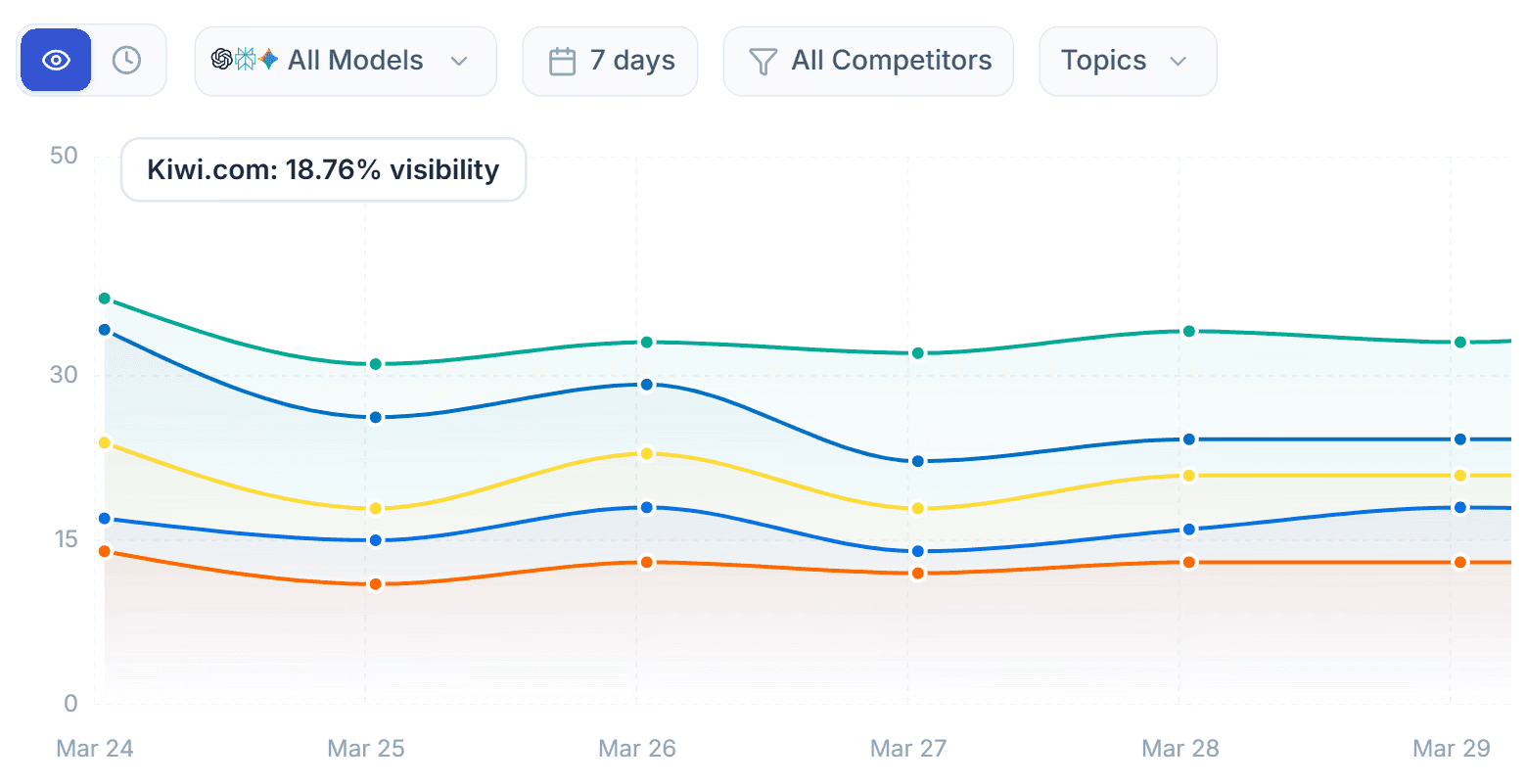
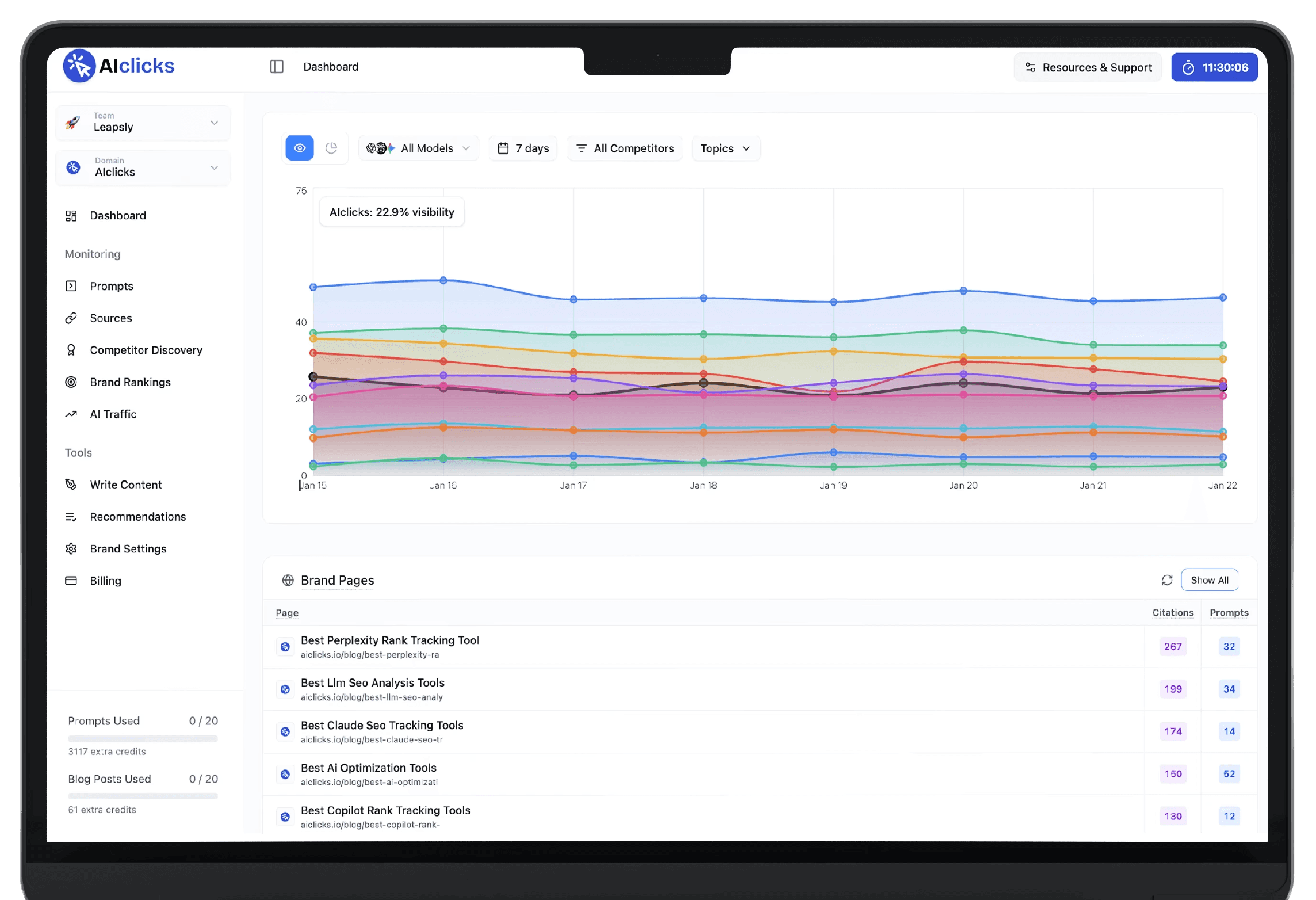
The Dashboard Your Dedicated AI Search Team Works In
AIclicks gives you a live dashboard with daily ChatGPT mention rate, citation rate, sentiment, and share-of-voice across your tracked prompts, plus GA4 referral attribution for the traffic ChatGPT does send back.
Choose Your Plan
Flexible pricing that grows with your team. Upgrade or downgrade at any time.
Monthly
Yearly
-20%
Starter
Perfect for individuals & small teams
$49
/ month
Billed annually — you save $142
Choose 3 from:
Daily

" height="16px" id="fvSweaOBo" transform="translate(1 0)" width="14px"/></svg>)
" width="14px"><path d="M 13.864 5.629 L 13.3 5.629 L 13.3 5.6 L 7 5.6 L 7 8.4 L 10.956 8.4 C 10.379 10.03 8.828 11.2 7 11.2 C 4.681 11.2 2.8 9.319 2.8 7 C 2.8 4.681 4.681 2.8 7 2.8 C 8.071 2.8 9.045 3.204 9.786 3.864 L 11.766 1.884 C 10.516 0.719 8.844 0 7 0 C 3.134 0 0 3.134 0 7 C 0 10.866 3.134 14 7 14 C 10.866 14 14 10.866 14 7 C 14 6.531 13.952 6.073 13.864 5.629 Z" fill="rgb(255, 193, 7)" height="14px" id="H_YjfTNpn" width="14px"/><path d="M 0 3.742 L 2.3 5.429 C 2.922 3.888 4.429 2.8 6.193 2.8 C 7.264 2.8 8.238 3.204 8.979 3.864 L 10.959 1.884 C 9.709 0.719 8.037 0 6.193 0 C 3.504 0 1.172 1.518 0 3.742 Z" fill="rgb(255, 61, 0)" height="5.428500000000002px" id="PlkthQDhg" transform="translate(0.875 0)" width="10.959199999999996px"/><path d="M 6.232 5.581 C 8.04 5.581 9.683 4.889 10.925 3.764 L 8.758 1.931 C 8.032 2.483 7.144 2.782 6.232 2.781 C 4.411 2.781 2.865 1.62 2.283 0 L 0 1.759 C 1.159 4.026 3.511 5.581 6.232 5.581 Z" fill="rgb(76, 175, 80)" height="5.581099999999999px" id="WlnJ5gngE" transform="translate(0.7 8.4)" width="10.924899999999994px"/><path d="M 6.864 0.029 L 6.3 0.029 L 6.3 0 L 0 0 L 0 2.8 L 3.956 2.8 C 3.68 3.576 3.183 4.254 2.526 4.75 L 2.527 4.749 L 4.693 6.582 C 4.54 6.722 7 4.9 7 1.4 C 7 0.931 6.952 0.473 6.864 0.029 Z" fill="rgb(25, 118, 210)" height="6.589883930775992px" id="x_rSW275p" transform="translate(7 5.6)" width="7px"/></g></svg>)
" height="16px" id="hHS98fTxZ" width="16px"/></svg>)
 scale(1 1) translate(-1.861736945942159, -1.1170155383302638)" id="P20NzAvj0-699428820-radial-gradient" r="0.9935228066204626"><stop offset="0" stop-color="rgb(0, 174, 255)"/><stop offset="1" stop-color="rgb(7, 54, 196)"/></radialGradient><radialGradient cx="0.48250042504016705" cy="1.8366934653567062" gradient-transform="translate(0.48250042504016705, 1.8366934653567062) scale(1 1) translate(-0.48250042504016705, -1.8366934653567062)" id="UEWZqVjij-699428820-radial-gradient" r="0.9176890228114506"><stop offset="0" stop-color="rgb(255, 182, 87)"/><stop offset="1" stop-color="rgb(192, 43, 60)"/></radialGradient><linearGradient id="jyMN3TmKx-699428820-linear-gradient" x1="0.4594862532842614" x2="0.5405137467157386" y1="0" y2="1"><stop offset="0" stop-color="rgb(13, 145, 225)"/><stop offset="1" stop-color="rgb(255, 200, 0)"/></linearGradient><linearGradient id="xhMNwDFG0-699428820-linear-gradient" x1="0.4784828731548295" x2="0.5215171268451705" y1="5.551115123125783e-17" y2="1"><stop offset="0" stop-color="rgb(61, 203, 255)"/><stop offset="1" stop-color="rgba(5, 136, 247, 0)"/></linearGradient><radialGradient cx="1.4305090871482182" cy="0.34866158048251783" gradient-transform="translate(1.4305090871482182, 0.34866158048251783) scale(1 1) translate(-1.4305090871482182, -0.34866158048251783)" id="i79kAqaS4-699428820-radial-gradient" r="1.3362743412697924"><stop offset="0" stop-color="rgb(140, 72, 255)"/><stop offset="1" stop-color="rgb(255, 177, 82)"/></radialGradient><linearGradient id="mcxvno3tX-699428820-linear-gradient" x1="0.49844355920154226" x2="0.5015564407984577" y1="0" y2="1"><stop offset="0" stop-color="rgb(248, 173, 250)"/><stop offset="1" stop-color="rgba(168, 110, 221, 0)"/></linearGradient></defs><g d="M 11.605 1.219 C 11.397 0.499 10.739 0.002 9.989 0 L 9.498 0 C 8.682 0.002 7.985 0.588 7.842 1.391 L 7 6.016 L 7.209 5.296 C 7.416 4.574 8.075 4.076 8.825 4.074 L 11.681 4.074 L 12.879 4.545 L 14.033 4.074 L 13.697 4.074 C 12.947 4.072 12.289 3.575 12.081 2.855 Z M 4.413 13.387 C 4.618 14.111 5.278 14.611 6.031 14.613 L 7.075 14.613 C 7.988 14.613 8.735 13.88 8.758 12.96 L 8.871 8.5 L 8.633 9.319 C 8.426 10.039 7.768 10.537 7.018 10.539 L 4.138 10.539 L 3.111 9.977 L 2 10.539 L 2.331 10.539 C 3.084 10.542 3.743 11.042 3.949 11.766 L 4.413 13.387 Z M 9.999 0 L 4.167 0 C 2.501 0 1.501 2.221 0.834 4.441 C 0.045 7.073 -0.989 10.591 2.001 10.591 L 4.519 10.591 C 5.273 10.591 5.933 10.089 6.139 9.36 C 6.577 7.815 7.345 5.121 7.948 3.069 C 8.255 2.027 8.509 1.132 8.901 0.575 C 9.148 0.212 9.56 -0.004 9.999 0 M 9.999 0 L 4.167 0 C 2.501 0 1.501 2.221 0.834 4.441 C 0.045 7.073 -0.989 10.591 2.001 10.591 L 4.519 10.591 C 5.273 10.591 5.933 10.089 6.139 9.36 C 6.577 7.815 7.345 5.121 7.948 3.069 C 8.255 2.027 8.509 1.132 8.901 0.575 C 9.148 0.212 9.56 -0.004 9.999 0 M 6 14.593 L 11.833 14.593 C 13.499 14.593 14.499 12.372 15.166 10.151 C 15.955 7.519 16.989 4 13.999 4 L 11.48 4 C 10.725 4.002 10.063 4.505 9.86 5.232 C 9.266 7.332 8.663 9.429 8.051 11.523 C 7.745 12.566 7.49 13.461 7.098 14.019 C 6.851 14.382 6.439 14.597 6 14.593 M 6 14.593 L 11.833 14.593 C 13.499 14.593 14.499 12.372 15.166 10.151 C 15.955 7.519 16.989 4 13.999 4 L 11.48 4 C 10.725 4.002 10.063 4.505 9.86 5.232 C 9.266 7.332 8.663 9.429 8.051 11.523 C 7.745 12.566 7.49 13.461 7.098 14.019 C 6.851 14.382 6.439 14.597 6 14.593" fill="transparent" height="14.613333333333333px" id="QzkBy4Ibc" transform="translate(0 1)" width="16.00011071294081px"><path d="M 4.605 1.219 C 4.397 0.499 3.739 0.002 2.989 0 L 2.498 0 C 1.682 0.002 0.985 0.588 0.842 1.391 L 0 6.016 L 0.209 5.296 C 0.416 4.574 1.075 4.076 1.825 4.074 L 4.681 4.074 L 5.879 4.545 L 7.033 4.074 L 6.697 4.074 C 5.947 4.072 5.289 3.575 5.081 2.855 Z" fill="url(%23P20NzAvj0-699428820-radial-gradient)" height="6.016px" id="P20NzAvj0" transform="translate(7 0)" width="7.0333333333333385px"/><path d="M 2.413 4.887 C 2.618 5.611 3.278 6.111 4.031 6.113 L 5.075 6.113 C 5.988 6.113 6.735 5.38 6.758 4.46 L 6.871 0 L 6.633 0.819 C 6.426 1.539 5.768 2.037 5.018 2.039 L 2.138 2.039 L 1.111 1.477 L 0 2.039 L 0.331 2.039 C 1.084 2.042 1.743 2.542 1.949 3.266 L 2.413 4.887 Z" fill="url(%23UEWZqVjij-699428820-radial-gradient)" height="6.113333333333333px" id="UEWZqVjij" transform="translate(2 8.5)" width="6.871333333333332px"/><path d="M 9.999 0 L 4.167 0 C 2.501 0 1.501 2.221 0.834 4.441 C 0.045 7.073 -0.989 10.591 2.001 10.591 L 4.519 10.591 C 5.273 10.591 5.933 10.089 6.139 9.36 C 6.577 7.815 7.345 5.121 7.948 3.069 C 8.255 2.027 8.509 1.132 8.901 0.575 C 9.148 0.212 9.56 -0.004 9.999 0" fill="url(%23jyMN3TmKx-699428820-linear-gradient)" height="10.591388755215167px" id="jyMN3TmKx" width="9.999444046274142px"/><path d="M 9.999 0 L 4.167 0 C 2.501 0 1.501 2.221 0.834 4.441 C 0.045 7.073 -0.989 10.591 2.001 10.591 L 4.519 10.591 C 5.273 10.591 5.933 10.089 6.139 9.36 C 6.577 7.815 7.345 5.121 7.948 3.069 C 8.255 2.027 8.509 1.132 8.901 0.575 C 9.148 0.212 9.56 -0.004 9.999 0" fill="url(%23xhMNwDFG0-699428820-linear-gradient)" height="10.591388755215167px" id="xhMNwDFG0" width="9.999444046274142px"/><path d="M 0 10.593 L 5.833 10.593 C 7.499 10.593 8.499 8.372 9.166 6.151 C 9.955 3.519 10.989 0 7.999 0 L 5.48 0 C 4.725 0.002 4.063 0.505 3.86 1.232 C 3.266 3.332 2.663 5.429 2.051 7.523 C 1.745 8.566 1.49 9.461 1.098 10.019 C 0.851 10.382 0.439 10.597 0 10.593" fill="url(%23i79kAqaS4-699428820-radial-gradient)" height="10.593388755215164px" id="i79kAqaS4" transform="translate(6 4)" width="10.000110712940803px"/><path d="M 0 10.593 L 5.833 10.593 C 7.499 10.593 8.499 8.372 9.166 6.151 C 9.955 3.519 10.989 0 7.999 0 L 5.48 0 C 4.725 0.002 4.063 0.505 3.86 1.232 C 3.266 3.332 2.663 5.429 2.051 7.523 C 1.745 8.566 1.49 9.461 1.098 10.019 C 0.851 10.382 0.439 10.597 0 10.593" fill="url(%23mcxvno3tX-699428820-linear-gradient)" height="10.593388755215164px" id="mcxvno3tX" transform="translate(6 4)" width="10.000110712940803px"/></g></svg>)
" height="15.360666565427872px" id="HZPvvPBv7" transform="translate(0 0.5)" width="16px"/></svg>)
Tracked prompts
30
Websites you can add
3
LLMs you can track
3
Countries per project
1
LLM responses / mo
4,650
AI-optimized articles per month
10
Integrations
-
Support
Pro
For growing teams for more power
$140
/ month
Billed annually — you save $454
Choose 4 from:
Daily
Tracked prompts
150
Websites you can add
Unlimited
LLMs you can track
4
Countries per project
Unlimited
LLM responses / mo
18,600
AI-optimized articles per month
20
Integrations
Google Analytics
Support
BUSINESS
Best for medium-sized organizations
$357
/ month
Billed annually — you save $1198
Choose 6 from:
Daily
Tracked prompts
300
Websites you can add
Unlimited
LLMs you can track
6
Countries per project
Unlimited
LLM responses / mo
55,800
AI-optimized articles per month
30
Integrations
Google Analytics, API
Support
Dedicated account specialist
Become the #1 Answer in AI
Succeed in GEO yourself, or let us do all the work.
Do it yourself
Use AIclicks to see exactly where you appear across 10+ AI platforms, spot the gaps competitors are filling, and act on clear weekly recommendations.
From $59/month · Cancel anytime
Done for you
We Do All the Work for You
Our team manages your complete search presence: traditional SEO and GEO strategy, content, implementation, and reporting. You focus on travelers.
Custom pricing · Minimum 3-month engagement
The AI SEO agency trusted by 1,000+ brands worldwide
From solo founders to multi-client agencies, AIclicks runs the full AI SEO agency program for organizations of every shape and size that want to be cited across every AI surface.
4.9/5 stars on G2







FAQ
How long before SEO fills our tour calendar?
Expect map pack movement in 3 to 4 months and destination keyword rankings in 9 to 12. The complication is seasonality: travelers book 1 to 3 months ahead, so work started in January affects summer, not spring. Start a full season before you need the bookings. Operators in smaller destinations often move faster. Anyone promising page one before your next season is selling something else.
Should we optimise for Google or for AI trip planners?
Both, and tourism is further into the AI shift than most industries because travelers now build itineraries in ChatGPT before they open a map. Ahrefs analysed 863,000 keywords and found only 38% of pages cited in AI Overviews also ranked in the top 10, down from 76% a year earlier. Ranking no longer carries you into the answer. Being named, priced and structured does.
How is tour operator SEO different from normal local SEO?
It differs in 3 ways. Your customers are not local, so near me advice only catches them after they arrive, while the real money is in destination research done months earlier. Your product data sits inside a third-party booking widget crawlers cannot read. And your biggest competitors are not other operators but Tripadvisor, Viator and the tourism board that lists you. Generic local SEO addresses none of it.
What should a tour company budget for SEO?
Tourism agencies typically quote $1,500 to $3,000 a month for a single-destination operator and $4,000 to $8,000 for multi-destination or multi-activity businesses, with one-off site rebuilds priced separately. Judge it against commission rather than against zero: at 20% to 30% per marketplace booking, shifting even a fifth of your volume direct usually covers the retainer. Beware anyone selling a fixed package without touching your booking system.
How does SEO fit with the ads we already run?
They cover different parts of the season. Ads fill next weekend’s empty seats and stop the day you pause them; SEO builds the baseline that carries the shoulder season. Most operators run ads hard on peak-demand weeks and on branded terms the marketplaces bid against, while building organic strength on destination and planning queries that are cheaper to rank for. Measure both on cost per direct booking, not clicks.
Which pages should a tour company build first?
Google Business Profile first, because it is free and the map pack sits above Tripadvisor. Then a real page for your highest-margin tour, with price, duration, meeting point and group size in crawlable text rather than inside the booking widget. Then the planning answers guides repeat all day. Then one page per landmark or activity you serve. The blog is last, and only for questions travelers actually ask.
How do we know the SEO is actually working?
Track direct bookings, not rankings. Tag your booking widget so you can separate organic bookings from marketplace and paid ones inside FareHarbor, Rezdy or Xola, and put call tracking on the phone number since a lot of tour enquiries are calls. Watch Search Console impressions on destination and activity terms, which rise before positions do. Then check whether commission as a share of revenue is falling. That is the real number.
Do we need a travel specialist or any good SEO?
A competent generalist can handle most of it, with 2 exceptions worth paying for. Whoever you hire has to be willing to get inside FareHarbor, Peek Pro or whichever system you run, because the indexation problem lives there and a generalist will audit the wrapper page and declare it fine. And they need to understand booking windows, or they will publish your summer content in June. Keep guide bios, photos and review requests in-house.
Further Reading
Go deeper on GEO, AI search, and visibility tracking.