SEO for Therapy Practices:
Someone looking for a therapist reads 6 or 7 profiles before they message anyone. It happens late at night, on a phone, usually while they work out whether they can afford it at all. Search visibility decides whose profile opens first.









Why Therapy Practices Need SEO
Therapy near me draws roughly 154,000 US searches a month, and a directory owns the top result. Now ChatGPT answers the same question, and almost no practice knows what it says.
Search your own name and a Psychology Today profile usually appears above your own website. You wrote both, but only one of them is yours. The profile sends every enquiry through a form you rent, ranks for the conditions you treat, and stops working the day you stop paying the monthly listing fee.
Type therapist near me anywhere in the country and Psychology Today takes the first organic result, with Zocdoc and insurer provider finders just below. They win on the aggregate weight of thousands of clinicians. Your listing lives inside their page, beside every colleague chasing the same enquiry.
A Psychology Today listing runs about $30 a month per clinician, and therapist SEO retainers typically sit between $500 and $1,500, rising past $1,500 once content and links are included. The listing stops the month you cancel. Group practices pay it per head and still rank for nothing themselves.
How SEO Works for Therapy Practices
Search Engine Optimization projects are long-term investments for therapists, where each task supplements the others and creates compound results over time.
01
Keywords, page structure, and the signals Google reads directly
Therapy sites break on vocabulary. The words clinicians use and the words clients type barely overlap: a site organised around integrative, psychodynamic and person-centred approaches reads well to a supervisor and matches nothing anyone searches. Clients type anxiety therapist near me, EMDR for PTSD, or couples counseling that takes my insurance. Google also files mental health under YMYL and holds it to the strictest quality bar it has, so a page with no named clinician, no visible credentials and no state of licensure gets held back regardless of how well it is written. The pages carrying real weight are condition pages, modality pages and your fees page.
Condition and fee pages age extremely well. An honest page on what therapy costs without insurance, or what the first session actually involves, keeps drawing enquiries for years, since the questions do not change and the fear behind them does not either. The churn sits in everything pinned to a calendar: the awareness month post, the announcement that a clinician has joined, the note about holiday availability. Those last weeks and quietly become most of a practice blog. Worse, the highest-converting page on most therapy sites, the one listing session fees and sliding scale, is usually the one nobody has touched since launch.
1
Break the single services page apart: one URL per presenting concern and one per modality, such as anxiety therapy, EMDR, couples counseling, ADHD assessment.
2
When a clinician leaves, redirect their bio to the condition page they covered, then clear the dead URL in Search Console.
3
Use MedicalBusiness schema for the practice, Person schema with hasCredential for each clinician, and FAQPage on the fees and insurance blocks.
4
Publish a fees page with real session rates, a sliding scale explainer, and one page per insurance panel and EAP you accept.
02
Map Pack visibility, citations, and proximity signals
Weekly therapy is a local purchase almost by definition, and telehealth is capped at the states a clinician is licensed in, so demand stays local either way. The 3 map pack slots therefore decide more caseload than anything else on the page: they sit above Psychology Today, above Zocdoc, above everything. It is also the only surface where a solo clinician can beat a directory holding thousands of profiles, because proximity and profile quality count for more than domain authority.
Choose Psychotherapist, Counselor or Psychologist as your primary category rather than the vaguer Mental Health Service, then list the specialisms you genuinely offer. Therapists get one complication nobody else does: if you only see clients online, Google will not verify an address you do not staff, and a coworking suite used purely for ranking gets the profile suspended. Run it as a service-area business instead. Add real room photos, a booking link, and pre-answered questions on fees, waitlist and telehealth.
Mental health carries a verification layer that generic local guides never mention. Psychology Today, TherapyDen, GoodTherapy, Zencare and Inclusive Therapists carry weight because they check licence numbers before publishing. So do your state licensing board register, your APA or ACA chapter listing, plus the provider directory of every panel you sit on, including Headway and Alma. Each must show the same spelling, suite number and phone line. One outdated variant across 30 profiles is enough for Google to treat them as separate businesses.
1
Pick Psychotherapist as the primary category, list each modality as a service, and connect the booking link to your SimplePractice portal.
2
Multi-site groups need a separate profile, landing page and phone number per office, each naming only the clinicians who practise there.
3
Audit Psychology Today, TherapyDen, GoodTherapy and every insurance panel portal with BrightLocal, and fix each suite-number and abbreviation variant you find.
4
Post a Google Business Profile update weekly stating current openings, because waitlist status is the single thing every searching client wants to know.
03
Topic authority, inbound links, and content that earns traffic
Nobody books a first session without settling 3 questions: whether what they are feeling counts as a reason to go, what it will cost, and whether they will have to explain themselves to a stranger. Content that answers those plainly outperforms anything built for a keyword. A page describing what happens in a first session, minute by minute, or an honest explanation of the difference between an LCSW, an LMFT and a psychologist, lands exactly when the reader is still weighing it up.
Someone who has accepted they need therapy is now choosing a person, and they are reading for fit rather than credentials. Put the answer on the page: who you work with and who you do not, your rate, whether you have openings this month, how long the waitlist runs, and what a session feels like. A short video of the clinician speaking converts better than any testimonial you are ethically allowed to publish. Most practices bury all of it behind a contact form.
Links in this field come from the professions around you rather than from the industry itself. Referring physicians, school counselling departments, employee assistance providers and the graduate programmes you supervise for all publish pages that link out. Journalists cover mental health constantly and need a licensed clinician on deadline; Qwoted and Featured route those requests to you. Podcasts will have you on. Your professional association chapter lists members. None of it costs anything beyond the hour it takes to reply.
1
Publish an annual guide comparing what therapy costs with insurance, out of network with superbills, sliding scale, and platforms like BetterHelp.
2
Build one page per condition per area you serve, each naming the clinician who takes those referrals and their current availability.
3
Cluster every affordability query into one hub: in-network panels, superbill reimbursement, EAP sessions and sliding scale criteria, all linking back to fees.
4
Give each modality you are genuinely trained in its own page, such as EMDR, DBT, IFS or Gottman, with your certification level stated.
04
Site speed, crawlability, Core Web Vitals, and mobile health
The failure specific to therapy sites is that the most important page is invisible. HIPAA pushes practices to embed intake and booking from SimplePractice, Jane or IntakeQ as an iframe or script widget, so the contact page Google renders contains a heading and an empty box. No crawlable phone number, no address, no service text. Add the client portal living on a subdomain the practice does not own, and the conversion path contributes nothing to rankings.
The searches that matter happen at 1 in the morning, on a phone, from someone who has been putting this off for months and has finally opened Google. They will not try twice. Therapy sites are usually the worst offenders on weight, because the template ships a full-screen background video of a lake, a calming stock library at camera resolution, and a chat widget that loads before the phone number does.
1
Open your contact page in Search Console URL Inspection and read the rendered HTML; if the intake widget is absent, add crawlable text beside it.
2
Run PageSpeed Insights on the homepage, remove the autoplaying hero video, and get the largest visible element painting inside 2.5 seconds on 4G.
3
Convert office and therapy-room photos to WebP, size them to how they actually display, set width and height, and drop stock imagery.
4
Keep condition, modality and clinician pages in a sitemap separate from the blog, and resubmit whenever availability or accepted panels change.
05
Star ratings, review volume, and response strategy that builds trust
No industry has a harder review problem. The map pack runs on review volume and recency, but a therapist cannot ask a client for a public review without touching confidentiality, and most ethics codes discourage soliciting testimonials from anyone currently in treatment. Meanwhile the clients most motivated to write are the ones dropped from a waitlist or billed for a missed session. Unmanaged practices end up with 4 reviews, 2 of them angry, and no way to answer either.
The ethical route is to ask people who were never clients. Referring clinicians, supervisees, workshop attendees, EAP coordinators and the parents who attended a parenting group can all write about working with you without disclosing anything. For former clients, wait until treatment has ended and the file is closed, then send one plain request that names no condition. Ask consistently rather than after good outcomes, and reply to every review in language that confirms nothing.
1
Trigger the review link from SimplePractice or TherapyNotes when a file is marked closed, never while someone is still in weekly sessions.
2
Answer inside a day with a single neutral line that never confirms the reviewer was a client, then move it offline.
3
Place reviews mentioning a specific modality on that modality page, and put your Google rating beside the booking button rather than on a testimonials page.
4
Ask workshop attendees, corporate wellness audiences and supervision groups for reviews, since none are clients and all have seen you work.
Google is No Longer the Only Place Your clients are Searching
Clients are using AI to find answers, and they trust what it tells them. Invest in GEO to get recommended in those answers.
1 Billion
Questions ChatGPT receives every single day
38%
Your #1 top ranking page on Google would be cited by AI
14%
of therapists optimise for GEO. The rest are invisible in AI answers


You can rank #1 for “therapist near me” and still not exist in ChatGPT’s answer. Run a free GEO audit to see where your brand actually stands.
GEO vs SEO: Same Goal, Different Methods
GEO is wider than SEO. AI recommends the brands that show up across the sources it reads, so your presence in forums, social platforms and mental health blogs decides your odds. AIclicks measures the three metrics below so you know which to work on first.
AI Assistant
How do I find a trauma therapist taking clients?
Your Therapy Practice
Citation Rate
Shows how many AI answers about therapy practices name your brand, out of every 100. Models pull from the same trusted pages over and over, so citations compound: once you are in, staying in gets easier. Find the competitor pages AI cites most, then publish your own version of each.
Your Therapy Practice
82% positive
Competitor A
54% positive
Competitor B
38% positive
Brand Sentiment
Shows how AI describes you when your brand comes up: positive, neutral or negative. Tone is what separates being mentioned from being recommended, and models repeat whatever framing they find. Track the negative mentions back to the reviews and threads behind them, then publish content that answers those directly.
Others 52%
You 24%
— 24%
Your Therapy Practice
AI mention share of voice — mental health category
Competitors
Not Cited
Share of Voice in AI
Shows how much of the mental health conversation belongs to you rather than your competitors. This is the metric that matters most, the GEO version of a Google ranking. With only 1–5 brands named per answer, the market is winner-takes-more and every point is taken from someone.
The Dashboard Your Dedicated AI Search Team Works In
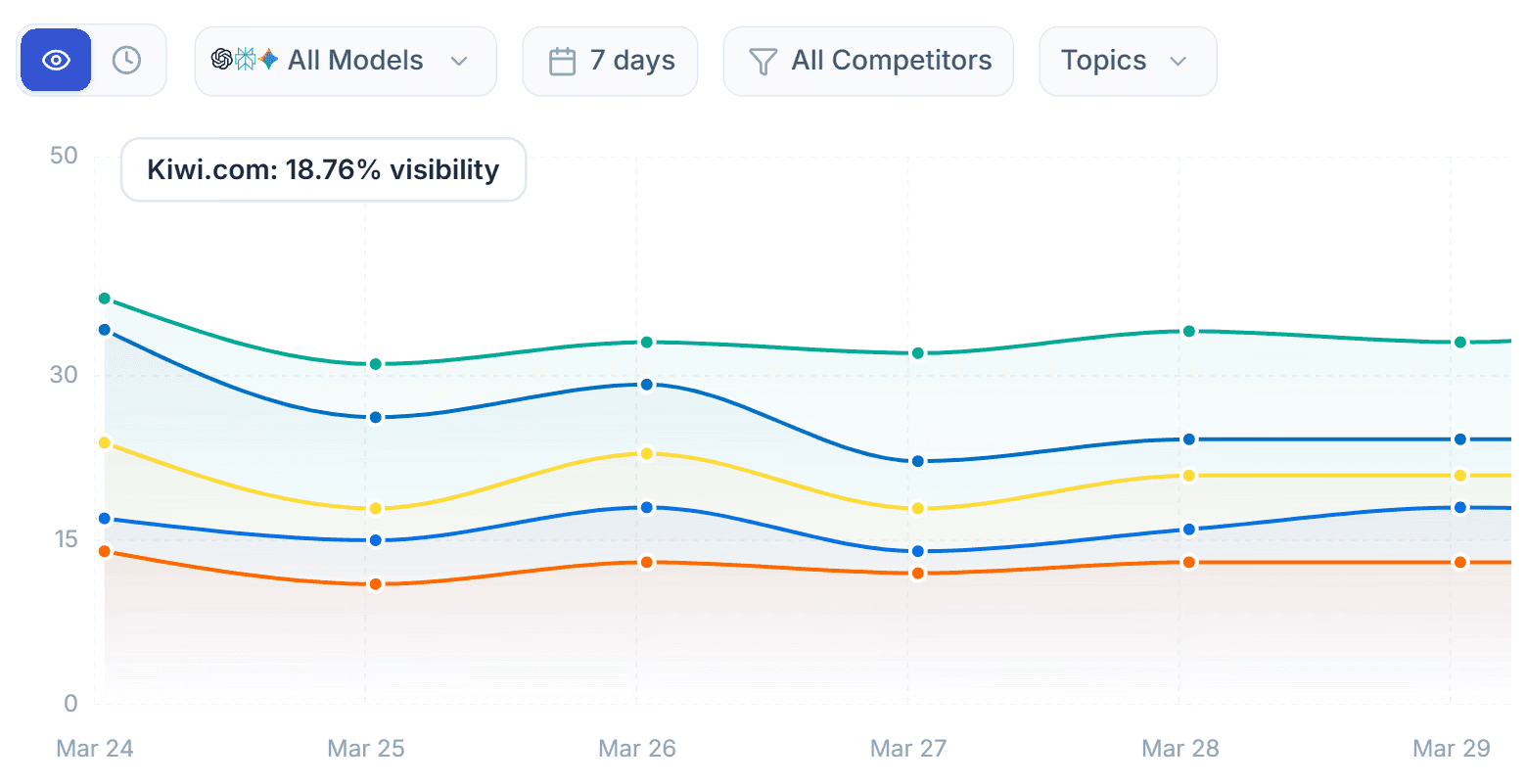
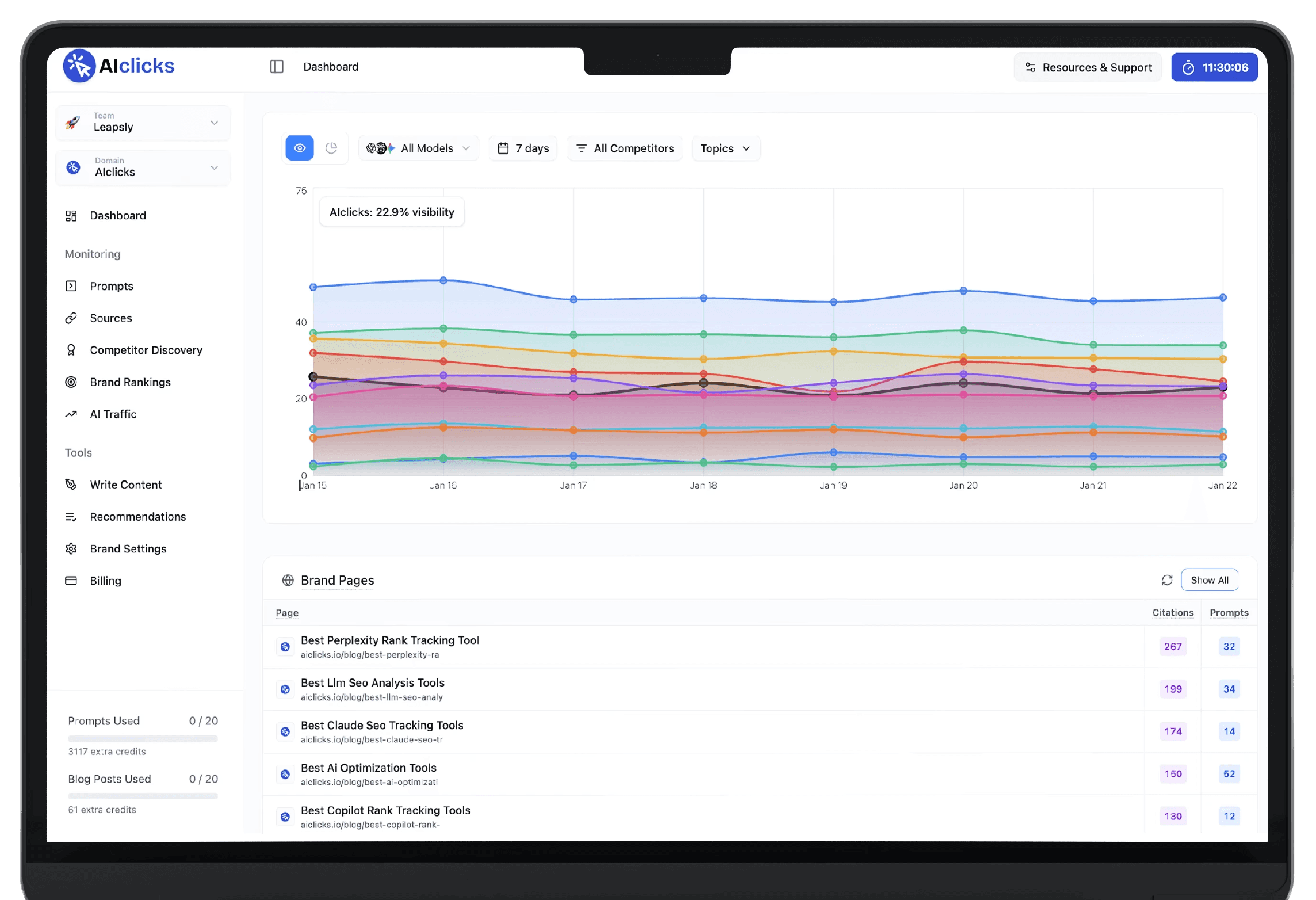
AIclicks gives you a live dashboard with daily ChatGPT mention rate, citation rate, sentiment, and share-of-voice across your tracked prompts, plus GA4 referral attribution for the traffic ChatGPT does send back.
Choose Your Plan
Flexible pricing that grows with your team. Upgrade or downgrade at any time.
Monthly
Yearly
-20%
Starter
Perfect for individuals & small teams
$49
/ month
Billed annually — you save $142
Choose 3 from:
Daily

" height="16px" id="fvSweaOBo" transform="translate(1 0)" width="14px"/></svg>)
" width="14px"><path d="M 13.864 5.629 L 13.3 5.629 L 13.3 5.6 L 7 5.6 L 7 8.4 L 10.956 8.4 C 10.379 10.03 8.828 11.2 7 11.2 C 4.681 11.2 2.8 9.319 2.8 7 C 2.8 4.681 4.681 2.8 7 2.8 C 8.071 2.8 9.045 3.204 9.786 3.864 L 11.766 1.884 C 10.516 0.719 8.844 0 7 0 C 3.134 0 0 3.134 0 7 C 0 10.866 3.134 14 7 14 C 10.866 14 14 10.866 14 7 C 14 6.531 13.952 6.073 13.864 5.629 Z" fill="rgb(255, 193, 7)" height="14px" id="H_YjfTNpn" width="14px"/><path d="M 0 3.742 L 2.3 5.429 C 2.922 3.888 4.429 2.8 6.193 2.8 C 7.264 2.8 8.238 3.204 8.979 3.864 L 10.959 1.884 C 9.709 0.719 8.037 0 6.193 0 C 3.504 0 1.172 1.518 0 3.742 Z" fill="rgb(255, 61, 0)" height="5.428500000000002px" id="PlkthQDhg" transform="translate(0.875 0)" width="10.959199999999996px"/><path d="M 6.232 5.581 C 8.04 5.581 9.683 4.889 10.925 3.764 L 8.758 1.931 C 8.032 2.483 7.144 2.782 6.232 2.781 C 4.411 2.781 2.865 1.62 2.283 0 L 0 1.759 C 1.159 4.026 3.511 5.581 6.232 5.581 Z" fill="rgb(76, 175, 80)" height="5.581099999999999px" id="WlnJ5gngE" transform="translate(0.7 8.4)" width="10.924899999999994px"/><path d="M 6.864 0.029 L 6.3 0.029 L 6.3 0 L 0 0 L 0 2.8 L 3.956 2.8 C 3.68 3.576 3.183 4.254 2.526 4.75 L 2.527 4.749 L 4.693 6.582 C 4.54 6.722 7 4.9 7 1.4 C 7 0.931 6.952 0.473 6.864 0.029 Z" fill="rgb(25, 118, 210)" height="6.589883930775992px" id="x_rSW275p" transform="translate(7 5.6)" width="7px"/></g></svg>)
" height="16px" id="hHS98fTxZ" width="16px"/></svg>)
 scale(1 1) translate(-1.861736945942159, -1.1170155383302638)" id="P20NzAvj0-699428820-radial-gradient" r="0.9935228066204626"><stop offset="0" stop-color="rgb(0, 174, 255)"/><stop offset="1" stop-color="rgb(7, 54, 196)"/></radialGradient><radialGradient cx="0.48250042504016705" cy="1.8366934653567062" gradient-transform="translate(0.48250042504016705, 1.8366934653567062) scale(1 1) translate(-0.48250042504016705, -1.8366934653567062)" id="UEWZqVjij-699428820-radial-gradient" r="0.9176890228114506"><stop offset="0" stop-color="rgb(255, 182, 87)"/><stop offset="1" stop-color="rgb(192, 43, 60)"/></radialGradient><linearGradient id="jyMN3TmKx-699428820-linear-gradient" x1="0.4594862532842614" x2="0.5405137467157386" y1="0" y2="1"><stop offset="0" stop-color="rgb(13, 145, 225)"/><stop offset="1" stop-color="rgb(255, 200, 0)"/></linearGradient><linearGradient id="xhMNwDFG0-699428820-linear-gradient" x1="0.4784828731548295" x2="0.5215171268451705" y1="5.551115123125783e-17" y2="1"><stop offset="0" stop-color="rgb(61, 203, 255)"/><stop offset="1" stop-color="rgba(5, 136, 247, 0)"/></linearGradient><radialGradient cx="1.4305090871482182" cy="0.34866158048251783" gradient-transform="translate(1.4305090871482182, 0.34866158048251783) scale(1 1) translate(-1.4305090871482182, -0.34866158048251783)" id="i79kAqaS4-699428820-radial-gradient" r="1.3362743412697924"><stop offset="0" stop-color="rgb(140, 72, 255)"/><stop offset="1" stop-color="rgb(255, 177, 82)"/></radialGradient><linearGradient id="mcxvno3tX-699428820-linear-gradient" x1="0.49844355920154226" x2="0.5015564407984577" y1="0" y2="1"><stop offset="0" stop-color="rgb(248, 173, 250)"/><stop offset="1" stop-color="rgba(168, 110, 221, 0)"/></linearGradient></defs><g d="M 11.605 1.219 C 11.397 0.499 10.739 0.002 9.989 0 L 9.498 0 C 8.682 0.002 7.985 0.588 7.842 1.391 L 7 6.016 L 7.209 5.296 C 7.416 4.574 8.075 4.076 8.825 4.074 L 11.681 4.074 L 12.879 4.545 L 14.033 4.074 L 13.697 4.074 C 12.947 4.072 12.289 3.575 12.081 2.855 Z M 4.413 13.387 C 4.618 14.111 5.278 14.611 6.031 14.613 L 7.075 14.613 C 7.988 14.613 8.735 13.88 8.758 12.96 L 8.871 8.5 L 8.633 9.319 C 8.426 10.039 7.768 10.537 7.018 10.539 L 4.138 10.539 L 3.111 9.977 L 2 10.539 L 2.331 10.539 C 3.084 10.542 3.743 11.042 3.949 11.766 L 4.413 13.387 Z M 9.999 0 L 4.167 0 C 2.501 0 1.501 2.221 0.834 4.441 C 0.045 7.073 -0.989 10.591 2.001 10.591 L 4.519 10.591 C 5.273 10.591 5.933 10.089 6.139 9.36 C 6.577 7.815 7.345 5.121 7.948 3.069 C 8.255 2.027 8.509 1.132 8.901 0.575 C 9.148 0.212 9.56 -0.004 9.999 0 M 9.999 0 L 4.167 0 C 2.501 0 1.501 2.221 0.834 4.441 C 0.045 7.073 -0.989 10.591 2.001 10.591 L 4.519 10.591 C 5.273 10.591 5.933 10.089 6.139 9.36 C 6.577 7.815 7.345 5.121 7.948 3.069 C 8.255 2.027 8.509 1.132 8.901 0.575 C 9.148 0.212 9.56 -0.004 9.999 0 M 6 14.593 L 11.833 14.593 C 13.499 14.593 14.499 12.372 15.166 10.151 C 15.955 7.519 16.989 4 13.999 4 L 11.48 4 C 10.725 4.002 10.063 4.505 9.86 5.232 C 9.266 7.332 8.663 9.429 8.051 11.523 C 7.745 12.566 7.49 13.461 7.098 14.019 C 6.851 14.382 6.439 14.597 6 14.593 M 6 14.593 L 11.833 14.593 C 13.499 14.593 14.499 12.372 15.166 10.151 C 15.955 7.519 16.989 4 13.999 4 L 11.48 4 C 10.725 4.002 10.063 4.505 9.86 5.232 C 9.266 7.332 8.663 9.429 8.051 11.523 C 7.745 12.566 7.49 13.461 7.098 14.019 C 6.851 14.382 6.439 14.597 6 14.593" fill="transparent" height="14.613333333333333px" id="QzkBy4Ibc" transform="translate(0 1)" width="16.00011071294081px"><path d="M 4.605 1.219 C 4.397 0.499 3.739 0.002 2.989 0 L 2.498 0 C 1.682 0.002 0.985 0.588 0.842 1.391 L 0 6.016 L 0.209 5.296 C 0.416 4.574 1.075 4.076 1.825 4.074 L 4.681 4.074 L 5.879 4.545 L 7.033 4.074 L 6.697 4.074 C 5.947 4.072 5.289 3.575 5.081 2.855 Z" fill="url(%23P20NzAvj0-699428820-radial-gradient)" height="6.016px" id="P20NzAvj0" transform="translate(7 0)" width="7.0333333333333385px"/><path d="M 2.413 4.887 C 2.618 5.611 3.278 6.111 4.031 6.113 L 5.075 6.113 C 5.988 6.113 6.735 5.38 6.758 4.46 L 6.871 0 L 6.633 0.819 C 6.426 1.539 5.768 2.037 5.018 2.039 L 2.138 2.039 L 1.111 1.477 L 0 2.039 L 0.331 2.039 C 1.084 2.042 1.743 2.542 1.949 3.266 L 2.413 4.887 Z" fill="url(%23UEWZqVjij-699428820-radial-gradient)" height="6.113333333333333px" id="UEWZqVjij" transform="translate(2 8.5)" width="6.871333333333332px"/><path d="M 9.999 0 L 4.167 0 C 2.501 0 1.501 2.221 0.834 4.441 C 0.045 7.073 -0.989 10.591 2.001 10.591 L 4.519 10.591 C 5.273 10.591 5.933 10.089 6.139 9.36 C 6.577 7.815 7.345 5.121 7.948 3.069 C 8.255 2.027 8.509 1.132 8.901 0.575 C 9.148 0.212 9.56 -0.004 9.999 0" fill="url(%23jyMN3TmKx-699428820-linear-gradient)" height="10.591388755215167px" id="jyMN3TmKx" width="9.999444046274142px"/><path d="M 9.999 0 L 4.167 0 C 2.501 0 1.501 2.221 0.834 4.441 C 0.045 7.073 -0.989 10.591 2.001 10.591 L 4.519 10.591 C 5.273 10.591 5.933 10.089 6.139 9.36 C 6.577 7.815 7.345 5.121 7.948 3.069 C 8.255 2.027 8.509 1.132 8.901 0.575 C 9.148 0.212 9.56 -0.004 9.999 0" fill="url(%23xhMNwDFG0-699428820-linear-gradient)" height="10.591388755215167px" id="xhMNwDFG0" width="9.999444046274142px"/><path d="M 0 10.593 L 5.833 10.593 C 7.499 10.593 8.499 8.372 9.166 6.151 C 9.955 3.519 10.989 0 7.999 0 L 5.48 0 C 4.725 0.002 4.063 0.505 3.86 1.232 C 3.266 3.332 2.663 5.429 2.051 7.523 C 1.745 8.566 1.49 9.461 1.098 10.019 C 0.851 10.382 0.439 10.597 0 10.593" fill="url(%23i79kAqaS4-699428820-radial-gradient)" height="10.593388755215164px" id="i79kAqaS4" transform="translate(6 4)" width="10.000110712940803px"/><path d="M 0 10.593 L 5.833 10.593 C 7.499 10.593 8.499 8.372 9.166 6.151 C 9.955 3.519 10.989 0 7.999 0 L 5.48 0 C 4.725 0.002 4.063 0.505 3.86 1.232 C 3.266 3.332 2.663 5.429 2.051 7.523 C 1.745 8.566 1.49 9.461 1.098 10.019 C 0.851 10.382 0.439 10.597 0 10.593" fill="url(%23mcxvno3tX-699428820-linear-gradient)" height="10.593388755215164px" id="mcxvno3tX" transform="translate(6 4)" width="10.000110712940803px"/></g></svg>)
" height="15.360666565427872px" id="HZPvvPBv7" transform="translate(0 0.5)" width="16px"/></svg>)
Tracked prompts
30
Websites you can add
3
LLMs you can track
3
Countries per project
1
LLM responses / mo
4,650
AI-optimized articles per month
10
Integrations
-
Support
Pro
For growing teams for more power
$140
/ month
Billed annually — you save $454
Choose 4 from:
Daily
Tracked prompts
150
Websites you can add
Unlimited
LLMs you can track
4
Countries per project
Unlimited
LLM responses / mo
18,600
AI-optimized articles per month
20
Integrations
Google Analytics
Support
BUSINESS
Best for medium-sized organizations
$357
/ month
Billed annually — you save $1198
Choose 6 from:
Daily
Tracked prompts
300
Websites you can add
Unlimited
LLMs you can track
6
Countries per project
Unlimited
LLM responses / mo
55,800
AI-optimized articles per month
30
Integrations
Google Analytics, API
Support
Dedicated account specialist
Become the #1 Answer in AI
Succeed in GEO yourself, or let us do all the work.
Do it yourself
Use AIclicks to see exactly where you appear across 10+ AI platforms, spot the gaps competitors are filling, and act on clear weekly recommendations.
From $59/month · Cancel anytime
Done for you
We Do All the Work for You
Our team manages your complete search presence: traditional SEO and GEO strategy, content, implementation, and reporting. You focus on clients.
Custom pricing · Minimum 3-month engagement
The AI SEO agency trusted by 1,000+ brands worldwide
From solo founders to multi-client agencies, AIclicks runs the full AI SEO agency program for organizations of every shape and size that want to be cited across every AI surface.
4.9/5 stars on G2







FAQ
How long before SEO fills a therapy caseload?
Map pack movement shows in 2 to 4 months, and a steadier flow of enquiries lands around 6. Competitive condition terms in a dense metro realistically run 6 to 12 months, because Google holds mental health content to a higher bar and wants credentials, citations and review activity to accumulate first. Practices in quieter markets or narrow specialisms move faster. The earliest honest signal is Google Business Profile calls, which rise well before organic rankings do.
Is it worth optimising for ChatGPT as well as Google?
Both, because they now reward different things. Ahrefs analysed 863,000 keywords and found only 38% of pages cited in AI Overviews also ranked in the top 10, down from 76% a year earlier. People increasingly describe a problem to ChatGPT and then ask who to see about it, and the assistant answers from directories and articles rather than from your site. Getting named there is a separate job from ranking.
How is therapy practice SEO unlike ordinary local SEO?
Three constraints that no other local trade has at once. Mental health is YMYL, so Google wants a named, licensed clinician behind every clinical claim. Ethics codes and confidentiality restrict how you gather reviews and testimonials, which removes the strongest local signal everyone else leans on. And telehealth breaks the usual location logic, because you can serve an entire state but only rank where you physically sit. Generic local advice ignores all three.
How much does decent SEO cost for a practice?
Most US practices pay between $500 and $1,500 a month, rising above $1,500 once content production and link building are included. Below roughly $500 you are usually buying directory submissions and a monthly report. Set that against a Psychology Today listing at about $30 a month per clinician, which buys visibility you never own. Judge any retainer on new clients per month against your average client value, not on rankings.
Do Google Ads work for therapists alongside SEO?
Ads fill this month, SEO fills next year. Most practices use ads to cover a new specialism or a location they have no chance of ranking for yet, then move that keyword to organic once a page exists. The discipline that matters is measuring both on cost per booked intake rather than clicks, because therapy enquiries convert slowly and a cheap click that never becomes a first session is not cheap at all.
Which pages should a therapy practice build first?
The Google Business Profile comes first; it costs nothing and outranks everything below it. Then your fees and insurance page, which is what most visitors are actually hunting for and what most practices hide. Then a page for each of your 2 or 3 strongest conditions, in the words clients use. Then clinician bios with credentials and current availability. Leave the blog until those exist, and write it only around questions clients ask on the phone.
How can we tell the SEO is actually working?
Count booked intakes attributed to organic search rather than positions in a ranking report. Add call tracking, because most therapy enquiries arrive by phone or voicemail and disappear from analytics otherwise. Google Business Profile insights move first: calls, website clicks and direction requests. Search Console impressions on condition and fee terms climb before positions do, so treat them as the leading indicator. Finally, check it against the practice management system: consultations held, and clients retained past session 2.
Should we do this ourselves or hire someone?
Keep the human half in-house. Profile updates, photos, availability posts and written replies to client questions depend on knowing how you actually practise. Schema, site speed, citation cleanup and link work are worth outsourcing. Whoever you pick should be able to discuss your licensing board advertising rules and confidentiality without being briefed, and should never publish a testimonial naming a diagnosis. A generalist agency creates compliance problems.
Further Reading
Go deeper on GEO, AI search, and visibility tracking.