SEO for Surgical Practices:
A referral used to end the search. Now the patient leaves the appointment with your name, opens their phone, reads your Healthgrades rating, watches somebody else’s recovery video, and asks ChatGPT whether they should get a second opinion before they ever call your office.









Why Surgical Practices Need SEO
Ask Google for the best surgeon in your area and the AI answer names 2 hospital systems, Healthgrades, US News and Zocdoc. No independent practice appears anywhere in it.
Your site is organized around the surgeons and a services list. Patients search the condition first and the operation second, in their own plain words: torn rotator cuff, gallbladder removal, bone-on-bone knee. They land on whoever wrote that page, book a consult there, and you never learn the enquiry existed.
Search orthopedic surgeon near me in a US city and Healthgrades, US News and the health system where you hold privileges sit above every practice. They rank on aggregate authority and thousands of profiles, then sell rivals a slot on the listing that buried you. Your hospital profile often outranks your site.
Most practices pay a medical web vendor $250 to $500 a month to host a site built from the same theme as hundreds of other sites, then buy ads on the elective procedure keywords on top. Turn the ads off and the consults stop that same week. Nothing in either line item accumulates into anything that you own.
How SEO Works for Surgical Practices
Search Engine Optimization projects are long-term investments for surgeons, where each task supplements the others and creates compound results over time.
01
Keywords, page structure, and the signals Google reads directly
On-page work is unusually hard for surgeons because there are 2 vocabularies and only one of them gets searched. Your site says arthroscopic partial meniscectomy; the patient types torn meniscus surgery. Google also files surgical content under YMYL, Your Money or Your Life, and holds it to its strictest quality bar, so a page with no named author and no visible board certification will not rank however accurate it is. The pages that carry the weight are your condition pages, your procedure pages and your surgeon bios, not the news feed.
The durable assets answer questions that outlive any single case. What recovery looks like week by week, when you can drive again, whether a patient meets the criteria for the operation, what the facility fee covers. Those pages earn consults for years because the procedure changes slowly and the fear does not. What churns is everything tied to a date: the press release announcing a new robotic platform, the top doctors award, the conference photo. Most practices publish 12 of those a year and have never once updated the recovery page.
1
Rebuild the services list into one page per operation, titled the way patients say it: gallbladder surgery, rotator cuff repair, knee replacement.
2
When a surgeon leaves the group, 301 their bio into the procedure page they covered, never leave a live profile taking consult calls.
3
Mark bios with Physician schema carrying board certification and hospital affiliation, and each operation page with MedicalProcedure, then check Google’s Rich Results Test.
4
Publish a recovery timeline per operation covering driving, work, lifting and flying, since those queries run all year and nobody answers them properly.
02
Map Pack visibility, citations, and proximity signals
Surgical demand is local, but with a wider radius than most trades: a patient will drive an hour for a fellowship-trained shoulder surgeon and will not leave their plan network to do it. That is why the map pack sits above every organic result for surgeon near me queries, and why the groups winning it carry 3,000 or 4,000 reviews. It is the one position where an independent practice outranks a health system, and claiming it costs nothing.
A complete surgical profile picks the narrowest accurate primary category, Orthopedic Surgeon or Bariatric Surgeon, rather than Doctor, then lists each operation as its own service. Set genuine hours, which for a surgeon means clinic days, not the days you are in the operating room. Load real photographs of the clinic, the team and the surgery center. Pre-answer the questions that actually decide bookings: whether you need a referral, which plans you take, where you operate, how soon a consult opens.
Surgery has a citation layer general local SEO never mentions, and it starts upstream. Your NPPES entry in the national NPI registry feeds Healthgrades, Vitals, WebMD and most insurer directories, so a stale suite number there quietly corrupts 40 listings at once. Above that sit ABMS Certification Matters, your state medical board license lookup, Doximity, US News Health, and the find-a-surgeon directory your specialty society runs. Every one needs the identical name, credential string and address.
1
Set the primary category to your subspecialty, Orthopedic Surgeon or Bariatric Surgeon, then list every operation as a separate service with its own description.
2
Give each surgeon a practitioner listing alongside the practice profile, and a page per clinic site naming who actually holds hours there.
3
Fix your NPPES record first, since Healthgrades, Vitals and insurer directories pull from it, then reconcile Doximity, ABMS and your state board listing.
4
Add a Google Q&A entry weekly answering whether a referral is needed, which plans you take, and how soon a consult opens.
03
Topic authority, inbound links, and content that earns traffic
Before a patient agrees to an operation they are trying to answer one question: do I actually need this? They want to know what happens if they wait, whether injections or physical therapy come first, what the imaging report actually said, and whether a second opinion is reasonable. Almost no surgical practice writes that content honestly, because it argues against operating. The ones that do get the consult, and they get a patient who arrives already trusting them.
A patient who has accepted the operation is now choosing a surgeon, and they are looking for numbers. How many of these you do a year, where you trained, which hospital or surgery center you operate at, whether you or a fellow holds the instruments, what the wait is for a date, and whether you are in network. Put those on the procedure page rather than 3 clicks away. Adjectives lose to a case volume figure every time.
Surgical links come from institutions rather than blogs. Hospital and surgery center affiliation pages, residency and fellowship alumni listings, specialty society committee and member pages, and clinical trial registries all link on request. Device manufacturers run trained-surgeon locators for platforms like Mako and da Vinci that most credentialed surgeons never claim. Then there is the referral network you already have: the primary care practices, physical therapy clinics and athletic trainers who send you patients and would happily link.
1
Publish an honest do you actually need this operation guide per procedure, covering non-operative options and when waiting is reasonable, signed by name.
2
Template a page per condition and procedure pair, torn meniscus to arthroscopy, gallstones to cholecystectomy, with real candidacy criteria rather than swapped keywords.
3
Cluster every affordability question into one hub: deductibles, in-network facility fees, separate anesthesia billing, prior authorization, and the cash price at your surgery center.
4
Write a page per platform you are credentialed on, Mako, da Vinci or ROSA, then claim your entry on the manufacturer’s surgeon locator.
04
Site speed, crawlability, Core Web Vitals, and mobile health
The failure nobody notices is the patient-education PDF. Practices upload the AAOS OrthoInfo or American College of Surgeons handout in place of writing a procedure page, so their highest-intent content is a duplicate of a document Google already trusts more, in a format with no schema, no author and no click-to-call. The second is the bio: the same paragraph sits on the group site, the hospital profile and a vanity domain, and Google picks the hospital.
Under the information blocking rules, imaging and pathology results now land in the patient portal the moment they are signed, often at night and before anyone has explained them. That patient reads the word tear or mass on their phone and starts searching immediately. If your procedure page takes 4 seconds because a case gallery loads at full resolution above the fold, or the phone number is baked into an image, they are already reading somebody else’s.
1
Crawl with Screaming Frog, list every patient-education PDF, and replace each with a written procedure page; check bios against your hospital profile text.
2
Run the case gallery through URL Inspection’s live test; if the rendered HTML comes back empty, a modal is hiding your best pages.
3
Serve radiographs and consent-cleared case photos as WebP at display size with lazy loading, and keep the gallery below the fold on procedure pages.
4
Keep procedure, condition and surgeon pages in a sitemap separate from news, resubmitting whenever privileges, accepted plans or a fellowship-trained hire changes.
05
Star ratings, review volume, and response strategy that builds trust
Reviews decide surgical searches because a stranger is about to be anesthetized and cut, and the star rating is the only evidence they have. They are also scattered. The same surgeon carries one average on Google, another on Healthgrades, and a hospital-published score drawn from Press Ganey surveys the practice does not control. Meanwhile the outcome that earns 5 stars arrives 6 to 12 weeks after surgery, and the surprise facility bill arrives the same week.
The moment to ask is the post-operative visit where you clear the patient to drive or return to work, not discharge day, when they are on pain medication and cannot type. Wire the request to fire when that encounter closes in your practice management system, signed by the surgeon rather than the practice. Make it one tap from the text message, with no account to create. Ask every patient, not only the ones whose cases went perfectly, or the profile reads curated.
1
Fire the request from SocialClimb, Weave or your EHR when the post-operative visit closes, not on discharge day.
2
Answer within 24 hours without confirming anyone had an operation, and move billing or facility-fee complaints offline to your practice administrator.
3
Place reviews naming a specific operation on that procedure page, and surface your Healthgrades and Google ratings together on each surgeon bio.
4
Ask referring primary care doctors, physical therapists and athletic trainers for Doximity endorsements, because referral sources persuade patients differently than post-operative reviews.
Google is No Longer the Only Place Your patients are Searching
Patients are using AI to find answers, and they trust what it tells them. Invest in GEO to get recommended in those answers.
1 Billion
Questions ChatGPT receives every single day
38%
Your #1 top ranking page on Google would be cited by AI
14%
of surgeons optimise for GEO. The rest are invisible in AI answers


You can rank #1 for “surgeon near me” and still not exist in ChatGPT’s answer. Run a free GEO audit to see where your brand actually stands.
GEO vs SEO: Same Goal, Different Methods
GEO is wider than SEO. AI recommends the brands that show up across the sources it reads, so your presence in forums, social platforms and surgical blogs decides your odds. AIclicks measures the three metrics below so you know which to work on first.
AI Assistant
Which surgeon should I see for a torn meniscus?
Your Surgical Group
Citation Rate
Shows how many AI answers about surgical practices name your brand, out of every 100. Models pull from the same trusted pages over and over, so citations compound: once you are in, staying in gets easier. Find the competitor pages AI cites most, then publish your own version of each.
Your Surgical Group
82% positive
Competitor A
54% positive
Competitor B
38% positive
Brand Sentiment
Shows how AI describes you when your brand comes up: positive, neutral or negative. Tone is what separates being mentioned from being recommended, and models repeat whatever framing they find. Track the negative mentions back to the reviews and threads behind them, then publish content that answers those directly.
Others 52%
You 24%
— 24%
Your Surgical Group
AI mention share of voice — surgical category
Competitors
Not Cited
Share of Voice in AI
Shows how much of the surgical conversation belongs to you rather than your competitors. This is the metric that matters most, the GEO version of a Google ranking. With only 1–5 brands named per answer, the market is winner-takes-more and every point is taken from someone.
The Dashboard Your Dedicated AI Search Team Works In
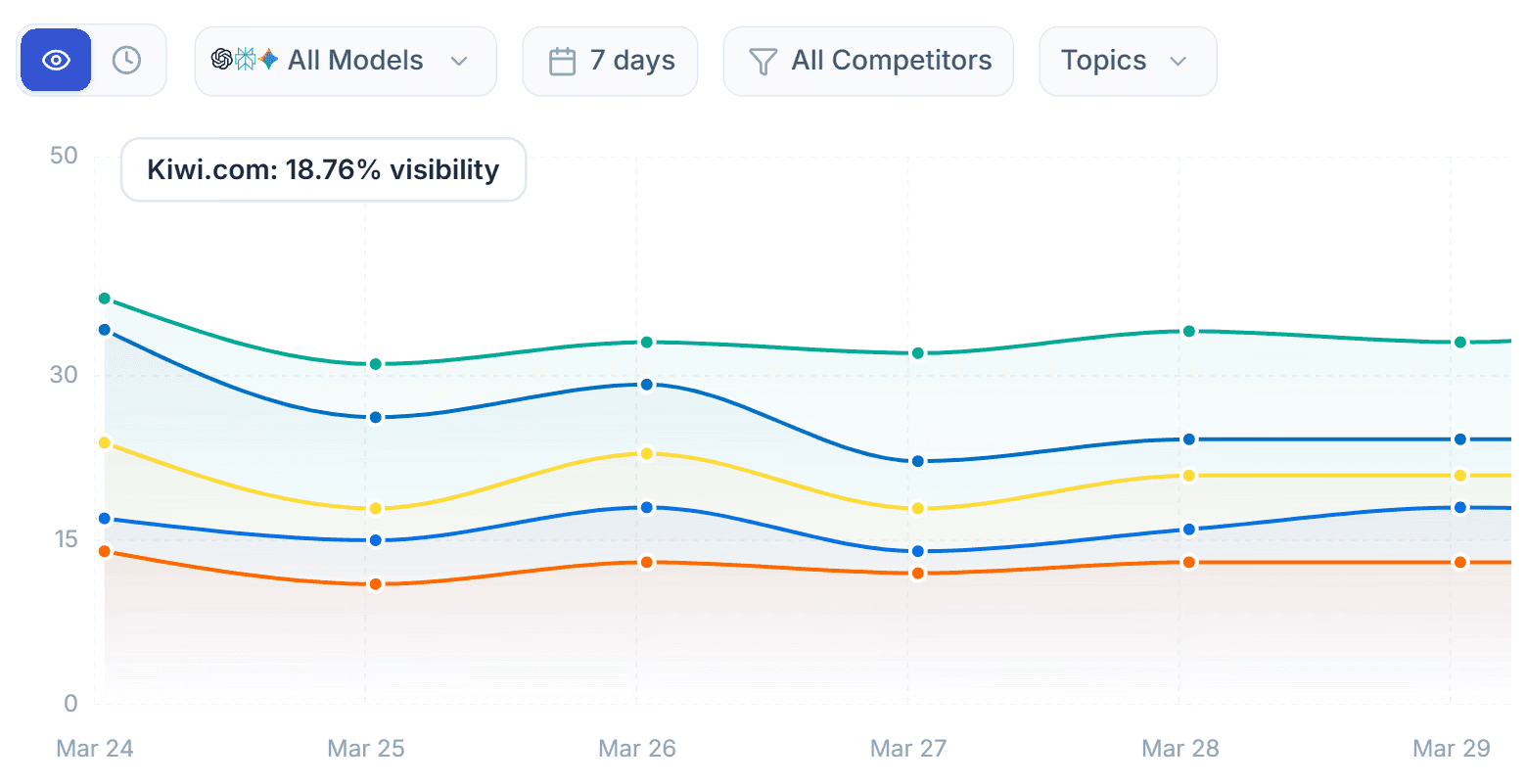
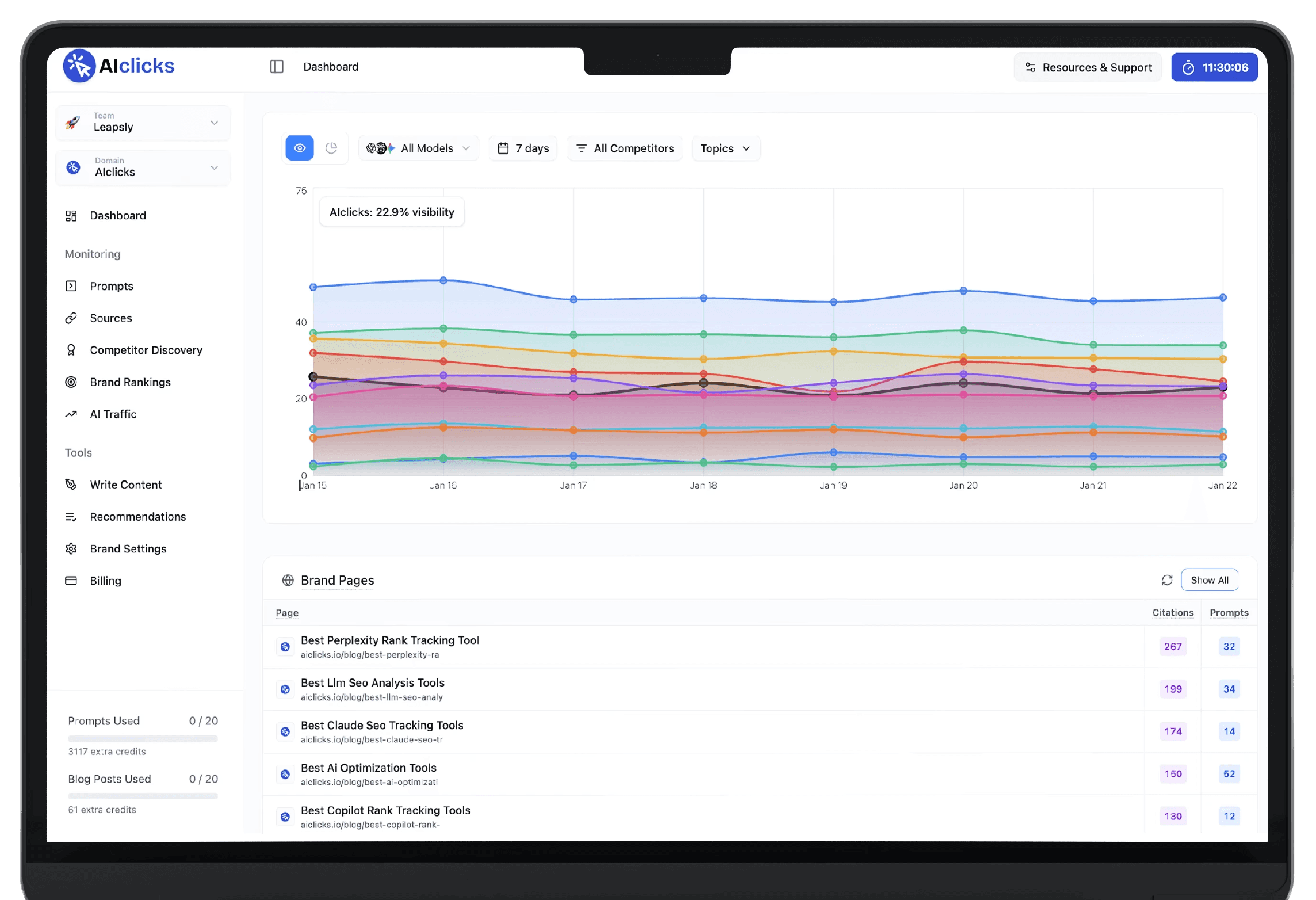
AIclicks gives you a live dashboard with daily ChatGPT mention rate, citation rate, sentiment, and share-of-voice across your tracked prompts, plus GA4 referral attribution for the traffic ChatGPT does send back.
Choose Your Plan
Flexible pricing that grows with your team. Upgrade or downgrade at any time.
Monthly
Yearly
-20%
Starter
Perfect for individuals & small teams
$49
/ month
Billed annually — you save $142
Choose 3 from:
Daily

" height="16px" id="fvSweaOBo" transform="translate(1 0)" width="14px"/></svg>)
" width="14px"><path d="M 13.864 5.629 L 13.3 5.629 L 13.3 5.6 L 7 5.6 L 7 8.4 L 10.956 8.4 C 10.379 10.03 8.828 11.2 7 11.2 C 4.681 11.2 2.8 9.319 2.8 7 C 2.8 4.681 4.681 2.8 7 2.8 C 8.071 2.8 9.045 3.204 9.786 3.864 L 11.766 1.884 C 10.516 0.719 8.844 0 7 0 C 3.134 0 0 3.134 0 7 C 0 10.866 3.134 14 7 14 C 10.866 14 14 10.866 14 7 C 14 6.531 13.952 6.073 13.864 5.629 Z" fill="rgb(255, 193, 7)" height="14px" id="H_YjfTNpn" width="14px"/><path d="M 0 3.742 L 2.3 5.429 C 2.922 3.888 4.429 2.8 6.193 2.8 C 7.264 2.8 8.238 3.204 8.979 3.864 L 10.959 1.884 C 9.709 0.719 8.037 0 6.193 0 C 3.504 0 1.172 1.518 0 3.742 Z" fill="rgb(255, 61, 0)" height="5.428500000000002px" id="PlkthQDhg" transform="translate(0.875 0)" width="10.959199999999996px"/><path d="M 6.232 5.581 C 8.04 5.581 9.683 4.889 10.925 3.764 L 8.758 1.931 C 8.032 2.483 7.144 2.782 6.232 2.781 C 4.411 2.781 2.865 1.62 2.283 0 L 0 1.759 C 1.159 4.026 3.511 5.581 6.232 5.581 Z" fill="rgb(76, 175, 80)" height="5.581099999999999px" id="WlnJ5gngE" transform="translate(0.7 8.4)" width="10.924899999999994px"/><path d="M 6.864 0.029 L 6.3 0.029 L 6.3 0 L 0 0 L 0 2.8 L 3.956 2.8 C 3.68 3.576 3.183 4.254 2.526 4.75 L 2.527 4.749 L 4.693 6.582 C 4.54 6.722 7 4.9 7 1.4 C 7 0.931 6.952 0.473 6.864 0.029 Z" fill="rgb(25, 118, 210)" height="6.589883930775992px" id="x_rSW275p" transform="translate(7 5.6)" width="7px"/></g></svg>)
" height="16px" id="hHS98fTxZ" width="16px"/></svg>)
 scale(1 1) translate(-1.861736945942159, -1.1170155383302638)" id="P20NzAvj0-699428820-radial-gradient" r="0.9935228066204626"><stop offset="0" stop-color="rgb(0, 174, 255)"/><stop offset="1" stop-color="rgb(7, 54, 196)"/></radialGradient><radialGradient cx="0.48250042504016705" cy="1.8366934653567062" gradient-transform="translate(0.48250042504016705, 1.8366934653567062) scale(1 1) translate(-0.48250042504016705, -1.8366934653567062)" id="UEWZqVjij-699428820-radial-gradient" r="0.9176890228114506"><stop offset="0" stop-color="rgb(255, 182, 87)"/><stop offset="1" stop-color="rgb(192, 43, 60)"/></radialGradient><linearGradient id="jyMN3TmKx-699428820-linear-gradient" x1="0.4594862532842614" x2="0.5405137467157386" y1="0" y2="1"><stop offset="0" stop-color="rgb(13, 145, 225)"/><stop offset="1" stop-color="rgb(255, 200, 0)"/></linearGradient><linearGradient id="xhMNwDFG0-699428820-linear-gradient" x1="0.4784828731548295" x2="0.5215171268451705" y1="5.551115123125783e-17" y2="1"><stop offset="0" stop-color="rgb(61, 203, 255)"/><stop offset="1" stop-color="rgba(5, 136, 247, 0)"/></linearGradient><radialGradient cx="1.4305090871482182" cy="0.34866158048251783" gradient-transform="translate(1.4305090871482182, 0.34866158048251783) scale(1 1) translate(-1.4305090871482182, -0.34866158048251783)" id="i79kAqaS4-699428820-radial-gradient" r="1.3362743412697924"><stop offset="0" stop-color="rgb(140, 72, 255)"/><stop offset="1" stop-color="rgb(255, 177, 82)"/></radialGradient><linearGradient id="mcxvno3tX-699428820-linear-gradient" x1="0.49844355920154226" x2="0.5015564407984577" y1="0" y2="1"><stop offset="0" stop-color="rgb(248, 173, 250)"/><stop offset="1" stop-color="rgba(168, 110, 221, 0)"/></linearGradient></defs><g d="M 11.605 1.219 C 11.397 0.499 10.739 0.002 9.989 0 L 9.498 0 C 8.682 0.002 7.985 0.588 7.842 1.391 L 7 6.016 L 7.209 5.296 C 7.416 4.574 8.075 4.076 8.825 4.074 L 11.681 4.074 L 12.879 4.545 L 14.033 4.074 L 13.697 4.074 C 12.947 4.072 12.289 3.575 12.081 2.855 Z M 4.413 13.387 C 4.618 14.111 5.278 14.611 6.031 14.613 L 7.075 14.613 C 7.988 14.613 8.735 13.88 8.758 12.96 L 8.871 8.5 L 8.633 9.319 C 8.426 10.039 7.768 10.537 7.018 10.539 L 4.138 10.539 L 3.111 9.977 L 2 10.539 L 2.331 10.539 C 3.084 10.542 3.743 11.042 3.949 11.766 L 4.413 13.387 Z M 9.999 0 L 4.167 0 C 2.501 0 1.501 2.221 0.834 4.441 C 0.045 7.073 -0.989 10.591 2.001 10.591 L 4.519 10.591 C 5.273 10.591 5.933 10.089 6.139 9.36 C 6.577 7.815 7.345 5.121 7.948 3.069 C 8.255 2.027 8.509 1.132 8.901 0.575 C 9.148 0.212 9.56 -0.004 9.999 0 M 9.999 0 L 4.167 0 C 2.501 0 1.501 2.221 0.834 4.441 C 0.045 7.073 -0.989 10.591 2.001 10.591 L 4.519 10.591 C 5.273 10.591 5.933 10.089 6.139 9.36 C 6.577 7.815 7.345 5.121 7.948 3.069 C 8.255 2.027 8.509 1.132 8.901 0.575 C 9.148 0.212 9.56 -0.004 9.999 0 M 6 14.593 L 11.833 14.593 C 13.499 14.593 14.499 12.372 15.166 10.151 C 15.955 7.519 16.989 4 13.999 4 L 11.48 4 C 10.725 4.002 10.063 4.505 9.86 5.232 C 9.266 7.332 8.663 9.429 8.051 11.523 C 7.745 12.566 7.49 13.461 7.098 14.019 C 6.851 14.382 6.439 14.597 6 14.593 M 6 14.593 L 11.833 14.593 C 13.499 14.593 14.499 12.372 15.166 10.151 C 15.955 7.519 16.989 4 13.999 4 L 11.48 4 C 10.725 4.002 10.063 4.505 9.86 5.232 C 9.266 7.332 8.663 9.429 8.051 11.523 C 7.745 12.566 7.49 13.461 7.098 14.019 C 6.851 14.382 6.439 14.597 6 14.593" fill="transparent" height="14.613333333333333px" id="QzkBy4Ibc" transform="translate(0 1)" width="16.00011071294081px"><path d="M 4.605 1.219 C 4.397 0.499 3.739 0.002 2.989 0 L 2.498 0 C 1.682 0.002 0.985 0.588 0.842 1.391 L 0 6.016 L 0.209 5.296 C 0.416 4.574 1.075 4.076 1.825 4.074 L 4.681 4.074 L 5.879 4.545 L 7.033 4.074 L 6.697 4.074 C 5.947 4.072 5.289 3.575 5.081 2.855 Z" fill="url(%23P20NzAvj0-699428820-radial-gradient)" height="6.016px" id="P20NzAvj0" transform="translate(7 0)" width="7.0333333333333385px"/><path d="M 2.413 4.887 C 2.618 5.611 3.278 6.111 4.031 6.113 L 5.075 6.113 C 5.988 6.113 6.735 5.38 6.758 4.46 L 6.871 0 L 6.633 0.819 C 6.426 1.539 5.768 2.037 5.018 2.039 L 2.138 2.039 L 1.111 1.477 L 0 2.039 L 0.331 2.039 C 1.084 2.042 1.743 2.542 1.949 3.266 L 2.413 4.887 Z" fill="url(%23UEWZqVjij-699428820-radial-gradient)" height="6.113333333333333px" id="UEWZqVjij" transform="translate(2 8.5)" width="6.871333333333332px"/><path d="M 9.999 0 L 4.167 0 C 2.501 0 1.501 2.221 0.834 4.441 C 0.045 7.073 -0.989 10.591 2.001 10.591 L 4.519 10.591 C 5.273 10.591 5.933 10.089 6.139 9.36 C 6.577 7.815 7.345 5.121 7.948 3.069 C 8.255 2.027 8.509 1.132 8.901 0.575 C 9.148 0.212 9.56 -0.004 9.999 0" fill="url(%23jyMN3TmKx-699428820-linear-gradient)" height="10.591388755215167px" id="jyMN3TmKx" width="9.999444046274142px"/><path d="M 9.999 0 L 4.167 0 C 2.501 0 1.501 2.221 0.834 4.441 C 0.045 7.073 -0.989 10.591 2.001 10.591 L 4.519 10.591 C 5.273 10.591 5.933 10.089 6.139 9.36 C 6.577 7.815 7.345 5.121 7.948 3.069 C 8.255 2.027 8.509 1.132 8.901 0.575 C 9.148 0.212 9.56 -0.004 9.999 0" fill="url(%23xhMNwDFG0-699428820-linear-gradient)" height="10.591388755215167px" id="xhMNwDFG0" width="9.999444046274142px"/><path d="M 0 10.593 L 5.833 10.593 C 7.499 10.593 8.499 8.372 9.166 6.151 C 9.955 3.519 10.989 0 7.999 0 L 5.48 0 C 4.725 0.002 4.063 0.505 3.86 1.232 C 3.266 3.332 2.663 5.429 2.051 7.523 C 1.745 8.566 1.49 9.461 1.098 10.019 C 0.851 10.382 0.439 10.597 0 10.593" fill="url(%23i79kAqaS4-699428820-radial-gradient)" height="10.593388755215164px" id="i79kAqaS4" transform="translate(6 4)" width="10.000110712940803px"/><path d="M 0 10.593 L 5.833 10.593 C 7.499 10.593 8.499 8.372 9.166 6.151 C 9.955 3.519 10.989 0 7.999 0 L 5.48 0 C 4.725 0.002 4.063 0.505 3.86 1.232 C 3.266 3.332 2.663 5.429 2.051 7.523 C 1.745 8.566 1.49 9.461 1.098 10.019 C 0.851 10.382 0.439 10.597 0 10.593" fill="url(%23mcxvno3tX-699428820-linear-gradient)" height="10.593388755215164px" id="mcxvno3tX" transform="translate(6 4)" width="10.000110712940803px"/></g></svg>)
" height="15.360666565427872px" id="HZPvvPBv7" transform="translate(0 0.5)" width="16px"/></svg>)
Tracked prompts
30
Websites you can add
3
LLMs you can track
3
Countries per project
1
LLM responses / mo
4,650
AI-optimized articles per month
10
Integrations
-
Support
Pro
For growing teams for more power
$140
/ month
Billed annually — you save $454
Choose 4 from:
Daily
Tracked prompts
150
Websites you can add
Unlimited
LLMs you can track
4
Countries per project
Unlimited
LLM responses / mo
18,600
AI-optimized articles per month
20
Integrations
Google Analytics
Support
BUSINESS
Best for medium-sized organizations
$357
/ month
Billed annually — you save $1198
Choose 6 from:
Daily
Tracked prompts
300
Websites you can add
Unlimited
LLMs you can track
6
Countries per project
Unlimited
LLM responses / mo
55,800
AI-optimized articles per month
30
Integrations
Google Analytics, API
Support
Dedicated account specialist
Become the #1 Answer in AI
Succeed in GEO yourself, or let us do all the work.
Do it yourself
Use AIclicks to see exactly where you appear across 10+ AI platforms, spot the gaps competitors are filling, and act on clear weekly recommendations.
From $59/month · Cancel anytime
Done for you
We Do All the Work for You
Our team manages your complete search presence: traditional SEO and GEO strategy, content, implementation, and reporting. You focus on patients.
Custom pricing · Minimum 3-month engagement
The AI SEO agency trusted by 1,000+ brands worldwide
From solo founders to multi-client agencies, AIclicks runs the full AI SEO agency program for organizations of every shape and size that want to be cited across every AI surface.
4.9/5 stars on G2




FAQ
How long does SEO take for a surgical practice?
Local movement usually appears in 2 to 4 months, and consult volume from organic search around 6 to 9. Competitive procedure terms take 9 to 18 months, because you are competing with hospital systems and Healthgrades on domain authority, not just page quality. Practices in narrower subspecialties move faster. Watch Search Console impressions on procedure terms first; they rise months before positions do.
Does AI search matter yet for surgeons?
It already does, and it is a different job from ranking. Ahrefs analysed 863,000 keywords and found only 38% of pages cited in AI Overviews also ranked in the top 10, down from 76% a year earlier. Ask any assistant for the best surgeon in your area and it will name hospital systems and Healthgrades. Getting quoted needs credentials, case volume and clear structured answers on the page.
Why can't we just use generic local SEO advice?
Because 3 things about surgery break the generic playbook. Google treats surgical content as YMYL and will not rank an unattributed procedure page. Patients search the condition and the lay term for the operation, not your subspecialty. And your citation layer is not Yelp; it is the NPI registry, ABMS, Doximity, your specialty society directory and every insurer whose plans you take.
How much does surgeon SEO actually cost monthly?
Published medical SEO rates typically run $1,500 to $3,500 a month for a single-location practice, $5,000 to $15,000 for multi-location groups or competitive subspecialties. Separately, many practices already pay a medical web vendor $250 to $500 a month simply to host a template site, which buys nothing. Judge any retainer on cost per booked consult against the revenue of one case.
Do we still need Google Ads if we do SEO?
Usually yes, on a shrinking list of terms. Ads buy the elective and cash-pay procedures where competition is fiercest and margins justify it; organic search is cheaper on condition, recovery and insurance queries that make up most surgical volume. Use the ad data to sequence content: whichever procedure keywords convert to booked consults deserve a page first. Measure both on cost per surgical case, not clicks.
What should we build first on the website?
Google Business Profile first, with the subspecialty as primary category, because it is free and sits above everything. Then the surgeon bio, since it carries your board certification, fellowship and hospital privileges. Then a page for each of your 3 highest-volume operations in patient language. Then a coverage and cost page. Condition pages after that. The news section is last and mostly optional.
How do we tell if any of this works?
Count booked consults from organic search, not rankings. Surgical enquiries arrive by phone, so put call tracking on the site or they vanish from analytics. Tag which procedure page the caller landed on, then reconcile against surgeries actually scheduled in your practice management system. Watch Google Business Profile calls and direction requests, which move first, and impressions on procedure terms in Search Console.
Should our practice manager handle this or an agency?
Split it. Your practice manager should own the Google profile, the review asks and the answers to insurance and referral questions, because nobody outside the practice knows your OR schedule or your payer mix. Outsource schema, site speed, PDF cleanup and link work. If you hire out, avoid the web vendor who builds every surgical site on one template and then sells you SEO to fix it.
Further Reading
Go deeper on GEO, AI search, and visibility tracking.