SEO for Software Companies:
A buyer shortlists 3 tools before anyone at your company hears about it. They read a G2 category page, skim 2 comparison posts, ask ChatGPT which vendor fits their stack, then book demos. Search visibility decides who is on that list.









Why Software Companies Need SEO
Software buyers finish most of their research before contacting a vendor, and a growing share of it happens inside ChatGPT and AI Overviews rather than on your site. The shortlist is written without you.
Your site is organised around the product: modules, features, release notes. Buyers search the category and the job: invoice reconciliation software, alternatives to the tool they hate, integrations with their stack. Each lands on a competitor who wrote that page in the buyer’s language, and you never see the lost demo.
Search software development company near me, or the best software in your category, and the first page belongs to Clutch, Thumbtack, Yelp and G2. They win on aggregate review volume that no single vendor can match. Then they charge your competitors for a sponsored slot inside the very result that pushed you off page one.
Software category keywords are among the most expensive in all of Google Ads, and a G2 category sponsorship is only a subscription, not an asset. Meanwhile SaaS SEO retainers typically run from $3,000 to $10,000 a month. Pause any of it and the pipeline drops inside a quarter, because nothing that you bought stays yours.
How SEO Works for Software Companies
Search Engine Optimization projects are long-term investments for software firms, where each task supplements the others and creates compound results over time.
01
Keywords, page structure, and the signals Google reads directly
Two vocabularies collide on a software marketing site. Your team names things internally: workspaces, flows, entities. Buyers type the category, the competitor, the integration and the problem. Worse, half the site is generated by the same React app that runs the product, so headings, canonical tags and meta descriptions live in component props rather than a CMS anyone in marketing can edit. The pages that carry real weight here are your category page, your integration pages, your alternatives pages and your pricing page, not the engineering blog. It is the single biggest reason technically excellent sites rank for nothing but their own brand name.
Pages tied to a job outlive pages tied to a release. A page explaining how to migrate data out of the incumbent tool, or what a category actually costs at 50 seats, still converts 3 years later because the problem outlives every version number. What churns is everything shipped from the changelog: v4.2 release notes, the funding announcement, the conference recap, the post about your new logo. Most software firms invert this. They publish 4 changelog posts a month and leave the alternatives page untouched since launch, then wonder why organic pipeline is flat.
1
Build one page for the software category buyers actually search, titled with the G2 category name rather than your internal product name.
2
Sunset feature pages and deprecated API docs quarterly using Search Console’s page report, then 301 each into the current feature or changelog entry.
3
Mark up every product page with SoftwareApplication schema including offers and aggregateRating, then check it in the Rich Results Test before release.
4
Publish a versus page for each named competitor and an alternatives page for the incumbent, both maintained on a fixed quarterly review.
02
Map Pack visibility, citations, and proximity signals
Not all software demand is local, but more of it is than founders assume. Search software development company near me and Google returns a 3-result map pack above every organic listing, filled with firms that claimed a profile and collected reviews. Implementation work, integration projects and enterprise procurement all skew toward vendors with a verifiable US address. The profile costs nothing and outranks the site you paid to build.
The primary category should be Software Company rather than the vague Computer Consultant, and each service you genuinely deliver belongs as its own entry: custom software development, mobile app development, systems integration, staff augmentation. Upload photos of the actual team and office, not stock developers at monitors. List real hours, name the languages and platforms you build in, and pre-answer what procurement always asks: contract minimums, onshore versus offshore staffing, security certifications.
Two directory layers matter, and software firms usually claim only the first. There is the general one, Google Business Profile, Bing Places, Apple Business Connect and Yelp. Then there is the buyer layer that decides deals: G2, Capterra, Software Advice, TrustRadius, GetApp, Clutch, GoodFirms, Product Hunt, StackShare and the AWS and Salesforce marketplaces. Those profiles are also what AI assistants read when someone asks what to buy, so a stale listing with an old logo costs you twice.
1
Pick Software Company as your main Google Business Profile category, then list custom development, systems integration and support as separate service entries.
2
Give each office in a second market its own profile and staffed page, and never list a coworking address you do not actually occupy.
3
Run Yext or Semrush Listing Management across G2, Capterra, Clutch, GoodFirms and Crunchbase, then fix every legal-entity, suite and phone variant.
4
Each week, answer one unanswered question on your G2 and Capterra profiles and post a shipped feature to Google Business Profile.
03
Topic authority, inbound links, and content that earns traffic
A buyer will not book a demo until 3 questions are answered: is this a real category, what does it cost, and will it break what we already run. Content that answers those honestly beats anything written to rank. A page mapping the category’s tools by team size, or one explaining what integration with the systems they already own actually involves, earns trust at the exact moment a shortlist gets written.
Once the category is settled, the question becomes which vendor, and buyers at that stage want evidence rather than adjectives. Published pricing with seat tiers. A migration guide from the incumbent. A security page with SOC 2 status and subprocessors listed. Named customers in their own industry. Put all of it on the comparison page, not behind a form. Software firms lose these buyers at the exact point where the pricing page says contact sales.
Software links come from the ecosystem rather than outreach. Every platform you integrate with runs a partner directory and an app marketplace listing that links back, and almost nobody claims all of them. Open-source repositories, changelogs and StackShare profiles link naturally. Trade press like TechCrunch and The New Stack want data, so publish benchmarks from your own product telemetry. Customers will link from their engineering blog if you ask while the case study is being written.
1
Publish an annual buyer’s guide ranking every tool in your category, including yourself honestly, and refresh the pricing table each January.
2
Build one page per integration, such as your tool plus Salesforce or Slack, with real setup steps and screenshots rather than a swapped logo.
3
Cluster every cost question into one hub: per-seat versus usage pricing, total cost at 50 and 500 seats, implementation fees, and build-versus-buy maths.
4
Write a page for every platform and language you build on, such as Salesforce, SAP, React Native or Snowflake, since buyers search stacks first.
04
Site speed, crawlability, Core Web Vitals, and mobile health
Almost every software marketing site has the same invisible defect: it renders in the browser rather than on the server. The site ships as a React or Next.js bundle, content appears only after JavaScript executes, and Googlebot defers that rendering by days. AI crawlers are worse. GPTBot, ClaudeBot and PerplexityBot do not run JavaScript at all, so they fetch a page containing a loading div and nothing else. Nobody notices, because logged-in engineers see a fast, perfect app every day.
Software buyers do not decide on a phone the way a homeowner picks a plumber, but they do open your pricing page on mobile between meetings, and they forward the link to a colleague who opens it on a locked-down laptop. A marketing site carrying the full product bundle, a session-replay script, 2 chat widgets and an analytics tag manager will take several seconds to become interactive. That is long enough for a comparison tab to win.
1
Fetch your key pages with JavaScript disabled, or use Search Console’s URL Inspection rendered HTML, and move anything missing to server-side rendering.
2
Profile your pricing and comparison pages in PageSpeed Insights, the table-heavy ones, and target Interaction to Next Paint under 200 milliseconds.
3
Export product screenshots and dashboard GIFs as WebP or AVIF at display size, and replace autoplay demo videos with a poster image and click-to-play.
4
Split marketing, docs and changelog into separate sitemaps, and block every Vercel or Netlify preview deployment with robots.txt before it gets indexed.
05
Star ratings, review volume, and response strategy that builds trust
Procurement will not sign off on a vendor with 4 reviews and no G2 badge, which makes reviews the strongest signal you do not directly control. They are also unusually hard to collect. Your happiest users are individual contributors with no authority to publish anything under a company name, your champion changes job every 18 months, and G2 and Capterra both verify identity and employer before a review is allowed to go live.
Ask the week a customer hits the outcome they bought you for, the first successful migration, the first month they clear their own number. Not at renewal, when the conversation has turned to price. Wire the request to a product event rather than a calendar so it fires from inside your own app while the person is still using it. Ask every account, not only the logos, or the profile reads curated.
1
Fire the G2 review request from a product event in Segment or Customer.io, such as first successful data import, not from a renewal reminder.
2
Answer every G2 or Capterra criticism within 48 hours, naming the release that fixed it and linking the changelog entry as proof.
3
Embed verified G2 quotes on the pricing and versus pages where the decision happens, marked with Review schema, not in a homepage carousel.
4
Ask implementation partners and resellers for Clutch reviews, and keep Glassdoor healthy, because enterprise procurement checks both before signing a multi-year contract.
Google is No Longer the Only Place Your buyers are Searching
Buyers are using AI to find answers, and they trust what it tells them. Invest in GEO to get recommended in those answers.
1 Billion
Questions ChatGPT receives every single day
38%
Your #1 top ranking page on Google would be cited by AI
14%
of software firms optimise for GEO. The rest are invisible in AI answers


You can rank #1 for “software firm near me” and still not exist in ChatGPT’s answer. Run a free GEO audit to see where your brand actually stands.
GEO vs SEO: Same Goal, Different Methods
GEO is wider than SEO. AI recommends the brands that show up across the sources it reads, so your presence in forums, social platforms and B2B software blogs decides your odds. AIclicks measures the three metrics below so you know which to work on first.
AI Assistant
Who builds custom software for a company our size?
Your Company
Citation Rate
Shows how many AI answers about software companies name your brand, out of every 100. Models pull from the same trusted pages over and over, so citations compound: once you are in, staying in gets easier. Find the competitor pages AI cites most, then publish your own version of each.
Your Company
82% positive
Competitor A
54% positive
Competitor B
38% positive
Brand Sentiment
Shows how AI describes you when your brand comes up: positive, neutral or negative. Tone is what separates being mentioned from being recommended, and models repeat whatever framing they find. Track the negative mentions back to the reviews and threads behind them, then publish content that answers those directly.
Others 52%
You 24%
— 24%
Your Company
AI mention share of voice — B2B software category
Competitors
Not Cited
Share of Voice in AI
Shows how much of the B2B software conversation belongs to you rather than your competitors. This is the metric that matters most, the GEO version of a Google ranking. With only 1–5 brands named per answer, the market is winner-takes-more and every point is taken from someone.
The Dashboard Your Dedicated AI Search Team Works In
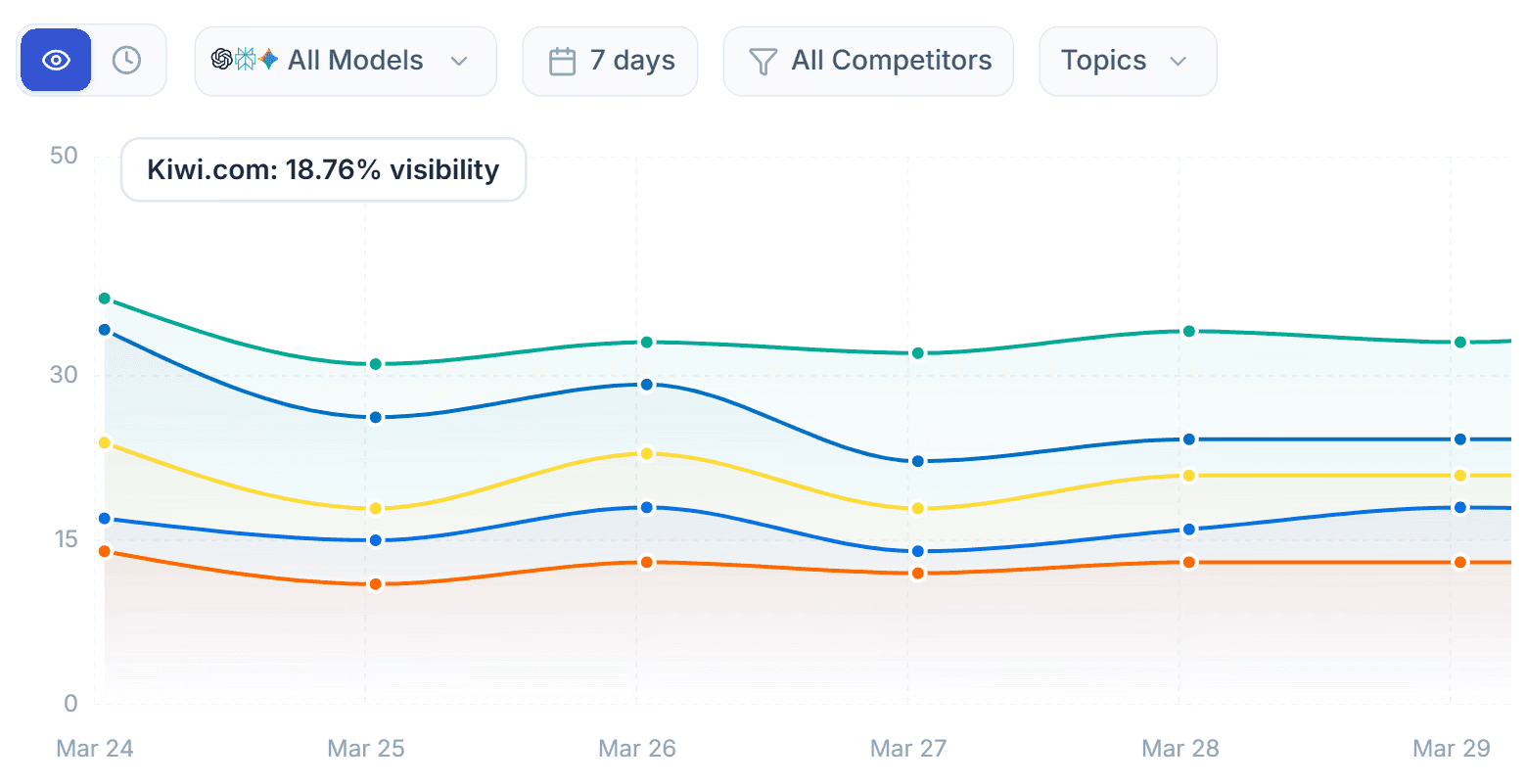
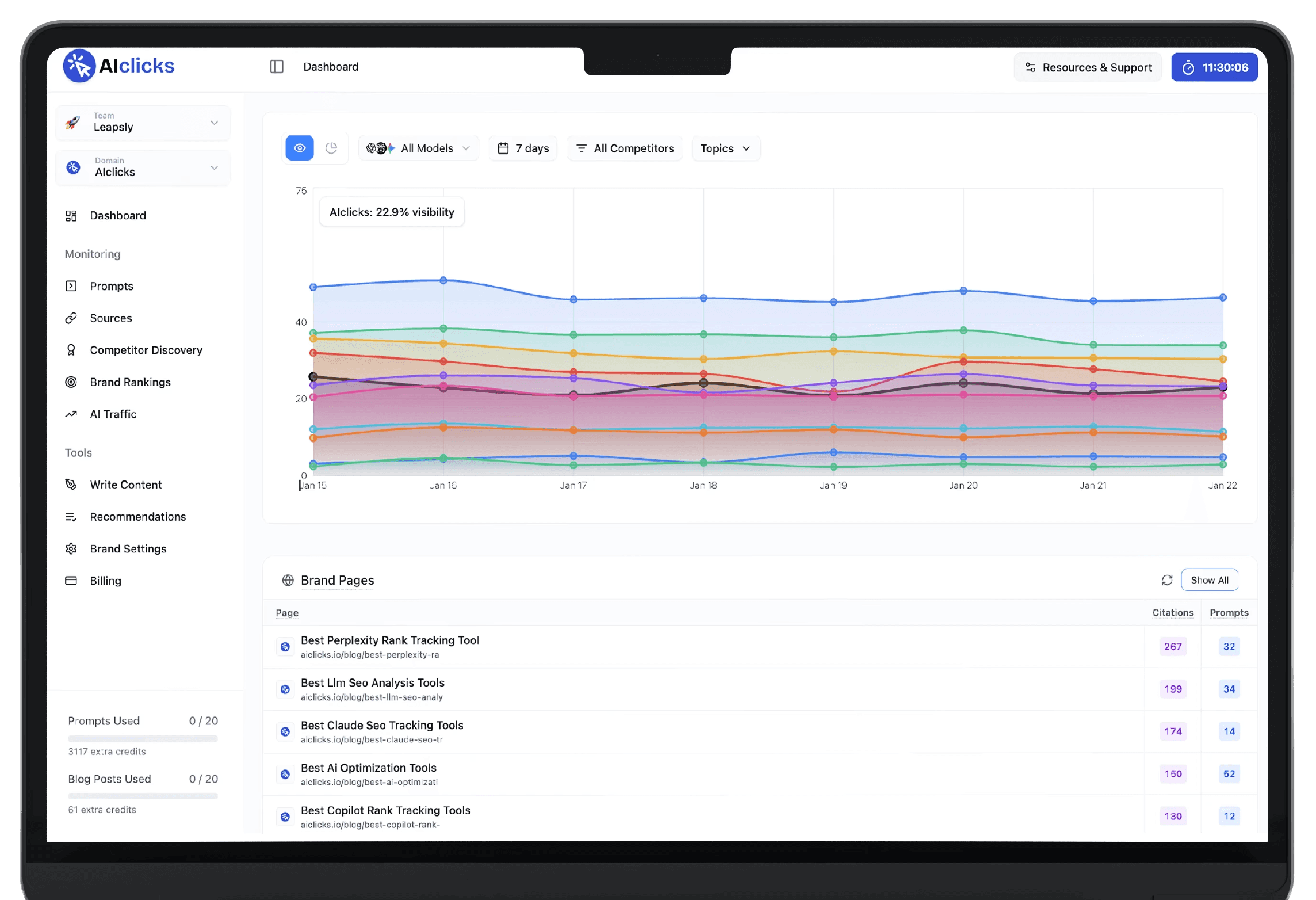
AIclicks gives you a live dashboard with daily ChatGPT mention rate, citation rate, sentiment, and share-of-voice across your tracked prompts, plus GA4 referral attribution for the traffic ChatGPT does send back.
Choose Your Plan
Flexible pricing that grows with your team. Upgrade or downgrade at any time.
Monthly
Yearly
-20%
Starter
Perfect for individuals & small teams
$49
/ month
Billed annually — you save $142
Choose 3 from:
Daily

" height="16px" id="fvSweaOBo" transform="translate(1 0)" width="14px"/></svg>)
" width="14px"><path d="M 13.864 5.629 L 13.3 5.629 L 13.3 5.6 L 7 5.6 L 7 8.4 L 10.956 8.4 C 10.379 10.03 8.828 11.2 7 11.2 C 4.681 11.2 2.8 9.319 2.8 7 C 2.8 4.681 4.681 2.8 7 2.8 C 8.071 2.8 9.045 3.204 9.786 3.864 L 11.766 1.884 C 10.516 0.719 8.844 0 7 0 C 3.134 0 0 3.134 0 7 C 0 10.866 3.134 14 7 14 C 10.866 14 14 10.866 14 7 C 14 6.531 13.952 6.073 13.864 5.629 Z" fill="rgb(255, 193, 7)" height="14px" id="H_YjfTNpn" width="14px"/><path d="M 0 3.742 L 2.3 5.429 C 2.922 3.888 4.429 2.8 6.193 2.8 C 7.264 2.8 8.238 3.204 8.979 3.864 L 10.959 1.884 C 9.709 0.719 8.037 0 6.193 0 C 3.504 0 1.172 1.518 0 3.742 Z" fill="rgb(255, 61, 0)" height="5.428500000000002px" id="PlkthQDhg" transform="translate(0.875 0)" width="10.959199999999996px"/><path d="M 6.232 5.581 C 8.04 5.581 9.683 4.889 10.925 3.764 L 8.758 1.931 C 8.032 2.483 7.144 2.782 6.232 2.781 C 4.411 2.781 2.865 1.62 2.283 0 L 0 1.759 C 1.159 4.026 3.511 5.581 6.232 5.581 Z" fill="rgb(76, 175, 80)" height="5.581099999999999px" id="WlnJ5gngE" transform="translate(0.7 8.4)" width="10.924899999999994px"/><path d="M 6.864 0.029 L 6.3 0.029 L 6.3 0 L 0 0 L 0 2.8 L 3.956 2.8 C 3.68 3.576 3.183 4.254 2.526 4.75 L 2.527 4.749 L 4.693 6.582 C 4.54 6.722 7 4.9 7 1.4 C 7 0.931 6.952 0.473 6.864 0.029 Z" fill="rgb(25, 118, 210)" height="6.589883930775992px" id="x_rSW275p" transform="translate(7 5.6)" width="7px"/></g></svg>)
" height="16px" id="hHS98fTxZ" width="16px"/></svg>)
 scale(1 1) translate(-1.861736945942159, -1.1170155383302638)" id="P20NzAvj0-699428820-radial-gradient" r="0.9935228066204626"><stop offset="0" stop-color="rgb(0, 174, 255)"/><stop offset="1" stop-color="rgb(7, 54, 196)"/></radialGradient><radialGradient cx="0.48250042504016705" cy="1.8366934653567062" gradient-transform="translate(0.48250042504016705, 1.8366934653567062) scale(1 1) translate(-0.48250042504016705, -1.8366934653567062)" id="UEWZqVjij-699428820-radial-gradient" r="0.9176890228114506"><stop offset="0" stop-color="rgb(255, 182, 87)"/><stop offset="1" stop-color="rgb(192, 43, 60)"/></radialGradient><linearGradient id="jyMN3TmKx-699428820-linear-gradient" x1="0.4594862532842614" x2="0.5405137467157386" y1="0" y2="1"><stop offset="0" stop-color="rgb(13, 145, 225)"/><stop offset="1" stop-color="rgb(255, 200, 0)"/></linearGradient><linearGradient id="xhMNwDFG0-699428820-linear-gradient" x1="0.4784828731548295" x2="0.5215171268451705" y1="5.551115123125783e-17" y2="1"><stop offset="0" stop-color="rgb(61, 203, 255)"/><stop offset="1" stop-color="rgba(5, 136, 247, 0)"/></linearGradient><radialGradient cx="1.4305090871482182" cy="0.34866158048251783" gradient-transform="translate(1.4305090871482182, 0.34866158048251783) scale(1 1) translate(-1.4305090871482182, -0.34866158048251783)" id="i79kAqaS4-699428820-radial-gradient" r="1.3362743412697924"><stop offset="0" stop-color="rgb(140, 72, 255)"/><stop offset="1" stop-color="rgb(255, 177, 82)"/></radialGradient><linearGradient id="mcxvno3tX-699428820-linear-gradient" x1="0.49844355920154226" x2="0.5015564407984577" y1="0" y2="1"><stop offset="0" stop-color="rgb(248, 173, 250)"/><stop offset="1" stop-color="rgba(168, 110, 221, 0)"/></linearGradient></defs><g d="M 11.605 1.219 C 11.397 0.499 10.739 0.002 9.989 0 L 9.498 0 C 8.682 0.002 7.985 0.588 7.842 1.391 L 7 6.016 L 7.209 5.296 C 7.416 4.574 8.075 4.076 8.825 4.074 L 11.681 4.074 L 12.879 4.545 L 14.033 4.074 L 13.697 4.074 C 12.947 4.072 12.289 3.575 12.081 2.855 Z M 4.413 13.387 C 4.618 14.111 5.278 14.611 6.031 14.613 L 7.075 14.613 C 7.988 14.613 8.735 13.88 8.758 12.96 L 8.871 8.5 L 8.633 9.319 C 8.426 10.039 7.768 10.537 7.018 10.539 L 4.138 10.539 L 3.111 9.977 L 2 10.539 L 2.331 10.539 C 3.084 10.542 3.743 11.042 3.949 11.766 L 4.413 13.387 Z M 9.999 0 L 4.167 0 C 2.501 0 1.501 2.221 0.834 4.441 C 0.045 7.073 -0.989 10.591 2.001 10.591 L 4.519 10.591 C 5.273 10.591 5.933 10.089 6.139 9.36 C 6.577 7.815 7.345 5.121 7.948 3.069 C 8.255 2.027 8.509 1.132 8.901 0.575 C 9.148 0.212 9.56 -0.004 9.999 0 M 9.999 0 L 4.167 0 C 2.501 0 1.501 2.221 0.834 4.441 C 0.045 7.073 -0.989 10.591 2.001 10.591 L 4.519 10.591 C 5.273 10.591 5.933 10.089 6.139 9.36 C 6.577 7.815 7.345 5.121 7.948 3.069 C 8.255 2.027 8.509 1.132 8.901 0.575 C 9.148 0.212 9.56 -0.004 9.999 0 M 6 14.593 L 11.833 14.593 C 13.499 14.593 14.499 12.372 15.166 10.151 C 15.955 7.519 16.989 4 13.999 4 L 11.48 4 C 10.725 4.002 10.063 4.505 9.86 5.232 C 9.266 7.332 8.663 9.429 8.051 11.523 C 7.745 12.566 7.49 13.461 7.098 14.019 C 6.851 14.382 6.439 14.597 6 14.593 M 6 14.593 L 11.833 14.593 C 13.499 14.593 14.499 12.372 15.166 10.151 C 15.955 7.519 16.989 4 13.999 4 L 11.48 4 C 10.725 4.002 10.063 4.505 9.86 5.232 C 9.266 7.332 8.663 9.429 8.051 11.523 C 7.745 12.566 7.49 13.461 7.098 14.019 C 6.851 14.382 6.439 14.597 6 14.593" fill="transparent" height="14.613333333333333px" id="QzkBy4Ibc" transform="translate(0 1)" width="16.00011071294081px"><path d="M 4.605 1.219 C 4.397 0.499 3.739 0.002 2.989 0 L 2.498 0 C 1.682 0.002 0.985 0.588 0.842 1.391 L 0 6.016 L 0.209 5.296 C 0.416 4.574 1.075 4.076 1.825 4.074 L 4.681 4.074 L 5.879 4.545 L 7.033 4.074 L 6.697 4.074 C 5.947 4.072 5.289 3.575 5.081 2.855 Z" fill="url(%23P20NzAvj0-699428820-radial-gradient)" height="6.016px" id="P20NzAvj0" transform="translate(7 0)" width="7.0333333333333385px"/><path d="M 2.413 4.887 C 2.618 5.611 3.278 6.111 4.031 6.113 L 5.075 6.113 C 5.988 6.113 6.735 5.38 6.758 4.46 L 6.871 0 L 6.633 0.819 C 6.426 1.539 5.768 2.037 5.018 2.039 L 2.138 2.039 L 1.111 1.477 L 0 2.039 L 0.331 2.039 C 1.084 2.042 1.743 2.542 1.949 3.266 L 2.413 4.887 Z" fill="url(%23UEWZqVjij-699428820-radial-gradient)" height="6.113333333333333px" id="UEWZqVjij" transform="translate(2 8.5)" width="6.871333333333332px"/><path d="M 9.999 0 L 4.167 0 C 2.501 0 1.501 2.221 0.834 4.441 C 0.045 7.073 -0.989 10.591 2.001 10.591 L 4.519 10.591 C 5.273 10.591 5.933 10.089 6.139 9.36 C 6.577 7.815 7.345 5.121 7.948 3.069 C 8.255 2.027 8.509 1.132 8.901 0.575 C 9.148 0.212 9.56 -0.004 9.999 0" fill="url(%23jyMN3TmKx-699428820-linear-gradient)" height="10.591388755215167px" id="jyMN3TmKx" width="9.999444046274142px"/><path d="M 9.999 0 L 4.167 0 C 2.501 0 1.501 2.221 0.834 4.441 C 0.045 7.073 -0.989 10.591 2.001 10.591 L 4.519 10.591 C 5.273 10.591 5.933 10.089 6.139 9.36 C 6.577 7.815 7.345 5.121 7.948 3.069 C 8.255 2.027 8.509 1.132 8.901 0.575 C 9.148 0.212 9.56 -0.004 9.999 0" fill="url(%23xhMNwDFG0-699428820-linear-gradient)" height="10.591388755215167px" id="xhMNwDFG0" width="9.999444046274142px"/><path d="M 0 10.593 L 5.833 10.593 C 7.499 10.593 8.499 8.372 9.166 6.151 C 9.955 3.519 10.989 0 7.999 0 L 5.48 0 C 4.725 0.002 4.063 0.505 3.86 1.232 C 3.266 3.332 2.663 5.429 2.051 7.523 C 1.745 8.566 1.49 9.461 1.098 10.019 C 0.851 10.382 0.439 10.597 0 10.593" fill="url(%23i79kAqaS4-699428820-radial-gradient)" height="10.593388755215164px" id="i79kAqaS4" transform="translate(6 4)" width="10.000110712940803px"/><path d="M 0 10.593 L 5.833 10.593 C 7.499 10.593 8.499 8.372 9.166 6.151 C 9.955 3.519 10.989 0 7.999 0 L 5.48 0 C 4.725 0.002 4.063 0.505 3.86 1.232 C 3.266 3.332 2.663 5.429 2.051 7.523 C 1.745 8.566 1.49 9.461 1.098 10.019 C 0.851 10.382 0.439 10.597 0 10.593" fill="url(%23mcxvno3tX-699428820-linear-gradient)" height="10.593388755215164px" id="mcxvno3tX" transform="translate(6 4)" width="10.000110712940803px"/></g></svg>)
" height="15.360666565427872px" id="HZPvvPBv7" transform="translate(0 0.5)" width="16px"/></svg>)
Tracked prompts
30
Websites you can add
3
LLMs you can track
3
Countries per project
1
LLM responses / mo
4,650
AI-optimized articles per month
10
Integrations
-
Support
Pro
For growing teams for more power
$140
/ month
Billed annually — you save $454
Choose 4 from:
Daily
Tracked prompts
150
Websites you can add
Unlimited
LLMs you can track
4
Countries per project
Unlimited
LLM responses / mo
18,600
AI-optimized articles per month
20
Integrations
Google Analytics
Support
BUSINESS
Best for medium-sized organizations
$357
/ month
Billed annually — you save $1198
Choose 6 from:
Daily
Tracked prompts
300
Websites you can add
Unlimited
LLMs you can track
6
Countries per project
Unlimited
LLM responses / mo
55,800
AI-optimized articles per month
30
Integrations
Google Analytics, API
Support
Dedicated account specialist
Become the #1 Answer in AI
Succeed in GEO yourself, or let us do all the work.
Do it yourself
Use AIclicks to see exactly where you appear across 10+ AI platforms, spot the gaps competitors are filling, and act on clear weekly recommendations.
From $59/month · Cancel anytime
Done for you
We Do All the Work for You
Our team manages your complete search presence: traditional SEO and GEO strategy, content, implementation, and reporting. You focus on buyers.
Custom pricing · Minimum 3-month engagement
The AI SEO agency trusted by 1,000+ brands worldwide
From solo founders to multi-client agencies, AIclicks runs the full AI SEO agency program for organizations of every shape and size that want to be cited across every AI surface.
4.9/5 stars on G2







FAQ
How long does SEO take to work for software companies?
First movement lands in 3 to 6 months; pipeline you can point at takes closer to 9. Long-tail integration and comparison pages often rank within a quarter because almost nobody targets them properly. Head category terms in a crowded software market realistically take 12 to 18 months, since you are building authority against competitors who started years earlier. A brand-new domain sits at the slow end of every one of those ranges.
Do we need to optimise for ChatGPT as well?
Yes, and it is a different job from ranking. Ahrefs analysed 863,000 keywords and found only 38% of pages cited in AI Overviews also ranked in the top 10, down from 76% a year earlier. Software queries are worse than most, because assistants answering best tool for X quote G2, Capterra and third-party roundups, not vendor sites. Getting named there means earning mentions on the pages those models read.
What makes SEO for software companies its own thing?
Software SEO answers to a buying committee rather than one person, so a single landing page closes nothing and you need content for the researcher, the champion and procurement separately. Your real competitors on the SERP are review marketplaces, which makes G2 and Capterra profiles ranking infrastructure rather than nice-to-haves. And your site is probably an application, so crawlability is an engineering ticket. Generic local SEO advice touches none of it.
How much does SEO cost for a software company?
Published rates split hard by who you are. Small development shops are quoted around $500 to $750 a month for basic work, while B2B software companies competing on category terms typically pay $3,000 to $10,000 a month, and enterprise programmes go higher. Judge it against a fully loaded engineer at roughly $200,000 a year, or against what a single closed contract is worth, rather than against zero.
Do we still need Google Ads if SEO works?
Yes, for a while, because they buy different things. Paid keeps this quarter’s forecast alive and disappears with the budget; organic lowers blended acquisition cost over years. Most software companies bid on competitor and category terms while building organic strength on integration, alternatives and pricing queries that cost far less to win. Use the ad data to sequence content: whichever keywords produced closed revenue deserve a page first.
Which pages should we build first with a small team?
Start with the pages a buyer needs to say yes: a real pricing page with numbers on it, then one alternatives page for the incumbent everyone is trying to leave. After that, the category page in the buyer’s words, then integration pages for your top 5 partners. Claim and complete G2, Capterra and Clutch in the same fortnight, since they cost nothing. Leave the blog until those exist; it is the last lever, not the first.
How do we know the SEO work is paying off?
Track pipeline from organic, not rankings. Tag demo requests by landing page, push the source into your CRM so opportunities and closed revenue carry it through, and watch Search Console impressions on category and comparison terms, which rise before positions do. Separately, run a monthly prompt set through ChatGPT and Perplexity to see whether you are named at all. Any agency report that ends at sessions rather than opportunities is not a report.
Are SaaS SEO agencies worth it or should we hire in-house?
Divide it by who owns the knowledge. Comparison pages, integration docs, the pricing story and review replies stay inside, because nobody outside your company can write those without producing something your engineers quietly hate. Outsource rendering fixes, schema, link acquisition and directory cleanup. If you hire out, pick someone who can discuss server-side rendering with your engineers and show software case studies, because a generalist agency publishes 20 posts nobody searches for.
Further Reading
Go deeper on GEO, AI search, and visibility tracking.