SEO for Schools:
Parents start looking a full year before they apply, usually at night, usually on a phone, comparing tuition and test scores and asking an AI assistant to narrow it down. By the time your admissions office hears from them, the shortlist already exists and 2 schools are on it.









Why Schools Need SEO
Roughly 30,000 private schools operate in the US, plus every charter and district around you. A search result and an AI summary decide which 3 a family ever visits.
School sites are built for people already enrolled: lunch menus, the portal login, next Friday’s game. The pages a searching family needs, tuition and aid, reading intervention, what a school day actually contains, sit behind a login or were never written. Nobody at the school learns the visit happened, because it ended on the search results page.
GreatSchools and Niche rank above almost every school they profile, and GreatSchools ratings appear inside Zillow and Realtor.com listings. So a family forms an opinion about your school on a property page, from a rating built on test scores you never chose to publish. Regional parenting magazines rank too, on directory pages the office never claimed.
Most schools spend the admissions budget on postcards, open house mailers and a booth at the local fair, then top it up with Google Ads bidding on their own name. Retainers at school marketing agencies typically start at around $1,500 a month. Pause it and the inquiries stop the same week, because not one dollar of any of it leaves an asset behind.
How SEO Works for Schools
Search Engine Optimization projects are long-term investments for schools, where each task supplements the others and creates compound results over time.
01
Keywords, page structure, and the signals Google reads directly
Page-level work at a school fails on a conflict, not on craft: the website has 2 audiences with opposite needs, and the enrolled one always wins. Current families want the calendar, the portal and the lunch menu; prospective families want tuition, admissions deadlines, curriculum and what happens after graduation. The pages that matter for search are the ones nobody owns: the page that states tuition, one page per program or division, the admissions process page, and the open house page. Committees write those to satisfy the board, not to answer what a parent actually typed into Google.
Durable school pages answer the questions that repeat every admissions cycle: what tuition actually costs and who qualifies for aid, how the application timeline runs, what class sizes look like by grade, what a specific teaching model means day to day. Those keep pulling inquiries for years, because the questions do not change. The churn sits in whatever the front office produced last month: the winter concert gallery, the staff appreciation post, the annual fund thermometer, none of which survives a term in the index. Most schools ship 40 news posts a season, then leave the tuition page half-finished for a decade.
1
Put real tuition figures and the financial aid range on one indexable HTML page, not a PDF sitting behind the admissions portal.
2
Redirect last year’s open house, summer camp and application deadline pages into this cycle’s version rather than leaving 5 dated duplicates live.
3
Use the exact EducationalOrganization subtype for your site, Preschool, ElementarySchool or HighSchool, and tag every tour with Event schema.
4
Give each teaching model you actually run its own page, Montessori, classical, project-based or dual language, since parents search the model first.
02
Map Pack visibility, citations, and proximity signals
School demand has one dominant trigger that other local businesses do not: the move. A family relocating searches schools before they sign a lease, often from another state, and they search on Maps because they are also looking at commute. The map pack therefore carries more weight in education than almost anywhere, and it is where a 200-student campus can appear above a national directory. The second trigger is mid-year, when a placement fails somewhere else.
Two settings decide whether a school profile works, and neither is the category. The first is the appointment link: point it at the tour booking page so a parent goes from Maps to a scheduled visit in one tap. The second is calendar honesty. Mark winter and summer breaks as special hours, because a profile reading closed for 9 weeks every summer sheds ranking exactly when relocating families search hardest. Then answer tuition, aid, uniforms, bus routes and waiting lists in the Q&A.
School data travels further than most owners realize. GreatSchools ratings and attendance-zone data syndicate into Zillow, Realtor.com and Redfin, so a family house hunting meets your listing before they meet your website. Underneath sits the federal NCES directory, which most aggregators pull from and almost no school has ever checked. Then the membership layers: your accreditor, your state association, and locators run by AMS, ACSI or NCEA. One wrong grade range propagates everywhere.
1
Point the Google Business Profile appointment link straight at your tour booking page, and enter every division you teach as its own service.
2
Run a standalone profile, review stream and landing page for each campus, naming the grades actually taught at that address.
3
Start with the NCES listing, then match grade range, legal name and phone across GreatSchools, Niche and your accreditor’s locator.
4
Push every tour date, application deadline and open house out as a dated profile event post, which also feeds Event structured data.
03
Topic authority, inbound links, and content that earns traffic
Long before a family fills anything in, they are quietly auditing whether their child would be happy. What does a Tuesday actually look like. What happens when a kid is bored, or behind, or friendless in week 3. How much homework is real. Who teaches reading, and how. Pages that answer that in ordinary language beat anything written about mission and values, and they are what an assistant repeats back when a parent describes their specific child to it.
A family down to a shortlist wants logistics as much as outcomes, and almost no school publishes them. Put the daily schedule, the bus and carpool map, the uniform cost, the calendar against local district dates, the real acceptance and re-enrollment rates, and where last year’s graduates went, on pages a parent can find without calling. Then put the tour dates on the same page. Schools lose finalists at the sentence request more information.
The best school links are the ones nobody pitches for. Regional parenting magazines publish a school directory every spring and will list you free. Real estate agents write relocation guides that name schools by attendance zone, and they update them yearly. Local news covers a robotics result or a state music placement if someone sends it. Feeder preschools, summer camp partners, the athletic league and the booster club all run sites with an outbound links page nobody has ever asked to be on.
1
Publish a yearly public versus private versus charter comparison for your area, showing your own class sizes, tuition and calendar side by side.
2
Build one page per grade band you enroll, such as private middle school or preschool, and say how many seats open each year.
3
Build a money hub covering tuition by grade, what FACTS or TADS aid actually awards, uniforms, lunch, bus fees and trips.
4
Document each support you genuinely provide on its own page: Orton-Gillingham reading intervention, 504 plans, gifted acceleration, English language support.
04
Site speed, crawlability, Core Web Vitals, and mobile health
School sites lose more visibility to the PDF than to any rival school. Handbooks, supply lists, the tuition schedule and the application itself get uploaded as scans from the front-office copier, with no text layer at all, so search engines see an image and index nothing. Everything else gets pushed behind the parent portal login, where Blackbaud, PowerSchool or ParentSquare hold it. What is left crawlable is a homepage, a news feed and a contact form.
Speed matters here in a specific window: the 20 minutes a parent gives you between dinner and bedtime, on a phone, with 4 tabs open for 4 schools. School homepages tend to open with a full-width campus video and an embedded calendar widget, both loading before any text. If your page is still painting when theirs has already answered the question, the comparison is over and you were never really in it.
1
List every indexed PDF in Screaming Frog, then rebuild the tuition schedule, handbook and application as real HTML pages with headings.
2
Open the tour booking page on a low-end phone over 4G, then track that URL group in the Search Console Core Web Vitals report.
3
Convert classroom and event photography to WebP at container width, and keep a photo release log so legal never forces a bulk removal.
4
Disallow the parent portal and login paths in robots.txt so crawl budget goes to admissions, and list only public pages in the sitemap index.
05
Star ratings, review volume, and response strategy that builds trust
Google reviews of a school rarely come from the people choosing one. They come from teenagers rating their own homework load, from a neighbor annoyed by the pickup line blocking their driveway, and from one family whose child was not admitted. A prospective parent reads all of it. Meanwhile the 400 families who are quietly happy have never been asked, because asking feels like something a business does and schools do not think of themselves that way.
The reliable moment is an event where parents are already on campus and pleased: grandparents day, the spring showcase, the last day of camp. Hand out a printed QR card as they leave, from the teacher they just watched, not from the marketing office. Build a second ask into the re-enrollment confirmation email each spring. And route the Niche request separately, because that platform wants parent and alumni voices and those are the ratings families read first.
1
Print QR cards for grandparents day, the spring showcase and camp pickup, and add the ask to the re-enrollment confirmation email.
2
Reply inside Google Business Profile in general terms only, never confirming a student attended, and move the specifics to a phone call the same day.
3
Drop lower school reviews onto the lower school page and athletics quotes beside the athletics program, not pooled into one homepage slider.
4
Chase reviews from summer camp, aftercare and enrichment families as well, because those programs feed enrollment and their parents say yes more readily.
Google is No Longer the Only Place Your families are Searching
Families are using AI to find answers, and they trust what it tells them. Invest in GEO to get recommended in those answers.
1 Billion
Questions ChatGPT receives every single day
38%
Your #1 top ranking page on Google would be cited by AI
14%
of schools optimise for GEO. The rest are invisible in AI answers


You can rank #1 for “school near me” and still not exist in ChatGPT’s answer. Run a free GEO audit to see where your brand actually stands.
GEO vs SEO: Same Goal, Different Methods
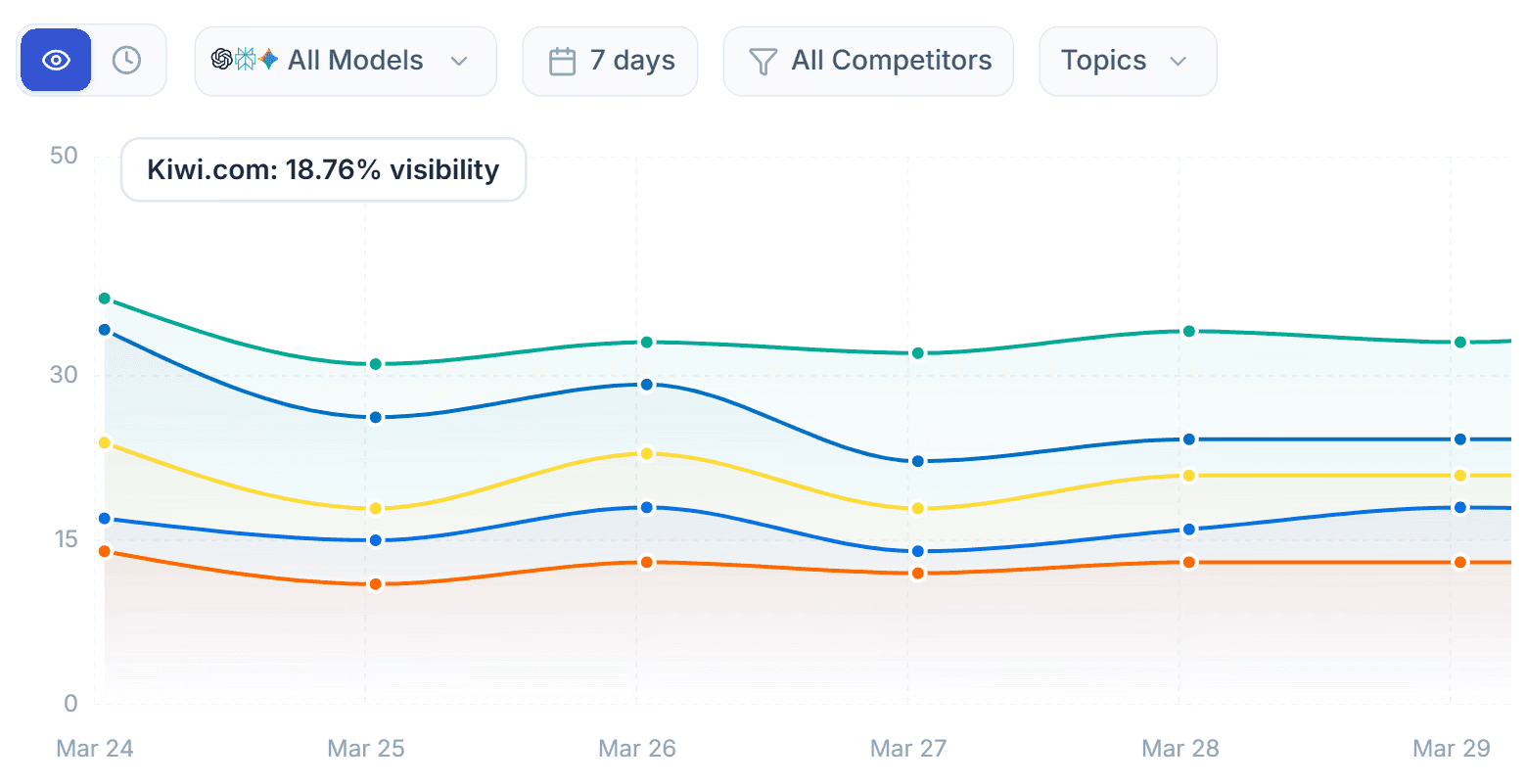
GEO is wider than SEO. AI recommends the brands that show up across the sources it reads, so your presence in forums, social platforms and education blogs decides your odds. AIclicks measures the three metrics below so you know which to work on first.
AI Assistant
Which nearby schools take students mid-year?
Your School
Citation Rate
Shows how many AI answers about schools name your brand, out of every 100. Models pull from the same trusted pages over and over, so citations compound: once you are in, staying in gets easier. Find the competitor pages AI cites most, then publish your own version of each.
Your School
82% positive
Competitor A
54% positive
Competitor B
38% positive
Brand Sentiment
Shows how AI describes you when your brand comes up: positive, neutral or negative. Tone is what separates being mentioned from being recommended, and models repeat whatever framing they find. Track the negative mentions back to the reviews and threads behind them, then publish content that answers those directly.
Others 52%
You 24%
— 24%
Your School
AI mention share of voice — education category
Competitors
Not Cited
Share of Voice in AI
Shows how much of the education conversation belongs to you rather than your competitors. This is the metric that matters most, the GEO version of a Google ranking. With only 1–5 brands named per answer, the market is winner-takes-more and every point is taken from someone.
The Dashboard Your Dedicated AI Search Team Works In
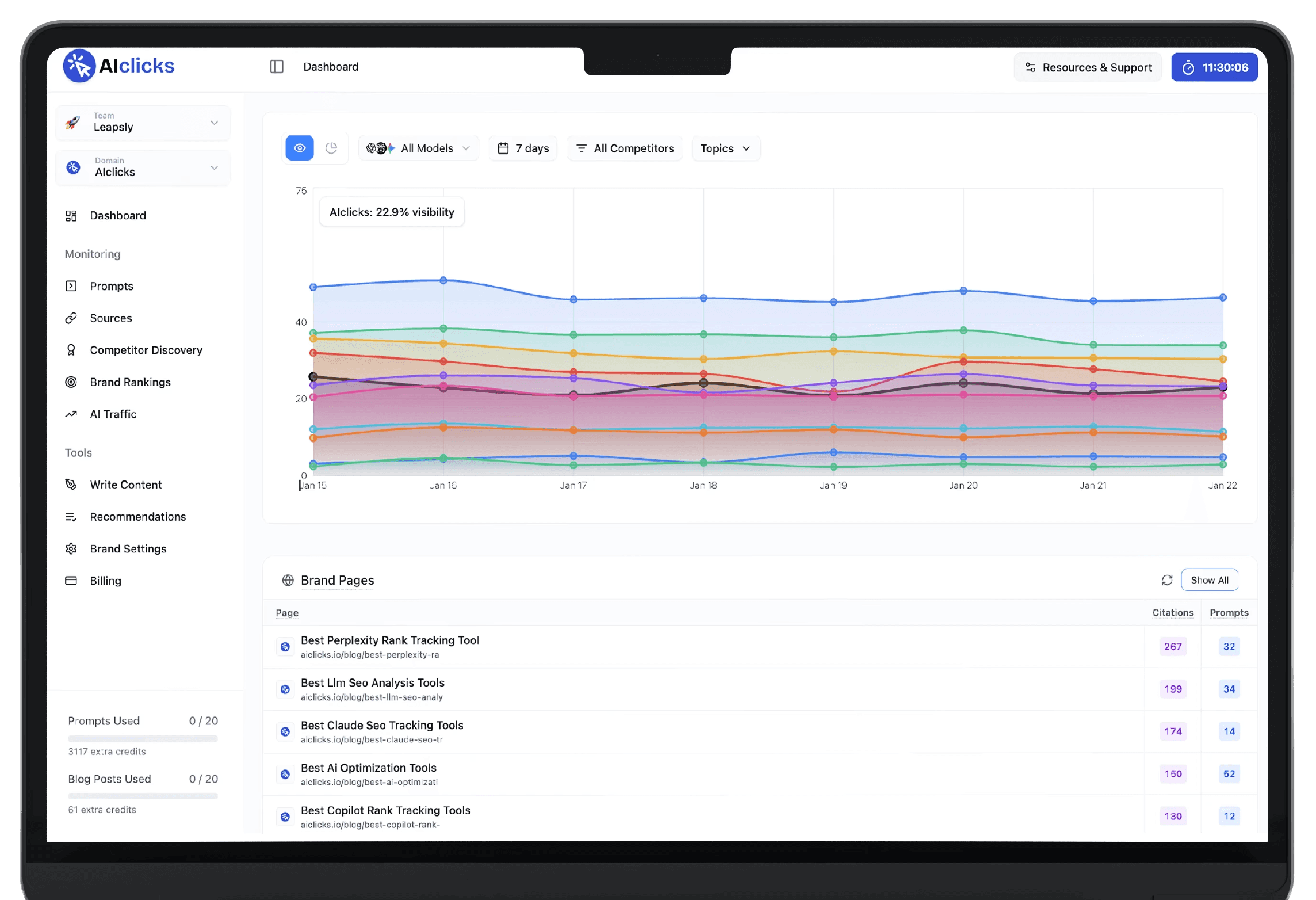
AIclicks gives you a live dashboard with daily ChatGPT mention rate, citation rate, sentiment, and share-of-voice across your tracked prompts, plus GA4 referral attribution for the traffic ChatGPT does send back.
Choose Your Plan
Flexible pricing that grows with your team. Upgrade or downgrade at any time.
Monthly
Yearly
-20%
Starter
Perfect for individuals & small teams
$49
/ month
Billed annually — you save $142
Choose 3 from:
Daily

" height="16px" id="fvSweaOBo" transform="translate(1 0)" width="14px"/></svg>)
" width="14px"><path d="M 13.864 5.629 L 13.3 5.629 L 13.3 5.6 L 7 5.6 L 7 8.4 L 10.956 8.4 C 10.379 10.03 8.828 11.2 7 11.2 C 4.681 11.2 2.8 9.319 2.8 7 C 2.8 4.681 4.681 2.8 7 2.8 C 8.071 2.8 9.045 3.204 9.786 3.864 L 11.766 1.884 C 10.516 0.719 8.844 0 7 0 C 3.134 0 0 3.134 0 7 C 0 10.866 3.134 14 7 14 C 10.866 14 14 10.866 14 7 C 14 6.531 13.952 6.073 13.864 5.629 Z" fill="rgb(255, 193, 7)" height="14px" id="H_YjfTNpn" width="14px"/><path d="M 0 3.742 L 2.3 5.429 C 2.922 3.888 4.429 2.8 6.193 2.8 C 7.264 2.8 8.238 3.204 8.979 3.864 L 10.959 1.884 C 9.709 0.719 8.037 0 6.193 0 C 3.504 0 1.172 1.518 0 3.742 Z" fill="rgb(255, 61, 0)" height="5.428500000000002px" id="PlkthQDhg" transform="translate(0.875 0)" width="10.959199999999996px"/><path d="M 6.232 5.581 C 8.04 5.581 9.683 4.889 10.925 3.764 L 8.758 1.931 C 8.032 2.483 7.144 2.782 6.232 2.781 C 4.411 2.781 2.865 1.62 2.283 0 L 0 1.759 C 1.159 4.026 3.511 5.581 6.232 5.581 Z" fill="rgb(76, 175, 80)" height="5.581099999999999px" id="WlnJ5gngE" transform="translate(0.7 8.4)" width="10.924899999999994px"/><path d="M 6.864 0.029 L 6.3 0.029 L 6.3 0 L 0 0 L 0 2.8 L 3.956 2.8 C 3.68 3.576 3.183 4.254 2.526 4.75 L 2.527 4.749 L 4.693 6.582 C 4.54 6.722 7 4.9 7 1.4 C 7 0.931 6.952 0.473 6.864 0.029 Z" fill="rgb(25, 118, 210)" height="6.589883930775992px" id="x_rSW275p" transform="translate(7 5.6)" width="7px"/></g></svg>)
" height="16px" id="hHS98fTxZ" width="16px"/></svg>)
 scale(1 1) translate(-1.861736945942159, -1.1170155383302638)" id="P20NzAvj0-699428820-radial-gradient" r="0.9935228066204626"><stop offset="0" stop-color="rgb(0, 174, 255)"/><stop offset="1" stop-color="rgb(7, 54, 196)"/></radialGradient><radialGradient cx="0.48250042504016705" cy="1.8366934653567062" gradient-transform="translate(0.48250042504016705, 1.8366934653567062) scale(1 1) translate(-0.48250042504016705, -1.8366934653567062)" id="UEWZqVjij-699428820-radial-gradient" r="0.9176890228114506"><stop offset="0" stop-color="rgb(255, 182, 87)"/><stop offset="1" stop-color="rgb(192, 43, 60)"/></radialGradient><linearGradient id="jyMN3TmKx-699428820-linear-gradient" x1="0.4594862532842614" x2="0.5405137467157386" y1="0" y2="1"><stop offset="0" stop-color="rgb(13, 145, 225)"/><stop offset="1" stop-color="rgb(255, 200, 0)"/></linearGradient><linearGradient id="xhMNwDFG0-699428820-linear-gradient" x1="0.4784828731548295" x2="0.5215171268451705" y1="5.551115123125783e-17" y2="1"><stop offset="0" stop-color="rgb(61, 203, 255)"/><stop offset="1" stop-color="rgba(5, 136, 247, 0)"/></linearGradient><radialGradient cx="1.4305090871482182" cy="0.34866158048251783" gradient-transform="translate(1.4305090871482182, 0.34866158048251783) scale(1 1) translate(-1.4305090871482182, -0.34866158048251783)" id="i79kAqaS4-699428820-radial-gradient" r="1.3362743412697924"><stop offset="0" stop-color="rgb(140, 72, 255)"/><stop offset="1" stop-color="rgb(255, 177, 82)"/></radialGradient><linearGradient id="mcxvno3tX-699428820-linear-gradient" x1="0.49844355920154226" x2="0.5015564407984577" y1="0" y2="1"><stop offset="0" stop-color="rgb(248, 173, 250)"/><stop offset="1" stop-color="rgba(168, 110, 221, 0)"/></linearGradient></defs><g d="M 11.605 1.219 C 11.397 0.499 10.739 0.002 9.989 0 L 9.498 0 C 8.682 0.002 7.985 0.588 7.842 1.391 L 7 6.016 L 7.209 5.296 C 7.416 4.574 8.075 4.076 8.825 4.074 L 11.681 4.074 L 12.879 4.545 L 14.033 4.074 L 13.697 4.074 C 12.947 4.072 12.289 3.575 12.081 2.855 Z M 4.413 13.387 C 4.618 14.111 5.278 14.611 6.031 14.613 L 7.075 14.613 C 7.988 14.613 8.735 13.88 8.758 12.96 L 8.871 8.5 L 8.633 9.319 C 8.426 10.039 7.768 10.537 7.018 10.539 L 4.138 10.539 L 3.111 9.977 L 2 10.539 L 2.331 10.539 C 3.084 10.542 3.743 11.042 3.949 11.766 L 4.413 13.387 Z M 9.999 0 L 4.167 0 C 2.501 0 1.501 2.221 0.834 4.441 C 0.045 7.073 -0.989 10.591 2.001 10.591 L 4.519 10.591 C 5.273 10.591 5.933 10.089 6.139 9.36 C 6.577 7.815 7.345 5.121 7.948 3.069 C 8.255 2.027 8.509 1.132 8.901 0.575 C 9.148 0.212 9.56 -0.004 9.999 0 M 9.999 0 L 4.167 0 C 2.501 0 1.501 2.221 0.834 4.441 C 0.045 7.073 -0.989 10.591 2.001 10.591 L 4.519 10.591 C 5.273 10.591 5.933 10.089 6.139 9.36 C 6.577 7.815 7.345 5.121 7.948 3.069 C 8.255 2.027 8.509 1.132 8.901 0.575 C 9.148 0.212 9.56 -0.004 9.999 0 M 6 14.593 L 11.833 14.593 C 13.499 14.593 14.499 12.372 15.166 10.151 C 15.955 7.519 16.989 4 13.999 4 L 11.48 4 C 10.725 4.002 10.063 4.505 9.86 5.232 C 9.266 7.332 8.663 9.429 8.051 11.523 C 7.745 12.566 7.49 13.461 7.098 14.019 C 6.851 14.382 6.439 14.597 6 14.593 M 6 14.593 L 11.833 14.593 C 13.499 14.593 14.499 12.372 15.166 10.151 C 15.955 7.519 16.989 4 13.999 4 L 11.48 4 C 10.725 4.002 10.063 4.505 9.86 5.232 C 9.266 7.332 8.663 9.429 8.051 11.523 C 7.745 12.566 7.49 13.461 7.098 14.019 C 6.851 14.382 6.439 14.597 6 14.593" fill="transparent" height="14.613333333333333px" id="QzkBy4Ibc" transform="translate(0 1)" width="16.00011071294081px"><path d="M 4.605 1.219 C 4.397 0.499 3.739 0.002 2.989 0 L 2.498 0 C 1.682 0.002 0.985 0.588 0.842 1.391 L 0 6.016 L 0.209 5.296 C 0.416 4.574 1.075 4.076 1.825 4.074 L 4.681 4.074 L 5.879 4.545 L 7.033 4.074 L 6.697 4.074 C 5.947 4.072 5.289 3.575 5.081 2.855 Z" fill="url(%23P20NzAvj0-699428820-radial-gradient)" height="6.016px" id="P20NzAvj0" transform="translate(7 0)" width="7.0333333333333385px"/><path d="M 2.413 4.887 C 2.618 5.611 3.278 6.111 4.031 6.113 L 5.075 6.113 C 5.988 6.113 6.735 5.38 6.758 4.46 L 6.871 0 L 6.633 0.819 C 6.426 1.539 5.768 2.037 5.018 2.039 L 2.138 2.039 L 1.111 1.477 L 0 2.039 L 0.331 2.039 C 1.084 2.042 1.743 2.542 1.949 3.266 L 2.413 4.887 Z" fill="url(%23UEWZqVjij-699428820-radial-gradient)" height="6.113333333333333px" id="UEWZqVjij" transform="translate(2 8.5)" width="6.871333333333332px"/><path d="M 9.999 0 L 4.167 0 C 2.501 0 1.501 2.221 0.834 4.441 C 0.045 7.073 -0.989 10.591 2.001 10.591 L 4.519 10.591 C 5.273 10.591 5.933 10.089 6.139 9.36 C 6.577 7.815 7.345 5.121 7.948 3.069 C 8.255 2.027 8.509 1.132 8.901 0.575 C 9.148 0.212 9.56 -0.004 9.999 0" fill="url(%23jyMN3TmKx-699428820-linear-gradient)" height="10.591388755215167px" id="jyMN3TmKx" width="9.999444046274142px"/><path d="M 9.999 0 L 4.167 0 C 2.501 0 1.501 2.221 0.834 4.441 C 0.045 7.073 -0.989 10.591 2.001 10.591 L 4.519 10.591 C 5.273 10.591 5.933 10.089 6.139 9.36 C 6.577 7.815 7.345 5.121 7.948 3.069 C 8.255 2.027 8.509 1.132 8.901 0.575 C 9.148 0.212 9.56 -0.004 9.999 0" fill="url(%23xhMNwDFG0-699428820-linear-gradient)" height="10.591388755215167px" id="xhMNwDFG0" width="9.999444046274142px"/><path d="M 0 10.593 L 5.833 10.593 C 7.499 10.593 8.499 8.372 9.166 6.151 C 9.955 3.519 10.989 0 7.999 0 L 5.48 0 C 4.725 0.002 4.063 0.505 3.86 1.232 C 3.266 3.332 2.663 5.429 2.051 7.523 C 1.745 8.566 1.49 9.461 1.098 10.019 C 0.851 10.382 0.439 10.597 0 10.593" fill="url(%23i79kAqaS4-699428820-radial-gradient)" height="10.593388755215164px" id="i79kAqaS4" transform="translate(6 4)" width="10.000110712940803px"/><path d="M 0 10.593 L 5.833 10.593 C 7.499 10.593 8.499 8.372 9.166 6.151 C 9.955 3.519 10.989 0 7.999 0 L 5.48 0 C 4.725 0.002 4.063 0.505 3.86 1.232 C 3.266 3.332 2.663 5.429 2.051 7.523 C 1.745 8.566 1.49 9.461 1.098 10.019 C 0.851 10.382 0.439 10.597 0 10.593" fill="url(%23mcxvno3tX-699428820-linear-gradient)" height="10.593388755215164px" id="mcxvno3tX" transform="translate(6 4)" width="10.000110712940803px"/></g></svg>)
" height="15.360666565427872px" id="HZPvvPBv7" transform="translate(0 0.5)" width="16px"/></svg>)
Tracked prompts
30
Websites you can add
3
LLMs you can track
3
Countries per project
1
LLM responses / mo
4,650
AI-optimized articles per month
10
Integrations
-
Support
Pro
For growing teams for more power
$140
/ month
Billed annually — you save $454
Choose 4 from:
Daily
Tracked prompts
150
Websites you can add
Unlimited
LLMs you can track
4
Countries per project
Unlimited
LLM responses / mo
18,600
AI-optimized articles per month
20
Integrations
Google Analytics
Support
BUSINESS
Best for medium-sized organizations
$357
/ month
Billed annually — you save $1198
Choose 6 from:
Daily
Tracked prompts
300
Websites you can add
Unlimited
LLMs you can track
6
Countries per project
Unlimited
LLM responses / mo
55,800
AI-optimized articles per month
30
Integrations
Google Analytics, API
Support
Dedicated account specialist
Become the #1 Answer in AI
Succeed in GEO yourself, or let us do all the work.
Do it yourself
Use AIclicks to see exactly where you appear across 10+ AI platforms, spot the gaps competitors are filling, and act on clear weekly recommendations.
From $59/month · Cancel anytime
Done for you
We Do All the Work for You
Our team manages your complete search presence: traditional SEO and GEO strategy, content, implementation, and reporting. You focus on families.
Custom pricing · Minimum 3-month engagement
The AI SEO agency trusted by 1,000+ brands worldwide
From solo founders to multi-client agencies, AIclicks runs the full AI SEO agency program for organizations of every shape and size that want to be cited across every AI surface.
4.9/5 stars on G2







FAQ
How soon do tour bookings start going up?
Tour bookings from organic usually pick up in the second admissions season, not the first. Local and map visibility shifts within a term, and rankings on tuition and program terms land at 6 to 12 months, but a family that discovers you in March applies in the next cycle rather than this one. That lag is the honest answer nobody gives. Inquiry forms and impressions in Search Console shift first, so track those from month 2.
Do parents actually use ChatGPT to pick schools?
More than you would guess, and they ask it the way they would ask a friend, describing their child rather than typing a keyword. In an Ahrefs study of 863,000 keywords, only 38% of pages cited in AI Overviews were also ranking in the top 10, against 76% the year before. A good Google position no longer buys you into the answer. Keep both: rank on the search, and give models plain facts they can quote.
What makes school SEO different from other local SEO?
Start with the fact that the buyer is not the user. A parent decides and a child lives with it, so the same page has to reassure an adult about outcomes and a 12-year-old about whether they will fit in. Second, you are selling a decade-long commitment, which means trust content beats conversion copy. Third, most of your best material is locked in PDFs and a parent portal, so the site Google sees is a fraction of the school.
What do schools normally pay an SEO agency?
Most single-campus schools are quoted somewhere under $3,500 a month, with $6,000 and up where several independent schools chase the same families. Networks with multiple sites pay more again. The comparison that matters is not the retainer against zero, it is the retainer against one enrolled student: with day tuition commonly between $12,000 and $30,000 annually and families staying for years, 2 extra enrollments usually cover the whole program.
Should we keep spending on ads and mailers?
Keep them, but stop treating them as the plan. Paid search and open house mailers earn their keep in the 8 weeks either side of your application deadline, when intent spikes and organic cannot be turned up on demand. Organic covers the other 10 months, including the long quiet stretch when nothing is being advertised at all. Read the ad data backwards to order your content: any term that produced a booked tour has earned a page.
What should we fix first if we only fix one thing?
Publish the tuition. It is the most searched and least published page a school owns, and a real number filters out families who were never going to apply while pulling in the ones who were. After that, complete the Google Business Profile, with its appointment link aimed at your tour page. Then rebuild whatever currently lives only as a PDF. The news feed can wait indefinitely.
Which numbers tell us the work is landing?
Booked tours and completed applications attributed to organic, and nothing else. Rankings screenshots prove nothing here because the term list is short and seasonal. Run call tracking against the admissions line, because parents still phone, tag every inquiry form with the page it came from, and reconcile monthly against Ravenna, Veracross or your student information system. Watch open house registrations too, as the earliest honest signal.
Can our one marketing person really do this alone?
Not all of it, and pretending otherwise is why school SEO stalls. One person is usually covering the website, social, photography, the newsletter and the yearbook, so the technical backlog never moves. Keep what needs inside knowledge: profile updates, review asks, writing answers to the questions admissions fields daily. Send out the crawl cleanup, schema and directory work. Whoever you hire should have opened a school CMS before, not just a WordPress site.
Further Reading
Go deeper on GEO, AI search, and visibility tracking.