SEO for Roofing Companies:
A homeowner with a water stain on the ceiling does not know a single roofer by name. They search, read reviews, ask ChatGPT which contractor to trust, and shortlist 3 companies before the first phone rings. Visibility decides who gets that call.









Why Roofing Companies Need SEO
Invoca found 80% of homeowners had no roofing company in mind when they started searching. That shortlist now forms across Google, review sites and AI answers before anyone picks up a phone.
Roofing demand arrives in bursts. A hail line moves through, and for 2 weeks every homeowner under it searches at once. If you have no page for hail damage, no storm post on your profile and no rankings built beforehand, the out-of-state crews with billboards take the whole surge.
Type roofers near me anywhere in the country and the top organic listing usually belongs to GAF, the manufacturer whose shingles you install. Below it sit BBB, Thumbtack and Angi. You show up inside their listings, then buy the same lead back from Angi, shared with 3 competitors.
Roofing SEO retainers cluster between $750 and $5,000 a month, and roofers on Reddit report both ends. A shared Angi or Thumbtack lead costs money whether or not you close it, and Local Services Ads charge per call. Stop paying and the pipeline empties, because none of it was yours.
How SEO Works for Roofing Companies
Search Engine Optimization projects are long-term investments for roofers, where each task supplements the others and creates compound results over time.
01
Keywords, page structure, and the signals Google reads directly
Roofing on-page work is hard because one homepage is being asked to serve 3 unrelated buyers at once. There is the leak that started an hour ago, the insurance claim after hail, and the retail replacement someone has been budgeting for since spring. Each has different urgency, different language and a different decision, yet most roofing sites answer all 3 with a single services page listing repair, replacement and gutters as bullets. The pages that actually earn jobs are one per service and material: asphalt shingle replacement, metal roof installation, flat roof repair, storm and hail restoration, emergency tarping.
What holds value is the cost page. A homeowner replacing a roof once in 20 years wants the number before they will call anyone, and cost per square by material is searched every month of the year. The same is true of the insurance claim explainer, the repair-or-replace decision page, and the metal versus asphalt comparison. What churns is everything a roofing site actually publishes: the storm-of-the-week post, the hiring notice, the crew photo from last October. Most roofing sites run it the other way round, with a thin cost page nobody has touched since 2022 and a blog full of weather updates.
1
Break the single services page apart: one page each for hail damage restoration, metal roof installation, flat roof repair and emergency tarping.
2
Keep storm landing pages live year-round rather than deleting them after the event; 301 one-off hail campaign URLs into the evergreen storm damage page.
3
Mark the site up with RoofingContractor schema including areaServed and licence number, add Service schema per job type, validate in Rich Results Test.
4
Publish a roof replacement cost page priced per square by material, updated annually, plus a roof lifespan page for asphalt, metal and tile.
02
Map Pack visibility, citations, and proximity signals
Nobody hires a roofer from 3 states away. Every job is won inside a drive radius, which is why the 3-result map pack outranks GAF, Angi and everything organic beneath them. Roofing is also a service-area business, so ranking depends on service area, category and review volume rather than a storefront address. That makes the map pack the one place a two-van outfit genuinely beats a national platform.
Set the primary category to Roofing Contractor, then add the secondaries you actually run: gutter service, siding contractor, insulation contractor. Hide the address and define the service area by county, because a home address or a PO box on a roofing profile is the fastest route to suspension. Add custom services for emergency roof repair, hail damage inspection and free estimates, upload real job photos through CompanyCam, and pre-answer financing, warranty and insurance questions in the Q&A.
Roofing has a citation layer general advice never mentions. The manufacturer directories carry the most weight, because GAF Master Elite, Owens Corning Platinum Preferred and CertainTeed SELECT ShingleMaster listings are verified credentials rather than paid profiles. Under those sit BBB, Angi, Thumbtack, Houzz, Nextdoor and your state contractor licence lookup. Every one needs the identical business name, phone and service area; conflicting data is the reason plenty of roofers sit outside a map pack they should own.
1
Choose Roofing Contractor as the primary category, hide the street address, set the service area by county, and add custom services for hail inspections.
2
Give each branch its own profile, its own service area and its own crew page, never one profile covering 4 counties.
3
Run BrightLocal or Whitespark across GAF, Owens Corning, CertainTeed, BBB and Angi, correcting every phone number and business-name variant you find.
4
Post one completed job a week to the profile with drone photos, the material used and the town, treating it as proof rather than advertising.
03
Topic authority, inbound links, and content that earns traffic
Before a homeowner calls anyone they are trying to answer 3 questions: is this a repair or a replacement, will insurance pay for it, and what does the whole thing cost. Roofing is one of the few trades where the customer genuinely cannot inspect the product, so they compensate by reading. A plain explanation of actual cash value versus replacement cost, or what an adjuster looks for, earns more trust than any page about your equipment.
The homeowner who has accepted they need a roof is now choosing a crew, and they are checking for specific things: your licence and insurance numbers on the page, whether the crew is in-house or subcontracted, which warranty tier you can register, and finance options. Put the GAF Golden Pledge or Owens Corning Preferred warranty detail on the service page, not buried in an about section, because that is the comparison they are running.
Roofing links come from the supply chain and the community, not from outreach. Manufacturer certification directories link out. Distributors like ABC Supply, Beacon and SRS publish contractor and event pages. Realtors, property managers and public adjusters will link to a roofer they refer to. Then there are the giveaway programmes: No Roof Left Behind and the Owens Corning Roof Deployment Project generate genuine local news coverage that no directory submission ever will.
1
Publish a yearly roof replacement cost guide with real per-square ranges for asphalt, metal, tile and flat systems, and date-stamp the update.
2
Build one page per service per town you actually crew, with named subdivisions, roof styles common there and photos of jobs you finished.
3
Build one money hub covering deductibles, actual cash value versus replacement cost, supplements, financing through GreenSky or Hearth, and paying without a claim.
4
Write a page for each system you install, such as GAF Timberline HDZ or standing seam metal, since homeowners search the product first.
04
Site speed, crawlability, Core Web Vitals, and mobile health
The failure nobody notices is the rebuild. Roofers change marketing companies more often than almost any trade, and each new agency ships a fresh site on a fresh URL structure. The old service and town pages 404, nothing gets redirected, and every link and ranking earned over 4 years evaporates on launch day. Worse, the agency often registered the domain, the profile and the analytics account, so the history leaves with them.
The highest-intent roofing search happens outdoors on a phone held by someone standing in a yard full of shingles the morning after a windstorm, often on a degraded cell connection. They want a number and a sentence confirming you handle storm work. Roofing sites are the worst offenders on weight, because the gallery is full of 12-megapixel drone stills served at full resolution. If it does not paint in a couple of seconds, they call the next truck.
1
Pull the old URL set from Wayback Machine and the Search Console 404 report, then 301 every dead service and town page to its replacement.
2
Run PageSpeed Insights on your project gallery on mobile, since drone imagery routinely pushes a single roofing page past 8 megabytes.
3
Export drone and before-and-after roof photos as WebP sized to the container, set width and height, and lazy-load anything below the fold.
4
Split roofing sitemaps by type so service and town URLs are not buried behind blog posts, and resubmit the day a storm page goes live.
05
Star ratings, review volume, and response strategy that builds trust
Roofing carries more trust risk than any home trade. The homeowner is spending five figures on something they will never climb up to inspect, in a category that storm chasers have spent years discrediting. A star average is all they have to weigh. Collecting reviews is awkward, though: the crew that did the work leaves the same afternoon, the office handles the paperwork, and on insurance jobs the final cheque lands weeks later once depreciation is released.
Ask during the final walkthrough, while the crew chief is still on the roof line pointing at the new ridge vent and the magnet sweep has just cleared the driveway. That is the peak of the homeowner’s confidence and it never comes back. A QR card in the foreman’s pocket beats an email sent 3 days later. Drip the requests out rather than sending 20 at once, because a sudden burst gets filtered.
1
Fire the review link from AccuLynx or JobNimbus when the job status flips to complete, or hand over a QR card at final walkthrough.
2
Answer inside 24 hours, naming the crew lead and the fix offered, because most roofing complaints are about communication and delays rather than workmanship.
3
Pull hail restoration reviews onto the storm damage page and metal roof reviews onto the metal page, so proof sits next to the decision.
4
Ask after small repairs, gutter work and maintenance inspections too, since those jobs outnumber replacements and produce willing reviewers all year round.
Google is No Longer the Only Place Your homeowners are Searching
Homeowners are using AI to find answers, and they trust what it tells them. Invest in GEO to get recommended in those answers.
1 Billion
Questions ChatGPT receives every single day
38%
Your #1 top ranking page on Google would be cited by AI
14%
of roofers optimise for GEO. The rest are invisible in AI answers


You can rank #1 for “roofer near me” and still not exist in ChatGPT’s answer. Run a free GEO audit to see where your brand actually stands.
GEO vs SEO: Same Goal, Different Methods
GEO is wider than SEO. AI recommends the brands that show up across the sources it reads, so your presence in forums, social platforms and roofing blogs decides your odds. AIclicks measures the three metrics below so you know which to work on first.
AI Assistant
Which roofing company near me handles insurance claims?
Your Roofing Company
Citation Rate
Shows how many AI answers about roofing companies name your brand, out of every 100. Models pull from the same trusted pages over and over, so citations compound: once you are in, staying in gets easier. Find the competitor pages AI cites most, then publish your own version of each.
Your Roofing Company
82% positive
Competitor A
54% positive
Competitor B
38% positive
Brand Sentiment
Shows how AI describes you when your brand comes up: positive, neutral or negative. Tone is what separates being mentioned from being recommended, and models repeat whatever framing they find. Track the negative mentions back to the reviews and threads behind them, then publish content that answers those directly.
Others 52%
You 24%
— 24%
Your Roofing Company
AI mention share of voice — roofing category
Competitors
Not Cited
Share of Voice in AI
Shows how much of the roofing conversation belongs to you rather than your competitors. This is the metric that matters most, the GEO version of a Google ranking. With only 1–5 brands named per answer, the market is winner-takes-more and every point is taken from someone.
The Dashboard Your Dedicated AI Search Team Works In
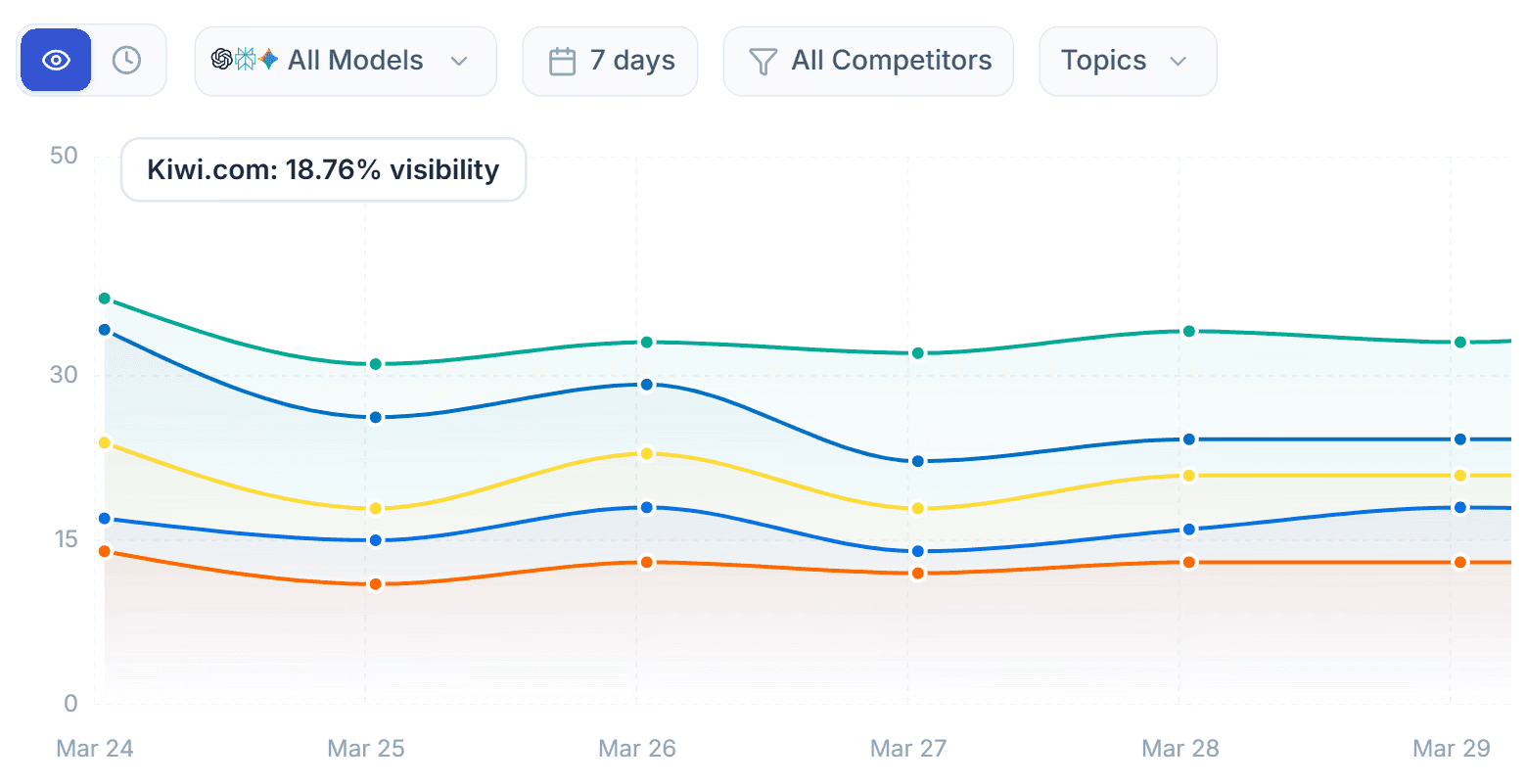
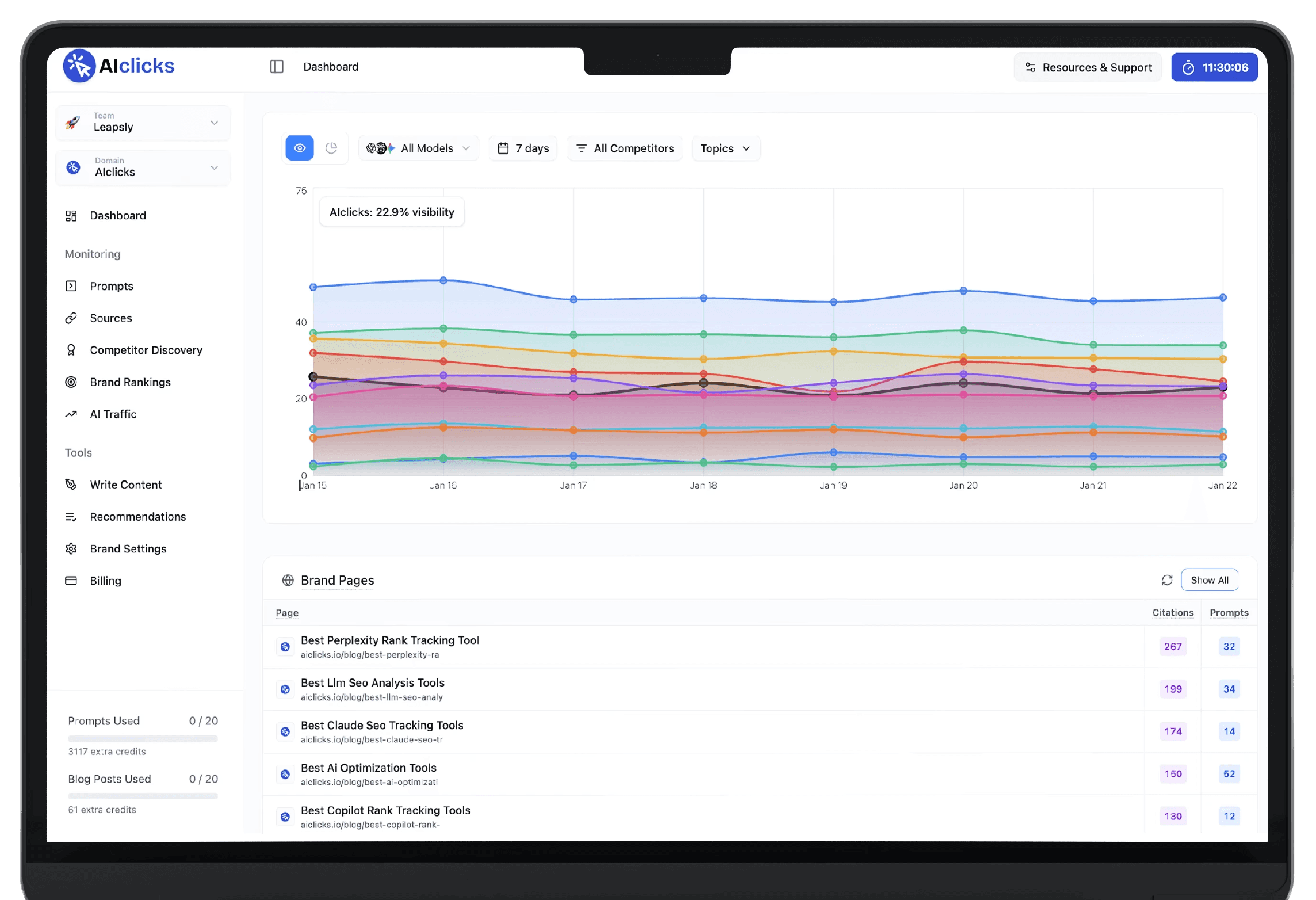
AIclicks gives you a live dashboard with daily ChatGPT mention rate, citation rate, sentiment, and share-of-voice across your tracked prompts, plus GA4 referral attribution for the traffic ChatGPT does send back.
Choose Your Plan
Flexible pricing that grows with your team. Upgrade or downgrade at any time.
Monthly
Yearly
-20%
Starter
Perfect for individuals & small teams
$49
/ month
Billed annually — you save $142
Choose 3 from:
Daily

" height="16px" id="fvSweaOBo" transform="translate(1 0)" width="14px"/></svg>)
" width="14px"><path d="M 13.864 5.629 L 13.3 5.629 L 13.3 5.6 L 7 5.6 L 7 8.4 L 10.956 8.4 C 10.379 10.03 8.828 11.2 7 11.2 C 4.681 11.2 2.8 9.319 2.8 7 C 2.8 4.681 4.681 2.8 7 2.8 C 8.071 2.8 9.045 3.204 9.786 3.864 L 11.766 1.884 C 10.516 0.719 8.844 0 7 0 C 3.134 0 0 3.134 0 7 C 0 10.866 3.134 14 7 14 C 10.866 14 14 10.866 14 7 C 14 6.531 13.952 6.073 13.864 5.629 Z" fill="rgb(255, 193, 7)" height="14px" id="H_YjfTNpn" width="14px"/><path d="M 0 3.742 L 2.3 5.429 C 2.922 3.888 4.429 2.8 6.193 2.8 C 7.264 2.8 8.238 3.204 8.979 3.864 L 10.959 1.884 C 9.709 0.719 8.037 0 6.193 0 C 3.504 0 1.172 1.518 0 3.742 Z" fill="rgb(255, 61, 0)" height="5.428500000000002px" id="PlkthQDhg" transform="translate(0.875 0)" width="10.959199999999996px"/><path d="M 6.232 5.581 C 8.04 5.581 9.683 4.889 10.925 3.764 L 8.758 1.931 C 8.032 2.483 7.144 2.782 6.232 2.781 C 4.411 2.781 2.865 1.62 2.283 0 L 0 1.759 C 1.159 4.026 3.511 5.581 6.232 5.581 Z" fill="rgb(76, 175, 80)" height="5.581099999999999px" id="WlnJ5gngE" transform="translate(0.7 8.4)" width="10.924899999999994px"/><path d="M 6.864 0.029 L 6.3 0.029 L 6.3 0 L 0 0 L 0 2.8 L 3.956 2.8 C 3.68 3.576 3.183 4.254 2.526 4.75 L 2.527 4.749 L 4.693 6.582 C 4.54 6.722 7 4.9 7 1.4 C 7 0.931 6.952 0.473 6.864 0.029 Z" fill="rgb(25, 118, 210)" height="6.589883930775992px" id="x_rSW275p" transform="translate(7 5.6)" width="7px"/></g></svg>)
" height="16px" id="hHS98fTxZ" width="16px"/></svg>)
 scale(1 1) translate(-1.861736945942159, -1.1170155383302638)" id="P20NzAvj0-699428820-radial-gradient" r="0.9935228066204626"><stop offset="0" stop-color="rgb(0, 174, 255)"/><stop offset="1" stop-color="rgb(7, 54, 196)"/></radialGradient><radialGradient cx="0.48250042504016705" cy="1.8366934653567062" gradient-transform="translate(0.48250042504016705, 1.8366934653567062) scale(1 1) translate(-0.48250042504016705, -1.8366934653567062)" id="UEWZqVjij-699428820-radial-gradient" r="0.9176890228114506"><stop offset="0" stop-color="rgb(255, 182, 87)"/><stop offset="1" stop-color="rgb(192, 43, 60)"/></radialGradient><linearGradient id="jyMN3TmKx-699428820-linear-gradient" x1="0.4594862532842614" x2="0.5405137467157386" y1="0" y2="1"><stop offset="0" stop-color="rgb(13, 145, 225)"/><stop offset="1" stop-color="rgb(255, 200, 0)"/></linearGradient><linearGradient id="xhMNwDFG0-699428820-linear-gradient" x1="0.4784828731548295" x2="0.5215171268451705" y1="5.551115123125783e-17" y2="1"><stop offset="0" stop-color="rgb(61, 203, 255)"/><stop offset="1" stop-color="rgba(5, 136, 247, 0)"/></linearGradient><radialGradient cx="1.4305090871482182" cy="0.34866158048251783" gradient-transform="translate(1.4305090871482182, 0.34866158048251783) scale(1 1) translate(-1.4305090871482182, -0.34866158048251783)" id="i79kAqaS4-699428820-radial-gradient" r="1.3362743412697924"><stop offset="0" stop-color="rgb(140, 72, 255)"/><stop offset="1" stop-color="rgb(255, 177, 82)"/></radialGradient><linearGradient id="mcxvno3tX-699428820-linear-gradient" x1="0.49844355920154226" x2="0.5015564407984577" y1="0" y2="1"><stop offset="0" stop-color="rgb(248, 173, 250)"/><stop offset="1" stop-color="rgba(168, 110, 221, 0)"/></linearGradient></defs><g d="M 11.605 1.219 C 11.397 0.499 10.739 0.002 9.989 0 L 9.498 0 C 8.682 0.002 7.985 0.588 7.842 1.391 L 7 6.016 L 7.209 5.296 C 7.416 4.574 8.075 4.076 8.825 4.074 L 11.681 4.074 L 12.879 4.545 L 14.033 4.074 L 13.697 4.074 C 12.947 4.072 12.289 3.575 12.081 2.855 Z M 4.413 13.387 C 4.618 14.111 5.278 14.611 6.031 14.613 L 7.075 14.613 C 7.988 14.613 8.735 13.88 8.758 12.96 L 8.871 8.5 L 8.633 9.319 C 8.426 10.039 7.768 10.537 7.018 10.539 L 4.138 10.539 L 3.111 9.977 L 2 10.539 L 2.331 10.539 C 3.084 10.542 3.743 11.042 3.949 11.766 L 4.413 13.387 Z M 9.999 0 L 4.167 0 C 2.501 0 1.501 2.221 0.834 4.441 C 0.045 7.073 -0.989 10.591 2.001 10.591 L 4.519 10.591 C 5.273 10.591 5.933 10.089 6.139 9.36 C 6.577 7.815 7.345 5.121 7.948 3.069 C 8.255 2.027 8.509 1.132 8.901 0.575 C 9.148 0.212 9.56 -0.004 9.999 0 M 9.999 0 L 4.167 0 C 2.501 0 1.501 2.221 0.834 4.441 C 0.045 7.073 -0.989 10.591 2.001 10.591 L 4.519 10.591 C 5.273 10.591 5.933 10.089 6.139 9.36 C 6.577 7.815 7.345 5.121 7.948 3.069 C 8.255 2.027 8.509 1.132 8.901 0.575 C 9.148 0.212 9.56 -0.004 9.999 0 M 6 14.593 L 11.833 14.593 C 13.499 14.593 14.499 12.372 15.166 10.151 C 15.955 7.519 16.989 4 13.999 4 L 11.48 4 C 10.725 4.002 10.063 4.505 9.86 5.232 C 9.266 7.332 8.663 9.429 8.051 11.523 C 7.745 12.566 7.49 13.461 7.098 14.019 C 6.851 14.382 6.439 14.597 6 14.593 M 6 14.593 L 11.833 14.593 C 13.499 14.593 14.499 12.372 15.166 10.151 C 15.955 7.519 16.989 4 13.999 4 L 11.48 4 C 10.725 4.002 10.063 4.505 9.86 5.232 C 9.266 7.332 8.663 9.429 8.051 11.523 C 7.745 12.566 7.49 13.461 7.098 14.019 C 6.851 14.382 6.439 14.597 6 14.593" fill="transparent" height="14.613333333333333px" id="QzkBy4Ibc" transform="translate(0 1)" width="16.00011071294081px"><path d="M 4.605 1.219 C 4.397 0.499 3.739 0.002 2.989 0 L 2.498 0 C 1.682 0.002 0.985 0.588 0.842 1.391 L 0 6.016 L 0.209 5.296 C 0.416 4.574 1.075 4.076 1.825 4.074 L 4.681 4.074 L 5.879 4.545 L 7.033 4.074 L 6.697 4.074 C 5.947 4.072 5.289 3.575 5.081 2.855 Z" fill="url(%23P20NzAvj0-699428820-radial-gradient)" height="6.016px" id="P20NzAvj0" transform="translate(7 0)" width="7.0333333333333385px"/><path d="M 2.413 4.887 C 2.618 5.611 3.278 6.111 4.031 6.113 L 5.075 6.113 C 5.988 6.113 6.735 5.38 6.758 4.46 L 6.871 0 L 6.633 0.819 C 6.426 1.539 5.768 2.037 5.018 2.039 L 2.138 2.039 L 1.111 1.477 L 0 2.039 L 0.331 2.039 C 1.084 2.042 1.743 2.542 1.949 3.266 L 2.413 4.887 Z" fill="url(%23UEWZqVjij-699428820-radial-gradient)" height="6.113333333333333px" id="UEWZqVjij" transform="translate(2 8.5)" width="6.871333333333332px"/><path d="M 9.999 0 L 4.167 0 C 2.501 0 1.501 2.221 0.834 4.441 C 0.045 7.073 -0.989 10.591 2.001 10.591 L 4.519 10.591 C 5.273 10.591 5.933 10.089 6.139 9.36 C 6.577 7.815 7.345 5.121 7.948 3.069 C 8.255 2.027 8.509 1.132 8.901 0.575 C 9.148 0.212 9.56 -0.004 9.999 0" fill="url(%23jyMN3TmKx-699428820-linear-gradient)" height="10.591388755215167px" id="jyMN3TmKx" width="9.999444046274142px"/><path d="M 9.999 0 L 4.167 0 C 2.501 0 1.501 2.221 0.834 4.441 C 0.045 7.073 -0.989 10.591 2.001 10.591 L 4.519 10.591 C 5.273 10.591 5.933 10.089 6.139 9.36 C 6.577 7.815 7.345 5.121 7.948 3.069 C 8.255 2.027 8.509 1.132 8.901 0.575 C 9.148 0.212 9.56 -0.004 9.999 0" fill="url(%23xhMNwDFG0-699428820-linear-gradient)" height="10.591388755215167px" id="xhMNwDFG0" width="9.999444046274142px"/><path d="M 0 10.593 L 5.833 10.593 C 7.499 10.593 8.499 8.372 9.166 6.151 C 9.955 3.519 10.989 0 7.999 0 L 5.48 0 C 4.725 0.002 4.063 0.505 3.86 1.232 C 3.266 3.332 2.663 5.429 2.051 7.523 C 1.745 8.566 1.49 9.461 1.098 10.019 C 0.851 10.382 0.439 10.597 0 10.593" fill="url(%23i79kAqaS4-699428820-radial-gradient)" height="10.593388755215164px" id="i79kAqaS4" transform="translate(6 4)" width="10.000110712940803px"/><path d="M 0 10.593 L 5.833 10.593 C 7.499 10.593 8.499 8.372 9.166 6.151 C 9.955 3.519 10.989 0 7.999 0 L 5.48 0 C 4.725 0.002 4.063 0.505 3.86 1.232 C 3.266 3.332 2.663 5.429 2.051 7.523 C 1.745 8.566 1.49 9.461 1.098 10.019 C 0.851 10.382 0.439 10.597 0 10.593" fill="url(%23mcxvno3tX-699428820-linear-gradient)" height="10.593388755215164px" id="mcxvno3tX" transform="translate(6 4)" width="10.000110712940803px"/></g></svg>)
" height="15.360666565427872px" id="HZPvvPBv7" transform="translate(0 0.5)" width="16px"/></svg>)
Tracked prompts
30
Websites you can add
3
LLMs you can track
3
Countries per project
1
LLM responses / mo
4,650
AI-optimized articles per month
10
Integrations
-
Support
Pro
For growing teams for more power
$140
/ month
Billed annually — you save $454
Choose 4 from:
Daily
Tracked prompts
150
Websites you can add
Unlimited
LLMs you can track
4
Countries per project
Unlimited
LLM responses / mo
18,600
AI-optimized articles per month
20
Integrations
Google Analytics
Support
BUSINESS
Best for medium-sized organizations
$357
/ month
Billed annually — you save $1198
Choose 6 from:
Daily
Tracked prompts
300
Websites you can add
Unlimited
LLMs you can track
6
Countries per project
Unlimited
LLM responses / mo
55,800
AI-optimized articles per month
30
Integrations
Google Analytics, API
Support
Dedicated account specialist
Become the #1 Answer in AI
Succeed in GEO yourself, or let us do all the work.
Do it yourself
Use AIclicks to see exactly where you appear across 10+ AI platforms, spot the gaps competitors are filling, and act on clear weekly recommendations.
From $59/month · Cancel anytime
Done for you
We Do All the Work for You
Our team manages your complete search presence: traditional SEO and GEO strategy, content, implementation, and reporting. You focus on homeowners.
Custom pricing · Minimum 3-month engagement
The AI SEO agency trusted by 1,000+ brands worldwide
From solo founders to multi-client agencies, AIclicks runs the full AI SEO agency program for organizations of every shape and size that want to be cited across every AI surface.
4.9/5 stars on G2







FAQ
How long before roofing SEO actually brings in jobs?
Expect map pack movement in 2 to 4 months and steady organic jobs around 6. Agencies and roofers on Reddit converge on the same 3 to 6 month window before rankings shift, and competitive metros with storm demand take 9 to 12. One exception moves faster: reporting map competitors who use keyword-stuffed names or PO box addresses can lift you within weeks.
Should we worry about ChatGPT or just rank on Google?
Both, and they are not the same job. Ahrefs analysed 863,000 keywords and found only 38% of pages cited in AI Overviews also ranked in the top 10, down from 76% a year earlier. Ranking no longer carries you into the answer. Assistants recommending roofers pull from manufacturer directories, BBB, Angi and Reddit threads far more than from your own site, so those profiles are the work.
What makes roofing SEO different from normal local SEO?
Roofing breaks generic local SEO in 3 places. Demand is weather-driven, so rankings have to exist before the storm rather than being built during it. Your credentials live on manufacturer directories, which is a citation layer no other trade has. And you are a service-area business, so an address on the profile or a PO box gets you suspended, while a plumber with a shopfront has no such problem.
How much should a roofing company pay for SEO?
Published roofing packages run from about $750 a month for a single-town operation to $5,000 for a competitive metro, with agency tiers stretching from roughly $1,200 to $4,200 and commercial specialists starting near $8,000. Roofers on Reddit quote the same spread. Judge it against a job, not against nothing: when an average replacement lands in five figures, 2 extra jobs a month covers most retainers.
How does SEO fit with our Local Services Ads?
They cover different gaps. Local Services Ads and Google Ads buy the storm week; SEO owns the months either side and lowers cost per job over time. Most roofers run both, using ads for hail and emergency terms that spike unpredictably, and organic for cost, insurance and material queries that never stop. Measure both on cost per signed contract, not cost per click.
Which pages should a roofing company build first?
Google Business Profile first, because it is free and it sits above GAF and Angi. Then the storm damage page, which absorbs the surge when weather hits. Then a proper page for each of your 2 highest-value services, written in homeowner language with real prices. Then the roof cost guide, then town pages for areas you genuinely crew. The blog is last and optional.
How do we know if the SEO is actually working?
Count signed contracts from organic, not rankings. Put call tracking on the site, because roofing enquiries arrive as phone calls and organic never gets credited otherwise. Check the profile insights for call clicks and direction requests, which lift before rankings do. Search Console impressions on service and cost terms rise before positions do. Then reconcile against AccuLynx or JobNimbus, because jobs sold is the only number that pays wages.
Should we do roofing SEO in-house or hire someone?
Split it, and keep ownership whatever you decide. Photos, review requests, profile posts and answering homeowner questions belong in-house, because your foremen are the only people with the job site and the knowledge. Schema, redirects, site speed and link work need a specialist. Whoever you hire, register the domain, the profile and the analytics property in your own name, because the rebuild churn is what quietly resets roofing sites.
Further Reading
Go deeper on GEO, AI search, and visibility tracking.