SEO for Retail Stores:
Shoppers check whether you have it before they leave the house. They search the product, scan the map pack, read a handful of reviews, then ask an assistant where to buy it locally. Every one of those steps happens before anyone walks through your door.









Why Retail Stores Need SEO
More than 80% of shoppers research online before buying anything in a store. That research now runs through map packs, marketplaces and AI assistants, and almost none of it touches your product pages.
Carry 40 brands and you inherit all 40 brands’ product copy, the same paragraphs sitting on hundreds of other retailers’ sites. Google picks just one of them, and it is rarely you. Meanwhile the category pages that hold the real commercial keywords get 2 lines of intro text and a product grid.
Search clothing stores near me in a US city and the first organic result is a chain store locator, not a shop. Kohl’s ranks its locator above every independent in the country, and Yelp collects the best-of queries underneath it. You appear inside someone else’s page, ranked by their criteria.
Retail marketing budgets go to Performance Max, Meta and the mailer that lands after the customer already bought. Agency SEO retainers for retailers typically run $500 to $5,000 a month on top. Pause the ads and traffic drops the same week, because the catalogue never earned a ranking of its own.
How SEO Works for Retail Stores
Search Engine Optimization projects are long-term investments for retailers, where each task supplements the others and creates compound results over time.
01
Keywords, page structure, and the signals Google reads directly
On-page work breaks down in retail for a reason no other local business faces: most of the words on your site were written by somebody else. A store carrying 40 labels inherits vendor-supplied descriptions that sit verbatim on hundreds of competing retailers, and Google indexes one version. The pages that actually carry commercial intent are not the product pages at all. They are the category pages, the ones targeting jeans, running shoes or dining tables, and in most retail sites those get a heading, a paragraph of filler and a product grid. Fix the categories before you touch a single SKU.
What holds its value in retail is anything answering a question the calendar cannot date. A guide to sizing, a fit comparison between 2 brands you stock, a page explaining what to look for in a mattress: those keep pulling shoppers in for years, because the question outlives the stock. What churns is the catalogue itself. Products get discontinued, seasons turn over, and every deleted SKU takes its accumulated links with it. Most retail sites publish sale announcements weekly and have not revisited their main category copy since the site was launched. That ratio is exactly backwards.
1
Rewrite your top 10 category pages with buying criteria, brand line-up and stock reality above the grid, not 2 lines of filler.
2
Never delete a discontinued product URL. Redirect it to the successor SKU or its parent category, and keep seasonal lines live year-round.
3
Mark up every product with Product and Offer schema carrying price, availability and AggregateRating, plus BreadcrumbList, then validate in Google’s Rich Results Test.
4
Publish size charts, care instructions and compatibility guides for the categories you stock, since those rank all year and never go on sale.
02
Map Pack visibility, citations, and proximity signals
Retail demand is location-gated even when the product is national. Near me variants alone draw roughly 7.1 million searches a month, and the phrase shoppers actually use is in stock near me. The map pack sits above the chain locators and the directories, and it is the one position an independent shop can genuinely take from a national brand. Proximity you cannot change. Profile completeness and review volume you can.
A complete retail profile picks the narrowest accurate category, Clothing Store or Furniture Store rather than Store, then loads the product catalogue directly into the profile. Turn on the attributes shoppers filter by: in-store pickup, curbside, delivery, wheelchair access, whether you take returns without a receipt. Connect a local inventory feed through Google Merchant Center so See What’s In Store shows live stock. Photograph the actual shop floor, not the products.
Retail has a citation layer general advice never mentions. Yelp, Yellow Pages, Better Business Bureau, Foursquare, Apple Business Connect and Bing Places are the baseline. The layer that actually converts is the stockist locators run by the brands you carry, because a shopper searching a label goes to that brand’s find a retailer page first. Add your downtown business association, the visitors bureau shopping directory and your shopping centre’s tenant listing. Identical name, unit number and phone on every one.
1
Set the narrowest category, upload your product catalogue to the profile, and switch on in-store pickup, curbside and delivery attributes.
2
Give every branch its own profile, its own page and its own hours, then sync them through Yext or Uberall to stop drift.
3
Run BrightLocal across Yelp, Yellow Pages, Foursquare and Apple Business Connect, then check every brand stockist locator lists your current address.
4
Post new arrivals as Google Business Profile Product posts every week, and update holiday hours before the weekend everyone searches for them.
03
Topic authority, inbound links, and content that earns traffic
More than 80% of shoppers research a purchase online before they buy it in a shop, and what they are looking for is not your inventory. They want to know which model suits them, what the difference is between 2 brands you both stock, and whether the cheaper option will last. Comparison content and honest buying guides win that reader, and they win them well before anyone is ready to type your name.
The shopper who has already chosen the product is asking one question: who has it, at what price, and can I pick it up today. That decision is won with live stock status on the page, the price stated plainly, your returns window, and whether the item can be reserved for collection. Retailers lose these buyers to marketplaces because a marketplace answers all 4 questions above the fold and the shop answers none of them.
Links in retail come from the supply chain and the high street, not from outreach campaigns. Every brand you stock runs a dealer or stockist page that will link to you for asking. Local press and city guides publish best shops roundups every year. Downtown associations, the chamber, the market you trade at and the charity you sponsor all publish member lists. Suppliers will feature you as a case study if you give them photographs.
1
Publish one annual buyer’s guide per category, with a real spec comparison table covering every brand you stock and what each is best for.
2
Build one landing page per brand and category you carry, such as a specific label’s denim, listing the exact lines held in store.
3
Cluster every affordability question into one hub: price ranges, layaway, Klarna and Affirm financing, price matching, and when each category goes on clearance.
4
Write an authority page for every label you are an authorised dealer for, then ask that brand to link it from their stockist locator.
04
Site speed, crawlability, Core Web Vitals, and mobile health
The technical failure specific to retail is faceted navigation. Every filter combination of colour, size, price and brand generates its own crawlable URL, and a catalogue of 2,000 products quietly becomes 400,000 addresses. Googlebot spends its crawl allowance on parameter permutations while genuinely new products sit undiscovered for weeks. Out-of-stock items make it worse, returning a 200 status with an empty page. The symptom looks like slow indexing. The cause is a URL space you built by accident.
Retail’s decisive mobile moment happens in a car park or a rival’s aisle, with the shopper checking whether you have the thing in their size before driving over. They will give the page a few seconds. Product galleries at full camera resolution, a review widget loading from a third party and a chat bubble that covers the price all push Largest Contentful Paint past the point where they bother. The sale goes to whoever loaded.
1
Crawl with Screaming Frog, count how many parameter URLs exist, then canonicalise filtered views to the clean category and disallow sort parameters in robots.txt.
2
Run PageSpeed Insights on your largest category grid, lazy-load product tiles below the fold, and hold Largest Contentful Paint under 2.5 seconds.
3
Serve product photography as WebP at display size with explicit dimensions, and submit an image sitemap so Google Lens can match your shots.
4
Keep products, categories and store pages in separate sitemaps with honest lastmod dates, and resubmit whenever a new season’s stock lands.
05
Star ratings, review volume, and response strategy that builds trust
Retail runs 2 review economies at once and most shops manage only one. The store rating on Google and Yelp decides whether anyone drives over; the product ratings on the page decide whether they buy once they arrive. The difficulty is the till. A shop takes hundreds of transactions a week from people whose email you never captured, so there is no list to ask. The customers who do write unprompted are the ones returning something.
Ask twice, at 2 different moments. Print a QR code on the receipt so the store review can be left at the counter while the bag is being packed. Then let the product settle: a request 5 to 7 days after purchase, once the jacket has been worn or the chair assembled, produces a specific review rather than a polite one. Capture the email at checkout by offering the warranty registration, not a newsletter nobody wants.
1
Print a Google review QR on receipts from Square or Lightspeed, then fire a product review request from Klaviyo 5 days after purchase.
2
Answer inside 24 hours naming the actual fix, because most retail 1-star reviews are about stock, pricing or a returns policy nobody explained.
3
Put product reviews on the product page under AggregateRating markup, and store reviews on the location page where the map pack sends people.
4
Chase reviews for alterations, repairs, delivery and assembly separately, since a service that went right earns a warmer review than any purchase does.
Google is No Longer the Only Place Your shoppers are Searching
Shoppers are using AI to find answers, and they trust what it tells them. Invest in GEO to get recommended in those answers.
1 Billion
Questions ChatGPT receives every single day
38%
Your #1 top ranking page on Google would be cited by AI
14%
of retailers optimise for GEO. The rest are invisible in AI answers


You can rank #1 for “retailer near me” and still not exist in ChatGPT’s answer. Run a free GEO audit to see where your brand actually stands.
GEO vs SEO: Same Goal, Different Methods
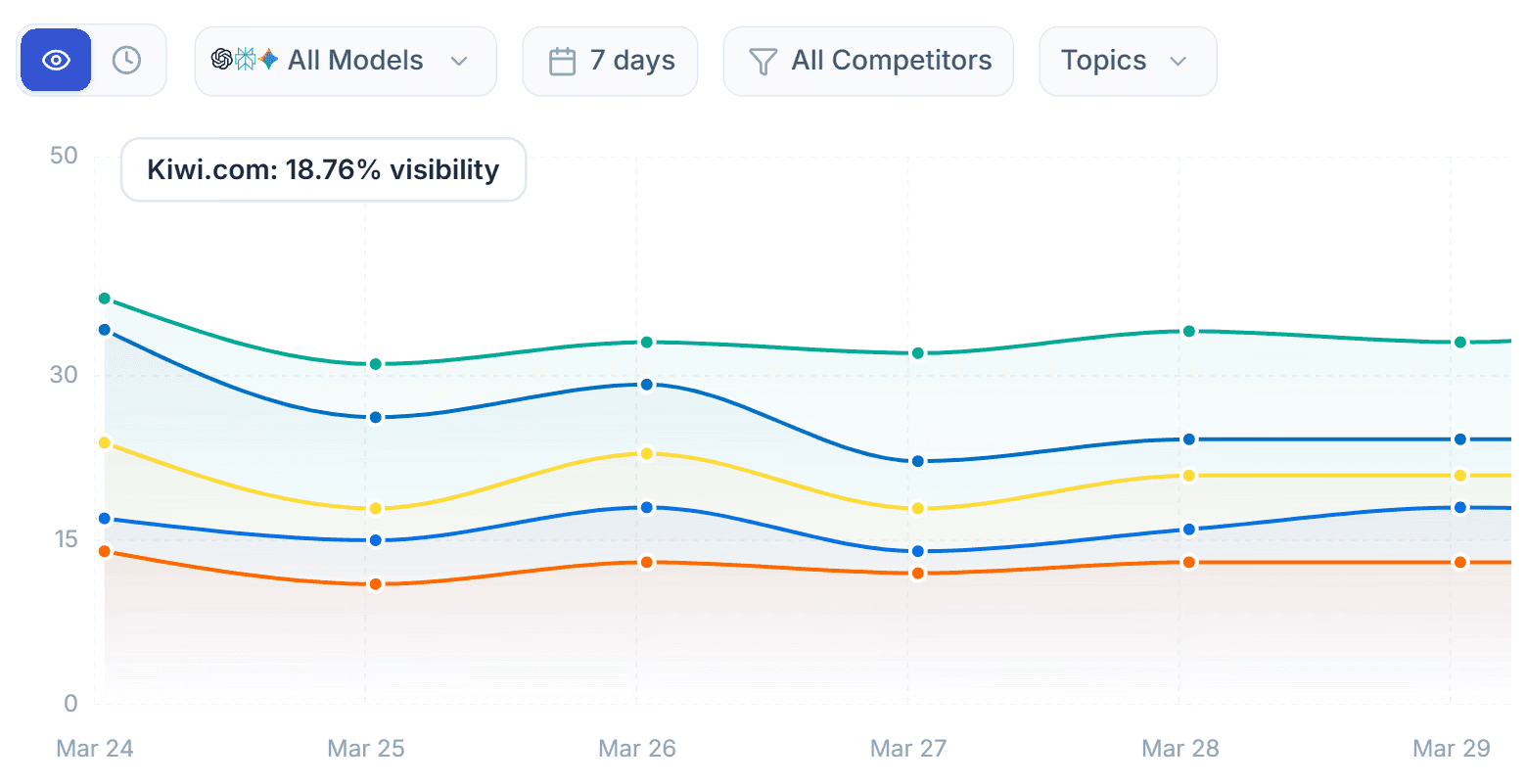
GEO is wider than SEO. AI recommends the brands that show up across the sources it reads, so your presence in forums, social platforms and retail blogs decides your odds. AIclicks measures the three metrics below so you know which to work on first.
AI Assistant
Which local shops sell good quality clothes?
Your Store
Citation Rate
Shows how many AI answers about retail stores name your brand, out of every 100. Models pull from the same trusted pages over and over, so citations compound: once you are in, staying in gets easier. Find the competitor pages AI cites most, then publish your own version of each.
Your Store
82% positive
Competitor A
54% positive
Competitor B
38% positive
Brand Sentiment
Shows how AI describes you when your brand comes up: positive, neutral or negative. Tone is what separates being mentioned from being recommended, and models repeat whatever framing they find. Track the negative mentions back to the reviews and threads behind them, then publish content that answers those directly.
Others 52%
You 24%
— 24%
Your Store
AI mention share of voice — retail category
Competitors
Not Cited
Share of Voice in AI
Shows how much of the retail conversation belongs to you rather than your competitors. This is the metric that matters most, the GEO version of a Google ranking. With only 1–5 brands named per answer, the market is winner-takes-more and every point is taken from someone.
The Dashboard Your Dedicated AI Search Team Works In
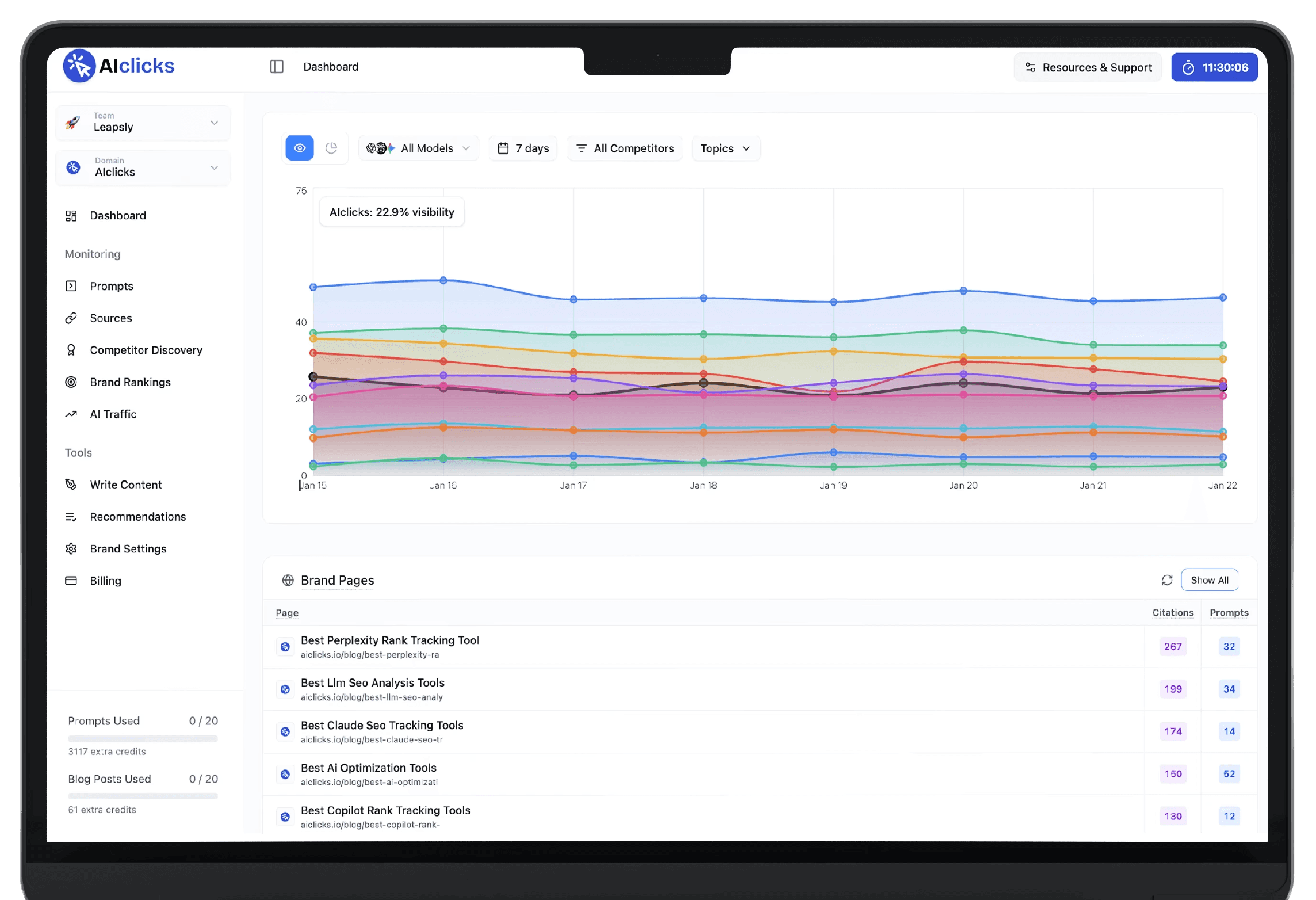
AIclicks gives you a live dashboard with daily ChatGPT mention rate, citation rate, sentiment, and share-of-voice across your tracked prompts, plus GA4 referral attribution for the traffic ChatGPT does send back.
Choose Your Plan
Flexible pricing that grows with your team. Upgrade or downgrade at any time.
Monthly
Yearly
-20%
Starter
Perfect for individuals & small teams
$49
/ month
Billed annually — you save $142
Choose 3 from:
Daily

" height="16px" id="fvSweaOBo" transform="translate(1 0)" width="14px"/></svg>)
" width="14px"><path d="M 13.864 5.629 L 13.3 5.629 L 13.3 5.6 L 7 5.6 L 7 8.4 L 10.956 8.4 C 10.379 10.03 8.828 11.2 7 11.2 C 4.681 11.2 2.8 9.319 2.8 7 C 2.8 4.681 4.681 2.8 7 2.8 C 8.071 2.8 9.045 3.204 9.786 3.864 L 11.766 1.884 C 10.516 0.719 8.844 0 7 0 C 3.134 0 0 3.134 0 7 C 0 10.866 3.134 14 7 14 C 10.866 14 14 10.866 14 7 C 14 6.531 13.952 6.073 13.864 5.629 Z" fill="rgb(255, 193, 7)" height="14px" id="H_YjfTNpn" width="14px"/><path d="M 0 3.742 L 2.3 5.429 C 2.922 3.888 4.429 2.8 6.193 2.8 C 7.264 2.8 8.238 3.204 8.979 3.864 L 10.959 1.884 C 9.709 0.719 8.037 0 6.193 0 C 3.504 0 1.172 1.518 0 3.742 Z" fill="rgb(255, 61, 0)" height="5.428500000000002px" id="PlkthQDhg" transform="translate(0.875 0)" width="10.959199999999996px"/><path d="M 6.232 5.581 C 8.04 5.581 9.683 4.889 10.925 3.764 L 8.758 1.931 C 8.032 2.483 7.144 2.782 6.232 2.781 C 4.411 2.781 2.865 1.62 2.283 0 L 0 1.759 C 1.159 4.026 3.511 5.581 6.232 5.581 Z" fill="rgb(76, 175, 80)" height="5.581099999999999px" id="WlnJ5gngE" transform="translate(0.7 8.4)" width="10.924899999999994px"/><path d="M 6.864 0.029 L 6.3 0.029 L 6.3 0 L 0 0 L 0 2.8 L 3.956 2.8 C 3.68 3.576 3.183 4.254 2.526 4.75 L 2.527 4.749 L 4.693 6.582 C 4.54 6.722 7 4.9 7 1.4 C 7 0.931 6.952 0.473 6.864 0.029 Z" fill="rgb(25, 118, 210)" height="6.589883930775992px" id="x_rSW275p" transform="translate(7 5.6)" width="7px"/></g></svg>)
" height="16px" id="hHS98fTxZ" width="16px"/></svg>)
 scale(1 1) translate(-1.861736945942159, -1.1170155383302638)" id="P20NzAvj0-699428820-radial-gradient" r="0.9935228066204626"><stop offset="0" stop-color="rgb(0, 174, 255)"/><stop offset="1" stop-color="rgb(7, 54, 196)"/></radialGradient><radialGradient cx="0.48250042504016705" cy="1.8366934653567062" gradient-transform="translate(0.48250042504016705, 1.8366934653567062) scale(1 1) translate(-0.48250042504016705, -1.8366934653567062)" id="UEWZqVjij-699428820-radial-gradient" r="0.9176890228114506"><stop offset="0" stop-color="rgb(255, 182, 87)"/><stop offset="1" stop-color="rgb(192, 43, 60)"/></radialGradient><linearGradient id="jyMN3TmKx-699428820-linear-gradient" x1="0.4594862532842614" x2="0.5405137467157386" y1="0" y2="1"><stop offset="0" stop-color="rgb(13, 145, 225)"/><stop offset="1" stop-color="rgb(255, 200, 0)"/></linearGradient><linearGradient id="xhMNwDFG0-699428820-linear-gradient" x1="0.4784828731548295" x2="0.5215171268451705" y1="5.551115123125783e-17" y2="1"><stop offset="0" stop-color="rgb(61, 203, 255)"/><stop offset="1" stop-color="rgba(5, 136, 247, 0)"/></linearGradient><radialGradient cx="1.4305090871482182" cy="0.34866158048251783" gradient-transform="translate(1.4305090871482182, 0.34866158048251783) scale(1 1) translate(-1.4305090871482182, -0.34866158048251783)" id="i79kAqaS4-699428820-radial-gradient" r="1.3362743412697924"><stop offset="0" stop-color="rgb(140, 72, 255)"/><stop offset="1" stop-color="rgb(255, 177, 82)"/></radialGradient><linearGradient id="mcxvno3tX-699428820-linear-gradient" x1="0.49844355920154226" x2="0.5015564407984577" y1="0" y2="1"><stop offset="0" stop-color="rgb(248, 173, 250)"/><stop offset="1" stop-color="rgba(168, 110, 221, 0)"/></linearGradient></defs><g d="M 11.605 1.219 C 11.397 0.499 10.739 0.002 9.989 0 L 9.498 0 C 8.682 0.002 7.985 0.588 7.842 1.391 L 7 6.016 L 7.209 5.296 C 7.416 4.574 8.075 4.076 8.825 4.074 L 11.681 4.074 L 12.879 4.545 L 14.033 4.074 L 13.697 4.074 C 12.947 4.072 12.289 3.575 12.081 2.855 Z M 4.413 13.387 C 4.618 14.111 5.278 14.611 6.031 14.613 L 7.075 14.613 C 7.988 14.613 8.735 13.88 8.758 12.96 L 8.871 8.5 L 8.633 9.319 C 8.426 10.039 7.768 10.537 7.018 10.539 L 4.138 10.539 L 3.111 9.977 L 2 10.539 L 2.331 10.539 C 3.084 10.542 3.743 11.042 3.949 11.766 L 4.413 13.387 Z M 9.999 0 L 4.167 0 C 2.501 0 1.501 2.221 0.834 4.441 C 0.045 7.073 -0.989 10.591 2.001 10.591 L 4.519 10.591 C 5.273 10.591 5.933 10.089 6.139 9.36 C 6.577 7.815 7.345 5.121 7.948 3.069 C 8.255 2.027 8.509 1.132 8.901 0.575 C 9.148 0.212 9.56 -0.004 9.999 0 M 9.999 0 L 4.167 0 C 2.501 0 1.501 2.221 0.834 4.441 C 0.045 7.073 -0.989 10.591 2.001 10.591 L 4.519 10.591 C 5.273 10.591 5.933 10.089 6.139 9.36 C 6.577 7.815 7.345 5.121 7.948 3.069 C 8.255 2.027 8.509 1.132 8.901 0.575 C 9.148 0.212 9.56 -0.004 9.999 0 M 6 14.593 L 11.833 14.593 C 13.499 14.593 14.499 12.372 15.166 10.151 C 15.955 7.519 16.989 4 13.999 4 L 11.48 4 C 10.725 4.002 10.063 4.505 9.86 5.232 C 9.266 7.332 8.663 9.429 8.051 11.523 C 7.745 12.566 7.49 13.461 7.098 14.019 C 6.851 14.382 6.439 14.597 6 14.593 M 6 14.593 L 11.833 14.593 C 13.499 14.593 14.499 12.372 15.166 10.151 C 15.955 7.519 16.989 4 13.999 4 L 11.48 4 C 10.725 4.002 10.063 4.505 9.86 5.232 C 9.266 7.332 8.663 9.429 8.051 11.523 C 7.745 12.566 7.49 13.461 7.098 14.019 C 6.851 14.382 6.439 14.597 6 14.593" fill="transparent" height="14.613333333333333px" id="QzkBy4Ibc" transform="translate(0 1)" width="16.00011071294081px"><path d="M 4.605 1.219 C 4.397 0.499 3.739 0.002 2.989 0 L 2.498 0 C 1.682 0.002 0.985 0.588 0.842 1.391 L 0 6.016 L 0.209 5.296 C 0.416 4.574 1.075 4.076 1.825 4.074 L 4.681 4.074 L 5.879 4.545 L 7.033 4.074 L 6.697 4.074 C 5.947 4.072 5.289 3.575 5.081 2.855 Z" fill="url(%23P20NzAvj0-699428820-radial-gradient)" height="6.016px" id="P20NzAvj0" transform="translate(7 0)" width="7.0333333333333385px"/><path d="M 2.413 4.887 C 2.618 5.611 3.278 6.111 4.031 6.113 L 5.075 6.113 C 5.988 6.113 6.735 5.38 6.758 4.46 L 6.871 0 L 6.633 0.819 C 6.426 1.539 5.768 2.037 5.018 2.039 L 2.138 2.039 L 1.111 1.477 L 0 2.039 L 0.331 2.039 C 1.084 2.042 1.743 2.542 1.949 3.266 L 2.413 4.887 Z" fill="url(%23UEWZqVjij-699428820-radial-gradient)" height="6.113333333333333px" id="UEWZqVjij" transform="translate(2 8.5)" width="6.871333333333332px"/><path d="M 9.999 0 L 4.167 0 C 2.501 0 1.501 2.221 0.834 4.441 C 0.045 7.073 -0.989 10.591 2.001 10.591 L 4.519 10.591 C 5.273 10.591 5.933 10.089 6.139 9.36 C 6.577 7.815 7.345 5.121 7.948 3.069 C 8.255 2.027 8.509 1.132 8.901 0.575 C 9.148 0.212 9.56 -0.004 9.999 0" fill="url(%23jyMN3TmKx-699428820-linear-gradient)" height="10.591388755215167px" id="jyMN3TmKx" width="9.999444046274142px"/><path d="M 9.999 0 L 4.167 0 C 2.501 0 1.501 2.221 0.834 4.441 C 0.045 7.073 -0.989 10.591 2.001 10.591 L 4.519 10.591 C 5.273 10.591 5.933 10.089 6.139 9.36 C 6.577 7.815 7.345 5.121 7.948 3.069 C 8.255 2.027 8.509 1.132 8.901 0.575 C 9.148 0.212 9.56 -0.004 9.999 0" fill="url(%23xhMNwDFG0-699428820-linear-gradient)" height="10.591388755215167px" id="xhMNwDFG0" width="9.999444046274142px"/><path d="M 0 10.593 L 5.833 10.593 C 7.499 10.593 8.499 8.372 9.166 6.151 C 9.955 3.519 10.989 0 7.999 0 L 5.48 0 C 4.725 0.002 4.063 0.505 3.86 1.232 C 3.266 3.332 2.663 5.429 2.051 7.523 C 1.745 8.566 1.49 9.461 1.098 10.019 C 0.851 10.382 0.439 10.597 0 10.593" fill="url(%23i79kAqaS4-699428820-radial-gradient)" height="10.593388755215164px" id="i79kAqaS4" transform="translate(6 4)" width="10.000110712940803px"/><path d="M 0 10.593 L 5.833 10.593 C 7.499 10.593 8.499 8.372 9.166 6.151 C 9.955 3.519 10.989 0 7.999 0 L 5.48 0 C 4.725 0.002 4.063 0.505 3.86 1.232 C 3.266 3.332 2.663 5.429 2.051 7.523 C 1.745 8.566 1.49 9.461 1.098 10.019 C 0.851 10.382 0.439 10.597 0 10.593" fill="url(%23mcxvno3tX-699428820-linear-gradient)" height="10.593388755215164px" id="mcxvno3tX" transform="translate(6 4)" width="10.000110712940803px"/></g></svg>)
" height="15.360666565427872px" id="HZPvvPBv7" transform="translate(0 0.5)" width="16px"/></svg>)
Tracked prompts
30
Websites you can add
3
LLMs you can track
3
Countries per project
1
LLM responses / mo
4,650
AI-optimized articles per month
10
Integrations
-
Support
Pro
For growing teams for more power
$140
/ month
Billed annually — you save $454
Choose 4 from:
Daily
Tracked prompts
150
Websites you can add
Unlimited
LLMs you can track
4
Countries per project
Unlimited
LLM responses / mo
18,600
AI-optimized articles per month
20
Integrations
Google Analytics
Support
BUSINESS
Best for medium-sized organizations
$357
/ month
Billed annually — you save $1198
Choose 6 from:
Daily
Tracked prompts
300
Websites you can add
Unlimited
LLMs you can track
6
Countries per project
Unlimited
LLM responses / mo
55,800
AI-optimized articles per month
30
Integrations
Google Analytics, API
Support
Dedicated account specialist
Become the #1 Answer in AI
Succeed in GEO yourself, or let us do all the work.
Do it yourself
Use AIclicks to see exactly where you appear across 10+ AI platforms, spot the gaps competitors are filling, and act on clear weekly recommendations.
From $59/month · Cancel anytime
Done for you
We Do All the Work for You
Our team manages your complete search presence: traditional SEO and GEO strategy, content, implementation, and reporting. You focus on shoppers.
Custom pricing · Minimum 3-month engagement
The AI SEO agency trusted by 1,000+ brands worldwide
From solo founders to multi-client agencies, AIclicks runs the full AI SEO agency program for organizations of every shape and size that want to be cited across every AI surface.
4.9/5 stars on G2







FAQ
How long does SEO take for a retail store?
Local movement in 2 to 4 months, category rankings in 6 to 12. Google Business Profile and review work compound quickly, so map pack impressions rise first. Category and buying guide pages take longer because you are competing with marketplaces that have been indexed for a decade. Agencies commonly quote at least 4 months before anything meaningful shows. A shop in a quiet market with few rivals will move faster than that.
Should we optimise for Google or AI shopping assistants?
Both, and retail is where they diverge most. Ahrefs analysed 863,000 keywords and found only 38% of pages cited in AI Overviews also ranked in the top 10, down from 76% a year earlier. Worse for retailers, assistants answer where should I buy this by summarising roundups, marketplace listings and forum threads, not your product pages. Getting cited means being described accurately on sources you do not own.
How is retail SEO different from normal local SEO?
Retail SEO is a catalogue problem rather than a content problem. Scale and vendor-supplied duplicate copy are the main obstacles, not thin pages. Inventory turns over constantly, so crawl management and redirect discipline matter far more than they do for a service business. And your competition is not other shops, it is chain store locators, Yelp and marketplaces that already rank for every product term you sell.
What should a retail store budget for SEO?
Published retail SEO rates run roughly $500 to $5,000 a month, with the low end covering a single shop and profile work, and the top end covering catalogue-scale technical fixes and content. Multi-site chains sit above that. Judge the number against what you already pay for Performance Max and Meta, not against zero, and measure it on cost per order rather than on the retainer alone.
How does SEO fit with the ads we already run?
They cover different halves of the catalogue. Shopping ads and Performance Max buy visibility on your highest-margin lines this week; organic search earns the long tail of specific model, size and brand queries that would be uneconomic to bid on. Use the search terms report to decide which category pages to write first, because whatever already converts through paid is proof the demand exists. Measure both on cost per order.
Which pages should a retail store build first?
Google Business Profile first, with the product catalogue and a local inventory feed attached, because it costs nothing and sits above every organic result. Then your top 5 category pages, rewritten properly. Then a store page per location carrying real hours, parking and stock. Then brand pages for the labels you are an authorised dealer for. Product pages come after all of that, and the blog last.
How do we prove the SEO is driving sales?
Measure orders and store visits from organic, not rankings. Google Business Profile insights show direction requests and calls, which move before revenue does. In Search Console, watch impressions on category and brand terms rather than position. Tag organic sessions that end in an in-store pickup order. And ask at the till how people found you, because footfall driven by search is the number that never appears in analytics.
Can we run retail SEO without an agency?
Partly, and the split should follow who knows the stock. Category copy, brand pages, product descriptions and review requests should stay with the buyers and floor staff, because nobody outside the shop knows why one line sells. Hand out the catalogue-scale technical work: faceted URL control, redirect maps for discontinued lines, schema and feeds. If you hire, ask a candidate how they would handle 400,000 filter URLs before you ask about content.
Further Reading
Go deeper on GEO, AI search, and visibility tracking.