SEO for Restaurants:
A diner decides where to eat in under a minute, on a phone, halfway through a search that never reaches your website. They read the map pack, scan photos, check a review or two, and increasingly ask an assistant to pick. Search visibility decides whether you are on that shortlist.









Why Restaurants Need SEO
Close to 8 in 10 restaurant searches never mention a restaurant by name. Diners describe a craving, a neighbourhood or an occasion, and pick from whatever Google hands back.
Every dish you sell is a search someone is running right now, and none of them lead back to you. Your menu sits in a PDF or inside an ordering widget on someone else’s domain, so Google never learns that you serve birria tacos, a gluten-free crust or a tasting menu. The demand exists; the page does not.
Type best restaurants near me into a phone anywhere in the country and Yelp, DoorDash and Uber Eats stack up above almost every independent kitchen. The apps then take a cut of every order they route back to you, and Yelp sells the restaurant down the street an ad slot on the listing that outranked you.
Most independents run $500 to $2,000 a month through Instagram boosts, app promotions and printed flyers, then hand another 15% to 30% of delivery revenue to the apps. Restaurant SEO retainers typically sit between $1,500 and $5,000 a month. The difference is that one still works when you stop paying.
How SEO Works for Restaurants
Search Engine Optimization projects are long-term investments for restaurants, where each task supplements the others and creates compound results over time.
01
Keywords, page structure, and the signals Google reads directly
On-page work fails in restaurants for an unusual reason: the most valuable content on the site was never written by a marketer. It is the menu, and the menu is usually a picture. It arrives as a PDF the designer exported or a JPEG of the printed card, so Google can read the file name and nothing else. Every dish you sell is a query with real volume behind it, and none of that text exists anywhere on your domain. The pages that actually earn traffic are the menu in HTML, the ordering page, the reservations page, and one page per cuisine or occasion you serve.
What holds value is anything tied to a dish, a diet or an occasion rather than a date. A page on your signature dish, one on private dining and buyouts, one on catering minimums and lead times, and one on gluten-free or halal options will still be pulling bookings in 3 years, because the craving and the constraint do not change. What churns is the events calendar, the seasonal cocktail list and last quarter’s happy hour graphic. Most restaurant sites are built almost entirely from the second list, and then rank for the venue’s own name and little else.
1
Publish every dish, description and price as crawlable HTML on your own domain, not a PDF or an embedded Toast iframe.
2
Unpublish last season’s tasting menus and closed pop-up pages, and 301 each into the current menu or cuisine page.
3
Add Restaurant schema with servesCuisine and hasMenu, then Menu, MenuSection and MenuItem markup with real prices, validated in Google’s Rich Results Test.
4
Build standing pages for private dining, catering, large groups and dietary menus, the queries that run all year regardless of season.
02
Map Pack visibility, citations, and proximity signals
Practically all restaurant demand is local and immediate. Someone is hungry, within a few miles, and choosing inside 60 seconds, which is why the 3 map pack slots sit above Yelp, DoorDash and everything else on the results page. Nowhere else does a single independent genuinely outrank a national platform, because proximity, profile completeness and review velocity decide it, and only the first of those is fixed.
Make the primary category the cuisine itself, Barbecue Restaurant rather than Restaurant, then add takeout, catering and bar as secondary categories. Upload the full menu inside the profile, not a link. Point the ordering and reservation buttons at your own domain rather than DoorDash. Fill every attribute diners filter on: outdoor seating, high chairs, late-night hours, vegan options, parking. Refresh food photos monthly, and post specials weekly.
Restaurants carry a citation layer nobody else has. Beyond Yelp, Apple Business Connect and Bing Places sit Tripadvisor, OpenTable, Resy, Foursquare, AllMenus, Restaurantji, HappyCow for plant-based and Find Me Gluten Free for coeliac diners, plus the delivery apps whose listing pages rank in their own right. Menu and hours drift across all of them the moment you change a price, so a single source of truth matters more here than the address ever will.
1
Set the narrowest cuisine category available, upload the full menu into the profile, and point ordering links at your own site.
2
Give each venue a profile of its own and a URL under /locations/, never subdomains, with that kitchen’s menu, hours and reviews.
3
Run Marqii or Yext across Yelp, Tripadvisor, OpenTable and the delivery apps so hours, menu and phone match everywhere.
4
Post the actual weekly special to Google Business Profile with its price and a link straight to your ordering page.
03
Topic authority, inbound links, and content that earns traffic
Before a table gets booked, the diner is resolving practical worries: is there anything my vegetarian friend can eat, can we get a stroller in, how loud is it at 8, do you take walk-ins. Pages that answer those plainly outperform anything written about the chef’s philosophy. So do the questions that decide a large booking: minimum spend, deposit, whether the private room has its own bar.
A diner who has already decided on ramen tonight is comparing 3 places on one screen. Give them the thing that closes it: current prices next to every dish, real photographs of the plates as they leave the pass, tonight’s actual hours, and an order or reserve button that never leaves your domain. The booking is lost at the exact moment a price or a reserve link cannot be found.
Restaurant links are easier to earn than in most trades because food is editorial. City food blogs, Eater-style local sites, the alt-weekly’s best-of roundups and university dining guides all publish lists somebody has to fill. Suppliers link too: the roaster, the brewery, the farm and the cheesemonger you name on the menu usually keep a stockist page. So do festivals you cook at, the chamber, the tourism board and every charity dinner you host.
1
Run an annual comparison of catering packages, per-head pricing and minimums against what local competitors publish, since almost none of them do.
2
Build one page per cuisine, dish and occasion you serve, such as ramen delivery, birthday dinner, or brunch bottomless mimosas.
3
Group every cost question onto one hub page: average spend per head, happy hour, prix fixe, kids eat free, catering minimums.
4
Give each named supplier its own page, the roaster, the brewery, the farm, because diners search those brands more than yours.
04
Site speed, crawlability, Core Web Vitals, and mobile health
The failure almost nobody catches is that the menu is not actually on your website. It renders through a third-party ordering script, so the dish names, descriptions and prices exist only in JavaScript fetched from the vendor’s domain. View source and there is nothing there. Crawlers that do not execute scripts, which includes most AI crawlers, see a page about a restaurant with no food on it. Owners never notice, because the menu looks perfect in their own browser.
The deciding search happens on a phone, on the street, with 4 people waiting for an answer. That phone is loading a full-screen autoplay hero video of the kitchen, a Google Maps embed, a reservation widget and a cookie banner before the hours appear. Restaurant sites are among the heaviest small-business sites on the web for exactly this reason. Every second of that is a table walking into the place next door.
1
Open your menu page, disable JavaScript, and reload. If the dishes vanish, publish them as HTML or use Screaming Frog’s rendered-versus-raw comparison.
2
Test the homepage in PageSpeed Insights, replace the autoplay background video with a still, and re-test on a throttled 4G connection.
3
Compress gallery and dish photography to WebP, size it to the container and lazy-load it, since food photography dominates page weight here.
4
Split menu, location and occasion pages into a sitemap of their own, away from events, and resubmit the day a price changes.
05
Star ratings, review volume, and response strategy that builds trust
Nothing decides a restaurant search like the star rating, because it is the only evidence a stranger has that the food is worth the trip. Volume beats perfection: a place with 400 reviews at 4.3 will usually outrank one with 30 at 4.9. The difficulty is velocity. Ratings decay if they stall, one bad service night produces 4 angry reviews by midnight, and the guests who loved it say so to the server and nowhere else.
The moment to ask is while the guest is still at the table, paying, warm and holding a phone. A QR code on the check presenter converts better than any email sent the following day, and the server who looked after them should be the one asking. For delivery and pickup, fire the request from Toast or ChowNow about 90 minutes after the order, once the food has been eaten rather than collected.
1
Put a Google review QR code in every check presenter, and have the server name it when they drop the bill.
2
Answer inside 24 hours, name the dish or the shift, offer a direct email, and never argue about wait times publicly.
4
Ask catering and private-event clients for reviews too, since one office lunch buyer writes the review that wins the next 10 bookings.
Google is No Longer the Only Place Your diners are Searching
Diners are using AI to find answers, and they trust what it tells them. Invest in GEO to get recommended in those answers.
1 Billion
Questions ChatGPT receives every single day
38%
Your #1 top ranking page on Google would be cited by AI
14%
of restaurants optimise for GEO. The rest are invisible in AI answers


You can rank #1 for “restaurant near me” and still not exist in ChatGPT’s answer. Run a free GEO audit to see where your brand actually stands.
GEO vs SEO: Same Goal, Different Methods
GEO is wider than SEO. AI recommends the brands that show up across the sources it reads, so your presence in forums, social platforms and restaurant blogs decides your odds. AIclicks measures the three metrics below so you know which to work on first.
AI Assistant
What restaurant nearby is good for a date?
Your Restaurant
Citation Rate
Shows how many AI answers about restaurants name your brand, out of every 100. Models pull from the same trusted pages over and over, so citations compound: once you are in, staying in gets easier. Find the competitor pages AI cites most, then publish your own version of each.
Your Restaurant
82% positive
Competitor A
54% positive
Competitor B
38% positive
Brand Sentiment
Shows how AI describes you when your brand comes up: positive, neutral or negative. Tone is what separates being mentioned from being recommended, and models repeat whatever framing they find. Track the negative mentions back to the reviews and threads behind them, then publish content that answers those directly.
Others 52%
You 24%
— 24%
Your Restaurant
AI mention share of voice — restaurant category
Competitors
Not Cited
Share of Voice in AI
Shows how much of the restaurant conversation belongs to you rather than your competitors. This is the metric that matters most, the GEO version of a Google ranking. With only 1–5 brands named per answer, the market is winner-takes-more and every point is taken from someone.
The Dashboard Your Dedicated AI Search Team Works In
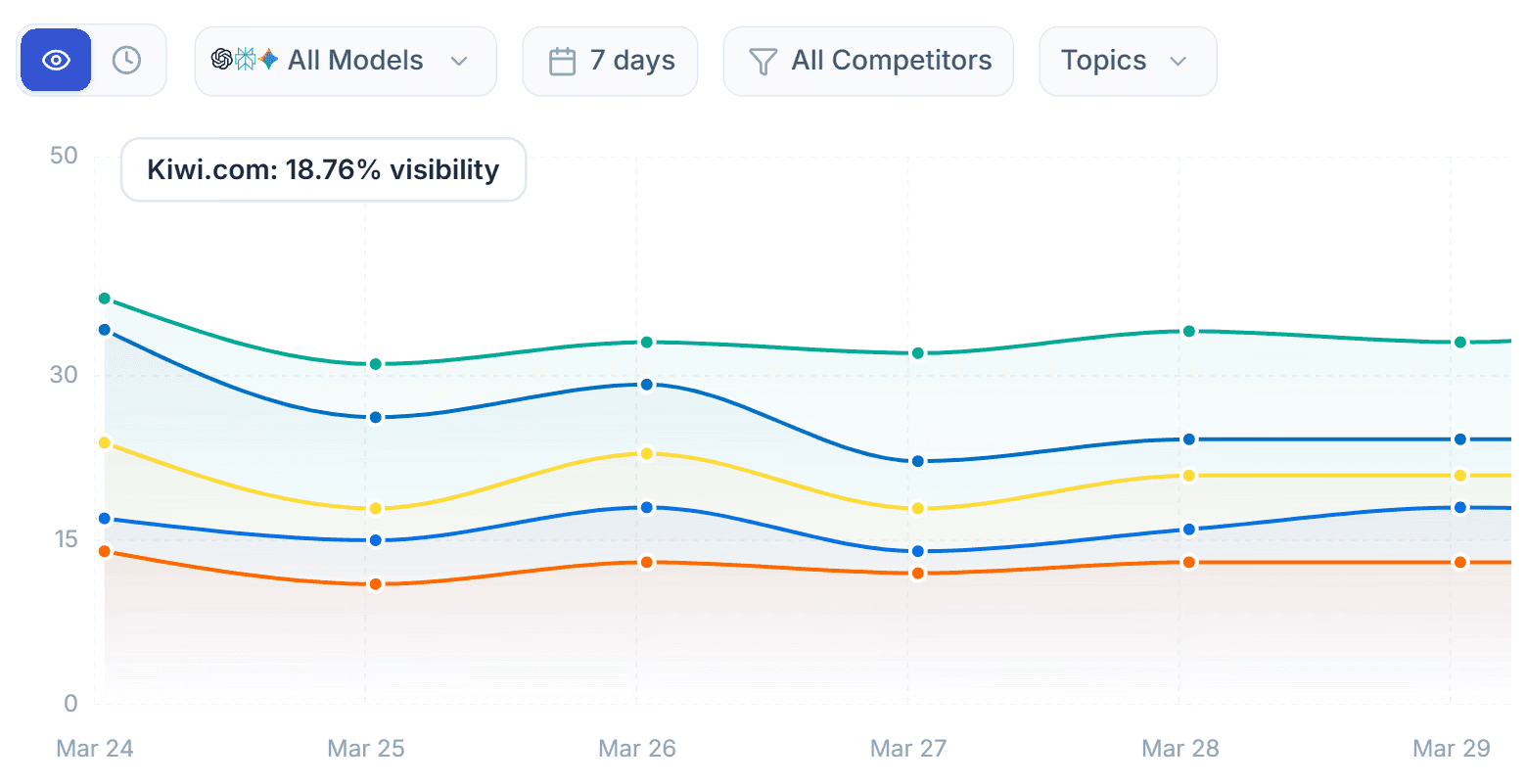
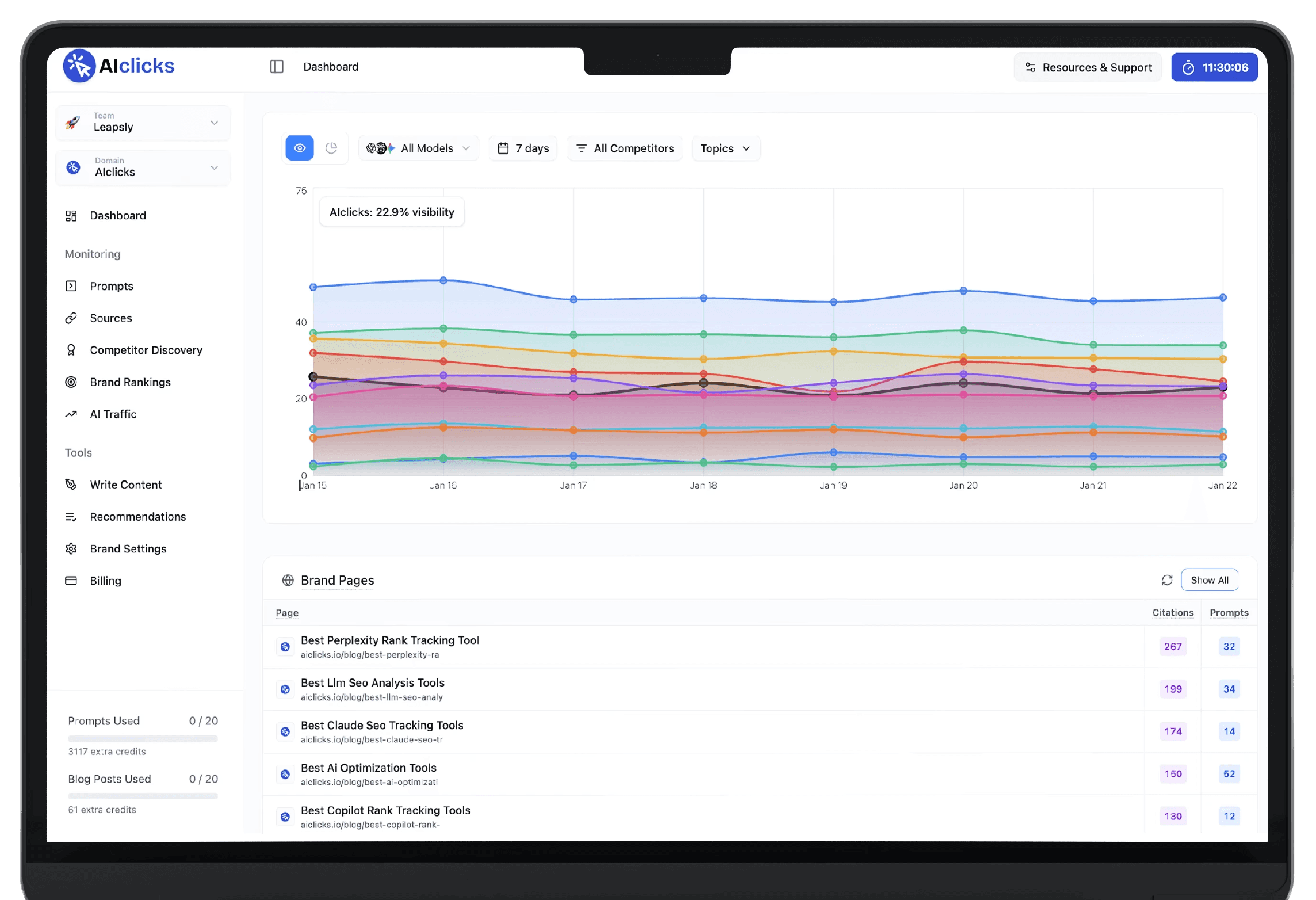
AIclicks gives you a live dashboard with daily ChatGPT mention rate, citation rate, sentiment, and share-of-voice across your tracked prompts, plus GA4 referral attribution for the traffic ChatGPT does send back.
Choose Your Plan
Flexible pricing that grows with your team. Upgrade or downgrade at any time.
Monthly
Yearly
-20%
Starter
Perfect for individuals & small teams
$49
/ month
Billed annually — you save $142
Choose 3 from:
Daily

" height="16px" id="fvSweaOBo" transform="translate(1 0)" width="14px"/></svg>)
" width="14px"><path d="M 13.864 5.629 L 13.3 5.629 L 13.3 5.6 L 7 5.6 L 7 8.4 L 10.956 8.4 C 10.379 10.03 8.828 11.2 7 11.2 C 4.681 11.2 2.8 9.319 2.8 7 C 2.8 4.681 4.681 2.8 7 2.8 C 8.071 2.8 9.045 3.204 9.786 3.864 L 11.766 1.884 C 10.516 0.719 8.844 0 7 0 C 3.134 0 0 3.134 0 7 C 0 10.866 3.134 14 7 14 C 10.866 14 14 10.866 14 7 C 14 6.531 13.952 6.073 13.864 5.629 Z" fill="rgb(255, 193, 7)" height="14px" id="H_YjfTNpn" width="14px"/><path d="M 0 3.742 L 2.3 5.429 C 2.922 3.888 4.429 2.8 6.193 2.8 C 7.264 2.8 8.238 3.204 8.979 3.864 L 10.959 1.884 C 9.709 0.719 8.037 0 6.193 0 C 3.504 0 1.172 1.518 0 3.742 Z" fill="rgb(255, 61, 0)" height="5.428500000000002px" id="PlkthQDhg" transform="translate(0.875 0)" width="10.959199999999996px"/><path d="M 6.232 5.581 C 8.04 5.581 9.683 4.889 10.925 3.764 L 8.758 1.931 C 8.032 2.483 7.144 2.782 6.232 2.781 C 4.411 2.781 2.865 1.62 2.283 0 L 0 1.759 C 1.159 4.026 3.511 5.581 6.232 5.581 Z" fill="rgb(76, 175, 80)" height="5.581099999999999px" id="WlnJ5gngE" transform="translate(0.7 8.4)" width="10.924899999999994px"/><path d="M 6.864 0.029 L 6.3 0.029 L 6.3 0 L 0 0 L 0 2.8 L 3.956 2.8 C 3.68 3.576 3.183 4.254 2.526 4.75 L 2.527 4.749 L 4.693 6.582 C 4.54 6.722 7 4.9 7 1.4 C 7 0.931 6.952 0.473 6.864 0.029 Z" fill="rgb(25, 118, 210)" height="6.589883930775992px" id="x_rSW275p" transform="translate(7 5.6)" width="7px"/></g></svg>)
" height="16px" id="hHS98fTxZ" width="16px"/></svg>)
 scale(1 1) translate(-1.861736945942159, -1.1170155383302638)" id="P20NzAvj0-699428820-radial-gradient" r="0.9935228066204626"><stop offset="0" stop-color="rgb(0, 174, 255)"/><stop offset="1" stop-color="rgb(7, 54, 196)"/></radialGradient><radialGradient cx="0.48250042504016705" cy="1.8366934653567062" gradient-transform="translate(0.48250042504016705, 1.8366934653567062) scale(1 1) translate(-0.48250042504016705, -1.8366934653567062)" id="UEWZqVjij-699428820-radial-gradient" r="0.9176890228114506"><stop offset="0" stop-color="rgb(255, 182, 87)"/><stop offset="1" stop-color="rgb(192, 43, 60)"/></radialGradient><linearGradient id="jyMN3TmKx-699428820-linear-gradient" x1="0.4594862532842614" x2="0.5405137467157386" y1="0" y2="1"><stop offset="0" stop-color="rgb(13, 145, 225)"/><stop offset="1" stop-color="rgb(255, 200, 0)"/></linearGradient><linearGradient id="xhMNwDFG0-699428820-linear-gradient" x1="0.4784828731548295" x2="0.5215171268451705" y1="5.551115123125783e-17" y2="1"><stop offset="0" stop-color="rgb(61, 203, 255)"/><stop offset="1" stop-color="rgba(5, 136, 247, 0)"/></linearGradient><radialGradient cx="1.4305090871482182" cy="0.34866158048251783" gradient-transform="translate(1.4305090871482182, 0.34866158048251783) scale(1 1) translate(-1.4305090871482182, -0.34866158048251783)" id="i79kAqaS4-699428820-radial-gradient" r="1.3362743412697924"><stop offset="0" stop-color="rgb(140, 72, 255)"/><stop offset="1" stop-color="rgb(255, 177, 82)"/></radialGradient><linearGradient id="mcxvno3tX-699428820-linear-gradient" x1="0.49844355920154226" x2="0.5015564407984577" y1="0" y2="1"><stop offset="0" stop-color="rgb(248, 173, 250)"/><stop offset="1" stop-color="rgba(168, 110, 221, 0)"/></linearGradient></defs><g d="M 11.605 1.219 C 11.397 0.499 10.739 0.002 9.989 0 L 9.498 0 C 8.682 0.002 7.985 0.588 7.842 1.391 L 7 6.016 L 7.209 5.296 C 7.416 4.574 8.075 4.076 8.825 4.074 L 11.681 4.074 L 12.879 4.545 L 14.033 4.074 L 13.697 4.074 C 12.947 4.072 12.289 3.575 12.081 2.855 Z M 4.413 13.387 C 4.618 14.111 5.278 14.611 6.031 14.613 L 7.075 14.613 C 7.988 14.613 8.735 13.88 8.758 12.96 L 8.871 8.5 L 8.633 9.319 C 8.426 10.039 7.768 10.537 7.018 10.539 L 4.138 10.539 L 3.111 9.977 L 2 10.539 L 2.331 10.539 C 3.084 10.542 3.743 11.042 3.949 11.766 L 4.413 13.387 Z M 9.999 0 L 4.167 0 C 2.501 0 1.501 2.221 0.834 4.441 C 0.045 7.073 -0.989 10.591 2.001 10.591 L 4.519 10.591 C 5.273 10.591 5.933 10.089 6.139 9.36 C 6.577 7.815 7.345 5.121 7.948 3.069 C 8.255 2.027 8.509 1.132 8.901 0.575 C 9.148 0.212 9.56 -0.004 9.999 0 M 9.999 0 L 4.167 0 C 2.501 0 1.501 2.221 0.834 4.441 C 0.045 7.073 -0.989 10.591 2.001 10.591 L 4.519 10.591 C 5.273 10.591 5.933 10.089 6.139 9.36 C 6.577 7.815 7.345 5.121 7.948 3.069 C 8.255 2.027 8.509 1.132 8.901 0.575 C 9.148 0.212 9.56 -0.004 9.999 0 M 6 14.593 L 11.833 14.593 C 13.499 14.593 14.499 12.372 15.166 10.151 C 15.955 7.519 16.989 4 13.999 4 L 11.48 4 C 10.725 4.002 10.063 4.505 9.86 5.232 C 9.266 7.332 8.663 9.429 8.051 11.523 C 7.745 12.566 7.49 13.461 7.098 14.019 C 6.851 14.382 6.439 14.597 6 14.593 M 6 14.593 L 11.833 14.593 C 13.499 14.593 14.499 12.372 15.166 10.151 C 15.955 7.519 16.989 4 13.999 4 L 11.48 4 C 10.725 4.002 10.063 4.505 9.86 5.232 C 9.266 7.332 8.663 9.429 8.051 11.523 C 7.745 12.566 7.49 13.461 7.098 14.019 C 6.851 14.382 6.439 14.597 6 14.593" fill="transparent" height="14.613333333333333px" id="QzkBy4Ibc" transform="translate(0 1)" width="16.00011071294081px"><path d="M 4.605 1.219 C 4.397 0.499 3.739 0.002 2.989 0 L 2.498 0 C 1.682 0.002 0.985 0.588 0.842 1.391 L 0 6.016 L 0.209 5.296 C 0.416 4.574 1.075 4.076 1.825 4.074 L 4.681 4.074 L 5.879 4.545 L 7.033 4.074 L 6.697 4.074 C 5.947 4.072 5.289 3.575 5.081 2.855 Z" fill="url(%23P20NzAvj0-699428820-radial-gradient)" height="6.016px" id="P20NzAvj0" transform="translate(7 0)" width="7.0333333333333385px"/><path d="M 2.413 4.887 C 2.618 5.611 3.278 6.111 4.031 6.113 L 5.075 6.113 C 5.988 6.113 6.735 5.38 6.758 4.46 L 6.871 0 L 6.633 0.819 C 6.426 1.539 5.768 2.037 5.018 2.039 L 2.138 2.039 L 1.111 1.477 L 0 2.039 L 0.331 2.039 C 1.084 2.042 1.743 2.542 1.949 3.266 L 2.413 4.887 Z" fill="url(%23UEWZqVjij-699428820-radial-gradient)" height="6.113333333333333px" id="UEWZqVjij" transform="translate(2 8.5)" width="6.871333333333332px"/><path d="M 9.999 0 L 4.167 0 C 2.501 0 1.501 2.221 0.834 4.441 C 0.045 7.073 -0.989 10.591 2.001 10.591 L 4.519 10.591 C 5.273 10.591 5.933 10.089 6.139 9.36 C 6.577 7.815 7.345 5.121 7.948 3.069 C 8.255 2.027 8.509 1.132 8.901 0.575 C 9.148 0.212 9.56 -0.004 9.999 0" fill="url(%23jyMN3TmKx-699428820-linear-gradient)" height="10.591388755215167px" id="jyMN3TmKx" width="9.999444046274142px"/><path d="M 9.999 0 L 4.167 0 C 2.501 0 1.501 2.221 0.834 4.441 C 0.045 7.073 -0.989 10.591 2.001 10.591 L 4.519 10.591 C 5.273 10.591 5.933 10.089 6.139 9.36 C 6.577 7.815 7.345 5.121 7.948 3.069 C 8.255 2.027 8.509 1.132 8.901 0.575 C 9.148 0.212 9.56 -0.004 9.999 0" fill="url(%23xhMNwDFG0-699428820-linear-gradient)" height="10.591388755215167px" id="xhMNwDFG0" width="9.999444046274142px"/><path d="M 0 10.593 L 5.833 10.593 C 7.499 10.593 8.499 8.372 9.166 6.151 C 9.955 3.519 10.989 0 7.999 0 L 5.48 0 C 4.725 0.002 4.063 0.505 3.86 1.232 C 3.266 3.332 2.663 5.429 2.051 7.523 C 1.745 8.566 1.49 9.461 1.098 10.019 C 0.851 10.382 0.439 10.597 0 10.593" fill="url(%23i79kAqaS4-699428820-radial-gradient)" height="10.593388755215164px" id="i79kAqaS4" transform="translate(6 4)" width="10.000110712940803px"/><path d="M 0 10.593 L 5.833 10.593 C 7.499 10.593 8.499 8.372 9.166 6.151 C 9.955 3.519 10.989 0 7.999 0 L 5.48 0 C 4.725 0.002 4.063 0.505 3.86 1.232 C 3.266 3.332 2.663 5.429 2.051 7.523 C 1.745 8.566 1.49 9.461 1.098 10.019 C 0.851 10.382 0.439 10.597 0 10.593" fill="url(%23mcxvno3tX-699428820-linear-gradient)" height="10.593388755215164px" id="mcxvno3tX" transform="translate(6 4)" width="10.000110712940803px"/></g></svg>)
" height="15.360666565427872px" id="HZPvvPBv7" transform="translate(0 0.5)" width="16px"/></svg>)
Tracked prompts
30
Websites you can add
3
LLMs you can track
3
Countries per project
1
LLM responses / mo
4,650
AI-optimized articles per month
10
Integrations
-
Support
Pro
For growing teams for more power
$140
/ month
Billed annually — you save $454
Choose 4 from:
Daily
Tracked prompts
150
Websites you can add
Unlimited
LLMs you can track
4
Countries per project
Unlimited
LLM responses / mo
18,600
AI-optimized articles per month
20
Integrations
Google Analytics
Support
BUSINESS
Best for medium-sized organizations
$357
/ month
Billed annually — you save $1198
Choose 6 from:
Daily
Tracked prompts
300
Websites you can add
Unlimited
LLMs you can track
6
Countries per project
Unlimited
LLM responses / mo
55,800
AI-optimized articles per month
30
Integrations
Google Analytics, API
Support
Dedicated account specialist
Become the #1 Answer in AI
Succeed in GEO yourself, or let us do all the work.
Do it yourself
Use AIclicks to see exactly where you appear across 10+ AI platforms, spot the gaps competitors are filling, and act on clear weekly recommendations.
From $59/month · Cancel anytime
Done for you
We Do All the Work for You
Our team manages your complete search presence: traditional SEO and GEO strategy, content, implementation, and reporting. You focus on diners.
Custom pricing · Minimum 3-month engagement
The AI SEO agency trusted by 1,000+ brands worldwide
From solo founders to multi-client agencies, AIclicks runs the full AI SEO agency program for organizations of every shape and size that want to be cited across every AI surface.
4.9/5 stars on G2







FAQ
How long does restaurant SEO take to work?
Movement in the map pack tends to show inside 4 to 8 weeks, since profile fixes and new reviews register quickly. Ranking for dish and cuisine terms takes 3 to 6 months, and competitive city-centre categories can run past 12. A newly opened restaurant with no review history takes longer than an established one with 300 reviews. Watch discovery searches in Google Business Profile first; they rise well before covers do.
Should we worry about Google or ChatGPT?
Both, and for restaurants they run on different fuel. Ahrefs analysed 863,000 keywords and found only 38% of pages cited in AI Overviews also ranked in the top 10, down from 76% a year earlier. Worse, assistants answering where should we eat tonight mostly quote Yelp, Tripadvisor and local best-of lists, not your site. So you need crawlable menu text and a presence in the sources they read.
Why is restaurant SEO its own discipline?
Three things. Your inventory is a menu, so ranking depends on dish-level text most sites never publish. Your competition includes the delivery apps that both outrank you and take a cut of the order they win. And demand swings by hour and by season, so hours accuracy, holiday hours and event pages behave like ranking factors. Off-the-shelf local SEO playbooks address none of them.
What should a restaurant budget for SEO?
Restaurant packages generally start near $300 to $1,500 monthly for listings-and-profile work, and run $1,500 to $5,000 for full-service SEO with content and links. Multi-site groups run higher. Weigh it against what you already lose: with delivery apps taking 15% to 30% of each order, a restaurant doing $20,000 a month through them hands over more than most retainers cost. Judge it on covers, not on the invoice.
Do Google Ads even work for restaurants?
They work, but narrowly, and they stop the day you stop. Ads make sense on catering, private dining and high-margin delivery terms where a single booking pays for a month of clicks. They rarely pay on generic near-me searches, where you are bidding against delivery apps that can outspend any single restaurant. Build the profile, reviews and menu pages first, then use ads for the terms you cannot yet rank for.
Which pages should a restaurant build first?
Finish the Google Business Profile before touching anything else; it outranks your own homepage and costs nothing to fix. Then the menu as HTML text on your own domain, which is the single change that unlocks the most queries. Then a direct ordering or reservation page that never redirects off-site. Then catering, private dining and dietary pages, which carry the highest value per enquiry. The blog is last, and honestly optional.
What tells us the SEO is actually paying off?
Measure covers and direct orders, not rankings. The profile insights move first: discovery searches, direction requests, menu views and calls. Put a unique phone number on the site so calls attribute properly, and tag your ordering links so direct sales separate cleanly from app sales. Then reconcile against the POS. If first-party order share is climbing while app volume holds, the work is paying for itself.
Should the owner run this or hire it out?
Split it. Profile posts, photos, review asks and answering guest questions belong in-house, because nobody else knows tonight’s specials or which table is loud. Hand out the technical layer: menu markup, listing sync, site speed and the AI visibility work. If you hire, avoid anyone whose plan is a monthly blog post, and ask specifically how they will get your dish names into crawlable text.
Further Reading
Go deeper on GEO, AI search, and visibility tracking.