SEO for Recruitment Agencies:
A hiring manager with an urgent vacancy shortlists 3 agencies before anyone picks up the phone, usually from a Google search, a colleague’s name-drop and whatever ChatGPT returns. Candidates run the same check on you. Search decides who gets the job order.









Why Recruitment Agencies Need SEO
Roughly 3 in 4 job searches begin on Google, and hiring managers vet agencies the same way, increasingly by asking an AI assistant first. Most recruitment sites are invisible at both ends.
Most agency sites rank for the firm’s name and nothing else. There is no page for legal recruitment, no page for warehouse temp staffing, no page for the roles you actually fill. A hiring manager typing engineering recruiter for a mid-market manufacturer finds a competitor who wrote it, and you never learn the job order existed.
Type staffing agencies near me anywhere in the country and Labor Finders or Adecco normally appears ahead of the first independent firm. They rank on hundreds of location pages and on decades of domain authority. Indeed and Glassdoor take the candidate side of the same query, then rent your competitors a sponsored slot on it.
Agencies routinely run four figures a month in sponsored Indeed slots and a LinkedIn Recruiter seat that clears $10,000 a year, then add the job board subscriptions on top of that. Pause any of it and the applicant flow stops the same week. You have rented attention for a vacancy that has closed, and built nothing that lasts.
How SEO Works for Recruitment Agencies
Search Engine Optimization projects are long-term investments for recruiters, where each task supplements the others and creates compound results over time.
01
Keywords, page structure, and the signals Google reads directly
Recruitment makes on-page work structurally harder than any fixed-service business, because most of your inventory expires. A vacancy page goes live, ranks after 3 weeks, and the role fills in 4. Meanwhile the pages that could rank permanently, the ones a hiring manager searches, are usually missing entirely. What earns durable traffic is not the job board: it is your sector pages, your role-family pages, your salary guides and your 2 conversion pages, one aimed at employers commissioning a search and one aimed at candidates deciding whether to register with you at all.
Value sits in whatever is attached to a discipline instead of a single requisition. An annual salary guide covering the roles you place, a straight explanation of how contingency and retained fees differ, a breakdown of typical time-to-hire in your sector: those keep pulling enquiries year after year, because the same questions come round every hiring cycle. What churns is everything you publish weekly. Individual vacancies, office move announcements, the consultant who just joined, this quarter’s placement count. Most agencies have hundreds of the second kind indexed and none of the first, which is exactly backwards.
1
Give each sector and seniority you genuinely place its own page, titled the way employers search: warehouse temp staffing, finance executive search.
2
Never 404 a filled role. Set JobPosting validThrough, then 301 the URL into its sector page so the link equity survives.
3
Mark every live vacancy with JobPosting schema including salary, employmentType and jobLocation, then check eligibility using the Rich Results Test.
4
Publish a salary benchmark page per discipline from your own placement data, updated each January, since it ranks year-round and attracts links.
02
Map Pack visibility, citations, and proximity signals
Recruitment demand splits by travel time. Employers hiring for on-site roles want an agency that knows their local hiring market, and temporary or light industrial staffing is almost entirely a local business, which is why a 3-result map pack outranks every organic listing on staffing agencies near me, and only those branches get the calls. For an agency with a physical office, that profile often out-earns the whole website, and claiming it is free.
Choose the tightest category that is still true, Employment Agency or Temp Agency instead of Recruiter, then list each specialism separately as a described service. Load photos of the actual branch and consultants, not stock handshakes. List genuine hours, including early starts if you dispatch shift workers. Use the Q and A block to settle what decides contact: do you charge candidates, what is your fee model, how fast can you fill a shift.
Recruitment carries a citation layer general local SEO never mentions. The American Staffing Association member directory, Staffing Industry Analysts listings, SHRM vendor directories, Clutch and your state workforce agency’s approved supplier list all verify that you are a real firm. Add Indeed and Glassdoor company profiles, Yelp and your chamber listing. Every listing must carry the same legal entity name, suite and phone number, because a branch that relocated 2 years ago still leaks the signal.
1
Make Employment Agency your primary category, enter every discipline you staff as a named service, and upload photographs of the real branch.
2
Each branch needs a separate profile, a separate page and the consultants staffed there, rather than 6 addresses stacked on a contact page.
3
Sync BrightLocal or Moz Local across your ASA listing, Indeed and Glassdoor company pages and Clutch profile, correcting every trading-name variant.
4
Publish one Google Business Profile post a week: a live shift vacancy, a local pay update, a placement story with the client’s permission.
03
Topic authority, inbound links, and content that earns traffic
Before a hiring manager releases a job order they are working out whether to use an agency at all, what it will cost, and whether anyone understands their sector. An honest answer to those beats anything engineered for rankings. A page laying out contingency versus retained versus RPO, a realistic time-to-hire benchmark, and what a 20% placement fee actually buys will win the enquiry from someone who was quietly planning to hire direct.
The employer who has decided to use an agency is now choosing which one, and wants evidence instead of adjectives. Named placements with the role, the timeframe and the outcome. Consultants whose own profiles show they have worked in that sector. Your fill rate and your replacement guarantee in plain numbers. Candidates run the parallel check: they want to know whether you ghost people. Both audiences need separate proof on separate pages.
Recruitment links come from data and from trade press. Staffing Industry Analysts, ERE Media, Recruiter.com and HR Dive all publish commentary and will quote an agency with real numbers on pay rates or vacancy volumes. Your own placement database is the asset nobody else has: publish a quarterly hiring index for your niche and journalists will cite it. Beyond that, client case studies, university careers services, trade associations and sponsored industry awards all link out.
1
Release a yearly comparison of contingency, retained and RPO models with real fee percentages, written for employers still deciding how to hire.
2
Template a page per job family per market you serve, such as CNC machinist recruitment, filled with genuine local pay and shift detail.
3
Group every how much do recruitment agencies charge query into a single fee hub: percentage rates, rebate periods, temp margins, RPO pricing.
4
Build a dedicated page around every certification or system you recruit against, such as SAP, Epic, CDL-A or ACCA, since employers search credentials first.
04
Site speed, crawlability, Core Web Vitals, and mobile health
Almost every agency shares the same failure: the job board is not actually on their website. Bullhorn, JobAdder, Loxo and Crelate career portals render vacancies through an iframe or a JavaScript widget, often on a vendor subdomain, so every listing’s authority accrues to the vendor rather than to you. Underneath it, faceted filters for sector, location and contract type spawn tens of thousands of near-identical URLs that burn crawl budget on pages nobody will ever rank.
Two thirds of applications are submitted on a phone, often on a break, on a warehouse floor or in a car park between shifts. That candidate will not fight a form. If the vacancy page loads slowly because the widget fetches listings client-side, or the apply button demands a login and a resume parse before showing salary, they leave. The employer side is worse: a hiring manager comparing 3 agencies at 9pm judges you on the slowest page.
1
Fetch a vacancy URL in Search Console’s URL Inspection tool; if the rendered HTML has no job text, the widget is invisible to Google.
2
Profile your job search results page in PageSpeed Insights, usually an agency site’s heaviest template, and fix whatever pushes Largest Contentful Paint past 2.5 seconds.
3
Compress consultant headshots and client logo walls to WebP, sized to their display box, with dimensions declared so the team page stops jumping.
4
Generate a separate sitemap for live vacancies that regenerates on every post and expiry, and noindex all filter and pagination URLs.
05
Star ratings, review volume, and response strategy that builds trust
Reviews decide recruitment searches because both sides of your market arrive suspicious. Candidates have been ghosted before and employers have been sent unvetted CVs before, so whatever rating shows next to your name is the only evidence either side has. Managing them is unusually hard: you place 1 person per vacancy and disappoint everyone else on the shortlist, and those are the people with time to write. Left alone, an agency’s rating ends up written almost entirely by rejected applicants.
The moment to ask a candidate is the end of their first week in the job, not on offer acceptance, when the relief is about the offer rather than about you. Ask the employer once the guarantee period closes and the hire has stuck. Wire both triggers into your ATS so they fire on status change, signed by the consultant who ran the search. And ask the people you did not place, because a fair rejection handled well earns 5 stars surprisingly often.
1
Trigger the review request from Bullhorn or Crelate on the placement start date, sent under the consultant’s own name.
2
Answer inside 24 hours on Google, Indeed and Glassdoor without naming the role or the client, then offer a named phone line offline.
3
Place employer reviews on your client-facing sector pages and candidate reviews on the registration page, so each audience sees proof from its own side.
4
Ask temporary and contract workers at each assignment renewal, since your redeployment pool is the largest willing source of reviews you already have.
Google is No Longer the Only Place Your hiring managers are Searching
Hiring Managers are using AI to find answers, and they trust what it tells them. Invest in GEO to get recommended in those answers.
1 Billion
Questions ChatGPT receives every single day
38%
Your #1 top ranking page on Google would be cited by AI
14%
of recruiters optimise for GEO. The rest are invisible in AI answers


You can rank #1 for “recruiter near me” and still not exist in ChatGPT’s answer. Run a free GEO audit to see where your brand actually stands.
GEO vs SEO: Same Goal, Different Methods
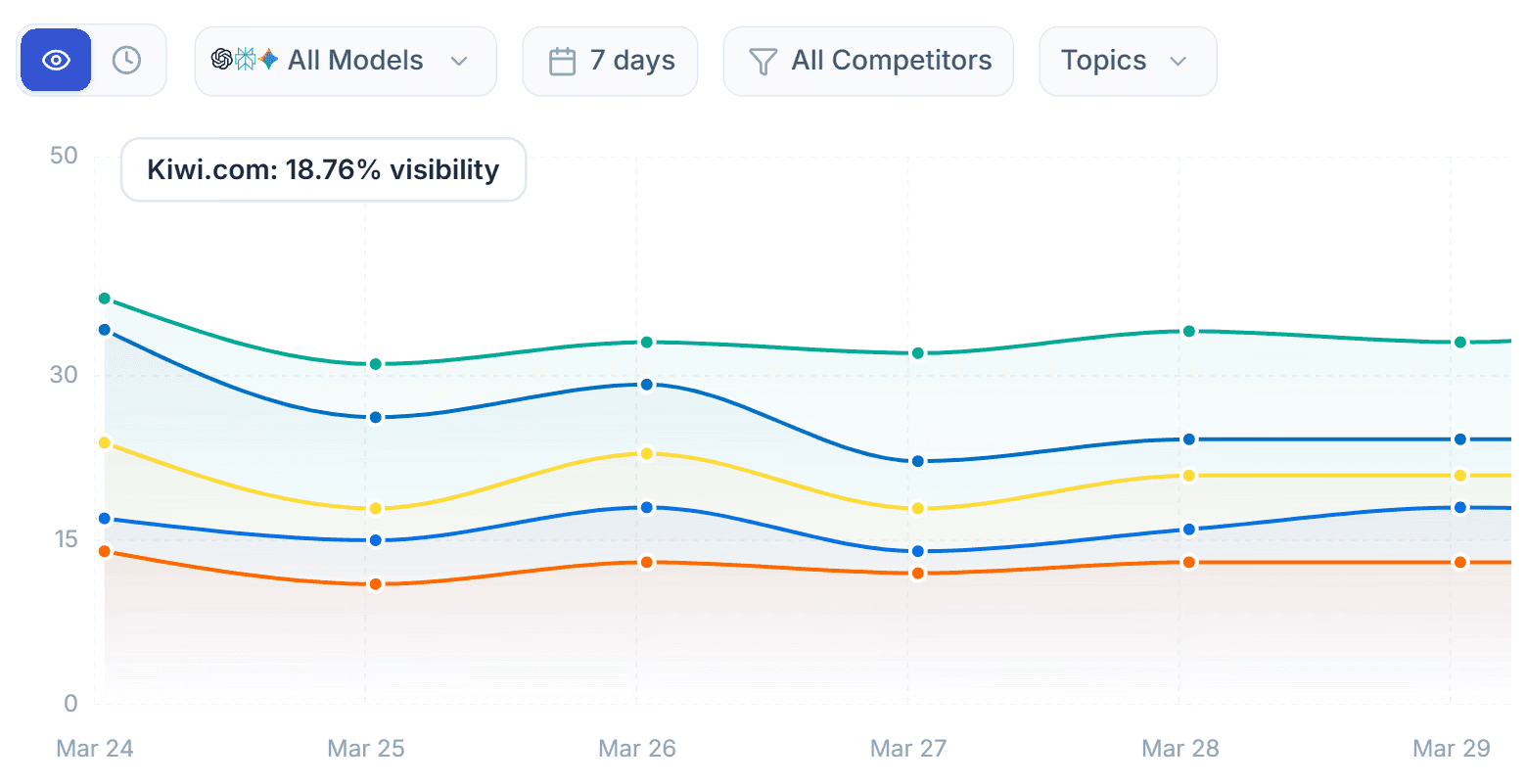
GEO is wider than SEO. AI recommends the brands that show up across the sources it reads, so your presence in forums, social platforms and recruitment blogs decides your odds. AIclicks measures the three metrics below so you know which to work on first.
AI Assistant
Who can fill warehouse shifts fast in my area?
Your Agency
Citation Rate
Shows how many AI answers about recruitment agencies name your brand, out of every 100. Models pull from the same trusted pages over and over, so citations compound: once you are in, staying in gets easier. Find the competitor pages AI cites most, then publish your own version of each.
Your Agency
82% positive
Competitor A
54% positive
Competitor B
38% positive
Brand Sentiment
Shows how AI describes you when your brand comes up: positive, neutral or negative. Tone is what separates being mentioned from being recommended, and models repeat whatever framing they find. Track the negative mentions back to the reviews and threads behind them, then publish content that answers those directly.
Others 52%
You 24%
— 24%
Your Agency
AI mention share of voice — recruitment category
Competitors
Not Cited
Share of Voice in AI
Shows how much of the recruitment conversation belongs to you rather than your competitors. This is the metric that matters most, the GEO version of a Google ranking. With only 1–5 brands named per answer, the market is winner-takes-more and every point is taken from someone.
The Dashboard Your Dedicated AI Search Team Works In
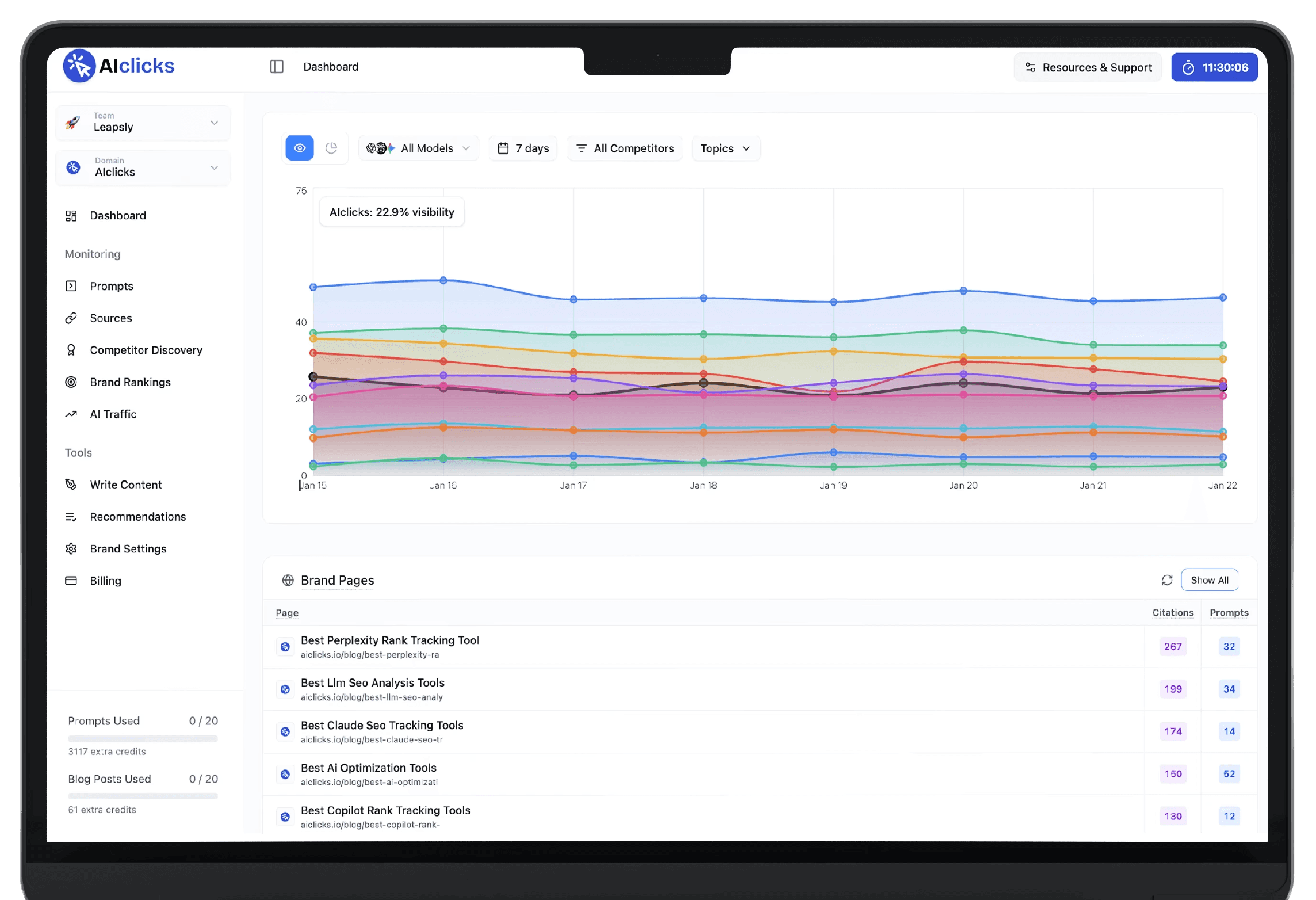
AIclicks gives you a live dashboard with daily ChatGPT mention rate, citation rate, sentiment, and share-of-voice across your tracked prompts, plus GA4 referral attribution for the traffic ChatGPT does send back.
Choose Your Plan
Flexible pricing that grows with your team. Upgrade or downgrade at any time.
Monthly
Yearly
-20%
Starter
Perfect for individuals & small teams
$49
/ month
Billed annually — you save $142
Choose 3 from:
Daily

" height="16px" id="fvSweaOBo" transform="translate(1 0)" width="14px"/></svg>)
" width="14px"><path d="M 13.864 5.629 L 13.3 5.629 L 13.3 5.6 L 7 5.6 L 7 8.4 L 10.956 8.4 C 10.379 10.03 8.828 11.2 7 11.2 C 4.681 11.2 2.8 9.319 2.8 7 C 2.8 4.681 4.681 2.8 7 2.8 C 8.071 2.8 9.045 3.204 9.786 3.864 L 11.766 1.884 C 10.516 0.719 8.844 0 7 0 C 3.134 0 0 3.134 0 7 C 0 10.866 3.134 14 7 14 C 10.866 14 14 10.866 14 7 C 14 6.531 13.952 6.073 13.864 5.629 Z" fill="rgb(255, 193, 7)" height="14px" id="H_YjfTNpn" width="14px"/><path d="M 0 3.742 L 2.3 5.429 C 2.922 3.888 4.429 2.8 6.193 2.8 C 7.264 2.8 8.238 3.204 8.979 3.864 L 10.959 1.884 C 9.709 0.719 8.037 0 6.193 0 C 3.504 0 1.172 1.518 0 3.742 Z" fill="rgb(255, 61, 0)" height="5.428500000000002px" id="PlkthQDhg" transform="translate(0.875 0)" width="10.959199999999996px"/><path d="M 6.232 5.581 C 8.04 5.581 9.683 4.889 10.925 3.764 L 8.758 1.931 C 8.032 2.483 7.144 2.782 6.232 2.781 C 4.411 2.781 2.865 1.62 2.283 0 L 0 1.759 C 1.159 4.026 3.511 5.581 6.232 5.581 Z" fill="rgb(76, 175, 80)" height="5.581099999999999px" id="WlnJ5gngE" transform="translate(0.7 8.4)" width="10.924899999999994px"/><path d="M 6.864 0.029 L 6.3 0.029 L 6.3 0 L 0 0 L 0 2.8 L 3.956 2.8 C 3.68 3.576 3.183 4.254 2.526 4.75 L 2.527 4.749 L 4.693 6.582 C 4.54 6.722 7 4.9 7 1.4 C 7 0.931 6.952 0.473 6.864 0.029 Z" fill="rgb(25, 118, 210)" height="6.589883930775992px" id="x_rSW275p" transform="translate(7 5.6)" width="7px"/></g></svg>)
" height="16px" id="hHS98fTxZ" width="16px"/></svg>)
 scale(1 1) translate(-1.861736945942159, -1.1170155383302638)" id="P20NzAvj0-699428820-radial-gradient" r="0.9935228066204626"><stop offset="0" stop-color="rgb(0, 174, 255)"/><stop offset="1" stop-color="rgb(7, 54, 196)"/></radialGradient><radialGradient cx="0.48250042504016705" cy="1.8366934653567062" gradient-transform="translate(0.48250042504016705, 1.8366934653567062) scale(1 1) translate(-0.48250042504016705, -1.8366934653567062)" id="UEWZqVjij-699428820-radial-gradient" r="0.9176890228114506"><stop offset="0" stop-color="rgb(255, 182, 87)"/><stop offset="1" stop-color="rgb(192, 43, 60)"/></radialGradient><linearGradient id="jyMN3TmKx-699428820-linear-gradient" x1="0.4594862532842614" x2="0.5405137467157386" y1="0" y2="1"><stop offset="0" stop-color="rgb(13, 145, 225)"/><stop offset="1" stop-color="rgb(255, 200, 0)"/></linearGradient><linearGradient id="xhMNwDFG0-699428820-linear-gradient" x1="0.4784828731548295" x2="0.5215171268451705" y1="5.551115123125783e-17" y2="1"><stop offset="0" stop-color="rgb(61, 203, 255)"/><stop offset="1" stop-color="rgba(5, 136, 247, 0)"/></linearGradient><radialGradient cx="1.4305090871482182" cy="0.34866158048251783" gradient-transform="translate(1.4305090871482182, 0.34866158048251783) scale(1 1) translate(-1.4305090871482182, -0.34866158048251783)" id="i79kAqaS4-699428820-radial-gradient" r="1.3362743412697924"><stop offset="0" stop-color="rgb(140, 72, 255)"/><stop offset="1" stop-color="rgb(255, 177, 82)"/></radialGradient><linearGradient id="mcxvno3tX-699428820-linear-gradient" x1="0.49844355920154226" x2="0.5015564407984577" y1="0" y2="1"><stop offset="0" stop-color="rgb(248, 173, 250)"/><stop offset="1" stop-color="rgba(168, 110, 221, 0)"/></linearGradient></defs><g d="M 11.605 1.219 C 11.397 0.499 10.739 0.002 9.989 0 L 9.498 0 C 8.682 0.002 7.985 0.588 7.842 1.391 L 7 6.016 L 7.209 5.296 C 7.416 4.574 8.075 4.076 8.825 4.074 L 11.681 4.074 L 12.879 4.545 L 14.033 4.074 L 13.697 4.074 C 12.947 4.072 12.289 3.575 12.081 2.855 Z M 4.413 13.387 C 4.618 14.111 5.278 14.611 6.031 14.613 L 7.075 14.613 C 7.988 14.613 8.735 13.88 8.758 12.96 L 8.871 8.5 L 8.633 9.319 C 8.426 10.039 7.768 10.537 7.018 10.539 L 4.138 10.539 L 3.111 9.977 L 2 10.539 L 2.331 10.539 C 3.084 10.542 3.743 11.042 3.949 11.766 L 4.413 13.387 Z M 9.999 0 L 4.167 0 C 2.501 0 1.501 2.221 0.834 4.441 C 0.045 7.073 -0.989 10.591 2.001 10.591 L 4.519 10.591 C 5.273 10.591 5.933 10.089 6.139 9.36 C 6.577 7.815 7.345 5.121 7.948 3.069 C 8.255 2.027 8.509 1.132 8.901 0.575 C 9.148 0.212 9.56 -0.004 9.999 0 M 9.999 0 L 4.167 0 C 2.501 0 1.501 2.221 0.834 4.441 C 0.045 7.073 -0.989 10.591 2.001 10.591 L 4.519 10.591 C 5.273 10.591 5.933 10.089 6.139 9.36 C 6.577 7.815 7.345 5.121 7.948 3.069 C 8.255 2.027 8.509 1.132 8.901 0.575 C 9.148 0.212 9.56 -0.004 9.999 0 M 6 14.593 L 11.833 14.593 C 13.499 14.593 14.499 12.372 15.166 10.151 C 15.955 7.519 16.989 4 13.999 4 L 11.48 4 C 10.725 4.002 10.063 4.505 9.86 5.232 C 9.266 7.332 8.663 9.429 8.051 11.523 C 7.745 12.566 7.49 13.461 7.098 14.019 C 6.851 14.382 6.439 14.597 6 14.593 M 6 14.593 L 11.833 14.593 C 13.499 14.593 14.499 12.372 15.166 10.151 C 15.955 7.519 16.989 4 13.999 4 L 11.48 4 C 10.725 4.002 10.063 4.505 9.86 5.232 C 9.266 7.332 8.663 9.429 8.051 11.523 C 7.745 12.566 7.49 13.461 7.098 14.019 C 6.851 14.382 6.439 14.597 6 14.593" fill="transparent" height="14.613333333333333px" id="QzkBy4Ibc" transform="translate(0 1)" width="16.00011071294081px"><path d="M 4.605 1.219 C 4.397 0.499 3.739 0.002 2.989 0 L 2.498 0 C 1.682 0.002 0.985 0.588 0.842 1.391 L 0 6.016 L 0.209 5.296 C 0.416 4.574 1.075 4.076 1.825 4.074 L 4.681 4.074 L 5.879 4.545 L 7.033 4.074 L 6.697 4.074 C 5.947 4.072 5.289 3.575 5.081 2.855 Z" fill="url(%23P20NzAvj0-699428820-radial-gradient)" height="6.016px" id="P20NzAvj0" transform="translate(7 0)" width="7.0333333333333385px"/><path d="M 2.413 4.887 C 2.618 5.611 3.278 6.111 4.031 6.113 L 5.075 6.113 C 5.988 6.113 6.735 5.38 6.758 4.46 L 6.871 0 L 6.633 0.819 C 6.426 1.539 5.768 2.037 5.018 2.039 L 2.138 2.039 L 1.111 1.477 L 0 2.039 L 0.331 2.039 C 1.084 2.042 1.743 2.542 1.949 3.266 L 2.413 4.887 Z" fill="url(%23UEWZqVjij-699428820-radial-gradient)" height="6.113333333333333px" id="UEWZqVjij" transform="translate(2 8.5)" width="6.871333333333332px"/><path d="M 9.999 0 L 4.167 0 C 2.501 0 1.501 2.221 0.834 4.441 C 0.045 7.073 -0.989 10.591 2.001 10.591 L 4.519 10.591 C 5.273 10.591 5.933 10.089 6.139 9.36 C 6.577 7.815 7.345 5.121 7.948 3.069 C 8.255 2.027 8.509 1.132 8.901 0.575 C 9.148 0.212 9.56 -0.004 9.999 0" fill="url(%23jyMN3TmKx-699428820-linear-gradient)" height="10.591388755215167px" id="jyMN3TmKx" width="9.999444046274142px"/><path d="M 9.999 0 L 4.167 0 C 2.501 0 1.501 2.221 0.834 4.441 C 0.045 7.073 -0.989 10.591 2.001 10.591 L 4.519 10.591 C 5.273 10.591 5.933 10.089 6.139 9.36 C 6.577 7.815 7.345 5.121 7.948 3.069 C 8.255 2.027 8.509 1.132 8.901 0.575 C 9.148 0.212 9.56 -0.004 9.999 0" fill="url(%23xhMNwDFG0-699428820-linear-gradient)" height="10.591388755215167px" id="xhMNwDFG0" width="9.999444046274142px"/><path d="M 0 10.593 L 5.833 10.593 C 7.499 10.593 8.499 8.372 9.166 6.151 C 9.955 3.519 10.989 0 7.999 0 L 5.48 0 C 4.725 0.002 4.063 0.505 3.86 1.232 C 3.266 3.332 2.663 5.429 2.051 7.523 C 1.745 8.566 1.49 9.461 1.098 10.019 C 0.851 10.382 0.439 10.597 0 10.593" fill="url(%23i79kAqaS4-699428820-radial-gradient)" height="10.593388755215164px" id="i79kAqaS4" transform="translate(6 4)" width="10.000110712940803px"/><path d="M 0 10.593 L 5.833 10.593 C 7.499 10.593 8.499 8.372 9.166 6.151 C 9.955 3.519 10.989 0 7.999 0 L 5.48 0 C 4.725 0.002 4.063 0.505 3.86 1.232 C 3.266 3.332 2.663 5.429 2.051 7.523 C 1.745 8.566 1.49 9.461 1.098 10.019 C 0.851 10.382 0.439 10.597 0 10.593" fill="url(%23mcxvno3tX-699428820-linear-gradient)" height="10.593388755215164px" id="mcxvno3tX" transform="translate(6 4)" width="10.000110712940803px"/></g></svg>)
" height="15.360666565427872px" id="HZPvvPBv7" transform="translate(0 0.5)" width="16px"/></svg>)
Tracked prompts
30
Websites you can add
3
LLMs you can track
3
Countries per project
1
LLM responses / mo
4,650
AI-optimized articles per month
10
Integrations
-
Support
Pro
For growing teams for more power
$140
/ month
Billed annually — you save $454
Choose 4 from:
Daily
Tracked prompts
150
Websites you can add
Unlimited
LLMs you can track
4
Countries per project
Unlimited
LLM responses / mo
18,600
AI-optimized articles per month
20
Integrations
Google Analytics
Support
BUSINESS
Best for medium-sized organizations
$357
/ month
Billed annually — you save $1198
Choose 6 from:
Daily
Tracked prompts
300
Websites you can add
Unlimited
LLMs you can track
6
Countries per project
Unlimited
LLM responses / mo
55,800
AI-optimized articles per month
30
Integrations
Google Analytics, API
Support
Dedicated account specialist
Become the #1 Answer in AI
Succeed in GEO yourself, or let us do all the work.
Do it yourself
Use AIclicks to see exactly where you appear across 10+ AI platforms, spot the gaps competitors are filling, and act on clear weekly recommendations.
From $59/month · Cancel anytime
Done for you
We Do All the Work for You
Our team manages your complete search presence: traditional SEO and GEO strategy, content, implementation, and reporting. You focus on hiring managers.
Custom pricing · Minimum 3-month engagement
The AI SEO agency trusted by 1,000+ brands worldwide
From solo founders to multi-client agencies, AIclicks runs the full AI SEO agency program for organizations of every shape and size that want to be cited across every AI surface.
4.9/5 stars on G2







FAQ
How long before SEO brings in briefs and candidates?
First ranking movement usually appears in 3 to 5 months, with real enquiry volume between 5 and 7 months. Full compounding takes 12 to 18 months, which is roughly how long a sector page needs to outrank the national brands sitting on it. Local map pack results come faster, often inside 3 months, because profile and review work compounds quickly. Vacancy pages rank fastest of all and expire fastest too.
Do we need to worry about ChatGPT as well as Google?
Both matter, and they reward different assets. Ahrefs analysed 863,000 keywords and found only 38% of pages cited in AI Overviews also ranked in the top 10, down from 76% a year earlier. Position on the results page no longer buys you a place in the answer. Recruitment is badly exposed here, because most agency content is vacancies that expire, and an assistant cannot cite a page that no longer exists. Durable, quotable, sector-specific pages are what get named.
Why is recruitment SEO not just standard local SEO?
You are optimising for 2 audiences with opposite intent on one domain. Employers search fee models, sectors and fill times; candidates search job titles, pay and locations. Generic local SEO assumes a single customer. On top of that, your main content type expires, so you need an expiry and redirect policy no plumber ever thinks about, plus JobPosting schema and a job board that Google can actually render.
What should a recruitment agency budget for SEO?
Retainers typically sit between $1,500 and $3,000 monthly for a one-branch agency, $3,000 to $8,000 to compete across several sectors or markets, and higher again for multi-branch networks. Compare it against what you already spend: sponsored Indeed slots, job board subscriptions and a LinkedIn Recruiter seat clearing $10,000 a year buy nothing you keep. Judge the retainer on cost per inbound job order, not on traffic.
Where does SEO sit next to our Indeed and LinkedIn spend?
They solve different problems. Sponsored job slots fill the requisition in front of you this week and stop the day you pause them. SEO builds the pages that bring you the next job order without a bid. Most agencies run both, using paid distribution for urgent or hard-to-fill roles and organic for sector, fee and salary queries. Let your Indeed conversion data set the content order, since roles that already convert deserve a page first.
Which pages should a small agency build first?
Fix the job board first, because it is probably invisible, then claim the Google Business Profile. After that, build one sector page for the discipline that pays you most, written for employers rather than candidates. Then your fee and process page, then a salary guide for that sector. Location pages after those. The blog is last. Most agencies open with a blog and a vacancy feed, then rank for neither.
How do we know the SEO work is actually working?
Count inbound job orders attributed to organic search, rather than rankings or sessions. Tag every enquiry form and call by landing page, and log the source in your ATS at the point the vacancy is created, because attribution dies the moment a consultant types it in manually. In Search Console, watch impressions on sector and fee terms rather than position, since impressions move first. Track applications per vacancy page separately from client enquiries.
Do we run this internally or bring in a specialist?
Split the work. Consultants should write the sector pages and salary guides, because only they know the pay rates and the real fill times, and nobody outside can fake that. Keep review requests and Google Business Profile posts in-house too. Outsource the technical layer: job board rendering, schema, filter noindexing and site speed. When you buy it in, insist on someone who has already untangled an ATS-hosted careers portal.
Further Reading
Go deeper on GEO, AI search, and visibility tracking.