SEO for Real Estate Agencies:
A buyer scrolls Zillow for weeks, then searches the neighborhood name, reads 3 agents’ pages, checks Google reviews and asks ChatGPT who knows that street best. Every one of those steps happens before anybody fills in your contact form.









Why Real Estate Agencies Need SEO
The National Association of Realtors found every buyer in 2024 used the internet to search, and 52% found the home they bought online. Visibility is the whole funnel.
Your best pages are individual listings, and they die the day the property closes. The IDX feed drops them, the URL 404s, and every ranking and link goes with it. Agents rebuild the same traffic each quarter instead of compounding it, and a lead that never lands leaves no trace.
Type real estate agents near me anywhere in the US and Zillow, Realtor.com, Redfin and Trulia fill the entire page before any local brokerage appears. They aggregate the same MLS feed that you do, at national scale, then sell your own market’s leads back to you as paid referrals.
Portal referral programs typically take 30% to 40% of the commission on a closed deal, and Premier Agent zip codes run four figures a month before a single showing. Add an SEO retainer of $1,500 to $5,000 and the spend still buys rented placement rather than a pipeline you own.
How SEO Works for Real Estate Agencies
Search Engine Optimization projects are long-term investments for agents, where each task supplements the others and creates compound results over time.
01
Keywords, page structure, and the signals Google reads directly
On-page work in real estate fails for a reason unique to the industry: the words on your listing pages are not yours. IDX feeds syndicate the same MLS remarks, the same photo set and the same field data to every brokerage site in the market, so 200 agents publish byte-identical property descriptions and Google picks the portal with the most authority. The pages that can actually rank are the ones the feed cannot supply: neighborhood pages, buyer and seller guides, agent bios, and the market report you write yourself each month. Those are the pages worth building on-page discipline around.
The durable asset in real estate is the neighborhood page, not the listing. A page covering a subdivision’s HOA rules, school boundary, typical lot size and 5-year price trend keeps pulling buyers long after every home on it has sold, because the questions repeat with each new wave of movers. Everything dated churns instead: the just listed post, the open house announcement, the monthly market snapshot with last quarter’s numbers still on it. Most brokerage sites carry hundreds of the second kind and 3 of the first. Reverse that ratio and the site stops resetting every year.
1
Replace the syndicated MLS description on every listing page with 150 original words about the street, commute and who the home suits.
2
Never 404 a closed listing. Keep the URL live as a sold record with the final price, or 301 it to the neighborhood page.
3
Mark listings with RealEstateListing and SingleFamilyResidence schema, agent pages with RealEstateAgent, then run every template through the Schema Markup Validator before launch.
4
Build one page per subdivision and school attendance zone, covering HOA dues, commute times and price history, updated annually rather than rebuilt.
02
Map Pack visibility, citations, and proximity signals
Nobody hires an agent 3 states away. Google knows it, so the map pack loads above Zillow and Realtor.com on agent near me searches and takes the calls before the portals get a look. Nowhere else can a 2-person team genuinely outrank a national marketplace, because the inputs here are distance, a finished profile and review volume rather than the domain authority you could never afford to buy.
Pick Real Estate Agent or Real Estate Agency as the primary category to match how people actually search, then add Property Management or Commercial Real Estate Agency only if you truly do that work. List service areas rather than a storefront address if you work from home, upload photos of sold homes and the team instead of stock interiors, and pre-answer commission, buyer representation agreements and which zip codes you cover in the Q&A.
Real estate carries a citation layer general local SEO guides skip. Your Zillow, Realtor.com, Redfin and Homes.com agent profiles, your brokerage’s national roster page, your state licensing lookup, your local association and MLS member directory, and Homelight or FastExpert if you accept referrals. Google cross-checks the name, suite and phone on all of them against your profile, so a brokerage rebrand that updates 6 listings and misses 30 quietly weakens every one.
1
Set Real Estate Agent as the primary category, define service areas by zip code rather than radius, and hide a home office address.
2
Give each brokerage office its own verified profile and landing page listing the agents who sit there; individual agents get separate practitioner listings.
3
Audit Zillow, Realtor.com, Homes.com and your association roster with Whitespark or BrightLocal, matching the licensed name on your state register exactly.
4
Publish a Google Business Profile post for every new listing, price change and closing, with the neighborhood name in the first line.
03
Topic authority, inbound links, and content that earns traffic
Buyers and sellers spend months researching before they will name an agent. They want to know what their home is worth, what the commission actually is now that buyer agreements are signed upfront, what a given school zone does to resale, and whether it is a buyer’s or seller’s market this quarter. Answer those plainly and you meet people 6 months before the portals’ lead forms do, when nobody is competing for their attention yet.
Someone who has decided to move is now choosing an agent, and what they want is proof rather than a headshot. Sold comparables with the list-to-sale ratio, days on market for your listings against the board average, video walkthroughs of homes you actually sold, and a straight explanation of what you charge and what the other side pays. Put that on the neighborhood page and the bio, not behind a form.
Real estate links come from the transaction chain and the community around it. Lenders, title companies, home inspectors, stagers and moving firms all publish preferred-partner pages and will trade a link for one back. Chambers of commerce, HOA and neighborhood association sites, school fundraisers and relocation guides for local employers link readily. Journalists covering the housing market need someone local to quote on inventory and mortgage rates, and a quarterly market report emailed to the business desk earns that call.
1
Publish a quarterly market report per neighborhood with median price, inventory and days on market pulled from your MLS, charted and dated.
2
Scale one template across every subdivision, condo building and school zone you sell in, each carrying its own photos, HOA fees and current inventory.
3
Group money questions into a single hub: commission after the NAR settlement, closing costs, down payment assistance, and what a seller nets at each price.
4
Build a page for each specialism you hold, such as luxury, relocation, 1031 exchange, VA loans or new construction, with closed deals as proof.
04
Site speed, crawlability, Core Web Vitals, and mobile health
The failure nearly every brokerage site shares is the IDX search itself. Vendors like IDX Broker and iHomefinder often serve results in an iframe or on their own subdomain, so every listing page you think you own is credited elsewhere. Where the feed does live on your domain, faceted filters spawn thousands of near-identical URLs by price, beds and pool, and Google spends the crawl budget there instead of on your neighborhood pages.
Property pages are among the heaviest on the consumer web: 40 high-resolution photos, a Matterport embed, a map, a mortgage calculator and a chat widget all loading at once. The buyer is on a phone, standing outside the house, deciding whether to text you. If the gallery takes 6 seconds and the call button hides under a lead-capture popup, they open Zillow instead, which loads in under 2 and never asks them to register.
1
Search site:yourdomain.com plus a listing address in Google. If the IDX pages are missing, your vendor is serving them from an iframe or subdomain.
2
Block faceted IDX filter parameters in robots.txt and canonicalise sort variants, then watch crawl stats in Search Console for the shift toward content pages.
3
Convert listing galleries to WebP sized for the viewport, lazy-load everything past the third image, and defer Matterport and video embeds until a click.
4
Generate a listing sitemap straight from the IDX feed so new properties submit within hours, and give neighborhood content its own sitemap file.
05
Star ratings, review volume, and response strategy that builds trust
A home sale is the largest transaction most people ever make, so the star rating carries more weight here than in any other local trade, and Zillow, Google and Realtor.com each keep a separate one. The difficulty is volume: a busy agent closes maybe 20 deals a year, so review counts build slowly while a portal profile aggregates an entire brokerage. And the review that matters most, from the seller whose house sat 90 days, is the one nobody asks for.
Ask at the closing table, while the keys are still on it and the relief is real. A week later the client is unpacking boxes and you have lost them. Wire the request into Follow Up Boss or kvCORE so it fires on status change to closed, sent from the agent rather than the brokerage, with 3 links in order: Google first, then Zillow, then your association profile. Ask every client, including the ones who bought a starter condo.
1
Fire the review request from Follow Up Boss or kvCORE the moment a deal flips to closed, signed by the agent who ran it.
2
Reply within 24 hours, never disclose price, terms or the address, and offer to continue offline, since fair housing rules limit what you can say.
3
Place reviews mentioning a specific subdivision or transaction type on that neighborhood page, rather than in one site-wide testimonial slider nobody reads.
4
Collect reviews from the lenders, inspectors and title officers you close with, since trade endorsements read as competence where client reviews read as warmth.
Google is No Longer the Only Place Your clients are Searching
Clients are using AI to find answers, and they trust what it tells them. Invest in GEO to get recommended in those answers.
1 Billion
Questions ChatGPT receives every single day
38%
Your #1 top ranking page on Google would be cited by AI
14%
of agents optimise for GEO. The rest are invisible in AI answers


You can rank #1 for “agent near me” and still not exist in ChatGPT’s answer. Run a free GEO audit to see where your brand actually stands.
GEO vs SEO: Same Goal, Different Methods
GEO is wider than SEO. AI recommends the brands that show up across the sources it reads, so your presence in forums, social platforms and real estate blogs decides your odds. AIclicks measures the three metrics below so you know which to work on first.
AI Assistant
Which agent should I list my house with?
Your Agency
Citation Rate
Shows how many AI answers about real estate agencies name your brand, out of every 100. Models pull from the same trusted pages over and over, so citations compound: once you are in, staying in gets easier. Find the competitor pages AI cites most, then publish your own version of each.
Your Agency
82% positive
Competitor A
54% positive
Competitor B
38% positive
Brand Sentiment
Shows how AI describes you when your brand comes up: positive, neutral or negative. Tone is what separates being mentioned from being recommended, and models repeat whatever framing they find. Track the negative mentions back to the reviews and threads behind them, then publish content that answers those directly.
Others 52%
You 24%
— 24%
Your Agency
AI mention share of voice — real estate category
Competitors
Not Cited
Share of Voice in AI
Shows how much of the real estate conversation belongs to you rather than your competitors. This is the metric that matters most, the GEO version of a Google ranking. With only 1–5 brands named per answer, the market is winner-takes-more and every point is taken from someone.
The Dashboard Your Dedicated AI Search Team Works In
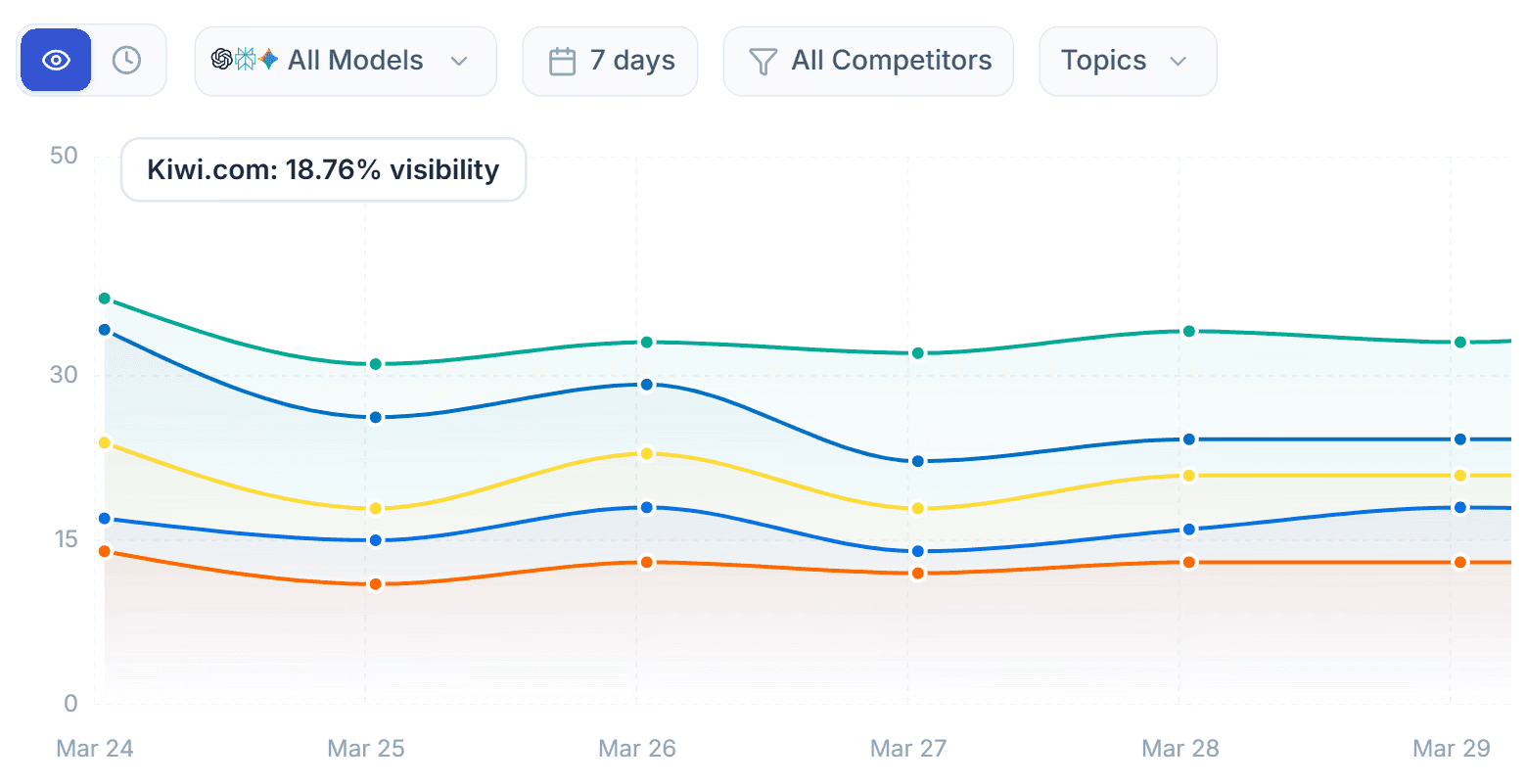
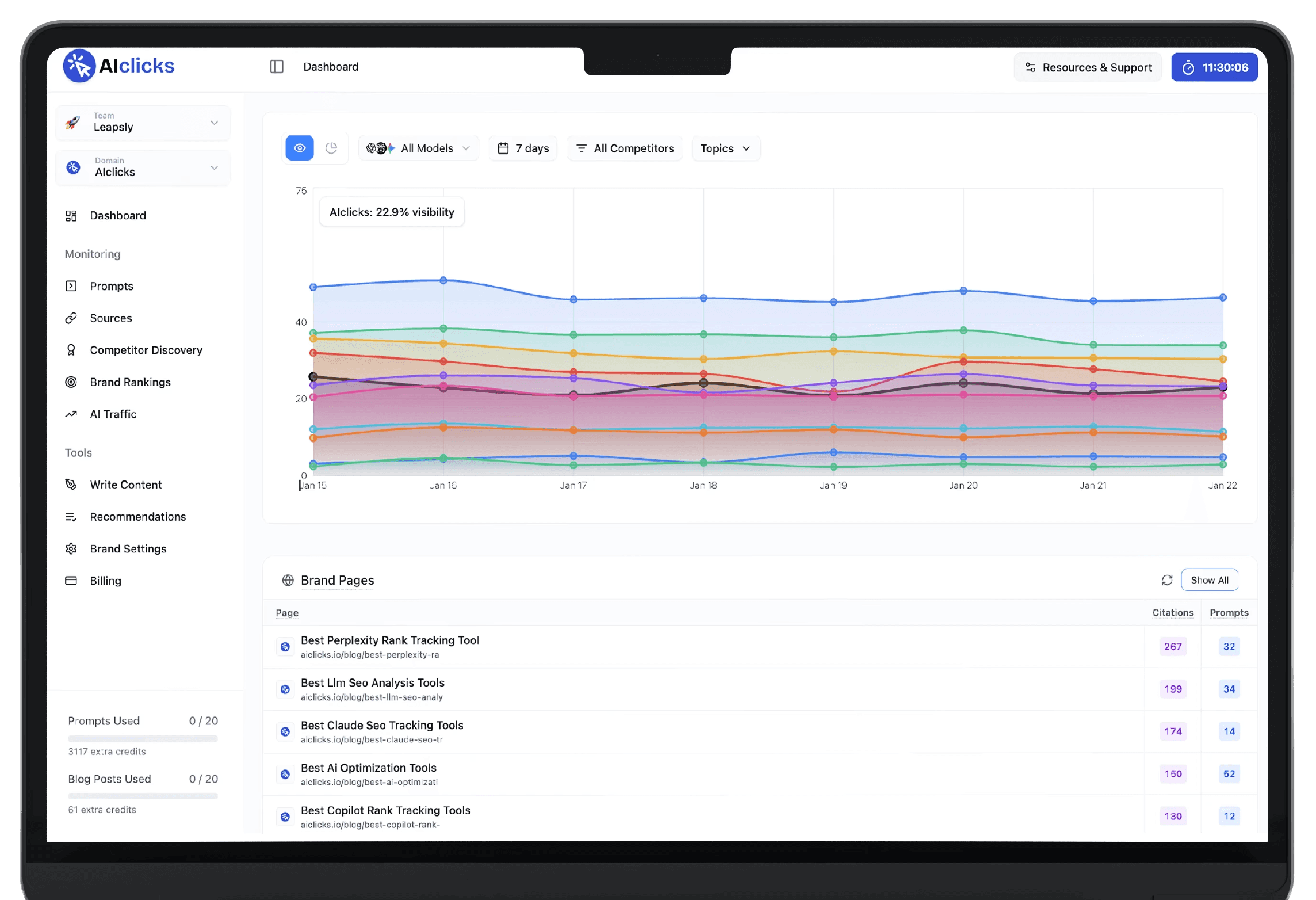
AIclicks gives you a live dashboard with daily ChatGPT mention rate, citation rate, sentiment, and share-of-voice across your tracked prompts, plus GA4 referral attribution for the traffic ChatGPT does send back.
Choose Your Plan
Flexible pricing that grows with your team. Upgrade or downgrade at any time.
Monthly
Yearly
-20%
Starter
Perfect for individuals & small teams
$49
/ month
Billed annually — you save $142
Choose 3 from:
Daily

" height="16px" id="fvSweaOBo" transform="translate(1 0)" width="14px"/></svg>)
" width="14px"><path d="M 13.864 5.629 L 13.3 5.629 L 13.3 5.6 L 7 5.6 L 7 8.4 L 10.956 8.4 C 10.379 10.03 8.828 11.2 7 11.2 C 4.681 11.2 2.8 9.319 2.8 7 C 2.8 4.681 4.681 2.8 7 2.8 C 8.071 2.8 9.045 3.204 9.786 3.864 L 11.766 1.884 C 10.516 0.719 8.844 0 7 0 C 3.134 0 0 3.134 0 7 C 0 10.866 3.134 14 7 14 C 10.866 14 14 10.866 14 7 C 14 6.531 13.952 6.073 13.864 5.629 Z" fill="rgb(255, 193, 7)" height="14px" id="H_YjfTNpn" width="14px"/><path d="M 0 3.742 L 2.3 5.429 C 2.922 3.888 4.429 2.8 6.193 2.8 C 7.264 2.8 8.238 3.204 8.979 3.864 L 10.959 1.884 C 9.709 0.719 8.037 0 6.193 0 C 3.504 0 1.172 1.518 0 3.742 Z" fill="rgb(255, 61, 0)" height="5.428500000000002px" id="PlkthQDhg" transform="translate(0.875 0)" width="10.959199999999996px"/><path d="M 6.232 5.581 C 8.04 5.581 9.683 4.889 10.925 3.764 L 8.758 1.931 C 8.032 2.483 7.144 2.782 6.232 2.781 C 4.411 2.781 2.865 1.62 2.283 0 L 0 1.759 C 1.159 4.026 3.511 5.581 6.232 5.581 Z" fill="rgb(76, 175, 80)" height="5.581099999999999px" id="WlnJ5gngE" transform="translate(0.7 8.4)" width="10.924899999999994px"/><path d="M 6.864 0.029 L 6.3 0.029 L 6.3 0 L 0 0 L 0 2.8 L 3.956 2.8 C 3.68 3.576 3.183 4.254 2.526 4.75 L 2.527 4.749 L 4.693 6.582 C 4.54 6.722 7 4.9 7 1.4 C 7 0.931 6.952 0.473 6.864 0.029 Z" fill="rgb(25, 118, 210)" height="6.589883930775992px" id="x_rSW275p" transform="translate(7 5.6)" width="7px"/></g></svg>)
" height="16px" id="hHS98fTxZ" width="16px"/></svg>)
 scale(1 1) translate(-1.861736945942159, -1.1170155383302638)" id="P20NzAvj0-699428820-radial-gradient" r="0.9935228066204626"><stop offset="0" stop-color="rgb(0, 174, 255)"/><stop offset="1" stop-color="rgb(7, 54, 196)"/></radialGradient><radialGradient cx="0.48250042504016705" cy="1.8366934653567062" gradient-transform="translate(0.48250042504016705, 1.8366934653567062) scale(1 1) translate(-0.48250042504016705, -1.8366934653567062)" id="UEWZqVjij-699428820-radial-gradient" r="0.9176890228114506"><stop offset="0" stop-color="rgb(255, 182, 87)"/><stop offset="1" stop-color="rgb(192, 43, 60)"/></radialGradient><linearGradient id="jyMN3TmKx-699428820-linear-gradient" x1="0.4594862532842614" x2="0.5405137467157386" y1="0" y2="1"><stop offset="0" stop-color="rgb(13, 145, 225)"/><stop offset="1" stop-color="rgb(255, 200, 0)"/></linearGradient><linearGradient id="xhMNwDFG0-699428820-linear-gradient" x1="0.4784828731548295" x2="0.5215171268451705" y1="5.551115123125783e-17" y2="1"><stop offset="0" stop-color="rgb(61, 203, 255)"/><stop offset="1" stop-color="rgba(5, 136, 247, 0)"/></linearGradient><radialGradient cx="1.4305090871482182" cy="0.34866158048251783" gradient-transform="translate(1.4305090871482182, 0.34866158048251783) scale(1 1) translate(-1.4305090871482182, -0.34866158048251783)" id="i79kAqaS4-699428820-radial-gradient" r="1.3362743412697924"><stop offset="0" stop-color="rgb(140, 72, 255)"/><stop offset="1" stop-color="rgb(255, 177, 82)"/></radialGradient><linearGradient id="mcxvno3tX-699428820-linear-gradient" x1="0.49844355920154226" x2="0.5015564407984577" y1="0" y2="1"><stop offset="0" stop-color="rgb(248, 173, 250)"/><stop offset="1" stop-color="rgba(168, 110, 221, 0)"/></linearGradient></defs><g d="M 11.605 1.219 C 11.397 0.499 10.739 0.002 9.989 0 L 9.498 0 C 8.682 0.002 7.985 0.588 7.842 1.391 L 7 6.016 L 7.209 5.296 C 7.416 4.574 8.075 4.076 8.825 4.074 L 11.681 4.074 L 12.879 4.545 L 14.033 4.074 L 13.697 4.074 C 12.947 4.072 12.289 3.575 12.081 2.855 Z M 4.413 13.387 C 4.618 14.111 5.278 14.611 6.031 14.613 L 7.075 14.613 C 7.988 14.613 8.735 13.88 8.758 12.96 L 8.871 8.5 L 8.633 9.319 C 8.426 10.039 7.768 10.537 7.018 10.539 L 4.138 10.539 L 3.111 9.977 L 2 10.539 L 2.331 10.539 C 3.084 10.542 3.743 11.042 3.949 11.766 L 4.413 13.387 Z M 9.999 0 L 4.167 0 C 2.501 0 1.501 2.221 0.834 4.441 C 0.045 7.073 -0.989 10.591 2.001 10.591 L 4.519 10.591 C 5.273 10.591 5.933 10.089 6.139 9.36 C 6.577 7.815 7.345 5.121 7.948 3.069 C 8.255 2.027 8.509 1.132 8.901 0.575 C 9.148 0.212 9.56 -0.004 9.999 0 M 9.999 0 L 4.167 0 C 2.501 0 1.501 2.221 0.834 4.441 C 0.045 7.073 -0.989 10.591 2.001 10.591 L 4.519 10.591 C 5.273 10.591 5.933 10.089 6.139 9.36 C 6.577 7.815 7.345 5.121 7.948 3.069 C 8.255 2.027 8.509 1.132 8.901 0.575 C 9.148 0.212 9.56 -0.004 9.999 0 M 6 14.593 L 11.833 14.593 C 13.499 14.593 14.499 12.372 15.166 10.151 C 15.955 7.519 16.989 4 13.999 4 L 11.48 4 C 10.725 4.002 10.063 4.505 9.86 5.232 C 9.266 7.332 8.663 9.429 8.051 11.523 C 7.745 12.566 7.49 13.461 7.098 14.019 C 6.851 14.382 6.439 14.597 6 14.593 M 6 14.593 L 11.833 14.593 C 13.499 14.593 14.499 12.372 15.166 10.151 C 15.955 7.519 16.989 4 13.999 4 L 11.48 4 C 10.725 4.002 10.063 4.505 9.86 5.232 C 9.266 7.332 8.663 9.429 8.051 11.523 C 7.745 12.566 7.49 13.461 7.098 14.019 C 6.851 14.382 6.439 14.597 6 14.593" fill="transparent" height="14.613333333333333px" id="QzkBy4Ibc" transform="translate(0 1)" width="16.00011071294081px"><path d="M 4.605 1.219 C 4.397 0.499 3.739 0.002 2.989 0 L 2.498 0 C 1.682 0.002 0.985 0.588 0.842 1.391 L 0 6.016 L 0.209 5.296 C 0.416 4.574 1.075 4.076 1.825 4.074 L 4.681 4.074 L 5.879 4.545 L 7.033 4.074 L 6.697 4.074 C 5.947 4.072 5.289 3.575 5.081 2.855 Z" fill="url(%23P20NzAvj0-699428820-radial-gradient)" height="6.016px" id="P20NzAvj0" transform="translate(7 0)" width="7.0333333333333385px"/><path d="M 2.413 4.887 C 2.618 5.611 3.278 6.111 4.031 6.113 L 5.075 6.113 C 5.988 6.113 6.735 5.38 6.758 4.46 L 6.871 0 L 6.633 0.819 C 6.426 1.539 5.768 2.037 5.018 2.039 L 2.138 2.039 L 1.111 1.477 L 0 2.039 L 0.331 2.039 C 1.084 2.042 1.743 2.542 1.949 3.266 L 2.413 4.887 Z" fill="url(%23UEWZqVjij-699428820-radial-gradient)" height="6.113333333333333px" id="UEWZqVjij" transform="translate(2 8.5)" width="6.871333333333332px"/><path d="M 9.999 0 L 4.167 0 C 2.501 0 1.501 2.221 0.834 4.441 C 0.045 7.073 -0.989 10.591 2.001 10.591 L 4.519 10.591 C 5.273 10.591 5.933 10.089 6.139 9.36 C 6.577 7.815 7.345 5.121 7.948 3.069 C 8.255 2.027 8.509 1.132 8.901 0.575 C 9.148 0.212 9.56 -0.004 9.999 0" fill="url(%23jyMN3TmKx-699428820-linear-gradient)" height="10.591388755215167px" id="jyMN3TmKx" width="9.999444046274142px"/><path d="M 9.999 0 L 4.167 0 C 2.501 0 1.501 2.221 0.834 4.441 C 0.045 7.073 -0.989 10.591 2.001 10.591 L 4.519 10.591 C 5.273 10.591 5.933 10.089 6.139 9.36 C 6.577 7.815 7.345 5.121 7.948 3.069 C 8.255 2.027 8.509 1.132 8.901 0.575 C 9.148 0.212 9.56 -0.004 9.999 0" fill="url(%23xhMNwDFG0-699428820-linear-gradient)" height="10.591388755215167px" id="xhMNwDFG0" width="9.999444046274142px"/><path d="M 0 10.593 L 5.833 10.593 C 7.499 10.593 8.499 8.372 9.166 6.151 C 9.955 3.519 10.989 0 7.999 0 L 5.48 0 C 4.725 0.002 4.063 0.505 3.86 1.232 C 3.266 3.332 2.663 5.429 2.051 7.523 C 1.745 8.566 1.49 9.461 1.098 10.019 C 0.851 10.382 0.439 10.597 0 10.593" fill="url(%23i79kAqaS4-699428820-radial-gradient)" height="10.593388755215164px" id="i79kAqaS4" transform="translate(6 4)" width="10.000110712940803px"/><path d="M 0 10.593 L 5.833 10.593 C 7.499 10.593 8.499 8.372 9.166 6.151 C 9.955 3.519 10.989 0 7.999 0 L 5.48 0 C 4.725 0.002 4.063 0.505 3.86 1.232 C 3.266 3.332 2.663 5.429 2.051 7.523 C 1.745 8.566 1.49 9.461 1.098 10.019 C 0.851 10.382 0.439 10.597 0 10.593" fill="url(%23mcxvno3tX-699428820-linear-gradient)" height="10.593388755215164px" id="mcxvno3tX" transform="translate(6 4)" width="10.000110712940803px"/></g></svg>)
" height="15.360666565427872px" id="HZPvvPBv7" transform="translate(0 0.5)" width="16px"/></svg>)
Tracked prompts
30
Websites you can add
3
LLMs you can track
3
Countries per project
1
LLM responses / mo
4,650
AI-optimized articles per month
10
Integrations
-
Support
Pro
For growing teams for more power
$140
/ month
Billed annually — you save $454
Choose 4 from:
Daily
Tracked prompts
150
Websites you can add
Unlimited
LLMs you can track
4
Countries per project
Unlimited
LLM responses / mo
18,600
AI-optimized articles per month
20
Integrations
Google Analytics
Support
BUSINESS
Best for medium-sized organizations
$357
/ month
Billed annually — you save $1198
Choose 6 from:
Daily
Tracked prompts
300
Websites you can add
Unlimited
LLMs you can track
6
Countries per project
Unlimited
LLM responses / mo
55,800
AI-optimized articles per month
30
Integrations
Google Analytics, API
Support
Dedicated account specialist
Become the #1 Answer in AI
Succeed in GEO yourself, or let us do all the work.
Do it yourself
Use AIclicks to see exactly where you appear across 10+ AI platforms, spot the gaps competitors are filling, and act on clear weekly recommendations.
From $59/month · Cancel anytime
Done for you
We Do All the Work for You
Our team manages your complete search presence: traditional SEO and GEO strategy, content, implementation, and reporting. You focus on clients.
Custom pricing · Minimum 3-month engagement
The AI SEO agency trusted by 1,000+ brands worldwide
From solo founders to multi-client agencies, AIclicks runs the full AI SEO agency program for organizations of every shape and size that want to be cited across every AI surface.
4.9/5 stars on G2







FAQ
How long does real estate SEO take to work?
Expect technical and on-page fixes to show in 1 to 3 months, ranking movement by 3 to 6, and meaningful lead volume between 6 and 12. Neighborhood pages in a smaller market can move faster; competing for a metro’s head terms against Zillow takes longer than that and may never be the right target. Map pack impressions rise first, so watch those before you judge anything.
Do buyers actually use ChatGPT to find agents?
Increasingly, and the answer they get is assembled from sources you do not control. Ahrefs analysed 863,000 keywords and found only 38% of pages cited in AI Overviews also ranked in the top 10, down from 76% a year earlier. A top-10 position is no longer a ticket into the answer. Assistants pull from review text, neighborhood content and third-party profiles, so an agent with no independent pages simply is not in the set.
What makes real estate SEO harder than regular local SEO?
Three things. Most of your content arrives from an MLS feed and is identical to every rival site in the market, so originality has to be added deliberately. Your inventory expires, which means URL lifecycle management is a permanent job rather than a cleanup. And you are not really competing with other brokerages: Zillow, Redfin and Realtor.com hold the broad terms permanently and resell your own market back to you.
What should a brokerage budget for SEO?
Retainers typically run $1,500 to $3,000 monthly for a solo agent or small team, $3,000 to $8,000 for a brokerage competing across a whole metro, and more where custom IDX development is involved. Judge it against what you already pay for leads: portal referral programs commonly take 30% to 40% of the commission on a closed deal, so a retainer that produces even 4 direct transactions a year usually clears.
Is SEO worth it if we already pay for Zillow leads?
Yes, but they solve different timeframes. Portal placement and paid search buy transactions this quarter and stop the day you cancel; organic builds pages that keep producing without a per-lead fee. Most brokerages run both, using ad data to decide which neighborhoods deserve a page and which price bands actually convert. The discipline is measuring everything on cost per closed transaction, not cost per lead, because portal leads convert at a fraction of organic ones.
Which pages should a real estate site build first?
Google Business Profile first, because it sits above the portals and costs nothing. Then a home valuation page, the single highest-intent seller search in the industry. Then one page for each of your 3 strongest neighborhoods, written from actual knowledge rather than census data. Then agent bios with closed sales attached. Listings come last, since they expire; treat them as inventory, not as your ranking strategy.
Does real estate SEO actually bring quality leads?
It does, but only if you measure transactions rather than traffic. Add call tracking to every page, tag each form by its landing page, and push the source into Follow Up Boss so a closing traces back to the page that started it. Watch Search Console impressions on neighborhood terms, which move months before positions do. Organic leads take longer to convert than portal leads and close at a much higher rate.
Should we hire an SEO agency or do it ourselves?
Split it by what only you know. Neighborhood pages, market commentary, listing descriptions and review requests should stay in-house, because no agency can describe a street they have never driven. Hand out the technical layer: IDX indexation, crawl budget, structured data, Core Web Vitals and directory cleanup. If you outsource content too, insist on a writer who reads the MLS data, or you will publish the same generic guide as every rival.
Further Reading
Go deeper on GEO, AI search, and visibility tracking.