SEO for Plumbing Companies:
A homeowner standing in water does not browse. They search once, tap the first number that looks open and reviewed, and stop. That decision happens on a phone in under a minute, mostly inside Google Maps and increasingly inside an AI answer.









Why Plumbing Companies Need SEO
BrightLocal found 98% of consumers used the internet to find a local business last year. Increasingly that means an AI answer, not a list of links, and 3 problems decide whether you appear.
Water heater replacement, sewer line repair, slab leak detection and drain cleaning are 4 searches with 4 price points. Most plumbing sites list them as bullets under Services and rank for none of them. The homeowner who typed sewer line repair cost never reaches you, and you never learn it existed.
Type emergency plumber near me anywhere in the US and Angi, Thumbtack and Yelp sit above almost every plumbing company on the page. They rank on aggregate authority, then sell the resulting enquiry to you and 4 competitors at once. You are paying for a lead generated by a listing that outranked you.
One owner posted a $3,500 a month local SEO quote and got 280 replies arguing about it, mostly because nobody could say what it bought. Local Services Ads and shared-lead platforms take another slice per booked job. Stop paying either and the phone goes quiet the same week, because nothing was owned.
How SEO Works for Plumbing Companies
Search Engine Optimization projects are long-term investments for plumbers, where each task supplements the others and creates compound results over time.
01
Keywords, page structure, and the signals Google reads directly
Plumbing on-page work fails on vocabulary. The trade names a job by the fix, hydro jetting, backflow testing, PEX repipe. The homeowner names it by the symptom: sewage smell in the bathroom, no hot water, water bubbling up through the floor drain. Pages titled after the fix rank for nothing a panicking homeowner types. The pages that earn calls are one per service written in symptom language, plus an emergency page and a pricing page. Compounding it, one site has to serve someone standing in water and someone quietly pricing a repipe for next spring.
Pages built around a failure mode outlast pages built around a month. What a water heater replacement actually costs, how to tell a slab leak from a running toilet, what a sewer camera inspection shows: those keep pulling calls for years, because copper still fails and water heaters still die at 12 years. What churns is the seasonal post. Winter pipe-freeze warnings, spring flood-season checklists and the annual drain-cleaning coupon burn out inside a month and end up being most of the blog. Audit the blog once a year, delete what nobody searched for, and put that hour into the water heater cost page instead.
1
Split the services list into one page per job, titled how homeowners search: water heater replacement cost, sewer line repair, slab leak detection.
2
Unpublish expired seasonal coupons and discontinued brand pages, redirecting each to the live service page; catch them quarterly in Search Console’s page indexing report.
3
Use schema.org Plumber rather than generic LocalBusiness, add areaServed and OpeningHoursSpecification, then confirm each service page passes Google’s Rich Results Test.
4
Publish a cost page per major job and a permit-and-code explainer for your state, both searched year-round regardless of weather.
02
Map Pack visibility, citations, and proximity signals
Almost nothing about plumbing travels. A homeowner picks whoever is close, open and reviewed, which makes the 3-result map pack the most valuable real estate in the trade. It sits above Angi and Yelp, and a 2-van outfit can outrank a national franchise there on review strength alone. Google weighs proximity, relevance and prominence; proximity you cannot move, but the other 2 are entirely yours to build.
Make Plumber the primary category, then add the secondaries Google actually offers: Drainage Service, Water Heater Repair Service, Septic System Service. Add every job you quote as an individual service, giving each a description and a starting price. Set a real service area by town rather than a 50-mile circle, hide the address if you work from a yard, and state after-hours cover in the hours, not just the description.
The citation list that matters to plumbers is not the one generic local SEO hands you. Bing Places, Apple Business Connect, Facebook and the Better Business Bureau are table stakes. The list that moves rankings is the trade one: Angi, HomeAdvisor, Thumbtack, Yelp, Nextdoor, Porch, Houzz, your state contractor licence lookup and your PHCC chapter listing. Licence registers count twice, because homeowners verify them. A phone number that differs by one digit on 3 of 60 listings is enough to stall the whole set.
1
Pick Plumber as your primary category, add Drainage Service and Water Heater Repair Service, and give each job a starting price.
2
Give each branch a separate profile, a separate phone number and a page naming the technicians dispatched from it, never one shared contact page.
3
Run BrightLocal or Whitespark across Angi, HomeAdvisor, Thumbtack, Nextdoor and your state licence register, then fix every abbreviation and phone variant it flags.
4
Upload 3 photos from a finished job each week, plus a profile update answering a question homeowners actually ask on the phone.
03
Topic authority, inbound links, and content that earns traffic
Before a homeowner calls, they are working out how bad it is, whether it can wait until morning, and roughly what it will cost. Answer those honestly and you beat every page optimised to rank. A guide to shutting off the main before the plumber arrives, or to why a water heater at 12 years is worth replacing rather than repairing, lands exactly when someone is choosing a number.
Someone who already knows they need a repipe is comparing companies, and they want evidence. Licence and bond numbers on the page, the warranty in writing, a flat-rate or hourly answer rather than call for pricing, and photos of finished work in homes like theirs. Add response time honestly: 90 minutes is a selling point, 2 days is not. Companies lose these jobs at the moment a visitor cannot find a number.
Plumbing links come from the supply chain and the street. Wholesalers and manufacturers publish installer locators, and Rheem, Navien, Moen and Pfister all run find-a-pro pages you can qualify for. Home warranty networks, restoration firms and insurance adjusters list preferred contractors. Builders and realtors publish trade lists. Sponsor the youth team, join the chamber, and get on the city’s list of licensed contractors. None of it costs a link fee.
1
Publish a repair-versus-replace guide for each major system, water heaters, sewer lines, whole-house repipes, with real price bands updated annually.
2
Build service-plus-town pages only where you dispatch, each naming local pipe age, water hardness and permit office, never one template with a swapped name.
3
Build one pricing hub answering what a plumber costs: call-out fees, hourly versus flat rate, emergency surcharges, financing and home warranty cover.
4
Write a page per brand you install and certify on, such as Rinnai tankless, Bradford White or Kohler, since homeowners search the brand first.
04
Site speed, crawlability, Core Web Vitals, and mobile health
The failure nobody notices is the phone number. Most plumbing sites run call tracking, so CallRail or a similar script swaps the number in the DOM after the page loads. The crawler and the AI scraper often read the swapped number, the footer carries the old one, and the LocalBusiness schema hardcodes a third. Google now sees 3 numbers for one business and quietly trusts the listing less. The owner sees a working phone and assumes the site is fine.
The highest-intent plumbing search happens at midnight, on cellular, by someone kneeling next to a shut-off valve with wet hands. They want a number and a sentence confirming you answer now. A hero video of the van, a booking wizard that loads before the header, and a chat bubble that opens by itself all cost you that call. Reddit’s plumbing threads keep landing on the same test: 75 to 80 on mobile PageSpeed, minimum.
1
Fetch your homepage in Search Console URL Inspection, compare the rendered phone number against Google Business Profile and your LocalBusiness schema, and reconcile all 3.
2
Test your emergency page in PageSpeed Insights, usually the heaviest with its map embed and review widget, and lazy-load both behind a static facade.
3
Convert technician job photos to WebP at display size before upload; a phone camera ships 4 megabyte images your gallery loads all at once.
4
Keep service and town pages in a sitemap separate from the blog, and ping Bing IndexNow whenever hours, pricing or emergency cover change.
05
Star ratings, review volume, and response strategy that builds trust
Nothing decides a plumbing search faster than the review count, because someone is about to be let into a house at night and billed before anyone can see the work. The difficulty is velocity. Google weights the last 90 days heavily, and a plumbing company doing 200 jobs a month gets maybe 4 reviews unless someone asks every time. The customers who write unprompted are the ones disputing an invoice.
Ask in the driveway, while the technician is packing up and the water is running again. That is the only moment relief is at its peak. Hand over a phone with the review page already open, or fire the text from Housecall Pro or Jobber the instant the invoice is marked paid. Make it the technician’s job, not the office’s, and track requests per technician, because the gap between the ones who ask and the ones who forget is the whole review profile.
1
Wire Housecall Pro, Jobber or ServiceTitan to text the review link when the job is marked complete, signed by the technician’s first name.
2
Reply within 24 hours naming the invoice date and the fix you offered; price disputes dominate plumbing reviews, and specifics read better than apologies.
3
Pull reviews that mention water heaters onto the water heater page and repipe reviews onto the repipe page, next to the price.
4
Ask property managers, restaurant owners and landlords on your commercial maintenance contracts too, since business reviews mention response time, the thing residential searchers screen for.
Google is No Longer the Only Place Your homeowners are Searching
Homeowners are using AI to find answers, and they trust what it tells them. Invest in GEO to get recommended in those answers.
1 Billion
Questions ChatGPT receives every single day
38%
Your #1 top ranking page on Google would be cited by AI
14%
of plumbers optimise for GEO. The rest are invisible in AI answers


You can rank #1 for “plumber near me” and still not exist in ChatGPT’s answer. Run a free GEO audit to see where your brand actually stands.
GEO vs SEO: Same Goal, Different Methods
GEO is wider than SEO. AI recommends the brands that show up across the sources it reads, so your presence in forums, social platforms and plumbing blogs decides your odds. AIclicks measures the three metrics below so you know which to work on first.
AI Assistant
Which plumber near me handles sewer backups at night?
Your Company
Citation Rate
Shows how many AI answers about plumbing companies name your brand, out of every 100. Models pull from the same trusted pages over and over, so citations compound: once you are in, staying in gets easier. Find the competitor pages AI cites most, then publish your own version of each.
Your Company
82% positive
Competitor A
54% positive
Competitor B
38% positive
Brand Sentiment
Shows how AI describes you when your brand comes up: positive, neutral or negative. Tone is what separates being mentioned from being recommended, and models repeat whatever framing they find. Track the negative mentions back to the reviews and threads behind them, then publish content that answers those directly.
Others 52%
You 24%
— 24%
Your Company
AI mention share of voice — plumbing category
Competitors
Not Cited
Share of Voice in AI
Shows how much of the plumbing conversation belongs to you rather than your competitors. This is the metric that matters most, the GEO version of a Google ranking. With only 1–5 brands named per answer, the market is winner-takes-more and every point is taken from someone.
The Dashboard Your Dedicated AI Search Team Works In
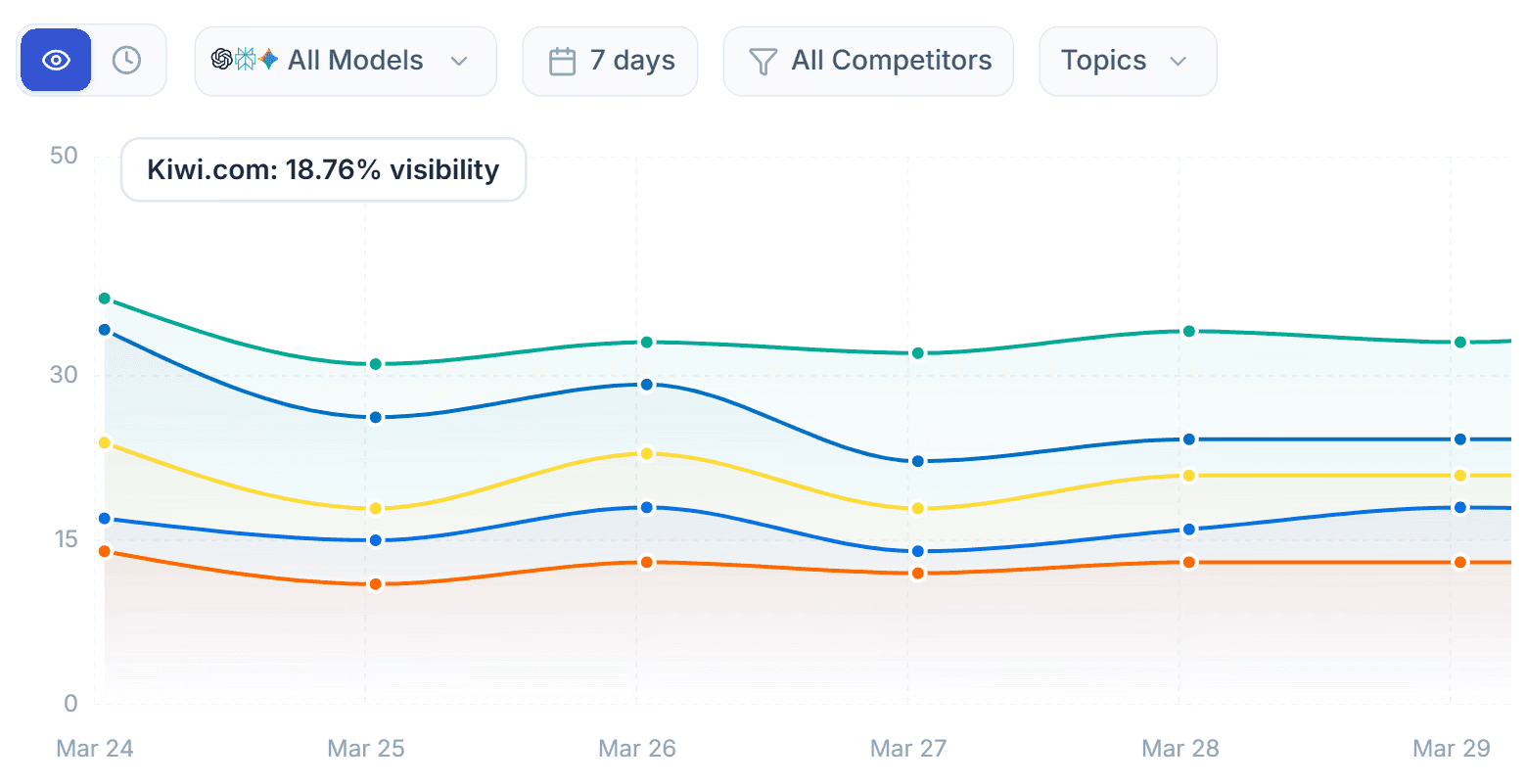
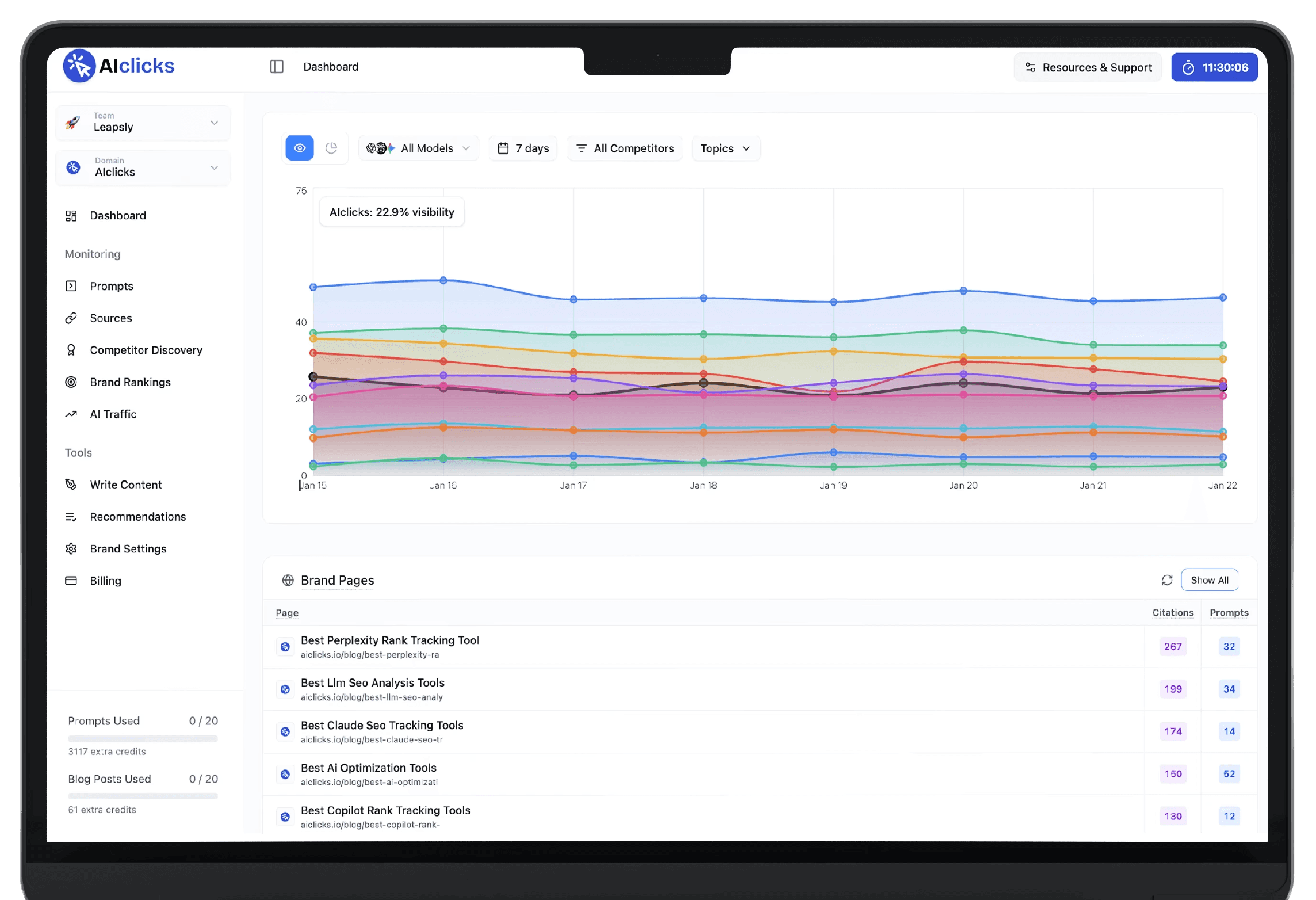
AIclicks gives you a live dashboard with daily ChatGPT mention rate, citation rate, sentiment, and share-of-voice across your tracked prompts, plus GA4 referral attribution for the traffic ChatGPT does send back.
Choose Your Plan
Flexible pricing that grows with your team. Upgrade or downgrade at any time.
Monthly
Yearly
-20%
Starter
Perfect for individuals & small teams
$49
/ month
Billed annually — you save $142
Choose 3 from:
Daily

" height="16px" id="fvSweaOBo" transform="translate(1 0)" width="14px"/></svg>)
" width="14px"><path d="M 13.864 5.629 L 13.3 5.629 L 13.3 5.6 L 7 5.6 L 7 8.4 L 10.956 8.4 C 10.379 10.03 8.828 11.2 7 11.2 C 4.681 11.2 2.8 9.319 2.8 7 C 2.8 4.681 4.681 2.8 7 2.8 C 8.071 2.8 9.045 3.204 9.786 3.864 L 11.766 1.884 C 10.516 0.719 8.844 0 7 0 C 3.134 0 0 3.134 0 7 C 0 10.866 3.134 14 7 14 C 10.866 14 14 10.866 14 7 C 14 6.531 13.952 6.073 13.864 5.629 Z" fill="rgb(255, 193, 7)" height="14px" id="H_YjfTNpn" width="14px"/><path d="M 0 3.742 L 2.3 5.429 C 2.922 3.888 4.429 2.8 6.193 2.8 C 7.264 2.8 8.238 3.204 8.979 3.864 L 10.959 1.884 C 9.709 0.719 8.037 0 6.193 0 C 3.504 0 1.172 1.518 0 3.742 Z" fill="rgb(255, 61, 0)" height="5.428500000000002px" id="PlkthQDhg" transform="translate(0.875 0)" width="10.959199999999996px"/><path d="M 6.232 5.581 C 8.04 5.581 9.683 4.889 10.925 3.764 L 8.758 1.931 C 8.032 2.483 7.144 2.782 6.232 2.781 C 4.411 2.781 2.865 1.62 2.283 0 L 0 1.759 C 1.159 4.026 3.511 5.581 6.232 5.581 Z" fill="rgb(76, 175, 80)" height="5.581099999999999px" id="WlnJ5gngE" transform="translate(0.7 8.4)" width="10.924899999999994px"/><path d="M 6.864 0.029 L 6.3 0.029 L 6.3 0 L 0 0 L 0 2.8 L 3.956 2.8 C 3.68 3.576 3.183 4.254 2.526 4.75 L 2.527 4.749 L 4.693 6.582 C 4.54 6.722 7 4.9 7 1.4 C 7 0.931 6.952 0.473 6.864 0.029 Z" fill="rgb(25, 118, 210)" height="6.589883930775992px" id="x_rSW275p" transform="translate(7 5.6)" width="7px"/></g></svg>)
" height="16px" id="hHS98fTxZ" width="16px"/></svg>)
 scale(1 1) translate(-1.861736945942159, -1.1170155383302638)" id="P20NzAvj0-699428820-radial-gradient" r="0.9935228066204626"><stop offset="0" stop-color="rgb(0, 174, 255)"/><stop offset="1" stop-color="rgb(7, 54, 196)"/></radialGradient><radialGradient cx="0.48250042504016705" cy="1.8366934653567062" gradient-transform="translate(0.48250042504016705, 1.8366934653567062) scale(1 1) translate(-0.48250042504016705, -1.8366934653567062)" id="UEWZqVjij-699428820-radial-gradient" r="0.9176890228114506"><stop offset="0" stop-color="rgb(255, 182, 87)"/><stop offset="1" stop-color="rgb(192, 43, 60)"/></radialGradient><linearGradient id="jyMN3TmKx-699428820-linear-gradient" x1="0.4594862532842614" x2="0.5405137467157386" y1="0" y2="1"><stop offset="0" stop-color="rgb(13, 145, 225)"/><stop offset="1" stop-color="rgb(255, 200, 0)"/></linearGradient><linearGradient id="xhMNwDFG0-699428820-linear-gradient" x1="0.4784828731548295" x2="0.5215171268451705" y1="5.551115123125783e-17" y2="1"><stop offset="0" stop-color="rgb(61, 203, 255)"/><stop offset="1" stop-color="rgba(5, 136, 247, 0)"/></linearGradient><radialGradient cx="1.4305090871482182" cy="0.34866158048251783" gradient-transform="translate(1.4305090871482182, 0.34866158048251783) scale(1 1) translate(-1.4305090871482182, -0.34866158048251783)" id="i79kAqaS4-699428820-radial-gradient" r="1.3362743412697924"><stop offset="0" stop-color="rgb(140, 72, 255)"/><stop offset="1" stop-color="rgb(255, 177, 82)"/></radialGradient><linearGradient id="mcxvno3tX-699428820-linear-gradient" x1="0.49844355920154226" x2="0.5015564407984577" y1="0" y2="1"><stop offset="0" stop-color="rgb(248, 173, 250)"/><stop offset="1" stop-color="rgba(168, 110, 221, 0)"/></linearGradient></defs><g d="M 11.605 1.219 C 11.397 0.499 10.739 0.002 9.989 0 L 9.498 0 C 8.682 0.002 7.985 0.588 7.842 1.391 L 7 6.016 L 7.209 5.296 C 7.416 4.574 8.075 4.076 8.825 4.074 L 11.681 4.074 L 12.879 4.545 L 14.033 4.074 L 13.697 4.074 C 12.947 4.072 12.289 3.575 12.081 2.855 Z M 4.413 13.387 C 4.618 14.111 5.278 14.611 6.031 14.613 L 7.075 14.613 C 7.988 14.613 8.735 13.88 8.758 12.96 L 8.871 8.5 L 8.633 9.319 C 8.426 10.039 7.768 10.537 7.018 10.539 L 4.138 10.539 L 3.111 9.977 L 2 10.539 L 2.331 10.539 C 3.084 10.542 3.743 11.042 3.949 11.766 L 4.413 13.387 Z M 9.999 0 L 4.167 0 C 2.501 0 1.501 2.221 0.834 4.441 C 0.045 7.073 -0.989 10.591 2.001 10.591 L 4.519 10.591 C 5.273 10.591 5.933 10.089 6.139 9.36 C 6.577 7.815 7.345 5.121 7.948 3.069 C 8.255 2.027 8.509 1.132 8.901 0.575 C 9.148 0.212 9.56 -0.004 9.999 0 M 9.999 0 L 4.167 0 C 2.501 0 1.501 2.221 0.834 4.441 C 0.045 7.073 -0.989 10.591 2.001 10.591 L 4.519 10.591 C 5.273 10.591 5.933 10.089 6.139 9.36 C 6.577 7.815 7.345 5.121 7.948 3.069 C 8.255 2.027 8.509 1.132 8.901 0.575 C 9.148 0.212 9.56 -0.004 9.999 0 M 6 14.593 L 11.833 14.593 C 13.499 14.593 14.499 12.372 15.166 10.151 C 15.955 7.519 16.989 4 13.999 4 L 11.48 4 C 10.725 4.002 10.063 4.505 9.86 5.232 C 9.266 7.332 8.663 9.429 8.051 11.523 C 7.745 12.566 7.49 13.461 7.098 14.019 C 6.851 14.382 6.439 14.597 6 14.593 M 6 14.593 L 11.833 14.593 C 13.499 14.593 14.499 12.372 15.166 10.151 C 15.955 7.519 16.989 4 13.999 4 L 11.48 4 C 10.725 4.002 10.063 4.505 9.86 5.232 C 9.266 7.332 8.663 9.429 8.051 11.523 C 7.745 12.566 7.49 13.461 7.098 14.019 C 6.851 14.382 6.439 14.597 6 14.593" fill="transparent" height="14.613333333333333px" id="QzkBy4Ibc" transform="translate(0 1)" width="16.00011071294081px"><path d="M 4.605 1.219 C 4.397 0.499 3.739 0.002 2.989 0 L 2.498 0 C 1.682 0.002 0.985 0.588 0.842 1.391 L 0 6.016 L 0.209 5.296 C 0.416 4.574 1.075 4.076 1.825 4.074 L 4.681 4.074 L 5.879 4.545 L 7.033 4.074 L 6.697 4.074 C 5.947 4.072 5.289 3.575 5.081 2.855 Z" fill="url(%23P20NzAvj0-699428820-radial-gradient)" height="6.016px" id="P20NzAvj0" transform="translate(7 0)" width="7.0333333333333385px"/><path d="M 2.413 4.887 C 2.618 5.611 3.278 6.111 4.031 6.113 L 5.075 6.113 C 5.988 6.113 6.735 5.38 6.758 4.46 L 6.871 0 L 6.633 0.819 C 6.426 1.539 5.768 2.037 5.018 2.039 L 2.138 2.039 L 1.111 1.477 L 0 2.039 L 0.331 2.039 C 1.084 2.042 1.743 2.542 1.949 3.266 L 2.413 4.887 Z" fill="url(%23UEWZqVjij-699428820-radial-gradient)" height="6.113333333333333px" id="UEWZqVjij" transform="translate(2 8.5)" width="6.871333333333332px"/><path d="M 9.999 0 L 4.167 0 C 2.501 0 1.501 2.221 0.834 4.441 C 0.045 7.073 -0.989 10.591 2.001 10.591 L 4.519 10.591 C 5.273 10.591 5.933 10.089 6.139 9.36 C 6.577 7.815 7.345 5.121 7.948 3.069 C 8.255 2.027 8.509 1.132 8.901 0.575 C 9.148 0.212 9.56 -0.004 9.999 0" fill="url(%23jyMN3TmKx-699428820-linear-gradient)" height="10.591388755215167px" id="jyMN3TmKx" width="9.999444046274142px"/><path d="M 9.999 0 L 4.167 0 C 2.501 0 1.501 2.221 0.834 4.441 C 0.045 7.073 -0.989 10.591 2.001 10.591 L 4.519 10.591 C 5.273 10.591 5.933 10.089 6.139 9.36 C 6.577 7.815 7.345 5.121 7.948 3.069 C 8.255 2.027 8.509 1.132 8.901 0.575 C 9.148 0.212 9.56 -0.004 9.999 0" fill="url(%23xhMNwDFG0-699428820-linear-gradient)" height="10.591388755215167px" id="xhMNwDFG0" width="9.999444046274142px"/><path d="M 0 10.593 L 5.833 10.593 C 7.499 10.593 8.499 8.372 9.166 6.151 C 9.955 3.519 10.989 0 7.999 0 L 5.48 0 C 4.725 0.002 4.063 0.505 3.86 1.232 C 3.266 3.332 2.663 5.429 2.051 7.523 C 1.745 8.566 1.49 9.461 1.098 10.019 C 0.851 10.382 0.439 10.597 0 10.593" fill="url(%23i79kAqaS4-699428820-radial-gradient)" height="10.593388755215164px" id="i79kAqaS4" transform="translate(6 4)" width="10.000110712940803px"/><path d="M 0 10.593 L 5.833 10.593 C 7.499 10.593 8.499 8.372 9.166 6.151 C 9.955 3.519 10.989 0 7.999 0 L 5.48 0 C 4.725 0.002 4.063 0.505 3.86 1.232 C 3.266 3.332 2.663 5.429 2.051 7.523 C 1.745 8.566 1.49 9.461 1.098 10.019 C 0.851 10.382 0.439 10.597 0 10.593" fill="url(%23mcxvno3tX-699428820-linear-gradient)" height="10.593388755215164px" id="mcxvno3tX" transform="translate(6 4)" width="10.000110712940803px"/></g></svg>)
" height="15.360666565427872px" id="HZPvvPBv7" transform="translate(0 0.5)" width="16px"/></svg>)
Tracked prompts
30
Websites you can add
3
LLMs you can track
3
Countries per project
1
LLM responses / mo
4,650
AI-optimized articles per month
10
Integrations
-
Support
Pro
For growing teams for more power
$140
/ month
Billed annually — you save $454
Choose 4 from:
Daily
Tracked prompts
150
Websites you can add
Unlimited
LLMs you can track
4
Countries per project
Unlimited
LLM responses / mo
18,600
AI-optimized articles per month
20
Integrations
Google Analytics
Support
BUSINESS
Best for medium-sized organizations
$357
/ month
Billed annually — you save $1198
Choose 6 from:
Daily
Tracked prompts
300
Websites you can add
Unlimited
LLMs you can track
6
Countries per project
Unlimited
LLM responses / mo
55,800
AI-optimized articles per month
30
Integrations
Google Analytics, API
Support
Dedicated account specialist
Become the #1 Answer in AI
Succeed in GEO yourself, or let us do all the work.
Do it yourself
Use AIclicks to see exactly where you appear across 10+ AI platforms, spot the gaps competitors are filling, and act on clear weekly recommendations.
From $59/month · Cancel anytime
Done for you
We Do All the Work for You
Our team manages your complete search presence: traditional SEO and GEO strategy, content, implementation, and reporting. You focus on homeowners.
Custom pricing · Minimum 3-month engagement
The AI SEO agency trusted by 1,000+ brands worldwide
From solo founders to multi-client agencies, AIclicks runs the full AI SEO agency program for organizations of every shape and size that want to be cited across every AI surface.
4.9/5 stars on G2







FAQ
How long before plumbing SEO actually brings in calls?
Expect movement in 3 to 6 months and real call volume around 6 to 9. Profile completeness and review velocity move fastest, often inside 8 weeks, because Google refreshes those signals quickly. Service and town pages take longer, since they need to be crawled, indexed and then earn a few local links. A new domain in a competitive metro can take 12 months. Anyone promising the map pack in 30 days is guessing.
Do we need to worry about ChatGPT recommending plumbers?
Yes, and the mechanics differ from Google. Ahrefs analysed 863,000 keywords and found only 38% of pages cited in AI Overviews also ranked in the top 10, down from 76% a year earlier. Position and citation have come apart. For plumbing it matters more, because assistants build their shortlist from reviews, Maps data and directory mentions rather than your own site. A company visible only on its own domain gets left out.
What makes plumbing SEO different from generic local SEO?
Three things. Demand is emergency-driven, so the searcher is not comparing, they are dialling, which shifts everything toward proximity, hours and response time. Second, your real competition is Angi, Thumbtack and Yelp reselling the lead, not the shop across town. Third, licensing and permits are part of the content: homeowners verify a licence number before booking, and Google reads the same registers. None of that appears in generic local SEO checklists.
What should a plumbing company budget for SEO?
Published plumbing packages typically run $500 to $1,500 a month for one location in a quiet market, $2,000 to $4,000 to compete in a metro, and higher for multi-branch operations. The $3,500 quote that started a 280-comment argument on Reddit was not unreasonable; what was unreasonable was that it came with no measurable goals. Judge any retainer on cost per booked job against your Local Services Ads cost, not against zero.
Where does SEO sit next to our Local Services Ads?
They cover different gaps. Local Services Ads and Google Ads buy the call you need this week and stop the day you pause them; organic and map pack visibility compound and lower cost per booked job over time. Most companies run both, letting paid cover the emergency terms while organic takes the cost, brand and repair-versus-replace queries. Use the ad data to pick which service pages to write first.
Should we start with citations or backlinks?
Citations first, and it is not close. Get the Google Business Profile complete, then fix your name, address and phone across Angi, HomeAdvisor, Thumbtack, Yelp, Nextdoor, Bing Places and your state licence register. That is the trust layer Google checks before anything else. Then the emergency page, then your 3 highest-value service pages. Links come after, and locally: chamber, suppliers, sponsorships. Backlink campaigns on a site with broken citations waste money.
How do we tell if any of this is paying off?
Count booked jobs from organic and Maps; rankings are not the metric. Fit call tracking with one number per source, but leave your real number in the footer and schema. Google Business Profile insights show calls, direction requests and website clicks before anything else moves. Search Console impressions on service terms tell you next. Then reconcile against dispatch software, because jobs booked per source is the number that decides everything.
Can I do this myself or should I hire someone?
Do the parts only you can do. Profile updates, job photos, review requests at the truck and honest answers to pricing questions belong with your crew, and nobody outside the company can fake them. Outsource the technical layer: schema, site speed, citation cleanup and the call-tracking mess. If you hire, ask for a plumbing client, the keywords they ranked and how long it took. Anyone who will not name numbers is selling contracts.
Further Reading
Go deeper on GEO, AI search, and visibility tracking.