SEO for Physiotherapy Clinics:
A patient with a flaring back does not browse. They search on a phone, skim 3 clinics, check whether you take their insurer, and book whoever answers fastest. Most of that happens on Google and in an AI answer before your phone rings.









Why Physiotherapy Clinics Need SEO
Roughly 77% of patients search before booking healthcare. That search now splits: 3 map results, and an AI answer that names clinics without anybody clicking through to check.
Nobody types physiotherapy. They type sciatica, frozen shoulder, plantar fasciitis, can I run on a sprained ankle. Your site has one treatments page listing manual therapy and dry needling, so every condition search lands on whoever wrote the page. The enquiry never reaches you, and shows up in no report.
Search private physiotherapist near me and the first results belong to nhs.uk, the Chartered Society of Physiotherapy’s Physio2u directory, Nuffield Health and Bupa. They rank on national authority no clinic can assemble. Your listing sits inside their pages, ranked by their filters, beside every rival.
Clinic owners report paying agency retainers of around £1,200 a month, often with another £800 of Google Ads on top, and a keyword like sports massage near me still costs several pounds a click. Pause either one and the diary empties inside just a fortnight, because none of it ever left an asset behind.
How SEO Works for Physiotherapy Clinics
Search Engine Optimization projects are long-term investments for physiotherapists, where each task supplements the others and creates compound results over time.
01
Keywords, page structure, and the signals Google reads directly
On-page work is harder in physiotherapy for a reason nobody mentions: you cannot see the demand. Google Ads Keyword Planner restricts health queries, so physiotherapy and chiropractic terms come back blank while every other trade gets clean volumes. Then there is the language gap. You write manual therapy and myofascial release; patients type my back went while lifting. The pages that carry a clinic are condition pages, one per complaint, plus a first-appointment page and a fees page. Each needs the treating physiotherapist named with their HCPC registration, because Google holds health pages to a stricter bar.
Condition pages age extremely well. A page on how long a rotator cuff takes to settle, or whether you should keep running with shin splints, still books appointments 4 years later, because the injury does not change and neither does the worry. What churns is everything dated: the bank holiday opening notice, the new grad joining, the half-price sports massage in January, the clinic’s Instagram round-up. Those hold value for about a fortnight and quietly become the bulk of a clinic blog. Write fewer, longer condition pages, revisit the fees on them each year, and delete the rest without sentiment.
1
Split the treatments page into one page per complaint, titled as patients search: sciatica treatment, frozen shoulder physio, plantar fasciitis rehab.
2
Unpublish last season’s injury clinics and retired staff bios, and 301 each into the condition page or team page that replaced it.
3
Mark the clinic up with Physiotherapy schema, each clinician with Person and hasCredential, then validate in Google’s Rich Results Test.
4
Publish recovery timeline pages: how long a hamstring tear, ACL rehab or frozen shoulder actually takes, the question every enquiry opens with.
02
Map Pack visibility, citations, and proximity signals
Physiotherapy is almost entirely a travel-distance decision. A patient in pain will not drive past 4 clinics, so the 3-result map pack decides the week’s bookings and sits above nhs.uk, the CSP directory and every private hospital group. Roughly 46% of all Google searches carry local intent, and in physiotherapy the share is far higher. Proximity is fixed. Profile completeness and review depth are not, and they are what separates the clinics inside that box from the ones under it.
Set the primary category to Physiotherapist, not Physical Therapy Clinic, then add sports injury clinic, sports massage and acupuncture as secondary categories only where you genuinely deliver them. List every insurer that recognises you as a service, because patients filter on that first. Upload real treatment-room and gym photos rather than stock. Put late and Saturday slots in the hours, and pre-answer parking, self-referral, whether you do home visits and what a first assessment costs.
Physiotherapy has 3 citation layers. The general one is Yell, Bing Places, Apple Maps and Facebook. The one that verifies you is the professional layer: the HCPC register, the CSP’s Physio2u directory, Physio First, and the AACP listing if you needle. The layer that actually converts is insurer recognition, Bupa, AXA Health, Aviva, Vitality and WPA, because patients search by cover before anything else. One mismatched suite number across those and the whole signal degrades.
1
Set the primary category to Physiotherapist, then list every recognised insurer and every treatment you offer as separate Google Business Profile services.
2
Give each site its own profile, its own page and the physiotherapists who actually work there, with genuinely different opening hours listed.
3
Run BrightLocal across your HCPC, Physio2u, Physio First and insurer entries, and fix every trading-name, suite and phone variant.
4
Post one profile update a week: a cancellation slot this Thursday, a rehab tip, a return-to-sport milestone a named patient agreed to share.
03
Topic authority, inbound links, and content that earns traffic
Before booking, a patient is working out 3 things: whether this needs a professional at all, whether the NHS will see them soon enough, and what going private actually costs. Answer all 3 plainly. A page comparing NHS waiting times with self-referral, and a page giving real session prices rather than call for a quote, will out-earn anything written about your treatment philosophy, because both meet the reader at the exact moment they are deciding.
The patient who has accepted they need physiotherapy is now choosing a clinic, and they want evidence rather than adjectives. Name the physiotherapist who will treat them, their HCPC number and their postgraduate work. Show which insurers you take and whether you invoice directly. Publish session length, price and how many sessions a typical case runs. Clinics lose these bookings at the point where the fee is missing and the reader has to ring to find out.
Physiotherapy links are earned through the sports economy rather than the health one. Running clubs, triathlon and cycling clubs, rugby and netball sides, CrossFit boxes and climbing walls all publish partner pages and rarely have a physio on them. Sponsor a race and you get a link plus a photo. Universities list placement providers and alumni. Podiatrists, sports massage therapists and strength coaches you already refer to should be linking back, and mostly are not.
1
Publish an annual NHS versus private physiotherapy comparison covering current waiting times, self-referral routes and what each session costs, updated every January.
2
Build one page per condition per area you draw from, with real travel and parking detail, not the same paragraph with a place name swapped.
3
Cluster every affordability question into one hub: session fees, block-booking discounts, insurer excess, direct billing, and what happens when cover runs out.
4
Write a page for each specialism and system you actually use, such as shockwave therapy, dry needling, Physitrack home programmes or blood flow restriction training.
04
Site speed, crawlability, Core Web Vitals, and mobile health
The failure specific to physiotherapy is the booking calendar. Clinics run online booking through Cliniko, TM3, WriteUpp or Jane, and the embedded diary generates a distinct URL for every practitioner, appointment type and date. Googlebot spends its crawl allowance on thousands of empty date pages while condition pages get revisited once a quarter. Worse, the Book Now button leaves your domain for a vendor subdomain, so the page that converts is not yours and never accrues a thing.
The highest-intent physiotherapy search happens at 11 at night from someone who cannot get comfortable, on a phone, one-handed. They want a price, a distance and a way to book without ringing anyone in the morning. Physio sites are heavy in a particular way: autoplaying clinic footage, self-hosted exercise demonstration videos and full-resolution gym photography. Ship all that to a phone on mobile data and the page is still assembling itself when they have gone back to the results.
1
Open Search Console Crawl Stats, see what share of requests hit booking calendar URLs, then disallow the date and practitioner parameters in robots.txt.
2
Run PageSpeed Insights on your busiest condition page and your team page, then keep Interaction to Next Paint inside Google’s green band on 4G.
3
Move exercise demonstrations off self-hosted MP4s onto YouTube or Vimeo with lazy-loaded facades, and serve treatment-room photography as WebP at display size.
4
Keep condition, area and clinician pages in a sitemap separate from blog archives, and resubmit whenever fees, insurers or a physiotherapist change.
05
Star ratings, review volume, and response strategy that builds trust
Reviews decide physiotherapy searches because the patient is buying an outcome they cannot verify in advance and a stranger’s hands on their spine. They are also awkward to collect. Recovery is gradual, so there is no single moment of relief to capture. A course of treatment runs 6 to 8 weeks, by which point the patient has stopped thinking about you. And the people most motivated to write are the ones whose symptoms did not resolve on the timeline they expected.
Ask at the session where the patient first notices the change, usually the second or third, while they are still in the room and pleased. Not at discharge, when the appointment has become admin. Wire the request into Cliniko or TM3 so it fires 2 hours after that appointment, sent by the physiotherapist who treated them, one link and one sentence. Ask every patient at that point rather than only the ones who finished a full course.
1
Set Cliniko, TM3 or WriteUpp to send the review link 2 hours after the session where progress first shows, signed by the treating physiotherapist.
2
Answer inside a day, never confirming anyone attended, because HCPC confidentiality standards bind you even after the reviewer has published everything themselves.
3
Pull reviews mentioning sciatica onto the sciatica page and knee rehab reviews onto the knee page, instead of one site-wide testimonial slider.
4
Ask sports massage and Pilates class clients for reviews too, since those sessions run weekly and produce far more willing reviewers than rehab courses do.
Google is No Longer the Only Place Your patients are Searching
Patients are using AI to find answers, and they trust what it tells them. Invest in GEO to get recommended in those answers.
1 Billion
Questions ChatGPT receives every single day
38%
Your #1 top ranking page on Google would be cited by AI
14%
of physiotherapists optimise for GEO. The rest are invisible in AI answers


You can rank #1 for “physiotherapist near me” and still not exist in ChatGPT’s answer. Run a free GEO audit to see where your brand actually stands.
GEO vs SEO: Same Goal, Different Methods
GEO is wider than SEO. AI recommends the brands that show up across the sources it reads, so your presence in forums, social platforms and physiotherapy blogs decides your odds. AIclicks measures the three metrics below so you know which to work on first.
AI Assistant
Should I see a physio or a chiropractor?
Your Clinic
Citation Rate
Shows how many AI answers about physiotherapy clinics name your brand, out of every 100. Models pull from the same trusted pages over and over, so citations compound: once you are in, staying in gets easier. Find the competitor pages AI cites most, then publish your own version of each.
Your Clinic
82% positive
Competitor A
54% positive
Competitor B
38% positive
Brand Sentiment
Shows how AI describes you when your brand comes up: positive, neutral or negative. Tone is what separates being mentioned from being recommended, and models repeat whatever framing they find. Track the negative mentions back to the reviews and threads behind them, then publish content that answers those directly.
Others 52%
You 24%
— 24%
Your Clinic
AI mention share of voice — physiotherapy category
Competitors
Not Cited
Share of Voice in AI
Shows how much of the physiotherapy conversation belongs to you rather than your competitors. This is the metric that matters most, the GEO version of a Google ranking. With only 1–5 brands named per answer, the market is winner-takes-more and every point is taken from someone.
The Dashboard Your Dedicated AI Search Team Works In
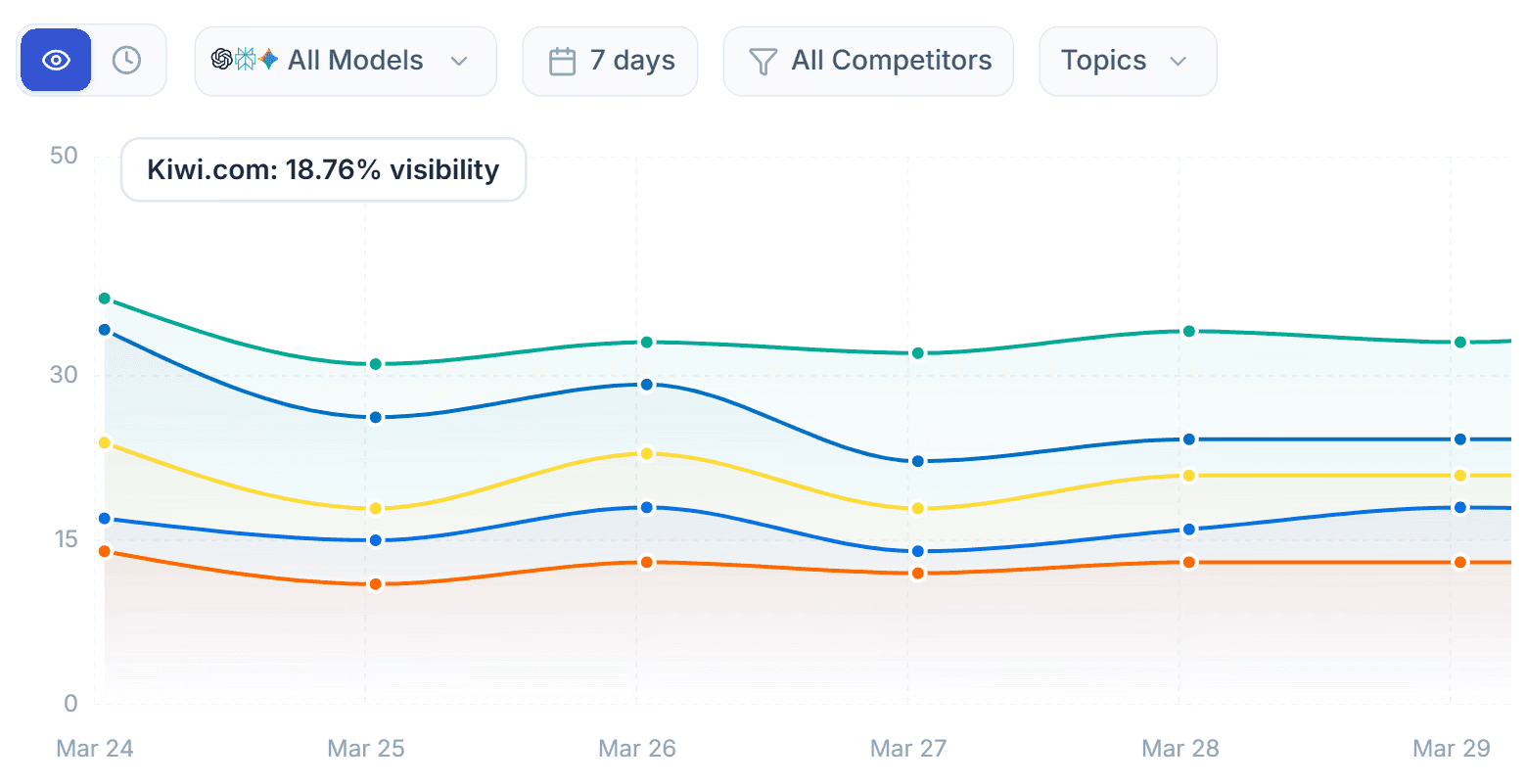
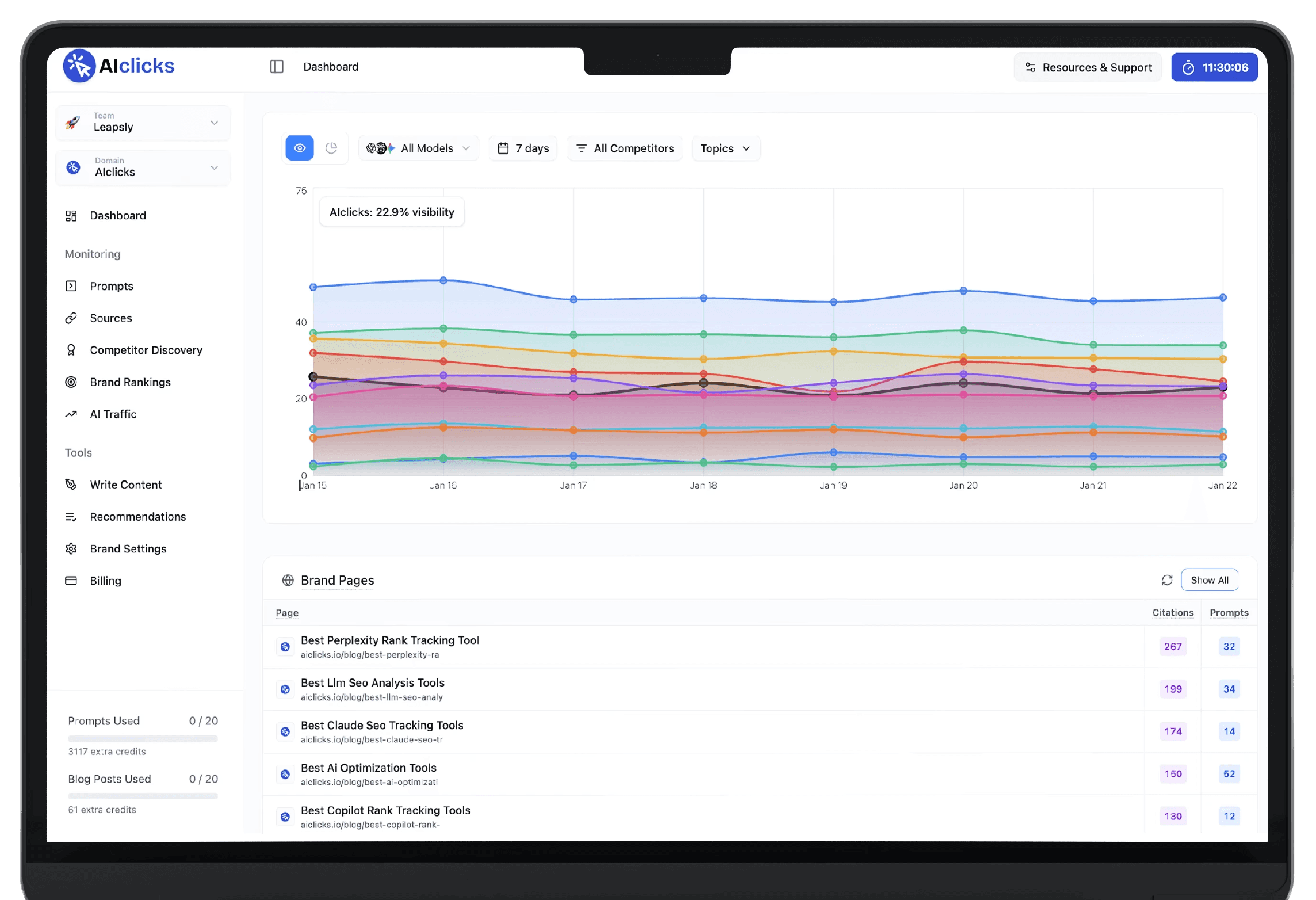
AIclicks gives you a live dashboard with daily ChatGPT mention rate, citation rate, sentiment, and share-of-voice across your tracked prompts, plus GA4 referral attribution for the traffic ChatGPT does send back.
Choose Your Plan
Flexible pricing that grows with your team. Upgrade or downgrade at any time.
Monthly
Yearly
-20%
Starter
Perfect for individuals & small teams
$49
/ month
Billed annually — you save $142
Choose 3 from:
Daily

" height="16px" id="fvSweaOBo" transform="translate(1 0)" width="14px"/></svg>)
" width="14px"><path d="M 13.864 5.629 L 13.3 5.629 L 13.3 5.6 L 7 5.6 L 7 8.4 L 10.956 8.4 C 10.379 10.03 8.828 11.2 7 11.2 C 4.681 11.2 2.8 9.319 2.8 7 C 2.8 4.681 4.681 2.8 7 2.8 C 8.071 2.8 9.045 3.204 9.786 3.864 L 11.766 1.884 C 10.516 0.719 8.844 0 7 0 C 3.134 0 0 3.134 0 7 C 0 10.866 3.134 14 7 14 C 10.866 14 14 10.866 14 7 C 14 6.531 13.952 6.073 13.864 5.629 Z" fill="rgb(255, 193, 7)" height="14px" id="H_YjfTNpn" width="14px"/><path d="M 0 3.742 L 2.3 5.429 C 2.922 3.888 4.429 2.8 6.193 2.8 C 7.264 2.8 8.238 3.204 8.979 3.864 L 10.959 1.884 C 9.709 0.719 8.037 0 6.193 0 C 3.504 0 1.172 1.518 0 3.742 Z" fill="rgb(255, 61, 0)" height="5.428500000000002px" id="PlkthQDhg" transform="translate(0.875 0)" width="10.959199999999996px"/><path d="M 6.232 5.581 C 8.04 5.581 9.683 4.889 10.925 3.764 L 8.758 1.931 C 8.032 2.483 7.144 2.782 6.232 2.781 C 4.411 2.781 2.865 1.62 2.283 0 L 0 1.759 C 1.159 4.026 3.511 5.581 6.232 5.581 Z" fill="rgb(76, 175, 80)" height="5.581099999999999px" id="WlnJ5gngE" transform="translate(0.7 8.4)" width="10.924899999999994px"/><path d="M 6.864 0.029 L 6.3 0.029 L 6.3 0 L 0 0 L 0 2.8 L 3.956 2.8 C 3.68 3.576 3.183 4.254 2.526 4.75 L 2.527 4.749 L 4.693 6.582 C 4.54 6.722 7 4.9 7 1.4 C 7 0.931 6.952 0.473 6.864 0.029 Z" fill="rgb(25, 118, 210)" height="6.589883930775992px" id="x_rSW275p" transform="translate(7 5.6)" width="7px"/></g></svg>)
" height="16px" id="hHS98fTxZ" width="16px"/></svg>)
 scale(1 1) translate(-1.861736945942159, -1.1170155383302638)" id="P20NzAvj0-699428820-radial-gradient" r="0.9935228066204626"><stop offset="0" stop-color="rgb(0, 174, 255)"/><stop offset="1" stop-color="rgb(7, 54, 196)"/></radialGradient><radialGradient cx="0.48250042504016705" cy="1.8366934653567062" gradient-transform="translate(0.48250042504016705, 1.8366934653567062) scale(1 1) translate(-0.48250042504016705, -1.8366934653567062)" id="UEWZqVjij-699428820-radial-gradient" r="0.9176890228114506"><stop offset="0" stop-color="rgb(255, 182, 87)"/><stop offset="1" stop-color="rgb(192, 43, 60)"/></radialGradient><linearGradient id="jyMN3TmKx-699428820-linear-gradient" x1="0.4594862532842614" x2="0.5405137467157386" y1="0" y2="1"><stop offset="0" stop-color="rgb(13, 145, 225)"/><stop offset="1" stop-color="rgb(255, 200, 0)"/></linearGradient><linearGradient id="xhMNwDFG0-699428820-linear-gradient" x1="0.4784828731548295" x2="0.5215171268451705" y1="5.551115123125783e-17" y2="1"><stop offset="0" stop-color="rgb(61, 203, 255)"/><stop offset="1" stop-color="rgba(5, 136, 247, 0)"/></linearGradient><radialGradient cx="1.4305090871482182" cy="0.34866158048251783" gradient-transform="translate(1.4305090871482182, 0.34866158048251783) scale(1 1) translate(-1.4305090871482182, -0.34866158048251783)" id="i79kAqaS4-699428820-radial-gradient" r="1.3362743412697924"><stop offset="0" stop-color="rgb(140, 72, 255)"/><stop offset="1" stop-color="rgb(255, 177, 82)"/></radialGradient><linearGradient id="mcxvno3tX-699428820-linear-gradient" x1="0.49844355920154226" x2="0.5015564407984577" y1="0" y2="1"><stop offset="0" stop-color="rgb(248, 173, 250)"/><stop offset="1" stop-color="rgba(168, 110, 221, 0)"/></linearGradient></defs><g d="M 11.605 1.219 C 11.397 0.499 10.739 0.002 9.989 0 L 9.498 0 C 8.682 0.002 7.985 0.588 7.842 1.391 L 7 6.016 L 7.209 5.296 C 7.416 4.574 8.075 4.076 8.825 4.074 L 11.681 4.074 L 12.879 4.545 L 14.033 4.074 L 13.697 4.074 C 12.947 4.072 12.289 3.575 12.081 2.855 Z M 4.413 13.387 C 4.618 14.111 5.278 14.611 6.031 14.613 L 7.075 14.613 C 7.988 14.613 8.735 13.88 8.758 12.96 L 8.871 8.5 L 8.633 9.319 C 8.426 10.039 7.768 10.537 7.018 10.539 L 4.138 10.539 L 3.111 9.977 L 2 10.539 L 2.331 10.539 C 3.084 10.542 3.743 11.042 3.949 11.766 L 4.413 13.387 Z M 9.999 0 L 4.167 0 C 2.501 0 1.501 2.221 0.834 4.441 C 0.045 7.073 -0.989 10.591 2.001 10.591 L 4.519 10.591 C 5.273 10.591 5.933 10.089 6.139 9.36 C 6.577 7.815 7.345 5.121 7.948 3.069 C 8.255 2.027 8.509 1.132 8.901 0.575 C 9.148 0.212 9.56 -0.004 9.999 0 M 9.999 0 L 4.167 0 C 2.501 0 1.501 2.221 0.834 4.441 C 0.045 7.073 -0.989 10.591 2.001 10.591 L 4.519 10.591 C 5.273 10.591 5.933 10.089 6.139 9.36 C 6.577 7.815 7.345 5.121 7.948 3.069 C 8.255 2.027 8.509 1.132 8.901 0.575 C 9.148 0.212 9.56 -0.004 9.999 0 M 6 14.593 L 11.833 14.593 C 13.499 14.593 14.499 12.372 15.166 10.151 C 15.955 7.519 16.989 4 13.999 4 L 11.48 4 C 10.725 4.002 10.063 4.505 9.86 5.232 C 9.266 7.332 8.663 9.429 8.051 11.523 C 7.745 12.566 7.49 13.461 7.098 14.019 C 6.851 14.382 6.439 14.597 6 14.593 M 6 14.593 L 11.833 14.593 C 13.499 14.593 14.499 12.372 15.166 10.151 C 15.955 7.519 16.989 4 13.999 4 L 11.48 4 C 10.725 4.002 10.063 4.505 9.86 5.232 C 9.266 7.332 8.663 9.429 8.051 11.523 C 7.745 12.566 7.49 13.461 7.098 14.019 C 6.851 14.382 6.439 14.597 6 14.593" fill="transparent" height="14.613333333333333px" id="QzkBy4Ibc" transform="translate(0 1)" width="16.00011071294081px"><path d="M 4.605 1.219 C 4.397 0.499 3.739 0.002 2.989 0 L 2.498 0 C 1.682 0.002 0.985 0.588 0.842 1.391 L 0 6.016 L 0.209 5.296 C 0.416 4.574 1.075 4.076 1.825 4.074 L 4.681 4.074 L 5.879 4.545 L 7.033 4.074 L 6.697 4.074 C 5.947 4.072 5.289 3.575 5.081 2.855 Z" fill="url(%23P20NzAvj0-699428820-radial-gradient)" height="6.016px" id="P20NzAvj0" transform="translate(7 0)" width="7.0333333333333385px"/><path d="M 2.413 4.887 C 2.618 5.611 3.278 6.111 4.031 6.113 L 5.075 6.113 C 5.988 6.113 6.735 5.38 6.758 4.46 L 6.871 0 L 6.633 0.819 C 6.426 1.539 5.768 2.037 5.018 2.039 L 2.138 2.039 L 1.111 1.477 L 0 2.039 L 0.331 2.039 C 1.084 2.042 1.743 2.542 1.949 3.266 L 2.413 4.887 Z" fill="url(%23UEWZqVjij-699428820-radial-gradient)" height="6.113333333333333px" id="UEWZqVjij" transform="translate(2 8.5)" width="6.871333333333332px"/><path d="M 9.999 0 L 4.167 0 C 2.501 0 1.501 2.221 0.834 4.441 C 0.045 7.073 -0.989 10.591 2.001 10.591 L 4.519 10.591 C 5.273 10.591 5.933 10.089 6.139 9.36 C 6.577 7.815 7.345 5.121 7.948 3.069 C 8.255 2.027 8.509 1.132 8.901 0.575 C 9.148 0.212 9.56 -0.004 9.999 0" fill="url(%23jyMN3TmKx-699428820-linear-gradient)" height="10.591388755215167px" id="jyMN3TmKx" width="9.999444046274142px"/><path d="M 9.999 0 L 4.167 0 C 2.501 0 1.501 2.221 0.834 4.441 C 0.045 7.073 -0.989 10.591 2.001 10.591 L 4.519 10.591 C 5.273 10.591 5.933 10.089 6.139 9.36 C 6.577 7.815 7.345 5.121 7.948 3.069 C 8.255 2.027 8.509 1.132 8.901 0.575 C 9.148 0.212 9.56 -0.004 9.999 0" fill="url(%23xhMNwDFG0-699428820-linear-gradient)" height="10.591388755215167px" id="xhMNwDFG0" width="9.999444046274142px"/><path d="M 0 10.593 L 5.833 10.593 C 7.499 10.593 8.499 8.372 9.166 6.151 C 9.955 3.519 10.989 0 7.999 0 L 5.48 0 C 4.725 0.002 4.063 0.505 3.86 1.232 C 3.266 3.332 2.663 5.429 2.051 7.523 C 1.745 8.566 1.49 9.461 1.098 10.019 C 0.851 10.382 0.439 10.597 0 10.593" fill="url(%23i79kAqaS4-699428820-radial-gradient)" height="10.593388755215164px" id="i79kAqaS4" transform="translate(6 4)" width="10.000110712940803px"/><path d="M 0 10.593 L 5.833 10.593 C 7.499 10.593 8.499 8.372 9.166 6.151 C 9.955 3.519 10.989 0 7.999 0 L 5.48 0 C 4.725 0.002 4.063 0.505 3.86 1.232 C 3.266 3.332 2.663 5.429 2.051 7.523 C 1.745 8.566 1.49 9.461 1.098 10.019 C 0.851 10.382 0.439 10.597 0 10.593" fill="url(%23mcxvno3tX-699428820-linear-gradient)" height="10.593388755215164px" id="mcxvno3tX" transform="translate(6 4)" width="10.000110712940803px"/></g></svg>)
" height="15.360666565427872px" id="HZPvvPBv7" transform="translate(0 0.5)" width="16px"/></svg>)
Tracked prompts
30
Websites you can add
3
LLMs you can track
3
Countries per project
1
LLM responses / mo
4,650
AI-optimized articles per month
10
Integrations
-
Support
Pro
For growing teams for more power
$140
/ month
Billed annually — you save $454
Choose 4 from:
Daily
Tracked prompts
150
Websites you can add
Unlimited
LLMs you can track
4
Countries per project
Unlimited
LLM responses / mo
18,600
AI-optimized articles per month
20
Integrations
Google Analytics
Support
BUSINESS
Best for medium-sized organizations
$357
/ month
Billed annually — you save $1198
Choose 6 from:
Daily
Tracked prompts
300
Websites you can add
Unlimited
LLMs you can track
6
Countries per project
Unlimited
LLM responses / mo
55,800
AI-optimized articles per month
30
Integrations
Google Analytics, API
Support
Dedicated account specialist
Become the #1 Answer in AI
Succeed in GEO yourself, or let us do all the work.
Do it yourself
Use AIclicks to see exactly where you appear across 10+ AI platforms, spot the gaps competitors are filling, and act on clear weekly recommendations.
From $59/month · Cancel anytime
Done for you
We Do All the Work for You
Our team manages your complete search presence: traditional SEO and GEO strategy, content, implementation, and reporting. You focus on patients.
Custom pricing · Minimum 3-month engagement
The AI SEO agency trusted by 1,000+ brands worldwide
From solo founders to multi-client agencies, AIclicks runs the full AI SEO agency program for organizations of every shape and size that want to be cited across every AI surface.
4.9/5 stars on G2







FAQ
How long does SEO take to work for a physio clinic?
Expect the map pack and review work to move in 2 to 4 months, and condition pages to rank in 6 to 12. Agencies quoting 3 to 6 months are describing the local half only. A clinic in a quiet town with 2 rivals will be faster; a city with 30 clinics and a hospital group takes longer. Watch Search Console impressions on condition terms, which rise months before bookings do.
Should we bother with AI search or just Google?
Both, and they reward different things. Ahrefs looked at 863,000 keywords and found only 38% of pages cited in AI Overviews also ranked in the top 10, down from 76% the year before. Ranking no longer carries you into the answer. Patients now ask assistants whether physiotherapy or a chiropractor suits their problem, and the clinics quoted back are the ones with named, registered clinicians and direct, structured answers on the page.
How is physio SEO different from normal local SEO?
Three things change it. You compete against the NHS for every condition term, and Google treats nhs.uk as the definitive source, so you win on private, local and practical angles instead. Keyword tools withhold health data, so demand has to be reconstructed from Search Console and enquiry logs. And insurer recognition works like a ranking filter, because patients screen by cover before they screen by anything else.
What should a physio clinic budget for SEO?
Single-clinic retainers typically run £600 to £1,200 a month, rising to £1,500 to £3,000 where several sites or a competitive city are involved. Clinic owners on forums describe roughly £1,200 a month as normal for a new practice in a busy area, which matches. Below roughly £500 you are usually buying directory submissions and a report. Judge it on new patients per month against the value of a full course of treatment.
Do we still need Google Ads if we do SEO?
Yes, for a while, and for specific things. Ads fill a new clinician’s diary this month and cover the terms you cannot rank for yet, such as sports massage and shockwave therapy. Search earns the condition and cost queries that never stop being asked. Use ad data to sequence content: whichever keywords actually convert into booked assessments deserve a page. Measure both on cost per booked assessment, never on clicks.
Which pages should a physiotherapy clinic build first?
Google Business Profile first, because it is free and it sits above everything. Then a fees page with actual prices, which filters enquiries and answers the question every caller opens with. Then condition pages for your 3 busiest complaints, written in patient language. Then an insurers page listing everyone who recognises you. Clinician bios after that, area pages last. The blog is optional, and most clinics start there.
How do we know if any of this is working?
Count booked assessments from organic search, not rankings. Add call tracking, since a large share of physiotherapy enquiries still arrive by phone and vanish from analytics otherwise. In Google Business Profile, the metrics that shift earliest are direction requests and website clicks. In Search Console, follow impressions on condition terms rather than average position. Then reconcile everything against Cliniko or TM3, because assessments booked and courses completed are the numbers that pay.
Should we do this ourselves or hire someone?
Split it. Profile updates, photos, review requests and writing honest answers to the questions patients ask in clinic all belong in-house, because nobody outside knows how you actually treat. Hand out the technical layer: schema, crawl and speed work, citation cleanup and links. If you hire, ask what they will do about the booking system swallowing your crawl budget. Anyone who cannot answer that has never worked on a clinic site.
Further Reading
Go deeper on GEO, AI search, and visibility tracking.