SEO for Photography Studios:
A couple picks their photographer 9 months out, after scrolling 40 portfolios that all look alike, reading vendor reviews, and asking ChatGPT who shoots in a documentary style near them. Almost none of that happens on Instagram anymore.









Why Photography Studios Need SEO
The Knot’s own wedding survey puts 90% of planning online, with roughly 73% of couples using Google to find vendors. Your portfolio is competing in a text-based index.
A portfolio site is 200 photographs and 300 words. Google indexes the words. Someone searching for a documentary wedding photographer, or a newborn session in a home rather than a studio, finds a competitor who wrote 800 words about exactly that shoot. Your best work never entered the running.
Search wedding photographer near me in a US city and The Knot and WeddingWire sit above almost every individual photographer, with Thumbtack just behind. They rank on aggregate reviews you helped generate, then charge you a monthly storefront fee to appear on the listing that outranked your site.
Premium marketplace listings typically run a few hundred dollars a month per platform, and studios often carry 2 or 3 at once alongside Instagram ad spend. Cancel them and the enquiries stop that week. You have rented placement on somebody else’s domain and built nothing that keeps on ranking.
How SEO Works for Photography Studios
Search Engine Optimization projects are long-term investments for photographers, where each task supplements the others and creates compound results over time.
01
Keywords, page structure, and the signals Google reads directly
On-page work fights the whole design of a photography site. The template you bought is built to get images on screen fast: full-bleed sliders, a homepage with 6 words on it, and headline type baked into image files so the font survives. Every one of those decisions removes something Google can read. Worse, drag-and-drop builders like Showit maintain a separate mobile canvas, so the same page ships 2 H1s and Google picks the wrong one. The pages that actually earn bookings are your service pages, your location pages and individual session stories, not the homepage everyone obsesses over.
Session stories age strangely well. A post about a ceremony at a particular barn, courthouse or state park keeps pulling enquiries for years, because the next couple booking that venue searches the venue name and finds you already standing in it. The posts that rot are the ones pinned to your calendar: mini-session announcements, this year’s booking-now-open post, the price-increase notice, the gear you switched to. Most photographers publish 30 of those and 2 of the first kind. Reverse the ratio. Then revisit the durable posts each year so the pricing, the venue rules and the timeline detail still hold up.
1
Add 400 words of real copy under every gallery, naming the venue, the session type and the city, in HTML rather than baked into images.
2
Redirect retired mini-session and expired pricing posts into the service page that replaced them, instead of leaving 2019 rates indexed.
3
Mark the studio up as ProfessionalService, then add ImageObject with creator, creditText and licence fields so Google Images shows the Licensable badge.
4
Publish a guide per venue you shoot: permit rules, ceremony light times, backup rain plan. It ranks whether or not you have bookings.
02
Map Pack visibility, citations, and proximity signals
Almost every booking has a geography attached, even the destination ones, because couples start from where the event is. That is why service plus location beats everything else photographers try, and why the map pack sits above The Knot on phone screens. Only 3 studios take those calls. The awkward part is that most photographers work from home and hide the address, which is exactly the signal Google uses to place them.
Set the primary category to the narrowest true one, Wedding Photographer or Portrait Studio rather than Photographer, and add the rest as services with prices attached. Service-area businesses hide the street address but must still draw the radius honestly. Upload work monthly, not once at setup, and answer in the Q&A what nobody puts on a website: whether raw files are included, how many images are delivered, and the turnaround.
Photography has its own citation layer beneath the general Yelp, Bing Places and Apple Maps tier. The Knot, WeddingWire, Zola and Thumbtack carry the booking intent; Junebug Weddings, Style Me Pretty and Rock n Roll Bride carry the editorial authority. Venue preferred-vendor lists matter more than any of them, because that is where planners send couples first. All of it needs one identical business name and phone, or the signal splits.
1
Pick Wedding Photographer or Newborn Photographer as the primary category, list every session type as a service, and add starting prices.
2
Run a separate profile only where you hold a real lease. For travel work, widen the service area instead of inventing satellite addresses.
3
Sweep The Knot, WeddingWire, Zola and Thumbtack with BrightLocal for stale phone numbers and old studio names left over from a rebrand.
4
Upload 5 fresh geotagged images to the Google Business Profile each week from that week’s shoot, with a post naming the venue.
03
Topic authority, inbound links, and content that earns traffic
Long before anyone searches for a photographer, they are searching for the thing being photographed. Couples look for venues, timelines and what an unplugged ceremony means. Expectant parents look for when to book newborn photos and whether 6 weeks is too late. Write those answers properly and you meet people 9 months before they are ready to enquire, which is also when they decide who feels like the expert.
By the time someone is ready to book, they are comparing 4 of you, and the thing that separates you is not the work. It is knowing what a collection costs, how long delivery takes, whether you will travel, and what happens if it rains. Photographers hide all of it behind an enquiry form to force a conversation. Publishing a starting price loses you the browsers and wins you the couples who were ready.
Links in this trade come from the people standing next to you at the event. Every venue, planner, florist and band has a preferred-vendor page and a blog, and most will link if you send them the gallery first. Submission platforms like Two Bright Lights push real weddings to editorial blogs that link back. Styled shoots exist almost entirely for this. Local press covers the community shoot you already do for free.
1
Publish an annual roundup of the venues you shoot most, with capacity, indoor backup and light timing, updated every spring rather than abandoned.
2
Build one page per session type per city you travel to, using genuine parking, permit and location detail rather than a swapped place name.
3
Build one pricing hub answering what a wedding photographer costs: hourly rates, collections, second shooters, albums, engagement sessions and travel fees.
4
Write a page for each specialism you genuinely offer, such as 35mm film, direct flash or documentary coverage, because couples search the style first.
04
Site speed, crawlability, Core Web Vitals, and mobile health
The failure nobody spots is that the work itself never gets indexed. Delivery galleries live on Pixieset, Pic-Time or ShootProof, so every wedding a studio shoots builds authority for somebody else’s domain. What stays on the site is a slider of 8 megabyte exports with no captions and no headings, sitting behind a lazy-load script Googlebot never triggers. The site ranks for the studio name and nothing else, which looks like success in analytics.
Photography sites are the heaviest pages most people load on a phone. A homepage carrying 30 full-width JPEGs regularly ships 15 megabytes to a couple browsing on a commute, on 4G, comparing you against 3 others in open tabs. They will not wait. The cruel part is that compressing to WebP at display width is invisible to everyone except the photographer squinting for artefacts, and it is the single fastest win available.
1
Run URL Inspection in Search Console on a gallery page and read the rendered HTML; if the captions are missing, so is your content.
2
Test the homepage in PageSpeed Insights on mobile, cap total page weight under 2 megabytes, and target Largest Contentful Paint below 2.5 seconds.
3
Export web files at 2048 pixels as WebP, and keep IPTC creator and copyright fields intact so Google Images can credit the photograph.
4
Keep service and venue pages in a sitemap separate from session posts, add an image sitemap, and resubmit whenever a real wedding publishes.
05
Star ratings, review volume, and response strategy that builds trust
Reviews decide this more than portfolio quality, because every photographer’s website shows their 20 best frames and none of them show what the day was like to be around. The problem is timing. A couple gets married, leaves for a honeymoon, comes back to 400 unread emails, and by the time the gallery lands the wedding is 8 weeks gone. Ask then and you are competing with a thank-you note they meant to write.
The moment that works is gallery delivery, while they are still scrolling through it and crying. Wire the request into the delivery email itself rather than sending it 3 days later. Ask for Google first, then the marketplace where you actually pay for a listing, and never both in the same message. Sneak preview day works too: send 5 images within 48 hours of the wedding, and ask there instead.
1
Fire the review link from Pixieset, Pic-Time or HoneyBook the moment the gallery is delivered, signed by the photographer who shot the day.
2
Reply within 24 hours, never mention what the couple paid, and offer to continue in email; note that WeddingWire and The Knot reviews sync.
3
Place newborn reviews on the newborn page and venue-specific reviews on that venue’s guide, marked up with Review schema rather than a homepage carousel.
4
Ask the planners, venues and florists you worked beside for reviews too, since a venue vouching for you reads differently than another couple’s review.
Google is No Longer the Only Place Your clients are Searching
Clients are using AI to find answers, and they trust what it tells them. Invest in GEO to get recommended in those answers.
1 Billion
Questions ChatGPT receives every single day
38%
Your #1 top ranking page on Google would be cited by AI
14%
of photographers optimise for GEO. The rest are invisible in AI answers


You can rank #1 for “photographer near me” and still not exist in ChatGPT’s answer. Run a free GEO audit to see where your brand actually stands.
GEO vs SEO: Same Goal, Different Methods
GEO is wider than SEO. AI recommends the brands that show up across the sources it reads, so your presence in forums, social platforms and photography blogs decides your odds. AIclicks measures the three metrics below so you know which to work on first.
AI Assistant
Which photographer should I hire for my wedding?
Your Studio
Citation Rate
Shows how many AI answers about photography studios name your brand, out of every 100. Models pull from the same trusted pages over and over, so citations compound: once you are in, staying in gets easier. Find the competitor pages AI cites most, then publish your own version of each.
Your Studio
82% positive
Competitor A
54% positive
Competitor B
38% positive
Brand Sentiment
Shows how AI describes you when your brand comes up: positive, neutral or negative. Tone is what separates being mentioned from being recommended, and models repeat whatever framing they find. Track the negative mentions back to the reviews and threads behind them, then publish content that answers those directly.
Others 52%
You 24%
— 24%
Your Studio
AI mention share of voice — photography category
Competitors
Not Cited
Share of Voice in AI
Shows how much of the photography conversation belongs to you rather than your competitors. This is the metric that matters most, the GEO version of a Google ranking. With only 1–5 brands named per answer, the market is winner-takes-more and every point is taken from someone.
The Dashboard Your Dedicated AI Search Team Works In
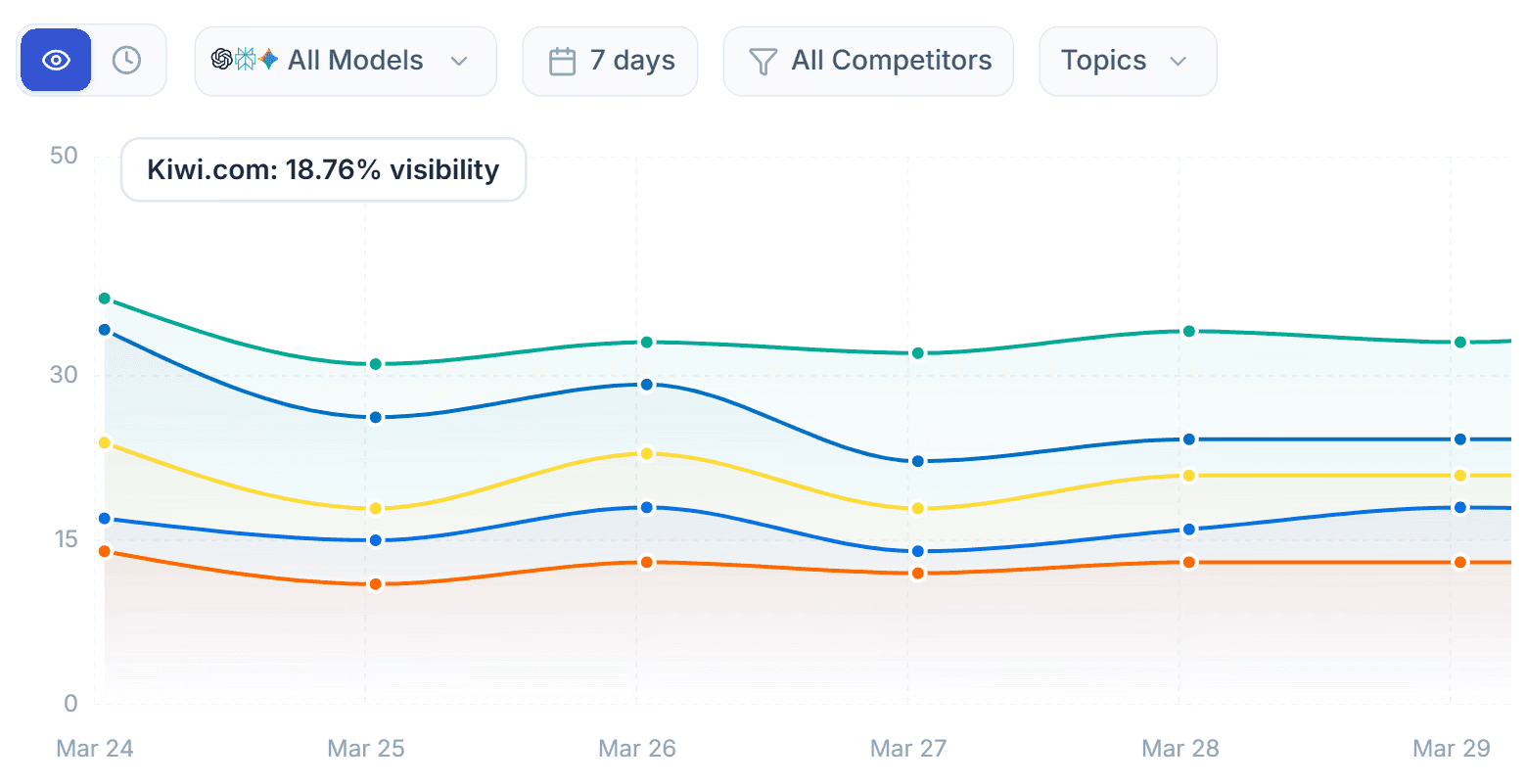
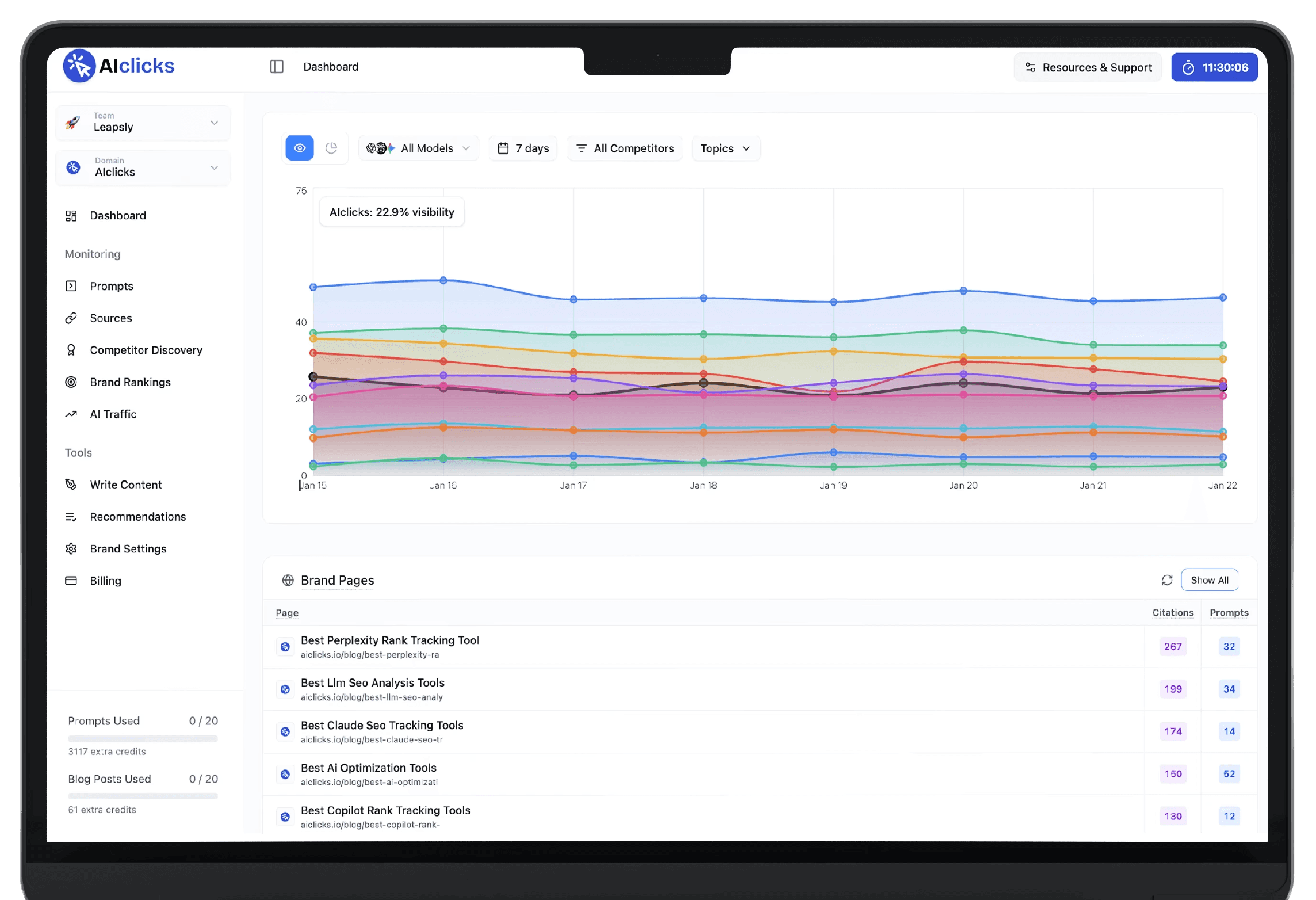
AIclicks gives you a live dashboard with daily ChatGPT mention rate, citation rate, sentiment, and share-of-voice across your tracked prompts, plus GA4 referral attribution for the traffic ChatGPT does send back.
Choose Your Plan
Flexible pricing that grows with your team. Upgrade or downgrade at any time.
Monthly
Yearly
-20%
Starter
Perfect for individuals & small teams
$49
/ month
Billed annually — you save $142
Choose 3 from:
Daily

" height="16px" id="fvSweaOBo" transform="translate(1 0)" width="14px"/></svg>)
" width="14px"><path d="M 13.864 5.629 L 13.3 5.629 L 13.3 5.6 L 7 5.6 L 7 8.4 L 10.956 8.4 C 10.379 10.03 8.828 11.2 7 11.2 C 4.681 11.2 2.8 9.319 2.8 7 C 2.8 4.681 4.681 2.8 7 2.8 C 8.071 2.8 9.045 3.204 9.786 3.864 L 11.766 1.884 C 10.516 0.719 8.844 0 7 0 C 3.134 0 0 3.134 0 7 C 0 10.866 3.134 14 7 14 C 10.866 14 14 10.866 14 7 C 14 6.531 13.952 6.073 13.864 5.629 Z" fill="rgb(255, 193, 7)" height="14px" id="H_YjfTNpn" width="14px"/><path d="M 0 3.742 L 2.3 5.429 C 2.922 3.888 4.429 2.8 6.193 2.8 C 7.264 2.8 8.238 3.204 8.979 3.864 L 10.959 1.884 C 9.709 0.719 8.037 0 6.193 0 C 3.504 0 1.172 1.518 0 3.742 Z" fill="rgb(255, 61, 0)" height="5.428500000000002px" id="PlkthQDhg" transform="translate(0.875 0)" width="10.959199999999996px"/><path d="M 6.232 5.581 C 8.04 5.581 9.683 4.889 10.925 3.764 L 8.758 1.931 C 8.032 2.483 7.144 2.782 6.232 2.781 C 4.411 2.781 2.865 1.62 2.283 0 L 0 1.759 C 1.159 4.026 3.511 5.581 6.232 5.581 Z" fill="rgb(76, 175, 80)" height="5.581099999999999px" id="WlnJ5gngE" transform="translate(0.7 8.4)" width="10.924899999999994px"/><path d="M 6.864 0.029 L 6.3 0.029 L 6.3 0 L 0 0 L 0 2.8 L 3.956 2.8 C 3.68 3.576 3.183 4.254 2.526 4.75 L 2.527 4.749 L 4.693 6.582 C 4.54 6.722 7 4.9 7 1.4 C 7 0.931 6.952 0.473 6.864 0.029 Z" fill="rgb(25, 118, 210)" height="6.589883930775992px" id="x_rSW275p" transform="translate(7 5.6)" width="7px"/></g></svg>)
" height="16px" id="hHS98fTxZ" width="16px"/></svg>)
 scale(1 1) translate(-1.861736945942159, -1.1170155383302638)" id="P20NzAvj0-699428820-radial-gradient" r="0.9935228066204626"><stop offset="0" stop-color="rgb(0, 174, 255)"/><stop offset="1" stop-color="rgb(7, 54, 196)"/></radialGradient><radialGradient cx="0.48250042504016705" cy="1.8366934653567062" gradient-transform="translate(0.48250042504016705, 1.8366934653567062) scale(1 1) translate(-0.48250042504016705, -1.8366934653567062)" id="UEWZqVjij-699428820-radial-gradient" r="0.9176890228114506"><stop offset="0" stop-color="rgb(255, 182, 87)"/><stop offset="1" stop-color="rgb(192, 43, 60)"/></radialGradient><linearGradient id="jyMN3TmKx-699428820-linear-gradient" x1="0.4594862532842614" x2="0.5405137467157386" y1="0" y2="1"><stop offset="0" stop-color="rgb(13, 145, 225)"/><stop offset="1" stop-color="rgb(255, 200, 0)"/></linearGradient><linearGradient id="xhMNwDFG0-699428820-linear-gradient" x1="0.4784828731548295" x2="0.5215171268451705" y1="5.551115123125783e-17" y2="1"><stop offset="0" stop-color="rgb(61, 203, 255)"/><stop offset="1" stop-color="rgba(5, 136, 247, 0)"/></linearGradient><radialGradient cx="1.4305090871482182" cy="0.34866158048251783" gradient-transform="translate(1.4305090871482182, 0.34866158048251783) scale(1 1) translate(-1.4305090871482182, -0.34866158048251783)" id="i79kAqaS4-699428820-radial-gradient" r="1.3362743412697924"><stop offset="0" stop-color="rgb(140, 72, 255)"/><stop offset="1" stop-color="rgb(255, 177, 82)"/></radialGradient><linearGradient id="mcxvno3tX-699428820-linear-gradient" x1="0.49844355920154226" x2="0.5015564407984577" y1="0" y2="1"><stop offset="0" stop-color="rgb(248, 173, 250)"/><stop offset="1" stop-color="rgba(168, 110, 221, 0)"/></linearGradient></defs><g d="M 11.605 1.219 C 11.397 0.499 10.739 0.002 9.989 0 L 9.498 0 C 8.682 0.002 7.985 0.588 7.842 1.391 L 7 6.016 L 7.209 5.296 C 7.416 4.574 8.075 4.076 8.825 4.074 L 11.681 4.074 L 12.879 4.545 L 14.033 4.074 L 13.697 4.074 C 12.947 4.072 12.289 3.575 12.081 2.855 Z M 4.413 13.387 C 4.618 14.111 5.278 14.611 6.031 14.613 L 7.075 14.613 C 7.988 14.613 8.735 13.88 8.758 12.96 L 8.871 8.5 L 8.633 9.319 C 8.426 10.039 7.768 10.537 7.018 10.539 L 4.138 10.539 L 3.111 9.977 L 2 10.539 L 2.331 10.539 C 3.084 10.542 3.743 11.042 3.949 11.766 L 4.413 13.387 Z M 9.999 0 L 4.167 0 C 2.501 0 1.501 2.221 0.834 4.441 C 0.045 7.073 -0.989 10.591 2.001 10.591 L 4.519 10.591 C 5.273 10.591 5.933 10.089 6.139 9.36 C 6.577 7.815 7.345 5.121 7.948 3.069 C 8.255 2.027 8.509 1.132 8.901 0.575 C 9.148 0.212 9.56 -0.004 9.999 0 M 9.999 0 L 4.167 0 C 2.501 0 1.501 2.221 0.834 4.441 C 0.045 7.073 -0.989 10.591 2.001 10.591 L 4.519 10.591 C 5.273 10.591 5.933 10.089 6.139 9.36 C 6.577 7.815 7.345 5.121 7.948 3.069 C 8.255 2.027 8.509 1.132 8.901 0.575 C 9.148 0.212 9.56 -0.004 9.999 0 M 6 14.593 L 11.833 14.593 C 13.499 14.593 14.499 12.372 15.166 10.151 C 15.955 7.519 16.989 4 13.999 4 L 11.48 4 C 10.725 4.002 10.063 4.505 9.86 5.232 C 9.266 7.332 8.663 9.429 8.051 11.523 C 7.745 12.566 7.49 13.461 7.098 14.019 C 6.851 14.382 6.439 14.597 6 14.593 M 6 14.593 L 11.833 14.593 C 13.499 14.593 14.499 12.372 15.166 10.151 C 15.955 7.519 16.989 4 13.999 4 L 11.48 4 C 10.725 4.002 10.063 4.505 9.86 5.232 C 9.266 7.332 8.663 9.429 8.051 11.523 C 7.745 12.566 7.49 13.461 7.098 14.019 C 6.851 14.382 6.439 14.597 6 14.593" fill="transparent" height="14.613333333333333px" id="QzkBy4Ibc" transform="translate(0 1)" width="16.00011071294081px"><path d="M 4.605 1.219 C 4.397 0.499 3.739 0.002 2.989 0 L 2.498 0 C 1.682 0.002 0.985 0.588 0.842 1.391 L 0 6.016 L 0.209 5.296 C 0.416 4.574 1.075 4.076 1.825 4.074 L 4.681 4.074 L 5.879 4.545 L 7.033 4.074 L 6.697 4.074 C 5.947 4.072 5.289 3.575 5.081 2.855 Z" fill="url(%23P20NzAvj0-699428820-radial-gradient)" height="6.016px" id="P20NzAvj0" transform="translate(7 0)" width="7.0333333333333385px"/><path d="M 2.413 4.887 C 2.618 5.611 3.278 6.111 4.031 6.113 L 5.075 6.113 C 5.988 6.113 6.735 5.38 6.758 4.46 L 6.871 0 L 6.633 0.819 C 6.426 1.539 5.768 2.037 5.018 2.039 L 2.138 2.039 L 1.111 1.477 L 0 2.039 L 0.331 2.039 C 1.084 2.042 1.743 2.542 1.949 3.266 L 2.413 4.887 Z" fill="url(%23UEWZqVjij-699428820-radial-gradient)" height="6.113333333333333px" id="UEWZqVjij" transform="translate(2 8.5)" width="6.871333333333332px"/><path d="M 9.999 0 L 4.167 0 C 2.501 0 1.501 2.221 0.834 4.441 C 0.045 7.073 -0.989 10.591 2.001 10.591 L 4.519 10.591 C 5.273 10.591 5.933 10.089 6.139 9.36 C 6.577 7.815 7.345 5.121 7.948 3.069 C 8.255 2.027 8.509 1.132 8.901 0.575 C 9.148 0.212 9.56 -0.004 9.999 0" fill="url(%23jyMN3TmKx-699428820-linear-gradient)" height="10.591388755215167px" id="jyMN3TmKx" width="9.999444046274142px"/><path d="M 9.999 0 L 4.167 0 C 2.501 0 1.501 2.221 0.834 4.441 C 0.045 7.073 -0.989 10.591 2.001 10.591 L 4.519 10.591 C 5.273 10.591 5.933 10.089 6.139 9.36 C 6.577 7.815 7.345 5.121 7.948 3.069 C 8.255 2.027 8.509 1.132 8.901 0.575 C 9.148 0.212 9.56 -0.004 9.999 0" fill="url(%23xhMNwDFG0-699428820-linear-gradient)" height="10.591388755215167px" id="xhMNwDFG0" width="9.999444046274142px"/><path d="M 0 10.593 L 5.833 10.593 C 7.499 10.593 8.499 8.372 9.166 6.151 C 9.955 3.519 10.989 0 7.999 0 L 5.48 0 C 4.725 0.002 4.063 0.505 3.86 1.232 C 3.266 3.332 2.663 5.429 2.051 7.523 C 1.745 8.566 1.49 9.461 1.098 10.019 C 0.851 10.382 0.439 10.597 0 10.593" fill="url(%23i79kAqaS4-699428820-radial-gradient)" height="10.593388755215164px" id="i79kAqaS4" transform="translate(6 4)" width="10.000110712940803px"/><path d="M 0 10.593 L 5.833 10.593 C 7.499 10.593 8.499 8.372 9.166 6.151 C 9.955 3.519 10.989 0 7.999 0 L 5.48 0 C 4.725 0.002 4.063 0.505 3.86 1.232 C 3.266 3.332 2.663 5.429 2.051 7.523 C 1.745 8.566 1.49 9.461 1.098 10.019 C 0.851 10.382 0.439 10.597 0 10.593" fill="url(%23mcxvno3tX-699428820-linear-gradient)" height="10.593388755215164px" id="mcxvno3tX" transform="translate(6 4)" width="10.000110712940803px"/></g></svg>)
" height="15.360666565427872px" id="HZPvvPBv7" transform="translate(0 0.5)" width="16px"/></svg>)
Tracked prompts
30
Websites you can add
3
LLMs you can track
3
Countries per project
1
LLM responses / mo
4,650
AI-optimized articles per month
10
Integrations
-
Support
Pro
For growing teams for more power
$140
/ month
Billed annually — you save $454
Choose 4 from:
Daily
Tracked prompts
150
Websites you can add
Unlimited
LLMs you can track
4
Countries per project
Unlimited
LLM responses / mo
18,600
AI-optimized articles per month
20
Integrations
Google Analytics
Support
BUSINESS
Best for medium-sized organizations
$357
/ month
Billed annually — you save $1198
Choose 6 from:
Daily
Tracked prompts
300
Websites you can add
Unlimited
LLMs you can track
6
Countries per project
Unlimited
LLM responses / mo
55,800
AI-optimized articles per month
30
Integrations
Google Analytics, API
Support
Dedicated account specialist
Become the #1 Answer in AI
Succeed in GEO yourself, or let us do all the work.
Do it yourself
Use AIclicks to see exactly where you appear across 10+ AI platforms, spot the gaps competitors are filling, and act on clear weekly recommendations.
From $59/month · Cancel anytime
Done for you
We Do All the Work for You
Our team manages your complete search presence: traditional SEO and GEO strategy, content, implementation, and reporting. You focus on clients.
Custom pricing · Minimum 3-month engagement
The AI SEO agency trusted by 1,000+ brands worldwide
From solo founders to multi-client agencies, AIclicks runs the full AI SEO agency program for organizations of every shape and size that want to be cited across every AI surface.
4.9/5 stars on G2







FAQ
How long before SEO actually brings in bookings?
Expect the first movement in 3 to 6 months, and real bookings closer to 9. Local terms and the map pack respond fastest because profile and review work compounds quickly. Venue and session-type pages take longer, and wedding SEO has a lag nobody mentions: a couple who finds you today books for a date 12 to 18 months out, so the revenue lands a year after the ranking does.
Do we need to show up in AI answers?
Yes, and photography is unusually exposed here. Ahrefs analysed 863,000 keywords and found only 38% of pages cited in AI Overviews also ranked in the top 10, down from 76% a year earlier. Assistants cannot see your photographs; they quote text. So the studios getting recommended are the ones with written venue guides, published pricing and answers to real planning questions, not the prettiest portfolios.
Why can't we just follow generic local SEO advice?
Three things. Your site is mostly images, so there is far less text to rank than a plumber or a florist has, and the fix is writing rather than tweaking. Your competitors are marketplaces you also pay to be listed on, which is a conflict no other trade has. And demand is seasonal and booked far ahead, so this year’s traffic pays next year’s invoices.
What should a photographer budget for SEO?
Specialist wedding SEO courses and bootcamps typically run a few hundred to around $1,500 one-off, audits sit near $500 to $1,500, and done-for-you retainers commonly start around $750 a month for a solo studio and reach $3,000 or more for a multi-shooter team. Set that against what you already pay for marketplace storefronts, which buy placement you never own. The number to watch is cost per booked date.
How does SEO fit with the ads we run?
They cover different parts of the calendar. Instagram and Meta ads fill the gaps in a season you are already in; organic search reaches couples planning 12 months ahead, which is when a photographer actually gets chosen. Most studios run ads on high-intent terms and marketplace storefronts while building organic strength on venue, pricing and style queries. Judge both on enquiries that turn into signed contracts, not clicks.
Which pages should a photography website build first?
The Google Business Profile comes first; it costs nothing and outranks your homepage. Then one service page per session type, written in the words clients use rather than your internal categories. Then a pricing page with a real starting number on it. Then venue or location guides, which are the only pages that reliably attract links. Session stories come after all of that, and the about page never ranks.
How do we know the SEO is actually working?
Count enquiries and booked dates that came through search, not rankings. Add a source field to your enquiry form, because couples who found you through a venue guide 8 months ago will say Instagram. Watch Search Console impressions on venue and session terms, which climb before positions do, and check Google Business Profile for calls and direction requests. Then reconcile against your calendar in HoneyBook or Dubsado.
Can I do SEO myself or should I hire someone?
Do the writing yourself. Nobody else can describe a venue you have shot 12 times, and outsourced session copy reads like it. Keep the profile, the reviews and the blogging in-house. Hire out the parts that need tools: rendering audits, image pipelines, schema, and untangling whatever your website designer did with headings. If you hire a generalist, check they have opened a Showit or Pixieset account before.
Further Reading
Go deeper on GEO, AI search, and visibility tracking.