SEO for Pest Control Companies:
Nobody shops around for an exterminator. They see something move across the kitchen floor at 11 at night, grab a phone, and call one of the first 3 companies whose rating looks safe enough. That decision is made in under 10 minutes, before your office opens.









Why Pest Control Companies Need SEO
Around 46% of Google searches carry local intent, and pest demand is urgent, seasonal and decided fast. Three map slots and, increasingly, one AI answer decide who ever gets called.
Most sites split into Residential and Commercial and stop there. Nobody types residential pest control. They type carpenter ant treatment, bed bug heat treatment cost, or wasp nest in siding, and land on whoever wrote it. Each pest is its own search, its own season, its own competitor. You never wrote 15 of them.
Type pest control near me in the US and Yelp’s top 10 list and the BBB directory land in the organic results, with national branch pages from Orkin and Terminix wrapped around them. Every one aggregates what you do. You appear inside their lists, ranked by their criteria, beside competitors paying for placement.
Operators report paying around $20 a click on pest control and exterminator terms, and roughly $550 to $600 to acquire one customer. Competing on ads alone in a decent market takes north of $5,000 every month. Pause it in May and the phones go quiet by that Friday. Nothing that you bought is still there afterwards.
How SEO Works for Pest Control Companies
Search Engine Optimization projects are long-term investments for exterminators, where each task supplements the others and creates compound results over time.
01
Keywords, page structure, and the signals Google reads directly
On-page work in this industry has a multiplication problem no other trade has. You treat 20 or 30 named pests across 40 or 50 towns, and every combination is technically a search. Build all of them and you have a doorway-page farm Google ignores; build none and you rank for nothing specific. The pages that actually earn calls are one per pest with real treatment detail, one per genuine service area, and your emergency and same-day pages. There is also a compliance layer: state pesticide regulators and EPA labelling rules bar claims like safe, harmless or non-toxic, so the copy most operators write is the copy they cannot publish.
Pest pages hold value for a decade. What a termite inspection actually costs, how to tell carpenter ants from termites, what heat treatment does to a bed bug infestation: those questions get asked in identical words every single year. What churns is anything with a year attached. Spring specials, Mosquito Season 2025 landing pages, the new branch announcement, the truck wrap photo. Most operator sites carry 6 dead seasonal URLs for every live treatment page. Seasonality belongs inside the evergreen page, refreshed each spring, not in a new URL that dies every autumn.
1
Break the services page apart into one URL per pest: termite treatment, bed bug heat treatment, rodent exclusion, carpenter ant control.
2
Pull last season’s promotion pages out of the index each quarter and 301 them to the evergreen pest page that now covers the offer.
3
Mark up each treatment with Service and hasOfferCatalog under a LocalBusiness node, add FAQPage blocks, then test with Schema Markup Validator.
4
Give every pest an identification page and a cost page; both rank year-round and screen out DIY callers before the phone rings.
02
Map Pack visibility, citations, and proximity signals
Almost nobody hires an exterminator from another county. Demand is bounded by a truck’s drive time, so the 3 map results are worth more than every organic listing beneath them combined. That block sits above Yelp, above the Better Business Bureau, above every national branch page, and it is the only block where a two-truck operator beats Orkin. Most pest control companies are service-area businesses with no storefront, so your radius setting and profile completeness do the work a street address does elsewhere.
Make Pest Control Service the primary category, add Animal Control Service only if you genuinely do wildlife, and list every treatment as its own service entry with a description. Configure the profile as a service-area business covering towns you actually reach, not a 60-mile fantasy radius. Upload photos of real technicians, real trucks and real equipment rather than stock beetles. Pre-answer the questions that decide bookings in Q&A: pet and child safety, how fast you can come, and whether the treatment carries a warranty.
Two citation layers matter here. The general one is Yelp, the Better Business Bureau, Angi, Thumbtack, Nextdoor, Bing Places and Apple Business Connect. The layer that separates you is credential-based: PestWorld’s consumer directory from the National Pest Management Association, the QualityPro accredited company list, your state pest management association roster, and your state’s licence register. Those verify a licence, which is why Google leans on them. Every entry needs one spelling of the company name and one phone number, or the layer cancels itself.
1
Set Pest Control Service as the primary category, flag the profile as a service-area business, and list only towns a technician reaches same day.
2
Each branch needs a separate profile carrying its own licence number, plus a page naming the technicians and trucks genuinely stationed there.
3
Audit Yelp, Angi, PestWorld and your state licence register with BrightLocal or Whitespark, and fix every abbreviated or legacy company name.
4
Publish a profile update every week naming the pest currently active locally, with a photo from a job your crew ran that week.
03
Topic authority, inbound links, and content that earns traffic
Nobody calls until they have done 3 things: tried to identify what they have, worked out whether a hardware-store spray will kill it, and decided whether it is safe around a dog or a toddler. Answer all 3 honestly, including the cases where a $12 bait station genuinely works, and you get the calls that matter. Identification content is the biggest under-built asset in the trade, because it catches people at the exact moment they realise this is beyond them.
By the time someone accepts they need a professional, they are comparing 3 companies on a phone. They want the price band before calling, how many visits it takes, what happens if the pests come back, whether the technician is licensed, and whether they have to leave the house. Put that on the treatment page, not behind a quote form. Published warranty terms and a price range beat any amount of family-owned since 1987, and they are what an AI assistant can quote back.
Links here come from 2 places generic advice never mentions. The trade press will publish operators: Pest Control Technology and Pest Management Professional both run contributed technical pieces, and the National Pest Management Association lists members. Then there is your referral network, which already exists offline. Realtor associations, property management groups, apartment and restaurant associations and home inspectors all publish vendor pages, and every one of them needs a termite inspector on speed dial. University extension entomology pages link to reputable local operators too.
1
Publish a DIY-versus-professional comparison per pest, with honest costs for hardware-store bait, foggers and a licensed treatment, and when each one genuinely works.
2
Create one page per pest per town you genuinely cover, grounded in local housing stock and real infestation pressure, not a swapped town name.
3
Build one affordability hub covering one-off treatments, quarterly plans, termite bonds, bed bug heat jobs and exactly what the warranty covers.
4
Give each named system you genuinely operate its own page: Sentricon, Termidor, thermal remediation, canine bed bug detection.
04
Site speed, crawlability, Core Web Vitals, and mobile health
The failure specific to this trade is the ZIP code gate. Vendor-built sites put an Enter your ZIP box where the location content should be, then render the service area, pricing and availability from JavaScript after the lookup. Googlebot sees one templated shell for 400 towns and nothing to index beneath it. Underneath, the same platform quietly spawns query-string URLs for every pest and ZIP combination, so crawl budget drains into pages nobody will ever rank.
The most valuable search in this trade happens at midnight, one-handed, by someone standing on a chair. There is no browsing happening. They want a phone number and one line confirming you can be there tomorrow. Pest sites are heavy in a particular way: full-resolution macro photography of insects, an embedded scheduling widget, a chat bubble and a review carousel, all loading before the phone number does. Every second the call button spends invisible is a job booked by whoever loaded faster.
1
Fetch your service area pages with Screaming Frog in JavaScript rendering mode; anything the crawler returns blank needs a static, linked URL per town.
2
Test your emergency and same-day pages in PageSpeed Insights on throttled mobile, and paint click-to-call before any scheduling widget loads.
3
Serve identification macros and infestation photos as WebP at display width with explicit dimensions, since these galleries are the heaviest asset on pest sites.
4
Split pest and service-area URLs into their own sitemap away from blog archives, and resubmit 6 weeks before swarm and mosquito season.
05
Star ratings, review volume, and response strategy that builds trust
Reviews decide this category because the buyer is letting a stranger into the house with a chemical they cannot identify. The awkward part is that pest work produces almost no moment of delight; success looks like nothing happening for 3 months. Meanwhile the people most motivated to write are the ones disputing an auto-renewing annual agreement or angry that ants returned in week 5. Left alone, a company with genuinely good technicians drifts to a rating that reads as mediocre.
Ask at the truck, while the technician is showing the customer the nest they just pulled out of the soffit. That is the only genuinely emotional moment in the job, and it lasts about 90 seconds. Wire the request to fire from the technician’s mobile app the second the service ticket is closed, signed with the technician’s name. Do it on routine quarterly visits too, not just the dramatic ones, because recurring accounts are where the volume actually lives.
1
Configure PestPac, FieldRoutes or GorillaDesk so closing the ticket on site fires the review request, signed with the technician’s own name.
2
Answer within 24 hours by naming the retreatment window in your warranty rather than arguing, because most negative pest reviews are about pests returning.
3
Pull bed bug reviews onto the bed bug page and termite reviews onto the termite page, instead of a single site-wide testimonial slider.
4
Chase reviews from restaurant, warehouse and property management accounts as well, since a passed food-safety audit reads differently to a homeowner comparing companies.
Google is No Longer the Only Place Your customers are Searching
Customers are using AI to find answers, and they trust what it tells them. Invest in GEO to get recommended in those answers.
1 Billion
Questions ChatGPT receives every single day
38%
Your #1 top ranking page on Google would be cited by AI
14%
of exterminators optimise for GEO. The rest are invisible in AI answers


You can rank #1 for “exterminator near me” and still not exist in ChatGPT’s answer. Run a free GEO audit to see where your brand actually stands.
GEO vs SEO: Same Goal, Different Methods
GEO is wider than SEO. AI recommends the brands that show up across the sources it reads, so your presence in forums, social platforms and pest control blogs decides your odds. AIclicks measures the three metrics below so you know which to work on first.
AI Assistant
Which exterminator near me actually handles bed bugs?
Your Company
Citation Rate
Shows how many AI answers about pest control companies name your brand, out of every 100. Models pull from the same trusted pages over and over, so citations compound: once you are in, staying in gets easier. Find the competitor pages AI cites most, then publish your own version of each.
Your Company
82% positive
Competitor A
54% positive
Competitor B
38% positive
Brand Sentiment
Shows how AI describes you when your brand comes up: positive, neutral or negative. Tone is what separates being mentioned from being recommended, and models repeat whatever framing they find. Track the negative mentions back to the reviews and threads behind them, then publish content that answers those directly.
Others 52%
You 24%
— 24%
Your Company
AI mention share of voice — pest control category
Competitors
Not Cited
Share of Voice in AI
Shows how much of the pest control conversation belongs to you rather than your competitors. This is the metric that matters most, the GEO version of a Google ranking. With only 1–5 brands named per answer, the market is winner-takes-more and every point is taken from someone.
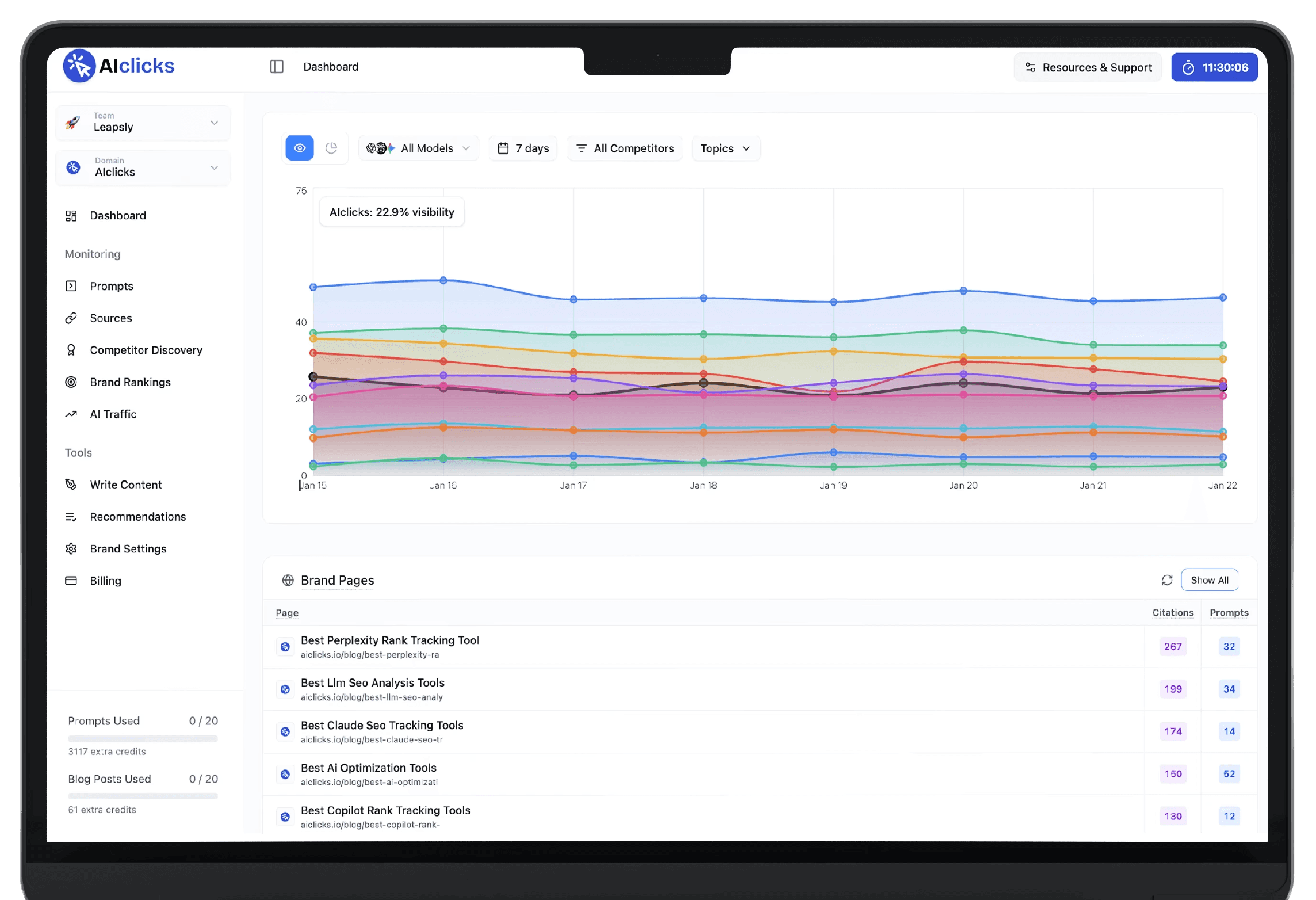
The Dashboard Your Dedicated AI Search Team Works In
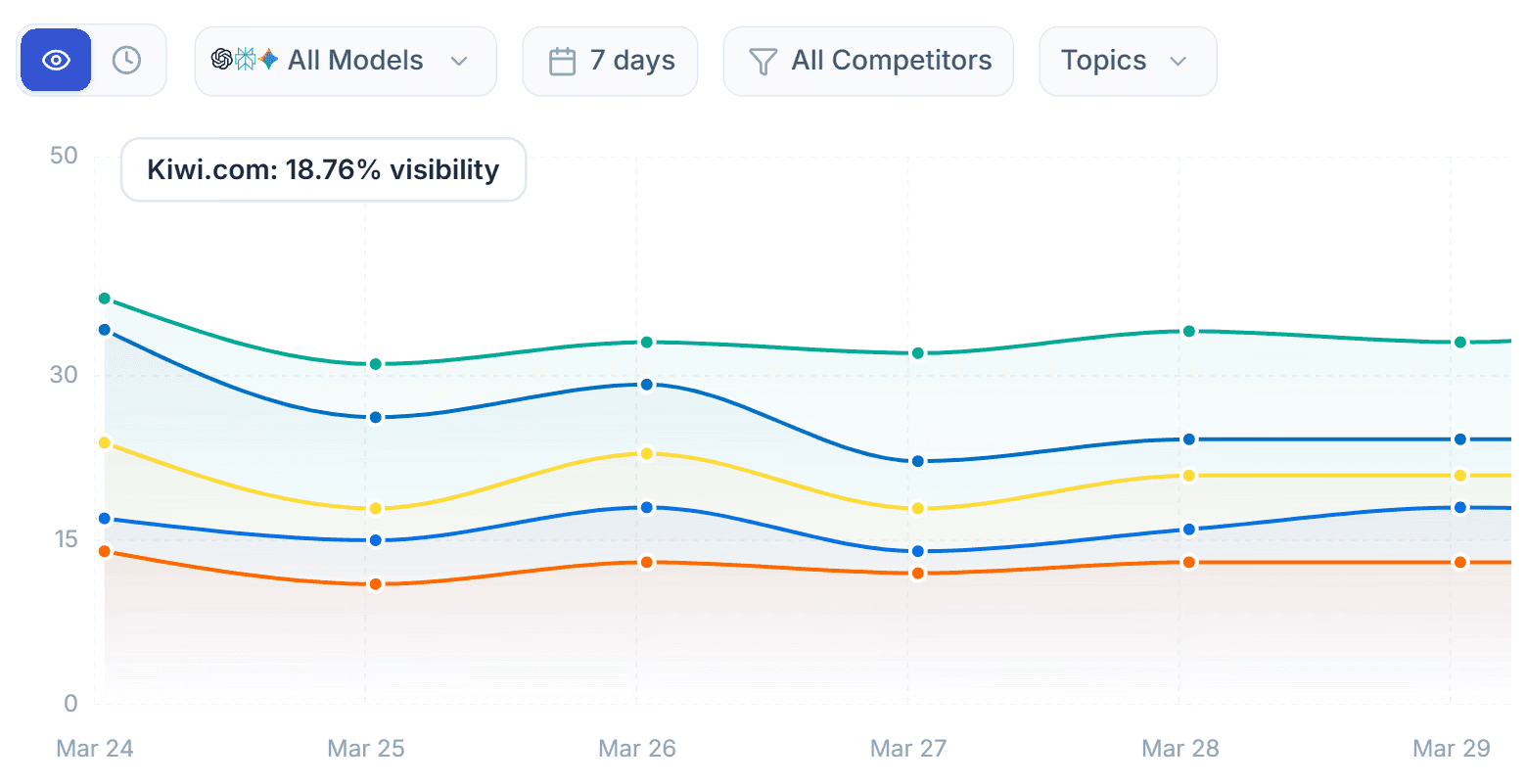
AIclicks gives you a live dashboard with daily ChatGPT mention rate, citation rate, sentiment, and share-of-voice across your tracked prompts, plus GA4 referral attribution for the traffic ChatGPT does send back.
Choose Your Plan
Flexible pricing that grows with your team. Upgrade or downgrade at any time.
Monthly
Yearly
-20%
Starter
Perfect for individuals & small teams
$49
/ month
Billed annually — you save $142
Choose 3 from:
Daily

" height="16px" id="fvSweaOBo" transform="translate(1 0)" width="14px"/></svg>)
" width="14px"><path d="M 13.864 5.629 L 13.3 5.629 L 13.3 5.6 L 7 5.6 L 7 8.4 L 10.956 8.4 C 10.379 10.03 8.828 11.2 7 11.2 C 4.681 11.2 2.8 9.319 2.8 7 C 2.8 4.681 4.681 2.8 7 2.8 C 8.071 2.8 9.045 3.204 9.786 3.864 L 11.766 1.884 C 10.516 0.719 8.844 0 7 0 C 3.134 0 0 3.134 0 7 C 0 10.866 3.134 14 7 14 C 10.866 14 14 10.866 14 7 C 14 6.531 13.952 6.073 13.864 5.629 Z" fill="rgb(255, 193, 7)" height="14px" id="H_YjfTNpn" width="14px"/><path d="M 0 3.742 L 2.3 5.429 C 2.922 3.888 4.429 2.8 6.193 2.8 C 7.264 2.8 8.238 3.204 8.979 3.864 L 10.959 1.884 C 9.709 0.719 8.037 0 6.193 0 C 3.504 0 1.172 1.518 0 3.742 Z" fill="rgb(255, 61, 0)" height="5.428500000000002px" id="PlkthQDhg" transform="translate(0.875 0)" width="10.959199999999996px"/><path d="M 6.232 5.581 C 8.04 5.581 9.683 4.889 10.925 3.764 L 8.758 1.931 C 8.032 2.483 7.144 2.782 6.232 2.781 C 4.411 2.781 2.865 1.62 2.283 0 L 0 1.759 C 1.159 4.026 3.511 5.581 6.232 5.581 Z" fill="rgb(76, 175, 80)" height="5.581099999999999px" id="WlnJ5gngE" transform="translate(0.7 8.4)" width="10.924899999999994px"/><path d="M 6.864 0.029 L 6.3 0.029 L 6.3 0 L 0 0 L 0 2.8 L 3.956 2.8 C 3.68 3.576 3.183 4.254 2.526 4.75 L 2.527 4.749 L 4.693 6.582 C 4.54 6.722 7 4.9 7 1.4 C 7 0.931 6.952 0.473 6.864 0.029 Z" fill="rgb(25, 118, 210)" height="6.589883930775992px" id="x_rSW275p" transform="translate(7 5.6)" width="7px"/></g></svg>)
" height="16px" id="hHS98fTxZ" width="16px"/></svg>)
 scale(1 1) translate(-1.861736945942159, -1.1170155383302638)" id="P20NzAvj0-699428820-radial-gradient" r="0.9935228066204626"><stop offset="0" stop-color="rgb(0, 174, 255)"/><stop offset="1" stop-color="rgb(7, 54, 196)"/></radialGradient><radialGradient cx="0.48250042504016705" cy="1.8366934653567062" gradient-transform="translate(0.48250042504016705, 1.8366934653567062) scale(1 1) translate(-0.48250042504016705, -1.8366934653567062)" id="UEWZqVjij-699428820-radial-gradient" r="0.9176890228114506"><stop offset="0" stop-color="rgb(255, 182, 87)"/><stop offset="1" stop-color="rgb(192, 43, 60)"/></radialGradient><linearGradient id="jyMN3TmKx-699428820-linear-gradient" x1="0.4594862532842614" x2="0.5405137467157386" y1="0" y2="1"><stop offset="0" stop-color="rgb(13, 145, 225)"/><stop offset="1" stop-color="rgb(255, 200, 0)"/></linearGradient><linearGradient id="xhMNwDFG0-699428820-linear-gradient" x1="0.4784828731548295" x2="0.5215171268451705" y1="5.551115123125783e-17" y2="1"><stop offset="0" stop-color="rgb(61, 203, 255)"/><stop offset="1" stop-color="rgba(5, 136, 247, 0)"/></linearGradient><radialGradient cx="1.4305090871482182" cy="0.34866158048251783" gradient-transform="translate(1.4305090871482182, 0.34866158048251783) scale(1 1) translate(-1.4305090871482182, -0.34866158048251783)" id="i79kAqaS4-699428820-radial-gradient" r="1.3362743412697924"><stop offset="0" stop-color="rgb(140, 72, 255)"/><stop offset="1" stop-color="rgb(255, 177, 82)"/></radialGradient><linearGradient id="mcxvno3tX-699428820-linear-gradient" x1="0.49844355920154226" x2="0.5015564407984577" y1="0" y2="1"><stop offset="0" stop-color="rgb(248, 173, 250)"/><stop offset="1" stop-color="rgba(168, 110, 221, 0)"/></linearGradient></defs><g d="M 11.605 1.219 C 11.397 0.499 10.739 0.002 9.989 0 L 9.498 0 C 8.682 0.002 7.985 0.588 7.842 1.391 L 7 6.016 L 7.209 5.296 C 7.416 4.574 8.075 4.076 8.825 4.074 L 11.681 4.074 L 12.879 4.545 L 14.033 4.074 L 13.697 4.074 C 12.947 4.072 12.289 3.575 12.081 2.855 Z M 4.413 13.387 C 4.618 14.111 5.278 14.611 6.031 14.613 L 7.075 14.613 C 7.988 14.613 8.735 13.88 8.758 12.96 L 8.871 8.5 L 8.633 9.319 C 8.426 10.039 7.768 10.537 7.018 10.539 L 4.138 10.539 L 3.111 9.977 L 2 10.539 L 2.331 10.539 C 3.084 10.542 3.743 11.042 3.949 11.766 L 4.413 13.387 Z M 9.999 0 L 4.167 0 C 2.501 0 1.501 2.221 0.834 4.441 C 0.045 7.073 -0.989 10.591 2.001 10.591 L 4.519 10.591 C 5.273 10.591 5.933 10.089 6.139 9.36 C 6.577 7.815 7.345 5.121 7.948 3.069 C 8.255 2.027 8.509 1.132 8.901 0.575 C 9.148 0.212 9.56 -0.004 9.999 0 M 9.999 0 L 4.167 0 C 2.501 0 1.501 2.221 0.834 4.441 C 0.045 7.073 -0.989 10.591 2.001 10.591 L 4.519 10.591 C 5.273 10.591 5.933 10.089 6.139 9.36 C 6.577 7.815 7.345 5.121 7.948 3.069 C 8.255 2.027 8.509 1.132 8.901 0.575 C 9.148 0.212 9.56 -0.004 9.999 0 M 6 14.593 L 11.833 14.593 C 13.499 14.593 14.499 12.372 15.166 10.151 C 15.955 7.519 16.989 4 13.999 4 L 11.48 4 C 10.725 4.002 10.063 4.505 9.86 5.232 C 9.266 7.332 8.663 9.429 8.051 11.523 C 7.745 12.566 7.49 13.461 7.098 14.019 C 6.851 14.382 6.439 14.597 6 14.593 M 6 14.593 L 11.833 14.593 C 13.499 14.593 14.499 12.372 15.166 10.151 C 15.955 7.519 16.989 4 13.999 4 L 11.48 4 C 10.725 4.002 10.063 4.505 9.86 5.232 C 9.266 7.332 8.663 9.429 8.051 11.523 C 7.745 12.566 7.49 13.461 7.098 14.019 C 6.851 14.382 6.439 14.597 6 14.593" fill="transparent" height="14.613333333333333px" id="QzkBy4Ibc" transform="translate(0 1)" width="16.00011071294081px"><path d="M 4.605 1.219 C 4.397 0.499 3.739 0.002 2.989 0 L 2.498 0 C 1.682 0.002 0.985 0.588 0.842 1.391 L 0 6.016 L 0.209 5.296 C 0.416 4.574 1.075 4.076 1.825 4.074 L 4.681 4.074 L 5.879 4.545 L 7.033 4.074 L 6.697 4.074 C 5.947 4.072 5.289 3.575 5.081 2.855 Z" fill="url(%23P20NzAvj0-699428820-radial-gradient)" height="6.016px" id="P20NzAvj0" transform="translate(7 0)" width="7.0333333333333385px"/><path d="M 2.413 4.887 C 2.618 5.611 3.278 6.111 4.031 6.113 L 5.075 6.113 C 5.988 6.113 6.735 5.38 6.758 4.46 L 6.871 0 L 6.633 0.819 C 6.426 1.539 5.768 2.037 5.018 2.039 L 2.138 2.039 L 1.111 1.477 L 0 2.039 L 0.331 2.039 C 1.084 2.042 1.743 2.542 1.949 3.266 L 2.413 4.887 Z" fill="url(%23UEWZqVjij-699428820-radial-gradient)" height="6.113333333333333px" id="UEWZqVjij" transform="translate(2 8.5)" width="6.871333333333332px"/><path d="M 9.999 0 L 4.167 0 C 2.501 0 1.501 2.221 0.834 4.441 C 0.045 7.073 -0.989 10.591 2.001 10.591 L 4.519 10.591 C 5.273 10.591 5.933 10.089 6.139 9.36 C 6.577 7.815 7.345 5.121 7.948 3.069 C 8.255 2.027 8.509 1.132 8.901 0.575 C 9.148 0.212 9.56 -0.004 9.999 0" fill="url(%23jyMN3TmKx-699428820-linear-gradient)" height="10.591388755215167px" id="jyMN3TmKx" width="9.999444046274142px"/><path d="M 9.999 0 L 4.167 0 C 2.501 0 1.501 2.221 0.834 4.441 C 0.045 7.073 -0.989 10.591 2.001 10.591 L 4.519 10.591 C 5.273 10.591 5.933 10.089 6.139 9.36 C 6.577 7.815 7.345 5.121 7.948 3.069 C 8.255 2.027 8.509 1.132 8.901 0.575 C 9.148 0.212 9.56 -0.004 9.999 0" fill="url(%23xhMNwDFG0-699428820-linear-gradient)" height="10.591388755215167px" id="xhMNwDFG0" width="9.999444046274142px"/><path d="M 0 10.593 L 5.833 10.593 C 7.499 10.593 8.499 8.372 9.166 6.151 C 9.955 3.519 10.989 0 7.999 0 L 5.48 0 C 4.725 0.002 4.063 0.505 3.86 1.232 C 3.266 3.332 2.663 5.429 2.051 7.523 C 1.745 8.566 1.49 9.461 1.098 10.019 C 0.851 10.382 0.439 10.597 0 10.593" fill="url(%23i79kAqaS4-699428820-radial-gradient)" height="10.593388755215164px" id="i79kAqaS4" transform="translate(6 4)" width="10.000110712940803px"/><path d="M 0 10.593 L 5.833 10.593 C 7.499 10.593 8.499 8.372 9.166 6.151 C 9.955 3.519 10.989 0 7.999 0 L 5.48 0 C 4.725 0.002 4.063 0.505 3.86 1.232 C 3.266 3.332 2.663 5.429 2.051 7.523 C 1.745 8.566 1.49 9.461 1.098 10.019 C 0.851 10.382 0.439 10.597 0 10.593" fill="url(%23mcxvno3tX-699428820-linear-gradient)" height="10.593388755215164px" id="mcxvno3tX" transform="translate(6 4)" width="10.000110712940803px"/></g></svg>)
" height="15.360666565427872px" id="HZPvvPBv7" transform="translate(0 0.5)" width="16px"/></svg>)
Tracked prompts
30
Websites you can add
3
LLMs you can track
3
Countries per project
1
LLM responses / mo
4,650
AI-optimized articles per month
10
Integrations
-
Support
Pro
For growing teams for more power
$140
/ month
Billed annually — you save $454
Choose 4 from:
Daily
Tracked prompts
150
Websites you can add
Unlimited
LLMs you can track
4
Countries per project
Unlimited
LLM responses / mo
18,600
AI-optimized articles per month
20
Integrations
Google Analytics
Support
BUSINESS
Best for medium-sized organizations
$357
/ month
Billed annually — you save $1198
Choose 6 from:
Daily
Tracked prompts
300
Websites you can add
Unlimited
LLMs you can track
6
Countries per project
Unlimited
LLM responses / mo
55,800
AI-optimized articles per month
30
Integrations
Google Analytics, API
Support
Dedicated account specialist
Become the #1 Answer in AI
Succeed in GEO yourself, or let us do all the work.
Do it yourself
Use AIclicks to see exactly where you appear across 10+ AI platforms, spot the gaps competitors are filling, and act on clear weekly recommendations.
From $59/month · Cancel anytime
Done for you
We Do All the Work for You
Our team manages your complete search presence: traditional SEO and GEO strategy, content, implementation, and reporting. You focus on customers.
Custom pricing · Minimum 3-month engagement
The AI SEO agency trusted by 1,000+ brands worldwide
From solo founders to multi-client agencies, AIclicks runs the full AI SEO agency program for organizations of every shape and size that want to be cited across every AI surface.
4.9/5 stars on G2







FAQ
How long before pest control SEO brings in calls?
Map pack and review work tends to move inside 3 months. Organic rankings for pest and town terms take 6 to 12 months, and a crowded metro runs longer. Seasonality distorts the read: publish termite content in April and you have already missed swarm season, so judge progress against the same month last year rather than last month. One operator posted a sevenfold local visibility lift in 3 months and still had ground to cover.
Should we chase Google rankings or AI answers?
Both, and they no longer travel together. Ahrefs analysed 863,000 keywords and found only 38% of pages cited in AI Overviews also ranked in the top 10 for that query, down from 76% a year earlier. Cost and worth-it questions in this trade fire an AI answer almost every time. Ranking earns the click; being licensed, priced and structured so an assistant can quote you earns the citation.
What makes pest control SEO different from normal local SEO?
Three things. Demand is seasonal, so content has to be indexed and aged 6 to 8 weeks before termites swarm or mosquitoes arrive, not published the week the calls start. Your advertising claims are regulated: EPA labelling rules and state pesticide boards bar safe, harmless and non-toxic language about treatments. And the money sits in recurring plans, so a single lead is worth years of billing rather than one job.
What should a pest control company budget for SEO?
Published pest control SEO rates run roughly $500 to $5,000 a month, with $1,500 to $2,300 typical for one location in a normal market and more for multi-branch operators. Budgets under $500 rarely buy anything but reporting. Weigh it against what you already pay for demand: operators report about $20 a click and $550 to $600 to acquire a customer, against a recurring plan worth several years of billing.
Do we still need Google Ads and LSAs?
Yes, at least through the first season. Local Services Ads and search ads buy the calls you need this week, while organic and map pack work compound into next year. Most operators run ads hardest through swarm and mosquito season and lean on organic in the shoulder months. Use ad data to pick content order: whichever pest terms actually convert to booked jobs deserve a page first. Measure both on cost per booked job.
Which pages should a pest control company build first?
Google Business Profile before anything else, since it is free and renders above the organic results. Then your emergency and same-day page, which catches the highest-intent searches in the trade. Then one page each for your 3 most profitable pests, usually termites, bed bugs and rodents, with real prices and warranty terms. Then genuine service-area pages for towns you actually cover. Identification content next. Blog content comes last, if at all, and only where customers genuinely ask.
How do we know the SEO is actually working?
Count jobs booked from organic, not positions. Add call tracking to every page, because most pest enquiries arrive as phone calls that never reach analytics at all. Watch Google Business Profile calls and direction requests, which move first. In Search Console, compare impressions on pest and town terms year over year, since month over month only measures the season. Then reconcile against your field service software: jobs booked and recurring plans sold are the numbers that pay.
Should we hire an SEO company or do it ourselves?
Do both, but split it properly. Profile posts, photos from real jobs and review requests belong in-house, because your technicians are the only people who can produce them. Technical work, schema and link outreach need a specialist. Operators on Reddit report hiring 3 agencies over 5 years with nothing to show, so ask any candidate for a pest control client whose map pack rankings you can check yourself, and insist on reporting tied to booked jobs.
Further Reading
Go deeper on GEO, AI search, and visibility tracking.