SEO for Personal Injury Firms:
Someone gets rear-ended on a Tuesday and researches for 4 days before calling anyone. They read settlement ranges, check star ratings, ask ChatGPT what a case like theirs is worth, and shortlist 3 firms. Your intake team never sees any of it.









Why Personal Injury Firms Need SEO
More than 48,000 personal injury firms compete in the US, and the injured client comparing them now reads an AI summary of fee percentages and case values before a single firm gets clicked.
Most firms publish one personal injury page and a car accident page, then wonder why the trucking, rideshare and nursing home files all go to someone else. Every one of them is a distinct searcher with a distinct policy limit behind it. The claimant looking for an 18-wheeler case cannot tell that you handle them.
Search car accident lawyer near me in any US metro and Avvo, Super Lawyers and a national advertising firm sit above the first local practice. The directories rank on aggregate authority; the nationals rank on budget you cannot match. Both then sell your competitors a sponsored slot inside the listing that beat you.
Personal injury clicks are the most expensive in Google Ads, routinely clearing $200, and Local Services Ads leads commonly land between $150 and $300 each before anyone signs. Add television and billboard spend and the cost per signed case stays flat for years. Pause any of it and intake goes quiet the same week.
How SEO Works for Personal Injury Firms
Search Engine Optimization projects are long-term investments for injury lawyers, where each task supplements the others and creates compound results over time.
01
Keywords, page structure, and the signals Google reads directly
On-page work in personal injury is difficult for a reason most agencies gloss over: the pages that sign cases are the ones state bar advertising rules police hardest. A case results page has to carry the past-results disclaimer. A page claiming specialisation has to survive your state’s certification rule. Calling yourself the best is prohibited outright in most states, which is exactly the phrase your searcher typed. The pages that carry the weight are your case-type pages, your case results, your attorney bios and the fee page, not the accident-news blog most firms fill instead.
The durable assets answer the questions a claimant asks before they trust anyone: what a case like theirs is typically worth, how comparative fault reduces a recovery, how long their state gives them to file, and what 33% versus 40% actually means once costs come out. Those pages keep pulling enquiries for years, since the statute rarely moves. What churns is the accident report post. Firms publish a summary of every wreck reported in the county, thin, near-identical, and occasionally distressing to the family involved. Hundreds of those pages dilute a site rather than build it.
1
Break the single personal injury page out by case type: rideshare collisions, 18-wheeler crashes, nursing home neglect, dog bites, premises liability.
2
Prune the accident report archive in Search Console, keep the few that earned links, and 301 the rest into the matching case-type page.
3
Mark the firm up as Attorney with a hasOfferCatalog listing each case type, and wrap settlement questions in FAQPage schema.
4
Publish a statute of limitations page and a comparative fault explainer for your state; each ranks all year and pre-qualifies every caller.
02
Map Pack visibility, citations, and proximity signals
Injured people hire near home. They want an office they can reach on crutches and a lawyer who knows the local adjusters and the local bench, so Google weights proximity heavily and puts 3 map results above every organic listing. For a firm with a single office, the local pack is the only place you can outrank Avvo and the national advertisers on the same screen. It also converts to calls rather than clicks.
Make Personal Injury Attorney the primary category, then add Trial Attorney and any case-type category you genuinely run. List every case type as a service with its own description. Set hours to open 24 hours only if someone truly answers, because missed calls from the profile are visible to Google. Load photographs of the actual office and staff, turn on messaging, and answer the fee question in the Q&A before a competitor answers it for you.
Personal injury has a citation stack of its own. Avvo, Justia, Martindale-Hubbell, FindLaw, Nolo and Lawyers.com carry weight precisely because each one verifies bar admission, and your state trial lawyers association listing carries more than any general directory. Add your county bar and the American Association for Justice member page. Every entry needs the same firm name, suite and tracked-free phone number, because one legacy address from an old office quietly splits the signal.
1
Choose Personal Injury Attorney as primary, add each case type as a separate service, and pre-answer the fee question in Google Q&A.
2
A virtual office or shared suite will get your profile suspended; only create a profile where staff genuinely sit during posted hours.
3
Run Whitespark or BrightLocal across Justia, Avvo, FindLaw, your state trial lawyers association and Martindale-Hubbell, then correct every phone and suite variant.
4
Add fresh profile photos and one update each week, and reply to every Google question, since abandoned profiles slide out of the map pack.
03
Topic authority, inbound links, and content that earns traffic
Before anyone calls, they are trying to price their own claim. They search what a whiplash settlement pays, whether the adjuster’s first offer is normal, and whether they even need a lawyer for a minor collision. Answer those honestly, including the cases you would tell them not to file, and you win the reader who was expecting a sales pitch. That reader is also the one who forwards your page to their family.
The claimant who has decided to hire someone is now comparing 3 firms and looking for proof. Give them verdicts and settlements with the injury, the venue type and the number, the trial record rather than the phrase aggressive representation, who actually handles the file after signing, and what happens to costs if the case loses. Put that on the case-type page. Most firms bury it in a results archive nobody reaches from search.
Links in personal injury come from the safety and advocacy world, not from legal blogs. Bike coalitions, motorcycle safety courses, victim advocacy groups, rehabilitation clinics and driver education programmes all publish resource pages and all take sponsors. Your state trial lawyers association links to members who speak or write for it. Reporters need someone to explain a policy limit on deadline, and Qwoted and Muck Rack broker that. Scholarship link schemes no longer work.
1
Publish an annual settlement range guide per injury type, using your own closed files rather than the invented numbers on calculator sites.
2
Give each case type its own page in each city you serve, naming the crash corridors, hospitals and courthouse rather than swapping a place name.
3
Cluster every contingency fee question into one hub: percentages before and after filing, case costs, liens, medical bills, and what a losing case costs.
4
Build a page for every major auto insurer you negotiate against, covering how that carrier handles first offers, because claimants search the insurer by name.
04
Site speed, crawlability, Core Web Vitals, and mobile health
The failure hiding in plain sight is domain sprawl. The television campaign got its own domain, the vanity number got another, an old office kept a third, and each runs the same content with a different logo. Link equity that should have compounded on one site is split 4 ways, and Google picks whichever it likes. The Spanish version is usually worse: a translate widget rather than crawlable Spanish URLs, so none of it is indexed.
The search that matters happens on a cracked phone screen, one-handed, on cellular, often by a relative rather than the injured person. Personal injury sites accumulate third-party scripts faster than anything else the firm owns: a chat bot, dynamic number insertion, an exit popup, a video header and a review carousel, all loading before the phone number renders. Google’s own research puts mobile abandonment at 53% once a page passes 3 seconds.
1
List every domain the firm owns in Ahrefs Site Explorer, then 301 the campaign and vanity domains into the main site rather than mirroring content.
2
Run your busiest case-type page through WebPageTest on a throttled mobile connection and cut every intake script that loads ahead of the phone number.
3
Replace settlement result graphics and scanned verdict PDFs with real HTML text plus compressed WebP, so the numbers are readable and indexable.
4
Give Spanish pages real /es/ URLs, hreflang tags and their own sitemap submitted in Search Console, so fresh case-type pages get crawled within days.
05
Star ratings, review volume, and response strategy that builds trust
A 5-star average decides more personal injury searches than any headline verdict, because the reader has no way to judge legal skill and every way to judge whether people felt looked after. Collecting them is brutal in this niche. The client who lost feels you failed them, the client who won often blames you for the lien deductions, and either way the case took 2 years, by which point they have moved and changed numbers.
Ask on disbursement day, in the room, when the client is holding the check and the lien math has already been explained. Not at case closure by email 3 weeks later. Fire the request from your case management system on the status change, signed by the paralegal who actually took their calls, because that is the person they remember. One sentence, one link. Ask on every file, including the small ones that settled pre-suit.
1
Wire Filevine or CASEpeer to fire the review request the moment a matter hits disbursed status, from the paralegal who handled the file.
2
Reply within 48 hours acknowledging frustration without confirming representation or discussing any settlement figure, then move the conversation to a direct phone number.
3
Pull truck crash reviews onto the trucking page and dog bite reviews onto that page, placing them beside the verdicts rather than in a carousel.
4
Ask Spanish-speaking clients to review in Spanish, since those reviews surface for Spanish queries where almost no competing firm has any at all.
Google is No Longer the Only Place Your injured clients are Searching
Injured Clients are using AI to find answers, and they trust what it tells them. Invest in GEO to get recommended in those answers.
1 Billion
Questions ChatGPT receives every single day
38%
Your #1 top ranking page on Google would be cited by AI
14%
of injury lawyers optimise for GEO. The rest are invisible in AI answers


You can rank #1 for “injury lawyer near me” and still not exist in ChatGPT’s answer. Run a free GEO audit to see where your brand actually stands.
GEO vs SEO: Same Goal, Different Methods
GEO is wider than SEO. AI recommends the brands that show up across the sources it reads, so your presence in forums, social platforms and personal injury blogs decides your odds. AIclicks measures the three metrics below so you know which to work on first.
AI Assistant
Which injury firm should I hire for a truck crash?
Your Injury Firm
Citation Rate
Shows how many AI answers about personal injury firms name your brand, out of every 100. Models pull from the same trusted pages over and over, so citations compound: once you are in, staying in gets easier. Find the competitor pages AI cites most, then publish your own version of each.
Your Injury Firm
82% positive
Competitor A
54% positive
Competitor B
38% positive
Brand Sentiment
Shows how AI describes you when your brand comes up: positive, neutral or negative. Tone is what separates being mentioned from being recommended, and models repeat whatever framing they find. Track the negative mentions back to the reviews and threads behind them, then publish content that answers those directly.
Others 52%
You 24%
— 24%
Your Injury Firm
AI mention share of voice — personal injury category
Competitors
Not Cited
Share of Voice in AI
Shows how much of the personal injury conversation belongs to you rather than your competitors. This is the metric that matters most, the GEO version of a Google ranking. With only 1–5 brands named per answer, the market is winner-takes-more and every point is taken from someone.
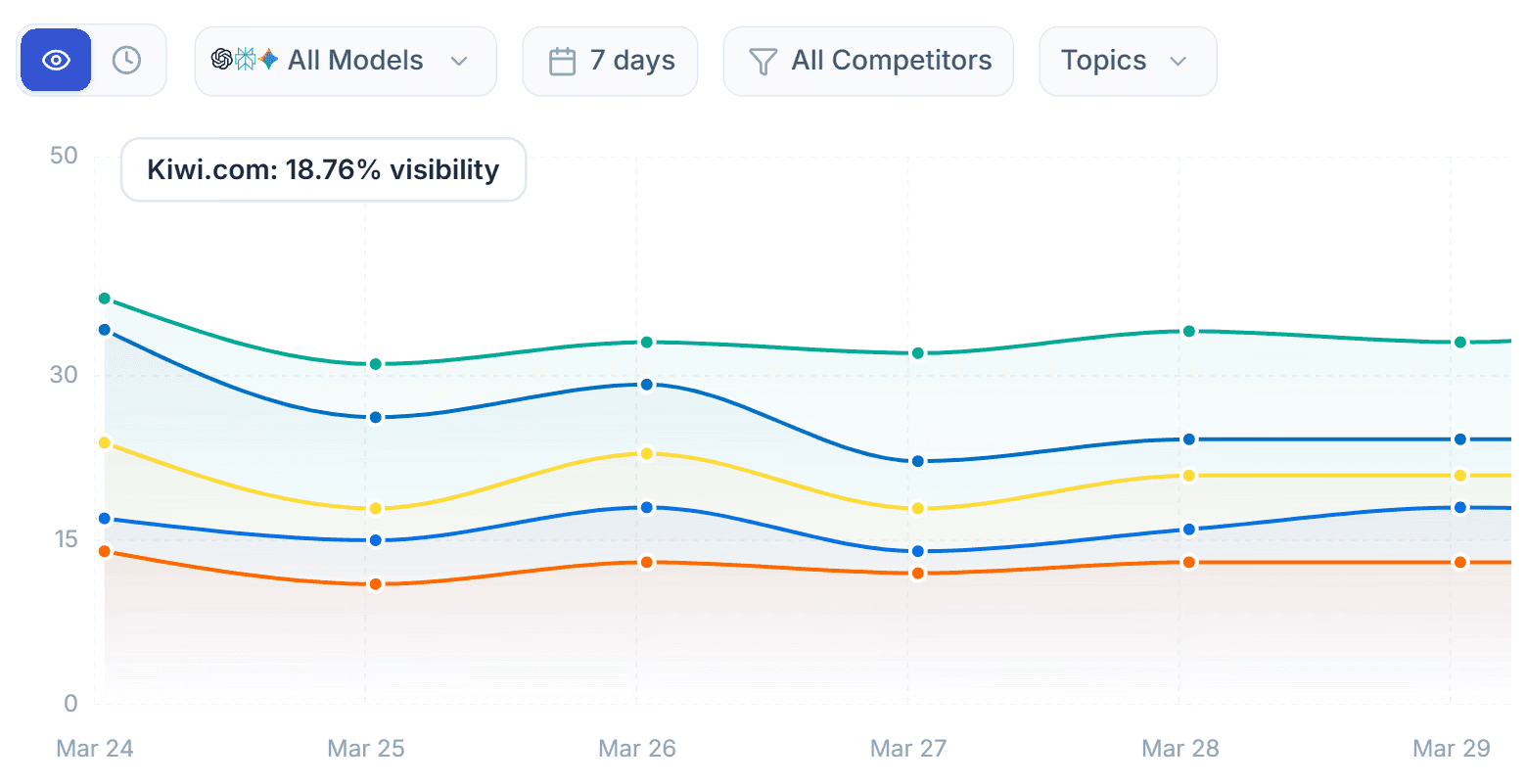
The Dashboard Your Dedicated AI Search Team Works In
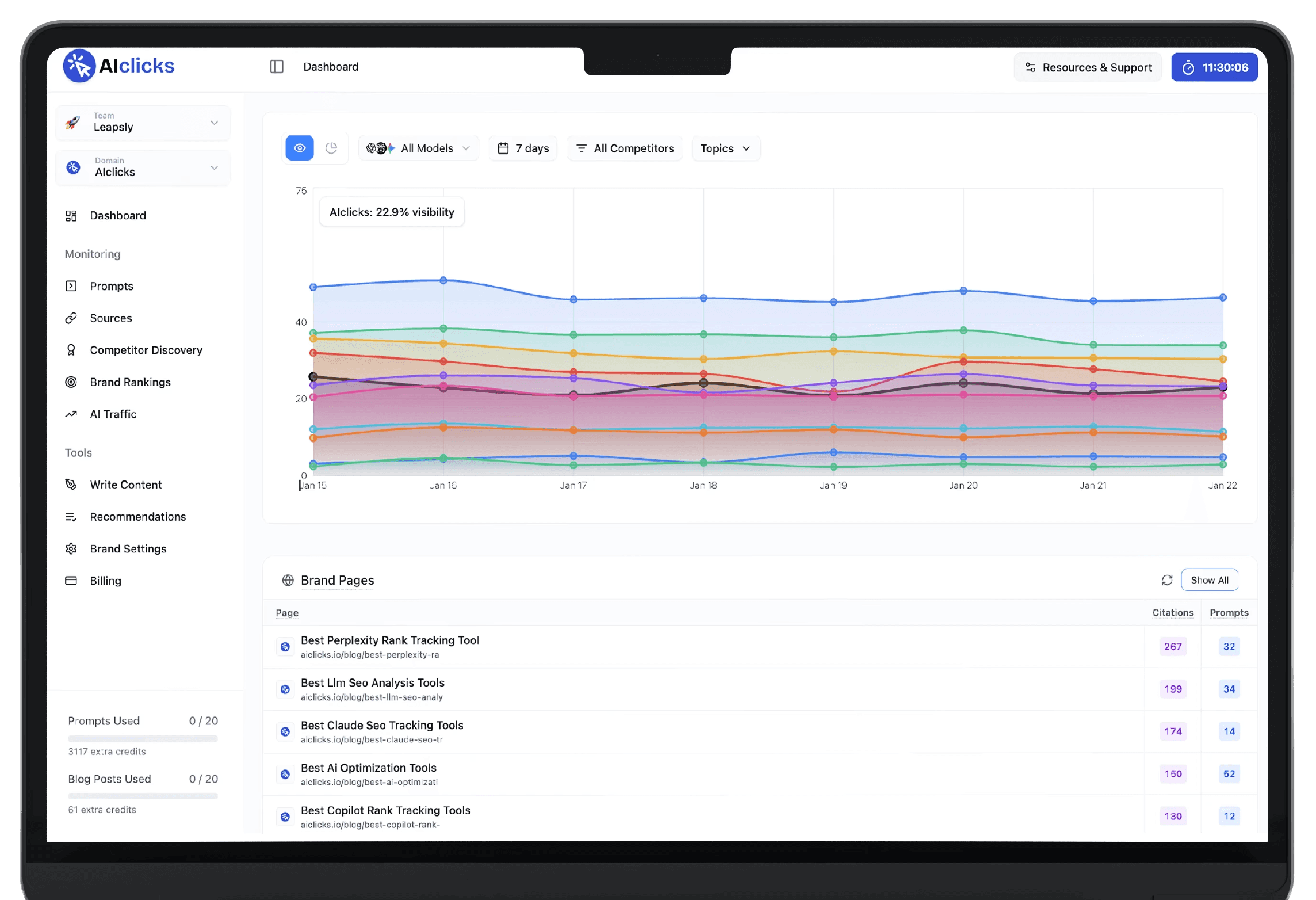
AIclicks gives you a live dashboard with daily ChatGPT mention rate, citation rate, sentiment, and share-of-voice across your tracked prompts, plus GA4 referral attribution for the traffic ChatGPT does send back.
Choose Your Plan
Flexible pricing that grows with your team. Upgrade or downgrade at any time.
Monthly
Yearly
-20%
Starter
Perfect for individuals & small teams
$49
/ month
Billed annually — you save $142
Choose 3 from:
Daily

" height="16px" id="fvSweaOBo" transform="translate(1 0)" width="14px"/></svg>)
" width="14px"><path d="M 13.864 5.629 L 13.3 5.629 L 13.3 5.6 L 7 5.6 L 7 8.4 L 10.956 8.4 C 10.379 10.03 8.828 11.2 7 11.2 C 4.681 11.2 2.8 9.319 2.8 7 C 2.8 4.681 4.681 2.8 7 2.8 C 8.071 2.8 9.045 3.204 9.786 3.864 L 11.766 1.884 C 10.516 0.719 8.844 0 7 0 C 3.134 0 0 3.134 0 7 C 0 10.866 3.134 14 7 14 C 10.866 14 14 10.866 14 7 C 14 6.531 13.952 6.073 13.864 5.629 Z" fill="rgb(255, 193, 7)" height="14px" id="H_YjfTNpn" width="14px"/><path d="M 0 3.742 L 2.3 5.429 C 2.922 3.888 4.429 2.8 6.193 2.8 C 7.264 2.8 8.238 3.204 8.979 3.864 L 10.959 1.884 C 9.709 0.719 8.037 0 6.193 0 C 3.504 0 1.172 1.518 0 3.742 Z" fill="rgb(255, 61, 0)" height="5.428500000000002px" id="PlkthQDhg" transform="translate(0.875 0)" width="10.959199999999996px"/><path d="M 6.232 5.581 C 8.04 5.581 9.683 4.889 10.925 3.764 L 8.758 1.931 C 8.032 2.483 7.144 2.782 6.232 2.781 C 4.411 2.781 2.865 1.62 2.283 0 L 0 1.759 C 1.159 4.026 3.511 5.581 6.232 5.581 Z" fill="rgb(76, 175, 80)" height="5.581099999999999px" id="WlnJ5gngE" transform="translate(0.7 8.4)" width="10.924899999999994px"/><path d="M 6.864 0.029 L 6.3 0.029 L 6.3 0 L 0 0 L 0 2.8 L 3.956 2.8 C 3.68 3.576 3.183 4.254 2.526 4.75 L 2.527 4.749 L 4.693 6.582 C 4.54 6.722 7 4.9 7 1.4 C 7 0.931 6.952 0.473 6.864 0.029 Z" fill="rgb(25, 118, 210)" height="6.589883930775992px" id="x_rSW275p" transform="translate(7 5.6)" width="7px"/></g></svg>)
" height="16px" id="hHS98fTxZ" width="16px"/></svg>)
 scale(1 1) translate(-1.861736945942159, -1.1170155383302638)" id="P20NzAvj0-699428820-radial-gradient" r="0.9935228066204626"><stop offset="0" stop-color="rgb(0, 174, 255)"/><stop offset="1" stop-color="rgb(7, 54, 196)"/></radialGradient><radialGradient cx="0.48250042504016705" cy="1.8366934653567062" gradient-transform="translate(0.48250042504016705, 1.8366934653567062) scale(1 1) translate(-0.48250042504016705, -1.8366934653567062)" id="UEWZqVjij-699428820-radial-gradient" r="0.9176890228114506"><stop offset="0" stop-color="rgb(255, 182, 87)"/><stop offset="1" stop-color="rgb(192, 43, 60)"/></radialGradient><linearGradient id="jyMN3TmKx-699428820-linear-gradient" x1="0.4594862532842614" x2="0.5405137467157386" y1="0" y2="1"><stop offset="0" stop-color="rgb(13, 145, 225)"/><stop offset="1" stop-color="rgb(255, 200, 0)"/></linearGradient><linearGradient id="xhMNwDFG0-699428820-linear-gradient" x1="0.4784828731548295" x2="0.5215171268451705" y1="5.551115123125783e-17" y2="1"><stop offset="0" stop-color="rgb(61, 203, 255)"/><stop offset="1" stop-color="rgba(5, 136, 247, 0)"/></linearGradient><radialGradient cx="1.4305090871482182" cy="0.34866158048251783" gradient-transform="translate(1.4305090871482182, 0.34866158048251783) scale(1 1) translate(-1.4305090871482182, -0.34866158048251783)" id="i79kAqaS4-699428820-radial-gradient" r="1.3362743412697924"><stop offset="0" stop-color="rgb(140, 72, 255)"/><stop offset="1" stop-color="rgb(255, 177, 82)"/></radialGradient><linearGradient id="mcxvno3tX-699428820-linear-gradient" x1="0.49844355920154226" x2="0.5015564407984577" y1="0" y2="1"><stop offset="0" stop-color="rgb(248, 173, 250)"/><stop offset="1" stop-color="rgba(168, 110, 221, 0)"/></linearGradient></defs><g d="M 11.605 1.219 C 11.397 0.499 10.739 0.002 9.989 0 L 9.498 0 C 8.682 0.002 7.985 0.588 7.842 1.391 L 7 6.016 L 7.209 5.296 C 7.416 4.574 8.075 4.076 8.825 4.074 L 11.681 4.074 L 12.879 4.545 L 14.033 4.074 L 13.697 4.074 C 12.947 4.072 12.289 3.575 12.081 2.855 Z M 4.413 13.387 C 4.618 14.111 5.278 14.611 6.031 14.613 L 7.075 14.613 C 7.988 14.613 8.735 13.88 8.758 12.96 L 8.871 8.5 L 8.633 9.319 C 8.426 10.039 7.768 10.537 7.018 10.539 L 4.138 10.539 L 3.111 9.977 L 2 10.539 L 2.331 10.539 C 3.084 10.542 3.743 11.042 3.949 11.766 L 4.413 13.387 Z M 9.999 0 L 4.167 0 C 2.501 0 1.501 2.221 0.834 4.441 C 0.045 7.073 -0.989 10.591 2.001 10.591 L 4.519 10.591 C 5.273 10.591 5.933 10.089 6.139 9.36 C 6.577 7.815 7.345 5.121 7.948 3.069 C 8.255 2.027 8.509 1.132 8.901 0.575 C 9.148 0.212 9.56 -0.004 9.999 0 M 9.999 0 L 4.167 0 C 2.501 0 1.501 2.221 0.834 4.441 C 0.045 7.073 -0.989 10.591 2.001 10.591 L 4.519 10.591 C 5.273 10.591 5.933 10.089 6.139 9.36 C 6.577 7.815 7.345 5.121 7.948 3.069 C 8.255 2.027 8.509 1.132 8.901 0.575 C 9.148 0.212 9.56 -0.004 9.999 0 M 6 14.593 L 11.833 14.593 C 13.499 14.593 14.499 12.372 15.166 10.151 C 15.955 7.519 16.989 4 13.999 4 L 11.48 4 C 10.725 4.002 10.063 4.505 9.86 5.232 C 9.266 7.332 8.663 9.429 8.051 11.523 C 7.745 12.566 7.49 13.461 7.098 14.019 C 6.851 14.382 6.439 14.597 6 14.593 M 6 14.593 L 11.833 14.593 C 13.499 14.593 14.499 12.372 15.166 10.151 C 15.955 7.519 16.989 4 13.999 4 L 11.48 4 C 10.725 4.002 10.063 4.505 9.86 5.232 C 9.266 7.332 8.663 9.429 8.051 11.523 C 7.745 12.566 7.49 13.461 7.098 14.019 C 6.851 14.382 6.439 14.597 6 14.593" fill="transparent" height="14.613333333333333px" id="QzkBy4Ibc" transform="translate(0 1)" width="16.00011071294081px"><path d="M 4.605 1.219 C 4.397 0.499 3.739 0.002 2.989 0 L 2.498 0 C 1.682 0.002 0.985 0.588 0.842 1.391 L 0 6.016 L 0.209 5.296 C 0.416 4.574 1.075 4.076 1.825 4.074 L 4.681 4.074 L 5.879 4.545 L 7.033 4.074 L 6.697 4.074 C 5.947 4.072 5.289 3.575 5.081 2.855 Z" fill="url(%23P20NzAvj0-699428820-radial-gradient)" height="6.016px" id="P20NzAvj0" transform="translate(7 0)" width="7.0333333333333385px"/><path d="M 2.413 4.887 C 2.618 5.611 3.278 6.111 4.031 6.113 L 5.075 6.113 C 5.988 6.113 6.735 5.38 6.758 4.46 L 6.871 0 L 6.633 0.819 C 6.426 1.539 5.768 2.037 5.018 2.039 L 2.138 2.039 L 1.111 1.477 L 0 2.039 L 0.331 2.039 C 1.084 2.042 1.743 2.542 1.949 3.266 L 2.413 4.887 Z" fill="url(%23UEWZqVjij-699428820-radial-gradient)" height="6.113333333333333px" id="UEWZqVjij" transform="translate(2 8.5)" width="6.871333333333332px"/><path d="M 9.999 0 L 4.167 0 C 2.501 0 1.501 2.221 0.834 4.441 C 0.045 7.073 -0.989 10.591 2.001 10.591 L 4.519 10.591 C 5.273 10.591 5.933 10.089 6.139 9.36 C 6.577 7.815 7.345 5.121 7.948 3.069 C 8.255 2.027 8.509 1.132 8.901 0.575 C 9.148 0.212 9.56 -0.004 9.999 0" fill="url(%23jyMN3TmKx-699428820-linear-gradient)" height="10.591388755215167px" id="jyMN3TmKx" width="9.999444046274142px"/><path d="M 9.999 0 L 4.167 0 C 2.501 0 1.501 2.221 0.834 4.441 C 0.045 7.073 -0.989 10.591 2.001 10.591 L 4.519 10.591 C 5.273 10.591 5.933 10.089 6.139 9.36 C 6.577 7.815 7.345 5.121 7.948 3.069 C 8.255 2.027 8.509 1.132 8.901 0.575 C 9.148 0.212 9.56 -0.004 9.999 0" fill="url(%23xhMNwDFG0-699428820-linear-gradient)" height="10.591388755215167px" id="xhMNwDFG0" width="9.999444046274142px"/><path d="M 0 10.593 L 5.833 10.593 C 7.499 10.593 8.499 8.372 9.166 6.151 C 9.955 3.519 10.989 0 7.999 0 L 5.48 0 C 4.725 0.002 4.063 0.505 3.86 1.232 C 3.266 3.332 2.663 5.429 2.051 7.523 C 1.745 8.566 1.49 9.461 1.098 10.019 C 0.851 10.382 0.439 10.597 0 10.593" fill="url(%23i79kAqaS4-699428820-radial-gradient)" height="10.593388755215164px" id="i79kAqaS4" transform="translate(6 4)" width="10.000110712940803px"/><path d="M 0 10.593 L 5.833 10.593 C 7.499 10.593 8.499 8.372 9.166 6.151 C 9.955 3.519 10.989 0 7.999 0 L 5.48 0 C 4.725 0.002 4.063 0.505 3.86 1.232 C 3.266 3.332 2.663 5.429 2.051 7.523 C 1.745 8.566 1.49 9.461 1.098 10.019 C 0.851 10.382 0.439 10.597 0 10.593" fill="url(%23mcxvno3tX-699428820-linear-gradient)" height="10.593388755215164px" id="mcxvno3tX" transform="translate(6 4)" width="10.000110712940803px"/></g></svg>)
" height="15.360666565427872px" id="HZPvvPBv7" transform="translate(0 0.5)" width="16px"/></svg>)
Tracked prompts
30
Websites you can add
3
LLMs you can track
3
Countries per project
1
LLM responses / mo
4,650
AI-optimized articles per month
10
Integrations
-
Support
Pro
For growing teams for more power
$140
/ month
Billed annually — you save $454
Choose 4 from:
Daily
Tracked prompts
150
Websites you can add
Unlimited
LLMs you can track
4
Countries per project
Unlimited
LLM responses / mo
18,600
AI-optimized articles per month
20
Integrations
Google Analytics
Support
BUSINESS
Best for medium-sized organizations
$357
/ month
Billed annually — you save $1198
Choose 6 from:
Daily
Tracked prompts
300
Websites you can add
Unlimited
LLMs you can track
6
Countries per project
Unlimited
LLM responses / mo
55,800
AI-optimized articles per month
30
Integrations
Google Analytics, API
Support
Dedicated account specialist
Become the #1 Answer in AI
Succeed in GEO yourself, or let us do all the work.
Do it yourself
Use AIclicks to see exactly where you appear across 10+ AI platforms, spot the gaps competitors are filling, and act on clear weekly recommendations.
From $59/month · Cancel anytime
Done for you
We Do All the Work for You
Our team manages your complete search presence: traditional SEO and GEO strategy, content, implementation, and reporting. You focus on injured clients.
Custom pricing · Minimum 3-month engagement
The AI SEO agency trusted by 1,000+ brands worldwide
From solo founders to multi-client agencies, AIclicks runs the full AI SEO agency program for organizations of every shape and size that want to be cited across every AI surface.
4.9/5 stars on G2





FAQ
How long before SEO brings in signed cases?
Expect map pack movement in 4 to 6 months and reliable signed case volume between 9 and 12. Personal injury agencies publish case studies showing meaningful return at 12 to 18 months, and in a large metro against firms with 10-year link profiles it takes longer still. Narrow case types like dog bites or nursing home neglect move much faster than car accident head terms. Nobody ranks a new injury site in 90 days.
Should we chase Google rankings or AI answers?
Both, but AI is where injury research now starts. Ahrefs analysed 863,000 keywords and found only 38% of pages cited in AI Overviews also ranked in the top 10, down from 76% a year earlier. The questions that used to feed your funnel, what a claim is worth, what percentage a lawyer takes, how long you have to file, are answered above the results now. Being quotable matters as much as ranking.
What makes personal injury SEO different from local SEO?
Three things set it apart. Your competitors are not corner businesses, they are national advertisers spending 7 figures a month plus directories with 20 years of links. Your content sits in YMYL, so Google wants named, credentialed authors before it ranks a claim about compensation. And your state’s advertising rules dictate how results may be described, which means half the copy that ranks in other trades would put you in front of a disciplinary board.
What does personal injury SEO actually cost per month?
Published retainers typically run $3,000 to $7,500 monthly for one office in a mid-size market, $8,000 to $15,000 to compete seriously in a large metro, and well beyond that for multi-state firms. Judge it against what a signed case costs you today, not against zero. When injury clicks clear $200 and Local Services Ads leads run $150 to $300, an asset that lowers acquisition cost every year is the cheaper column.
Is Google Ads or SEO better for a PI practice?
Run both, and add Local Services Ads first if you are starting from nothing. LSAs put you in the Google Screened block above everything, charge per lead rather than per click, and require only a background check and licence verification. Ads buy this month’s cases at a price that never improves. SEO lowers the price of every case after it. Most firms use ad conversion data to decide which case-type page to build next.
Which pages should a new injury firm build first?
Claim the Google Business Profile before anything else; it costs nothing and outranks your own homepage. Then build one proper page for the case type you most want more of, with real verdicts on it. Then the fee page, since that question decides who gets called. Then attorney bios carrying your credentials, then the deadline and comparative fault explainers. City pages come later, and the accident news blog probably never.
What should we measure to prove SEO is working?
Signed cases by source, and case value by source. Rankings and traffic tell you nothing about whether the files are worth taking. Put unique tracking numbers on the profile, the site and any directory listing, record intake calls, and tag every form by landing page. Then reconcile monthly against your case management system: retainers signed, case types signed, and average fee per signed file. An agency reporting traffic without those columns is hiding.
Should we hire an agency or do this in-house?
Divide it by who owns the knowledge. Keep profile posts, review requests and intake inside the firm, since an outside vendor never learns your case mix and never answers the phone at midnight. Outsource technical work, schema and link building. If you hire out, ask for 3 current injury clients in markets like yours and call them, then ask who actually writes the content, whether AI produces it, and whether you keep the site and domain when you leave.
Further Reading
Go deeper on GEO, AI search, and visibility tracking.