SEO for Optometry Practices:
Someone whose vision has slipped opens their phone, checks which practices take their vision plan, reads the reviews, and books with whoever answers first. Most of that happens on Google Maps and in an AI answer, long before your front desk hears anything.









Why Optometry Practices Need SEO
Roughly 3 in 4 patients research a healthcare provider online before booking, and eye care is almost entirely a local search. The results they see now include an AI answer nobody is tracking.
Dry eye, myopia management, scleral lenses and vision therapy are the highest-margin work in the practice, and most sites bury all 4 in a bulleted list on one services page. A parent searching for myopia control finds the practice 30 minutes away that wrote the page. You never learn the enquiry existed.
Search eye doctor near me in a US city and the first organic result is VSP, with the American Optometric Association directory below it. Both aggregate tens of thousands of providers, so no practice can match their authority. You appear inside their locator, filtered by plan, beside every rival in town.
Optometry SEO is sold cheap. Practices sign at $300 to $500 a month, get title-tag edits and a monthly blog about sunglasses, and cancel after a year with nothing at all to show. Competing properly typically runs $1,500 to $3,000 a month. The cheap version costs less and builds nothing that you keep.
How SEO Works for Optometry Practices
Search Engine Optimization projects are long-term investments for optometrists, where each task supplements the others and creates compound results over time.
01
Keywords, page structure, and the signals Google reads directly
On-page work is awkward in optometry because the practice is 2 businesses sharing one website. One half is medical: comprehensive exams, glaucoma monitoring, diabetic retinopathy screening, dry eye. The other half is retail: frames, lenses, contact lens supply. Patients search for them in completely different language, and Google treats the medical half as YMYL, applying its strictest quality bar. The pages that carry the practice are one per medical service, one per specialty, and the new patient page. The optical shop needs its own section entirely. Most sites blend both into a single services page that ranks for neither.
The durable pages are the ones tied to a condition or a decision rather than a season. An honest page on what a comprehensive eye exam costs without insurance, or how myopia management actually slows progression in children, will still be booking appointments in 4 years. What churns is everything dated: the frame trunk show, the new lens technology announcement, the back-to-school promotion that expired in September. Those quietly become most of a practice blog and none of them rank after 6 weeks. Write fewer pages, about conditions and costs rather than events, and revisit the prices on them annually.
1
Split the services page into one page per condition: dry eye treatment, myopia management, scleral lens fitting, diabetic eye exam.
2
Unpublish last season’s frame promotions and discontinued lens brand pages, redirecting each into the optical or service page that replaced it.
3
Mark the practice up as Optician plus MedicalClinic, each optometrist as Physician with medicalSpecialty, then validate in Google’s Rich Results Test.
4
Publish an explainer for every condition you treat: keratoconus, computer vision syndrome, amblyopia, glaucoma monitoring. They rank all year, independent of promotions.
02
Map Pack visibility, citations, and proximity signals
Nobody drives across the state for a routine eye exam. Patients choose from what is close, in network and well reviewed, which makes the 3-result map pack the most valuable position in optometry. It sits above VSP, above the association directory, above everything, and it is the one place a single-location practice genuinely outranks a national network. Ranking there comes down to proximity, profile completeness and review volume.
Set the primary category to Optometrist rather than Eye Care Center, then add Contact Lens Supplier and Optician as secondaries if you dispense. List every vision plan you accept in the services and description fields, because patients filter by plan before anything else. Photograph the exam lanes, the frame boards and the actual doctors. Pre-answer the questions that decide bookings in Q&A: exam cost without insurance, walk-in availability, whether you see toddlers.
Optometry has a citation layer general local SEO never mentions. The vision plan locators matter most: VSP, EyeMed, Davis Vision, Superior Vision, and every plan on your accepted list. Then the professional layer: the AOA doctor locator, your state optometric association, Healthgrades, Vitals and Zocdoc. Specialty registries pull their own weight, including the COVD locator for vision therapy and manufacturer fitter finders for ortho-k and scleral lenses. Every listing needs the identical practice name, suite and phone.
1
Choose Optometrist as the primary category, list every accepted vision plan as a service, and upload real exam lane and frame board photos.
2
Run a separate profile and a separate location page per office, each naming the optometrists who actually work that schedule.
3
Audit your entry in every vision plan portal you accept, plus the AOA locator and Healthgrades, with Whitespark or BrightLocal tracking variants.
4
Post to the profile weekly: a new frame line, an open Saturday slot, a plain answer to a question the front desk keeps fielding.
03
Topic authority, inbound links, and content that earns traffic
Before booking, patients are working out 3 things: whether their symptom is serious, whether their plan covers the visit, and what it costs if it does not. Content that answers those plainly beats anything written to rank. A page on what a comprehensive exam costs without insurance, or when blurry vision warrants an appointment rather than a new prescription, earns trust at the moment someone decides who to call.
Someone who has decided they need scleral lenses or a myopia program is now choosing a provider, and they want evidence. Name the optometrist who runs that clinic and what they are certified in, show the topographer and the fitting process, publish the fee and what the plan typically covers, and say how many visits the fitting takes. Put it on the specialty page, not 3 clicks away in a PDF.
Optometry links are mostly professional and civic. Optometry schools list alumni and preceptors. State association committee pages, the AOA and specialty bodies like COVD and the Scleral Lens Education Society publish member listings. Ophthalmology practices you co-manage cataract and LASIK patients with should be linking both ways. Then the local layer: school vision screenings, sports teams whose mouthguard and sports-goggle sponsor you are, and the charity glasses drives that publish sponsor pages nobody claims.
1
Publish a yearly guide to what an eye exam, glasses and contacts cost with and without vision coverage, updated each January.
2
Build one specialty page per town you draw from, with real drive times and parking detail, rather than the place name swapped in.
3
Build one hub covering accepted plans, FSA and HSA eligibility, CareCredit financing, exam pricing without coverage, and when medical insurance pays instead.
4
Write a page for every technology and brand you fit, such as MiSight, Optomap, Paragon CRT or Zeiss lenses, since patients search brands first.
04
Site speed, crawlability, Core Web Vitals, and mobile health
The failure specific to optometry is the optical shop bolted onto the site. Practices switch on a frames catalog fed from a manufacturer feed, and it generates thousands of near-identical product URLs, faceted by brand, color, size and material, all of them duplicated across every other practice using the same feed. Crawl budget goes there instead of your service pages. Meanwhile the booking widget sits in an iframe Google never reads, so your most important page has almost no indexable text.
Eye care searches skew older and they happen on a phone held at arm’s length. A patient who cannot read your hours without pinching, or who taps a phone number rendered as an image, leaves. The heaviest thing on most practice sites is a full-width hero video of a slit lamp exam plus an unoptimized frame gallery. Text below 16 pixels and tap targets under 48 pixels are the 2 mobile usability failures Search Console flags most on these sites.
1
Crawl the site with Screaming Frog, then noindex faceted frame URLs and canonicalize duplicate product pages fed from the manufacturer catalog.
2
Run PageSpeed Insights on the appointment page and replace the iframe scheduler with a linked booking flow carrying real headings and text.
3
Serve frame and eyewear photography as WebP at display size with lazy loading, and set explicit dimensions so the gallery stops shifting layout.
4
Keep service and location URLs in a sitemap separate from the frames catalog, and resubmit whenever accepted plans or doctors change.
05
Star ratings, review volume, and response strategy that builds trust
Reviews decide the map pack in optometry, and the practice with 400 of them beats the practice with 40 almost regardless of anything else. Collecting them is awkward here. The visit ends at the optical counter arguing about what the plan covers, which is the worst possible moment to ask. Recall cycles run 12 to 24 months, so a happy patient forgets you long before you next see them. The motivated writers are the ones billed unexpectedly.
The moment that works is glasses pickup, not the exam. The patient has just put on lenses that let them read a menu again, they are pleased, and they are already holding their phone. Trigger the request there from Weave, Solutionreach or your practice management system, sent by the optician who fitted them rather than the practice. Ask contact lens patients at supply reorder too, since that is your highest-frequency touchpoint.
1
Fire the review request from Weave or RevolutionEHR when the job is marked collected, signed by the optician who did the fitting.
2
Answer negative reviews the same day, addressing the process rather than the person, because naming anyone as a patient is a HIPAA breach.
3
Place dry eye reviews on the dry eye page and myopia reviews on the myopia page, not in a site-wide testimonial slider.
4
Collect reviews for the dispensary separately, asking about frame selection and lens advice, because eyewear buyers write differently to exam patients.
Google is No Longer the Only Place Your patients are Searching
Patients are using AI to find answers, and they trust what it tells them. Invest in GEO to get recommended in those answers.
1 Billion
Questions ChatGPT receives every single day
38%
Your #1 top ranking page on Google would be cited by AI
14%
of optometrists optimise for GEO. The rest are invisible in AI answers


You can rank #1 for “optometrist near me” and still not exist in ChatGPT’s answer. Run a free GEO audit to see where your brand actually stands.
GEO vs SEO: Same Goal, Different Methods
GEO is wider than SEO. AI recommends the brands that show up across the sources it reads, so your presence in forums, social platforms and optometric blogs decides your odds. AIclicks measures the three metrics below so you know which to work on first.
AI Assistant
Where should I go for dry eye treatment?
Your Optometry Practice
Citation Rate
Shows how many AI answers about optometry practices name your brand, out of every 100. Models pull from the same trusted pages over and over, so citations compound: once you are in, staying in gets easier. Find the competitor pages AI cites most, then publish your own version of each.
Your Optometry Practice
82% positive
Competitor A
54% positive
Competitor B
38% positive
Brand Sentiment
Shows how AI describes you when your brand comes up: positive, neutral or negative. Tone is what separates being mentioned from being recommended, and models repeat whatever framing they find. Track the negative mentions back to the reviews and threads behind them, then publish content that answers those directly.
Others 52%
You 24%
— 24%
Your Optometry Practice
AI mention share of voice — optometric category
Competitors
Not Cited
Share of Voice in AI
Shows how much of the optometric conversation belongs to you rather than your competitors. This is the metric that matters most, the GEO version of a Google ranking. With only 1–5 brands named per answer, the market is winner-takes-more and every point is taken from someone.
The Dashboard Your Dedicated AI Search Team Works In
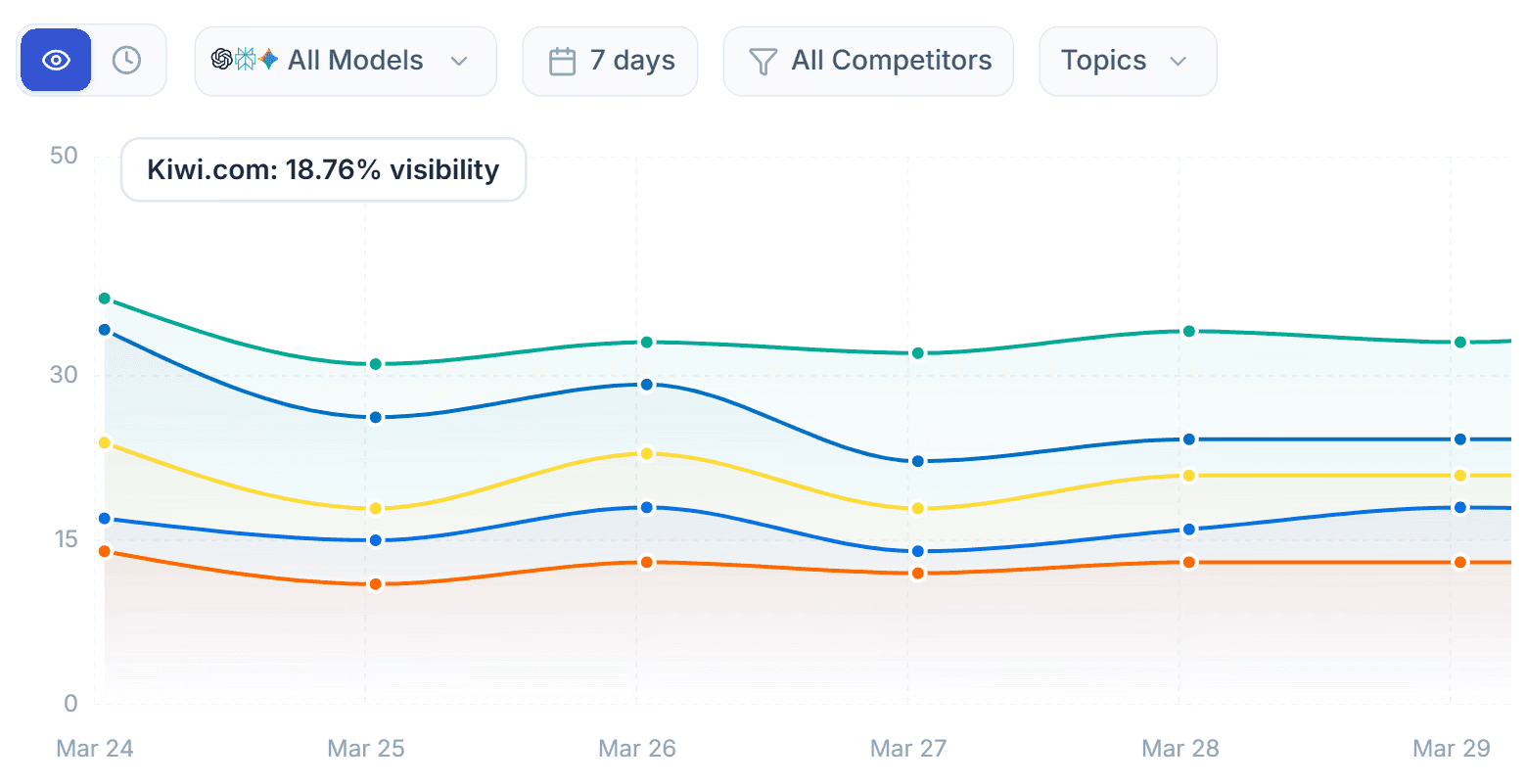
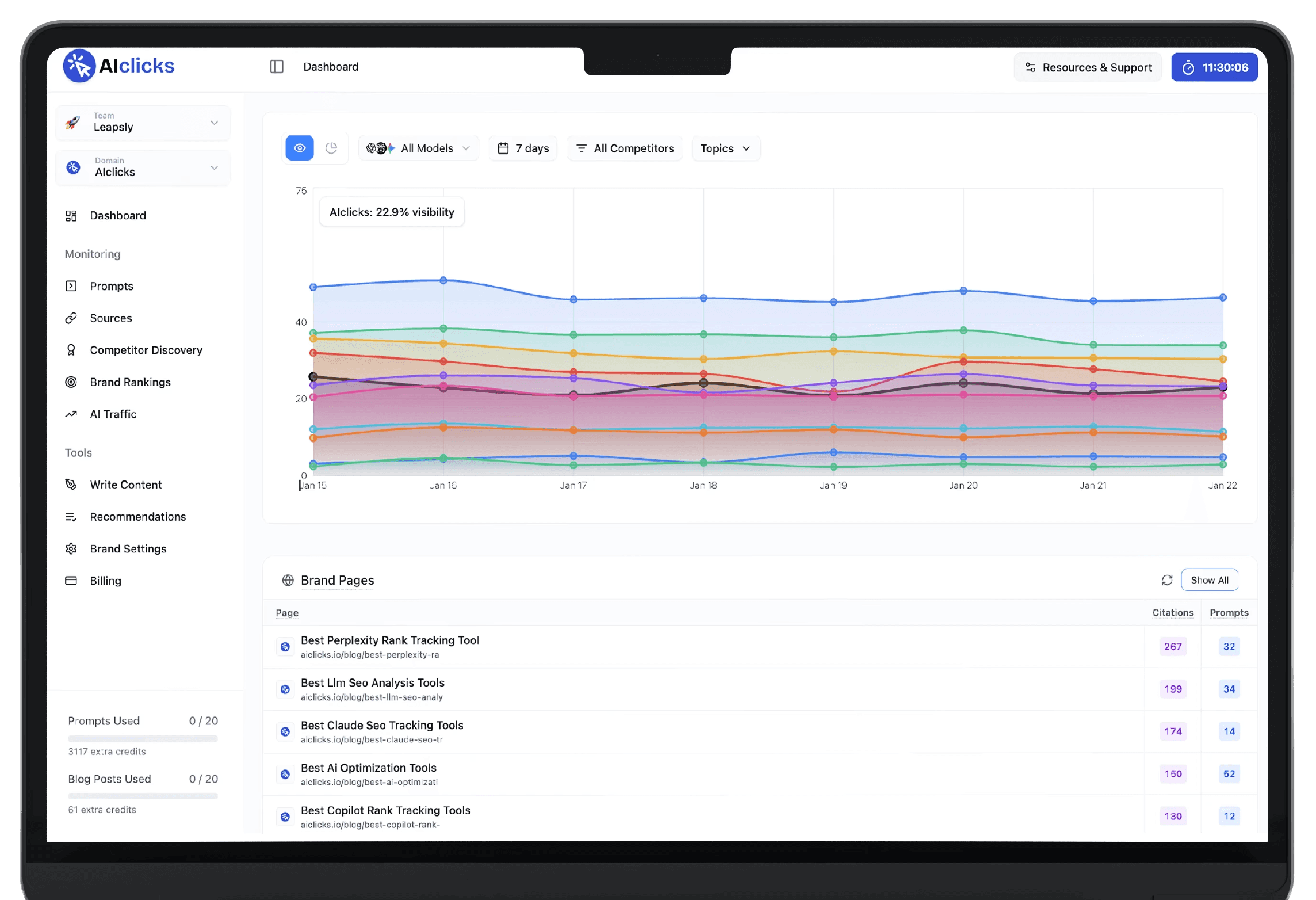
AIclicks gives you a live dashboard with daily ChatGPT mention rate, citation rate, sentiment, and share-of-voice across your tracked prompts, plus GA4 referral attribution for the traffic ChatGPT does send back.
Choose Your Plan
Flexible pricing that grows with your team. Upgrade or downgrade at any time.
Monthly
Yearly
-20%
Starter
Perfect for individuals & small teams
$49
/ month
Billed annually — you save $142
Choose 3 from:
Daily

" height="16px" id="fvSweaOBo" transform="translate(1 0)" width="14px"/></svg>)
" width="14px"><path d="M 13.864 5.629 L 13.3 5.629 L 13.3 5.6 L 7 5.6 L 7 8.4 L 10.956 8.4 C 10.379 10.03 8.828 11.2 7 11.2 C 4.681 11.2 2.8 9.319 2.8 7 C 2.8 4.681 4.681 2.8 7 2.8 C 8.071 2.8 9.045 3.204 9.786 3.864 L 11.766 1.884 C 10.516 0.719 8.844 0 7 0 C 3.134 0 0 3.134 0 7 C 0 10.866 3.134 14 7 14 C 10.866 14 14 10.866 14 7 C 14 6.531 13.952 6.073 13.864 5.629 Z" fill="rgb(255, 193, 7)" height="14px" id="H_YjfTNpn" width="14px"/><path d="M 0 3.742 L 2.3 5.429 C 2.922 3.888 4.429 2.8 6.193 2.8 C 7.264 2.8 8.238 3.204 8.979 3.864 L 10.959 1.884 C 9.709 0.719 8.037 0 6.193 0 C 3.504 0 1.172 1.518 0 3.742 Z" fill="rgb(255, 61, 0)" height="5.428500000000002px" id="PlkthQDhg" transform="translate(0.875 0)" width="10.959199999999996px"/><path d="M 6.232 5.581 C 8.04 5.581 9.683 4.889 10.925 3.764 L 8.758 1.931 C 8.032 2.483 7.144 2.782 6.232 2.781 C 4.411 2.781 2.865 1.62 2.283 0 L 0 1.759 C 1.159 4.026 3.511 5.581 6.232 5.581 Z" fill="rgb(76, 175, 80)" height="5.581099999999999px" id="WlnJ5gngE" transform="translate(0.7 8.4)" width="10.924899999999994px"/><path d="M 6.864 0.029 L 6.3 0.029 L 6.3 0 L 0 0 L 0 2.8 L 3.956 2.8 C 3.68 3.576 3.183 4.254 2.526 4.75 L 2.527 4.749 L 4.693 6.582 C 4.54 6.722 7 4.9 7 1.4 C 7 0.931 6.952 0.473 6.864 0.029 Z" fill="rgb(25, 118, 210)" height="6.589883930775992px" id="x_rSW275p" transform="translate(7 5.6)" width="7px"/></g></svg>)
" height="16px" id="hHS98fTxZ" width="16px"/></svg>)
 scale(1 1) translate(-1.861736945942159, -1.1170155383302638)" id="P20NzAvj0-699428820-radial-gradient" r="0.9935228066204626"><stop offset="0" stop-color="rgb(0, 174, 255)"/><stop offset="1" stop-color="rgb(7, 54, 196)"/></radialGradient><radialGradient cx="0.48250042504016705" cy="1.8366934653567062" gradient-transform="translate(0.48250042504016705, 1.8366934653567062) scale(1 1) translate(-0.48250042504016705, -1.8366934653567062)" id="UEWZqVjij-699428820-radial-gradient" r="0.9176890228114506"><stop offset="0" stop-color="rgb(255, 182, 87)"/><stop offset="1" stop-color="rgb(192, 43, 60)"/></radialGradient><linearGradient id="jyMN3TmKx-699428820-linear-gradient" x1="0.4594862532842614" x2="0.5405137467157386" y1="0" y2="1"><stop offset="0" stop-color="rgb(13, 145, 225)"/><stop offset="1" stop-color="rgb(255, 200, 0)"/></linearGradient><linearGradient id="xhMNwDFG0-699428820-linear-gradient" x1="0.4784828731548295" x2="0.5215171268451705" y1="5.551115123125783e-17" y2="1"><stop offset="0" stop-color="rgb(61, 203, 255)"/><stop offset="1" stop-color="rgba(5, 136, 247, 0)"/></linearGradient><radialGradient cx="1.4305090871482182" cy="0.34866158048251783" gradient-transform="translate(1.4305090871482182, 0.34866158048251783) scale(1 1) translate(-1.4305090871482182, -0.34866158048251783)" id="i79kAqaS4-699428820-radial-gradient" r="1.3362743412697924"><stop offset="0" stop-color="rgb(140, 72, 255)"/><stop offset="1" stop-color="rgb(255, 177, 82)"/></radialGradient><linearGradient id="mcxvno3tX-699428820-linear-gradient" x1="0.49844355920154226" x2="0.5015564407984577" y1="0" y2="1"><stop offset="0" stop-color="rgb(248, 173, 250)"/><stop offset="1" stop-color="rgba(168, 110, 221, 0)"/></linearGradient></defs><g d="M 11.605 1.219 C 11.397 0.499 10.739 0.002 9.989 0 L 9.498 0 C 8.682 0.002 7.985 0.588 7.842 1.391 L 7 6.016 L 7.209 5.296 C 7.416 4.574 8.075 4.076 8.825 4.074 L 11.681 4.074 L 12.879 4.545 L 14.033 4.074 L 13.697 4.074 C 12.947 4.072 12.289 3.575 12.081 2.855 Z M 4.413 13.387 C 4.618 14.111 5.278 14.611 6.031 14.613 L 7.075 14.613 C 7.988 14.613 8.735 13.88 8.758 12.96 L 8.871 8.5 L 8.633 9.319 C 8.426 10.039 7.768 10.537 7.018 10.539 L 4.138 10.539 L 3.111 9.977 L 2 10.539 L 2.331 10.539 C 3.084 10.542 3.743 11.042 3.949 11.766 L 4.413 13.387 Z M 9.999 0 L 4.167 0 C 2.501 0 1.501 2.221 0.834 4.441 C 0.045 7.073 -0.989 10.591 2.001 10.591 L 4.519 10.591 C 5.273 10.591 5.933 10.089 6.139 9.36 C 6.577 7.815 7.345 5.121 7.948 3.069 C 8.255 2.027 8.509 1.132 8.901 0.575 C 9.148 0.212 9.56 -0.004 9.999 0 M 9.999 0 L 4.167 0 C 2.501 0 1.501 2.221 0.834 4.441 C 0.045 7.073 -0.989 10.591 2.001 10.591 L 4.519 10.591 C 5.273 10.591 5.933 10.089 6.139 9.36 C 6.577 7.815 7.345 5.121 7.948 3.069 C 8.255 2.027 8.509 1.132 8.901 0.575 C 9.148 0.212 9.56 -0.004 9.999 0 M 6 14.593 L 11.833 14.593 C 13.499 14.593 14.499 12.372 15.166 10.151 C 15.955 7.519 16.989 4 13.999 4 L 11.48 4 C 10.725 4.002 10.063 4.505 9.86 5.232 C 9.266 7.332 8.663 9.429 8.051 11.523 C 7.745 12.566 7.49 13.461 7.098 14.019 C 6.851 14.382 6.439 14.597 6 14.593 M 6 14.593 L 11.833 14.593 C 13.499 14.593 14.499 12.372 15.166 10.151 C 15.955 7.519 16.989 4 13.999 4 L 11.48 4 C 10.725 4.002 10.063 4.505 9.86 5.232 C 9.266 7.332 8.663 9.429 8.051 11.523 C 7.745 12.566 7.49 13.461 7.098 14.019 C 6.851 14.382 6.439 14.597 6 14.593" fill="transparent" height="14.613333333333333px" id="QzkBy4Ibc" transform="translate(0 1)" width="16.00011071294081px"><path d="M 4.605 1.219 C 4.397 0.499 3.739 0.002 2.989 0 L 2.498 0 C 1.682 0.002 0.985 0.588 0.842 1.391 L 0 6.016 L 0.209 5.296 C 0.416 4.574 1.075 4.076 1.825 4.074 L 4.681 4.074 L 5.879 4.545 L 7.033 4.074 L 6.697 4.074 C 5.947 4.072 5.289 3.575 5.081 2.855 Z" fill="url(%23P20NzAvj0-699428820-radial-gradient)" height="6.016px" id="P20NzAvj0" transform="translate(7 0)" width="7.0333333333333385px"/><path d="M 2.413 4.887 C 2.618 5.611 3.278 6.111 4.031 6.113 L 5.075 6.113 C 5.988 6.113 6.735 5.38 6.758 4.46 L 6.871 0 L 6.633 0.819 C 6.426 1.539 5.768 2.037 5.018 2.039 L 2.138 2.039 L 1.111 1.477 L 0 2.039 L 0.331 2.039 C 1.084 2.042 1.743 2.542 1.949 3.266 L 2.413 4.887 Z" fill="url(%23UEWZqVjij-699428820-radial-gradient)" height="6.113333333333333px" id="UEWZqVjij" transform="translate(2 8.5)" width="6.871333333333332px"/><path d="M 9.999 0 L 4.167 0 C 2.501 0 1.501 2.221 0.834 4.441 C 0.045 7.073 -0.989 10.591 2.001 10.591 L 4.519 10.591 C 5.273 10.591 5.933 10.089 6.139 9.36 C 6.577 7.815 7.345 5.121 7.948 3.069 C 8.255 2.027 8.509 1.132 8.901 0.575 C 9.148 0.212 9.56 -0.004 9.999 0" fill="url(%23jyMN3TmKx-699428820-linear-gradient)" height="10.591388755215167px" id="jyMN3TmKx" width="9.999444046274142px"/><path d="M 9.999 0 L 4.167 0 C 2.501 0 1.501 2.221 0.834 4.441 C 0.045 7.073 -0.989 10.591 2.001 10.591 L 4.519 10.591 C 5.273 10.591 5.933 10.089 6.139 9.36 C 6.577 7.815 7.345 5.121 7.948 3.069 C 8.255 2.027 8.509 1.132 8.901 0.575 C 9.148 0.212 9.56 -0.004 9.999 0" fill="url(%23xhMNwDFG0-699428820-linear-gradient)" height="10.591388755215167px" id="xhMNwDFG0" width="9.999444046274142px"/><path d="M 0 10.593 L 5.833 10.593 C 7.499 10.593 8.499 8.372 9.166 6.151 C 9.955 3.519 10.989 0 7.999 0 L 5.48 0 C 4.725 0.002 4.063 0.505 3.86 1.232 C 3.266 3.332 2.663 5.429 2.051 7.523 C 1.745 8.566 1.49 9.461 1.098 10.019 C 0.851 10.382 0.439 10.597 0 10.593" fill="url(%23i79kAqaS4-699428820-radial-gradient)" height="10.593388755215164px" id="i79kAqaS4" transform="translate(6 4)" width="10.000110712940803px"/><path d="M 0 10.593 L 5.833 10.593 C 7.499 10.593 8.499 8.372 9.166 6.151 C 9.955 3.519 10.989 0 7.999 0 L 5.48 0 C 4.725 0.002 4.063 0.505 3.86 1.232 C 3.266 3.332 2.663 5.429 2.051 7.523 C 1.745 8.566 1.49 9.461 1.098 10.019 C 0.851 10.382 0.439 10.597 0 10.593" fill="url(%23mcxvno3tX-699428820-linear-gradient)" height="10.593388755215164px" id="mcxvno3tX" transform="translate(6 4)" width="10.000110712940803px"/></g></svg>)
" height="15.360666565427872px" id="HZPvvPBv7" transform="translate(0 0.5)" width="16px"/></svg>)
Tracked prompts
30
Websites you can add
3
LLMs you can track
3
Countries per project
1
LLM responses / mo
4,650
AI-optimized articles per month
10
Integrations
-
Support
Pro
For growing teams for more power
$140
/ month
Billed annually — you save $454
Choose 4 from:
Daily
Tracked prompts
150
Websites you can add
Unlimited
LLMs you can track
4
Countries per project
Unlimited
LLM responses / mo
18,600
AI-optimized articles per month
20
Integrations
Google Analytics
Support
BUSINESS
Best for medium-sized organizations
$357
/ month
Billed annually — you save $1198
Choose 6 from:
Daily
Tracked prompts
300
Websites you can add
Unlimited
LLMs you can track
6
Countries per project
Unlimited
LLM responses / mo
55,800
AI-optimized articles per month
30
Integrations
Google Analytics, API
Support
Dedicated account specialist
Become the #1 Answer in AI
Succeed in GEO yourself, or let us do all the work.
Do it yourself
Use AIclicks to see exactly where you appear across 10+ AI platforms, spot the gaps competitors are filling, and act on clear weekly recommendations.
From $59/month · Cancel anytime
Done for you
We Do All the Work for You
Our team manages your complete search presence: traditional SEO and GEO strategy, content, implementation, and reporting. You focus on patients.
Custom pricing · Minimum 3-month engagement
The AI SEO agency trusted by 1,000+ brands worldwide
From solo founders to multi-client agencies, AIclicks runs the full AI SEO agency program for organizations of every shape and size that want to be cited across every AI surface.
4.9/5 stars on G2





FAQ
How long does SEO take to work for an optometry practice?
Map pack movement usually shows in 2 to 4 months, and organic rankings for service terms in 6 to 12. Specialty pages such as dry eye or myopia management often move faster, because far fewer practices have written them. A practice in a quiet market can see new patients sooner. The earliest honest signal is Search Console impressions on service terms, which climb well before bookings do.
Should we bother with AI search or just Google?
Both, and they reward different work. Ahrefs analyzed 863,000 keywords and found only 38% of pages cited in AI Overviews also ranked in the top 10, down from 76% a year earlier. Ranking no longer carries you into the answer. Eye health queries trigger AI summaries almost every time, so what matters is being quotable: question headings, direct first sentences, FAQ schema, and a named optometrist attached to every clinical claim.
What makes optometry SEO different from ordinary local SEO?
Three things. Your practice is medical and retail at once, so half the site is judged under YMYL rules and half competes with eyewear ecommerce. Vision plans act as ranking infrastructure, because patients filter by accepted plan before they read a single review. And your keyword universe is genuinely small, maybe 40 terms with real volume, which means depth on specialties beats publishing volume every time.
What should an optometry practice budget for SEO?
Plan on $1,000 to $2,000 a month for a single location in an average market, and $2,500 to $5,000 to compete in a dense metro or across multiple offices. Anything near $300 a month buys title tag edits and a stock blog, which is why so many practices conclude SEO does not work. Judge it on cost per new patient exam against lifetime value, not on the retainer alone.
How does SEO fit with the Google Ads we already run?
They cover different gaps. Ads fill next week’s open lanes and stop the day you pause them; SEO compounds and lowers what each new patient costs. Most practices bid on high-value specialty terms where organic takes longest, while building organic strength on exam, insurance and cost queries. Use the ad data to sequence content: whichever keywords actually produce booked exams are the ones that deserve a page.
Which pages should an optometry practice build first?
Google Business Profile first, because it sits above everything and costs nothing. Then the accepted plans page, since that is the filter patients apply before anything else. Then one page each for your 2 or 3 highest-margin specialties, written under a named doctor. Then a comprehensive eye exam page with real pricing. Location pages after that. The blog is last and optional, and most practices start there.
How do we tell whether any of this is working?
Count new patient exams from organic search, not rankings. Put call tracking on the site with CallRail, because most eye care inquiries are still phone calls and they disappear from analytics otherwise. Watch profile insights for calls, direction requests and booking clicks, which move first. Reconcile against your practice management system: exams booked, exams attended, and how many converted to a dispense. Traffic reported without that reconciliation means nothing.
Should we handle this in-house or hire someone?
Split it. Profile posts, photos, review requests and answering patient questions in writing all belong in-house, because nobody outside knows your lanes or your plan mix. Hand out the technical layer: schema, site speed, the frames catalog crawl mess, and citation cleanup across plan locators. If you hire, ask how many other practices run on that agency’s website platform, because a shared template is the duplicate content you would be paying them to fix.
Further Reading
Go deeper on GEO, AI search, and visibility tracking.