SEO for Nonprofit Organizations:
Someone hears your cause mentioned once, then opens a search bar to check whether you are real, where the money goes, and how to help. That search decides whether they give, volunteer, or quietly pick a bigger organisation instead.









Why Nonprofit Organizations Need SEO
Only 37% of nonprofits run any search strategy, and almost none check whether AI assistants name them. Both gaps hand your donors, volunteers and clients to somebody else.
Most nonprofit sites are built around the org chart: About Us, Our Mission, Board, News, Donate. The rental assistance program, the after-school tutoring, the free legal clinic get a bullet on a services page. Every one of those is a separate search by someone who needs help tonight, and they will not find you.
Search food pantry near me in a US city and Feeding America’s ZIP-code locator sits near the top, with FoodFinder and 211 close behind. Donor searches go the same way: Charity Navigator and GuideStar rank on aggregate authority no single organisation can match. You appear inside their databases, in their words.
The Google Ad Grant gives $10,000 a month in ads capped at $2 a click, and agencies charge another $500 to $2,000 a month to manage it. Drop below the 5% click-through requirement and the whole account is suspended. You have rented visibility on Google’s terms and built nothing that survives the suspension.
How SEO Works for Nonprofit Organizations
Search Engine Optimization projects are long-term investments for nonprofits, where each task supplements the others and creates compound results over time.
01
Keywords, page structure, and the signals Google reads directly
On-page work fails in this sector for a language reason. Nonprofits describe themselves the way funders and boards talk: food insecurity, wraparound services, capacity building, community empowerment. Nobody types that. They type free groceries near me, help paying rent, where to donate winter coats, or how do I get a food box. Your grant reports and your website are written by the same people in the same vocabulary, and only one of those documents has to be found by a stranger. The pages that carry the weight are your program pages, your eligibility and how-to-get-help pages, and your ways-to-give page.
The durable pages are the ones tied to a need rather than a date. A page explaining who qualifies for your food box, what documents to bring, or how a bequest works keeps earning visits for years, because the need does not expire and the paperwork rarely changes. What churns is everything with a year in it: the 2024 gala, last spring’s giving day, the capital campaign that closed, the newsletter archive going back a decade. Most nonprofit sites have 40 dead event pages and 3 thin program pages. Reverse that ratio and traffic follows within a couple of quarters.
1
Split the services page into one page per program, titled in the words people actually type: free groceries, emergency shelter, after-school tutoring.
2
Unpublish every past gala, giving-day and closed campaign page each January, redirecting each into the program it funded rather than the homepage.
3
Mark the organisation up as NGO with nonprofitStatus Nonprofit501c3 and your EIN, add DonateAction to the give page, then validate in Rich Results Test.
4
Publish explainers on the issue itself, not your work on it: eligibility rules, benefit deadlines, what the data says in your state.
02
Map Pack visibility, citations, and proximity signals
Run the query yourself and the shape is obvious: for food pantry near me the map pack holds 3 individual organisations carrying 200 to 250 Google reviews apiece, sitting above Feeding America. That is the one position in search where a small nonprofit beats a national body outright, and it costs nothing to claim. Most service demand and most volunteer demand is local, and the map pack answers both before anyone scrolls.
Do not set the primary category to Non-Profit Organization. Pick the narrowest accurate one, Food Bank, Homeless Shelter, Free Clinic, Animal Rescue Service, Thrift Store, then list programs as services. Hours matter more here than in any commercial category, because someone arriving at a closed pantry does not come back. Add the donate link, load real photos of the site and the volunteers, and pre-answer eligibility, documents required and languages spoken in the Q&A.
The citation layer here is not Yelp. It is your Candid profile and its Seal of Transparency, Charity Navigator, GreatNonprofits, the IRS Tax Exempt Organization Search record, 211 and findhelp for service listings, and VolunteerMatch and Idealist for people offering time. Candid feeds the workplace-giving platforms, so a stale profile propagates into Benevity, Bright Funds and hundreds of employer portals at once. One outdated address quietly wrong in 40 places.
1
Choose the narrowest real category over Non-Profit Organization, add every program as a service, and keep distribution hours accurate week by week.
2
Give each branch, chapter or distribution site its own profile and page, since affiliates sharing one national profile lose every local ranking.
3
Update Candid first because Charity Navigator, Benevity and donor-advised fund portals pull from it, then match Google, 211 and GreatNonprofits to that record.
4
Post to Google Business Profile weekly with what you need this week: 40 turkeys, 6 drivers, winter coats. Specific asks get shared.
03
Topic authority, inbound links, and content that earns traffic
Before a stranger gives you anything they are checking whether you are legitimate and where the money lands. They search your name plus reviews, plus scam, plus 990. They want the program split, the CEO’s salary, and evidence the work happened. A plainly written impact page with real numbers and a linked Form 990 beats a video of the executive director thanking people, and it is the page most organisations have never built.
The supporter who has already decided to give is now deciding the mechanics, and that is where nonprofits lose them. Publish what a monthly gift funds at each tier, whether the gift is tax deductible and under which EIN, how employer matching works and which portal to use, and whether stock, donor-advised funds or a bequest are accepted. Answer that on the give page, not in a PDF 3 clicks down.
No sector has an easier link profile and none claims it. Every foundation that funded you publishes a grantee page. Every corporate sponsor lists you. Universities publish service-learning partner lists, coalitions publish member directories, United Way publishes partner agencies, and school districts link to the programs they refer families into. These are .edu, .gov and foundation domains that commercial businesses spend years chasing. Send one email asking each of them to link the program page rather than the homepage.
1
Publish the impact report as an HTML page with real figures and the Form 990 linked, never as a downloadable PDF nobody can search.
2
Build one page per program per community you actually serve, with the real site address, hours, bus route and referral partner named.
3
Cluster every giving question into one hub: program ratio, tax deductibility, matching gifts through Double the Donation, stock, donor-advised funds, bequests.
4
Write a page for each affiliation and standard you hold, such as Feeding America membership, CARF accreditation or a Candid Platinum seal.
04
Site speed, crawlability, Core Web Vitals, and mobile health
The quiet failure is that your most important page is not on your website. Donation, event and volunteer flows get handed to Classy, Givebutter, Donorbox or Blackbaud, which host them on their own domains. So every press mention, every partner link and every social share pointing at donate sends authority to a vendor instead of you, and the page never enters your sitemap. Nobody notices, because the homepage still ranks for the organisation’s name.
Two audiences meet on mobile and both are unforgiving. Someone looking for a pantry, a shelter bed or a diaper bank is often on an old Android handset with metered data and a weak signal, and a 4 megabyte hero video means they never see your hours. At the other end, close to 30% of annual giving arrives in December, much of it on phones after 9 at night. A slow give page costs real money on the days it matters most.
1
Serve the donation form on your own domain via a reverse proxy or subdirectory embed, then ask partners to relink from the vendor URL.
2
Run PageSpeed Insights on the give page and the how-to-get-help page, targeting Largest Contentful Paint under 2.5 seconds on a throttled 4G connection.
3
Convert program and event galleries to WebP at display size and lazy-load them, since photojournalism-style imagery is the heaviest asset on most nonprofit sites.
4
Keep program and location pages in a sitemap separate from events and news, and convert indexed annual report PDFs into crawlable HTML pages.
05
Star ratings, review volume, and response strategy that builds trust
Reviews decide the map pack here as much as anywhere, and the food banks holding the top 3 spots carry 200 to 250 of them. The difficulty is ethical rather than practical. The people you serve are the ones with the strongest stories and the ones you must never ask, because a family collecting groceries cannot freely decline a request from the organisation feeding them. That rules out your highest-volume audience before you start.
Ask volunteers instead, at the end of a shift, while they are still holding a clipboard and feeling useful. Wire the request into shift check-out in Galaxy Digital, Golden or Better Impact so it fires automatically. Ask event attendees the morning after the gala, and ask board members and corporate volunteer teams too. Then push the harder stories to GreatNonprofits, where reviewers can write anonymously and beneficiaries can speak without being asked to their face.
1
Trigger the review request from Galaxy Digital or Golden when a volunteer checks out of a shift, signed by the coordinator who ran it.
2
Reply within 24 hours to reviews attacking salaries or overhead by linking the impact page and the Form 990, never by arguing.
3
Put volunteer reviews on the volunteer page and donor testimonials on the give page, not in one site-wide testimonials slider nobody reads.
4
Ask at the thrift store, resale shop or community hall you rent out, since those customers review freely and their reviews feed the same profile.
Google is No Longer the Only Place Your supporters are Searching
Supporters are using AI to find answers, and they trust what it tells them. Invest in GEO to get recommended in those answers.
1 Billion
Questions ChatGPT receives every single day
38%
Your #1 top ranking page on Google would be cited by AI
14%
of nonprofits optimise for GEO. The rest are invisible in AI answers


You can rank #1 for “nonprofit near me” and still not exist in ChatGPT’s answer. Run a free GEO audit to see where your brand actually stands.
GEO vs SEO: Same Goal, Different Methods
GEO is wider than SEO. AI recommends the brands that show up across the sources it reads, so your presence in forums, social platforms and nonprofit blogs decides your odds. AIclicks measures the three metrics below so you know which to work on first.
AI Assistant
Where can I volunteer to help feed families?
Your Nonprofit
Citation Rate
Shows how many AI answers about nonprofit organizations name your brand, out of every 100. Models pull from the same trusted pages over and over, so citations compound: once you are in, staying in gets easier. Find the competitor pages AI cites most, then publish your own version of each.
Your Nonprofit
82% positive
Competitor A
54% positive
Competitor B
38% positive
Brand Sentiment
Shows how AI describes you when your brand comes up: positive, neutral or negative. Tone is what separates being mentioned from being recommended, and models repeat whatever framing they find. Track the negative mentions back to the reviews and threads behind them, then publish content that answers those directly.
Others 52%
You 24%
— 24%
Your Nonprofit
AI mention share of voice — nonprofit category
Competitors
Not Cited
Share of Voice in AI
Shows how much of the nonprofit conversation belongs to you rather than your competitors. This is the metric that matters most, the GEO version of a Google ranking. With only 1–5 brands named per answer, the market is winner-takes-more and every point is taken from someone.
The Dashboard Your Dedicated AI Search Team Works In
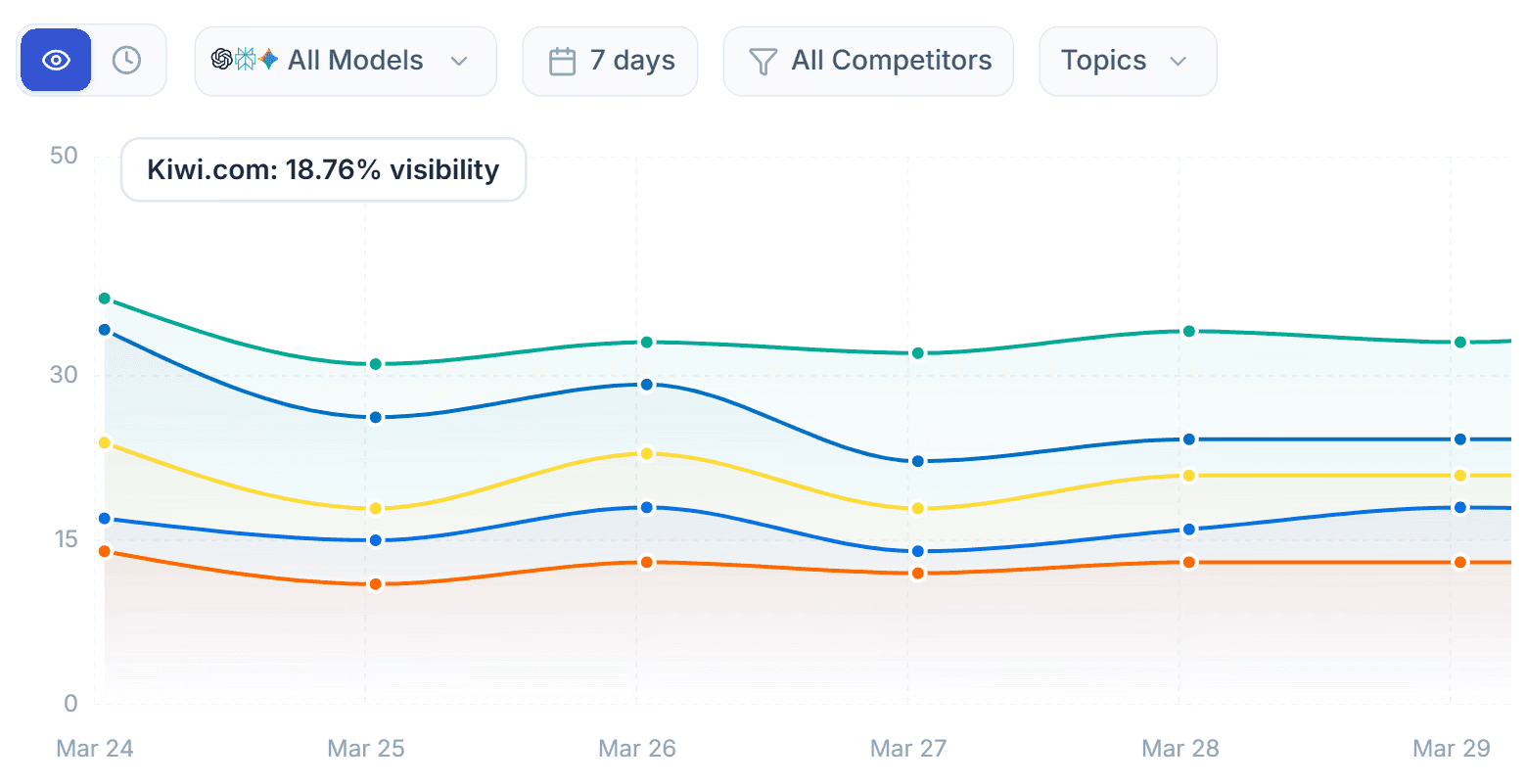
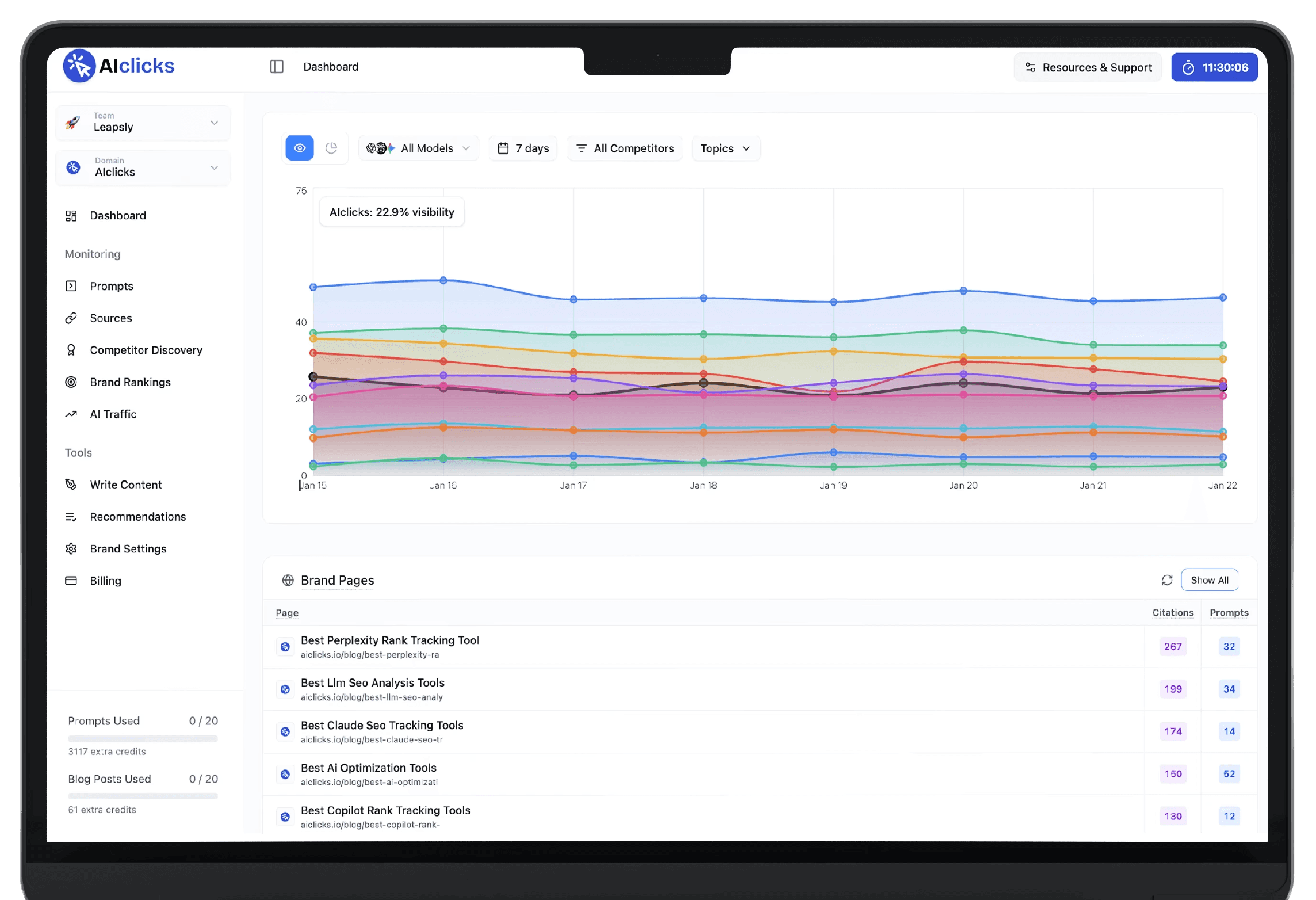
AIclicks gives you a live dashboard with daily ChatGPT mention rate, citation rate, sentiment, and share-of-voice across your tracked prompts, plus GA4 referral attribution for the traffic ChatGPT does send back.
Choose Your Plan
Flexible pricing that grows with your team. Upgrade or downgrade at any time.
Monthly
Yearly
-20%
Starter
Perfect for individuals & small teams
$49
/ month
Billed annually — you save $142
Choose 3 from:
Daily

" height="16px" id="fvSweaOBo" transform="translate(1 0)" width="14px"/></svg>)
" width="14px"><path d="M 13.864 5.629 L 13.3 5.629 L 13.3 5.6 L 7 5.6 L 7 8.4 L 10.956 8.4 C 10.379 10.03 8.828 11.2 7 11.2 C 4.681 11.2 2.8 9.319 2.8 7 C 2.8 4.681 4.681 2.8 7 2.8 C 8.071 2.8 9.045 3.204 9.786 3.864 L 11.766 1.884 C 10.516 0.719 8.844 0 7 0 C 3.134 0 0 3.134 0 7 C 0 10.866 3.134 14 7 14 C 10.866 14 14 10.866 14 7 C 14 6.531 13.952 6.073 13.864 5.629 Z" fill="rgb(255, 193, 7)" height="14px" id="H_YjfTNpn" width="14px"/><path d="M 0 3.742 L 2.3 5.429 C 2.922 3.888 4.429 2.8 6.193 2.8 C 7.264 2.8 8.238 3.204 8.979 3.864 L 10.959 1.884 C 9.709 0.719 8.037 0 6.193 0 C 3.504 0 1.172 1.518 0 3.742 Z" fill="rgb(255, 61, 0)" height="5.428500000000002px" id="PlkthQDhg" transform="translate(0.875 0)" width="10.959199999999996px"/><path d="M 6.232 5.581 C 8.04 5.581 9.683 4.889 10.925 3.764 L 8.758 1.931 C 8.032 2.483 7.144 2.782 6.232 2.781 C 4.411 2.781 2.865 1.62 2.283 0 L 0 1.759 C 1.159 4.026 3.511 5.581 6.232 5.581 Z" fill="rgb(76, 175, 80)" height="5.581099999999999px" id="WlnJ5gngE" transform="translate(0.7 8.4)" width="10.924899999999994px"/><path d="M 6.864 0.029 L 6.3 0.029 L 6.3 0 L 0 0 L 0 2.8 L 3.956 2.8 C 3.68 3.576 3.183 4.254 2.526 4.75 L 2.527 4.749 L 4.693 6.582 C 4.54 6.722 7 4.9 7 1.4 C 7 0.931 6.952 0.473 6.864 0.029 Z" fill="rgb(25, 118, 210)" height="6.589883930775992px" id="x_rSW275p" transform="translate(7 5.6)" width="7px"/></g></svg>)
" height="16px" id="hHS98fTxZ" width="16px"/></svg>)
 scale(1 1) translate(-1.861736945942159, -1.1170155383302638)" id="P20NzAvj0-699428820-radial-gradient" r="0.9935228066204626"><stop offset="0" stop-color="rgb(0, 174, 255)"/><stop offset="1" stop-color="rgb(7, 54, 196)"/></radialGradient><radialGradient cx="0.48250042504016705" cy="1.8366934653567062" gradient-transform="translate(0.48250042504016705, 1.8366934653567062) scale(1 1) translate(-0.48250042504016705, -1.8366934653567062)" id="UEWZqVjij-699428820-radial-gradient" r="0.9176890228114506"><stop offset="0" stop-color="rgb(255, 182, 87)"/><stop offset="1" stop-color="rgb(192, 43, 60)"/></radialGradient><linearGradient id="jyMN3TmKx-699428820-linear-gradient" x1="0.4594862532842614" x2="0.5405137467157386" y1="0" y2="1"><stop offset="0" stop-color="rgb(13, 145, 225)"/><stop offset="1" stop-color="rgb(255, 200, 0)"/></linearGradient><linearGradient id="xhMNwDFG0-699428820-linear-gradient" x1="0.4784828731548295" x2="0.5215171268451705" y1="5.551115123125783e-17" y2="1"><stop offset="0" stop-color="rgb(61, 203, 255)"/><stop offset="1" stop-color="rgba(5, 136, 247, 0)"/></linearGradient><radialGradient cx="1.4305090871482182" cy="0.34866158048251783" gradient-transform="translate(1.4305090871482182, 0.34866158048251783) scale(1 1) translate(-1.4305090871482182, -0.34866158048251783)" id="i79kAqaS4-699428820-radial-gradient" r="1.3362743412697924"><stop offset="0" stop-color="rgb(140, 72, 255)"/><stop offset="1" stop-color="rgb(255, 177, 82)"/></radialGradient><linearGradient id="mcxvno3tX-699428820-linear-gradient" x1="0.49844355920154226" x2="0.5015564407984577" y1="0" y2="1"><stop offset="0" stop-color="rgb(248, 173, 250)"/><stop offset="1" stop-color="rgba(168, 110, 221, 0)"/></linearGradient></defs><g d="M 11.605 1.219 C 11.397 0.499 10.739 0.002 9.989 0 L 9.498 0 C 8.682 0.002 7.985 0.588 7.842 1.391 L 7 6.016 L 7.209 5.296 C 7.416 4.574 8.075 4.076 8.825 4.074 L 11.681 4.074 L 12.879 4.545 L 14.033 4.074 L 13.697 4.074 C 12.947 4.072 12.289 3.575 12.081 2.855 Z M 4.413 13.387 C 4.618 14.111 5.278 14.611 6.031 14.613 L 7.075 14.613 C 7.988 14.613 8.735 13.88 8.758 12.96 L 8.871 8.5 L 8.633 9.319 C 8.426 10.039 7.768 10.537 7.018 10.539 L 4.138 10.539 L 3.111 9.977 L 2 10.539 L 2.331 10.539 C 3.084 10.542 3.743 11.042 3.949 11.766 L 4.413 13.387 Z M 9.999 0 L 4.167 0 C 2.501 0 1.501 2.221 0.834 4.441 C 0.045 7.073 -0.989 10.591 2.001 10.591 L 4.519 10.591 C 5.273 10.591 5.933 10.089 6.139 9.36 C 6.577 7.815 7.345 5.121 7.948 3.069 C 8.255 2.027 8.509 1.132 8.901 0.575 C 9.148 0.212 9.56 -0.004 9.999 0 M 9.999 0 L 4.167 0 C 2.501 0 1.501 2.221 0.834 4.441 C 0.045 7.073 -0.989 10.591 2.001 10.591 L 4.519 10.591 C 5.273 10.591 5.933 10.089 6.139 9.36 C 6.577 7.815 7.345 5.121 7.948 3.069 C 8.255 2.027 8.509 1.132 8.901 0.575 C 9.148 0.212 9.56 -0.004 9.999 0 M 6 14.593 L 11.833 14.593 C 13.499 14.593 14.499 12.372 15.166 10.151 C 15.955 7.519 16.989 4 13.999 4 L 11.48 4 C 10.725 4.002 10.063 4.505 9.86 5.232 C 9.266 7.332 8.663 9.429 8.051 11.523 C 7.745 12.566 7.49 13.461 7.098 14.019 C 6.851 14.382 6.439 14.597 6 14.593 M 6 14.593 L 11.833 14.593 C 13.499 14.593 14.499 12.372 15.166 10.151 C 15.955 7.519 16.989 4 13.999 4 L 11.48 4 C 10.725 4.002 10.063 4.505 9.86 5.232 C 9.266 7.332 8.663 9.429 8.051 11.523 C 7.745 12.566 7.49 13.461 7.098 14.019 C 6.851 14.382 6.439 14.597 6 14.593" fill="transparent" height="14.613333333333333px" id="QzkBy4Ibc" transform="translate(0 1)" width="16.00011071294081px"><path d="M 4.605 1.219 C 4.397 0.499 3.739 0.002 2.989 0 L 2.498 0 C 1.682 0.002 0.985 0.588 0.842 1.391 L 0 6.016 L 0.209 5.296 C 0.416 4.574 1.075 4.076 1.825 4.074 L 4.681 4.074 L 5.879 4.545 L 7.033 4.074 L 6.697 4.074 C 5.947 4.072 5.289 3.575 5.081 2.855 Z" fill="url(%23P20NzAvj0-699428820-radial-gradient)" height="6.016px" id="P20NzAvj0" transform="translate(7 0)" width="7.0333333333333385px"/><path d="M 2.413 4.887 C 2.618 5.611 3.278 6.111 4.031 6.113 L 5.075 6.113 C 5.988 6.113 6.735 5.38 6.758 4.46 L 6.871 0 L 6.633 0.819 C 6.426 1.539 5.768 2.037 5.018 2.039 L 2.138 2.039 L 1.111 1.477 L 0 2.039 L 0.331 2.039 C 1.084 2.042 1.743 2.542 1.949 3.266 L 2.413 4.887 Z" fill="url(%23UEWZqVjij-699428820-radial-gradient)" height="6.113333333333333px" id="UEWZqVjij" transform="translate(2 8.5)" width="6.871333333333332px"/><path d="M 9.999 0 L 4.167 0 C 2.501 0 1.501 2.221 0.834 4.441 C 0.045 7.073 -0.989 10.591 2.001 10.591 L 4.519 10.591 C 5.273 10.591 5.933 10.089 6.139 9.36 C 6.577 7.815 7.345 5.121 7.948 3.069 C 8.255 2.027 8.509 1.132 8.901 0.575 C 9.148 0.212 9.56 -0.004 9.999 0" fill="url(%23jyMN3TmKx-699428820-linear-gradient)" height="10.591388755215167px" id="jyMN3TmKx" width="9.999444046274142px"/><path d="M 9.999 0 L 4.167 0 C 2.501 0 1.501 2.221 0.834 4.441 C 0.045 7.073 -0.989 10.591 2.001 10.591 L 4.519 10.591 C 5.273 10.591 5.933 10.089 6.139 9.36 C 6.577 7.815 7.345 5.121 7.948 3.069 C 8.255 2.027 8.509 1.132 8.901 0.575 C 9.148 0.212 9.56 -0.004 9.999 0" fill="url(%23xhMNwDFG0-699428820-linear-gradient)" height="10.591388755215167px" id="xhMNwDFG0" width="9.999444046274142px"/><path d="M 0 10.593 L 5.833 10.593 C 7.499 10.593 8.499 8.372 9.166 6.151 C 9.955 3.519 10.989 0 7.999 0 L 5.48 0 C 4.725 0.002 4.063 0.505 3.86 1.232 C 3.266 3.332 2.663 5.429 2.051 7.523 C 1.745 8.566 1.49 9.461 1.098 10.019 C 0.851 10.382 0.439 10.597 0 10.593" fill="url(%23i79kAqaS4-699428820-radial-gradient)" height="10.593388755215164px" id="i79kAqaS4" transform="translate(6 4)" width="10.000110712940803px"/><path d="M 0 10.593 L 5.833 10.593 C 7.499 10.593 8.499 8.372 9.166 6.151 C 9.955 3.519 10.989 0 7.999 0 L 5.48 0 C 4.725 0.002 4.063 0.505 3.86 1.232 C 3.266 3.332 2.663 5.429 2.051 7.523 C 1.745 8.566 1.49 9.461 1.098 10.019 C 0.851 10.382 0.439 10.597 0 10.593" fill="url(%23mcxvno3tX-699428820-linear-gradient)" height="10.593388755215164px" id="mcxvno3tX" transform="translate(6 4)" width="10.000110712940803px"/></g></svg>)
" height="15.360666565427872px" id="HZPvvPBv7" transform="translate(0 0.5)" width="16px"/></svg>)
Tracked prompts
30
Websites you can add
3
LLMs you can track
3
Countries per project
1
LLM responses / mo
4,650
AI-optimized articles per month
10
Integrations
-
Support
Pro
For growing teams for more power
$140
/ month
Billed annually — you save $454
Choose 4 from:
Daily
Tracked prompts
150
Websites you can add
Unlimited
LLMs you can track
4
Countries per project
Unlimited
LLM responses / mo
18,600
AI-optimized articles per month
20
Integrations
Google Analytics
Support
BUSINESS
Best for medium-sized organizations
$357
/ month
Billed annually — you save $1198
Choose 6 from:
Daily
Tracked prompts
300
Websites you can add
Unlimited
LLMs you can track
6
Countries per project
Unlimited
LLM responses / mo
55,800
AI-optimized articles per month
30
Integrations
Google Analytics, API
Support
Dedicated account specialist
Become the #1 Answer in AI
Succeed in GEO yourself, or let us do all the work.
Do it yourself
Use AIclicks to see exactly where you appear across 10+ AI platforms, spot the gaps competitors are filling, and act on clear weekly recommendations.
From $59/month · Cancel anytime
Done for you
We Do All the Work for You
Our team manages your complete search presence: traditional SEO and GEO strategy, content, implementation, and reporting. You focus on supporters.
Custom pricing · Minimum 3-month engagement
The AI SEO agency trusted by 1,000+ brands worldwide
From solo founders to multi-client agencies, AIclicks runs the full AI SEO agency program for organizations of every shape and size that want to be cited across every AI surface.
4.9/5 stars on G2






FAQ
How long before SEO brings our nonprofit results?
Expect map pack and local movement in 3 to 4 months, and meaningful organic traffic to program pages around 6 to 9. Nonprofits often move faster than commercial sites because the link sources are easy: foundations, sponsors and .edu partners will link on request. Competitive donor terms like best charities for a cause take 12 to 18 months. Watch Search Console impressions on program terms, which rise well before positions do.
Should we optimise for Google or for AI assistants?
Both, and the gap between them is now the point. Ahrefs analysed 863,000 keywords and found only 38% of pages cited in AI Overviews also ranked in the top 10, down from 76% a year earlier. Ranking no longer carries you into the answer. Notice what AI answers cite for nonprofit queries: Candid profiles, Charity Navigator and news coverage far more often than the organisation’s own site. Fix those records first.
How is nonprofit SEO different from normal local SEO?
You are optimising for 4 audiences at once, not one. Donors, volunteers, people who need your services and journalists researching the issue all search differently and want different pages, and a commercial site only ever serves buyers. Second, the terms people use are nothing like the terms your grant reports use. Third, your reputation lives on Candid and Charity Navigator rather than on your own domain. Generic local SEO advice addresses none of that.
What should a nonprofit budget for SEO work?
Agency retainers aimed at nonprofits typically run $1,500 to $3,500 a month for a single-site organisation and $4,000 to $8,000 for national or multi-chapter groups, with Ad Grant management often quoted separately at $500 to $2,000. Many consultants will scope a fixed-fee project instead, optimise the site once and hand your team a content plan. That model suits most budgets better than an open-ended retainer, and it is worth asking for.
How does SEO fit with our Google Ad Grant?
They feed each other, and the grant depends on it. Ad Grant accounts must hold a 5% click-through rate or Google suspends them, and the fastest way to lift that rate is landing pages that genuinely match the query, which is on-page SEO. Use grant data in reverse too: whichever keywords actually produce donations, volunteer signups or service enquiries are the ones worth a proper page. Most organisations never make that loop.
Which pages should our nonprofit build first?
Google Business Profile and your Candid profile first, because both are free and both feed everything downstream. Then one real page per program, written in the words people searching for help would use. Then the give page, with tax deductibility, matching gifts and monthly tiers answered on the page. Then an impact page with the Form 990 linked. The blog is last, and only for questions about the issue itself.
How do we tell whether the agency is working?
Measure actions, not rankings. Tag donation, volunteer signup and service enquiry completions as conversions in GA4 and attribute them to landing pages, then reconcile against Bloomerang, Neon CRM or whichever donor system holds the truth. Watch Google Business Profile calls and direction requests, which move first. If a report shows traffic and keyword positions but never ties to gifts, signups or people served, ask what it is measuring.
Can we do this in-house with no budget?
Mostly yes, and this is the sector where that is genuinely true. Search Console, Google Business Profile, your Candid profile, Bing Webmaster Tools and Ahrefs Webmaster Tools are all free, and your program staff already know the language beneficiaries use. Keep profile upkeep, program pages and partner link requests in-house. Buy in the technical work: schema, the donation-domain fix and site speed. TechSoup also discounts tools once your 501(c)(3) status is validated.
Further Reading
Go deeper on GEO, AI search, and visibility tracking.