SEO for Musicians and Bands:
Someone hears you on a playlist, or needs a band for a date in 6 months, and the first thing they do is search your name. What Google and ChatGPT show them decides whether you get the stream, the ticket or the booking.









Why Musicians and Bands Need SEO
More than 100,000 tracks reach streaming platforms every day. Nobody browses that. They search a name, a lyric or a mood, and increasingly they ask an assistant, which answers from sources you never edited.
Search your own name and see what comes back. For most acts it is a louder artist with the same name, a lyrics site, a dead SoundCloud page and a Linktree. Google cannot tell which entity you are, so it hedges, and the fan who half-remembered you gives up.
Search live band for hire near me in a US city and GigSalad, The Bash and Thumbtack sit above every working act. They aggregate thousands of profiles, rank on that authority, then charge you for leads generated by the listing that outranked your own site.
Most acts pour release budgets into Meta and Spotify ads, plus a publicist at $1,000 to $3,000 a month for a 6-week campaign. The streams spike and flatten. Nothing indexes, nothing accumulates, and the next single starts from zero with a fresh invoice.
How SEO Works for Musicians and Bands
Search Engine Optimization projects are long-term investments for musicians, where each task supplements the others and creates compound results over time.
01
Keywords, page structure, and the signals Google reads directly
On-page work is strange for musicians because the page that matters most is not a page you can optimise in the usual sense. Your highest-volume query is your own name, and the result set for it is assembled from Spotify, YouTube, Instagram, Genius and a knowledge panel you do not own. What you can control is a single site with real pages behind it: one for music, one for videos, one for tour dates, one for press with a downloadable EPK, and one for booking. Most acts publish a single scrolling homepage with a hero video and nothing addressable underneath it.
The durable assets are the ones that stay true after the tour ends. A lyrics and credits page for each release, a page explaining what gear and tunings you use, a song list for the acts that gig, and a proper about page written in your own voice all keep earning years later. What churns is everything with a date on it: the show announcement, the pre-save link, the album-out-now banner. Those become dead pages within weeks and they quietly become most of the site. Write fewer pages about the work and more about what does not expire.
1
Pick one domain as the hub, then 301 every old band site, tour microsite and album landing page into it.
2
Move past shows into an archive page and 301 expired pre-save and ticket URLs to the release page they promoted.
3
Mark the site up with MusicGroup schema, sameAs links to every profile, and MusicEvent on each tour date; validate in Rich Results Test.
4
Publish a page per song with lyrics, credits, tunings and the story behind it, the queries fans type at 2 in the morning.
02
Map Pack visibility, citations, and proximity signals
Recorded music travels; paid work does not. Weddings, corporate parties, restaurant residencies and function gigs are booked inside a drive radius, which is why the map pack sits above GigSalad for hire queries and why 3 acts take the enquiries. Google Business Profile is available to bands and solo performers as a service-area business, and almost no working act has claimed one. It costs nothing and it outranks your own website.
Choose Band or Musician as the primary category rather than Entertainment Agency, hide the address and set a service radius, then list each act configuration as a service: solo, duo, four-piece, full horn section. Upload video from real receptions rather than promo stills, publish genuine availability, and pre-answer the questions that decide bookings: set length, PA and lighting, learning a first-dance song, travel fees and deposit terms.
Musicians need 2 separate citation stacks, and general local SEO advice covers neither. The booking layer is GigSalad, The Bash, Thumbtack, WeddingWire and The Knot, where couples filter before they ever open Google. The entity layer is MusicBrainz, Discogs, Wikidata, AllMusic, Songkick and Bandsintown, which feed the knowledge panel and the streaming metadata behind it. Every one needs the identical act name, spelling and phone, because a stray The or an alternate spelling splits you into 2 artists.
1
Set Band or Musician as the primary category, hide the address, set a travel radius, and list every lineup size as a service.
2
Give a tribute act, a wedding band and a solo residency each their own profile, site and reviews, never one shared listing.
3
Run BrightLocal across GigSalad, The Bash, Bandsintown, Songkick and MusicBrainz, and fix every alternate spelling, stray The and old phone number.
4
Post one Google Business Profile update a week: a clip from Saturday’s set, an open date, a new song added to the list.
03
Topic authority, inbound links, and content that earns traffic
Someone planning a reception is 9 months out and has no idea what live music costs, how long a band plays, or whether the quote includes a PA and a sound engineer. Nobody publishes that, so the page that does gets the enquiry. The same is true for fans: a page that says what your record actually sounds like, and who played on it, does more than another press release.
A booker who has decided on live music is now choosing between acts, and they want evidence rather than adjectives. Full-length video from a real reception, not a 30-second reel. The song list as text on the page, so it is searchable and Google can read it. Pricing tiers by lineup size. Named players with credits. And reviews from event clients, which at this point decide it.
Music links are unusually easy to earn because the whole industry publishes lineups. Every venue you play lists you on an event page. Every festival prints a bill. Promoters, wedding planners and photographers publish vendor pages and supplier lists. Local radio, college stations and genre blogs still review records. Add MusicBrainz, Discogs and Songkick entries, plus the studios and producers you worked with, and most of your link profile builds itself if you ask.
1
Publish an annual guide to what live music costs by event type, using real quote ranges rather than call for pricing.
2
Build one page per event type you play: wedding band, corporate function band, festival act, restaurant residency, each with its own set list and video.
3
Cluster every how much does a band cost question into one hub: deposits, overtime, travel fees, PA hire, and what a smaller lineup saves.
4
Write a page for each genre set you actually perform, such as Motown, 90s hip hop or standards, since bookers search styles before names.
04
Site speed, crawlability, Core Web Vitals, and mobile health
The failure almost every artist site shares is that its content lives in someone else’s iframe. Tour dates come from a Bandsintown or Songkick widget, the music is a Spotify or Bandcamp embed, and the merch is on a separate Shopify subdomain. Google renders a page with a hero video, a logo and no text. You get no Event rich results, no lyrics in the index, and a site that ranks for nothing but the domain name.
The moment that matters happens on a phone. Someone is standing in a venue, hears you, and searches the name on the poster before the set ends. Or a planner is comparing 4 bands on a laptop with 20 tabs open. Both bounce if a full-screen video takes 8 seconds over venue wifi, or an autoplaying track starts before anything renders. Serve a poster image, defer the video, and put the booking form above the fold.
1
Fetch your tour page in Search Console URL Inspection; if the dates are missing from the rendered HTML, output them server-side with MusicEvent markup.
2
Run PageSpeed Insights on the homepage, the heaviest page on nearly every artist site, and replace the background video with a poster image.
3
Convert press shots and album art to WebP at display size with width and height set, and keep the raw files in the EPK download.
4
Keep tour and release pages in a separate sitemap from the blog, and resubmit whenever a date is added, moved or cancelled.
05
Star ratings, review volume, and response strategy that builds trust
Reviews decide bookings because nobody can audition a band. A planner is committing $3,000 or more to a group they have never heard live, and the star rating is the only proof that the last 40 receptions went well. The difficulty is that the audience who loved you leaves the venue and never thinks of it again, while the one guest whose request you did not know is the one motivated to write something.
Ask the day after the event, while the client is still posting photos and before the credit card statement arrives. Build it into the contract workflow so the request fires automatically when the final invoice is marked paid, sent from the bandleader by name with one link. Ask the venue and the planner too, not just the couple. And ask after every function gig, not only the ones that felt special, because volume is what the rating needs.
1
Wire HoneyBook or Gigwell to send the review link when the final invoice clears, signed by the bandleader rather than the act.
2
Answer negative reviews within 24 hours without arguing about the set list, and move the detail to email; onlookers are the real audience.
3
Put wedding reviews on the wedding page and corporate reviews on the corporate page, next to the video from that kind of event.
4
Collect reviews from venue managers, planners and sound engineers on GigSalad and The Bash, because trade endorsements carry weight bookers trust.
Google is No Longer the Only Place Your bookers are Searching
Bookers are using AI to find answers, and they trust what it tells them. Invest in GEO to get recommended in those answers.
1 Billion
Questions ChatGPT receives every single day
38%
Your #1 top ranking page on Google would be cited by AI
14%
of musicians optimise for GEO. The rest are invisible in AI answers


You can rank #1 for “musician near me” and still not exist in ChatGPT’s answer. Run a free GEO audit to see where your brand actually stands.
GEO vs SEO: Same Goal, Different Methods
GEO is wider than SEO. AI recommends the brands that show up across the sources it reads, so your presence in forums, social platforms and music blogs decides your odds. AIclicks measures the three metrics below so you know which to work on first.
AI Assistant
Which local band plays the best wedding receptions?
Your Band
Citation Rate
Shows how many AI answers about musicians and bands name your brand, out of every 100. Models pull from the same trusted pages over and over, so citations compound: once you are in, staying in gets easier. Find the competitor pages AI cites most, then publish your own version of each.
Your Band
82% positive
Competitor A
54% positive
Competitor B
38% positive
Brand Sentiment
Shows how AI describes you when your brand comes up: positive, neutral or negative. Tone is what separates being mentioned from being recommended, and models repeat whatever framing they find. Track the negative mentions back to the reviews and threads behind them, then publish content that answers those directly.
Others 52%
You 24%
— 24%
Your Band
AI mention share of voice — music category
Competitors
Not Cited
Share of Voice in AI
Shows how much of the music conversation belongs to you rather than your competitors. This is the metric that matters most, the GEO version of a Google ranking. With only 1–5 brands named per answer, the market is winner-takes-more and every point is taken from someone.
The Dashboard Your Dedicated AI Search Team Works In
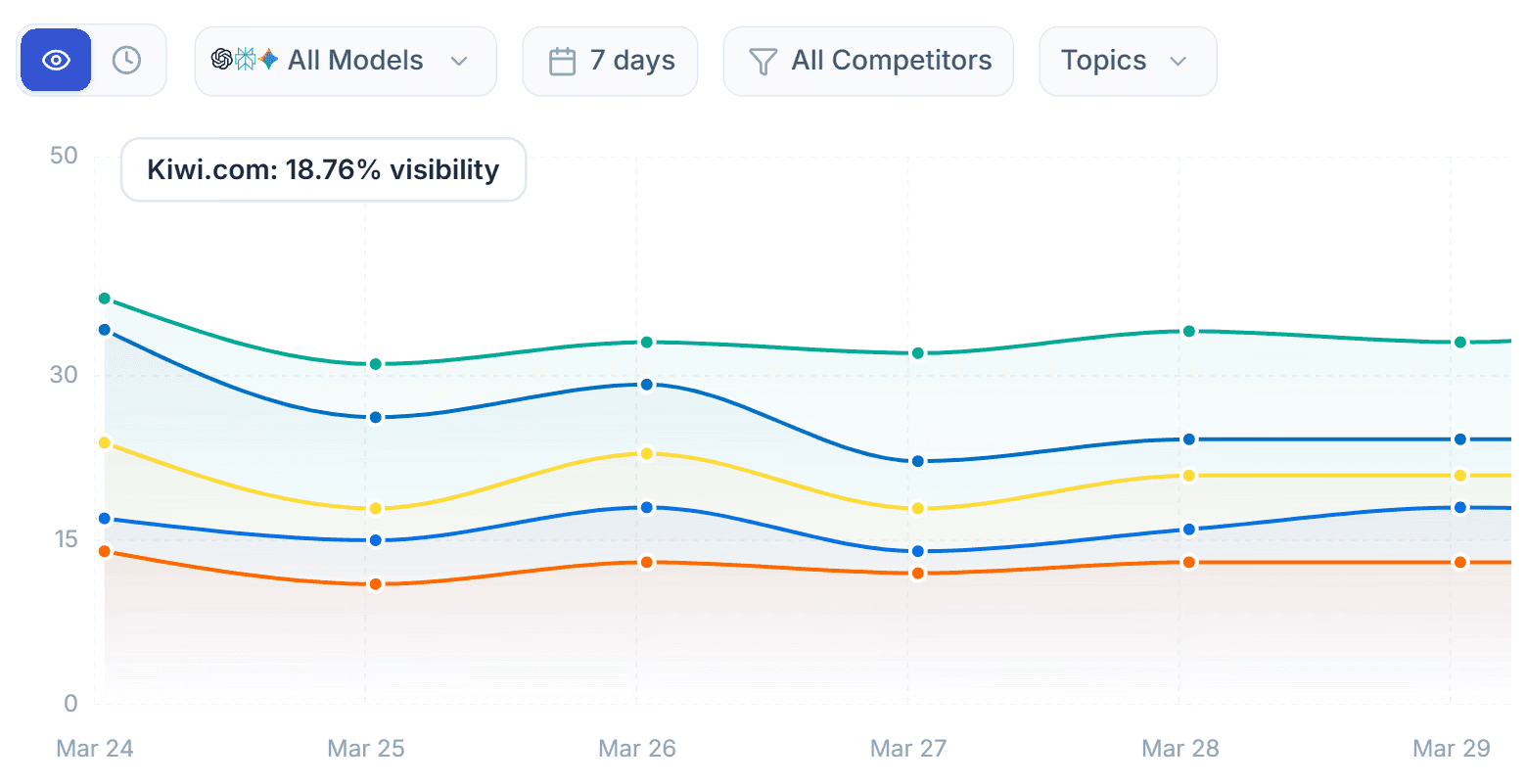
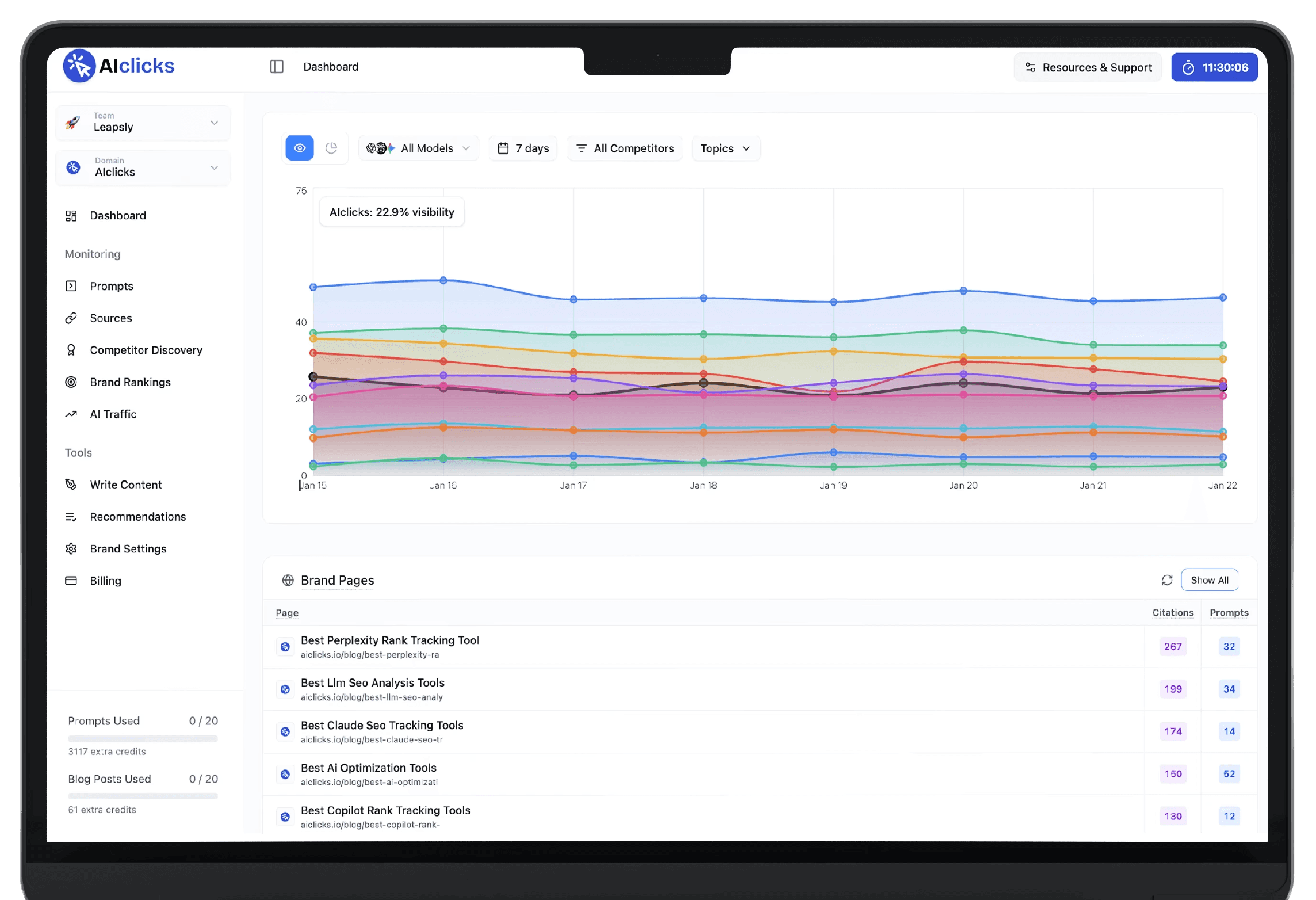
AIclicks gives you a live dashboard with daily ChatGPT mention rate, citation rate, sentiment, and share-of-voice across your tracked prompts, plus GA4 referral attribution for the traffic ChatGPT does send back.
Choose Your Plan
Flexible pricing that grows with your team. Upgrade or downgrade at any time.
Monthly
Yearly
-20%
Starter
Perfect for individuals & small teams
$49
/ month
Billed annually — you save $142
Choose 3 from:
Daily

" height="16px" id="fvSweaOBo" transform="translate(1 0)" width="14px"/></svg>)
" width="14px"><path d="M 13.864 5.629 L 13.3 5.629 L 13.3 5.6 L 7 5.6 L 7 8.4 L 10.956 8.4 C 10.379 10.03 8.828 11.2 7 11.2 C 4.681 11.2 2.8 9.319 2.8 7 C 2.8 4.681 4.681 2.8 7 2.8 C 8.071 2.8 9.045 3.204 9.786 3.864 L 11.766 1.884 C 10.516 0.719 8.844 0 7 0 C 3.134 0 0 3.134 0 7 C 0 10.866 3.134 14 7 14 C 10.866 14 14 10.866 14 7 C 14 6.531 13.952 6.073 13.864 5.629 Z" fill="rgb(255, 193, 7)" height="14px" id="H_YjfTNpn" width="14px"/><path d="M 0 3.742 L 2.3 5.429 C 2.922 3.888 4.429 2.8 6.193 2.8 C 7.264 2.8 8.238 3.204 8.979 3.864 L 10.959 1.884 C 9.709 0.719 8.037 0 6.193 0 C 3.504 0 1.172 1.518 0 3.742 Z" fill="rgb(255, 61, 0)" height="5.428500000000002px" id="PlkthQDhg" transform="translate(0.875 0)" width="10.959199999999996px"/><path d="M 6.232 5.581 C 8.04 5.581 9.683 4.889 10.925 3.764 L 8.758 1.931 C 8.032 2.483 7.144 2.782 6.232 2.781 C 4.411 2.781 2.865 1.62 2.283 0 L 0 1.759 C 1.159 4.026 3.511 5.581 6.232 5.581 Z" fill="rgb(76, 175, 80)" height="5.581099999999999px" id="WlnJ5gngE" transform="translate(0.7 8.4)" width="10.924899999999994px"/><path d="M 6.864 0.029 L 6.3 0.029 L 6.3 0 L 0 0 L 0 2.8 L 3.956 2.8 C 3.68 3.576 3.183 4.254 2.526 4.75 L 2.527 4.749 L 4.693 6.582 C 4.54 6.722 7 4.9 7 1.4 C 7 0.931 6.952 0.473 6.864 0.029 Z" fill="rgb(25, 118, 210)" height="6.589883930775992px" id="x_rSW275p" transform="translate(7 5.6)" width="7px"/></g></svg>)
" height="16px" id="hHS98fTxZ" width="16px"/></svg>)
 scale(1 1) translate(-1.861736945942159, -1.1170155383302638)" id="P20NzAvj0-699428820-radial-gradient" r="0.9935228066204626"><stop offset="0" stop-color="rgb(0, 174, 255)"/><stop offset="1" stop-color="rgb(7, 54, 196)"/></radialGradient><radialGradient cx="0.48250042504016705" cy="1.8366934653567062" gradient-transform="translate(0.48250042504016705, 1.8366934653567062) scale(1 1) translate(-0.48250042504016705, -1.8366934653567062)" id="UEWZqVjij-699428820-radial-gradient" r="0.9176890228114506"><stop offset="0" stop-color="rgb(255, 182, 87)"/><stop offset="1" stop-color="rgb(192, 43, 60)"/></radialGradient><linearGradient id="jyMN3TmKx-699428820-linear-gradient" x1="0.4594862532842614" x2="0.5405137467157386" y1="0" y2="1"><stop offset="0" stop-color="rgb(13, 145, 225)"/><stop offset="1" stop-color="rgb(255, 200, 0)"/></linearGradient><linearGradient id="xhMNwDFG0-699428820-linear-gradient" x1="0.4784828731548295" x2="0.5215171268451705" y1="5.551115123125783e-17" y2="1"><stop offset="0" stop-color="rgb(61, 203, 255)"/><stop offset="1" stop-color="rgba(5, 136, 247, 0)"/></linearGradient><radialGradient cx="1.4305090871482182" cy="0.34866158048251783" gradient-transform="translate(1.4305090871482182, 0.34866158048251783) scale(1 1) translate(-1.4305090871482182, -0.34866158048251783)" id="i79kAqaS4-699428820-radial-gradient" r="1.3362743412697924"><stop offset="0" stop-color="rgb(140, 72, 255)"/><stop offset="1" stop-color="rgb(255, 177, 82)"/></radialGradient><linearGradient id="mcxvno3tX-699428820-linear-gradient" x1="0.49844355920154226" x2="0.5015564407984577" y1="0" y2="1"><stop offset="0" stop-color="rgb(248, 173, 250)"/><stop offset="1" stop-color="rgba(168, 110, 221, 0)"/></linearGradient></defs><g d="M 11.605 1.219 C 11.397 0.499 10.739 0.002 9.989 0 L 9.498 0 C 8.682 0.002 7.985 0.588 7.842 1.391 L 7 6.016 L 7.209 5.296 C 7.416 4.574 8.075 4.076 8.825 4.074 L 11.681 4.074 L 12.879 4.545 L 14.033 4.074 L 13.697 4.074 C 12.947 4.072 12.289 3.575 12.081 2.855 Z M 4.413 13.387 C 4.618 14.111 5.278 14.611 6.031 14.613 L 7.075 14.613 C 7.988 14.613 8.735 13.88 8.758 12.96 L 8.871 8.5 L 8.633 9.319 C 8.426 10.039 7.768 10.537 7.018 10.539 L 4.138 10.539 L 3.111 9.977 L 2 10.539 L 2.331 10.539 C 3.084 10.542 3.743 11.042 3.949 11.766 L 4.413 13.387 Z M 9.999 0 L 4.167 0 C 2.501 0 1.501 2.221 0.834 4.441 C 0.045 7.073 -0.989 10.591 2.001 10.591 L 4.519 10.591 C 5.273 10.591 5.933 10.089 6.139 9.36 C 6.577 7.815 7.345 5.121 7.948 3.069 C 8.255 2.027 8.509 1.132 8.901 0.575 C 9.148 0.212 9.56 -0.004 9.999 0 M 9.999 0 L 4.167 0 C 2.501 0 1.501 2.221 0.834 4.441 C 0.045 7.073 -0.989 10.591 2.001 10.591 L 4.519 10.591 C 5.273 10.591 5.933 10.089 6.139 9.36 C 6.577 7.815 7.345 5.121 7.948 3.069 C 8.255 2.027 8.509 1.132 8.901 0.575 C 9.148 0.212 9.56 -0.004 9.999 0 M 6 14.593 L 11.833 14.593 C 13.499 14.593 14.499 12.372 15.166 10.151 C 15.955 7.519 16.989 4 13.999 4 L 11.48 4 C 10.725 4.002 10.063 4.505 9.86 5.232 C 9.266 7.332 8.663 9.429 8.051 11.523 C 7.745 12.566 7.49 13.461 7.098 14.019 C 6.851 14.382 6.439 14.597 6 14.593 M 6 14.593 L 11.833 14.593 C 13.499 14.593 14.499 12.372 15.166 10.151 C 15.955 7.519 16.989 4 13.999 4 L 11.48 4 C 10.725 4.002 10.063 4.505 9.86 5.232 C 9.266 7.332 8.663 9.429 8.051 11.523 C 7.745 12.566 7.49 13.461 7.098 14.019 C 6.851 14.382 6.439 14.597 6 14.593" fill="transparent" height="14.613333333333333px" id="QzkBy4Ibc" transform="translate(0 1)" width="16.00011071294081px"><path d="M 4.605 1.219 C 4.397 0.499 3.739 0.002 2.989 0 L 2.498 0 C 1.682 0.002 0.985 0.588 0.842 1.391 L 0 6.016 L 0.209 5.296 C 0.416 4.574 1.075 4.076 1.825 4.074 L 4.681 4.074 L 5.879 4.545 L 7.033 4.074 L 6.697 4.074 C 5.947 4.072 5.289 3.575 5.081 2.855 Z" fill="url(%23P20NzAvj0-699428820-radial-gradient)" height="6.016px" id="P20NzAvj0" transform="translate(7 0)" width="7.0333333333333385px"/><path d="M 2.413 4.887 C 2.618 5.611 3.278 6.111 4.031 6.113 L 5.075 6.113 C 5.988 6.113 6.735 5.38 6.758 4.46 L 6.871 0 L 6.633 0.819 C 6.426 1.539 5.768 2.037 5.018 2.039 L 2.138 2.039 L 1.111 1.477 L 0 2.039 L 0.331 2.039 C 1.084 2.042 1.743 2.542 1.949 3.266 L 2.413 4.887 Z" fill="url(%23UEWZqVjij-699428820-radial-gradient)" height="6.113333333333333px" id="UEWZqVjij" transform="translate(2 8.5)" width="6.871333333333332px"/><path d="M 9.999 0 L 4.167 0 C 2.501 0 1.501 2.221 0.834 4.441 C 0.045 7.073 -0.989 10.591 2.001 10.591 L 4.519 10.591 C 5.273 10.591 5.933 10.089 6.139 9.36 C 6.577 7.815 7.345 5.121 7.948 3.069 C 8.255 2.027 8.509 1.132 8.901 0.575 C 9.148 0.212 9.56 -0.004 9.999 0" fill="url(%23jyMN3TmKx-699428820-linear-gradient)" height="10.591388755215167px" id="jyMN3TmKx" width="9.999444046274142px"/><path d="M 9.999 0 L 4.167 0 C 2.501 0 1.501 2.221 0.834 4.441 C 0.045 7.073 -0.989 10.591 2.001 10.591 L 4.519 10.591 C 5.273 10.591 5.933 10.089 6.139 9.36 C 6.577 7.815 7.345 5.121 7.948 3.069 C 8.255 2.027 8.509 1.132 8.901 0.575 C 9.148 0.212 9.56 -0.004 9.999 0" fill="url(%23xhMNwDFG0-699428820-linear-gradient)" height="10.591388755215167px" id="xhMNwDFG0" width="9.999444046274142px"/><path d="M 0 10.593 L 5.833 10.593 C 7.499 10.593 8.499 8.372 9.166 6.151 C 9.955 3.519 10.989 0 7.999 0 L 5.48 0 C 4.725 0.002 4.063 0.505 3.86 1.232 C 3.266 3.332 2.663 5.429 2.051 7.523 C 1.745 8.566 1.49 9.461 1.098 10.019 C 0.851 10.382 0.439 10.597 0 10.593" fill="url(%23i79kAqaS4-699428820-radial-gradient)" height="10.593388755215164px" id="i79kAqaS4" transform="translate(6 4)" width="10.000110712940803px"/><path d="M 0 10.593 L 5.833 10.593 C 7.499 10.593 8.499 8.372 9.166 6.151 C 9.955 3.519 10.989 0 7.999 0 L 5.48 0 C 4.725 0.002 4.063 0.505 3.86 1.232 C 3.266 3.332 2.663 5.429 2.051 7.523 C 1.745 8.566 1.49 9.461 1.098 10.019 C 0.851 10.382 0.439 10.597 0 10.593" fill="url(%23mcxvno3tX-699428820-linear-gradient)" height="10.593388755215164px" id="mcxvno3tX" transform="translate(6 4)" width="10.000110712940803px"/></g></svg>)
" height="15.360666565427872px" id="HZPvvPBv7" transform="translate(0 0.5)" width="16px"/></svg>)
Tracked prompts
30
Websites you can add
3
LLMs you can track
3
Countries per project
1
LLM responses / mo
4,650
AI-optimized articles per month
10
Integrations
-
Support
Pro
For growing teams for more power
$140
/ month
Billed annually — you save $454
Choose 4 from:
Daily
Tracked prompts
150
Websites you can add
Unlimited
LLMs you can track
4
Countries per project
Unlimited
LLM responses / mo
18,600
AI-optimized articles per month
20
Integrations
Google Analytics
Support
BUSINESS
Best for medium-sized organizations
$357
/ month
Billed annually — you save $1198
Choose 6 from:
Daily
Tracked prompts
300
Websites you can add
Unlimited
LLMs you can track
6
Countries per project
Unlimited
LLM responses / mo
55,800
AI-optimized articles per month
30
Integrations
Google Analytics, API
Support
Dedicated account specialist
Become the #1 Answer in AI
Succeed in GEO yourself, or let us do all the work.
Do it yourself
Use AIclicks to see exactly where you appear across 10+ AI platforms, spot the gaps competitors are filling, and act on clear weekly recommendations.
From $59/month · Cancel anytime
Done for you
We Do All the Work for You
Our team manages your complete search presence: traditional SEO and GEO strategy, content, implementation, and reporting. You focus on bookers.
Custom pricing · Minimum 3-month engagement
The AI SEO agency trusted by 1,000+ brands worldwide
From solo founders to multi-client agencies, AIclicks runs the full AI SEO agency program for organizations of every shape and size that want to be cited across every AI surface.
4.9/5 stars on G2







FAQ
How long does SEO take to work for a band?
Your own name usually cleans up in 4 to 8 weeks once the site, schema and profiles agree. Booking queries such as wedding band plus your area take 4 to 8 months. The knowledge panel is slower and less predictable, because it depends on MusicBrainz, Wikidata and press coverage Google has to trust first. Anyone promising a panel on a deadline does not control that.
Is AI search worth bothering with, or just Google?
Both, and they behave differently. Ahrefs looked at 863,000 keywords and found just 38% of pages cited in AI Overviews also sat in the top 10, down from 76% the year before, so ranking no longer carries you into the answer. Music assistants build recommendations from third-party sources: MusicBrainz, press write-ups, playlist descriptions, marketplace profiles. Almost none of it is your website, which is exactly why nobody checks it.
How is music SEO different from normal local SEO?
Your biggest keyword is a proper noun you share with strangers. Most local businesses fight over category terms; musicians fight to be the correct entity for their own name, against a better-known act, a common word or a defunct project. On top of that you have 2 unrelated audiences, fans and bookers, searching completely different things, and an entity layer of MusicBrainz, Discogs and Wikidata that no plumber has ever needed.
What should a band budget for SEO and marketing?
Less than most acts spend on ads. A hosted music site runs $10 to $20 a month, distribution $20 to $50 a year, and freelance SEO help for an artist typically $750 to $2,500 a month. Publicists start around $1,000 a month and stop the day you stop paying. Set it against the gig: a wedding band commonly quotes $3,000 to $8,000, so one extra booking covers a year of it.
How does SEO fit with the ads we already run?
They do different jobs. Meta and Spotify ads buy attention for a release window and stop when the campaign ends; search picks up the people already looking for you, which is a smaller number converting far harder. Run ads to create the name recognition, then make sure the search that follows lands somewhere you own. Use the ad data to decide which event types and genres deserve a page.
Which pages should we build first on the site?
One canonical domain first, with everything else redirected into it. Then the booking page, because that is the only page anyone pays you from. Then music and video pages with real text, then tour dates output as HTML rather than a widget, then a press page with a downloadable EPK. Lyrics pages after that. Skip the blog until something is genuinely worth writing, which for most acts is never.
How do we know if any of this is working?
Count enquiries and booked dates from organic search, not rankings. Put a distinct phone number and form on the booking page so gig enquiries attribute properly. In Search Console, watch impressions on your act name and on hire terms separately, since the name cleans up first. Then check quarterly whether an assistant names you when asked for a band in your area, because nothing else reports that.
Should we do this ourselves or hire someone?
Split it. Nobody outside the band can write the bio, pick the photos, chase reviews or keep the tour dates honest, so keep that in-house. Hand out the technical layer: redirects from old domains, schema, getting dates out of the widget, and MusicBrainz and Wikidata submissions, which have style rules that get sloppy edits reverted. If you hire, pick someone who has actually built a knowledge panel.
Further Reading
Go deeper on GEO, AI search, and visibility tracking.