SEO for Managed Service Providers:
An office manager whose server died at 7am does not read your homepage first. They ask 3 peers, search managed IT services near me, then ask ChatGPT which providers are credible. Your visibility decides whether you make that list.









Why Managed Service Providers Need SEO
Most IT buying now starts with a search and ends in an AI summary naming 3 providers. Ahrefs found only 38% of pages cited in AI Overviews still rank in the top 10.
Ask 10 MSPs for their target keywords and you get one list: managed IT services, IT solutions, cloud services, IT support. Everyone crowds the head term and nobody writes the page a controller searches, like Microsoft 365 tenant migration for a 40-seat office. The specific searches go unanswered.
Search managed IT services near me in a US city and Clutch, Cloudtango, UpCity, G2 and Yelp usually sit above the first actual provider on the page. They rank on aggregate review volume that no single MSP can match, then sell your competitors a sponsored slot on the very listing that outranked you.
MSP marketing retainers commonly start around $2,000 a month and run past $6,000 once content and links are included, on top of trade show booths and channel event sponsorships. Threads on r/msp are full of providers who spent 18 months on both and cannot name a single contract either produced.
How SEO Works for Managed Service Providers
Search Engine Optimization projects are long-term investments for MSPs, where each task supplements the others and creates compound results over time.
01
Keywords, page structure, and the signals Google reads directly
On-page work is awkward for MSPs because the thing you sell has no name your buyer uses. Internally it is a stack: an RMM agent, EDR, 24/7 monitoring, immutable backup and a patch cadence. Externally a controller types IT support for a 30-person office, or asks who fixes our Microsoft 365 email. The pages that carry the load are your 3 core service pages, managed IT, cybersecurity and cloud, the vertical pages for industries you genuinely serve, and a co-managed IT page, which almost nobody writes and which every prospect with an internal technician searches for by name.
The durable pages are tied to a decision rather than a release. What managed IT costs per user, whether to hire a technician or outsource, what a co-managed arrangement actually covers, what happens to your data when you leave a provider: a new buyer asks those every week and the answers barely change. What churns is the vendor-supplied blog, the CVE roundup, the partner tier announcement, the conference recap. Most MSP sites carry far more of the second kind than the first, and the pages a buyer would have paid to read were never written at all.
1
Put a per-user monthly price band on the managed IT services page. It is the question buyers search most and competitors refuse to answer.
2
Audit syndicated vendor articles and end-of-life pages such as Windows Server 2012 in Search Console, then rewrite them or 301 them into the service page.
3
Mark the managed IT page with Service and ProfessionalService schema, add Review and FAQPage blocks, then validate everything in Google’s Rich Results Test.
4
Publish one page per framework you support, HIPAA, CMMC 2.0, PCI DSS and SOC 2 readiness, because audit deadlines drive searches all year.
02
Map Pack visibility, citations, and proximity signals
Almost every managed services contract is won inside a drive time. Owners want an engineer on site the same morning when a switch fails, so proximity carries real weight even for work that is mostly remote. That is why the 3-result map pack sits above every organic listing, above Clutch, and it is the one position a 6-person MSP can take from a national roll-up. Proximity you cannot change. Profile completeness and reviews you can.
Pick Computer Support and Services as the primary category rather than the vaguer Computer Consultant, then add cybersecurity and data recovery as secondaries. Most MSPs are service-area businesses with no reception desk, so set a service radius and hide the street address instead of risking a suspension. List help desk, network monitoring, cloud migration and backup as separate services, upload photos of the actual engineers, and pre-answer response times, after-hours cover and minimum seat count.
MSPs carry 2 citation layers and most work only the first. General listings, Apple Maps, Bing Places and Yelp, keep the name and address consistent. The layer that moves this market is the channel: Clutch, Cloudtango, UpCity and G2 for reviews, then the vendor partner locators, Microsoft Solutions Partner, Cisco Partner Locator, ConnectWise Marketplace, Kaseya and Fortinet. Those carry certification signals no general directory can fake, and one stale suite number dilutes all of them.
1
Set Computer Support and Services as the primary category, define a service radius rather than a map pin, and list help desk and backup individually.
2
Give each staffed office its own profile and page naming the engineers there, and never claim a co-working address you cannot answer the door at.
3
Check the Microsoft Solutions Partner directory, Cisco Partner Locator, ConnectWise Marketplace and Kaseya listings for stale addresses, dead links and pre-merger brand names.
4
Publish a Google Business Profile update weekly on a live threat, a patch you pushed overnight, or an outage you caught before any client noticed.
03
Topic authority, inbound links, and content that earns traffic
Before anyone books a call they are working out whether outsourcing beats hiring, what a fair per-seat price looks like, and how badly a switchover will hurt. Answer those plainly and you make the shortlist. A page comparing an internal technician against a managed contract across year 1, or a straight breakdown of what a service level agreement actually guarantees, earns more calls than any post about the latest ransomware strain.
A buyer who has decided to outsource is now comparing providers and wants evidence rather than uptime adjectives. Publish your response and resolution targets as numbers, your onboarding plan week by week, your exit terms, your cyber liability cover and your SOC 2 status. Name the virtual CIO who will run the account. Two reference clients of similar seat count in the same vertical settle it faster than any capability list.
MSP links come from the channel and most sit unclaimed. Vendor partner pages link out: Microsoft, Datto, ConnectWise, SonicWall. CompTIA, ISACA and your nearest InfraGard chapter publish member listings. Channel Futures, CRN, TechRepublic, Spiceworks and SmarterMSP all take contributor commentary from engineers who actually run networks. Chambers of commerce, regional business journals and the community colleges you hire apprentices from publish sponsor pages. None of it requires buying a link.
1
Run a yearly managed IT pricing breakdown: per-user bands by seat count, what a co-managed tier costs, and which conditions push a quote higher.
2
Build one page per vertical you genuinely serve, such as IT support for accounting firms or CMMC compliance for defence subcontractors, with named client proof.
3
Cluster every affordability and switching question into one hub: contract length, onboarding fees, per-user versus per-device pricing, and what walking away actually costs.
4
Write a page for each platform you deploy, such as Microsoft 365, SentinelOne, Datto or Meraki, because buyers search the vendor before the provider.
04
Site speed, crawlability, Core Web Vitals, and mobile health
The failure unique to this trade is self-inflicted. You harden your own site the way you harden a client’s: bot fight mode on, aggressive rate limits, whole countries blocked, a challenge page in front of anything that looks automated. Then GPTBot, ClaudeBot, PerplexityBot and sometimes Bingbot collect 403s, and half the service pages render client-side so nothing useful survives without JavaScript. The security posture is defensible. The consequence is that you are missing from the answers your buyers read.
The people choosing an MSP check you on a phone between meetings, usually while something is already broken and the current provider has not called back. They want a number, a response-time promise, and proof you have handled a business their size. MSP homepages fight all 3 with a video background, a rotating carousel of 30 partner logos, a chat widget and a booking embed, every one of them loading before the phone number appears.
1
Fetch your service pages with curl using the GPTBot and Bingbot user agents. Anything returning 403 or a challenge page is invisible to AI answers.
2
Run PageSpeed Insights on the homepage, usually the heaviest page because of logo carousels and video hero sections, targeting Largest Contentful Paint under 2.5 seconds.
3
Serve vendor certification badges and engineer headshots as WebP at display size, and replace the logo slider with a static grid carrying real alt text.
4
Split service, vertical and location pages into their own sitemap away from the blog, and resubmit whenever pricing or a certification changes.
05
Star ratings, review volume, and response strategy that builds trust
Reviews decide this market because nothing else about the service is visible. When an MSP is doing its job the client notices nothing at all, so the only people carrying a story are the ones you rescued. Worse, plenty of clients will not publicly name the firm running their security, which quietly removes exactly the accounts you would most want quoted. Thin review counts then sit beside directory profiles carrying hundreds.
The moment to ask is the ticket-close survey, not a quarterly email blast. Wire the PSA so a positive rating on resolution offers the review link immediately, while the relief is fresh and the tab is still open. Ask after completed projects too, migrations and office moves, because those involve the decision-maker rather than whoever filed the ticket. Then ask that same person for a Clutch review at the next business review.
1
Wire ConnectWise Manage, Autotask or HaloPSA so a positive CSAT rating at ticket close sends the Google review link automatically.
2
Answer negative reviews within 24 hours, state the resolution timeline, and never disclose the client’s stack or which incident the reviewer means.
3
Put accounting client reviews on the accounting vertical page and manufacturing reviews on the manufacturing one, beside the proof each is meant to support.
4
Ask decision-makers for a Clutch review at the quarterly business review, since Clutch verifies by phone and those profiles feed AI answers.
Google is No Longer the Only Place Your clients are Searching
Clients are using AI to find answers, and they trust what it tells them. Invest in GEO to get recommended in those answers.
1 Billion
Questions ChatGPT receives every single day
38%
Your #1 top ranking page on Google would be cited by AI
14%
of MSPs optimise for GEO. The rest are invisible in AI answers


You can rank #1 for “MSP near me” and still not exist in ChatGPT’s answer. Run a free GEO audit to see where your brand actually stands.
GEO vs SEO: Same Goal, Different Methods
GEO is wider than SEO. AI recommends the brands that show up across the sources it reads, so your presence in forums, social platforms and IT blogs decides your odds. AIclicks measures the three metrics below so you know which to work on first.
AI Assistant
Which managed IT provider is best for small businesses?
Your MSP
Citation Rate
Shows how many AI answers about managed service providers name your brand, out of every 100. Models pull from the same trusted pages over and over, so citations compound: once you are in, staying in gets easier. Find the competitor pages AI cites most, then publish your own version of each.
Your MSP
82% positive
Competitor A
54% positive
Competitor B
38% positive
Brand Sentiment
Shows how AI describes you when your brand comes up: positive, neutral or negative. Tone is what separates being mentioned from being recommended, and models repeat whatever framing they find. Track the negative mentions back to the reviews and threads behind them, then publish content that answers those directly.
Others 52%
You 24%
— 24%
Your MSP
AI mention share of voice — IT category
Competitors
Not Cited
Share of Voice in AI
Shows how much of the IT conversation belongs to you rather than your competitors. This is the metric that matters most, the GEO version of a Google ranking. With only 1–5 brands named per answer, the market is winner-takes-more and every point is taken from someone.
The Dashboard Your Dedicated AI Search Team Works In
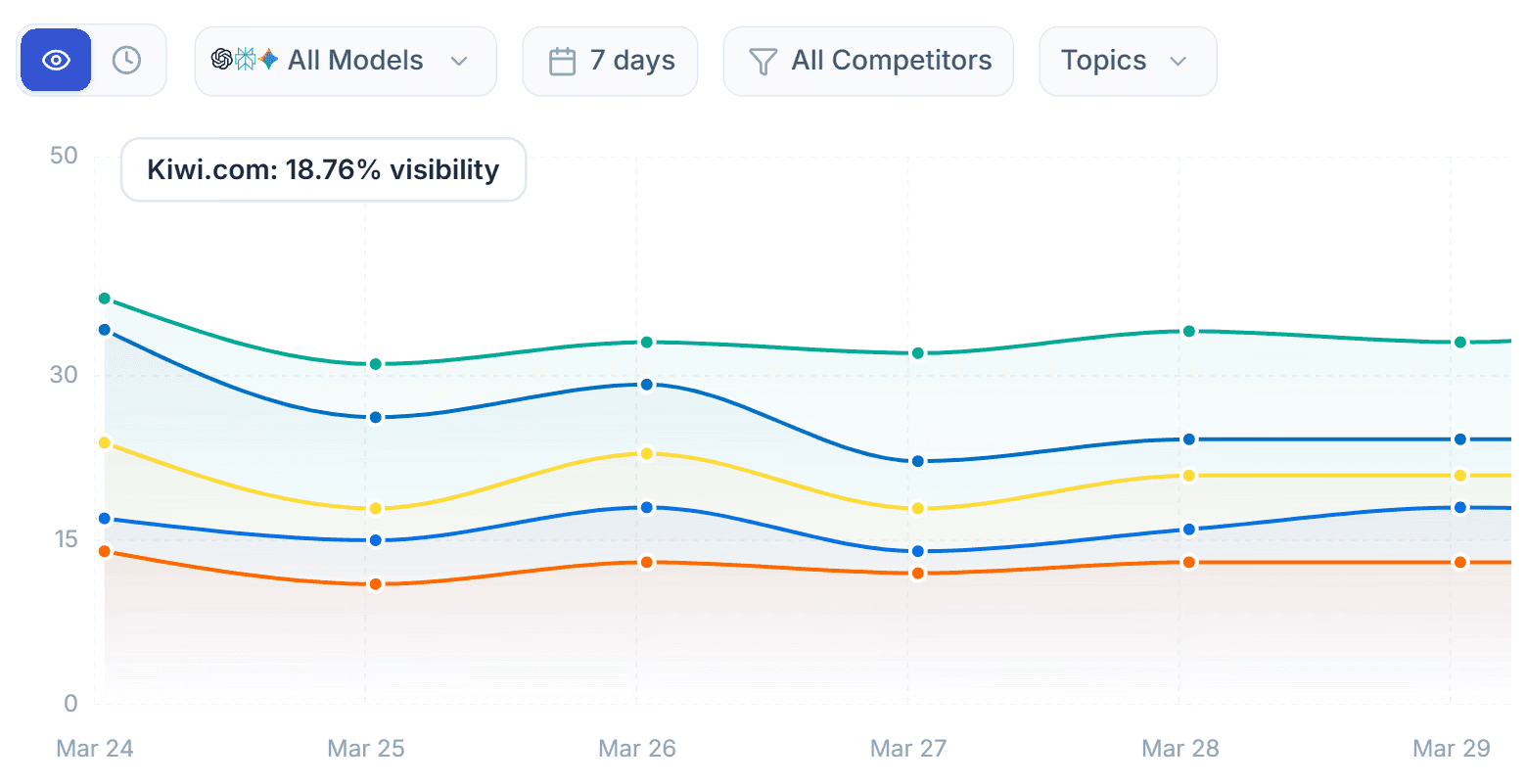
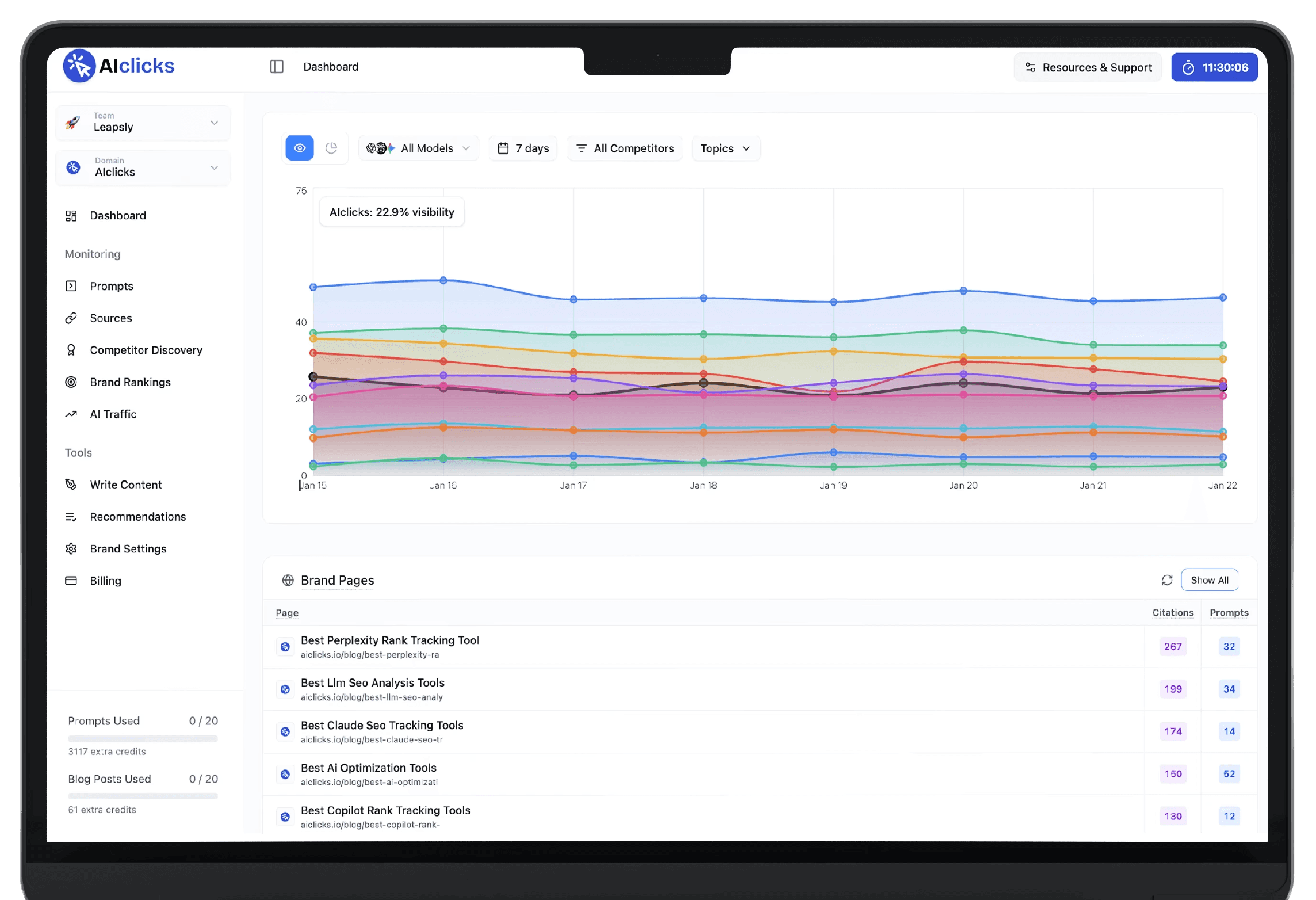
AIclicks gives you a live dashboard with daily ChatGPT mention rate, citation rate, sentiment, and share-of-voice across your tracked prompts, plus GA4 referral attribution for the traffic ChatGPT does send back.
Choose Your Plan
Flexible pricing that grows with your team. Upgrade or downgrade at any time.
Monthly
Yearly
-20%
Starter
Perfect for individuals & small teams
$49
/ month
Billed annually — you save $142
Choose 3 from:
Daily

" height="16px" id="fvSweaOBo" transform="translate(1 0)" width="14px"/></svg>)
" width="14px"><path d="M 13.864 5.629 L 13.3 5.629 L 13.3 5.6 L 7 5.6 L 7 8.4 L 10.956 8.4 C 10.379 10.03 8.828 11.2 7 11.2 C 4.681 11.2 2.8 9.319 2.8 7 C 2.8 4.681 4.681 2.8 7 2.8 C 8.071 2.8 9.045 3.204 9.786 3.864 L 11.766 1.884 C 10.516 0.719 8.844 0 7 0 C 3.134 0 0 3.134 0 7 C 0 10.866 3.134 14 7 14 C 10.866 14 14 10.866 14 7 C 14 6.531 13.952 6.073 13.864 5.629 Z" fill="rgb(255, 193, 7)" height="14px" id="H_YjfTNpn" width="14px"/><path d="M 0 3.742 L 2.3 5.429 C 2.922 3.888 4.429 2.8 6.193 2.8 C 7.264 2.8 8.238 3.204 8.979 3.864 L 10.959 1.884 C 9.709 0.719 8.037 0 6.193 0 C 3.504 0 1.172 1.518 0 3.742 Z" fill="rgb(255, 61, 0)" height="5.428500000000002px" id="PlkthQDhg" transform="translate(0.875 0)" width="10.959199999999996px"/><path d="M 6.232 5.581 C 8.04 5.581 9.683 4.889 10.925 3.764 L 8.758 1.931 C 8.032 2.483 7.144 2.782 6.232 2.781 C 4.411 2.781 2.865 1.62 2.283 0 L 0 1.759 C 1.159 4.026 3.511 5.581 6.232 5.581 Z" fill="rgb(76, 175, 80)" height="5.581099999999999px" id="WlnJ5gngE" transform="translate(0.7 8.4)" width="10.924899999999994px"/><path d="M 6.864 0.029 L 6.3 0.029 L 6.3 0 L 0 0 L 0 2.8 L 3.956 2.8 C 3.68 3.576 3.183 4.254 2.526 4.75 L 2.527 4.749 L 4.693 6.582 C 4.54 6.722 7 4.9 7 1.4 C 7 0.931 6.952 0.473 6.864 0.029 Z" fill="rgb(25, 118, 210)" height="6.589883930775992px" id="x_rSW275p" transform="translate(7 5.6)" width="7px"/></g></svg>)
" height="16px" id="hHS98fTxZ" width="16px"/></svg>)
 scale(1 1) translate(-1.861736945942159, -1.1170155383302638)" id="P20NzAvj0-699428820-radial-gradient" r="0.9935228066204626"><stop offset="0" stop-color="rgb(0, 174, 255)"/><stop offset="1" stop-color="rgb(7, 54, 196)"/></radialGradient><radialGradient cx="0.48250042504016705" cy="1.8366934653567062" gradient-transform="translate(0.48250042504016705, 1.8366934653567062) scale(1 1) translate(-0.48250042504016705, -1.8366934653567062)" id="UEWZqVjij-699428820-radial-gradient" r="0.9176890228114506"><stop offset="0" stop-color="rgb(255, 182, 87)"/><stop offset="1" stop-color="rgb(192, 43, 60)"/></radialGradient><linearGradient id="jyMN3TmKx-699428820-linear-gradient" x1="0.4594862532842614" x2="0.5405137467157386" y1="0" y2="1"><stop offset="0" stop-color="rgb(13, 145, 225)"/><stop offset="1" stop-color="rgb(255, 200, 0)"/></linearGradient><linearGradient id="xhMNwDFG0-699428820-linear-gradient" x1="0.4784828731548295" x2="0.5215171268451705" y1="5.551115123125783e-17" y2="1"><stop offset="0" stop-color="rgb(61, 203, 255)"/><stop offset="1" stop-color="rgba(5, 136, 247, 0)"/></linearGradient><radialGradient cx="1.4305090871482182" cy="0.34866158048251783" gradient-transform="translate(1.4305090871482182, 0.34866158048251783) scale(1 1) translate(-1.4305090871482182, -0.34866158048251783)" id="i79kAqaS4-699428820-radial-gradient" r="1.3362743412697924"><stop offset="0" stop-color="rgb(140, 72, 255)"/><stop offset="1" stop-color="rgb(255, 177, 82)"/></radialGradient><linearGradient id="mcxvno3tX-699428820-linear-gradient" x1="0.49844355920154226" x2="0.5015564407984577" y1="0" y2="1"><stop offset="0" stop-color="rgb(248, 173, 250)"/><stop offset="1" stop-color="rgba(168, 110, 221, 0)"/></linearGradient></defs><g d="M 11.605 1.219 C 11.397 0.499 10.739 0.002 9.989 0 L 9.498 0 C 8.682 0.002 7.985 0.588 7.842 1.391 L 7 6.016 L 7.209 5.296 C 7.416 4.574 8.075 4.076 8.825 4.074 L 11.681 4.074 L 12.879 4.545 L 14.033 4.074 L 13.697 4.074 C 12.947 4.072 12.289 3.575 12.081 2.855 Z M 4.413 13.387 C 4.618 14.111 5.278 14.611 6.031 14.613 L 7.075 14.613 C 7.988 14.613 8.735 13.88 8.758 12.96 L 8.871 8.5 L 8.633 9.319 C 8.426 10.039 7.768 10.537 7.018 10.539 L 4.138 10.539 L 3.111 9.977 L 2 10.539 L 2.331 10.539 C 3.084 10.542 3.743 11.042 3.949 11.766 L 4.413 13.387 Z M 9.999 0 L 4.167 0 C 2.501 0 1.501 2.221 0.834 4.441 C 0.045 7.073 -0.989 10.591 2.001 10.591 L 4.519 10.591 C 5.273 10.591 5.933 10.089 6.139 9.36 C 6.577 7.815 7.345 5.121 7.948 3.069 C 8.255 2.027 8.509 1.132 8.901 0.575 C 9.148 0.212 9.56 -0.004 9.999 0 M 9.999 0 L 4.167 0 C 2.501 0 1.501 2.221 0.834 4.441 C 0.045 7.073 -0.989 10.591 2.001 10.591 L 4.519 10.591 C 5.273 10.591 5.933 10.089 6.139 9.36 C 6.577 7.815 7.345 5.121 7.948 3.069 C 8.255 2.027 8.509 1.132 8.901 0.575 C 9.148 0.212 9.56 -0.004 9.999 0 M 6 14.593 L 11.833 14.593 C 13.499 14.593 14.499 12.372 15.166 10.151 C 15.955 7.519 16.989 4 13.999 4 L 11.48 4 C 10.725 4.002 10.063 4.505 9.86 5.232 C 9.266 7.332 8.663 9.429 8.051 11.523 C 7.745 12.566 7.49 13.461 7.098 14.019 C 6.851 14.382 6.439 14.597 6 14.593 M 6 14.593 L 11.833 14.593 C 13.499 14.593 14.499 12.372 15.166 10.151 C 15.955 7.519 16.989 4 13.999 4 L 11.48 4 C 10.725 4.002 10.063 4.505 9.86 5.232 C 9.266 7.332 8.663 9.429 8.051 11.523 C 7.745 12.566 7.49 13.461 7.098 14.019 C 6.851 14.382 6.439 14.597 6 14.593" fill="transparent" height="14.613333333333333px" id="QzkBy4Ibc" transform="translate(0 1)" width="16.00011071294081px"><path d="M 4.605 1.219 C 4.397 0.499 3.739 0.002 2.989 0 L 2.498 0 C 1.682 0.002 0.985 0.588 0.842 1.391 L 0 6.016 L 0.209 5.296 C 0.416 4.574 1.075 4.076 1.825 4.074 L 4.681 4.074 L 5.879 4.545 L 7.033 4.074 L 6.697 4.074 C 5.947 4.072 5.289 3.575 5.081 2.855 Z" fill="url(%23P20NzAvj0-699428820-radial-gradient)" height="6.016px" id="P20NzAvj0" transform="translate(7 0)" width="7.0333333333333385px"/><path d="M 2.413 4.887 C 2.618 5.611 3.278 6.111 4.031 6.113 L 5.075 6.113 C 5.988 6.113 6.735 5.38 6.758 4.46 L 6.871 0 L 6.633 0.819 C 6.426 1.539 5.768 2.037 5.018 2.039 L 2.138 2.039 L 1.111 1.477 L 0 2.039 L 0.331 2.039 C 1.084 2.042 1.743 2.542 1.949 3.266 L 2.413 4.887 Z" fill="url(%23UEWZqVjij-699428820-radial-gradient)" height="6.113333333333333px" id="UEWZqVjij" transform="translate(2 8.5)" width="6.871333333333332px"/><path d="M 9.999 0 L 4.167 0 C 2.501 0 1.501 2.221 0.834 4.441 C 0.045 7.073 -0.989 10.591 2.001 10.591 L 4.519 10.591 C 5.273 10.591 5.933 10.089 6.139 9.36 C 6.577 7.815 7.345 5.121 7.948 3.069 C 8.255 2.027 8.509 1.132 8.901 0.575 C 9.148 0.212 9.56 -0.004 9.999 0" fill="url(%23jyMN3TmKx-699428820-linear-gradient)" height="10.591388755215167px" id="jyMN3TmKx" width="9.999444046274142px"/><path d="M 9.999 0 L 4.167 0 C 2.501 0 1.501 2.221 0.834 4.441 C 0.045 7.073 -0.989 10.591 2.001 10.591 L 4.519 10.591 C 5.273 10.591 5.933 10.089 6.139 9.36 C 6.577 7.815 7.345 5.121 7.948 3.069 C 8.255 2.027 8.509 1.132 8.901 0.575 C 9.148 0.212 9.56 -0.004 9.999 0" fill="url(%23xhMNwDFG0-699428820-linear-gradient)" height="10.591388755215167px" id="xhMNwDFG0" width="9.999444046274142px"/><path d="M 0 10.593 L 5.833 10.593 C 7.499 10.593 8.499 8.372 9.166 6.151 C 9.955 3.519 10.989 0 7.999 0 L 5.48 0 C 4.725 0.002 4.063 0.505 3.86 1.232 C 3.266 3.332 2.663 5.429 2.051 7.523 C 1.745 8.566 1.49 9.461 1.098 10.019 C 0.851 10.382 0.439 10.597 0 10.593" fill="url(%23i79kAqaS4-699428820-radial-gradient)" height="10.593388755215164px" id="i79kAqaS4" transform="translate(6 4)" width="10.000110712940803px"/><path d="M 0 10.593 L 5.833 10.593 C 7.499 10.593 8.499 8.372 9.166 6.151 C 9.955 3.519 10.989 0 7.999 0 L 5.48 0 C 4.725 0.002 4.063 0.505 3.86 1.232 C 3.266 3.332 2.663 5.429 2.051 7.523 C 1.745 8.566 1.49 9.461 1.098 10.019 C 0.851 10.382 0.439 10.597 0 10.593" fill="url(%23mcxvno3tX-699428820-linear-gradient)" height="10.593388755215164px" id="mcxvno3tX" transform="translate(6 4)" width="10.000110712940803px"/></g></svg>)
" height="15.360666565427872px" id="HZPvvPBv7" transform="translate(0 0.5)" width="16px"/></svg>)
Tracked prompts
30
Websites you can add
3
LLMs you can track
3
Countries per project
1
LLM responses / mo
4,650
AI-optimized articles per month
10
Integrations
-
Support
Pro
For growing teams for more power
$140
/ month
Billed annually — you save $454
Choose 4 from:
Daily
Tracked prompts
150
Websites you can add
Unlimited
LLMs you can track
4
Countries per project
Unlimited
LLM responses / mo
18,600
AI-optimized articles per month
20
Integrations
Google Analytics
Support
BUSINESS
Best for medium-sized organizations
$357
/ month
Billed annually — you save $1198
Choose 6 from:
Daily
Tracked prompts
300
Websites you can add
Unlimited
LLMs you can track
6
Countries per project
Unlimited
LLM responses / mo
55,800
AI-optimized articles per month
30
Integrations
Google Analytics, API
Support
Dedicated account specialist
Become the #1 Answer in AI
Succeed in GEO yourself, or let us do all the work.
Do it yourself
Use AIclicks to see exactly where you appear across 10+ AI platforms, spot the gaps competitors are filling, and act on clear weekly recommendations.
From $59/month · Cancel anytime
Done for you
We Do All the Work for You
Our team manages your complete search presence: traditional SEO and GEO strategy, content, implementation, and reporting. You focus on clients.
Custom pricing · Minimum 3-month engagement
The AI SEO agency trusted by 1,000+ brands worldwide
From solo founders to multi-client agencies, AIclicks runs the full AI SEO agency program for organizations of every shape and size that want to be cited across every AI surface.
4.9/5 stars on G2







FAQ
How long does SEO take to work for an MSP?
Expect first movement in 3 to 4 months and real lead flow between 6 and 12. Dense metros with entrenched providers take 9 to 18 months, because the gap is usually authority and review volume rather than missing pages. Contracts also close slowly here, so a lead created in month 5 may not sign until month 8. Track booked discovery calls before judging anything else.
Do we optimise for Google or for ChatGPT?
Both, and for MSPs the AI half runs through directories. Ahrefs analysed 863,000 keywords and found only 38% of pages cited in AI Overviews also ranked in the top 10, down from 76% a year earlier. When an owner asks an assistant who should manage their IT, the answer gets assembled from Clutch, Cloudtango, G2 and vendor partner listings as often as from your own site.
How is MSP SEO different from normal local SEO?
Three things. You are a service-area business with no walk-in office, so half the storefront playbook simply does not apply. Search volume is tiny and contract value is large, which makes intent matter far more than traffic ever will. And the channel directory layer, Clutch, Cloudtango, UpCity and the vendor partner locators, works as ranking and citation infrastructure. Generic local SEO advice covers none of that.
What should an MSP budget for SEO each month?
Plan on $1,500 to $3,000 a month for one market and a narrow service set, and $3,000 to $8,000 to compete properly in a dense metro or across several verticals. Providers on r/msp routinely report retainers starting around $2,000. Judge it against contract value rather than against zero: if one 40-seat client is worth six figures over its life, the arithmetic is not close.
Should we keep running Google Ads alongside SEO?
Keep both, and give them different jobs. Ads buy the handful of high-intent searches you cannot yet rank for and stop producing the day you pause them. Organic compounds and lowers cost per contract. The useful sequence is running exact-match ads first on terms like managed IT services near me, seeing which produce booked calls, then building pages only for those. Measure both on cost per signed contract.
Which pages should an MSP build first?
Google Business Profile first, because it is free and sits above every organic result. Then rebuild the managed IT services page with real per-user pricing on it. Then a co-managed IT page, which barely any competitor has bothered to write. Then one vertical page for the industry already paying you most, and one compliance page for the framework those clients answer to. Location pages after that.
How do we tell if the SEO is working?
Measure signed contracts and new monthly recurring revenue from organic, not rankings. Put call tracking on the site with CallRail or WhatConverts, because most first contact is a phone call and it vanishes from analytics otherwise. Watch Search Console impressions on service and vertical terms, which move before positions do. Run a geogrid in BrightLocal for map visibility, and check quarterly whether assistants name you.
Should we run SEO in-house or hire an agency?
Split it. Nobody outside the company can write the explainer on why a 40-seat office needs conditional access, so keep engineer-authored content, profile upkeep and review requests in-house. Outsource technical work, schema and link building to a specialist. One check before signing: ask the agency to show you 3 client blogs, and if the posts are the same syndicated vendor articles, walk away.
Further Reading
Go deeper on GEO, AI search, and visibility tracking.