
SEO for Moving Companies:
Nobody plans a move calmly. A lease ends, a closing date lands, and the search happens on a phone between packing boxes. Customers message 3 or 4 movers in the same 10 minutes and book whoever answers first with proof they are licensed.









Why Moving Companies Need SEO
Moving demand is almost entirely local and almost entirely urgent. Most of it now passes through 3 map results, a handful of lead marketplaces, and an AI answer nobody at your company has read.
Your site says relocation solutions and full-service logistics. Customers type movers near me, apartment movers, piano movers, same-day movers, even removal companies. Each phrase is its own search, with its own competitor already sitting at the top. The quote lands with whoever used the customer’s words.
Type movers near me from any US address and Thumbtack sits above almost every real moving company, with Yelp, Angi and U-Haul’s Moving Help just under it. Those marketplaces win on pooled domain authority a single mover cannot reach, then charge you for the lead and hand the identical job to several rivals.
Movers buy shared leads by the piece, bid Local Services Ads right through peak season, and watch cost per booked job climb every summer. Retainers of $1,500 upward sit on that, and $5,000 is normal in a busy metro. Kill the spend in the fall and the trucks sit idle by the following Monday, with nothing left.
How SEO Works for Moving Companies
Search Engine Optimization projects are long-term investments for movers, where each task supplements the others and creates compound results over time.
01
Keywords, page structure, and the signals Google reads directly
On-page work fails for movers because the site is organized around how the company sells and not how the move is bought. A menu reading Residential, Commercial, Storage matches almost nothing a customer types. They search by the thing being moved and the situation they are in: apartment movers, office relocation, piano movers, last-minute movers, packing services, storage in transit. Each is a distinct page with distinct competitors. The pages that actually earn quote requests are one page per move type, one page per city you genuinely serve, and a pricing page. The blog is not on that list.
Move-type and cost pages age well. What an interstate move costs per pound, how binding estimates differ from non-binding ones, what valuation coverage actually pays out when a dresser gets scratched: none of that changes much, and the anxiety behind it never changes at all. The dated material is what churns. Summer availability posts, truck fleet announcements, holiday discount banners and this year’s peak-season pricing update all vanish from the index inside a month, and on most mover sites they outnumber the durable pages several times over. Publish less, about the move rather than the month, and refresh the numbers each spring.
1
One URL per move type, replacing the single services page: apartment movers, office relocation, piano movers, packing, storage in transit.
2
Unpublish last summer’s availability and discount pages each fall, redirecting each one into the move-type or pricing page that now covers it.
3
Add MovingCompany schema with areaServed, your USDOT number as identifier, and Service entries per move type, then check it in Rich Results Test.
4
Give every year-round cost question its own page: hourly crew rates, interstate cost per pound, binding versus non-binding estimates, valuation coverage.
02
Map Pack visibility, citations, and proximity signals
Practically nobody hires a mover from outside their own metro for a local job, so the 3-result map pack decides most of the market. It outranks Thumbtack, Yelp and the van line franchises, and a two-truck operator can beat a national brand there on the same terms. Google weighs relevance, proximity and prominence; 2 of the 3 answer directly to work you can start this month.
The primary category is Mover, not Moving and Storage Service, and the difference shows in the pack. Add packing service, storage facility or self-storage only where you genuinely provide them. Movers are service-area businesses, so hide the yard address and draw the area by the cities and ZIP codes your crews actually reach. Load photos of your own trucks, crews and wrapped furniture. Pre-answer what decides the booking: deposit, minimum hours, stairs, elevator reservations, whether you disassemble beds.
Movers sit on a citation layer that generic local SEO checklists never reach. Beyond Nextdoor, Yelp, Apple Maps and Bing Places sit the mover-specific sources: Thumbtack, Angi, HireAHelper, Moving Help, MyMovingReviews, MovingWaldo and your state movers association. Behind all of them is your FMCSA record. Your USDOT and MC numbers, the company name on your operating authority, and the name on every listing have to match, because customers verify you at protectyourmove.gov before they call.
1
Pick Mover for the primary category, add each move type as a separate service, and define coverage by ZIP rather than radius.
2
Every staffed yard earns a distinct profile, a distinct page and crew photos taken there; a virtual office Google catches gets the listing suspended.
3
Audit Thumbtack, Angi, HireAHelper, MyMovingReviews and BBB with BrightLocal or Whitespark, aligning every listing to the legal name on your USDOT authority.
4
Publish one profile update a week built from a finished job: the neighborhood, the move size, a photo of the loaded truck.
03
Topic authority, inbound links, and content that earns traffic
Two questions decide whether a quote request ever gets sent: what this costs, and who is going to break something. Content answering both plainly outperforms anything written for rankings. A page showing how an hourly local estimate is built, crew size, truck time, travel fee, materials, does more than a paragraph about your commitment to care. So does a straight explanation of what a deposit protects and when it is refundable.
The customer who has settled on hiring movers is now short-listing, and they want evidence. Your USDOT number visible on the page, proof of workers’ compensation and cargo liability, named crew leads, real photos from moves the size of theirs, and a date-availability check they can use without a phone call. Put that on the move-type page instead of a generic about-us. Movers who publish a real hourly rate get fewer calls and more bookings.
Mover links come from the people who stand next to the move. Realtors and brokerages keep preferred-vendor pages. Property managers and student housing offices publish approved-mover lists that almost nobody asks to join. Self-storage operators, apartment complexes, senior living communities and estate liquidators all link to a mover they trust. Add your chamber, the charity furniture bank you donate loads to, and your state movers association directory. The whole list costs nothing except the email.
1
Publish a yearly moving cost guide with your real hourly crew rates and travel fee, updated every spring before peak season starts.
2
Give each move type a page in each city you crew, with real access notes: elevator booking, permit parking, walk-up floors, truck limits.
3
Build one hub for the money questions: binding versus non-binding estimates, deposits, cancellation terms, tipping, valuation coverage, and what makes a quote change.
4
Write an authority page for each specialism you carry: pianos, gun safes, pool tables, fine art, laboratory equipment, or climate-controlled storage.
04
Site speed, crawlability, Core Web Vitals, and mobile health
The failure specific to movers is the quote wizard. On most mover sites the highest-value page is a multi-step estimate form injected as a third-party iframe or script from the moving CRM, SmartMoving, Supermove, MoveitPro or Elromco. Crawlers arrive, see a heading, a truck photo and an empty container, and index a page with almost no text. The URL that converts best on the whole site is the one Google understands least, and the form works fine for humans, so nobody looks.
Moving searches happen standing in a half-packed room on a Saturday morning, and the customer is contacting several movers at once. Whoever loads and answers first usually wins the job. A mover site typically carries a photo gallery of every truck, a chat widget, a call-tracking script and that CRM iframe, all firing before the phone number renders. On a budget handset with a weak signal that is several seconds of blank screen, and the next mover is one tap away.
1
Run your quote page through the URL Inspection tool and read the rendered HTML; if the estimate form is an iframe, add crawlable copy.
2
Test your heaviest city page in PageSpeed Insights, normally the one carrying the fleet gallery, and keep Largest Contentful Paint below 2.5 seconds.
3
Serve crew and completed-move photos as compressed WebP and lazy-load the gallery, since job photography is the heaviest asset movers publish.
4
Keep move-type and city pages in their own sitemap, apart from the blog, and push a resubmission whenever rates or service areas change.
05
Star ratings, review volume, and response strategy that builds trust
Nothing decides a mover search like review count, because the customer is handing strangers every object they own and has nothing else to go on. The difficulty is timing and volume. A move ends with everyone exhausted, boxes everywhere and nobody reaching for their phone. The customers who volunteer a review are usually the ones with a damage claim or a bill that came in higher than the estimate, so an unmanaged mover drifts to a rating below what its crews earn.
Ask on the truck ramp while the crew lead is doing the final walkthrough and the customer is relieved it went fine. That is the peak, and it lasts about an hour. A QR card handed over with the signed bill of lading outperforms any email sequence sent 3 days later. If you automate, fire the request from your CRM when the job status flips to complete, signed by the crew lead by name. Ask on every job, including the small ones.
1
Wire SmartMoving or Supermove so the review request texts out the moment a job is marked closed, under the crew lead’s name.
2
Answer damage complaints inside 24 hours, spelling out the claims process and your cargo liability terms, because prospects read the worst review first.
3
Show reviews that mention pianos on the piano page and office moves on the commercial page, not in one site-wide slider.
4
Ask storage and packing-only customers too, since those jobs finish calmly and produce willing reviewers that full-move crews rarely have time to catch.
Google is No Longer the Only Place Your customers are Searching
Customers are using AI to find answers, and they trust what it tells them. Invest in GEO to get recommended in those answers.
1 Billion
Questions ChatGPT receives every single day
38%
Your #1 top ranking page on Google would be cited by AI
14%
of movers optimise for GEO. The rest are invisible in AI answers


You can rank #1 for “mover near me” and still not exist in ChatGPT’s answer. Run a free GEO audit to see where your brand actually stands.
GEO vs SEO: Same Goal, Different Methods
GEO is wider than SEO. AI recommends the brands that show up across the sources it reads, so your presence in forums, social platforms and moving blogs decides your odds. AIclicks measures the three metrics below so you know which to work on first.
AI Assistant
Which local moving company is worth the money?
Your Company
Citation Rate
Shows how many AI answers about moving companies name your brand, out of every 100. Models pull from the same trusted pages over and over, so citations compound: once you are in, staying in gets easier. Find the competitor pages AI cites most, then publish your own version of each.
Your Company
82% positive
Competitor A
54% positive
Competitor B
38% positive
Brand Sentiment
Shows how AI describes you when your brand comes up: positive, neutral or negative. Tone is what separates being mentioned from being recommended, and models repeat whatever framing they find. Track the negative mentions back to the reviews and threads behind them, then publish content that answers those directly.
Others 52%
You 24%
— 24%
Your Company
AI mention share of voice — moving category
Competitors
Not Cited
Share of Voice in AI
Shows how much of the moving conversation belongs to you rather than your competitors. This is the metric that matters most, the GEO version of a Google ranking. With only 1–5 brands named per answer, the market is winner-takes-more and every point is taken from someone.
The Dashboard Your Dedicated AI Search Team Works In
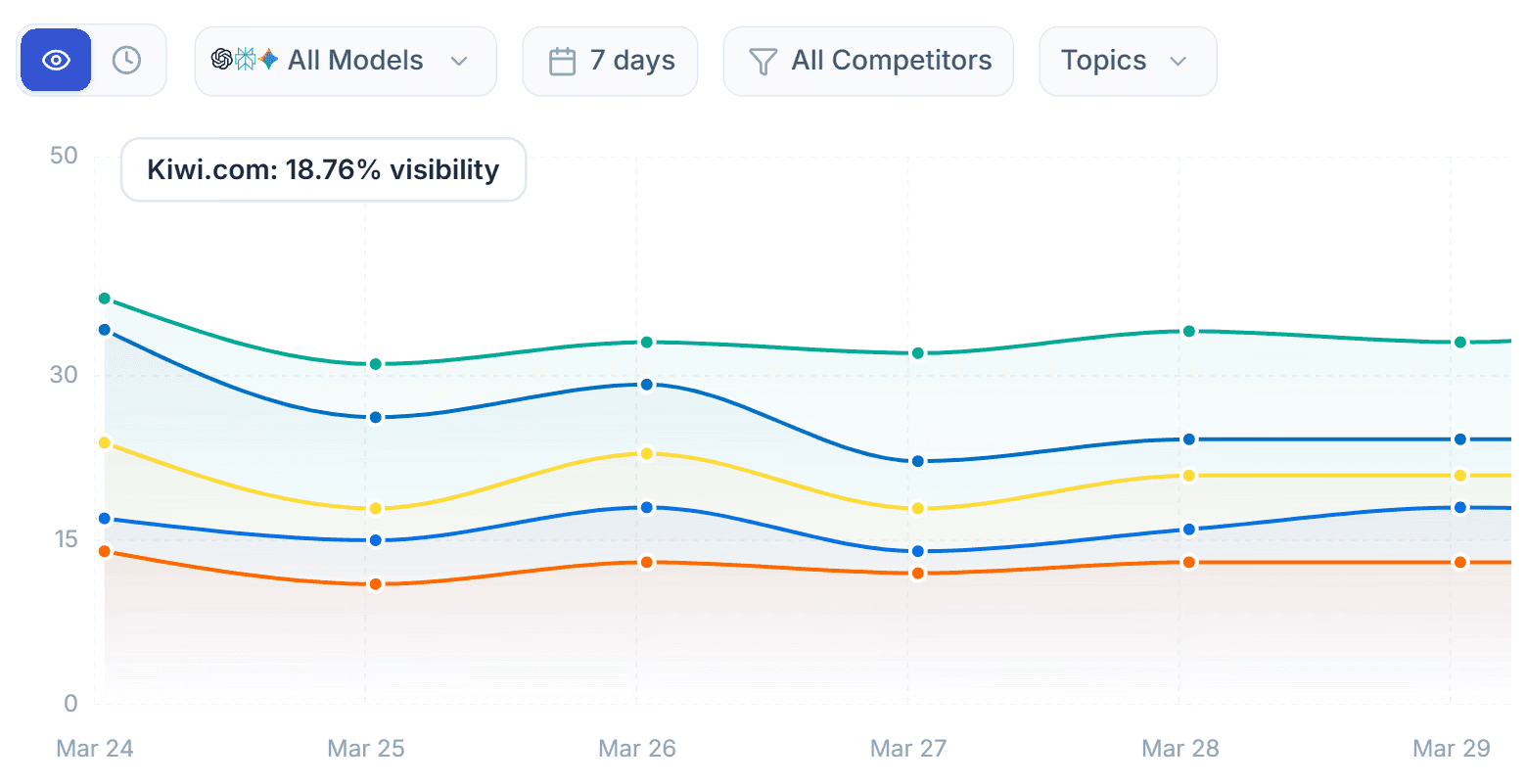
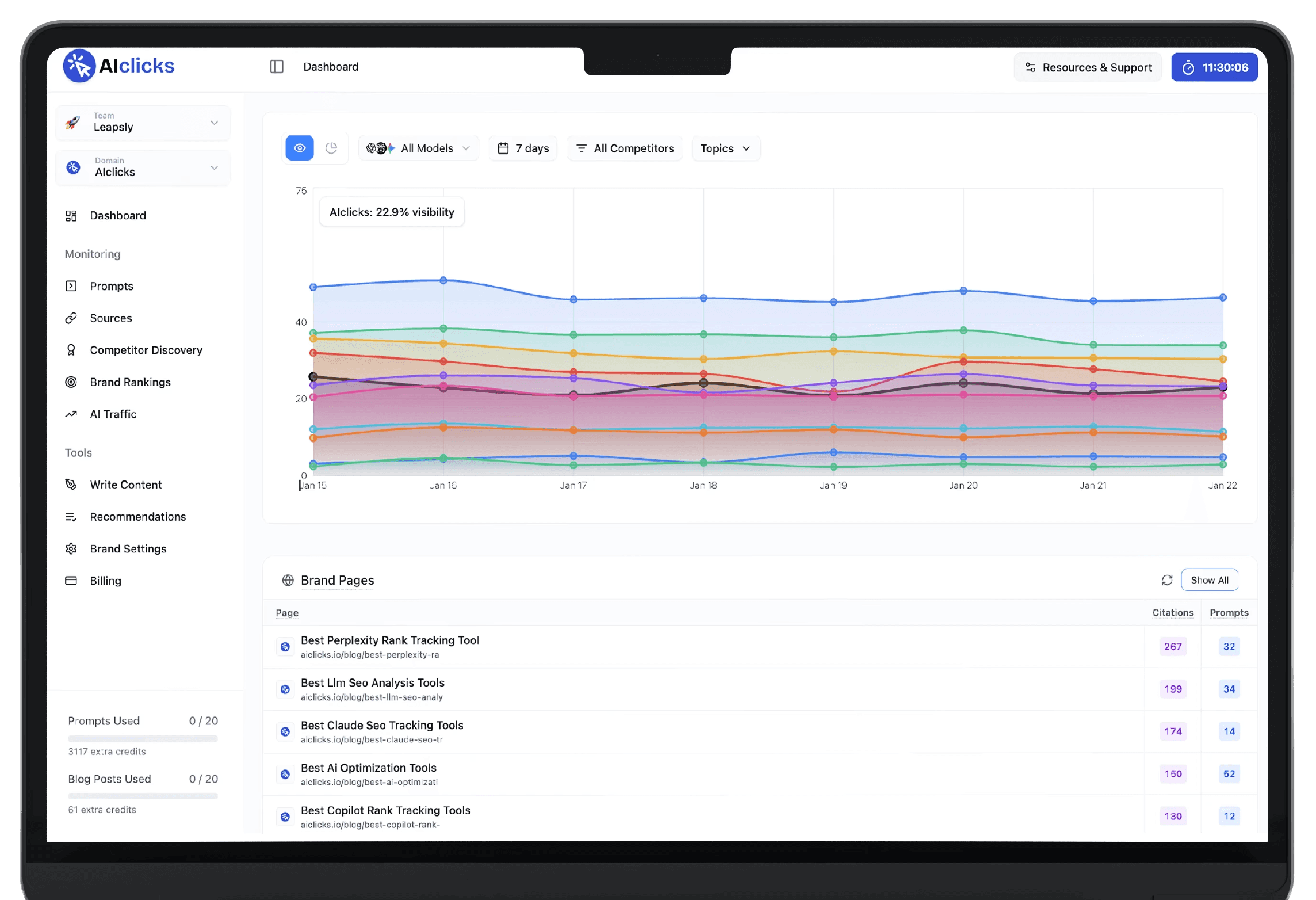
AIclicks gives you a live dashboard with daily ChatGPT mention rate, citation rate, sentiment, and share-of-voice across your tracked prompts, plus GA4 referral attribution for the traffic ChatGPT does send back.
Choose Your Plan
Flexible pricing that grows with your team. Upgrade or downgrade at any time.
Monthly
Yearly
-20%
Starter
Perfect for individuals & small teams
$49
/ month
Billed annually — you save $142
Choose 3 from:
Daily

" height="16px" id="fvSweaOBo" transform="translate(1 0)" width="14px"/></svg>)
" width="14px"><path d="M 13.864 5.629 L 13.3 5.629 L 13.3 5.6 L 7 5.6 L 7 8.4 L 10.956 8.4 C 10.379 10.03 8.828 11.2 7 11.2 C 4.681 11.2 2.8 9.319 2.8 7 C 2.8 4.681 4.681 2.8 7 2.8 C 8.071 2.8 9.045 3.204 9.786 3.864 L 11.766 1.884 C 10.516 0.719 8.844 0 7 0 C 3.134 0 0 3.134 0 7 C 0 10.866 3.134 14 7 14 C 10.866 14 14 10.866 14 7 C 14 6.531 13.952 6.073 13.864 5.629 Z" fill="rgb(255, 193, 7)" height="14px" id="H_YjfTNpn" width="14px"/><path d="M 0 3.742 L 2.3 5.429 C 2.922 3.888 4.429 2.8 6.193 2.8 C 7.264 2.8 8.238 3.204 8.979 3.864 L 10.959 1.884 C 9.709 0.719 8.037 0 6.193 0 C 3.504 0 1.172 1.518 0 3.742 Z" fill="rgb(255, 61, 0)" height="5.428500000000002px" id="PlkthQDhg" transform="translate(0.875 0)" width="10.959199999999996px"/><path d="M 6.232 5.581 C 8.04 5.581 9.683 4.889 10.925 3.764 L 8.758 1.931 C 8.032 2.483 7.144 2.782 6.232 2.781 C 4.411 2.781 2.865 1.62 2.283 0 L 0 1.759 C 1.159 4.026 3.511 5.581 6.232 5.581 Z" fill="rgb(76, 175, 80)" height="5.581099999999999px" id="WlnJ5gngE" transform="translate(0.7 8.4)" width="10.924899999999994px"/><path d="M 6.864 0.029 L 6.3 0.029 L 6.3 0 L 0 0 L 0 2.8 L 3.956 2.8 C 3.68 3.576 3.183 4.254 2.526 4.75 L 2.527 4.749 L 4.693 6.582 C 4.54 6.722 7 4.9 7 1.4 C 7 0.931 6.952 0.473 6.864 0.029 Z" fill="rgb(25, 118, 210)" height="6.589883930775992px" id="x_rSW275p" transform="translate(7 5.6)" width="7px"/></g></svg>)
" height="16px" id="hHS98fTxZ" width="16px"/></svg>)
 scale(1 1) translate(-1.861736945942159, -1.1170155383302638)" id="P20NzAvj0-699428820-radial-gradient" r="0.9935228066204626"><stop offset="0" stop-color="rgb(0, 174, 255)"/><stop offset="1" stop-color="rgb(7, 54, 196)"/></radialGradient><radialGradient cx="0.48250042504016705" cy="1.8366934653567062" gradient-transform="translate(0.48250042504016705, 1.8366934653567062) scale(1 1) translate(-0.48250042504016705, -1.8366934653567062)" id="UEWZqVjij-699428820-radial-gradient" r="0.9176890228114506"><stop offset="0" stop-color="rgb(255, 182, 87)"/><stop offset="1" stop-color="rgb(192, 43, 60)"/></radialGradient><linearGradient id="jyMN3TmKx-699428820-linear-gradient" x1="0.4594862532842614" x2="0.5405137467157386" y1="0" y2="1"><stop offset="0" stop-color="rgb(13, 145, 225)"/><stop offset="1" stop-color="rgb(255, 200, 0)"/></linearGradient><linearGradient id="xhMNwDFG0-699428820-linear-gradient" x1="0.4784828731548295" x2="0.5215171268451705" y1="5.551115123125783e-17" y2="1"><stop offset="0" stop-color="rgb(61, 203, 255)"/><stop offset="1" stop-color="rgba(5, 136, 247, 0)"/></linearGradient><radialGradient cx="1.4305090871482182" cy="0.34866158048251783" gradient-transform="translate(1.4305090871482182, 0.34866158048251783) scale(1 1) translate(-1.4305090871482182, -0.34866158048251783)" id="i79kAqaS4-699428820-radial-gradient" r="1.3362743412697924"><stop offset="0" stop-color="rgb(140, 72, 255)"/><stop offset="1" stop-color="rgb(255, 177, 82)"/></radialGradient><linearGradient id="mcxvno3tX-699428820-linear-gradient" x1="0.49844355920154226" x2="0.5015564407984577" y1="0" y2="1"><stop offset="0" stop-color="rgb(248, 173, 250)"/><stop offset="1" stop-color="rgba(168, 110, 221, 0)"/></linearGradient></defs><g d="M 11.605 1.219 C 11.397 0.499 10.739 0.002 9.989 0 L 9.498 0 C 8.682 0.002 7.985 0.588 7.842 1.391 L 7 6.016 L 7.209 5.296 C 7.416 4.574 8.075 4.076 8.825 4.074 L 11.681 4.074 L 12.879 4.545 L 14.033 4.074 L 13.697 4.074 C 12.947 4.072 12.289 3.575 12.081 2.855 Z M 4.413 13.387 C 4.618 14.111 5.278 14.611 6.031 14.613 L 7.075 14.613 C 7.988 14.613 8.735 13.88 8.758 12.96 L 8.871 8.5 L 8.633 9.319 C 8.426 10.039 7.768 10.537 7.018 10.539 L 4.138 10.539 L 3.111 9.977 L 2 10.539 L 2.331 10.539 C 3.084 10.542 3.743 11.042 3.949 11.766 L 4.413 13.387 Z M 9.999 0 L 4.167 0 C 2.501 0 1.501 2.221 0.834 4.441 C 0.045 7.073 -0.989 10.591 2.001 10.591 L 4.519 10.591 C 5.273 10.591 5.933 10.089 6.139 9.36 C 6.577 7.815 7.345 5.121 7.948 3.069 C 8.255 2.027 8.509 1.132 8.901 0.575 C 9.148 0.212 9.56 -0.004 9.999 0 M 9.999 0 L 4.167 0 C 2.501 0 1.501 2.221 0.834 4.441 C 0.045 7.073 -0.989 10.591 2.001 10.591 L 4.519 10.591 C 5.273 10.591 5.933 10.089 6.139 9.36 C 6.577 7.815 7.345 5.121 7.948 3.069 C 8.255 2.027 8.509 1.132 8.901 0.575 C 9.148 0.212 9.56 -0.004 9.999 0 M 6 14.593 L 11.833 14.593 C 13.499 14.593 14.499 12.372 15.166 10.151 C 15.955 7.519 16.989 4 13.999 4 L 11.48 4 C 10.725 4.002 10.063 4.505 9.86 5.232 C 9.266 7.332 8.663 9.429 8.051 11.523 C 7.745 12.566 7.49 13.461 7.098 14.019 C 6.851 14.382 6.439 14.597 6 14.593 M 6 14.593 L 11.833 14.593 C 13.499 14.593 14.499 12.372 15.166 10.151 C 15.955 7.519 16.989 4 13.999 4 L 11.48 4 C 10.725 4.002 10.063 4.505 9.86 5.232 C 9.266 7.332 8.663 9.429 8.051 11.523 C 7.745 12.566 7.49 13.461 7.098 14.019 C 6.851 14.382 6.439 14.597 6 14.593" fill="transparent" height="14.613333333333333px" id="QzkBy4Ibc" transform="translate(0 1)" width="16.00011071294081px"><path d="M 4.605 1.219 C 4.397 0.499 3.739 0.002 2.989 0 L 2.498 0 C 1.682 0.002 0.985 0.588 0.842 1.391 L 0 6.016 L 0.209 5.296 C 0.416 4.574 1.075 4.076 1.825 4.074 L 4.681 4.074 L 5.879 4.545 L 7.033 4.074 L 6.697 4.074 C 5.947 4.072 5.289 3.575 5.081 2.855 Z" fill="url(%23P20NzAvj0-699428820-radial-gradient)" height="6.016px" id="P20NzAvj0" transform="translate(7 0)" width="7.0333333333333385px"/><path d="M 2.413 4.887 C 2.618 5.611 3.278 6.111 4.031 6.113 L 5.075 6.113 C 5.988 6.113 6.735 5.38 6.758 4.46 L 6.871 0 L 6.633 0.819 C 6.426 1.539 5.768 2.037 5.018 2.039 L 2.138 2.039 L 1.111 1.477 L 0 2.039 L 0.331 2.039 C 1.084 2.042 1.743 2.542 1.949 3.266 L 2.413 4.887 Z" fill="url(%23UEWZqVjij-699428820-radial-gradient)" height="6.113333333333333px" id="UEWZqVjij" transform="translate(2 8.5)" width="6.871333333333332px"/><path d="M 9.999 0 L 4.167 0 C 2.501 0 1.501 2.221 0.834 4.441 C 0.045 7.073 -0.989 10.591 2.001 10.591 L 4.519 10.591 C 5.273 10.591 5.933 10.089 6.139 9.36 C 6.577 7.815 7.345 5.121 7.948 3.069 C 8.255 2.027 8.509 1.132 8.901 0.575 C 9.148 0.212 9.56 -0.004 9.999 0" fill="url(%23jyMN3TmKx-699428820-linear-gradient)" height="10.591388755215167px" id="jyMN3TmKx" width="9.999444046274142px"/><path d="M 9.999 0 L 4.167 0 C 2.501 0 1.501 2.221 0.834 4.441 C 0.045 7.073 -0.989 10.591 2.001 10.591 L 4.519 10.591 C 5.273 10.591 5.933 10.089 6.139 9.36 C 6.577 7.815 7.345 5.121 7.948 3.069 C 8.255 2.027 8.509 1.132 8.901 0.575 C 9.148 0.212 9.56 -0.004 9.999 0" fill="url(%23xhMNwDFG0-699428820-linear-gradient)" height="10.591388755215167px" id="xhMNwDFG0" width="9.999444046274142px"/><path d="M 0 10.593 L 5.833 10.593 C 7.499 10.593 8.499 8.372 9.166 6.151 C 9.955 3.519 10.989 0 7.999 0 L 5.48 0 C 4.725 0.002 4.063 0.505 3.86 1.232 C 3.266 3.332 2.663 5.429 2.051 7.523 C 1.745 8.566 1.49 9.461 1.098 10.019 C 0.851 10.382 0.439 10.597 0 10.593" fill="url(%23i79kAqaS4-699428820-radial-gradient)" height="10.593388755215164px" id="i79kAqaS4" transform="translate(6 4)" width="10.000110712940803px"/><path d="M 0 10.593 L 5.833 10.593 C 7.499 10.593 8.499 8.372 9.166 6.151 C 9.955 3.519 10.989 0 7.999 0 L 5.48 0 C 4.725 0.002 4.063 0.505 3.86 1.232 C 3.266 3.332 2.663 5.429 2.051 7.523 C 1.745 8.566 1.49 9.461 1.098 10.019 C 0.851 10.382 0.439 10.597 0 10.593" fill="url(%23mcxvno3tX-699428820-linear-gradient)" height="10.593388755215164px" id="mcxvno3tX" transform="translate(6 4)" width="10.000110712940803px"/></g></svg>)
" height="15.360666565427872px" id="HZPvvPBv7" transform="translate(0 0.5)" width="16px"/></svg>)
Tracked prompts
30
Websites you can add
3
LLMs you can track
3
Countries per project
1
LLM responses / mo
4,650
AI-optimized articles per month
10
Integrations
-
Support
Pro
For growing teams for more power
$140
/ month
Billed annually — you save $454
Choose 4 from:
Daily
Tracked prompts
150
Websites you can add
Unlimited
LLMs you can track
4
Countries per project
Unlimited
LLM responses / mo
18,600
AI-optimized articles per month
20
Integrations
Google Analytics
Support
BUSINESS
Best for medium-sized organizations
$357
/ month
Billed annually — you save $1198
Choose 6 from:
Daily
Tracked prompts
300
Websites you can add
Unlimited
LLMs you can track
6
Countries per project
Unlimited
LLM responses / mo
55,800
AI-optimized articles per month
30
Integrations
Google Analytics, API
Support
Dedicated account specialist
Become the #1 Answer in AI
Succeed in GEO yourself, or let us do all the work.
Do it yourself
Use AIclicks to see exactly where you appear across 10+ AI platforms, spot the gaps competitors are filling, and act on clear weekly recommendations.
From $59/month · Cancel anytime
Done for you
We Do All the Work for You
Our team manages your complete search presence: traditional SEO and GEO strategy, content, implementation, and reporting. You focus on customers.
Custom pricing · Minimum 3-month engagement
The AI SEO agency trusted by 1,000+ brands worldwide
From solo founders to multi-client agencies, AIclicks runs the full AI SEO agency program for organizations of every shape and size that want to be cited across every AI surface.
4.9/5 stars on G2







FAQ
How long until SEO fills the schedule?
Map pack movement typically appears by month 3 or 4, and booked jobs from organic search around month 6. Agencies working in this industry describe the same curve: trends turning by month 4 and a positive return by month 6, with competitive metros running 6 to 12 months. A mover starting in the fall has a real advantage, because the work matures just as peak season opens rather than during it.
Is AI search worth chasing, or just Google?
Both, though for movers the gap between them is unusually wide. Just 38% of pages that AI Overviews cite were also top 10 rankers, Ahrefs found across 863,000 keywords, down from 76% the year before. Assistants asked who should move my apartment lean on review marketplaces, forum threads and license records instead of mover websites, so you can own the map pack and still be absent from the answer.
Why does mover SEO need its own playbook?
Seasonality, federal licensing and lead marketplaces. Demand is violently seasonal, so the rankings that carry your summer were earned the previous winter, and work started in June is already late. You are also federally regulated: an active USDOT number, operating authority and cargo liability are trust signals customers verify before calling. And your head terms belong to marketplaces that resell the same lead to several movers. A generic local checklist misses all 3.
What should a moving company budget for SEO?
Published rates in this industry begin near $1,500 monthly for a single-market mover and reach $5,000 where the metro is competitive, with one national agency quoting $2,500 to $20,000 depending on footprint. Retainers under $1,000 usually buy citation submissions and a monthly blog post. Benchmark the number against your current cost per shared lead and per booked job in July, never against zero.
Do we still need Local Services Ads if SEO works?
They cover opposite halves of the calendar. Paid channels, Local Services Ads especially, buy the calls you need next Saturday and go silent the hour you switch them off; map pack and organic visibility is what keeps trucks loaded through the slow months when nobody is bidding. Let the ad data sequence your content, building pages for the move types that turn into signed jobs rather than the ones that only draw clicks.
Which pages should a moving company build first?
The Google Business Profile, before anything on the website, since nobody charges for it and it outranks every organic result. Next your pricing page, because cost is the question that stops the call. After that, a dedicated page for each of your 3 best-margin move types, written in the words customers type. City pages follow, covering the places your crews genuinely work, then storage and specialty pages. Leave the blog until last. Most movers run this order backwards.
How do we prove this is generating moves?
Count booked moves attributed to organic search, and ignore ranking screenshots. Add call tracking, because most moving jobs are booked over the phone and never show up in analytics. Inside Google Business Profile, calls and direction requests move well before revenue does. Search Console impressions on move-type and city terms climb before positions do, so read those early. Then reconcile against your CRM, comparing revenue per booked job by source.
Should we hire an agency or keep it in-house?
Split it by who knows the trucks. Profile posts, job photos, chasing reviews and writing honest answers about stairs, permits and deposits belong in-house, because your dispatcher knows all of it and an agency never will. Contract out the engineering: structured data, page speed, listing cleanup, link outreach. When you do hire, insist on someone fluent in USDOT authority and peak-season planning; a generalist will just sell you a blog.
Further Reading
Go deeper on GEO, AI search, and visibility tracking.