SEO for Mortgage Brokerages:
A borrower shops rates for weeks before they ever call anyone. They read Reddit threads, run affordability calculators, ask ChatGPT whether a broker beats a bank, and arrive with 3 names already written down. Search decides whose name is on that list.









Why Mortgage Brokerages Need SEO
Over 60% of mortgage searches happen on a phone, and borrowers now settle the broker-versus-bank question in an AI chat before they ever type a near me query.
A broker site lists FHA, VA, USDA, jumbo and cash-out refinance as checkboxes on a single loan programs page. Each of those is a distinct search with a distinct borrower behind it. Someone hunting a bank statement loan for self-employed income never finds you, because that page was never written.
Type mortgage broker near me anywhere in the US and the top organic results are Zillow, the BBB and the branch locators the national banks run. Bankrate, NerdWallet and LendingTree own every rate query above them. Your business surfaces inside their listings, next to whoever paid for placement.
Shared leads from the big portals run $100 to $250 each and land in 4 inboxes at once, so conversion sits near 1%. Add an agency retainer, usually somewhere between $1,500 and $5,000 monthly, plus a Google Ads budget. Stop paying and the pipeline empties that week, because nothing was ever owned.
How SEO Works for Mortgage Brokerages
Search Engine Optimization projects are long-term investments for mortgage brokers, where each task supplements the others and creates compound results over time.
01
Keywords, page structure, and the signals Google reads directly
On-page work is constrained here in a way other trades never deal with. The moment a page states a rate, an APR, a monthly payment or a down payment figure, Regulation Z treats those as triggering terms and requires a block of disclosures alongside them. Compliance responds by stripping the numbers out, which leaves a page that ranks for nothing. Build the disclosure into the template once and the numbers can stay. The pages carrying the weight are your loan program pages, your originator bios with live NMLS IDs, and your calculator pages, not the rate feed nobody is allowed to describe.
Durable pages attach to a borrower situation rather than to a rate. What documents a self-employed applicant actually needs, how a DSCR loan is underwritten, what a 3% down conventional program costs against an FHA loan over 5 years: none of that moves when the ten-year yield does, and borrowers search it every month. Weekly rate commentary is the opposite. It is stale by Thursday, it triggers the disclosure rules, and it quietly becomes 80% of the blog. Most brokerages publish 40 rate posts a year and 2 program pages, and wonder why nothing ranks.
1
Break the loan programs page apart, one page per product: FHA, VA, USDA, jumbo, DSCR, bank statement, cash-out refinance.
2
Pull expired rate posts and discontinued program pages out of the index quarterly, redirecting each into the loan program page that replaced it.
3
Mark each program page with MortgageLoan and FinancialService schema, and put your NMLS ID in Person schema on every originator bio.
4
Build a page per down payment assistance program and per credit score threshold, since eligibility questions rank year-round regardless of where rates sit.
02
Map Pack visibility, citations, and proximity signals
Almost all non-branded mortgage search is local, because a borrower wants somebody licensed in the state the property sits in and, usually, somebody they can meet. That puts the 3-result map pack above Zillow and above every bank locator, the only position an independent shop can take from a lender with a billion-dollar ad budget. Proximity you cannot change; profile completeness and review velocity you can, and both move faster than anything on the website.
Pick Mortgage Broker for the primary category rather than Financial Consultant or Loan Agency, then add every product you actually originate as a service with its own description. Put the NMLS ID in the business description, because borrowers verify it before they call. Define the service area by county and ZIP rather than the office pin, list genuine hours including evenings, and seed the Q&A with the questions you answer daily: minimum credit score, self-employed income, how commission is paid.
Mortgage carries a citation layer general local SEO advice never mentions. NMLS Consumer Access is the register borrowers and Google both check, and your state licensing lookup sits beside it. Then the industry directories: Zillow’s lender profiles, Bankrate, LendingTree, Experience.com, the Better Business Bureau, and findamortgagebroker.com if you are an AIME member. Every one needs the identical legal entity name, suite and phone, because the DBA you use on marketing rarely matches the name on the licence.
1
Set Mortgage Broker as your primary category, list each loan product as its own service, and publish the NMLS ID in the description.
2
Give each licensed branch its own profile and page; give individual originators their own bio pages, never a duplicate profile on the same address.
3
Audit NMLS Consumer Access, Zillow, Bankrate and your BBB profile with Yext or BrightLocal, reconciling every DBA against the licensed entity name.
4
Post to the profile weekly: a program change, a closed loan type, a straight answer to a question borrowers keep asking.
03
Topic authority, inbound links, and content that earns traffic
Before a borrower will speak to anyone they are working out 3 things: what they can actually afford, whether a broker beats going straight to a bank, and who pays you. That last one kills more enquiries than rate ever does, because most people assume a broker costs them extra. A page explaining lender-paid versus borrower-paid compensation in plain English converts better than any rate table, and it is the question the aggregators deliberately never answer clearly.
A borrower who has decided to use a broker is now picking one, and they want evidence they can check. Show which lenders you have wholesale access to, what your average close time actually is, how many of your files were self-employed or credit-challenged last year, and the originator’s licence number and states. Put the pre-qualification link on the same page. Brokers lose these people to a form that asks for a social security number before it asks anything else.
Mortgage links come from the referral network you already have and from trade press that runs on deadline. Real estate agents, title companies, home inspectors and CPAs all publish preferred-partner pages. NAMB and AIME list members. HousingWire, National Mortgage Professional and Scotsman Guide need an originator to explain a rate move the same day, and Qwoted and Featured broker those requests. Keep RESPA Section 8 in mind: a link exchanged for referrals is a different thing entirely.
1
Publish an annual broker versus bank comparison with real rate spreads, fee schedules and close times, updated when wholesale pricing shifts.
2
Build one page per loan program per area you are licensed in, using real loan limits and local down payment assistance, not swapped place names.
3
Answer the money questions in one linked hub: closing costs, PMI, discount points, broker compensation, and what extending a rate lock costs.
4
Give each wholesale lender and niche you place volume with its own page, such as non-QM, DSCR or VA, since borrowers search products first.
04
Site speed, crawlability, Core Web Vitals, and mobile health
Most originators do not own their website. The brokerage or the LOS vendor hands out a templated microsite on a shared domain, one per loan officer, identical down to the paragraph, and Google indexes maybe 2 of them. The bigger problem arrives the day you change sponsorship: the NMLS record updates, the microsite is switched off, and every link, ranking and review page you built for 3 years disappears without a single redirect.
Borrowers open your site standing in a house they want, at an open house on a Sunday, deciding whether to text you before the offer deadline. That page is usually the heaviest one you own: an affordability calculator, a rate table and a point-of-sale widget from Blend or Floify, all loaded through third-party JavaScript that fires after everything else. If the calculator has not rendered in 3 seconds, they use the one Zillow already loaded.
1
Move your content to a domain you control, then 301 the vendor microsite into it before your next sponsorship change, not after.
2
Profile your affordability calculator and rate pages in PageSpeed Insights, defer the third-party widgets, and keep Interaction to Next Paint under 200 milliseconds.
3
Serve originator headshots and closing-day video testimonials as WebP and lazy-loaded MP4 with poster frames, never autoplaying video above the fold.
4
Split loan program and licensed-area pages out of the rate-post sitemap, and ping IndexNow whenever loan limits or program guidelines change.
05
Star ratings, review volume, and response strategy that builds trust
Reviews decide mortgage searches because the borrower is handing a stranger their tax returns, their bank statements and the biggest purchase of their life. They are also awkward to run at scale. Reviews attach to the originator on Zillow and Experience.com but to the company on Google, so a top producer’s proof sits in 3 places and none of them add up. Meanwhile every declined application is a potential 1-star review you cannot answer in detail.
Ask at the closing table, or within the hour, while the keys are still in their hand. Wait until the funding confirmation email lands on Monday and the feeling has gone. Fire the request from Total Expert, Surefire or Jungo on the funded milestone, signed by the originator rather than the brand, with one link and one sentence. Ask realtors and title officers you closed with too; their reviews read as professional endorsement.
1
Fire the review request from Total Expert, Surefire or Jungo the moment a loan flips to funded in the LOS.
2
Answer inside a day without confirming an application ever existed; GLBA privacy still applies when a reviewer publishes their own loan details.
3
Pull reviews that mention a specific program onto that program page, so the VA proof sits on the VA loan page.
4
Ask the realtors, title officers and builders you close with for reviews too, since referral partners drive more volume than any single borrower.
Google is No Longer the Only Place Your borrowers are Searching
Borrowers are using AI to find answers, and they trust what it tells them. Invest in GEO to get recommended in those answers.
1 Billion
Questions ChatGPT receives every single day
38%
Your #1 top ranking page on Google would be cited by AI
14%
of mortgage brokers optimise for GEO. The rest are invisible in AI answers


You can rank #1 for “mortgage broker near me” and still not exist in ChatGPT’s answer. Run a free GEO audit to see where your brand actually stands.
GEO vs SEO: Same Goal, Different Methods
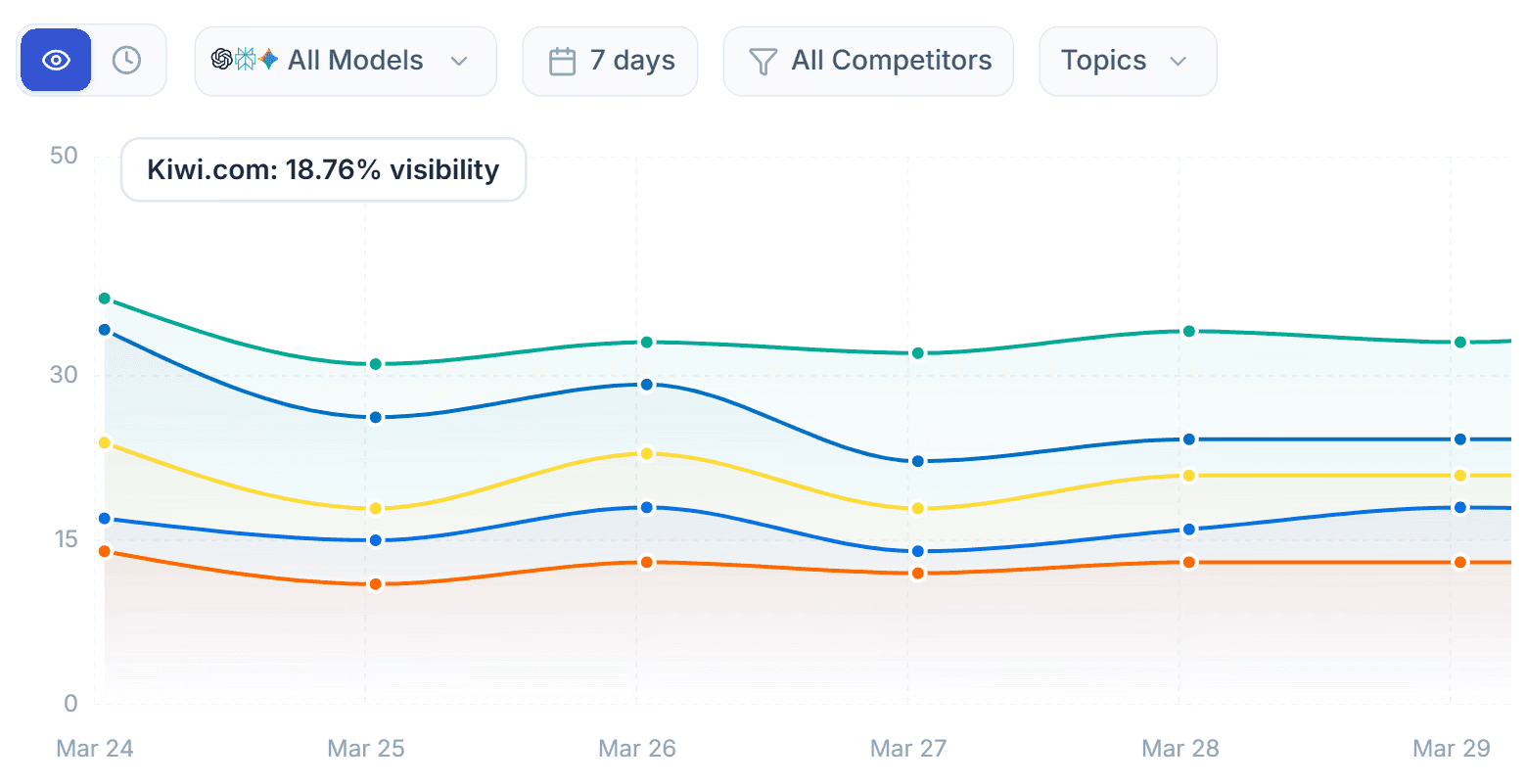
GEO is wider than SEO. AI recommends the brands that show up across the sources it reads, so your presence in forums, social platforms and mortgage blogs decides your odds. AIclicks measures the three metrics below so you know which to work on first.
AI Assistant
Which broker can approve a self-employed borrower quickly?
Your Brokerage
Citation Rate
Shows how many AI answers about mortgage brokerages name your brand, out of every 100. Models pull from the same trusted pages over and over, so citations compound: once you are in, staying in gets easier. Find the competitor pages AI cites most, then publish your own version of each.
Your Brokerage
82% positive
Competitor A
54% positive
Competitor B
38% positive
Brand Sentiment
Shows how AI describes you when your brand comes up: positive, neutral or negative. Tone is what separates being mentioned from being recommended, and models repeat whatever framing they find. Track the negative mentions back to the reviews and threads behind them, then publish content that answers those directly.
Others 52%
You 24%
— 24%
Your Brokerage
AI mention share of voice — mortgage category
Competitors
Not Cited
Share of Voice in AI
Shows how much of the mortgage conversation belongs to you rather than your competitors. This is the metric that matters most, the GEO version of a Google ranking. With only 1–5 brands named per answer, the market is winner-takes-more and every point is taken from someone.
The Dashboard Your Dedicated AI Search Team Works In
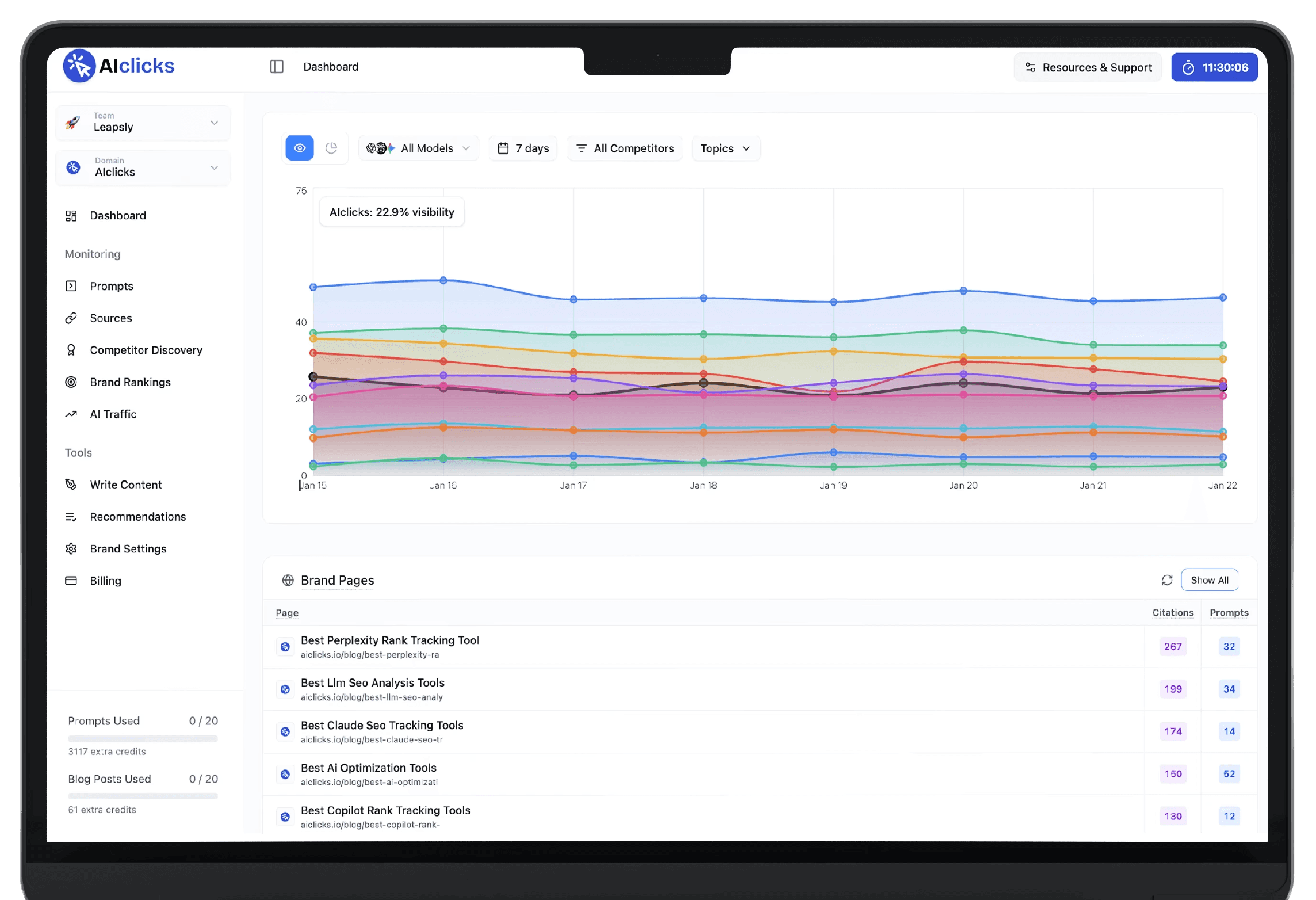
AIclicks gives you a live dashboard with daily ChatGPT mention rate, citation rate, sentiment, and share-of-voice across your tracked prompts, plus GA4 referral attribution for the traffic ChatGPT does send back.
Choose Your Plan
Flexible pricing that grows with your team. Upgrade or downgrade at any time.
Monthly
Yearly
-20%
Starter
Perfect for individuals & small teams
$49
/ month
Billed annually — you save $142
Choose 3 from:
Daily

" height="16px" id="fvSweaOBo" transform="translate(1 0)" width="14px"/></svg>)
" width="14px"><path d="M 13.864 5.629 L 13.3 5.629 L 13.3 5.6 L 7 5.6 L 7 8.4 L 10.956 8.4 C 10.379 10.03 8.828 11.2 7 11.2 C 4.681 11.2 2.8 9.319 2.8 7 C 2.8 4.681 4.681 2.8 7 2.8 C 8.071 2.8 9.045 3.204 9.786 3.864 L 11.766 1.884 C 10.516 0.719 8.844 0 7 0 C 3.134 0 0 3.134 0 7 C 0 10.866 3.134 14 7 14 C 10.866 14 14 10.866 14 7 C 14 6.531 13.952 6.073 13.864 5.629 Z" fill="rgb(255, 193, 7)" height="14px" id="H_YjfTNpn" width="14px"/><path d="M 0 3.742 L 2.3 5.429 C 2.922 3.888 4.429 2.8 6.193 2.8 C 7.264 2.8 8.238 3.204 8.979 3.864 L 10.959 1.884 C 9.709 0.719 8.037 0 6.193 0 C 3.504 0 1.172 1.518 0 3.742 Z" fill="rgb(255, 61, 0)" height="5.428500000000002px" id="PlkthQDhg" transform="translate(0.875 0)" width="10.959199999999996px"/><path d="M 6.232 5.581 C 8.04 5.581 9.683 4.889 10.925 3.764 L 8.758 1.931 C 8.032 2.483 7.144 2.782 6.232 2.781 C 4.411 2.781 2.865 1.62 2.283 0 L 0 1.759 C 1.159 4.026 3.511 5.581 6.232 5.581 Z" fill="rgb(76, 175, 80)" height="5.581099999999999px" id="WlnJ5gngE" transform="translate(0.7 8.4)" width="10.924899999999994px"/><path d="M 6.864 0.029 L 6.3 0.029 L 6.3 0 L 0 0 L 0 2.8 L 3.956 2.8 C 3.68 3.576 3.183 4.254 2.526 4.75 L 2.527 4.749 L 4.693 6.582 C 4.54 6.722 7 4.9 7 1.4 C 7 0.931 6.952 0.473 6.864 0.029 Z" fill="rgb(25, 118, 210)" height="6.589883930775992px" id="x_rSW275p" transform="translate(7 5.6)" width="7px"/></g></svg>)
" height="16px" id="hHS98fTxZ" width="16px"/></svg>)
 scale(1 1) translate(-1.861736945942159, -1.1170155383302638)" id="P20NzAvj0-699428820-radial-gradient" r="0.9935228066204626"><stop offset="0" stop-color="rgb(0, 174, 255)"/><stop offset="1" stop-color="rgb(7, 54, 196)"/></radialGradient><radialGradient cx="0.48250042504016705" cy="1.8366934653567062" gradient-transform="translate(0.48250042504016705, 1.8366934653567062) scale(1 1) translate(-0.48250042504016705, -1.8366934653567062)" id="UEWZqVjij-699428820-radial-gradient" r="0.9176890228114506"><stop offset="0" stop-color="rgb(255, 182, 87)"/><stop offset="1" stop-color="rgb(192, 43, 60)"/></radialGradient><linearGradient id="jyMN3TmKx-699428820-linear-gradient" x1="0.4594862532842614" x2="0.5405137467157386" y1="0" y2="1"><stop offset="0" stop-color="rgb(13, 145, 225)"/><stop offset="1" stop-color="rgb(255, 200, 0)"/></linearGradient><linearGradient id="xhMNwDFG0-699428820-linear-gradient" x1="0.4784828731548295" x2="0.5215171268451705" y1="5.551115123125783e-17" y2="1"><stop offset="0" stop-color="rgb(61, 203, 255)"/><stop offset="1" stop-color="rgba(5, 136, 247, 0)"/></linearGradient><radialGradient cx="1.4305090871482182" cy="0.34866158048251783" gradient-transform="translate(1.4305090871482182, 0.34866158048251783) scale(1 1) translate(-1.4305090871482182, -0.34866158048251783)" id="i79kAqaS4-699428820-radial-gradient" r="1.3362743412697924"><stop offset="0" stop-color="rgb(140, 72, 255)"/><stop offset="1" stop-color="rgb(255, 177, 82)"/></radialGradient><linearGradient id="mcxvno3tX-699428820-linear-gradient" x1="0.49844355920154226" x2="0.5015564407984577" y1="0" y2="1"><stop offset="0" stop-color="rgb(248, 173, 250)"/><stop offset="1" stop-color="rgba(168, 110, 221, 0)"/></linearGradient></defs><g d="M 11.605 1.219 C 11.397 0.499 10.739 0.002 9.989 0 L 9.498 0 C 8.682 0.002 7.985 0.588 7.842 1.391 L 7 6.016 L 7.209 5.296 C 7.416 4.574 8.075 4.076 8.825 4.074 L 11.681 4.074 L 12.879 4.545 L 14.033 4.074 L 13.697 4.074 C 12.947 4.072 12.289 3.575 12.081 2.855 Z M 4.413 13.387 C 4.618 14.111 5.278 14.611 6.031 14.613 L 7.075 14.613 C 7.988 14.613 8.735 13.88 8.758 12.96 L 8.871 8.5 L 8.633 9.319 C 8.426 10.039 7.768 10.537 7.018 10.539 L 4.138 10.539 L 3.111 9.977 L 2 10.539 L 2.331 10.539 C 3.084 10.542 3.743 11.042 3.949 11.766 L 4.413 13.387 Z M 9.999 0 L 4.167 0 C 2.501 0 1.501 2.221 0.834 4.441 C 0.045 7.073 -0.989 10.591 2.001 10.591 L 4.519 10.591 C 5.273 10.591 5.933 10.089 6.139 9.36 C 6.577 7.815 7.345 5.121 7.948 3.069 C 8.255 2.027 8.509 1.132 8.901 0.575 C 9.148 0.212 9.56 -0.004 9.999 0 M 9.999 0 L 4.167 0 C 2.501 0 1.501 2.221 0.834 4.441 C 0.045 7.073 -0.989 10.591 2.001 10.591 L 4.519 10.591 C 5.273 10.591 5.933 10.089 6.139 9.36 C 6.577 7.815 7.345 5.121 7.948 3.069 C 8.255 2.027 8.509 1.132 8.901 0.575 C 9.148 0.212 9.56 -0.004 9.999 0 M 6 14.593 L 11.833 14.593 C 13.499 14.593 14.499 12.372 15.166 10.151 C 15.955 7.519 16.989 4 13.999 4 L 11.48 4 C 10.725 4.002 10.063 4.505 9.86 5.232 C 9.266 7.332 8.663 9.429 8.051 11.523 C 7.745 12.566 7.49 13.461 7.098 14.019 C 6.851 14.382 6.439 14.597 6 14.593 M 6 14.593 L 11.833 14.593 C 13.499 14.593 14.499 12.372 15.166 10.151 C 15.955 7.519 16.989 4 13.999 4 L 11.48 4 C 10.725 4.002 10.063 4.505 9.86 5.232 C 9.266 7.332 8.663 9.429 8.051 11.523 C 7.745 12.566 7.49 13.461 7.098 14.019 C 6.851 14.382 6.439 14.597 6 14.593" fill="transparent" height="14.613333333333333px" id="QzkBy4Ibc" transform="translate(0 1)" width="16.00011071294081px"><path d="M 4.605 1.219 C 4.397 0.499 3.739 0.002 2.989 0 L 2.498 0 C 1.682 0.002 0.985 0.588 0.842 1.391 L 0 6.016 L 0.209 5.296 C 0.416 4.574 1.075 4.076 1.825 4.074 L 4.681 4.074 L 5.879 4.545 L 7.033 4.074 L 6.697 4.074 C 5.947 4.072 5.289 3.575 5.081 2.855 Z" fill="url(%23P20NzAvj0-699428820-radial-gradient)" height="6.016px" id="P20NzAvj0" transform="translate(7 0)" width="7.0333333333333385px"/><path d="M 2.413 4.887 C 2.618 5.611 3.278 6.111 4.031 6.113 L 5.075 6.113 C 5.988 6.113 6.735 5.38 6.758 4.46 L 6.871 0 L 6.633 0.819 C 6.426 1.539 5.768 2.037 5.018 2.039 L 2.138 2.039 L 1.111 1.477 L 0 2.039 L 0.331 2.039 C 1.084 2.042 1.743 2.542 1.949 3.266 L 2.413 4.887 Z" fill="url(%23UEWZqVjij-699428820-radial-gradient)" height="6.113333333333333px" id="UEWZqVjij" transform="translate(2 8.5)" width="6.871333333333332px"/><path d="M 9.999 0 L 4.167 0 C 2.501 0 1.501 2.221 0.834 4.441 C 0.045 7.073 -0.989 10.591 2.001 10.591 L 4.519 10.591 C 5.273 10.591 5.933 10.089 6.139 9.36 C 6.577 7.815 7.345 5.121 7.948 3.069 C 8.255 2.027 8.509 1.132 8.901 0.575 C 9.148 0.212 9.56 -0.004 9.999 0" fill="url(%23jyMN3TmKx-699428820-linear-gradient)" height="10.591388755215167px" id="jyMN3TmKx" width="9.999444046274142px"/><path d="M 9.999 0 L 4.167 0 C 2.501 0 1.501 2.221 0.834 4.441 C 0.045 7.073 -0.989 10.591 2.001 10.591 L 4.519 10.591 C 5.273 10.591 5.933 10.089 6.139 9.36 C 6.577 7.815 7.345 5.121 7.948 3.069 C 8.255 2.027 8.509 1.132 8.901 0.575 C 9.148 0.212 9.56 -0.004 9.999 0" fill="url(%23xhMNwDFG0-699428820-linear-gradient)" height="10.591388755215167px" id="xhMNwDFG0" width="9.999444046274142px"/><path d="M 0 10.593 L 5.833 10.593 C 7.499 10.593 8.499 8.372 9.166 6.151 C 9.955 3.519 10.989 0 7.999 0 L 5.48 0 C 4.725 0.002 4.063 0.505 3.86 1.232 C 3.266 3.332 2.663 5.429 2.051 7.523 C 1.745 8.566 1.49 9.461 1.098 10.019 C 0.851 10.382 0.439 10.597 0 10.593" fill="url(%23i79kAqaS4-699428820-radial-gradient)" height="10.593388755215164px" id="i79kAqaS4" transform="translate(6 4)" width="10.000110712940803px"/><path d="M 0 10.593 L 5.833 10.593 C 7.499 10.593 8.499 8.372 9.166 6.151 C 9.955 3.519 10.989 0 7.999 0 L 5.48 0 C 4.725 0.002 4.063 0.505 3.86 1.232 C 3.266 3.332 2.663 5.429 2.051 7.523 C 1.745 8.566 1.49 9.461 1.098 10.019 C 0.851 10.382 0.439 10.597 0 10.593" fill="url(%23mcxvno3tX-699428820-linear-gradient)" height="10.593388755215164px" id="mcxvno3tX" transform="translate(6 4)" width="10.000110712940803px"/></g></svg>)
" height="15.360666565427872px" id="HZPvvPBv7" transform="translate(0 0.5)" width="16px"/></svg>)
Tracked prompts
30
Websites you can add
3
LLMs you can track
3
Countries per project
1
LLM responses / mo
4,650
AI-optimized articles per month
10
Integrations
-
Support
Pro
For growing teams for more power
$140
/ month
Billed annually — you save $454
Choose 4 from:
Daily
Tracked prompts
150
Websites you can add
Unlimited
LLMs you can track
4
Countries per project
Unlimited
LLM responses / mo
18,600
AI-optimized articles per month
20
Integrations
Google Analytics
Support
BUSINESS
Best for medium-sized organizations
$357
/ month
Billed annually — you save $1198
Choose 6 from:
Daily
Tracked prompts
300
Websites you can add
Unlimited
LLMs you can track
6
Countries per project
Unlimited
LLM responses / mo
55,800
AI-optimized articles per month
30
Integrations
Google Analytics, API
Support
Dedicated account specialist
Become the #1 Answer in AI
Succeed in GEO yourself, or let us do all the work.
Do it yourself
Use AIclicks to see exactly where you appear across 10+ AI platforms, spot the gaps competitors are filling, and act on clear weekly recommendations.
From $59/month · Cancel anytime
Done for you
We Do All the Work for You
Our team manages your complete search presence: traditional SEO and GEO strategy, content, implementation, and reporting. You focus on borrowers.
Custom pricing · Minimum 3-month engagement
The AI SEO agency trusted by 1,000+ brands worldwide
From solo founders to multi-client agencies, AIclicks runs the full AI SEO agency program for organizations of every shape and size that want to be cited across every AI surface.
4.9/5 stars on G2







FAQ
How long before mortgage SEO actually brings in loans?
Expect the first real enquiries around month 5 or 6. Months 1 to 3 are foundation work with almost nothing visible, months 3 to 4 show impressions climbing in Search Console, and months 7 to 12 are where organic becomes a reliable channel rather than luck. Map pack movement comes faster, often inside 8 weeks. Anyone quoting first-page rankings inside a month is describing paid search.
Do borrowers actually use ChatGPT to find a broker?
They use it before they search. The broker-versus-bank question, affordability, credit thresholds, all of it gets asked in chat first, and the answer usually names Rocket, Zillow or a bank because those are the sources the model has. Ahrefs analysed 863,000 keywords and found only 38% of pages cited in AI Overviews also ranked in the top 10, down from 76% a year earlier. A top-10 position is no longer the ticket into the answer.
Why is mortgage SEO harder than ordinary local SEO?
Three constraints generic advice ignores. Regulation Z turns any page quoting a rate or payment into an advertisement requiring disclosures, so your best commercial pages need legal review. Your licensing footprint, not your drive time, defines the area you can rank for, and it changes state by state. And most originators publish on a brokerage-owned microsite they lose on their next sponsorship change. None of that applies to a landscaper.
What should a mortgage brokerage budget for SEO?
Published rates run from about $400 a month for a 4-keyword local package up to $5,000 and beyond for a multi-state brokerage, with most independent shops landing between $1,500 and $3,000. Weigh it against what leads already cost you: shared portal leads cost $100 to $250 each and convert near 1%. The only number worth comparing is cost per funded loan, and the retainer alone tells you nothing.
Should we keep buying leads while SEO builds?
Yes, but shift the mix as organic comes online. Paid search and portal leads fill the pipeline this month; organic lowers what each funded loan costs you over the next 2 years. Use your ad data to sequence content: whichever loan types actually close from paid clicks are the pages worth writing first. Track both against cost per funded loan, not cost per lead, and cut whichever loses.
Which pages should a mortgage broker build first?
Google Business Profile first: it costs nothing and it outranks Zillow on every near me query. Then your 2 highest-volume loan programs as standalone pages. Then a compensation page explaining who pays the broker, which nobody else writes and every borrower wants. Then originator bios carrying NMLS IDs and licensed states. Location pages after that. Rate commentary is last, and mostly optional. Most brokerages start with rate commentary.
How do we prove the SEO spend is paying off?
Count funded loans sourced from organic, not rankings. Put CallRail or a similar tracking number on the site, because most mortgage enquiries arrive as calls that analytics never records. Tag every pre-qualification submission with its landing page and push the source into your CRM so it survives to funding. In Search Console, follow impressions on program terms, which rise months before positions do, and watch profile calls separately.
Should we hire an agency or handle SEO ourselves?
Split it by what needs a licence. Profile posts, review requests, program explainers and answering borrower questions should stay with the originators, because nobody outside knows your lender panel or your overlays. Hand out the technical layer, schema, citations and site speed. If you outsource content, pick someone who understands Regulation Z triggering terms and RESPA Section 8, or your compliance officer will spend a quarter unwinding it.
Further Reading
Go deeper on GEO, AI search, and visibility tracking.