SEO for Manufacturers:
Engineers and procurement managers research suppliers long before they contact one. They search by specification, material grade and certification, shortlist from what they find, and issue the request for quote to 3 names. If your capabilities are not indexed, you never enter the shortlist.









Why Manufacturers Need SEO
Gartner expects 80% of B2B sales interactions between suppliers and buyers to happen through digital channels. In manufacturing that means search is now the first stage of qualification.
An engineer searching for a 6061-T6 aluminium housing to a five-thou tolerance is looking for a spec table. What they find on most manufacturer sites is a capabilities page describing quality commitment and decades of experience, with tolerances, materials and the machine list nowhere on the page. The quote goes elsewhere.
Thomasnet, Kompass, DirectIndustry and instant-quote marketplaces like Protolabs Network sit between you and every buyer searching for your capability. They aggregate thousands of suppliers, rank on that authority, then charge you for placement or take a margin on the job. Your shop appears as one row in someone else’s table.
A single trade show booth, with freight, stand build, travel and staff off the floor for a week, routinely costs more than a year of search visibility. It generates a badge scan list that decays in a fortnight. Search generates buyers who arrived already specifying, and it keeps producing them month after month between shows.
How SEO Works for Manufacturers
Search Engine Optimization projects are long-term investments for manufacturers, where each task supplements the others and creates compound results over time.
01
Keywords, page structure, and the signals Google reads directly
On-page work in manufacturing fails on vocabulary. The words that describe your capability precisely, the alloy designation, the tolerance band, the certification, are exactly the words your marketing team removed for being too technical. What is left ranks for nothing, because nobody searches world-class quality. There is also a scale problem no other local industry has: a catalogue can run to thousands of part numbers, each theoretically a page, most of them thin and near-identical. The pages that earn qualified enquiries are capability pages, material and process pages, and a genuinely detailed spec table on each.
The durable assets are process and material pages. A page explaining what tolerances you hold on Swiss turning, or which grades you anodise and to what specification, stays accurate for years because the physics does not move. Engineers find it, bookmark it, and return with a drawing. What churns is the news column: the new machine announcement, the show stand invitation, the annual certification renewal post. Those age immediately and, on a site with thin part-number pages already, actively dilute what little topical focus exists. Fewer pages, written properly, outperform a catalogue dump every time.
1
Build one page per process with the machine list, tolerance ranges, materials handled and maximum part envelope stated as numbers.
2
Redirect obsolete part numbers to the current equivalent or the category page, rather than leaving thousands of soft 404s indexed.
3
Apply Product and Organization schema to catalogue items, exposing material, dimensions and certifications so both Google and AI engines parse them.
4
Publish a page for each material grade and industry standard you work to, such as ISO 9001, AS9100 or specific alloy designations.
02
Map Pack visibility, citations, and proximity signals
Local search matters less in manufacturing than in any other industry on this list, and it is still worth doing. Buyers do search near me when freight cost, lead time or site visits matter, and regional sourcing has become more common as supply chains shortened. Every plant, sales office and distribution centre can hold its own profile. The share of demand that is genuinely local here is smaller, but it is also the least contested.
A manufacturing profile should carry the precise category, Machine Shop or Metal Fabricator rather than Manufacturer, and list capabilities as individual services. Add photographs of the shop floor and the machines, because buyers use them to judge whether you can handle their part. State certifications, hours that reflect when someone actually answers, and the industries you serve. Then answer the questions that decide a first enquiry: minimum order quantity, typical lead time, whether you take prototype work.
The citation layer here is industrial rather than local. Thomasnet, Kompass, DirectIndustry, IQS Directory and MFG.com are where buyers actually start, and your trade association and certification body listings carry real weight because they verify what you claim. General directories matter far less. What matters most is that your certifications, capabilities and contact details read identically everywhere, since a procurement manager cross-checking 3 sources and finding 3 different answers simply moves on.
1
Set the primary category to your actual process, such as Machine Shop or Metal Fabricator, and list each capability as a service.
2
Create a separate profile and page for every plant, sales office and distribution centre, each naming the capabilities available at that site.
3
Check Thomasnet, Kompass, IQS Directory and your certification bodies for outdated capability lists and expired certifications, then correct every entry.
4
Post monthly on new equipment, fresh certifications or a completed part, since buyers check whether the profile shows an active business.
03
Topic authority, inbound links, and content that earns traffic
Industrial buying cycles run for months and involve several people, and McKinsey found B2B buyers now use an average of 10 channels along the way. Early on they are not looking for you; they are looking for how to specify the part. Content that helps them choose between processes, materials or tolerances puts you in the room before a shortlist exists. Design-for-manufacture guides and material comparison pages do this better than any capability brochure.
The buyer who has specified the part is now qualifying suppliers, and they are checking things a brochure never mentions. Can you hold the tolerance. Are you certified to the standard their customer demands. What is your lead time at current capacity, what is your minimum quantity, and can you supply first article inspection reports. Publish downloadable spec sheets and a straightforward request-for-quote path. Every field you add to that form costs you quotes.
Industrial links come from the supply chain. Material suppliers publish approved fabricator lists. Machine tool builders run customer case studies and want yours. Certification bodies and trade associations list members. Trade publications need technical contributors far more than they need advertisers, and a well-written article on a process problem will earn a link no outreach campaign matches. Your own customers publish supplier pages. None of this is bought; all of it is documented.
1
Publish comparison guides engineers actually search for, such as casting versus machining or which aluminium grade suits a given application.
2
Build a page per capability per industry served, such as aerospace CNC machining, with the certifications and tolerances that sector demands.
3
Cluster every pricing question into one hub: what drives part cost, tooling amortisation, volume breaks, and why quotes vary between shops.
4
Write a page for each machine platform and brand you run, since buyers search equipment names when matching a part to a supplier.
04
Site speed, crawlability, Core Web Vitals, and mobile health
The technical failure unique to manufacturing is catalogue scale. A product database generates thousands of near-identical URLs, one per size or finish, each with 3 lines of text and a shared description. Google crawls a fraction, indexes fewer, and forms a low opinion of the whole domain. Faceted filters multiply it further, generating URL combinations nobody ever intended to publish. Most manufacturers do not know how many pages their site has, which is the first thing to find out.
Mobile matters differently here. The buyer is rarely on a phone at the moment of specifying, but they very often are on a plant floor, in a workshop or between meetings, checking whether a supplier is worth a longer look. Heavy CAD previews, uncompressed machine photography and gated PDF datasheets all fail in that moment. If a spec sheet cannot be opened on a phone without a form, the buyer moves to whoever published theirs openly.
1
Crawl the full site with Screaming Frog, count indexable URLs against products, and noindex or consolidate thin variant pages.
2
Run PageSpeed Insights on your heaviest catalogue category, where filters and large product grids usually push load times well past target.
3
Serve part photography and drawing previews as compressed WebP, and make datasheet PDFs crawlable rather than hidden behind a form.
4
Split sitemaps by capability, product and content, exclude faceted URLs in robots.txt, and resubmit whenever the catalogue changes materially.
05
Star ratings, review volume, and response strategy that builds trust
Reviews work differently in manufacturing and most shops therefore ignore them entirely. A procurement manager is not reading Google stars; they are checking references, audit results and whether anyone in their network has used you. But the star rating still appears beside your name in local results and increasingly inside AI answers, and a shop with 4 reviews from 2019 reads as dormant. The reputation signals that matter most are quality certifications and named customer references.
Ask at the point a repeat order is placed, which is the clearest evidence a customer is satisfied and the moment they are most willing. Route it through the account manager rather than a marketing address, because industrial buyers respond to people they deal with. Accept that many corporate customers cannot review publicly, and collect a written reference or a case study permission instead. One named customer case study is worth more here than 20 anonymous stars.
1
Have account managers request a review or case study permission when a customer places a second order, not after the first delivery.
2
Respond within 24 hours describing the corrective action taken, since buyers judge suppliers on how nonconformances are handled rather than never occurring.
3
Place named customer references and audit results on the relevant capability page, where a buyer qualifying that process will actually see them.
4
Publish on-time delivery and quality scorecard results your customers already measure, since those numbers persuade procurement more than any testimonial.
Google is No Longer the Only Place Your buyers are Searching
Buyers are using AI to find answers, and they trust what it tells them. Invest in GEO to get recommended in those answers.
1 Billion
Questions ChatGPT receives every single day
38%
Your #1 top ranking page on Google would be cited by AI
14%
of manufacturers optimise for GEO. The rest are invisible in AI answers


You can rank #1 for “manufacturer near me” and still not exist in ChatGPT’s answer. Run a free GEO audit to see where your brand actually stands.
GEO vs SEO: Same Goal, Different Methods
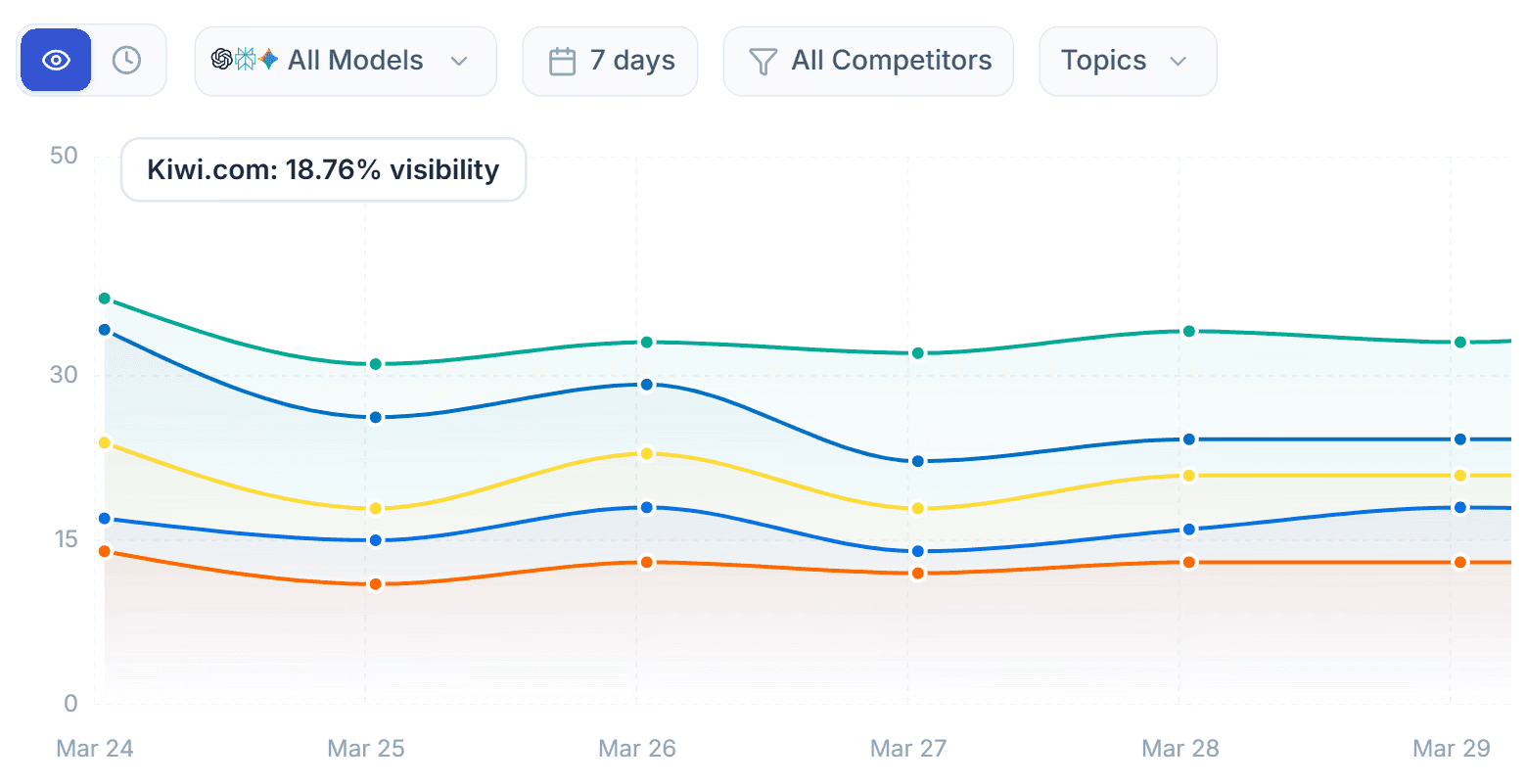
GEO is wider than SEO. AI recommends the brands that show up across the sources it reads, so your presence in forums, social platforms and industrial blogs decides your odds. AIclicks measures the three metrics below so you know which to work on first.
AI Assistant
Where can I get precision machined parts near me?
Your Company
Citation Rate
Shows how many AI answers about manufacturers name your brand, out of every 100. Models pull from the same trusted pages over and over, so citations compound: once you are in, staying in gets easier. Find the competitor pages AI cites most, then publish your own version of each.
Your Company
82% positive
Competitor A
54% positive
Competitor B
38% positive
Brand Sentiment
Shows how AI describes you when your brand comes up: positive, neutral or negative. Tone is what separates being mentioned from being recommended, and models repeat whatever framing they find. Track the negative mentions back to the reviews and threads behind them, then publish content that answers those directly.
Others 52%
You 24%
— 24%
Your Company
AI mention share of voice — industrial category
Competitors
Not Cited
Share of Voice in AI
Shows how much of the industrial conversation belongs to you rather than your competitors. This is the metric that matters most, the GEO version of a Google ranking. With only 1–5 brands named per answer, the market is winner-takes-more and every point is taken from someone.
The Dashboard Your Dedicated AI Search Team Works In
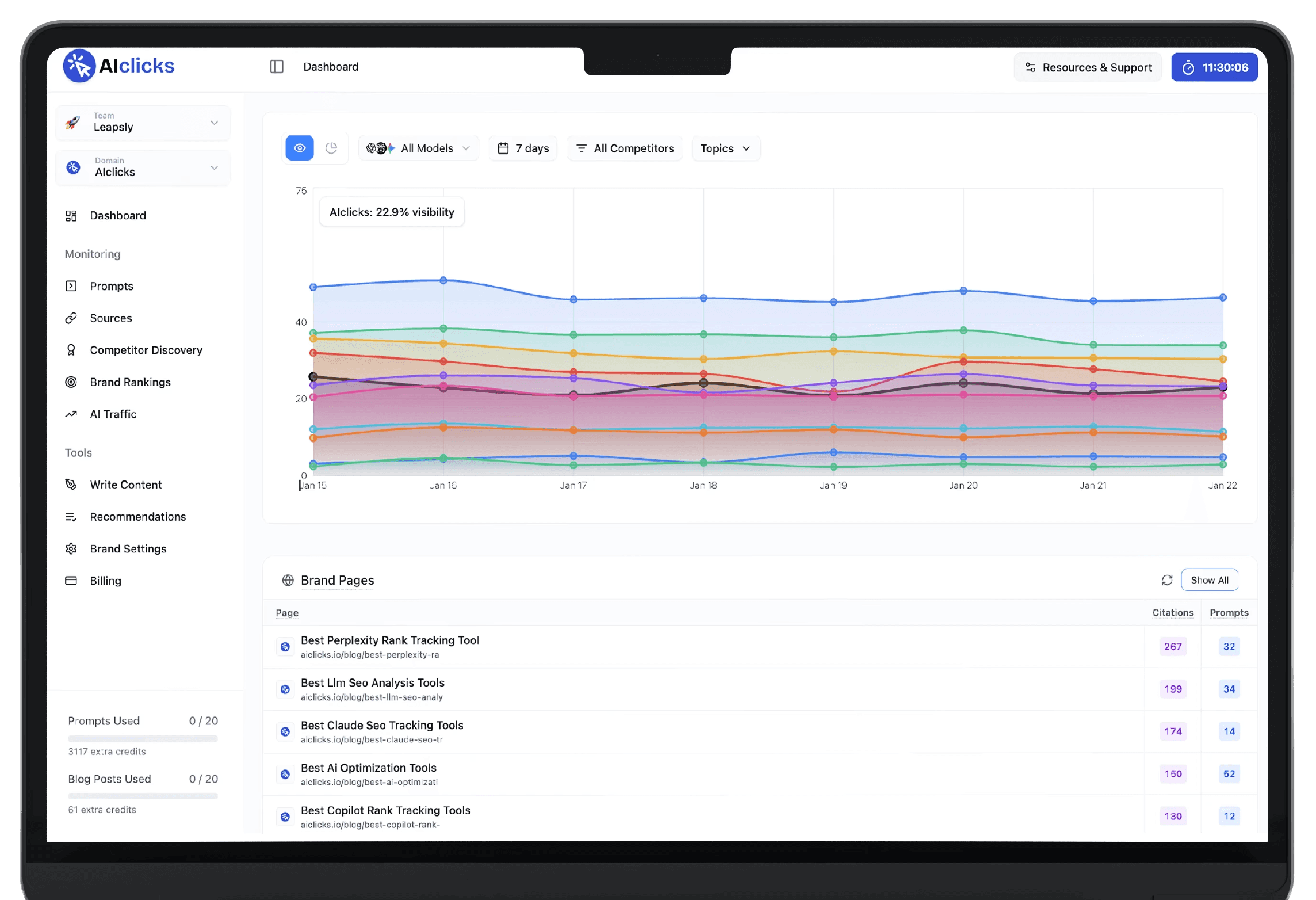
AIclicks gives you a live dashboard with daily ChatGPT mention rate, citation rate, sentiment, and share-of-voice across your tracked prompts, plus GA4 referral attribution for the traffic ChatGPT does send back.
Choose Your Plan
Flexible pricing that grows with your team. Upgrade or downgrade at any time.
Monthly
Yearly
-20%
Starter
Perfect for individuals & small teams
$49
/ month
Billed annually — you save $142
Choose 3 from:
Daily

" height="16px" id="fvSweaOBo" transform="translate(1 0)" width="14px"/></svg>)
" width="14px"><path d="M 13.864 5.629 L 13.3 5.629 L 13.3 5.6 L 7 5.6 L 7 8.4 L 10.956 8.4 C 10.379 10.03 8.828 11.2 7 11.2 C 4.681 11.2 2.8 9.319 2.8 7 C 2.8 4.681 4.681 2.8 7 2.8 C 8.071 2.8 9.045 3.204 9.786 3.864 L 11.766 1.884 C 10.516 0.719 8.844 0 7 0 C 3.134 0 0 3.134 0 7 C 0 10.866 3.134 14 7 14 C 10.866 14 14 10.866 14 7 C 14 6.531 13.952 6.073 13.864 5.629 Z" fill="rgb(255, 193, 7)" height="14px" id="H_YjfTNpn" width="14px"/><path d="M 0 3.742 L 2.3 5.429 C 2.922 3.888 4.429 2.8 6.193 2.8 C 7.264 2.8 8.238 3.204 8.979 3.864 L 10.959 1.884 C 9.709 0.719 8.037 0 6.193 0 C 3.504 0 1.172 1.518 0 3.742 Z" fill="rgb(255, 61, 0)" height="5.428500000000002px" id="PlkthQDhg" transform="translate(0.875 0)" width="10.959199999999996px"/><path d="M 6.232 5.581 C 8.04 5.581 9.683 4.889 10.925 3.764 L 8.758 1.931 C 8.032 2.483 7.144 2.782 6.232 2.781 C 4.411 2.781 2.865 1.62 2.283 0 L 0 1.759 C 1.159 4.026 3.511 5.581 6.232 5.581 Z" fill="rgb(76, 175, 80)" height="5.581099999999999px" id="WlnJ5gngE" transform="translate(0.7 8.4)" width="10.924899999999994px"/><path d="M 6.864 0.029 L 6.3 0.029 L 6.3 0 L 0 0 L 0 2.8 L 3.956 2.8 C 3.68 3.576 3.183 4.254 2.526 4.75 L 2.527 4.749 L 4.693 6.582 C 4.54 6.722 7 4.9 7 1.4 C 7 0.931 6.952 0.473 6.864 0.029 Z" fill="rgb(25, 118, 210)" height="6.589883930775992px" id="x_rSW275p" transform="translate(7 5.6)" width="7px"/></g></svg>)
" height="16px" id="hHS98fTxZ" width="16px"/></svg>)
 scale(1 1) translate(-1.861736945942159, -1.1170155383302638)" id="P20NzAvj0-699428820-radial-gradient" r="0.9935228066204626"><stop offset="0" stop-color="rgb(0, 174, 255)"/><stop offset="1" stop-color="rgb(7, 54, 196)"/></radialGradient><radialGradient cx="0.48250042504016705" cy="1.8366934653567062" gradient-transform="translate(0.48250042504016705, 1.8366934653567062) scale(1 1) translate(-0.48250042504016705, -1.8366934653567062)" id="UEWZqVjij-699428820-radial-gradient" r="0.9176890228114506"><stop offset="0" stop-color="rgb(255, 182, 87)"/><stop offset="1" stop-color="rgb(192, 43, 60)"/></radialGradient><linearGradient id="jyMN3TmKx-699428820-linear-gradient" x1="0.4594862532842614" x2="0.5405137467157386" y1="0" y2="1"><stop offset="0" stop-color="rgb(13, 145, 225)"/><stop offset="1" stop-color="rgb(255, 200, 0)"/></linearGradient><linearGradient id="xhMNwDFG0-699428820-linear-gradient" x1="0.4784828731548295" x2="0.5215171268451705" y1="5.551115123125783e-17" y2="1"><stop offset="0" stop-color="rgb(61, 203, 255)"/><stop offset="1" stop-color="rgba(5, 136, 247, 0)"/></linearGradient><radialGradient cx="1.4305090871482182" cy="0.34866158048251783" gradient-transform="translate(1.4305090871482182, 0.34866158048251783) scale(1 1) translate(-1.4305090871482182, -0.34866158048251783)" id="i79kAqaS4-699428820-radial-gradient" r="1.3362743412697924"><stop offset="0" stop-color="rgb(140, 72, 255)"/><stop offset="1" stop-color="rgb(255, 177, 82)"/></radialGradient><linearGradient id="mcxvno3tX-699428820-linear-gradient" x1="0.49844355920154226" x2="0.5015564407984577" y1="0" y2="1"><stop offset="0" stop-color="rgb(248, 173, 250)"/><stop offset="1" stop-color="rgba(168, 110, 221, 0)"/></linearGradient></defs><g d="M 11.605 1.219 C 11.397 0.499 10.739 0.002 9.989 0 L 9.498 0 C 8.682 0.002 7.985 0.588 7.842 1.391 L 7 6.016 L 7.209 5.296 C 7.416 4.574 8.075 4.076 8.825 4.074 L 11.681 4.074 L 12.879 4.545 L 14.033 4.074 L 13.697 4.074 C 12.947 4.072 12.289 3.575 12.081 2.855 Z M 4.413 13.387 C 4.618 14.111 5.278 14.611 6.031 14.613 L 7.075 14.613 C 7.988 14.613 8.735 13.88 8.758 12.96 L 8.871 8.5 L 8.633 9.319 C 8.426 10.039 7.768 10.537 7.018 10.539 L 4.138 10.539 L 3.111 9.977 L 2 10.539 L 2.331 10.539 C 3.084 10.542 3.743 11.042 3.949 11.766 L 4.413 13.387 Z M 9.999 0 L 4.167 0 C 2.501 0 1.501 2.221 0.834 4.441 C 0.045 7.073 -0.989 10.591 2.001 10.591 L 4.519 10.591 C 5.273 10.591 5.933 10.089 6.139 9.36 C 6.577 7.815 7.345 5.121 7.948 3.069 C 8.255 2.027 8.509 1.132 8.901 0.575 C 9.148 0.212 9.56 -0.004 9.999 0 M 9.999 0 L 4.167 0 C 2.501 0 1.501 2.221 0.834 4.441 C 0.045 7.073 -0.989 10.591 2.001 10.591 L 4.519 10.591 C 5.273 10.591 5.933 10.089 6.139 9.36 C 6.577 7.815 7.345 5.121 7.948 3.069 C 8.255 2.027 8.509 1.132 8.901 0.575 C 9.148 0.212 9.56 -0.004 9.999 0 M 6 14.593 L 11.833 14.593 C 13.499 14.593 14.499 12.372 15.166 10.151 C 15.955 7.519 16.989 4 13.999 4 L 11.48 4 C 10.725 4.002 10.063 4.505 9.86 5.232 C 9.266 7.332 8.663 9.429 8.051 11.523 C 7.745 12.566 7.49 13.461 7.098 14.019 C 6.851 14.382 6.439 14.597 6 14.593 M 6 14.593 L 11.833 14.593 C 13.499 14.593 14.499 12.372 15.166 10.151 C 15.955 7.519 16.989 4 13.999 4 L 11.48 4 C 10.725 4.002 10.063 4.505 9.86 5.232 C 9.266 7.332 8.663 9.429 8.051 11.523 C 7.745 12.566 7.49 13.461 7.098 14.019 C 6.851 14.382 6.439 14.597 6 14.593" fill="transparent" height="14.613333333333333px" id="QzkBy4Ibc" transform="translate(0 1)" width="16.00011071294081px"><path d="M 4.605 1.219 C 4.397 0.499 3.739 0.002 2.989 0 L 2.498 0 C 1.682 0.002 0.985 0.588 0.842 1.391 L 0 6.016 L 0.209 5.296 C 0.416 4.574 1.075 4.076 1.825 4.074 L 4.681 4.074 L 5.879 4.545 L 7.033 4.074 L 6.697 4.074 C 5.947 4.072 5.289 3.575 5.081 2.855 Z" fill="url(%23P20NzAvj0-699428820-radial-gradient)" height="6.016px" id="P20NzAvj0" transform="translate(7 0)" width="7.0333333333333385px"/><path d="M 2.413 4.887 C 2.618 5.611 3.278 6.111 4.031 6.113 L 5.075 6.113 C 5.988 6.113 6.735 5.38 6.758 4.46 L 6.871 0 L 6.633 0.819 C 6.426 1.539 5.768 2.037 5.018 2.039 L 2.138 2.039 L 1.111 1.477 L 0 2.039 L 0.331 2.039 C 1.084 2.042 1.743 2.542 1.949 3.266 L 2.413 4.887 Z" fill="url(%23UEWZqVjij-699428820-radial-gradient)" height="6.113333333333333px" id="UEWZqVjij" transform="translate(2 8.5)" width="6.871333333333332px"/><path d="M 9.999 0 L 4.167 0 C 2.501 0 1.501 2.221 0.834 4.441 C 0.045 7.073 -0.989 10.591 2.001 10.591 L 4.519 10.591 C 5.273 10.591 5.933 10.089 6.139 9.36 C 6.577 7.815 7.345 5.121 7.948 3.069 C 8.255 2.027 8.509 1.132 8.901 0.575 C 9.148 0.212 9.56 -0.004 9.999 0" fill="url(%23jyMN3TmKx-699428820-linear-gradient)" height="10.591388755215167px" id="jyMN3TmKx" width="9.999444046274142px"/><path d="M 9.999 0 L 4.167 0 C 2.501 0 1.501 2.221 0.834 4.441 C 0.045 7.073 -0.989 10.591 2.001 10.591 L 4.519 10.591 C 5.273 10.591 5.933 10.089 6.139 9.36 C 6.577 7.815 7.345 5.121 7.948 3.069 C 8.255 2.027 8.509 1.132 8.901 0.575 C 9.148 0.212 9.56 -0.004 9.999 0" fill="url(%23xhMNwDFG0-699428820-linear-gradient)" height="10.591388755215167px" id="xhMNwDFG0" width="9.999444046274142px"/><path d="M 0 10.593 L 5.833 10.593 C 7.499 10.593 8.499 8.372 9.166 6.151 C 9.955 3.519 10.989 0 7.999 0 L 5.48 0 C 4.725 0.002 4.063 0.505 3.86 1.232 C 3.266 3.332 2.663 5.429 2.051 7.523 C 1.745 8.566 1.49 9.461 1.098 10.019 C 0.851 10.382 0.439 10.597 0 10.593" fill="url(%23i79kAqaS4-699428820-radial-gradient)" height="10.593388755215164px" id="i79kAqaS4" transform="translate(6 4)" width="10.000110712940803px"/><path d="M 0 10.593 L 5.833 10.593 C 7.499 10.593 8.499 8.372 9.166 6.151 C 9.955 3.519 10.989 0 7.999 0 L 5.48 0 C 4.725 0.002 4.063 0.505 3.86 1.232 C 3.266 3.332 2.663 5.429 2.051 7.523 C 1.745 8.566 1.49 9.461 1.098 10.019 C 0.851 10.382 0.439 10.597 0 10.593" fill="url(%23mcxvno3tX-699428820-linear-gradient)" height="10.593388755215164px" id="mcxvno3tX" transform="translate(6 4)" width="10.000110712940803px"/></g></svg>)
" height="15.360666565427872px" id="HZPvvPBv7" transform="translate(0 0.5)" width="16px"/></svg>)
Tracked prompts
30
Websites you can add
3
LLMs you can track
3
Countries per project
1
LLM responses / mo
4,650
AI-optimized articles per month
10
Integrations
-
Support
Pro
For growing teams for more power
$140
/ month
Billed annually — you save $454
Choose 4 from:
Daily
Tracked prompts
150
Websites you can add
Unlimited
LLMs you can track
4
Countries per project
Unlimited
LLM responses / mo
18,600
AI-optimized articles per month
20
Integrations
Google Analytics
Support
BUSINESS
Best for medium-sized organizations
$357
/ month
Billed annually — you save $1198
Choose 6 from:
Daily
Tracked prompts
300
Websites you can add
Unlimited
LLMs you can track
6
Countries per project
Unlimited
LLM responses / mo
55,800
AI-optimized articles per month
30
Integrations
Google Analytics, API
Support
Dedicated account specialist
Become the #1 Answer in AI
Succeed in GEO yourself, or let us do all the work.
Do it yourself
Use AIclicks to see exactly where you appear across 10+ AI platforms, spot the gaps competitors are filling, and act on clear weekly recommendations.
From $59/month · Cancel anytime
Done for you
We Do All the Work for You
Our team manages your complete search presence: traditional SEO and GEO strategy, content, implementation, and reporting. You focus on buyers.
Custom pricing · Minimum 3-month engagement
The AI SEO agency trusted by 1,000+ brands worldwide
From solo founders to multi-client agencies, AIclicks runs the full AI SEO agency program for organizations of every shape and size that want to be cited across every AI surface.
4.9/5 stars on G2







FAQ
How long does SEO take to work for manufacturers?
Longer than in consumer industries, but from a weaker field. Technical capability terms are far less contested than local service keywords, so a well-written process page can rank within 4 to 6 months. Broader category terms take 9 to 12, especially against Thomasnet and the marketplaces. The lag that matters more is the sales cycle: a buyer who finds you in March may issue a request for quote in September.
Should we focus on Google or AI search?
AI search matters unusually early here, because engineers use assistants to narrow processes and materials before they ever open Google. Ahrefs found only 38% of pages cited in AI Overviews were also ranking in the top 10, down from 76%, so ranking does not buy the citation. What earns it is what you should be publishing anyway: explicit specifications, tolerance figures, named certifications, and answers stated as facts rather than claims.
How is manufacturing SEO different from local SEO?
Almost entirely. The buyer is a committee, not a person, and the cycle runs months rather than minutes. Search happens by specification rather than by proximity, so the map pack matters far less than a capability page that states real tolerances. Catalogue scale creates crawl problems no local business ever encounters. And the directories that matter are Thomasnet and Kompass, not Yelp. Local SEO playbooks address almost none of this.
What should a manufacturer budget for SEO?
Industrial programmes typically run $3,000 to $10,000 a month, higher where a large catalogue needs technical work or where several languages are involved. Set it against what you already spend on trade shows and directory placement, which is usually far more for a shorter return. The metric that matters is cost per qualified request for quote, and then per contract won, given how large a single industrial order can be.
How does SEO relate to our trade show spend?
They reach the same buyers at different points. Shows work for relationships and for products people need to see and handle; search works for the specification stage, which now happens months before anyone walks a hall. The practical move is to connect them: publish the technical content you present at shows, and give every badge scan a reason to visit a page that still explains your capability in January.
Which pages should a manufacturer build first?
Start with a capability page for your most profitable process, written with real numbers: tolerances, materials, part envelope, machine list. Then a certifications page stating exactly what you hold and to which revision. Then a material or process comparison guide that helps engineers specify. Then industry pages for the sectors you serve. Fix the catalogue crawl problem in parallel. The company news section can wait indefinitely.
How do we know if manufacturing SEO is working?
Track requests for quote from organic search and, more importantly, their quality: the right materials, realistic volumes, industries you actually serve. Volume metrics mislead badly in manufacturing, where 10 qualified enquiries beat 1,000 visits. Watch Search Console impressions on capability and material terms, which move first. Then connect it to the CRM, because with a 9-month cycle the contract that closes today came from a page published last year.
Should we run this in-house or hire an agency?
The technical content has to come from your engineers. No agency writer knows what tolerance you actually hold or why a grade was specified, and content written without that reads hollow to the exact buyer you want. The workable split is engineers supplying facts and an outside team handling structure, crawl issues, schema and publishing. When choosing an agency, ask what they have written about a manufacturing process. Most will have nothing.
Further Reading
Go deeper on GEO, AI search, and visibility tracking.